Submitted 11 January 2015 Accepted 15 July 2015 Published6 August 2015
Corresponding author
Michelle Ploughman, [email protected]
Academic editor
Nora Nock
Additional Information and Declarations can be found on page 11
DOI10.7717/peerj.1158
Copyright
2015 Ploughman et al.
Distributed under
Creative Commons CC-BY 4.0
OPEN ACCESS
Predictors of exercise participation in
ambulatory and non-ambulatory older
people with multiple sclerosis
Michelle Ploughman1, Chelsea Harris1, Elizabeth M. Wallack1,
Olivia Drodge1, Serge Beaulieu2, Nancy Mayo3and Health Lifestyle and Aging with MS Canadian Consortium
1Recovery and Performance Laboratory, Rehabilitation Research Unit, Faculty of Medicine,
Memorial University, St. John’s, NL, Canada
2Eastern Health Authority, St. John’s, NL, Canada
3Department of Clinical Epidemiology, McGill University, Montreal, QC, Canada
ABSTRACT
Background.Exercise at moderate intensity may confer neuroprotective benefits in multiple sclerosis (MS), however it has been reported that people with MS (PwMS) exercise less than national guideline recommendations. We aimed to determine predictors of moderate to vigorous exercise among a sample of older Canadians with MS who were divided into ambulatory (less disabled) and non-ambulatory (more disabled) groups.
Methods.We analysed data collected as part of a national survey of health, lifestyle and aging with MS. Participants(n=743)were Canadians over 55 years of age with MS for 20 or more years. We identified ‘a priori’ variables (demographic, personal, socioeconomic, physical health, exercise history and health care support) that may predict exercise at moderate to vigorous intensity (>6.75 metabolic equivalent hours/week). Predictive variables were entered into stepwise logistic regression until best fit was achieved.
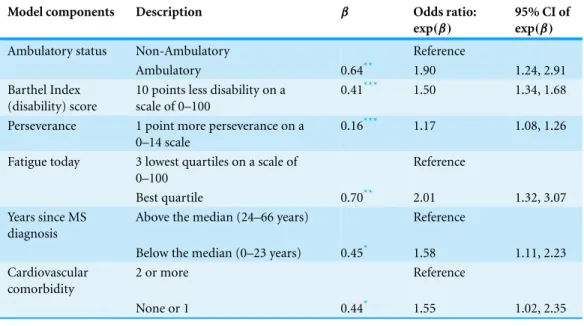
Results.There was no difference in explanatory models between ambulatory and non-ambulatory groups. The model predicting exercise included the ability to walk independently (OR 1.90, 95% CI [1.24–2.91]); low disability (OR 1.50, 95% CI [1.34–1.68] for each 10 point difference in Barthel Index score), perseverance (OR 1.17, 95% CI [1.08–1.26] for each additional point on the scale of 0–14), less fatigue (OR 2.01, 95% CI [1.32–3.07] for those in the lowest quartile), fewer years since MS diagnosis (OR 1.58, 95% CI [1.11–2.23] below the median of 23 years) and fewer cardiovascular comorbidities (OR 1.55 95% CI [1.02–2.35] one or no comorbidities). It was also notable that the factors, age, gender, social support, health care support and financial status were not predictive of exercise.
Subjects Epidemiology, Kinesiology, Neurology, Psychiatry and Psychology
Keywords Disability, Physical activity, Rehabilitation, Exercise behavior, Physiotherapy, Progressive multiple sclerosis, Perseverence, Resilience, Self-efficacy, Depression
INTRODUCTION
Exercise training has the potential to mitigate the symptoms of multiple sclerosis (MS), a neurological disease characterized by unpredictable progressive episodes of inflammation and demyelination of the central nervous system (Latimer-Cheung et al., 2013;Prakash
et al., 2010). The potential role of exercise to slow MS progression, preserve neuronal
integrity and promote healthy aging is gaining interest (Dalgas & Stenager, 2012), however, people with MS engage in lower levels of exercise when compared to the general population (Motl & McAuley, 2009;Stroud, Minahan & Sabapathy, 2009;Van der Ploeg et al., 2007). With high exercise drop-out rates (Kayes et al., 2011;Ploughman et al., 2012a), nearly 80% of relapsing-remitting MS patients are not reaching the public health recommended guidelines of moderate-to-vigorous physical activity (Klaren et al., 2013). Understanding the factors predicting exercise participation among people with MS-related disability is the first step in developing new strategies to promote exercise.
Most studies examining predictors of exercise in MS do not distinguish between physical activity and exercise (Boslaugh & Andresen, 2006;Dalgas & Stenager, 2012). Although the terms are sometimes used interchangeably, they are different in that physical activity is any activity that is part of everyday life, while exercise is planned and structured intended to improve or maintain physical fitness (ACSM, 2010). As emerging evidence suggests that exercise at moderate to high intensity (as opposed to light physical activity) is neuroprotective (Austin et al., 2014;Klaren et al., 2014;Ploughman et al., 2015), predictors specific to higher intensity training may be important for exercise prescription. Previous studies have reported that exercise barriers in MS are primarily level of disability, fatigue (Asano et al., 2013) and self-efficacy (Stroud, Minahan & Sabapathy, 2009) while physical activity predictors are level of disability, enjoyment, and social support (Motl et al., 2006). In one study of moderate to vigorous exercise activity predictors among people with spinal cord injury (SCI; mean age 47 and average 15 years post-injury), strongest exercise predictors were positive exercise intentions and number of years post-injury. Greater social integration, physical independence and employment were also associated with exercise
(Ginis et al., 2012). Whether these factors also apply to people with MS-related disability
is not known. Considering the importance of exercise, understanding the barriers to participation in exercise at intensities high enough to induce a training effect is imperative for future MS clinical trials.
Almost all studies in MS and exercise recruit subjects at the early phase of the disease
(Rietberg et al., 2005). Older people with MS are often excluded from MS research
(Ploughman et al., 2012a;Ploughman et al., 2012b;Ploughman et al., 2014). Several authors
in systematic reviews have expressed an urgent need to examine exercise interventions among people with more advanced MS-related disability (Latimer-Cheung et al., 2013;
adherence (at American College of Sports Medicine (ACSM) recommended levels) among older people with MS in order to design more tailored interventions across disability levels. We hypothesize that predictors of exercise will be different between people with MS who are ambulatory and those who are non-ambulatory.
METHODS
Survey design
We accessed and performed secondary analysis of data collected from 743 people with MS as part of a national survey; the ‘Canadian Survey of Health, Lifestyle and Aging with MS’
(Ploughman et al., 2014) which was approved by 11 health research ethics boards across
Canada. The database included health and lifestyle variables obtained from self-report questionnaires mailed to participants over the age of 55 years with MS symptoms for more than 20 years. Complete survey methods are described elsewhere (Ploughman et al., 2014).
Potential predictive variables
Based on previous research (Asano et al., 2013;Kayes et al., 2011;Motl et al., 2006;
Stroud, Minahan & Sabapathy, 2009) and a model of healthy aging created using a
qualitative approach (Ploughman et al., 2010;Ploughman et al., 2012a;Ploughman et
al., 2012b;Ploughman et al., 2014) a list of ‘a priori’ factors potentially associated with
exercise adherence were categorized into six domains; (1) demographic, (2) personal, (3) socioeconomic, (4) physical health, (5) exercise history and (6) healthcare support. Demographic information included age, gender, years of education, type of MS at diagnosis and years since MS diagnosis. Personal factors included stress, measured as part of the Simple Lifestyle Indicator Questionnaire (SLIQ) (Godwin et al., 2008), mood, measured using the Hospital Anxiety and Depression Scale (HADS) (Zigmond & Snaith, 1983), and resilience (the Resilience Scale) (Wagnild, 2009). HADS and the Resilience Scale were separated into their subcomponents; HADS into anxiety (HADS-A) and depression (HADS-D) and resilience into five aspects (equanimity, perseverance, self-reliance, meaningfulness, and existential aloneness) (Wagnild, 2009).
Physical health variables included disability, measured by the Barthel Index (Mahoney
& Barthel, 1965), fatigue (rated with a visual analogue scale), and co-morbid conditions
determined using the Co-morbidity Questionnaire developed by Marie and Horwitz
(Marrie & Horwitz, 2010). Socioeconomic variables included financial situation and
social support. Level of social support was measured using the Personal Resource Questionnaire-2000 which consists of 15 items with a score range from a low of 7 to high of 105 (Weinert & Brandt, 1987). To determine health care support, participants identified and ranked the helpfulness of health care providers on a scale of 1 (not helpful) to 5 (very helpful). Participation in exercise and other lifestyle habits (smoking, alcohol, diet) was collected from responses to the Simple Lifestyle Indicator Questionnaire (SLIQ) (Godwin
et al., 2008). In addition to describing their current level of exercise, respondents were also
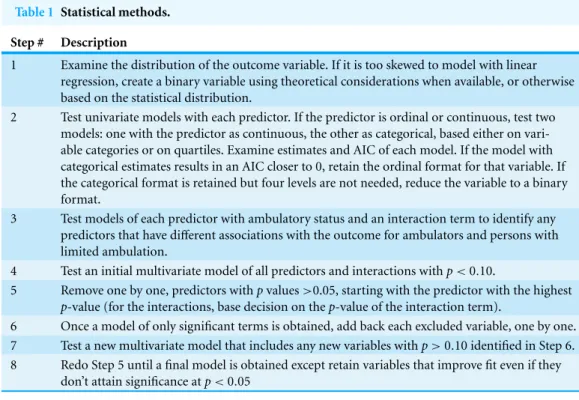
Table 1 Statistical methods.
Step # Description
1 Examine the distribution of the outcome variable. If it is too skewed to model with linear regression, create a binary variable using theoretical considerations when available, or otherwise based on the statistical distribution.
2 Test univariate models with each predictor. If the predictor is ordinal or continuous, test two models: one with the predictor as continuous, the other as categorical, based either on vari-able categories or on quartiles. Examine estimates and AIC of each model. If the model with categorical estimates results in an AIC closer to 0, retain the ordinal format for that variable. If the categorical format is retained but four levels are not needed, reduce the variable to a binary format.
3 Test models of each predictor with ambulatory status and an interaction term to identify any predictors that have different associations with the outcome for ambulators and persons with limited ambulation.
4 Test an initial multivariate model of all predictors and interactions withp<0.10.
5 Remove one by one, predictors withpvalues>0.05, starting with the predictor with the highest
p-value (for the interactions, base decision on thep-value of the interaction term).
6 Once a model of only significant terms is obtained, add back each excluded variable, one by one. 7 Test a new multivariate model that includes any new variables withp>0.10 identified in Step 6. 8 Redo Step 5 until a final model is obtained except retain variables that improve fit even if they
don’t attain significance atp<0.05
All the survey measures (and the survey itself) had been tested or validated among people with MS or community-living older adults. Complete information is provided elsewhere (Ploughman et al., 2014). The Barthel Index, SLIQ and Personal Resource Questionnaire 2000 were pretested using cognitive debriefing (Ploughman et al., 2010).
Data analysis
The statistical methods follow the steps outlined inTable 1. To create the outcome, descriptive physical activity information from SLIQ was transformed into metabolic equivalents (METS; a measure that quantifies exercise intensity based on the ACSM guidelines (ACSM, 2010)), and then MET-hours per week (MET intensity×number of 1 h intervals of exercise per week). As this measure was highly skewed, we classified respondents into ‘Exercisers’ (>6.75 MET-hours per week) or ‘Non-exercisers’ (<6.75 MET hours per week). These cut-offvalues were based on the ACSM recommendation that in order to improve or maintain fitness people with MS should be active three times weekly for 20–30 min at a moderate intensity (∼4.5 METs×3×30 min sessions=6.75 MET-hours/week) (ACSM, 2010).
levels were not required to categorize the variable, levels were combined and the variable retained in a binary format.
It was our hypothesis that predictors of exercise would differ among people with different degrees of MS disability. A variable indicating ambulation was therefore created from the response to the ambulation question in the Barthel Index. Those who scored 0 or 5 (answers walk independently with or without a cane>150 m) were categorized as ‘Ambulators’. Respondents who scored 10 or 15 on Barthel Index ambulatory question (an-swers use of wheelchair/walking aid indoors only) were categorized as ‘Non-Ambulators’. All predictor variables were tested for interaction with ambulation (step 3;Table 1): a main effect of and an interaction with ambulatory status were added to each of the univariate models to determine if the association with exercising was different for persons who were ambulatory and those who were not.
In step 4, all variables (linear or categorical, with or without an associated interaction) that predicted exercise, (p<0.10) were entered into a multivariate logistic regression model. Variables with p-values above 0.05 were removed from the model one by one, based on their p-values (step 5;Table 1). Once all remaining variables were statistically significant, all variables that had been removed were re-entered one by one as well as with an interaction for ambulation to verify that none was eligible to re-enter the model (step 6;Table 1).
Because it was hypothesized, ‘a priori’, that predictors of exercising would vary between ambulators and non-ambulators, an internal cross validation (Kleinbaum, Kupper &
Muller, 1988) was also done to examine whether a model created among ambulators would
also fit non-ambulators. To do this, betas from a logistic regression model created among ambulators was applied to non-ambulators andc-statistics of the two compared.
Differences between exercisers and non-exercisers were compared using ANOVA and chi-square; significance set atp<0.05. Statistical analyses were performed using SAS 9.3.
RESULTS
Participant characteristics
Table 2 Characteristics of exercisers and non-exercisers.
Self-reported characteristics Exerciser
N =404
mean (±SD)
Non-exerciser N=339
mean (±SD)
Age 64.1 (±5.8) 65.1 (±6.5)*
Total education 13.6 (±2.5) 13.3 (±2.7)
Gender Male 83 83
Female 321 256
Years since diagnosis 23.6 (±10.2) 26.3 (±9.7)** Barthel Index 87.0 (±14.7) 63.2 (±28.0)**
Relapsing-Remitting 234 (60.6%) 152 (39.4%)* Primary progressive 40 (37.5%) 59 (62.5%)* Secondary progressive 26 (40.0%) 39 (60.0%)* Progressive relapsing 7 (43.8%) 9 (56.3%)
Benign 26 (60.5%) 17 (39.5%)
Type of MS (Initial diagnosis)
Unknown 68 (54.0%) 58 (46.0%)
Notes. *p<0.05.
**p<0.01.
Predictors of exercise
Table 3 Explanatory model of exercise participation.
Model components Description β Odds ratio:
exp(β)
95% CI of
exp(β)
Ambulatory status Non-Ambulatory Reference
Ambulatory 0.64** 1.90 1.24, 2.91 Barthel Index
(disability) score
10 points less disability on a scale of 0–100
0.41*** 1.50 1.34, 1.68
Perseverance 1 point more perseverance on a 0–14 scale
0.16*** 1.17 1.08, 1.26
Fatigue today 3 lowest quartiles on a scale of 0–100
Reference
Best quartile 0.70** 2.01 1.32, 3.07 Years since MS
diagnosis
Above the median (24–66 years) Reference
Below the median (0–23 years) 0.45* 1.58 1.11, 2.23 Cardiovascular
comorbidity
2 or more Reference
None or 1 0.44* 1.55 1.02, 2.35
Notes. *p<0.05.
**p<0.01.
***p<0.001.
Exp (β): exponential of theβcoefficient yields the OR.
based on AIC statistics of other models considered. Furthermore, thec-statistic of 0.81 is considered strong (Hosmer & Lemeshow, 1989;Hosmer & Lemeshow, 2000): ac-statistic of 0.5 indicates allocation no better than chance and a value of 1.0 perfect assignment.
To determine if separate statistical models were needed to predict exercising among ambulatory and non-ambulatory persons, internal cross-validation methodology was performed by fitting a logistic regression model to ambulators, applying the regression coefficients for the explanatory variables(β)to the observed data on these variables among the non-ambulators, and comparing fit via c-statistics (Kleinbaum, Kupper & Muller, 1988). For ambulators alone, fatigue was replaced with a measure of depressive symptoms. Fatigue and depressive symptoms were correlated, but while fatigue was a better fit for the model of ambulators and non-ambulators combined, depression improved fit among ambulators only. Thec-statistics among ambulators was 0.71 (95% CI [0.65–0.78]), and that of non-ambulators 0.74, supporting the determination that only a single model was needed to determine predictors of exercise.
DISCUSSION
exercise compliance in future MS clinical exercise trials. We also applied strict criteria to delineate exercise levels based on ACSM guidelines as a growing body of research suggests that moderate exercise (not light physical activity) may be neuroprotective
(Austin et al., 2014;Dalgas & Stenager, 2012). We found that predictors of exercise were
the same for older people with MS whether they were ambulatory or not. Ambulatory status, disability, perseverance, fatigue, years since MS diagnosis and cardiorespiratory comorbidity explained exercise participation among older people with MS.
Level of disability a major predictor
Level of disability was the major predictor of exercise in both ambulatory and non-ambulatory groups. Respondents scoring 100/100 on Barthel Index (highest quartile; least disability) were 10 times more likely and those scoring 85–90, seven times more likely to exercise than those scoring less than 60 (lowest quartile). Ambulatory people with MS were 1.9 times more likely to exercise than those who were non-ambulatory (walked indoors only, used a wheelchair or were bedridden). Furthermore, respondents diagnosed for less than 24 years were 1.6 times more likely to exercise than those diagnosed longer than 24 years. Taken together, our results suggest that respondents who need assistance or who have walking disability have few exercise options. Development of seated and modified exercise programs followed by effectiveness research is required. Programs that are individually tailored, guided by qualified personnel such as a physiotherapist, focused on goal-setting and independence using remote technology such as Blue Prescription, hold promise (Hale et al., 2013). Several systematic reviews examining exercise in MS suggest a critical need for rehabilitation research among more disabled groups (Latimer-Cheung et
al., 2013;Rietberg et al., 2005). Although our sample were on average 64 years of age with
MS symptoms for about 33 years, our finding of the critical role of disability in exercise concurs with findings from a sample of 417 ambulatory participants who were on average 43 years old with symptoms for about 8 years (Asano et al., 2013) and among 68 people with relapsing-remitting MS (Suh et al., 2014).
Our findings also suggest that the predictors of exercise participation in MS differ somewhat from those of people with SCI (Ginis et al., 2012). Martin Ginis and group showed that physical independence and injury severity were not strongly predictive of exercise participation in middle-aged people with chronic spinal cord injury (Ginis et al., 2012), suggesting that interventions to promote exercise compliance in SCI may not be entirely applicable to MS.
Perseverance
A novel finding in this study was the role of resilience, specifically perseverance, in pre-dicting exercise participation. Respondents scoring in the highest quartile of perseverance (scores of 13 or 14 out of 14) were 2.7 times more likely to exercise than those scoring in the lowest quartile (less than 10). In our previous qualitative research (Ploughman et al., 2012a;
Ploughman et al., 2012b), perseverance, or commitment to an outcome despite challenges,
Lifestyle and Aging with MS’ database showed that this sample of older people with MS exercise more than other older Canadians (Ploughman et al., 2014).
Other studies have shown that self-efficacy (Kasser & Kosma, 2012;Kosma & Kasser, 2012;Nickel et al., 2014;Schmitt et al., 2014), perceived exercise benefits (Kosma & Kasser,
2012;Suh et al., 2014) and positive exercise intentions (Ginis et al., 2012) are associated
with exercise participation in people with MS and SCI-related mobility disability. Self-efficacy, resilience and perseverance are overlapping constructs that impact health behaviors (Pilutti et al., 2014;Sinnakaruppan et al., 2010). Resilience is believed to be an innate characteristic but research suggests that it can also be learned (McAllister &
McKinnon, 2009). Researchers have used focused cognitive behavioural techniques to
encourage optimism and dispute pessimistic thinking as a method to improve individual resilience and self-efficacy (Graziano et al., 2014). Resilience can be improved using opti-mism training, as well as teaching control and empowerment, educating individuals about their illness, and involving patients in support groups (Ng et al., 2013). These techniques are clearly important in promoting exercise participation and should be considered in the design of exercise trials especially among people with significant MS-related barriers.
Fatigue or depression as predictors?
We found that participants who reported less fatigue (top quartile in 0-100 scale) were twice as likely to exercise. Asano and group (Asano et al., 2013) have also reported fatigue (feeling too tired) as an exercise barrier among people with MS. It is important to consider that MS fatigue and depressive symptoms overlap and in fact, fatigue is an attribute of depression suggesting a complex relationship between the two (Feinstein et al., 2014). Presence of depressive symptoms provided a slightly better model fit than fatigue in the ambulatory group during our analysis. Motl et al. also showed that depression was a symptom inversely associated with exercise in a group of ambulatory subjects with relapsing–remitting MS (Suh, Motl & Mohr, 2010). Whether fatigue or depression or both, better symptom management is required in order to foster exercise participation in the long term.
Comorbid conditions
As our study cohort were older, we expected participants to have more comorbid condi-tions, however, to our knowledge this is the first report that the number of cardiovascular comorbid conditions impacted exercise behaviour in MS. It was interesting that cardio-vascular conditions (diabetes, hypertension and hyperlipidemia) but not musculoskeletal conditions (arthritis, joint replacement etc.) predicted exercise. Participants reporting fewer than two cardiovascular comorbidities were 1.5 times more likely to exercise than those reporting more. As reported by Marrie and Hanwell, comorbid conditions are associated with increased MS disability progression and lower adherence to treatment which could be linked to low exercise participation (Marrie & Hanwell, 2013). Exercise participation, adherence to a healthy diet and avoidance of smoking and excessive alcohol are likely parts of an overall MS self-management program to enhance healthy aging with
Factors that do not predict exercise
Previous research suggests that as individuals age they experience a progressive loss of cognitive and physical skills and abilities, which act as barriers for engagement in healthy lifestyle practices, like physical activity (Widerstrom-Noga & Finlayson, 2010;Motl et al.,
2006;Prakash et al., 2010). Our findings did not support age as an exercise predictor.
Based on previous qualitative and quantitative we had expected that gender (Anens et al., 2014), social support (Ploughman et al., 2012a), financial resources (Ginis et al., 2012), previous exercise behaviors and the support of health care professionals (Ploughman et al.,
2012b) would be predictive of exercise participation but they were not. When subjected to
rigorous analysis in a large cohort with MS-related disability, the influence of these factors were negligible and even absent. On the other hand, our cohort of older people with MS was unique so the impact of gender as reported by others (Anens et al., 2014) and other differences may not be as applicable in this group.
Limitations
Although this unique cohort may provide new insights into maintaining exercise participation among people with MS as they age, there are some study limitations. The cross-sectional design limits our ability to assess change and the effects of variables on predicting exercise participation over time. As the data analysed was obtained through surveys, the responses to the questions were subjective which may or may not align with objective measures. Furthermore, questions such as past exercise experience and diagnosis of co-morbid conditions can be affected by recall bias and memory difficulties. By nature of the volunteer survey design, our sample may be biased in that active participants and those without cognitive impairment may have been more likely to respond. We did not examine cognitive impairment, nor did we have access to data about sleep patterns and pain; potential moderators of exercise and physical activity.
CONCLUSION
This study sought to determine the factors predicting exercise adherence among older peo-ple with MS-related disability. We found level of disability and perseverance to be strong predictors whether participants were ambulatory or not. Clearly, in order for older people with MS to maintain exercise participation as they age they need exercise tailored to their abilities paired with techniques to overcome challenges that arise. Our findings also show that fatigue and cardiovascular comorbid conditions are modifiable barriers to exercise.
ACKNOWLEDGEMENTS
John D. Fisk PhD, A. Dessa Sadovnick PhD, Paul O’Connor, MD, FRCPC, Sarah A. Morrow, MD, FRCPC, Katherine B. Knox MD, FRCPC, Luanne M. Metz MD, FRCPC, Penelope Smyth MD, FRCPC, Susan Scott, MSc, Stephen H. Hogan MScPT, Ruth Ann Marrie, MD, PhD, Penelope W. Alderdice PhD, Mark Stefanelli MD FRCPC, Marshall Godwin, MD.
ADDITIONAL INFORMATION AND DECLARATIONS
Funding
This study was funded by a Canadian Institutes of Health Research (CIHR) Post-doctoral Fellowship for M.P., a Newfoundland and Labrador Centre for Applied Health Research, Healthy Aging Research Program Project Grant, the Health Care Foundation (Eastern Health Authority) Research Project Grant, and the Physiotherapy Foundation of Canada Alberta Research Award. The funders had no role in study design, data collection and analysis, decision to publish, or preparation of the manuscript.
Grant Disclosures
The following grant information was disclosed by the authors:
Canadian Institutes of Health Research (CIHR) Post-doctoral Fellowship. Newfoundland and Labrador Centre for Applied Health Research. Healthy Aging Research Program.
Health Care Foundation (Eastern Health Authority).
Physiotherapy Foundation of Canada Alberta Research Award.
Competing Interests
Dr. Penelope Smyth has served on scientific advisory boards for Novartis and EMD Serono. She has received funding for travel to pharmaceutically sponsored events by EMD Serono. She has received honoraria for speaking, facilitating and chairing from Novartis and EMD Serono as well as from the MS Society of Canada. She has received academic research support for medical education research from the Arnold P. Gold Foundation, and the Teaching and Learning Enhancement Fund from the University of Alberta. Dr. Ruth Ann Marrie receives research funding from: Canadian Institutes of Health Research, Multiple Sclerosis Society of Canada, Multiple Sclerosis Scientific Research Foundation, Rx & D Health Research Foundation, and has conducted clinical trials funded by Sanofi-Aventis. Dr. Katherine Knox received grant funding from Saskatoon City Hospital Foundation and MS Society of Canada, educational CME event grant funding from Bayer HealthCare Pharmaceuticals, honoraria /travel grant from Biogen and Teva. She was a member of the CIHR and MS Society of Canada Scientific Expert Working Group on CCSVI and MS. Dr. Mark Stefanelli has served on advisory boards for Biogen Idec and Novartis and has been provided speaker/travel support by Teva Neuroscience. His research was supported by Genzyme and Biogen. Dr. Marshall Godwin’s research is funded by the Canadian Institutes of Health Research, Public Health Agency of Canada, Health Canada, and Newfoundland and Labrador Centre for Applied Health Research. He reports no conflicts of interest.
Author Contributions
• Michelle Ploughman conceived and designed the experiments, performed the experiments, analyzed the data, contributed reagents/materials/analysis tools, wrote the paper, prepared figures and/or tables, reviewed drafts of the paper.
• Chelsea Harris conceived and designed the experiments, performed the experiments, analyzed the data, contributed reagents/materials/analysis tools, wrote the paper, prepared figures and/or tables, reviewed drafts of the paper, ethics applications, recruitment, data entry, data cleaning.
• Elizabeth M. Wallack and Olivia Drodge conceived and designed the experiments, performed the experiments, analyzed the data, contributed reagents/materials/analysis tools, wrote the paper, prepared figures and/or tables, reviewed drafts of the paper.
• Serge Beaulieu performed the experiments, analyzed the data, contributed reagents/materials/analysis tools, development of database management system.
• Nancy Mayo performed the experiments, analyzed the data, contributed reagents/materials/analysis tools, wrote the paper, prepared figures and/or tables, reviewed drafts of the paper, ethics applications, recruitment, data entry, data cleaning.
Human Ethics
The following information was supplied relating to ethical approvals (i.e., approving body and any reference numbers):
Health Lifestyle and Aging with MS Study Ethics boards:
Capital Health Research Ethics Board, Halifax NS Canada;
McGill University Health Centre and Montreal General Hospital Research Ethics Office, Montreal QC Canada;
Health Sciences Research Ethics Board, University of Western Ontario, London ON Canada;
Research Ethics Board, St. Michael’s Hospital, Toronto ON Canada;
Research Ethics Board. Bannatyne campus, University of Manitoba, Winnipeg MB Canada;
Behavioural Research Ethics Board, University of Saskatchewan, Saskatoon SK Canada; Health Research Ethics Board, University of Alberta, Alberta Health Services, Edmonton AB, Canada;
Behavioural Research Ethics Board, University of British Columbia, Vancouver BC, Canada.
Data Availability
The following information was supplied regarding the deposition of related data:
Dr. Michelle Ploughman is the data custodian for the data contained within the Health Lifestyle and Aging with MS Survey. The data is maintained in a secure network as per ethics requirements. Access to the data can be requested by contacting Dr. Ploughman at [email protected].
REFERENCES
American College of Sports Medicine (ACSM). 2010.ACSM’s guidelines for exercise testing and prescription. Philidelphia: Lippincott Williams & Wilkins.
Anens E, Emtner M, Zetterberg L, Hellstrom K. 2014. Physical activity in subjects with multiple sclerosis with focus on gender differences: a survey.BMC Neurology
14:47DOI 10.1186/1471-2377-14-47.
Asano M, Duquette P, Andersen R, Lapierre Y, Mayo NE. 2013.Exercise barriers and preferences among women and men with multiple sclerosis.Disability and Rehabilitation35:353–361
DOI 10.3109/09638288.2012.742574.
Austin MW, Ploughman M, Glynn L, Corbett D. 2014. Aerobic exercise effects on neuroprotection and brain repair following stroke: a systematic review and perspective. Neuroscience Research87C:8–15DOI 10.1016/j.neures.2014.06.007.
Boslaugh SE, Andresen EM. 2006.Correlates of physical activity for adults with disability. Preventing Chronic Disease3(3):A78.Available athttp://www.cdc.gov/pcd/issues/2006/jul/05 0207.htm.
Dalgas U, Stenager E. 2012.Exercise and disease progression in multiple sclerosis: can exercise slow down the progression of multiple sclerosis?Therapeutic Advances in Neurological Disorders 5:81–95DOI 10.1177/1756285611430719.
Feinstein A, Magalhaes S, Richard JF, Audet B, Moore C. 2014.The link between multiple sclero-sis and depression.Nature Reviews Neurology10:507–517DOI 10.1038/nrneurol.2014.139.
of leisure time physical activity among people with spinal cord injury.Annals of Behavioral Medicine44:104–118DOI 10.1007/s12160-012-9370-9.
Godwin M, Streight S, Dyachuk E, Van den Hooven EC, Ploemacher J, Seguin R, Cuthbertson S. 2008.Testing the simple lifestyle indicator questionnaire: initial psychometric study.Canadian Family Physician54:76–77.
Graziano F, Calandri E, Borghi M, Bonino S. 2014.The effects of a group-based cognitive behavioral therapy on people with multiple sclerosis: a randomized controlled trial.Clinical Rehabilitation28:264–274DOI 10.1177/0269215513501525.
Hale LA, Mulligan HF, Treharne GJ, Smith CM. 2013.The feasibility and short-term benefits of Blue Prescription: a novel intervention to enable physical activity for people with multiple sclerosis.Disability and Rehabilitation35:1213–1220DOI 10.3109/09638288.2012.723787.
Hosmer DW, Lemeshow S. 1989.Applied logistic regression. New York NY: John Wiley & Sons.
Hosmer DW, Lemeshow S. 2000.Applied logistic regression. 2nd Edition. New York NY: John Wiley & Sons.
Kasser SL, Kosma M. 2012.Health beliefs and physical activity behavior in adults with multiple sclerosis.Disability and Health Journal5:261–268DOI 10.1016/j.dhjo.2012.07.001.
Kayes NM, McPherson KM, Taylor D, Schluter PJ, Kolt GS. 2011.Facilitators and barriers to engagement in physical activity for people with multiple sclerosis: a qualitative investigation. Disability and Rehabilitation33:625–642DOI 10.3109/09638288.2010.505992.
Klaren RE, Motl RW, Dlugonski D, SandroffBM, Pilutti LA. 2013.Objectively quantified physical activity in persons with multiple sclerosis. Archives of Physical Medicine and Rehabilitation94:2342–2348DOI 10.1016/j.apmr.2013.07.011.
Klaren RE, Motl RW, Woods JA, Miller SD. 2014.Effects of exercise in experimental autoimmune encephalomyelitis (an animal model of multiple sclerosis).Journal of Neuroimmunology 274:14–19DOI 10.1016/j.jneuroim.2014.06.014.
Kleinbaum DG, Kupper LL, Muller KE. 1988.Applied regression analysis and other multivariable methods. Boston: PWS-KENT Publishing Co.
Kosma M, Kasser S. 2012.Psychosocial predictors of physical activity among adults with multiple sclerosis.Annals of Behavioral Medicine43:S203–S203.
Latimer-Cheung AE, Pilutti LA, Hicks AL, Martin Ginis KA, Fenuta AM, MacKibbon KA, Motl RW. 2013.Effects of exercise training on fitness, mobility, fatigue, and health-related quality of life among adults with multiple sclerosis: a systematic review to inform guideline development.Archives of Physical Medicine and Rehabilitation94:1800–1828
DOI 10.1016/j.apmr.2013.04.020.
Mahoney FI, Barthel DW. 1965.Functional evaluation: the barthel index.Maryland State Medical Journal14:61–65.
Marrie RA, Hanwell H. 2013.General health issues in multiple sclerosis: comorbidities, secondary conditions, and health behaviors.Continuum (Minneap, Minn)19:1046–1057.
Marrie RA, Horwitz RI. 2010.Emerging effects of comorbidities on multiple sclerosis.Lancet Neurology9:820–828DOI 10.1016/S1474-4422(10)70135-6.
McAllister M, McKinnon J. 2009.The importance of teaching and learning resilience in the health disciplines: a critical review of the literature.Nurse Education Today29:371–379
DOI 10.1016/j.nedt.2008.10.011.
Motl RW, Snook EM, McAuley E, Scott JA, Douglass ML. 2006.Correlates of physical activity among individuals with multiple sclerosis.Annals of Behavioral Medicine32:154–161
DOI 10.1207/s15324796abm3202 13.
Ng A, Kennedy P, Hutchinson B, Ingram A, Vondrell S, Goodman T, Miller D. 2013.Self-efficacy and health status improve after a wellness program in persons with multiple sclerosis.Disability and Rehabilitation35:1039–1044DOI 10.3109/09638288.2012.717586.
Nickel D, Spink K, Andersen M, Knox K. 2014.Attributions and self-efficacy for physical activity in multiple sclerosis.Psychology, Health and Medicine19:433–441
DOI 10.1080/13548506.2013.832783.
Pilutti LA, Dlugonski D, SandroffBM, Klaren R, Motl RW. 2014.Randomized controlled trial of a behavioral intervention targeting symptoms and physical activity in multiple sclerosis. Multiple Sclerosis Journal20:594–601DOI 10.1177/1352458513503391.
Ploughman M, Austin MW, Glynn L, Corbett D. 2015.The effects of poststroke aerobic exercise on neuroplasticity: a systematic review of animal and clinical studies.Translational Stroke Research6:13–28DOI 10.1007/s12975-014-0357-7.
Ploughman M, Austin MW, Murdoch M, Kearney A, Fisk JD, Godwin M, Stefanelli M. 2012a.
Factors influencing healthy aging with multiple sclerosis: a qualitative study.Disability and Rehabilitation34:26–33DOI 10.3109/09638288.2011.585212.
Ploughman M, Austin MW, Murdoch M, Kearney A, Godwin M, Stefanelli M. 2012b.The path to self-management: a qualitative study involving older people with multiple sclerosis. Physiotherapy Canada64:6–17DOI 10.3138/ptc.2010-42.
Ploughman M, Austin M, Stefanelli M, Godwin M. 2010.Applying cognitive debriefing to pre-test patient-reported outcomes in older people with multiple sclerosis.Quality of Life Research19:483–487DOI 10.1007/s11136-010-9602-z.
Ploughman M, Beaulieu S, Harris C, Hogan S, Manning OJ, Alderdice PW, Fisk JD, Sadovnick AD, O’Connor P, Morrow SA, Metz LM, Smyth P, Mayo N, Marrie RA, Knox KB, Stefanelli M, Godwin M. 2014.The Canadian survey of health, lifestyle and ageing with multiple sclerosis: methodology and initial results.BMJ Open4:e005718
DOI 10.1136/bmjopen-2014-005718.
Prakash RS, Snook EM, Motl RW, Kramer AF. 2010.Aerobic fitness is associated with gray matter volume and white matter integrity in multiple sclerosis.Brain Research1341:41–51
DOI 10.1016/j.brainres.2009.06.063.
Rietberg MB, Brooks D, Uitdehaag BM, Kwakkel G. 2005.Exercise therapy for multiple sclerosis. Cochrane Database of Systematic ReviewsCD003980DOI 10.1002/14651858.
Schmitt MM, Goverover Y, Deluca J, Chiaravalloti N. 2014.Self-efficacy as a predictor of self-reported physical, cognitive, and social functioning in multiple sclerosis.Rehabilitation Psychology59:27–34DOI 10.1037/a0035288.
Sinnakaruppan I, Macdonald K, McCafferty A, Mattison P. 2010.An exploration of the relationship between perception of control, physical disability, optimism, self-efficacy and hopelessness in multiple sclerosis.International Journal of Rehabilitation Research33:26–33
DOI 10.1097/MRR.0b013e32832e6b16.
Stroud N, Minahan C, Sabapathy S. 2009.The perceived benefits and barriers to exercise participation in persons with multiple sclerosis.Disability and Rehabilitation31:2216–2222
DOI 10.3109/09638280902980928.
Suh Y, Joshi I, Olsen C, Motl RW. 2014.Social cognitive predictors of physical activity in relapsing-remitting multiple sclerosis.International Journal of Behavioral Medicine21:891–898
Suh Y, Motl RW, Mohr DC. 2010.Physical activity, disability, and mood in the early stage of multiple sclerosis.Disability and Health Journal3:93–98DOI 10.1016/j.dhjo.2009.09.002.
Van der Ploeg HP, Streppel KR, Van der Beek AJ, Van der Woude LH, Vollenbroek-Hutten MM, Van Harten WH, Van Mechelen W. 2007.Successfully improving physical activity behavior after rehabilitation.American Journal of Health Promotion21:153–159
DOI 10.4278/0890-1171-21.3.153.
Wagnild G. 2009.A review of the resilience scale.Journal of Nursing Measurement 17:105–113
DOI 10.1891/1061-3749.17.2.105.
Weinert C, Brandt PA. 1987.Measuring social support with the Personal Resource Questionnaire. Western Journal of Nursing Research9:589–602DOI 10.1177/019394598700900411.
Widerstrom-Noga E, Finlayson ML. 2010.Aging with a disability: physical impairment, pain, and fatigue.Physical Medicine and Rehabilitation Clinics of North America21:321–337
DOI 10.1016/j.pmr.2009.12.010.