www.epjournal.net – 2007. 5(2): 347-357
¯ ¯ ¯ ¯ ¯ ¯ ¯ ¯ ¯ ¯ ¯ ¯ ¯ ¯ ¯ ¯ ¯ ¯ ¯ ¯ ¯ ¯ ¯ ¯ ¯ ¯ ¯ ¯
Original Article
Greater Emphasis on Female Attractiveness in Homo sapiens: A Revised
Solution to an Old Evolutionary Riddle
Jonathan Gottschall, Washington and Jefferson College, Washington, Pennsylvania, 15301, [email protected]
Abstract: Substantial evidence from psychology and cross-cultural anthropology supports a general rule of greater emphasis on female physical attractiveness in Homo sapiens. As sensed by Darwin (1871) and clarified by Trivers (1972), generally higher female parental investment is a key determinant of a common pattern of sexual selection in which male animals are more competitive, more eager sexually and more conspicuous in courtship display, ornamentation, and coloration. Therefore, given the larger minimal and average parental investment of human females, keener physical attractiveness pressure among women has long been considered an evolutionary riddle. This paper briefly surveys previous thinking on the question, before offering a revised explanation for why we should
expect humans to sharply depart from general zoological pattern of greater emphasis on male attractiveness. This contribution hinges on the argument that humans have been seen as anomalies mainly because we have been held up to the wrong zoological comparison groups. I argue that humans are a partially sex-role reversed species, and more emphasis on female physical attractiveness is relatively common in such species. This solution to the riddle, like those of other evolutionists, is based on peculiarities in human mating behavior, so this paper is also presented as a refinement of current thinking about the evolution of human mating preferences.
Keywords: Physical Attractiveness; Partial Sex-Role Reversal; Mate Preferences; Homo
sapiens.
¯ ¯ ¯ ¯ ¯ ¯ ¯ ¯ ¯ ¯ ¯ ¯ ¯ ¯ ¯ ¯ ¯ ¯ ¯ ¯ ¯ ¯ ¯ ¯ ¯ ¯ ¯ ¯ ¯ ¯ ¯ ¯ ¯ ¯ ¯ ¯ ¯ ¯ ¯ ¯ ¯ ¯ ¯ ¯ ¯ ¯ ¯ ¯ ¯ ¯ ¯ ¯ ¯ ¯ ¯ ¯ ¯ ¯ ¯ ¯ ¯ ¯ ¯ ¯ ¯ ¯ ¯ ¯ ¯ ¯ ¯ ¯ ¯ ¯ ¯ ¯ ¯ ¯ ¯ ¯ ¯ ¯ Introduction
Quish, and Rhea, 2004; for literature reviews see for Buss, 2003; Geary, Vigil, and Byrd-Craven, 2004), and that women feel more anxiety about their physical appearances, spend more time and money enhancing them, and are more likely to suffer from eating disorders (see Etcoff, 1999). The few large-scale cross-cultural studies that directly address gendered attractiveness emphasis coincide with studies of Western populations. For instance, Ford and Beach's (1951) trail-breaking study of sexuality in 190 traditional populations concluded that, "in most societies the physical beauty of the female receives more explicit consideration than does the handsomeness of the male” (p.86). (While Ford and Beach's vague wording, "most societies," implies cultures where "explicit consideration" was equal or male-skewed, they do not identify any exceptional societies). Similarly, a meta-analysis of several content-analytic studies suggests that print advertising featuring attractive young women in "decorative roles" is longitudinally stable and cross-culturally pervasive (Saad, 2004). Finally, in two distinct, large-scale content analyses of reasonably representative samples of traditional world folk tales, Gottschall and colleagues (2005; in press) reported that information on character attractiveness was much more likely to be conveyed, and repeatedly stressed, if the character was female.
Of course, modern academics were hardly first to sense this phenomenon and to recognize it as a riddle in need of a solution. For example, over-emphasis on female attractiveness has inspired feminist indignation and resistance from the movement’s earliest beginnings (see Wollstonecraft, 1792) up to the present (see Wolf, 1991). Similarly, the riddle has consistently excited the interest of evolutionists, from Darwin (1871; for other early thinking see Ellis, 1926; Westermarck, 1921) up to the present (see Dawkins, 1976; Symons, 1979; Buss, 1989; Sugiyama, 2005). In The Descent of Man and Selection in Relation to Sex (1871), Darwin identified a common pattern of sexual selection in which male animals are more competitive, more eager sexually and—most importantly for our purposes--more conspicuous in courtship display, ornamentation, and coloration (also see Andersson, 1994). He noted that humans generally fit this pattern except for one thing: in humans it is the female, not the male, who uses physical attractiveness to "charm," "excite," "fascinate," and "allure" the opposite sex (1871, p.618). In contrast to his treatment of female attractiveness salience in certain bird species (1871, chap. 16), Darwin did not connect the peculiarity of greater emphasis on women's physical attractiveness to men's higher than average parental investment. Rather, Darwin suggested that human females were more attractive, in an absolute sense, because male choice, not female, came to dominate the course of human sexual selection (p.619). And throughout that time, males were selecting, perhaps above all, for female beauty (see chap. 20, esp. p.619).
Modern evolutionists have also been drawn to the riddle. In the wake of Trivers (1972), evolutionists began thinking of sexual selection mainly in terms of parental investment (but see Clutton-Brock and Parker, 1992). Parental investment theory predicts that members of the sex investing less—usually males--will compete for access to the other sex's larger reproductive investment. Therefore, given women's much larger minimal and average parental investment, keener physical attractiveness competition among women is initially problematic. Dawkins's neatly summarized the problem in The Selfish Gene:
drab… .[B]ut, on average, there can be no doubt that in our society the equivalent of the peacock's tail is exhibited by the female, not by the male.…Faced with these facts, a biologist would be forced to suspect that he was looking at a society in which females compete for males, rather than vice versa… . Has the male really become the sought-after sex, the one that is in demand, the sex that can afford to be choosy? If so, why? (1976, pp.164-165; see also Jones, 1996, pp.16-17)
Symons (1979) provided an answer to Dawkins's question, arguing that greater emphasis on female attractiveness—not just in the West but worldwide—reflects the unusually high variability and detectability of women's reproductive value, especially aspects of reproductive value that are can be accurately assessed on the basis of age. Greater emphasis on women's attractiveness reflects the fact that "a female's reproductive value can be assessed more accurately from her physical appearance than a male's reproductive value can" (p. 201).
Symons's solution was accurate but not complete. This paper seeks to more efficiently isolate the fundamental variables differentiating human patterns of male-female mating preferences from those of most other mammals—patterns which, it is argued, result in more intense emphasis on women's attractiveness. Developing broad trends in the theoretical and empirical literature of animal mate choice (e.g., Kokko, Brooks, Jennions, and Moreley, 2003; Iwasa and Pomiankowski, 1999), it is argued that a species' mate preferences can be simply and reliably predicted on the basis of the relative variance and detectability of reproductively significant traits in the opposite sex. This argument is supported with evidence of correspondences between human mate preference patterns and those of other species with similar patterns of male-female variance and detectability of reproductively significant traits. More specifically, I suggest that the evolutionary riddle of greater emphasis on human female attractiveness is resolved when it is realized that Homo sapiens is a partially sex-role reversed species. While greater emphasis on women's attractiveness is usually approached as a comparative anomaly, male preferences for physically attractive mates (i.e., mates with phenotypes signaling fecundity and/or high genetic quality) are quite common in other partially sex-role reversed species that share, with humans, similar patterns of variance and detectability of reproductively significant traits. In short, this contribution hinges on the argument that greater emphasis on human female attractiveness has been seen as an anomaly mainly because humans have been held up to the wrong zoological comparison groups.
Homo sapiens: A Partially Sex-Role Reversed Species
Exceptions occur 1) when males invest heavily in reproduction, 2) when variance in female mate quality is high, and/or 3) when the costs of choice for males are atypically low (the costs of choice can include increased opportunity, search, and competition costs). These exceptional species vary along a continuum from partially sex-role reversed species (males both choosy and competitive) to the inverted species featured in Darwin's (1871) and Trivers's (1972) models of sexual selection (for sex-role reversal see also Wallace, 1867; Williams, 1966; Bonduriansky, 2001; Gwynne, 1991; Parker, 1983; Johnstone, Reynolds, and Deutsch, 1996).
Degree of sex-role reversal is an increasing function of male mating choosiness. And, according to comparative studies, variance in female quality may influence male choosiness as much as relative parental investment (see reviews in Bonduriansky, 2001; Johnstone et al., 1996; Andersson, 1994). Moreover, the same studies show that choosy males most commonly discriminate on the basis of phenotypic indicators of female fecundity (see reviews in Bonduriansky, 2001; Andersson, 1994, pp.132-142, 186). This tendency for selective males to prefer the most fecund mates is most pronounced in more polygynous systems. In more monogamous systems, where male reproductive success is more closely linked to the genetic quality of single females, male preferences for fecund mates may be balanced with preferences for mates exhibiting indicators of "good genes."
Thus when viewed in comparative context, the puzzle of greater emphasis on human female physical attractiveness may not be so puzzling after all. As Darwin seemed to sense (1871, p. 619), humans—with exceptionally high male parental investment (see Alexander and Noonan, 1979) and high variances in female mate quality (more on this below)--represent a relatively straightforward example of a partially sex-role reversed species. The males of partially-reversed species are still competitive, but they are also more sexually discriminating (see Bonduriansky, 2001). Further, in dozens of partially reversed species for which we have data—mainly fishes, insects, and other invertebrates--males discriminate mainly on the basis of "physical attractiveness." That is, the choosy males of partially sex-role reversed species prefer females who exhibit phenotypic indicators of fecundity and/or--depending where they sit on the monogamy-polygyny continuum--good genes. The apparent correspondence of human patterns of male choice with those relatively commonly encountered in remote taxa, but rarely encountered in mammals, is an evolutionary puzzle in its own right—one that will be addressed in this paper's last section.
Predicting Mate Preferences on the Basis of Variability and Detectability
indicators of 1) fertility (the physiological ability to produce offspring), 2) parental investment (the ability and willingness to devote resources to offspring), and 3) good genes (hereditary traits likely to enhance the reproductive success of offspring).
The basic model differs most substantially from the traditional parental investment model of mating choosiness (Trivers, 1972) in the emphasis it places on mate quality variance: theory suggests and studies show that male choosiness can emerge in species with little or no male parental investment provided that variance in female mate quality is sufficiently high (Bonduriansky, 2001). Moreover, the basic model suggests that mate quality variance helps to determine not only the degree of choosiness, but also the specific nature of the mate preferences themselves. Specifically, because choosiness in one sex is only favored if the mate quality of members of the opposite sex varies in detectable ways (Parker, 1983; Iwasa and Pomiankowski, 1999; Kokko et al., 2003; see also Fisher, 1958, p.136), it is to be expected that mating preferences across species will be biased toward reproductively significant traits that show greatest variance and detectability in the opposite sex.
From this vantage point, the emphasis on male attractiveness in so many non-human species is predictable. The dominant pattern of sexual selection is that males are competitive and females are choosy (Darwin, 1871; Andersson, 1994). In species that conform to this pattern, males contribute little to reproduction beyond genetic material: male parental investment is usually a non-factor and male fertility variance is relatively small and is apparently difficult to assess on the basis of phenotypic cues (except, perhaps, on the basis of extremes in physiological condition). Thus females can discriminate among males primarily, or only, on the basis of physical and behavioral phenotypes indicating genetic quality.
By placing heavier emphasis on mate quality variance it is possible to develop a model that more efficiently isolates the fundamental variables in the evolution of human mate preferences, that is integrated with established theoretical models in the study of animal mate preferences (Iwasa and Pomiankowski, 1999; Kokko et al., 2003), and that is consistent with human empirical studies (e.g., Buss, 1989; for literature overviews see Buss, 2003; Gottschall et al., 2004; Geary et al., 2004). The fundamental prediction is that men and women will express strongest preferences for reproductively significant traits that 1) vary most in the opposite sex, and that 2) can be reliably assessed (i.e., have high detectability and "honesty" in a Zahavian sense).
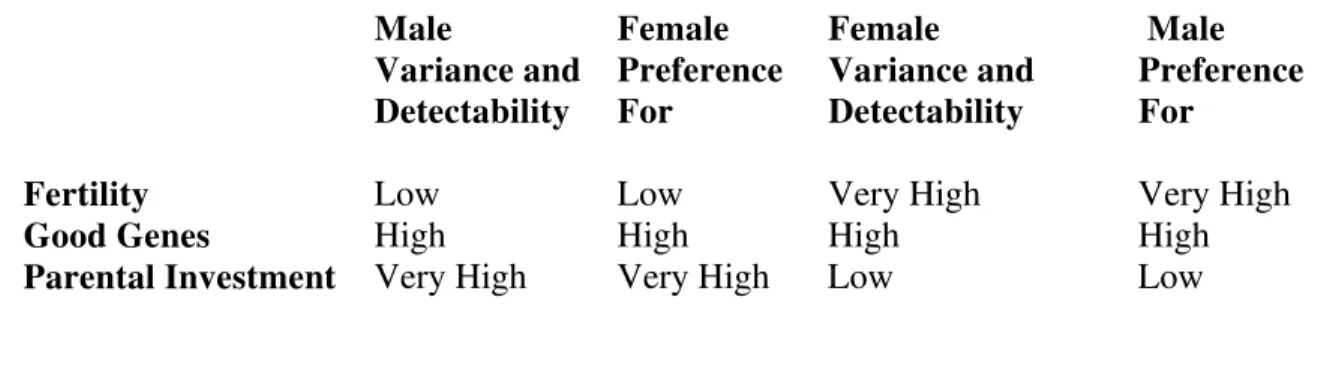
external cues (except in the very young, very old, and very unhealthy), male fertility is expected to play a very small role in women's mating decisions. This leads to the expectation that women will express only moderate interest in male physical attractiveness because their preferences for indicators of good genes (which are partially signaled by physical attractiveness cues) must be balanced with preferences for signals of parental investment (see Table 1).
The importance of male parental investment meant that ancestral women could not afford to concentrate mainly on physical attractiveness. Women who concentrated primarily on physical appearance would have had lower fitness than those who balanced, and perhaps subordinated, their desires for physically attractive males with their desires for males providing resources. In short-term mating situations women would be expected to place more emphasis on indicators of good genes (see Greiling and Buss, 2000; Cashdan, 1996; Gangestad and Thornhill, 1997). But given the evidence from preindustrial societies that short-term mates also contribute resources to offspring (Hill and Hurtado, 1996; Buss, 2003, pp.86-91; for review see Hrdy, 1999, chap. 10), and that modern women may use short-term mating as a stepping stone to long-term engagements (for overview see Buss, 1999, pp.176-186), this model does not necessarily predict that parental investment will be an insignificant factor in women's short-term decisions.
Table 1: Typical variance and detectability of different aspects of male and female mate quality in Homo sapiens; expected strength and direction of male and female mate preferences.
_________________________________________________________________________
Male
Variance and
Female Preference
Female Variance and
Male Preference
Detectability For Detectability For
Fertility Low Low Very High Very High
Good Genes High High High High
Parental Investment Very High Very High Low Low
_________________________________________________________________________
into extreme fertility variances among women that can be reliably assessed on the basis of age cues. In addition, there is currently much plausible speculation (e.g., Symons, 1979, 1995; Johnston and Franklin, 1993; Thornhill and Gangestad, 1999; Singh, 1993, 1995; Feinberg et al., 2005), and intriguing evidence (e.g., Alonso and Rosenfield, 2002; Kaye, Folsome, and Prineas, 1990; Jasienska, Ziomkiewicz, Ellison, Lipson, and Thune, 2004; Moran et al., 1999; Zaastra, et al., 1993; Kissebah and Krakower, 1994; Yusuf et al., 2005) that other aspects of female figures and faces may honestly signal relative fertility. In short, it is expected that men will be most strongly attracted to phenotypic indicators of female fertility because of its exceptionally high variance and detectability (see Table 1). They are also expected to value indicators of good genes, especially in long-term mating contexts where their fitness interests are increasingly tied to the genetic quality of their mates.
Males are expected to be substantially less sensitive to indicators of female parental investment. This is obviously not because female parental investment was irrelevant to the reproductive success of ancestral men. Rather, males are expected to be less sensitive to cues of female parental investment ability because the minimal costs of successful reproduction for ancestral women were massive and relatively fixed. For almost all mothers in human history, the minimal costs of successfully reproducing included nine months of gestation, a long period of lactation, and long years of rearing effort (see Ellison, 2003). Thus, in contrast to the variance in male parental investment, which is enormous, female parental investment ability and willingness varies much less; ancestral males could afford to take it almost for granted while they concentrated on more variable and accurately assessed traits.
Moreover, unlike female preferences, robust male preferences for attractive mates are expected to be relatively insensitive to long-term or short-term mating situations. The difference will be in which type of attractiveness indicator is preferred: in short-term situations, males are expected to place principal emphasis on cues of immediate reproductive capacity (i.e., fecundity); in long-term situations, males will balance preferences for cues of long-term reproductive potential (i.e., fertility) with preferences for indicators of good genes.
In summary, the fact that male reproductive success is constrained more by access to fertile mates (Trivers, 1972) is not the primary determinant of greater emphasis on women's attractiveness. Humans share this feature with most other sexual species and, in most species where the sexes differ, primary emphasis is on male attractiveness. Greater emphasis on women's attractiveness emerges mainly from the specific patterns of male-female variance in mate quality described above. The crux of the matter is this: In contrast to ancestral women, who had to balance their preferences for physically attractive mates with their preferences for parentally investing mates, ancestral males were not obliged to compromise as much on attractiveness (Sugiyama, 2005 also recognizes this trade off as fundamental to the greater salience of women's physical attractiveness). Because they could take high female parental investment almost as a given, ancestral males were free to concentrate on phenotypic indicators of fertility and good genes.
Fishes, Insects, and other Invertebrates)
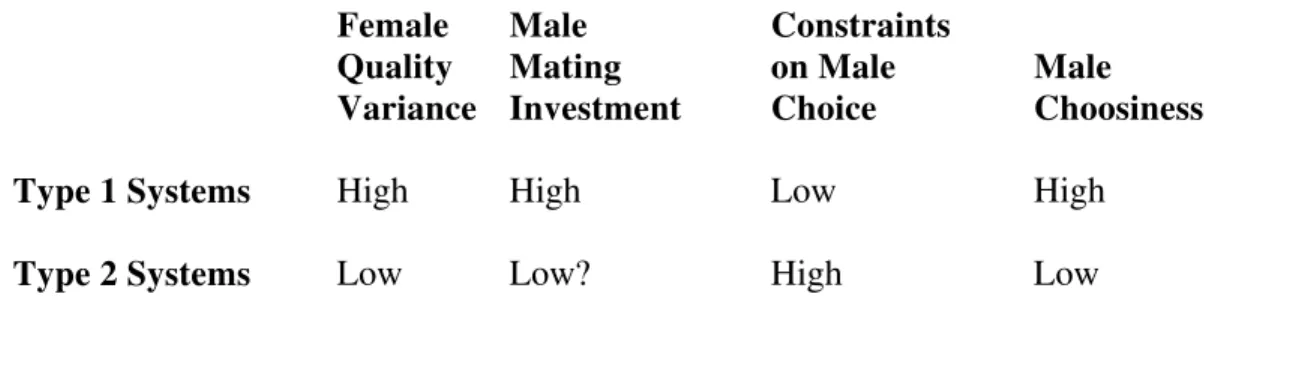
As mentioned above, the empirical evidence for the basic model comes mainly from the study of fishes and, especially, insects and other invertebrates. Why are human patterns of male choosiness--and male preferences for physically attractive mates--most similar to patterns that are relatively common in remote taxa but much less common in mammals? Bonduriansky's review of the animal mate choice literature (2001) suggests that species can be roughly divided into two categories: Type 1 species where female fitness typically increases with the number of copulations, and Type 2 species where female fitness peaks at one or a low number of copulations (see Table 2). Type 1 species include oviparous species where multiple copulations are required to fertilize all of the eggs, or species in which females receive other benefits from mating (e.g., nuptial gifts). Type 1 species are further characterized by high female mate quality variance, high male mating investment, low constraints on male choosiness (e.g., low search costs), and high male choosiness. Type 2 species are characterized by low female mate quality variance, low male mating investment, high male choosiness constraints, and low male choosiness.
Table 2: Expected associations of sex role parameters in systems where female fitness increases with each additional mating (Type 1 systems), and systems where female fitness is maximized at a small number of matings (Type 2 systems). After Bonduriansky (2001). _________________________________________________________________________
Female Quality Variance
Male Mating
Investment
Constraints on Male Choice
Male
Choosiness
Type 1 Systems High High Low High
Type 2 Systems Low Low? High Low
_________________________________________________________________________
Received 26 February; Revision submitted 18 May 2007; Accepted 21 May 2007
References
Alexander, R. D., and Noonan, K. M. (1979). Concealment of ovulation, parental care, and human social evolution. In N. A. Chagnon and W. Irons (Eds.), Evolutionary biology and human social behavior: An anthropological perspective (pp.402-435). North Scituate, MA: Duxbury Press.
Alonso, L.C. and. Rosenfield, R.L, (2002). Oestrogens and puberty. Best Practice and Research Clinical Endocrinology and Metabolism,16, 13–30.
Andersson, M. (1994). Sexual selection. Princeton: Princeton University Press.
Buss, D. M. (1989). Sex differences in human mate preferences: Evolutionary hypotheses tested in 37 cultures. Behavioral and Brain Sciences, 12, 1-49.
Buss, D. M. (1999). Evolutionary psychology: The new science of the mind. Boston, MA: Allyn and Bacon.
Buss, D. M. (2003). The evolution of desire: Strategies in human mating. New York: Basic Books.
Bonduriansky, R. (2001). The evolution of male mate choice in insects: A synthesis of ideas and evidence. Biological Review, 76, 305-339.
Bordo, S. (1993). Unbearable weight: Feminism, western culture, and the body. Berkeley: University of California Press.
Brownmiller, S. (1984). Femininity. New York: Linden Press.
Cashdan, E. (1996). Women's mating strategies. Evolutionary Anthropology, 5, 134- 143.
Clutton-Brock, T. H., and Parker, G. H. (1992).Potential reproductive rates and the operation of sexual selection. Quarterly Review of Biology, 67, 437-456. Darwin, C. The descent of man and selection in relation to sex (1998, 1871). NY:
Prometheus Books.
Dawkins, R. (1976). The selfish gene. Oxford: Oxford University Press. Etcoff, N. (1999). Survival of the prettiest. New York: Doubleday.
Ellis, H. (1926). Studies in the psychology of sex, volume IV. Philadelphia: F. A. Davis. Ellison, P. (2003). On fertile ground: A natural history of human reproduction.
Cambridge: Harvard.
Feinberg, D., Jones, B., DeBruine, L., Moore, F., Law Smith, M., Cornwell, R.,
Tiddeman, B., Boothroyd, L., and Perrett, D. (2005). The voice and face of woman: One ornament that signals quality? Evolution and Human Behavior, 26, 398-408. Fisher, R. A. (1958). The genetical theory of natural selection. New York: Dover. Ford, C. and Beach, F. (1951). Patterns of sexual behavior. New York: Harper and Row
Publishers.
Gangestad, S. and Thornhill, R. (1997). The evolutionary psychology of extrapair sex: The role of fluctuating asymmetry. Evolution and Human Behavior, 18, 69-88. Geary, D., Vigil, J., and Byrd-Craven, J. (2004). Evolution of human mate choice.
Gottschall, J., Martin, J., Quish, H., and Rhea, J. (2004). Sex differences in mate choice criteria are reflected in folktales from around the world and in historical European literature. Evolution and Human Behavior, 25, 102-112.
Gottschall, J., Berkey, R., Drown, C., Fleischner, M., Glotzbecker, M., Kernan, K.,
Magnan, T., Muse, K., Ogburn, C., Skeels, C., St. Joseph, S., Weeks, S., Welch, A., and Welch, E. (2005). The heroine with a thousand faces: Universal trends in the characterization of female folk tale protagonists. Evolutionary Psychology, 3, 85-103.
Gottschall, J., and 30 co-authors. (in press). The "Beauty myth" is no myth: Emphasis on male-female attractiveness in world folk tales. Human Nature. Greiling, H., and Buss, D. (2000). Women's sexual strategies: The hidden dimension of
short-term mating. Personality and Individual Differences, 28, 929-963. Gwynne, D. (1991). Sexual competition among females: What causes courtship-
role reversal. Trends in Ecology and Evolution, 6, 118-121.
Hill, K., and Hurtado, M. (1996). Aché life history: The ecology and demography of a foraging people. Hawthorne, New York: Aldine de Gruyter.
Hrdy, S. (1999). Mother nature: A history of mothers, infants, and natural selection. New York: Pantheon Books.
Iwasa, Y.,and Pomiankowski, A. (1999). Good parent and good genes models of handicap evolution. Journal of Theoretical Biology, 200, 97-109.
Jasienska, G., Ziomkiewicz, A., Ellison, P. T., Lipson, S. F., and Thune, I. (2004). Large breasts and narrow waists indicate high reproductive potential in women.
Proceedings of the Royal Society of London B, 271, 1213-1217
Johnston, V., and Franklin, M. (1993). Is beauty in the eye of the beholder? Ethology and Sociobiology,14, 183-199.
Johnstone, R., Reynolds, J., and Deutsch, J. (1996). Mutual mate choice and sex differences in choosiness. Evolution, 50, 1382-1391.
Jones, D. (1996). Physical attractiveness and the theory of sexual selection. Ann Arbor: University of Michigan.
Kaye, S., Folsom, S. and Prineas, R. (1990). The association of body fat distribution with lifestyle and reproductive factors in a population study of postmenopausal women.
International Journal of Obesity, 14, 583-591.
Kirkpatrick, M., and Ryan, M. (1991). The evolution of mating preferences and the paradox of the lek. Nature, 350, 33-38.
Kissebah, A.H. and Krakower, G.R. (1994). Regional adiposity and mortality.
Physiological Reviews, 74, 761-811.
Kokko, H., Brooks, R., Jennions, M., and Moreley, J. (2003). The evolution of mate choice and mating biases. Proceedings of the Royal Society of London B, 270, 653-664.
Lightbody, J., and Weatherhead, P. (1988). Female settling patterns and polygyny: Tests of a neutral-mate-choice hypothesis. American Naturalist,132, 20-33.
Moran, C., Hernandez, E., Ruiz, J., Fonseca, M., Bermudez, J., and Zarate, A. (1999). Upper body obesity and hyperinsulinemia are associated with anovulation.
Parker, G. A. (1983). Mate quality and mating decisions. In P. Bateson (Ed.), Mate Choice (pp. 181–210). Cambridge: Cambridge University Press.
Price, T. (1984). Sexual selection on body size, territory and plumage variables in a population of Darwin's Finches. Evolution, 38, 327-341.
Saad, G. (2004). Applying evolutionary psychology in understanding the representation of women in advertisements. Psychology and Marketing,21, 593-612.
Singh, D. (1993). Adaptive significance of female physical attractiveness: Role of waist- to-hip ratio. Journal of Personality and Social Psychology, 65, 293-307.
Singh, D. (1995). Female health, attractiveness, and desirability for relationships: Role of breast asymmetry and waist-to-hip ratio. Ethology and Sociobiology, 16, 461-481.
Sugiyama, L. (2005). Physical attractiveness in adaptationist perspective. D. Buss (Ed.),
The handbook of evolutionary psychology (pp. 292-343). New York: Wiley. Symons, D. (1979). The evolution of human sexuality. Oxford: Oxford University
Press.
Symons, D. (1995). Beauty is in the adaptations of the beholder: The evolutionary
psychology of human female sexual attractiveness. In P. Ambramson and S. Pinkerton (Eds.), Sexual Nature/Sexual Culture (pp.80-118), Chicago: University of
Chicago Press.
Thornhill, R. (1983). Cryptic female choice in the scorpionfly Harpobittacus nigriceps and its implications. American Naturalist,122, 765-788
Thornhill, R., and Gangestad, S. (1999). Facial Attractiveness. Trends in Cognitive Sciences, 3, 452-460.
Trivers, R. L. (1972). Parental investment and sexual selection. In B. Campbell (Ed.),
Sexual selection and the descent of man 1871-1971 (pp. 136-179). Chicago, IL: Aldine Publishing.
Travis, C., Meginnis, K., and Bardari, K. (2000). Beauty, sexuality, and identity: The social control of women. In C. B. Travis and J. W. White, (Eds.), Sexuality, society, and feminism: Psychological perspectives on women, (pp.237-272). Washington, D.C.: American Psychological Association.
Wallace, A. R. (1867). Westminster Review. July.
Westermarck, E. (1921). The history of human marriage, volume I. London: MacMillian. Williams, G. (1966). Adaptation and natural selection. Princeton: Princeton
University Press.
Wolf, N. (1991, 2001). The beauty myth: How images of female beauty are used against women. New York: William Morrow and Co.
Wollstonecraft, M. (1792). A vindication of the rights of woman. Boston: Peter Edes. Yusuf, S., Hawken, S., Ounpun, S. et al., (2005). Obesity and risk of myocardial infarction
in 27000 participants from 52 countries: A case-control study. Lancet, 360, 1640- 1649.