ACPD
8, 14717–14763, 2008Diffusional and accretional growth of
water drops
W. W. Grabowski and L.-P. Wang
Title Page
Abstract Introduction
Conclusions References
Tables Figures
◭ ◮
◭ ◮
Back Close
Full Screen / Esc
Printer-friendly Version
Interactive Discussion
Atmos. Chem. Phys. Discuss., 8, 14717–14763, 2008 www.atmos-chem-phys-discuss.net/8/14717/2008/ © Author(s) 2008. This work is distributed under the Creative Commons Attribution 3.0 License.
Atmospheric Chemistry and Physics Discussions
This discussion paper is/has been under review for the journalAtmospheric Chemistry and Physics (ACP). Please refer to the corresponding final paper inACPif available.
Di
ff
usional and accretional growth of
water drops in a rising adiabatic parcel:
e
ff
ects of the turbulent collision kernel
W. W. Grabowski1and L.-P. Wang2
1
Mesoscale and Microscale Meteorology Division, National Center for Atmospheric Research, Boulder, CO 80307, USA
2
Department of Mechanical Engineering, University of Delaware, Newark, DE 19716, USA
Received: 26 June 2008 – Accepted: 4 July 2008 – Published: 31 July 2008
Correspondence to: W. W. Grabowski ([email protected])
ACPD
8, 14717–14763, 2008Diffusional and accretional growth of
water drops
W. W. Grabowski and L.-P. Wang
Title Page
Abstract Introduction
Conclusions References
Tables Figures
◭ ◮
◭ ◮
Back Close
Full Screen / Esc
Printer-friendly Version
Interactive Discussion
Abstract
A large set of rising adiabatic parcel simulations is executed to investigate the com-bined diffusional and accretional growth of cloud droplets in maritime and continental conditions, and to assess the impact of enhanced droplet collisions due to small-scale cloud turbulence. The microphysical model applies the droplet number density function
5
to represent spectral evolution of cloud and rain/drizzle drops, and various numbers of bins in the numerical implementation, ranging from 40 to 320. Simulations are per-formed applying two traditional gravitational collection kernels and two kernels repre-senting collisions of cloud droplets in the turbulent environment, with turbulent kinetic energy dissipation rates of 100 and 400 cm2s−3. The overall result is that the rain
ini-10
tiation time significantly depends on the number of bins used, with earlier initiation of rain when the number of bins is low. This is explained as a combination of the increase of the width of activated droplet spectrum and enhanced numerical spreading of the spectrum during diffusional and collisional growth when the number of model bins is low. Simulations applying around 300 bins seem to produce rain at times which no
15
longer depend on the number of bins, but the activation spectra are unrealistically nar-row. These results call for an improved representation of droplet activation in numerical models of the type used in this study.
Despite the numerical effects that impact the rain initiation time in different simula-tions, the turbulent speedup factor, the ratio of the rain initiation time for the turbulent
20
collection kernel and the corresponding time for the gravitational kernel, is approxi-mately independent of aerosol characteristics, parcel vertical velocity, and the number of bins used in the numerical model. The turbulent speedup factor is in the range 0.75–0.85 and 0.60–0.75 for the turbulent kinetic energy dissipation rates of 100 and 400 cm2s−3, respectively.
ACPD
8, 14717–14763, 2008Diffusional and accretional growth of
water drops
W. W. Grabowski and L.-P. Wang
Title Page
Abstract Introduction
Conclusions References
Tables Figures
◭ ◮
◭ ◮
Back Close
Full Screen / Esc
Printer-friendly Version
Interactive Discussion
1 Introduction
Development of drizzle and rain in warm ice-free clouds, the so-called warm-rain pro-cess, has been a subject of vigorous research over past several decades (e.g. Prup-pacher and Klett, 1997; see the introduction section in Xue et al., 2008 – hereafter XWG08 – for a review of issues relevant to the current study). It is clear from these
5
studies that growth of small cloud droplets (radii smaller than about 20µm) is mostly due to diffusion of water vapor, whereas formation of drizzle and rain (radii larger than 100µm) involves collisions between drops and their subsequent coalescence. Gravitational collisions (i.e. collisions resulting from different sedimentation velocities of droplets with different sizes) form a basis of the classical model of warm-rain
for-10
mation. However, there is circumstantial evidence that rain in nature may form more rapidly than predicted by such a model (see discussion in XWG08) and the effects of turbulence on gravitational collisions are often argued to be the factor accelerating warm rain formation (e.g. Pinsky and Khain, 1997, 2002; Falkovich et al., 2002; Ghosh et al., 2005; Riemer and Wexler, 2005; Wang et al., 2006).
15
XWG08 investigated warm rain formation through collision-coalescence using var-ious formulations of the collection kernel and focusing on the enhancement of the gravitational collision-coalescence due to small-scale turbulence. However, XWG08’s theoretical study considered only collisional growth and their calculations were initi-ated using a prescribed cloud droplet spectra. The impact of cloud turbulence using
20
the most realistic turbulent collection kernel, the Ayala kernel (Ayala, 2008a, b), was shown to be significant, reducing the time by a few tens of percent for high turbulence intensity. Studies applying more realistic droplet growth conditions, including droplet activation, diffusional growth, and eventual collision-coalescence, are needed to as-sess the impact of cloud turbulence on warm rain development with more confidence.
25
ACPD
8, 14717–14763, 2008Diffusional and accretional growth of
water drops
W. W. Grabowski and L.-P. Wang
Title Page
Abstract Introduction
Conclusions References
Tables Figures
◭ ◮
◭ ◮
Back Close
Full Screen / Esc
Printer-friendly Version
Interactive Discussion
such studies are undertaken, however, one should test the microphysical scheme in a more idealized framework to ensure that microphysical predictions are robust and do not depend, for instance, on details of the numerical grid, model time step, or rep-resentation of various microphysical processes. This paper reports on exactly such simulations applying the highly idealized framework of an adiabatic rising parcel model.
5
The next section discusses formulation of the model and its numerical implementa-tion. Section 3 presents formulation of gravitational and turbulent collection kernels. Results are presented in Sect. 4 and additional sensitivity simulations are reviewed in Sect. 5. A brief discussion of model results in Sect. 6 concludes the paper.
2 Adiabatic parcel model
10
The model solves equations describing conservation of the moist static energy and total water in a rising adiabatic parcel, with the pressure of the parcel assumed equal to the environmental pressure at each height. These can be written as time (t) evolu-tion equaevolu-tions for the temperatureT, water vapor mixing ratioqv, air pressure p, and the spectral density functionφ(r) of cloud drops [where φ(r)≡d n(r)/dr, d n(r) is the
15
concentration, per unit mass of dry air, of drops in the radius interval (r, r+dr)]. The equations are as follows:
cpd T
d t =−g w + L C (1a)
d qv
d t =−C (1b)
d p
d t =−ρowg (1c)
20
∂φ ∂t +
∂ ∂r
dr
d tφ
= ∂φ
∂t
act
+ ∂φ
∂t
coal
ACPD
8, 14717–14763, 2008Diffusional and accretional growth of
water drops
W. W. Grabowski and L.-P. Wang Title Page Abstract Introduction Conclusions References Tables Figures ◭ ◮ ◭ ◮ Back Close
Full Screen / Esc
Printer-friendly Version
Interactive Discussion
wheregis the acceleration of gravity;w is the prescribed vertical velocity of the rising parcel;L=2.5×10⁶J kg−1is the latent heat of vaporization; cp=1005 J kg−1K−1is the specific heat of air at constant pressure;Cis the condensation rate related to the sec-ond term on the left-hand-side of Eq. (1d) that represents growth of cloud drops by the condensation of water vapor (the advection ofφin the radius space;dr/d t is the rate
5
of change of the droplet radiusr due to condensation of water vapor);ρo=1 kg m−3is the reference air density; and the two terms of the right-hand-side of Eq. (1d) repre-sent sources due to cloud droplet activation (i.e., the initial source of cloud droplets) and changes of the spectral density function due to collision-coalescence. Note that assuming constant air density in Eq. (1c) instead of an ambient density profile
sim-10
plifies the governing equations; this is equivalent to the so-called shallow convection approximation valid when the parcel vertical displacement is much smaller than the atmospheric density scale height (equal to about 8 km). The condensation rateC is given by: C≡ Z q(0) ∂φ ∂t cond dr 15 = Z q(0) −∂ ∂r dr d tφ
dr (2)
whereq(0)=4/3πρwr3is the mass of a single drop with radiusr (ρw=103kg m−3is the water density)1. The condensed water mixing ratio isqc≡R
q(0)φ dr.
The rate of change of the drop radiusrdue to condensation of water vapor is given by
dr/d t=fventA S/r, wherefvent is the ventilation coefficient (i.e. the enhancement factor
20
of the condensational growth rate or evaporation for a drop falling at terminal velocity in comparison to the motionless drop),A≈10−10m2s−1, andS is the supersaturation.
1
ACPD
8, 14717–14763, 2008Diffusional and accretional growth of
water drops
W. W. Grabowski and L.-P. Wang Title Page Abstract Introduction Conclusions References Tables Figures ◭ ◮ ◭ ◮ Back Close
Full Screen / Esc
Printer-friendly Version
Interactive Discussion
The ventilation effects are modeled in a standard way (cf. (13.60) and (13.61) in Prup-pacher and Klett, 1997). These effects are important for raindrop evaporation and are negligible for growth of drops considered here. The supersaturation is calculated as
S≡qv/qvs−1, whereqvs=ǫes(T)/[p−es(T)] is the saturated water vapor mixing ratio,
es(T)=e00exp[L/Rv(1/T00−1/T)] is the water vapor pressure at saturation;ǫ=Rd/Rv;
5
Rd=287 J kg−1K−1andRv=461 J kg−1K−1are the gas constants for the dry air and wa-ter vapor, respectively;T00=283.16 K ande00=1227 Pa are the reference values of the temperature and saturated water vapor pressure around which the Clausius-Clapeyron relationship is applied withL=const.
In the discrete system consisting of N bins (or classes) of drop sizes, the spectral
10
density function for each bin (i) (radius r(i)) is defined as φ(i)=n(i)/∆r(i), where n(i)
is the concentration (per unit mass) of drops in the bini,∆r(i)=r(i+1/2)−r(i−1/2)is the width of this bin, and the bin boundaries are defined as r(i+1/2)=0.5(r(i+1)+r(i)). This transforms the continuous Eq. (1d) into a system ofN coupled equations:
∂φ(i) ∂t = ∂φ(i) ∂t ! cond + ∂φ (i) ∂t ! act + ∂φ (i) ∂t ! coal , 15
fori =1, ...,N (3)
where the first term on the right-had-side represents the condensational growth term in Eq. (1d) (i.e. the transport of droplets from one bin to another due to their growth by diffusion of water vapor) and, as in Eq. (1d), the second and the third term represent cloud droplet activation and growth by collision-coalescence. The cloud water mixing
20
ratio in the discrete system is given byqc=PN
i=1q (0) i φ
(i)
∆r(i), where qi(0)is the mass of a single droplet with radiusr(i).
The activation term in Eq. (3) represents the initial source of cloud droplets due to activation of cloud condensation nuclei (CCN). As in many other detailed microphysics models (e.g. Clark, 1974; Hall, 1980; Grabowski, 1989; Stevens et al., 1996), it is
25
ACPD
8, 14717–14763, 2008Diffusional and accretional growth of
water drops
W. W. Grabowski and L.-P. Wang
Title Page
Abstract Introduction
Conclusions References
Tables Figures
◭ ◮
◭ ◮
Back Close
Full Screen / Esc
Printer-friendly Version
Interactive Discussion
CCN NCCN is related to the supersaturation S through a traditional expression (e.g. Twomey, 1959; see also Pruppacher and Klett, 1997):
NCCN=C0(100S)k (4)
whereC0andk are coefficients determined by the characteristics of the CCN. Herein, we contrast the clean maritime conditions (hereafter MARITIME) and polluted
conti-5
nental conditions (hereafter CONTINENTAL) by assumingC0=120 (mg)− 1
andk=0.4 for the MARITIME case andC0=1000 (mg)−1andk=0.6 for the CONTINENTAL case2. Equation (4) is used in the model in the following way. At every time step, the value of the predicted supersaturationS is compared to the maximum supersaturation Smax experienced by the parcel in the past (Smax is tracked by the model). IfS>Smax, then
10
additional condensation nuclei have to be activated and their number is derived as
∆n=C0 (100S) k
−C0 (100Smax) k
. Subsequently, the spectral density function in the first bin is increased by∆n/∆r(1) and Smax takes the value ofS. Such a simple ap-proach, commonly used in numerical models with bin microphysics, results in realistic predictions of the nucleated number of cloud droplets, but not necessary spectral
char-15
acteristics of cloud droplet spectrum after activation. This aspect will play a significant role in the discussion of model results presented in this paper.
The numerical treatment of the coalescence term is the same as in Morrison and Grabowski (2007). In general, this term can be expressed as a difference between the source term representing collisions of two droplets from different bins that result
20
in formation of a droplet in bin (i) and the sink term representing collisions of droplets from bin (i) with all other droplets (e.g. Pruppacher and Klett, 1997). For the spectral
2
Note that the coefficientC0as well as the drop concentrations are expressed in this paper
ACPD
8, 14717–14763, 2008Diffusional and accretional growth of
water drops
W. W. Grabowski and L.-P. Wang
Title Page
Abstract Introduction
Conclusions References
Tables Figures
◭ ◮
◭ ◮
Back Close
Full Screen / Esc
Printer-friendly Version
Interactive Discussion
(number) density functionφrepresented using a finite number of bins, the coalescence term can be schematically written as:
∂φ(i) ∂t
!
coal
=
i
X
k=1
Kklφ(k)φ(l) − φ(i)
N X
k=1
Kkiφ(k) , (5)
where the first sum is only for bins k and l such that two colliding drops from these bins create a droplet from the bin i (i.e. qk(0)+q(0)l falls within bin i), and Kkl is the
5
collection kernel for droplets from bins k and l. In the numerical implementation, we consider binary collisions between drops from all bins, and move resulting drops into appropriate target bins. This ensures the exact conservation of the total mass of the condensed water and the correct change of the number of drops during collisional growth. The Linear Flux Method of Bott (1998) is used in the calculations3.
10
The system (1a, b, c) and (3) is solved using the time splitting technique, with con-densational and collisional growth calculated with different frequencies. Collisional growth is calculated using a forward-in-time approach on longer time steps (between 0.5 and 2 s), whereas condensation (treated as advection in the radius space using the 1-D advection scheme of Smolarkiewicz, 1984) applies a centered-in-time
predictor-15
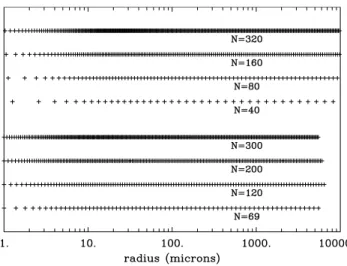
corrector technique using shorter time steps (between 0.05 and 0.5 s). To ensure that numerical results are not affected by the details of the finite difference setup, we ap-ply several grid configuration in the radius space and various time stepping intervals. All grids follow a general strategy, already applied in Morrison and Grabowski (2007), where the grid spacing is close to uniform in the range dominated by the diffusional
20
growth (say, forr smaller than 20µm) and rapidly increases in the collisional growth range to allow covering the needed range (say, up to 10 mm) with a reasonable num-ber of bins. Morrison and Grabowski (2007) applied the linear-exponential grid, with
3
ACPD
8, 14717–14763, 2008Diffusional and accretional growth of
water drops
W. W. Grabowski and L.-P. Wang
Title Page
Abstract Introduction
Conclusions References
Tables Figures
◭ ◮
◭ ◮
Back Close
Full Screen / Esc
Printer-friendly Version
Interactive Discussion
the mean radiusri (inµm) for each bini given by:
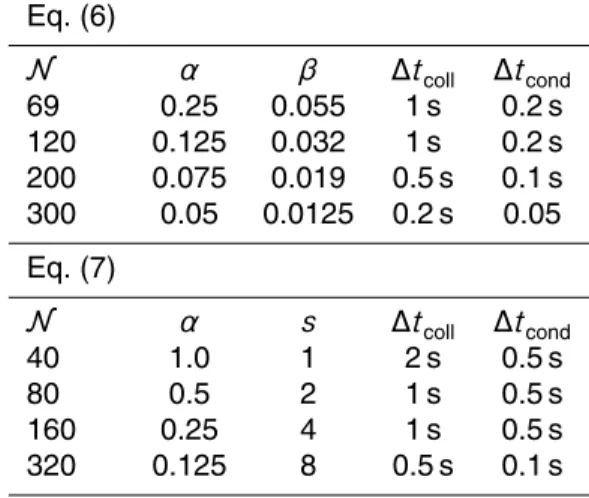
ri =(i −1)α+10(i−1)β fori =1, ...,N , (6) whereα and β are parameters (see Table 1). We also apply a linear-mass doubling grid which combines the linear grid with a grid (often used in collision/coalescence studies) where the drop mass doubles everys bins. In this case the radius ri (in µm)
5
is obtained as:
ri =(i −1)α+ 3m
i 4πρw
1/3
fori =1, ...,N , (7)
where the massmi is given by the recurrence mi/mi−1=21/s and m0 is taken as the mass of a droplet with 1-µm radius. Note that the second term on rhs of Eq. (7) needs to be converted into microns before it is added to the first term. Table 1 shows the grid
10
parameters (N, α,β, and s, as well as model time steps applied in simulations with
w=1 m s−1) for 8 grid configurations applied in this study. Figure 1 illustrates the grids. Initial conditions for all simulations are T(0)=288.16 K, p(0)=900 hPa,
qv(0)=qvs[T(0), p(0)] (i.e. S(0)=0), and φ(i)(0)=0 for i=1, ...,N. Most of the simulations are performed assuming parcel vertical velocity ofw=1 m s−1, and some
15
simulations usingw=0.2 andw=5 m s−1will be reported as well. The calculations pro-ceed until the radar reflectivity factor (the sixth moment of the droplet size distribution) reaches 30 dBz.
3 Formulation of collection kernels
The impact of turbulent collisions on warm rain initiation is evaluated by comparing
20
ACPD
8, 14717–14763, 2008Diffusional and accretional growth of
water drops
W. W. Grabowski and L.-P. Wang
Title Page
Abstract Introduction
Conclusions References
Tables Figures
◭ ◮
◭ ◮
Back Close
Full Screen / Esc
Printer-friendly Version
Interactive Discussion
The gravitational collection kernel without effects of turbulence is given by:
Ki j =E g
i j π(ri +rj) 2|vt
i −v t
j| , (8)
whereEi jg is the collision efficiency of droplets with radiiri andrj in a quiescent back-ground air, andvitandvjtare their sedimentation (terminal) velocities. Two formulations of the collision efficiencies and terminal velocities are used here. The first one follows
5
that of Long (1974) as given in Simmel et al. (2002; see Sect. 4.2.1 therein) and it will be referred to as the Long kernel. The second one applies tabulated collision efficiencies given in Hall (1980) and terminal velocities of Beard (1976) as given by Pruppacher and Klett (1997). This kernel will be referred to as the Hall kernel.
The turbulent collection kernel employed in this paper combines the analytical
pa-10
rameterization of turbulent geometric collection kernel of Ayala et al. (2008b) with the collision-efficiency enhancement factor obtained from a hybrid direct numerical simula-tion (Wang et al., 2008). Namely, the turbulent collecsimula-tion kernel is expressed as
Ki j =Ki j0Ei jg ηE , (9)
where the turbulent geometric collection kernel Ki j0 is obtained when droplet-droplet
15
local aerodynamic interaction is not considered, in which case the disturbance flows induced by other droplets are excluded when the motion of a given droplet is solved. The collision efficiency of droplets in a quiescent background airEi jgis as in Eq. (8). The ratio of turbulent collision efficiency toEi jg is represented by the relative enhancement
factorηE, see Wang et al. (2005). The geometric collection kernelKi j0 is given by the
20
following kinematic formulation (Wang et al., 2005)
Ki j0=2πR2h|wr(r =R)|igi j(r =R) , (10)
where the radial relative velocitywr is defined in terms of the center-to-center separa-tion vectorr (pointing from a droplet of radius rj to a droplet of radiusri), the velocity
Vi of theri droplet, and the velocityVj of the rj droplet as wr=r·(Vi−Vj)/r withr=|r|.
ACPD
8, 14717–14763, 2008Diffusional and accretional growth of
water drops
W. W. Grabowski and L.-P. Wang
Title Page
Abstract Introduction
Conclusions References
Tables Figures
◭ ◮
◭ ◮
Back Close
Full Screen / Esc
Printer-friendly Version
Interactive Discussion R≡ri+rj is the geometric collision radius. The additional factorgi j is the radial
distribu-tion funcdistribu-tion which measures the effect of preferential concentration on the pair number density at separationr=R. Both h|wr|iand gi j in Eq. (10) are computed without local aerodynamic interaction. The kinematic formulations (9) and (10) have been validated against dynamic collision rates from direct numerical simulations (DNS), for both ghost
5
droplets and aerodynamically-interacting droplets in a turbulent air flow, see Wang et al. (2005) and Ayala et al. (2008a).
Ayala et al. (2008b) developed parameterizations for bothh|wr|i and gi j, guided by data from DNS. It should be noted that their parameterizations consider the effects of flow Reynolds number which cannot be fully represented by the hybrid DNS. For
exam-10
ple, the parameterization forh|wr|imakes use of velocity correlations that are valid for both the dissipation subrange and the energy-containing subrange of turbulence. The intermittency of small-scale turbulent fluctuations was incorporated into the model for
gi j following Chun et al. (2005). The detailed expression forK 0
i j can be found in Ayala et al. (2008b). The enhancement factorηE is interpolated from the hybrid DNS results
15
reported in Wang et al. (2008) and depends on the flow dissipation rate. We apply the Ayala turbulent collection kernel for two dissipation rates, 100 and 400 cm2s−3, and refer to these kernels as A100 and A400, respectively.
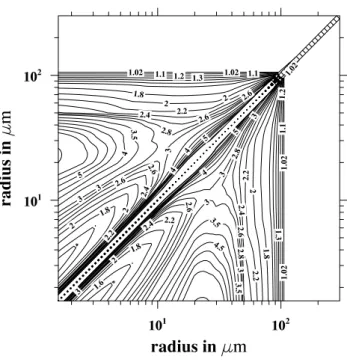
Figure 2 shows the ratio of the A400 turbulent kernel to the Hall gravitational kernel. This ratio is a product of the enhancement of geometric kernel by air turbulence and of
20
ηE (Wang et al., 2005). Several important inferences can be made from Fig. 2. First, a noticeable enhancement occurs for droplets less than 100µm. Second, the overall en-hancement is moderate with a value ranging from 1.0 to 5.0. The enen-hancement factors shown in Fig. 2 are similar to those reported recently by Pinsky and Khain (2004) and Pinsky et al. (2006), where dramatically different approaches were employed. Third,
25
ACPD
8, 14717–14763, 2008Diffusional and accretional growth of
water drops
W. W. Grabowski and L.-P. Wang
Title Page
Abstract Introduction
Conclusions References
Tables Figures
◭ ◮
◭ ◮
Back Close
Full Screen / Esc
Printer-friendly Version
Interactive Discussion
4 Results for CONTINENTAL and MARITIME conditions for w=1 m s−1
4.1 Typical evolution of microphysical properties
We start with a general overview of results obtained using the rising parcel framework, and contrasting the CONTINENTAL and MARITIME conditions. Figures 3 and 4 il-lustrate the results obtained using the Hall gravitational kernel in the CONTINENTAL
5
w=1 m s−1case and applying 120 bins. Results for other kernels are qualitatively sim-ilar and are not shown. Figure 3 shows the evolution of the temperature, water vapor mixing ratio, condensed cloud water mixing ratio, and supersaturation. As the par-cel rises, the parpar-cel temperature gradually decreases (the rate corresponds to about 5 K km−1, the moist adiabatic lapse rate at these temperatures), the water vapor
de-10
creases and the condensed water increases. The total water, the sum of the water vapor and cloud water, does not change. The supersaturation sharply increases in the initial few seconds (not captured by the temporal resolution of the plot) and then gradually decreases throughout the most of the simulation. The rapid increase of the supersaturation early in the simulation corresponds to the activation phase, when both
15
the droplet concentration and supersaturation increase until the supersaturation levels offand the activation is completed. The increase of the supersaturation toward the end of the simulation is due to reduction of the droplet concentration, when drizzle and rain-drops rapidly remove cloud droplets (the evolution of the supersaturation depends on the parcel vertical velocity and on the phase relaxation time scale, the latter inversely
20
proportional to the product of the droplet concentration and their mean radius, see for instance Clark and Hall, 1979; Eq. 2.22).
The decrease of the drop concentration toward the end of the simulation is illus-trated in Fig. 4 which shows evolution of the drop concentration, mean volume radius (the third moment of the distribution), radar reflectivity (the sixth moment), and spectral
25
ACPD
8, 14717–14763, 2008Diffusional and accretional growth of
water drops
W. W. Grabowski and L.-P. Wang
Title Page
Abstract Introduction
Conclusions References
Tables Figures
◭ ◮
◭ ◮
Back Close
Full Screen / Esc
Printer-friendly Version
Interactive Discussion
throughout most of the simulation and then rapidly in the final few minutes. Arguably, the former is due the autoconversion phase of the collisional growth, when collisions between droplets of similar sizes widen the spectrum, whereas the latter corresponds to the accretion phase of the collisional growth, when drizzle drops efficiently collect cloud droplets (Berry and Reinhardt, 1974). The mean volume radius increases
gradu-5
ally throughout the most of the simulation and quite rapidly near the end, again consis-tent with the autoconversion and accretion phases of the rain development. The radar reflectivity increases from initial values below−60 dBz to values close to−10 dBz quite gradually and then rapidly. The transition from gradual to rapid increase of the radar reflectivity will be used as one of the metrics to identify to onset of precipitation, as
10
discussed later in the paper. The spectral width of the drop spectrum is quite small, around 1µm, throughout the most of the simulation. Overall, it takes about 32 min and close to 2 km of the vertical displacement to develop radar reflectivity of 30 dBz.
Figure 5 and 6 are for the MARITIME case. Overall, the evolution of various quan-tities is similar to the CONTINENTAL case, but there are important differences. First,
15
the supersaturation peak at the activation phase is higher and the concentration of nu-cleated droplets is lower (around 90 (mg)−1). The mean volume radius increases faster since there are fewer droplets, and the rapid increase of the radar reflectivity (starting again at around−10 dBz) happens earlier in the simulation. The mean volume radius at this transition is larger than for the CONTINENTAL case (around 18 versus around
20
12µm) and the radar reflectivity of 30 dBz is reached at a lower altitude, around 1.4 km, slightly over 22 min of the parcel rise. These differences are consistent with numerous observational and modeling studies of cloud processes in continental and maritime environments.
Figures 7 and 8 show the evolution of the mass density distribution (derived from the
25
drop spectra asφ(i)qi(0)∆r(i)/log10 r(i+1/2)
ACPD
8, 14717–14763, 2008Diffusional and accretional growth of
water drops
W. W. Grabowski and L.-P. Wang
Title Page
Abstract Introduction
Conclusions References
Tables Figures
◭ ◮
◭ ◮
Back Close
Full Screen / Esc
Printer-friendly Version
Interactive Discussion
droplet sizes grown by diffusion of water vapor, the evolutions are similar. At −20 dBz (after about 8 and 4 min for CONTINENTAL and MARITIME cases) the spectra are relatively narrow, centered at about 8 and 10µm for both cases. The spectra become significantly wider at −10 dBz (25 and 12 min, respectively) due to effects of droplet collisions. This is the autoconversion phase of the collisional growth (Berry and
Rein-5
hardt, 1974). At times corresponding to subsequent radar reflectivities (0, 10, and 20 dBz), the drizzle drops (i.e. drops larger than about 100µm) appear in appreciable numbers and the concentration of diffusionally-grown droplets begins to decrease (this is more apparent in drop concentration panels of Figs. 4 and 6). This stage corre-sponds to the accretion phase of the collisional growth (Berry and Reinhardt, 1974).
10
The peak in the drizzle/raindrop part of the spectrum, developed somewhere between times corresponding to−10 and 0 dBz, begins to shift towards larger sizes, and a clear minimum separating cloud droplets and drizzle/rain drops is maintained between 30 and 40µm.
Figures 9 and 10 show evolution of the droplet growth rate separated into
conden-15
sational and collisional components, for CONTINENTAL and MARITIME conditions, respectively, and for the same simulations as Figs. 3 to 8. The collisional growth rate during the autoconversion phase (say, around−10 dBz; cf. Fig. 7 and 8) is hardly visi-ble in the figures. Comparavisi-ble growth rates for diffusional and collisional contributions occur only during the accretion phase of collisional growth, when reflectivities exceed
20
about 10 dBz.
All simulations performed in this study demonstrate features highlighted above. To facilitate comparison between various simulations, model results were compiled into several tables to document essential differences in the simulations. Some of the dif-ferences are due to numerical aspects and some are due to physical processes. The
25
discussion below aims at separating one from the other.
ACPD
8, 14717–14763, 2008Diffusional and accretional growth of
water drops
W. W. Grabowski and L.-P. Wang
Title Page
Abstract Introduction
Conclusions References
Tables Figures
◭ ◮
◭ ◮
Back Close
Full Screen / Esc
Printer-friendly Version
Interactive Discussion
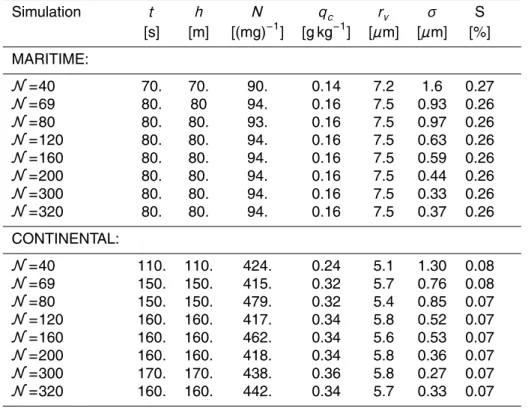
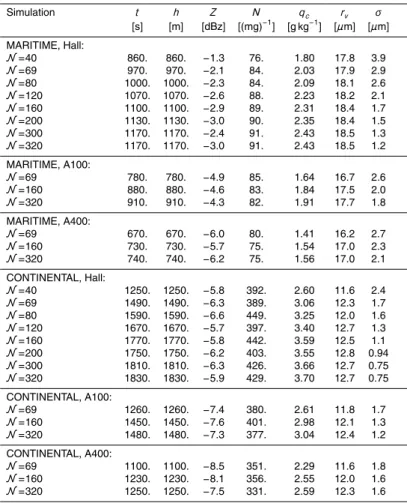
applied in the finite difference algorithm. This is illustrated in Table 2, which shows selected model results at the time when the radar reflectivity factor is at−30 dBz (i.e. soon after the activation of cloud droplets is completed) forw=1 m s−1CONTINENTAL and MARITIME cases, and applying the Hall collection kernel and various grids, with number of bins from 40 to 320 (cf. Table 1). Since the form of the collection kernel
5
is irrelevant for the activation of cloud droplets, results for all other kernels are virtu-ally the same and thus are omitted. The table shows that the −30 dBz is reached at height of about 80/160 m for the MARITIME/CONTINENTAL case. The number of activated droplets shows small dependence on the number of bins in the MARITIME case, but more significant in the CONTINENTAL case. The liquid water mixing ratios,
10
droplet mean volume radii, and supersaturations vary consistently between CONTI-NENTAL and MARITIME conditions and they weakly depend on the numerical grid applied. However, the width of the droplet spectrum, σ, decreases significantly when the number of binsN increases, from values close to 1µm for low resolution to around 0.3µm for the highest4. The dependence of σ on N is a combination of two effects:
15
(i) the dependence of the width of the droplet spectrum at the end of activation onN, and (ii) the widening of the spectrum due to smallN for subsequent diffusional growth (i.e. before the reflectivity reaches −30 dBz). By comparing the width of the droplet spectrum at the maximum supersaturation to the data shown in Table 2, it is concluded that both effects contribute to the width at−30 dBz (not shown). As one might expect,
20
this aspect has significant effect on the development of drizzle and rain as documented in the following discussion.
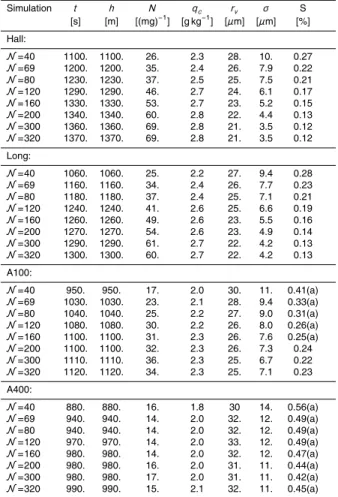
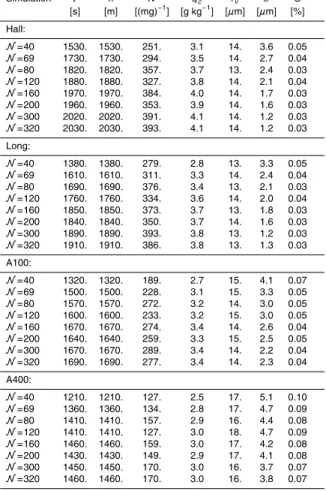
Tables 3 and 4 present selected results at the time when the radar reflectivity factor is 20 dBz (i.e. when the precipitation-size drops are already present in the parcel, see Figs. 7 and 8), again for w=1 m s−1 MARITIME and CONTINENTAL cases applying
25
various collection kernels (Hall, Long, A100, and A400). In both tables, the
develop-4
Differences between simulations using 300 and 320 bins seem inconsistent because
ACPD
8, 14717–14763, 2008Diffusional and accretional growth of
water drops
W. W. Grabowski and L.-P. Wang
Title Page
Abstract Introduction
Conclusions References
Tables Figures
◭ ◮
◭ ◮
Back Close
Full Screen / Esc
Printer-friendly Version
Interactive Discussion
ment of rain is faster for the Long kernel than for the Hall kernel, and it is the fastest for the A400 kernel. For a given kernel, the development of rain is the fastest with the lowest number of bins. For instance, for the MARITIME/CONTINENTAL cases using Hall kernel, the 20 dBz is reached after 1100/1530 s forN=40 and after 1370/2030 s forN=320, whereas for the A400 kernel corresponding numbers are 880/1210 and
5
990/1460. The dependence of the 20-dBz-timing on the collection kernel is clearly physical (e.g. see XWG08), but onN is numerical. Arguably, faster development of rain in simulations with lowN is a combination of (i) a wider droplet spectrum grown by diffusion of water vapor (resulting from both the increased width of the spectrum at the end of activation and the numerical broadening during diffusional growth due to
10
the small number of bins), and (ii) broadening of the spectrum during the growth by collision-coalescence. One can argue that the results with large number of bins (say, 200, 300, and 320) can be viewed as not far from converged solutions, that is, solutions obtained with sufficiently large number of bins. Although that might be approximately true for the timing of the precipitation development, it is not true for the droplet activation
15
as shown in Table 2. In the MARITIME case, rapid development of precipitation and washout of small cloud droplets near the end of the simulation results in an increase of the supersaturation above values encountered at the cloud base. In such cases, ad-ditional activation of cloud droplets has to take place in the parcel. All simulation with A400 kernel and more than a half in A100 kernel experience this in-cloud activation as
20
marked in Table 3.
4.2 Rain initiation and speedup due to turbulent collisions
The transition from slow to rapid increase of the radar reflectivity between −10 and 0 dBz (see Figs. 4, 6, 7 and 8) corresponds to the development of a new peak in the drop size distributions for drops with radius around 100µm (i.e., drizzle). This specific
25
ACPD
8, 14717–14763, 2008Diffusional and accretional growth of
water drops
W. W. Grabowski and L.-P. Wang
Title Page
Abstract Introduction
Conclusions References
Tables Figures
◭ ◮
◭ ◮
Back Close
Full Screen / Esc
Printer-friendly Version
Interactive Discussion
be defined as the time of the maximum second derivative (i.e. the maximum curvature) of the radar reflectivity as a function of time for the reflectivity range of−10 to 0 dBz. The motivation for using radar reflectivity as a measure of rain initiation time is the possibility of a direct comparison between model results and field observations.
The rain initiation time can also be defined based on the evolution of the growth rate
5
by collision-coalescence shown at right panels of Figs. 9 and 10. XWG08 proposed to specify the rain initiation time as the time when the autoconversion phase finishes and the accretion phase begins, and formally define the boundary between the two phases by the sudden increase of the drop radius corresponding to the maximum growth rate due to collision-coalenecence (see Figs. 13 and 14 in XWG08 and the accompanying
10
discussion). This time will be referred to as the autoconversion-accretion transition time. In the model data for low resolution (smallN), the increase of the drop radius corresponding to the maximum collisional growth rate is rather gradual, so the addi-tional condition used to define the autoconversion-accretion transition time is that the radius of the maximum has to be larger than 60µm.
15
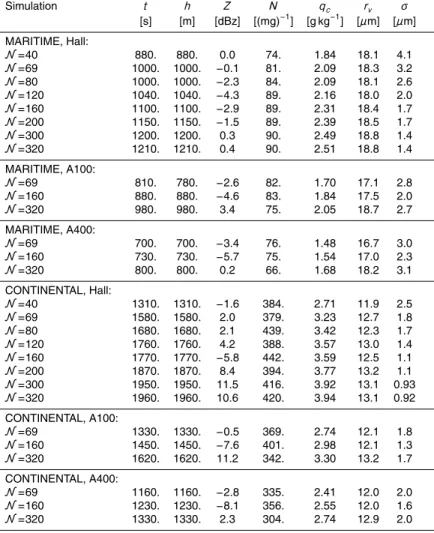
Table 5 compiles various quantities predicted by the parcel model at the radar reflec-tivity transition time, for MARITIME and CONTINENTAL cases with 1 m s−1updraft and various collection kernels. Results shown in the table are consistent with various fea-tures of parcel model results discussed already. For instance, the transition happens earlier in the MARITIME cases when compared to the corresponding CONTINENTAL
20
cases; for a given kernel and the CCN type, rain initiation is the fastest/slowest for grid configurations with small/largeN; the mean volume radius at the rain initiation time is around 18µm in MARITIME cases and around 12µm in the CONTINENTAL cases. An-other relevant features include (i) only slightly reduced drop concentration compared to the values just after activation (cf. Table 2); (ii) systematically decreasing spectral
25
associ-ACPD
8, 14717–14763, 2008Diffusional and accretional growth of
water drops
W. W. Grabowski and L.-P. Wang
Title Page
Abstract Introduction
Conclusions References
Tables Figures
◭ ◮
◭ ◮
Back Close
Full Screen / Esc
Printer-friendly Version
Interactive Discussion
ated with numerical aspects, (iii) is most likely related to significantly increased A400 collection kernel compared to gravitational kernels.
Table 6 compiles the same quantities as Table 5, but for the autoconversion-accretion transition time. In general, the results are similar to the radar reflectivity transition time, but the corresponding times (and thus heights, radar reflectivities, liquid water mixing
5
ratios, mean volume radii, and spectral widths) are larger. For the Hall gravitational kernel, the difference between corresponding heights in Table 5 and 6 is 20 to 40 m for the MARITIME case and 60 to 140 m for the CONTINENTAL case depending onN. The drop concentration is also slightly reduced. The corresponding radar reflectivity varies significantly for the CONTINENTAL case as a function ofN.
10
The rain initiation times defined above (i.e. either the radar reflectivity transition time or the autoconversion-accretion transition time) are used in the analysis of the speedup factor for turbulent collision-coalescence, defined as the ratio of the rain initiation time for the turbulent collection kernel (either A100 or A400) and the corresponding time for the Hall gravitational kernel. Before showing the turbulent speedup factors, however,
15
we first show the corresponding ratio between the radar reflectivity transition times us-ing the Long and Hall kernels. The motivation is that both the Long and Hall kernels represent different approximations for the gravitational kernel. One can argue that the Hall kernel is more accurate (e.g. because of a more accurate formulation of droplet terminal velocity or more up-to-date collision efficiency data), but the differences
be-20
tween results obtained using the two kernels can be used to assess the differences between gravitational and turbulent kernels.
Figure 11 shows the ratio of the radar reflectivity transition time for the Long and Hall kernels, for CONTINENTAL and MARITIME cases, and for simulations with differentN. Despite significant differences in the rain initiation times for variousN (factor of almost
25
ACPD
8, 14717–14763, 2008Diffusional and accretional growth of
water drops
W. W. Grabowski and L.-P. Wang
Title Page
Abstract Introduction
Conclusions References
Tables Figures
◭ ◮
◭ ◮
Back Close
Full Screen / Esc
Printer-friendly Version
Interactive Discussion
the radar reflectivity transition times) and 13 (applying the autoconversion-accretion transition times). In general, the speedup factors are quite similar using either definition of the transition time. Despite significant dependence of the rain initiation times on N, the turbulent speedup factor only weakly depends on the bin resolution. Overall, the speedup factors seem to decrease slightly with N and are slightly larger for the
5
CONTINENTAL case. The speedup factors for A100 kernel are around 0.8, and for A400 the factors are between 0.65 and 0.75.
By comparing Figs. 11, 12, and 13, one can clearly see that turbulent enhancement is significantly larger than the uncertainty associated with the formulation of the grav-itational kernel. Moreover, if results for higher N are considered more reliable, the
10
turbulent kernel corresponding to the turbulent dissipation rate of 100/400 cm2s−3can reduce the rain initiation time by about 20%/35% compared to the gravitational case in-dependent whether the radar reflectivity transition time or the autoconversion-accretion transition time is used as the rain initiation time.
5 Sensitivity simulations
15
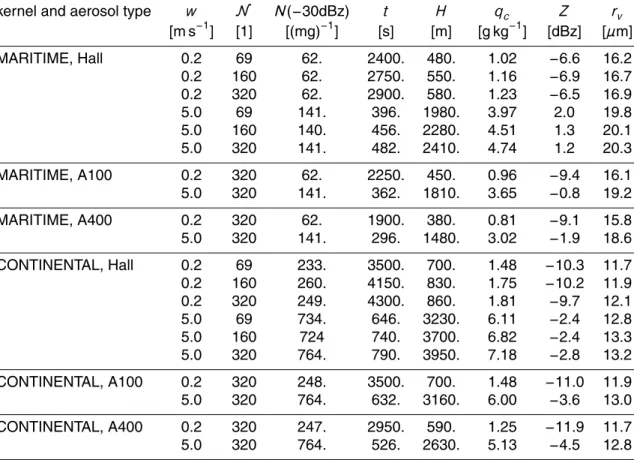
To ensure that the results discussed above are robust, a set of sensitivity simulations withw=0.2 and 5 m s−1 was executed. Table 7 presents selected results from these simulations, for both MARITIME and CONTINENTAL cases and for selected number of bins N. The table shows concentration of droplets at −30 dBz (i.e. shortly after the activation) and several quantities at the radar reflectivity transition time (the time
20
and height of the transition, liquid water mixing ratio and the mean volume radius). As expected, the concentration of droplets is significantly affected by the vertical velocity: for the MARITIME case the concentration changes from 62 to 141 (mg)−1forw of 0.2 and 5 m s−1. This has significant impact on the rain initiation which forN=320 occurs at times 2900 and 482 s (heights of 580 and 2410 m) for MARITIME cases with the
25
ACPD
8, 14717–14763, 2008Diffusional and accretional growth of
water drops
W. W. Grabowski and L.-P. Wang
Title Page
Abstract Introduction
Conclusions References
Tables Figures
◭ ◮
◭ ◮
Back Close
Full Screen / Esc
Printer-friendly Version
Interactive Discussion
(reflectivity increases from−7 to 1 dBz). For the corresponding CONTINENTAL case, the liquid water increases from 1.8 to 7.2 g kg−1and the reflectivity increases from−10 to−3 dBz. The mean volume radius at the time of the transition varies between 16 and 20µm for the MARITIME case and between 12 and 13µm for the CONTINENTAL case. It follows that the rain initiation time is a sensitive function of the parcel vertical
5
velocity, and it is a combination of different concentrations of droplets activated near the cloud base at different w (as documented in Table 7) and different times when the autoconversion phase of the collisional growth starts. As illustrated in Figs. 7 and 8, the autoconversion phase requires cloud droplets to reach radii around 10µm and reflectivities between−20 and−10 dBz.
10
Despite such a wide range of rain initiation times for variousw, the turbulent speedup factors are similar. This is illustrated in Fig. 14 which shows the speedup factors apply-ing the radar reflectivity transition times for variousw,N and either A100 or A400 tur-bulent collection kernels. As the figure shows, the speedup factors are slightly smaller for the MARITIME case and larger vertical velocities. They are between 0.75 and 0.85
15
for A100 kernel, and between 0.60 and 0.75 for the A400 kernel.
6 Discussion and conclusions
This paper discusses the impact of small-scale cloud turbulence on the development of drizzle and rain using an idealized framework of the adiabatic rising parcel. This study extends that of XWG08 where only collisional growth was considered. Here, activation
20
of cloud droplets and their diffusional growth were added, which allowed studying the impact of different collection kernels in a more realistic framework. Current study rep-resents an intermediate step toward the evaluation of the impact of cloud turbulence using a dynamic cloud model. Results applying two formulations of the gravitational collection kernel were compared to results with turbulent kernels for eddy dissipation
25
ACPD
8, 14717–14763, 2008Diffusional and accretional growth of
water drops
W. W. Grabowski and L.-P. Wang
Title Page
Abstract Introduction
Conclusions References
Tables Figures
◭ ◮
◭ ◮
Back Close
Full Screen / Esc
Printer-friendly Version
Interactive Discussion
bins resulting in a more rapid development of drizzle and rain. This was shown to be a combination of three effects. First, the width of the spectrum immediately after the ac-tivation (i.e. after the maximum supersaturation) significantly depends on the number of bins applied, with lower number of bins resulting in wider activation spectra. To the authors’ knowledge this significant aspect has not been noticed previously despite the
5
fact that such a simple and computationally efficient approach is often used in bin mi-crophysics models. Second, representation of diffusional growth suffers from numerical widening of the spectra when the number of bins for radii below, say, 20µm is small. Arguably this artificial widening helps to initiate and accelerates the autoconversion phase of the collisional growth. Finally, small number of bins can also affect collisional
10
growth, for instance, through an earlier transition to the accretion phase, when both cloud droplets and drizzle drops coexist. Despite these numerical issues, the estimate of the turbulent speedup factor, the ratio between the rain initiation times for turbulent and gravitational kernels, appears to be only weakly dependent on the number of bins applied in numerical simulations. It also depends weakly on the vertical velocity of the
15
adiabatic parcel and characteristics of the CCN.
The turbulent speedup factor obtained in current simulations is between 0.75 and 0.85 for the turbulence intensity of 100 cm2s−3 and and between 0.60 and 0.75 for 400 cm2s−3. As explained above, these ranges come from a weak dependence on the number of bins used in the model and on the parcel updraft velocity. The speedup
20
factors obtained here are smaller than those reported in XWG08. The fact that current results show smaller accelerations of rain initiation is expected because current calcu-lations include not only collisional growth, but also droplet activation and the diffusional growth. Since collisional growth is inefficient for droplet radii smaller than 10µm, con-siderable time is spent with mostly diffusional growth before autoconversion phase of
25
the collisional growth is initiated.
ACPD
8, 14717–14763, 2008Diffusional and accretional growth of
water drops
W. W. Grabowski and L.-P. Wang
Title Page
Abstract Introduction
Conclusions References
Tables Figures
◭ ◮
◭ ◮
Back Close
Full Screen / Esc
Printer-friendly Version
Interactive Discussion
Albrecht, 1994; Moeng, 2000; Siebesma et al., 2003) and the adiabatic parcel model provides an oversimplified representation of microphysical processes in such clouds. Entrainment has an important and still poorly understood effect on the spectra of cloud droplets. It has been argued to significantly widen the spectra, for instance, through the mixing of parcels with different degree of dilution and thus different reductions of
5
the liquid water content and the mean droplet size. This is why applying an entrain-ing parcel model to quantify the acceleration of the warm rain initiation would not be a robust approach either. Moreover, since the number of activated droplets depends on the strength of the cloud-base updraft, and the updraft can vary significantly across the cloud base, mixing of adiabatic parcels above the cloud base can result in some
widen-10
ing of the adiabatic spectra as well. All these factors result in cloud droplet spectra that are typically significantly wider than those predicted by the adiabatic parcel model (e.g. Brenguier and Chaumat, 2001, and references therein; Pawlowska et al., 2006). One can also argue that the combination of adiabatic water contents and relatively high levels of cloud turbulence considered here is not realistic either. There seems to be
15
considerable evidence from in-situ aircraft observations that high turbulence is typically found in mixing regions where the liquid water contents are considerably below adia-batic. Finally, once formed, drizzle and rain drops have appreciable terminal velocities and they fall out of the parcel before the reflectivity reaches 10 or 20 dBz level. The latter is why the two-dimensional kinematic framework is perhaps more appropriate as
20
argued in Morrison and Grabowski (2007). Nevertheless, the adiabatic parcel model clearly demonstrates that turbulent collisions can accelerate the development of rain significantly.
One of the goals of this study was to access the number of bins required in the bin microphysics framework before such an approach is used in a dynamic cloud model,
25
ACPD
8, 14717–14763, 2008Diffusional and accretional growth of
water drops
W. W. Grabowski and L.-P. Wang
Title Page
Abstract Introduction
Conclusions References
Tables Figures
◭ ◮
◭ ◮
Back Close
Full Screen / Esc
Printer-friendly Version
Interactive Discussion
narrow droplet spectra shortly after activation. Overall, the dependence of the width of the droplet spectra after activation on the number of bins is unexpected. As shown in this paper (and in many previous studies), such a simple scheme results in a realistic prediction of the total number of activated droplets. To predict the width of the activated spectrum, however, a modified approach is needed, for instance, assuming the
activa-5
tion spectrum as in Kogan (1991, Sect. 2b1). Activation of cloud droplets is a difficult problem because it involves detailed physical and chemical characteristics of aerosol particles and, to be treated with confidence, it requires model grid reaching sizes well below 1µm and significant number of bins (see, for instance, the discussion in Srivas-tava, 1991). However, extending the model grid into droplets significantly smaller than
10
1µm requires extremely small time steps and most likely cannot be considered for a dynamic model. Moreover, limitations due to spatial resolution of the cloud model need to be considered as well (see discussion in Sect. 4 of Morrison and Grabowski, 2008). We are currently investigating alternative approaches to represent droplet activation in a bin microphysics model of the type used here. The overall goal is to predict activation
15
spectra similar to those obtained in high resolution droplet activation models and in ob-servations. Results of this investigation as well as investigations of rain development and its acceleration due to cloud turbulence using a cloud model with bin microphysics will be reported in future publications.
Acknowledgements. This work was supported by the National Science Foundation (NSF)
un-20
der grants ATM-0114100 and ATM-0527140. W. W. Grabowski acknowledges additional sup-port from NOAA grant NA05OAR4310107. L.-P. Wang also acknowledges supsup-port by the NSF Grant No. PHY05-51164 through Kavli Institute for Theoretical Physics at UCSB, and by National Natural Science Foundation of China (Project No. 10628206). Comments on the manuscript by Charlie Knight, Hugh Morrison, and Knut von Salzen are acknowledged. The
25
ACPD
8, 14717–14763, 2008Diffusional and accretional growth of
water drops
W. W. Grabowski and L.-P. Wang
Title Page
Abstract Introduction
Conclusions References
Tables Figures
◭ ◮
◭ ◮
Back Close
Full Screen / Esc
Printer-friendly Version
Interactive Discussion
References
Ayala, O., Rosa, B., Wang, L.-P., and Grabowski, W. W.: Effects of turbulence on the geometric collision rate of sedimenting droplets: Part 1. Results from direct numerical simulation, New J. Physics, in press, 2008a.
Ayala, A., Rosa, B., and Wang, L.-P.: Effects of turbulence on the geometric collision rate of
5
sedimenting droplets: Part 2. Theory and parameterization, New J. Physics, in press, 2008b. Beard, K. V.: Terminal velocity and shape of cloud and precipitation drops aloft, J. Atmos. Sci.,
33, 851–864, 1976.
Berry, E. X. and Reinhardt, R. L.: An analysis of cloud drop growth by collection: Part I. Double distributions, J. Atmos. Sci., 31, 1814–1824, 1974.
10
Blyth, A. M.: Entrainment in cumulus clouds, J. Appl. Meteor., 32, 626–640, 1993.
Bott, A.: A flux method for the numerical solution of the stochastic collection equation, J. Atmos. Sci., 55, 2284–2293, 1998.
Brenguier, J.-L. and Chaumat, L.: Droplet spectra broadening in cumulus clouds. Part I: Broad-ening in adiabatic cores. framework, J. Atmos. Sci., 58, 628–641, 2001.
15
Chun, J., Koch, D., Rani, S. L., Ahluwalia, A., and Collins, L. R.: Clustering of aerosol particles in isotropic turbulence, J. Fluid Mech., 536, 219–251, 2005.
Clark, T. L.: On modelling nucleation and condensation theory in Eulerian spatial domain, J. Atmos. Sci., 31, 2099–2117, 1974.
Clark, T. L. and Hall, W. D.: A numerical experiment on stochastic condensation theory, J.
20
Atmos. Sci., 36, 470–483, 1979.
Falkovich, G., Fouxon, A., and Stepanov, M. G.: Acceleration of rain initiation by cloud turbu-lence, Nature, 419, 151–154, 2002.
Ghosh, S., Davila, J., Hunt, J. C. R., Srdic, A., Fernando, H. J. S., and Jonas, P.: How turbulence enhances coalescence of settling particles with applications to rain in clouds, Proc. Roy. Soc.
25
London, 461A, 3059–3088, 2005.
Grabowski, W. W.: Numerical experiments on the dynamics of the cloud-environment interface: small cumulus in a shear-free environment, J. Atmos. Sci., 46, 3513–3541, 1989.
Hall, W. D.: A detailed microphysical model within a two-dimensional framework: Model de-scription and preliminary results, J. Atmos. Sci., 37, 2486–2507, 1980.
30
ACPD
8, 14717–14763, 2008Diffusional and accretional growth of
water drops
W. W. Grabowski and L.-P. Wang
Title Page
Abstract Introduction
Conclusions References
Tables Figures
◭ ◮
◭ ◮
Back Close
Full Screen / Esc
Printer-friendly Version
Interactive Discussion
Liu, Y. and Daum, P. H.: Spectral dispersion of cloud droplet size distributions and the parame-terization of cloud droplet effective radius, Geophys. Res. Lett., 27, 1903–1906, 2000. Long, A. B.: Solutions to the droplet collection equation for polynomial kernels, J. Atmos. Sci.,
31, 1040–1052, 1974.
Moeng, C.-H.: Entrainment rate, cloud fraction, and liquid water path of PBL stratocumulus
5
clouds, J. Atmos. Sci., 57, 3627–3643, 2000.
Morrison, H. and Grabowski, W. W.: Comparison of bulk and bin warm rain microphysics mod-els using a kinematic framework, J. Atmos. Sci., 64, 2839–2861, 2007.
Morrison, H. and Grabowski, W. W.: Modeling supersaturation and subgrid-scale mixing with two-moment bulk warm microphysics, J. Atmos. Sci., 65, 792–812, 2008.
10
Paluch, I. R. and Baumgardner, D. G.: Entrainment and fine-scale mixing in a continental convective cloud, J. Atmos. Sci., 46, 261–278, 1989.
Pawlowska, H., Grabowski, W. W., and Brenguier, J. L.: Observations of the
width of cloud droplet spectra in stratocumulus, Geophys. Res. Lett., 33, L19810, doi:10.1029/2006GL026841, 2006.
15
Pinsky, M. B. and Khain, A. P.: Turbulence effects on droplet growth and size distribution in clouds – A review, J. Aerosol Sci., 28, 1177–1214, 1997.
Pinsky, M. B. and Khain, A. P.: Effects of in-cloud nucleation and turbulence on droplet spectrum formation in cumulus clouds, Q. J. Roy. Meteorol. Soc., 128, 501–533, 2002.
Pinsky, M. B. and Khain, A. P.: Collisions of small drops in a turbulent flow. Part II: Effects of
20
flow accelerations, J. Atmos. Sci., 61, 1926–1939, 2004.
Pinsky, M. B., Khain, A. P., Grits, B., and Shapiro, M.: Collisions of small drops in a turbulent flow. Part III: Relative droplet fluxes and swept volumes, J. Atmos. Sci., 63, 2123–2139, 2006.
Pruppacher, H. R. and Klett, J. D.: Microphysics of Clouds and Precipitation, Kluwer Academic,
25
954 pp, 1997.
Rauber, R. M., Stevens, B., Ochs, H. T., et al.: Rain in Shallow Cumulus Over the Ocean: The RICO Campaign, B. Am. Meteorol. Soc., 88, 1912–1928, 2007.
Riemer, N. and Wexler, A. S.: Droplets to drops by turbulent coagulation, J. Atmos. Sci., 62, 1962–1975, 2005.
30
Siebesma, A. P., Bretherton, C. S., Brown, A., et al.: A large eddy simulation intercomparison study of shallow cumulus convection, J. Atmos. Sci., 60, 1201–1219, 2003.
ACPD
8, 14717–14763, 2008Diffusional and accretional growth of
water drops
W. W. Grabowski and L.-P. Wang
Title Page
Abstract Introduction
Conclusions References
Tables Figures
◭ ◮
◭ ◮
Back Close
Full Screen / Esc
Printer-friendly Version
Interactive Discussion
equation – comparison of the Linear Discrete Method with other methods, Atmos. Res., 61, 135–148, 2002.
Smolarkiewicz, P. K.: A fully multidimensional positive definite advection transport algorithm with small implicit diffusion, J. Comput. Phys., 54, 325–362, 1984.
Srivastava, R. C.: Growth of cloud drops by condensation: Effect of surface tension on the
5
dispersion of drop sizes, J. Atmos. Sci., 48, 1596–1605, 1991.
Stevens, B., Feingold, G., Cotton, W. R., and Walko, R. L.: Elements of the microphysical structure of numerically simulated nonprecipitating stratocumulus, J. Atmos. Sci., 53, 980– 1006, 1996.
Twomey, S.: The nuclei of natural cloud formation part II: The supersaturation in natural clouds
10
and the variation of cloud droplet concentration, Pure Appl. Geophys., 43, 243–249, 1959. Wang, L. P., Ayala, O., Kasprzak, S. E., and Grabowski, W. W.: Theoretical formulation of
col-lision rate and colcol-lision efficiency of hydrodynamically-interacting cloud droplets in turbulent atmospheres, J. Atmos. Sci., 62, 2433–2450, 2005.
Wang, L. P., Ayala, O., Xue, T., and Grabowski, W. W.: Comments on “Droplets to drops by
15
turbulent coagulation” by Riemer and Wexler, J. Atmos. Sci., 63, 2397–2401, 2006.
Wang, L.-P., Ayala, O., Rosa, B., and Grabowski, W. W.: Turbulent collision efficiency of cloud droplets, New J. Physics, in press, 2008.
Wang, Q. and Albrecht, B. A.: Observations of cloud-top entrainment in marine stratocumulus clouds, J. Atmos. Sci., 51, 1530–1547, 1994.
20
ACPD
8, 14717–14763, 2008Diffusional and accretional growth of
water drops
W. W. Grabowski and L.-P. Wang
Title Page
Abstract Introduction
Conclusions References
Tables Figures
◭ ◮
◭ ◮
Back Close
Full Screen / Esc
Printer-friendly Version
Interactive Discussion
Table 1. Grid formulation parameters and time steps for collisional (∆tcoll) and condensational
(∆tcond) growth for the case ofw=1 m s−1.
Eq. (6)
N α β ∆tcoll ∆tcond
69 0.25 0.055 1 s 0.2 s
120 0.125 0.032 1 s 0.2 s
200 0.075 0.019 0.5 s 0.1 s
300 0.05 0.0125 0.2 s 0.05
Eq. (7)
N α s ∆tcoll ∆tcond
40 1.0 1 2 s 0.5 s
80 0.5 2 1 s 0.5 s
160 0.25 4 1 s 0.5 s
ACPD
8, 14717–14763, 2008Diffusional and accretional growth of
water drops
W. W. Grabowski and L.-P. Wang
Title Page
Abstract Introduction
Conclusions References
Tables Figures
◭ ◮
◭ ◮
Back Close
Full Screen / Esc
Printer-friendly Version
Interactive Discussion
Table 2. Selected model results at−30 dBz for MARITIME and CONTINENTAL cases,
vari-ous grid resolutions, and Hall gravitational kernel. The columns show grid resolutionN, time elapsedtand heighthof −30 dBz level, drop concentrationN, liquid water contentqc, mean volume radiusrv, standard deviation of the drop spectrumσ, and supersaturationS.
Simulation t h N qc rv σ S
[s] [m] [(mg)−1] [g kg−1] [µm] [µm] [%]
MARITIME:
N=40 70. 70. 90. 0.14 7.2 1.6 0.27
N=69 80. 80 94. 0.16 7.5 0.93 0.26
N=80 80. 80. 93. 0.16 7.5 0.97 0.26
N=120 80. 80. 94. 0.16 7.5 0.63 0.26
N=160 80. 80. 94. 0.16 7.5 0.59 0.26
N=200 80. 80. 94. 0.16 7.5 0.44 0.26
N=300 80. 80. 94. 0.16 7.5 0.33 0.26
N=320 80. 80. 94. 0.16 7.5 0.37 0.26
CONTINENTAL:
N=40 110. 110. 424. 0.24 5.1 1.30 0.08
N=69 150. 150. 415. 0.32 5.7 0.76 0.08
N=80 150. 150. 479. 0.32 5.4 0.85 0.07
N=120 160. 160. 417. 0.34 5.8 0.52 0.07
N=160 160. 160. 462. 0.34 5.6 0.53 0.07
N=200 160. 160. 418. 0.34 5.8 0.36 0.07
N=300 170. 170. 438. 0.36 5.8 0.27 0.07
ACPD
8, 14717–14763, 2008Diffusional and accretional growth of
water drops
W. W. Grabowski and L.-P. Wang
Title Page
Abstract Introduction
Conclusions References
Tables Figures
◭ ◮
◭ ◮
Back Close
Full Screen / Esc
Printer-friendly Version
Interactive Discussion
Table 3. Selected model results at 20 dBz for MARITIME case with various kernels and grid
resolutions. The data as in Table 2. The symbol (a) in the last column identifies simulations with additional activation of cloud droplets toward the end of the simulation.
Simulation t h N qc rv σ S
[s] [m] [(mg)−1] [g kg−1] [µm] [µm] [%]
Hall:
N=40 1100. 1100. 26. 2.3 28. 10. 0.27
N=69 1200. 1200. 35. 2.4 26. 7.9 0.22
N=80 1230. 1230. 37. 2.5 25. 7.5 0.21
N=120 1290. 1290. 46. 2.7 24. 6.1 0.17
N=160 1330. 1330. 53. 2.7 23. 5.2 0.15
N=200 1340. 1340. 60. 2.8 22. 4.4 0.13
N=300 1360. 1360. 69. 2.8 21. 3.5 0.12
N=320 1370. 1370. 69. 2.8 21. 3.5 0.12
Long:
N=40 1060. 1060. 25. 2.2 27. 9.4 0.28
N=69 1160. 1160. 34. 2.4 26. 7.7 0.23
N=80 1180. 1180. 37. 2.4 25. 7.1 0.21
N=120 1240. 1240. 41. 2.6 25. 6.6 0.19
N=160 1260. 1260. 49. 2.6 23. 5.5 0.16
N=200 1270. 1270. 54. 2.6 23. 4.9 0.14
N=300 1290. 1290. 61. 2.7 22. 4.2 0.13
N=320 1300. 1300. 60. 2.7 22. 4.2 0.13
A100:
N=40 950. 950. 17. 2.0 30. 11. 0.41(a)
N=69 1030. 1030. 23. 2.1 28. 9.4 0.33(a)
N=80 1040. 1040. 25. 2.2 27. 9.0 0.31(a)
N=120 1080. 1080. 30. 2.2 26. 8.0 0.26(a)
N=160 1100. 1100. 31. 2.3 26. 7.6 0.25(a)
N=200 1100. 1100. 32. 2.3 26. 7.3 0.24
N=300 1110. 1110. 36. 2.3 25. 6.7 0.22
N=320 1120. 1120. 34. 2.3 25. 7.1 0.23
A400:
N=40 880. 880. 16. 1.8 30 14. 0.56(a)
N=69 940. 940. 14. 2.0 32. 12. 0.49(a)
N=80 940. 940. 14. 2.0 32. 12. 0.49(a)
N=120 970. 970. 14. 2.0 33. 12. 0.49(a)
N=160 980. 980. 14. 2.0 32. 12. 0.47(a)
N=200 980. 980. 16. 2.0 31. 11. 0.44(a)
N=300 980. 980. 17. 2.0 31. 11. 0.42(a)
ACPD
8, 14717–14763, 2008Diffusional and accretional growth of
water drops
W. W. Grabowski and L.-P. Wang
Title Page
Abstract Introduction
Conclusions References
Tables Figures
◭ ◮
◭ ◮
Back Close
Full Screen / Esc
Printer-friendly Version
Interactive Discussion
Table 4. As Table 3, but for the CONTINENTAL case.
Simulation t h N qc rv σ S
[s] [m] [(mg)−1] [g kg−1] [µm] [µm] [%]
Hall:
N=40 1530. 1530. 251. 3.1 14. 3.6 0.05
N=69 1730. 1730. 294. 3.5 14. 2.7 0.04
N=80 1820. 1820. 357. 3.7 13. 2.4 0.03
N=120 1880. 1880. 327. 3.8 14. 2.1 0.04
N=160 1970. 1970. 384. 4.0 14. 1.7 0.03
N=200 1960. 1960. 353. 3.9 14. 1.6 0.03
N=300 2020. 2020. 391. 4.1 14. 1.2 0.03
N=320 2030. 2030. 393. 4.1 14. 1.2 0.03
Long:
N=40 1380. 1380. 279. 2.8 13. 3.3 0.05
N=69 1610. 1610. 311. 3.3 14. 2.4 0.04
N=80 1690. 1690. 376. 3.4 13. 2.1 0.03
N=120 1760. 1760. 334. 3.6 14. 2.0 0.04
N=160 1850. 1850. 373. 3.7 13. 1.8 0.03
N=200 1840. 1840. 350. 3.7 14. 1.6 0.03
N=300 1890. 1890. 393. 3.8 13. 1.2 0.03
N=320 1910. 1910. 386. 3.8 13. 1.3 0.03
A100:
N=40 1320. 1320. 189. 2.7 15. 4.1 0.07
N=69 1500. 1500. 228. 3.1 15. 3.3 0.05
N=80 1570. 1570. 272. 3.2 14. 3.0 0.05
N=120 1600. 1600. 233. 3.2 15. 3.0 0.05
N=160 1670. 1670. 274. 3.4 14. 2.6 0.04
N=200 1640. 1640. 259. 3.3 15. 2.5 0.05
N=300 1670. 1670. 289. 3.4 14. 2.2 0.04
N=320 1690. 1690. 277. 3.4 14. 2.3 0.04
A400:
N=40 1210. 1210. 127. 2.5 17. 5.1 0.10
N=69 1360. 1360. 134. 2.8 17. 4.7 0.09
N=80 1410. 1410. 157. 2.9 16. 4.4 0.08
N=120 1410. 1410. 127. 3.0 18. 4.7 0.09
N=160 1460. 1460. 159. 3.0 17. 4.2 0.08
N=200 1430. 1430. 149. 2.9 17. 4.1 0.08
N=300 1450. 1450. 170. 3.0 16. 3.7 0.07