with a Reading Deficit in a Psychiatric Hospital Setting
Michelle Dowd
1,
Diane Vickers
2, Joaquim Rosario
3, Stephanie Peck Peterson
4,
T. F. McLaughlin
51Gonzaga University, East 502 Boone Avenue Spokane, WA 99258-0025
2Gonzaga University, East 502 Boone Avenue Spokane, WA 99258-0025
4Western Michigan University, Department of Psychology Kalamazoo, MI
5Gonzaga University, East 502 Boone Avenue Spokane, WA 99258-0025
Abstract – The purpose of the research was to carry out a component analysis of assisted reading. A third grade student with a reading deficit who was attending an impatient psychiatric classroom setting was the participant. Data were collected from the student's oral reading. The measures gathered were percent correct, errors per minute, and the percent of comprehension questions correctly answered from the passages from the classroom reading text. The component analysis of assisted reading was evaluated in an ABCBDBEB single case design. The results indicated improvements in number of words read correctly, decreases as well as in comprehension when the total components of assisted reading were employed. Errors were low but increased when the various components of assisted reading were removed. The results of the component analysis, indicated that for this child, the auditory and repeated readings components were essential for comprehension as well as improvements in correct oral reading and reductions in errors. When the researchers removed the visual module, the results in comprehension were only slightly affected. The strengths and weaknesses in the present analysis are listed. The practicality of the procedures for use in the classroom and areas of future research are discussed.
Key Words – Assisted Reading, Component Analysis, reading Comprehension, reading fluency, reading errors
1
Introduction
technology, reading is a necessary requirement for acquiring and maintaining employable skills. Several authors have commented on the importance teaching reading with evidence-based procedures
in today’s schools (Carnine, Silbert, Kameenui, & Tarver, 2004; Chambers et al., 2004). Reading failure has been described as being the most serious educational problems by The National Advisory Committee on Dyslexia and Related Disorders (Lerner & Kline, 2006) and U.S. federal government (National Reading Panel 2000; National Research Council 1998). Reading problems in students with and without disabilities have aroused considerable interest among professionals who are concerned with early identification of the problem and effective remediation (Carnine et al., 2004; Mercer & Pullen, 2008).
Accurate word identification is an obvious skill that is necessary for successful reading. However, some research has indicated that accurate word identification is not sufficient for reading comprehension (Cunningham, 1979; Laberge & Samuels, 1974). To facilitate reading comprehension, it is important for students to demonstrate automaticity of decoding, which results in fluent reading. Cunningham (1979) suggested that assisted reading is one technique that can effectively improve reading fluency.
Heckelman (1969) first demonstrated the effectiveness of assisted reading using what he termed the "neurological impress method." Using this method, the student sits side by side with his or her teacher while decoding reading passages. The teacher's finger passes under the words as he or she reads the words directly into the ear of the student. The student is required to follow the teacher's finger and read along with the teacher. Although Lorenz (1979) suggested that this procedure might hold promise for students with learning disabilities, he cautioned that the impress method would most likely be less effective with children who have auditory learning disabilities because of the method's dependence on the auditory modality.
Hollingsworth (1970, 1978) felt that the neurological impress method was too time-consuming for
teachers because it required one-on-one teacher attention. Therefore, he adapted the procedure using
tape recorders and headsets. Using Hollingsworth's (1970, 1978) method, students are required to listen to a pre-recorded passage and to read aloud into their own microphones. Using individual
headsets, the student listens to his or her own voice along with the pre-recorded voice.
Chomsky (1976) also reported success in improving reading skills in young children who did not learn reading skills with traditional methods of instruction. In this study, the students listened to a pre
-recorded passage multiple times, while following along either silently or orally. This procedure was repeated until the students could orally read the passage fluently without audio support. The children not only became fluent with the selected passage, but they required fewer listenings for fluency with each successive passage.
Holmes and McLaughlin (1987) employed assisted reading techniques with three fourth-grade
students who were having reading difficulty. In this study, the teacher recorded passages from the children's basal readers on audiocassettes. The students listened to the tapes and followed along silently. The procedure was repeated for three days, after which the students read the same passage for 1 minute. This resulted in a decrease in student errors and increased correct rates in all three students.
Van Wagenen, Williams, and McLaughlin (1994) replicated the results of Holmes and McLaughlin (1987) with three Spanish-speaking students who were learning English as a second language (ESL).
reading) and performance feedback to improve the fluency and comprehension with four students with behavior disorders in a special day school. They found increased fluency with three of the four students and improved literal and inferential comprehension with assisted reading and performance feedback. Thus, these studies demonstrated that assisted reading programs can be used successfully with non-English speaking students as well as with students who are English speaking.
Carbo (1978) also utilized teacher-made audiotapes to increase reading fluency for students with
learning disabilities. However, in this study the audiotapes were developed from teacher made passages, rather than from commercially prepared textbooks, in order to modify the length and difficulty of the passages according to the reading skills of the student. Thus, this study demonstrated that assisted-reading techniques can be useful with students who have learning disabilities. However,
because this study used specially-designed teacher made materials, it is unclear whether these
procedures would have been equally effective using the students' regular basal readers. It is possible that the improvement in reading fluency was due to the fact that adapted materials were used with the students, rather than the use of assisted-reading techniques.
Sherman, McLaughlin, Derby, and Johnson (2009) employed an assisted reading program using a computer-based program with a single middle school student with learning disabilities. The outcomes
evaluated with an ABABA design indicated that decreases in time to read passages, improvements in comprehension, with a reduction in errors.
The purpose of this study was to identify the critical components of an assisted reading package for a third-grade student with reading deficits. First, the passages from stories in the participant's classroom
text were identified for intervention. Next, an assisted reading package, which consisted of the identified material was read to the student by one of the researchers who read the passage the first time through and then reading aloud with the researcher while following along with his/her finger. The students then read the passage aloud once, and three more times silently. Finally, the student was required to read the passage aloud in to an audio recorder for later analysis. In the present study, we used a component analysis procedure (Wacker, Steege, Northrup et al., 1990) to systematically test the significance of each component of the assisted reading method. The results of the component analysis on both reading fluency and comprehension were analyzed.
2
Method
2.1 Participant and Setting
The participant was an elementary school student who was an inpatient at a psychiatric center for children and adolescents, located in a major medical center in the Pacific Northwest. The subject was 9-years-old and had attended third grade in his local school district. Based the participant's test scores
from the Woodcock Johnson Psycho-educational Battery (Woodcock & Johnson, 1977) he was
performing at a half year below grade level in reading. From the WISC-R, the participant was of
average intellectual ability of 100 when it was administered two months prior to data collection.
The setting for the study was a psychiatric unit that provided a classroom setting for inpatients during their stay at the center. The length of stays ranged from 30 to 45 calendar days. There were an average of 6 to 8 students in the classroom at one time. The students receive individual instruction in basic academic skills, such as, reading, spelling, math, and handwriting. The classroom was staffed by two certified teachers and from one to two practicum students from a local university.
comprehension questions were taken from the text and were listed at the end of each story. The number of questions varied according to the particular passage. A Fry readability of the reading materials was found to be at the third grade second month level.
2.2 Dependent Measures and Measurement Procedures
The target behaviors were the percentage of words read correctly per session, error per minute, and comprehension. A correct word was defined as, a word read without any mispronunciations of the whole word or word parts. The percentage of words read correctly per session was measured by dividing the total number of correctly read words by the total number of correct and error words. Errors were measured by counting the number of errors which included: (1) insertion of extra words, (2) omissions of words or word parts, (3) mispronunciations of whole words or word parts, (4) word or sound reversals, and (S) substitutions of words or word parts. Mispronunciations attributed to speech impediment, repetitions, and self-corrections were not counted as errors. The number of errors was
divided by time to determine the number of errors per minute.
Comprehension was evaluated as the percent correct on the comprehension questions at the end of each passage. There was an average of eight comprehension questions asked over each passage. These were written to assess the student's retention of the material read. These questions varied from straight recall, sequence, or vocabulary items.
Data were collected via the student's audio recording of the passage. Each session lasted approximately four minutes. Each individual researcher calculated the correct reading rate, error rate, and reading comprehension for each session.
2.3 Experimental Design and Conditions
The component analysis was implemented within a reversal design ABCBDBEB (Barlow, Nock, & Hersen, 2008; Kazdin, 1982). This design was employed to evaluate the effects of the removing each of these three components of assisted reading (e. g. auditory, repeats, and the visual model). Each of the components was evaluated separately by systematically removing them one at a time, and analyzing their effects independently. A description of the various phases follows.
Baseline (BL). The reading material was taken from the student’s classroom reader, entitled Stories
for Children. Baseline instruction consisted of the reading instruction typically used in the classroom
to teach reading skills. This included the researchers introducing and discussing new vocabulary words within the assigned section and having the student practice reading the designated passage silently. The student then read the passage into the cassette recorder. After reading the assigned passage, the student completed the comprehension questions that accompanied each passage. No feedback was given to the student on his overall performance.
experiment and it always followed either baseline or an assisted reading condition where a component had been removed. It was employed for a total of 12 sessions.
Assisted reading minus auditory (AR-A). During this phase, the auditory component of the assisted
reading package was removed. This entailed the omittance of modeling the assigned passage for the student. Therefore, the student was asked to independently read the passage both silently and aloud. This was in effect for three sessions.
Assisted reading minus repeats (AR-R). During this phase, the researchers omitted the repeated
reading component of the assisted reading package. This entailed the omittance of the subject being able to reread the passage silently three times before reading aloud for the second time. This was in effect for three sessions.
Assisted reading minus visual (AR-V). During this phase the researchers omitted the visual module
component of the assisted reading package. This entailed the omittance of the subject being able to see and follow along with the passage while the researchers read aloud. This was in effect for three sessions.
2.4 Interobserver Agreement and Reliability of Measurement
Interobserver checks were made three times during baseline and five times during each component of assisted reading. For words read correctly, and errors, an agreement was scored if both observers recorded the word as either correct or incorrect. A disagreement was scored if one observer recorded a word as incorrect and the other scored the same word as correct, or vice versa. For comprehension questions, both observers had to score the answer in the same manner. Any disagreement was scored as an error. Interobserver agreement was calculated by dividing the number of agreements by the number of agreements plus disagreements and multiplying by 100. Interobserver agreement for words read correctly was 96% (range 88 to100%). Interobserver agreement for error rate was 96% (range 88% to 100%). Interobserver agreement for the percent correct for comprehension questions was 100%. Data as to the implementation of the various experimental manipulations were taken from the audio-tapes and from the research verification form (McLaughlin, B. Williams, R. Williams, Peck,
Derby, Bjordahl, & Weber, 1999) completed by the classroom teachers. Reliability as to the fidelity of the independent variables was 100%.
3
Results
3.1 Percent of Words Read Correctly
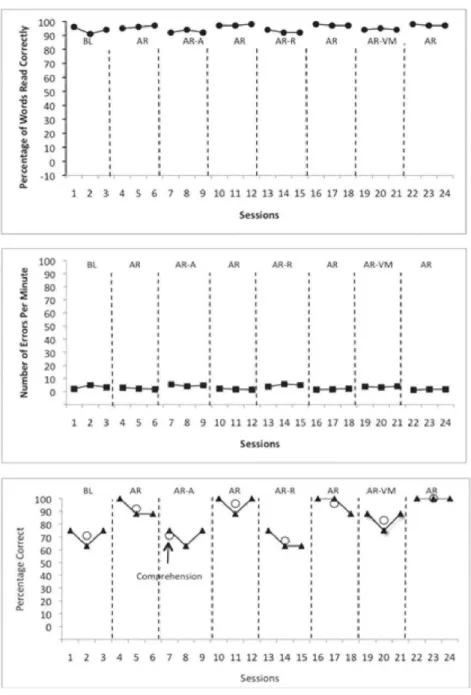
Figure 1: The percent of words read correctly (upper panel), errors per minute (middle panel), and comprehension (lower panel) during the various experimental conditions BL = baseline; AR = assisted reading; AR-A = Assisted reading minus auditory; AR = assisted reading;
AR-R = Assisted reading minus repeats, AR = assisted reading; AR-VM= Assisted
Reading minus visual; and AR = assisted reading. Open circles represent condition means for comprehension.
3.2 Errors Per Minute
errors (M = 1.83; range 1.50 to 2.25 errors). When repeats were removed, (AR-R), his average errors
increased (M = 4.83; range 3.75 to 5.75 errors per minute). A reintroduction of assisted reading generated a decrease in errors (M = 1.83; range 1.5 to 2.25 words per minute). The absence of a visual module increased the number of errors per minute (M = 3.67; range 3.25 to 4.0 errors). The final implementation of the complete assisted reading program decreased the number of errors per minute (M = 1.52; range 1.25 to 1.75 words).
3.3 Comprehension
The percentage of correct for comprehension questions for our participant during baseline was 71% with a range 63% to 75%. With the implementation of the assisted reading package, the percent of comprehension questions answered correctly increased (M = 92%; range 88% to 100%). When the auditory modeling component of assisted reading was removed, the percent of correct comprehension questions correctly answered decreased (M = 71%; range 63% to 75%). The replication of the total assisted reading package produced an increase in comprehension (M = 96% range 88% to 100%). With the absence of the repeats, the comprehension scored decreased (M = 67%; range 63% to 75%). A reintroduction of the assisted reading package yielded an increase in comprehension (M = 96%; range 88% to 100%). When the visual module of assisted reading was removed, comprehension averaged 84% with a range of 75% to 88%. The final implementation of the total assisted reading program, produced an improvement in comprehension to 100%.
4
Discussion
This case study indicated that the assisted reading intervention was very effective in increasing reading fluency and accuracy for a student who had a reading deficit. The results of the component analysis utilized with the assisted reading program, indicated that the repeated reading element along with the auditory feedback are the most beneficial. With the implementation of the assisted reading there was an increase in the percentage of words read correctly per session. The absence of both the repeats and auditory component slightly reduced the words read correctly. The withholding of the visual module corresponded with the baseline data. These outcomes were replicated four different times. In evaluating the percent of comprehension questions that were answered correctly, it was concluded that the absence of the auditory and repeats components resulted in a decrease in comprehension accuracy. However, the absence of the visual module appeared to have a small effect on comprehension performance for our participant. The number of errors or corrects were somewhat affected by the absence of any one component. The assisted reading program, as a whole, appears to be most beneficial for the related subject. During the assisted reading intervention the subject's errors decreased and his percentage of accuracy in words read correctly was the highest.
An additional manner to evaluate the various components of assisted reading would have been to employ an alternating treatments design (Barlow et al., 2008; Kazdin, 1982). In this way, the various components could be evaluated each session. In the present case report, we had three sessions for each of our comparisons. The return to the total package of assisted reading took place four times for a total of 12 sessions. It is possible that have more opportunity to experience the complete assisted reading package, improved the participant’s scores on all three measures. The use of an alternating treatments design allows one to make brief one-session comparisons and order effects are kept to a
minimum (Barlow et al., 2008).
been a factor for both of the above symptoms. Second, future studies should concentrate on the effects of a component analysis of the assisted reading package with more participants. Since, our study was limited to just one child, the results maybe somewhat unclear and biased based on the students mood, vision, and medication level. With such an analysis, that the results and trend should be more decisive. The reading passages that our participant read each day were varied. This was done to prevent our student from memorizing reading materials. An informal reading inventory of the text, indicated increases in difficulty as the student progressed through the material. However, this is what we typically find in reading materials employed in the schools.
The assisted reading method used in this study was economical as well as effective. It replicated much of the previous research with assisted reading (Alber-Morgan et al., 2007; Gilbert et al., 1996;
Sherman et al., 2009; Van Holmes & McLaughlin, 1987; Van Wagenen et al., 1987) and its many variations (Blum & Koskinen, 1991; Carbo, 1970; Cunningham, 1978, 1979, Heckelman, 1979; Lorenz, 1979; Samuels, 1979). In the present analysis, we could employ assisted reading in a unique classroom setting in a hospital. Teachers at the study site appeared to be interested and enthusiastic about utilizing this program. The assisted reading program is a very useful individualized method of teaching reading. Therefore, the program could be beneficial for both teachers and students at the classroom located on the psychiatric unit for children and adolescents where much of instruction is individualized. Also, as noted in previous research, assisted reading can be employed in more traditional special education classroom settings.
Acknowledgement
This research write-up was completed in partial fulfillment for a Master of Education in Special
Education at Gonzaga University by the first author and in partial fulfillment of an Endorsement in Special Education by the second and third authors. The authors would like to give special thanks to the classroom teachers Arlene and Lynn for allowing us to work in their classroom. Dr. Stephanie Peck Peterson is now in the Department of Psychology at Western Michigan University in Kalamazoo, MI. Requests for reprints should be sent to Dr. T. F. McLaughlin, Department of special education, Gonzaga University, Spokane, WA 99258-0025 or via email at [email protected]
References
Alber-Morgan, S., Ramp, E. M., Anderson, L. L., & Martin, C. M. (2007). Effects of repeated
reading, error correction, and performance feedback on the fluency and comprehension of middle school students with behavior problems. The Journal of Special Education, 41, 17-30.
Barlow, D. H., Nock, M., Hersen, M. (2008). Single case research designs: Strategies for studying
behavior change (3rd ed.). New York: Allyn and Bacon.
Blum, I. H., & Koskinen, P. S. (1991). Repeated reading: A strategy for enhancing fluency and fostering expertise. Theory into Practice, 30, 195-200.
Carbo, M. (1978). Teaching reading with talking books. The Reading Teacher, 32, 267-273.
Carnine, D., & Silbert, J., Kameenui, E. J., & Tarver, S. G. (2004). Direct Instruction reading (4th ed.). Upper Saddle River, NJ: Merrill/Pearson.
Chambers, D., Dunn, C., & Rabren, K. (2004). Variables affecting students’ decisions to drop out of school. Remedial & Special Education.25, 314-325.
Chomsky, C. (1976). After decoding: What? Language Arts, 53, 288-296.
Cunningham, P. M. (1978). "Mumble reading" for beginning readers. The Reading Teacher, 31, 409
-411.
Cunningham, P. M. (1979). Imitative reading. The Reading Teacher, 33, 80-83.
Gilbert, L., Williams, R. L., & Williams, R. L. (1996). Use of assisted reading to increase correct reading rates and decrease errors of students with learning disabilities. Journal of Applied
Behavior Analysis, 29, 255-257.
Hagedorn, C. & McLaughlin, T. F. (1982). Assisted reading: A review and analysis of its effects with remedial readers. B. C. Journal of Special Education, 6, 311-322.
Heckelman, R. G. (1979). A neurological impress method of remedial reading instruction. Academic
Therapy, 5, 277-282.
Holmes, I. K., & McLaughlin, T. F. (1987). Assisted reading with fourth-grade readers: A multiple
baseline analysis. B. C. Journal of Special Education, 11, 335-341.
Kazdin, A. E. (2011). Single case research designs: Methods for clinical and applied settings (2nd Ed.). New York, NY: Oxford University Press.
LaBerge, D., & Samuels, J. (1974). Toward a theory of automatic information processing in reading.
Cognitive Psychology, 6, 293-323.
Lerner, J., & Kline, F. (2006). Learning disabilities and related disorders: Characteristics and
teaching strategies. Boston, MA: Houghton Mifflin Company.
Lorenz, L. (1979). Using the neurological impress method with learning disabled readers. Journal of
Learning Disabilities, 12, 67-69.
McLaughlin, T. F., Williams, B. F., Williams, R. L., Peck, S. M., Derby, K. M., Bjordahl, J. M., & Weber, K. P. (1999). Behavioral training for teachers in special education: The Gonzaga University program. Behavioral Interventions, 14, 83-134.
Mercer, C. D., & Pullen, P. C. (2009). Students with learning disabilities (7th Ed.). Upper Saddle River, NJ: Merrill/Pearson.
National Reading Panel. (2000). Teaching children to read: An evidence-based assessment of the
scientific research literature on reading and its implications for reading instruction. Available on-line: http://www.nichd.nih. gov/publications/nrp/smallbook.htm
National Research Council. (1998). Preventing reading difficulties in young children. Washington DC: National Academy Press.
Samuels, S. J. (1979). The method of repeated readings. The Reading Teacher, 32, 403-408.
Sherman, B., McLaughlin, T. F., Derby, K. M., & Johnson, G. (2009). The effects of assisted reading using the reading attainment system on time to completion and comprehension for a middle school student with learning disabilities. Journal of Educational Research: JER, 12(2), 86-96.
Retrieved from: http://www.iub.edu.pk/jer/previous_issue.html
Van Wagenen, M. A., Williams, R. L., & McLaughlin, T. F. (1994). Use of assisted reading to improve reading rate, word accuracy, and comprehension with ESL Spanish-speaking students.
Perceptual and Motor Skills, 79, 227-230.
Wechsler, D. (1974). Wechsler Intelligence Scale for Children-Revised. New York: The
Psychological Corporation.
Woodcock, R. W., & Johnson, M. B. (1977). Woodcock-Johnson Psycho educational Battery. Allen,