Seroconversion of Hepatitis B Vaccine in
Young Children in the Kassena Nankana
District of Ghana: A Cross-Sectional Study
Sylvester Dassah2, Samuel A. Sakyi1*, Margaret T. Frempong1, Arnold T. Luuse3, Richard K. D. Ephraim4, Enoch O. Anto1, Abraham Oduro2
1Department of Molecular Medicine, School of Medical Sciences, Kwame Nkrumah University of Science and Technology (KNUST), Kumasi, Ghana,2Navrongo Health Research Centre, Navrongo, Upper East, Ghana,3Faculty of Allied Health Science, University of Health and Allied Sciences, Ho, Ghana, 4Department of Medical Laboratory Technology, University of Cape Coast, Cape Coast, Ghana
Abstract
Background
Hepatitis B Virus (HBV) infection is an important public health problem that requires high pri-ority efforts towards prevention and control. Active immunization is the single most impor-tant and effective preventive measure against HBV infection. As a protective measure, Ghana introduced the mass immunization program against hepatitis B infection in children in 2002 in her Expanded Programme on Immunization (EPI). This study evaluated serocon-version (the point in time when the amount of antibody in the blood becomes detectable) and seroprotection (the point in time when the amount of antibody in the blood is enough to confer protection from the antigen that induced it production) status of children under this mass immunization program and measured their antibody levels five years after
immunization.
Materials and Method
200 archived plasma samples of children between the ages of 1–10 years were retrieved from a previous cross-sectional study by researchers from NHRC between 2009 and 2010. Of these, 104 have completed the EPI and were screened for HBsAg. Those found to be HBsAg-seronegative were stratified into three groups according to their age at which the last vaccine was administered. Their anti-HBsAg titer levels were estimated by enzyme linked immunosorbant assay (ELISA).
Results
Two (1.9%) samples were HBsAg seropositive and were excluded from further analyses. 10 more samples were excluded from analyses because they were insufficient. The anti-HBs titers recorded ranged from 1.021 IU/L to 751.64 IU/L indicating a 100% seroconver-sion rate. In group one (0–6 months), 87.9% were seroprotected. Group two (2-3yrs) had OPEN ACCESS
Citation:Dassah S, Sakyi SA, Frempong MT, Luuse AT, Ephraim RKD, Anto EO, et al. (2015)
Seroconversion of Hepatitis B Vaccine in Young Children in the Kassena Nankana District of Ghana: A Cross-Sectional Study. PLoS ONE 10(12): e0145209. doi:10.1371/journal.pone.0145209
Editor:Geetha P. Bansal, Tulane University, UNITED STATES
Received:February 17, 2015
Accepted:December 1, 2015
Published:December 30, 2015
Copyright:© 2015 Dassah et al. This is an open access article distributed under the terms of the
Creative Commons Attribution License, which permits unrestricted use, distribution, and reproduction in any medium, provided the original author and source are credited.
Data Availability Statement:All relevant data are held in a public repository at doi:10.5061/dryad.1f52j
Funding:The authors have no support or funding to report.
78.3% seroprotection and group three (3-5yrs) had 41.7% seroprotection. There was no sig-nificant difference between group 1 and 2. However, there was a sigsig-nificant difference between group 1 and 3 (p= 0.0137) and between group 2 and 3 (p= 0.0390) respectively. There was no significant difference between male and female children.
Conclusion
All the children who received doses of hepatitis B vaccine at 6, 10 and 14 weeks in the immunization program seroconverted, but their levels of protection waned with increasing years. Booster doses are therefore recommended after 5 years.
Introduction
The World Health Organization (WHO) has estimated that two billion people (one-third of the world’s population) have serologic evidence of past or present hepatitis B virus (HBV) infection and 360 million are chronic carriers who are at risk of liver disease [1]. Approxi-mately, 620,000 deaths occur every year as a result of secondary complications to hepatitis B and 4.5 million new cases of hepatitis B are reported each year worldwide [2]. Chronic hepatitis B has been identified as one of the most common causes of liver failure and hepatocellular car-cinoma. Many preventive measures have been employed, including screening of blood donors, preparation of plasma-derived products in a way that inactivates hepatitis B virus, the imple-mentation of infection control measures, and administration of hepatitis B immunoglobulin [3]. However, active immunization with hepatitis B vaccine remains the single most important hepatitis B prevention measure. Following the availability of hepatitis B vaccines for the pre-vention of HBV infection in 1982, the vaccine has been used in different parts of the world. Sig-nificant impact has been observed on the incidence of HBV infection through the
implementation of mass immunization programs among infants, children, and adolescents in many countries [2,4].
Populations in the intermediate and high endemic regions are more at risk of acquiring HBV infection if not vaccinated [5]. Sero-prevalence surveys, indicates that Ghana falls within the endemic regions, with HBV carrier rates between 2.2% to 13.8% in some districts [6,7]. The WHO recommended in 1991 that hepatitis B vaccination should be included in national immunization programs for all countries with hepatitis B carrier prevalence of 8% or greater by 1995 and in all other countries by 1997. Ghana started mass immunization program on hep-atitis B in infants in 2002 with a single-combined EPI vaccine; pentavalent vaccine (DTPw–
HepB–Hib; Panacea Biotech ltd, India). This vaccine are administered at weeks 6, 10 and 14 respectively.
Materials and Methods
Ethical considerations
The study protocol was approved by the Institutional Review Board (IRB) of Navrongo Health Research Center (NHRC), and the Committee on Human Research Publication and Ethics (CHRPE) of the School of Medical Sciences, Kwame Nkrumah University of Science and Tech-nology. Written informed consent were sought from parents and guardians of children whose archived samples were used in the study. This was done during a follow up outreach program in the district.
Study Area
The study was conducted at the Navrongo Health Research Center (NHRC) located in the Kas-sena Nankana District in the Upper East Region of Ghana. The War Memorial Hospital in Navrongo is a referral center and serves as the recruitment point for most of the biomedical studies conducted by the NHRC. The District Health Directorate carried out immunization exercises at clinics, outreaches in the communities and house-to-house immunizations through home visits and supplementary immunization activities.
Study population and subject selection
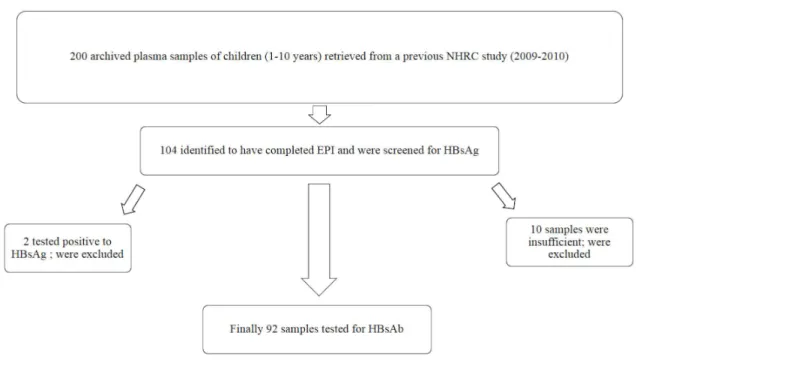
Two hundred (200) plasma samples of children between the ages of 1–10 years were retrieved from a previous cross-sectional study conducted between 2009 and 2010 by researchers from NHRC. The samples had been collected from healthy children within the community during an outreach program, and were being stored at -80°C in the research laboratory at NHRC. The samples were previously used for the determination of sero-prevalence of antibodies against candidate malaria vaccine viral vectors, EPI programs and for establishment of normal labora-tory reference values. The samples were checked against available records, 104 samples were identified to have completed the EPI vaccination program and were selected as subjects for this study. The selected 104 samples were stratified according to the following categories: Group 1 (1 to 6 months after their last dose of vaccination), Group 2 (3 years after their last dose of vac-cination) and, Group 3 (5 years after their last dose of vacvac-cination). The vaccination records of participants were obtained from the Navrongo Demographic Surveillance System (NDSS) and verified from the vaccination cards with 100% accuracy.Fig 1shows how the study population and subjects were selected.
Sample analysis
Data Analyses
Data was entered into an Excel spread sheet. OD’s from the ELISA plate reader including stan-dards were converted into actual concentrations using an Auditable Data Analysis and Man-agement System for ELISA (ADAMSEL-V1.1). All data analyses were performed using STATA andp0.05 was considered statistically significant. Anti-HBs titers were converted into log titers before one-way ANOVA followed by Tukey Post Hoc multiple comparison was used to test for significance. Fischer exact test was used to compare the differences in degree of sero-protection between the males and females.
Individuals with antibody concentration of1mIU/mL were considered to have serocon-verted and vice visa as per kit manufacture instructions and WHO standard. Seroprotection against hepatitis B virus infection was taken to be antibody titer10mIU/ml.
Results
General characteristics
Forty-five (45) out of the final 92 samples were male children whereas 47 were females. The average weight of all the children was 13.19kg (lower-upper weight: 6.8–21.3kg) and their mean age was 3.12years (lower-upper age: 0.11–6.50years). A review of the vaccination records of the children showed that none of them had had a post-exposure prophylaxis or dose at birth. They, however, had complete records for all the three scheduled doses at 6, 10 and 14 weeks.
Seroconversion status of hepatitis B vaccinees
All the 92 children that were included in the quantification of anti-HBs seroconverted (i.e. had anti-HBs1 mIU/mL). Anti-HBs titers recorded ranged from 1.021 IU/L to 751.64 IU/L. The geometric mean titer (GMT) for group one antibody was 96.12 IU/L (range: 1.02 IU/L to 573.64 IU/L). Among group two, the GMT was 83.78 IU/L (range: 2.15 IU/L to 225.76 IU/L).
Fig 1. Flow chart showing study population and subject selection.
In group three, the GMT was 37.55 IU/L (range: 2.39 IU/L to 751.64 IU/L). Among males, the GMT was 66.67 IU/L whilst 79.90 IU/L was recorded among the females (Tables1and2).
Anti-HBs titer and their association with protection
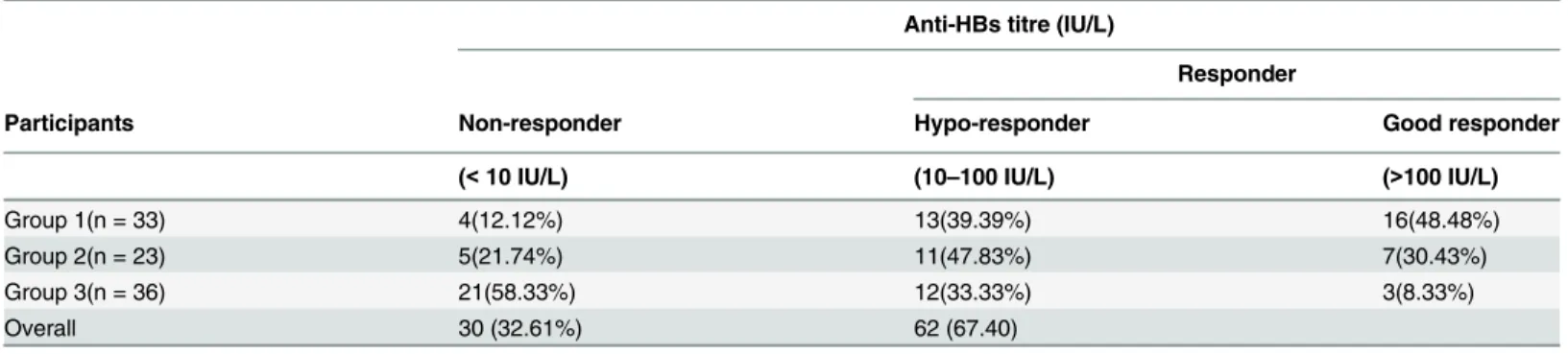
Seroprotection analyses (Table 3) revealed that in group one, 87.9% were seroprotected after 1 to 6 months of vaccination and 12.1% were non-responders. In group two, 78.3% were seropro-tected after 3 years of completing vaccination schedule while 21.7% were non-responders. In group three, 41.7% were seroprotected after 5 years of completing vaccination schedule whereas 58.3% were non-responders. This trend indicates that seroprotection declines as the vaccinees get older though this was not statistically significant (Table 1) between age group one and two (p>0.05); however, there was a significant difference between age group one and
three (p = 0.0137) and between age group two and three (p = 0.0390).
The effect of age and sex on the immune response to hepatitis B vaccine
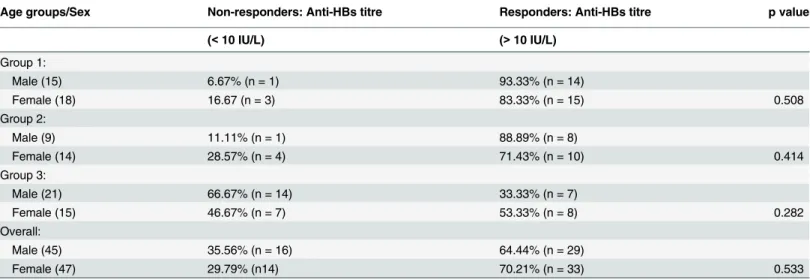
Table 4indicates the effect of age and sex on immune response to HBV infection. 93.3% of males and 83.3% of females in group one were seroprotected (anti-HBs titre10 IU/L) in
Table 1. Antibody Concentration among the three age Groups.
Mean titer (IU/L) of Groups (95% CI)
Group 1 Group 2 Group 3 p-value
96.12*(63.24–146.10) 83.78a‡
(53.58–130.99) 37.55a*(18.82–74.93) 0.02
One-way ANOVA followed by Tukey Post Hoc multiple comparison. Values with same superscript (*) (Group 1 vs 3) and subscript (a) (Group 2 vs 3) are significantly different compared to each other whilst values with different superscript (‡) (Group 1 vs 2) are not statistically different compared to each other.
doi:10.1371/journal.pone.0145209.t001
Table 2. Antibody concentration among male and female vaccine.
Age groups Mean titer (IU/L) (95% CI) of males Mean titer (IU/L) (95% CI) of females
Group 1 83.7(47.65–147.02) 110.38 (55.36–220.08)
Group 2 103.43 (48.83–219.07) 71.85 (37.70–137.02)
Group 3 25.6 (13.47–48.67) 52.51 (14.29–192.92)
All Groups 66.66 (45.10–98.57) 79.9 (51.81–123.22)
doi:10.1371/journal.pone.0145209.t002
Table 3. Seroprotection among the vaccinees in the three age groups.
Anti-HBs titre (IU/L)
Responder
Participants Non-responder Hypo-responder Good responder
(<10 IU/L) (10–100 IU/L) (>100 IU/L)
Group 1(n = 33) 4(12.12%) 13(39.39%) 16(48.48%)
Group 2(n = 23) 5(21.74%) 11(47.83%) 7(30.43%)
Group 3(n = 36) 21(58.33%) 12(33.33%) 3(8.33%)
Overall 30 (32.61%) 62 (67.40)
group two, 88.9% of the males and 71.4% of the females were seroprotected whilst in group three 33.3% of males and 53.3% of the females were seroprotected. In all these groups there were differences in degree of seroprotection between the males and females but these differ-ences were not statistically significant (p>0.05).
Distribution of Antibody concentration among vaccinees within the three
age groups
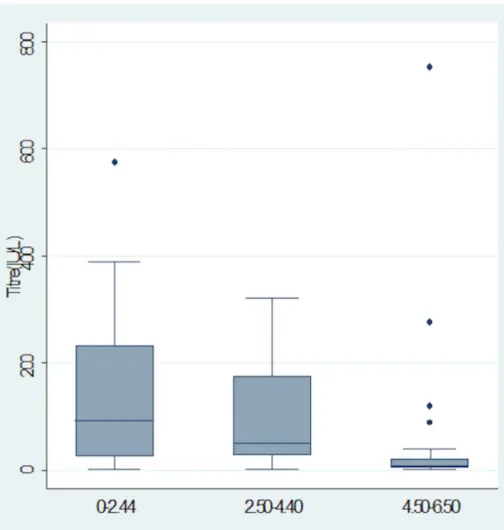
Median antibody concentration were observed to decrease with increasing age (p<0.05) as
indicated inFig 2.
Distribution of Antibody concentration among males and female
vaccinees within the three age groups
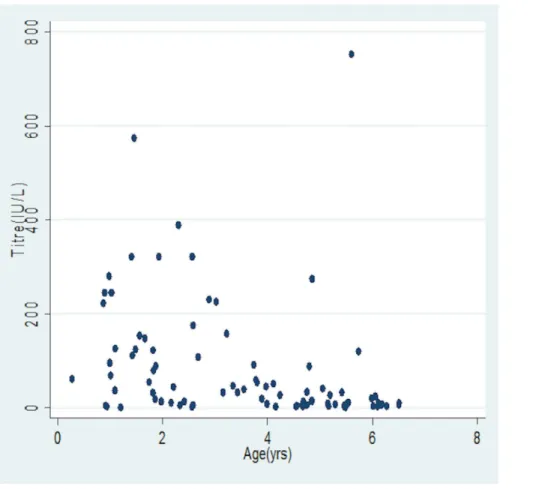
InFig 3, the median antibody concentrations were observed to decrease with increasing age irrespective of gender (p<0.05), whileFig 4shows variations of antibody concentration with
age.
Discussion
This study evaluated seroconversion and seroprotection status of children under HBV mass immunization program and measured their antibody levels five years after immunization. All the children in the study showed levels of seroconversion (i.e. had anti-HBs1 IU/L) after three doses of hepatitis B vaccination in the EPI. Some of the antibody levels however, did not reach concentrations that confers protection. Seroprotection levels indicated a waning protec-tive immunity in the amounts of anti-HBs produced by the children from 87.9% to 41.7%. Fur-thermore, this study showed a varying rate of non-protection (12.1% after 1 to 6 months, 21.7% after 3 years and 58.3% after 5 years). This study further revealed that, 1 to 6 months after receiving three doses of hepatitis B vaccine in the EPI, 12.1% of the population of remain vulnerable to HBV infection. When extrapolated into our vaccination coverage it indicates that a large number of children remain exposed to risk of HBV infection. There was no gender dif-ferences in the immunological response to hepatitis B vaccine among our study group.
Table 4. Age group and sex among the vaccinees in relation to seroprotection.
Age groups/Sex Non-responders: Anti-HBs titre Responders: Anti-HBs titre p value
(<10 IU/L) (>10 IU/L)
Group 1:
Male (15) 6.67% (n = 1) 93.33% (n = 14)
Female (18) 16.67 (n = 3) 83.33% (n = 15) 0.508
Group 2:
Male (9) 11.11% (n = 1) 88.89% (n = 8)
Female (14) 28.57% (n = 4) 71.43% (n = 10) 0.414
Group 3:
Male (21) 66.67% (n = 14) 33.33% (n = 7)
Female (15) 46.67% (n = 7) 53.33% (n = 8) 0.282
Overall:
Male (45) 35.56% (n = 16) 64.44% (n = 29)
Female (47) 29.79% (n14) 70.21% (n = 33) 0.533
Findings from our study is consistent with a longitudinal studies by Freitas da Mottaet al., [10] in Brazil, who reported, 98% of individuals seroconverted. Moreover, Chakrabortyet al., [11] reported 100% seroconversion in a cross-sectional study in Bangladesh. In two separate studies conducted in South Africa and Brazil, 86.80% and 90.00% seroprotection levels were reported [12–14]. Guho and colleagues [15] in Bangladesh also reported 88.67% of seroprotec-tion in their study. The waning immunity observed in our study is consistent with findings by El-Sayedet al., [16] who reported that anti-HB titers decline over time. In a long-term study to evaluate protection of hepatitis B vaccination among children immunized when infants, Den-tinger and colleagues [17] also found that anti-HBs concentration dropped rapidly among all participants. Moreover, findings from other studies also showed a varying rate of non-protec-tion. Puvacicet al., [18] reported that vaccination against viral hepatitis B results in immuno-logic memory response among the vaccinated and that even after a decrease of anti-HB levels to below the protective level of10 IU/L, a booster dose was not needed. Luet al., [19] on the other hand reported 29.2% non-responsiveness to a booster dose by vaccinees that initially seroconverted with non-protective levels. The need for booster dose for long term protection into adolescence and adulthood need to be well investigated and a consensus reached on the
Fig 2. Box-plot showing the distribution of Antibody concentration among vaccinees within the three age groups.Figure is represented as median (interquartile range).
large pool of non-responders being reported across the globe. In contrast to our findings, Behairyet al., [16] reported that males retain higher anti-HBsAb titres values than females. [20]. The findings of this current study is consistent with the report of some studies which had reported that there was no gender differences in the immunological response to hepatitis B vac-cine [21,22].
The main limitation of the current study is that archived samples were used and this impacted on the sample size. Nevertheless, the findings from this study corresponded well with previous studies and is adequate to represent the baseline information about seroconversion and seroprotection under the EPI program.
Conclusion
All the children who received three doses of hepatitis B vaccine at 6, 10 and 14 weeks serocon-verted, but their levels of protection waned with increasing years. Booster doses are therefore recommended after 5 years for long term protection into adolescence and adulthood.
Fig 3. Box-plot showing the distribution of Antibody concentration among males and female vaccinees within the three age groups.Figure is represented as median (interquartile range)
This study will serve as a baseline for further studies with prospective cohort design involv-ing large sample size to establish the strength of this observation.
Acknowledgments
We wish to express our deepest gratitude to the guardians and study participants as well as the staff of Navrongo Health Research Center (NHRC); Dr. Patrick Odum Ansah, Dr. Frank Atu-guba, Mr Thomas Anyorigiya, Mr Victor Asoala and Mr. Awine Timothy for their support in conducting this study. We are also grateful to Mr. Godfred Agongo, Mr. Stephen Nii Quaye and Miss. Mary-Immaculate Anati all of NHRC research laboratory for their contributions towards the success of this work.
Author Contributions
Conceived and designed the experiments: SD SAS MTF AO ATL. Performed the experiments: SD SAS ATL AO MTF. Analyzed the data: EOA SAS SD ATL AO. Contributed reagents/mate-rials/analysis tools: ATL RKDE EOA SAS. Wrote the paper: SAS SD MTF AO. Enrolled/ recruited patients: ATL EOA SD RKDE.
References
1. WHO (2000) Hepatitis B.(Fact sheet no. 204). Geneva, Switzerland: World Health Organization, 2000. Available from:http://www.who.int/mediacentre/.
Fig 4. Scatter plot of antibody concentration with age.
2. Zanetti AR, Van Damme P, Shouval D (2008) The global impact of vaccination against hepatitis B: a historical overview. Vaccine 26: 6266–6273. doi:10.1016/j.vaccine.2008.09.056PMID:18848855 3. Shepard CW, Simard EP, Finelli L, Fiore AE, Bell BP (2006) Hepatitis B virus infection: epidemiology
and vaccination. Epidemiologic reviews 28: 112–125. PMID:16754644 4. WHO (2014) Hepatitis B fact sheet N 204. Retrieved 15 December 2014.
5. Lavanchy D (2004) Hepatitis B virus epidemiology, disease burden, treatment, and current and emerg-ing prevention and control measures. Journal of viral hepatitis 11: 97–107. PMID:14996343
6. Cho Y, Bonsu G, Akoto-Ampaw A, Nkrumah-Mills G, Nimo JJ, Park JK, et al. (2012) The prevalence and risk factors for hepatitis B surface ag positivity in pregnant women in eastern region of ghana. Gut and liver 6: 235–240. doi:10.5009/gnl.2012.6.2.235PMID:22570754
7. Rufai T, Mutocheluh M, Kwarteng K, Dogbe E (2014) The prevalence of hepatitis B virus E antigen among Ghanaian blood donors. Pan African Medical Journal 17.
8. CDC (2011) Immunization of health-care personnel: recommendations of the Advisory Committee on Immunization Practices (ACIP). MMWR Recommendations and reports: Morbidity and mortality weekly report Recommendations and reports/Centers for Disease Control 60: 1.
9. Gomber S, Sharma R, Ramachandran VG, Talwar V, Singh B (2000) Immunogenicity of hepatitis B vaccine incorporated into the expanded program of immunization schedule. Indian pediatrics 37: 411– 413. PMID:10781235
10. Freitas da Motta MS, Mussi-Pinhata MM, Jorge SM, Tachibana Yoshida CF, Sandoval de Souza CB (2002) Immunogenicity of hepatitis B vaccine in preterm and full term infants vaccinated within the first week of life. Vaccine 20: 1557–1562. PMID:11858862
11. Chakraborty B, Bashar T, Roy K, Noor R, Rahman MM (2011) Persistence of Anti-HBs Antibody and Immunological Memory in Healthy Individuals Vaccinated with Hepatitis B Vaccine. Stamford Journal of Microbiology 1: 37–41.
12. Ribeiro TM, Azevedo RS (2006) Seroconversion of hepatitis B vaccine in infants related to the mother's serostatus in a community of São José dos Campos, state of São Paulo, Brazil. Clinics 61: 387–394. PMID:17072435
13. Tsebe KV, Burnett RJ, Hlungwani NP, Sibara MM, Venter PA, Mphahlele MJ (2001) The first five years of universal hepatitis B vaccination in South Africa: evidence for elimination of HBsAg carriage in under 5-year-olds. Vaccine 19: 3919–3926. PMID:11427266
14. Luo Z, Li L, Ruan B (2012) Impact of the implementation of a vaccination strategy on hepatitis B virus infections in China over a 20-year period. International Journal of Infectious Diseases 16: e82–e88. doi:10.1016/j.ijid.2011.10.009PMID:22178658
15. Guho A, abdul Ahad M, Salam MA, Alim MA, Haque AE, Islam QT (2010) Seroconversion after recom-binant hepatitis B vaccination. Journal of Medicine 11: 143–150.
16. El-Sayed B, El-Guindi M, El-Shaarawy A, Salama E, Sobhy GA (2009) Long-term Immunogenicity of Hepatitis B Vaccination in children. Zagazig J Occup Health Safety 2: 17–28.
17. Dentinger CM, McMahon BJ, Butler JC, Dunaway CE, Zanis CL, Bulkow LR, et al. (2005) Persistence of antibody to hepatitis B and protection from disease among Alaska natives immunized at birth. The Pediatric infectious disease journal 24: 786–792. PMID:16148845
18. PuvacićS, Ravlija J, PuvacićZ, CurićI (2005) Long term protection after hepatitis B vaccination. Bos-nian journal of basic medical sciences/Udruzenje basicnih mediciniskih znanosti = Association of Basic Medical Sciences 5: 50–53.
19. Lu C-Y, Ni Y-H, Chiang B-L, Chen P-J, Chang M-H, Chang L-Y, et al. (2008) Humoral and cellular immune responses to a hepatitis B vaccine booster 15–18 years after neonatal immunization. Journal of Infectious Diseases 197: 1419–1426. doi:10.1086/587695PMID:18444799
20. El Mazahi MM, Maksoud HMA, Salam MA, Ali MA, El-Nawawy AN, Ahmad SM (2014) Long Term Immunity to Hepatitis B Vaccine Among a Sample of Secondary School Students in Damietta. Journal of American Science 10.
21. Yazdanpanah B, Safari M, Yazdanpanah S (2010) Persistence of HBV vaccine’s protection and response to hepatitis B booster immunization in 5-to 7-year-old children in the Kohgiloyeh and Boyerah-mad Province, Iran. Hepatitis monthly 10: 17. PMID:22308120