Azarian Journal of Agriculture
www.azarianjournals.ir Azarian Journals
Short communication ISSN:2383-4420
142
Changes in essential oil content of different organs of dill genotypes in response to water
deficit
Kazem Ghassemi-Golezani1*,Mehrdad Moradi1, Saeid Zehtab-Salmasi1, Saeideh Alizadeh-Salteh2
and Saeid Ghassemi1
Article Info ABSTRACT
Accepted: 1 Oct. 2015
A split plot experiment (based on RCB design) with four replications was conducted in 2014, to evaluate the effects of different irrigation treatments (I1, I2, I3 and I4: irrigation after 70, 100, 130 and 160 mm evaporation, respectively) on essential oilcontent ofdill (Anethum graveolens L.) organs in two genotypes (Local and Mammoth). Irrigation treatments and genotypes were allocated to the main and sub-plots, respectively. Essential oil percentage of dill organs increased, but their essence yield decreased as water deficit severed. Mammoth had the highest essential oil percentage in all organs, but essential oil yield of vegetative organs and flowers of the local genotype was much more than that of mammoth genotype. However, the difference in essence yield of seeds between two genotypes was not significant. The highest essential oil percentage and yield under all irrigation intervals were obtained from seeds, followed by flowers and vegetative organs. It was concluded that seeds and flowers are the most beneficial organs of dill, regarding essential oil production, although dill is largely used as a vegetable.
Keywords:
Dill organs, Essential oil, Water deficit
INTRODUCTION1
edicinal and aromatic plants are very importance because of the increasing demand for their products. Anethum graveolens L. known as Dill, is an annual aromatic and medicinal plant belonging to the Apiaceae (Umbilliferae) family. Constituents of dill include essential oils, fatty oil, proteins, carbohydrates, fibre, ash and mineral elements such as calcium, potassium, magnesium, phosphorous, sodium, vitamin A and niacin (Kaur and Arora 2010). Dill is native to Mediterranean countries and south-eastern Europe, used primarily as a condiment. Dill seed and leaves are used as flavouring in sauces, vinegars, pastries, and soups. Dill has medicinal value as a diuretic, stimulant, and a carminative. The dill seeds have essential oil as an active substance, while carvone and limonene are the main constituents of essential oil (Bailer et al.
1- Department of Plant Eco-physiology, Faculty of Agriculture, University of Tabriz, Tabriz, Iran.
2- Department of Horticulture, Faculty of Agriculture, University of Tabriz, Tabriz, Iran
*Email: [email protected]
2001; Singh et al. 2005; Callan et al. 2007). Environmental factors such as water stress may influence essential oil content dill organs (Ghassemi-Golezani et al. 2008)
Water deficit is known as an important limiting factor for plant production in arid and semiarid regions (Rodriguez 2006). It is more important in regions which experience the problem due to climate change, but have not been paid attention (Chaves and Oliveira 2004), because the global environment change enhances water loss. Environmental stresses bring about a wide range of responses in plants from genetic changes to the changes in growth and yield (Reddy et al. 2004).
143
smaller cell volume, reduced leaf area, increased leaf thickness, hairy leaves, and increased root/shoot ratio, as well as several changes in enzyme and hormone syntheses and activity (Pugnaire et al. 1999). The adaptability and responses to water stress depend on duration and magnitude of stress and developmental stage of plant (Kramer 1983).
In medicinal plants, metabolite content is economically more important than the yield of the plant part containing the metabolite, as it determines the cost of its extraction (Jaleel et al. 2007). The biosynthesis of secondary metabolites in medicinal and aromatic plants is strongly influenced by environmental factors (Tabatabaie and Nazari 2007). Solinas and Deiana (1996) reported that secondary products of plants can be altered by environmental factors and water stress is a major factor affecting the synthesis of natural products. Most of the essential oil is produced in the seeds and flowers of dill, although leaves and stems also contain essential oil (Ghassemi-Golezani et al. 2008). Since water resources in north-west of Iran are limited at the later stages of dill growth and development, this research was carried out to investigate the effects of water stress on essential oil content of dill organs in two genotypes.
MATERIALS AND METHODS
This experiment was conducted in 2014 at the Research Farm of the Faculty of Agriculture, University of Tabriz, Tabriz, Iran (Latitude 38° 05ʹN, Longitude 46° 17ʹE, Altitude 1360 m above sea level) to evaluate the effects of different irrigation treatments on essential oil content of dill organs. The climate is characterized by mean annual precipitation of 245.75 mm per year and mean annual temperature of 10°C. The experiment was arranged as split plot experiment (using RCB design) with four replications with irrigation treatments (I1, I2,I3 and I4: irrigation after 70, 100, 130 and 160 mm evaporation from class A pan, respectively) in main plots and dill genotypes (Native of Tabriz and Long island mammoth) in sub-plots.
Each plot consisted of 8 rows with 3 m length and 25 cm apart. Seeds were treated with Benomyl at a rate of 2 g/kg and were sown by hand on 30 April, 2014, in 1/5 cm depth of a sandy loam soil. All plots were irrigated immediately after sowing. After seedling establishment, irrigations were carried out according to the treatments. Weeds were controlled by hand during crop growth and development as required.
At flowering stage, vegetative organs (leaves and stems) and flowers and at maturity, seeds were harvested from middle part of each plot.
Each sample was dried in a room at about 20-25ºC for seven days and separately weighed. A sample of 15 g from each organ was mixed with 250 ml distilled water and then it was subjected to hydro-distillation for 3 hours, using a Clevenger-type in 250 ºC (Darzi et al. 2012). Analyses of variance of the data were carried out by MSTAT-C software and means of each trait were compared by Duncan test at p≤0.05.
RESULTS AND DISCUSSION
The results of analyses of variance showed that the irrigation treatments had significant (P ≤ 0.01) effects on essential oil percentage and yield of dill organs. Essential oil percentage and yield of vegetative organs and flowers were significantly (P ≤ 0.01) affected by genotype. Genotype had also significant (P ≤ 0.01) effect on essential oil percentage of seeds, but not on their essential oil yield (P ˃ 0.05).
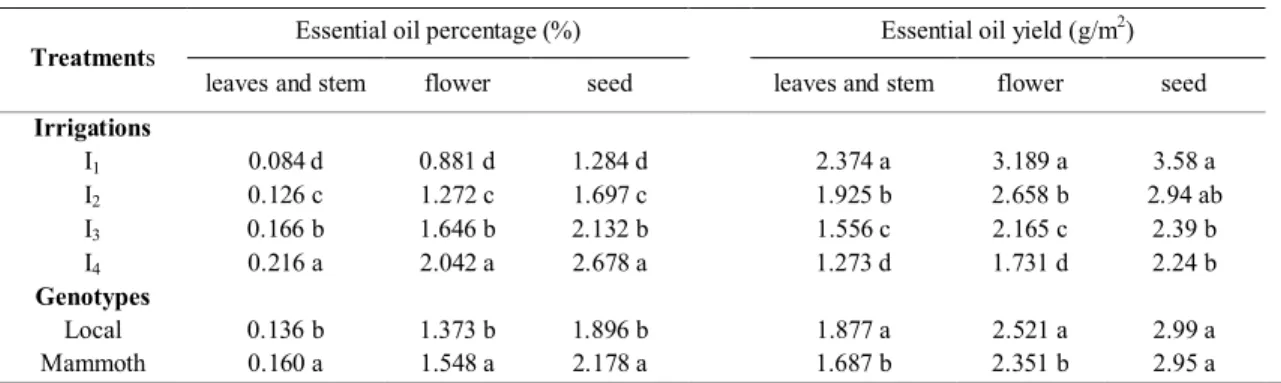
Essential oil percentage of dill organs significantly increased, but their essence yield per unit area decreased as a result of water stress, although there was no significant difference in essential oil yield of seeds under well watering (I1) and mild water deficit (I2). Mammoth genotype had the highest essential oil percentage, but the lowest essential oil yield in all organs. However, the difference in essential oil yield of seeds between local and mammoth genotypes was not statistically significant (Table 1).
Ghassemi-Golezani et al. (2008) also reported that the essential oil percentage of dill significantly improved, when plants were subjected to water stress during reproductive stages. This may be attributed to the function of secondary metabolites as self-defence components against stress conditions. In other words, the stress conditions accelerate the biosynthesis of essential oils (Ezz et al. 2009). Drought stress increases the essential oil percentage of medicinal and aromatic plants, in order to prevent oxidization within the plant cells (Aliabadi et al. 2009).
144
in photosynthesis and carbohydrate production and suppression of the plant growth under stress condition (Flexas and Medrano 2002).
Essential oil percentage of all organs in Mammoth was higher than that of local genotype, but essential oil yield of vegetative organs and flowers of the local genotype was much more than that of mammoth genotype, with no significant difference in essential oil yield of seeds between two genotypes (Table 1). This indicates that individual organ mass of local genotype was higher than that of mammoth genotype. Secondary metabolites in the medicinal and aromatic plants are strongly influenced by genotypes and environmental conditions (Yazdani et al. 2002). Ozturk (2004), Safikhani (2007) and Farahani (2009) believed that depending upon the plant species and genotype, drought stress can increase, decrease or have no effect on the levels of metabolites.
Essential oil percentage linearly increased in dill organs with increasing irrigation intervals. The rate of essence enhancement in leaves and stems was low, but in flowers and grains it was high, as indicated by the slope of the regression lines. Seeds
had the highest essence percentage under all irrigation treatments, followed by flowers and vegetative organs (Figure 1a). In contrast, essential oil yield of dill organs linearly and almost with similar trend decreased as water deficit increased. The highest essential oil yield under all irrigation intervals was also recorded for seeds and then for flowers and vegetative organs, respectively. Very low essence percentage of vegetative organs of dill to some extent was compensated by their high mass and essence yield per unit area (Figure 1b). Seeds and flowers of dill also produced more essential oil in comparison with leaves under drought (Ghassemi-Golezani et al. 2008) and salinity (Ghassemi-Golezani et al. 2011) stresses.
CONCLUSION
Essential oil percentage of dill organs linearly increased, but their essence yield decreased with decreasing water availability. The highest essential oil percentage and yield under all irrigation treatments were obtained from seeds, followed by flowers and vegetative organs. Essential oil yield of vegetative organs and flowers of the local genotype was much more than that of mammoth genotype, with no significant difference in essence yield of seeds. Therefore, seeds and flowers of dill were the
Table 1- Means of the essential oil percentage and yield of dill organs for different irrigation treatments and genotypes
Treatments Essential oil percentage (%) Essential oil yield (g/m
2)
leaves and stem flower seed leaves and stem flower seed
Irrigations
I1 0.084d 0.881 d 1.284 d 2.374 a 3.189 a 3.58 a
I2 0.126 c 1.272 c 1.697 c 1.925 b 2.658 b 2.94 ab
I3 0.166 b 1.646 b 2.132 b 1.556 c 2.165 c 2.39 b
I4 0.216 a 2.042 a 2.678 a 1.273 d 1.731 d 2.24 b
Genotypes
Local 0.136 b 1.373 b 1.896 b 1.877 a 2.521 a 2.99 a
Mammoth 0.160 a 1.548 a 2.178 a 1.687 b 2.351 b 2.95 a
Different letters in each column indicate significant difference at P ≤ 0.05. I1, I2, I3, I4: Irrigation after 70, 100, 130 and 160 mm evaporation, respectively.
Figure 1. Changes in essential oil percentage (a) and yield (b) of dill organs at different irrigation intervals
0 1 2 3
70 100 130 160
Es
se
nt
ia
l
oi
l (
%
)
Irrigation intervals (mm evaporation)
leaf and stem flower seed
0 1 2 3 4
70 100 130 160
Es
se
nt
ia
l
oi
l y
ie
ld
(
g/
m
2)
Irrigation intervals (mm evaporation)
leaf and stem flower seed
145
most beneficial organs for essential oil production, and local genotype was generally superior in this regard.
REFERENCES
Aliabadi F.H. Valadabadi S.A.R. Daneshian J. Khalvati M.A. (2009) Evaluation changing of essential oil of balm (Melissa officinalis L.) under water deficit stress conditions. Journal of Medicinal Plants Research, 3: 329–33.
Bailer J. Aichinger T. Hackl G. Hueber K. Dachler M. (2001) Essential oil content and composition in commercially available dill cultivars in comparison to caraway. Industrial Crops and Products, 14: 229- 239.
Callan N.W. Johnson D.L. Westcott M.P. Welty L.E. (2007) Herb and oil composition of dill (Anethum graveolens L.): Effects of crop maturity and plant density. Industrial Crops and Products, 25: 282–287.
Chaves M.M. Oliveira M.M. (2004) Mechanisms underlying plant resilience to water deficits: Prospects for water-saving agriculture. Journal of Experimental Botany, 55: 2365-2384. Darzi M.T. Haj Seyed Hadi M.R. (2012) Effects of
the application of organic manure and biofertilizer on the fruit yield and yield components in Dill (Anethum graveolens). Journal of Medicinal Plants Research, 6: 3266- 3271.
Ezz E. Aziz E.E. Hendawy S.F. Omer E.A. (2009) Response of Thymus vulgaris L. to salt stress and alar (B9) in newly reclaimed soil. Journal of applied sciences research, 5: 2165–2170. Farahani H.A. Valadabadi S.A. Daneshian J.
Khalvati M.A. (2009) Evaluation changing of essential oil of balm (Melissa officinalis L.) under water deficit stress conditions. Journal of Medicinal Plants Research, 3: 329-333. Fatima S. Farooqi A.H.A. Sangwan R.S. (2005)
Water stress mediated modulation in essential oil, proline and polypeptide profile in palmarosa and citronella java. Physiology and Molecular Biology of Plants, 11: 153 -156. Flexas J. Medrano H. (2002) Drought-inhibition of
Photosynthesis in C3 plants: Stomatal and Non-stomatal Limitations Revisited. Annals of Botany, 89: 183-189.
Ghassemi-Golezani K. Andalibi B. Zehtab-Salmasi S. Saba J. (2008) Effect of water stress during vegetative and reproductive stages on seed yield and essential oil content of dill (Anethum graveolens L.). Journal of Food, Agriculture and Environment, 6: 282-84.
Ghassemi-Golezani K. Zehtab-Salmasi S. Dastborhan S. (2011) Changes in essential oil content of dill (Anethum graveolens) organs under salinity stress. Journal of Medicinal Plants Research,5(14), pp. 3142-3145.
Jaleel C.A. Gopi R. Manivannan P. Sankar B. Kishorekumar A. Panneerselvam R. (2007) Antioxidant potentials and ajmalicine accumulation in Catharanthus roseus after treatment with giberellic acid. Colloids and Surfaces B: Biointerfaces, 60: 195–200. Kaur G.J. Arora D.S. (2010) Bioactive potential of
Anethum graveolens, Foeniculum vulgare and
Trachyspermum ammi belonging to the family
Umbelliferae-Current status. Journal of Medicinal Plants Research, 4: 087–094. Kramer P.J. (1983) Water relations of plants. New
York: Academic Press.
Ozturk A. Unlukara A. Ipek A. Gurbuz B. (2004) Effects of salt stress and water deficit on plant growth and essential oil content of Lemon Balm (Melissa officialis L.). Pakistan Journal of Botany, 36: 787-792.
Pugnaire F.I. Serrano L. Pardos J. (1999) Constraints by water stress on plant growth. In: Pessarakli M. (ed.). Handbook of plant and crop stress. Marcel Dekker, Inc., New York, USA, pp. 271-283.
Rahmani N. Aliabadi Farahani H. Valadabadi S.A.R. (2008) Effects of nitrogen on oil yield and its component of calendula (Calendula officinalis L.) in drought stress conditions. Abstracts of the world congress on medicinal and aromatic plants, South Africa, p.364. Reddy A.R. Chaitanya K.V. Viekanadan M.V.
(2004) Drought–induced responses of photo synthesis and antioxidant metabolism in higher plant. Journal of Plant Physiology, 161: 1189– 1202.
Rodriguez L. (2006) Drought and drought stress on south Texas Landscape Plants. San Antonio Express-News. Avilable at (http: bexar – Tx. T. Tamu. edu).
Safikhani F. Heydari sharifabad H. Syadat A. Sharifi ashorabadi A. Syednedjad M. Abbaszadeh B. (2007) The effect of drought stress on percentage and yield of essential oil and physiological characteristics of
Deracocephalum moldavica L.. Iranian Journal of Medicinal and Aromatic Plants, 23: 86-99. Singh G. Maurya S. De Lampasona M.P. Catalan
C. (2005) Chemical Constituents, Antimicrobial Investigations, and Antioxidative Potentials of Anethum graveolens L. Essential Oil and Acetone Extract: Part 52. Journal of Food Science, 70: 208-215.
Solinas V. Deiana S. (1996) Effect of water and nutritional coditions on the Rosmarinus officinalis L., phenolic fraction and essential oil yields. Rivista Italian Eposs, 19: 189-198. Tabatabaie S.J. Nazari J. (2007) Influence of
146
Upadhyaya H. Panda S.K. (2004) Responses of
Camellia sinensis to drought and rehydration. Biologia Plantarum, 48: 597-600.
Yazdani D. Jamshidi H. Mojab F. (2002) Compare of essential oil yield and menthol existent in
Peppermint (Mentha piperita L.) planted in different origin of iran. Journal of Medicinal Plants Institu Jahad daneshgahi, 3: 73- 78.
Journal sponsorship