* Corresponding author.
E-mail address: [email protected] (B. Zeynizadeh) © 2015 Growing Science Ltd. All rights reserved. doi: 10.5267/j.ccl.2016.1.002
Current Chemistry Letters 5 (2016) 51–58
Contents lists available at GrowingScience
Current Chemistry Letters
homepage: www.GrowingScience.com
The immobilized NaHSO
4·H
2O on activated charcoal: a highly efficient promoter
system for
N
-formylation of amines with ethyl formate
Behzad Zeynizadeh* and Mohammad Abdollahi
Faculty of Chemistry, Urmia University, Urmia 5756151818, Iran
C H R O N I C L E A B S T R A C T
Article history:
Received October 21, 2015 Received in revised form December 20, 2015 Accepted 15 January 2016 Available online 15 January 2016
The immobilized NaHSO4·H2O on activated charcoal was used as a highly efficient promoter
system for facile N-formylation of amines with ethyl formate. All reactions were carried out in refluxing ethyl formate (54 ºC) under mild conditions within 10-100 min to afford the product formamides in high to excellent yields (80-94%).
© 2016 Growing Science Ltd. All rights reserved. Keywords:
Amines
Activated charcoal Ethyl formate Formylation NaHSO4·H2O
1. Introduction
The protection of amines by the formation of formamides is one of the most important and widely
used transformations in organic chemistry.1 Formamides as important class of amine derivatives have
been used widely in the synthesis of pharmaceutically valuable compounds such as fluoroquinolines,2
1-arylimidazole-5-carboxylates,3 1-formyl-1,2-dihydroquinolines4 nitrogen bridged heterocyles,5
oxazilidones,6 cancer chemotherapeutic agents,7 fungicides,3,8 preparation of isocyanates,9
foramidines,10 and nitriles,11 the Vilsmeier-Haake formylation reaction,12 allylation13 and
hydrosilylation14 of carbonyl compounds. Due to wide synthetic and biological applications of
formamides, a number of methods and reagents such as Cl3CCHO,15 CH(OEt)3,16 NaOEt/CHCl3,17
HCO2NH4,18 HCO2NH4/nano Fe3O4/PEG-400,19 2,2,2-trifluoroethyl formate,20 phenyl formate,21
pentafluorophenyl formate,22 acetic formic anhydride,23 and KF-Al
2O3/CHCl3,24 formic acid in the
presence of HCO2Na,25 NH2OH·HCl,26 I2,27 DCC,28 EDCI,29 ZnCl2,30 In,31 ZnO,32 TiO2-P25 (TiO2
-SO42-)33 nanoceria,34 Zr-MCM-41,35 NiFe2O4@SiO2-PPA,36 γ-Fe2O3@HAp-SO3H,37 WO4(SO3H)2,38
Fe(III)-exchanged sepiolite,39 2-chloro-4,6-dimethoxy-1,3,5-triazine,40 melamine trisulfonic acid,41
(RHA-52
[pmim]HSO4)44 PEG-400,45 HClO4/SiO2,46 silica sulfuric acid,47 hafnium(IV)
bis(perfluorooctane-sulfonyl)imide complex supported on fluorous silica gel,48 ultrasound,49 ultrasound/[bmim]BF
4,50 and
ultrasound/nano CeO2,51 ethyl formate in the presence of 2-(sulfooxy)propane-1,2,3-tricarboxylic
acid/SiO2,52 silphos [PCl3-n(SiO2)n],53 and microwave/disulfonamides polymers54 have been reported
for the formylation of various primary and secondary aromatic/aliphatic amines. In this context, some protocols did not use any catalysts/promoters, and the formylation reactions were carried out under
particular conditions.55,56 Recently, N-formylation of amines has been extensively reviewed by Gerack
et al.57
Many of these methods suffer from various drawbacks such as using expensive or toxic formylating reagents/catalysts, acidic reaction conditions, organic solvents, the excess amounts of formic acid, high reaction temperature, prolonged reaction times and removal of by-products. Therefore, there is a need to develop a better catalyst or conditions for synthesis of formamides in terms of operational simplicity
and economical viability. Herein, we wish to introduce the immobilized NaHSO4·H2O on activated
charcoal as an efficient promoter system for facile N-formylation of various amines in refluxing ethyl formate (54 ºC) under net conditions (Scheme 1).
NH2
R
NHCHO
R
Ethyl formate/reflux (54 oC)
NaHSO4·H2O/Charcoal
Scheme 1.N-formylation of amines with NaHSO4·H2O/activated charcoal system
2. Results and Discussion
Hydrated sodium hydrogen sulfate, NaHSO4·H2O, as a cheap and mineral weak acidic reagent, has
been found to have some useful applications in organic synthesis.58 In this context, using NaHSO4·H2O
as an efficient promoter has been successfully used by our research group for the Biginelli synthesis of
3,4-dihydropyrimidin-2(1H)-ones59,60 and facile reduction of carbonyl compounds with NaBH4.61 In
line with the outlined strategies for N-formylation of amines, we found that this transformation in the presence of hydrated sodium hydrogen sulfate has not been investigated yet. Therefore, this subject and our research interest to prepare formamides as a key intermediate, encouraged us to investigate the
influence of NaHSO4·H2O on the titled transforma-tions.
N-formylation of amines was primarily examined by the reaction of aniline with ethyl formate as a
non-acidic formylating agent in the absence and presence of NaHSO4·H2O. The results of this
investigation are summarized in Table 1. Entries 1 and 2 show that the formylation of aniline in the absence of hydrated sodium hydrogen sulfate did not any take place, and the reaction with a molar ratio
of aniline:NaHSO4·H2O (1:0.1) in refluxing ethyl formate (2 mL) encountered with low efficiency
(40%). This result exhibited that though hydrated sodium hydrogen sulfate affected the rate of formylation reaction, however, the influence was not sufficient and therefore completion of the reaction required to an additional co-catalyst.
Nowadays, activated charcoal, because of its high degree of micro-porosity (just one gram of
activated carbon has a surface area in excess of 500-1500 m2 being readily achievable) provides a high
surface area and this situation makes it more desirable for academic and industrial applications.62-64 In
this context, we decided to incorporate the weak acidic character of NaHSO4·H2O and micro-porosity
of activated charcoal with together, and so using them as an efficient promoter system in N-formylation of aniline by ethyl formate. The incorporation of hydrated sodium hydrogen sulfate with activated
charcoal was carried out by mixing some mass ratio of NaHSO4·H2O and activated charcoal in water
and then evaporation of the solvent in a microwave oven to afford different composition percentage of
the immobilized NaHSO4·H2O on activated charcoal. The influence of the obtained immobilized
systems was then studied in N- formylation of aniline (1 mmol) with ethyl formate (2 mL) (entries
shows a dramatic acceleration leading to complete the reaction within 25 min. Therefore, the conditions mentioned in entry 7 were selected as the optimum conditions.
Table 1. Optimization experiments for N-formylation of aniline with ethyl formate in the presence of
NaHSO4·H2O/activated charcoal systema
Entry Charcoal (g) NaHSO4·H2O (g) Condition Time (min) Conv. (%)
1 - - reflux 360 0
2 - 0.1 reflux 360 40
3 0.1 - reflux 360 30
4 0.05 0.05 reflux 120 70
5 0.1 0.05 reflux 120 75
6 0.1 0.1 reflux 30 85
7 0.1 0.2 reflux 25 100
aAll reactions were carried out with 1 mmol of aniline in ethyl formate (2 mL).
Encouraged by the result, the capability of this synthetic protocol was more studied with the reaction of various aromatic primary amines containing electron-releasing or withdrawing groups with ethyl formate at the optimized reactions conditions. Table 2 shows the general trend and versatility of this synthetic method. As seen, all reactions were carried out successfully in the presence of the
immobilized NaHSO4·H2O (0.2 g) on activated charcoal (0.1 g) within 10-55 min to afford the products
formamides in high yields (80-94%). The table also shows that the effect of substitutions on aromatic rings is noteworthy. Electron-releasing groups accelerated the rate of formylation reaction and in contrast withdrawing substitutions prolonged the reaction times through the deactivation of aromatic rings. Entries 11 and 12 also show that the current protocol is only useful for N-formylation of aromatic primary amines, and in the case of 2- and 4-aminophenols, O-formylation of phenolic substitution did not any take place. This means that the chemoselective N-formylation of aromatic primary amines can be successfully carried out in the presence of phenolic substitutions. More examination also resulted that in the case of aromatic secondary and aliphatic amines such as N-methylaniline and benzylamine, this protocol was also efficient and produced the corresponding formamides in 85-91% yields (Table 2, entries 18 and 19).
Table 2. N-formylation of amines with ethyl formate in the presence of NaHSO4·H2O/activated charcoal
systema
Entry Substrate Product Time
(min)
Yield
(%)b m.p. (ºC) ref.
1 NH2 NHCHO 25 92 46-48 48
2 NH2
CH3
NHCHO
CH3
19 88 60-62 48
3 H3C NH2 H3C NHCHO 18 91 52-54 48
4 MeO NH2 MeO NHCHO 12 90 81-82 19
5 NH2
MeO
NHCHO
MeO
10 93 55-57 65
6 NH2
Cl
NHCHO
Cl
54
7 NH2
Cl
NHCHO
Cl
35 94 56-57 65
8 Cl NH2 Cl NHCHO 40 92 100-102 48
9 NH2
Cl Cl
NHCHO
Cl Cl
45 90 149-151 48
10 Br NH2 Br NHCHO 33 89 118-120 48
11 HO NH2 HO NHCHO 37 87 135-137 19
12 NH2
OH
NHCHO
OH
30 91 129-131 19
13 HO2C NH2 HO2C NHCHO 55 90 256-258 44
14 O2N NH2 O2N NHCHO 50 93 194-195 48
15 NH2
O2N
NHCHO
O2N
45 90 134-135 65
16 H2N NH2 OHCHN NHCHO 30 80 210-212 44
17
NH2 NHCHO
31 94 136-138 44
18 CH2NH2 CH2NHCHO 45 91 60-62 48
19 NHMe NHMe
CHO
100 85 123-124 19
aAll reactions were carried out with 1 mmol of amines in the presence of NaHSO
4·H2O/activated charcoal (0.2 g : 0.1 g) system in refluxing ethyl formate (2 mL). bYields refer to isolated pure products.
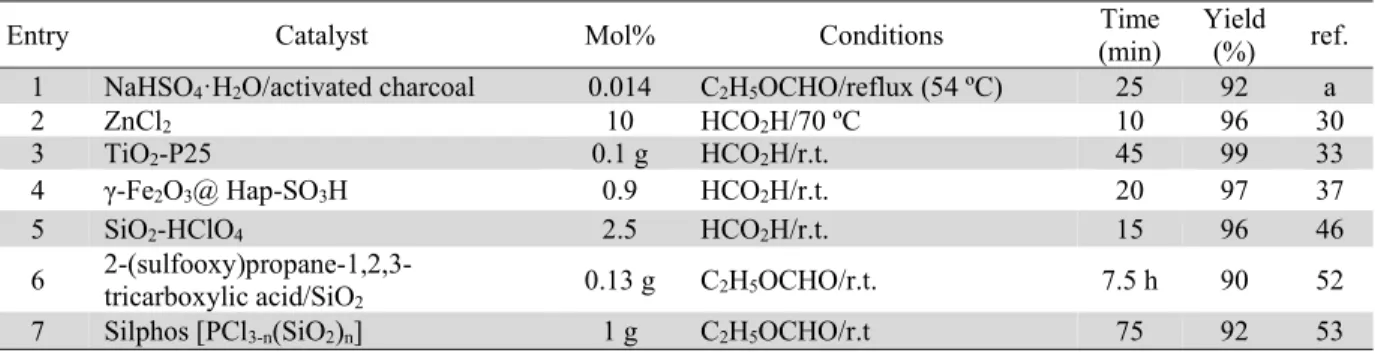
The usefulness and capability of NaHSO4·H2O/activated charcoal system in N-formylation of
amines was highlighted by a comparison of the obtained results for aniline with other reported reagents (Table 3). A case study shows that in viewpoints of availability and cheapness of the reagents, non-acidic character of formylating agent, mild reaction conditions and easy work-up procedure, the current protocol shows a more or comparable efficiency towards the other reagents. Although the exact mechanism of this synthetic method is not clear, however, we think that the weak acidic character of
NaHSO4·H2O activates the ethyl formate for nucleophilic attack of amines. In addition, the
microporosity of activated charcoal provides the excess and more efficient pores or surfaces for better
Table 3. Comparison of N-formylation of aniline with NaHSO4·H2O/activated charcoal system and
other reported reagents
Entry Catalyst Mol% Conditions Time
(min)
Yield
(%) ref.
1 NaHSO4·H2O/activated charcoal 0.014 C2H5OCHO/reflux (54 ºC) 25 92 a
2 ZnCl2 10 HCO2H/70 ºC 10 96 30
3 TiO2-P25 0.1 g HCO2H/r.t. 45 99 33
4 γ-Fe2O3@ Hap-SO3H 0.9 HCO2H/r.t. 20 97 37
5 SiO2-HClO4 2.5 HCO2H/r.t. 15 96 46
6
2-(sulfooxy)propane-1,2,3-tricarboxylic acid/SiO2 0.13 g C2H5OCHO/r.t. 7.5 h 90 52
7 Silphos [PCl3-n(SiO2)n] 1 g C2H5OCHO/r.t 75 92 53
aCurrent protocol.
3. Conclusions
In summary, we have shown that NaHSO4·H2O/activated charcoal system can be used as an efficient
promoter system for N-formylation of various amines with ethyl formate. All reactions were carried
out successfully using the immobilized NaHSO4·H2O (0.2 g) on activated charcoal (0.1 g) per 1 mmol
of amines within 10-100 min. The product formamides were obtained in 80-94% yields. The cheapness and availability of the reagents, high yields and easy work-up procedure as well as the benefits of neat reaction conditions are the advantages which make this protocol a synthetically useful addition to the present methodologies.
Acknowledgements
The authors gratefully acknowledge the financial support of this work by the research council of Urmia University.
Experimental
General
All reagents and substrates were purchased from commercial sources with the best quality and they were used without further purification. Activated charcoal was obtained from Merck Company (Art No
102186). 1H and 13C NMR spectra were recorded on 300 MHz Bruker spectrometer. All chemical shifts
were measured with reference to TMS (δ = 0.00 ppm). FT-IR spectra were recorded on Thermo Nicolet
Nexus 670 spectrophotometer using the KBr-pellet technique. All products are known and were
characterized by their 1H, 13C NMR and FT-IR spectra followed by comparison with authentic data.
TLC was applied for the purity determination of the substrates, products and the reaction monitoring over silica gel 60 F254 aluminum sheet.
Preparation of the immobilized NaHSO4·H2O on activated charcoal
In a round-bottomed flask, a solution of NaHSO4·H2O (0.2 g) in distilled water (2 mL) was prepared.
Next, activated charcoal (0.1 g) was added and the mixture was stirred vigorously for 15 min at room temperature. The solvent was then evaporated by microwave irradiation (500 W) to afford the
immobilized NaHSO4·H2O on activated charcoal (0.3 g).
A typical procedure for N-formylation of amines with ethyl formate in the presence of NaHSO4·H2O/activated charcoal system
In a round-bottomed flask (5 mL) equipped with a magnetic stirrer and condenser, a solution of
aniline (1 mmol, 0.093 g) in ethyl formate (2 mL, 0.025 mol) was prepared. NaHSO4·H2O/activated
56
then evaporated under reduced pressure to afford the pure N-phenyl formamide in 92% yield (0.111 g, Table 2, entry 1).
References
1. Otera J., and Nishikido J. (2010) Esterification, Methods, Reactions and Applications, 2nd ed.,
Wiley-VCH, Weinheim.
2. Jackson A., and Meth-Cohn O. (1995) A new short and efficient strategy for the synthesis of quinolone
antibiotics. Chem. Commun. (13) 1319-1319.
3. Chen B. C., Bednarz M. S., Zhao R., Sundeen J. E., Chen P., Shen Z., Skoumbourdis A. P., and Barrish
J. C. (2000) A new facile method for the synthesis of 1-arylimidazole-5-carboxylates. Tetrahedron Lett.,
41 (29) 5453-5456.
4. Kobayashi K., Nagato S., Kawakita M., Morikawa O., and Konishi H. (1995) Synthesis of
1-formyl-1,2-dihydroquinoline derivatives by a Lewis acid-catalyzed cyclization of o-(1-hydroxy-2-alkenyl) phenyl isocyanides. Chem. Lett., 24 (7) 575-576.
5. Kakehi A., Ito S., Hayashi S., and Fujii T. (1995) Preparation of new nitrogen-bridged heterocycles. 40.
Synthesis of 1,4-dihydropyrido (2,3-b) indolizin-4-one derivatives. Bull. Chem. Soc. Jpn., 68 (12) 3573-3580.
6. Lohray B. B., Baskaran S., Rao B. S., Reddy B. Y., and Rao I. N. (1999) A short synthesis of
oxazolidinone derivatives Linezolid and Eperezolid: A new class of antibacterials. Tetrahedron Lett., 40 (26) 4855-4856.
7. Pettit G., Kalnins M., Liu T., Thomas E., and Parent K. (1961) Notes- potential cancerocidal agents. III.
Formanilides. J. Org. Chem., 26 (7) 2563-2566.
8. Grant H. G., and Summers L. A. (1980) Synthesis of
N-methyl-N-(2,2,2-trichloro-1-arylamino-ethyl)tormamides and related-compounds as potential fungicides. Aust. J. Chem., 33 (3) 613-617.
9. Faraj M. K. (1997) Synthesis of isocyanate precursors from primary formamides. U.S. Patent, 5,686,645.
10. Han Y., and Cai L. (1997) An efficient and convenient synthesis of formamidines. Tetrahedron Lett.,
38 (31) 5423-5426.
11. Arlt D., and Klein G. (1983) Preparation of nitriles from formamides. U.S. Patent, 4,419,297.
12. Downie I. M., Earle M. J., Heaney H., and Shuhaibar K. F. (1993) Vilsmeier formylation and
glyoxylation reactions of nucleophilic aromatic compounds using pyrophosphoryl chloride. Tetrahedron, 49 (19) 4015-4034.
13. Kobayashi S., and Nishio K. (1994) Facile and highly stereoselective synthesis of homoallylic alcohols
using organosilicon intermediates. J. Org. Chem., 59 (22) 6620-6628.
14. Kobayashi S., Yasuda M., and Hachiya I. (1996) Trichlorosilane-dimethylformamide (Cl3SiH-DMF)
as an efficient reducing agent. Reduction of aldehydes and imines and reductive amination of aldehydes under mild conditions using hypervalent hydridosilicates. Chem. Lett., 25 (5) 407-408.
15. Blicke F. F., and Lu C. -J. (1952) Formylation of amines with chloral and reduction of the N-formyl
derivatives with lithium aluminum hydride. J. Am. Chem. Soc., 74 (15) 3933-3934.
16. Kaboudin B., and Khodamorady M. (2010) Organic reactions in water: a practical and convenient
method for the N-formylation of amines in water. Synlett (19) 2905-2907.
17. Shastri L. A., Shastri S. L., Bathula C. D., Basanagouda M., and Kulkarni M. V. (2009) Mild, simple,
and efficient method for N-formylation of secondary amines via Reimer-Tiemann reaction. Synth. Commun., 41 (4) 476-484.
18. Ganapati Reddy P., Kishore Kumar G. D., and Baskaran S. (2000) A convenient method for the
N-formylation of secondary amines and anilines using ammonium formate. Tetrahedron Lett., 41 (47) 9149-9151.
19. Wang Z. -G., and Lu M. (2014) Highly efficient N-formylation of amines with ammonium formate
catalyzed by nano-Fe3O4 in PEG-400. RSC Adv., 4 (3) 1234-1240.
20. Hill D. R., Hsiao C. -N., Kurukulasuriya R., and Wittenberger S. J. (2002) 2,2,2-Trifluoroethyl formate:
a versatile and selective reagent for the formylation of alcohols, amines, and N-hydroxylamines. Org. Lett., 4 (1) 111-113.
21. Yale H. (1971) Formylation of amines with phenyl formate. J. Org. Chem., 36, 3238-3240.
22. Kisfaludy L., and Ötvös Jr L. (1987) Rapid and selective formylation with pentafluorophenyl formate.
23. Krishnamurthy S. (1982) A highly efficient and general N-monomethylation of functionalized primary amines via formylation-borane:methyl sulfide reduction. Tetrahedron Lett., 23 (33) 3315-3318.
24. Mihara M., Ishino Y., Minakata S., and Komatsu M. (2003) Convenient N-formylation of secondary
amines: KF-Al2O3-promoted synthesis of formamide derivatives via dichlorocarbene generated from
chloroform. Synthesis (15) 2317-2320.
25. Brahmachari G., and Laskar S. (2010) A very simple and highly efficient procedure for N-formylation
of primary and secondary amines at room temperature under solvent-free conditions. Tetrahedron Lett., 51 (17) 2319-2322.
26. Deepali, A., Akansha, A., Anamika B., and Kumar K. V. (2014) Hydroxylamine hydrochloride as an
effective catalyst for form amide derivative synthesis and their DPPH scavenging activity. Res. J. Chem. Sci., 4 (10) 54-57.
27. Kim J. G., and Jang D. O. (2010) Facile and highly efficient N-formylation of amines using a catalytic
amount of iodine under solvent-free conditions. Synlett (14) 2093-2096.
28. Waki M., and Meienhofer J. (1977) Efficient preparation of N.α-formylamino acid tert-butyl esters. J.
Org. Chem., 42 (11) 2019-2020.
29. Chen F. M., and Benoiton N. L. (1979) A general method for formylating sensitive amino acid esters.
Synthesis (9) 709-710.
30. Shekhar A. C., Kumar, A. R., Sathaiah, G., Paul, V. L., Sridhar, M., and Rao, P. S. (2009) Facile
N-formylation of amines using Lewis acids as novel catalysts. Tetrahedron Lett., 50 (50) 7099-7101.
31. Kim J. -G., and Jang, D. O. (2010) Indium-catalyzed N-formylation of amines under solvent-free
conditions. Synlett (8) 1231-1234.
32. Hosseini-Sarvari M., and Sharghi H. (2006) ZnO as a new catalyst for N-formylation of amines under
solvent-free conditions. J. Org. Chem., 71 (17) 6652-6654.
33. Krishnakumar B., and Swaminathan M. (2011) A convenient method for the N-formylation of amines
at room temperature using TiO2-P25 or sulfated titania. J. Mol. Catal. A Chem., 334 (1-2) 98-102.
34. Patil U. B., Singh A. S., and Nagarkar J. M. (2013) Nanoceria-catalyzed highly efficient procedure for
N-formylation of amines at room temperature under solvent-free conditions. Chem. Lett., 42 (5) 524-526.
35. Sadeghpour M., Olyaei A., Derikvand Z., Razeghi R., and Vaziri M. (2013) Zr-MCM-41 nanoreactors:
a highly efficient, reusable and novel catalyst for the synthesis of N-heteroaryl formamides under solvent-free conditions. J. Basic. Appl. Sci. Res., 3 (2s) 125-128.
36. Khojastehnezhad A., Rahimizadeh M., Moeinpour F., Eshghi H., and Bakavoli M. (2014)
Polyphosphoric acid supported on silica-coated NiFe2O4 nanoparticles: An efficient and
magnetically-recoverable catalyst for N-formylation of amines. Comptes Rendus Chimie, 17 (5) 459-464.
37. Ma’mani L., Sheykhan M., Heydari A., Faraji M., and Yamini Y. (2010) Sulfonic acid supported on
hydroxyapatite-encapsulated-γ-Fe2O3 nanocrystallites as a magnetically Brønsted acid for
N-formylation of amines. Appl. Catal. A, 377 (1-2) 64-69.
38. Pathare S. P., Sawant, R. V., and Akamanchi K. G. (2012) Sulfated tungstate catalyzed highly
accelerated N-formylation. Tetrahedron Lett., 53 (26) 3259-3263.
39. Eren B., Aydin R., and Eren E. (2014) Catalysis and reaction mechanisms of N-formylation of amines
using Fe(III)-exchanged sepiolite. Chem. Papers 68 (5) 584-590.
40. De Luca L., Giacomelli G., Porcheddu A., and Salaris M. (2004) A new, simple procedure for the
synthesis of formyl amides. Synlett, (14) 2570-2572.
41. Yang X. J., and Zhang Y. S. (2013) Melamine trisulfonic acid-catalyzed N-formylation of amines under
solvent-free conditions. Res. Chem. Intermed., 39 (6) 2843-2848.
42. Lei M., Ma L., and Hu, L. (2010) A convenient one-pot synthesis of formamide derivatives using
thiamine hydrochloride as a novel catalyst. Tetrahedron Lett., 51 (32) 4186-4188.
43. Baghbanian S. M., and Farhang M. (2013) Protic [TBD][TFA] ionic liquid as a reusable and highly
efficient catalyst for N-formylation of amines using formic acid under solvent-free condition. J. Mol. Liq., 183 (1) 45-49.
44. Shirini F., Seddighi M., and Mamaghani, M. (2014) Brønsted acidic ionic liquids supported on rice husk
ash (RHA-[pmim]HSO4): a highly efficient and reusable catalyst for the formylation of amines and
58
45. Das B., Krishnaiah M., Balasubramanyam P., Veeranjaneyulu B., and Kumar D. N. (2008) A
remarkably simple N-formylation of anilines using polyethylene glycol. Tetrahedron Lett., 49 (14) 2225-2227.
46. Ansari M. I., Hussain M. K., Yadav N., Gupta P. K., and Hajela K. (2012) Silica supported perchloric
acid catalyzed rapid N-formylation under solvent-free conditions. Tetrahedron Lett., 53 (16) 2063-2065.
47. Habibi D., Rahmani P., and Akbaripanah Z. (2013) N-formylation of anilines with silica sulfuric acid
under solvent-free conditions. J. Chem. 1-6 (Article ID 972960).
48. Hong M., and Xiao G. (2013) Hafnium(IV) bis(perfluorooctanesulfonyl)imide complex supported on
fluorous silica gel catalyzed N-formylation of amines using aqueous formic acid. J. Fluor. Chem., 146 (1) 11-14.
49. Habibi D., and Nasrollahzadeh M. (2013) An ultrasound-promoted green approach for the
N-formylation of amines under solvent- and catalyst-free conditions at room temperature. Comptes Rendus Chimie, 16 (11) 1008-1016.
50. Kamble V. T., Bondle G. M., and Pisal P. M. (2013) Ultrasonic promoted catalyst-free N-formylation
of amines in neutral ionic liquid 1-butyl-3-methylimidazolium tetrafluoroborate. Arab. J. Chem., 6 (DOI: doi:10.1016/j.arabjc.2013.09.007).
51. Sajadi S. M., Maham M., and Rezaei, A. (2014) An eco-friendly N-formylation of amines using nano
cerium oxide as a recyclable catalyst under solvent-free and ultrasound irradiation conditions at room temperature. Lett. Org. Chem., 11 (1) 49-54.
52. Ghorbani-Choghamarani A., and Akbaripanah Z. (2012)2-(Sulfooxy)propane-1,2,3-tricarboxylic acid
as novel and versatile catalyst for the formylation of alcohols and amines using ethyl formate under neat conditions. Chin. Chem. Lett., 23 (4) 450-453.
53. Iranpoor N., Firouzabadi H., and Jamalian A. (2005) Silphos [PCl3−n(SiO2)n]: a heterogeneous
phosphine reagent for formylation and acetylation of alcohols and amines with ethyl formate and acetate. Tetrahedron Lett., 46 (46) 7963-7966.
54. Ghorbani-Vaghei R., Veisi H., Amiri M. (2009) Poly(N,N′
-dichloro-N-ethyl-benzene-1,3-disulfonamide, N,N,N′,N′-tetrachlorobenzene-1,3-disulfonamide, poly(N,N′
-dibromo-N-ethylbenze-ne-1,3-disulfonamide, and N,N,N′,N′-tetrabromobenzene-1,3-disulfonamide catalyzed formylation of
amines and alcohols using ethyl formate under microwave irradiation. J. Iran. Chem. Soc., 6 (4) 761-768.
55. Jung S. H., Ahn J. H., Park S. K., and Choi J. -K. (2002) A practical and convenient procedure fo rthe
N-formylation of amines using formic acid. Bull. Korean Chem. Soc., 23 (1) 149-150.
56. Dhake K. P., Tambade P. J., Singhal R. S., and Bhanage B. M. (2011) An efficient, catalyst- and
solvent-free N-formylation of aromatic and aliphatic amines. Green Chem. Lett. Rev., 4 (2) 151-157.
57. Gerack C. J., and McElwee-White L. (2014) Formylation of amines. Molecules, 19 (6) 7689-7713.
58. Paquette L. A., Crich D., Fuchs P. L., and Molander G. A. (2009) Encyclopedia of Reagents for Organic
Synthesis, 2nd ed., Wiley-VCH, Weinheim.
59. Zeynizadeh B., Akbari Dilmaghani K., and Yari M. (2009) NaHSO4·H2O as a heterogeneous acidic
reagent for mild and convenient synthesis of 3,4-dihydropyrimidin-2(1H)-ones and their sulfur derivatives. Phosphorus, Sulfur, Silicon Relat. Elem., 184 (9) 2465-2471.
60. Akbari Dilmaghani K., Zeynizadeh B., and Amirpoor M. (2013) Ultrasound-mediated synthesis of
3,4-dihydropyrimidin-2-(1H)-ones (or thiones) with NaHSO4·H2O. Phosphorus, Sulfur, Silicon Relat.
Elem., 188 (11) 1634-1642.
61. Zeynizadeh B., and Behyar T. (2005) NaBH4/NaHSO4·H2O a heterogeneous acidic system for a mild
and convenient reduction of carbonyl compounds under protic condition. Z. Naturforsch., 60b (4) 453-457.
62. Marsh H., and Rodríguez-Reinoso F. (2006) Activated Carbon, Elsevier, Amsterdam.
63. Bandosz T. J. (2006) Activated Carbon Surfaces in Environmental Remediation, Elsevier, Amsterdam.
64. Kwiatkowski J. F. (2011) Activated Carbon: Classifications, Properties and Applications, Nova
Science, New York.
65. DeWolf, R. H., and Newcomb R. C. (1971) Hydrolysis of formanilides in alkaline solutions. J. Org.