I
NFRASTRUCTURE AND PRODUCTIVITY IN
L
ATIN
A
MERICA
:
I
S THERE A RELATIONSHIP
IN THE LONG RUN
?
C
AIOC
ESARM
USSOLINIV
LADIMIRK
UHLT
ELESFevereiro
de 2010
T
T
e
e
x
x
t
t
o
o
s
s
p
p
a
a
r
r
a
a
D
TEXTO PARA DISCUSSÃO 246• FEVEREIRO DE 2010• 1
Os artigos dos Textos para Discussão da Escola de Economia de São Paulo da Fundação Getulio Vargas são de inteira responsabilidade dos autores e não refletem necessariamente a opinião da
FGV-EESP. É permitida a reprodução total ou parcial dos artigos, desde que creditada a fonte.
Escola de Economia de São Paulo da Fundação Getulio Vargas FGV-EESP
Infrastructure and productivity in Latin America: Is there a
relationship in the long run?
Vladimir Kühl Teles Getulio Vargas Foundation Sao Paulo School of Economics
Caio Mussolini
University of New South Wales Australian School of Business
ABSTRACT
This article analyses the relationship between infrastructure and total factor productivity (TFP) in the four major Latin American economies: Argentina, Brazil, Chile and Mexico. We hypothesise that an increase in infrastructure has an indirect effect on long-term economic growth by raising productivity. To assess this theory, we use the traditional Johansen methodology for testing the cointegration between TFP and physical measures of infrastructure stock, such as energy, roads, and telephones. We then apply the Lütkepohl, Saikkonen and Trenkler Test, which considers a possible level shift in the series and has better small sample properties, to the same data set and compare the two tests. The results do not support a robust long-term relationship between the series; we do not find strong evidence that cuts in infrastructure investment in some Latin American countries were the main reason for the fall in TFP during the 1970s and 1980s.
1. Introduction
Can investments in infrastructure explain the productivity slowdown in Latin America during recent decades? Countries such as Argentina, Brazil, and Mexico have shown a drastic reduction in their total factor productivity (TFP) together with a decrease in infrastructure since the 1970s. The simultaneity of these two events suggests that
productivity slowdown might be related to the drop in investments in infrastructure. Such a relationship is similar to the conclusion proposed by Aschauer (1989) in his seminal article; Aschauer concluded that insufficient investments in infrastructure during the 1970s and 1980s were one of the main causes of productivity slowdown in the United States. The fact that Chile, which did not decrease its investments in infrastructure, did not present such a drop in productivity reinforces such reasoning.
As a result of the fiscal adjustments adopted during the 1980s and 1990s in response to the Debt Crisis, most Latin American countries experienced a significant reduction in public investment, especially in infrastructure. According to Servén (1997), public investment (as a proportion of the GDP) dropped approximately 2.5 percentage points during the 1980s in Latin American countries, whereas in East Asian countries (which did not adopt fiscal adjustments), it increased by approximately 3.5 percentage points. As a result, Latin America remained behind in terms of infrastructure expansion and improvements compared to other developing countries.
Calderón, Easterly, and Servén (2003)1 showed that in Argentina, Brazil, and Mexico, the reduction of public investments in infrastructure contributed to an increase in the primary surplus of the GDP ratio (between the periods of 1980-84 and 1995-98) at average rates of 54 percent, 174 percent, and 32 percent, respectively.2 Thus, in Brazil, the decrease was larger than the adjustment itself, indicating that there were increases in expenditures in other sectors of the government.
1 The authors calculate that in 1997, 232 phone lines per thousand workers (median) were installed in Latin
America, whereas in East Asia that figure was 500. As for electric energy, the total installed generating capacity per worker in East Asian countries increased from 70% (1980) to 165% (1997) in relation to the capacity of Latin American countries. The transportation sector also showed great discrepancies across regions, and although Latin America and East Asia had the same amount of paved road mileage per worker, both regions were still behind the developed countries, which had ten times more paved roads in 1997.
It is reasonable to expect that if the government is forced to cut down on public expenditures, it would rather cut down on investments instead of expenditures associated with personnel (active and inactive) and/or social assistance. This preference can be explained by the relationship between the lengthy maturation period of infrastructure projects and the not-so-lengthy political cycle (four to five years). In Latin America,
where poverty and inequality are significant, infrastructure projects do not offer the likelihood of political gains, but assistencialist policies do. This factor combined with the
region’s unstable political environment results in public administrators that only promote
projects with brief periods of maturation.
Such a decrease in public investments (infrastructure) has likely affected the productivity of Latin American economies. Gomes, Pessoa, and Veloso (2003) calculated the evolution of the TFP and the DTFP3 (detrended total factor productivity) from 1950 to 2000 for several countries using a calibration model. With the exception of Chile, a significant period of reduction in the DTFP was observed in Latin American countries between 1978 and 1994. In Brazil, this decrease was approximately 2.9 percent per year, with a 2 percent decrease in TFP.4
Using cointegration tests in time series, this study analyses the behaviour of infrastructure and its long-run relationship with productivity in Argentina, Brazil, Chile, and Mexico. A vast literature has already addressed the relationship between
infrastructure and economic growth, but the majority of previous studies have obtained ambiguous rather than robust results because of problems associated with the
methodology used. These problems are discussed in the next section.
Above all, the nature of integrated variables (I(1)) must be seriously considered; as such, proper estimation techniques must be used. The frequently used small samples can significantly distort the power of standard tests and might lead to misguided
conclusions. Consequently, every attempt should be made to guarantee the efficient use of data to draw accurate inferences.
3 See Appendix 1.
In using time-series tests, we still face the possibility of structural breaks because of a likely cointegrated relationship between productivity and infrastructure. Thus, it is unclear what the estimated models represent. That is, do they represent a structural long-run equilibrium or a spurious relationship? We believe that the present paper sheds some light on this issue, which is of utmost importance. In summary, the main purpose of this paper is threefold:
1. Because of heterogeneity problems, Durlauf (2001) questioned the validity of previous studies that analyse growth. Within our analysis, we use time-series tests instead of cross-sectional tests, eliminating potential heterogeneity associated with the data and with the specificities of each country. Our goal is to offer new research based upon a greater level of empirical rigor. We also analyse the importance of infrastructure within the evolution of productivity for each specific case.
2. In addition to the Johansen (1988) test, we use a two-stage cointegration test
that increases the estimation’s efficiency in cases of small samples (like ours).
3. We take into account the fact that the relationship between economic activity and infrastructure possibly involves structural breaks and can seriously affect the properties of the test. Leybourne and Newbold (2003) found spurious cointegration between two independently generated random walks. Using tests from Engle-Granger (1987), Johansen (1988), and Banerjee et al. (1986) with the simulation of breaks in the level as well as the slope of the series, Leybourne and Newbold showed that the tests’
inferences are vulnerable. To solve this problem, we use the Lutkepohl, Saikkonen, and Trenkler (2004) test, which considers an unknown time level shift in the series.
In sum, the present paper addresses the empirical relationship between
2. Growth, Productivity, and Infrastructure
Four major issues documented in the literature are relevant to our analysis: the nature of the relationship, the increments generated by investments, the increase in demand derived from investment in infrastructure, and the simultaneity bias.
We mentioned that Aschauer (1989) initiated the empirical literature relating infrastructure and economic growth (productivity). He estimated that the productivity elasticity in relation to the public capital in the United States was 0.24 for the “core”
infrastructure (i.e., roads and highways, airports, gas and electrical and gas facilities, mass transportation, sewers and water).
Despite the evidence presented, the methodology used has been called into question. Based on the unit root Dickey-Fuller test, Tatom (1991) concluded that the variables from the model developed by Aschauer are non-stationary5, and the first difference estimation of the production function with public capital leads to an
insignificant coefficient. Therefore, the fact that product and public investment are non-stationary variables might imply that the relationship obtained by the regressions, based on data in time series, is spurious.
However, according to Munell (1992), first difference estimations minimise any long-run relationship (the detection of which is exactly the goal of these models) and generate implausible and non-significant coefficients for capital and labour. Munell also noted that the best option would be to test whether variables show a tendency to move together, i.e., whether they are cointegrated.
A review of the economic growth literature reveals that the perpetual inventory method for the construction of series of capital is used most often in empirical models. In addition to the well-known problems of this methodology, Pritchett (2000)6 raised
another important issue; he pointed out that the cost of investment is supposedly equal to the increment it generates in capital stock. Such equality is expected to prevail in the private sector, where agents (firms) are a priori considered efficient investors. However,
because of corruption and inefficient use of funds within the public sector, an additional
5It is worth noting that Tatom’s sample is from 1950 to 1989, which differs slightly from the sample used by Aschauer (1989). The variable log(Y/K) is stationary around the trend whereas the other variables in the model show a stochastic trend.
dollar’s investment will not necessarily be converted to an additional dollar in capital stock. Pritchett (2000) argued that this problem is quite persistent in developing
countries, where inefficiency is active in the public sector and the government is the main investor. That is, the more inefficient the government is (or the larger the public
investment proportional to the total investment), the larger is this distortive effect in the estimations.
In view of this constraint, Sanchez-Robles (1998) sought to relate physical capital measures in infrastructure (as opposed to the stock built by the perpetual inventory method) to the long-run growth rate. Given that these infrastructure measures are deeply correlated (producing problems of multicollinearity), he constructed an aggregated infrastructure index through principal component analysis. Based on a sample of 57 Latin American countries and a sub-sample of 19 of these countries, the infrastructure index for the period between 1970 and 1985 (derived from an OLS estimation) is significant and positively correlated with the growth rate of the product per capita.
Another critique of the use of public capital relates to simultaneity bias. Such investments are endogenous variables given that the increase in productivity (income) can result in an increase in the demand for infrastructure services, which can lead to a positive bias in the estimation of returns.
Additionally, several studies have seeksought to identify the relationship between a specific infrastructure sector and economic growth, addressing solutions to the
simultaneity problem. Fernald (1999) analysed the highway sector and its impact on the productivity of the US economy. He argued that the construction of highways has an impact on the productivity of vehicle-intensive industries. That is, there is strong
evidence against the hypothesis of “reverse causation” between infrastructure and
productivity; if such were the case, industries would benefit from road building equally, independent of the intensity of vehicle usage. Moreover, since productivity slowed down after 1973 (when the highway network was practically finalised in the US), there is no reason to believe that the direction of causation runs from TFP to infrastructure
road building was responsible for 76 percent of the decrease in the TFP between 1973 and 1989.
Likewise, Röller and Waverman (2001) analysed the impact of the
telecommunications sector on the GDP in the long run while also addressing the problem of simultaneity bias. The authors used a micro-model in addition to the production function, which estimates equations of supply and demand for the telecommunication stock for OCDE countries. They claimed that the size of the country is significant; that is, there is an important scale effect. Moreover, the authors found that the effect of the telecommunication stock7 on the product is non-linear, which suggests that the elasticity is larger in countries where access to these services is universal (considering that each
household has 2.5 habitants on average). This result can be explained by this sector’s
network externalities; i.e., the more people there are who use it, the greater the value attributed to it by users.
Finally, Calderón and Sérven (2003) estimated the elasticity of the product per worker (for the period of 1960-1997) in relation to the telecommunication, energy, and highway sectors for a panel of 101 countries. Based on the difference-GMM model, they found elasticity between 15 and 17 percent for the three sectors. They also argued that about a third of the increase in the output gap between the Latin American economies and the East Asian Tigers8 in the 1980s and 1990s can be attributed to the reduction in the formation of capital in the infrastructure.
In short, there is room in the literature for a deeper understanding of the relationship between infrastructure and economic growth (productivity). Specifically, there is great heterogeneity associated with this relationship among countries, as shown by Esfahani and Ramírez (2003). Therefore, an estimation strategy specific to each country is more suitable for the analysis in question. Moreover, there is little evidence to support the idea that the relationship between infrastructure and productivity is stable in the long run.9 We attempt to answer the following questions: Is there a long-run
7 The number of phone lines per capita is used as proxy for the telecommunication stock. When this value reaches a “critical mass” of 0.4 the returns are even larger. According to the authors, for a sample of countries outside the OCDE this value is in average 0.04 which suggests that one of the explanations of income divergence among countries could be the sector’s underdevelopment.
8 Hong Kong, Indonesia, Malaysia, Singapore, South Korea, Thailand, and Taiwan.
relationship between infrastructure and productivity? Does this relationship exist in all countries? Is this a stable relationship, or is it subject to structural breaks?
3. Database
The main source of data for the infrastructure stock was Canning’s (1998) annual
database of physical measures for a sample of 152 countries between 1950 and 1995. We used Ferreira and Malliagros`(1998) values for Brazil given their compatibility with
Canning’s database. The series used in the current study are electric generating capacity
(million kilowatts), paved roads (kilometres) and telephones.10
The series for the 1990s were completed using the growth rate of the energy production series from the World Development Indicators (WDI) and the growth rate in the number of telephone main lines found by Canning (1998) for electric generating capacity and telephones, respectively. We carried out a similar procedure for paved roads using the actual growth rate of paved roads from the WDI. In cases of missing data between years, linear interpolation was done. The economically active population (EAP) we used is taken from the Penn World Table 6.1 and the TFP was found by Gomes, Pessoa, and Veloso (2003).11
The TFP is calculated as a residue in a production function that has physical (infrastructure and others) and human capital stocks as inputs. One might argue, though, that the proper way to calculate the impact of infrastructure on productivity would be to exclude the infrastructure capital from the production function when calculating the TFP. This approach is not correct for the current study given that an important part of the output explanation (per worker) would be disregarded as residue, and a positive correlation between TFP and infrastructure would be created. Therefore, in trying to detect a long-run relationship between infrastructure and TFP, we are actually trying to identify the indirect effect of infrastructure on output per worker (via productivity), not
its direct effect, which is (hypothetically) equal to the capital’s share.
4. Cointegration Tests
Because the variables used are I(1)12, we can test the possibility of cointegration among
them while estimating their long-run relationship. We use the Johansen procedure to test for cointegration among those variables.
In this section, the TFP elasticity, related to the physical measures of
infrastructure and normalised by the EAP/1000, is estimated for each of the countries in the sample. The use of physical measures instead of the stock calculated through
perpetual inventory is more accurate in relation to the issues addressed by Pritchett (2000). Because of the high correlation found between the series, one infrastructure measurement is tested at a time, an approach that is commonly adopted in the literature.
4.1 Brazil
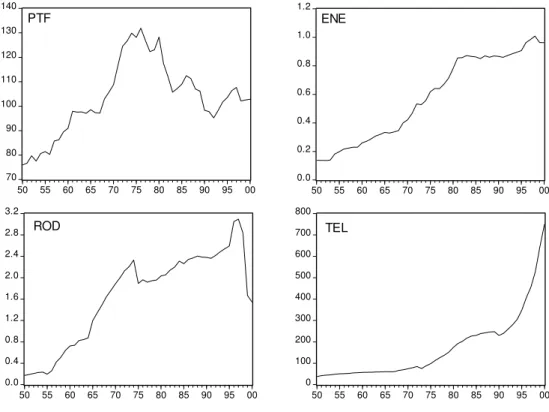
Figure 1 shows the evolution of TFP and infrastructure in Brazil between 1950 and 2000. Productivity reached its peak in the 1970s and drastically decreased until the 1990s, when it began to recover. With regard to paved roads, the growth tendency changed over time and shows an apparent structural break in 1975.13 Most of the
investments in this sector were made before 1975, and the expansion rate of paved roads was approximately 12.3 percent per year from the beginning of the series until 1974.
The electric energy generating capacity increased to approximately 800,000 kilowatts until 1980, when it stagnated. Araújo and Ferreira (2006) calculated that between 1960 and 1980, the average annual growth of the total generating capacity was 10.3 percent, whereas that figure decreased to as low as 3.6 percent between 1981 and 2000. Lastly, the telecommunications sector shows a positive relationship in its trajectory from the second half of the 1970s. Up until the 1970s, approximately 80 telephones per thousand workers were installed; by 1995, this figures increased to 350. The privatisation of the telecommunications sector started in 1996, and it is clear that it had a decisive role in the universalisation of this service.
12 See Appendix 2.
Figure 1: Brazil - TFP and Physical Measures of Infrastructure 70 80 90 100 110 120 130 140
50 55 60 65 70 75 80 85 90 95 00
PTF 0.0 0.2 0.4 0.6 0.8 1.0 1.2
50 55 60 65 70 75 80 85 90 95 00
ENE 0.0 0.4 0.8 1.2 1.6 2.0 2.4 2.8 3.2
50 55 60 65 70 75 80 85 90 95 00
ROD 0 100 200 300 400 500 600 700 800
50 55 60 65 70 75 80 85 90 95 00
TEL
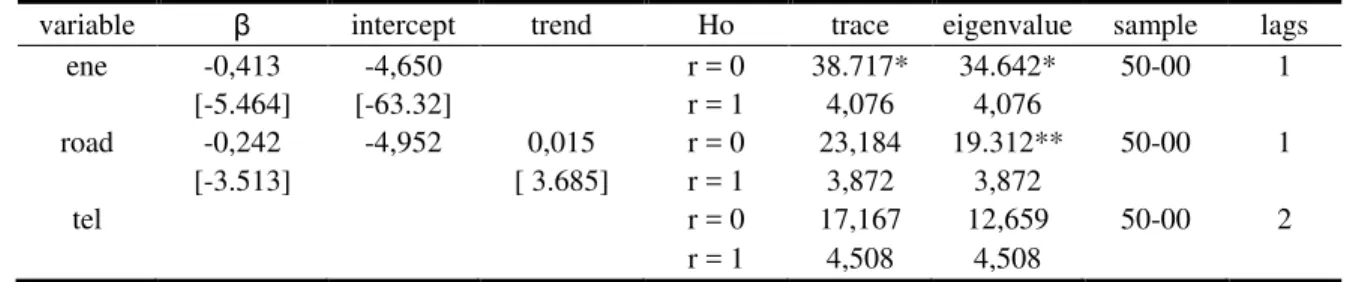
Table 1 shows an estimation of the normalised cointegration vector14 and the eigenvalue and trace statistics. All of the selection criteria15 point toward an estimation of VAR with one lag in the models for roads and energy, which do not show a residual autocorrelation. Productivity and electric energy cointegrate – a 1 percent increase in generating capacity increases the TFP by 0.41 percent in the long run. The impact of paved roads is smaller, with an elasticity of approximately 0.24. The variables cointegrate through autovalue, not through trace. The installed phone variable does not show a long-run relationship with the TFP. This series shows a sharp increase from 1974 onwards, while productivity decreases dramatically during the same period (see Figure 1).
14 A negative β (cointegration coefficient) implies a positive relationship between variables in the long run. All variables are log transformed.
Table 1: Brazil – TFP Elasticity in Relation to Infrastructure
variable β intercept trend Ho trace eigenvalue sample lags
ene -0,413 -4,650 r = 0 38.717* 34.642* 50-00 1
[-5.464] [-63.32] r = 1 4,076 4,076
road -0,242 -4,952 0,015 r = 0 23,184 19.312** 50-00 1
[-3.513] [ 3.685] r = 1 3,872 3,872
tel r = 0 17,167 12,659 50-00 2
r = 1 4,508 4,508
**(*) Rejects Ho at 5%, t statistic in square brackets.
4.2. Argentina
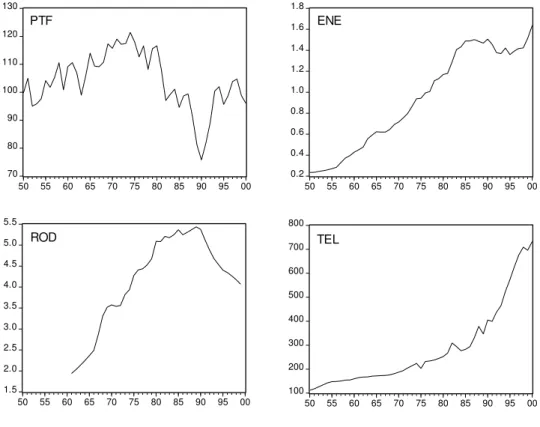
The behaviour of Argentinean productivity is similar to that observed in Brazil. However, the series presents more eminent cyclical components, which might indicate a less stable level of activity. There was a drastic drop in TFP during the triennium of 1988/89/90 - a reflection of the severe recession combined with the hyperinflation faced by the country during those years. The energy generating capacity grew steadily since 1950 and dropped only in the period subsequent to 1988. With the privatisation of this sector in 1995, however, new investments started to come in. As a result, in 2000, the generating capacity per thousand workers reached 1.63 million kilowatts. There are no data for paved roads available from the 1950s, though we can note a significant increase between the 1960s and 1980s, followed by a substantial drop in the 1990s. Private concessionaires started to operate the majority of the roads in the country as a
consequence of the privatisation program implemented by the Menem government in 1990; however, no greenfield projectswere implemented afterward. As in Brazil, the number of installed phones showed a continuous increase that has accentuated in 1990 with the privatisation of the state-owned company ENTEL.16
Figure 2: Argentina - TFP and Physical Measures of Infrastructure 70 80 90 100 110 120 130
50 55 60 65 70 75 80 85 90 95 00
PTF 0.2 0.4 0.6 0.8 1.0 1.2 1.4 1.6 1.8
50 55 60 65 70 75 80 85 90 95 00
ENE 1.5 2.0 2.5 3.0 3.5 4.0 4.5 5.0 5.5
50 55 60 65 70 75 80 85 90 95 00
ROD 100 200 300 400 500 600 700 800
50 55 60 65 70 75 80 85 90 95 00
TEL
The trace and eigenvalue statistics show that the variables “lene” and “lroad”
cointegrate with the TFP at a significance level of 1 percent. The productivity elasticity in relation to energy is about 0.12, a low value compared to that of Brazil. A 10 percent increase in the paved roads measure increased the TFP by approximately 4.2 percent in the long run (in Brazil, the estimated impact is 2.4 percent). Although the Johansen test indicates cointegration between installed phones and productivity, the respective elasticity is not significant.
Table 2: Argentina – TFP Elasticity in Relation to Infrastructure
variable β intercept Trend Ho trace eigenvalue sample lags
ene -0,118 -4,477 r = 0 29.573* 24.762* 50-00 2
[-2.370] [-120.512] r = 1 4,810 4,810
road -0,427 -3,927 r = 0 34.100* 30.080* 61-99 1
[-3.591] [-23.302] r = 1 4,020 4,020
tel -0,115 -4,442 r = 0 28.209* 22.892* 50-00 1
[-0.670] [-4.703] r = 1 5,317 5,317
4.3. Mexico
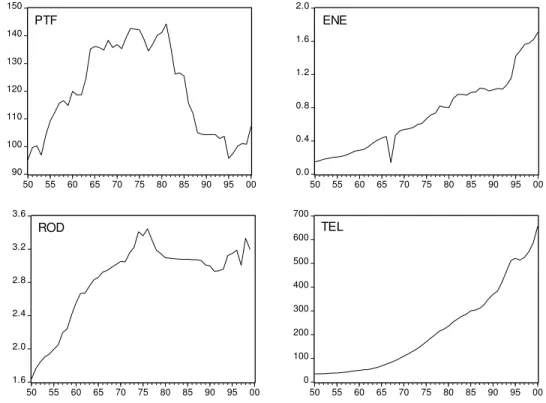
The total factor productivity for Mexico can be divided into two very distinct periods (see Figure 3). From 1950 to 1981, the TFP trended toward growth and remained high throughout the entire period. From 1982 onward, productivity decreased drastically, with a slight recovery in the second half of the 1990s. This drastic drop is the result of the Mexican moratorium and the insolvency of many developing countries. On the other hand, the energy generating capacity experienced growth throughout the entire period with the exception of 1967, when it experienced a sudden drop, which might be due to problems with the database.
Figure 3: Mexico - TFP and Infrastructure Physical Measures
90 100 110 120 130 140 150
50 55 60 65 70 75 80 85 90 95 00
PTF 0.0 0.4 0.8 1.2 1.6 2.0
50 55 60 65 70 75 80 85 90 95 00
ENE 1.6 2.0 2.4 2.8 3.2 3.6
50 55 60 65 70 75 80 85 90 95 00
ROD 0 100 200 300 400 500 600 700
50 55 60 65 70 75 80 85 90 95 00
TEL
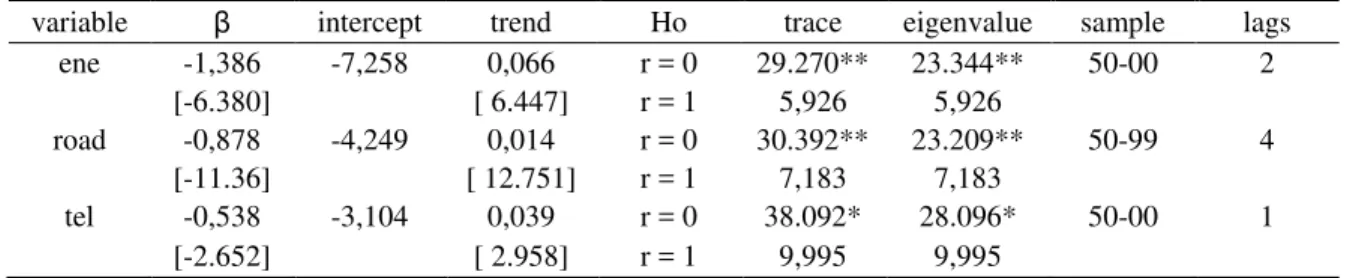
Table 3 shows that the three measures of infrastructure cointegrate with TFP. A VAR with two lags was estimated for electric energy (AIC and FPE), and the obtained elasticity was 1.38; that is, an increase in this variable more than proportionally increased productivity in the long run. A 10 percent increase in the extension of roads increased the TFP in a model with four lags (AIC and FPE) by 8.8 percent. The estimated coefficient for the number of phones is 0.53 with one lag (SC), but the residues present
autocorrelation in the first lag. There is no cointegration between the variables when a model with two lags is estimated (indicated by the other criterias).
Table 3: Mexico – TFP Elasticity in Relation to Infrastructure
variable β intercept trend Ho trace eigenvalue sample lags
ene -1,386 -7,258 0,066 r = 0 29.270** 23.344** 50-00 2
[-6.380] [ 6.447] r = 1 5,926 5,926
road -0,878 -4,249 0,014 r = 0 30.392** 23.209** 50-99 4
[-11.36] [ 12.751] r = 1 7,183 7,183
tel -0,538 -3,104 0,039 r = 0 38.092* 28.096* 50-00 1
[-2.652] [ 2.958] r = 1 9,995 9,995
**(*) Rejects Ho at 5% (1%), t statistic in square brackets.
4.4. Chile
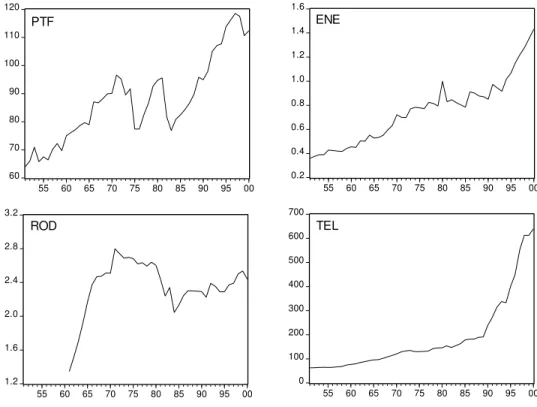
Chile is the only country that has not reversed its growth tendency of productivity. Two drops in the TFP occurred, in 1975 and in the 1980s (probably as a consequence of external shocks during those periods), followed by a quick recovery. Through the alternative decomposition of growth, Gomes et al. (2003) calculated that, between 1950 and 2000, the TFP was responsible for 97 percent of the product growth per Chilean worker.
road network17, there was a drastic drop in the available mileage at the beginning of the 1970s. However, growth resumed in 1984, resulting in 2.43 kilometres of paved road per thousand workers in 2000. On the other hand, the main characteristic of the
telecommunications sector is its fast growth from 1990 onward. The privatisation of this sector occurred in 1990, and investment up through 2000 significantly expanded the network, reaching 640 phones per thousand workers.
Figure 4: Chile - TFP and Infrastructure Physical Measures
60 70 80 90 100 110 120
55 60 65 70 75 80 85 90 95 00
PTF 0.2 0.4 0.6 0.8 1.0 1.2 1.4 1.6
55 60 65 70 75 80 85 90 95 00
ENE 1.2 1.6 2.0 2.4 2.8 3.2
55 60 65 70 75 80 85 90 95 00
ROD 0 100 200 300 400 500 600 700
55 60 65 70 75 80 85 90 95 00
TEL
The results show that a 1 percent increase in the generating capacity implies a 0.38 percent increase in the TFP in a VAR with two lags. These values are similar to those of Brazil (0.41 percent), once again emphasising the importance of this sector with relation to productivity. Telecommunication and roads cointegrate with TFP at a 1 percent significance level; in both cases, the criteria point to a model with only one lag. The coefficient estimated for paved roads is high, around 1.35. For instance, an
investment in 2001 that increased the available extension by 2.67 kilometres per thousand
workers would increase productivity up to 13.5 percent in the long run. The estimated elasticity of installed phones is actually in opposition to the expected result, but it is not statistically significant.
Table 4: Chile – TFP Elasticity in Relation to Infrastructure
variable β Intercept trend Ho trace eigenvalue sample lags
ene -0,385 -4,596 r = 0 15.473** 15.138** 51-00 2
[-7.373] r = 1 0,335 0,335
road -1,355 -2,906 -0,015 r = 0 34.641* 30.612* 61-00 1
[-5.480] [-4.653] r = 1 4,029 4,029
tel 0,040 -4,305 r = 0 44.762 36.441 51-00 1
[ 0.462] [-9.900] r = 1 8,321 8,321
**(*) Rejects Ho at 5% (1%), t statistic in square brackets.
5. Cointegration Tests with Structural Breaks
The result of a cointegration test can be modified if a change in the coefficient of the deterministic components (intercept and trend) is taken into account. As mentioned in the introduction, Leybourne and Newbold (2003) found spurious cointegration between two independently generated random walks. Using tests from Engle-Granger (1987), Johansen (1988), and Banerjee et al. (1986) while simulating breaks in the trend of the series compromises the inferences of those tests. That is, the hypothesis of
non-cointegration among variables is rejected, implying a Type 1 Error.
In this section, the existence of cointegration among the aforementioned series is tested, considering a possible structural break at the level of variables. To do so, we use the cointegration test with endogenous break developed by Lütkepohl, Saikkonen and Trenkler (2004) (summarised below).
5.1.The Lütkepohl, Saikkonen and Trenkler Test (LST)
Consider the vector y (n x 1) t determined by
t t p t p t
t t d Ay A y
y 0 1 1 1 1... (1)
where dt is an intercept dummy, with dt 0 for t and dt 1 for t . The date of
are real numbers arbitrarily next to zero and one respectively, and [.] indicates the complete part of the argument. Equation (1) represents an unconstrained VAR of order p,
with Aj representing a matrix n x n of coefficients andt ~i.i.d.(0,). The estimator of
is determined by
T p t t t 1 ' ˆ ˆ det min arg ~ in which ˆt are the residues of (1) estimated by OLS for a given p, chosen through any
selection criteria. The authors show that, in relation to some hypothesis, ~/T is a
consistent estimator of the sample fraction ˆt. Once the date of the break is estimated,
the test follows what Saikkonen and Lütkepohl (2000) have described. First, the series xˆt
is obtained and adjusted for deterministic terms based on
ˆ0 ˆ1 ˆ ˆ
ˆt yt t dt
x
where the parameter vectors 0,1, are estimated by a Feasible GLS.18 Next,
0 0
0(r):rk( ) r
H is tested against H1(r0):rk()r0 in relation to the adjusted series in
a VECM. The test statistics are determined through the solution of a generalised eigenvalue problem and given by the LR statistics
n r j j r LR 1 0 0 ) ˆ 1 log( ) ( of which the critical values can be found in Saikkonen and Lütkepohl (2000). A great advantage of this procedure is that, under the null hypothesis, the asymptotic distribution of the LR statistics is the same when the date of the break is known. Moreover, the critical values do not depend on the date of the change in level. This does not hold true in a similar test proposed by Johansen and Nielsen (1993), in which a new table has to be obtained for every date of the break. Actually, as pointed out by Lütkephol et al. (2003), in the case of such small samples, Saikkonen and Lütkepohl`s (2000) test is usually more powerful and contains better properties than the test described by Johansen and Nielsen (1993). The LST test presupposes the existence of a break in the data generator process;
that is, it excludes the possibility of 0or 1. According to Perron (2006), however, once the filter procedure of the series (Feasible GLS) is done, the asymptotic distribution is not modified.
Table 5: Cointegration Tests with Structural Breaks
Brazil
β Ho LR 10% 5% 1% sample lags
ene -0.477 r = 0 10.14 13.78 15.83 19.85 50-00 2 r = 1 1.97 5.42 6.79 10.04
road -0.38 r = 0 9.38 13.78 15.83 19.85 50-00 2 r = 1 2.27 5.42 6.79 10.04
tel 1.26 r = 0 11.74 13.78 15.83 19.85 50-00 3 r = 1 3.56 5.42 6.79 10.04
Argentina
β Ho LR 10% 5% 1% sample lags
ene -1.102 r = 0 12.76 13.78 15.83 19.85 50-00 2 r = 1 4.65 5.42 6.79 10.04
road -0.011 r = 0 10.58 13.78 15.83 19.85 61-99 2 r = 1 4.35 5.42 6.79 10.04
tel -0.095 r = 0 15.61* 13.78 15.83 19.85 50-00 2 r = 1 4.98 5.42 6.79 10.04
Mexico
β Ho LR 10% 5% 1% sample lags
ene -1.482 r = 0 19.81** 13.78 15.83 19.85 50-00 2 r = 1 4.09 5.42 6.79 10.04
road -0.761 r = 0 14.56* 13.78 15.83 19.85 50-99 4 r = 1 6.26 5.42 6.79 10.04
tel -0.925 r = 0 10.79 13.78 15.83 19.85 50-00 2 r = 1 3.58 5.42 6.79 10.04
Chile
β Ho LR 10% 5% 1% sample lags
ene 1.275 r = 0 12.61 13.78 15.83 19.85 51-95 3 r = 1 4.30 5.42 6.79 10.04
road -3.22 r = 0 18.84** 13.78 15.83 19.85 61-00 2 r = 1 5.33 5.42 6.79 10.04
tel -0.148 r = 0 12.16 13.78 15.83 19.85 51-00 2
r = 1 4.34 5.42 6.79 10.04
5.2.Results
Table 5 presents the results of the cointegration tests, which take into account structural breaks and use the two-stage procedures described above.19 When the possibility of structural breaks is disregarded, the obtained results are quite different. Therefore, we can verify that the probable existence of a break in many cases, reinforcing that the non-consideration of such breaks considerably alters the results.
Almost all of the results for the tests without breaks show a tendency toward cointegration, as described in the previous section. On the other hand, in tests that consider the possibility of structural breaks, such cointegration is less noticeable. In the case of Brazil, none of the infrastructure series show a cointegration relationship with the
TFP. In Argentina, only the telecommunications sector exhibits this effect, while Chile’s
paved roads series presents cointegration with a high estimated elasticity of 3.22. The roads and electric energy infrastructures show cointegration in the case of Mexico, both with values similar to the ones obtained through the Johansen procedure.
These results reinforce the hypothesis that infrastructure is indeed correlated with TFP, yet there are limits to the effect of infrastructure on productivity. We argue that infrastructure causes an increase in the TFP when the former is scarce. In other words, infrastructure is necessary, but it is not sufficient for the growth of the TFP. Even in the
event of an infrastructure “boom” (such as during the privatisation process in Brazil in
the 1990s), the TFP might not grow due to different factors, such as poor institutions or little human capital.
Such perspective allows an understanding of the impacts of structural breaks in the results. If breaks in the infrastructures series (which result from privatisations) are considered, we note that the increase in infrastructure was not followed by an increase in the TFP in all cases. Therefore, a long-run relationship cannot be assumed.
6. Conclusion
We sought to evaluate how infrastructure has affected the total factor productivity in four Latin American countries: Argentina, Brazil, Chile, and Mexico. This paper makes three
additional contributions to the existing literature. First, the estimations used for the time series avoid distortions related to the idiosyncrasies of each country. Second, the paper analyses the relationship between TFP and the physical measures of infrastructure
through a cointegration analysis given the non-stationary nature of the series. Finally, the two-stage test used here, which was developed by Lutkepohl, Saikkonen and Trenkler (2004), takes into account structural breaks at levels in the cointegration relationship, which empowers tests when analysing small samples.
The results from the traditional Johansen test show that there is a clear
cointegration relationship between infrastructure and productivity. However, when a two-stage test with breaks was conducted, we obtained different results. In some cases, these results go along with the results obtained with the first test, but in many cases they don`t. Consequently, we can assume that the infrastructure stock is not sufficient to bring about sustainable growth in the TFP.
Appendix 1 - TFP Calculation
Gomes et al. (2003) departed from a Cobb-Douglas production function with constant scale returns:
(
)
1t it it it
it
A
k
H
y
01 (1)where y is the output per worker, A is the DTFP, k is the physical capital stock per
worker, H is the human capital stock per worker, is the technologic frontier evolution,
and α is the income-elasticity of the capital. i represents the country, and t represents the
period of time. The technological frontier evolution t t (1g)
is given by the leading
economy (USA) and is supposedly equal to all of the countries at a certain moment of time.
The capital stock K was constructed by the perpetual inventory method
it it
it
K
I
K
(
1
)
(2)where δ is the depreciation rate, and I is the gross investment. The functional form
of human capital is derived from Bils and Klenow’s (2000) specification and is
represented by
(.) concave; that is, the return of one additional year of schooling onhuman capital is decreasing.
) (hit
it
e
H
where
1 1 )
(h h , with 0 e 0 1
When the terms of Equation (1) are manipulated, we easily obtain the estimated TFP:
1 1it it t it
H
k
y
A
TFP
(3)efficiency of their respective economy (Ait), and the contribution of the frontier to the
product, considered as the technological progress (it1).
The EAP, GDP and investment series were extracted from the PWT version 6.1, whereas the education data came from Barro and Lee (2000). The values of the
parameters are: 0,4; g 0,0153; 0,035; 0,32; 0,58. The rate of
evolution of the frontier g was calculated based on the product growth per worker of the
USA between 1950 and 1972.20 They did not use the rate of the entire period (1959-2000) because after the first Oil Shock, the growth of the TFP slowed down, as
mentioned previously. Finally, the TFP series was normalised by the US TFP from 1950. For example, if the Brazilian TFP was 109 in 1970, this TFP was 9 percent larger than that of the US TFP from 1950.
Appendix 2 - Infrastructure Physical Measures Unit Root Tests21
Brazil Mexico
ADF p value ADF p value
tfp -2.0928 0.2484 tfp -1.95823 0.6093 dtfp -5.5117 0.0000 dtfp -5.28293 0.0001 ene -0.28388 0.989 ene -1.01394 0.7407 dene -3.93881 0.0002 dene -10.4866 0 road -0.27719 0.9893 road -2.58756 0.2875 droad -4.36552 0 droad -2.6309 0.0096 tel -2.14357 0.5086 tel -2.69311 0.2444 dtel -3.84084 0.0048 dtel -3.29621 0.0204
Argentina Chile
ADF p value ADF p value
tfp -2.0003 0.2858 tfp -2.31626 0.4175
dtfp -6.05547 0 dtfp -6.62989 0
ene -0.30767 0.9883 ene -1.77076 0.7033
dene -4.37868 0.001 dene -9.79693 0
road -0.18622 0.9911 road 0.935903 0.9039 droad -4.22789 0.01 droad -4.38511 0.0001 tel -0.39058 0.9853 tel -1.66384 0.7486
dtel -7.93842 0 dtel -4.75618 0.0003
References
Aschauer, D. 1989. “Is public expenditure productive?” Journal of Monetary
Economics 23: 177-200.
Araújo, C. H. and Ferreira, 2006. “ On the economic and fiscal effects of
infrastructure investment in Brazil.” Ensaios Econômicos EPGE/FGV:
http://epge.fgv.br/pt/ensaios-economicos.
Banerjee, A., Dolado, J. J., Hendry, D. F. and Smith, G. W. 1986. “Exploring
equilibrium relationships in econometrics through static models: Some Monte Carlo
evidence.” Oxford Bulletin of Economics and Statistics 48: 253–77.
Bils, M., and Klenow, P. J. 2000. “Does schooling cause growth?” American
Economic Review 90: 1160-1183.
Calderón, C., Easterly, W. and Servén, L. 2003. “Latin America’s infrastructure
in the era of macroeconomic crises.” In The limits of Stabilization: Infrastructure, Public
Deficits and growth in Latin America. Stanford University Press.
Calderón, C., Servén, L. 2003. “The output cost of Latin America’s infrastructure
gap.” In The limits of Stabilization: Infrastructure , Public Deficits and growth in Latin
America. Stanford University Press.
Canning, D. 1998. “A database of world stocks of infrastructure, 1950-1995.”
World Bank Economic Review 12: 529-547.
Durlauf, S. 2001. “Manifesto for a Growth Econometrics” Journal of
Econometrics, 100: 65-69.
Ellery Jr., R., Ferreira, P. C.; Gomes V. 2005. “Produtividade agregada brasileira
(1970-2000): declínio robusto e fraca recuperação.” Ensaios Econômicos EPGE/FGV:
http://epge.fgv.br/pt/ensaios-economicos.
Engle, R. F. and Granger, C. W.J. (1987). “Cointegration and Error Correction:
Representation, Estimation, and Testing”, Econometrica .55, 251-276.
Esfahani, H.S.; Ramírez M.T. 2003. Institutions, infrastructure, and economic growth. Journal of Development Economics 70: 443–477.
Fernald, G. 1999. “ Roads to prosperity? Assessing the link between public
capital and productivity.” American Economic Review 89: 619-638.
Ferreira, P. C., and Malliagros, T. 1998. “Impactos produtivos da infra-estrutura
Gomes, V.; Pessôa S., Veloso, F. 2003 “Evolução da produtividade total dos
fatores na economia brasileira: uma análise comparativa.” Pesquisa e Planejamento
Econômico 33: 389-434.
Johansen, S. 1988. “Statistical Analysis of Cointegration Vectors”, Journal of
Economic Dynamics and Control 12: 231-254.
Johansen, S.1995. Likelihood-based inference in cointegrated vector autoregressive models. Oxford University Press.
Johansen, S., Nielsen, B., 1993. “ Manual for the simulation program DisCo.”
Institute of Mathematical Statistics, University of Copenhagen:
http://math.ku.dk/~sjo/disco/disco.ps.
Leybourne, S. J., and Newbold, P. 2003.“Spurious rejections by cointegration
tests induced by structural breaks.” Applied Economics 35: 1117-1121.
Lütkephol, H., and Saikkonen, P. 1999. “Order selection in testing for the
cointegrating rank of a VAR process.” In Cointegration, Causality and Forecasting. A
Festschrift in Honour of Clive W. J. Granger. Oxford University Press.
Lütkephol, H., and Saikkonen, P. 2000. “Testing for the cointegration rank of a
VAR process with a time trend.” Journal of Econometric .95: 177-198.
Lütkephol, H., Saikkonen, P., and Trenkler, C. 2003. “Comparition of tests for
the cointegrating rank of a VAR process with structural shift.” Journal of Econometric.
113: 201-229.
Lütkephol, H., Saikkonen, P., and Trenkler, C. 2004. “Testing for the
cointegration rank of a VAR process with level shift at unknown time.” Econometrica
72: 647-662.
Munnel, A. 1992. “Infrastructure investment and economic growth.” Journal of
Economic Perspectives, 6: 189-198.
Perron, P. 2006 "Dealing with structural breaks." In Palgrave Handbook of Econometrics, Vol. 1: Econometric Theory. Edited by K. Patterson and T.C. Mills.
Palgrave Macmillan: 278-352.
Pritchett, L. 2000. “The tyranny of concepts: CUDIE (cumulated, depreciated,
investment effort) is not capital.” Journal of Economic Growth 5: 361-384.
Röller, L., and Waverman L. 2001. “Telecommunications infrastructure and
economic development: a simultaneous approach.” American Economic Review 91:
Saikkonen P. e Lütkepohl, H. 2000. “Trend adjustment prior to testing for the
cointegrating rank of a vector autoregressive process.” Journal of Time Series Analysis
21: 435- 456.
Sanchez-Robles, B. 1998. “Infrastructure investment and growth: some empirical
evidence.” Contemporary Economic Policy 6: 98-108.
Servèn, L. 1997.“Uncertainty, instability, and irreversible investment.” World
Bank Policy Research Working Paper 1722. Washington D. C.: 1997
Tatom, J. 1991. “Public capital and private performance.” Review, Federal