HAMILTON GOMES DE OLIVEIRA
HOW TO REALIZE THE POTENTIAL OF THE PREDATORY MITE
PHYTOSEIULUS MACROPILIS TO CONTROL TWO-SPOTTED
SPIDER-MITES IN STRAWBERRY?
Tese apresentada à Universidade Federal de Viçosa, como parte das exigências do Programa de Pós-Graduação em Entomologia, para obtenção do título de “Doctor Scientiae”.
VICOSA
HAMILTON GOMES DE OLIVEIRA
HOW TO REALIZE THE POTENTIAL OF THE PREDATORY MITE
PHYTOSEIULUS MACROPILIS
TO CONTROL TWO-SPOTTED
SPIDER-MITES IN STRAWBERRY?
Tese apresentada à Universidade Federal de Viçosa, como parte das exigências do Programa de Pós-Graduação em Entomologia, para obtenção do título de “Doctor Scientiae”.
Aprovada:2
4
de novembro de 2006
Prof. Eraldo Rodrigues de Lima
(Co-orientador)
Prof. Raul N.C. Guedes
(Co-orientador)
Prof. Simon Elliot
Prof. Arnoldus Rudolf Maria Janssen
À minha esposa Cristina
À minha mãe Sebastiana
Às minhas irmãs Maria, Marlene, Isa e Nilza
Ao meu orientador Angelo Pallini
Ao amigo Marcos Fadini
Às colegas de trabalho Vanessa, Daniela, Elisa e Cleide
AGRADECIMENTOS
À Universidade Federal de Viçosa pela infra-estrutura que nos dispõem e que permite que os trabalhos sejam realizados com sucesso.
Ao CNPq pelo consentimento da bolsa de estudo para que esse trabalho fosse realizado.
Ao professor Angelo Pallini, orientador deste trabalho, por toda contribuição proferida para que essa Tese se tornasse uma realidade e pela confiança a mim dedicada.
Aos co-orientadores: Dra: Madelaine Venzon, Raul N.C. Guedes, Eraldo Rodrigues Lima e José Cola Zanuncio pela importante contribuição dedicada e pela constante disposição para discutir e corrigir os dados aqui representados
Ao professor Arne Janssen pela importante para que essa tese se tornasse realidade.
Ao professor Simon Elliot pelos valiosos comentários realizados e por participar da comissão de defesa desta Tese.
À Dona Paula cuja presença na Secretaria de Entomologia é para nós uma dádiva. À Mirian pela amizade e pela constate disposição em ajudar.
À Solange pela paciência e dedicação para corrigir e colocar essa tese nas normas da UFV.
Aos Amigos Samir, Cristina, Anderson, Alberto, Gabriela, Rosenilson, Cláudia, Célia, Claudinei, Renato, Sãozinha, Rosenilson, Ângela, Cezar, Eugênio, Adenir, Fadini, João, Adrián, Silma, Fernanda e Edmar pela amizade em todos os momentos de realização deste trabalho.
BIOGRAFIA
SUMÁRIO
Página RESUMO... Vi
ABSTRACT ………..………... Viii
CHAPTER 1: Introduction and general discussion……….... 1
1.2. References... 5
1.3. Figures legends... 8
1.4 Figures... 9
CHAPTER 2: A phytoseiid predator from the tropics as potential biological control agent for the spider mite Tetranychus urticae Koch (Acari: Tetranychidae)………... 10 2.1. Abstract... 10
2.2. Introduction... 11
2.3. Material and methods... 12
2.4. Results... 14
2.5. Discussion... 15
2.6. References... 18
2.7. Figures legends... 21
2.8. Figures... 22
CHAPTER 3: Abamectin and dimethoate are more harmful to the predator Phytoseiulus macropilis than to its prey Tetranychus urticae….. 27
3.1. Abstract... 27
2.2. Introduction... 28
3.3. Material and methods... 30
3.4.Results... 32
3.5. Discussion... 33
3.6. References... 36
3.7. Figures legends... 41
3.8. Figures... 42
CHAPTER 4: Aacaricides impede the olfactory response of a predatory mite to plants infested with its prey………...………... 44
4.1. Abstract... 44
2.2. Introduction... 45
4.3. Material And Methods... 47
4.4. Results... 51
4.5. Discussion... 51
4.6. References... 54
4.7. Figures legends... 60
RESUMO
OLIVEIRA, Hamilton Gomes de, D.Sc., Universidade Federal de Viçosa, novembro de 2006. Como desenvolver o potencial do acaro predador Phytoseiulus macropilis para controlar o ácaro-rajado em plantas de morango? Orientador: Angelo Pallini Filho. Co-Orientadores: Madelaine Venzon, Raul Narciso .C. Guedes, Eraldo Rodrigues de Lima e Jose Cola Zanuncio.
Controle biológico através de predadores que ocorrem naturalmente em suas regiões de origem é visto como uma promissora alternativa ao controle químico de pragas. No Brasil, estudos de campo demonstraram que o ácaro predador nativo,
Phytoseiulus macropilis Banks é constantemente encontrado associado à populações do ácaro-rajado Tetranychus urticae Koch em plantações de morango no estado de Minas Gerais. A ocorrência desse predador é maior sobre plantas abandonadas do que sobre plantas ainda exploradas comercialmente e, consequentemente pulverizadas com acaricidas. Nessa tese foram avaliados os seguintes pontos: i) a capacidade de P. macropilis em controlar populações locais do ácaro-rajado Tetranychus urticae, ii) os efeitos letais e subletais dos acaricidas abamectin e dimetoato sobre o fitófago T. urticae
e P. macropilis e iv) através de experimento de olfatometria os efeitos dos acaricidas sobre a capacidade de P. macropilis em detectar voláteis de plantas de morango infestadas com T. urticae. Os resultados mostraram que o ácaro predador P. macropilis
ABSTRACT
OLIVEIRA, Hamilton Gomes de, D.Sc., Universidade Federal de Viçosa, november, 2006. How to realize the potential of the predatory mite Phytoseiulus macropilis to control two-spotted spider-mites in strawberry? Adviser: Angelo Pallini Filho. Co-Advisers: Madelaine Venzon, Raul Narciso .C. Guedes, Eraldo Rodrigues de Lima e Jose Cola Zanuncio.
Biological control using naturally occurring predators has been attempted. In Brazil, field studies showed that the indigenous predatory mite Phytoseiulus macropilis
(Banks) is constantly found associated with spider mites in strawberry crops in the Minas Gerais state. This predatory mite occurrence is high on abandoned strawberry fields, but on plants that are yet commercially explored and are sprayed with acaricides the occurrence of P. macropilis is less frequent. So, spider mite control is done through acaricides application in the area studied. The most applied acaricides in the area are abamectin and dimethoate. In this thesis it was studied the capacity of P. macropilis to be used as biological control agent against T. urticae in strawberry fields. It was evaluated i) the capacity of P. macropilis to control local population of T. urticae, ii) the lethal and sublethal effects of the acaricides abamectin and dimethoate on T. urticae and iii) studied by use of olfactory experiment, acaricides effects on the capacity of the P. macropilis to detect volatiles from strawberry infested plants with T. urticae. The results showed that P. macropilis is able to control T. urticae population and its reproduction and growth rates are high. However, Acaricides application is very harmful to P. macropilis. Predatory mite that survived the acaricide application have lower population growth rate than T. urticae when exposed to the same acaricide dose. Besides, surviving predators became unable to detect volatiles from infested plants with
CHAPTER 1: INTRODUCTION AND GENERAL DISCUSSION
Spider mites are common pest on many plants. Injury is caused as they feed, bruising
the cells with their small whiplike mouthparts and ingesting the sap (Helle and Sabelis, 1985).
Damaged areas typically appear marked with many small, light flecks, giving the plant a
somewhat speckled appearance (Greco, 2005).
The dispersal ability of T. urticae in field is an important factor to be considered on
pest control. Hussey and Parr (1963) indicated that the two spotted spider mites dispersed in
the following ways: migration of newly emerged (presumably mated) females to oviposition
sites; dispersal from infested plants, simply by dropping off; and movements over soil surface
in accordance with the plane of polarized light.
There is direct evidence that the mites are able to suspend themselves on silken threads
and thus be carried along by air currents (Kennedy and Smitley, 1985). Mites can also be
dispersed on the clothing of greenhouse personnel or through the movement of infested plant
material. Despite the dispersal ability of the mites, it is not uncommon to find infestations in
one portion of the field throughout the season, and perhaps even from season to season.
Patchy infestations in the field are characteristic of the two spotted spider mites. These
population characteristics make the spider mite control difficult to be managed (Zemek and
Nachman, 1999).
Chemical control is the most used control for spider mite. Prophylactic pesticide
applications are used widely in commercial fields to manage spider mites. However,
increasing concerns about the pesticides impact on the environment and human safety have
prohibit the use of certain pesticides (Stark and Banks, 2003). In addition, few acaricides of
different chemical classes are available and a spraying sequence with one active ingredient
bears the risk of fast resistance development (Sechser et al., 2002). Thus, there is the need of
implementation of other forms for spider mite control. Biological control of this herbivore
using predatory mite is the main alternative to chemical pesticides.
Predatory mites are the most important biological control agents of spider mite
affecting many crops in different parts of the world (Helle and Sabelis, 1985). In some
agroecosystems these natural enemies may drive spider mite numbers below economically
damaging levels (Nirop et al., 1998). Infested plants with T. urticae produce volatiles that are
used by the predator in both long range and local foraging (Sabelis & Dicke, 1985). At long
range, volatiles may attract a predator to the source or cause a predator to search more
intensively around a prey-infested plant (Janssen, 1999). Once on a plant, these same plant
volatiles may be important in local arrestment (Sabelis et al., 1984; Sabelis & Afman, 1994).
Phytoseiulus persimilis Athias-Henriot (Acari-Phytoseiidae) is the predatory mite most
used against spider mite and normally this predator is mass reared in laboratory and then
released in the field. However, biological control using naturally occurring predators has been
attempted (Waite, 1987; García-Marí and González-Zamora, 1999). In Brazil, field studies
showed that the indigenous predaceous mite Phytoseiulus macropilis (Banks) is constantly
found associated with spider mites in strawberry crops in the Minas Gerais state, Brazil
(Fadini et al., 2004). P. macropilis life cycle is well known (Prasad, 1967) and it is shorter
than its prey, the spider mite T. urticae (Fadini et al., 2004) (Figure 1). This predatory mite
occurrence is high on abandoned strawberry fields, but on the plants that are yet commercially
applied acaricides in the area are abamectin and dimethoate. Although, studies are done
concerning sublethal effects of pesticides on population growth rate of other beneficial
organisms (Stark and Banks, 2003, Teodoro et al., 2005), little is known about the
susceptibility of P. macropilis to these acaricides.
In this thesis, it was studied if spider mite local population can be controlled by the
predator mite P. macropilis. In chapter 2, the capacity of P. macropilis to control local
population of T. urticae was investigated. This trait was accessed through the predation and
oviposition rates of the predators when fed on all prey stages. P. macropilis had high rates of
predation and oviposition when fed on spider mite and showed capacity to control local
population of this pest in five days.
In chapter 3, was studied the lethal and sublethal effects of the acaricides abamectin
and dimethoate on T. urticae and P. macropilis. In this chapter, sublethal effects were
accessed through growth rate population study of both mite species. Acaricides caused lethal
and sublethal effects on T. urticae and P. macropilis. However, P. macropilis was more
affected by acaricides application.
In chapter 4, by using olfactory experiment, acaricides effects on the capacity of the P.
macropilis to detect volatiles from strawberry infested plants with T. urticae was studied. P.
macropilis that was exposed to abamectin and dimethoate was able to survive, but was unable
to discern between volatiles that were from infested and non infested plants.
Concluding, the predatory mite P. macropilis is able to control T. urticae population.
Its reproduction and growth rates are higher than Phytoseiulus persimilis Banks (Acari:
Phytoseiidae), which is the most used predatory mite on biological control programs
worldwide. However, acaricides application is the source of the negative effects on P.
rate than T. urticae when exposed to the same acaricide dose. Besides, surviving predators
became unable to detect volatiles from infested plants with T. urticae.
Acknowledgements
Financial support was provided by the National Council of Scientific and Technological
Development (CNPq) and by the Minas Gerais State Foundation for Research Aid
(FAPEMIG). We are acknowledged also to the Coordination for Higher Level Graduates
References
Fadini, M.A.M., Lemos, W.P.; Pallini, A.; Venzon, M. and Mourão, S.A. 2004. Herbivoria de
Tetranychus urticae Koch (Acari: Tetranychidae) induz defesa direta em morangueiro?
Neotropical Entomology 33,3, 293-297.
García-Marí, F. and González-Zamora, J.E., 1999. Biological control of Tetranychus urticae
(Acari: Tetranychidae) with naturally occurring predators in strawberry plantings in
Valencia, Spain. Experimental and Applied Acarology 23, 487–495.
Greco, N.M. and Sanchez, N.E., 2005. Neoseiulus californichus as a potential control agent of
Tetranychus urticae (Acari: Tetranychidae): effect of pest/predator ration on pest
abundance on strawberry. Experimental and Applied Acarology 37, 57-66.
Helle, W. amd Sabelis, M.W., ed. Spider mites: their biology, natural enemies and control.
Amsterdam: Elsevier, 1985,lA, 405 p.
Hussey N.W. and Scopes N. 1985. Greenhouse Vegetables (Britain). In: Helle W. and Sabelis
M.W.(eds), Spider Mites Their Biology, Natural Enemies and Control. Elsevier,
Amsterdam, pp. 285–297.
Hussey, N.W. and Parr, W.J. 1963. The effect of glasshouse red spider mite (Tetranychus
urticae Koch) on the yield of cucumbers. Journal of Horticulture Science 38, 255–263.
Kennedy, G.G. and Smitley, D.R. 1985. Dispersal, p.233-242. In W. Helle & M.W. Sabelis
(Eds.), Spider mites: Their biology, natural enemies and control. Elsevier, Amsterdam,
(World Crop Pests, 1A) 404p.
Nagelkerke, C.J. and Sabelis, M.W. 1998. Precise control of sex allocation in
Nyrop, J.; English-Loeb, G;. and Roda, A. 1998. Conservation biological control of spider
mites in perennial cropping systems. In: Barbosa P. (ed.), Conservation Biological
Control. Academic Press, pp396.
Prasad, V., 1967. Biology of the predatory mite Phytoseiulus macropilis in Hawaii (Acarina:
Phytoseiidae). Annual Entomology Society American 60, 905-908.
Roy, M.; Brodeur, J. and Cloutier, C. 2003. Temperature and sex allocation in a spider mite.
Oecologia 135, 322-326.
Sabelis, M. W. and Afman, B.P. 1994. Synomone-induced suppression of take-off in the
phytoseiid mite Phytoseiulus persimilis Athias-Henriot. Experimental and Applied
Acarology 18, 711–721.
Sabelis, M. W.; Vermaat, J.E. and Groeneveld, A. 1984. Arrestment responses of the
predatory mite Phytoseiulus persimilis to steep odour gradients of a kairomone.
Physiological Entomology 9, 437–446.
Sechser, B.; Reber, B.; and Bougeois, F. 2002. Pymetrozine: Selectivity spectrum to beneficial
arthropods and fitness for integrated pest management. Journal of Pest Science 75, 72-77.
Stark J.D. and Banks J.E. 2003. Population-level effects of pesticides and other toxicants on
arthropods. Annual Review of Entomology, 48, 505–519.
Teodoro, A.V.; M.A.M. Fadini; W.P. Lemos; R.N.C. Guedes and A. Pallini. 2005.Lethal and
sub-lethal selectivity of fenbutatin oxide and sulfur to the predator Iphiseiodes zuluagai
(Acari: Phytoseiidae) and its prey, Oligonychus ilicis (Acari: Tetranychidae), in Brazilian
coffee palntationa. Experimental and Applied Acarology, 36, 61-70.
Zemek, R. and Nachman, G. 1999. Interactions in a tritrophic acarine predator– prey
Figure Legend
Figure 1: Life cycle of predatory mite P. macropilis and of Tetranychus urticae on Strawberry
CHAPTER 2: A PHYTOSEIID PREDATOR FROM THE TROPICS AS
POTENTIAL BIOLOGICAL CONTROL AGENT FOR THE SPIDER
MITE
TETRANYCHUS URTICAE
(ACARI: TETRANYCHIDAE)”
Abstract
The two-spotted spider mite Tetranychus urticae Koch (Acari: Tetranychidae) is
one of the most important pests of many crops in temperate and tropical climates. Chemical
control is the main method of combating this mite, but it is less preferred due to the
development of resistance as well as environmental problems associated with the use of
pesticides. Biological control of spider mites has been tried as a logical alternative method
for chemical control. Studies have been conducted in different countries to assess the effect
and potential of natural enemies for controlling the pest. The predatory mite Phytoseiulus
macropilis (Banks) (Acari: Phytoseiidae) was found associated with spider mites in
strawberry crops in the state of Minas Gerais, Brazil. Earlier studies suggested that P.
macropilis was able to control spider mites, but predation and oviposition rates have not
been measured so far. We measured predation and oviposition on strawberry with spider
mites as prey in the laboratory. The predator fed on all prey stages and showed capacity to
control local prey populations on leaf disks. The oviposition rate of P. macropilis is similar
of the most used predatory mite Phytoseiulus persimilis and the predation rate is higher
than that of the latter. Our results suggest that P. macropilis is a promising candidate to
control two-spotted spider mites in the tropics and other areas.
Key words: Phytoseiulus macropilis, predatory mites, local prey population, strawberry
1. Introduction
The two-spotted spider mite Tetranychus urticae Koch (Acari: Tetranychidae) is
one of the most important pests of many crops in temperate and tropical climates (Skirvin
and Williams; 1999; García-Marí and Gozález-Zamora, 1999). Spider mites can colonize
plants shortly after crops have been planted and damaging outbreaks usually occur later
during the growing season (Badii al., 2004). The number of spider mites can increase up
40% per day. This exponential population growth usually ends abruptly due to
overexploitation of the host plant (Krips et al., 1998).
Chemical control is the main method of combating spider mites. Due to the
excessive use of pesticides and the associated problems of pesticide resistance and
environmental pollution, there is an increasing demand for sustainable, environmental-
friendly control methods. Biological control of spider mites has been tried as an alternative
method to chemical control. Several species of natural enemies have been reported to prey
on spider mites and studies have been conducted in different countries to assess the
potential of natural enemies for controlling the pest without the use of pesticides and
without economic damage to the crop (Opit et al., 2005).
Predatory mites from the family Phytoseiidae have been used to suppress T. urticae
populations (Escudero and Ferragut, 2005). One species of phytoseiid mite that is widely
used with success and is commercially available is Phytoseiulus persimilis Athias-Henriot.
However, in Mediterranean countries, P. persimilis has been less successful, possibly
because it is not well adapted to prevailing climatic conditions (Bakker et al., 1993).
Skirvin and Fenlon (2003) reported that temperatures above 25 °C may be detrimental to
urticae in warmer areas has resulted in a search for predators that are adapted to such
climatic conditions (Prasad, 1967; Shih et al., 1979).
The predatory mite Phytoseiulus macropilis (Banks) (Acari: Phytoseiidae) was first
found in Florida and it is the most common predatory mite in this region (Saba, 1974). It
was also found in Europe and tropical areas in Africa and South America (Moraes et al.,
2004, Rosa et al., 2005). In Brazil, P. macropilis was found associated with spider mites in
strawberry crops in the state of Minas Gerais (Fadini et al., 2004) where the annual average
temperature is about 25°C. The reproductive biology of P. macropilis when fed on T.
urticae mites at various temperatures has already been studied. Its net reproductive rate was
highest at 28°C and the intrinsic rate of increase also peaked at 28°C (Ali, 1998). However,
the efficacy of P. macropilis to control populations of T. urticae has never been tested. We
evaluated the oviposition and predation rates on each stage of T. urticae, as well as the
capacity of the predator to control small prey populations on strawberry leaves.
2. Materials and methods
2.1 General procedures
Strawberry plants were grown in 500 ml pots in a greenhouse (13-38 °C, 40-60 RH
and 13:12 L:D). Part of these plants was used to rear T. urticae. Adults of T. urticae were
transferred from these plants through detached strawberry leaves and then placed on
moistened cotton pads on top of a sponge (3.0 cm thick) in a plastic box (15 x 25 x 5 cm)
that was used as rearing unit. Water was added to the rearing units when necessary to keep
the cotton moist. To rear predators, arenas with T. urticae were taken from the culture and a
± 5% RH and at 13:11 light: dark cycle, corresponding to the conditions in the region
where mites were collected. When leaves were deteriorating, they were taken from the
rearing unit and placed on top of a new arena to allow the mites to move onto the new
arena. Arenas were examined once per day. When over-population of the predators was
observed, predators were transferred to new arenas infested with prey.
2.2 Predation rates and reproduction on different prey stages
The predation and oviposition rate of P. macropilis were measured on a diet
consisting of either T. urticae eggs, larvae, protonymphs, deutonymphs or adult female
prey. In order to obtain prey eggs, strawberry leaf discs (Ø = 2 cm) were infested with 45-
50 adult females for 24 h. Subsequently, females were removed and the eggs were counted.
We did not manipulate egg densities because this would also damage the web produced by
the spider mites. The other stages were collected from a rearing unit and placed on clean
strawberry leaf discs with a fine brush. A single gravid female of P. macropilis was added
immediately after releasing the prey. Hence, in the experiments with juvenile and adult
stages there was almost no spider-mite web on the leaf disc. Fifteen replicates were done
for each stage, and the densities per arena were 98.60 ± 7.40 eggs, 78.00 ± 5.29 larvae,
72.53 ± 3.54 protonymphs, 77.13 ± 3.09 deutonymphs and 46.47 ± 0.84 adult females.
These numbers are high enough to ensure sufficient food for the predator (Oliveira, pers.
obs). As a control for natural prey mortality, five arenas per stage with the same mean
number of prey were incubated without predator. The number of consumed and alive prey
as well as survival and oviposition of the predators was recorded every day during three
food source (Nomikou et al., 2001), we analyzed data only from the second and third day.
Daily oviposition and predation rates were analyzed using ANOVA followed by posthoc
Tukey tests (α = 0.05) when necessary.
2.2 Time needed to control a local prey population
In order to test the capacity of P. macropilis to control local prey populations in
presence of web produced by prey, strawberry leaf discs (Ø = 2 cm) were infested with 50
adult female of T. urticae, which were allowed to oviposit for 24h. Subsequently, the
number of adults and eggs was assessed. One gravid female predator was released on each
leaf disc, and all stages of prey and predators were counted daily. The experiment was
terminated when numbers of prey eggs were too low (14.7 eggs per arena) to sustain the
predators. The control consisted of five arenas infested with 50 adult female prey without
predators. Data were analyzed using ANOVA followed by post hoc Tukey tests α = 0.05
when necessary.
3. Results
3.1 Predation rate and reproduction on different prey stages
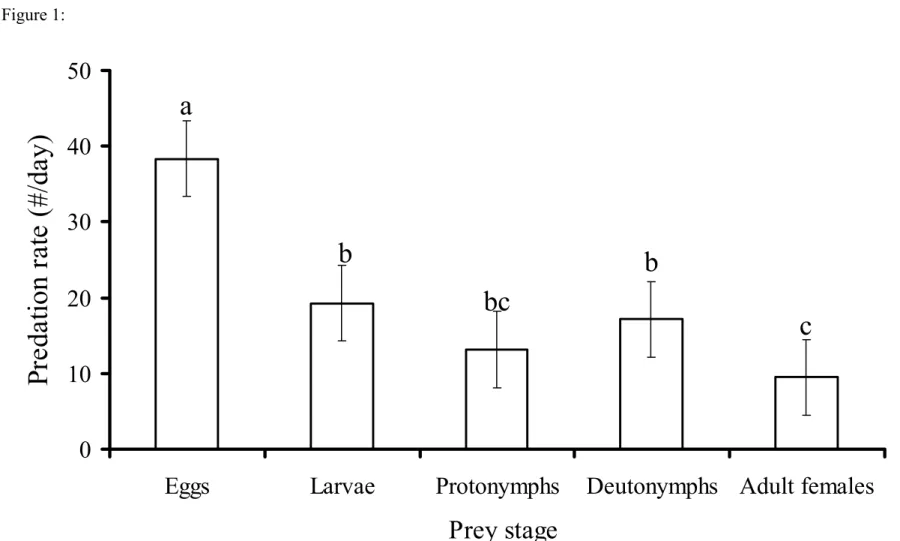
Predators were able to feed on all prey stages (Figure 1). Predation was higher on
eggs than on the later stages (F = 221.98; df = 4; p<0.00001) (Figure 1). Because the
number of prey offered largely exceeded the maximum predation rate observed, it is
reasonable to assume that predators were not limited by food and that the results reflect the
maximum predation rates.
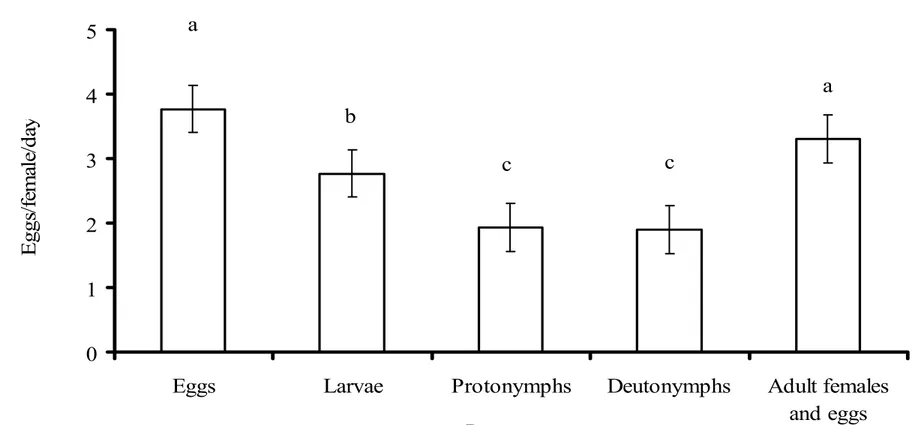
Predators oviposited when feeding on each prey stage, however, oviposition rates
oviposition rate was observed when predators fed on eggs and on adult females and eggs
(Figure 2).
3.2 Time needed to control a local prey population
The time needed for a predator to control a local prey population was determined
until the prey numbers remaining on the arenas were too low to feed the predator. The
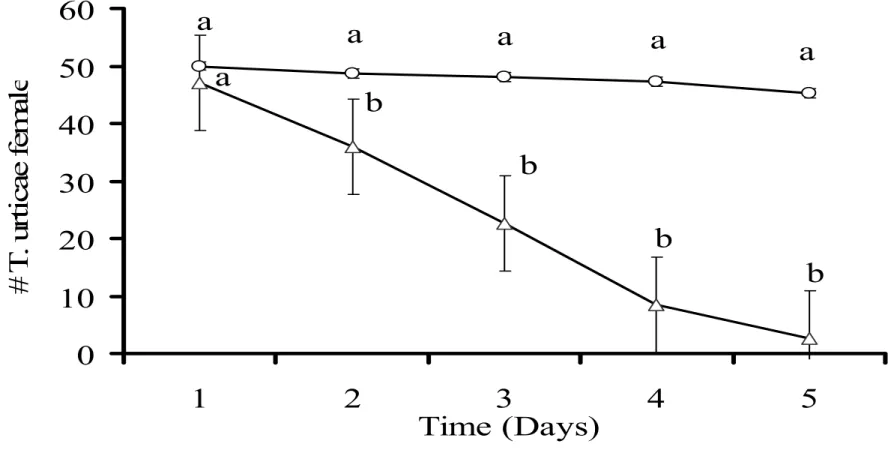
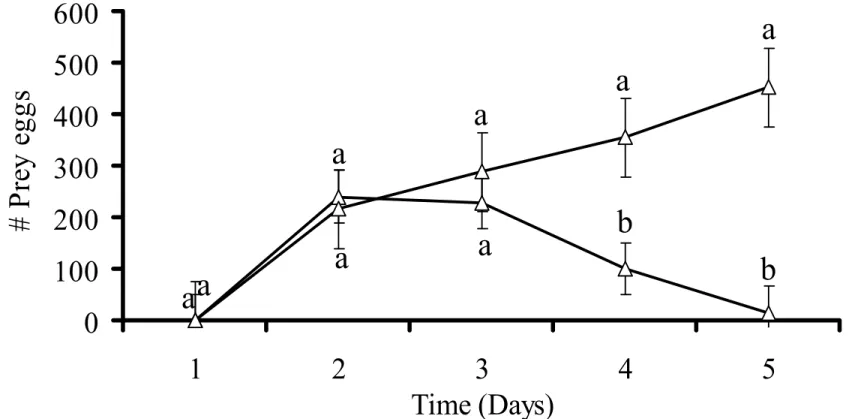
numbers of adult female prey and eggs reached such low levels in five days (Figure 3 and
4), whereas the numbers of predators increased (Figure 5), showing that the predators were
capable of controlling small local prey populations.
4. Discussion
Adult females of the predatory mite P. macropilis fed on all stages of the spider
mite T. urticae, but predation was higher on eggs than on the other stages. The differences
in predation of the various stages could be due to differences in the ability of spider mites
to escape and because of the preference of predators. The predation rate on spider mite eggs
was about 40 eggs per day, which is much higher than that of the widely used control agent
P. persimilis.Ashihara et al. (1978) reported that P. persimilis fed on 28.1 spider mite eggs
per day.
Predators oviposited when feeding on each prey stage, but the highest oviposition
rate of P. macropilis was observed when predators fed on eggs and on adult females more
eggs. The oviposition rate is similar to that of P. persimilis (M.W. Sabelis & A. Janssen,
unpubl. data). Probably, the high oviposition rate shown by P. macropilis when feeding on
The capacity of P. macropilis to control spider mites was confirmed by the finding
that predators controlled small prey populations on leaf disks after as little as five days. The
populations on these discs reflected the natural structure of the prey population; spider
mites are usually concentrated in a relatively small area of a plant, and deposit eggs close to
were they feed. Most offspring do not move very far from where they hatch, dispersing
only far enough to find undamaged leaf tissue near the parent cluster (Kondo and Takafuji,
1985; Mayland et al., 2000), resulting in small prey colonies with high densities.
An important characteristic of P. macropilis is that it is well adapted to warm
climates and may be more efficient in controlling T. urticae in Mediterranean areas than are
the currently available natural enemies (Bakker et al., 1993; Escudero and Ferragut, 2005).
Moreover, it can probably also be used in greenhouses, where temperatures can easily
exceed 25°C, particularly in the summer months. In contrast, the predation rate of the
commonly used control agent P. persimilis declines at temperatures above 25 °C (Skirvin
and Fenlon, 2003).
If P. macropilis can suppress T. urticae populations, the question remains why this
pest reaches high numbers in crops in Brazil, such as strawberry, tomatoes, cucumbers and
roses, where the predator does occur. This may be because of the frequency of pesticide
applications, including acaricides, which will kill large numbers of the predators, whereas
spider mites may develop resistance (Oliveira et al. in prep.). If this is the case, a reduction
of pesticide application would probably result in increased control of the spider mite pest.
Summarizing, the predatory mite P. macropilis is a promising potential biological
control agent of the two-spotted spider mite, especially in warmer areas. Other studies
suggested that P. macropilis was able to control spider mites (Prasad, 1967; Shih et al.,
oviposition rates as showed here. It remains to be investigated how this predatory mite
controls groups of local spider mite populations (metapopulations).
Acknowledgements
Financial support was provided by the National Council of Scientific and Technological
Development (CNPq) and by the Minas Gerais State Foundation for Research Aid
(FAPEMIG). We are acknowledged also to the Coordination for Higher Level Graduates
References
Ali, F.S., 1998. Life tables of Phytoseiulus macropilis (Banks) (Gamasida: Phytoseiidae) at
different temperatures. Experimental and Applied Acarology 22, 335-342.
Ashihara, W., Hamamura, T., Shinkaji, N., 1978. Feeding, reproduction, and development
of Phytoseiulus persimilis Athias-Henriot (Acarina: Phytoseiidae) on various food
substances. Bulletin of Fruit Tree Research Station Japan 2, 91-98.
Badii, M.H., Hernandez-Ortiz, E., Flores, A.E., Landeros, J.N., 2004. Prey stage preference
and functional response of Euseius hibisci to Tetranychus urticae (Acari: Phytoseiidae,
Tetranychidae). Experimental and Applied Acarology 34, 263-273.
Bakker, F.M., Klein, M.E., Mesa, N.C., Braun, A.R., 1993. Saturation deficit tolerance
spectra of phytophagous mites and their phytoseiid predators on cassava. Experimental
and Applied Acarology 17, 97-113.
Escudero, L.A., Ferragut, F., 2005. Life-history of predatory mites Neoseiulus californicus
and Phytoseiulus persimilis (Acari: Phytoseiidae) on four spider mite species as prey,
with special reference to Tetranychus evansi (Acari: Tetranychidae). Biological Control
32, 372-384.
Fadini, M.A.M., W.P. Lemos, A. Pallini, M. Venzon, Mourão, S.A. 2004. Herbivoria de
Tetranychus urticae Koch (Acari: Tetranychidae) induz defesa direta em morangueiro?
Neotropical Entomology 33,3, 293-297.
García-Marí, F., González-Zamora, J.E., 1999. Biological control of Tetranychus urticae
(Acari: Tetranychidae) with naturally occurring predators in strawberry plantings in
Valencia, Spain. Experimental and Applied Acarology 23, 487–495.
Kondo, A., Takafuji, A., 1985. Resource utilization pattern of two species of tetranychid
Krips, O.E., Witul, A., Willems, P.E.L., Dicke, M., 1998. Intrinsic rate of population
increase of the spider mite Tetranychus urticae on the ornamental crop gerbera:
intraspecific variation in host plant and herbivore. Entomologia Experimentalis et
Applicata 89, 159-168.
Mayland, H., Margolies, C.C., Charlton, R. E., 2000. Local and distant prey-related cues
influence when an acarina predator leaves a prey patch. Entomologia Experimentalis et
Applicata 96, 245-252.
Moraes, G.J., McMurtry, J.A., Denmark H.A., Campos, C.B., 2004. A revised catalog of
the mite family Phytoseiidae. Zootaxa 434: 1- 494.
Nomikou, M., Janssen, A., Schraag, R., Sabelis, M.W., 2001. Phytoseiid predators as
potential biological control agents for Bemisia tabaci. Experimental and Applied
Acarology 25, 271-291.
Opit, G.P., Nechols, J.R., Margolies, D.C., Williams, K.A., 2005. Survival, horizontal
distribution, and economics of releasing predatory mites (Acari: Phytoseiidae) using
mechanical blowers. Biological Control 33, 344-351.
Prasad, V., 1967. Biology of the predatory mite Phytoseiulus macropilis in Hawaii
(Acarina: Phytoseiidae). Annual Entomology Society American 60, 905-908.
Rosa, A.A., Gondim Jr, M.G.C., Fiaboe, K.K.M., Demoraes, G.J., Knapp, M., 2005.
Predatory mites associated with Tetranychus evansi Baker & Pritchard (Acari:
Tetranychidae) on native solanaceous plants of coastal Pernambuco State, Brazil.
Neotropical Entomology 34, 689-692.
Saba, F., 1974. Life history and population dynamics of Tetranychus tumidus in Florida
Shih, C.I., Poe, S.L., Cromroy, H.L., 1979. Biology and predation of Phytoseiulus
macropilis on Tetranychus urticae. Florida Entomology 62, 48-53.
Shrewsbury, P.M., Hardin, M.R., 2003. Evaluation of predatory mite (Acari: Phytoseiidae)
releases to suppress spider mites, Oligonychus ununguis (Acari: Tetranychidae), on
juniper. Journal of Economic Entomology 96, 1675-1684.
Skirvin, D.J., Fenlon, J.S., 2003. The effect of temperature on the functional response of
Phytoseiulus persimilis (Acari: Phytoseiidae). Experimental and Applied Acarology 31,
37-49.
Skirvin, D.J., Williams, M.C., 1999. Differential effects of plant species on a mite pest
(Tetranychus urticae) and its predator (Phytoseiulus persimilis): Implications for
Figure legends.
Figure 1: Average (±1 SE) predation rate of P. macropilis females on different stages of
the prey T. urticae under laboratory conditions. Different characters above the bars
indicate significant differences in predation rate (p < 0.05, Tukey HSD test).
Figure 2: Average (±1 SE) oviposition rate of P. macropilis females on different stages of
the prey T. urticae under laboratory conditions. Different characters above the bars indicate
significant differences in oviposition rate (p < 0.05, Tukey HSD test).
Figure 3: Average numbers of T. urticae females as function of time on leaf discs without
P. macropilis (open circles) or with P. macropilis (open triangles). Data shown are
means ± 1 SE. Different characters above the symbols indicate significant differences in
numbers of adult females with and without predators (p < 0.05 by Tukey HSD test).
Figure 4: Average numbers of T. urticae eggs as function of time on leaf discs without P.
macropilis (open circle) and with P. macropilis (open triangle). Data shown are means
± 1 SE. Different characters above the symbols indicate significant differences in
numbers of adult females with and without predators (p < 0.05 by Tukey HSD test).
Figure 5: Average numbers of mobile stages of P. macropilis as function of time on leaf
discs with adult females and eggs of T. urticae as food.
Figure 1:
c
b
bc
a
b
0
10
20
30
40
50
Eggs
Larvae
Protonymphs
Deutonymphs Adult females
Prey stage
P
red
at
io
n
rat
e
(#
/d
ay
Figure 2:
c
c
a
b
a
0
1
2
3
4
5
Eggs
Larvae
Protonymphs
Deutonymphs
Adult females
and eggs
Prey stage
E
g
g
s/
femal
e/
d
Figure 3:
a
b
b
b
b
a
a
a
a
a
0
10
20
30
40
50
60
1
2
3
4
5
Time (Days)
#
T
. u
rt
icae f
em
al
Figure 4:
b
b
a
a
a
a
a
a
a
a
0
100
200
300
400
500
600
1
2
3
4
5
Time (Days)
# P
re
y
e
gg
Figure: 5
0
2
4
6
8
10
12
0
1
2
3
4
5
Time (Days)
# pr
edator
CHAPTER: 3 ABAMECTIN AND DIMETHOATE ARE MORE
HARMFUL TO THE PREDATOR
PHYTOSEIULUS
MACROPILIS
THAN TO ITS PREY
TETRANYCHUS URTICAE
Abstract
Recent studies in laboratory showed that the predatory mite Phytoseiulus macropilis Banks
(Acari: Phytoseiidae) is efficient in to control spider mite Tetranychus urticae (Acari:
Phytoseiidae, Tetranychidae) population. However, in Brazilian strawberry field, one of the
various cultures when the predatory mite was found, spider mite is the major pest and it
control is done by acaricides application. In contradiction, splayed plants are continually
damaged by spider mite and predatory presence is low on those plants. After production
season, plants are no more splayed with acaricides and predatory mite is found in high
number on those and all spider mite population is controlled. Thus, we formulated the
hypotheses that acaricide application is more harmful for predatory mite that for the pest
spider mite. Acaricides more used on strawberry plants in Brazil are abamectin and
dimethoate. We addressed the lethal and sublethal effects by determining the relative
toxicity of the acaricides abamectin and dimethoate to the predaceous mite P. macropilis
and to its prey, the spider mite T. urticae (Acari: Phytoseiidae, Tetranychidae). The spider
mite was 2.58x and 4.21x more tolerant than the predator to abamectin and dimethoate,
respectively. The instantaneous rate of increase of spider mites and predatory miteslinearly
decreased with increasing concentrations of both acaricides. However, the instantaneous
rate of increase of the predator decreased more rapidly with increasing acaricide
concentrations than that of the pest, resulting in extinction of predator populations while the
pest persisted. Because P. macropolis is a promising candidate for biological control of
spider mites, farmers may achieve better control by not spraying, but managing the
populations of this predator.
Key words: Pesticides, biological control, Integrated Pest Management, lethal and
Introduction
The phytophagous spider mite Tetranychus urticae Koch has a broad host-plant
range and is a serious pest of various crops worldwide as is described by various studies
(Easterbrook et al., 2001; Sato et al., 2002; Kishimoto, 2002; Fadini et al., 2004,).
Strawberry plants are often heavily infested and suffer severe damage by T. urticae (Sato et
al., 2001). The mite mainly feeds on leaves; usually on the underside, but can also cause
direct economic damage when feed on fruits, flowers and on tips of shoots (Lourenção et
al., 2000). The typical symptoms of spider mite feeding are small, light colored punctures
(Alford, 1972).
Prophylactic pesticide applications are widely used in commercial greenhouses to
control spider mites on strawberry plants (Easterbrook et al., 2001). However, increasing
concerns about the impact of pesticides on the environment and human safety have made
pesticides less desirable and resulted in more restrictive governmental regulation regarding
their use (Opit et al., 2001). Besides, economical damage levels of spider mites have been
reported even when acaricides were applied (Wilson et al., 1991). Thus, there is a need to
implement other, more sustainable methods for spider mite control. Biological control with
predatory mites is the main alternative to chemical pesticides (Shrewsbury and Hardin,
2003).
Several species of natural enemies have been reported to prey on T. urticae, and
studies have been conducted in different countries to assess the potential of natural enemies
for controlling the pest without the use of pesticides and without economic damage to the
crop. Two approaches have been developed for using biological control. These are the mass
release of Phytoseiulus persimilis (Acari: Phytoseiidae) and other predatory mites (Oatman
populations of predators. The first option has been the most common strategy, but
biocontrol of spider mites by native predators has also been attempted, mainly with
phytoseiids (Fournier et al., 1985; Waite, 1988, García-Marí and Gonzáles-Zamora, 1999).
In field surveys, the native predaceous mite Phytoseiulus macropilis (Banks) was
found associated with spider mites in strawberry crops in the State of Minas Gerais, Brazil
(Fadini et al., 2004). Probably P. macropilis that are found on strawberry plants is
originated in local vegetation that there is near strawberry fields. Laboratory and
greenhouse experiment showed that P. macropilis has high predation rate on T. urticae and
can control local population of this pest in few days (Oliveira et al., unpubl. data).
Despite the presence of this predatory mite in strawberry fields, spider mites are
predominantly controlled through chemical pesticides. Two acaricides, abamectin and
dimethoate, are frequently used in Brazilian strawberry fields (Sato et al., 2002).
Applications of these acaricides are timed to coincide with the appearance of spider mite
after its presence is noted by farmer observation and follows a calendar base. At this same
time, P. macropilis is present in strawberry fields. Thus, an overlap occurs between the
acaricide applications against spider mites and the presence of P. macropilis. However,
nothing is known about the susceptibility of P. macropilis to these acaricides. We noticed
that acaricides splaying causes a contradiction because splayed plants are continually
damaged by spider mite and predatory presence turns low or absent on those plants. After
production season, plants remained in the field and are no more splayed with acaricides. In
this time predatory mite is found in high number on those plants and all spider mite
population is controlled. Thus, we formulated the hypotheses that acaricides application are
determination of the lethal and sublethal effects of abamectin and dimethoate on P.
macropilis and its prey T. urticae.
Material and methods
Adult phytophagous and predatory mites from strawberry field in south state of
Minas Gerais, Brazil were brought for the lab. Phytophagous were reared on arenas made
of strawberry leaves that were put on moistened cotton pads on top of a sponge (3.0 cm
thick) in a plastic box (15 cm x 25 cm x 5 cm). Predatory mites were reared on these spider
mites arenas. Arenas with predators and with phytophagous mites were kept in separate
climate boxes at 25 ± 1°C, 60 ± 5% RH and 13 h of light. Water was added to the rearing
units when necessary to keep the cotton moist. Arenas were examined every day and when
a high population of predators was observed, the predators were transferred to new arenas
infested with the pest.
Concentration–response bioassays
Concentration–response bioassays were carried out for both acaricides using adult
female predatory mites (4–5 days old), or T. urticae (14-15 days old) at the beginning of
their reproductive period. The acaricides were sprayed on strawberry leaf disks (3.0 cm
diameter) using a Potter tower. Spraying was carried out at 0.34 bar (= 3.44/104 kPa) with a
2.5 ml spray aliquot in accordance with recommendations of the International Organization
for Biological Control of Noxious Animals and Plants (Hassan et al. 1994).
The sprayed leaf disks and acetone-sprayed controls were air-dried for 1 h.
each disk. Five replicates were used per acaricide concentration for each mite species.
During the experiment, other strawberry leaf disks where sprayed with the same acaricide
concentration and with spider mites were incubated on this disc. These mites were used for
feeding the predators whenever necessary during the experiment, in order to better reflect
field conditions because in splayed crops, predatory mite will prey only splayed spider
mite. Were maintained 200 or more prey per arena per day as food for predatory mite.
Treated leaf discs with mites were maintained at 25 ± 2 0C, 60 ± 10% R.H. and 13 h
light in a climate box. The concentrations used in the bioassays were selected after
preliminary tests with a broad concentration range, allowing selection of lower and upper
limits of the concentration that causes minimum and maximum mite mortality for each
acaricide and mite species. Technical grade acaricides (> 84% pure) were obtained from
BASF and CHEMINOVA Chemical Companies. Acaricides were dissolved in acetone. A
control treatment in which only acetone was sprayed was used to correct the data for
mortality that was not caused by application of acaricides. Mite mortality was assessed after
72 h exposure and mites were considered dead if they did not move after disturbing them
with a fine brush (Stark et al. 1997). Concentration–mortality curves were estimated using
probit analysis (SAS Institute 1997). For each acaricide, the index of differential selectivity
was obtained by dividing the LC50 of spider mites by the LC50 of predatory mites, and
confidence limits (95%) were calculated following Robertson and Preisler (1992).
Demographic bioassays
The instantaneous rate of increase (ri) was estimated using the equation
living mites and ∆T is the time interval (days) elapsed between the start and the end of the
bioassay (Stark et al. 1997). The experimental procedures and acaricides were the same as
those used for concentration–mortality bioassays with daily progeny assessments up to
seven days following initial exposure. Either five adult female predatorsor ten adult female
spider mites were used per replicate.
The mites were kept in rearing chambers under the same conditions as the
concentration–response bioassays. Spider mite females were provided daily as food source
for the predatory mites. These spider mites where obtained from strawberry leaf disks
sprayed with the same concentration as that of the leaf disks with predatory mites. The
acaricide concentrations for the demographic assays were based on the previously obtained
concentration–mortality curves. Controls were sprayed with acetone only. Regression
analyses were carried out to assess the effect of acaricide concentrations on the
instantaneous rate of increase of each mite species.
Results
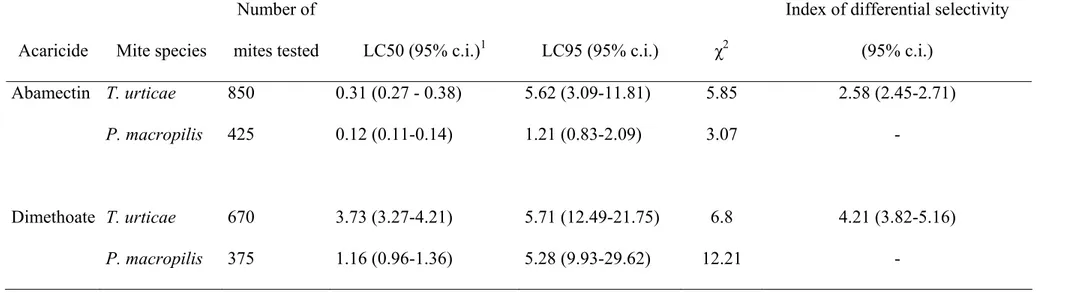
The spider mite T. urticae was more tolerant to both acaricides than its predator P.
macropilis (Table 1).
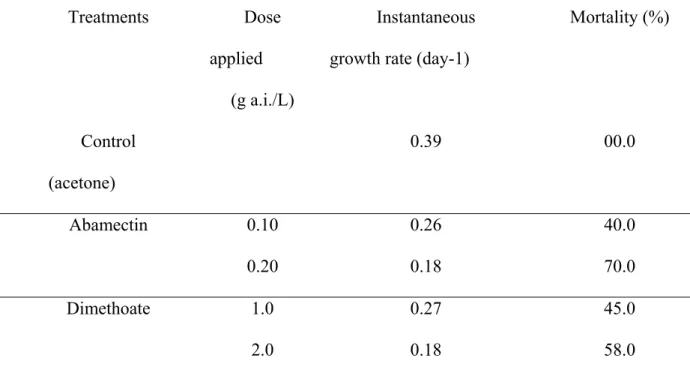
The instantaneous population growth rate of T. urticae and P. macropilis decreased
linearly with increasing concentrations of both acaricides (Figures 1 and 2). Spider mite
populations that were exposed to concentrations of abamectin around LC50 (i.e., 0.31 mg
a.i./L) showed positive values of ri (0.10 ± 0.08 day-1), indicating population growth after
seven days of exposure to this acaricide (Figure 1). Extinction of spider mite populations
occurred only at concentrations ≥ 0.42 mg a.i./L, close to the LC60. Abamectin showed a
concentrations as low as 0.27 mg a.i./Ll (ri = -0.10 ± 0.04 day -1) after seven days of
exposure (Figure 1). Spider mites had a positive population growth rate at this
concentration (ri = 0.12 ± 0.09 day-1) after seven days of exposure.
Results for dimethoate also showed more drastic effects for predatory mites than for
spider mites. Predator extinction occurred at 4.25 mg a.i./L (ri = -0.013 ± 0.00 day-1)
whereas for spider mites, extinction occurred at 6.0 mg a.i./L (ri = -0.024 ± 0.001 day-1)
after seven days of exposure (Figure 2).
Discussion
The spider mite T. urticae was more tolerant to the acaricides abamectin and
dimethoate than its natural enemy, the predatory mite P. macropilis. Contrary results were
reported by Kim and Yoo (2002) that showed that the acaricides bifenazate, acequinocyl,
chlorfenapyr and fenbutatin oxide were much less toxic to Phytoseiulus persimilis Koch
adult females than to T. urticae adult females. Dekeyser et al. (1996) also reported that the
acaricide bifenazate shows high activity on phytophagous mites, such as Tetranychus,
Eutetranychus, Oligonychus and Panonychus species, whereas it is harmless to predacious
mites, such as the phytoseiids Amblyseius fallacis Garman, Galendromus occidentalis
Nesbitt and Zetzellia mali Ewing.
In the areas were these mites used in this study where collected, the farmers apply
acaricides twice per week. This acaricide application is done for more than 10 years ago.
Strawberry culture is cultivated for eight months per year. Under this environment acaricide
resistance is likely to occur, as observed elsewhere (Sato et al., 2004). Population of spider
have been reported for various compounds, such as organophosphates, dicofol, organotins,
hexythiazox, clofentezine and abamectin, only a few years after the introduction of such
products (Stumpf and Nauen 2001). The rapid development of resistance in T. urticae is
favoured by its high reproductive potential, extremely short life cycle and its arrhenotokous
mating system, and it is increased due to the relative isolation of mite populations that
normally coupled in the path, the extended growing season and the frequency of spraying
(Cranham and Helle, 1985).
Considerable research efforts have been devoted to finding alternative strategies for
suppression of T. urticae populations (Kim and Yoo, 2001). Phytoseiid predators are the
most important biological control agents of phytophagous mites in integrated mite
management programs of outdoors and of greenhouse crops (Van Lenteren and Woets,
1988). Until recently, P. macropilis was not recognized as a potentially effective biocontrol
agent of T. urticae, and it was therefore not considered in decisions of acaricide
applications. This predator species is found in strawberry fields mainly at the end of the
growing season, when acaricides are no longer applied (Fadini et al., 2004). Thus,
interruption of acaricide applications is probably the main cause of predator presence at end
of the season, and consequently their absence on sprayed plants, as confirmed in the present
study.
As an effective biological control agent, predaceous mites must be the center of
concern for the development of sustainable integrated management of phytophagous mites
and their native occurrence should be incremented (Amano and Haseeb, 2001). In
particular, acaricide use is not compatible with management of populations of P. macropilis
because the recommended field concentration of abamectin is 0.135 mg a.i./L (Andrei,
mites. Spraying would thus cause a small decrease in the population growth rate of spider
mites and have a much larger negative effect on predator populations. The recommended
field concentration of dimethoate (4.8 g a.i./L) (Andrei, 1999) corresponds to the LC60 of
spider mites, but did not cause spider mite extinction in our assays, whereas this
concentration corresponds to the LC90 of P. macropilis and led to its extinction in the
present study. This shows that the recommended acaricide doses do not exterminate spider
mite populations, but cause severe reductions of predatory mite populations.
The lethal and sub-lethal assessments presented here indicate that the use of
abamectin and dimethoate at recommended concentrations for the control of spider mites
are more harmful for predators than for the pest species. Pest control programs depending
on application of broad-spectrum pesticides often produce various detrimental side effects
(Kongchuensin and Takafuji, 2006). The use of such acaricides should therefore be avoided
where predators are present. Some chemicals, such as these used in this study can reduce
control of pests in agroecosystem by destroying natural enemies such as phytoseiids.
Our results support the hypothesis that the capacity of P. macropilis to control
spider mites is impaired by acaricide applications because these acaricides are more
detrimental to the predator than to the spider mites. As P. macropilis has high potential to
control spider mite populations, we believe that the control of spider mite populations may
be improved by abandoning acaricide applications.
Acknowledgements
Financial support was provided by the National Council of Scientific and Technological
Development (CNPq), the Coordination for Improvement of Post-Graduate Education
References
Alford D V (1972) The effect of Tarsonemus fragariae Zimmerman (Acarina:
Tarsonemidae) on strawberry yields. Anal of Applied Biology 70: 13–18.
Amano H, Hasseb M (2001). Recently-proposed methods and concepts of testing the
effects of pesticides on the beneficial mite and insect species: study limitations and
implications in IPM. Applied Entomology and Zoology 36: 1-11.
Andrei E. (ed.) 1999. Compêndio de defensivos agrícolas. 6a ed., São Paulo, Editora
Andrei, 672p.
Benuzzi M, Nicoli G (1991) Phytoseiulus persimilis. Informatore Fitopatologico 5: 41–46.
Cranham J E, Helle W (1985) Pesticide resistance in Tetranychidae. In: Helle W. and
Sabelis M.W. (eds) Spider Mites: Their Biology, Natural Enemies and Control. Vol.
1B. Elsevier, Amsterdam, The Netherlands, 458 pp.
Dekeyser, M.A.; McDonald, P. T.; Angle, G. W.; Moore, R. C. (1996) D2341- a novel
agent to control spider mites. Proceedings of the Brighton Crop Protection Conference
– Pests and Diseases 2: 487–492.
Easterbrook M A, Fitzgerald J D, Solomon M G (2001) Biological control of strawberry
tarsonemid mite Phytonemus pallidus and two-spotted spider mite Tetranychus urticae
on strawberry in the UK using species of Neoseiulus (Amblyseius) (Acari:
Phytoseiidae). Experimental and Applied Acarology 25: 25-36.
Fadini M A M, Venzon M, Pallini A, Oliveira H G (2004) Manejo ecológico de ácaros
fitófagos na cultura do morangueiroIn:Livro de palestras do 2° Simpósio Nacional do
Fournier D, Pralavorio M, Pourriere O (1985). Etude du phytoseiide Cydnodromus
chilenensis en vue de son utilisation contre Tetranychus urticae en culture protegee de
fraisier. Entomophaga 30: 113–120.
García-Marí F, González-Zamora J E (1999) Biological control of Tetranychus urticae
(Acari: Tetranychidae) with naturally occurring predators in strawberry plantings in
Valencia, Spain. Experimental and Applied Acarology 23: 487 – 495.
Hassan S A, Bigler F, Bogenshutz H, Boller F, Brun J, Calis J N M, Coremans-Pelseneer J,
Duso C, Grove A, Heimbach U, Helver N, Hokkanen H, Lewis G B, Mansur G B,
Moreth L, Polgar L, Samsoe-Petersen L, Sauphanor B, Staubli A, Sterk G, Vainio A,
van de Veire M, Viggiani G, Vogt H (1994) Results of the sixth Join Pesticide Testing
Programme of the IOBC/WPRS – working group ‘‘Pesticides and Beneficial
Organisms’’. Entomophaga 39: 107–119.
Kim S S, Yoo S S (2002) Comparative toxicity of some acaricides to the predatory mite,
Phytoseiulus persimilis and the two spotted spider mite, Tetranychus urticae.
BioControl 47: 563-572.
Kishimoto H. (2002). Species composition and seasonal occurrence of spider mites (Acari:
Tetranychidae) and their predators in Japanese pear orchards with different
agrochemical spraying programs. Applied Entomology and Zoology 37: 603-615.
Kongchuensin M, Takafuji A (2006) Effects of some pesticides on the predatory mite,
Neoseiulus longispinosus Evans (Gamasina: Phytoseiidae). Journal of the Acarological
Society of Japan 15: 17-27.
Lourenção A L, Moraes G. J., Passos F A., Ambrosano G M B, Silva L V F (2000)
Oatman E R, McMurtry J A, Voth V (1968). Suppression of the two-spotted spider mite on
strawberry with mass releases of Phytoseiulus persimilis. Journal of Economic
Entomology 64: 1517–1521.
Opit G P, Jonas V M, Williams K A, Margolies D C, Nechols J R (2001). Effects of
cultivar and irrigation management on population growth of the twospotted spider mite
Tetranychus urticae on greenhouse in geranium. Experimental and Applied Acarology
25: 849-847.
Which predatory mite can control both a dominant mite pest, Tetranychus urticae, and a latent mite pest, Eotetranychus asiaticus, on strawberry?
Robertson J L, Preisler H K (1992) Pesticide Bioassays with Arthropods. CRC, Boca
Raton, Florida, USA, 127p.
SAS Institute (1997) SAS/STAT User’s Guide: Statistics, version 6.12. SAS Institute,
Cary, NC, USA.
Sato M E, Da Silva T M M, Raga A, Filho M F S (2004). Selections for fenpyroximate
resistance and susceptibility, and inheritance, cross-resistance and stability of
fenpyroximate resistance in Tetranychus urticae Koch (Acari: Tetranychidae). Applied
Entomology and Zoology 39: 293-302.
SATO M. E.,. Da SILVA M.Z, RAGA A., SOUZA FILHO M.F. (2005). Abamectin resistance in
Tetranychus Urticae Koch (Acari: Tetranychidae): selection, cross-resistance and
stability of resistance. Neotropical Entomology 34: 991-998.
Sato M. E., Da Silva M., Gonçalves L. R., Souza Filho M. F., Adalton R. (2002).
Differential Toxicity of Pesticides to Neoseiulus californicus (McGregor) (Acari:
Phytoseiidae) and Tetranychus urticae Koch (Acari: Tetranychidae) on Strawberry.
Sato M. E., Passerotti C. M., Takematsu, A. P., Souza Filho M. F.; Potenza M. R.; Sivieri
A. P. (2000).Resistência de Tetranychus urticae (Koch, 1836) a acaricidas, em
pessegueiro (Prunus persica (L.) Batsch), em Paranapanema e Jundiaí-SP. Arquivos do
Instituto Biológico 67: 117-123.
Shrewsbury P M, Hardin M R (2003) Evaluation of predatory mite (Acari: Phytoseiidae)
releases to suppress spruce spider mites, Oligonychus ununguis (Acari: Tetranychidae),
on Juniper. Journal of Economic Entomology 6: 1675-1684.
Simmonds S P (1971) Observations on the possible control of Tetranychus urticae on
strawberries by Phytoseiulus persimilis. Plant Pathology 20: 117–119.
Stark J D; Tanigoshi L, Bounfour M, Antonelli A (1997) Reproductive potential: its
influence on the susceptibility of a species to pesticides. Ecotoxicology and
Environmental Safety 37: 273–279.
Stumpf N, Nauen R (2001) Cross-resistance, inheritance, and biochemistry of
mitochondrial electron transport inhibitor-acaricide resistance in Tetranychus urticae
(Acari: Tetranychidae). Journal of Economic Entomology 94: 1577–1583.
Van Lenteren J C, and Woets J (1988) Biological control and integrated pest control in
greenhouses. Annual Review of Entomology 33: 239–269.
Waite G K (1988) Integrated control of Tetranychus urticae in strawberry in south-east
Queensland. Experimental and Applied Acarology 5: 23–32.
Wilson L T, Trichilo P J, Gonzalez D (1991) Natural enemies of spider mites (Acari:
Tetranychidae) on cotton: Density or casual association? Environmental Entomological
Table 1: Table 1: Toxicity of abamectin and dimethoate to the predatory mite Phytoseiulus macropilis and its prey Tetranychus urticae.
Acaricide Mite species
Number of
mites tested LC50 (95% c.i.)1 LC95 (95% c.i.) χ2
Index of differential selectivity
(95% c.i.)
Abamectin T. urticae 850 0.31 (0.27 - 0.38) 5.62 (3.09-11.81) 5.85 2.58 (2.45-2.71)
P. macropilis 425 0.12 (0.11-0.14) 1.21 (0.83-2.09) 3.07 -
Dimethoate T. urticae 670 3.73 (3.27-4.21) 5.71 (12.49-21.75) 6.8 4.21 (3.82-5.16)
P. macropilis 375 1.16 (0.96-1.36) 5.28 (9.93-29.62) 12.21 -
Figure Legends
Figure 1. Instantaneous rate of increase (ri, day-1) of Phytoseiulus macropilis (open
dots) (Y = -1.8187x + 0.4414) and Tetranychus urticae (open squares) (Y = -0.8597x + 0.3543) exposed to various concentrations of abamectin.
Figure 2. Instantaneous rate of increase (ri, day-1) of Phytoseiulus macropilis
CHAPTER 4: ACARICIDE IMPEDES THE OLFACTORY RESPONSE
OF A PREDATORY MITE TO PLANTS INFESTED WITH ITS PREY
AbstractIt is well-known that natural enemies use plant volatiles that are induced by herbivores
to detect plants with their prey. These studies have shown that the response of predators to infested plants can be affected by several factors, such as plant species, plant cultivar, plant developmental stage, herbivore species, and herbivore developmental stage. In this paper we
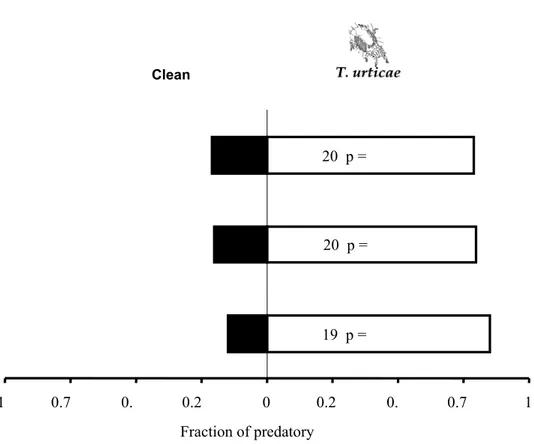
investigated the sublethal effects of the acaricides abamectin and dimethoate on the olfactory response of predatory mites, Phytoseiulus macropilis Banks (Acari: Phytoseiidae),to volatiles
from strawberry plants infested with spider mites, their prey. Predators that were exposed to residues of abamectin (0.01 and 0.02 mg a.i./ml) and dimethoate (1 and 2 mg a.i. /ml) did not discriminate between odours from plants infested with spider mites and clean plants.
Pesticides can be very harmful to beneficial organisms, but usually only the lethal effects are studied. This study shows that sublethal effects of pesticides can be very important for the
foraging efficiency of predatory mites.
1 - Introduction
Plants produce volatiles in response to herbivore damage (Dicke, 1994), and these volatiles thus provide information about the presence of herbivores (Sabelis and Dicke, 1985;
Sabelis et al., 1998). It has been documented that carnivorous arthropods can exploit these volatiles to locate herbivorous prey (Dicke, 1999a,b; Turlings et al. 1990a,b; 1991a,b; Turlings and Tumlinson 1992; Moraes et al., 1998; Kessler and Baldwin 2001). Assuming
that there are no more than three trophic levels in the food chain (i.e. plants, herbivores, and predators), emission of infochemicals will benefit plants in two separate ways. First, these
volatiles signal to other herbivores that the quality of the plant is reduced because it is already under attack and the defense system of plants has been switched on. Second, they signal to the predators of herbivores that their prey is in the vicinity.
The response of predators and parasitoids to these volatiles can be affected by several factors (Maeda et al., 2000; Maeda and Liu, 2006). For example, the olfactory response of the
predatory mite P. persimilis to plant volatiles depends upon plant species, plant cultivars, plant developmental stage and herbivore species (Takabayashi et al., 1994) and on predator experience (Drukker et al., 2000). Exposure to pesticides may also change the response of
natural enemies to volatiles, and thus impede searching for prey. For example, prey consumption by Pardosa amentata was significantly reduced after its exposure to
cypermethrin (Shaw et al., 2006). Exposure of coccinellids to insecticide residues on plant surfaces and through the consumption of contaminated prey may lead to mortality, or sub-lethal effects resulting in altered foraging and searching patterns, and thus altered
effectiveness of coccinellids as aphid predators (Singh et al., 2001, 2004). The effects of topical and surface exposure to pesticides on carabids are described as decreasing activity
1995) and learning of odours (Abramson et al., 1999; Decourtye and Pham-Delegue, 2002).
Orientation to sex pheromone in the pink bollworm moth Pectinophora gossypiella is disturbed by permethrin (Haynes and Baker, 1985). Komeza et al. (2001) demonstrated that
the behavioural response of the parasitoid Leptopilina boulardi to host chemicals could be disturbed by a low dose of chlorpyrifos. This insecticide has also been shown to alter sex pheromone communication in Trichogramma (Delpuech et al., 1998). An increased response
to host habitat odour after exposure to chlorpyrifos was also described by Rafalimanana et al. (2002). Deltamethrin at a sublethal dose increased the arrestment behaviour of treated
Trichogramma males responding to female pheromone (Delpuech et al., 1999). Trissolcus
basalis females exposed to a low dose of this insecticide reduced their walking speed and the
time spent on host-patches (Salerno et al., 2002). As was described above, individuals that
survive toxicant exposure may still sustain significant damage, which can be manifested as a reduction in population growth rate and changes in behaviour such as feeding. Thus,
pesticides exert subtle as well as overt effects on beneficials organisms and on natural enemies that must be considered when examining their impact.
In this paper, we show that exposure of a natural enemy to sublethal doses of two
acaricides impedes their response to odours produced by plants with its prey.
The study system
In Brazilian strawberry fields, the predator mite Phytoseiulus macropilis Banks (Acari: Phytoseiidae) is found preying on Tetranychus urticae (Fadini et al., 2004), on which it has a
high predation rate (Oliveira et al., pers. obs.). Despite the presence of this natural enemy in strawberry fields, spider mites are predominantly controlled through toxic pesticides such as