
GEOGRAPHIA
NAPOCENSIS
AN.VII,
nr.1/2013
http://geographianapocensis.acad-cluj.ro
HUMAN-INDUCED CHANGES IN ECOSYSTEM SERVICES IN
THE PETRO
Ş
ANI DEPRESSION (SOUTHERN CARPATHIANS,
ROMANIA)
ANDRA COSTACHE,R DI A ALEXE1
Abstract: – The paper focuses on the changes in ecosystem services in the most important coal field from the
Southern Carpathians (Romania). The time horizon considered is the interval 1950-2010, characterized by two major processes: intensive development of the mining industry (1950-1989) and subsequent restructuring of mining, with significant consequences since 1996. Socio-economic phenomena associated with these two stages in the evolution of the region have generated major changes in ecosystem services, leading to increased human vulnerability, both to extreme events (natural hazards) and pressure from economic factors.
Key words: ecosystem services, human impact, local development, pit coal basin.
I. Introduction
Mining was a highly subsidized economic sector during the communist regime in Romania, which led to the development of several mono-industrial regions where mining has become the main source of income of the population. It is the case of the Petroşani Depression, the main pit coal basin of the country before the fall of the communist regime (1989).
The studied region (1032 km2) currently concentrates 138,775 inhabitants (2011), and is facing complex problems related to mining downturn, to the effects of environmental changes and to the need to identify viable ways of economic revitalization after mine closure.
In this context, the ecosystem services should be considered because of their potential to provide adaptation options for the local communities affected by unemployment, poverty, and natural hazards.
Also, the economic value of ecosystem services can provide an alternative for the future development of this mountain region.
The main objectives of this study were to establish those ecosystem services valued by the local communities (the significant ecosystem services to each livelihood category) and to identify the tendencies in the state of ecosystem
services during the last 60 years (in the communist and post-communist period).
In order to achieve these objectives we used both field observations and participatory research methods (focus group discussions and surveys).
II. Conceptual Background
The concept of ecosystem services and references to the economic value of ecosystems are found in the literature since the 1960s [1], [2].
In response to the increasing concerns about interactions between natural ecosystems and human society, the researches of ecosystem services have gained momentum [3]-[7].
In this paper, ecosystem goods (e.g. raw materials) and services provided to the human society (e.g. erosion control) will be seen as the benefits that human population derives, directly or indirectly, from ecosystem functions.
Ecosystem functions refer variously to the habitat, biological or system properties or processes of ecosystems [3], [8].
Because it is sometimes difficult to determine whether a benefit provided by an ecosystem is a “good” or a “service”, all these benefits can be considered together as
GEOGRAPHIA
NAPOCENSIS
AN.VII,
nr.1/2013
http://geographianapocensis.acad-cluj.ro
“ecosystem services” [6] and they can beclassified in four categories:
1) Regulating services: the benefits obtained from the regulation of ecosystem processes, such as gas regulation (e.g. air quality maintenance), climate regulation, and disturbance regulation (e.g., flood control, drought recovery), water regulation, and erosion control (e.g. prevention of mass movements).
2) Provisioning services: the products obtained from ecosystems, such as food, raw materials, water supply, and natural medicines.
3) Recreational and cultural services: the nonmaterial benefits that people obtain from ecosystems, such as reflection, recreation (e.g., eco-tourism and other outdoor recreational activities), spiritual enhancement, and educational or scientific values of ecosystems.
4) Supporting services: those necessary for the production of all other ecosystem services, such as soil formation, nutrient cycling, water cycling, and photosynthesis.
III. Research Results
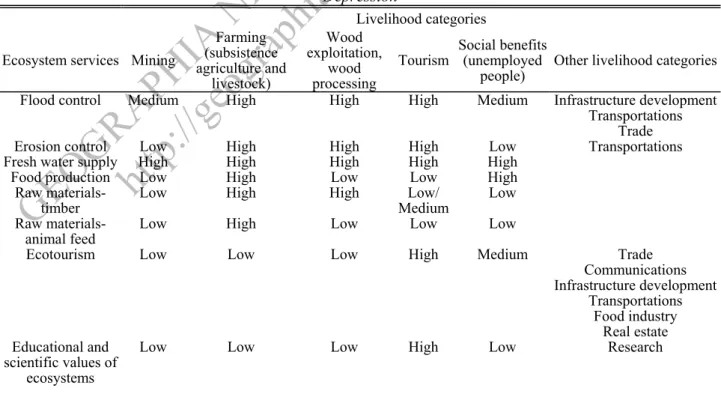
The main types of ecosystems identified in the studied area are: forests, pastures, hayfields, cultivated land, water bodies (rivers and lakes) and urbanized areas (they include infrastructural land, production spaces for industry and residential areas). In the first phase of the study we established a wide range of services associated with these ecosystems, but after consultations with stakeholders (focus group discussions and surveys), the research area was narrowed to several services (see Table I), which are directly used by the local people [9] and are seen as the most important for the main livelihood categories: flood control; erosion control; fresh water supply; food production; raw material provisioning; ecotourism and educational and scientific values of ecosystems. The changes occurred in these ecosystem services have an impact on human communities after a relatively short period of time. Thus, given the time horizon chosen for the study of changes in ecosystem services, we consider their selection as adequate.
Table I. Importance of the Ecosystem Services for the Main Livelihood Categories in the Petroşani Depression
Livelihood categories
Ecosystem services Mining
Farming (subsistence agriculture and
livestock)
Wood exploitation,
wood processing
Tourism
Social benefits (unemployed
people)
Other livelihood categories
Flood control Medium High High High Medium Infrastructure development Transportations
Trade Erosion control Low High High High Low Transportations
Fresh water supply High High High High High
Food production Low High Low Low High Raw materials-
timber
Low High High Low/
Medium
Low
Raw materials- animal feed
Low High Low Low Low
Ecotourism Low Low Low High Medium Trade
Communications Infrastructure development
Transportations Food industry
Real estate Educational and
scientific values of ecosystems
Low Low Low High Low Research
GEOGRAPHIA
NAPOCENSIS
AN.VII,
nr.1/2013
http://geographianapocensis.acad-cluj.ro
The tendencies in the human use of anecosystem service and the type of changes occurred in the features of ecosystem services were established in this study by taking into account several indicators, e.g. trends in human consumption of the ecosystem service, number of people affected by the service, changes in the area over which the service is provided or production per area, current use of the service in comparison with sustainable levels, and changes in the features of ecosystem that impacted on the quality of the provided benefit.
In the Petroşani Depression, the socio-economic context and the features of human pressure on environment changed during the studied period (2010). Thus, within 1950-1989 the ecosystem services and their use changed, as a consequence of mining development and population growth (by the end of the period, the number of inhabitants in the region doubled). The quantity of provisioning services (fresh water and timber) used by humans increased; in most of the cases, these services were used at unsustainable rates and they were degraded. Human activities also altered the regulating services (flood control, erosion control and the capacity of ecosystems to purify residual waters), by modifying the
ecosystem that provided the service and, in the case of waste processing service, by exceeding the capabilities of ecosystems to provide the service. Most changes to regulating services were the result of measures taken to enhance the supply of provision services, because the modification of an ecosystem to alter one ecosystem service generally results in changes to other ecosystem services as well [6]. Such examples are deforestations aimed to increase the timber production, which changed the capacity of forest to provide flood control and erosion control.
During the post communist period (1990-2010), the mine closure triggered a significant decline of the region, income reduction, unemployment and a population reduction of 17%. These factors, along with legislative changes required by accession to the European Union have contributed to lower human pressure on the environment, leading to different intensity of use of ecosystem services and human impact on them than in the previous period.
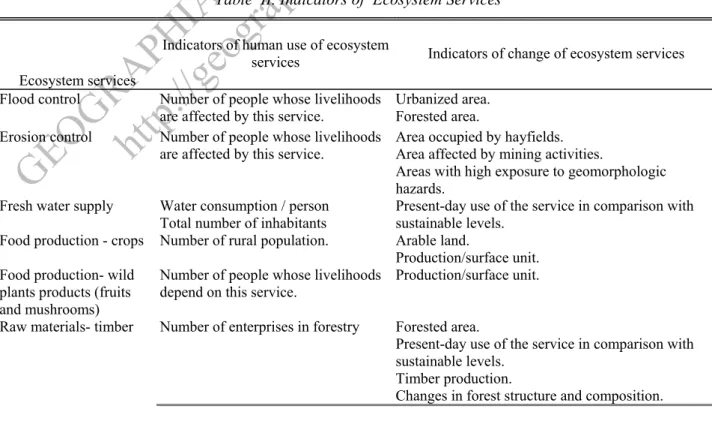
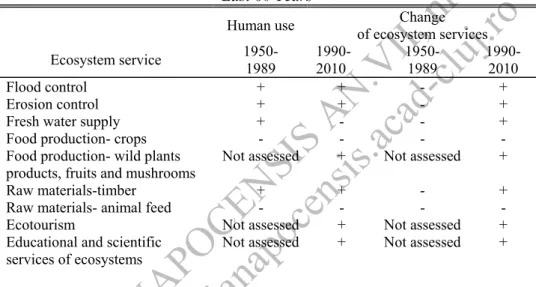
Field research and analysis of indicators established for each ecosystem service (see Table II) revealed the changes in ecosystem services in each of the two stages of the studied interval (see Table III).
Table II. Indicators of Ecosystem Services
Ecosystem services
Indicators of human use of ecosystem
services Indicators of change of ecosystem services
Flood control Number of people whose livelihoods are affected by this service.
Urbanized area. Forested area. Erosion control Number of people whose livelihoods
are affected by this service.
Area occupied by hayfields. Area affected by mining activities.
Areas with high exposure to geomorphologic hazards.
Fresh water supply Water consumption / person Total number of inhabitants
Present-day use of the service in comparison with sustainable levels.
Food production - crops Number of rural population. Arable land.
Production/surface unit. Food production- wild
plants products (fruits and mushrooms)
Number of people whose livelihoods depend on this service.
Production/surface unit.
Raw materials- timber Number of enterprises in forestry Forested area.
Present-day use of the service in comparison with sustainable levels.
Timber production.
GEOGRAPHIA
NAPOCENSIS
AN.VII,
nr.1/2013
http://geographianapocensis.acad-cluj.ro
Ecosystem servicesIndicators of human use of ecosystem
services Indicators of change of ecosystem services
Raw materials- animal feed
Livestock. Area occupied by meadows.
Changes in meadows structure and composition. Present-day use in comparison with sustainable levels.
Ecotourism Number of people whose livelihoods depend on this service.
Number of tourists.
Educational and scientific values of ecosystems
Number of programs aimed to enhance the use of the service.
Number of protected areas.
Table III. The Petroşani Depression: Changes in Ecosystem Services During the Last 60 Years
Human use Change
of ecosystem services
Ecosystem service 1950- 1989
1990- 2010
1950- 1989
1990- 2010
Flood control + + - +
Erosion control + + - +
Fresh water supply + - - +
Food production- crops - - - -
Food production- wild plants products, fruits and mushrooms
Not assessed + Not assessed +
Raw materials-timber + + - +
Raw materials- animal feed - - - -
Ecotourism Not assessed + Not assessed + Educational and scientific
services of ecosystems
Not assessed + Not assessed +
For human use of ecosystem services, “+” signifies increase, and “-“ indicates a decrease. For changes in ecosystem services, “+” signifies enhancement of benefits provided by ecosystems and “-“ indicates a degradation of these benefits.
A. Flood Control
It is a key service provided by the components of ecosystems in the Petroşani Depression. The land use/land cover, and especially forested area, influences the response to major rainfall events, the occurrence and intensity of floods.
On the other hand, the increase of urbanized area and industrial area at the expense of natural ecosystems indicates a higher intensity of human pressure on the environment that reduces the regulation benefits provided by the natural ecosystems.
Flood control is connected with other benefits provided by ecosystems, such as ecotourism and crop production. Thus, changes in the capacity of ecosystems’ components to protect against flood can affect most of the
livelihoods categories and the development of the entire region.
Before 1989, demographic growth and urbanization lead to an extension of settlements in areas exposed to floods, thus the human use of the ecosystem service increased. Land use and land cover changes caused a decline in ecosystems’ capacity to buffer from extreme events.
In the last two decades, although the population has decreased significantly [10], human use of the service remains high, because the low income level undermines the population response to hazards.
GEOGRAPHIA
NAPOCENSIS
AN.VII,
nr.1/2013
http://geographianapocensis.acad-cluj.ro
0,00 20,00 40,00 60,00 80,00
arable land pastures hayfields forests
%
2005
2002
1992
Fig. 1 The share of different land use categories in the total area of the Petroşani Depression [11]
Unlike the previous period, the area occupied by forests slightly elevated (Fig. 1), which indicates an improvement in the benefits provided by of this regulation service.
B. Erosion Control
Prevention of soil erosion (sheet erosion, gully erosion and mass movements) is largely ensured by the protection provided by vegetation cover, root matrix and soil biota. In the Petroşani Depression, the processes of erosion are induced by the geological structure and climatic conditions, but also by the human activities (such as deforestation, quarry mining and inadequate location of buildings or roads).
The erosion processes have impact on infrastructure and on some residential areas, which are inadequately built; they affect also the forest and agricultural land. The livelihoods threatened by potential changes in this ecosystem service are mainly subsistence agriculture and livestock breeding.
Before 1989, the development of mining activities particularly decreased areas occupied by arable land, forests and meadows. For example, over 50% of the areas currently occupied by dumps were originally used as hayfields, 40% were occupied by grazing land, and 5% are former forest land. Underground mining and quarrying had both visual and landscape impact and effects on land use and land stability. Most waste dumps were located in proximity to residential areas, so that subsidence, landslides and mud flows produced on the dumps represented a threat to the nearby human communities. Also, the induced
subsidence led to dismantling of buildings, requiring evacuation of the population even in the residential areas.
In rural areas, the capability of ecosystems to provide erosion control was maintained because local people developed sustainable land use practices, such as the traditional agro-pastoral activities based on cultivated lands and hayfields characterized by a dynamic equilibrium [12].
Fig. 2 Causes of land degradation in the Petroşani Depression
In the last decade, the ecological reconstruction made after mine closure led to the regeneration of small areas occupied by dumps. Case studies conducted in some mining areas have shown that both natural and artificial regeneration of dumps is possible, even without cover with topsoil, in relatively short time intervals (10 years), the vegetation having the capacity to stabilize dumps and to initiate soil formation processes [13]. Still, mining remains the main cause of land degradation in the studied region (Fig. 2).
Currently, land with low and very low stability have a share of 12% in the total area of the Petroşani Depression, but they can be extended by land use changes due to new economic activities (e.g., tourism and forestry) and by changes in rainfall patterns.
C. Fresh Water Supply
GEOGRAPHIA
NAPOCENSIS
AN.VII,
nr.1/2013
http://geographianapocensis.acad-cluj.ro
important, because it can remove pollutantsfrom industrial and domestic residual waters. Changes in this ecosystem service can affect all water consumers, from households and subsistence agriculture to industry and tourism.
In the Petroşani Depression, land use changes occurred during the communist period generated a decrease in the capacity of terrestrial ecosystems’ components to filter the pollutant substances.
On the other hand, the level of pollution due to mining activities exceeded the capacity of aquatic ecosystems to “treat” waste and to purify waters.
In the last two decades, after the closure of several mining units, the pollution diminished significantly in the basin of Jiu River (Fig. 3) and the ecosystem services tend to be restored. On the other hand, given the population decline and industrial restructuring, the human use of this provisioning service decreased.
0 20000 40000 60000 80000 100000 120000
2001 2002 2003 2004 2005
m
in
er
a
l s
u
s
pen
s
ions
(
m
g/
l)
Fig. 3 Concentration of mineral suspensions in the Jiu River [14]
D. Food Production
In the Petrosani Depression, crop production is important especially to a specific group of stakeholders, the native population of momârlani. They are concentrated in rural areas, representing less than 1% of the region population.
The present-day aging of rural population, the demographic decline, and a slight decrease of the surface occupied by arable land have decreased the use of this service and the production / unit area.
Food production as an ecosystem service provided recently an adaptive option for the unemployed people from the region (gathering and selling forest fruits and mushrooms).
E. Raw Materials
In the studied area, ecosystems provide renewable biotic resources used as raw materials (timber) and animal-feed. Changes in this service can affect two main livelihood categories (forestry and livelihood breeding) and they can be especially triggered by land use changes and changes in the structure and composition of vegetal formations.
Towards the end of the 19th and beginning of the 20th century, after the mines from Petroşani basin were opened, the forests were intensely cut, especially resinous trees, used to reinforce mine galleries. In compensation, massif plantations of resinous trees were created at the foot of the slopes, which determined a profound perturbation in the sequence of vegetal series and increased soil acidity. During the second half of the 20th century, forest exploitations took place (the trees, especially beech and mixed forest, were cut to the ground) on large areas. These terrains are now under way to regenerate themselves. Near the villages, the grazing in the forest and the irregular cutting of trees have had negative effects on both the soil and the drainage regime of the slopes. As a consequence, these forests have a low consistency.
GEOGRAPHIA
NAPOCENSIS
AN.VII,
nr.1/2013
http://geographianapocensis.acad-cluj.ro
During the last decade, the wood industrydeveloped in the Petroşani Depression, which have led to the exploitation of about 1 000 000 m3. At the same time, forest plantations have covered around 750 ha (most of the forested surface was planted in 2004).
The livestock breeding is a traditional activity in the Petroşani Depression, which is sustained by the large areas of pastures and hayfield. The share of these land use categories in the total area of the region decreased since 1990, thus pastures are currently covering 16369 ha (15.8%), while the hayfields cover 17485 ha (16.9%), in comparison to 17%, respectively 20% at the beginning of the 1990s. The livestock also decreased since 1990, the larges reduction (32%) being recorded in the number of sheep. As a consequence, the present-day use of the meadows is below the sustainable level (the current stocking numbers are 0.8 animals/ha for sheep and 0.35 animals/ha for cattle).
F. Ecotourism, Educational and Scientific Values of Ecosystems
In the Petroşani Depression, natural ecosystems provide opportunities for tourism development (e.g. winter sports, hiking, camping, and rafting), for nature study, environmental education and scientific research (benefits ensured especially by the proximity of Retezat National Park, with endemic species of plants and animals, glacial lakes and glacial relief).
These benefits can contribute to the economic development of the region, even to its economic revival. The livelihood categories influenced by the state of ecosystems’ recreational and cultural services are tourism industry and other economic sectors, such as transportations, infrastructure development, trade or real estate. The main threats to these services are land use/land cover change, land degradation and climate variability. Given the lack of data for the communist period, we could not assess the change in human use of these services or changes in the benefits provided by them for the entire time horizon under study. Still, the improvement of the region’s
perception at national scale, the increasing number of tourists during the winter and the development of tourist infrastructure (e.g., in Parâng, Straja, and Câmpu lui Neag) suggest an enhancement of these ecosystem services in the last two decades.
IV. Conclusions
The research shows an improvement in most of the surveyed ecosystem services, in comparison with the communist period. This enhancement was caused by the reduction of human pressure on the environment, mainly due to the closure of mines. Local development policies could turn to advantage this improvement of benefits provided by ecosystems. Still, the region remains a fragile environment and the potentiality of new environmental damages triggered by the unsustainable development of new economic activities should always be considered.
References
[1] R. T. KING, “Wildlife and man,” New York
Conservationist 20(6), pp. 8-11, 1966.
[2] D. R. HELLIWELL, “Valuation of wildlife
resources,” Regional studies 3, pp. 41-49, 1969.
[3] R. R. CONSTANZA et al., “The value of the
world’s ecosystem services and natural capital,” Nature, 387, pp. 253-260, 1997.
[4] S. CORK, “Identifying the opportunities: how the concept of ecosystem services can help,”
8th National Conference and Workshop on the Productive Use and Rehabilitation of Saline Land (PURSL), Fremantle, 16-20 September 2002.
[5] R. S. DE GROOT, A.W. WILSON and R.M.J.
BOUMANS, “A typology for the classification, description and valuation of ecosystem functions, goods and services,”
Ecological Economics 41, pp. 393-408, 2002.
[6] Millennium Ecosystem Assessement,
Ecosystems and human well-being: Synthesis. Washington D.C.: Island Press, 2005.
[7] P. KUMAR, editor, The Economics of
Ecosystems and Biodiversity: Ecological and
Economic Foundations, London and
Washington: Earthscan, 2010
GEOGRAPHIA
NAPOCENSIS
AN.VII,
nr.1/2013
http://geographianapocensis.acad-cluj.ro
Habitat, societate, mediu (Urban ecosystem of Târgovilte. Habitat, society, environment), Târgovişte: Transversal, 2007
[9] A. COSTACHE, A. HODOROGIA,
“Participatory research applied in geography. The results of two focus group discussions in the Jiu Valley,” Valahia University Annals, Geographical Series, vol. 4-5, pp. 216-224, 2005
[10] INSSE, Recensământul popula iei şi
locuin elor 20 -31 octombrie 2011. Rezultate provizorii (Population and household census, October 20-31, 2011. Provisionally results), INSSE, Bucureşti, 2012
[11] INSSE, DJS Hunedoara, Jude ul Hunedoara – Baza de date a localităilor (Hunedoara County, Localities Database), INSSE, Bucureşti, DJS Hunedoara, 1992- 2010
[12] A. COSTACHE, Vulnerabilitatea aşezărilor umane şi riscurile sociale în Depresiunea
Petroşani – rezumatul tezei de doctorat (Human settlements vulnerability and social risks in the Petroşani Depression – synthesis of the PhD thesis), Târgovişte: Valahia University Press, 2010
[13] C. BIRO, Reabilitarea terenurilor degradate de activităile antropice din bazinul minier Petroşani (Reabilitation of the land degraded by human activities in the mining basin of Petroşani), PhD thesis,University of Petroşani, 2005
[14] National Hard Coal Company, „Concentrations of mineral suspensions recorded in the Jiu River due to mining activities in the C.N.H.-S.A.”, Department for Environmental Protection and Ecological Programs, 2005
![Fig. 1 The share of different land use categories in the total area of the Petroşani Depression [11]](https://thumb-eu.123doks.com/thumbv2/123dok_br/14939339.2887/5.892.103.430.132.315/fig-share-different-land-categories-total-petrosani-depression.webp)
![Fig. 3 Concentration of mineral suspensions in the Jiu River [14]](https://thumb-eu.123doks.com/thumbv2/123dok_br/14939339.2887/6.892.95.441.568.904/fig-concentration-mineral-suspensions-jiu-river.webp)
