Vet erinary World, EI SSN: 2231- 0916
Available at w w w.vet erinaryw orld.org/ Vol.7/ Oct ober- 2014/ 10.pdf
Vet erinary World, EI SSN: 2231- 0916 807
RESEARCH ARTI CLE Ope n Acce ss
Associa t ion st u dy of ge n e t ic va r ia n t s a t sin gle n u cle ot ide polym or ph ism
r s1 0 9 2 3 1 4 0 9 of m a n n ose - bin din g le ct in s 1 ge n e w it h m a st it is
su sce pt ibilit y in V r in da va n i cr ossbr e d ca t t le
V. N. Muhasin Asaf1, Bharat Bhushan1, Manj it Panigrahi1, Prashant Dewangan1, Am od Kum ar1,
Pushpendra Kum ar1 and G. K. Gaur2
1. Division of Anim al Genet ics, I ndian Vet erinary Research I nst it ut e, Bareilly, Ut t ar Pradesh, I ndia; 2. Livest ock Product ion Managem ent Sect ion, I ndian Vet erinary Research I nst it ut e, Bareilly, Ut t ar Pradesh, I ndia.
Cor r e spon din g a u t h or : V. N. Muhasin Asaf, e- m ail: asaf.m uhasin@gm ail.com , BB: bhushan.drbharat @gm ail.com , MP: m anj it 707@gm ail.com , PD: prshnt dewangan@gm ail.com , AK: am odvet @gm ail.com , PK: pushpendra64@gm ail.com ,
GKG: gyanendrakg@gm ail.com
Re ce ive d: 21- 06- 2014, Re vise d: 05- 09- 2014, Acce pt e d: 11- 09- 2014, Pu blish e d on lin e :12-10-2014
doi: 10.14202/ vet w orld.2014.807- 810. H ow t o cit e t h is a r t icle : Asaf VNM, Bhushan B, Panigrahi M, Dewangan P, Kum ar A, Kum ar P, Gaur GK ( 2014) Associat ion st udy of genet ic variant s at single nucleot ide polym orphism rs109231409 of m annose- binding lect ins 1 gene w it h m ast it is suscept ibilit y in Vrindavani crossbred cat t le, Vet erinary World 7( 10) : 807- 810.
Abst r a ct
Aim: The present study was undertaken to identify whether single nucleotide polymorphism (SNP) rs109231409 located on mannose-binding lectins 1 (MBL1) gene was associated with mastitis tolerance/susceptibility.
Materials and Methods: After grouping 100 Vrindavani crossbred cattle as mastitis positive and negative animals, they were genotyped using polymerase chain reaction (PCR)-restriction fragment length polymorphisms method. Gene and genotype frequencies of different patterns were estimated by standard procedure (POPGENE version 1.32, (University of Alberta, Canada) and statistical analysis was carried out by logistic regression methods using STATA 12 software (StataCorp LP, USA).
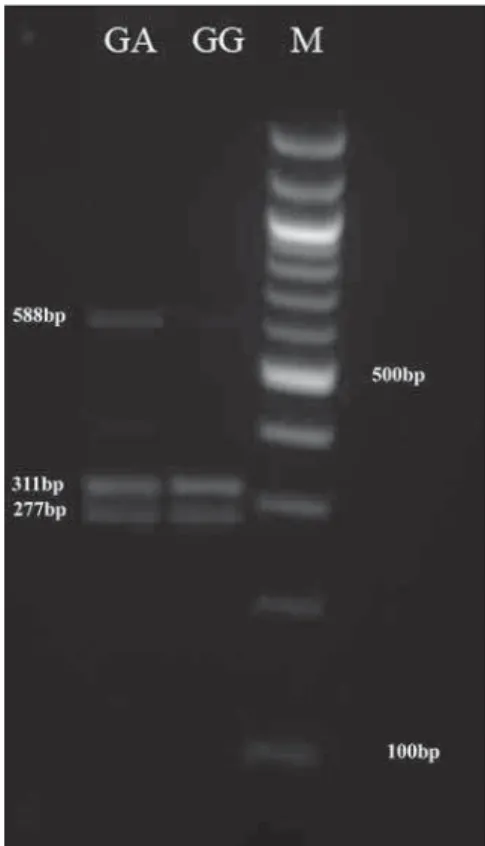
Results: The 588 bp fragment of MBL1 gene was amplified using PCR. PCR product was digested with ApaI restriction enzyme showed two distinct genotypes viz., GG (311 bp and 272 bp fragments) and GA (588 bp, 311 bp and 277 bp fragments). The gene, genotype frequencies, average heterozygosity, polymorphic information content and χ2 values for the locus rs109231409 was ascertained.
Conclusions: No significant association between SNP “rs109231409” with mastitis tolerance was found. Although there is a lack of association, further studies have to be undertaken in a large population in order to validate the impact of rs109231409 (g.855G >A) on mastitis tolerance.
Keywords: mannose-binding lectins 1, mastitis, polymerase chain reaction-restriction fragment length polymorphisms, single nucleotide polymorphism.
I n t r odu ct ion
Bovine mastitis is an economically important inflammatory udder disease creating havoc to the dairy industry worldwide [1]. Mastitis can be caused due to microbes like bacteria, viruses, mycoplasma, yeasts and algae [2] or can be due to thermal, chemical or mechanical injury [3]. Bacterial mastitis is the most common [4] which can be due to contagious patho-gens or environmental pathopatho-gens [5]. Development of animals tolerant to mastitis is always sought after by researchers owing to the economic importance of the disease. Mastitis tolerances being a threshold trait; the selection strategies are a little different from the conventional approaches for quantitative traits. Lack of phenotypic data on clinical mastitis underscores breeding programmes and hence heavily relies on somatic cell count (SCC) as an indirect indicator for clinical mastitis [6].
California mastitis test (CMT) is a simple and inexpensive test that gives qualitative estimate of SCC
in the foremilk of individual cows or quarters. CMT is often used as an indirect measure of mastitis [7,8] but SCC is regarded as the gold standard to measure mas-titis, and other methods are compared with SCC [9]. Milk SCC has been used extensively as an indicator of intra-mammary infections since 1960. This trait is used as an indicator of udder health for manage-ment and selection purposes [10]. SCC is a fast and reliable analytical tool. It is related to the immunolog-ical status of the udder and increases in response to an inflammatory stimulus like bacterial infection [11,12]. Currently by many researchers across the globe has used SCC for mastitis resistance studies [13-15]. SCC and mastitis are genetically correlated on an average 0.7 [16].
There are a number of candidate genes associated with mastitis tolerance of which Mannose-binding lectins 1 (MBL1) gene requires special attention. The bovine MBL1 gene is located on chromosome 28 [17]. Most of the mammals have two MBL genes viz., MBL1
and MBL2. MBL1 gene encodes the MBL-A protein.
MBL1 gene is involved in the innate immune response mediation process [18]. Recently, single nucleotide polymorphism (SNP) in the MBL1 gene has been searched for its association with mastitis tolerance, Copyright : The aut hors. This art icle is an open access art icle licensed
Available at w w w.vet erinaryw orld.org/ Vol.7/ Oct ober- 2014/ 10.pdf
Vet erinary World, EI SSN: 2231- 0916 808
and a few of them was found to be associated. All these studies were conducted in Chinese native cattle. There is a need to check whether these SNPs have any association in crossbred cattle of India in an attempt to identify these SNP markers which can be incorporated into the breeding programmes in future.
The current study was undertaken to identify whether the SNP rs109231409 (g.855G>A) located in the introns 1 of MBL1 gene was associated with mas-titis tolerance or not.
M a t e r ia ls a n d M e t h ods
Et h ica l a ppr ova l
The experimental and plan of study was duly approved by Institution Animal Ethics Committee of Indian Veterinary Research Institute, Bareilly, Uttar Pradesh, India.
Re sou r ce popu la t ion
The experimental study consisted of 100 Vrindavani crossbred cattle (Holstein Friesian/Brown Swiss/Jersey X Haryana) maintained at cattle and buffalo farm, Indian Veterinary Research Institute, Bareilly, Uttar Pradesh, India.
Gr ou pin g of a n im a ls
One hundred Vrindavani milch animals were selected randomly. These animals were then grouped into mastitis negative (65) and positive animals (35) on the basis of CMT along with SCC.
Ge n ot ypin g of SN P
The SNP “rs109231409” located on the
MBL1 gene was genotyped using polymerase chain reaction-restriction fragment length poly-morphisms (PCR-RFLP). Genomic DNA was iso-lated from blood samples using phenol-chloroform extraction method. Primers for the PCR reaction for amplifying the introns 1 of MBL1 gene was 5’-CCCTTCCAACTCATTGCTTC-3’ (Forward) and 5’-AGTCCCAACCACCCTCA-3’ (Reverse). The PCR reaction was carried out in a final volume of 25 μl reaction mixture containing 12.5 μl of GoTaq Green MasterMix (Promega, Madison, USA) and 1.25 μl each of upstream and downstream primers (10 pmol/μl). PCR profile consisted of initial dena-turation at 94°C for 5 min, followed by 34 cycles of denaturation at 94° for 30 s, annealing at 62°C for 30 s, extension at 72°C for 30 s and final extension for 5 min at 72°C. The amplified PCR products were then subjected to restriction enzyme (RE) digestion using
ApaI enzyme. Aliquots of 20 μl PCR amplified prod-ucts were digested with 10U of ApaI (New England Biolabs, Massachusetts, USA) at 25°C for 3 h. The RE digested products were detected by electrophoresis in 2.5% agarose gel electrophoresis stained with ethid-ium bromide for 1.5 h in ×1 TBE buffer.
St a t ist ica l a n a lysis a n d a ssocia t ion st u dy
The gene and genotype frequencies of differ-ent patterns were estimated by standard procedure (POPGENE version 1.32) and for the statistical
analysis; logistic regression methods were fitted using STATA 12 software (StataCorp LP, USA).
Mastitis affection of animals was taken as depen-dent variable whereas genotypes of the fragment was considered as independent variables. Initially in the logistic regression analysis, factors like milk yield, age at first calving, lactation length and calving inter-val were also fitted but none of these effects was sig-nificantly affecting the incidences of mastitis. Hence, these variables were dropped in the model fitted for studying effect of different genotypes on mastitis. The following model was used for the analysis of the data;
Define Yi=1 if individual i is mastitic, 0 otherwise;
α=The intercept
β=Regression coefficients for different parameters X1i=Variable for genotypes of MBL1 fragment (2 gen-otype groups i.e. 1 for GG and 2 for GA).
Then, our model is Yi ~ Bernoulli (pi), where Ln (pi/1-pi)=α+β1X1i+ε
Re su lt s
The 588 bp fragment of MBL1 gene amplified using PCR on digestion with ApaI RE yielded two distinct genotypes viz., GG (311 bp and 272 bp ments) and GA (588 bp, 311 bp and 277 bp frag-ments) (Figure-1). The gene frequency of allele G was found to be 0.7462 and 0.7286 and that of allele A was 0.2538 and 0.2714 respectively in mastitis pos-itive and negative animals. Polymorphic information content (PIC) for both mastitis positive and mastitis
Available at w w w.vet erinaryw orld.org/ Vol.7/ Oct ober- 2014/ 10.pdf
Vet erinary World, EI SSN: 2231- 0916 809
negative were found to be <0.5 indicating that the locus is moderately polymorphic in Vrindavani herd. The population under study was not found to be in Hardy Weinberg equilibrium as there was a signifi-cant difference between observed and expected fre-quencies of genotypes (p<0.05). In the present study, we did not find enough evidence to reject the null hypothesis (p=0.737) and conclude the odds of mas-titis occurrence in genotype GA compared to gen-otype GG is not significantly different. The gene, genotype frequencies, average heterozygosity, PIC and χ2 values for the locus rs109231409 is shown in
Table-1.
D iscu ssion
MBL1 gene contains four introns and five exons, encoding a 248 aa protein. MBL is a pattern recog-nizing serum protein that participates in the innate immune system of mammals as an opsonin. The antimicrobial function of MBL includes opsoniza-tion, neutralization and complement activation [19]. The recognition domain of MBL selectively targets invading microorganisms by binding to mannose and N-acetylglucosamine residues on the cell surface and thereby activating MBL-associated serine prote-ases (MASPs) [20]. MBL circulates in complex with MASPs MASP-1, MASP-2, MASP-3 and MAp19. When MBL recognizes suitable patterns, results in activation of MASPs initiating the MBL pathway of complement activation leading to opsonization or direct killing of targeted microorganisms [21].
MBL1 is a critical gene in relation to the innate immune response of the animal. MBLs have been found to be associated with susceptibility to various bacterial and viral diseases [22]. MBL1 in the porcine and bovine is considered as a candidate gene for mas-titis resistance [23]. MBL1 gene was proposed as an indirect marker to improve dairy mastitis resistance traits in cattle [24]. SNPs of MBL1 gene in vari-ous breeds of pigs were found to be associated with impaired disease resistance [25]. Both MBL1and
MBL2 gene mutations were found to be having impact on susceptibility to different infections [26]. Variations in the coding and the non-coding regions of the MBL gene in various species resulted in innate immune dysfunction [23]. The SNP under study,
rs109231409 (g.855G>A) is located in the intron I and is characterised by G>A mutation. Association study of rs109231409 in Chinese native cattle also yielded a similar result that they could not find any significant association with mastitis tolerance [27]. In that study, they screened three SNPs in the MBL1 gene with mas-titis tolerance and found that no association between g.855G>A or g.2686T>C but significant association was found for g.2651G>A. On analysis of four SNPs on MBL2 gene in Chinese Holstein cattle and Luxi yel-low cattle, the authors found two of them viz., g.201 G > A, and g.234 C > A to be significantly correlated with somatic cell score [23].
Con clu sion
In the present study, 100 randomly selected Vrindavani crossbred cows were grouped into mastitis positive (35), and negative animals (65) based on CMT and SCC. Genomic DNA was isolated by using phe-nol-chloroform extraction. PCR-RFLP technique was used to genotype the SNP rs109231409 (g.855G>A) located on the MBL1 gene. The 588 bp PCR product was digested with ApaI RE to yield two distinct geno-types viz., GG (311 bp and 272 bp fragments) and GA (588 bp, 311 bp and 277 bp fragments). The locus was found to be moderately polymorphic. Statistical analy-sis yielded no significant association between the gen-otypes with mastitis tolerance. Although there is a lack of association, further studies have to be undertaken in a large population in order to validate the impact of rs109231409 (g.855G>A) on mastitis tolerance.
Au t h or s’ Con t r ibu t ion s
VNMA, BB and MP: Substantially contributed to design and plan of the study. VNMA, BB and MP: Drafted the manuscript, analysed and interpreted the results. VNMA, BB, MP, PD, AK, PK and GKG: Revised manuscript for important intellectual content. All authors read and approved the final manuscript.
Ack n ow le dge m e n t s
The authors wish to acknowledge the help, and support rendered by Director, Indian Veterinary Research Institute, Izatnagar, Bareilly, India, for providing necessary facilities to carry out this work. The study was funded by Indian Veterinary Research
Ta ble - 1 : Dat a of gene, genot ype frequencies, average het erozygosit y, PI C and χ2 values.
Locu s Alle le G Alle le A Ge n ot ype GG Ge n ot ype GA Ge n ot ype AA Ave r a ge . H e t . PI C Ch i- squ a r e
Mast it is negat ive anim als
( 65 anim als) MBL1 rs109231409
0.7462 0.2538 0.49 0.51 0 0.3788 0.307 7.257732
Mast it is posit ive anim als ( 35 anim als)
MBL1 rs109231409
0.7286 0.2714 0.46 0.54 0 0.3955 0.3173 4.560
Available at w w w.vet erinaryw orld.org/ Vol.7/ Oct ober- 2014/ 10.pdf
Vet erinary World, EI SSN: 2231- 0916 810
Institute under the project “Genetic variability of host resistance to mastitis in cattle.”
Com pe t in g I n t e r e st s
The authors declare that they have no competing interests.
Re fe r e n ce s
1. Russell, C.D. , Widdison, S., Leigh, J.A. and Coffey, T.J. (2012) Identification of single nucleotide polymorphisms in the bovine toll-like receptor 1 gene and association with health traits in cattle. Vet. Res., 43: 17.
2. Awale, M.M., Dudhatra, G.B., Kumar, A., Chauhan, B.N., Kamani, D.R., Modi, C.M., Patel, H.B. and Mody SK. (2012) Bovine mastitis: A threat to the economy. Sci. Rep.,
1: 295.
3. Zhang C., Wang Y., Chen H., Gu C. and Fang, X. (2009) SLC11A1 gene polymorphisms are not associated to somatic cell score and milk yield in Chinese Holstein. Vet. Immunol. Immunopathol., 127(3-4): 389-292.
4. Mir, A.Q., Bansal, B.K. and Gupta, D.K. (2014) Subclinical mastitis in machine milked dairy farms in Punjab: Prevalence, distribution of bacteria and current antibiogram.
Vet. World, 7(5): 291-294.
5. Bramley, A. (1996) Current Concepts of Bovine Mastitis. National Mastitis Council, Madison, WI.
6. Rupp, R. and D. Boichard. (1999) Genetic parameters for clinical mastitis, somatic cell score, production, udder type trait and milking ease. J. Dairy Sci., 82: 2198-2204. 7. Pyörälä, S. (2003). Indicators of inflammation in the
diag-nosis of mastitis. Vet. Res., 34(5): 565-78.
8. Sharma, N., Singh, N.K. and Bhadwal, M.S. (2011) Relationship of somatic cell count and mastitis: An over-view. Asian Aust. J. Anim. Sci., 24(3): 429-438.
9. Hamann, J. (2002) Milk quality and udder health in rela-tion to modern milking. In: Recent Developments and Perspectives in Bovine Medicine. XXII World Buiatrics Congress, Hannover, August, 18-23. p334-345.
10. Rodriguez, Z., Gianola, S.L.D. and Shook, G.E. (2000) Evaluation of models for somatic cell score lactation pat-terns in Holsteins. Livest. Prod. Sci., 67: 19-30.
11. O’Brien, B., Fitzpatrick, C., Meaney, W.J. and Joyce, P. (1999). Relationship between somatic cell count and neu-trophils in milk. Ir. J. Agric. Food Res., 38: 288-296. 12. Leitner, G., Shoshani, E., Krifucks, O., Chaffer, M. and
Saran, A. (2000) Milk leukocyte population patterns in bovine udder infection of different etiology. J. Vet. Med. B. Infect. Dis. Vet. Public Health, 47(8): 581-589.
13. Yuan, Z., Chu, G., Dan, Y., Li, J., Zhang, L., Gao, X., Gao, H., Li, J., Xu, S. and Liu, Z. (2012) BRCA1: A new candidate gene for bovine mastitis and its association anal-ysis between single nucleotide polymorphisms and milk somatic cell score. Mol. Biol. Rep., 39(6): 6625-6631. 14. Huang, J., Wang, H., Wang, C., Li, J., Li, Q., Hou, M. and
Zhong, J. (2010) Single nucleotide polymorphisms, haplo-types and combined genohaplo-types of lactoferrin gene and their associations with mastitis in Chinese Holstein cattle. Mol.
Biol. Rep., 37(1): 477-483.
15. Kolbehdari, D., Wang, Z., Grant, J.R., Murdoch, B., Prasad, A., Xiu, Z., Marques, E., Stothard, P. and Moore, S.S. (2009) A whole genome scan to map QTL for milk produc-tion traits and somatic cell score in Canadian Holstein bulls. J. Anim. Breed Genet., 126(3): 216-27.
16. Yuan, Z.R., Li, J., Liu, L., Zhang, L.P., Zhang, L.M., Chen, C., Chen, X.J., Gao, X., Li, J.Y., Chen, J.B., Gao, H.J. and Xu, S.Z. (2011) Single nucleotide polymorphism of CACNA2D1 gene and its association with milk somatic cell score in cattle. Mol. Biol. Rep., 38(8): 5179-5183.
17. Gjerstorff, M., Hansen, S., Jensen, B., Dueholm, B., Horn, P., Bendixen, C. and Holmskov, U. (2004). The genes encoding bovine SP-A, SP-D, MBL-A, conglutinin, CL-43 and CL-46 form a distinct collectin locus on Bos tau-rus chromosome 28 (BTA28) at position q.1.8–1.9. Anim. Genet. 35(4): 333-337.
18. Holmskov, U., Thiel, S. and Jensenius, J.C. (2003) Collectins and ficolins: Humoral lectins of the innate immune defense.
Annu. Rev. Immunol., 21: 547-5678.
19. Van de Wetering, J.K., Golde, L.M and Batenburg, J.J. (2004) Collectins: Players of the innate immune system.
Eur. J. Biochem., 271: 1229-1249.
20. Sorensen, R., Thiel, S. and Jensenius, J.C., (2005) Mannan-binding lectin associated serine proteases, characteristics and disease associations. SpringerSemin. Immunopathol., 27(3): 299-319.
21. Frederiksen, P.D., Thiel, S., Jensen, L., Hansen, A.G., Matthiesen, F. and Jensenius, J.C. (2006) Quantification of mannan-binding lectin. J. Immunol. Methods, 315(1-2): 49-60.
22. Eisen, D.P. and Minchinton, R.M. (2003) Impact of man-nan-binding lectin on susceptibility to infectious diseases.
J. Infect. Dis., 37: 1496-1505.
23. Wang, X., Ju, Z., Huang, J., Hou, M., Zhou, L., Qi, C., Zhang, Y., Gao, Q., Pan, Q., Li, G., Zhong, J. and Wang, C. (2012) The relationship between the variants of the bovine MBL2 gene and milk production traits, mastitis, serum MBL-C levels and complement activity. Vet. Immunol. Immunopathol., 148(3-4): 311-319.
24. Yuan, Z., Li, J., Li, J., Gao, X. and Xu, S. (2013). SNPs identification and its correlation analysis with milk somatic cell score in bovine MBL1 gene. Mol. Biol. Rep., 40(1): 7-12.
25. Lillie, B.N., Hammermueller, J.D., MacInnes, J.I., Jacques, M. and Hayes, M.A. (2006) Porcine mannan-bind-ing lectin A binds to Actinobacillus suis and Haemophilus parasuis. Dev. Comp. Immunol., 30, 954-965.
26. Capparelli, R., Parlato, M., Amoroso, M.G., Roperto, S., Marabelli, R., Roperto, F. and Iannelli, D. (2008) Mannan-binding lectin haplotypes influence Brucella abortus infec-tion in the water buffalo (Bubalus bubalis). Immunogenetics,
60, 157-165.
27. Wang, C., Liu, M., Li, Q., Ju, Z., Huang, J., Li, J., Wang, H. and Zhong, J. (2011). Three novel single-nucleotide poly-morphisms of MBL1 gene in Chinese native cattle and their associations with milk performance traits. Vet. Immunol. Immunopathol., 139(2-4): 229-236.