OSD
11, 2495–2532, 2014Friction and mixing effects on potential vorticity for bottom current crossing
a marine strait
F. Falcini and E. Salusti
Title Page
Abstract Introduction
Conclusions References
Tables Figures
◭ ◮
◭ ◮
Back Close
Full Screen / Esc
Printer-friendly Version Interactive Discussion
Discussion
P
a
per
|
Discus
sion
P
a
per
|
Discussion
P
a
per
|
Discussion
P
a
per
|
Ocean Sci. Discuss., 11, 2495–2532, 2014 www.ocean-sci-discuss.net/11/2495/2014/ doi:10.5194/osd-11-2495-2014
© Author(s) 2014. CC Attribution 3.0 License.
This discussion paper is/has been under review for the journal Ocean Science (OS). Please refer to the corresponding final paper in OS if available.
Friction and mixing e
ff
ects on potential
vorticity for bottom current crossing
a marine strait: an application to the Sicily
Channel (central Mediterranean Sea)
F. Falcini and E. Salusti
CNR-ISAC, Via del Fosso del Cavaliere 100, 00133 Rome, Italy
Received: 8 August 2014 – Accepted: 1 October 2014 – Published: 18 November 2014
Correspondence to: F. Falcini ([email protected])
OSD
11, 2495–2532, 2014Friction and mixing effects on potential vorticity for bottom current crossing
a marine strait
F. Falcini and E. Salusti
Title Page
Abstract Introduction
Conclusions References
Tables Figures
◭ ◮
◭ ◮
Back Close
Full Screen / Esc
Printer-friendly Version Interactive Discussion
Discussion
P
a
per
|
Discus
sion
P
a
per
|
Discussion
P
a
per
|
Discussion
P
a
per
Abstract
We discuss here the evolution of vorticity and potential vorticity (PV) for a bottom
cur-rent crossing a marine channel in shallow-water approximation, focusing on the effect
of friction and mixing. We argue that bottom current vorticity is prone to significant sign
changes and oscillations due to topographic effects when, in particular, the current
5
flows over the sill of a channel. These vorticity variations are, however, modulated by frictional effects due to seafloor roughness and morphology. Such behavior is also re-flected in the PV spatial evolution, which shows an abrupt peak around the sill region. Our theoretical findings are discussed by means of in situ hydrographic data related to the Eastern Mediterranean Deep Water, i.e., a dense, bottom water vein that flows
10
northwestward, along the Sicily Channel (Mediterranean Sea). Indeed, the narrow sill of this channel implies that friction and entrainment need to be considered. Small tidal effects in the Sicily Channel allow for a steady theoretical approach. Our diagnoses on vorticity and PV allow us to obtain general insights about the effect of mixing and fric-tion on the pathway and internal structure of bottom-trapped currents flowing through
15
channels and straits, and to discuss spatial variability of the frictional coefficient. Our
approach significantly differs from other PV-constant approaches previously used in
studying the dynamics of bottom currents flowing through rotating channels.
1 Introduction
An ongoing debate in diagnostic model for currents that flow over a sill in a
rotat-20
ing channel with varying cross sections concerns the effect of friction and mixing,
which clearly play an important role in the presence of morphological constraints (Pratt et al., 2008; Pratt and Whitehead, 2008). Idealized models for marine currents flow-ing through rotatflow-ing channels (e.g., Whitehead et al., 1974; Gill, 1977; Borenas and Lundberg, 1986, 1988; Killworth, 1992) have provided basic ideas about their
hy-25
OSD
11, 2495–2532, 2014Friction and mixing effects on potential vorticity for bottom current crossing
a marine strait
F. Falcini and E. Salusti
Title Page
Abstract Introduction
Conclusions References
Tables Figures
◭ ◮
◭ ◮
Back Close
Full Screen / Esc
Printer-friendly Version Interactive Discussion
Discussion
P
a
per
|
Discus
sion
P
a
per
|
Discussion
P
a
per
|
Discussion
P
a
per
|
dynamic (Pratt and Whitehead, 2008). These models, which usually assume a steady state, are often simplified, out of necessity, for a feasible analytic investigation. This, for instance, leads to friction being neglected, assuming a uniform potential vorticity (PV), and considering channels with rectangular or smooth, idealized cross sections in order to avoid dynamic pathologies at the current lateral edges (Lacombe and Richez, 1982;
5
Hogg,1983; Pratt et al., 2008).
In particular, the most often cited models for these currents assume a zero-potential-vorticity flow (Whitehead et al., 1974; Borenas and Lundberg, 1988). Such an assump-tion is mostly applied for fluid columns coming from a quasi-quiescent upstream state and then severely squashed as they cross the sill of a channel. Cross-sectional depth
10
and velocity profiles for these approximated currents are particularly simple to predict and, for the case of a rectangular cross section, it has been demonstrated that such flows are also stable (Paldor, 1983). In fact, realistic bottom marine currents that are confined to channels or straits show a thickness that goes to zero at the lateral edges, which can lead to pathological features in terms of flow stability (Pratt et al., 2008).
15
A second, often adopted approximation is given by disregarding friction and ver-tical entrainment of bottom currents flowing in rotating channels (Armi and Farmer, 1985; Bryden and Kinder, 1991; Whitehead et al., 1974; Gill, 1977; Borenas and Lund-berg, 1986). Friction and entrainment in fact play an important role for currents crossing channels or straits (Johnson and Ohlsen, 1994), in particular when along-channel
mor-20
phology variations are present (Borenas and Lundberg, 1986, 1988; Killworth, 1992, among others).
Experimental data on this regard have shown complicated dynamics. Johnson et al. (1976) showed the presence of an increasing geostrophic velocity with depth at the bottom of the Vema Channel: the coldest, most turbid water of the current was
25
OSD
11, 2495–2532, 2014Friction and mixing effects on potential vorticity for bottom current crossing
a marine strait
F. Falcini and E. Salusti
Title Page
Abstract Introduction
Conclusions References
Tables Figures
◭ ◮
◭ ◮
Back Close
Full Screen / Esc
Printer-friendly Version Interactive Discussion
Discussion
P
a
per
|
Discus
sion
P
a
per
|
Discussion
P
a
per
|
Discussion
P
a
per
analysis of bottom currents that cross a narrow marine channel, in the presence of an
irregular morphology, and flow underneath upper layers that have different dynamics.
To pursue such an investigation, we derive vorticity and PV equations from the clas-sic stream-tube model (Smith, 1975; Killworth, 1977), which describes the steady prop-erties of a homogeneous bottom water vein, also considering entrainment in the mass
5
conservation equation (Turner, 1986). We then discuss these equations in order to figure out the role of seafloor morphology, friction, and mixing in marine channel dy-namics.
We finally introduce the hydrographic settings of the Sicily Channel (Fig. 1) (Astraldi et al., 2001; A01 hereafter) and employ interpolated, cross-averaged flow velocity (u)
10
and thickness (h) data related to the Eastern Mediterranean Deep Water (EMDW, a
bot-tom vein flowing northwestward through the Sicily Channel) in order to diagnose our vorticity and PV equations. The EMDW flows underneath the Levantine Intermediate Water (LIW) and the Modified Atlantic Water (MAW). Those currents constitute a three-layer system (Fig. 2), whose hydrodynamics are strongly affected by baroclinic, mixing,
15
and topographic effects (A01).
Our approach differs from a similar investigation proposed by Hogg (1983) and
Whitehead (1998), among many others, who analyzed the hydraulic control and fric-tionless flow separation in the Vema Channel. The Sicily Channel has relatively unim-portant tides; its sill is 300 m deep and shows an irregular and narrow morphology, all
20
features that make this channel particularly suitable for our goals and theoretical ap-proaches. In particular, the usual inviscid quasi-geostrophic approach does not seem particularly adequate in the Sicily Channel.
2 Momentum and mass conservation of dense flows for realistic channels
Here we consider the dynamics of a shallow, homogeneous, bottom layer of fluid
flow-25
ing in a deep channel, underneath upper moving layers of water that have a slightly
OSD
11, 2495–2532, 2014Friction and mixing effects on potential vorticity for bottom current crossing
a marine strait
F. Falcini and E. Salusti
Title Page
Abstract Introduction
Conclusions References
Tables Figures
◭ ◮
◭ ◮
Back Close
Full Screen / Esc
Printer-friendly Version Interactive Discussion
Discussion
P
a
per
|
Discus
sion
P
a
per
|
Discussion
P
a
per
|
Discussion
P
a
per
|
a realistic, quasi-rounded cross section (Fig. 2a). The stream-wise evolution of such a bottom flow is governed by the shallow-water equations. The use of the full equa-tions, rather than “balance” equations or other approximaequa-tions, is required in order for hydraulic effects to be accurately captured (Pratt et al., 2008).
To take into account the role of upper layers, we consider a shallow-water model
5
for multiple homogeneous layers with thicknesses hj, densities ρj, and velocities
uj ≡(uj,vj), where j=1, 2,. . . indicates the different layers; z is the vertical
coordi-nate (positive upward);tis the time;b(x,y) is the sea bottom, with ∂x∂b ≪ ∂b∂y andWj(x) being the cross-channel layer widths (Fig. 2a).
The hydrostatic pressures related to the three layers (j=1, 2, 3) can be written as
10
(Hogg, 1983)
p1=p0+gρ1(h1−z) (1a)
for the upper layer, whereh1is the air–sea surface;
p2=p′0+gρ2(h2−z)+gρ1(h1−h2) (1b)
for the second layer;
15
p3=p′′0+gρ3(h3−z)+gρ2(h2−h3)+gρ1(h1−h2) (1c)
for the lowest layer, where p0, p′0, and p′′0 are constants and g is the gravitational
OSD
11, 2495–2532, 2014Friction and mixing effects on potential vorticity for bottom current crossing
a marine strait
F. Falcini and E. Salusti
Title Page
Abstract Introduction
Conclusions References
Tables Figures
◭ ◮
◭ ◮
Back Close
Full Screen / Esc
Printer-friendly Version Interactive Discussion
Discussion
P
a
per
|
Discus
sion
P
a
per
|
Discussion
P
a
per
|
Discussion
P
a
per
The full shallow-water equations for a streamline in thejth layer are as follows (Gill, 1982, p. 231–232; Pratt et al., 2008):
δ ∂
∂tuj+δuj ∂
∂xuj+δvj ∂
∂yuj−f vj =−
1
ρj ∂
∂xpj+δ
∗Fj
ρj
δ ∂
∂tvj+uj ∂
∂xvj+vj ∂
∂yvj+f uj =−
1
ρj ∂
∂ypj+δ
∗Fj
ρj
δ ∂
∂thj+hj ∂
∂xuj+hj ∂ ∂yvj =δ
∗E|u
j−uj±1|,
(2)
wheref is the Coriolis parameter; Fj and E|uj−uj
+1| represent, respectively, friction
and entrainment between adjacent layers; andE is a suitable entrainment parameter.
5
In Eq. (2)δ=0 gives the steady, quasi-geostrophic approximation, while δ∗=0 leads
to the inviscid case. For the lowest layer (j=3),F3contains both inter-layer friction and
bottom stress. Note thatF
j in Eq. (2) schematizes the upper and lower friction, which
mainly occurs at the boundaries of each layer and which induces upper and lower
Ekman spirals, in addition to some entrainment effects (Johnson and Ohlsen, 1994).
10
A general formulation for bottom friction can be defined as
Fn,m=−Kn,m(u3,h3)ρ3u3 (3)
or, following Baringer and Price (1997a, b) and A01, as an empirical, nonlinear relation such as
F
n,m=−
X
n,m
Kn,mρ3
un3
hm3
u3=−X ρ3u3, (4)
15
whereKn,mandX are unknown coefficients or functions of flow thickness and velocity.
OSD
11, 2495–2532, 2014Friction and mixing effects on potential vorticity for bottom current crossing
a marine strait
F. Falcini and E. Salusti
Title Page
Abstract Introduction
Conclusions References
Tables Figures
◭ ◮
◭ ◮
Back Close
Full Screen / Esc
Printer-friendly Version Interactive Discussion
Discussion
P
a
per
|
Discus
sion
P
a
per
|
Discussion
P
a
per
|
Discussion
P
a
per
|
the effect of friction in the bottom layer is more complex, mostly in the sill region. Real seafloors are indeed irregular, with bathymetric heterogeneities of many space scales. This gives a much thicker benthic layer, i.e., (2K/f)1/2≈O(10) m for a turbulent
viscos-ityK ≫ν(Salon et al., 2008). Moreover, Johnson et al. (1976) noted the occurrence of
a secondary, frictional-induced cross-channel circulation, which forces spun-down fluid
5
into the interior, further limiting the sill flow (see Fig. 5 of Johnson and Ohlsen, 1994). Vorticity is therefore strongly affected by these frictional effects. Moreover, because the bottom frictional coefficient (or function) shows reasonable variation both along-and cross-stream, due to the spatial pattern of bottom irregularities, it may further in-crease the effect of friction on flow vorticity and PV.
10
3 The vorticity equation
By focusing on the narrow bottom layer (j=3, where the index “3” will be disregarded
hereafter), we make use of a stream-tube model (Fig. 2b) in a stream-wise coordinate system (ξ,ψ). In this frame,ξ is the along-flow coordinate, centered along the midline
of the vein, and ψ is the cross-flow coordinate (Smith, 1975; Killworth, 1977). Such
15
a frame implies that the velocity of a stream line is a function ofξonly: by definition,v≪
uis anti-symmetric and vanishes at the vein lateral boundaries ψ=±W/2 (Baringer
and Price, 1997b). The angle between the stream-tube axes (ξ,ψ) and the fixed axes
(x,y) is β(Fig. 2b). Consequently, in this new frame, the horizontal gradient operator can be written as (Smith, 1975)
20
∇h=
1
1−ψ∂β∂ξ ∂ ∂ξ,
∂
∂ψ −
∂β ∂ξ
1−ψ∂β∂ξ
≈
∂ ∂ξ,
∂ ∂ψ
, (5)
OSD
11, 2495–2532, 2014Friction and mixing effects on potential vorticity for bottom current crossing
a marine strait
F. Falcini and E. Salusti
Title Page
Abstract Introduction
Conclusions References
Tables Figures
◭ ◮
◭ ◮
Back Close
Full Screen / Esc
Printer-friendly Version Interactive Discussion
Discussion
P
a
per
|
Discus
sion
P
a
per
|
Discussion
P
a
per
|
Discussion
P
a
per
By cross-differentiating the horizontal components of Eq. (2), for a dense water
streamline one obtains the classical vorticity equation (Gill, 1982; p. 231)
d
dtζ+(ζ+f)(divu)=
1
ρ(curlF)z, (6)
which, in steady state, is
u∂
∂ξζ+(ζ+f)(divu)=
1
ρ(curlF)z. (7)
5
It is useful to recall thatζ, in Eq. (7), is the sum of a “shear vorticity”, related to the lateral shear of the current, and a “curvature vorticity” due to the bending streamline of the current (Holton, 1972; Chen et al., 1992). The frictional term in Eq. (6) and (7) can be explicated asρ1(curlF)z=−K ζ for a linear friction, while the general formulation
Eq. (4) would giveρ1(curlF)
z=−X ζ. We finally emphasize that our Eq. (7) looks rather
10
different from the steady, quasi-geostrophic, and inviscid version proposed by Hogg
(1983):
∂v ∂ξ +f
u− ∂
∂ψB=0, (8)
whereB=pρ+v
2
2 is the Bernoulli function.
Equation (7), once integrated, gives an exact diagnostic relation for the spatial
evo-15
lution ofζ by assuming the knowledge ofh(ξ,ψ) andu(ξ,ψ):
ζ f =e
−Rξ0 1
u(X+divu)dx
ζ0
f −
ξ
Z
0
eRx01u(X+divu)dx′1
u(divu)dx
OSD
11, 2495–2532, 2014Friction and mixing effects on potential vorticity for bottom current crossing
a marine strait
F. Falcini and E. Salusti
Title Page
Abstract Introduction
Conclusions References
Tables Figures
◭ ◮
◭ ◮
Back Close
Full Screen / Esc
Printer-friendly Version Interactive Discussion
Discussion
P
a
per
|
Discus
sion
P
a
per
|
Discussion
P
a
per
|
Discussion
P
a
per
|
Let us also note that an approximated solution of Eq. (7) forζ≪f is
ζ f =e
−Rξ0X udx
ζ0
f −
ξ
Z
0
eR0xXudx′1
u(divu)dx
. (10)
Intuitively, the two solutions Eqs. (9) and (10) are rather similar, although Eq. (10), analytically speaking, is relatively more subject to eventual irregularities in the flow velocityu, such as sharp and large peaks around the sill region. Moreover, we note that
5
the approximation that leads to Eq. (10) cannot be applied near the sill of a channel if the flow there is subject to hydraulic control.
In real field cases, the knowledge ofh(ξ,ψ) andu(ξ,ψ) is often difficult to infer form in situ hydrographic data. By seeking for a more applicable relation we therefore con-sider cross-sectional averages of the various terms of Eq. (7). This leads to the
follow-10
ing solution forζ≪f (Appendix A):
ζ f =e
−Rξ0 X udx
ζ0
f −
ξ
Z
0
e
Rx 0 X udx
′1
u(div
u)dx
, (11)
where the overbars indicate the cross-channel average.
Such a cross-averaging approach is further justified by the fact that the bottom vein is assumed to flow along a narrow and long channel, where the longitudinal length scale
15
is greater than the transversal one. In this way, one can diagnose the cross-channel
average of flow vorticity (ζ) from the experimental knowledge of the cross-channel
averagedhandu, which are bulk quantities easily inferable from in situ measurements. Moreover, the cross-channel averaging allows for further perturbations to be avoided that can be given by waves occurring along the lateral edges of the current, which are
20
known, however, to have a small local effect (Lacombe and Richez, 1982; Pratt et al.,
OSD
11, 2495–2532, 2014Friction and mixing effects on potential vorticity for bottom current crossing
a marine strait
F. Falcini and E. Salusti
Title Page
Abstract Introduction
Conclusions References
Tables Figures
◭ ◮
◭ ◮
Back Close
Full Screen / Esc
Printer-friendly Version Interactive Discussion
Discussion
P
a
per
|
Discus
sion
P
a
per
|
Discussion
P
a
per
|
Discussion
P
a
per
Ekman boundary layers, which can perturb the non-averaged vorticity field, as was found in the study of Johnson and Ohlsen (1994).
4 Continuity equation and vertical entrainment
To include dynamical effects due to entrainment between the two lowest,
cross-sectionally homogeneous layers, we consider here the mass continuity equation
(Ap-5
pendix A)
d
dth+hdivu=E
u−u2 (12)
or, in steady state,
u∂
∂ξh+hdivu=E
u−u2, (13)
whereEu−u2describes the vertical displacement of the interface between the two
10
lowest layers due to mixing. Layer 2 (i.e., the middle layer; Fig. 2a) has velocity (u2,
0), and the entrainment dimensionless parameterE is assumed to be∼10−4 (Ellison
and Turner, 1959; Turner, 1986). Entrainment also implies an exchange of momen-tum between layers, and thus an additional resistive force (Baringer and Price, 1997b;
Gerdes et al., 2002) should be considered in the momentum balance. However, if u
15
is∼u2 (Tables 1 and 2), momentum variations due to entrainment can be reasonably
OSD
11, 2495–2532, 2014Friction and mixing effects on potential vorticity for bottom current crossing
a marine strait
F. Falcini and E. Salusti
Title Page Abstract Introduction Conclusions References Tables Figures ◭ ◮ ◭ ◮ Back Close
Full Screen / Esc
Printer-friendly Version Interactive Discussion Discussion P a per | Discus sion P a per | Discussion P a per | Discussion P a per |
5 Vorticity equation with entrainment
By substituting the divuin Eq. (11) with that from Eq. (13), one obtains
ζ f =
u0
ue
−Rξ0 X udx
ζ0
f + 1 u0 ξ Z 0 e Rx 0Xu∂x
′"u h
∂h
dx −
1
h
E(u−u2) #
dx
, (14a)
while, disregarding the entrainment, Eqs. (11) and (13) simply give
ζ f =
u0
ue
−Rξ0 X u∂x
ζ0
f + 1 u0 ξ Z 0 e Rx 0 X u∂x ′u h ∂h
dxdx
. (14b)
5
Note that, for the sake of simplicity, we hereafter omit overbars on all the cross-channel averaged variables.
Equations (14a) and (14b) show that the main forcing onζ is given by (i) a vorticity
stretching termuh∂h∂x(Gill, 1977), (ii) the entrainment effect, and (iii) friction. In particular, we note that
10
1. ζ is the sum of an initial condition (ζ0) plus the integral of both stretching and
en-trainment termsuh∂x∂h−1hE(u−u2)
due to bathymetric forcing and vertical mixing, respectively;
2. the entrainment term 1hE(u−u2) is, however, small for u≈u2, a condition that
occurs when the two adjacent bottom and intermediate layers flow in the same
15
direction;
3. both initial condition and stretching terms are multiplied by uu
0e
−Rξ0 X
udx, which is related to friction, and it vanishes progressively over a distance∼3u/X. One can therefore argue that the role of frictional effects largely depend on the friction coefficient (or function)X and thus on the local sea-bottom roughness.
OSD
11, 2495–2532, 2014Friction and mixing effects on potential vorticity for bottom current crossing
a marine strait
F. Falcini and E. Salusti
Title Page
Abstract Introduction
Conclusions References
Tables Figures
◭ ◮
◭ ◮
Back Close
Full Screen / Esc
Printer-friendly Version Interactive Discussion
Discussion
P
a
per
|
Discus
sion
P
a
per
|
Discussion
P
a
per
|
Discussion
P
a
per
All these features are particularly valid where topographic changes are significant and therefore represent general effects for deep, steady, baroclinic currents in marine chan-nels, straits, and ridges.
Our considerations imply that the evolution of ζf is not strictly related to the initial or downstream conditions but rather that it is mainly ruled by uh∂h∂x. Indeed, upstream of
5
the sill of a marine channel, uh∂h∂x ≤0, while uh∂h∂x becomes positive downstream, which
means thatζ must decrease as the sill is approached, eventually becoming negative.
Once downstream of the sill, ζ will increase again, reaching pre-existing upstream
values. This is an important point since it differs from classical stream-tube models that require, for hydraulically supercritical flows, the integral from the upstream location to
10
be taken in order to obtain solutions forζ. Moreover, “if the ordinary differential equation can be solved analytically in closed form, the constant of integration in the analytic solution can be determined from the boundary condition; consequently the location of the control section, where the boundary condition is prescribed, is of no concern” (Jain, 2001).
15
6 PV equation
By combining Eqs. (6) and (12), for cross-section averaged quantities, one obtains the shallow-water vertical PV equation
d dt+ Γ
Π =(curl
F)
z
ρh =−
X ζ
h , withΠ = ζ+f
h andΓ =
E|u−u2|
h . (15)
In a steady case, Eq. (15) gives
20
Π =e−Rξ0Γudx
Π0−
ξ
Z
0
eR0xΓudx′X ζ
hudx
OSD
11, 2495–2532, 2014Friction and mixing effects on potential vorticity for bottom current crossing
a marine strait
F. Falcini and E. Salusti
Title Page
Abstract Introduction
Conclusions References
Tables Figures
◭ ◮
◭ ◮
Back Close
Full Screen / Esc
Printer-friendly Version Interactive Discussion
Discussion
P
a
per
|
Discus
sion
P
a
per
|
Discussion
P
a
per
|
Discussion
P
a
per
|
which can be significantly simplified if the exponential length scaleu/Γin Eq. (16a) is much larger than the channel length:
Π≈Π0−
ξ
Z
0
X ζ
hudx. (16b)
Equations (16a) and (16b) confirm that variations in ζ and h, along with frictional
effects represented by the presence ofX, play a direct role inΠvariations. Moreover,
5
becauseu,h, and X are, in general, rather regular and positive quantities, whileζ is
much more variable, Eqs. (15) and (16) suggest that for positiveζ and weak friction –
as occurs upstream of a sill –Πmust decrease; for a negativeζ and strong friction at
the sill region,Πincreases.
7 Diagnostic analysis in the Sicily Channel
10
We now analyze Eqs. (14) and (16), namelyζ(ξ) andΠ(ξ), for the realistic case of the EMDW flowing through the Sicily Channel (Fig. 1).
7.1 Sicily Channel hydrographic settings
Cross-channel vertical sections of potential temperature (θ) and salinity (S) along the whole Sicily Channel were performed by A01 during MATER II (10–31 January 1997)
15
and MATER IV (21 April–14 May 1998) cruises (Fig. 1a) in order to investigate the three-layer flow properties, in particular, around the sill (Figs. 3 and 4). CTD casts were
collected over a regular grid (CTD stations∼9 km apart from each other; near the sill
the distance was reduced to∼5 km).
The analysis of potential density (σ),θ, andS, combined with the assumption that the
20
LIW flux is conserved, allowed A01 to estimate the thickness of EMDW, LIW, and MAW
OSD
11, 2495–2532, 2014Friction and mixing effects on potential vorticity for bottom current crossing
a marine strait
F. Falcini and E. Salusti
Title Page
Abstract Introduction
Conclusions References
Tables Figures
◭ ◮
◭ ◮
Back Close
Full Screen / Esc
Printer-friendly Version Interactive Discussion
Discussion
P
a
per
|
Discus
sion
P
a
per
|
Discussion
P
a
per
|
Discussion
P
a
per
LIW and EMDW byσ∼ 29.11–29.16 (Figs. 3 and 4). A01 analysis showed that the
EMDW enters the channel from the east at a depth of∼400–550 m, flowing along the
Sicilian shelf break (Figs. 1b, 3, and 4). There, the width (W) of the current is about
20 km, σ is ∼29.17, the cross-channel averaged velocity uis 12–13 cm s−1, and the
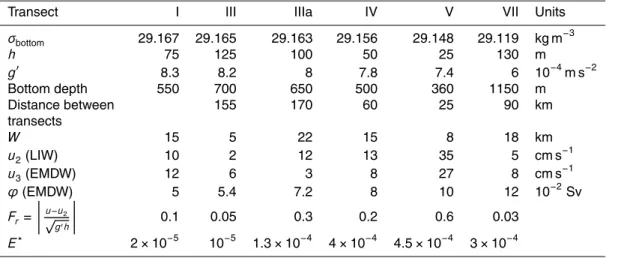
cross-channel averaged thicknesshis∼75–120 m (Tables 1 and 2). Further west, the
5
EMDW was observed to sink to depths greater than 700 m (transect III in Figs. 3 and 4), rising again at 300–350 m depth at the western sill but, rather surprisingly, flowing
along the Tunisian shelf break (transects IV–V). There,W is∼8–15 km, σ is∼29.15,
his∼25–50 m, and ureaches ∼27–46 cm s−1. At the western mouth of the channel
the EMDW sinks again along the Sicilian coast at∼1100–1200 m (transect VII). Then,
10
it attains a buoyancy equilibrium in the southern Tyrrhenian Sea, whereW is∼20 km,
σ is ∼29.12, u is ∼8–17 cm s−1, and h is ∼130–200 m (Sparnocchia et al., 1999;
Figs. 3 and 4). This final sinking is allowed by the small density of the Tyrrhenian LIW (σ∼29.05).
The initial θ−S characteristics of the EMDW at the eastern entrance are
progres-15
sively modified along the vein route (Figs. 3 and 4). These changes are rather weak east of the sill and within the channel, while they become larger in the region west of the sill. This stresses the important role of friction and mixing around the sill region in modifying the hydrographic characteristics of the bottom water.
From these data, A01 also estimated Rossby (Ro∼0.1) and Froude numbers. Far
20
from the sill the EMDW was characterized by a Froude number of Fr∼0.1, a small
value that would inhibit a strong mixing between LIW and EMDW. Over the sill Fr is
∼0.6–0.8 (Tables 1 and 2). These values, however, are obtained from time averaging
and thus depict a steady condition (A01). We believe thatFr may reach higher values
during strong transient phenomena.
25
Finally, by assuming quadratic friction,F =−K∗ρu
h
u, A01 estimated a dimensionless
OSD
11, 2495–2532, 2014Friction and mixing effects on potential vorticity for bottom current crossing
a marine strait
F. Falcini and E. Salusti
Title Page
Abstract Introduction
Conclusions References
Tables Figures
◭ ◮
◭ ◮
Back Close
Full Screen / Esc
Printer-friendly Version Interactive Discussion
Discussion
P
a
per
|
Discus
sion
P
a
per
|
Discussion
P
a
per
|
Discussion
P
a
per
|
of 2–12 (×10−3) (Baringer and Price, 1997b) – and is likely justified by the very irregular topography of the Sicily Channel around the sill region.
7.2 Diagnostic analysis for vorticity and PV
From hydrographic and current-meter data for the EMDW above described we perform
a scale analysis of Eq. (6): consideringL∼105m andW ∼104m as the along-channel
5
and cross-channel space scale, respectively, andU∼10−1m s−1as the along-channel velocity, we obtain
u ∂
∂xζ+(ζ+f) (divu)=−X ζ U
L
U
R +
U W
+
U
R +
U W +f
U L
=X
U
R +
U W
1
T(10
−6
+10−5)+1
T(10
−6
+10−5+10−4)=10−6×10⁻⁴,
(17)
whereT ∼104–5s is the EMDW timescale, f is ∼10−4s−1, and R∼105m is an esti-mated curvature radius for the EMDW pathway around the sill region; the friction
coef-10
ficientX ∼10−5s−1 is estimated by considering the value proposed by A01 (i.e.,K∗),
multiplied byU2/H∼10−4s−1(whereH ∼100 m scales for the EMDW thickness). We
remark thatζ in Eq. (17) is the sum of a “shear vorticity” (U/W ∼10−5s−1in the Sicily Channel) and a “curvature vorticity” (U/R∼10−6s−1in the Sicily Channel) due to the bending pathway of the EMDW.
15
The scale analysis in Eq. (17) shows that each term of Eq. (6), and thus of Eq. (15), plays a role in the EMDW dynamics. Moreover, since (i)ζ≪f in Eq. (17), (ii)u≈u2in
Eq. (14a), and (iii) the length scale u/Γ ≈106m in Eq. (16) results in being larger than the entire channel length, one can reasonably use the approximated solutions for vor-ticity and PV in Eqs. (14b) and (16b). From these considerations we therefore expect
20
OSD
11, 2495–2532, 2014Friction and mixing effects on potential vorticity for bottom current crossing
a marine strait
F. Falcini and E. Salusti
Title Page
Abstract Introduction
Conclusions References
Tables Figures
◭ ◮
◭ ◮
Back Close
Full Screen / Esc
Printer-friendly Version Interactive Discussion
Discussion
P
a
per
|
Discus
sion
P
a
per
|
Discussion
P
a
per
|
Discussion
P
a
per
and a rather large peak ofΠ immediately after the sill, as confirmed by the detailed
results we describe below. The following analysis of Eqs. (14) and (16) in their closed form is performed by using continuous functions foru(ξ) andh(ξ), which are computed from modified spline interpolations ofui andhi as obtained from the in situ data (Ap-pendix B). Velocity interpolations are also compared with PROTHEUS numerical data
5
(Fig. 5), a relatively coarse resolution Mediterranean model (1/8◦×1/8◦) based on the MIT general circulation model (MITgcm; Sannino et al., 2009; Sannino, personal communication), and show fair agreement with the splines.
MATER II cruise (January 1997)
For this data set (Figs. 3 and 5, Table 3) we see that both ζ and Π are rather small
10
upstream of the sill, namelyζ∼5×10⁻⁶s−1 or less andΠ∼8×10⁻⁷s−1m−1(Fig. 6). Approaching the sill, vorticity changes sign (Fig. 6) due to the stretching term uh∂h∂ξ in Eq. (14). A negative valueζ∼ −6×10⁻⁵s−1is then reached at transect IV, and conse-quentlyΠreaches a very large peak ∼6×10⁻⁶s−1m−1 at transect V. Downstream of the sill, in the southern Tyrrhenian Sea,ζ again has a positive value,ζ∼6×10⁻⁵s−1,
15
andΠstrongly decreases to 8×10⁻⁷s−1m−1(Fig. 6).
MATER IV cruise (April–May 1998)
This springtime data set (Figs. 4 and 5, Table 4), although similar to the one described above, shows lower velocities and fluxes than those of the winter case (Fig. 6; Stans-field et al., 2001). Upstream of the sillζ is∼5×10⁻⁶s−1andΠis∼1×10⁻⁶s−1m−1,
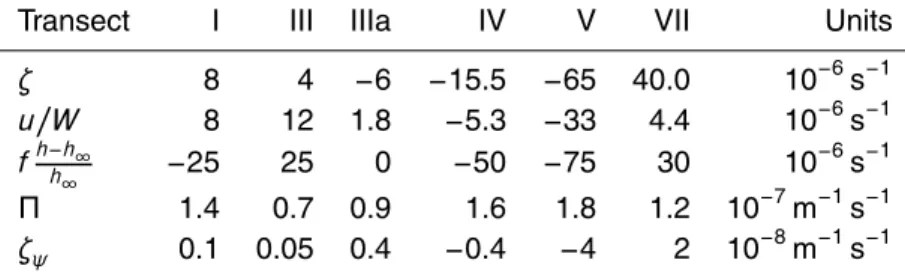
20
while, for a region about 120 km long before the sill,ζgoes from∼10−6to−7×10⁻⁵s−1. In the same way,Πgoes from∼10−6s−1m−1to∼6×10⁻⁶s−1m−1immediately after the sill (Fig. 6). In the southern Tyrrhenian Sea, downstream of the sill,ζ∼4×10⁻⁵s−1. This shows a sudden change in vorticity, as for the MATER II cruise data (Fig. 6). Ac-cordingly,Πdecreases strongly from the largest value at the sill to∼1.5×10⁻⁶s−1m−1
25
OSD
11, 2495–2532, 2014Friction and mixing effects on potential vorticity for bottom current crossing
a marine strait
F. Falcini and E. Salusti
Title Page
Abstract Introduction
Conclusions References
Tables Figures
◭ ◮
◭ ◮
Back Close
Full Screen / Esc
Printer-friendly Version Interactive Discussion
Discussion
P
a
per
|
Discus
sion
P
a
per
|
Discussion
P
a
per
|
Discussion
P
a
per
|
8 Discussions
The lack of specific current-meter measurements does not allow for a realistic deter-mination of vorticity and, in particular, for a validation of our model. A rough, although reasonable, way to infer the EMDW vorticity independently from our model is given by the following considerations: since the EMDW path is rather straight upstream of the sill
5
(Fig. 1), the curvature vorticity of this flow along the upstream region of the channel is very small (Holton, 1972). Therefore, initial values of vorticity for our analysis are taken
from the shear vorticity only, which is approximately ζ0∼U/W (Fig. 6). Although this
approximation – taken as an initial condition for our vorticity analysis – can be affected by a large error, Eq. (14) shows that the “memory” of the initial vorticity ζ0 vanishes
10
within a few kilometers.
A different option for determiningζ is suggested through use of the classicalΠ con-servation:ζ=hf h
∞ −f (Gill, 1982), where h∞ is the bottom depth far upstream, in the
Ionian Sea. This suggests that a vorticity stream-wise profile should look approximately
like the EMDW thickness profile. However, such an estimate ofζ only holds far from
15
the sill, where friction and mixing certainly do not affect the deep current.
Our diagnosis, through use of the A01 experimental data set, confirms both (i) the “memory-loss” effect of upstream vorticity conditions due to the role of friction and (ii) the inability of classical approaches (e.g., Gill’s formulation as well as similar ones) to describe flow vorticity under the presence of a narrow sill. We found that the region
20
around the sill (∼70 km length) has an unexpected negative peak ofζ that, moreover,
seems to be also in agreement with the EMDW–LIW interface tilting that occurs at the sill (Figs. 3 and 4) in terms of change in flow curvature.
Abrupt changes in vorticity are also reflected in the downstream evolution of PV, which is definitely not constant around the sill region. This interesting result points out
25
OSD
11, 2495–2532, 2014Friction and mixing effects on potential vorticity for bottom current crossing
a marine strait
F. Falcini and E. Salusti
Title Page
Abstract Introduction
Conclusions References
Tables Figures
◭ ◮
◭ ◮
Back Close
Full Screen / Esc
Printer-friendly Version Interactive Discussion
Discussion
P
a
per
|
Discus
sion
P
a
per
|
Discussion
P
a
per
|
Discussion
P
a
per
An interesting aside, we check the reliability of the idealized friction coefficient by investigating the balance of the PV Eq. (15) for the EMDW along-channel evolution. The nonlinear friction F =−K∗ρu
h
u described above, with the constant friction coefficient
K∗=2.6×10⁻²(A01), gives the following PV balance:
d dt+ Γ
Π = (curl
F)
z
ρh ≈ −
2K∗uζ h2 ∼10
−11
m−1s−2. (18)
5
Equation (18) is nicely satisfied in the upstream part of the Sicily Channel, while this agreement fails over the sill (Fig. 7). Therefore, to investigate such a discrepancy, we analyze
ε=
u∂ ∂ξ + Γ
ζ +f
h −
(curlF)
z
ρh =
u ∂ ∂ξ+ Γ
ζ +f
h +
K∗ h2uζ
=ud
dξΠ
| {z }
ε1
+ ΓΠ |{z}
ε2
+K∗
h2u ζ | {z }
ε3
≈10−10–10−11s−2m−1. (19)
For both MATER cruises, the along-channel profiles of the three termsε1,ε2, andε3
10
(Fig. 7) are rather small but never exactly balanced, in particular around the sill region. For the MATER IV cruise, which was characterized by lower velocities, this unbalance
seems to be due to the variability of the entrainment termε2, when approaching the
sill, and to the advection term ε1, which results in being too small for balancing the
friction termε3.
15
This suggests that some tuning of the quadratic friction coefficient is needed. Con-sequently, we propose the use of a varying friction coefficient, namelyK∗→K∗+χ∗(ξ). Indeed, large values ofεaround the sill (Fig. 7) suggest that both local roughness due to the sea-bottom morphology over the sill and an additional frictional effect due to the strong mixing occurring at the sill could affect the local schematization for friction. To
OSD
11, 2495–2532, 2014Friction and mixing effects on potential vorticity for bottom current crossing
a marine strait
F. Falcini and E. Salusti
Title Page
Abstract Introduction
Conclusions References
Tables Figures
◭ ◮
◭ ◮
Back Close
Full Screen / Esc
Printer-friendly Version Interactive Discussion
Discussion
P
a
per
|
Discus
sion
P
a
per
|
Discussion
P
a
per
|
Discussion
P
a
per
|
optimize the balance of Eq. (19), we set
0=u d
dxΠ + ΓΠ +
K∗+χ∗(ξ)
h2 u, (20)
which leads to local solutions forχ∗(ξ) (Fig. 8).
In the region where the bottom of the channel is rather flat, i.e., until 350 km from the beginning of the channel (around transect IIIa, Fig. 1), one obtainsχ∗(ξ)≪K∗, in good
5
agreement with the A01 coefficient. Then, approaching the sill, a∼50 % greater friction coefficient is required to satisfy Eq. (20) (Fig. 8). We note that a similar approach for seeking a more realistic frictional coefficient along particular morphological settings (such as straits and channels) was also pursued by Baringer and Price (1997a, b). Their results showed that (i) “large bottom friction coupled with the relatively small
10
thickness of outflows may lead to a turbulent bottom boundary layer that extends over much of the total thickness of the outflow” and (ii) “the bottom stress appears to follow a quadratic drag law, though the appropriatecD [i.e., dimensionless friction coefficient] will vary considerably with the type of average velocity available for the parameter-ization”. Both conclusions are in agreement with our results.
15
9 Conclusions
We investigated vorticity (ζ) and PV (Π) evolution of the EMDW flowing along the
Sicily Channel by developing a novel shallow-water, stream-tube approach. The model
allowed us to diagnose bottom current properties under the effect of sea-bottom
changes, bottom friction, and vertical entrainment. Our analysis reveals sharp negative
20
vorticity peaks over the sill region, whileζ again becomes positive downstream of the
sill, as they were in the eastern basin. All this reflects on the PV behavior of the bottom
currents, which experience large variations inΠ, and reveals how PV-constant models
are not suitable for exploring bottom currents dynamics along rotating channels. We argue that the along-channel evolution of both vorticity and PV is due to bathymetric
OSD
11, 2495–2532, 2014Friction and mixing effects on potential vorticity for bottom current crossing
a marine strait
F. Falcini and E. Salusti
Title Page
Abstract Introduction
Conclusions References
Tables Figures
◭ ◮
◭ ◮
Back Close
Full Screen / Esc
Printer-friendly Version Interactive Discussion
Discussion
P
a
per
|
Discus
sion
P
a
per
|
Discussion
P
a
per
|
Discussion
P
a
per
effects occurring approaching the sill, which are also modulated by frictional effects and significantly change the structure of vorticity and PV equations for describing such dynamics.
Knowledge of the downstream evolution of ζ allowed us (i) to infer the deep vein
dynamics, in particular, around the sill region, where the flow is dramatically
non-5
geostrophic; (ii) to diagnose the PV balance; and thus (iii) to tune the parameterization for bottom friction. In this regard, our novel analysis is a general implication of the steady, deep, and baroclinic current theory in marine straits (Smith, 1975; Killworth, 1977; Hogg, 1983).
Appendix A: The cross-sectional averages
10
We evaluate here the cross-sectional averages of various terms of the vorticity Eq. (7). Let us first assume that, for a narrow and long strait or channel, the derivative ∂ψ∂ a≫
∂
∂ξacross-strait, whereais a general flow property. We then define the cross-channel
average asa=Radzdψ.
For a nonlinear friction Fn,m=−Kn,m ρ
hmu n
u≡ −Xu, the cross-channel averaging
15
would therefore give
1
ρ(curlFn,m)z=Km,n un
hm ∂u
∂ψ =−Km,n un
hm
ζ≡ −Xζ (A1)
sinceuandhby definition are functions ofξ only.
Accordingly, the second term on the left-hand side of the vorticity Eq. (7) can be
averaged by considering that Rdψ∂ψv=0 since v is symmetric and vanishes at the
20
vein lateral borders. Therefore, one obtains
divu≡ Z
dzdψ(∂ξu+∂ψv)= Z
OSD
11, 2495–2532, 2014Friction and mixing effects on potential vorticity for bottom current crossing
a marine strait
F. Falcini and E. Salusti
Title Page
Abstract Introduction
Conclusions References
Tables Figures
◭ ◮
◭ ◮
Back Close
Full Screen / Esc
Printer-friendly Version Interactive Discussion
Discussion
P
a
per
|
Discus
sion
P
a
per
|
Discussion
P
a
per
|
Discussion
P
a
per
|
This, moreover, results that
ζ∂u ∂ξ +u
∂ζ ∂ξ =
Z Z ∂
∂ξ(uζ)dzdψ≈ ∂ ∂ξ
Z Z
(uζ)dzdψ≈ ∂ ∂ξu
Z Z
ζdzdψ=u∂ζ ∂ξ+ζ
∂u ∂ξ,
(A3)
sinceuis less variable thanζ. All of this leads to the cross-averaged vorticity equation in the steady case
u∂
∂ξζ+(f+ζ)divu≈
1
ρ(curlF)z=−Xζ (A4)
5
and thus to the corresponding solution, Eq. (11), in the main text forζ≪f. Similarly, the mass conservation equation
u∂
∂ξh+hdivu≈E|u−u2| (A5)
becomes Eq. (12) in the main text.
Appendix B: The spline interpolation of theui andhi
10
To use the cross-averaged EMDW data of A01 (Tables 1 and 2), we computed a con-tinuous u(ξ) and h(ξ) spline interpolation of the ui and hi from transect i =1, 2,. . .
(Fig. 6). This problem may be solved exactly by fitting a polynomial of degreen−1. Un-fortunately, for such a “polynomial” solution, it is not easy to control for the influence of any particular observation. Moreover, it can behave very strangely at the boundaries.
15
OSD
11, 2495–2532, 2014Friction and mixing effects on potential vorticity for bottom current crossing
a marine strait
F. Falcini and E. Salusti
Title Page
Abstract Introduction
Conclusions References
Tables Figures
◭ ◮
◭ ◮
Back Close
Full Screen / Esc
Printer-friendly Version Interactive Discussion
Discussion
P
a
per
|
Discus
sion
P
a
per
|
Discussion
P
a
per
|
Discussion
P
a
per
σthat varies asσ2=v2+µΛ(ξ) withµ≫v2. For such a “modified” spline interpolation, one has
Λ(ξ)=35
32
"
1−
2(ξ− ∆ξm)
ξm−ξm−1
2#3
, where∆ξm=(ξm−ξm−1)/2, (B1)
for all points in an intervalξm−1< ξ < ξm+1and zero elsewhere. We moreover impose
that our transect V is a local minimum for h(ξ) and a maximum of u(ξ) as shown in
5
Fig. 6. Note that, although these last plots might look rather discontinuous over the sill, in reality this apparent effect is due to the vigorous evolution of the current over the sill.
We moreover compare such a modified spline interpolation of ui with monthly
av-eraged data of PROTHEUS (see text). Along-channel velocities for January 1997 and April 1998 cruises are shown in Fig. 5, superimposed on modified spline interpolations
10
of both MATER II and MATER IV.
Author contributions. E. Salusti developed the analytic theory with contributions of F. Falcini, who also performed the vorticity and PV diagnosis. Both authors prepared the manuscript.
Acknowledgements. We thank M. Astraldi and G. P. Gasparini for help and criticism, and V. Rupolo and G. M. Sannino for the PROTHEUS data. Many thanks are also due to M.
Kur-15
gansky, L. Pratt and R. Wood for suggestions about potential vorticity dynamics, as well as to T. Proietti for discussion regarding the spline interpolations.
References
Armi, L. and Farmer, D.: The internal hydraulics of the Strait of Gibraltar and associated sills and narrows, Oceanol. Acta, 8, 37–46, 1985.
20
Astraldi, M., Gasparini, G. P., Gervasio, L., and Salusti, E.: Dense water dynamics along the Strait of Sicily (Mediterranean Sea), J. Phys. Oceanogr., 31, 3457–3475, 2001.
OSD
11, 2495–2532, 2014Friction and mixing effects on potential vorticity for bottom current crossing
a marine strait
F. Falcini and E. Salusti
Title Page
Abstract Introduction
Conclusions References
Tables Figures
◭ ◮
◭ ◮
Back Close
Full Screen / Esc
Printer-friendly Version Interactive Discussion
Discussion
P
a
per
|
Discus
sion
P
a
per
|
Discussion
P
a
per
|
Discussion
P
a
per
|
Baringer, M. O. N. and Price, J. F.: Momentum and energy balance of the Mediterranean out-flow, J. Phys. Oceanogr., 27, 1678–1692, 1997b.
Borenäs, K. and Lundberg, P.: Rotating hydraulics of flow in a parabolic channel, J. Fluid Mech., 167, 309–326, 1986.
Borenäs, K. M. and Lundberg, P. A.: On the deep-water flow through the Faroe Bank Channel,
5
J. Geophys. Res.-Oceans, 93, 1281–1292, 1988.
Bryden, H. L. and Kinder, T. H.: Steady two-layer exchange through the Strait of Gibraltar, Deep Sea Res. Pt. I, 38, S445–S463, 1991.
Chen, C., Beardsley, R. C., and Limeburner, R.: The structure of the Kuroshio southwest of Kyushu: velocity, transport and potential vorticity fields, Deep Sea Res. Pt. I, 39, 245–268,
10
1992.
Durbin, J. and Koopman, S. J.: Time Series Analysis by State Space Methods, Oxford University Press, Oxford, UK, 2012.
Ellison, T. H. and Turner, J. S.: Turbulent entrainment in stratified flows, J. Fluid Mech., 6, 423– 448, 1959.
15
Gerdes, F., Garrett, C., and Farmer, D.: On internal hydraulics with entrainment, J. Phys. Oceanogr., 32, 1106–1111, 2002.
Gill, A. E.: The hydraulics of rotating-channel flow, J. Fluid Mech., 80, 641–671, 1977.
Gill, A. E.: Atmosphere–Ocean Dynamics, vol. 30, Academic Press, San Diego, USA, 662 pp., 1982.
20
Hogg, N. G.: Hydraulic control and flow separation in a multi-layered fluid with applications to the Vema Channel, J. Phys. Oceanogr., 13, 695–708, 1983.
Holton. J. R.: Introduction to Dynamic Meteorology, Academic Press, New York, USA, 319 pp., 1972.
Jain, S. C.: Open-Channel Flows, John Wiley and Sons, New York, USA, 328 pp., 2001.
25
Johnson, D. A., McDowell, S. E., Sullivan, L. G., and Biscaye, P. E.: Abyssal hydrography, neph-elometry, currents, and benthic boundary layer structure in the Vema Channel, J. Geophys. Res., 81, 5771–5786, 1976.
Johnson, G. C. and Ohlsen, D. R.: Frictionally modified rotating hydraulic channel exchange and ocean outflows, J. Phys. Oceanogr., 24, 66–78, 1994.
30
OSD
11, 2495–2532, 2014Friction and mixing effects on potential vorticity for bottom current crossing
a marine strait
F. Falcini and E. Salusti
Title Page
Abstract Introduction
Conclusions References
Tables Figures
◭ ◮
◭ ◮
Back Close
Full Screen / Esc
Printer-friendly Version Interactive Discussion
Discussion
P
a
per
|
Discus
sion
P
a
per
|
Discussion
P
a
per
|
Discussion
P
a
per
Killworth, P. D.: Flow properties in rotating, stratified hydraulics, J. Phys. Oceanogr., 22, 997– 1017, 1992.
Lacombe, H. and Richez, C.: The regime of the Strait of Gibraltar. In: J.C.J. Nihoul (Editor), Hydrodynamics of Semi-Enclosed Seas, Elsevier Oceanography Series 34, Elsevier, Ams-terdam, 13–73, 1982.
5
Paldor, N.: Stability and stable modes of coastal fronts, Geophys. Astro. Fluid, 27, 217–228, 1983.
Pratt, L. J., Helfrich, K. R., and Leen, D.: On the stability of ocean overflows, J. Fluid Mech., 602, 241–266, 2008.
Pratt, L. L. and Whitehead, J. A.: Rotating Hydraulics: Nonlinear Topographic Effects in the
10
Ocean and Atmosphere, vol. 36, Springer, New York, USA, 2007.
Salon, S., Crise, A., and Van Loon, A. J.: Dynamics of the bottom boundary layer, contourites, Developments in Sedimentology, 60, 83–98, 2008.
Sannino, G., Herrmann, M., Carillo, A., Rupolo, V., Ruggiero, V., Artale, V., and Heimbach, P.: An eddy-permitting model of the Mediterranean Sea with a two-way grid refinement at the
15
Strait of Gibraltar, Ocean Model., 30, 56–72, 2009.
Smith, P. C.: A streamtube model for bottom boundary currents in the ocean, Deep-Sea Res., 22, 853–873, 1975.
Sparnocchia, S., Gasparini, G. P., Astraldi, M., Borghini, M., and Pistek, P.: Dynamics and mixing of the Eastern Mediterranean outflow in the Tyrrhenian basin, J. Marine Syst., 20,
20
301–317, 1999.
Stansfield, K., Smeed, D. A., Gasparini, G. P., McPhail, S., Millard, N., Stevenson, P., Webb, A., Vetrano, A., and Rabe, B.: Deep-sea, high-resolution, hydrography and current mea-surements using an autonomous underwater vehicle: the overflow from the Strait of Sicily, Geophys. Res. Lett., 28, 2645–2648, 2001.
25
Turner, J. S.: Turbulent entrainment: the development of the entrainment assumption, and its application to geophysical flows, J. Fluid Mech., 173, 431–471, 1986.
Whitehead, J. A.: Topographic control of oceanic flows in deep passages and straits, Rev. Geophys., 36, 423–440, 1998.
Whitehead, J. A., Leetmaa, A., and Knox, R. A.: Rotating hydraulics of strait and sill flows,
30
OSD
11, 2495–2532, 2014Friction and mixing effects on potential vorticity for bottom current crossing
a marine strait
F. Falcini and E. Salusti
Title Page
Abstract Introduction
Conclusions References
Tables Figures
◭ ◮
◭ ◮
Back Close
Full Screen / Esc
Printer-friendly Version Interactive Discussion
Discussion
P
a
per
|
Discus
sion
P
a
per
|
Discussion
P
a
per
|
Discussion
P
a
per
|
OSD
11, 2495–2532, 2014Friction and mixing effects on potential vorticity for bottom current crossing
a marine strait
F. Falcini and E. Salusti
Title Page
Abstract Introduction
Conclusions References
Tables Figures
◭ ◮
◭ ◮
Back Close
Full Screen / Esc
Printer-friendly Version Interactive Discussion
Discussion
P
a
per
|
Discus
sion
P
a
per
|
Discussion
P
a
per
|
Discussion
P
a
per
Table 1.Main experimental quantities measured by A01 in the Sicily Channel and in the
south-ern Tyrrhenian Sea during the MATER II cruise (Figs. 1 and 3). Hereσbottomis the maximumσθ
observed in the hydrographic casts,his the bottom layer thickness,g′is the reduced gravity,ϕ
(EMDW) is the EMDW flux,Fr is the Froude number, and the entrainment parameterE∗is the
one computed by Baringer and Price (1997b).
Transect I II III IV V VIc VII Units
σbottom 29.168 29.165 29.163 29.157 29.150 29.124 29.117 kg m− 3
h 120 150 140 100 50 150 200 m
g′ 3 3 4 6 6 3 2 10−4m s−2
Bottom depth 550 600 800 530 350 600 1200 m
Distance between 0 80 135 170 25 65 25 km
transects
W 20 80 40 15 15 30 20 km
u2(LIW) 12 5 3.2 18 53 11 7 cm s−
1
u3(EMDW) 13 8 5 14 46 15 17 cm s−
1
ϕ(EMDW) 0.23 0.26 0.20 0.23 0.32 0.35 0.34 Sv
Fr=
u−u2 √
g′h
0.1 0.2 0.1 0.2 0.8 0.2 0.5
OSD
11, 2495–2532, 2014Friction and mixing effects on potential vorticity for bottom current crossing
a marine strait
F. Falcini and E. Salusti
Title Page
Abstract Introduction
Conclusions References
Tables Figures
◭ ◮
◭ ◮
Back Close
Full Screen / Esc
Printer-friendly Version Interactive Discussion
Discussion
P
a
per
|
Discus
sion
P
a
per
|
Discussion
P
a
per
|
Discussion
P
a
per
|
Table 2.Same as Table 1 but for the MATER IV cruise (Figs. 1 and 4).
Transect I III IIIa IV V VII Units
σbottom 29.167 29.165 29.163 29.156 29.148 29.119 kg m− 3
h 75 125 100 50 25 130 m
g′ 8.3 8.2 8 7.8 7.4 6 10−4m s−2
Bottom depth 550 700 650 500 360 1150 m
Distance between 155 170 60 25 90 km
transects
W 15 5 22 15 8 18 km
u2(LIW) 10 2 12 13 35 5 cm s−
1
u3(EMDW) 12 6 3 8 27 8 cm s−
1
ϕ(EMDW) 5 5.4 7.2 8 10 12 10−2Sv
Fr=
u−u2 √
g′h
0.1 0.05 0.3 0.2 0.6 0.03
OSD
11, 2495–2532, 2014Friction and mixing effects on potential vorticity for bottom current crossing
a marine strait
F. Falcini and E. Salusti
Title Page
Abstract Introduction
Conclusions References
Tables Figures
◭ ◮
◭ ◮
Back Close
Full Screen / Esc
Printer-friendly Version Interactive Discussion
Discussion
P
a
per
|
Discus
sion
P
a
per
|
Discussion
P
a
per
|
Discussion
P
a
per
Table 3.Theoretical estimates ofζ for the MATER II cruise (Figs. 1 and 3). Values are
com-pared with the approximate vorticitiesζ0∼U/W (which moreover sets the initial values of our
theoretical estimation) andζ=hf h
∞−f (see text). The last two rows show theoretical estimates
ofΠandζψ.
Transect I II III IV V VI VII Units
ζ 7 2.0 −1.5 −60.5 20.0 45.5 50.0 10−6s−1
u/W 7 10 1.2 −10 −30 5 8.5 10−6s−1
fh−h∞
h∞ 0 25 16 −16 −58 25 66 10−
6 s−1
Π 8 7.0 7.5 5.0 19.5 9.0 6.0 10−7m−1s−1
OSD
11, 2495–2532, 2014Friction and mixing effects on potential vorticity for bottom current crossing
a marine strait
F. Falcini and E. Salusti
Title Page
Abstract Introduction
Conclusions References
Tables Figures
◭ ◮
◭ ◮
Back Close
Full Screen / Esc
Printer-friendly Version Interactive Discussion
Discussion
P
a
per
|
Discus
sion
P
a
per
|
Discussion
P
a
per
|
Discussion
P
a
per
|
Table 4.Same as Table 3 but for the MATER IV cruise (Figs. 1 and 4).
Transect I III IIIa IV V VII Units
ζ 8 4 −6 −15.5 −65 40.0 10−6s−1
u/W 8 12 1.8 −5.3 −33 4.4 10−6s−1
fh−h∞
h∞ −25 25 0 −50 −75 30 10
−6 s−1
Π 1.4 0.7 0.9 1.6 1.8 1.2 10−7m−1s−1
OSD
11, 2495–2532, 2014Friction and mixing effects on potential vorticity for bottom current crossing
a marine strait
F. Falcini and E. Salusti
Title Page
Abstract Introduction
Conclusions References
Tables Figures
◭ ◮
◭ ◮
Back Close
Full Screen / Esc
Printer-friendly Version Interactive Discussion
Discussion
P
a
per
|
Discus
sion
P
a
per
|
Discussion
P
a
per
|
Discussion
P
a
per
Figure 1a.General map of the Sicily Channel: the channel length is∼500 km, with two sills at
its eastern and western entrances (∼550 and∼350 m deep, respectively). Dots indicate the