Study of Direct
CP
Violation in
B
!
J= K
Decays
V. M. Abazov,36B. Abbott,75M. Abolins,65B. S. Acharya,29M. Adams,51T. Adams,49E. Aguilo,6S. H. Ahn,31 M. Ahsan,59G. D. Alexeev,36G. Alkhazov,40A. Alton,64,*G. Alverson,63G. A. Alves,2M. Anastasoaie,35L. S. Ancu,35 T. Andeen,53S. Anderson,45B. Andrieu,17M. S. Anzelc,53M. Aoki,50Y. Arnoud,14M. Arov,60M. Arthaud,18A. Askew,49 B. A˚ sman,41A. C. S. Assis Jesus,3O. Atramentov,49C. Avila,8C. Ay,24F. Badaud,13A. Baden,61L. Bagby,50B. Baldin,50 D. V. Bandurin,59P. Banerjee,29S. Banerjee,29E. Barberis,63A.-F. Barfuss,15P. Bargassa,80P. Baringer,58J. Barreto,2
J. F. Bartlett,50U. Bassler,18D. Bauer,43S. Beale,6A. Bean,58M. Begalli,3M. Begel,73C. Belanger-Champagne,41 L. Bellantoni,50A. Bellavance,50J. A. Benitez,65S. B. Beri,27G. Bernardi,17R. Bernhard,23I. Bertram,42M. Besanc¸on,18 R. Beuselinck,43V. A. Bezzubov,39P. C. Bhat,50V. Bhatnagar,27C. Biscarat,20G. Blazey,52F. Blekman,43S. Blessing,49 D. Bloch,19K. Bloom,67A. Boehnlein,50D. Boline,62T. A. Bolton,59G. Borissov,42T. Bose,77A. Brandt,78R. Brock,65 G. Brooijmans,70A. Bross,50D. Brown,81N. J. Buchanan,49D. Buchholz,53M. Buehler,81V. Buescher,22V. Bunichev,38
S. Burdin,42,†S. Burke,45T. H. Burnett,82C. P. Buszello,43J. M. Butler,62P. Calfayan,25S. Calvet,16J. Cammin,71 W. Carvalho,3B. C. K. Casey,50H. Castilla-Valdez,33S. Chakrabarti,18D. Chakraborty,52K. Chan,6K. M. Chan,55 A. Chandra,48F. Charles,19,**E. Cheu,45F. Chevallier,14D. K. Cho,62S. Choi,32B. Choudhary,28L. Christofek,77 T. Christoudias,43S. Cihangir,50D. Claes,67Y. Coadou,6M. Cooke,80W. E. Cooper,50M. Corcoran,80F. Couderc,18
M.-C. Cousinou,15S. Cre´pe´-Renaudin,14D. Cutts,77M. C´ wiok,30H. da Motta,2A. Das,45G. Davies,43K. De,78 S. J. de Jong,35E. De La Cruz-Burelo,64C. De Oliveira Martins,3J. D. Degenhardt,64F. De´liot,18M. Demarteau,50 R. Demina,71D. Denisov,50S. P. Denisov,39S. Desai,50H. T. Diehl,50M. Diesburg,50A. Dominguez,67H. Dong,72
L. V. Dudko,38L. Duflot,16S. R. Dugad,29D. Duggan,49A. Duperrin,15J. Dyer,65A. Dyshkant,52M. Eads,67 D. Edmunds,65J. Ellison,48V. D. Elvira,50Y. Enari,77S. Eno,61P. Ermolov,38H. Evans,54A. Evdokimov,73 V. N. Evdokimov,39A. V. Ferapontov,59T. Ferbel,71F. Fiedler,24F. Filthaut,35W. Fisher,50H. E. Fisk,50M. Fortner,52 H. Fox,42S. Fu,50S. Fuess,50T. Gadfort,70C. F. Galea,35E. Gallas,50C. Garcia,71A. Garcia-Bellido,82V. Gavrilov,37 P. Gay,13W. Geist,19D. Gele´,19C. E. Gerber,51Y. Gershtein,49D. Gillberg,6G. Ginther,71N. Gollub,41B. Go´mez,8
A. Goussiou,82P. D. Grannis,72H. Greenlee,50Z. D. Greenwood,60E. M. Gregores,4G. Grenier,20Ph. Gris,13 J.-F. Grivaz,16A. Grohsjean,25S. Gru¨nendahl,50M. W. Gru¨newald,30F. Guo,72J. Guo,72G. Gutierrez,50P. Gutierrez,75 A. Haas,70N. J. Hadley,61P. Haefner,25S. Hagopian,49J. Haley,68I. Hall,65R. E. Hall,47L. Han,7K. Harder,44A. Harel,71
R. Harrington,63J. M. Hauptman,57R. Hauser,65J. Hays,43T. Hebbeker,21D. Hedin,52J. G. Hegeman,34 J. M. Heinmiller,51A. P. Heinson,48U. Heintz,62C. Hensel,58K. Herner,72G. Hesketh,63M. D. Hildreth,55R. Hirosky,81 J. D. Hobbs,72B. Hoeneisen,12H. Hoeth,26M. Hohlfeld,22K. Holubyev,42S. J. Hong,31S. Hossain,75P. Houben,34Y. Hu,72
Z. Hubacek,10V. Hynek,9I. Iashvili,69R. Illingworth,50A. S. Ito,50S. Jabeen,62M. Jaffre´,16S. Jain,75K. Jakobs,23 C. Jarvis,61R. Jesik,43K. Johns,45C. Johnson,70M. Johnson,50A. Jonckheere,50P. Jonsson,43A. Juste,50E. Kajfasz,15
A. M. Kalinin,36J. M. Kalk,60S. Kappler,21D. Karmanov,38P. A. Kasper,50I. Katsanos,70D. Kau,49V. Kaushik,78 R. Kehoe,79S. Kermiche,15N. Khalatyan,50A. Khanov,76A. Kharchilava,69Y. M. Kharzheev,36D. Khatidze,70T. J. Kim,31
M. H. Kirby,53M. Kirsch,21B. Klima,50J. M. Kohli,27J.-P. Konrath,23V. M. Korablev,39A. V. Kozelov,39J. Kraus,65 D. Krop,54T. Kuhl,24A. Kumar,69A. Kupco,11T. Kurcˇa,20J. Kvita,9F. Lacroix,13D. Lam,55S. Lammers,70 G. Landsberg,77P. Lebrun,20W. M. Lee,50A. Leflat,38J. Lellouch,17J. Leveque,45J. Li,78L. Li,48Q. Z. Li,50S. M. Lietti,5
J. G. R. Lima,52D. Lincoln,50J. Linnemann,65V. V. Lipaev,39R. Lipton,50Y. Liu,7Z. Liu,6A. Lobodenko,40 M. Lokajicek,11P. Love,42H. J. Lubatti,82R. Luna,3A. L. Lyon,50A. K. A. Maciel,2D. Mackin,80R. J. Madaras,46 P. Ma¨ttig,26C. Magass,21A. Magerkurth,64P. K. Mal,82H. B. Malbouisson,3S. Malik,67V. L. Malyshev,36H. S. Mao,50
Y. Maravin,59B. Martin,14R. McCarthy,72A. Melnitchouk,66L. Mendoza,8P. G. Mercadante,5M. Merkin,38 K. W. Merritt,50A. Meyer,21J. Meyer,22,xT. Millet,20J. Mitrevski,70J. Molina,3R. K. Mommsen,44N. K. Mondal,29
R. W. Moore,6T. Moulik,58G. S. Muanza,20M. Mulders,50M. Mulhearn,70O. Mundal,22L. Mundim,3E. Nagy,15 M. Naimuddin,50M. Narain,77N. A. Naumann,35H. A. Neal,64J. P. Negret,8P. Neustroev,40H. Nilsen,23H. Nogima,3 S. F. Novaes,5T. Nunnemann,25V. O’Dell,50D. C. O’Neil,6G. Obrant,40C. Ochando,16D. Onoprienko,59N. Oshima,50
N. Osman,43J. Osta,55R. Otec,10G. J. Otero y Garzo´n,50M. Owen,44P. Padley,80M. Pangilinan,77N. Parashar,56 S.-J. Park,71S. K. Park,31J. Parsons,70R. Partridge,77N. Parua,54A. Patwa,73G. Pawloski,80B. Penning,23M. Perfilov,38
M. S. Rangel,2K. Ranjan,28P. N. Ratoff,42P. Renkel,79S. Reucroft,63P. Rich,44J. Rieger,54M. Rijssenbeek,72 I. Ripp-Baudot,19F. Rizatdinova,76S. Robinson,43R. F. Rodrigues,3M. Rominsky,75C. Royon,18P. Rubinov,50 R. Ruchti,55G. Safronov,37G. Sajot,14A. Sa´nchez-Herna´ndez,33M. P. Sanders,17A. Santoro,3G. Savage,50L. Sawyer,60 T. Scanlon,43D. Schaile,25R. D. Schamberger,72Y. Scheglov,40H. Schellman,53T. Schliephake,26C. Schwanenberger,44
A. Schwartzman,68R. Schwienhorst,65J. Sekaric,49H. Severini,75E. Shabalina,51M. Shamim,59V. Shary,18 A. A. Shchukin,39R. K. Shivpuri,28V. Siccardi,19V. Simak,10V. Sirotenko,50P. Skubic,75P. Slattery,71D. Smirnov,55
G. R. Snow,67J. Snow,74S. Snyder,73S. So¨ldner-Rembold,44L. Sonnenschein,17A. Sopczak,42M. Sosebee,78 K. Soustruznik,9B. Spurlock,78J. Stark,14J. Steele,60V. Stolin,37D. A. Stoyanova,39J. Strandberg,64S. Strandberg,41
M. A. Strang,69E. Strauss,72M. Strauss,75R. Stro¨hmer,25D. Strom,53L. Stutte,50S. Sumowidagdo,49P. Svoisky,55 A. Sznajder,3P. Tamburello,45A. Tanasijczuk,1W. Taylor,6J. Temple,45B. Tiller,25F. Tissandier,13M. Titov,18 V. V. Tokmenin,36T. Toole,61I. Torchiani,23T. Trefzger,24D. Tsybychev,72B. Tuchming,18C. Tully,68P. M. Tuts,70
R. Unalan,65L. Uvarov,40S. Uvarov,40S. Uzunyan,52B. Vachon,6P. J. van den Berg,34R. Van Kooten,54 W. M. van Leeuwen,34N. Varelas,51E. W. Varnes,45I. A. Vasilyev,39M. Vaupel,26P. Verdier,20L. S. Vertogradov,36
M. Verzocchi,50F. Villeneuve-Seguier,43P. Vint,43P. Vokac,10E. Von Toerne,59M. Voutilainen,68,kR. Wagner,68 H. D. Wahl,49L. Wang,61M. H. L. S. Wang,50J. Warchol,55G. Watts,82M. Wayne,55G. Weber,24M. Weber,50 L. Welty-Rieger,54A. Wenger,23,{N. Wermes,22M. Wetstein,61A. White,78D. Wicke,26M. Williams,42G. W. Wilson,58 S. J. Wimpenny,48M. Wobisch,60D. R. Wood,63T. R. Wyatt,44Y. Xie,77S. Yacoob,53R. Yamada,50M. Yan,61T. Yasuda,50 Y. A. Yatsunenko,36K. Yip,73H. D. Yoo,77S. W. Youn,53J. Yu,78A. Zatserklyaniy,52C. Zeitnitz,26T. Zhao,82B. Zhou,64
J. Zhu,72M. Zielinski,71D. Zieminska,54A. Zieminski,54,**L. Zivkovic,70V. Zutshi,52and E. G. Zverev38
(D0 Collaboration)
1
Universidad de Buenos Aires, Buenos Aires, Argentina
2LAFEX, Centro Brasileiro de Pesquisas Fı´sicas, Rio de Janeiro, Brazil 3Universidade do Estado do Rio de Janeiro, Rio de Janeiro, Brazil
4Universidade Federal do ABC, Santo Andre´, Brazil
5Instituto de Fı´sica Teo´rica, Universidade Estadual Paulista, Sa˜o Paulo, Brazil 6
University of Alberta, Edmonton, Alberta, Canada, Simon Fraser University, Burnaby, British Columbia, Canada,
York University, Toronto, Ontario, Canada, and McGill University, Montreal, Quebec, Canada
7
University of Science and Technology of China, Hefei, People’s Republic of China
8Universidad de los Andes, Bogota´, Colombia 9
Center for Particle Physics, Charles University, Prague, Czech Republic
10Czech Technical University, Prague, Czech Republic 11
Center for Particle Physics, Institute of Physics, Academy of Sciences of the Czech Republic, Prague, Czech Republic
12Universidad San Francisco de Quito, Quito, Ecuador 13LPC, Universite´ Blaise Pascal, CNRS/IN2P3, Clermont, France
14LPSC, Universite´ Joseph Fourier Grenoble 1, CNRS/IN2P3, Institut National Polytechnique de Grenoble, France 15CPPM, IN2P3/CNRS, Universite´ de la Me´diterrane´e, Marseille, France
16
LAL, Universite´ Paris-Sud, IN2P3/CNRS, Orsay, France
17LPNHE, IN2P3/CNRS, Universite´s Paris VI and VII, Paris, France 18
DAPNIA/Service de Physique des Particules, CEA, Saclay, France
19IPHC, Universite´ Louis Pasteur et Universite´ de Haute Alsace, CNRS/IN2P3, Strasbourg, France 20IPNL, Universite´ Lyon 1, CNRS/IN2P3, Villeurbanne, France and Universite´ de Lyon, Lyon, France
21III. Physikalisches Institut A, RWTH Aachen, Aachen, Germany 22Physikalisches Institut, Universita¨t Bonn, Bonn, Germany 23
Physikalisches Institut, Universita¨t Freiburg, Freiburg, Germany
24Institut fu¨r Physik, Universita¨t Mainz, Mainz, Germany 25
Ludwig-Maximilians-Universita¨t Mu¨nchen, Mu¨nchen, Germany
26Fachbereich Physik, University of Wuppertal, Wuppertal, Germany 27
Panjab University, Chandigarh, India
28Delhi University, Delhi, India
29Tata Institute of Fundamental Research, Mumbai, India 30
University College Dublin, Dublin, Ireland
31Korea Detector Laboratory, Korea University, Seoul, Korea 32
33CINVESTAV, Mexico City, Mexico
34FOM-Institute NIKHEF and University of Amsterdam/NIKHEF, Amsterdam, The Netherlands 35Radboud University Nijmegen/NIKHEF, Nijmegen, The Netherlands
36Joint Institute for Nuclear Research, Dubna, Russia 37
Institute for Theoretical and Experimental Physics, Moscow, Russia
38Moscow State University, Moscow, Russia 39
Institute for High Energy Physics, Protvino, Russia
40Petersburg Nuclear Physics Institute, St. Petersburg, Russia 41
Lund University, Lund, Sweden, Royal Institute of Technology and Stockholm University, Stockholm, Sweden, and Uppsala University, Uppsala, Sweden
42Lancaster University, Lancaster, United Kingdom 43
Imperial College, London, United Kingdom
44University of Manchester, Manchester, United Kingdom 45
University of Arizona, Tucson, Arizona 85721, USA
46Lawrence Berkeley National Laboratory and University of California, Berkeley, California 94720, USA 47
California State University, Fresno, California 93740, USA
48University of California, Riverside, California 92521, USA 49Florida State University, Tallahassee, Florida 32306, USA 50Fermi National Accelerator Laboratory, Batavia, Illinois 60510, USA
51University of Illinois at Chicago, Chicago, Illinois 60607, USA 52
Northern Illinois University, DeKalb, Illinois 60115, USA
53Northwestern University, Evanston, Illinois 60208, USA 54
Indiana University, Bloomington, Indiana 47405, USA
55University of Notre Dame, Notre Dame, Indiana 46556, USA 56
Purdue University Calumet, Hammond, Indiana 46323, USA
57Iowa State University, Ames, Iowa 50011, USA 58University of Kansas, Lawrence, Kansas 66045, USA 59
Kansas State University, Manhattan, Kansas 66506, USA
60Louisiana Tech University, Ruston, Louisiana 71272, USA 61
University of Maryland, College Park, Maryland 20742, USA
62Boston University, Boston, Massachusetts 02215, USA 63
Northeastern University, Boston, Massachusetts 02115, USA
64University of Michigan, Ann Arbor, Michigan 48109, USA 65Michigan State University, East Lansing, Michigan 48824, USA
66University of Mississippi, University, Mississippi 38677, USA 67University of Nebraska, Lincoln, Nebraska 68588, USA 68
Princeton University, Princeton, New Jersey 08544, USA
69State University of New York, Buffalo, New York 14260, USA 70
Columbia University, New York, New York 10027, USA
71University of Rochester, Rochester, New York 14627, USA 72State University of New York, Stony Brook, New York 11794, USA
73Brookhaven National Laboratory, Upton, New York 11973, USA 74Langston University, Langston, Oklahoma 73050, USA 75
University of Oklahoma, Norman, Oklahoma 73019, USA
76Oklahoma State University, Stillwater, Oklahoma 74078, USA 77
Brown University, Providence, Rhode Island 02912, USA
78University of Texas, Arlington, Texas 76019, USA 79
Southern Methodist University, Dallas, Texas 75275, USA
80Rice University, Houston, Texas 77005, USA 81University of Virginia, Charlottesville, Virginia 22901, USA
82University of Washington, Seattle, Washington 98195, USA (Received 26 February 2008; published 30 May 2008)
We present a search for directCPviolation inB!J= Kdecays. The event sample is selected
from2:8 fb1ofppcollisions recorded by D0 experiment in run II of the Fermilab Tevatron Collider. The
charge asymmetry ACPB!J= K 0:00750:0061stat 0:0030syst is obtained using a sample of approximately 40 000B!J= K decays. The achieved precision is of the same level as
the expected deviation predicted by some extensions of the standard model. We also measured the charge asymmetryACPB!J= 0:090:08stat 0:03syst.
This Letter presents a study of the charge asymmetry in the decayB !J= K, which is defined as
ACPB!J= K
NB
!J= KNB!J= K
NB!J= KNB!J= K:
A nonzero value ofACPB !J= Kcorresponds
to directCP violation in this decay. In theb!scc tran-sition (charge conjugate states are assumed throughout), the tree-level andb!spenguin amplitudes have a small relative weak phase, argVcsV
cb=VtsVtb . Therefore, the standard model predicts a small ACPB!J= K
0:003[1]. Thus, the measurement of ACPB!J= K is an important way of constraining those new physics models which predict an enhanced value of this asymmetry [1–3].
In b!dcc transitions, on the contrary, the relative phase between the tree-level and b!d penguin ampli-tudes,argVcdV
cb=VtdVtb , is expected to be significant so that directCPviolation may be of the order of 1% [4,5]. Decays governed by theb!dcc transition have already been explored by the Belle Collaboration [6] and the
BABAR Collaboration [7]. Here, we report a complemen-tary measurement of the directCP-violation asymmetry in theb!dcc transition using the decayB !J= .
The D0 detector is described in detail elsewhere [8]. The polarities of its solenoidal [8] and toroidal [9] magnets are reversed regularly during data taking, so that the four solenoid-toroid polarity combinations are exposed to ap-proximately the same integrated luminosity. The reversal of magnet polarities helps to reduce the detector-related systematic effects in asymmetry measurements and is fully exploited in this study.
The decay B!J= K with J= ! is
selected from 2:8 fb1 recorded by D0. Each muon is required to be identified by the muon system, to have an associated track in the central tracking system with at least two measurements in the silicon microstrip tracker, and a transverse momentumpT >1:5 GeV=cwith respect to the beam axis. At least one of the two muons is required to have matching track segments both inside and outside the toroidal magnet. The dimuon system must have a recon-structed invariant mass between 2.80 and3:35 GeV=c2. An additional charged particle with pT>0:5 GeV=c, total momentum above0:7 GeV=c, and at least two measure-ments in the silicon microstrip tracker, is selected. This particle is assigned the kaon mass and is required to have a common vertex with the two muons, with the 2 of the vertex fit being less than 16 for 3 degrees of freedom. The displacement of this vertex from the primary interaction point is required to exceed 3 standard deviations in the plane perpendicular to the beam direction. The primary vertex of thepp interaction is determined for each event using the method described in [10]. The average position of the beam-collision point is included as a constraint.
From each set of three particles fulfilling these require-ments, aBcandidate is constructed. The momenta of the
muons are corrected using the J= mass constraint. To further improve theBselection, a likelihood ratio method
[11] is applied. The details of the B selection can be
found in [12]. AllB candidates satisfying the selection
criteria are used for this analysis.
The resulting invariant mass distribution of the J= K system is shown in Fig. 1with the result of an unbinned likelihood fit to the sum of contributions fromB!J= K, B!J= , andB!J= K decays, as well as
combina-torial background (BKG). The mass distribution of the J= K system from theB!J= Khypothesis is parame-trized by a Gaussian function with the width depending on the momentum of theKcandidate. The parameters of this dependence are determined directly in the fit. The mass distribution of the J= system from the B!J= hypothesis is parametrized by a Gaussian function with the same width. It is then transformed into the distribution of theJ= Ksystem by assigning the kaon mass to the pion. The decayB!J= KwithK!K, where the pion is
not reconstructed, produces a broad J= Kmass distribu-tion with the threshold near mB m. It is parame-trized using the Monte Carlo simulation. The combina-torial background is described by an exponential function. The fractions of the J= K, J= , and J= K signal
depend on the kaon momentum. The Monte Carlo simula-tion shows that this dependence can be modeled by the same polynomial function with different scaling factors for J= K,J= , andJ= Kfractions. The coefficients of the
polynomial and the scaling factors are determined from the fit. The B!J= K signal contains 40 222242stat events, while the B!J= signal contains 1578
119statevents.
To measure the charge asymmetry A between the J= K and J= K final states, both physics
] 2 K) [GeV/c ψ
m(J/
5 5.1 5.2 5.3 5.4 5.5 5.6 5.7
]
2
Entries/0.03 [GeV/c
0 2000 4000 6000 8000 10000
12000 D0 Run II, 2.8 fb-1 DATAK ψ J/
π ψ J/
K* ψ J/
BKG
TOTAL FIT
and detector effects contributing to the possible imbalance of events with positive and negative kaons must be taken into account. One physics source of asymmetry is direct CPviolation in theB !J= Kdecay. In addition,
forward-backward charge asymmetry of events produced in the proton-antiproton collisions can also be present. Detector effects can give rise to an artificial asymmetry if, for example, the reconstruction efficiencies of positive and negative particles are different. However, a positive particle produces the same track as a negative particle in the detector with reversed magnet polarity. Therefore, essentially all detector effects can be canceled by regularly reversing the magnet polarity.
Following the method applied in [13,14], the event sample of Fig.1 is divided into eight subsamples corre-sponding to all possible combinations of the solenoid polarity 1, the sign of the pseudorapidity of the J= Ksystem 1, and the sign of the kaon candidate chargeq 1. In each subsample, the numbernq of the events in the contributing channels, J= K, J= , and J= K, is obtained from the unbinned likelihood fit to
the mass distributionmJ= Kusing the same likelihood function as for the whole sample. All parameters of the fits apart from the fractions of the J= K signal, the J= signal, and theJ= K signal are fixed to the values
deter-mined from the fit to the whole sample.
The number of events in theJ= KandJ= channels for eachqsubsample are used to disentangle the phys-ics asymmetries and the detector effects. Thenq can be expressed through the physics and the detector asymme-tries as follows [13]:
nq 14N1qA1qAfb1Adet1
qAq1qAq1A: (1)
Here N is the total number of signal events, is the fraction of integrated luminosity with solenoid polarity ( 1),Ais the charge asymmetry to be measured,
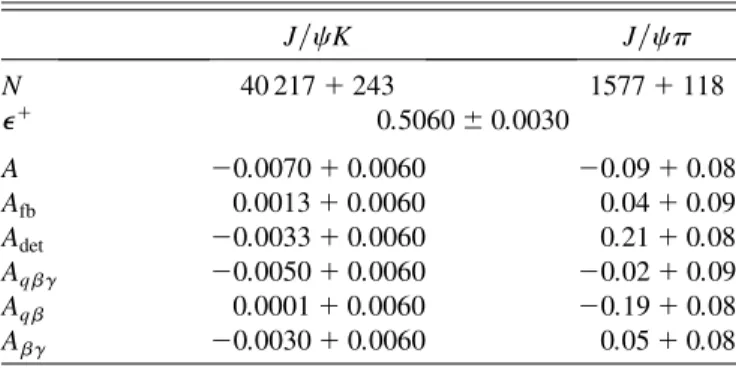
Afbaccounts for possible forward-backward asymmetricB meson production,Adetis the detector asymmetry for kaons emitted in the forward and backward direction, Aq ac-counts for the change in acceptance of kaons of different sign bent by the solenoid in different directions,Aqis the detector asymmetry, which accounts for the change in the kaon reconstruction efficiency when the solenoid polarity is reversed, and A accounts for any detector-related forward-backward asymmetries that remain after the sole-noid polarity flip. We apply a2fit of Eq. (1) to the number of events in all subsamples and extract all asymmetries and the total number of events in theJ= KandJ= channels together with the fraction of events with positive solenoid polarity, which is constrained to be the same for both
channels. Results are presented in Table I. The charge asymmetry betweenB!J= K andB!J= K is
measured to be AJ= K 0:00700:0060, and the
charge asymmetry between B!J= and B!
J= is found to be AJ= 0:090:08. The
detector asymmetries are all consistent with zero, since the acceptance of the charged particles of different sign inside the solenoid is the same. However, we measure these asymmetries directly and do not rely on assumptions. The forward-backward asymmetry is also consistent with zero, as expected in the standard model. As a result of the fit, the measured asymmetries show different degree of correla-tion, with the largest correlacorrela-tion, 0.83, being obtained betweenAandAq. The presence of correlations between the asymmetries is directly reflected in the statistical un-certainties of the measurement.
In addition to the detector effects, the charge asymmetry AB!J= Kis affected by the difference in the interac-tion cross secinterac-tion ofKandKwith the detector material
[15], which is due to the fact that the reactionKN !Y
(whereYare hyperons,, etc.) has noKNanalog. The
difference in the interaction cross section results in a lower reconstruction efficiency ofKand a negative kaon charge
asymmetry AK NK NK =NK NK ,
which shifts theAJ= Kasymmetry. The kaon asymme-try is measured directly in data by comparing the exclusive decayc!D!D0,D0!
Kand its charge conjugate. It is expected from theory that there is no CP violation in the semileptonicD0decays [16]. The possible CP-violating effects inB!DXdecays are estimated to
give a negligible contribution. Therefore, the observed asymmetry is only due to kaon reconstruction. The decay ofDproduces a clear peak in the mass difference,m
mK mK. Its width depends on the mass mK. An example of the m distribution for 1:6< mK<1:7 GeV=c2is shown in Fig.2. The combinato-rial background under the peak is determined using events where all three particles (muon, kaon, and pion) have the same charge. It is rescaled to match the number of signal events in themregion outside theDpeak and subtracted from the total number of events in the mass band under the Dpeak. The width of this band is varied depending on the mass of the K system to ensure maximal signal significance.
TABLE I. Physics and detector asymmetries for J= K and
J= channels. is constrained to be the same for both
channels.
J= K J=
N 40 217243 1577118
0:50600:0030
A 0:00700:0060 0:090:08
Afb 0:00130:0060 0:040:09
Adet 0:00330:0060 0:210:08
Aq 0:00500:0060 0:020:09
Aq 0:00010:0060 0:190:08
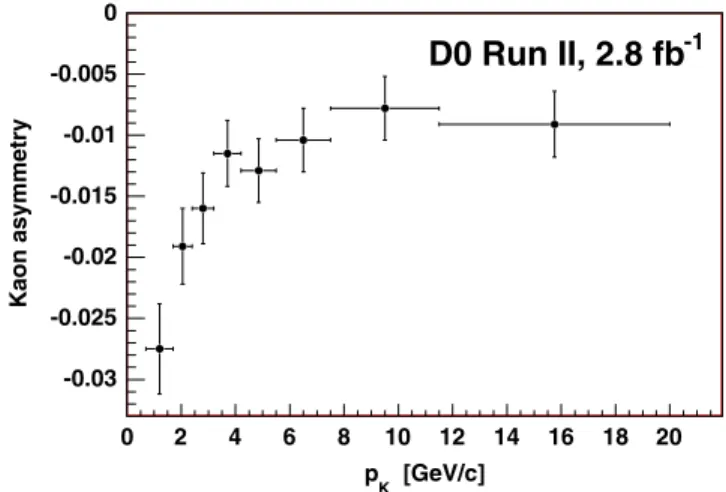
The detector charge asymmetries are disentangled from the kaon asymmetry using the same detector model of Eq. (1). To account for the momentum dependence of the kaon cross section [15], the kaon asymmetry is measured in different bins of kaon momentumpK, as shown in Fig.3. The obtained asymmetry is convoluted with the kaon mo-mentum distribution in the B!J= K decay giving the kaon asymmetry in the B!J= K decay AK 0:01450:0010. Finally, we obtain ACPB ! J= K AJ= K A
K 0:00750:0061stat. The systematic uncertainty of ACPB !J= K is
estimated as follows. The systematic uncertainty from the unbinned fit of the J= K invariant mass distribution is estimated by varying the parameters fixed during the fit in theqsubsamples by1, and is found to be 0.0002. The systematic uncertainty from the choice of the fitting
range is found to be 0.0004. The shape of the J= K
contribution to the likelihood function is parametrized using the Monte Carlo simulation, and therefore produces an uncertainty in the number of signal events. We repeat the fit with different models of J= K contribution,
in-cluding a model without any such contribution. The maxi-mal deviation in the resulting asymmetry is found to be 0.0025, which is taken as the systematic uncertainty from this source.
To measure the kaon asymmetry in the detector, we subtract the combinatorial background under theD peak
(see Fig.2, dashed line). To estimate the uncertainty from the background definition, we select the background from the events with the pion charge opposite to that of the muon and the kaon, and recalculate the kaon asymmetry. The resulting deviation inACPB !J= Kis 0.0008. Also,
the sample used to measure the kaon asymmetry contains a contribution ofD0 semileptonic decays without a charged kaon in the final state. They are taken into account assum-ing the same selection efficiency as the dominant D0! K decay. To find the impact of this assumption on the result, we repeat the measurement of the kaon asymmetry assuming a zero reconstruction efficiency for additionalD0 decay modes. The resulting deviation in ACPB! J= Kis 0.0005. To estimate the systematic uncertainty
from the choice of pK bins (see Fig. 3), we repeat the convolution with coarser binning. The resulting deviation in ACPB!J= Kis 0.0014. After adding all contri-butions in quadrature, the total systematic uncertainty on ACPB !J= Kis 0.0030, which is dominated by the
uncertainty from theJ= K modeling.
The systematic uncertainty of ACPB !J= is estimated similarly to that of ACPB!J= K. The
only sizable contributions are 0.01 from the variation of the fitting range and 0.02 from the J= K modeling. The
total systematic uncertainty is 0.03.
In conclusion, the directCP-violating asymmetry in the B!J= K decay is measured to be A
CPB ! J= K 0:0075 0:0061stat 0:0030syst,
which is consistent with other measurements [17–19], as well as with the world average, ACPB!J= K 0:0150:017[15], but has a factor of 2 improvement in precision, thus providing the most stringent bounds for new models predicting large values of ACPB! J= K. The directCP-violating asymmetry in theB!
J= decay is measured to be A
CPB!J= 0:090:08stat 0:03syst. Our result agrees with the previous measurements of this asymmetry [18,20] and has a competitive precision.
We thank the staffs at Fermilab and collaborating insti-tutions, and acknowledge support from the DOE and NSF (U.S.); CEA and CNRS/IN2P3 (France); FASI, Rosatom and RFBR (Russia); CNPq, FAPERJ, FAPESP and FUNDUNESP (Brazil); DAE and DST (India); Colciencias (Colombia); CONACyT (Mexico); KRF and
[GeV/c] K p
0 2 4 6 8 10 12 14 16 18 20
Kaon asymmetry
-0.03 -0.025 -0.02 -0.015 -0.01 -0.005 0
-1
D0 Run II, 2.8 fb
FIG. 3 (color online). Dependence of the kaon asymmetry,
AK NK NK =NK NK , on the kaon mo-mentum pK in eight bins of approximately equal statistics. Errors are statistical.
]
2
m [GeV/c ∆
0.12 0.13 0.14 0.15 0.16 0.17 0.18 0.19 0.2 0.21 0.22
]
2
entries/0.002 [GeV/c
0 10000 20000 30000 40000 50000 60000 70000 80000
-1
D0 Run II, 2.8 fb
K)<1.7 GeV/c
µ
1.6<m(
FIG. 2 (color online). The m distribution (solid line) for
1:6< mK<1:7 GeV=c2. The background distribution of
KOSEF (Korea); CONICET and UBACyT (Argentina); FOM (The Netherlands); STFC (United Kingdom); MSMT and GACR (Czech Republic); CRC Program, CFI, NSERC and WestGrid Project (Canada); BMBF and DFG (Germany); SFI (Ireland); The Swedish Research Council (Sweden); CAS and CNSF (China); and the Alexander von Humboldt Foundation.
*Visitor from: Augustana College, Sioux Falls, SD, USA. †Visitor from: The University of Liverpool, Liverpool, UK.
‡Visitor from: ICN-UNAM, Mexico City, Mexico.
x
Visitor from: II. Physikalisches Institut, Georg-August-University, Go¨ttingen, Germany.
kVisitor from: Helsinki Institute of Physics, Helsinki,
Finland.
{
Visitor from: Universita¨t Zu¨rich, Zu¨rich, Switzerland.
**Deceased.
[1] W.-S. Hou, M. Nagashima, and A. Soddu, arXiv:hep-ph/ 0605080.
[2] V. Barger, C.-W. Chiang, P. Langacker, and H.-S. Lee, Phys. Lett. B598, 218 (2004).
[3] G.-H. Wu and A. Soni, Phys. Rev. D62, 056005 (2000). [4] I. Dunietz, Phys. Lett. B316, 561 (1993).
[5] W.-S. Hou, arXiv:hep-ph/9905541.
[6] S. Fratinaet al.(Belle Collaboration), Phys. Rev. Lett.98, 221802 (2007).
[7] B. Aubertet al.(BABARCollaboration), Phys. Rev. Lett. 99, 071801 (2007).
[8] V. M. Abazov et al. (D0 Collaboration), Nucl. Instrum. Methods Phys. Res., Sect. A565, 463 (2006).
[9] V. M. Abazov et al. (D0 Collaboration), Nucl. Instrum. Methods Phys. Res., Sect. A552, 372 (2005).
[10] J. Abdallahet al.(DELPHI Collaboration), Eur. Phys. J. C 32, 185 (2004).
[11] G. Borisov, Nucl. Instrum. Methods Phys. Res., Sect. A 417, 384 (1998).
[12] V. Abazovet al.(D0 Collaboration), Phys. Rev. Lett.99, 172001 (2007).
[13] V. Abazov et al. (D0 Collaboration), Phys. Rev. D 74, 092001 (2006).
[14] V. Abazovet al.(D0 Collaboration), Phys. Rev. Lett.98, 151801 (2007).
[15] W.-M. Yaoet al.(Particle Data Group), J. Phys. G33, 1 (2006) ; and 2007 partial update for edition 2008 (http:// pdg.lbl.gov).
[16] A. Petrov, arXiv:hep-ph/0311371.
[17] B. Aubertet al.(BABARCollaboration), Phys. Rev. Lett. 94, 141801 (2005).
[18] K. Abe et al. (Belle Collaboration), Phys. Rev. D 67, 032003 (2003).
[19] G. Bonviciniet al.(CLEO Collaboration), Phys. Rev. Lett. 84, 5940 (2000).