EXPLORING STUDENT’S BLENDED LEARNING
THROUGH SOCIAL MEDIA
Leon Andretti Abdillah
Information System Department, Faculty of Computer Science, Bina Darma University, Jln. Ahmad Yani No.3, Plaju, Palembang, 30264
ABSTRACT
Information technology (IT) has been used widely in many aspects of our daily life. Social media as a leading application on the internet has changed many aspects of life become more globalized. This article discussed the use of social media to support learning activities for students in the faculty of computer science. The author used Facebook and WordPress as an alternative to electronic learning, those were: 1) online attendance tool, 2) media storage and dissemination of course materials, 3) and event scheduling for the lectures. Social media succeed to change the way of modern learning styles and environment. The results of this study are some learning activities such as (1) Preparation, (2) Weekly meeting activities, (3) Course Page, (4) Social Media as Online Attendance Tool, (5) Social Media as Learning Repository and Dissemination, and (6) Social Media as Online Event Scheduling. Change conventional learning model becomes visual and distanceless.
Keywords: student blended learning, social media, blog
INTRODUCTION
Social media (SM) offers many opportunities in various sectors. Especially in globalization era the requirement for the development of information technology (IT) makes the world of education must adopt and involve IT in the learning process (Abdillah, 2013). In the previous research, the author used e-learning software (Moodle) and blog (WordPress) for student learning environment.
There is some doubts whether or not Facebook can be used to support educational activities (Roblyer et al., 2010). A study has suggested that in the future there should be concerns about Facebook integration with education and teaching (Bicen & Cavus, 2011). In this research, the author expands the media for learning purposes by involving social media, Facebook. Because these internet sites attract billions of cyber users, especially young adults (SocialBakers, 2014).
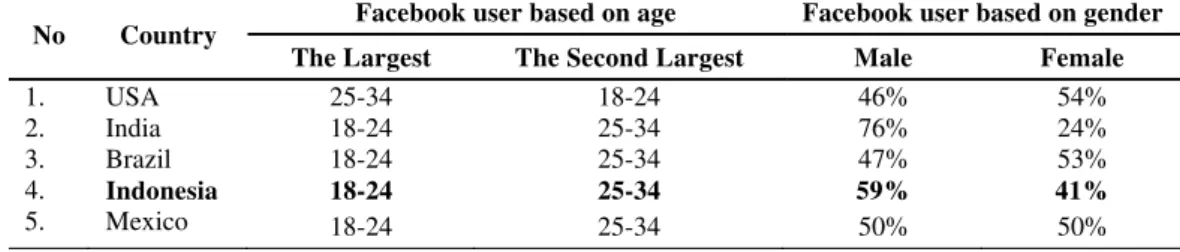
Table 1 Facebook User Distribution Based on SocialBakers
No Country Facebook user based on age Facebook user based on gender The Largest The Second Largest Male Female
1. USA 25-34 18-24 46% 54%
2. India 18-24 25-34 76% 24%
3. Brazil 18-24 25-34 47% 53%
4. Indonesia 18-24 25-34 59% 41%
The current condition of student learning behaviors is affected by the development of new social technology, such as social media. Based on Table 1, it is shown that the greatest number of Facebook users are young people aged between 18 to 24 years. This age range is an age when they are studying in college. Earlier observation that the author caught in a number of lectures showed the activity of social media Facebook usage while being in the classroom. See this condition; the authors are keen to develop the learning environment by involving social technologies that are popular in this decade.
The goal of this article is to manage student learning environment via social media.This article discusses the alternative media for blended e-learning strategy. The alternative media is using social media and blogs. This combination will create and support “always on” learning environment.
Based on the data collected and observations of the activities, the authors will discuss several strategies to conduct blended learning. Blended learning is the thoughtful integration of classroom face-to-face learning with online learning (Garrison & Kanuka, 2004). Those integrations could include the mix or combination of (1) modes of web-based technology, (2) various pedagogical approaches, (3) any form of instructional technology, and (4) instructional technology with actual job tasks to create a harmonious effect of learning and working (Driscoll, 2002). Today, organizations have a myriad of learning approaches and choices (Singh, 2003), see Table 2. The blended concept of learning is associated with: (1) thinking less about delivering instruction and more about producing learning, (2) reaching out to students through distance education technologies, and (3) promoting a strong sense of community among learners (Rovai & Jordan, 2004).
Table 2 Learning approaches and choices
Learning approaches Aproaches
Synchronous physical formats Instructor-led Classrooms & Lectures
Hands-on Labs & Workshops
Field Trips
Synchronous online formats
(live e-learning) Online Meetings Virtual Classrooms
Web Seminars and Broadcasts
Coaching
Instant Messaging
Conference Calls
Self-paced, asynchronous formats Documents & Web Pages
Web/Computer Based Training Modules
Assessments/Tests & Surveys
Simulations
Job Aids & Electronic Performance Support Systems (EPSS)
Recorded Live Events
Online Learning Communities and Discussion Forums
Distributed and Mobile Learning
The author will cluster the discussions into three groups, preparations, weekly activities meeting, classical meeting, and students participations via social media (Facebook) and blog (Wordpress).
college. There are 59% male users and 41% female users in Indonesia, compared to 46% and 54% in the USA, 76% and 24% in India, 47% and 53% in Brazil, and 50% and 50% in Mexico.
Social media like facebook and/or twitter become one of the most visited and used applications over the internet. They become one of the top internet application recently (Bi et al., 2014). The rapid development of online social networks has tremendously changed the way of people communicating with each other (Rahadi & Abdillah, 2013). They offer borderless environment for various activities. They change how people communicating each other, promoting their products (Baumgartner & Morris, 2010), becoming conventional communications venues for young adults (Abdillah, 2014), campaigning political parties (Abdillah, 2014; Bi et al., 2014; SocialBakers, 2014), disseminating knowledge and information (Abdillah, 2014), etc. This article will discuss the use of social media in managing online learning environment for higher education students in computer science field.
There is strong evidence that social media can facilitate the creation of Personal Learning Environment (PLE) (Dabbagh & Kitsantas, 2012) that helps learners to aggregate and share the results of learning achievements, participate in collective knowledge generation, and manage their meaning making. Several authors have found that the most efficient teaching model is a blended approach, which combines self-paced learning, live e-learning, and face-to-face classroom learning (Alonso, López, Manrique, & Viñes, 2005). By combining classical face-to-face meeting with online social media, learning process become placeless, borderless and timeless.
The combination of these schemes provides collaborative learning environment for students. Classical meetings are very important to get in touch directly with the students. Facebooking is the activity where the learning atmosphere involves cyber atmosphere for both lecturers and students. Lecturers are able to disseminate the knowledge (learning materials), assignments, online attendance to the students. On the other hand, students are also able to participate in learning scenario, downloading course materials, write their online presence in every meeting, submit their assignments, give comments, or discuss with their team.
Another technology used in this study is known as "social software." A blog, one of social software, is often involved in education domain (Kim, 2008). A study has summarized that students use blogs as an effective aid in teaching and learning (Williams & Jacobs, 2004). Because, blogs are easily published and accessed via the internet (Beldarrain, 2006), easy to use for everyone (Sanjaya & Pramsane, 2008), as practical tool for higher education (Al-Fadda & Al-Yahya, 2010), and last but not least allowing students to learn interactively and collaboratively (Schroeder et al., 2010). In this research, the author uses Wordpress as one of the most popular blogging tool or weblog software. WordPress is a free installation resource which has many useful plug-ins, comment spam-fighting features, and user-friendly interface (Hong, 2008), open-source and is relatively easy to use (Bean, 2014). WordPress is also very popular content management system that has been deployed in educational settings especially taking advantage of its potential with Multisite environments (Hoover, 2015). Lecturers use WordPress to publish course materials to students. Students create a blog post that a weekly question related to a main topic covered that week (Quesenberry et al., 2014).
METHODS
This research involves a total 100 students participated in the observations. The author made observations of student behavior in the classroom for some time previously. Furthermore, the authors explore a number of features on social media Facebook who could be involved in the learning process.
The subject is one specialization subject in computer science/information systems field, Knowledge Management Systems (KMS) (Abdillah, 2014). In KMS subject there is a subject of Knowledge Sharing. The author uses Social Media to apply knowledge sharing between lecturer and students, and student with their group study in the class. Knowledge sharing process (de Jorge Moreno, 2012) is the key to enhance the externalization and dissemination of knowledge.
Social media (Facebook), weblog application (Wordpress), mobile operating systems for Apple (iOS), blog application for iPhone (Wordpress for iPhone), and Facebook application for iPhone as the main software are used in the research. The author also involves cloud storage, Dropbox. Cloud storage services like Dropbox (Meske et al., 2014) allows users to store files remotely and to synchronize them with multiple devices. DropBox makes a class become a learning community working together simultaneously, in real-time, with or without face-to-face contact (Ries et al., 2012).
Lecturer combines severals conditions to conduct the blended learning involved class meeting, e-learning, and group presentations. The total general meeting is 14 (fourteen) meetings. Two of them are e-learning meetings; two meetings use for exams (9 and 14), one meeting for group presentations (13). Every class meeting will involve 31 – 55 students. During the semester, a subject consist of six main activities, namely: Daily Attendances, Daily Test (5), Mid Test (9), Weekly Reports (2-12), Presentation (13), and Final Test (14).
RESULTS AND DISCUSSIONS
In this section, Author explains how to set-up social media-based learning environments. The discussions are made in 6 sections as follows: (1) Preparation, (2) Weekly meeting activities, (3) Course Page, (4) Social Media as Online Attendance Tool, (5) Social Media as Learning Repository and Dissemination, and (6) Social Media as Online Event Scheduling.
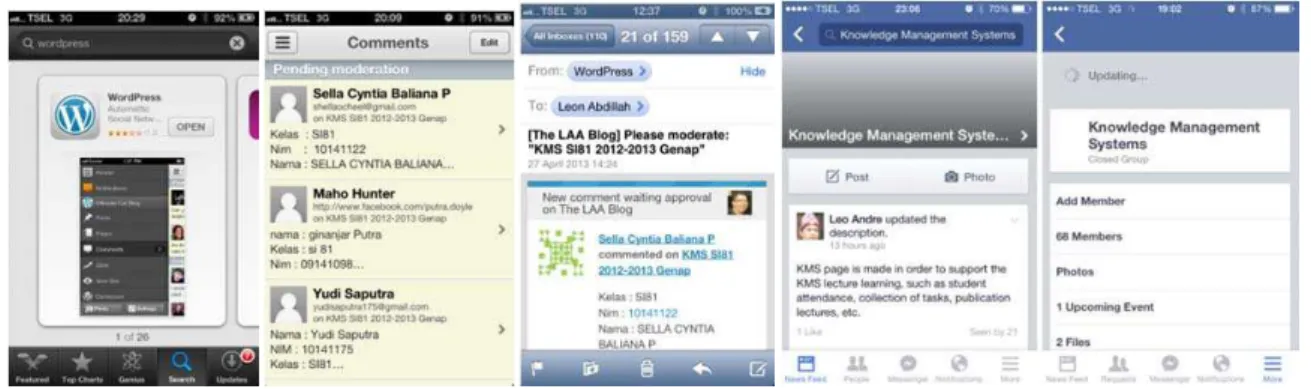
Figure 1 iOS App for Wordpress and Facebook
In the second stage for weekly activity, lecturer needs to manage the weekly schedule. In the first meeting, lecturer will normally introduce himself, materials of the course, Facebook and blog address. Lecturer also needs to explain course rules, review for the pre-requested subjects (optional), and introducing the current materials, grade scale systems, references. At the end of the first meeting, lecturer needs to set group study for the class. For small class, every group consists of 2 – 4 students. For medium class, every group consists of 4 – 6 students. For big class, every group consists of 6 – 8 students. After finishing setting up the group in the classroom, then the next step is to determine the topic of each group.
For the first month, learning activities will be dominantly classical face-to-face meeting. While giving the knowledge in the oral traditional class meeting, this activity also involves setting up group discussions in every class, asking students to create or activate or opening blog and Facebook accounts. Lecturer supplies course materials via blog and facebook. In the second month, lecturer no longer focuses on the classical meeting, instead of more active in Facebook facilities, such as
(1) online attendance, (2) checking submitted assignments, (3) chat with online participant students, (4) involve students activities by using blogs, among others. In the third month, the author starts using social media for students to prepare their presentation and assignments submissions, and also to publish the post related to their team project reports or works, as seen in Figure 2.
Figure 2 Facebook Page for the Course of Knowledge Management Systems
The author uses Facebook page to record students attendance in the class and for students who are not in the class. Facebook page provides a feature of "asked a question." The author uses this feature to share a question where the students need to reply in the comment box to write their class code, name, and student number. For students that both attend in the class and Facebook will get point 1, otherwise 0.5. To navigate the information related to the online attendance, the author informs the meeting, date, material theme, and notes. This strategy is very useful to engage students who can’t join the class physically, so they are still able to join the class and receive the course materials. Students in the class are excited to participate in cyber class. Figure 3 shows the example of some students who inform their attendance via social media group.
Figure 3 Online Attendance Check List
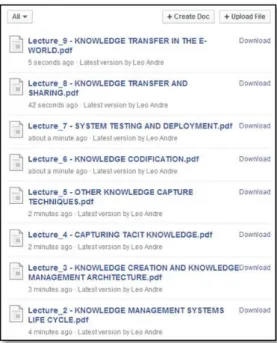
Figure 4 Uploaded or Stored Files for Knowledge Management Systems
In every semester, a course consists of some activities including (1) students' attendance, (2) daily questionnaires, (3) mid-semester exam, (4) teamwork students project presentation, (5) final semester exam, and others important announcements. Normally, at the beginning of the semester, there is tentative schedule for one semester. However, sometimes, the schedule could be changed. In order to accommodate this condition, the author uses social media to create events related to any announcements to the students. Once an event has been set, all of the participants will be notified. After the invitations have been sent to the participants, students as participants may respond to several conditions, such as: going, maybe, or invited (see figure 5).
Figure 5 Online Event Scheduling for Knowledge Management Systems
CONCLUSIONS
Based on the experiences and observations, the author suggests some schemes by using social media: (1) Social media as online attendance tool, (2) Social media as learning repository and dissemination, and (3) Social media as online event scheduling. Social media changes conventional learning model become visual and distanceless. Lecturers are able to disseminate course materials to learners (students), managing online attendance, explore the activities of each the participants such as assignment submissions, etc. In this article, the author also involves iPhone smartphone to monitor the student's activities on Facebook and blog.
For the next research, the author is still interested in working the online learning environment but with some extensions involving the benefits various of widgets and mobile devices. The next research involves more applications and enriches the learning strategy and environment. More features of distant learning with mobile based atmosphere are also to be considered for the next study. Last but
not least, the author is interested in integrating IT based education with psychology aspects.
REFERENCES
Abdillah, L. A. (2013). PDF Articles Metadata Harvester. Jurnal Komputer dan Informatika (JKI), 10(1), 1-7.
Abdillah, L. A. (2013). Students learning center strategy based on e-learning and blogs. Paper presented at the Seminar Nasional Sains dan Teknologi (SNST) ke-4 Tahun 2013, Fakultas Teknik Universitas Wahid Hasyim Semarang.
Abdillah, L. A. (2014). Indonesian's presidential social media campaigns. Paper presented at the Seminar Nasional Sistem Informasi Indonesia (SESINDO2014), ITS, Surabaya.
Abdillah, L. A. (2014). Knowledge Management Systems. Retrieved from http://blog.binadarma.ac.id/mleonaa/teaching/information-systems/knowledge-management-systems
Abdillah, L. A. (2014). Managing information and knowledge sharing cultures in higher educations institutions. Paper presented at the The 11th International Research Conference on Quality, Innovation, and Knowledge Management (QIK2014), The Trans Luxury Hotel, Bandung, Indonesia.
Abdillah, L. A. (2014). Social Media as Political Party Campaign in Indonesia. Jurnal Ilmiah MATRIK, 16(1), 1-10.
Al-Fadda, H., & Al-Yahya, M. (2010). Using Web Blogs as a Tool to Encourage Pre-Class Reading, Post-Class Reflections and Collaboration in Higher Education. Online Submission, 7(7), 100-106.
Alonso, F., López, G., Manrique, D., & Viñes, J. M. (2005). An Instructional Model for Web-based E-learning Education with a Blended Learning Process Approach. British Journal of Educational Technology, 36(2), 217-235. doi:10.1111/j.1467-8535.2005.00454.x
Bean, E. (2014). Creating WordPress Student Blogs Aligned with Common Core and Higher Ed Writing Standards. Retrieved from www.learntechlib.org/d/131203
Beldarrain, Y. (2006). Distance Education Trends: Integrating New Technologies to Foster Student Interaction and Collaboration. Distance Education, 27(2), 139-153.
Bi, J., Qin, Z., & Huang, J. (2014). Detecting Community and Topic Co-Evolution in Social Networks. TELKOMNIKA Indonesian Journal of Electrical Engineering, 12(5).
Bicen, H., & Cavus, N. (2011). Social network Sites Usage Habits of Undergraduate Students: Case Study of Facebook. Procedia-Social and Behavioral Sciences, 28, 943-947. doi: 10.1016/j.sbspro.2011.11.174
Dabbagh, N., & Kitsantas, A. (2012). Personal Learning Environments, social media, and self-regulated learning: A Natural Formula for Connecting Formal and Informal Learning. The Internet and Higher Education, 15(1), 3-8. doi: 10.1016/j.iheduc.2011.06.002
de Jorge Moreno, J. (2012). Using Social Network and Dropbox in Blended Learning: An Application to University Education. Business, Management and Education, 10(2), 220-231. doi: 10.3846/bme.2012.16
Driscoll, M. (2002). Blended Learning: Let’s Get Beyond the Hype. E-learning, 1(4), 1-4.
Garrison, D. R., & Kanuka, H. (2004). Blended learning: Uncovering its transformative potential in higher education. The Internet and Higher Education, 7(2), 95-105.
Hong, W. (2008). Exploring Educational Use of Blogs in US Education. Online Submission, 5(10), 34-38.
Hoover, C. (2015). Re-envisioning the Possibilities with WordPress: 4 Tips For Integrating Customizable Themes into the Classroom. Paper presented at the Society for Information Technology & Teacher Education International Conference.
Kim, H. N. (2008). The phenomenon of blogs and theoretical model of blog use in educational contexts. Computers & Education, 51(3), 1342-1352. doi: 10.1016/j.compedu.2007.12.005
Meske, C., Stieglitz, S., Vogl, R., Rudolph, D., & Öksüz, A. (2014). Cloud Storage Services in Higher Education–Results of a Preliminary Study in the Context of the Sync&Share-Project in Germany. Paper presented at the International Conference on Learning and Collaboration Technologies.
Quesenberry, K. A., Saewitz, D., & Kantrowitz, S. (2014). Blogging in the Classroom: Using WordPress Blogs with BuddyPress Plugin as a Learning Tool. Journal of Advertising Education, 18(2), 5.
Ries, T., Aliponga, J., & Kochiyama, M. (2012). < Articles> Dropbox: A Must for All Teachers?
近畿大学教養 外国語教育センタ 紀要. 外国語編= Kinki University Center for Liberal
Arts and Foreign Language Education Journal: Foreign Language Edition, 3(1), 209-216.
Roblyer, M. D., McDaniel, M., Webb, M., Herman, J., & Witty, J. V. (2010). Findings on Facebook in higher education: A comparison of college faculty and student uses and perceptions of social networking sites. The Internet and Higher Education, 13(3), 134-140. doi: 10.1016/j.iheduc.2010.03.002
Rovai, A. P., & Jordan, H. (2004). Blended learning and sense of community: A comparative analysis with traditional and fully online graduate courses. The International Review of Research in Open and Distributed Learning, 5(2).
Sanjaya, R., & Pramsane, S. (2008). Providing the E-Learning Services for the Blog. International Journal of the Computer, the Internet and Management (IJCIM),16(SP3), 29.1-29.5.
Schroeder, A., Minocha, S., & Schneider, C. (2010). The strengths, weaknesses, opportunities and threats of using social software in higher and further education teaching and learning.Journal of Computer Assisted Learning, 26(3), 159-174. doi: 10.1111/j.1365-2729.2010.00347.x
Singh, H. (2003). Building Effective Blended Learning Programs. Educational Technology, 43(6), 51-54.
SocialBakers. (2014). Facebook Statistics by Country. Retrieved in April 2014 from http://www.socialbakers.com/facebook-statistics/