Submitted15 November 2012
Accepted 11 January 2013
Published12 February 2013
Corresponding author Jose M. Palomo, [email protected]
Academic editor Luciana Leite
Additional Information and Declarations can be found on page 15
DOI10.7717/peerj.27
Copyright 2013 Romero et al.
Distributed under
Creative Commons CC-BY 3.0
OPEN ACCESS
Novel enzyme-polymer conjugates for
biotechnological applications
Oscar Romero, Cintia W. Rivero1, Jose M. Guisan and Jose M. Palomo
Departamento de Biocat´alisis, Instituto de Cat´alisis (CSIC), Spain
1Current address: Laboratorio de Investigaciones en Biotecnolog´ıa Sustentable (LIBioS),
Universidad Nacional de Quilmes, Argentina
ABSTRACT
In the present research, a rapid, simple and efficient chemoselective method for the site-directed incorporation of tailor-made polymers into protein to create biocatalysts with excellent properties for pharmaceutical industrial purpose has been performed. First we focused on the protein engineering of theGeobacillus thermocatenulatuslipase 2 (BTL2) to replace the two cysteines (Cys65, Cys296) in the wild type enzyme (BTL-WT) by two serines. Then, by similar mode, a unique cysteine was introduced in the lid area of the protein. For the site-directed polymer incorporation, a set of different tailor-made thiol-ionic-polymers were synthesized and the protein cysteine was previously activated with 2,2-dithiodipyridine (2-PDS) to allow the disulfide exchange. The protected BTL variants were specifically modified with the different polymers in excellent yields, creating a small library of new biocatalysts. Different and important changes in the catalytic properties, possible caused by structural changes in the lid region, were observed. The different modified biocatalysts were tested in the synthesis of intermediates of antiviral and antitumor drugs, like nucleoside analogues and derivatives of phenylglutaric acid. In the hydrolysis of per-acetylated thymidine, the best biocatalyst was the BTL*-193-DextCOOH , where the activity was increased in 3-fold and the regioselectivity was improved, reaching a yield of 92% of 3’-O-acetyl-thymidine. In the case of the asymmetric hydrolysis of dimethyl phenylglutarate, the best result was found with BTL*-193-DextNH2-6000, where the enzyme activity was increased more than 5-fold and the enantiomeric excess was>99%.
Subjects Biochemistry, Bioengineering, Biotechnology, Molecular Biology
Keywords Mutagenesis, Lipase, Tailor-made polymer, Chemical modification, Biotransformations, Drugs precursors, Biocatalyst, Nucleosides, Protein chemistry
1. INTRODUCTION
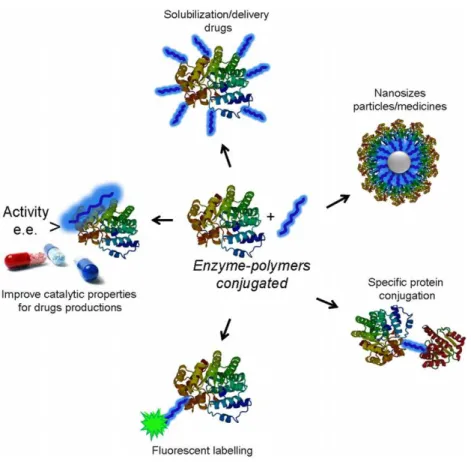
Figure 1 General scheme of the different applications of the site-directed modification of enzymes by tailor-made polymers.
A variety of available methods for protein modification has been reported (Hermanson, 2008). However, modification of the nucleophilic thiol of a unique cysteine is a convenient and widely employed strategy to obtain a site-selective bioconjugation (Chalker et al., 2009). A unique cysteine can be easily introduced at virtually any position within a protein structure by site-directed mutagenesis and then selectively modified using disulfide compounds, for example (Romero et al., 2012).
The lipases are currently the most used enzyme in biocatalysis and organic chem-istry (Drauz, Groger & May, 2012). In particular, the use of lipase to catalyze the asymmet-ric reactions has attracted great interest, due to them being able to accept a broad range of substrates with good activities, regio- and enantioselectivity (Faber, 2011). Moreover, in some cases, these good properties of lipases are insufficient, being the incorporation of polymers a useful and single alternative to improve them (Gutarra et al., 2011).
Figure 2 Biotransformations used in this work for synthesis of drug precursors. (A) Regioselective monodeprotection of per-O-acetylated thymidine; (B) Desymmetrization of dimethylphenylglutarate.
which implies a more complex catalytic mechanism (Carrasco-L´opez et al., 2009). Taking advantage of this tricky lid, the idea was to introduce a unique cysteine at different positions of the lid and modify with thiolated-ionic polymers afterwards. Using different mono-cysteine mutants and different polymers we have created a small library of different polymers-protein conjugates.
This small library of biocatalysts was tested in two biotransformations: regiose-lective deprotection of per-O-acetylated thymidine (1) and the desymmetrization of dimethylphenylglutaric acid diester (2). These are two important biotransformations with fascinating biotechnology application. For example, nucleoside analogues have attracted intense interest in medicine, where they are used as antitumor and antiviral agents (Galmarini, Mackey & Dumontet, 2002;Herdewijn, 2008). In the past 25 years, several nucleoside analog reverse-transcriptase inhibitors have been licensed and used in treatment of HIV/AIDS, for example Zidovudine (Est´e & Cihlar, 2010) (Fig. 2). In the case of the enzymatic asymmetric hydrolysis of prochiral compounds this is a simple and effective route for the production of chiral compounds (Garc´ıa-Urdiales, Alfonso & Gotor, 2005), such as the diesters of phenylglutaric acid (Cabrera & Palomo, 2011). There are a high number of pharmaceutically important compounds containing a 3-arylglutaric building block, as (-)-paroxetine, (R)-baclofen, etc. (Fig. 2).
2. MATERIALS AND METHODS
2.1. Materials
SepharoseR 4BCL activated with cyanogen bromide (CNBr) were from GE Healthcare
(Uppsala, Sweden). Dextran (Mr 1500, 6000), polyethyleneimine (PEI) (Mr 1500 kDa), 2-dipyridyldisulfide (2-PDS), diethyl-p-nitrophenylphosphate (D-pNP), dithiothreitol (DTT), L-aspartic acid, sodium borohydride, TritonR X-100, dimethylsulfoxide (DMSO),
thymidine, Dimethyl 3- phenylglutarate (2), p-nitrophenylbutyrate (pNPB) (3) and
N-Succinimidyl-S-acetylthioacetate were from Sigma. Dextran-aldehyde, aspartic-dextran and amines-dextran prepared as previously described (Fuentes et al., 2004;Guis´an et al., 1997). 3’,5’-di-O-acetylthymidine (1) was synthetized as previously described (Bavaro et al., 2009). Other reagents and solvents used were of analytical or HPLC grade.
2.2. Site-directed mutagenesis of BTL
B. thermocatenulatuslipase (Genkbank number X95309) mutants were prepared as pre-viously described (Romero et al., 2012). Briefly, all site-directed mutagenesis experiments were carried out by PCR using mutagenic primers (See ESI,Table S1). To introduce the amino acid change, the corresponding pair of primers was used as homologous primer pair in a PCR reaction using a specific plasmid as a template and Prime Start HS Takara DNA polymerase. The product of the PCR was digested with endonuclease DpnI that exclusively restricts methylated DNA (Schmidt-Dannert et al., 1996)E. coliDH10B cells were transformed directly with the digested product. The plasmid with mutated BTL were identified by sequencing and then transformed intoE. coliBL21 (DE3) cells to express the corresponding proteins. Firstly, C65S was created, and the resulting plasmid was used as a template to create the double mutant C65S/C296S-BTL. This plasmid was used as a template to construct additional mutations (A193C, L230C) using different mutagenic primer (Romero et al., 2012).
2.3. Cloning, expression, purification and immobilization of BTL variants
The gene corresponding to the mature lipase fromG. thermocatenulatusBTL was cloned into pT1 expression vector, as previously described (Schmidt-Dannert et al., 1996). Cells carrying the recombinant plasmid pT1BTL2 were grown at 30◦C and over expression
were induced by raising the temperature to 42◦C for 20 h. The enzyme was purified from E. colicrude extract by interfacial adsorption on Octyl-Sepharose as previously described (Fernandez-Lorente et al., 2008). The lipase was desorbed from the support adding 20 mL of 25 mM phosphate buffer pH 7 with 0.5% Triton X-100 (v/v) per gram of support. After that, the lipase was immobilized on CNBr-activated Sepharose at pH 7 in 25 mM sodium phosphate buffer for 1 h at 25◦C (>95% immobilization yields) with a final loading of 5 mglip/gcat.
2.4. Enzymatic hydrolysis of pNPB
Figure 3 Synthesis of tailor-made thiol-dextran polymers.
2.5. Preparation of different thiol-polymers
2.5.1. Preparation of thiol-aspartic-dextran (DextCOOH)
To a 100 mL of dextran-aspartic polymer solution (10 mg/mL) Mw. 1.500 in 5 mM sodium acetate buffer at pH 5.0 were added 16 and 9.6 mg (0.125 eq) of EDC and NHS, respectively. Similar to before, to a 100 mL of dextran-aspartic polymer solution (10 mg/mL) Mw. 6000 in 5 mM sodium acetate buffer at pH 5.0 were added 1.0 and 0.6 mg (0.0313 eq) of EDC and NHS, respectively. For both polymers, the reaction was maintained for 2 h at 25◦C. After that the mixture was then dialyzed 3 times against distilled water
(300 volumes). Then, the pH of polymer solution was set at 7.5 in 5 mM sodium phosphate buffer pH 7.5. Subsequently, 420µL (0.0625 eq) or 26µL (0.0156 eq) of a 100 mM cysteine solution were added to polymers of Mw 1.500 and 6.000, respectively. The reaction was maintained for 2 h at 25◦C and finally the mixture was extensively dialyzed (SeeFig. 3).
2.5.2. Preparation of thiol-amine-dextran (DextNH2)
To 100 mL of amine-dextran polymer solution (10 mg/mL), Mw 1.500 or 6.000, in 5 mM sodium phosphate buffer at pH 7.5 was added 420µL (0.0625 eq) or 26 (0.0156 eq)µL of a solution 100 mM in acetonitrile ofN-Succinimidyl-S-acetylthioacetate, respectively. The reaction was maintained for 2 h at 25◦C and finally the mixture was extensively dialyzed. Finally, a solution of 100 mM hydroxylamine chloride in 10 mM sodium acetate buffer pH 5.5 was added to the polymers for 30 min for deacetylation (seeFig. 3).
2.6. Protection of thiol in BTL variants by 2-PDS
Then 0.2 g of reduced BTL variants was added to 3 mL of 2-PDS solution (1.5 mM substrate in a mixture of DMSO (5%, v/v) in 25 mM phosphate buffer at pH 8.0) for 1 h. The cysteine PDS activation was followed spectrophotometrically by measuring the increase of the absorbance at 343 nm (by the release of 2-mercaptopyridine, which quickly tautomerizes into 2-thiopyridone) of the solution. A full modification was found in all BTL variants (Godoy et al., 2010).
2.7. Chemical incorporation of tailor-made polymers on different BTL variants
0.7 mL of respective polymer solution was dissolved in 2.3 mL of 500 mM sodium phosphate buffer with 0.5% Triton-X100 at pH 8. Then, 0.2 g of immobilized PDS-BTL variants was added. After 1 h, the modification was confirmed spectrophotometrically by measuring the increase of the absorbance at 343 nm. The biocatalyst was filtered.
2.8. Enzymatic hydrolysis of different substrates 2.8.1. Enzymatic hydrolysis of 3’,5’-di-O-acetylthymidine (1)
Substrate1(5 mM) was dissolved in a mixture of acetonitrile (5%, v/v) in 10 mM sodium phosphate at pH 7.0 or 10 mM sodium acetate at pH 5.0. 0.2 g of biocatalyst was added to 2 mL of this solution at 25◦C. During the reaction, the temperature and
the pH value was maintained constant using a pH-stat Mettler Toledo DL50 graphic. The degree of hydrolysis was analyzed by reverse phase HPLC (Spectra Physic SP 100 coupled with an UV detector Spectra Physic SP 8450). For these assays a Kromasil C18 5µmφ (25 cm×0.4 cm)column was used and the following gradient program (A: mixture of acetonitrile (10%, v/v) in 10 mM ammonium phosphate at pH 4.2; B: mixture of miliQ water (10%, v/v) in acetonitrile; method: 0–6 min 100% A, 6–14 min 85% A–15% B, 14–22 min 100% A, flow: 1.0 mL min−1). UV detection was performed at 260 nm. The unit of enzymatic activity was defined as micromoles of substrate hydrolyzed per minute per mg of immobilized protein. The monodeprotected 5-OH (4) and 3-OH (5) were used as pure standards. The retention time was 2.4 min for Thymidine, 9.4 min for5
and 10.2 min4and 19 min for1.
2.8.2. Enzymatic hydrolysis of dimethyl-3-phenylglutarate (2)
Determination of enantiomeric excess
The enantiomeric excess (ee) of the released monoester6was analyzed by chiral reverse phase HPLC. The column was a Chiracel OD-R, and the mobile phase was an isocratic mixture of acetonitrile (20%, v/v) in 10 mM ammonium phosphate at pH 3. The detection of the compounds was performed at 210 nm. The retention time was 58.7 min for(R)-6
and 63.2 min for(S)-6.
2.9. Irreversible inactivation of BTL immobilized preparations by diethyl-p-nitrophenylphosphate (D-pNP)
0.2 g of different BTL immobilized preparations were suspended in 4 mL of 25 mM sodium phosphate buffer solution at pH 7 and 25◦C with or without the presence of 0.5% of Triton
X-100. Then, 1.5 mM of inhibitor (D-pNP) was added to this solution. The reaction was maintained until the activity – measured using pNPB assay – of the immobilized enzyme was zero.
3. RESULTS AND DISCUSSION
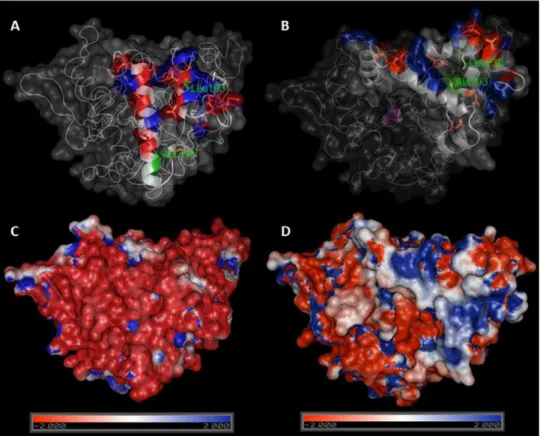
3.1. Mutagenesis, purification and immobilization of BTL variants Lipase BTL has the particularity that its open configuration involves a large structural rearrangement, and the concerted movements of a tricky lid formed by two different loops. We therefore set out to create semisynthetic BTL variants with only one cysteine located at lid zone. Based on a bioinformatics study using the crystallographic open conformation of the enzyme (Carrasco-L´opez et al., 2009) and the charged amino acid distribution in the lid (Baker et al., 2001), two different positions were selected to be mutated: Ala193 (in the internal loop) and Leu230 (in the external loop), seeFig. 4.
First, focused on the protein engineering of this lipase, the two cysteines (Cys65, Cys296) in the wild type enzyme (BTL-WT) were replaced by two serines. The new-engineered enzyme (BTL-C65S/C296S: BTL*) was expressed inE. coliwithout detriment to the enzyme activity. Therefore, using BTL C65S/C296S as template, residues Ala193 and Leu230 were replaced by cysteine residues by directed mutagenesis to create the two single cysteine variants: BTL*-A193C and BTL*-L230C. Both variants were expressed inE. coli with a good production similar than BTL-WT and BTL*.
All BTL variants were efficiently purified by hydrophobic chromatography ( Fernandez-Lorente et al., 2008) and immobilized on CNBr-activated Sepharose (>95% immobiliza-tion yields) with a final loading of 5 mglip/gcat.
3.2. Site-directed polymers incorporations
Figure 4 Comparison between crystal structures of BTL in closed (A) and open (B) conformation. Ala193 and Leu230 are marked in green, charged aminoacids in lid zone are highlighted in red (negative) and blue (positive). Electrostatic potential surface representations of crystal structures of BTL in closed (C) and open (D) conformation. Figure was drawn using Pymol 0.99 program and pdb codes: 1KU0 (closed) and 2W22 (open). Electrostatic potential surface was calculated using APBS software.
Finally, the different protected BTL variants were specifically modified with a set of tailor-made thiolated-ionic-polymers. The incorporation of the thiolated-ionic-polymer was followed spectrophotometrically by the release of 2-thiopyridone (as in the previous step) (Fig. 5). After 1 h of incubation, a quantitative yield of modification was achieved in all cases.
The BTL* (variant without cysteines) was subjected to a similar treatment in order to confirm that the chemical modification only involved the thiol group. This mutated BTL could not be modified at all by any of these polymers (data not shown).
3.3. Effect of the chemical modification on activity and hyperacti-vation
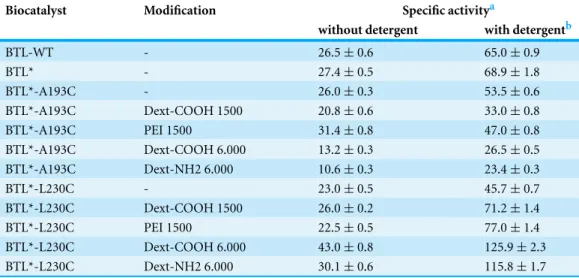
The effect of the modification of immobilized BTL* variants using different polymers (different sort and sizes) on the specific activity towardsp-nitrophenyl butyrate (3) is shown inTable 1.
Figure 5 Preparation of site-directed chemical modified BTL catalysts.
Table 1 Activity of the modified biocatalysts in the hydrolysis of pNPB in the absence or in the presence of detergent.
Biocatalyst Modification Specific activitya
without detergent with detergentb
BTL-WT - 26.5±0.6 65.0±0.9
BTL* - 27.4±0.5 68.9±1.8
BTL*-A193C - 26.0±0.3 53.5±0.6
BTL*-A193C Dext-COOH 1500 20.8±0.6 33.0±0.8
BTL*-A193C PEI 1500 31.4±0.8 47.0±0.8
BTL*-A193C Dext-COOH 6.000 13.2±0.3 26.5±0.5
BTL*-A193C Dext-NH2 6.000 10.6±0.3 23.4±0.3
BTL*-L230C - 23.0±0.5 45.7±0.7
BTL*-L230C Dext-COOH 1500 26.0±0.2 71.2±1.4
BTL*-L230C PEI 1500 22.5±0.5 77.0±1.4
BTL*-L230C Dext-COOH 6.000 43.0±0.8 125.9±2.3
BTL*-L230C Dext-NH2 6.000 30.1±0.6 115.8±1.7
Notes.
aSpecific activity was defined as:
µmol min−1mgprot. bActivity assay in present of 0.5% (w/v) of Triton-X100.
on the specific activity (up to 118%). The enzyme modification with others polymers decreased considerably the activity (from 78% to 40%).
The modification of the BTL variants with Dext-COOH 20000 greatly decreased the specific activity of the lipase in all cases (data not shown), this might be caused by steric hindrances with the incorporation of a “big size” polymer.
In order to investigate the effect of the polymer incorporation on the interfacial activation of the lipase, the specific activity in the hydrolysis of3was measured in the presence of 0.5% triton-X100 (v/v) (Table 1). As previously reported (Godoy et al., 2011), BTL-WT and BTL* are hyperactivated around 2.5 fold in presence of triton-X100, due to the stabilization of the open form of lipase molecule. Both mono-cysteine variants presented a similar hyperactivation (2 fold).
The hyper-activation showed by the polymer-modified BTL*-A193C variant was similar or even lower than non-modified enzyme. However, this site-directed chemical modification of the BTL*-L230C lipase variant caused a higher hyperactivation of the enzyme in the presence of detergent. In particular, BTL*-L230C-DextNH26000 showed the highest hyperactivation (approx. 4-fold) (Table 1).
These results show, activity and hyperactivation, that the specific incorporation of ionic polymers on the lid area alter the natural closed-open lid movement and maybe this effect is caused by steric hindrances, or the generation of a different lid conformational restructuration.
3.4. Effect of the chemical modification on the irreversible inhibi-tion with D-pNP
In order to evaluate the effect of the polymer incorporation of the lipase surface on the enzyme catalytic mechanism, the irreversible inhibition of the enzyme by using diethyl-p-nitrophenylphosphate (D-pNP) was studied. A faster decrease on the specific activity of the enzyme variants was observed after the chemical incorporation of the polymers (Fig. 6).
In the case of the BTL*-A193C variant, after 10 min, this mutated enzyme preserved 57% of the initial activity while BTL*-A193C-DextNH26000 maintained only 29% of activity. When the inhibition was performance in the presence of 0.5% Triton (condition where the conformational equilibrium of the lipase is displaced to the open form), BTL*-A193C conserved the 22% of activity at the same time (Fig. 6A). For the variant BTL*-L230C similar results were observed (Fig. 6B). This result might involve that a more open conformation structure of the lipase was favored in both cases after the polymer modification. Moreover, the size of the polymer also had influence on the final protein structure. The lipase modification with higher molecular size (6000 kDa) polymers caused a faster inhibition than the smaller ones (1500 kDa).
Figure 6 Irreversible inhibition of different biocatalysts using D-pNP.
3.5. Biotechnological applications of BTL modified variants
The biotechnological potential of these semisynthetic enzymes has been analyzed in two interesting biotransformations: the regioselective deprotection of per-O-acetylated thymidine (1) and the desymmetrization of dimethylphenylglutaric acid diester (2).
First, the BTL variants were tested in the hydrolysis of1at pH 7.0 (Table 2). Both mutated variants (BTL*-A193C and BTL*-L230C) showed a slight increase on activity and regioslectivity than the BTL-WT and BTL* toward the production of 3’-O-acetylthymidine (4). The incorporation of DextCOOH-6000 andDextNH2-6000 in the BTL*-A193C increased the lipase activity in 2.5 and 3 fold, respectively. Furthermore, the BTL*-A193C modified withDextNH26000 exhibited a significant increase in the regioselectivity, reaching a yield of 89% of (4). However, the modification at the mutated Cys230 did not produce better results, in both activity and regioselectivity. The BTL*-L230C-DextCOOH-6000 variant showed a decrease in activity in more than 3.5 fold and BTL*-L230C-DextNH2-1500 exhibited the lowest regioselectivity value (37% of4).
Table 2 Regioselective deprotection of 3,5-diacetylated thymidine with different biocatalysts at pH 7.0.
Biocatalyst Modification Activitya Time Yieldb
(h) 4 (%) 5 (%) Bc(%)
BTL-WT - 0.55±0.008 80 59 8 33
BTL* - 0.65±0.007 70 51 5 44
BTL*-A193C - 0.64±0.008 93 79 8 13
BTL*-A193C Dext-COOH 1.500 0.59±0.008 93 75 7 18
BTL*-A193C Dext-NH21.500 0.66±0.011 93 78 6 16
BTL*-A193C Dext-COOH 6.000 1.38±0.019 93 72 3 25
BTL*-A193C Dext-NH2 6.000 1.64±0.015 93 89 2 9
BTL*-L230C - 0.77±0.008 57 62 13 25
BTL*-L230C Dext-COOH 1.500 0.70±0.008 48 72 10 18
BTL*-L230C Dext-NH21.500 0.49±0.007 72 37 16 47
BTL*-L230C Dext-COOH 6.000 0.15±0.003 144 52 23 25
BTL*-L230C Dext-NH2 6.000 0.26±0.003 132 76 15 9
Notes.
aSpecific activity was defined as:
µmol min−1g×10−5. bYield of the corresponding product at 100% conversion. cB: Bihydrolyzed product (thymidine).
Table 3 Regioselective deprotection of 3,5-diacetylated thymidine with different biocatalysts at pH 5.0.
Biocatalyst Modification Activitya Time Yieldb
(h) 4 (%) 5 (%) Bc(%)
BTL-WT - 0.37±0.004 96 65 6 29
BTL* - 0.43±0.006 80 70 4 26
BTL*-A193C - 0.77±0.010 72 91 3 6
BTL*-A193C Dext-COOH 1.500 0.86±0.010 72 89 4 7
BTL*-A193C Dext-NH21.500 0.80±0.009 72 90 3 7
BTL*-A193C Dext-COOH 6.000 1.04±0.014 58 92 3 5
BTL*-A193C Dext-NH2 6.000 0.85±0.010 72 92 4 4
BTL*-L230C - 0.55±0.006 69 67 8 25
BTL*-L230C Dext-COOH 1500 1.78±0.007 55 84 5 11
BTL*-L230C Dext-NH21.500 2.32±0.009 55 80 5 15
BTL*-L230C Dext-COOH 6.000 0.07±0.001 216 74 19 7
BTL*-L230C Dext-NH2 6.000 0.11±0.002 264 76 16 8
Notes.
aSpecific activity was defined as:
µmol min−1g×10−5. bYield of the corresponding product at 100% conversion. cB: Bihydrolyzed product (thymidine).
Table 4 Asymmetric hydrolysis of dimethyl 3-phenylglutarate with different biocatalysts at pH 7.0.
Biocatalyst Modification Activitya Time Conversion Yieldb e.ec
(h) (%) (%) (%)
BTL-WT 8.48±0.10 196 48 42 68
BTL* 7.61±0.16 196 28 23 64
BTL*-A193C - 0.53±0.01 186 23 15 78
BTL*-A193C Dext-COOH 1500 0.48±0.01 186 12 1 n.dd
BTL*-A193C Dext-NH21.500 0.59±0.01 186 26 17 87
BTL*-A193C Dext-COOH 6.000 1.86±0.05 96 43 18 60
BTL*-A193C Dext-NH2 6.000 2.76±0.02 96 64 20 >99
BTL*-L230C - 11.33±0.12 96 65 38 93
BTL*-L230C Dext-COOH 1500 3.41±0.06 72 49 16 93
BTL*-L230C Dext-NH21.500 1.98±0.03 63 29 10 94
BTL*-L230C Dext-COOH 6.000 1.43±0.02 96 33 17 57
BTL*-L230C Dext-NH2 6.000 0.99±0.01 96 23 18 92
Notes.
aSpecific activity was defined as:
µmol min−1mgprot×10−3. bYield of monoester6.
cDetermined by HPLC.
dNot determined.
The BTL*-A193C variant exhibited the higher regioselectivity value at pH 5.0, with 91% yield of4. The modification with DextCOOH-6000 increased the activity in nearly 35% without decreasing in the regioselectivity (for time reaction course seeFig. S1).
The desymmetrization of dimethyl phenylglutaric acid diester (2) at pH 7.0 and 5.0 was studied after. The two monocysteine-BTL* variants showed higher enantiomeric excess than BTL-WT and BTL* (Tables 4and5).
In the hydrolysis of2at pH 7, the activity of BTL*-A193C decreased considerably compared with BTL-WT (more than 17 fold) (Table 4). The incorporation of tailor-made polymers improved the activity and the enantioselectivity. When the BTL*-A193C variant was modified with DextCOOH2-6000 the activity increased 3.5 fold. The modification withDextNH2-1500 gave a higher enantiomer excess (87%). Moreover, the best result was found after the chemical modification withDextNH2-6000. The initial enzymatic activity increased more than 5 fold after this modification and this variant catalyzed the hydrolytic reaction with excellent enantiomeric excess (>99%) (for time reaction course seeFig. S2).
Table 5 Asymmetric hydrolysis of dimethyl 3-phenylglutarate with different biocatalysts at pH 5.0.
Biocatalyst Modification Activitya Time Conversion Yieldb e.ec
(h) (%) (%) (%)
BTL-WT - 6.77±0.14 196 32 29 72
BTL* - 4.88±0.10 196 23 21 82
BTL*-A193C - 2.74±0.05 48 32 26 82
BTL*-A193C Dext-COOH 1.500 2.22±0.02 48 26 26 45
BTL*-A193C Dext-NH21.500 2.88±0.05 48 33 25 75
BTL*-A193C Dext-COOH 6.000 0.74±0.01 96 17 7 87
BTL*-A193C Dext-NH2 6.000 0.81±0.01 96 19 13 96
BTL*-L230C - 13.49±0.14 96 62 12 96
BTL*-L230C Dext-COOH 1.500 5.47±0.09 72 85 67 94
BTL*-L230C Dext-NH21.500 6.20±0.09 146 36 27 96
BTL*-L230C Dext-COOH 6.000 0.37±0.01 192 18 8 79
BTL*-L230C Dext-NH2 6.000 0.30±0.01 192 14 8 77
Notes.
aSpecific activity was defined as:
µmol min−1g×10−3. bYield of monoester6.
cDetermined by HPLC.
4. CONCLUSION
Site-directed incorporation of tailor-made ionic-polymers on the lid-site of two different cysteine-BTL variants -based on a fast thiol-disulfide exchange ligation- was successfully performed. Using different polymers (different sort and sizes), a small library of new biocatalysts was created. This generated biocatalysts showed different and important changes in the catalytic properties, possibly caused by structural changes in the lid region.
The modification of an enzyme variant with specific polymers have permitted the obtainment of biocatalysts with enhanced activity towards non-natural substrates and even excellent enantio- and regioselectivities in the production of two important intermediates in the synthesis of enantiomerically pure drugs. This strategy therefore represents a very rapid, simple and efficient methodology to create biocatalysts with excellent properties for pharmaceutical industrial purpose.
Abbreviations
BTL Geobacillus Thermocatenulatuslipase
CNBr SepharoseR 4BCL activated with cyanogen bromide
D-pNP diethyl-p-nitrophenylphosphate
DTT dithiothreitol
EDC 1-ethyl-3-(3-dimethylaminopropyl)-carbodiimide
NHS N-hydroxysuccinimide
EDA ethylenediamine
2-PDS 2,2’-dipyridyldisulfide
BTL-WT BTL lipase wild type
BTL*-193 BTL-C65S/C296S/A193C lipase mutant
BTL*-230 BTL-C65S/C296S/L2293C lipase mutant
Dext-COOH 1500 thiol-aspartic-dextran polymers Mw 1500
Dext-COOH 6000 thiol-aspartic-dextran polymers Mw 6000
Dext-NH21500 thiol-amine-dextran polymers Mw 1500
Dext-NH26000 thiol-amine-dextran polymers Mw 6000
ACKNOWLEDGEMENTS
Authors thank to Dr. de las Rivas (ICTAN-CSIC, Madrid) for its collaboration in providing the different BTL variants. I would like to express my sincere gratitude to Tanya Shew for the English proofreading of this manuscript.
ADDITIONAL INFORMATION AND DECLARATIONS
Funding
This work has been sponsored by the Spanish National Research Council (CSIC). O Romero is grateful to CONICYT (Programa Bicentenario Becas-Chile) for financial support. The funders had no role in study design, data collection and analysis, decision to publish, or preparation of the manuscript.
Grant Disclosures
The following grant information was disclosed by the authors: Spanish National Research Council (CSIC).
CONICYT (Programa Bicentenario Becas-Chile).
Competing Interests
Jose Palomo is an Academic Editor for PeerJ. There are no other Competing Interests.
Author Contributions
• Oscar Romero performed the experiments, analyzed the data, wrote the paper.
• Cintia W. Rivero performed the experiments, analyzed the data.
• Jose M. Guisan analyzed the data.
• Jose M. Palomo conceived and designed the experiments, analyzed the data, wrote the paper.
Supplemental Information
Supplemental information for this article can be found online athttp://dx.doi.org/ 10.7717/peerj.27.
REFERENCES
Bavaro T, Rocchietti S, Ubiali D, Filice M, Terreni M, Pregnolato M. 2009. A versatile synthesis of 5’-functionalized nucleosides through regioselective enzymatic hydrolysis of their peracetylated precursors.European Journal of Organic Chemistry2009:1967–1975 DOI./ejoc..
Cabrera Z, Palomo JM. 2011. Enantioselective desymmetrization of prochiral diesters catalyzed by immobilized Rhizopus oryzae lipase.Tetrahedron Asymmetry22:2080–2084 DOI./j.tetasy....
Carrasco-L ´opez C, Godoy C, de las Rivas B, Fern´andez-Lorente G, Palomo JM, Guis´an JM, Fern´andez-Lafuente R, Mart´ınez-Ripoll M, Hermoso JA. 2009.Activation of bacterial thermo alkalophilic lipases is spurred by dramatic structural rearrangements.Journal of Biological Chemistry284:4365–4372DOI./jbc.M.
Chalker JM, Bernardes GJL, Lin YA, Davis BG. 2009.Chemical modification of proteins at cysteine: opportunities in chemistry and biology.Chemistry – An Asian Journal4:630–640 DOI./asia..
D´ıaz-Rodr´ıguez A, Davis BG. 2011.Chemical modification in the creation of novel biocatalysts. Current Opinion in Chemical Biology15:211–219DOI./j.cbpa....
Drauz K, Gr¨oger H, May O. 2012.Enzyme catalysis in organic synthesis. New York: Wiley-VCH.
Est´e JA, Cihlar T. 2010.Current status and challenges of antiretroviral research and therapy. Antiviral Research85:25–33DOI./j.antiviral....
Faber K. 2011.Biotransformation in organic chemistry. Berlin: Springer-Verlag.
Fernandez-Lorente G, Godoy CA, Mendes AA, Lopez-Gallego F, Grazu V, de las Rivas B, Palomo JM, Hermoso J, Fernandez-Lafuente R, Guisan JM. 2008.Solid-phase chemical amination of a lipase from Bacillus thermocatenulatus to improve its stabilization via covalent immobilization on highly activated glyoxyl-agarose.Biomacromolecules9:2553–2561 DOI./bmg.
Fuentes M, Maquiese JV, Pessela BCC, Abian O, Fern´andez-Lafuente R, Mateo C, Guis´an JM. 2004.New cationic exchanger support for reversible immobilization of proteins.Biotechnology Progress20:284–288DOI./bp.
Galmarini CM, Mackey JR, Dumontet C. 2002.Nucleoside analogues and nucleobases in cancer treatment.Lancet Oncology3:415–424DOI./S-()-X.
Garc´ıa-Urdiales E, Alfonso I, Gotor V. 2005.Enantioselective enzymatic desymmetrizations in organic synthesis.Chemical Reviews105:313–354DOI./cra.
Gauthier MA, Klok HA. 2010.Polymer-protein conjugates: an enzymatic activity perspective. Polymer Chemistry1:1352–1373DOI./cpyj.
Godoy CA, de las Rivas B, Filice M, Fern´andez-Lorente G, Guisan JM, Palomo JM. 2010.
Enhanced activity of an immobilized lipase promoted by site-directed chemical modification with polymers.Process Biochemistry45:534–541DOI./j.procbio....
Godoy CA, Fern´andez-Lorente G, De Las Rivas B, Filice M, Guisan JM, Palomo JM. 2011. Medium engineering on modified Geobacillus thermocatenulatus lipase to prepare highly active catalysts.Journal of Molecular Catalysis B: Enzymatic 70:144–148 DOI./j.molcatb....
Gutarra MLE, Romero O, Abian O, Torres FAG, Freire DMG, Castro AM, Guisan JM, Palomo JM. 2011. Enzyme surface glycosylation in the solid phase: improved activity and selectivity of Candida antarctica lipase B. ChemCatChem3:1902–1910 DOI./cctc..
Haag R, Kratz F. 2006.Polymer therapeutics: concepts and applications.Angewandte Chemie – International Edition45:1198–1215DOI./anie..
Herdewijn P. 2008.Biologically active nucleosides.Current Protocols in Nucleic Acid Chemistry
34:14.0.1–14.0.6DOI./.ncs.
Hermanson G. 2008.Biotechnique techniques. San Diego: Academic Press.
Romero O, Filice M, De Las Rivas B, Carrasco-Lopez C, Klett J, Morreale A, Hermoso JA, Guisan JM, Abian O, Palomo JM. 2012.Semisynthetic peptide-lipase conjugates for improved biotransformations.Chemical Communications48:9053–9055DOI./ccck.
Schmidt-Dannert C, R ´ua ML, Atomi H, Schmid RD. 1996.Thermoalkalophilic lipase of Bacillus thermocatenulatus. I. Molecular cloning, nucleotide sequence, purification and some properties.Biochimica et Biophysica Acta – Lipids and Lipid Metabolism1301:105–114 DOI./-()-.
Verger R. 1997.‘Interfacial activation’ of lipases: facts and artifacts.Trends in Biotechnology