Innovating Science Teaching by Participatory
Action Research – Relections from an
Interdisciplinary Project of Curriculum
Innovation on Teaching about Climate Change
Timo Feierabend and Ingo Eilks*1
• his paper describes a three-year curriculum innovation pro-ject on teaching about climate change. he innovation for this study focused on a socio-critical approach towards teaching cli-mate change in four diferent teaching domains (biology, chem-istry, physics and politics). he teaching itself explicitly aimed at general educational objectives, i.e., fostering students’ com-munication and evaluation abilities as essential components for preparing young people for active participation in society. Participatory Action Research has been used as a collabora-tive strategy of cyclical curriculum innovation and research. Using past experiences and selected results from accompany-ing research, this project and its methodology will be relected upon from the viewpoint of the chemistry group taking part in the project. Core issues relected upon include how the project contributed to the creation of feasible curriculum materials, how it led to innovative structures in practice, and whether it supported experienced teachers’ ongoing professional develop-ment. General considerations for the process of curriculum in-novation will also be derived.
Key words: Climate change, Curriculum innovation, Participa-tory action research, Science education
1 *Coresponding author: University of Bremen - Department of Biology and
Chemistry, Institute for the Didactics of the Sciences (IDN) - Chemistry Education,
Leobener Str. NW2, 28334 Bremen, Germany
Teaching about climate change
and science education
Climate change has become one of the most dominant science-related issues in today’s political debate (e.g., Ekborg & Areskoug, 2006). It can be considered – borrowing the words of Wolfgang Klaki (2000) – to be one of society’s ‘key problems of our epoch’. For Klaki, these ‘key problems’ represent the most promising issues for educa-tors to employ in aiding their students to achieve Allgemeinbildung. Allgemeinbildung in this sense conceptualises the central goal of any contemporary education to help students better their capabilities in self-determination, political participation and solidarity with others in a democratic society (e.g., Hofstein, Eilks & Bybee, 2011).
One typical characteristic of such key problems is that they are (still) undetermined to some degree. Although there is a huge body of literature published about the causes and potential efects of climate change (e.g., IPCC, 2007) there is still no consensus about the implica-tions obtainable from the available data. his means we are faced with conlicting evidence and quite oten contradictory opinions (e.g., Ek-borg & Areskoug, 2006; Hulme, 2009). Nevertheless, decisions must be reached on both the individual as well as the political levels (Ekborg & Areskoug, 2006). Politics decides upon new regulations, e.g., the taxa-tion of renewable energies, but each individual also continually makes relevant decisions, such as whether to drive one’s own car or use public transport. he basis for many of these decisions is still undetermined, which makes climate change an interesting topic for contemporary education in general and for science education in particular. In the words of Sadler (2004): he most fruitful settings for science education are “those which encourage personal connections between students and the issues discussed, explicitly address the value of justifying claims and expose the importance of attending to contradictory opinions” (p. 523).
education as a whole oten remains a far too neglected ield (Hofstein et al., 2011). here seems to be a lack of proper strategies, materials, and their application. A recent survey of twenty German chemistry teachers’ views on and experiences with teaching climate change made it clear that a reliable consensus among teachers as to when, how, and even in which school subject climate change should be taught is still lacking, at least in the case of German schools. Although all of the teachers asked supported the importance of learning about climate change, they themselves did not consider climate change an equally important issue for their curricula as compared to more traditional topics of chemistry education (Feierabend, Jokmin & Eilks, 2011).
Based on these points, the project “he Climate Change Before the Court” was established. he project lasted a total of three years (2008-2011). It is a curriculum innovation and research project for teaching climate change in four diferent teaching domains: biology, chemistry, physics and politics (e.g., Eilks et al., 2011a; Feierabend & Eilks, 2010). he project was funded by the German Environmental Foundation (DBU), and in 2009 it was awarded as an oicial Ger-man project of the UN World Decade of Education for Sustainable Development.
he project “he Climate Change Before the Court” seeks to develop and research diferent ways of implementing teaching about climate change in the three science subjects (biology, chemistry and physics) and also involves politics lessons as an external reference. he project attempts to pinpoint criteria for the Where and How of teaching climate change in common curricular structures in the sci-ences. his includes the societal point of view, the use of innovative structures, introducing student-oriented pedagogy, and focusing on students’ evaluation and decision-making capabilities (Höttecke et al., 2010). As a common strategy, all school subjects selected the socio-critical and problem-oriented approach to science teaching (Marks & Eilks, 2009) and employed role-playing exercises to enhance learning about how socio-scientiic issues such as climate change are handled by society. he project was driven by the Participatory Action Research model of science education (Eilks & Ralle, 2002), which represents a collaborative process of cyclical curriculum innovation and research.
Participatory Action Research for curriculum
innovation in science education
he tradition of using action research for classroom improve-ment and teachers’ professional developimprove-ment is quite well-established for education in general and in science education in particular (e.g., Bencze & Hodson, 1999; Feldman, 1996; Parke & Coble, 1997). Difer-ences in the forms of action research are mainly connected to ques-tions of power and control. he processes of action and research can lean either to the researchers’ or to the practitioners’ side (Eilks & Ralle, 2002; Eilks, Markic & Witteck, 2010). In our case, we argue that applied academic educational research focusing on curriculum devel-opment in science education should have the goal of developing strate-gies and materials to potentially improve practices in as many learning groups as possible. hus, we chose an interpretation of action research that is more general and researcher-centred. he approach adopts the idea of Participatory Action Research (PAR) as described by Whyte, Greenwood and Lazes (1989) for the ield of economics and applies it to science education (Eilks & Ralle, 2002). In this way, we outlined ive equally important domains of objectives when using action research as a strategy for applied academic research (Fig. 1):
• he development of new concepts and materials for improving teaching and learning practices, including the evaluation and dissemination of the said strategies
• he attainment of empirical evidence on applied learning and teaching approaches within authentic teaching practice • he development of concrete teaching practices involved in
the process of deicit reduction
• In-service training of the practitioners involved pertaining to their self-awareness of how efectively they work, including improving their skills in curriculum development and evaluation
• Documentation of the settings and experiences as examples of good teaching practice
of the knowledge spectrum of teaching and learning, and both have their own strengths and are important in their own right (McIntyre, 2005). hus, we build cooperation between practicing science teachers in schools and science educators from university. As dictated by the foundations of action research and its roots in critical theory, everyone involved has equal status and contributes to each of the decisions made during the whole research and development process.
Figure 1. Participatory Action Research within domain-speciic education (Eilks & Ralle, 2002)
approaches and taking care of the feasibility of the eforts (Eilks & Ralle, 2002; Eilks et al., 2010). Nevertheless, all decisions are made through the consensus of the entire group.
he PAR research process is initiated by reports of deicits in teaching practices, either from hands-on experience or from empiri-cal educational research. his is the case concerning climate change, as has been documented in a whole series of studies (see above). PAR intends to ind new ways to reduce the reported problems step-by-step. he process begins with a thorough analysis of the relevant literature, which is provided by the accompanying researcher. he analysis ofers a starting point for group discussions by the researchers and teachers. It allows them to determine how - and if - the problem is authentic, of interest to the teachers, and potentially beneicial for improving teach-ing practices beyond the individual classroom. he discussions also focus upon the evidence from the scientiic literature and whether the teachers consider it to be of value for the speciic educational setting in which they work. his process ensures that any strategies developed are relevant to the teachers for problems found in their own authentic classroom practices. Additional input comes from analysis of the sci-entiic background and its integration into educational purposes, as well as from the personal experience, intuition and creativity of re-searchers and practitioners alike (Fig. 1).
For analysis of the data, Bodner, MacIsaac and Whyte (1999) suggest that classical philosophies applying a quantitative understand-ing of evaluation are not appropriate for this kind of curriculum de-velopment. hey warn us that far too many outside inluencing fac-tors cannot be controlled in a reliable fashion. Another reason for not applying positivistic-based philosophies of data interpretation is that both researchers and practitioners are personally involved in develop-ing and carrydevelop-ing out the practices. his means that a qualitative, in-terpretative paradigm of research is much more suitable for PAR-type research. Nevertheless, indings must meet quality control criteria. herefore, the validity of the interpretations is tested by communica-tive validation with the teachers. Altheide and Johnson’s (1994) criteria for interpretative research can be used for this: plausibility, credibility, relevance and importance.
Methodology and objectives of the project
“he Climate Change Before the Court”
‘Climate Change Before the Court’ represents interdisciplinary cooperation among educators and practitioners in the ields of chemis-try, biology, physics, and political education (Eilks et al., 2011a). In ad-dition to the university and roughly twenty diferent schools, some ten additional partners come from the informal sector of science educa-tion, e.g., a science centre dealing with the issue of climate, a museum of regional natural history and regional centres for informal environ-mental education.
In the course of the project, one group of Participatory Action Research was established for each of the four school subjects, namely Biology, Chemistry, Physics, and Politics. Each group was composed of 5-8 teachers accompanied by 1-2 domain-speciic university educators from the respective ield of study. he teachers came from diferent schools in the north of Germany and represented teaching practices in middle, grammar and comprehensive schools in both rural and mu-nicipal areas.
curriculum materials and potential school-type experiments from the scientiic literature, which worked as inspiration for their curriculum planning eforts.
Objectives of the project included:
• he development of lesson plans for teaching climate change with a special focus on strengthening students’ communication, evaluation and decision-making capabilities with the inclusion of a societal perspective;
• Implementing the lesson plans into practice, researching their feasibility and efects, and helping teachers in their professional development concerning the application of the respective teaching strategies; and
• Conducting accompanying research on how to deal with the challenge of climate change in domain-speciic cultures among educators working in the diferent science teaching domains.
Figure 2. he three phases of the development process in PAR (Eilks & Ralle, 2002)
in all learning groups. Both approaches focused upon lesson plan fea-sibility, students’ viewpoints concerning climate change, and learner self-relection on the decision-making process within the lesson plan. For later analysis of the course of the process, teacher feedback was also monitored by videotaping every action research group meeting. All data was then evaluated using qualitative content analysis (see Mayring, 2002).
Additional data was collected in order to better understand not only the domain-speciic cultures of how to deal with evaluation com-petency, but also the changes in teachers’ pedagogical content knowl-edge. Data from these studies are currently under evaluation and will not to be discussed in this paper.
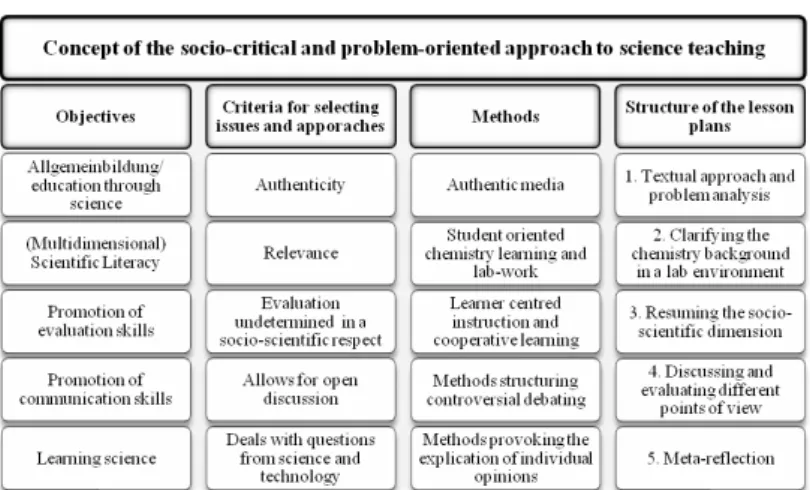
he teaching approach within the project
“he Climate Change Before the Court”
Figure 3. Conceptual framework of the socio-critical, problem-oriented approach to science teaching (Marks & Eilks, 2009).
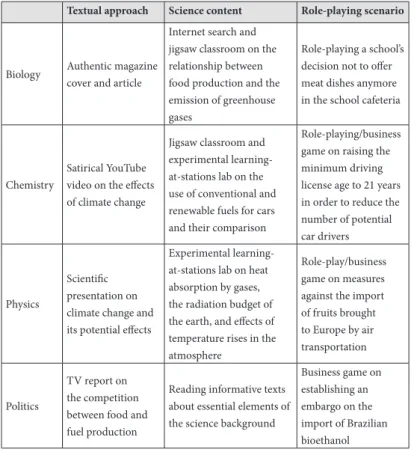
Table 1. Overview of the lesson plans from the various projects (Eilks et al., 2011a)
Textual approach Science content Role-playing scenario
Biology Authentic magazine cover and article
Internet search and jigsaw classroom on the relationship between food production and the emission of greenhouse gases
Role-playing a school’s decision not to ofer meat dishes anymore in the school cafeteria
Chemistry
Satirical YouTube video on the efects of climate change
Jigsaw classroom and experimental learning-at-stations lab on the use of conventional and renewable fuels for cars and their comparison
Role-playing/business game on raising the minimum driving license age to 21 years in order to reduce the number of potential car drivers
Physics
Scientiic presentation on climate change and its potential efects
Experimental learning-at-stations lab on heat absorption by gases, the radiation budget of the earth, and efects of temperature rises in the atmosphere
Role-play/business game on measures against the import of fruits brought to Europe by air transportation
Politics
TV report on the competition between food and fuel production
Reading informative texts about essential elements of the science background
Business game on establishing an embargo on the import of Brazilian bioethanol
Selected aspects of the accompanying research
stressed that their formal training as science teachers took place long before climate change ever became an issue of concern. Furthermore, in-service trainings focusing on multidimensional approaches to cli-mate change were not available at that time. Teachers also felt a lack in suicient support from textbooks and teaching materials. Here, they expressed their appreciation of the course the project took. he university input given as an update to their knowledge was very well-received, including not just the information about content but also that dealing with available pedagogies and school-type experiments.
he teachers’ participation in the project was acknowledged as being of great value. From the teachers’ viewpoint, this project resulted in highly feasible teaching materials that they enjoyed including in their regular teaching. he teachers felt that the help from the uni-versity was very valuable for the joint development of new teaching materials, but they also expressed satisfaction that their inluence on the structure of the teaching materials had been acknowledged. Also, the involvement of diferent types of schools (grammar, middle and comprehensive schools from both rural and municipal areas) in the two subjects where this was the case (biology and chemistry) was con-sidered to be beneicial because this led to continuous relection upon how the materials could be as broadly applicable as possible. In the end, the teachers felt better prepared to cope with diicult issues like climate change in their given subjects. Many of the teachers asked for further cooperation on both related and new issues. Altogether, the teachers reported a growth of personal expertise in the areas of con-tent, methodology, and using experimental work in the classroom.
science classrooms. Total agreement for this item was above 50% and partial agreement a further 25%. he results were similar in the other three subjects with only slight variation. In the open questionnaire, too, which was illed out before the Likert questionnaire, over 70% gave positive feedback on their own choices concerning diferent as-pects of the lesson plan, i.e., the applied pedagogies.
From the point of view of the students, the lesson plans made them think more about climate change, with nearly 70% of the students at least predominantly agreeing with such a statement (and another 25% partially agreeing). he chemistry students came predominantly from grade 9 comprehensive and middle school classes. Agreement was slightly lower in the other subjects, which were dominated by 10th grade grammar school classes. Perhaps the higher-achieving, older stu-dents in these courses felt themselves to be more self-relective on this topic prior to the lesson plan. Nevertheless, even among these groups between 45% (biology) and 60% (physics) of the learners positively re-plied to this item, with another 30% in both groups agreeing at least partially. Other items on this issue, e.g., whether students now saw the media debate with diferent eyes or whether their personal viewpoint towards climate change had altered, were also supported by roughly half of the pupils, with variations in the diferent subjects. Partial sup-port was expressed by another 30% of the participants.
more detailed analysis of the levels of argumentation is currently un-derway. Although one can hardly expect a single lesson plan of roughly 10 periods to cause a measurable increase in students’ argumentative capabilities, evaluation skills and decision-making processes, prelimi-nary indicators reveal that at least a small rise in students’ skill devel-opment took place.
Relection, discussion and implications
he relection on this project should focus on two diferent points: 1) the outcome of the project concerning teaching and curricu-lum materials, and 2) the PAR method, i.e., its potential for both cur-riculum and teachers’ ongoing professional development.
Concerning teaching about climate change, the diferent PAR groups clearly supported the theoretical analysis that this issue has high potential for promoting student capabilities in communication, evaluation and decision-making. he joint relection on the research evidence and teachers’ classroom experience was valuable for making teachers aware of both their own deicits and restrictions and also their interests and needs. his was an important starting point for sustain-able innovation, since Huberman (1993) has already stated that any sustainable innovation in education must be bound to personal expe-rience. In this case, it began with relection on teachers’ personal past experiences and was continuously linked to new experiences based on the newly-developed teaching approaches.
he teachers also agreed that the units showed promise for dealing with climate change in science education in a multidimen-sional fashion. Results from both teacher and student feedback show that this potential was beginning to be realised in the initial steps. he collaborative and cyclical design plan led – in the estimation of the teachers and educators – to highly feasible, motivating lesson plans. Both the theoretical input from the accompanying educator as well as the practical experience of the teachers contributed to the overall qual-ity of the curriculum materials.
interdisciplinary approaches towards complex issues such as climate change. Nevertheless, initially working in parallel teams then network-ing the diferent viewpoints and results proved to be a good strategy. It 1) allowed each group to become clear about their experiences and interests and 2) led to lesson plans feasible for individual syllabuses in individual subjects where administrative restrictions do not allow for interdisciplinary teaching (e.g., Feierabend & Eilks, 2010). Neverthe-less, the end product was a set of materials that can be combined in diferent ways for interdisciplinary or project-based approaches (Eilks et al. 2011b). he materials are now ready to integrate the science sub-jects under the inclusion of a societal point of view. his provides a basis for new teaching strategies on climate change in German science education classrooms. he inclusion of politics also helped a great deal, since this opened the project’s focus and employed political pedagogies that also show promise for the area of science education. hese experi-ences clearly support the idea that climate change as an issue requires a subject-integrated approach. his includes not just a combination of the diferent science teaching domains but also other relevant subjects such as politics, education, geography and other ields in the humani-ties. Educational policy should take care not to restrict the teaching of complex issues with more holistic approaches due to administra-tive barriers. his includes the overly thorough compartmentalising of education by strictly dividing it into diferent school subjects and their respective syllabuses. On the other hand, the inclusion of partners from the informal educational domain did not have much inluence on the curriculum development process within the project. However, we can recognise its still largely untapped potential for 1) increasing levels of exchange and cooperation between (in)formal education concern-ing curriculum development and 2) better educational networkconcern-ing and ine tuning in both schools and informal education. Nevertheless, the inclusion of informal education partners gave us a second platform for the implementation of part of the materials developed.
domains. Based on this experience, educational policy should provide stronger support to such multidimensional networks. It can acknowl-edge participation in such networks, for example by compensating the teachers with downtime for the time they spend working on project activities. Unfortunately, this was not the case for most of the teachers in this project, who had to sacriice their time on a voluntary basis. PAR proved to be a potentially beneicial structure for supporting such networking.
As part of teachers’ continuous professional development our experiences with PAR support the indings of similar projects, e.g., concerning the implementation of cooperative learning in chemistry education (Eilks et al., 2010) or the socio-critical, problem-oriented approach to chemistry teaching (Marks & Eilks, 2010). hevalue of PAR lies in its leading to a variety of lesson plans. hese plans are widely accepted by teachers as being authentic, well-tested and feasi-ble, as we observed for the current examples of climate change lessons within this project. Furthermore, PAR also contributed to teachers’ CPD in the sense that it caused changes in the teachers’ knowledge base, skills and attitudes, as previously reported in Eilks (2003) and Eilks et al. (2010). he respective indications were also found within this framework.
New perspectives on PAR from this project included 1) parallel application in diferent teaching domains and increasing integration and 2) the inclusion of partners from informal science-related educa-tion. he irst addition to the previous PAR framework in chemistry education had great value, both for the quality of the developed ma-terials as well as for expanded opportunities for teachers’ CPD. Con-versely, the presence of informal educational partners did not inlu-ence the project much. Perhaps more thorough integration with this domain may uncover further potential in such cooperation.
For educational policy, this and similar projects (e.g., Eilks et al., 2010; Marks & Eilks, 2009) yield clear support for our idea that more re-search-oriented partnerships between curriculum developers, educa-tional researchers, and practising teachers should be established. his would allow us to make use of all of the resources that are available for teaching practice innovation in a networked environment. PAR as a research design may help to uncover further potential for sustainable reform and implementation. hese are due to the fact that teachers’ be-liefs, their a priori knowledge and personal attitudes are all involved in such reforms and are taken into account seriously by the project. his is one of the essential basics for any successful, meaningful innovation in teaching practice, as has already been discussed by Haney, Czerniak and Lumpe (1996) or Huberman (1993).
Acknowledgement
We thank the Deutsche Bundesstitung Umwelt DBU (Ger-man Federal Trust for Environment) for their generous funding of this project.
References
Altheide, D., & Johnson, J. (1994). Criteria for Assessing Interpretative Validity in
Qualitative Research. In N. Denzin & Y. Lincoln (Eds.), Handbook of Qualitative Research
(pp. 485-499). Newsbury Park: Sage.
Altrichter, H., & Gstettner, P. (1993). Action Research: A Closed Chapter in the History of
German School Science. Educational Action Research, 1, 325-360.
Andersson, B., & Wallin, A. (2000). Students’ Understanding of the Greenhouse Efect,
Social Consequences of Reducing CO2 Emissions and Why Ozone Layer Depletion is a Problem. Journal of Research in Science Teaching, 37, 1096-1111.
Bencze, L., & Hodson, D. (1999). Changing Practice By Changing Practice: Toward More
Authentic Science and Science Curriculum Development. Journal of Research in Science
Teaching, 36, 521-539.
Bodner, G., MacIsaac, D., & White, S. (1999). Action Research: Overcoming the Sports
Mentality Approach to Assessment/Evaluation. University Chemistry Education,3(1),
31-36.
Boyes, E., Skamp, K., & Stanisstreet, M. (2009). Australian Secondary Students’ Views
About Global Warming: Beliefs About Actions, and Willingness to Act. Research in
Science Education, 39, 661-680.
Boyes, E., & Stanisstreet, M. (1993). he Greenhouse Efect: Children’s Perceptions of
Causes, Consequences and Cures. International Journal of Science Education, 15, 531-552.
Global Environmental Issues (Ozone Layer and Greenhouse Efect). Research in Science &
Technological Education, 15, 19-28.
Eilks, I. (2000). Promoting Scientiic and Technological Literacy: Teaching Biodiesel.
Science Education International,11(1), 16-21.
Eilks, I. (2002). Teaching ‘Biodiesel’: A Socio-Critical and Problem-Oriented Approach to
Chemistry Teaching, and Students’ First Views on It. Chemical Education: Research and
Practice in Europe,3, 67-75.
Eilks, I. (2003). Cooperative Curriculum Development in a Project of Participatory
Action Research Within Chemical Education: Teachers’ Relections. Science Education
International, 14(4), 41-49.
Eilks, I., Feierabend, T., Hößle, C., Höttecke, D., Menthe, J., Mrochen, M., & Oelgeklaus,
H. (2011a). Bewerten Lernen und Klimawandel in vier Fächern – Erste Einblicke in das
Projekt „Der Klimawandel vor Gericht“. Der Mathematische und Naturwissenschatliche
Unterricht, 64, 7-11 and 71-76.
Eilks, I., Feierabend, T., Hößle, C., Höttecke, D., Menthe, J., Mrochen, M., & Oelgeklaus,
H. (2011b). Der Klimawandel vor Gericht – Unterrichtmaterialien für den Fachunterricht
und fächerübergreifende Projekte. Köln: Aulis-Starck in print.
Eilks, I., Markic, S., & Witteck, T. (2010). Collaborative Innovation of the Science
Classroom by Participatory Action Research – heory and Practice in a Project of
Implementing Cooperative Learning Methods in Chemistry Education. In M. Valenčič
Zuljan, & J. Vogrinc (Eds.), Facilitating Efective Student Learning hrough Teacher
Research and Innovation (pp. 77-101). Ljubljana: University of Ljubljana.
Eilks, I., & Ralle, B. (2002). Participatory Action Research in Chemical Education. In B.
Ralle, & I. Eilks (Eds.), Research in Chemical Education - What does this mean? (pp.
87-98). Aachen: Shaker.
Ekborg, M., & Areskoug, M. (2006). How Student Teachers’ Understanding of the
Greenhouse Efect Develops During a Teacher Education Programme. NorDiNa - Nordic
Studies in Science Education, 5, 17-29.
Feierabend, T., & Eilks, I. (2010). Raising Students’ Perception of the Relevance of Science
Teaching and Promoting Communication and Evaluation Capabilities Using Authentic
and Controversial Socio-Scientiic Issues in the Framework of Climate Change. Science
Education International, 21, 176-196.
Feierabend, T., & Eilks, I. (2011). Teaching the Societal Dimension of Chemistry Along
a Socio-Critical and Problem-Oriented Lesson Plan on the Use of Bioethanol. Journal of
Chemical Education, accepted for publication.
Feierabend, T., Jokmin, S., & Eilks, I. (2011). Chemistry Teachers’ Views on Teaching
‘Climate Change’ – An Interview Case Study From Research-Oriented Learning in
Teacher Education. Chemistry Education Research and Practice, 11, 85-91.
Feldman, A. (1996). Enhancing the Practice of Physics Teachers: Mechanisms for the
Research. Journal of Research in Science Teaching, 33, 513-540.
Haney, J. J., Czerniak, C. M., & Lumpe, A. T. (1996). Teacher Beliefs and Intentions
Regarding the Implementation of Science Education Reform Strands. Journal of Research
in Science Teaching, 33, 971-993.
Hansen, P. J. K. (2010). Knowledge about the Greenhouse Efect and the Efects of the
Ozone Layer Among Norwegian Pupils Finishing Compulsory Education in 1989, 1993
and 2005 - What Now? International Journal of Science Education, 32, 397-419.
Hofstein, A., Eilks, I., & Bybee, R. (2011). Societal Issues and their Importance for
Contemporary Science Education: A Pedagogical Justiication and the State of the Art in
Israel, Germany and the USA. International Journal of Science and Mathematics Education,
published online January 2011.
Hulme, M. (2009). Why We Disagree about Climate Change. Understanding Controversy,
Inaction and Opportunity. Cambridge: Cambridge University Press.
IPCC (2007). Climate Change 2007 – he Physical Science Basis. Cambridge: Cambridge
University Press.
Höttecke, D., Hößle, C., Eilks, I., Menthe, J., Mrochen, M., Oelgeklaus, H., & Feierabend,
T. (2010). Judgment and Decision-Making about Socio-Scientiic Issues: A Fundament for
a Cross-Faculty Approach Towards Learning about Climate Change. In I. Eilks, & B. Ralle
(Eds.), Contemporary Science Education (pp. 179-192). Aachen: Shaker.
Huberman, M. (1993). Linking the Practitioner and Researcher Communities for School
Improvement. School Efectiveness and School Improvements, 4, 1-16.
Klaki, W. (2000). he Signiicance of Classical heories of Bildung for a Contemporary
Concept of Allgemeinbildung. In I. Westbury, S. Hopmann, & K. Riquarts (Eds.), Teaching
as Relective Practice. he German Didaktik Tradition (pp. 85-107). Mahwah: Lawrence
Erlbaum.
Marks, R., & Eilks, I. (2009). Promoting Scientiic Literacy Using a Socio-Critical and
Problem-Oriented Approach in Chemistry Education: Concept, Examples, Experiences.
International Journal of Environmental and Science Education 4, 131-145.
Marks, R., & Eilks, I. (2010). Research-Based Development of a Lesson Plan on Shower
Gels and Musk Fragrances Following a Socio-Critical and Problem-Oriented Approach to
Chemistry Teaching. Chemistry Education Research and Practice, 11, 129-141.
Mayring, P. (2002). Qualitative Content Analysis - Research Instrument or Mode
of Interpretation? In M. Kiegelmann (Ed.), he Role of the Researcher in Qualitative
Psychology (pp. 139-148). Tübingen: Ingeborg Huber.
McIntyre, D. (2005). Bridging the Gap between Research and Practice. Cambridge Journal
of Education,35, 357-382.
Parke, H. M., & Coble, C. R. (1997). Teachers Designing Curriculum as Professional
Development: A Model for Transformational Science Teaching. Journal of Research in
Science Teaching, 34, 773-790.
Have to Say about Research on Teacher Learning? Educational Researcher, 29, 4-15.
Rickinson, M. (2001). Learners and Learning in Environmental Education: A Critical
Review of the Evidence. Environmental Education Research, 7, 207-316.
Sadler, T. D. (2004). Informal Reasoning Regarding Socio-Scientiic Issues: A Critical
Review of Research. Journal of Research Science Teaching, 41, 513–536.
Whyte, W. F., Greenwood, D. J., & Lazes, P. (1989). Participatory Action Research. he
American Behavioural Scientist, 32, 513-551.
Biographical note
Timo Feierabend studied chemistry, mathematics and
edu-cation for becoming a teacher in German grammar schools. He cur-rently is in the inal stage of doing his PhD in chemistry education in the Institute for Science Education (IDN) at the University of Bremen (Germany).