GUILHERME VALE MENEZES
RECOMENDAÇÃO DE TAGS SOB DEMANDA
Dissertação apresentada ao Programa de Pós-Graduação em Ciência da Computação do Ins-tituto de Ciências Exatas da Universidade Fe-deral de Minas Gerais como requisito parcial para a obtenção do grau de Mestre em Ciência da Computação.
ORIENTADOR
: NIVIO
ZIVIANI
GUILHERME VALE MENEZES
DEMAND DRIVEN TAG RECOMMENDATION
Dissertation presented to the Graduate Pro-gram in Computer Science of the Universi-dade Federal de Minas Gerais in partial ful-fillment of the requirements for the degree of Master in Computer Science.
ADVISOR: NIVIO
Z
IVIANIc
2011, Guilherme Vale Menezes. Todos os direitos reservados.
Menezes, Guilherme Vale
M543d Demand Driven Tag Recommendation / Guilherme Vale Menezes. — Belo Horizonte, 2011.
xviii, 45 f. ; 29cm
Dissertação (mestrado) — Universidade Federal de Minas Gerais. Departamento de Ciência da Computação.
Orientador: Nivio Ziviani.
1. Computação - Teses. 2. Recuperação da informação - Teses. 3. Web 2.0 - Teses. I. Orientador. II. Título.
Acknowledgments
At first I wish to thank my family for all the support and patience on the weekdays and
weekends during the development of this work. I would not have finished it if it were not for
the support of my mother, Magda, father, Tarciso, and my two brothers, Murilo and Marcelo.
I would also like to thank very much my girlfriend, Renata, for all the support she gave
me during the last seven years. I apologize for the boring computer talk and thank you for
enduring it.
I wish to specially thank my adviser, Prof. Nivio Ziviani, for the many things I have
learned during the time we have been together: not only the solid technical support I have
received in LATIN, but also the values I have absorbed and which I will keep for the rest of
my life.
Also many thanks to the other researchers who collaborated with this work, such as
Prof. Adriano Veloso, Prof. Edleno Silva de Moura, Prof. Marcos Gonçalves and Prof.
Jussara Almeida.
Finally, I wish to thank all the friends from LATIN and LBD for the things I have learned by working with them. Alan, Prof. Alberto, Prof. Altigran, Anisio, Cristiano,
Denilson, Fabiano, Marco Modesto, Marco Cristo, Rickson, Thales, Thiago, Thierson, Tinti,
“Knowing is not enough; we must apply. Willing is not enough; we must do.”
Resumo
Rotulagem colaborativa (collaborative tagging) permite que usuários assinalem
palavras-chave (ou tags) que descrevam o conteúdo de objetos, o que facilita a navegação e melhora
algoritmos de busca sem o uso de categorias pré-definidas. Em sistemas de tagging de larga
escala, sistemas de recomendação de tags podem ajudar usuários a assinalar rótulos a objetos
e ajudar a consolidar o vocabulário entre diferentes usuários. Uma abordagem promissora
para recomendação de tags é explorar a co-ocorrência entre elas. Nesse caso, o enorme tamanho do vocabulário de tags é um desafio, porque (1) a complexidade computacional
pode crescer exponencialmente com o número de tags e (2) o peso atribuído a cada tag pode
ficar distorcido já que diferentes tags operam em diferentes escalas e os seus respectivos
pe-sos podem não ser diretamente comparáveis. Neste trabalho nós propomos um método novo
de recomendação de tags que é baseado em demanda e que faz recomendações a partir de
um conjunto inicial de tags previamente associado a um objeto. Ele reduz o espaço de
pos-síveis soluções, e, portanto, sua complexidade aumenta polinomialmente com o tamanho do
vocabulário de tags. Além disso, o peso de cada tag é calibrado usando uma abordagem de minimização de entropia que corrige possíveis distorções e provê recomendações mais
pre-cisas. Nós conduzimos uma avaliação sistemática de métodos propostos usando três tipos
de mídia: áudio, páginas Web e vídeo. Os resultados experimentais mostram que o método
proposto é rápido e melhora a qualidade da recomendação em diferentes cenários
experimen-tais. Por exemplo, no caso de um popular site de músicas ele provê melhoras em precisão
(p@5) de6,4% a46,7% (dependendo do número de tags dadas como entrada), melhorando
métodos de recomendação de tags baseados em co-ocorrência recentemente propostos.
Abstract
Collaborative tagging allows users to assign arbitrary keywords (or tags) describing the
con-tent of objects, which facilitates navigation and improves searching without dependence on
pre-configured categories. In large-scale tag-based systems, tag recommendation services
can assist a user in the assignment of tags to objects and help consolidate the vocabulary
of tags across users. A promising approach for tag recommendation is to exploit the
co-occurrence of tags. However, these methods are challenged by the huge size of the tag vo-cabulary, either because (1) the computational complexity may increase exponentially with
the number of tags or (2) the score associated with each tag may become distorted since
dif-ferent tags may operate in difdif-ferent scales and the scores are not directly comparable. In this
work we propose a novel method that recommends tags on a demand-driven basis according
to an initial set of tags applied to an object. It reduces the space of possible solutions, so that
its complexity increases polynomially with the size of the tag vocabulary. Further, the score
of each tag is calibrated using an entropy minimization approach which corrects possible
dis-tortions and provides more precise recommendations. We conducted a systematic evaluation of the proposed method using three types of media: audio, Web pages and video. The
exper-imental results show that the proposed method is fast and boosts recommendation quality on
different experimental scenarios. For instance, in the case of a popular music radio Web site
it provides improvements in precision (p@5) ranging from6.4% to46.7% (depending on the
number of tags given as input), outperforming a recently proposed co-occurrence based tag
recommendation method.
Contents
Acknowledgments ix
Resumo xiii
Abstract xv
1 Introduction 1
1.1 Objectives . . . 2
1.2 Contribution of the Dissertation . . . 3
1.3 Related Work . . . 4
1.4 Organization of the Dissertation . . . 7
2 Basic Concepts 9 2.1 Social Tagging . . . 9
2.2 Multi-label Classification . . . 13
2.3 Associative Classification . . . 14
2.4 Summary . . . 16
3 Proposed Method 17 3.1 Multi-label Classification Model . . . 17
3.2 Demand-Driven Rule Extraction . . . 18
3.3 Tag Ranking . . . 20
3.4 Calibration . . . 21
3.5 Summary . . . 23
4 Experiments 25 4.1 Baseline . . . 25
4.2 Collections . . . 26
4.2.2 LastFM . . . 27
4.2.3 YouTube . . . 27
4.3 Pre-Processing Steps and Setup . . . 27
4.4 Results . . . 29
4.4.1 Precision . . . 29
4.4.2 Mean Reciprocal Rank (MRR) . . . 32
4.4.3 Computational Efficiency . . . 32
4.5 Limitations of LATRE . . . 35
4.6 Summary . . . 35
5 Conclusions and Future Work 37
Bibliography 39
Chapter 1
Introduction
Social interaction has become one of the central aspects around which World Wide Web
applications are built in the Web 2.0 era. End-users contribute with content created by
them-selves, using social applications to collaborate and interact with each other by means of blog
posts, comments, forum messages, videos, audio or other media. They work collectively to
generate, augment, correct or update the content of digital objects that will be consumed by
their peers.
This new paradigm has brought challenges for Information Retrieval (IR) methods.
The lack of a centralized publisher allowed the production of astonishing amounts of user-generated data. At the same time, low-quality content composes most of this data, since
there are no quality standards in most Web 2.0 applications. Furthermore, a large fraction of
the generated content is in the form of multimedia, such as audio, image or video. Current
industrial IR technology cannot efficiently deal with multimedia objects directly, and they
usually resort to textual meta-data that surrounds each object (e.g., description or comments).
However, this textual data is often non-existent or simply too noisy to be used effectively in
IR.
In this context, social tagging has emerged as a means to allow users to describe
their objects by using a set of descriptive keywords (tags). These keywords may be used
to help users in organizing their objects, serving as a personalized, non-hierarchical cate-gorization system. IR methods can take advantage of tags to improve the retrieval of
ob-jects through browsing or searching. In fact, recent studies have demonstrated that tags are
among the best textual features to be exploited by IR services, such as automatic
classifica-tion [Figueiredo et al.,2009].
In order to incentive the use of tags, social tagging applications have developed tag
recommendation services that aim to aid the user in the act of assigning keywords to objects.
as-2 CHAPTER 1. INTRODUCTION
signment of keywords an easier task, motivating users to contribute with a larger set of tags;
(2) they provoke a convergence in the use of keywords among different users [Sen et al.,
2006], reducing noise and improving the effectiveness of IR processes; (3) they remind users of more rich or specific tags, which are descriptive despite not being among the most
fre-quently used.
This dissertation presents a new algorithm that recommends tags by exploiting tag
co-occurrence patterns. Our algorithm extracts co-occurrence patterns based on the tags
associated with previous objects in the collection, that is, tags that were associated to objects
by system users in the past. Recommendations are performed by using these patterns. An
advantage of relying only on tag co-occurrence is that the algorithm does not depend on the
content of the objects, i.e., the method is indifferent to the object media type. This feature
makes our method suitable to social tagging systems such as LastFM1, Flickr2and Youtube3, which contains audio, images and videos, respectively.
Typically, an object has several different tags associated with it, and tag
recommen-dation systems are expected to provide users with a small set of tags (3-5) to choose from.
There is an unlimited number of ways to describe an object by choosing arbitrary keywords.
Our strategy to this problem is to treat each possible tag already existent in the system as a
class for the object, modeling the problem of recommending tags as a multi-label
classifica-tion problem.
This approach is challenging since the vocabulary of tags in systems such as YouTube, Delicious4and LastFM is on the thousands. Current automatic classifiers cannot deal well
with problems with many thousands of classes. Multi-label classification systems also have
to consider possible combinations among these tags, which makes this problem even harder
in the tag recommendation context.
1.1
Objectives
In this dissertation we study the problem of recommending tags related to a specific object
given an initial set of tags already associated with this object. Formally, an initial set of tags Io, which is used to describe the object o, is provided to the recommendation method. The
method subsequently outputs a set of related tagsCo (Io∩ Co = ∅), which are regarded as
appropriate for describing this object.
Our purpose in this dissertation is to design better tag recommendation algorithms by
1.2. CONTRIBUTION OF THE DISSERTATION 3
exploiting more elaborate tag co-occurrence association rules. We are able to generate such
rules by taking an on-demand approach, that is, we generate rules on the fly according to each provided object. This is possible because we can project the search space according to
the input object, significantly reducing the computation needed to extract rules.
A specific objective is to reduce the distortions created in the calculation of the score
of candidate tags. This problem is common in applications that need to rank tags according
to some criterion. These distortions are present specially in cases in which the number
of tags in an object is small, as shown in our experiments. Another specific objective is
to generate datasets that can be used in experiments with tag recommendation, which are
datasets crawled from social bookmarking networks such as Delicious.
1.2
Contribution of the Dissertation
We present a Lazy Associative Tag REcommender, referred to as LATRE, which is an
al-gorithm based on the Lazy Associative Classifier (LAC) classifier [Veloso et al., 2006] that has been developed to deal with large-scale problems with thousands of tags (or classes).
LATRE exploits co-occurrence of tags by extracting association rules on a demand-driven
basis. These rules are the basic components of the classification model produced by LATRE.
In this case, rules have the formX −→y, whereX is a set of tags andyis the predicted tag.
Some of the results presented in this dissertation were published in [Menezes et al.,2010]. Rule extraction is a major issue for recommendation methods based on co-occurrence
[Heymann et al., 2008;Sigurbjörnsson and van Zwol, 2008], since the number of extracted rules may increase exponentially with the number of tags. LATRE, on the other hand, ex-tracts rules from the training data on the fly, at recommendation time. The algorithm projects
the search space for rules according to qualitative information present in each test object,
al-lowing the extraction of more elaborate rules with efficiency.
In other words, LATRE projects the training data according to the tags inIo and
ex-tracts rules from this projected data. This ensures that only rules that carry information about
objecto(i.e., a test object) are extracted from the training data, drastically bounding the
num-ber of possible rules. In fact, the computational complexity of LATRE is shown to increase
polynomially with the number of tags in the vocabulary. This efficiency enables LATRE to
explore portions of the rule space that could not be feasibly explored by other methods.
After a set of rules is extracted for objecto, LATRE uses them to rank candidate tags that are more likely to be correctly associated with this object. Each extracted rule X −→θ y
4 CHAPTER 1. INTRODUCTION
inX. Weighted votes for each tag are added and tags that scored higher are placed on the
beginning of the ranking. Usually, there are many candidate tags and, thus, properly ranking them is also a difficult issue, since different candidate tags may operate in different scales
(i.e., a popular tag may receive a large number of “weak” votes, and this tag is likely to
be placed before a specific tag which received a small number of “strong” votes). In order
to enforce all tags to operate in the same scale, so that they can be directly compared, we
employed an entropy-minimization calibration approach to correct possible distortions in the
scores of candidate tags.
Experimental results obtained from collections crawled from Delicious, LastFM
and YouTube show that LATRE recommends tags with a significantly higher precision
in all collections when compared to a recent co-occurrence based algorithm proposed
by Sigurbjörnsson and van Zwol [2008], which we considered our baseline method. The study of the effectiveness of LATRE on three different collections corresponding to different
media types (i.e., Web pages, audio and video) is also an important contribution of our work,
as most of the methods in the literature are tested only with one collection and one media
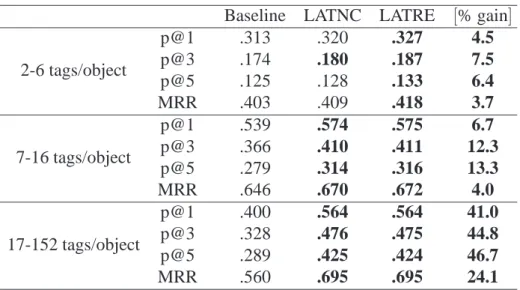
type. Depending on the number of tags provided as input to LATRE, it obtained gains in
pre-cision (p@5) ranging from 10.7% to 23.9% for Delicious, from 6.4% to 46.7% for LastFM,
and from 16.2% to 33.1% for YouTube.
1.3
Related Work
Social tagging systems allow users to associate keywords (tags) to any object, such as a Web
page, a video or a photo. These system have become popular in the Web 2.0 context, in which a large amount of data is created and there is the necessity of indexing it for later retrieval.
Tag recommendation services have emerged in social tagging systems with the objective of
helping users to better describe the content they created. For an introductory discussion of
social tagging and tag recommendation, please see Section2.1.
Possible sources of information for tag recommendation could be: (1) tags previously
associated with objects in the collection and (2) the textual content of other features (e.g.,
title, description, user comments) associated with the object for which the recommendation
is expected. While in case of (2) there could be more input for the sake of
recommen-dation, problems such as the lack of standardization in content format and the presence
of noisy content (e.g., non-existing words [Suchanek et al., 2008]) benefit the use of rec-ommendation methods that exploit solely tag co-occurrence information [Garg and Weber,
2008;Sigurbjörnsson and van Zwol,2008].
1.3. RELATED WORK 5
two presented works ([Sigurbjörnsson and van Zwol, 2008] and [Garg and Weber, 2008]) are the most related to our work in terms of the problem they treated and the methodology they adopted. The next three related works ([Heymann et al., 2008], [Krestel et al., 2009] and [Wu et al., 2009]) also explored tag co-occurrence to solve other tag expansion prob-lems (such as tag recommendation using content and the cold-start problem). The
follow-ing four related works ([Xu et al., 2006], [Weinberger et al., 2008], [Liu et al., 2009] and [Siersdorfer et al., 2009]) used tag co-occurrence in applications different from tag expan-sion, such as tag disambiguation. The last related works listed in this section also applied
classification in the social tagging domain.
Sigurbjörnsson and van Zwol[2008] explored tag co-occurrence with the objective of recommending tags directly to users based on an initial set of tags already associated with the
object. In this scenario, their method first associates a list of related tags with each input tag, and then combines the lists for all input tags in a single final ranking of related tags. The two
similarity measures used to compute co-occurrence of tags were the conditional probability
and the Jaccard coefficient. They combined the lists of related tags by summing up the
co-occurrence measures for each occurrence of a related tag. Finally, they altered the final
relatedness scores by promoting tags that are more descriptive of the content of the objects,
obtaining significant improvements. The problem they studied is very similar to ours, i.e.,
output a ranking of tags using only community knowledge (not personal information). For
this reason, we chose this method as a baseline in our experiments. The main difference between the method described in [Sigurbjörnsson and van Zwol, 2008] and our’s is that we employ a filtering process to reduce the size of the training data according to an input object.
This reduction causes an increased efficiency and allows LATRE to extract rules that are
more elaborate. The use of calibration is also a difference that improves the performance of
our method, specially for objects with a small number of tags.
Another related work is presented byGarg and Weber[2008]. They study the problem of making personal recommendations using the history of all tags a user has applied in the
past. Given a set of tags as input, the authors use a Naive Bayes classifier to obtain a ranking
of related tags specifically for the user. This model considers the probability that a related
tag will generate the set of input tags according to the user past behavior. Additionally, they use collective knowledge to estimate the co-occurrence of tags in the whole system, using
a scoring method which is based on TF-IDF. The best results were obtained by combining
the personal model and the collective model. They concluded that adding personal history
can improve the effectiveness of co-occurrence tag-recommendation. Our method also
mod-els the problem as classification, but we do not explore personal history and therefore the
6 CHAPTER 1. INTRODUCTION
only use rules of size two, i.e., one tag in the antecedent ("if") and one in the consequent
("then") of each rule. The reason is that these simple rules are easier to compute than more complex ones, that is, rules that have more than one tag in the antecedent of consequent.
They assessed the effectiveness of their tag expansion method by measuring precision and
recall of a tag-based object search engine. They only used single tag queries, that is, they did
not need to combine the expansion list of different input tags. The experiments have shown
that the expanded set of tags can increase recall by 50% while keeping the same precision.
Our work differs from [Heymann et al., 2008] in that we are able to extract rules of larger size to improve efficacy. Furthermore, we correct the final scores of candidate tags using
calibration.
Krestel et al. [2009] use Latent Dirichlet Allocation (LDA) to expand the set of tags of objects annotated by only a few users (the cold start problem). They use LDA to uncover the latent topics associated with each object in a dataset obtained from Delicious. Since each
object may be annotated by several users from different backgrounds, and each user may
re-gard the object as concurrently belonging to many topics, the discovered topics represent the
different semantic views of the object. After a comparison with [Heymann et al.,2008] they concluded that their method is more accurate and yields more specific recommendations, a
characteristic that may be useful in some applications. Even though this method also uses
tag co-occurrence, it focus on a different problem than ours.
Wu et al.[2009] model tag recommendation in Flickr as a learn-to-rank problem using RankBoost. Their problem is to recommend tags given a set of previously assigned tags and
the content of the images. They use as tag similarity measures the conditional probability,
the Jaccard coefficient and a tag similarity measure that explores image feature similarity
in a Visual Language Model (VLM). These similarity measures are given as features to the
learn to rank algorithm. They conclude that content features can help to ease the ambiguity,
polysemy and synonymy problems in tag recommendation. The main difference between
[Wu et al.,2009] and our method is that they use content features from pictures, combining them with tag co-occurrence information.
Tag co-occurrence has also been used in contexts different from tag expansion. For
ex-ample, the tag recommendation algorithm described in [Xu et al., 2006] uses co-occurrence information to select a small set of informative tags from the tags collectively used to
de-scribe an object. They give higher values to tags that have been used together by the same
user (complementary tags) and lower value to different tags that have been used by different
users to describe the same object (tags that describe the same concept).
Another example is the identification of ambiguous tags using co-occurrence
distri-1.4. ORGANIZATION OF THEDISSERTATION 7
butions of co-occurring tags arise after adding each ambiguous tag. A third example is tag
ranking [Liu et al.,2009], in which the authors used a random walk process based on tag co-occurrence information to generate a ranking that is shown to improve image search, tag
rec-ommendation and group recrec-ommendation. Finally, tag translation using tag co-occurrence
is described in [Siersdorfer et al.,2009]. The authors created a tag co-occurrence graph and used network similarity measures to find candidates for translation.
Classification algorithms have been used in tag recommendation in the past.
Heymann et al. [2008] use an SVM classifier to predict whether a tag t is associated with an object obased on the textual content of o. Their approach does not scale to many
thou-sands of tags since they need to build a binary classifier for each tag. In their experiments,
they use only the top 100 tags of their Delicious collection. A second approach is used by
Song et al. [2008b]. They group objects into clusters using a graph partitioning algorithm, and they train a Naive Bayes classifier using the generated clusters as classes. When a new
object arrives, their method classifies the object into one of the clusters and use the tags of
the cluster to generate a ranking of candidate tags. A third way is to consider each tag as
a class and model tag recommendation as a multi-label classification problem. In this case,
tags are used as both features and labels, and the classification algorithm must be able to
deal with a very large number of classes. This approach is discussed in [Garg and Weber,
2008] and [Song et al.,2008a], and used in this work. WhileGarg and Weber[2008] use a Naive Bayes classifier andSong et al.[2008a] propose a multi-label sparse Gaussian process classification to model tag recommendation, our work is based on associative classification
(see Section2.3), which can be applied to problems with thousands of classes.
In conclusion, tag co-occurrence is a very recent and active topic of research in
Infor-mation Retrieval. While many previous publications have focused in tag co-occurrence as a
means to solving different problems (such as tag recommendation and the cold start
prob-lem), none of them has given focus to an on-demand approach. This dissertation will cover
this aspect.
1.4
Organization of the Dissertation
The rest of the dissertation is organized as follows. In Chapter 2 we cover some basic
con-cepts. They will improve the readers’ understanding of the following chapters. In Chapter
3 we provide an in-depth description of our proposed method, whereas in Chapter 4 we
Chapter 2
Basic Concepts
In this chapter we present some basic definitions and concepts that will help the reader to
better understand the context of this thesis. First, we discuss the characteristics of social
tagging systems and how they can be used to improve Information Retrieval tasks. Next,
we overview multi-label classification, which is used in our method. Finally, we introduce
associative classification and show its application in tag recommendation.
2.1
Social Tagging
Social tagging systems allow users to annotate an object, such as a Web page, a video or a
photo, with freely chosen keywords (or tags). These systems constitute a new phenomenon,
specially when considered in the context of the Web 2.0, which allowed the creation of a
large amount of user generated data over the past few years. Some researchers have recently
studied the main characteristics of social tagging systems and the corresponding data their
users generate. In this section we discuss these characteristics and give examples of how they can be used to improve Information Retrieval (IR) tasks, such as clustering, search and
recommendation.
Social tagging systems are now popular due to the widespread adoption of Web 2.0
ap-plications, specially social networks (Facebook5, MySpace6, Orkut7), online media
publish-ing systems (YouTube, Flickr, LastFM) and social bookmarkpublish-ing systems (Delicious,
Stum-bleUpon8, Digg9, Technorati10). In fact, a survey published in 2007 has shown that 28% of
5http://www.facebook.com/ 6http://www.myspace.com/ 7http://www.orkut.com/ 8http://www.stumbleupon.com/ 9http://www.digg.com/
10 CHAPTER 2. BASIC CONCEPTS
Web users had already used tags to categorize content such as a photo, a news story or blog
posts [Rainie,2007].
In most social tagging systems, the tagging process is related to personal organization.
For example, tags are commonly used in social bookmarking systems, which are systems
that allow users to bookmark objects on the Web, i.e., keep them stored for later access. In
this scenario, users associate a set of tags to each object they bookmark with the purpose of
easily retrieving them in the future. Another example are blogs and other sites in which users
generate their own content. Users in this case are publishers and associate tags to their own
content in order to make it easier to be retrieved by other users or by themselves.
In such a scenario, users associate keywords that are related to their personal sense of
organization, i.e., they do not need to make sense to other users in general. For example,
users may associate to a blog post the tags “philosophy” and “psychology”, but they also may use the tags “to read” or “i37-2010”. In other words, users organize the set of objects
they have already tagged in personal classification systems, which are suited specifically for
their own context. They adapt their own classification of objects according to their language,
region, interest area, intention and personal conventions.
This personalized use of tags is possible because of the lack of a controlled vocabulary
to describe the users’ objects. This form of classification contrasts to traditional classification
systems, such as the Dewey Decimal Classification (DDC). The DDC attempts to classify all
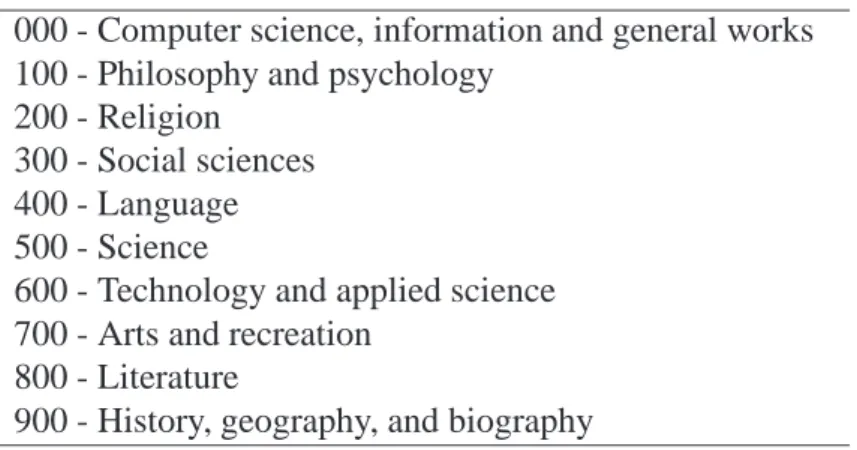
the human knowledge into a pre-defined hierarchy of classes (a taxonomy). This hierarchy spans from a set of ten main classes, such as “Religion” and “Science” (see Table2.1), going down three levels. Other well-known examples of traditional taxonomies are the Linnean
classification system, which is used to categorize all living organisms, and the Medical
Sub-ject Headings (MeSH), which is used to index journal articles and books in the medical area.
The classification systems based on tags has the advantage of having a much lower barrier
to entry, which reduces the effort of classification and permits objects to be classified by
ordinary Web users.
Despite the fact that social tagging systems serve mainly to the purpose of personal
organization, the collective use of tags causes the emergence of a more general
classifica-tion system. The reason is that users naturally converge in the way they describe objects, regardless of their personal aspects. For example, a popular picture that depicts a cat will
probably have the keyword “cat” as one of the most frequently assigned tags. This general
classification system is usually referred to as a folksonomy [Wal,2007].
The three main aspects that differentiates folksonomies from traditional taxonomies
are (1) the lack of an hierarchical organization, (2) its unconstrained nature, i.e., a user
can assign any keyword to any object, and (3) its bottom-up generation process. These
2.1. SOCIAL TAGGING 11
Table 2.1. The Dewey Decimal Classification (DDC) main classes.
000 - Computer science, information and general works 100 - Philosophy and psychology
200 - Religion 300 - Social sciences 400 - Language 500 - Science
600 - Technology and applied science 700 - Arts and recreation
800 - Literature
900 - History, geography, and biography
concepts are naturally assimilated. Furthermore, folksonomies are cheaper to construct and
maintain than a traditional taxonomy, since no specialized professional is needed. For these
reasons, there have been an increasing interest in using this information to aid IR tasks.
However, the use of folksonomies in Information Retrieval has also caused the
emer-gence of new interesting challenges to IR methods. First, many of the tags assigned to objects are noisy, since they may only make sense to the user who created them and do not serve
to the community as a whole. IR methods should take advantage of only informative tags,
while avoiding the destructive effect of noisy tags. objects with a small number of tags are
specially prone to the negative effects of noise, since they do not contain enough information
to differentiate useful tags from damaging ones. This effect was observed in our experiments
(Chapter4).
Second, these systems have a huge vocabulary of different tags, since there is a large
quantity of possible sets of keywords that may describe an object. This is a challenge to current machine learning techniques. Many classification algorithms, for example, cannot
deal efficiently with problems of thousands of classes. Moreover, issues such as synonymy
and polysemy (i.e., different keywords with the same meaning and same keywords with
a different meaning) makes the problem even more difficult from the point of view of IR
algorithms. In this work we propose a multi-label classification algorithm that can extract
more elaborate patterns with efficiency, effectively reducing the aforementioned problems.
Third, tags can be applied to objects with very different purposes. For example, users
may describe a picture of a cat objectively as “cat”, or more subjectively as “cute”. They
can also describe the picture with more specific or general keywords, such as “Siamese cat”
or “animal”. Furthermore, they can describe the process of producing the photograph, us-ing a keyword such as “close-up”. These are only some examples in an infinity of other
12 CHAPTER 2. BASIC CONCEPTS
[2009] propose a method that generates taxonomies based on tag usage data. Another example of ontology generation from community-based semantics is [Mika, 2007]. In [Heymann and Garcia-Molina, 2006] the authors present a simple algorithm for taxonomy generation from tag data. Semantic relatedness between tags is studied in [Cattuto et al.,
2008], which also characterizes the nature of the relationship between tags. Zhang et al.
[2006] also study how to statistically infer global semantic information from folksonomies. An IR task that may benefit from tag data is document clustering. For example,
[Lu et al.,2009] proposes a clustering method that is based on a tripartite graph model. This kind of graph modelling is common for methods that use tag information, and essentially
models the data as a graph with three different types of nodes: users, objects and tags. Their
method simultaneously cluster objects, users and tags by using a modified K-Means method,
which calculates the centroid in each step using information from the neighborhood of each node. In [Ramage et al., 2009] another document clustering method based on K-Means is proposed. The authors use an extended vector representation of each document,
contain-ing not only the terms in its content but also the tags associated to it. Li et al. [2008] use folksonomies to find communities of users interested in similar topics.
Search is another application that uses tags in IR.Bischoff et al.[2008] study the use-fulness of tags in search by comparing tags and the terms used in search queries for the same
documents. They concluded that most tags can be used for search, since the tag application
usage pattern follows the searching behavior. Carman et al. [2009] extend this analysis by observing that the distribution of tags and queries are very similar, but not identical.
Further-more, queries are usually more similar to the content of Web pages than tags, but queries and
tags are more similar to one another than to content. This is a clear indication that tags may
be used to improve the effectiveness of search engines.Schenkel et al.[2008] propose a new document ranking method that exploits information from the tripartite graph to significantly
improve the search engine effectiveness. The method expands the query with a set of similar
tags before performing the search in the document index.
Another possible application for tags in IR is in object recommendation.Konstas et al.
[2009] use the tripartite graph of users, objects and tags to design a new collaborative filtering algorithm that recommends objects to users. Their method uses a Random Walk approach to infer relationships between objects. In [Sen et al., 2009] another approach for object rec-ommendation using tag data is presented. The authors use the similarity between users and
tags to predict the similarity between users and objects. Finally,Shepitsen et al.[2008] pro-pose another object recommendation algorithm that uses clusters of tags as intermediaries
2.2. MULTI-LABEL CLASSIFICATION 13
2.2
Multi-label Classification
As observed in Section 2.1, the collective use of tags causes the emergence of a global classification system, in which each tag associated with an object is considered as a class of
that object. From this point of view, the problem of predicting which tags will be applied to
an object (tag recommendation) is similar to the problem of predicting which classes will be assigned to that object (multi-label classification). In this section we introduce multi-label
classification and discuss the peculiarities of its use in tag recommendation.
Multi-label classification contrasts with the simpler problem of single-label
classifi-cation, in which each object can be associated with only one label from a set of disjoint
labelsL, |L| > 1. In multi-label classification, examples are associated with a set of labels Y ⊆ L. In this framework, the algorithm associates a set of labels Yi to each test object
Xi . Multi-label classification methods are required in applications such as medical
diagno-sis, protein function classification, music categorization, semantic scene classification, and
document classification [Tsoumakas et al., 2006]. For example, a band can be classified in many categories simultaneously, such as “alternative”, “rock”, “pop” and “indie”. Similarly, a photograph can be classified in “sunset” and “sea” at the same time.
A common approach to multi-label classification is to train a separate binary
classi-fier for each class. Each classiclassi-fier is used to independently associate a score to each class,
and the top k classes are assigned to the test object. For example, Comité et al.[2003] use decision trees as individual classifiers. Another approach based on SVM is presented in
[Elisseeff and Weston, 2005]. These methods are called problem transformation methods, since they transform a multi-label problem into several binary classification problems. More
formally, in these approaches the original dataset Dis transformed into|L|datasetsDl that
contain all the examples in the original dataset, each one labelled as lor¬l. A single-label
classifier is then trained in eachDl[Tsoumakas et al.,2006].
One of the drawbacks of the binary approach is that they do not exploit correlation
among labels, that is, they consider that each label is independent of each other. This is an
oversimplifying strategy in some applications. If there is ambiguity in the use of a label, the
correlation among classes can help to narrow the meaning of the label. For instance, the label
“rock” may refer to a music genre or to a geological formation. If it co-occurs with the label
“music”, than we can discard the geology meaning from our candidate labels. A multi-label
classifier that do not use correlation would classify the object both as a geological formation
and music genre, disregarding any attempt of disambiguation.
Another benefit of considering correlation among labels is that the method can infer
14 CHAPTER 2. BASIC CONCEPTS
objects that contain the label “rock and roll” can also be used to predict new labels to objects
labeled only with “rock”.
In this dissertation, for example, we show that exploring the correlation among tags
can significantly improve the quality of the prediction, specially if objects have a relatively
large number of tags (see Chapter4). The reason is that tags are noisy labels, since they can be freely assigned by users. Consequently, correlation in tag recommendation is paramount.
Another major drawback of the binary classifier approach is that it cannot deal with
problems of many thousands of labels, since methods must calculate a score for each label
during run-time. It means that we need to evaluate each binary classifier for each tag in the
vocabulary in order to predict a set of recommended tags. If the vocabulary of tags is big,
the binary classifier approach is not feasible. In our experiments, the dataset from Delicious
contains about 800,000 different tags. Therefore, we need a multi-label classifier that can deal with a large vocabulary of tags.
A third drawback of the binary classifier approach is that it can not deal naturally with
a dynamic set of labels. If a new label appears, a separated binary classifier must be trained
for that specific label. There must be enough data to perform this training, otherwise the new
binary classifier would introduce noise in the method output. Therefore, there must be a way
to decide what labels are worth a classifier, and when to train it. In applications in which
new labels are constantly being created, we need a solution that can incorporate these new
labels transparently. This is another reason why the binary classifier approach is not suited to tag recommendation.
2.3
Associative Classification
In our dissertation scenario we need a multi-label classification algorithm that can scale,
that is able to exploit label correlations, and that can deal with a dynamic set of labels.
The solution we exploited was to use an associative classifier [Liu et al.,1998]. Associative classification methods first extract association rules from the training data, and then build
a classifier using these rules. These algorithms extract rules of the formX −→ y, in which
the antecedent is a set of features and the consequent is a class. The associative classifier
uses association rule mining algorithms, such as Apriori [Agrawal and Srikant, 1994] and FPGrowth [Han et al., 2000], to find the appropriate rules in the training data. A minimum support is used to limit the set of extracted rules, that is, the algorithms only extract rules that
2.3. ASSOCIATIVE CLASSIFICATION 15
θminis also used to filter the rule set. For a ruleX −→y,θis given by
θ = sup(X ∪y) sup(X)
The confidence of a ruleX −→ycan be though as the conditional probability that the classy
will occur given thatX has occurred.
During the test phase, the algorithm checks if each rule matches the test object. In
a single-label variation of the algorithm, one class must be chosen using the set of
match-ing rules M. There are different approaches to make this choice. For example, a greedy
approach would be to choose only the top ranked rule according to some criterion, such as
information gain. Another strategy is to perform a poll, in which each rule is viewed as a
weighted vote. For instance, the score for classyi in a set of rulesMis given by:
s(yi) =
X
X−→yi∈M
wi
The class with the highest score is the output. In this case, the algorithm is able to deal with
conflicting rules [Veloso et al.,2007].
A variation of the algorithm is to consider not only the topmost class in the ranking of
classes, but the top-k classes. In this case, we have a multi-label classification method. This
is the approach adopted in this dissertation. However, we had to perform some modifications
in the algorithm to adapt it to our needs. For example, in tag recommendation the domains
ofX andcare the same. Therefore, there is a set of trivial rules that must be ignored in the extraction phase. We further discuss our algorithm in Chapter3.
Associative classification has many advantages when used in tag recommendation. As
stated earlier in Section2.2, we need a method that exploits correlation among tags, that is, that can identify the correct meaning of ambiguous tags and that can identify different tags
with the same meaning. In tag recommendation these two problems are common.
Associa-tive classification naturally deal with correlation by extracting rules that have more than one
label as an antecedent, i.e.,|X |>1.
Furthermore, associative classification take advantage of a well-studied research field, which is association rule mining. Robust and efficient algorithms, such as Apriori and
FP-Growth [Han et al., 2000], can be directly exploited in associative classification. These al-gorithms are able to deal with problems with many thousands of labels. They are specially
suited to tag recommendation problems, that have a large vocabulary of tags.
16 CHAPTER 2. BASIC CONCEPTS
system, it is naturally incorporated into the method in the form of association rules. If the
new tag is not frequent enough, an association rule that contains it will have a low weight, and its influence on the classifier would be small. These characteristics make associative
classifier a good option to be used in tag recommendation.
2.4
Summary
In this chapter we presented some basic definitions and concepts that allow to reader to better
understand the following chapters. First, we introduce social tagging and tag
recommenda-tion. Next, we discuss multi-label classification and associative classification, describing
Chapter 3
Proposed Method
In this chapter we present a new demand driven tag recommendation method, which we refer
to as Lazy Associative Tag REcommender (LATRE). We first formally model the problem
using associative classification. New, we present the lazy aspect of the solution, i.e. the
filtering of the training data according to an input object with the objective of increasing
the efficiency of the rule extraction process. Later, we describe how we attribute score to
candidate tags, and then we present our calibration approach, which reduces distortions in
candidate tags’ scores.
3.1
Multi-label Classification Model
We have essentially modeled the tag recommendation task as a multi-label classification
problem. In this case, we have as input the training data (referred to as D), which consists
of objects of the form d=<Id,Yd>, where bothIdandYdare sets of tags, and initially,Id
contains all tags that are associated with object d, whileYdis empty. The test set (referred
to asT) consists of objects of the formt =<It,Yt>, where bothItandYt are sets of tags
associated with object t. However, while tags in It are known in advance, tags in Yt are
unknown, and functions learned from D are used to predict (or recommend) tags that are
likely to be in Ytbased on tags inIt. We developed the LATRE method within this model.
Recommendation functions produced by LATRE exploit the co-occurrence of tags in D,
which are represented by association rules [Agrawal et al.,1993], as defined below.
Definition 3.1 An association rule is an implication X −→θ y, where the antecedent X is a set of tags, and the consequent y is the predicted tag. The domain for X is denoted as I={I1 ∪ I2 ∪. . .∪ Im}∗ (i.e., X ⊆ I), wherem=|D|+|T |and the operatorA∗ denotes
18 CHAPTER 3. PROPOSED METHOD
ruleX −→yis given by the number of tags in the antecedent, that is|X |. The strength of the
association betweenX andyis given byθ, which is simply the conditional probability ofy
being inYo given thatX ⊆ Io.
We denote asRa rule-set composed of rulesX −→θ y. Next we present the major steps of LATRE: rule extraction, tag ranking, and calibration.
3.2
Demand-Driven Rule Extraction
The search space for rules is huge. Existing co-occurrence based recommendation methods,
such as the one proposed in [Sigurbjörnsson and van Zwol, 2008], impose computational cost restrictions during rule extraction. A typical strategy to restrict the search space for rules
is to prune rules that are not sufficiently frequent (i.e., minimum support). This strategy,
however, leads to serious problems because the vast majority of the tags are usually not
frequent enough. An alternate strategy is to extract only rulesX −→ysuch that|X | ≤αmax,
whereαmaxis a pre-specified threshold which limits the maximum size of the extracted rules.
However, in actual application scenarios, methods such as Sigurbjörnsson and van Zwol’s are only able to efficiently explore the search space for rules ifαmax=1. When the value of
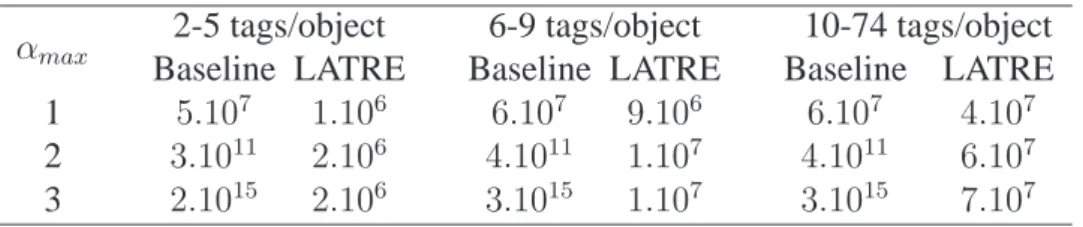
αmaxis increased, the number of rules extracted fromDincreases at a much faster pace (i.e.,
there is a combinatorial explosion).
A possible drawback of this approach (i.e., αmax=1) is that more complex rules (i.e.,
rules with|X |>1) will be not included in R. An assumption is that these rules may
pro-vide important information for the sake of recommendation. However, in order to test this
assumption we need an efficient method that can work using arbitrary values ofαmax. One
possible solution is to extract rules on a demand-driven basis, but before discussing this
solution we need to present the definition of useful association rules.
Definition 3.2 A rule{X −→y} ∈ Ris said to be useful for objectt=<It,Yt>ifX ⊆ It.
That is, rule{X −→y} ∈ Rcan only be used to predict tags for objectt ∈ T if all tags inX
are included inIt.
The idea behind demand-driven rule extraction is to extract only those rules that are
useful for objects inT. In this case, rule extraction is delayed until an objectt=<It,Yt>is
informed. Then, tags inItare used as a filter which configuresDin a way that only rules that
are useful for objectt can be extracted. This filtering process produces a projected training
data,Dt, which is composed of objects of the formdt=<Idt,Ydt>, whereIdt={Id∩It}and
Yt
3.2. DEMAND-DRIVEN RULE EXTRACTION 19
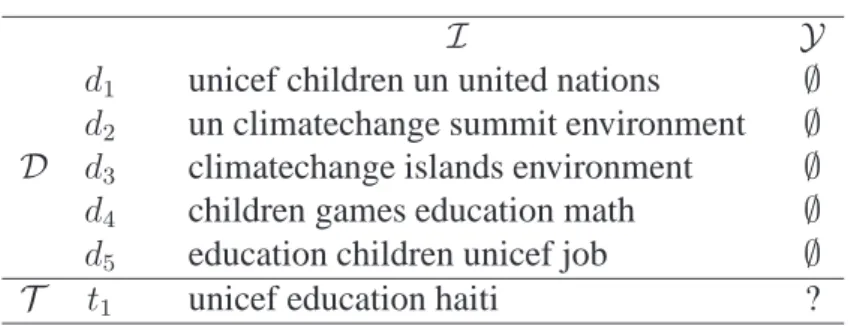
We now illustrate the filtering process. In Table 3.1there are 5 objects{<Id1,Yd1>;
<Id2,Yd2>;<Id3,Yd3>;<Id4,Yd4>;<Id5,Yd5>}inD, and one object<It1,Yt1>inT.
Table 3.2 showsD after being projected according to It1. In this case, I
t1
d1={It1 ∩
Id1}={unicef}, andY
t1
d1={Id1 − I
t1
d1}={children, un, united, nations}. The same procedure
is repeated for the remaining objects in D, so that Dt1 is finally obtained. For an arbitrary
objectt∈ T, we denote asRtthe rule-set extracted fromDt.
Lemma3.1states that all rules extracted from the filtered training set are useful for the input object (according to Definition3.2). In other words, after the filtering we only keep the objects that help us in extracting useful patterns.
Table 3.1. Training data and test set.
I Y
d1 unicef children un united nations ∅
d2 un climatechange summit environment ∅
D d3 climatechange islands environment ∅
d4 children games education math ∅
d5 education children unicef job ∅
T t1 unicef education haiti ?
Table 3.2. Projected training data for objectt1.
It Yt
dt1
1 unicef children un united nations
Dt1 d
t1
4 education children games math
dt1
5 unicef education children job
Lemma 3.1 All rules inRtare useful for objectt=<It,Yt>.
Proof Let X −→ y be an arbitrary rule in Rt. In this case, X ⊆ It. Thus, according to
Definition3.2, this rule must be useful for objectt.
For instance, any rule extracted fromDt1 (i.e., Table3.2) is useful for objectt1.
Exam-ples of rules extracted fromDt1 include:
• unicef−−−−→θ=1.00 children
• {unicef∧education}−−−−→θ=1.00 children
• education−−−−→θ=0.50 math
20 CHAPTER 3. PROPOSED METHOD
see that this rule cannot be extracted fromDt1, since tag “climatechange” is not present in
Dt1.
The next theorem states that LATRE efficiently extracts rules fromD. The key intuition
is that LATRE works only on tags that are known to be associated to each other, drastically
narrowing down the search space for rules.
Theorem 3.1 The complexity of LATRE increases polynomially with the number of tags in the vocabulary.
Proof Let n be the number of tags in the vocabulary. Obviously, the number of possible association rules that can be extracted fromDis 2n. Also, lett =<I
t,Yt>be an arbitrary
object inT. SinceItcontains at mostk tags (withk≪n), any rule useful for object t can
have at mostktags in its antecedent. Therefore, the number of possible rules that are useful
for objecttis(n-k)×(k+ k2
+. . .+ kk
) = O(nk)(sincek≪n), and thus, the number of
useful rules increases polynomially inn. Since, according to Lemma 1, LATRE extracts only
useful rules for objects inT, then the complexity of LATRE also increases polynomially in
n.
An important practical aspect of LATRE is that the projection of the dataset (as shown
in the examples in Tables3.1 and 3.2) greatly reduces the size of both n and k, since we only consider candidate tags that co-occur at least once with any tag in the test object (n is
reduced), while the size of the test object is small in practice (kis reduced). For instance, in
Tables3.1 and 3.2 we havek1 = 1, k2 = 0, k3 = 0, k4 = 1 andk5 = 2 for the projected
dataset. Therefore, the average k per object is(1 + 0 + 0 + 1 + 2)/5 = 4/5 = 0.8. This number is much smaller than the upper bound in the number of tags in an object, which is5
in the example.
3.3
Tag Ranking
In order to select candidate tags that are more likely to be associated with objectt ∈ T, it is
necessary to sort tags by combining rules inRt. In this case, LATRE interpretsRtas a poll,
in which each ruleX −→θ y∈ Rtis a vote given by tags inX for candidate tagy. Votes have
different weights, depending on the strength of the association they represent (i.e.,θ). The
weighted votes for each tagyare summed, giving the score for tagywith regard to objectt,
as shown in Equation3.1 (whereyi is the i-thcandidate tag, andθ(X −→ yi)is the valueθ
assumes for ruleX −→yi):
s(t, yi) =
X
3.4. CALIBRATION 21
Thus, for an object t, the score associated with tag yi is obtained by summing the
θ values of the rules predicting yi in Rt. The likelihood of t being associated with tag
yi is obtained by normalizing the scores, as expressed by the function pˆ(yi|t), shown in
Equation3.2:
ˆ
p(yi|t) =
s(t, yi) n
X
j=0
s(t, yj)
(3.2)
Candidate tags for object t are sorted according to Equation3.2, and tags appearing first in the ranking are finally recommended.
3.4
Calibration
According to Equation3.1, the score associated with a tag is impacted by two characteristics: (1) the number of votes it receives and (2) the strength of these votes. While both
charac-teristics are intuitively important to estimate the likelihood of association between tags and
objects, it may be difficult to decide which one is more important. In some cases, the scores
associated with different tags cannot be directly compared, because they operate in different scales (i.e., the score associated with popular tags are likely to be higher than the scores
asso-ciated with specific tags, simply because they receive a large number of votes). This means
that the same value of score can be considered either high or low, depending on the tag.
An approach for this problem would be to inspect the expected likelihoodpˆ(y|t), in
or-der to make scores associated with different tags directly comparable. The obvious problem
with this approach is that the correct value forpˆ(y|t)is not known in advance, sincet ∈ T,
and thus we cannot verify if y∈ Yt. An alternative is to use a validation set (denoted asV),
which is composed of objects of the form v =<Iv,Yv>, where both Iv andYv are sets of
tags associated with objectv, and{Iv∩ Yv}=∅. That is, the validation set essentially mimics
the test set, in the sense that Yv is not used for the sake of producing rules, but only to find
possible distortions in the value ofpˆ(y|v).
The key intuition of our approach is to contrast values ofpˆ(y|v)for whichy /∈ Yv, and
values ofpˆ(y|v)for whichy∈ Yv. In an ideal case, for a given tagy, there is a valuefy such
that:
22 CHAPTER 3. PROPOSED METHOD
Once fy is calculated, it can be used to determine whether a certain value of pˆ(y|v)
is low or high, so that the score associated with different tags can be directly compared. However, more difficult cases exist, for which it is not possible to obtain a perfect separation
in the space of values for pˆ(y|v). Thus, we propose a more general approach to calculate
fy. The basic idea is that any value forfy induces two partitions over the space of values
forpˆ(y|v)(i.e., one partition with values that are lower thanfy, and another partition with
values that are higher thanfy). Our approach is to setfy with the value which minimizes the
average entropy of these two partitions. In the following we present the basic definitions in
order to detail this approach.
Definition 3.3 Letybe an arbitrary tag, and letv =<Iv,Yv>be an arbitrary object inV.
In this case, leto(y, v)be a binary function such that:
o(y, v) =
(
1 ify∈ Yv
0 otherwise
Definition 3.4 ConsiderO(y)a list of pairs <o(y, v),pˆ(y|v)>, sorted in increasing order of pˆ(y|v). That is, O(y)={. . ., <o(y, vi), pˆ(y|vi)>, <o(y, vj),pˆ(y|vj)>, . . .}, such that
ˆ
p(y|vi) ≤ pˆ(y|vj). Also, consider ca candidate value for fy. In this case, Oc(y,≤) is a
sub-list of O(y), that is, Oc(y,≤)={. . ., <o(y, v),pˆ(y|v)>, . . .}, such that for all pairs in
Oc(y,≤), pˆ(y|v) ≤ c. Similarly,Oc(y, >)={. . ., <o(y, v),pˆ(y|v)>, . . .}, such that for all
pairs inOc(y, >),pˆ(y|v)> c. In other words,Oc(y,≤)andOc(y, >)are two partitions of
O(y)induced byc.
Definition 3.5 Consider N0(O(y)) the number of elements in O(y) for which o(y, v)=0.
Similarly, consider N1(O(y))the number of elements inO(y)for whicho(y, v)=1.
In our entropy-minimization calibration approach we can calculate the entropy of tag
yinO(y)using Equation3.3.
E(O(y)) =−
N0(O(y))
|O(y)| ×log
N0(O(y))
|O(y)|
−
N1(O(y))
|O(y)| ×log
N1(O(y))
|O(y)|
(3.3)
The first step is to calculate the sum of the entropies of tagyin each partition induced
byc, according to Equation3.4.
E(O(y), c) = |Oc(y,≤)|
|O(y)| ×E(Oc(y,≤)) +
|Oc(y, >)|
3.5. SUMMARY 23
The second step is to setfy to the value ofcwhich minimizesE(O(y), c). Now, the
final step is to calibrate each pˆ(y|t) (note that t ∈ T) using the corresponding fy (which
was obtained using the validation set). The intuition is thatfy separates values ofpˆ(y|t)that
should be considered high (i.e.,pˆ(y|t)> fy) from those that should be considered low (i.e.,
ˆ
p(y|t)≤fy). Thus, a natural way to calibratepˆ(y|t)is to calculate how many timespˆ(y|t)is
greater thanfy. This can be easily done as shown in Equation3.5. The values ofˆc(y|t)are
directly comparable, since the corresponding values of pˆ(y|t)were normalized byfy. Thus,
ˆ
c(y|t)is used to sort candidate tags that are more likely to be associated with objectt:
ˆ
c(y|t) = pˆ(y|t) fy
(3.5)
In some cases, calibration may drastically improves recommendation performance, as
we will show in the next chapter.
3.5
Summary
In this chapter we have presented our Lazy Tag REcommendation (LATRE) method. We
showed how we modelled tag recommendation as an associative classification problem.
Next, we discussed its lazy aspect, describing how the filtering of the training data increases
the algorithm efficiency. Later, we showed how we attribute scores to candidate tags, and
Chapter 4
Experiments
In this chapter we empirically analyze the recommendation performance of LATRE. We
em-ploy as the basic evaluation metrics precision at x (p@x), which measures the proportion of
relevant tags in the x first positions in the tag ranking, and MRR [Garg and Weber, 2008;
Sigurbjörnsson and van Zwol,2008], which shows the capacity of a method to return rele-vant tags early in the tag ranking. We first present the baseline and collections employed in
the evaluation, and then we discuss the recommendation performance of LATRE on these
collections.
4.1
Baseline
The baseline method used for comparison is described in [Sigurbjörnsson and van Zwol,
2008]. It is a co-occurrence method which also employs association rules. It gives less weight to candidate tags that are either too popular or too rare. Furthermore, its
algo-rithm gives more weight to candidate tags that are higher in each candidate tag list with
the goal of smoothening the co-occurrence values decay. The main difference between
Sigurbjörnsson and van Zwol’s and LATRE is that our method employs a filtering process to reduce the size of the training data according to an input object. This reduction causes
an increased efficiency and allows LATRE to extract rules that are more elaborate than the
baseline.
The reason the work in [Sigurbjörnsson and van Zwol, 2008] was used as baseline is that it is the state-of-the-art in tag recommendation using only tag co-occurrence and
collec-tive knowledge. Other related methods in Section 1.3were not considered as baselines be-cause they use additional information, such as the user history [Garg and Weber,2008], im-age features [Wu et al.,2009] and the page content [Heymann et al.,2008;Siersdorfer et al.,
26 CHAPTER 4. EXPERIMENTS
4.2
Collections
Differently from related work that present results restricted to a single
collec-tion [Garg and Weber, 2008; Heymann et al., 2008; Sigurbjörnsson and van Zwol, 2008], in this dissertation we experiment with several collections, namely, Delicious Web pages,
LastFM artists and YouTube videos. These datasets were chosen because they come from
popular Web 2.0 systems and because they represent different media types (Web pages, audio
and video). This diversity will help to validate our approach in several real scenarios. The
datasets can be obtained by e-mail request to the Laboratory for Treatment of Information (LATIN) at UFMG.
4.2.1
Delicious
Delicious is a popular social bookmarking application that permits users to store, share and
discover bookmarks. Users can categorize their bookmarks using tags, which serve as
per-sonal indexes so that a user can retrieve its stored pages. The assignment of tags in Delicious
is collaborative, i.e., the set of tags associated with a page is generated by many users in
collaboration.
For the Delicious crawl we used its “Recent Bookmarks” page, which is a public time-line that shows a subset of the most recently bookmarked objects. We collected unique
bookmarked page entries and extracted the set of most frequently used bookmarks for a
page (i.e., its “top bookmarks”). Delicious makes available as many as 30 “top bookmarks”.
Therefore, this is the maximum number of tags per object in our crawled dataset.
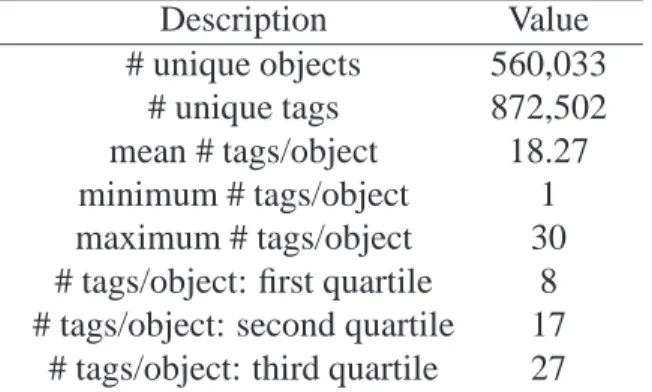
The crawl was performed in October 2009. Table4.1 presents some statistics for the Delicious dataset.
Table 4.1. In this table we show some statistics related to the Delicious dataset. The last
three entries refer to the first, second and third quartiles of the distribution of tags per object.
Description Value
# unique objects 560,033 # unique tags 872,502 mean # tags/object 18.27 minimum # tags/object 1 maximum # tags/object 30 # tags/object: first quartile 8 # tags/object: second quartile 17
4.3. PRE-PROCESSING STEPS AND SETUP 27
4.2.2
LastFM
LastFM is a Web 2.0 music website and Internet radio. It allows users to collaboratively
contribute with tags to categorize and describe the characteristics of artists, such as the music
genre. LastFM was crawled using a snowball approach, which collects a set of seed artists
and follows links to related artists. The artists used as seeds are the ones associated with the
system most popular tags.
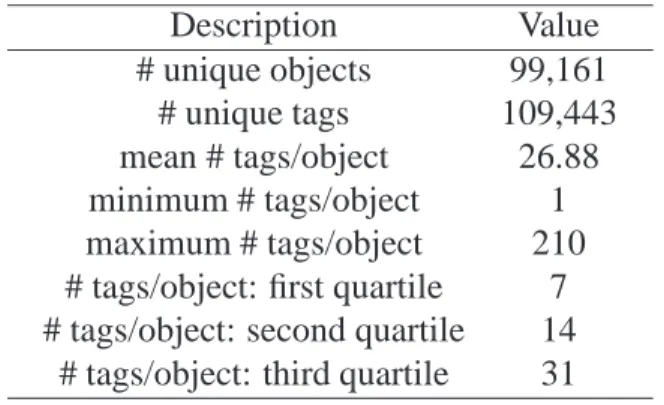
The crawl was performed in October 2008. Table4.2 presents some statistics for the LastFM dataset.
Table 4.2. Some statistics related to the LastFM dataset.
Description Value
# unique objects 99,161 # unique tags 109,443 mean # tags/object 26.88 minimum # tags/object 1 maximum # tags/object 210 # tags/object: first quartile 7 # tags/object: second quartile 14
# tags/object: third quartile 31
4.2.3
YouTube
YouTube is the largest video sharing application on the Web. Users that upload videos to
YouTube can provide a set of tags that describe them for indexing purposes. YouTube is different from Delicious and LastFM in that it is non-collaborative, that is, only the video
uploader can provide tags.
YouTube was crawled using a snowball approach, following links between related
videos. The all-time most popular videos were used as seeds. Our sample was obtained
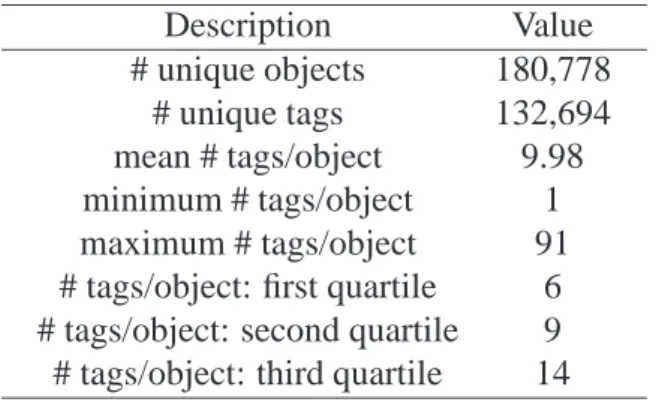
in July 2008. In Table4.3we show some statistics for the YouTube dataset.
4.3
Pre-Processing Steps and Setup
In order to assess the recommendation performance of the evaluated methods, we equally
di-vided the tags associated with test objectt =<It,Yt>: half of the tags is included inIt, and
the other half is included inYtand used to assess the performance. This division is made by
28 CHAPTER 4. EXPERIMENTS
Table 4.3. Some statistics related to the YouTube dataset.
Description Value
# unique objects 180,778 # unique tags 132,694 mean # tags/object 9.98 minimum # tags/object 1 maximum # tags/object 91 # tags/object: first quartile 6 # tags/object: second quartile 9 # tags/object: third quartile 14
applied Porter’s stemming algorithm [Porter, 1980] to avoid trivial recommendations such as plurals and small variations of the same input word.
We split each collection into three subsets: the first subset is composed of objects with
a large number of tags, the second subset is composed of objects with a moderate number of
tags, and the third subset is composed of objects with a small number of tags. The range of
tags per object was selected in a way that the corresponding subsets have approximately the
same number of objects. These subsets are characterized in Table4.4.
Then, we randomly selected 20,000 objects from each of the subsets. We divided each group of selected objects into 5 partitions of 4,000 objects each, and we used 5-fold cross
validation to assess recommendation performance. We use the validation set to find the best
parameters for each evaluated method.
Table 4.4. We divided each collection into three subsets according to the number of
tags per object. We show the number of objects in each of these subsets and the average number of tags per object (and its standard deviation) in each subset. Note that we excluded all objects associated with a single tag, since we need at least one tag inItand
one tag inYt.
Collection Range # Objects Avg. # Tags
Delicious
2 to 6 tags/object 188,173 3.94±1.38 7 to 12 tags/object 167,613 9.50±1.73 13 to 30 tags/object 170,708 15.92±2.53
LastFM
2 to 6 tags/object 29,622 3.96±1.39 7 to 16 tags/object 30,215 10.55±2.77 17 to 152 tags/object 31,492 44.99±25.30
YouTube