PRACTICE OF INDIGENOUS KNOWLEDGE SYSTEM BY THE FARMERS IN MAINTAINING ECOSYSTEM IN BANGLADESH
Md Mostafizur Rahman*
University of Rajshahi, Department of Agronomy and Agricultural Extension, Rajshahi- 6205, Bangladesh
Abstract: The main focus of the study was to identify the indigenous knowledge system being used by the rural men in farming and household activities and also to examine its extent. Data were collected from Poba upazila under Rajshahi district and Gabtoli upazila under Bogra district in Bangladesh from 125 randomly selected rural men out of total population of 1,145 from 15 February to 14 May, 2009. The fifty potential indigenous knowledge systems were identified through participatory rural appraisal prior to finalizing the schedule. The findings reveal that greater proportion of rural men were illiterate, middle aged categories, small farmer category, medium agricultural and environmental knowledge category, high level farming experience, medium cosmopoliteness, medium communication exposure, no organizational participation and moderately favorable category. Among the 50 identified indigenous knowledge systems, “Setting up bamboo sticks, branches of trees etc., in rice fields to let the birds sit and eat away insects” reached the highest extent of use by the farmers in agricultural practices. “Soaking boro rice seeds in water for 1-3 days before sowing in the bed for rapid germination”, “Drying mature bottle gourds (Lagenaria vulgaris) in the sun and
storing the seeds inside without rupturing the fruits” and “Keeping rice seedlings under shed for 1-2 days before transplanting for the purpose of increasing tolerance” took the 2nd, 3rd and 4th position regarding the extent of use. Considering farmers’ practicing category, the highest proportion (47.2%) of the respondents belonged to the low user as compared to 39.2% in the moderate user and 13.6% in the high user. Recommendations were forwarded to the extension specialists, researchers and administrators to undertake desk and experimental research concerning indigenous knowledge systems.
Key words: practices, indigenous knowledge system, maintaining, ecosystem.
*Corresponding author: e-mail: [email protected]
Introduction
Being a new country in an ancient land, Bangladesh possesses a rich heritage of indigenous technical knowledge, though much of which is lost during modernization of agriculture. Still this country and people are proud to nurture many myths, beliefs and traditions (Chowdhury et al., 1996). The historical, anthropological and socio-religious traditions of Bangladesh particularly the Mauryan epigraphy, the puthi calendars of Bengal, the Sayings of ‘Khana’ the Quran and Hadith, the value system of Hindus, exhibit a strong indigenous awareness of environment and rural resources conservation. IKS of farmers is believed to be highly effective and applicable to many instances even today. IKS of farmers is considered as an important source of information about the local farming systems, experiences, institutions, culture etc. and it is also proved that this knowledge system plays a significant role in designing a formal and efficient extension service (Sharland, 1991). There are many IKSs which are extensively used by the farmers but the scientists are not aware of these. The present study was, therefore, undertaken to identify the IKSs being used by the rural men in farming and household activities and also to examine its extent.
Material and Methods Study area
Three villages from each upazila namely Poba under Rajshahi district and Gabtoli upazila under Bogra district in Bangladesh were locales for the study and they were selected purposively because most of the farmers in these areas are engaged in fishery and animal husbandry besides the agricultural operation. The farmers who are practicing IKSs in their agricultural and household activities were taken into account as regards population. The population comprised 1,145 household heads of those 6 villages.
Collection of data
Semi-structured interview schedules were used for collecting data from a sample of 125 households out of 1,145 households from 15 February to 14 May, 2009. The schedule contained questions on selected individual characteristics of the respondents as well as 35 IKSs in agriculture, 9 in animal husbandry and 6 in fishery. This knowledge was identified through PRA (participatory rural appraisal) techniques prior to finalization of the schedule.
Measurement of farmers’ characteristics
agricultural knowledge and farmers’ knowledge about environmental pollution were included in different types of questions (each characteristic included 22 questions) in relation to those respective subjects and it was measured by using score. Four point Likert type scale was used on 15 statements which included different types of activities like agriculture, fishery and animal husbandry to measure supervision of crop production. Cosmopoliteness of a farmer was measured by computing a cosmopoliteness score on the basis of his frequency of visits to 6 different places outside his own social system. Communication exposure score of the respondents was computed by summing the obtained scores from the responses of the twenty-one selected communication media. Organizational participation of the respondents was measured on the basis of two dimensions; nature of involvement and number of organizations in which the respondents were involved. Attitude was measured by using five point Likert type scale with 14 statements (7 positive and 7 negative).
Measurement of extent of use of IKSs
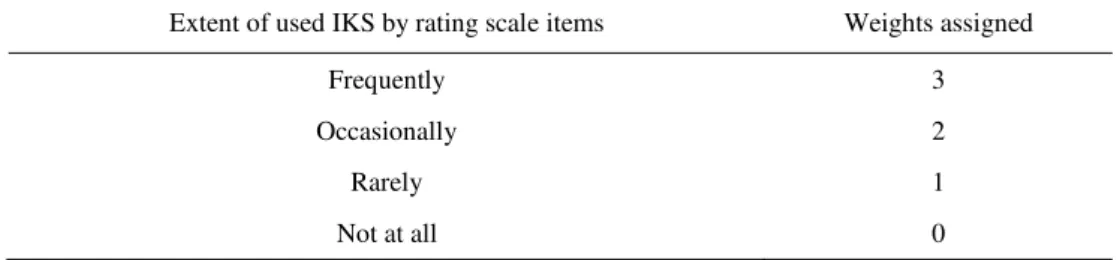
Four-point rating scale ranging from ‘frequently’, ‘occasionally’, ‘rarely’ to ‘not at all’ was used to measure the extent of use of IKS in this study. A similar four point scale was used by Saha (2008) and Roy (2009) for measuring “extent of use of IKS in agricultural practices”. The scoring techniques are given in Table 1.
Table 1. Scoring techniques for measuring IKS.
Extent of used IKS by rating scale items Weights assigned
Frequently 3
Occasionally 2
Rarely 1
Not at all 0
IKUI = N1 × 3 + N2 × 2 + N3 × 1 + N4 × 0. Where,
IKUI = Indigenous technology use index;
N1 = Number of farmers who used the IKS frequently; N2 = Number of farmers who used the IKS occasionally; N3 = Number of farmers who used the IKS rarely; N4 = Number of farmers who did not use the IKS at all; The IKUI for each of the IKSs could range from 0 to 375.
Results and Discussion
Characteristics of farmers
Human personality is the most complex and fascinating phenomenon. There are many interrelated and constituent attributes that characterize an individual and take an integral part in influencing the development of human behaviour. These include the individual’s personal, economic, social and psychological characteristics. It can be postulated that these characteristics influence decision-making process relating to an actual behaviour in the individual’s life. The information regarding the selected characteristics of the farmers is presented in Table 2.Categorization of the farmers was made on the basis of observed data and in some cases (age, farm size, education) considering the government rule.
Age: The majority (61.6%) of the farmers were middle-aged compared to 18.4% being young and 20.0% being old. Young people are always detached and not sincere in their familial life and the old always show the aloofness in different agricultural activities. This is why, during the selection of population in this study through PRA, middle aged farmers were considered. Saha (2008) found that age of the farmers had significant relationship for using indigenous technical knowledge (ITK) in agricultural practices.
Education: The highest proportion (43.2%) of the farmers was illiterate and 25.6% had primary school education. The data also showed that 11.2% of the respondents had secondary school education, 11.2% were able only to put signature, while 8.8% of the farmers had higher education qualifications. Education is the process of producing desired change in behaviour of the farmers and educated farmers are more conscious of using of environmentally friendly IKSs in their field.
Table 2. Farmers’ characteristics profile.
Sl.
No. Characteristics Measuring unit Range
Categories No. % Mean SD
P ossi bl e O bs er ved
1. Age Year -
25
-68
Young (<35) 23 18.4
44.17 3.9 Middle (36-50) 77 61.6
Old (>50) 25 20.0
2. Education Scores - 0-16
Illiterate (0) 54 43.2
5.03 4.10 Sign only (<1) 14 11.2
Primary (1-5) 32 25.6 Secondary (6-10) 14 11.2 Above secondary (>10) 11 8.8
3 Farm size Hectare -
0.
16
-4.
5 Very small (up to 0.20 ha) 10 8.0
1.01 0.90 Small (0.21-1.00 ha) 63 50.4
Medium 1.01-3.00 ha) 45 36.0 Large (>3.01 ha) 7 5.6
4. Agricultural knowledge Scores 0-44
18
-42
Low (18-25) 67 53.6
28.89 5.92 Medium (26-34) 28 22.4
High (>34) 30 24.0
5. Knowledge about environmental
pollution
0-30
8-28
Low (8-14) 36 28.8
17.45 4.50 Medium (15-21) 62 49.6
High (>21) 27 21.6
6. Farming experience Scores -
10
-50
Low (10-23) 15 12.0
34.68 7.66 Medium (24-37) 72 57.6
High (>37) 38 30.4
7 Supervision of crop production Scores 0-45
10.
43
Low (10-20) 22 17.6
28.56 7.08 Medium (21-31) 69 55.2
High (32-43) 34 27.2
8. Cosmopoliteness Scores 0-24 5-21
Low (5-10) 45 36.0
12.43 3.98 Medium(11-16) 66 52.8
High(>16) 14 11.2
9. Communication exposure Scores 0-57 8-48 Low (8-20)
53 42.4
23.26 8.66 Medium (21-34) 64 51.2
High (>34) 8 6.4
10. Organizational participation Scores -
0-18
No participation 46 36.8
3.62 4.42
Low 44 35.0
Medium 23 18.4
High 12 9.6
11. Attitude towards IKSs Scores 0-56
15
-54
Slightly favorable (15-25) 24 19.2
31.36 8.68 Moderately favorable (26-40) 76 60.8
Agricultural knowledge: The highest proportion (53.6%) of the respondents belonged to the medium knowledge category, while 24.0% belonged to the high knowledge category and 22.4% to the low knowledge category. Agricultural knowledge helps the farmers to grow crops by using environmentally friendly cultivation practices. Roy (2009) also found that IKS increased with the increased agricultural knowledge of the farmers.
Knowledge about environmental pollution: Almost half proportion (49.6%) of the farmers belonged to the medium category in respect to knowledge about environmental pollution while 28.8% belonged to the low category and 21.6% to the high category. Agriculture and environment have a close relationship and interact with each other in such a way that the health of agriculture depends on proper functioning of environmental process and the health of environment depends on respectful agriculture. Rahman (2008) observed that there was a positive significant relationship between knowledge about environmental pollution and an attitude towards IPM practices in rice cultivation.
Farming experience: The highest proportion (57.6%) of the farmers had medium farming experience compared to 30.4% having high farming experience and 12.0% having low farming experience.
Supervision of crop production: More than half (55.2%) of the farmers achieved a medium level of supervision for crop production as compared to 17.6% achieving low and 27.2% achieving a high level of supervision for the crop production (Table 2). Rahman (2008) observed that there was no relationship between supervision of crop production and an attitude towards IPM practices in rice cultivation.
Cosmopoliteness: The highest proportion (52.8%) of the farmers had medium cosmopoliteness as compared to 36.0% having low and 11.2% having high cosmopoliteness. Individuals who are cosmopolite frequently come in contact with new people, new things and new ideas. Cosmopoliteness thus brings about a change in the mental make-up and makes them more receptive to new ideas. Faruque (2002) in his study found that cosmopoliteness of the respondents had a significant negative relationship with their extent of use of ITK in rice cultivation. Saha (2008) found that cosmopoliteness of farmers had a significant negative relationship with their extent of use of ITKs in agricultural practices.
Communication exposure: Half proportion (51.2%) of the farmers of the study area had medium media contact as compared to 42.4% having low media contact. Only 6.4% of the farmers had high extension media contact. Islam (1996) observed in his study that there was a positive and significant relationship between the media exposure of the respondents and the extent of use of indigenous technical knowledge in the context of sustainable agricultural development.
(35.0%) had low organizational participation compared to 18.4% and 9.6% having medium and high organizational participation, respectively. Faruque (2002) in his study found that organizational participation of the respondents had a significant positive relationship with their extent of use of ITK in rice cultivation.
Attitude towards IKS: The highest proportion (60.8%) of the respondents had a moderately favorable attitude towards IKS practices as compared to 19.2% having slightly favorable and 20.0% highly favorable attitude towards IKS in agricultural practices. Saha (2006) conducted a study on perception of farmers on farmer information needs assessment (FINA) in Sadar upazila of Gazipur district. He observed that farming experience of the farmers had a highly significant positive relationship with their perception of FINA.
Identification of IKSs being used by the farmers
There is a wealth of knowledge at the disposal of farmers which they have been using generation after generation in Bangladesh. In the present study, IKS has been defined as the traditional knowledge of the farmers of Bangladesh in the production, protection and preservation of crops generated by their ancestors and internalized by the local people. Some identified IKSs in this study show colossal potential which has a direct positive influence on maintaining the ecosystem in Bangladesh. In all, there were 50 indigenous knowledge systems against which farmers were asked to pinpoint their uses. Table 1 presented the identified IKSs along with the number of citations on the extent of use of the individual IKSs. Based on these citations, IKUI for each of the IKSs was also calculated and finally ranked of each IKS. The IKUI along with its associated ranks appears in Table 3.
Among practices, the 35 identified IKSs in agriculture “Setting up bamboo sticks, branches of trees etc., in rice fields to let the birds sit and eat away insects” reached the highest extent of use by the farmers in agricultural practices. This is an easy IKS which is practised all over the country and does not need extra money. Farmers can put bamboo stick or branches of trees which are available in their surrounding area. So, the opinion of farmers regarding this IKS took the first position. “Soaking boro rice seeds in water for 1-3 days before sowing in the bed for rapid germination”, “Drying mature bottle gourds (Lagenaria vulgaris) in the
Table 3. List of identified IKSs used by the farmers in agriculture. Sl.
No. IKSs F O R NAA IKUIs Rank Citations (N=125)
1. Setting up bamboo sticks, branches of trees etc., in rice fields to let the birds sit and eat away insects
111 8 5 1 354 1
2. Spreading tobacco (Nicotiana tabacum) dusts over the field to control insects 12 8 10 95 62 26
3. Pulling ropes across the Boro rice field early in the morning to keep the soil moisture by falling dew drops
72 27 19 7 289 6
4. Applying fish-cleaning water at bean and cucurbit plant bases 78 16 4 27 270 8
5. De-topping Aus rice plants when the vegetative growth is vigorous 12 29 34 50 128 21
6. Using neem (Azadirachta indica) leaves to store grains 48 26 13 38 209 13.5
7. Using bishkatali (Polygonum hydropiper) to store grains 19 12 33 61 114 23
8. Drying mature bottle gourds (Lagenaria vulgaris) in the sun and storing the seeds
inside without rupturing the fruits 93 14 10 8 317 3
9. Laddering over the standing wheat crop (local variety) about a month after the seeding is done for profuse tillering
51 19 18 37 209 13.5
10. Making narrow incisions on the stem of papaya plants for better fruiting 58 8 12 47 202 15
11. Using hand net to control insects in the Aus rice fields 13 31 53 28 154 18
12. Fumigating kakrol (Momordica dioica) plants by igniting dhup to repel insects during flowering
6 4 18 97 44 32
13. Hand pollinating kakrol flowers for large, round and uniform fruits 2 7 18 98 38 33
14. Spraying neem solution to control insects in vegetables 7 9 13 96 52 30
15. Intercropping garlic (Allium sativum) and potato to minimize pest attack 20 22 30 53 134 20
16. Spreading ash in vegetable field to control aphid 70 13 11 31 247 12
17. Soaking Boro rice seeds in water for 1-3 days before sowing in the bed for rapid germination
97 10 7 11 318 2
18. Keeping rice seedlings under shed for 1-2 days before transplanting for the purpose of increasing tolerance
93 12 13 7 316 4
19. Spraying cow dung mixed with water in the rice field to prevent the attack of cattle and goat
4 24 34 63 94 25
20. Irrigating the rice fields by ‘Done’ (wood made water cane) 68 13 18 26 248 10.5
21. Using trap in the wheat and rice fields to control rodents 69 18 21 17 264 9
22. Using earthen containers and drum to store grains 79 15 12 19 279 7
23. Applying the excreta of poultry birds at the base bean and cucurbit plant for better yield
81 27 5 12 302 5
24. Mixing aphthalene powder with seeds for better germination 3 3 12 107 35 34
25. Spreading salt in the Aus rice fields to prevent the cut worm 3 10 31 81 60 27.5
26. Sowing red-stained Aus rice seeds in the field so that they are not eaten by the bird 14 20 14 77 96 24 27. Planting banana plants near the rodent holes in the Aman rice fields to control them 54 33 20 18 248 10.5 28. Achra (bamboo made rake) over the standing Aman rice (seedling stage) plant to
control weeds
22 42 38 23 188 16
29. Drawing straw-made kerosenized rope across the Aman rice fields to control insects
33 24 23 45 170 17
30. Mixing sands with pulses for long preservation 4 17 14 90 60 27.5
31. Longitudinal incision at the base of gourd plants by sharp blade for early flowering 11 34 43 37 144 19 32. For preserving the tender shoots of jute plants for future use as vegetable they are
slightly mixed with salts and dried in the sun
5 36 37 47 124 22
33. Destroying the eggs of yellow rice stem borer in Boro rice field by striking with the branches of spiny trees
5 12 17 91 56 29
34. Applying the mixture of kerosene and urea in the Aman rice fields to control stem
borer and leaf hoppers 2 13 17 93 49 31
35. Cutting of cabbage into small pieces dried in the sun and then kept in polythene bags
4 3 13 105 31 35
Among the 6 identified IKS in fishery “Applying cow dung in the pond to feed the fish” reached the highest extent of use by the farmers in agricultural practices (Table 4). Usually, farmers in the village do not buy any feed for fish. They always use cow dung, which is available in their homestead. This is why this IKS reached the highest rank of extent. The 2nd and 3rd highest extent of use were achieved by “Applying lime in the pond to clear the unclean water” and “Applying the excreta of poultry birds in the pond to feed the fish”, respectively. “Applying rice kura (rice husk) as fish-feed in the pond” reached the lowest extent of use by the farmers.
Table 4. List of identified IKSs used by the farmers in fishery.
Sl.
No. IKSs
Citations (N=125) F O R NAA IKUIs Rank 1. Applying cow dung in the pond to feed the fish 90 8 10 17 296 1 2. Applying oil cakes in the pond to feed the fish 25 57 16 27 205 5 3. Applying rice kura (rice husk) in the pond 26 24 38 37 164 6 4. Applying lime in the pond to clear the unclean water 85 13 14 13 295 2 5. Using banana leaves in the pond to feed grass carps 35 53 13 24 224 4 6. Applying the excreta of poultry birds in the pond to
feed the fish 84 11 8 22 282 3
F = frequently, O = occasionally, R = rarely, NAA = not at all, IKUI = indigenous technology use index.
Among the 9 identified IKSs in animal husbandry “Feeding rice mixed with KMnO4 to chicken to cure fowl cholera” reached the highest extent of use by the farmers in agricultural practices (Table 5). Generally, women in villages do this job habitually and receive excellent responses. “Feeding jat bichi kala (Musa sp.) to
livestock for curing loose motion” occupied the 2nd position for using of IKS in animal husbandry. Nowadays due to availability of a veterinary doctor farmers are not interested to use IKS in animal husbandry. The 3rd and 4th highest extents of use were held by “Feeding the katanate grass to livestock for improving lactation”, and “Feeding the flesh of mollusks and snails to ducks for growth”, respectively.
importance of using the IKSs which are low input oriented technologies can not be ignored.
Table 5. List of identified IKSs used by the farmers in animal husbandry.
Sl.
No. IKSs
Citations (N=125)
F O R NAA IKUIs Rank 1. Feeding garlic mixed with cow dung to chicken to
control ‘Ranikhet’ disease (Newcastle disease) 11 34 22 58 123 5 2. Feeding Maya tablet (a birth control tablet)
to chicken to control ‘Ranikhet’ disease 8 14 17 86 69 8 3. Feeding rice mixed with KMnO4 to chicken
to cure fowl cholera 61 23 11 30 240 1
4. Feeding the flesh of mollusks and snails to
ducks for growth 7 37 49 32 144 4
5. Using turmeric dust plus hukka (indigenous smoking
pipe) water to cure gas formation in livestock 8 17 19 81 77 7 6. Using rotten puti (Puntius stigma)fish extracts
to cure anorexia in cow 11 4 12 98 53 9
7. Feeding Jat Bichi Kala (Musa sp.) to livestock for
curing loose motion 41 43 26 15 235 2
8. Feeding the katanate grass to livestock for
improving lactation 48 6 14 57 170 3
9. Feeding used water of ‘Hukkah’ to goat to control
their hookworms 9 17 19 80 80 6
F = frequently, O = occasionally, R = rarely, NAA = not at all, IKUI = indigenous technology use index.
Extent of use of IKS by individual
The scores on the extent of use of IKS by individual in the study area ranged from 65 to 125 against a possible range of 0 to 150. The extent of use of IKS ranged from 65 to 125, the mean being 87.12 with standard deviation 14.92 and coefficient of variation 222.69. The respondents were categorized into low user, moderate user and high user categories. The distribution is shown in Table 6.
Table 6. Distribution of the farmers according to their use of IKS.
Categories Farmers Mean deviation Standard of variation Coefficient Number Percent
Low user (65-85) Moderate user (86-105) High user (above 105)
59 49 17
47.2 39.2 13.6
87.12 14.92 222.69
Data contained in Table 6 indicates that the highest proportion (47.2%) of the respondents belonged to the low user category as compared to 39.2% in the moderate user category and 13.6% in the high user category, respectively. Thus, the respondents in the study area provide no good footing in connection with their use of IKS in agricultural practices. From this standpoint, involvement of a minor proportion of the respondents in the high user category as well as a substantial attachment (86.4%) of the respondents to the low to moderate user categories seem to be somewhat confusing. Roy (2009) also found similar findings in her study that the highest proportion of the respondents fell into low to moderate user categories for practicing indigenous technical knowledge. Farmers are among the best evaluators of their own situation and environment. When they clearly understand and perceive that too much use of agrochemicals is not only detrimental to soil, water and environment at large but it is also hazardous for human health, they are careful. That is why the 1993 FAO Expert Consultation felt that the sustainability agenda called for extension agencies to be engaged in “learning from farmers’ experiences, participatory planning, the use of indigenous technical knowledge and open learning systems” in place of traditional top-down models of technology transfer (Stocking, 1994).
Conclusion
The present study reveals that the Bangladeshi farmers conventionally acquire IKSs and they are practicing these IKSs in their production field. Once these are thoroughly identified, modified and presented to the farmers as extension information from the concerned government departments there would be great potential for achieving environmentally sound agriculture and also maintaining the ecosystem. In order to minimize the emerging food demand for the rapid growth of population in Bangladesh, different high input orientated technologies are introduced in the agricultural sector. A lack of proper knowledge of the farmers in respect to technologies and their inputs caused pollution to soil, water and other elements of the environment. The concerned administrators and policy makers should give attention and take necessary steps in order to provide fruitful and effective training for the farmers on IKS and also launch motivational programs through mass media for using IKS in their field.
References
BBS (2001): Statistical year book of Bangladesh. Bangladesh Bureau of Statistics, Ministry of Planning, Government of the People’s Republic of Bangladesh, Dhaka, Bangladesh.
Farouk, S.M., Salam, M.U. (1996): Sustainable agriculture in Bangladesh addressing issues through human resource development. The Journal of Rural Development26(1):1-21.
Faruque, M.O. (2002): Use of indigenous technical knowledge (ITK) by the farmers in rice cultivation. M.Sc. Thesis. Department of Agricultural Extension Education, Bangladesh Agricultural University, Mymensingh, Bangladesh.
Islam, M.M. (1996): Farmers’ use of indigenous technical knowledge in the context of sustainable agricultural development. M.Sc. Thesis. Department of Agricultural Extension Education,
Bangladesh Agricultural University, Mymensingh, Bangladesh.
Rahman, M.M. (2008): Attitude of rice cultivating farmers towards integrated pest management practices in a selected Barind area under Rajshahi district. Ph.D. Thesis. Department of Agronomy and Agricultural Extension, University of Rajshahi, Rajshahi, Bangladesh.
Roy, S. (2009): Attitude towards and use of ITK in agricultural practices in North-East eco-systems in Bangladesh. Ph.D. Thesis. Department of Agricultural Extension and Rural Development, Bangabandhu Sheikh Mujibur Rahman Agricultural University, Gazipur, Bangladesh.
Saha, T.K. (2006): Perception of farmers on farmer information need assessment. M.Sc. Thesis. Department of Agricultural Extension and Rural Development, Bangabandhu Sheikh Mujibur Rahman Agricultural University, Gazipur, Bangladesh.
Saha, B.P. (2008): Use of IKSs in agricultural practices by the farmers of Paba Upazila under Rajshahi district. M.Sc. Thesis. Department of Agronomy and Agricultural Extension, University of Rajshahi, Rajshahi, Bangladesh.
Sharland, R.W. (1991): Indigenous knowledge systems, the cultural dimension of development. In: Warren, D.M., Slikkerveer, L.J., Brokensha, D. (Eds.), The cultural dimension of development: Indigenous knowledge systems, Intermediate Technology Publications, London, pp. 182-185. Stocking, M. (Ed.) (1994): Integrating environmental and sustainable development themes into
agricultural education and extension programmes. Report on an expert consultation held in Rome, 30 November to 03 December 1993, FAO, Rome.
Thrupp, L.A. (1987): Building legitimacy of indigenous knowledge: Environment for third world people of “Scientized packages” to be sold by development agencies? Paper presented at IDS Workshop on Farmers and Agricultural Research: Complementary Methods, 26-31 July 1987. University of Sussex, Brighton, U.K.
PRAKSA DOMAĆEG SISTEMA ZNANJA FARMERA U ODRŽAVANJU EKOSISTEMA U BANGLADEŠU
Md Mostafizur Rahman*
Radžšahi univerzitet, Odsek za agronomiju i poljoprivredno savetodavstvo, Radžšahi - 6205, Bangladeš
Glavni fokus ovog istraživanja je bila identifikacija domaćeg sistema znanja koji koriste poljoprivrednici u poljoprivredi i aktivnostima u domaćinstvu, kao i ispitivanje njegovog obima. Podaci su prikupljeni iz Poba upazila u Radžšahi okrugu i Gabtoli upazila u Bogra okrugu u Bangladešu od 125 slučajno izabranih
poljoprivrednika od ukupne populacije od 1.145 stanovnika u periodu od 15. februara do 14. maja 2009. godine. Pedeset potencijalnih domaćih sistema znanja
su prepoznati kroz participativno ruralno ocenjivanje pre izrade rasporeda. Rezultati pokazuju da je veći deo seoskih muškaraca nepismen, sredovečne
kategorije, kategorije malih farmera, srednjeg poljoprivrednog i ekološkog znanja, visokog nivoa poljoprivrednog iskustva, srednje kosmopolitnosti, srednje
komunikacione izloženosti, bez organizacionog učešća i umereno povoljne
kategorije. Među 50 identifikovanih sistema znanja, „Postavljanje bambusovih
štapova, grana drveća itd., u pirinčana polja kako bi se omogućilo da ptice sede i jedu insekte” je dostigao najviši stepen upotrebe od strane farmera u poljoprivrednoj praksi. „Potapanje boro pirinčanih semena u vodu 1-3 dana pre setve u leju radi brzog klijanja”, „Sušenje zrelih tikava u obliku flaša (Lagenaria vulgaris) na suncu i skladištenje semena unutra bez slamanja plodova” i „Držanje sadnica pirinča u šupi 1-2 dana pre presađivanja radi povećanja tolerantnosti”
zauzimaju drugo, treće i četvrto mesto u pogledu stepena upotrebe. Uzimajući u
obzir kategoriju farmerske prakse, najveći deo (47,2%) ispitanika pripada kategoriji slabog korisnika u poređenju sa 39,2% kod kategorije srednjeg korisnika i 13,6% kod kategorije visokog korisnika. Preporuke su prosleđene stručnjacima iz
oblasti savetodavstva, istraživačima i upravnicima da sprovedu sekundarno i eksperimentalno istraživanje u vezi sa domaćim sistemima znanja.
Ključne reči:prakse, domaći sistem znanja, održavanje, ekosistem.
Primljeno: 21. februara 2012. Odobreno: 7. marta 2013.