❊♥s❛✐♦s ❊❝♦♥ô♠✐❝♦s
❊s❝♦❧❛ ❞❡
Pós✲●r❛❞✉❛çã♦
❡♠ ❊❝♦♥♦♠✐❛
❞❛ ❋✉♥❞❛çã♦
●❡t✉❧✐♦ ❱❛r❣❛s
◆◦ ✼✶✼ ■❙❙◆ ✵✶✵✹✲✽✾✶✵
❆ ❙t♦❝❤❛st✐❝ ❞✐s❝♦✉♥t ❢❛❝t♦r ❛♣♣r♦❛❝❤ t♦ ❛s✲
s❡t ♣r✐❝✐♥❣ ✉s✐♥❣ ♣❛♥❡❧ ❞❛t❛ ❛s②♠♣t♦t✐❝s
❋❛❜✐♦ ❆r❛ú❥♦✱ ❏♦ã♦ ❱✐❝t♦r ■ss❧❡r
❖s ❛rt✐❣♦s ♣✉❜❧✐❝❛❞♦s sã♦ ❞❡ ✐♥t❡✐r❛ r❡s♣♦♥s❛❜✐❧✐❞❛❞❡ ❞❡ s❡✉s ❛✉t♦r❡s✳ ❆s
♦♣✐♥✐õ❡s ♥❡❧❡s ❡♠✐t✐❞❛s ♥ã♦ ❡①♣r✐♠❡♠✱ ♥❡❝❡ss❛r✐❛♠❡♥t❡✱ ♦ ♣♦♥t♦ ❞❡ ✈✐st❛ ❞❛
❋✉♥❞❛çã♦ ●❡t✉❧✐♦ ❱❛r❣❛s✳
❊❙❈❖▲❆ ❉❊ PÓ❙✲●❘❆❉❯❆➬➹❖ ❊▼ ❊❈❖◆❖▼■❆ ❉✐r❡t♦r ●❡r❛❧✿ ❘✉❜❡♥s P❡♥❤❛ ❈②s♥❡
❱✐❝❡✲❉✐r❡t♦r✿ ❆❧♦✐s✐♦ ❆r❛✉❥♦
❉✐r❡t♦r ❞❡ ❊♥s✐♥♦✿ ❈❛r❧♦s ❊✉❣ê♥✐♦ ❞❛ ❈♦st❛
❉✐r❡t♦r ❞❡ P❡sq✉✐s❛✿ ▲✉✐s ❍❡♥r✐q✉❡ ❇❡rt♦❧✐♥♦ ❇r❛✐❞♦ ❉✐r❡çã♦ ❞❡ ❈♦♥tr♦❧❡ ❡ P❧❛♥❡❥❛♠❡♥t♦✿ ❍✉♠❜❡rt♦ ▼♦r❡✐r❛ ❉✐r❡çã♦ ❞❡ ●r❛❞✉❛çã♦✿ ❘❡♥❛t♦ ❋r❛❣❡❧❧✐ ❈❛r❞♦s♦
❆r❛ú❥♦✱ ❋❛❜✐♦
❆ ❙t♦❝❤❛st✐❝ ❞✐s❝♦✉♥t ❢❛❝t♦r ❛♣♣r♦❛❝❤ t♦ ❛ss❡t ♣r✐❝✐♥❣ ✉s✐♥❣ ♣❛♥❡❧ ❞❛t❛ ❛s②♠♣t♦t✐❝s✴ ❋❛❜✐♦ ❆r❛ú❥♦✱ ❏♦ã♦ ❱✐❝t♦r ■ss❧❡r ✕ ❘✐♦ ❞❡ ❏❛♥❡✐r♦ ✿ ❋●❱✱❊P●❊✱ ✷✵✶✶
✹✺♣✳ ✲ ✭❊♥s❛✐♦s ❊❝♦♥ô♠✐❝♦s❀ ✼✶✼✮ ■♥❝❧✉✐ ❜✐❜❧✐♦❣r❛❢✐❛✳
A Stochastic Discount Factor Approach to Asset
Pricing using Panel Data Asymptotics
Fabio Araujo
Department of Economics
Princeton University
email: [email protected]
João Victor Issler
Graduate School of Economics – EPGE
Getulio Vargas Foundation
email: [email protected]
yThis Draft: May, 2011.
Keywords
: Stochastic Discount Factor, No-Arbitrage, Common
Features, Panel-Data Econometrics.
J.E.L. Codes:
C32, C33, E21, E44, G12.
This paper circulated in 2005-6 as “A Stochastic Discount Factor Approach without a Utility Func-tion.” Marcelo Fernandes was also a co-author in it. Since then, Fernandes has withdrawn from the paper and this draft includes solely the contributions of Araujo and Issler to that previous e¤ort. We thank the comments given by Jushan Bai, Marco Bonomo, Luis Braido, Xiaohong Chen, Valentina Corradi, Carlos E. Costa, Daniel Ferreira, Luiz Renato Lima, Oliver Linton, Humberto Moreira, Walter Novaes, and Farshid Vahid. Special thanks are due to Caio Almeida, Robert F. Engle, Marcelo Fernandes, René Garcia, Lars Hansen, João Mergulhão, Marcelo Moreira, Cristine Xavier Pinto, and José A. Scheinkman. We also thank José Gil Ferreira Vieira Filho and Rafael Burjack for excellent research assistance. The usual disclaimer applies. Fabio Araujo and João Victor Issler gratefully acknowledge support given by CNPq-Brazil and Pronex. Issler also thanks INCT and FAPERJ for …nancial support.
Abstract
Using the Pricing Equation in a panel-data framework, we construct a novel
consistent estimator of the stochastic discount factor (SDF) which relies on the fact
that its logarithm is the “common feature” in every asset return of the economy.
Our estimator is a simple function of asset returns and does not depend on any
parametric function representing preferences.
The techniques discussed in this paper were applied to two relevant issues in
macroeconomics and …nance: the …rst asks what type of parametric
preference-representation could be validated by asset-return data, and the second asks whether
or not our SDF estimator can price returns in an out-of-sample forecasting exercise.
In formal testing, we cannot reject standard preference speci…cations used in
the macro/…nance literature. Estimates of the relative risk-aversion coe¢cient are
between 1 and 2, and statistically equal to unity.
We also show that our SDF proxy can price reasonably well the returns of stocks
with a higher capitalization level, whereas it shows some di¢culty in pricing stocks
with a lower level of capitalization.
1
Introduction
In this paper, we derive a novel consistent estimator of the stochastic discount factor (or
pricing kernel) that takes seriously the consequences of the Pricing Equation established
by Harrison and Kreps (1979), Hansen and Richard (1987), and Hansen and Jagannathan
(1991), where asset prices today are a function of their expected future payo¤s discounted
by the stochastic discount factor (SDF). If the Pricing Equation is valid for all assets at
all times, it can serve as a basis to construct an estimator of the SDF in a panel-data
framework when the number of assets and time periods is su¢ciently large. This is exactly
the approach taken here.
We start with a general Taylor Expansion of the Pricing Equation to derive the
de-terminants of thelogarithm of returns once we impose the moment restriction implied by
the Pricing Equation. The identi…cation strategy employed to recover the logarithm of the SDF relies on one of its basic properties – it is a “common feature,” in the sense of
Engle and Kozicki (1993), of every asset return of the economy. Under mild restrictions
on the behavior of asset returns, used frequently elsewhere, we show how to construct a
consistent estimator for the SDF which is a simple function of the arithmetic and
geo-metric averages of asset returns alone, and does not depend on any parageo-metric function
used to characterize preferences.
A major bene…t of our approach is that we are able to study intertemporal asset pricing
without the need to characterize preferences or to use of consumption data; see a similar
approach by Hansen and Jagannathan (1991, 1997). This yields several advantages of
our SDF estimator over possible alternatives. First, since it does not depend on any
parametric assumptions about preferences, there is no risk of misspeci…cation in choosing
an inappropriate functional form for the estimation of the SDF. Moreover, our estimator
can be used to test directly di¤erent parametric-preference speci…cations commonly used
in …nance and macroeconomics. Second, since it does not depend on consumption data,
our estimator does not inherit the smoothness observed in previous consumption-based
estimates which generated important puzzles in …nance and in macroeconomics, such
etc.; see Hansen and Singleton (1982, 1983, 1984), Mehra and Prescott (1985), Campbell
(1987), Campbell and Deaton (1989), and Epstein and Zin (1991).
Our approach is related to research done in three di¤erent …elds. From econometrics,
it is related to the common-features literature after Engle and Kozicki (1993). Indeed, we
attempt to bridge the gap between a large literature on serial-correlation common features
applied to macroeconomics, e.g., Vahid and Engle (1993, 1997), Engle and Issler (1995),
Issler and Vahid (2001, 2006), Vahid and Issler (2002), Hecq, Palm and Urbain (2005),
Issler and Lima (2009), Athanasopoulos et al. (2011), and the …nancial econometrics
literature related to the SDF approach, perhaps best represented by Chapman (1998),
Aït-Sahalia and Lo (1998, 2000), Rosenberg and Engle (2002), Garcia, Luger, and
Re-nault (2003), Garcia, ReRe-nault, and Semenov (2006), Hansen and Scheinkman (2009), and
Hansen and Renault (2009). It is also related respectively to work on common factors
in macroeconomics and in …nance; see Geweke (1977), Stock and Watson (1989, 1993,
2002) Forni et al. (2000), and Bai and Ng (2004) as examples of the former, and a large
literature in …nance perhaps best exempli…ed by Fama and French (1992, 1993), Lettau
and Ludvigson (2001), Sentana (2004), and Sentana, Calzolari, and Fiorentini (2008) as
examples of the latter. From macroeconomics, it is related to the work using panel data
for testing optimal behavior in consumption, e.g., Runkle (1991), Blundell, Browning, and
Meghir (1994), Attanasio and Browning (1995), Attanasio and Weber (1995), and to the
work of Mulligan (2002) on cross-sectional aggregation and intertemporal substitution.
The set of assumptions needed to derive our results are common to many papers in
…nancial econometrics: the lack of arbitrage opportunities in pricing securities is assumed
in virtually all studies estimating the SDF, and the restrictions (discipline) we impose on
the stochastic behavior of asset returns are fairly standard. What we see as non-standard
in our approach is an attempt to bridge the gap between economic and econometric theory
in devising an econometric estimator of a random process which has a straightforward
economic interpretation: it is the common feature of asset returns. Once the estimation
problem is put in these terms, it is straightforward to apply panel-data techniques to
parametric function used to characterize preferences, which we see as a major bene…t
following the arguments in the seminal work of Hansen and Jagannathan (1991, 1997).
In a …rst application, with quarterly data on U.S.$ real returns, ultimately using
thou-sands of assets available to the average U.S. investor, our estimator of the SDF is close
to unity most of the time and bound by the interval [0:85;1:15], with an equivalent av-erage annual discount factor of0:9711, or an average annual real discount rate of2:97%. When we examined the appropriateness of di¤erent functional forms to represent
prefer-ences, we concluded that standard preference representations cannot be rejected by the
data. Moreover, estimates of the relative risk-aversion coe¢cient are close to what can
be expected a priori – between 1 and 2, statistically signi…cant, and not di¤erent from unity in statistical tests. In a second application, we tried to approximate the asymptotic
environment directly, working with monthly U.S. time-series return data with T = 336 observations, collected for a total of N = 16;193 assets. Using the distance measure of Hansen and Jagannathan (1997), we show that our SDF proxy can price reasonably well
the returns of stocks with a high capitalization value, although it shows some di¢culty in
pricing stocks of …rms with a low level of capitalization.
The next Section presents basic theoretical results, our estimation techniques, and a
discussion of our main result. Section 3 shows the results of empirical tests in
macro-economics and …nance using our estimator: estimating preference parameters using the
Consumption-based Capital Asset-Pricing Model (CCAPM) and out-of-sample evaluation
of the Asset-Pricing Equation. Section 4 concludes.
2
Economic Theory and SDF Estimator
2.1
A Simple Consistent Estimator
Harrison and Kreps (1979), Hansen and Richard (1987), and Hansen and Jagannathan
factor (SDF), which relies on the Pricing Equation1:
EtfMt+1xi;t+1g=pi;t; i= 1;2; : : : ; N; or (1)
EtfMt+1Ri;t+1g= 1; i= 1;2; : : : ; N; (2)
where Et( ) denotes the conditional expectation given the information available at time
t, Mt is the stochastic discount factor, pi;t denotes the price of the i-th asset at time t,
xi;t+1 denotes the payo¤ of thei-th asset in t+ 1,Ri;t+1 = xi;t+1pi;t denotes the gross return of thei-th asset in t+ 1, andN is the number of assets in the economy.
The existence of a SDF Mt+1 that prices assets in (1) is obtained under very mild conditions. In particular, there is no need to assume a complete set of security markets.
Uniqueness of Mt+1, however, requires the existence of complete markets. If markets are incomplete, i.e., if they do not span the entire set of contingencies, there will be an
in…nite number of stochastic discount factors Mt+1 pricing all traded securities. Despite that, there will still exist a unique discount factorMt+1, which is an element of the payo¤ space, pricing all traded securities. Moreover, any discount factorMt+1can be decomposed as the sum of Mt+1 and an error term orthogonal to payo¤s, i.e., Mt+1 = Mt+1 + t+1, whereEt( t+1xi;t+1) = 0. The important fact here is that the pricing implications of any
Mt+1 are the same as those of Mt+1, also known as the mimicking portfolio. We now state the four basic assumptions needed to construct our estimator:
Assumption 1: We assume the absence of arbitrage opportunities in asset pricing, c.f.,
Ross (1976). This must hold instantaneously for allt = 1;2; :::; T, i.e., it must hold at all times and for all lapses of time, however small.
Assumption 2: Let Rt = (R1;t; R2;t; ::: RN;t)0 be an N 1 vector stacking all asset
returns in the economy and consider the vector process fln (MtRt)g. In the time
(t) dimension, we assume that fln (MtRt)g
1
t=1 is covariance-stationary and ergodic
with …nite …rst and second moments uniformly acrossi.
At a basic level, Assumption 1 is a necessary and su¢cient condition for the
Pric-ing Equation (2) to hold; see Cochrane (2002). Under the assumptions in Hansen and
Renault (2009), Assumption 1 implies (2). In any case, (2) is present, either implicitly
or explicitly, in virtually all studies in …nance and macroeconomics dealing with asset
pricing and/or with intertemporal substitution; see, e.g., Hansen and Singleton (1982,
1983, 1984), Mehra and Prescott (1985), Epstein and Zin (1991), Fama and French (1992,
1993), Attanasio and Browning (1995), Lettau and Ludvigson (2001), Garcia, Renault,
and Semenov (2006), Hansen and Scheinkman (2009) and Hansen and Renault (2009). It
is essentially equivalent to the “law of one price” – where securities with identical payo¤s
in all states of the world must have the same price. We impose its validity instantaneously
since we will derive a logarithmic representation for (2), which allows exact measure of
instantaneous returns for all assets.
The absence of arbitrage opportunities has also two other important implications. The
…rst is there exists at least one stochastic discount factorMt, for whichMt>0; see Hansen
and Jagannathan (1997). This is due to the fact that, when we consider the existence
derivatives on traded assets, arbitrage opportunities will arise if Mt 0. Positivity of
some Mt is required here because we will take logs of Mt in proving our asymptotic
results2. The second is that the absence of arbitrage requires that a weak law-of-large
numbers (WLLN) holds in the cross-sectional dimension for the level of gross returnsRi;t
(Ross (1976, p. 342)). This controls the degree of cross-sectional dependence in the data
and constitutes the basis of the arbitrage pricing theory (APT). Applying the Ergodic
Theorem in the cross-sectional dimension, implies that we should also expect a WLLN to
hold for its logarithmic counterpart (lnRi;t), forming the basis of our asymptotic results.
Assumption 2 controls the degree of time-series dependence in the data. Across time
(t), asset returns have clear signs of heterogeneity: di¤erent means and variances, and con-ditional heteroskedasticity; as examples of the latter see Bollerslev, Engle and Wooldridge
(1988) and Engle and Marcucci (2006). Of course, weak-stationary processes can display
2Recall that all CCAPM studies implicitly assume M
t > 0, since Mt = u
0(c
t)
u0(ct 1) > 0, where ct is
conditional heteroskedasticity as long as second moments are …nite; see Engle (1982).
Therefore, Assumption 2 allows for heterogeneity in mean returns and conditional
het-eroskedasticity in returns used in computing our estimator. Uniformity across (i) is re-quired for technical reasons, since we want the mean across …rst and second moments of
returns to be de…ned.
To construct a consistent estimator for fMtg we consider a second-order Taylor
Ex-pansion of the exponential function around x; with incrementh; as follows:
ex+h =ex+hex+h
2ex+ (h)h
2 ; (3)
with (h) :R!(0;1): (4)
It is important to stress that (3) is an exact relationship and not an approximation. This
is due to the nature of the function (h) : R ! (0;1), which maps into the open unit interval. Thus, the last term is evaluated betweenxandx+h, making (3) to hold exactly. For the expansion of a generic function, ( ) would depend on x and h. However, dividing (3) byex:
eh = 1 +h+ h
2e (h)h
2 ; (5)
shows that (5) does not depend onx. Therefore, we get a closed-form solution for ( )as function of h alone:
(h) =
8 > < > :
1
h ln
2 (eh 1 h)
h2 ; h 6= 0
1=3; h= 0;
where ( ) maps from the real line into(0;1). To connect (5) with the Pricing Equation (2), we impose h= ln(MtRi;t) in (5) to obtain:
MtRi;t = 1 + ln(MtRi;t) +
[ln(MtRi;t)]2e (ln(MtRi;t)) ln(MtRi;t)
2 ; (6)
It is useful to de…ne the random variable collecting the higher order term of (6):
zi;t
1
2 [ln(MtRi;t)]
2
e (ln(MtRi;t)) ln(MtRi;t):
Taking the conditional expectation of both sides of (6) gives:
Et 1(MtRi;t) = 1 +Et 1(ln(MtRi;t)) +Et 1(zi;t). (7)
As a direct consequence of the Pricing Equation, the left-hand side cancels with the …rst
term of the right-hand side of (7), yielding:
Et 1(zi;t) = Et 1fln(MtRi;t)g: (8)
This …rst shows that Et 1(zi;t) will be solely a function of Et 1fln(MtRi;t)g if the
Pricing Equation holds, otherwise it will also be a function of Et 1(MtRi;t). Second,
zi;t 0 for all(i; t). Therefore, Et 1(zi;t) 2i;t 0, and we denote it as 2i;t to stress the
fact that it is non-negative.
Let 2
t 21;t; 22;t ; :::; 2N;t
0
and "t ("1;t; "2;t; :::; "N;t)
0
stack respectively the
condi-tional means 2
i;t and the forecast errors "i;t. Then, from the de…nition of "t we have:
ln(MtRt) = Et 1fln(MtRt)g+"t
= 2t +"t: (9)
Denoting by rt = ln (Rt), which elements are denoted by ri;t = ln (Ri;t), and by mt = ln (Mt), (9) yields the following system of equations:
ri;t = mt 2i;t+"i;t; i= 1;2; : : : ; N: (10)
The system (10) shows that the (log of the) SDF is a common feature, in the sense
of Engle and Kozicki (1993), of all (logged) asset returns. For any two economic series,
combination. Hansen and Singleton (1983) were the …rst authors to exploit this property
of (logged) asset returns, although the concept was only proposed 10 years later by Engle
and Kozicki.
Looking at (10), asset returns are decomposed into three terms, but we focus on the
…rst – the logarithm of the SDF, mt, which is common to all returns and has random
variation only across time. Notice thatmt can be removed by linearly combining returns:
for any two assets iand j,ri;t rj;t will not contain the featuremt, which makes(1; 1)
a “cofeature vector” for all asset pairs.
We label (10) as a quasi-structural system for logged returns, since its foundation is
the Asset-Pricing Equation (1). Equation (10) can be thought as a factor model for ri;t,
where the common factormthas only time-series variation. Indeed, this is the logarithmic
counterpart of the common-factor model assumed by Ross (1976) for the level of returns
Ri;t, where here the Pricing Equation (1) provides a solid structural foundation to it.
The sources of cross-sectional variation in every equation of the system (10) are "i;t
and 2
i;t. However, as we show next, the terms 2i;t are a linear function of lagged"i;t, tying
the cross-sectional variation in (10) ultimately to"i;t.
Start with Assumption 2. Because ln(MtRt) is weakly stationary, for every one of its
elements ln(MtRi;t), there exists a Wold representation, which is a linear function of the
innovation in ln(MtRi;t), de…ned as "i;t = ln(MtRi;t) Et 1fln(MtRi;t)g and stacked in
"t ("1;t; "2;t; :::; "N;t)
0
. Therefore, the individual Wold representations can be written
as:
ln(MtRi;t) = i+
1
X
j=0
bi;j"i;t j; i= 1;2; : : : ; N; (11)
where, for all i, bi;0 = 1, j ij <1, P1
j=0b2i;j <1, and "i;t is a multivariate white noise.
Using (8), in light of (11), leads to:
2
i E(zi;t) = Efln(MtRi;t)g= i; (12)
which is well de…ned and time-invariant under Assumption 2. Taking conditional
the following system, once we consider (10):
ri;t = mt 2i +"i;t
1
X
j=1
bi;j"i;t j; i= 1;2; : : : ; N: (13)
This is just a di¤erent way of writing (10)3. Because m
t is devoid of cross-sectional
variation, (13) shows that the ultimate source of cross-sectional variation for ri;t is "i;t
(and its lags). This paves the way to derive a consistent estimator for Mt based on the
existence of a WLLN for f"i;tgNi=1. This is consistent with lim
N!1V AR
1
N PN
i=1"i;t = 0,
but the critical issue is whether or not N1 PNi=1"i;t p
!0. If that were the case, it would
be straightforward to compute plim
N!1
1
N PN
i=1ri;t +mt and then construct a a consistent
estimator for Mt.
Convergence in probability for logged returns ri;t is not surprising, given the
assump-tion of convergence in probability for the levels of returnsRi;t behind the APT. After all,
ri;t = ln (Ri;t) is a measurable transformation of Ri;t. By applying the Ergodic Theorem
in the cross-sectional dimension, we should also expect that a WLLN holds for fri;tgNi=1 as well. Despite that, one may be skeptical of:
1
N
N X
i=1
"i;t p
!0: (14)
Equation (14) may seem restrictive because we can always decompose"i;t as:
"i;t = ln(MtRi;t) Et 1fln(MtRi;t)g (15)
= [mt Et 1(mt)] + [ri;t Et 1(ri;t)] =qt+vi;t; (16)
3Here it becomes obvious that:
2
i;t = 2i +
1
X
j=1
bi;j"i;t j
= i+
1
X
j=1
where qt = [mt Et 1(mt)] is the innovation in mt and vi;t = [ri;t Et 1(ri;t)] is the
innovation inri;t. Therefore, to get plim
N!1
1
N PN
i=1"i;t = 0, we need,
plim N!1 1 N N X i=1
vi;t = qt, (17)
which may seem like a knife-edge restriction on the cross-sectional distribution of vi;t.
Indeed, it is not. To show it, consider the argument of projecting vi;t into qt, collecting
terms, and decomposing "i;t as follows:
"i;t = iqt+ i;t, where i
COV("i;t; qt)
VAR(qt)
= 1 + COV(vi;t; qt)
VAR(qt)
. (18)
Here, we collect all that is pervasive in qt and thus it is reasonable to assume that
plim
N!1
1
N PN
i=1 i;t = 0. In this context of the factor model (18), in order to get plim
N!1
1
N PN
i=1"i;t =
0, we must have:
plim N!1 1 N N X i=1
i;t = qt, where lim
N!1 1 N N X i=1
i = . Thus, (19)
lim N!1 1 N N X i=1
i = = 0, or lim
N!1 1 N N X i=1
COV(vi;t; qt)
VAR(qt)
= 1: (20)
Equation (20) highlights that the issue is not one of a knife-edge restriction. In order
to obtain plim
N!1
1
N PN
i=1"i;t = 0, and use plim
N!1
1
N PN
i=1ri;t +mt to construct a consistent estimator for Mt, the average factor loading must obey lim
N!1
1
N PN
i=1 i = 0. Notice that
vi;t is an innovation coming from data(ri;t), butqtis an innovation coming from the latent
variable mt, which makes this an issue of separate identi…cation of the factor(qt) and of
its respective factor loadings( i).
Next, we state our most important result: a novel consistent estimator of the
sto-chastic processfMtg1t=1. Instead of using the Ergodic Theorem, we chose a more intuitive asymptotic approach based on no-arbitrage, where thequasi-structural system (10) serves
use directly the projection argument in (18) to show that no-arbitrage will indeed deliver
the seemingly knife-edge restriction lim
N!1
1
N PN
i=1 i = 0. In our discussion of the main
result below, we exploit further the econometric identi…cation issue raised above.
Theorem 1 Under Assumptions 1 and 2, as N; T ! 1, with N diverging at a rate at
least as fast asT, the realization of the SDF at timet, denoted by Mt, can be consistently
estimated using:
c
Mt=
RGt
1
T T P j=1
RGj RAj ;
where RGt = QNi=1R
1 N
i;t and R
A t = N1
N P i=1
Ri;t are respectively the geometric average of the
reciprocal of all asset returns and the arithmetic average of all asset returns.
Proof. Consider a cross-sectional average of (13):
1
N
N X
i=1
ri;t+mt=
1 N N X i=1 2 i + 1 N N X i=1 "i;t 1 N N X i=1 1 X j=1
bi;j"i;t j; (21)
and examine convergence in probability of N1 PNi=1ri;t+mt using (21).
First, because every term ln(MtRi;t) has a …nite mean i = 2i, uniformly across i,
the limit of their average must be …nite, i.e.,
lim N!1 1 N N X i=1 2
i 2 <1: (22)
Second, there is no correlation across time for the elements in "t ("1;t "2;t ::: "N;t)
0
,
due to the assumption of weak stationarity for the vector process fln (MtRt)g. Hence,
E("i;t "h;t j) = 0, for all i and h, and all j 1. Therefore, the asymptotic variance of
1
N PN
i=1ri;t+mt in the cross-sectional dimension has the following form:
lim
N!1V AR
1 N N X i=1 "i;t ! + lim
N!1V AR
1
N
N X
i=1
bi;1"i;t 1
!
+ lim
N!1V AR
1
N
N X
i=1
bi;2"i;t 2
!
+ .
Below, we will exploit the form of (23) in proving consistency of our estimator.
Notice that we have assumed that the absence of arbitrage opportunities must hold
instantaneously, where the level of returnsRi;t and its instantaneous counterpart ri;t are
identical. It is then intuitive that if a WLLN applies to fRi;tgNi=1 it should apply to
fri;tgNi=1 as well.
Large-sample arbitrage portfolios are characterized by weights wi, all of orderN 1 in
absolute value, stacked in a vectorW = (w1; w2; :::; wN)
0
, with the following properties:
(a) lim
N!1W
0 0 B B B B B B @ 1 1 ... 1 1 C C C C C C A
= 0; and (b) lim
N!1VAR
2 6 6 6 6 6 6 4 W0 0 B B B B B B @
r1;t
r2;t
.. . rN;t 1 C C C C C C A 3 7 7 7 7 7 7 5
= 0: (24)
Condition(a) implies that these portfolios cost nothing. Condition(b)implies that their
return is not random. In this context, no-arbitrage requires that all large-sample portfolios
W must also have a zero limit return, in probability:
plim N!1 W0 0 B B B B B B @
r1;t
r2;t
.. . rN;t 1 C C C C C C A
= 0: (25)
Notice that we need strict equality in (25). Condition plim
N!1 W0 0 B B B B B B @
r1;t
r2;t
.. . rN;t 1 C C C C C C A
0 does not
work because if we …nd a portfolioW for which plim
N!1 W0 0 B B B B B B @
r1;t
r2;t
.. . rN;t 1 C C C C C C A
arbitrage by using portfolio W: it obeys (24) and would have plim N!1 W0 0 B B B B B B @
r1;t
r2;t
.. . rN;t 1 C C C C C C A
>0.
Start with the stacked quasi-structural form for logged returns:
0 B B B B B B @
r1;t
r2;t
.. . rN;t 1 C C C C C C A
= mt
0 B B B B B B @ 1 1 .. . 1 1 C C C C C C A 0 B B B B B B @ 2 1 2 2 ... 2 N 1 C C C C C C A + 0 B B B B B B @
"1;t
"2;t
.. . "N;t 1 C C C C C C A + 0 B B B B B B @ P1
j=1b1;j"1;t j
P1
j=1b2;j"2;t j
.. .
P1
j=1bN;j"N;t j 1 C C C C C C A
From condition(a)in (24),every large-sample arbitrage portfolios removes the termmt
from the linear combination. From condition(b), in the limit, the variance of the arbitrage
portfolio must be zero, which poses a constraint on the cross-sectional dependence of
f"i;tgNi=1.
In what follows, we will prove that (23) is zero. Moreover, we will also prove that
plim
N!1
1
N PN
i=1"i;t = 0, plim
N!1
1
N PN
i=1bi;1"i;t 1 = 0, etc., using the factor model (18) for "i;t.
To do so, we construct no-arbitrage portfolios and investigate what type of restriction
they impose on the cross-sectional dependence of f"i;tgNi=1. We also show that portfolios
W, which obey (24) and for which plim
N!1 W0 0 B B B B B B @
r1;t
r2;t
... rN;t 1 C C C C C C A
= 0, are inconsistent with:
"i;t = iqt+ i;t, where
1 N N X i=1 i;t p
!0: (26)
Thus, a necessary condition for no-arbitrage is that"i;t does not contain a factorqt as in
(26) above.
Rothschild (1983). We have two equally weighted portfolios (bought and sold assets)
whose instantaneous returns are, respectively:
re;t = mt
1 N=2 N=2 X i=1 2 2i+
1
N=2
N=2
X
i=1
"2i;t
1 N=2 N=2 X i=1 1 X j=1
b2i;j"2i;t j:
ro;t = mt
1 N=2 N=2 X i=1 2 2i 1+
1
N=2
N=2
X
i=1
"2i 1;t
1 N=2 N=2 X i=1 1 X j=1
b2i 1;j"2i 1;t j
The instantaneous return of the arbitrage portfolio is:
re;t ro;t =
1 N=2 N=2 X i=1 2
2i 22i 1 + 1
N=2
N=2
X
i=1
("2i;t "2i 1;t)
1 N=2 N=2 X i=1 1 X j=1
(b2i;j"2i;t j b2i 1;j"2i 1;t j); (27)
which clearly eliminates the common-factormt in the linear combination of instantaneous
returns. From (25), no arbitrage in large samples implies:
0 = plim
N!1 1 N=2 N=2 X i=1
("2i;t "2i 1;t);
0 = plim
N!1 1 N=2 N=2 X i=1
(b2i;1"2i;t 1 b2i 1;1"2i 1;t 1);
0 = plim
N!1 1 N=2 N=2 X i=1
(b2i;2"2i;t 2 b2i 1;2"2i 1;t 2); etc. (28)
Notice that (28) requires convergence in probability for all stochastic terms in (27), since
there is no cross-correlation of errors across lags of"i;t. Indeed, this is the only way their
sum could converge to zero, in probability.
in (26):
0 = plim
N!1
1
N=2
N=2
X
i=1
("2i;t "2i 1;t)
= plim
N!1
1
N=2
N=2
X
i=1
2iqt+ 2i;t 2i 1qt+ 2i 1;t
=
2 4 lim
N!1
1
N=2
N=2
X
i=1
( 2i 2i 1)
3
5qt+plim
N!1
1
N=2
N=2
X
i=1
2i;t 2i 1;t
=
2 4 lim
N!1
1
N=2
N=2
X
i=1
( 2i 2i 1)
3
5qt: (29)
The cross-sectional dimension o¤ers no natural order of assets, which is taken to be
arbitrary here. Since (29) must hold for every possible permutation of odd and even
assets, and for all possible realizations of qt, in order to (29) to hold, we must have:
0 = lim
N!1
1
N=2
N=2
X
i=1
( 2i 2i 1); (30)
i.e., limit weights of all permutations of odd and even assets must cancel out. Notice
that this condition does not preclude the existence of a factor model as in (26) above.
However, the factor model must have the following structure:
"i;t = qt+ i;t;
i.e., we must have i = across all assets. In this context, in order to rule out a factor
structure we must have = 0. This will indeed be the case, as we show below.
To exclude a factor structure for"i;t, we now look into the all the other (in…nite) terms
in (27). For lag one and for higher lags of "i;t, notice that we have potentially di¤erent
array fbi;jg. This requires: 0 = 2 4 lim N!1 1 N=2 N=2 X i=1
( 2ib2i;1 2i 1b2i 1;1)
3 5qt 1;
0 = 2 4 lim N!1 1 N=2 N=2 X i=1
( 2ib2i;2 2i 1b2i 1;2) 3 5qt 2; ..
.
etc. (31)
Notice that, if"i;t contains a common factorqt, even if is eliminated for a given lag of"i;t,
and all permutations of assets, it will not be eliminated at other lags, because the limit
loadings will not necessarily match4. In this case,
plim
N!1
(re;t ro;t)
will necessarily be a linear function of qt and (of some or all) of its lags. Hence, for some
realization of the random processfqtg
1
t=1, we could not prevent that
plim
N!1
(re;t ro;t)>0 or plim
N!1
(re;t ro;t)<0holds.
However, this violates no arbitrage: there exists a portfolio W (or W), which obeys
(24) – cost nothing and have no uncertain return – and for which plim
N!1 W0 0 B B B B B B @
r1;t
r2;t
.. . rN;t 1 C C C C C C A
>0.
Considering all possible realizations fqtg1t=1, the only way to get plim
N!1
(re;t ro;t) = 0 4Of course, we can always impose a structure to the double arrayfb
is to rule out completely any common factorqt in "i;t. This leads to:
"i;t = i;t, with
1 N N X i=1 i;t p
!0;
implying: plim N!1 1 N N X i=1
"i;t = plim
N!1 1 N N X i=1
i;t = 0;
plim N!1 1 N N X i=1
bi;1"i;t 1 = plim
N!1 1 N N X i=1
bi;1 i;t 1 = 0; ...
etc. (32)
Up to now, we only discussed one possible large-sample arbitrage portfolio – buying
1=N units of even assets and selling1=N units of odd assets. But this is su¢cient to show that (32) holds and we need not discuss any further other no-arbitrage portfolios5.
Indeed, (32) proves that:
1
N
N X
i=1
ri;t+mt p ! lim N!1 1 N N X i=1 2
i 2: (33)
In excluding the factor structure for "i;t, we had to resort to the restrictions implied
by "i;t 1 and by higher lags of "i;t. However, even for the special case where the Wold
representation has anM A(0) structure, i.e.,
ri;t = mt 2i +"i;t; i= 1;2; : : : ; N; (34) 5Considering all possible arbitrage portfolios only reinforces the previous result of ruling out a common
factor model for"i;t, since we will necessarlily have to consider alternative weighting schemes to N1 and 1
our result still holds6.
As before, our starting point is the fact that ri;t +mt is weakly stationary, which
allows writing it as a linear function of the innovation "i;t as in (11) or (34) above as a
consequence of Wold’s Decomposition. As is well known, this proposition relies on the
existence of stable second moments, i.e., Assumption 2. Because the relationship between
ri;t+mtand"i;t is solely linear, we …rst eliminate the dependence of"i;tonmtby projecting
"i;t onto mt. Using (34) and collecting terms leads to:
ri;t = imt 2i + i;t; i= 1;2; : : : ; N; (35)
where, by construction, i 1 COV("i;t;mt)
VAR(mt) and it becomes clear that plim
N!1
1
N PN
i=1 i;t = 0,
since i;t is devoid of any pervasive factor. Notice that i is non-random for alli. Recall
the Pricing Equation using the unconditional expectation operator:
E[MtRi;t] = 1; i= 1;2; : : : ; N: (36)
Assume the usual regularity conditions and partially di¤erentiate (36) with respect tomt:
@ @mtE
[exp (ri;t+mt)] = E
@ @mt
exp (ri;t+mt) =
E exp (ri;t+mt)
@ri;t
@mt
+ 1 = 0; i= 1;2; : : : ; N:
Now, partially di¤erentiate (35) with respect tomt, recalling that i;t does not depend
on mt. The result is the non-random coe¢cient @r@mi;tt = i. It then follows that, for
i= 1;2; : : : ; N:
E exp (ri;t+mt)
@ri;t
@mt
+ 1 =E[MtRi;t]
@ri;t
@mt
+ 1 = 1 @ri;t
@mt
+ 1 = 0:
6It is important to stress that (34) encompasses the canonical log-Normal, homoskedastic case, for
Mt; R1;t; R2;t; RN;t
0
Thus:
@ri;t
@mt
= i = 1; i= 1;2; : : : ; N;
leading to,
ri;t = mt 2i + i;t; i= 1;2; : : : ; N: (37)
Compare now (34) with (37) to conclude that "i;t = i;t, which is devoid of any
pervasive factor7, and for which 1
N PN
i=1"i;t
p
!0 holds. As before, this proves that (33)
holds8.
From (33), using Slutsky’s Theorem, we can then propose a consistent estimator for
a tilted version of Mt (e
2
Mt=Mft): cf
Mt= N Y i=1 R 1 N
i;t : (39)
We now show how to estimate e 2 consistently and therefore how to …nd a consistent estimator for Mt. Multiply the Pricing Equation for every asset bye
2
to get:
e 2 =Et 1 e
2 2 M
tRi;t =Et 1
n f
MtRi;t o
:
Take now the unconditional expectation, use the law-of-iterated expectations, and average
across i= 1;2; :::; N to get:
e 2 = 1
N
N X
i=1
EnMftRi;t o
:
Because of Assumption 2, where fln (MtRt)g
1
t=1 is covariance-stationary and ergodic,
f
MtRi;t will keep these properties due to the Ergodic Theorem. Thus, it is straightforward 7From (37), it is straightforward to obtain a factor model for innovations as in (16). Take conditional
expectations of (37). Subtracting it from (37) yields:
vi;t= qt+ i;t, (38)
which makes clear that"i;t= i;t and that N1
PN
i=1"i;t p
!0.
8Going back to the canonical log-Normal, homoskedastic case, if the conditional distribution ofr i;t+mt isN i; 2i ,i= 1;2; : : : ; N, then 2i =
2 i
2 . Still,"i;t= i;t and 1
PN
i=1"i;t p
to obtain a consistent estimator fore 2 using (39): c e 2 = 1 N N X i=1 1 T T X t=1 cf
MtRi;t ! = 1 T T X t=1 N Y i=1 R 1 N i;t 1 N N X i=1 Ri;t ! = 1 T T X t=1
RGt R A t ;
where, in this last step,N must diverge at a rate at least as fast asT, otherwise we would not be able to exchange Mft byMcft.
We can …nally propose a consistent estimator for Mt:
c
Mt= cf
Mt c
e 2 =
RGt
1
T PT
j=1R
G
j R
A j
;
which is a simple function of asset returns.
2.2
Discussion
The Asset-Pricing Equation is a non-linear function of the SDF and of returns, which
may question the assumption of the existence of a linear factor model relating returns
to SDF factors. We show above how to derive an exact log-linear relationship between
returns and the SDF, which allows a natural one-factor model linkingri;t,i= 1;2; and
mt. Under the assumption that no-arbitrage holds instantaneously for all periods of time,
large-sample arbitrage portfolios may be constructed using this one-factor model. They
remove the common-factor component of returns, but must also remove any common
component of the pricing errors "i;t, since their returns must be non-random in the limit
and their limit returns must be zero. Hence, a WLLN applies to the simple average of
the cross-sectional errors of the exact log-linear models for returns. It is key to our proof
to assume that no-arbitrage holds instantaneously. Indeed, there is no reason why one
should dispense with this assumption.
Although our discussion in the previous section points out some skepticism regarding
whether or not one should expect 1
N PN
i=1"i;t
p
!0to hold, since a natural decomposition
of"i;t entails the factor qt, we show that, the weights ofqton this decomposition must all
issue using the quasi-structural system (10), where we try to separately identify mt and
its respective factor loadings. Applying a projection argument to (10), consider the factor
model relatingrfi;t and mft, which are demeaned versions of ri;t and mt respectively:
f
ri;t = imft+ i;t, (40)
Average (40) across i, taking the probability limit to obtain:
plim
N!1
1
N
N X
i=1
f
ri;t = lim
N!1
1
N
N X
i=1
i !
f
mt = mft; (41)
where the last equality de…nes notation. Equation (41) shows that we cannot separately
identify and mft. We have only one equation: the left-hand-side has observables, but
the right-hand-side has two unknowns ( and mft). Therefore, we need an additional
equation (restriction) to uniquely identifymft. As shown above, no-arbitrage o¤ers = 1.
This happens either directly, by forming arbitrage portfolios and imposing no arbitrage,
or indirectly, by consequence of di¤erentiating the Pricing Equation with respect to mt,
recalling that no arbitrage implies the existence of the Pricing Equation. The unit
elas-ticity is a natural consequence of the Asset Pricing Equation, since the product MtRi;t
must be unity, on average. Hence, increases in Mt must be o¤set by decreases in Ri;t in
the same magnitude, on average.
As is well known, an alternative route to separately identify factors and factor loadings
is the application of large-sample principal-component and factor analyses; see, e.g., Stock
and Watson (2002). However, there is an indeterminacy problem implicit in these
meth-ods; see Lawley and Maxwell (1971) for a classic discussion. Denote by r =E retret0 the variance-covariance matrix of logged returns, whereretstacks demeaned logged returnsrfi;t.
The …rst principal component of ret is a linear combination 0
e
rt with maximal variance.
As discussed in Dhrymes (1974), since its variance is 0
r , the problem has no unique
solution – we can make 0
a …xed N setting we have 0
= 1, and in a large-sample setting we have lim
N!1
0
= 1.
Alternatively, the no-arbitrage solution to the indeterminacy problem is to set the mean
factor loading in (40) to unity: lim
N!1
1
N N X
i=1
i = = 1. Intuitively, this is equivalent to
perform a reparameterization of the factor loadings from i to i= .
2.3
Properties of the
M
tEstimator
The …rst property of our estimator of Mt, labelled Mct, is that it is a function of
asset-return data alone. No assumptions whatsoever about preferences have been made so far.
Moreover, it is completely non-parametric.
Second, because Mct is a consistent estimator, it is interesting to discuss to what it
converges to. Of course, the SDF is a stochastic process: fMtg. Since convergence in
probability requires a limiting degenerate distribution, our estimatorMct converges to the
realization of M at time t. One important issue is that of identi…cation: to what type of SDF Mct converges to? Here, we must distinguish between complete and incomplete
markets for securities. In the complete markets case, there is a unique positive SDF
pricing all assets, which is identical to the mimicking portfolio Mt. Since our estimator is always positive,Mctconverges to this unique pricing kernel. Under incomplete markets,
no-arbitrage implies that there exists at least one SDF Mt such thatMt>0. There may
be more than one. If there is only one positive SDF, thenMct converges to it. If there are
more than one, then Mct converges to a convex combination of those positive SDFs. In
any case, since all of them have identical pricing properties, the pricing properties of Mct
will approach those of all of these positive SDFs.
Third, from a di¤erent angle, it is straightforward to verify that our estimator was
constructed to obey:
plim
N;T!1
1
N
N X
i=1 1
T
T X
t=1
c
MtRi;t = 1; (42)
which is a natural property arising from the moment restrictions entailed by the
Asset-Pricing Equation (2), when populational means of the time-series and of the cross-sectional
any speci…c asset, but it will price correctly all the assets used in computing it.
2.4
Comparisons with the Literature
As far as we are aware of, early studies in …nance and macroeconomics dealing with the
SDF did not try to obtain a direct estimate of it as we do: we treatedfMtgas a stochastic
process and constructed an estimate Mct, such that Mct Mt p
! 0. Conversely, most of
the previous literature estimated the SDF indirectly as a function of consumption data
from the National Income and Product Accounts (NIPA), using a parametric function to
represent preferences; see Hansen and Singleton (1982, 1983, 1984), Brown and Gibbons
(1985) and Epstein and Zin (1991). As noted by Rosenberg and Engle (2002), there
are several sources of measurement error for NIPA consumption data that can pose a
signi…cant problem for this type of estimate. Even if this were not the case, there is always
the risk that an incorrect choice of parametric function used to represent preferences will
contaminate the …nal SDF estimate.
Hansen and Jagannathan (1991, 1997) point out that early studies imposed potentially
stringent limits on the class of admissible asset-pricing models. They avoid dealing with a
direct estimate of the SDF, but note that the SDF has its behavior (and, in particular, its
variance) bounded by two restrictions. The …rst is Pricing Equation (2) and the second
isMt>0. They exploit the fact that it is always possible to projectM onto the space of
payo¤s, which makes it straightforward to express M , the mimicking portfolio, only as a function of observable returns:
Mt+1 = 0
N Et Rt+1R
0
t+1 1
Rt+1; (43)
where N is a N 1vector of ones, and Rt+1 is a N 1vector stacking all asset returns. Although they do not discuss it at any length in their paper, equation (43) shows that it
is possible to identify Mt+1 in the Hansen and Jagannathan framework. As in our case, (43) delivers an estimate of the SDF that is solely a function of asset returns and can
If one regards (43) as a means to identify M , there are some limitations that must be pointed out. First, it is obvious from (43) that a conditional econometric model
is needed to implement an estimate for Mt+1, since one has to compute the condi-tional moment Et Rt+1R0t+1 . To go around this problem, one may resort to the use of the unconditional expectation instead of conditional expectation, leading to Mt+1 =
0
N E Rt+1R0t+1 1
Rt+1. Second, as the number of assets increases (N ! 1), the use of (43) will su¤er numerical problems in computing an estimate of Et Rt+1R0t+1
1 . In
the limit, the matrix Et Rt+1R0t+1 will be of in…nite order. Even for …nite but large N there will be possible singularities in it, as the correlation between some assets may be very
close to unity. Moreover, the number of time periods used in computing Et Rt+1R0t+1 or E Rt
+1R0t+1 must be at least as large as N, which is infeasible for most datasets of asset returns.
Our approach is related to the return to aggregate capital. For algebraic convenience,
we use the log-utility assumption for preferences – where Mt+j = ct+jct – as well as the
assumption of no production in the economy in illustrating their similarities. Under the
Asset-Pricing Equation, since asset prices are the expected present value of the dividend
‡ows, and since with no production dividends are equal to consumption in every period,
the price of the portfolio representing aggregate capital pt is:
pt=Et ( 1
X
i=1
i ct
ct+i
ct+i )
=
1 ct:
Hence, the return on aggregate capital Rt+1 is given by:
Rt+1 =
pt+1+ct+1
pt
= ct+1+ (1 )ct+1
ct
= ct+1
ct
= 1
Mt+1
; (44)
which is the reciprocal of the SDF.
Our approach is also related to several articles that have in common the fact that
they reveal a trend in the SDF literature – proposing less restrictive estimates of the SDF
compared to the early functions of consumption growth; see, among others, Chapman
and Renault (2003), Sentana (2004), Garcia, Renault, and Semenov (2006), and Sentana,
Calzolari, and Fiorentini (2008). In some of these papers a parametric function is still used
to represent the SDF, although the latter does not depend on consumption at all or only
depends partially on consumption; see Rosenberg and Engle, who project the SDF onto
the payo¤s of a single traded asset; Aït-Sahalia and Lo (1998, 2000), who rely on
equity-index option prices to nonparametrically estimate the projection of the average stochastic
discount factor onto equity-return states; Sentana (2004), who uses factor analysis in
large asset markets where the conditional mean and covariance matrix of returns are
interdependently estimated using the kalman …lter; Garcia, Renault and Semenov (2006),
who introduce an exogenous reference level related to expected future consumption in
addition to the standard consumption term; and Sentana, Calzolari, and Fiorentini (2008),
who propose indirect estimators of common and idiosyncratic factors that depend on their
past unobserved values in a constrained Kalman-…lter setup. Sometimes non-parametric
or semi-parametric methods are used, but the SDF is still a function of current or lagged
values of consumption; see Chapman, among others, who approximates the pricing kernel
using orthonormal Legendre polynomials in state variables that are functions of aggregate
consumption.
Although our approach shares with these papers the construction of less stringent
SDF estimators, we do not need to characterize preferences or to use consumption data.
On the contrary, our approach is entirely based on prices of …nancial securities. Besides
the regularity conditions we assume on the stochastic process of returns, we only assume
the absence of arbitrage opportunities (the Asset-Pricing Equation). Compared with the
group of papers cited above, this setup is a step forward in relaxing the assumptions
needed to recover SDF estimates, while keeping a sensible balance with theory, since we
3
Empirical Applications in Macroeconomics and
Fi-nance
3.1
From Asset Prices to Preferences
An important question that can be addressed with our estimator ofMt is how to test and
validate speci…c preference representations. Here we focus on three di¤erent preference
speci…cations: the CRRA speci…cation, which has a long tradition in the …nance and
macroeconomic literatures, the external-habit speci…cation of Abel (1990), and the Kreps
and Porteus (1978) speci…cation used in Epstein and Zin (1991), which are respectively:
MtCRRA+1 = ct+1
ct
(45)
MtEH+1 = ct+1
ct
ct
ct 1
( 1)
(46)
MtKP+1 =
"
ct+1
ct
#1
1
Bt
1 1
; (47)
wherect denotes consumption,Btis the return on the optimal portfolio, is the discount
factor, is the relative risk-aversion coe¢cient, and is the time-separation parameter in
the habit-formation speci…cation. Notice thatMEH
t+1 is a weighted average of MtCRRA+1 and
ct
ct 1 . In the Kreps-Porteus speci…cation the intertemporal elasticity of substitution in
consumption is given by1=(1 )and = 1 determines the agent’s behavior towards risk. If we denote = 1 , it is clear that MKP
t+1 is a weighted average of MtCRRA+1 and 1
Bt , with weights and 1 , respectively.
For consistent estimates, we can always write:
mt+1=m[t+1+ t+1; (48)
The properties of t+1will depend on the properties ofMt+1andRi;t+1, and, in general, it will be serially dependent and heterogeneous. Using (48) and the expressions in (45),
(46) and (47), we arrive at:
[
mt+1 = ln lnct+1 CRRAt+1 ; (49)
[
mt+1 = ln lnct+1+ ( 1) lnct EHt+1; (50)
[
mt+1 = ln lnct+1 (1 ) lnBt+1 KPt+1; (51)
Perhaps the most appealing way of estimating (49), (50) and (51), simultaneously
testing for over-identifying restrictions, is to use the generalized method of moments
(GMM) proposed by Hansen (1982). Lagged values of returns, consumption and income
growth, and also of the logged consumption-to-income ratio can be used as instruments
in this case. Since (49) is nested into (50), we can also perform a redundancy test for
lnctin (49). The same applies regarding (49) and (51), since the latter collapses to the
former when lnBt+1 is redundant.
In our …rst empirical exercise, we apply our techniques to returns available to the
average U.S. investor, who has increasingly become more interested in global assets over
time. Real returns were computed using the consumer price index in the U.S. Our data
base covers U.S.$ real returns on G7-country stock indices and short-term government
bonds, where exchange-rate data were used to transform returns denominated in foreign
currency into U.S.$. In addition to G7 returns on stocks and bonds, we also use U.S.$
real returns on gold, U.S. real estate, bonds on AAA U.S. corporations, and on the SP
500. The U.S. government bond is chosen to be the 90-day T-Bill, considered by many to
be a “riskless asset.” All data were extracted from the DRI database, with the exception
of real returns on real-estate trusts, which are computed by the National Association of
Real-Estate Investment Trusts in the U.S.9 Our sample period starts in 1972:1 and ends
in 2000:4. Overall, we averaged the real U.S.$ returns on these 18 portfolios or assets10,
9Data on the return on real estate are measured using the return of all publicly traded REITs –
Real-Estate Investment Trusts.
10The complete list of the 18 portfolio- or asset-returns, all measured in U.S.$ real terms, is: returns
which are, in turn, a function of thousands of assets. These are predominantly U.S. based,
but we also cover a wide spectrum of investment opportunities across the globe. This is
an important element of our choice of assets, since diversi…cation allows reducing the
degree of correlation of returns across assets, whereas too much correlation may generate
no convergence in probability for sample means.
In estimating equations (49) and (50), we must use additional series. Real per-capita
consumption growth was computed using private consumption of non-durable goods and
services in constant U.S.$. We also used real per-capita GNP as a measure of income –
an instrument in running some of these regressions. Consumption and income series were
seasonally adjusted.
Figure 1 below shows our estimator of the SDF –Mct– for the period 1972:1 to 2000:4.
It is close to unity most of the time and bounded by the interval[0:85;1:15]. The sample mean ofMctis0:9927, implying an annual discount factor of0:9711, or an annual discount
rate of 2:97%, a very reasonable estimate.
0.85 0.90 0.95 1.00 1.05 1.10 1.15
1975 1980 1985 1990 1995 2000
Figure 1: Stochastic Discount Factor
Tables 1, 2, and 3 present GMM estimation of equations (49), (50) and (51),
spectively. We used as a basic instrument list two lags of all real returns employed in
computing Mct, two lags of ln ctct1 , two lags of ln ytyt1 , and one lag of ln cytt . This
basic list was altered in order to verify the robustness of empirical results. We also include
OLS estimates to serve as benchmarks in all three tables.
Table 1
Power-Utility Function Estimates
c
mt= ln lnct CRRAt
Instrument Set OIR Test
(SE) (SE) (P-Value)
OLS Estimate 1.002 1.979 –
(0.006) (0.884)
ri;t 1; ri;t 2;8i= 1;2; N: 0.999 1.125 (0.9953) (0.003) (0.517)
ri;t 1; ri;t 2;8i= 1;2; N; 1.001 1.370 (0.9964)
lnct 1; lnct 2: (0.003) (0.511)
ri;t 1; ri;t 2;8i= 1;2; N; 1.000 1.189 (0.9958)
lnyt 1; lnyt 2: (0.003) (0.523)
ri;t 1; ri;t 2;8i= 1;2; N; lnct 1; 0.999 1.204 (0.9985) lnct 2; lnyt 1; lnyt 2;lnyctt 11: (0.003) (0.514)
Notes: (1) Except when noted, all estimates are obtained using the generalized method of moments (GMM) of Hansen (1982), with robust Newey and West (1987) estimates for the variance-covariance matrix of estimated parameters. (2) OIR Test denotes the over-identifying restrictions test discussed in Hansen (1982). (3) A constant is included as instrument in GMM estimation.
Table 1 reports results obtained using a power-utility speci…cation for preferences. The
…rst thing to notice is that there is no evidence of rejection in over-identifying restrictions
tests in any GMM regression we have run. Moreover, all of them showed sensible estimates
for the discount factor and the risk-aversion coe¢cient: b 2 [0:999; 1:001], where in all cases the discount factor is not statistically di¤erent from unity and b 2 [1:125; 1:370], where in all cases the relative risk-aversion coe¢cient is likewise not statistically di¤erent
from unity. Our preferred regression is the last one in Table 1, where all instruments
are used in estimation. There, b = 0:999 and b = 1:204. These numbers are close to what could be expected a priori when power utility is considered; see the discussion in Mehra and Prescott (1985). They are in line with several panel-data estimates of the
Blundell, Browning and Meghir (1994).
Our estimates b and b in Table 1 are somewhat di¤erent from early estimates of
Hansen and Singleton (1982, 1984). As is well known, the equity-premium puzzle emerged
as a result of rejecting the over-identifying restrictions implied by the complete system
involving real returns on equity and on the T-Bill: Hansen and Singleton’s estimates of
are between 0:09 and 0:16, with a median of0:14, all statistically insigni…cant in testing. All of our estimates are statistically signi…cant, and their median estimate is1:20– almost ten times higher.
Table 2
External-Habit Utility-Function Estimates
c
mt= ln lnct+ ( 1) lnct 1 EHt
Instrument Set OIR Test
(SE) (SE) (SE) (P-Value)
OLS Estimate 1.002 1.975 -0.008 –
(0.006) (0.972) (0.997)
ri;t 1; ri;t 2;8i= 1;2; N: 1.005 1.263 -2.847 (0.9911) (0.003) (0.618) (8.333)
ri;t 1; ri;t 2;8i= 1;2; N; 0.9954 1.308 1.997 (0.9954)
lnct 1; lnct 2: (0.003) (0.562) (3.272)
ri;t 1; ri;t 2;8i= 1;2; N; 0.987 1.592 3.588 (0.9951)
lnyt 1; lnyt 2: (0.003) (0.688) (3.742)
ri;t 1; ri;t 2;8i= 1;2; N; lnct 1; 0.987 1.161 8.834 (0.9980) lnct 2; lnyt 1; lnyt 2;lnyctt 11. (0.002) (0.621) (32.769)
Notes: Same as Table 1.
Table 2 reports results obtained when (external) habit formation is considered in
preferences. Results are very similar to those obtained with power utility. A slight
di¤erence is the fact that, with one exception, all estimates of the discount factor are
smaller than unity. We cannot reject time-separation for all regressions we have run –
is statistically zero in testing everywhere. In this case, the external-habit speci…cation
Table 3
Kreps–Porteus Utility-Function Estimates
c
mt= ln lnct (1 ) lnBt KPt
Instrument Set OIR Test
(SE) (SE) (SE) (P-Value)
OLS Estimate 1.007 3.141 0.831 –
(0.006) (0.886) (0.022)
ri;t 1; ri;t 2;8i= 1;2; N: 1.001 1.343 0.933 (0.9963) (0.004) (0.723) (0.014)
ri;t 1; ri;t 2;8i= 1;2; N; 1.003 1.360 0.922 (0.9980)
lnct 1; lnct 2: (0.004) (0.768) (0.012)
ri;t 1; ri;t 2;8i= 1;2; N; 1.000 0.926 0.927 (0.9969)
lnyt 1; lnyt 2: (0.004) (0.756) (0.013)
ri;t 1; ri;t 2;8i= 1;2; N; lnct 1; 0.997 0.362 0.901 (0.9996) lnct 2; lnyt 1; lnyt 2;lnyctt 11: (0.004) (0.761) (0.012)
Notes: Same as Table 1.
Results using the Kreps-Porteus speci…cation are reported in Table 3. To implement its
estimation a …rst step is to …nd a proxy to the optimal portfolio. We followed Epstein and
Zin (1991) in choosing the NYSE for that role, although we are aware of the limitations
they raise for this choice. With that caveat, we …nd that the optimal portfolio term has a
coe¢cient that is close to zero in value ( close to unity), although(1 )is not statically
zero in any regressions we have run. If it were, then the Kreps-Porteus would collapse
to the power-utility speci…cation. The estimates of the relative risk-aversion coe¢cient
are not very similar across regressions, ranging from 0:362 to 1:360. Moreover, they are not statistically di¤erent from zero at the 5% signi…cance level, which di¤ers from
previous estimates in Tables 1 and 2. There is no evidence of rejection in over-identifying
restrictions tests in any GMM regression we have run, which is in sharp contrast to the
early results of Epstein and Zin using this same speci…cation.
Since the Kreps-Porteus encompasses the power utility speci…cation, the former should
be preferred to the latter in principle because (1 ) is not statistically zero. A reason
against it is the limitation in choosing a proxy for the optimal portfolio. Therefore, the
picture that emerges from the analysis of Tables 1, 2 and 3 is that both the power-utility
and the Kreps-Porteus speci…cations …t the CCAPM reasonably well when our estimator
in favor of external habit formation using our data.
3.2
Out-of-Sample Asset-Pricing Forecasting Exercise
Next, we present the results of an asset-pricing out-of-sample forecasting exercise in the
panel-data dimension. In constructing our estimator of the SDF, we try to
approxi-mate the asymptotic environment with monthly U.S. time-series return data from 1980:1
through 2007:12 (T = 336 observations), collected for N = 16;193 assets, grouped in the following four categories: mutual funds (7;932), stocks (6;009), real estate (383), and government bonds (1;869). After computingMct, we price individual return data not
used in constructing it, measuring the distance between forecast prices and1 using the
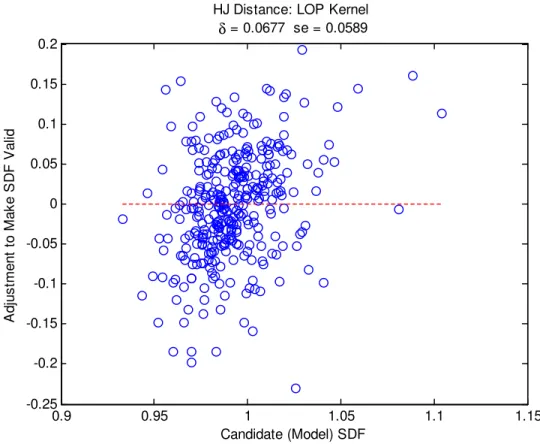
pricing-error measure proposed in Hansen and Jagannathan (1997).
All return data used in this exercise come from CRSP. Mutual-Fund return data
comes from the CRSP Mutual Fund Database, which reports open-ended mutual-fund
returns using survivor-bias-free data. Bias can arise, for example, when a older fund
splits into other share classes, each new share class being permitted to inherit the entire
return/performance history of the older fund. Stock return data comes from the CRSP
U.S. Stock and CRSP U.S. Indices, which collects returns from NYSE, AMEX, NASDAQ,
and, more recently, NYSE Arca. Real-Estate return data comes from the CRSP/Ziman
Real Estate Data Series. It collects return data on real-estate investment trusts (REITs)
that have traded on the NYSE, AMEX and NASDAQ exchanges. Finally,
government-bond return data comes from CRSP Monthly Treasury U.S. Database, which collects
monthly returns of U.S. Treasury bonds with di¤erent maturities.
The …rst step to perform our exercise is computingMct. Since we do not have a random
sample of returns, we decided to work with each of the four categories above, weighting
them by their respective importance in the median U.S. household portfolio. For each of
the four asset categories (mutual funds, stocks, real estate, and government bonds) we
computed the geometric average of the reciprocal of all asset returns and the arithmetic
average of all asset returns. Based on the “Wealth and Asset Ownership” tables of 2004,
four categories as follows: Mutual Funds (10%), Stocks (10%), Real Estate (60%), and
Government Bonds (20%)11. They are a close approximation of the median (and also the
mean) value of assets owned by U.S. households in these four categories. Local changes
in these weights (from5up to 20percentage points for individual categories) produce no
virtual change on the results of our exercise. Our …nal estimateMct results from weighting
geometric and arithmetic averages of returns in each of these four categories.
Once we obtain Mct, we forecast a group of returns not included in computing it for
all the 336 observations in the time-series dimension, comparing our results with unity.
Under the law of one price this exercise is similar in spirit to the one in Hansen and
Jagannathan (1997). Our forecasting exercise is performed using nominal returns either
in constructing the SDF or in out-of-sample evaluation of returns. Obviously, the product
MtRi;t is invariant to price in‡ation as long as the same price index is used in de‡ating
Mt and Ri;t.
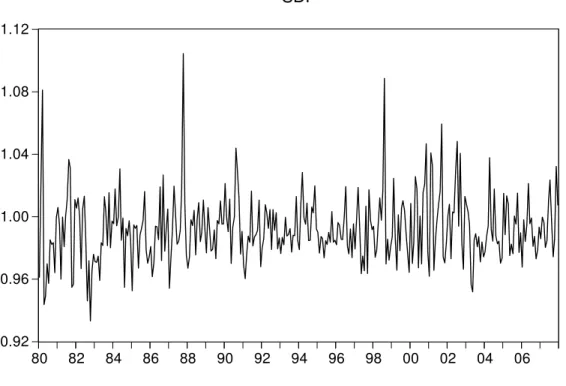
Our estimate of Mt has a nominal mean of0:9922 in a monthly basis, which amounts
to 0:9106 in a yearly basis. In comparison, average yearly CPI in‡ation for the same period is3:85%. The plot of Mct follows below in Figure 2.
11These tables can be downloaded from http://www.census.gov/hhes/www/wealth/2004_tables.html.
0.92 0.96 1.00 1.04 1.08 1.12
80 82 84 86 88 90 92 94 96 98 00 02 04 06
SDF
Figure 2: Stochastic Discount Factor
We want our forecasting exercise to be out of sample. In choosing the group of assets
which will have their returns priced, we require that they have not been included in
com-putingMct. To cover a wide spectrum of assets to be priced, we chose to work with stocks,
divided in 10 categories of capitalization, according to the CRSP Stock File
Capitaliza-tion Decile Indices. Their returns are calculated for each of the Stock File Indices market
groups. All securities, excluding ADRs on a given exchange or combination of exchanges,
are ranked according to capitalization and then divided into ten equal parts, each
rebal-ancing every year using the security market capitalization at the end of the previous year
to rank securities. The largest securities are placed in portfolio 10 and the smallest in
portfolio 1. Value-Weighted Index Returns including all dividends are calculated on each
of the ten portfolios. Because of the value-weighted character of these portfolios, and the
fact that they are rebalanced every year, their returns cannot be written as a …xed-weight