ISSN 1409 - 8695 UDC: 615.454.1:638.135]:615.256.5 Original scientiic paper
Bioinspired bioartiical polymer hybrid composites for propolis
vaginal delivery II: formulation and characterization
M. Glavas-Dodov*, M. Simonoska-Crcarevska, R. Slavevska Raicki, N. Sibinovska,
K. Mladenovska, A. Zairovska-Gapkovska
Institute of pharmaceutical technology, Faculty of pharmacy, “Ss. Cyril & Methodius” University, Majka Teresa 47, 1000 Skopje, Republic of Macedonia
Center of pharmaceutical nanotechnology, Faculty of pharmacy, “Ss. Cyril & Methodius” University, Majka Teresa 47, 1000 Skopje, Republic of Macedonia
Received: October 2014; Accepted: December 2014
Abstract
In our previous work Box-Behnken experimental design was applied for formulation optimization of the thermoreversible mucoad
-hesive in situ vaginal hydrogels with propolis and optimized batches were identiied. Optimized batches of bioartiicial polymer hybrid composites (chitosan, Lutrol® F-127 and Lutrol® F-68 mixture)) (CP1, CP2, CP3) were prepared using so-called cold method. Formula
-tion P3 (chitosan free) was prepared in order to evaluate the effect of chitosan on the physico-chemical and biopharmaceutical properties of the polymer hybrid composites (gels).
The pH values of the gels were 4-4.5. The gelation temperature for all formulations was in a range of 29-33 oC. Total lavonoids con -tent was above 95%. Increase in concentration of Lutrol® F-127 and Lutrol® F-68/Lutrol® F-127 ratio lead to a higher viscosity values and slower gel erosion/dissolution. The presence of chitosan increased gel viscosity and hence slow-down erossion/dissoluiton. Propolis
release ratewas the highest in P3 which released propolis within 5 h, corresponding to time of complete erosion. The same correlation be
-tween erosion process and drug release rate was observed in CP1-CP3, where prolonged propolis release for more than 10 h was achieved. Microbiological quality was in accordance with the requirements of Ph. Eur. 7. All formulations demonstrated adequate stability at 5 ± 3 °C
during 6 months. Based on overall results it can be anticipated that bioartiicial blended bioinspired polymer hybrid composites for propo
-lis vaginal delivery could represent intelligent delivery systems with physicochemical and biopharmaceutical properties in favor or efica
-cious and safe therapy of vaginal infections.
Key words:thermoreversible, mucoadhesive, vaginal gels, propolis, physicochemical and biopharmaceutical characterization
Introduction
Propolis (bee glue) exhibits well-known and docu -mented biological and pharmacological properties as anti -microbial and antifungal and most of them antiviral agent.
-dida albicans (Fearnley, 2001; Khalil, 2006; Kujumgiev et al., 1999; Marcucci, 1995; Sawaya et al., 2002), as well as its clinical eficacy in the treatment of vaginal infections. It is thought that propolis has local anesthetic and immunos -timulatory effects which are also important in the treatment of vaginal infections (Pochinkova, 1995).
The gels as vaginal drug delivery systems are most commonly used dosage forms amongst the patients, due to their advantages such as easy administration and uniform spreading over the surface, allowing more intimate con -tact with the vaginal mucosa, precise dosing and the ab -sence of discomfort after their administration (Das Neves and Bahia, 2006; Neves et al., 2009). However, despite these advantages, conventional gels demonstrate relative -ly fast drug release due to their dilution with vaginal lu -ids and dissolution. Another disadvantage is the possibili -ty of liquefaction at room temperature; therefore they can leak out of the vagina. To avoid these problems, there is a need for formulation of vaginal gels with local antimicro -bial activity which can provide uniform distribution over the surface of the vaginal mucosa, along with prolonged residence time and controlled drug release.
In the recent years, thermosensitive in situ-forming gel systems have been receiving a great deal of interest as vag -inal delivery systems for eficient local treatment of vari -ous diseases. These environmentally sensitive systems can be easily administered due to their liquid state at room tem -perature, whereas their geliication in response to environ -mental changes offers signiicant advantages such as pre -cise dosing, in vitro and in vivo stability and slow clear -ance from local sites due to mucoadhesive properties of the polymers used, therefore allowing prolonged drug release. Poloxamers are poly(ethylene oxide)-poly(propylene oxide)-poly(ethylene oxide) copolymers (PEO-PPO-PEO), known under the trade name of Lutrol, which form mi -celles at low concentration and clear thermoreversible gels at high concentrations (Alexandridis and Hatton, 1995). Poloxamers differ in their physical and surface properties due to the differences in the chemical structure. Lutrol
F-127 (LF-127) is a hydrophilic PEO-PPO-PEO tri-block copolymer (Escobar-Chávez et al., 2006) which has low toxicity, good dissolving capacity and it considered as a good vehicle for numerous active substances (Kolsure and Rajkapoor, 2012). Because of its thermoreversible geliica -tion properties and low toxicity, LF-127 can be applied in various drug delivery systems. Lutrol F-68 (LF-68) con -tains 81% of PEO units in its composition, which makes this poloxamer easily soluble in water (Fussneger, 1999). At higher concentrations, the water solutions of LF-68 ex -hibit non-Newtonian behavior and thermosensitivity when the concentration exceeds 20%. However, LF-68 is not used alone as gel-forming agent. Usually, it is combined with LF-127 in order to modify the thermorheological properties of the gels. The addition of LF-68 leads to an in -crease in the gelaton temperature (Tg), most probably due to the formation of mixed micelles and offers the advan
-tage of adjusting the Tg value to the desired one, by vary -ing the amount of LF-68 up to 20%. (Fussneger, 1999). Notwithstanding the wide application of thermosensitive poloxamer gels in formulation of different drug delivery systems, their main drawback is the fast erosion due to the low mechanical strength. Therefore, prolonged retention time and controlled drug release from poloxamer gels can be achieved by the combination with other polymers, such as chitosan (CTS). The addition of CTS causes the forma -tion of more dense poloxamer network, therefore resulting in increased mechanical strength of the gel matrix, as well as inluencing the drug diffusion and slowing its release (Gratieri et al., 2010; Varshosaz et al., 2008).
As it was already rationalized (Simonoska Crcarevs -ka et al., 2013b)by bioartiicial blending bioinspired poly -mer hybrid composites for propolis vaginal delivery could represent intelligent delivery systems with physico-chem -ical and biopharmaceut-ical properties in favor or efica -cious and safe therapy of vaginal infections. In our pre -vious work, response surface, Box-Behnken, experimen -tal design was applied for formulation optimization of the thermoreversible mucoadhesive in situ vaginal hydrogels with propolis and optimized batches were identiied (Si -monoska Crcarevska et al., 2013b). The main objective of this work was to characterize and evaluate physicochemi -cal and biopharmaceuti-cal properties of previously identi -ied formulations.
Materials and methods
Materials
Chitosan (CTS, low viscous, 95% deacetylation) was supplied from Sigma-Aldrich, USA. Poloxamers (Lutrol® F-127 and Lutrol® F-68) were obtained from BASF, Lud -wigshaften, Germany. 20% propylene-glycolic extract of propolis (PGEP) was kindly donated from Galafarm, Macedonia. All other reagents and solvents were of analyt -ical grade and used as received.
Methods
Preparation of polymer hybrid composites
Optimized batches of bioartiicial polymer hybrid composites (CTS, LF-127 and LF-68 mixture)) (thermo re -versible mucoadhesive in situ gels) (CP1, CP2, CP3) were prepared according to the previously described procedure using so-called cold method with minor modiication (Si -monoska Crcarevska et al., 2013b). Detailed composition of the formulations is presented in Table 1.
Bioinspired bioartiical polymer hybrid composites for propolis vaginal delivery II: formulation and characterization
Table 1. Composition of designed polymer hybrid com -posites (thermo reversible mucoadhesive in situ gels)
Formulation code
CTS
(%) LF-127(%) LF-68/LF-127mass ratio
PGEP (%)
CP1 1.5 16.39 0.06 3.0
CP2 1.5 17.36 0.09 3.0
CP3 1.5 18.24 0.12 3.0
P3 / 18.24 0.12 3.0
Preparation of simulated vaginal luid (SVF)
Human vaginal luid comes from several sources such as uterus, cervix and sometimes menstrual secretions and sperm. Due to the limited quantity of human vaginal lu -id (approximately 0.5–0.75 mL) and its rap-id degrada -tion after collec-tion from its source, a simulated vaginal luid (SVF) was developed (Aka-Any-Grah et al., 2010). SVF was prepared as follows: NaCl (3.51 g), KOH (1.4 g), Ca(OH)2 (0.22 g), bovine serum albumin (0.018 g), lactic acid (2.00 g), acetic acid (1.00 g), glycerol (0.16 g), urea (0.4 g) and glucose (5.00 g) were added to 900 ml distilled water and stirred mechanically until complete dissolution. The pH of the SVF was then adjusted to 4.5 using 0.1M HCl, and the inal volume was adjusted to 1 L.
Characterization of polymer hybrid composites (thermo-reversible mucoadhesive in situ gels)
Visual characterization
Visual characterization of color, appearance, odor, tex -ture and phase separation on designed and prepared formu -lations were carried out.
pH determination
Adequacy of designed polymer hybrid composites (thermo reversible mucoadhesive in situ gels) for vaginal use were evaluated by determination of their pH value (pH meter, Metler Toledo 340, Germany). pH evaluation was carried out in triplicate.
Determination of of the sol-gel transition temperature The sol-gel transition temperature (Tg) of the designed formulations was measured by tube inversion method (Ur-Rehman et al., 2010) with minor modiications (Simono -ska Crcarev-ska et al., 2013b). Briely, 2 ml of prepared formulations were transferred into a glass test tube sealed with a parailm and put in horizontal shaker water bath (50 strokes/ min). The temperature of the water bath was grad -ually increased (1 оC/ min) and the temperature at which the solution in the sample containing tube stopped low -ing upon invert-ing the tube was recorded. Similarly, the temperature was decreased and the temperature, at which the gel started lowing, was recorded. The average of both temperatures was calculated as the critical Tg.
Considering the possibility of change in the Tg of the
formulations after their dilution with vaginal luid (Aka-Any-Grah et al., 2010), the Tg of each formulation was also investigated after the addition of 0.75 μl of SVF.
Determination of propolis content
Propolis content in the prepared formulations was de -termined by validated spectrophotometric method (395 nm, Lambda 16, Perkin Elmer, USA) where quantiication of the total lavonoid content was done using chrysin as ex -ternal reference standard. Briely, 1g of prepared formula -tions was dissolved in 100 ml methanolic solution of ace -tic acid (0.5% v/v). 2 ml of prepared solution and exactly 1 ml of aluminum chloride water solution (2% w/w) were transferred in glass volumetric lask and methanolic solu -tion of acetic acid (0.5%, v/v) was added to a total vol -ume of 10ml. In parallel a compensatory solution was pre -pared on the same way without aluminum chloride. In the same manner external reference standard of chrysin was prepared (0.02% w/v). Three replicates were carried out to estimate the inherent variability of the determination and the total lavonoids content was expressed in mg of chrysin equivalents per gram of prepared formulations.
Viscosity determination
The viscosity (mPa*s) of the prepared polymer hybrid composites (thermo-reversible mucoadhesive in situ gels) was determined using cone/plate viscometer (Myr V2-L, 4.6/MOTv2, Viscotech, Spain). A sample solution (0.5 ml) was applied to the lower plate of the viscometer and vis -cosity was determined at at 25 ± 0.5 oC and 32 ± 0.5 oC us-ing spindle 52 at a shear rate rangus-ing from 5 to 400 rpm. All samples were analyzed in triplicate.
Erosion/dissolution and in vitro propolis release studies Thermo-reversible mucoadhesive in situ gels erosion/ dissolution proile and the in vitro propolis release from the designed formulations were obtained simultaneously. Briely, 2 g of each formulation were transferred in glass tubes, weighted and placed in horizontal shaker water bath (40 rpm) previously thermostated at 32 °C. After the gela -tion, 10 ml of SVF pre-equilibrated at 32 °C were added. At pre-determined time intervals (1, 2, 3, 4, 5, 6, 7, 8 and 12 h) the total volume of liquid medium was removed, and the weight of eroded/dissolved gel was calculated from the change in the weight (glass tube with gel) at the beginning of the experiment and at each time interval.
Afterwards the release medium was completely re -placed by 10 ml of fresh medium at predetermined time in -tervals. The concentration of propolis in the release medi -um was determined spectrophotometrically as it was pre -viously described. All experiments were performed as trip -licates.
Microbiological quality
The microbiological quality of the prepared formu -lations was evaluated according to the Ph.Eur.7 method 2.6.12 (Microbiological examination of non-sterile prod -ucts (total viable aerobic count)) and method 2.6.13 (test for speciied microorganisms)). The acceptance criteria for microbiological quality of vaginal preparations stated in the Ph.Eur.7 (5.1.4 - Microbiological quality of non-ster -ile pharmaceutical preparations and substances for phar -maceutical use) are based on the total aerobic microbial count (TAMC) and total yeast and mold count (TYMC).
Stability studies
Prepared formulations were sealed in glass vials and stored under controlled conditions (25 ± 2 °C and 5 ± 3
°C). Periodical testing of different parameters (organolep -tic properties, pH value, propolis content, microbiological quality) during 6 months was performed.
Results and discussion
In our previous work (Simonoska Crcarevska et al., 2013b) response surface Box-Benken experimental de -sign was used for development and optimization of prop -olis vaginal delivery system (polymer hybrid composites (thermo-reversible mucoadhesive in situ gels)) with de -sired gelling properties. Key formulation factors inluenc -ing Tg were determined and optimization of formulation was carried out. Optimized batches with Tg of 32 °C (CP1-CP3) were prepared and characterized accordingly.
Characterization of polymer hybrid composites (thermo-reversible mucoadhesive in situ gels)
The pH values of the prepared propolis vaginal deliv -ery system were in the range of 4 to 4.5 pointing to suitabil -ity of formulations for vaginal use (Table 2).
The gelation temperature was determined for all pre -pared formulations (CP1-CP3, P3) before and after their dilution with 0.75 µL SVF (Table 2).
Obtained results showed an increase of ~ 2 oC in Tg of the formulations diluted with SVF. These differences could be explained by the presence of co-solutes, i.e. ions and electrolytes in the SVF which probably interacted with po -loxamers. Considering the strong relation between the ge -lation and micellization processes, the observed increase of Tg value is most likely related to the increased critical mi -celle concentration or critical mi-celle temperature. The re -sults of our study also showed that the Tg of the P3 formu -lation prepared without chitosan was slightly higher com -pared to other formulations (CP1-CP3). Similar indings were reported by Gratieri et al. (Gratieri et al., 2010), in -dicating that CTS has an effect on the crosslinking and the packing of polymer chains, thus resulting in a denser net -work which gelled at lower temperature.
Total lavonoids content in the prepared formulations (CP1-CP3) was above 95% (Table 2).
The eficacy of gels intended for local treatment of vaginal infections depends to a great extent on the rheolog -ical characteristics of the system. Namely, improved ther -apeutic eficacy could be achieved by prolonged residence time at the site of action (vaginal mucosa) as well as con -trolled drug release (propolis) from hybrid polymer ma -trix. Rheological characteristics are inluenced by various factors such as the composition of formulations (polymers used as gel-forming agents), temperature, vaginal pH val -ue, amount of vaginal luid etc. Comparing viscosity val -ues measured at 25 and 32 oC it can be noticed that pre -pared polymer hybrid composites (thermo-reversible mu -coadhesive in situ gels) were characterized by higher vis -cosity at 32 oC as it was expected due to thermosensitive properties of used poloxamers. Obatined results pointed that by increasing the concentrations of 127 and LF-68/LF-127 ratio, higher viscosity values were observed. Formulation P3 was characterized by lower viscosity com -pared to CP1-CP3 (Table 2).
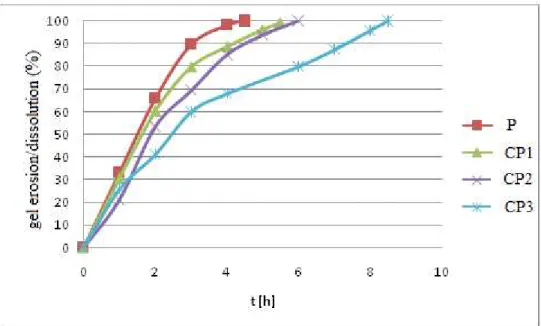
Erosion/dissolution and in vitro propolis release studies Fig. 1 presents the effect of formulation variables (LF-127 and LF-68/LF-(LF-127 ratio (CP1-CP3)), as well as CTS
Table 2. Gelation temperature (Tg) (mean ± SD) of the designed polymer hybrid composites (thermo reversible mucoadhe -sive in situ gels) (n=3)
Formulation code
pH values ± SD
Tg (oC) ± SD Total lavonoids Viscosity (mPa*s ± SD)
without
SVF 0.75 µl SVFwith mg/g ± SD % of the declared content ± SD 25 ± 0.5 oC 37 ± 0.5 oC
CP1 4.36 ± 0.03 29 ± 0.03 31 ± 0.05 2.46 ± 0.01 95.17 ± 0.67 1180 ± 0.2 65220 ± 0.5
CP2 4.06 ± 0.02 29 ± 0.02 31 ± 0.01 2.59 ± 0.02 99.87 ± 0.75 1340 ± 0.3 167930 ± 0.3
CP3 4.13 ± 0.04 29 ± 0.03 31 ± 0.05 2.55 ± 0.02 98.55 ± 0.79 1470 ± 0.1 219600 ± 0.3
Bioinspired bioartiical polymer hybrid composites for propolis vaginal delivery II: formulation and characterization
(P3 compared to CP3) on the gel erosion/dissolution vs time. Erosion/dissolution of formulation P3 (CTS free) was completed in 4.5 h, while CP1-CP3 showed decrease in the rate of gel erosion, 5.5-8.5 h accordingly. Results obtained for P3 (CTS free) were in accordance with the literature data, which suggest that gels consisted only by poloxam -ers dissociate rapidly in an aqueous environment (Chung et al., 2009). The observed results for CP1-CP3 pointed that increase in concentration of LF-127 and LF-68/LF-127 ra -tio lead to a higher viscosity of the system, thereby causing the formation of more dense gel network which erodes at a slower rate. The presence of CTS retarded the gel erosion/ dissolution due to its incorporation into the gel skeleton most likely resulting with increased mechanical strength of the gel network (Varshosaz et al., 2008).
The results of in vitro propolis release study are pre -sented in Fig. 2. It can be seen that propolis release follows gel erosion/dissolution processes. Propolis release rate was the highest in P3 formulation (CTS free), which released propolis within 5 h, corresponding to time of complete ero -sion. Furthermore, the same correlation between erosion process and drug release rate was observed in formulations CP1-CP3, where prolonged propolis release for more than 10 h was achieved, due to the effect of CTS.
The continuous swelling of poloxamers accounts for achieving prolonged drug release when used as gelling agents. Additionally, drug diffusion occurs through the ex -tramicellar aqueous channels formed during matrix ero -sion/dissolution. Hence, the decrease in the rate of propolis release with the increase in LF-127 concentration could be attributed to the increase of number and size of the micelles formed at higher polymer concentration (Radivojša et al., 2013). This could cause a greater extent of polymer chains entanglement in the aqueous phase of the gel structure and
slower dissolution rate. Additionally, higher poloxamer concentration could cause shorter intermicellar distance, leading to a larger number of cross-links between neigh -boring micelles and larger number of micelles per volume, along with subsequently slower rate of dissolution of the incorporated drug (Ibrahim et al., 2012).
Even though the chosen polymers differ in terms of chemical structure, both CTS and poloxamers have hydro -phobic regions in their chains (D-glucose residues in chi -tosan and polypropyloxyethylene blocks in poloxamers). When the temperature is increased, water molecules struc -tured around the hydrophobic regions of polymer chains in a sol state become disarranged. As a result, newly revealed hydrophobic regions attract each other to form bonds, whereas hydrophilic parts reorganize to maximize their contact with the aqueous medium. The resulting structures are micelles, which continue to grow in size and number at higher temperatures, leading to higher viscosity of the gel structure and consequently, slower rate of drug release is achieved (Varshosaz et al., 2008).
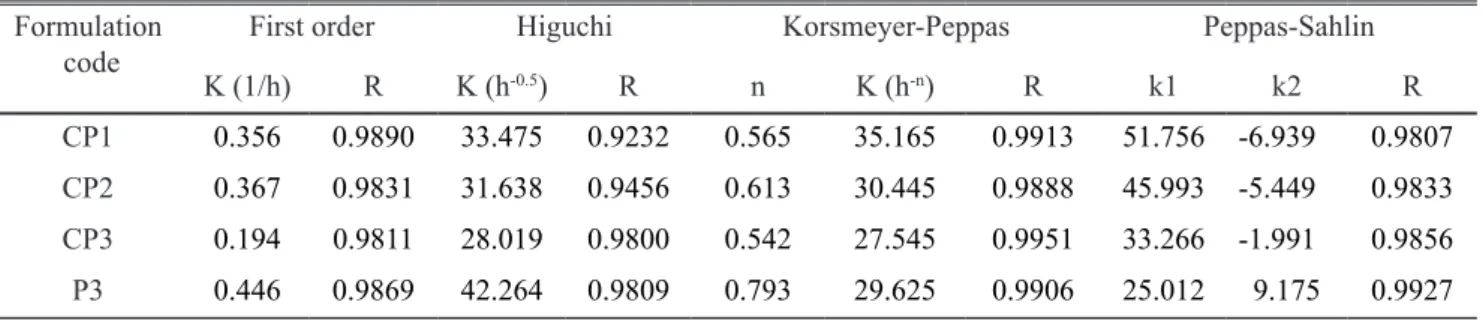
Drug release kinetics of propolis from the prepared for -mulations was determined by analyzing the dissolution data using various mathematical models. The kinetics constants and correlation coeficients for propolis release are shown in Table 3. Taking into account the values of correlation coefi -cients (R), it can be concluded that Korsmeyer-Peppas mod -el is the best one to describe the propolis r-elease from the prepared formulations. According to the obtained values of release rate constant (K), it can be claimed that the drug dis -solution rate decreases with the increase of 127 and LF-68 concentrations, as expected. Predominance of diffusion in release mechanisam was observed for CP1-CP3, while P3 (without CTS) demonstrated release mechanism most likely controlled by diffusion and gel erosion/dissolution.
Microbiological quality
The obtained results related to microbiological quality were in accordance with the requirements stated in Ph.Eur. 7.
Stability studies
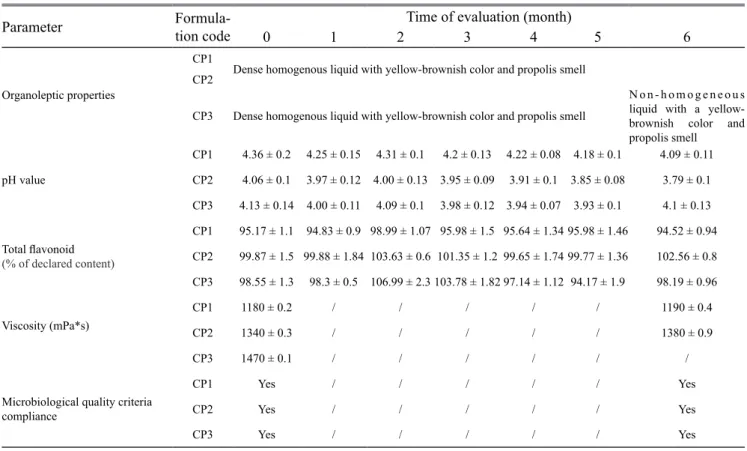
The results of the stability studies of the prepared for -mulations stored at 25 ± 2 °C and 5 ± 3 °C during 6 months are presented in Table 4 and 5, respectively.
Formulations CP1 and CP2 demonstrated adequate stability during 6 months of storage at 25 ± 2 °C with -out any signiicant changes in their organoleptic proper -ties, pH values, propolis content, viscosity and microbio -logical quality. CP3 formulation showed adequate stabili -ty during 5 months of storage 25 ± 2 °C, but after 6 months changes in its organoleptic properties were observed, i.e. viscous liquid was formed. On the other hand, all formu -lations demonstrated adequate stability at 5 ± 3 °C during 6 months.
Conclusion
To summarize in this work by bioartiical blending of natural and synthetic polymers thermo reversible mucoad -hesive in situ gels were prepared and characterized. Ad-dition of bio/mucoadhesive macromolecules (chitosan) to the poloxamers (Lutrol® F-127 and Lutrol® F-68) based vaginal delivery system resulted with increased viscosity, decreased gel erosion/dissolution rate thus improving the sustained release of propolis. Chitosan not only helped to circumvent draw backs of poloxamer gels alone like fast erosion/ dissolution, but also did not adversely affect its thermosensitive behavior. Based on the results obtained it can be concluded that chitosan-poloxamer based sys -tems would enable prolonged residence time allowing pro -longed drug release at the desired site of action and hence resulting with better therapeutic eficacy.
Fig. 2. In vitro release proiles of propolis from designed polymer hybrid composites (thermo reversible mucoadhesive in situ gels).
Table 3. Kinetics constants and coeficients for propolis release from the prepared formulations
Formulation code
First order Higuchi Korsmeyer-Peppas Peppas-Sahlin
K (1/h) R K (h-0.5) R n K (h-n) R k1 k2 R
CP1 0.356 0.9890 33.475 0.9232 0.565 35.165 0.9913 51.756 -6.939 0.9807
CP2 0.367 0.9831 31.638 0.9456 0.613 30.445 0.9888 45.993 -5.449 0.9833
CP3 0.194 0.9811 28.019 0.9800 0.542 27.545 0.9951 33.266 -1.991 0.9856
Bioinspired bioartiical polymer hybrid composites for propolis vaginal delivery II: formulation and characterization
Table 4. Results from stability studies of the prepared formulations stored at 25 ± 2 °C during 6 months period
Parameter Formulation code- Time of evaluation (month)
0 1 2 3 4 5 6
Organoleptic properties
CP1
Dense homogenous liquid with yellow-brownish color and propolis smell CP2
CP3 Dense homogenous liquid with yellow-brownish color and propolis smell
N o n - h o m o g e n e o u s liquid with a yellow-brownish color and propolis smell
pH value
CP1 4.36 ± 0.2 4.25 ± 0.15 4.31 ± 0.1 4.2 ± 0.13 4.22 ± 0.08 4.18 ± 0.1 4.09 ± 0.11
CP2 4.06 ± 0.1 3.97 ± 0.12 4.00 ± 0.13 3.95 ± 0.09 3.91 ± 0.1 3.85 ± 0.08 3.79 ± 0.1
CP3 4.13 ± 0.14 4.00 ± 0.11 4.09 ± 0.1 3.98 ± 0.12 3.94 ± 0.07 3.93 ± 0.1 4.1 ± 0.13
Total lavonoid
(% of declared content)
CP1 95.17 ± 1.1 94.83 ± 0.9 98.99 ± 1.07 95.98 ± 1.5 95.64 ± 1.34 95.98 ± 1.46 94.52 ± 0.94 CP2 99.87 ± 1.5 99.88 ± 1.84 103.63 ± 0.6 101.35 ± 1.2 99.65 ± 1.74 99.77 ± 1.36 102.56 ± 0.8 CP3 98.55 ± 1.3 98.3 ± 0.5 106.99 ± 2.3 103.78 ± 1.82 97.14 ± 1.12 94.17 ± 1.9 98.19 ± 0.96
Viscosity (mPa*s)
CP1 1180 ± 0.2 / / / / / 1190 ± 0.4
CP2 1340 ± 0.3 / / / / / 1380 ± 0.9
CP3 1470 ± 0.1 / / / / / /
Microbiological quality criteria compliance
CP1 Yes / / / / / Yes
CP2 Yes / / / / / Yes
CP3 Yes / / / / / Yes
Table 5. Results from stability studies of the prepared formulations stored at 5 ± 3 °C during 6 months period
Parameter Formula
-tion code
Time of evaluation (month)
0 1 2 3 4 5 6
Organoleptic properties
CP1
Dense homogenous liquid with yellow-brownish color and propolis smell CP2
CP3
pH value
CP1 4.36 ± 0.2 4.02 ± 0.1 3.99 ± 0.14 3.97 ± 0.1 3.82 ± 0.3 3.90 ± 0.16 3.78 ± 0.2
CP2 4.06 ± 0.1 4.30 ± 0.9 4.25 ± 0.5 4.20 ± 0.4 4.19 ± 0.1 4.23 ± 0.09 4.09 ± 0.18
CP3 4.13 ± 0.14 4.09 ± 0.56 4.01 ± 0.28 3.98 ± 0.35 3.95 ± 0.2 3.97 ± 0.25 3.86 ± 0.3
Total lavonoid
(% of declared content)
CP1 95.17 ± 1.1 98.84 ± 0.7 96.52 ± 1.22 94.98 ± 2.31 94.21 ± 0.8 96.14 ± 1.98 95.75 ± 2.21 CP2 99.87 ± 1.5 103.08 ± 1.82 99.61 ± 1.93 99.23 ± 1.85 98.84 ± 1.32 101.54 ± 2.23 102.38 ± 1.3 CP3 98.55 ± 1.3 107.72 ± 1.31 94.21 ± 2.15 98.84 ± 1.96 92.28 ± 1.64 103.47 ± 1.57 98.07 ± 1.84
Viscosity (mPa*s)
CP1 1180 ± 0.2 1180 ± 0.8 / / / / 1190 ± 0.4
CP2 1340 ± 0.3 1340 ± 0.7 / / / / 1380 ± 0.9
CP3 1470 ± 0.1 1470 ± 0.5 / / / / 1560 ± 0.8
Microbiological quality criteria compliance
CP1 Yes Yes / / / / Yes
CP2 Yes Yes / / / / Yes
Reference
Aka-Any-Grah, A., Bouchemal, K., Kofi, A., Agnely, F., Zhang, M., Djabourov, M., Ponchel, G., 2010. Formulation of mucoadhesive vaginal hydrogels insensitive to dilution with vaginal luids. Eur. J. Pharm. Bipharm. 76, 296-303. Alexandridis, P., Hatton, T.A., 1995. Poly (ethylene oxide)
- poly (propylene oxide) - poly (ethylene oxide) block copolymer surfactants in aqueous solutions and at interfaces: thermodynamics, structure, dynamics, and modeling. Colloid. Surface. A 96, 1-46.
Casaroto, A.R., Lara, V.S., 2010. Phytomedicines for Candida-associated denture stomatitis. Fitoterapia 81, 323-328. Chung, T.-W., Lin, S.-Y., Liu, D.-Z., Tyan, Y.-C., Yang,
J.-S., 2009. Sustained release of 5-FU from Poloxamer gels interpenetrated by crosslinking chitosan network. Int. J. Pharm. 382, 39-44.
Das Neves, J., Bahia, M., 2006. Gels as vaginal drug delivery systems. Int. J. Pharm. 318, 1-14.
Escobar-Chávez, J., López-Cervantes, M., Naik, A., Kalia, Y., Quintanar-Guerrero, D., Ganem-Quintanar, A., 2006. Applications of thermo-reversible pluronic F-127 gels in pharmaceutical formulations. J. Pharm. Pharm. Sci. 9, 339-358. Fearnley, J., 2001. Bee Propolis: Natural Healing from the Hive,
Souvenir Press.
Fussneger, B., 1999. Poloxamers (1) Lutrol® F 68 (Poloxamer 188) BASF product info. BASF ExAct (1999-11-03), pp.
5-6.
Gratieri, T., Gelfuso, G.M., Rocha, E.M., Sarmento, V.H., de Freitas, O., Lopez, R.F.V., 2010. A poloxamer/chitosan in situ forming gel with prolonged retention time for ocular delivery. Eur. J. Pharm. Biopharm. 75, 186-193.
Ibrahim, E.-S., Ismail, S., Fetih, G., Shaaban, O., Hassanein, K., Abdellah, N., 2012. Development and characterization of thermosensitive pluronic-based metronidazole in situ gelling formulations for vaginal application. Acta pharmaceut. 62,
59-70.
Khalil, M.L., 2006. Biological activity of bee propolis in health and disease. Asian Pac. J. Cancer Prev. 7, 22-31.
Kolsure, P.K., Rajkapoor, B., 2012. Development of zolmitriptan gel for nasal administration. Asian J. Pharm. and Clin. Res
5, 88-94.
Kujumgiev, A., Tsvetkova, I., Serkedjieva, Y., Bankova, V., Christov, R., Popov, S., 1999. Antibacterial, antifungal and antiviral activity of propolis of different geographic origin. J. Ethnopharmacol. 64, 235-240.
Marcucci, M.C., 1995. Propolis: chemical composition, biological properties and therapeutic activity. Apidologie 26, 83-99. Neves, J.d., da Silva, M.V., Gonçalves, M.P., Amaral, M.H.,
Bahia, M.F., 2009. Rheological properties of vaginal hydrophilic polymer gels. Curr. Drug Deliv. 6, 83-92. Pochinkova, P., 1995. Bee Products in Medicine-apitherapy, 2nd
ed. “Prof. Marin Drinov” Academic Publishing House, Soia. Radivojša, M., Grabnar, I., Grabnar, P.A., 2013. Thermoreversible
in situ gelling poloxamer-based systems with chitosan nanocomplexes for prolonged subcutaneous delivery of heparin: Design and in vitro evaluation. Eur. J. Pharm. Sci.
50, 93-101.
Ramos, A., Miranda, J., 2007. Propolis: a review of its anti-inlammatory and healing actions. JVATiTD 13, 697-710. Sawaya, A., Palma, A., Caetano, F., Marcucci, M., da Silva
Cunha, I., Araujo, C., Shimizu, M., 2002. Comparative study of in vitro methods used to analyse the activity of propolis extracts with different compositions against species of Candida. Lett. Appl. Microbiol. 35, 203-207.
Simonoska Crcarevska, M., Geskovski, N., Calis, S., Dimchevska, S., Kuzmanovska, S., Petruševski, G., Kajdžanoska, M., Ugarkovic, S., Goracinova, K., 2013a. Deinition of formulation design space, in vitro bioactivity and in vivo biodistribution for hydrophilic drug loaded PLGA/PEO-PPO-PEO nanoparticles using OFAT experiments. Eur. J. Pharm. Sci. 49, 65-80.
Simonoska Crcarevska, M., Zairovska Gapkovska, A.,
Mladenovska, K., Raicki, R.S., Geskovski, N., Dimcevska,
S., Glavas Dodov, M., 2013b. Bioinspired bioartiical polymer hybrid composites for propolis vaginal delivery I: formulation development and optimization of gelling temperature using experimental design. Maced. Pharm. Bull.
59, 33-40.
Ur-Rehman, T., Tavelin, S., Gröbner, G., 2010. Effect of DMSO on micellization, gelation and drug release proile of Poloxamer 407. Int. J. Pharm. 394, 92-98.
Varshosaz, J., Tabbakhian, M., Salmani, Z., 2008. Designing of a Thermosensitive Chitosan/Poloxamer In Situ Gel for Ocular Delivery of Ciproloxacin. TODDJ 2, 61-70.
Zhang, Y., Huo, M., Zhou, J., Zou, A., Li, W., Yao, C., Xie, S., 2010. DDSolver: an add-in program for modeling and comparison of drug dissolution proiles. The AAPS journal
Bioinspired bioartiical polymer hybrid composites for propolis vaginal delivery II: formulation and characterization
Резиме
Биоинспирирани биовештачки полимерни хибридни
композити со контролирано ослободување на прополис во
вагина II: формулација и карактеризација
Марија Главаш-Додов, Маја Симоноска-Црцаревска, Рената Славеска-Раички,
Надица Сибиновска, Кристина Младеновска, Ана Зафировска-Гапковска
Институт за фармацевтска технологија, Фармацевтски факултет, Универзитет „ Св. Кирил и Методиј“, Мајка Тереза 47, 1000 Скопје, Република Македонија
Центар за фармацевтска нанотехнологија, Фармацевтски факултет, Универзитет „ Св. Кирил и Методиј“, Мајка Тереза 47, 1000 Скопје, Република Македонија
Клучни зборови: термореверзибилни, мукоатхезивн, вагинални гели, прополис, физичко-хемиска и биофармацевтска
карактеризација