Is Aided Differentially by Two Invasive Whiteflies
Huipeng Pan1., Dong Chu2., Wenqian Yan1., Qi Su1
, Baiming Liu1, Shaoli Wang1, Qingjun Wu1, Wen Xie1, Xiaoguo Jiao1, Rumei Li1, Nina Yang1, Xin Yang1, Baoyun Xu1, Judith K. Brown3, Xuguo Zhou4*, Youjun Zhang1*
1Department of Plant Protection, Institute of Vegetables and Flowers, Chinese Academy of Agricultural Sciences, Beijing, People’s Republic of China,2High-tech Research Center, Shandong Academy of Agricultural Sciences, Jinan, People’s Republic of China,3School of Plant Sciences, The University of Arizona, Tucson, Arizona, United States of America,4Department of Entomology, University of Kentucky, Lexington, Kentucky, United States of America
Abstract
Background:Tomato yellow leaf curl virus(TYLCV) was introduced into China in 2006, approximately 10 years after the introduction of an invasive whitefly,Bemisia tabaci(Genn.) B biotype. Even so the distribution and prevalence of TYLCV remained limited, and the economic damage was minimal. Following the introduction of Q biotype into China in 2003, the prevalence and spread of TYLCV started to accelerate. This has lead to the hypothesis that the two biotypes might not be equally competent vectors of TYLCV.
Methodology/Principal Findings: The infection frequency of TYLCV in the field-collected B. tabaci populations was investigated, the acquisition and transmission capability of TYLCV by B and Q biotypes were compared under the laboratory conditions. Analysis ofB. tabacipopulations from 55 field sites revealed the existence of 12 B and 43 Q biotypes across 18 provinces in China. The acquisition and transmission experiments showed that both B and Q biotypes can acquire and transmit the virus, however, Q biotype demonstrated superior acquisition and transmission capability than its B counterparts. Specifically, Q biotype acquired significantly more viral DNA than the B biotype, and reached the maximum viral load in a substantially shorter period of time. Although TYLCV was shown to be transmitted horizontally by both biotypes, Q biotype exhibited significantly higher viral transmission frequency than B biotype. Vertical transmission result, on the other hand, indicated that TYLCV DNA can be detected in eggs and nymphs, but not in pupae and adults of the first generation progeny.
Conclusions/Significance:These combined results suggested that the epidemiology of TYLCV was aided differentially by the two invasive whiteflies (B and Q biotypes) through horizontal but not vertical transmission of the virus. This is consistent with the concomitant eruption of TYLCV in tomato fields following the recent rapid invasion of Q biotype whitefly in China.
Citation:Pan H, Chu D, Yan W, Su Q, Liu B, et al. (2012) Rapid Spread ofTomato Yellow Leaf Curl Virusin China Is Aided Differentially by Two Invasive Whiteflies. PLoS ONE 7(4): e34817. doi:10.1371/journal.pone.0034817
Editor:Gustavo Bonaventure, Max Planck Institute for Chemical Ecology, Germany
ReceivedDecember 1, 2011;AcceptedMarch 5, 2012;PublishedApril 13, 2012
Copyright:ß2012 Pan et al. This is an open-access article distributed under the terms of the Creative Commons Attribution License, which permits unrestricted use, distribution, and reproduction in any medium, provided the original author and source are credited.
Funding:This research was supported by the National Science Fund for Distinguished Young Scholars (31025020), the 973 Program (2009CB119200), the National Natural Science Foundation of China (31171857), the Outstanding Youth Science Foundation of Shandong Province (JQ200811), and the Key Laboratory of Vegetable Genetics and Physiology, Ministry of Agriculture. The funders had no role in study design, data collection and analysis, decision to publish, or preparation of the manuscript.
Competing Interests:The authors have declared that no competing interests exist.
* E-mail: [email protected] (YZ); [email protected] (XZ)
.These authors have equally contributed to this work.
Introduction
Tomato yellow leaf curl virus(TYLCV) is a single stranded DNA (ssDNA) plant virus in the genus Begomovirus, familyGeminiviridae. Begomovirus genomes are either a monopartite (DNA-A) or bipartite (DNA-A and DNA-B) and require a single coat protein molecule for encapsidation into a twinned icosahedral or ‘geminiate’ particle [1,2]. Begomoviruses are transmitted by the sweet potato whitefly, Bemisia tabaci (Gennadius) (Hemiptera: Aleyrodidae), in a circulative manner and are persistent in the whitefly vector [3–6]. TYLCV, originated in the Middle East-Mediterranean region [7], has been introduced into many other regions around the world making it among the most virulent and damaging begomoviruses in tomato crops. Symptoms of TYLCV
where it has caused unprecedented economic losses, particularly in tomato crops [11–14].
The acquisition and transmission of TYLCV through their insect vectors has been a research focus for the past decade. Several lines of evidence have suggested that TYLCV can be transmitted both horizontally by sexual transmission and vertically via transovarial passage [15,16]. These transmission routes may exert dramatic effects on virus epidemiology [17]. Ghanim and Czosnek (2000) demonstrated that horizontal transmission played a key role in transmitting TYLCV to tomato plants through infected whiteflies [18]. The bipartite begomovirusesSquash leaf curl virus (SLCV) and Watermelon chlorotic stunt virus (WmCSV) were transmitted horizontally among whiteflies with an efficacy similar to that of TYLCV [16]. In China, TYLCV andTomato yellow leaf curl China virus (TYLCCNV) were shown to be horizontally transmitted by both B and Q biotypes, but transmission frequency was low [19].
On the other hand, TYLCV can be acquired by whiteflies independent of the infected plant source, i.e., the virus can be transmitted either horizontally or vertically [20]. Ghanim et al. (1998) demonstrated that TYLCV could be passed onto whitefly progeny, and the progeny of viruliferous insects can infect tomato plants [15]. Similar to TYLCV, a closely relatedTomato yellow leaf curl Sardinia virus(TYLCSV) was found to be transmitted vertically to offspring [17]. Unlike TYLCV, however, the viruliferous progeny did not infect tomato plants [17].
The B. tabaci species complex is composed of closely-related sibling species. Each species is made up of a group of genetically divergent but morphologically indistinguishable haplotypes, that when well characterized are referred to as ‘biotypes’ [5,6]. These biotypes differ in host range, virus transmission, insecticide resistance, and endosymbionts [21–24]. It has also been proposed thatB. tabaciis better represented as a collection of discrete species [21,25,26], however, the absence of a tractable morphological and/or genetically based rationale for splitting groups of variants into separate species makes this suggestion taxonomically prema-ture [5,6]. Among this sibling species group are many haplotypes or variants, however, the B and Q biotypes have become prominent and are well known due to their invasive qualities, and a nearly worldwide distribution in agricultural and horticul-tural settings [25].
B. tabaciwas first recorded in China in the late 1940 s [27]. However, the crop damages and economic losses caused by this phloem-feeding insect had not been severe until the introduction ofB. tabaciB biotype in the mid-1990 s [28]. Since then, B biotype has quickly displaced the indigenousB. tabacipopulations, rapidly invaded the entire country, and has led to serious yield losses in many crops [29]. In 2003, Q biotype was first detected in Yunnan Province of China as a new invasive whitefly [29] and just like B biotype, it has quickly adapted and established in many provinces of the mainland China [30,31]. During the past few years, Q biotype has gradually displaced earlier well-established B biotype populations in the field and has become the dominant B. tabaci biotype in most parts of China [32–35].
In many regions of the world, outbreaks caused by whitefly-transmitted viruses have concurred with invasions of B. tabaci B and/or Q biotype [2,5,8,36,37]. In China, TYLCV has not been detected until the B. tabaciQ biotype became established, even though B biotype, an important vector of TYLCV elsewhere, has been in China since the mid-1990’s [28,31–35]. We hypothesize that the introduction and spread of TYLCV in China is closely related with the establishment ofB. tabaciQ biotype. To test this hypothesis, we 1) surveyed the frequency of TYLCV in the field-collected B. tabaci B and Q populations; 2) compared the virus
acquisition capability of the two biotypes; and 3) investigated the mode of viral transmission (horizontal and vertical) under controlled laboratory conditions.
Materials and Methods
Bemisia tabacifield collections and biotypes determination
B. tabaci populations were sampled from 55 field sites throughout 18 provinces of China during the 2009 crop season (Figure 1, Table S1). At each site, three subsamples of whiteflies were collected, with an approximately 500–1000 m distance in between each subsample. The whiteflies from three subsamples were combined into one collection per site. At least 100 whiteflies per collection site were preserved in 95% ethanol and stored at 220uC. Genomic DNA was extracted from each of 50 individual whiteflies per collection site according to De Barro and Driver (1997) and Frohlich et al. (1999) [38,39], and stored at 220uC until analysis. The whitefly biotypes were determined by the CAPS (cleavage amplified polymorphic sequence) ofmtCOI (mitochon-drial cytochrome oxidase I) with the restriction endonucleasesVspI [32]. The presence of TYLCV was assessed for 50 individuals from each collection site.
Bemisia tabacilaboratory population
The B biotype population was originally collected from a field-infested cabbage, Brassica oleracea L. cv. Jingfeng 1, in Beijing, China in 2004 [40], whereas, the Q biotype was collected from the poinsettia,Euphorbia pulcherrimaWild. ex Klotz., in Beijing, China in 2009. The B and Q biotype populations have been provisioned with tomato plants,Solanum lycopersicumMill. cv. Zhongza 9, and maintained in isolated whitefly-proof screen cages in a greenhouse under natural lighting and controlled temperature (2662uC) for 6 generations before subjected to this experiment. The purity of these populations was monitored by sampling 15 adults per generation using a molecular diagnostic technique, CAPS (cleavage amplified polymorphic sequence), and a molecular marker, mitochondrial cytochrome oxidase I genes (mtCOI) [32].
Acquisition of viruliferous and non-viruliferousB. tabaci TYLCV-infected tomato plants were obtained byAgrobacterium tumefaciens- mediated inoculation using a cloned TYLCV genome (GenBank accession ID: AM282874), which was originally isolated from tomato plants in Shanghai, China [9]. Inoculation was carried out at the 3 true-leaf stage. Viral infection of test plants was confirmed by the development of characteristic leaf curl symptoms and was further validated by the molecular analysis, as described below. ViruliferousB. tabaciwere obtained by caging adults (2 days post-emergence) with a TYLCV-infected tomato plant for a 72 h acquisition access period (AAP) [41]. Accordingly, non-viruliferous adults were collected from virus-free tomato plants two days post-inoculation and caged onto leaves of uninfected tomato plants for a 72 h AAP.
Acquisition of TYLCV byB. tabaciB and Q biotypes Approximately 350 newly emerged (0–8 h post-emergence) adults were placed on TYLCV-infected tomato plants. Thirty adults (females and males approximately in equal numbers) were collected randomly following a 6, 12, 24, 48, 72 h acquisition access period (AAP) on TYLCV-infected tomato plants, and stored at 280uC. DNA from the batches of 30 viruliferous whiteflies was extracted using Universal Genomic DNA Extraction Kit Ver.3.0, Cod: DV811A (TaKaRa Biotechnology, Dalian Co., Ltd). The design of TYLCV qRT-PCR primer set, TY-F
(GTCTACACGCTTACGCC) and TY-R (GCAATCTTCGT-CACCC) was based on a consensus of eight different TYLCV isolates. qRT-PCR reaction was carried out in a 96-well optical plate in the Applied Biosystems 7500 real time PCR instrument. The cycling condition was: 5 min activation at 94uC, 40 cycles of 30 s at 94uC, 30 s at 60uC, and 1 min at 72uC. For each sample, three replicates were amplified in each of the three biologically independent experiments. The relative gene expression of TYLCV was calculated using the 22DCtmethod [42].b-actinfromB. tabaci
was used as a reference gene to normalize the gene expression level.
Modes of viral transmission
feed and mate for 72 h at 2661uC, 50% relative humidity and a photoperiod of 14: 10 (L : D). Then, all whitefly adults were collected and stored at220uC for the subsequent detection of viral DNA.
Vertical transmission of TYLCV via inheritance. Similar to the horizontal transmission design, two sets of experiments were performed. For each set, four developmental stages (egg, crawler, pupa, and adult) of the progeny of viruliferous adults were tested for the presence of TYLCV DNA. Specifically, one non-viruliferous adult male and one non-viruliferous adult female were transferred to the lower surface of a cotton plant leaf and enclosed in a clip-cage. The adults were left to feed, mate, and oviposit for 5 days at 2661uC, 50% relative humidity, and a photoperiod of 14: 10 (L: D). Then the B. tabaciadults were removed and the eggs were left on the leaf to develop. Forty replicates were carried out for the whitefly biotype-TYLCV combinations. The replicates in each of the two sets were divided evenly into two groups. In accordance with the developmental periods of whitefly [15], sampling was timed to collect the progeny at different stages. Four days after removing adults, progeny of one group were sampled. Five eggs and five crawlers from each replicate were collected using disposable sterilized needles (one needle for each individual) and stored at 220uC for detection of viral DNA. Twenty days after removing adults, progeny of the second group were sampled. Five pupae and five adults from each replicate were collected using disposable sterilized needles (one needle for each individual) and stored at220uC for detection of viral DNA.
Viral DNA detection inB. tabaciand tomato plant, respectively
Genomic DNA was extracted fromB. tabaci pupa and adult, respectively, according to De Barro and Driver (1997) and Frohlich et al. (1999) [38,39], A different procedure, however, was used for the egg and the crawler stage. DNA was extracted by
crushing a single egg or crawler with a sterile needle once placed into 15ml of 0.56TE buffer in a 0.5 ml tubes. The suspensions were homogenized by a 30 min treatment in an ultrasonic bath, and then boiled for 5 min. Following brief centrifugation, extracts were used immediately subjected to the Whole Genome Amplification (WGA). The DNA extracts were first analyzed for the presence of B. tabaci DNA. Before PCR, all preparations of insect DNA were subjected to the WGA, using Universal WGA Kit (Tiandz, Inc, Beijing, China) according to the manufacturer’s protocol. The WGA products were used as templates for the subsequent PCR. The quality of the whitefly DNA preparation was assessed by PCR-amplification of a 372 bp fragment of B. tabaciketose reductase (KR) gene [17]. Two primers, TYLCV-61 and TYLCV-473 that amplified the AV2 gene, were used to detect the presence of TYLCV [16].
The cotton plants used to feedB. tabaciin this study are known to be immune to TYLCV. A negative control was included to eliminate the possibility that non-viruliferous B. tabaci might acquire virus through feeding on the cotton plants previously infested with viruliferous whiteflies. To explore this possibility, 8 viruliferous males of B-TYLCV and Q-TYLCV combinations, respectively, were transferred to the lower surface of a cotton leaf and allowed to feed for 72 h in a clip-cage. A total of 8 replicates were conducted for each combination. Then total DNA from the leaves had been fed by viruliferous adults were extracted using the method of Xie et al. (2002) [43], and viral DNA was detected as described above.
Data analysis
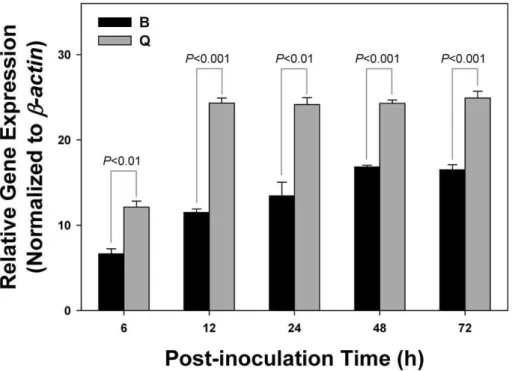
The different viral acquisition capability between B and Q biotypes at various AAP was analyzed using one-way analysis of variance (ANOVA). The frequency of TYLCV infection in B. tabaci B and Q biotype individuals and populations, the viral transmission between each biotype and TYLCV, and the virus-B. Figure 2. Acquisition of TYLCV byB. tabaciB and Q biotypes.Relative gene expressions of TYLCV inB. tabaciB and Q biotypes were measured using a qET-PCR after whiteflies fed on the TYLCV-infected tomato plants for 6, 12, 24, 48, and 72 h. Statistical differences are denoted by thep-value using a Chi-square test.
doi:10.1371/journal.pone.0034817.g002
tabacilife stage combinations of the biotype, were analyzed by the Chi-square analysis using SPSS (SPSS for Windows, Rel. 17.0.0. 2009. Chicago: SPSS Inc.).
Results
The distribution of TYLCV amongB. tabaciB and Q biotypes in China
PCR amplification of the AV2 gene of TYLCV resulted in the detection of a 400 bp amplicon among18 out of 55 collection sites across11 provinces, including Heilongjiang, Liaoning, Neimenggu, Hebei, Beijing, Shandong, Shanxi, Jiangsu, Zhejiang, Shanghai, and Hubei. TYLCV was not detected in the field-collected B. tabaci in the other 37 sites from 7 provinces, including Tianjin, Henan, Hainan, Hunan, Xinjiang, Fujian, and Guangdong (Figure 1, Table S1). Among these collection sites, 43 populations from 14 provinces were determined to be the Q biotype, while 12 populations from 8 provinces were identified as the B biotype (Figure 1, Table S1). Among the Q biotype populations, 17 (39.5%) were infected with TYLCV, while only 1 B biotype populations (8.3%) was infected. Similarly, the percentage of TYLCV-infected individuals was significantly lower among the B biotype (4.2%) than the Q biotype (24.4%).
Acquisition of TYLCV byB. tabaciB and Q biotypes In this study, the qRT-PCR method was adopted to compare the virus acquisition capability between B and Q biotypes. The relative viral gene expression level of Q biotype was significant higher than that of the B biotype in each of the five AAP (Figure 2). In addition,B. tabaciB and Q biotypes needed 48 and 12 h AAP, respectively, to reach their respective maximum viral loads (Figure 2).
Horizontal transmission of TYLCV
Two sets of experiments were carried out for the biotypes-virus combinations: B biotype-TYLCV and Q biotype-TYLCV. Results from non-viruliferous adults indicated that all four treatments involving the Q biotype-TYLCV combination were tested positive for the horizontal transmission, whereas only T2 and T3 treatments involving the B biotype-TYLCV combination were tested positive (Figure 3). Specifically, for the Q biotype-TYLCV combination, viruliferous females passed on the virus to 50% of the males in treatment (T1). Viruliferous males passed on the virus to 73.7% of the females in treatment (T2). Viruliferous females passed on the virus to 56.5% of the males in treatment (T3). Viruliferous males passed on the virus to 30.8% of the females in treatment (T4). For the B biotype-TYLCV combinations, viruliferous females failed to pass on the virus to the males in Figure 3. Horizontal transmission of TYLCV byB. tabaciB and Q biotypes.Transmission of TYLCV from viruliferous to non-viruliferousB. tabaci of the opposite sex was evaluated under four different treatments: T1 (1F*61M0), T2 (1F061M*), T3 (2F*62M0), and T4 (2F062M*). F*,
viruliferous female; F0, initially non-viruliferous female; M*, viruliferous male; M0, initially non-viruliferous male. A total of 25 replications were included
in each of these treatments. Detection of viral transmission was confirmed by the presence of a 400 bp amplicon of TYLCV DNA on an agarose gel (A). M, DNA size marker (Marker I, GIBCO-BRL). The percentage of whiteflies tested positive for TYLCY was summarized inB. Statistical differences are denoted by thep-value using a Chi-square test.
treatment (T1). Viruliferous males passed on the virus to 10.0% of the females in treatment (T2). Viruliferous females passed on the virus to 25.0% of the males in treatment (T3). Viruliferous males failed to pass on the virus to the females in treatment (T4). For each treatment, the percentage of TYLCV transmission by the Q biotype was substantially higher than the B biotype, and the overall percentage of TYLCV transmission by the Q biotype was 52.2%, compared to 10.5% for the B biotype, suggesting that the particular whitefly biotype had a significant effect on the frequency of horizontal transmission of TYLCV.
Vertical transmission of TYLCV
Both B and Q biotypes were found to transmit TYLCV vertically, in which TYLCV could be detected in the eggs and crawlers with infection rates of 50.0 and 22.0%, respectively, for the Q biotype individuals, and 30.0 and 22.0%, respectively, for the B biotype individuals. However, virus was not detected in the pupa or adult progeny from viruliferous B or Q whiteflies (Figure 4). Interestingly, an age-dependent pattern of transmission frequency was observed in the immature stages in which transmission frequency was higher at the egg stage, and decreased following the subsequent development of the whitefly offspring.
Discussion
Concurrent spread of the epidemic TYLCV and the invasiveB. tabaciQ biotype
The previous reports showed that TYLCV has been found only in 6 provinces during the past 5 years in China [9–14]. In the present study, TYLCV has been identified across 11 provinces in China. For the first time, TYLCV has moved into Heilongjiang, Liaoning, Shanxi, Neimenggu, and Hubei provinces. Based on the historical records and current results, it can be concluded that TYLCV has been spread gradually from south to north and from coastal areas to inland during the past 5 years. The concurrent invasion ofB. tabaciQ biotype [31–35] and frequent outbreaks of TYLCV in tomato crops suggested thatB. tabaciQ biotype might be a major biotic factor facilitates the rapid spread of this virus in China. This observation is consistent with a previous report [44], in which a Q biotype collected from southern Spain transmitted both TYLCV isolates (TYLCV-Sr or TYLCV-Is) more efficiently than the B biotype. The Q biotype infected a significantly higher percentage of the test plants in their controlled greenhouse study, suggesting that Q might be a more competent vector of the virus [44].
The intimate relationship between outbreaks of TYLCV and rapid spread ofB. tabaciQ biotype has been carefully documented Figure 4. Vertical transmission of TYLCV byB. tabaciB and Q biotypes.A total of four developmental stages (egg, crawler, pupa, and adult) from the first generation progeny of viruliferous adults were tested for the presence of TYLCV DNA. Detection of viral transmission was confirmed by the presence of a 400 bp amplicon of TYLCV DNA on an agarose gel (A). M, DNA size marker (Marker I, GIBCO-BRL). The percentage of whiteflies tested positive for TYLCY was summarized inB. Statistical differences are denoted by thep-value using a Chi-square test. NS stands for not significant. doi:10.1371/journal.pone.0034817.g004
in the Shandong Province, China. Field surveys dated thatB. tabaci Q biotype was introduced into the Shandong Province in 2005 when B was the dominant whitefly biotype in the area. Q started to displace B in 2007 and became the dominantB. tabacibiotype by 2009 [32,33]. As for tomato yellow leaf curl disease caused by TYLCV, it occurred only sporadically in Heze and Zibo, Shandong Province in 2007, then it started to quickly move into adjacent regions in 2008, including Weifang, Liaocheng, Jining, Qingdao, and Zaozhuang, Shandong Province. Eventually, it became epidemic across the entire Shandong Province and caused severe yield losses in tomato production in 2009 [12]. The concurrent movement of TYLCV and B. tabaci Q biotype in Shandong Province clearly supports our hypothesis that Q might be a causative agent facilitating the rapid spread of TYLCV in China.
Viral transmission capability ofB. tabaciB and Q biotypes Acquisition of TYLCV byB. tabaciB and Q biotypes exhibits substantial differences. Q biotype not only showed significantly higher viral gene expression level at all 5 acquisition access periods, it also reached the maximum viral load 4 times faster than its B counterparts (12 h in Q and 48 h in B). In addition, the observed infection frequency of TYLCV among B. tabaci field populations and the mode of transmission study provide additional empirical evidences to suggest a stronger association between TYLCV-Q than TYLCV-B biotype. The infection rate of TYLCV among Q field populations was significantly higher than B. Horizontal transmission appeared to be instrumental in increasing the number of whiteflies capable of transmitting virus to tomato plants for a givenB. tabacipopulation [18]. In this study, Q demonstrated superior horizontal transmission capability (52.2% infection frequency) in comparison to its B counterparts (10.5% infection frequency). On the other hand, TYLCV can also be transmitted between whiteflies in a sex-dependent manner [18]. TYLCV was transmitted from viruliferous males to viruliferous females and from viruliferous females to non-viruliferous males. Transmission of TYLCV in a gender-dependent manner was shared with both B and Q biotypes,
suggesting that this is a biologically conserved trait among whiteflies [16]. Our study showed that both B and Q biotypes were able to transmit TYLCV vertically to eggs and crawlers, but not to pupa or adult of the first generation progeny. Overall, transmission of viral DNA through the vector egg is relatively common; however, vertical transmission of the infectious agent through generation appears to be, at best, a rare event, reported only once [15, Table 1]. One possible explanation is that virus activates B. tabaci immune responses, including autophagy and antimicrobial peptide production, which could lead to the gradual decrease of viral titer within the viruliferous whitefly [45]. Furthermore, it appears that vertical transmission of TYLCV by B. tabaci has little or no bearing on the epidemiology of the TYLCD, at least, in the field. It is worth noting that some of the discrepancies observed between our results and previous studies [16,18,19, Table 1] could be due to environmental variations, the particular virus isolates examined, and/or the specific B. tabaci haplotypes used in the experiments.
Multiple factors contribute to the viral transmission in whiteflies, B. tabaciB and Q biotypes. It has recently been demonstrated that a 63-kDa GroEL homologue produced by the endosymbiotic bacteriaHamiltonellais essential for the circulative transmission of the virus in B. tabaci. Interactions between GroEL protein and TYLCV particles ensure the safe circulation of the virus in insect hemolymph [46–48]. In Israel,Hamiltonellahas only been detected in B biotype, and B can efficiently transmit the virus. In contrast, Q does not harbor Hamiltonella, and it can barely transmit TYLCV. Based on these observations, a causal link between the transmission efficiency of TYLCV and the presence ofHamiltonella has been established [46–48]. In China, however, the role of Hamiltonellaplayed in the viral transmission is unclear. A nation-wide survey in China showed that infection frequencies of Hamiltonellain 17 B and 44 Q field populations were equally high (46.7% and 46.5%, respectively) [24]. Moreover, the B and Q lab populations used in this study have a much higher infection rate of Hamiltonellathan in the field (nearly 100% for both biotypes; HPP, unpublished data). Although both B and Q biotypes in China can transmit TYLCV, Q demonstrates superior acquisition and transmission capability than its B counterparts. These results suggest that factors other thanHamiltonellalikely play a substantial role in mediating the acquisition and transmission ability of TYLCV between the two biotypes. Studies on the interactions between B. tabaci endosymbionts and TYLCV transmission are currently under investigation.
Previous studies have also shown that plant viruses can manipulate the biology of B. tabaci [41,44,49,50]. In a parallel study, TYLCV-infected tomato plants improve the performance of Q biotype, whereas it exerts negative effects on the B biotype in regard to the fecundity, survival rate, development time, and female body size (HPP, unpublished data). Current study also suggests that the introduction of TYLCV, coupled with unfavor-able environmental conditions in some locations, may influence the distribution profiles ofB. tabaciB and Q biotypes in China.
Summary
The combined field and laboratory observations demonstrate the potential for the differential spread of TYLCV byB. tabaciB and Q biotypes, which are both invasive and recently introduced B. tabaci vectors in China. These results in conjunction with previous studies suggest that the prevalence ofB. tabaciQ biotype is linked to a greater disease incidence compared to the B biotype in China.
Table 1.Vertical transmission of TYLCV inBemisia tabaci.
Virusa Biotype Life Stageb Reference
Egg Nymph Adult
TYLCV B 81% (46/57) 37% (26/58) 57% (46/81) [15]
TYLCV B 0% (0/100) 0% (0/100) 0% (0/125) [17]
TYLCSV B 9% (10/110) 29% (32/110) 2% (5/250) [17]
TYLCV B 28% (11/40) 8% (6/80) 0% (0/40) [19]
TYLCCNV B 19% (14/75) 11% (17/150) 0% (0/75) [19]
TYLCV B 30% (30/100) 11% (22/200)c0% (0/100) This study
TYLCV Q 17% (13/75) 15% (22/150) 3% (2/75) [19]
TYLCCNV Q 1% (1/75) 1% (2/150) 0% (0/75) [19]
TYLCV Q 50% (50/100) 11% (22/200)c0% (0/100) This study
aTomato yellow leaf curl virus(TYLCV),Tomato yellow leaf curl Sardinia virus
(TYLCSV), andTomato yellow leaf curl China virus(TYLCCNV).
bInfection percentage for each life stage is reported as % (infected individuals/
tested individuals).
cThe nymphal stage ofBemisia tabacican be divided into four instars. The first
Supporting Information
Table S1 Collection information for Bemisia tabaci field populations.
(PDF)
Acknowledgments
We thank Prof. Shusheng Liu (Institute of Insect Science, Zhejiang University) for his help in data analysis, and Prof. Xueping Zhou (Institute of Biotechnology, Zhejiang University) for providing TYLCV clones. The authors are also grateful to Dr. John Obrycki (Department of Entomology, University of Kentucky) for his comments on an earlier draft. This research
was supported by the National Science Fund for Distinguished Young Scholars (31025020), the 973 Program (2009CB119200), the National Natural Science Foundation of China (31171857), the Outstanding Youth Science Foundation of Shandong Province (JQ200811), and the Key Laboratory of Biology and Genetic Improvement of Horticultural Crops, Ministry of Agriculture, P.R.China.
Author Contributions
Conceived and designed the experiments: YJZ XGZ HPP. Performed the experiments: HPP DC QS BML SLW QJW WX RML NNY XY BYX WY. Analyzed the data: HPP XGJ YJZ. Wrote the paper: HPP DC XGZ YJZ JKB.
References
1. Boulton M (2003) Geminiviruses: major threats to world agriculture. Ann Appl Biol 142: 143–144.
2. Varma A, Malathi VG (2003) Emerging geminivirus problems: A serious threat to crop production. Ann Appl Biol 142: 145–164.
3. Brown JK (2000) Molecular markers for the identification and global tracking of whitefly vector-begomovirus complexes. Virus Res 71: 233–260.
4. Brown JK, Czosnek H (2002) Whitefly transmission of plant viruses. Adv Bot Res 36: 65–76.
5. Brown JK (2010) Phylogenetic biology of theBemisia tabacisibling species group. Chapter 2 Pages 31–67 in: Bionomics and Management of a Global Pest PA Stansly and SE Naranjo (eds.), Springer, Amsterdam. 350 p.
6. Gill R, Brown JK (2010) Systematics ofBemisiaandBemisiaRelatives: Can molecular techniques solve the Bemisia tabaci complex conundrum – a Taxonomist’s viewpoint. Chapter 1 Pages 5–29 in: Bionomics and Management of a Global Pest PA Stansly and SE Naranjo (eds.), Springer, Amsterdam. 350 p. 7. Cohen S, Harpaz I (1964) Periodic, rather than continual acquisition of a new tomato virus by its vector, the tobacco whitefly (Bemisia tabaci Gennadius). Entomol Exp Appl 7: 155–166.
8. Brown JK (2007) TheBemisia tabacispecies complex: Genetic and phenotypic variation and relevance to TYLCV-vector interactions. Chapter 3 Pages 25–55 in: Tomato Yellow Leaf Curl Virus Disease H Czosnek (ed.), Springer, New York and Tokyo. 447 p.
9. Wu JB, Dai FM, Zhou XP (2006) First report ofTomato yellow leaf curl virusin China. Ann Appl Biol 155: 439–448.
10. Mugiira RB, Liu SS, Zhou XP (2008)Tomato yellow leaf curl virusandTomato leaf curl Taiwan virusinvade south-east coast of China. J Phytopathol 156: 217–221. 11. Ji YH, Xiong RY, Cheng ZB, Zhou T, Zhao TM, et al. (2008) Molecular diagnosis ofTomato yellow leaf curldisease in Jiangsu Province. Acta Horticulturae Sinica 35: 1815–1818.
12. Sun ZW, Yang JX, Zhang MZ, Li XD (2009) Occurrence and control ofTomato yellow leaf curl virusdisease in Shandong Province. China Vegetables 21: 5–6. 13. Zhang AH, Zhang SM, Liu S, Di DP, Miao HQ (2010) Occurrence and
distribution ofTomato yellow leaf curldisease in Hebei Province. Plant Protection 36: 127–129.
14. Zhou T, Shi YC, Chen XY, Fan ZF (2010) Identification and control ofTomato yellow leaf curl virusdisease in Beijing. Plant Protection 36: 116–118.
15. Ghanim M, Morin S, Zeidan M, Czosnek H (1998) Evidence for transovarial transmission of tomato yellow leaf curl virus by its vector, the whiteflyBemisia tabaci. Virology 240: 295–303.
16. Ghanim M, Sobol I, Ghanim M, Czosnek H (2007) Horizontal transmission of begomoviruses between Bemisia tabaci biotypes. Arthropod-Plant Inte 1: 195–204.
17. Bosco D, Mason G, Accotto GP (2004) TYLCSV DNA, but not infectivity, can be transovarially inherited by the progeny of the whitefly vectorBemisia tabaci (Gennadius). Virology 323: 276–283.
18. Ghanim M, Czosnek H (2000) Tomato yellow leaf curl geminivirus (TYLCV-Is) is transmitted among whiteflies (Bemisia tabaci) in a sex-related manner. J Virol 74: 4738–4745.
19. Wang J, Zhao H, Liu J, Jiu M, Qian YJ, et al. (2010) Low frequency of horizontal and vertical transmission of two begomoviruses through whiteflies exhibits little relevance to the vector infectivity. Ann Appl Biol 157: 125–133. 20. Czosnek H, Ghanim M (2011)Bemisia tabaci-Tomato yellow leaf curl virusinteraction
causing worldwide epidemics. Chapter 3 Pages 51–67 in: The Whitefly,Bemisia tabaci(Homoptera: Aleyrodidae) Interaction with Geminivirus-Infected Host Plants WMO Thompson (ed.), Springer, Amsterdam. 396 p.
21. Perring TM (2001) TheBemisia tabacispecies complex. Crop Prot 20: 725–737. 22. Jones DR (2003) Plant viruses transmitted by whiteflies. Eur J Plant Pathol 109:
195–219.
23. Brown JK, Frohlich DR, Rosell RC (1995) The sweetpotato or silverleaf whiteflies: biotypes ofBemisia tabacior a species complex? Ann Rev Entomol 40: 511–534.
24. Pan HP, Li XC, Ge DQ, Wang SL, Wu QJ, et al. (2012) Factors affecting population dynamics of maternally transmitted endosymbionts inBemisia tabaci. PLoS One 7: e30760.
25. De Barro PJ, Liu SS, Boykin LM, Dinsdale A (2011)Bemisia tabaci: a statement of species status. Ann Rev Entomol 56: 1–19.
26. Dinsdale A, Cook L, Riginos C, Buckley YM, De Barro PJ (2010) Refined global analysis ofBemisia tabaci(Hemiptera: Sternorrhyncha: Aleyrodoidea: Aleyrodi-dae) mitochondrial cytochrome oxidase I to identify species level genetic boundaries. Ann Entomol Soc Am 103: 196–208.
27. Zhou Y (1949) The list of whiteflies in China. China Entomology 3: 1–18. 28. Luo C, Yao Y, Wang RJ, Yan FM, Hu DX, et al. (2002) The use of
mitochondrial cytochrome oxidase mtCOI gene sequences for the identification of biotypes ofBemisia tabaci(Gennadius) in China. Acta Entomologica Sinica 45: 759–763.
29. Chu D, Zhang YJ, Brown JK, Cong B, Xu BY, et al. (2006) The introduction of the exotic Q biotype ofBemisia tabacifrom the Mediterranean region into China on ornamental crops. Fla Entomol 89: 168–174.
30. Chu D, Jiang T, Liu GX, Jiang DF, Tao YL, et al. (2007) Biotype status and distribution ofBemisia tabaci(Hemiptera: Aleyrodidae) in Shandong Province of China based on mitochondrial DNA markers. Environ Entomol 36: 1290–1295. 31. Pan HP, Chu D, Ge DQ, Wang SL, Wu QJ, et al. (2011) Further spread of and domination byBemisia tabacibiotype Q on field crops in China. J Econ Entomol 104: 978–985.
32. Chu D, Wan FH, Zhang YJ, Brown JK (2010) Change in the biotype composition ofBemisia tabaciin Shandong Province of China from 2005 to 2008. Environ Entomol 39: 1028–1036.
33. Chu D, Zhang YJ, Wan FH (2010) Cryptic invasion of the exoticBemisia tabaci biotype Q occurred widespread in Shandong Province of China. Fla Entomol 93: 203–207.
34. Teng X, Wan FH, Chu D (2010)Bemisia tabacibiotype Q dominates other biotypes across China. Fla Entomol 93: 363–368.
35. Rao Q, Luo C, Zhang H, Guo X, Devine GJ (2011) Distribution and dynamics ofBemisia tabaci invasive biotypes in central China. Bull Entomol Res 101: 81–88.
36. Brown JK (1994) The status ofBemisia tabaci(Genn.) as a pest and vector in world agroecosystems. FAO Plant Prot Bull 42: 3–32.
37. Seal SE, VandenBosch F, Jeger MJ (2006) Factors influencing begomovirus evolution and their increasing global significance: implications for sustainable control. Crit Rev Plant Sci 25: 23–46.
38. De Barro PJ, Driver F (1997) Use of RAPD PCR to distinguish the B biotype from other biotypes ofBemisia tabaci(Gennadius) (Hemiptera: Aleyrodidae). Aust J Entomol 36: 149–152.
39. Frohlich DR, Torres-Jerez I, Bedford D, Markham PG, Brown JK (1999) A phylogeographical analysis of the Bemisia tabaci species complex based on mitochondrial DNA markers. Mol Ecol 8: 1683–1691.
40. Xie W, Wang SL, Wu QJ, Feng YT, Pan HP, et al. (2011) Induction effects of host plants on insecticide susceptibility and detoxification enzymes ofBemisia tabaci(Hemiptera: Aleyrodidae). Pest Manag Sci 67: 87–93.
41. Jiu M, Zhou XP, Tong L, Xu J, Yang X, et al. (2007) Vector-virus mutualism accelerates population increase of an invasive whitefly. PLoS One 2: e182. 42. Livak KJ, Schmittgen TD (2001) Analysis of relative gene expression data using
real-time quantitative PCR and the 22DDCT
method. Methods 25: 402–408. 43. Xie Y, Zhou XP, Zhang ZK, Qi YJ (2002)Tobacco curly shoot virusisolated in
Yunnan is a distinct species ofBegomovirus. Chinese Sci Bull 47: 197–200. 44. Rubinstein G, Czosnke H (1997) Long-term association of tomato yellow leaf
curl virus with its whitefly vectorBemisia tabaci:effect on the insect transmission capacity, longevity and fecundity. J Gen Virol 78: 2683–2689.
45. Luan JB, Li JM, Varela N, Wang YL, Li FF, et al. (2011) Global analysis of the transcriptional response of whitefly totomato yellow leaf curl China virusreveals the relationship of coevolved adaptations. J Virol 85: 3330–3340.
46. Morin S, Ghanim M, Sobol I, Czosnek H (2000) The GroEL protein of the whitefly Bemisia tabaci interacts with the coat protein of transmissible and nontransmissible begomoviruses in the yeast two-hybrid system. Virology 276: 404–416.
47. Morin S, Ghanim M, Zeidan M, Czosnek H, Verbeek M, et al. (1999) A GroEL homologue from endosymbiotic bacteria of the whitefly Bemisia tabaci is implicated in the circulative transmission of Tomato yellow leaf curl virus. Virology 256: 75–84.
48. Gottlieb Y, Zchori-Fein E, Mozes-Daube N, Kontsedalov S, Skaljac M, et al. (2010) The transmission efficiency oftomato yellow leaf curl virusis correlated with the presence of a specific symbiotic bacterium species. J Virol 84: 9310–9317. 49. Costa HS, Brown JK, Byrne DN (1991) Life history traits of the whitefly,Bemisia
tabaci(Homoptera: Aleyrodidae) on six virus-infected or healthy plant species. Environ Entomol 20: 1102–1107.