Camila Augusta Pires de Figueiredo
Hollywood goes Graphic: The Intermedial Transposition of
Graphic Novels to Films
Belo Horizonte UFMG
Hollywood goes Graphic: The Intermedial Transposition of
Graphic Novels to Films
Camila Augusta Pires de Figueiredo
Submitted in partial fulfillment of the requirements for the degree of Mestre em Estudos Literários: Literaturas de Expressão Inglesa”
Field of Research: Literature and Other Semiotic Systems Thesis Advisor: Thaïs Flores Nogueira Diniz, Ph.D.
Belo Horizonte Faculdade de Letras
ACKNOWLEDGEMENTS
I would like to thank God for His everlasting love and care. My mother, for the shelter and psychological support. My brother, for his friendship.
Dino and Kika, for cheering me up when I needed.
My husband, for his patience, incentive and for introducing me to the fantastic world of comics: this thesis would never exist without you!
ABSTRACT
Comic books have always been consigned to the children‟s shelves at libraries and bookstores. Recently, however, a massive publishing of comic books designed for the adult audience – called graphic novels – has caught the attention of academics, critics and the film industry. Despite the existence of a vast theoretical bibliography of screen adaptations based on novels, those theories can not be satisfactorily applied to the analysis of films based on comics and graphic novels, since they do not conceive, among other aspects, the translation of the drawings in comics to the photography of film. In this sense, this thesis focuses on an area that has not received enough critical attention: the specific case of the translation of comics and particularly of graphic novels into films. In light of this, I discuss Alan Moore‟s
Watchmen and Frank Miller‟s Sin City and their respective film versions. In order to support
RESUMO
LIST OF FIGURES
Fig. 1: The split screen and the final credits in Hulk (2003) ……..…………... 17
Fig. 2: Paul Auster’s City of Glass, page 4 ………. 20
Fig. 3: Meehan cartoons ... 36
Fig. 4: Frank Miller‟s 300. No page number ………... 37
Fig. 5: Sin City Recut, Unrated and Extended DVD version menu ……… 48
Fig. 6: Watchmen Photos at Flickr ………..………... 57
Fig. 7: Watchmen YouTube videos ... 58
Fig. 8: “Minutemen Arcade” online video game ………... 59
Fig. 9: The main domain, material for social network and to promote the film... 62
Fig. 10: The regular grid layout in Watchmen and one of its variations ………... 71
Fig. 11: The mirror-like central double-page composition ……… 71
Fig. 12: Back and front covers in Miller‟s 300….………. 74
Fig. 13: A double-page composition in 300 and its film version………... 75
Fig. 14: Examples from The Hard Goodbye ………....………. 78
Fig 15: Blank and dark full-pages. ………...……….... 79
Fig. 16: Full-page and double page compositions………. 80
Fig. 17: A multiple-panel page in That Yellow Bastard …..……….. 81
Fig. 18: A shot-by-shot film sequence ………...… 82
Fig. 19: A dark double-page composition and its film version……..……… 83
Fig. 20: A blank full-page and its transposition to screen ……….…… 83
Fig. 21: Onomatopoeia in Sin City: The Hard Goodbye ……….. 89
Fig. 23: Keanu Reeves and Winona Ryder in A Scanner Darkly………... 105
Fig 24: The steps of production in Sky Captain ………... 107
Fig. 25: Frank Miller‟s sketches for the film Sin City……… 110
Fig. 26: The original image, the animatic image, the filmic image…………..….. 110
Fig. 27: The green screen in Sin City and the final image ………. 111
Fig. 28: Digital intervention on characters Kevin and Gail in Sin City………….. 112
LIST OF TABLES Table 1: McFarlane‟s model for the analysis of film adaptations ………. 40
Table 2: Groensteen‟s mode of articulation compared in comics and films... 69
Table 3: Distribution of references to songs in the graphic novel…………... 90
Table 4: Distribution of songs in the film………... 92
TABLE OF CONTENTS
Introduction
A Short History of and between the Media ………...….1
Defining Comics ……….………..………3
From Comics to Graphic Novels……….………..7
Methodology and Chapter Division……….………10
Chapter 1: Intermedial Relations Notions on Intermedial Studies…….………..………….………14
The Contribution of Irina Rajewsky………15
a. Intermedial Reference….……….………16
b. Media Combination ……...……….…17
c. Media Transposition ………...21
The Prejudice against Comics-to-Film Adaptations ………..23
Literature Review on Comics and Films...………..26
The Contribution of Pascal Lefèvre………....31
Chapter 2: Narrative aspects Literature Review………35
Narrative in Watchmen………42
a. A Multiple DVD Experience.…...………42
b. Transmedia Storytelling in Watchmen……...………..…51
Conclusion ...………...………62
Chapter 3: Layout aspects Literature Review………64
Page and Screen Layouts in Sin City………..………….76
Conclusion………...……84
Chapter 4: Sound aspects Literature Review………...……….86
Sound in Watchmen………...89
Conclusion……….………..97
Chapter 5: Pictorial aspects Literature Review………99
Pictorial aspects in Sin City……….………..108
Conclusion….………117
Final Considerations……….………119
Appendix……….………...…124
“If people failed to understand comics
it was because they defined what
comics could be too narrowly!”
(McCloud, Understanding Comics, 3)
INTRODUCTION
A Short History of and between the Media
It is common knowledge that the origins of cinema date back to the 1890s, with August and Louis Lumière‟s celluloid experiments. Not many years later, cinema was already
recognized as the seventh art and found a definite place within Film Studies departments in many academic institutions.
In general, cinema has always sought for material for their films from other media. The most popular inspiration comes from novels. Today, as Deborah Cartmell, Timothy Corrigan and Imelda Whelehan explain, film adaptations of works by Shakespeare and Jane Austen can be considered film genres on their own (“Introduction to Adaptation”, 3). This
tendency is due to a common – and certainly also erroneous – concept that what has achieved popularity in one medium will probably achieve it in another.
Modern comics are older than cinema. According to Thierry Groensteen, modern printed comics appeared in the 1830s, with Rodolphe Töpffer (“Why Are Comics Still in
of study and creating research centers in this area. In Brazil, until the mid-eighties, the existing works were mostly related to the field of education, in which comics were seen as methodological tools for the development of a child‟s reading skills. Today, with a few exceptions of universities‟ research centers1
, the comics medium is still working its way towards academic and cultural recognition.
Nevertheless, since their origins, these two media have always conversed with each other. Hans-Christian Christiansen mentions that the inspiration for the 19th century comics involved cinema‟s motifs, storyline structure and subjects (“Comics and Film: A Narrative Perspective”, 107). Will Eisner, one of the greatest comic artists of the 20th
century goes further than that, using cinematographic angles and techniques of chiaroscuro in “The Spirit”,
published for the first time in 1940. The converse is also true: film adaptations of comics date from as early as 1900, with a series of films produced by the Edison Film Company based on Frederick Burr Opper‟s “Happy Hooligan” (idem).
This relationship is natural because both arts are essentially narrative, constructed under iconic signs. Both comics and films “have aesthetic qualities and formal properties, such as frames and panels, which have important visual resemblance (...) In addition, both comics and films also fit within a certain type of narrative tradition” (Gordon, Jancovich and McAllister, Film and Comic Books, xi).
Even though the relationship between cinema and comics is not a new phenomenon, the recent years have witnessed a considerable rise in the number of films based on comic books, which have been successful, if not for the critics, certainly in the box-office. Since the year 2000, forty-three adaptations of this kind have been listed2 and, by the time this thesis is being written, a good number of other works are expected to be released soon. There is also a
1. Such as the Observatório de Histórias em Quadrinhos, at Universidade de São Paulo. 2. According to the website Box Office Mojo accessed on March 1st, 2010.
good prospect for sequels, prequels and remakes of previous works. And, in a few years from now, I imagine that comics adaptations will also be considered a film genre on their own.
This rediscovery of comics as source-texts for profitable films finds two possible explanations. First, the fact that some comics have „grown up‟, bringing the need for a new category in comics genres. Second, the development of digital technology in cinema. Particularly in the case of adaptations of comic books, digital technology has redefined the aesthetics of film, creating a necessity to recreate the appearance of the comic book on screen. The influence of the comics medium is not limited to the adaptation of plot, characters and dialogues, but it also applies to its look, as a result of the transformation in film techniques.
Even though „comics cinema‟ has become a recurrent practice nowadays, it has not attracted much attention from scholars and critics. In this sense, this work results from a certain feeling of personal frustration at the disdain with which comics and comic book adaptations are generally dealt with. I consider that the relevance of this thesis lies in the recognition of comics as an autonomous medium, with mediatic and literary qualities distinct from those of literature. Because of this, my argument is that the intermedial transposition of comics to cinema – and therefore of graphic novels to films – involves more aspects than the existing novel-to-film adaptations are able to comprise, which suggests the refutation of some recurrent practices in adaptation studies as well as a re-evaluation of the comics medium.
Defining Comics
The use of the word „comics‟ may be confusing, even to those in the field. Robert C.
another name for a comedian. In short, comics lacks the precision it ought to have for ordinary communication let alone serious philosophical deliberations” (16).
Perhaps because comics has always been overlooked as a medium, it was not granted a common name across the different places where it was established. In many countries, such as in Italy, France and Brazil, the label was defined according to aspects of the language of comics. In the United States, however, it has always been connected to the humoristic and entertaining purposes of the first strips published daily or weekly in newspapers.
The discussion of what can or cannot be considered comics is also controversial. In fact, in most of the existing theoretical publications, the definition of comics is a recurring matter. According to Driest (2005), there are two ways used to define comics. The first is by the combination of word and image. Inevitably, this definition leads to debates whether this combination characterizes comics as a hybrid medium (a mere combination of words and images, or of painting and literature), in contrast to a distinct medium on its own. Moreover, Driest calls our attention to the fact that, in this approach, sequences of images without words cannot properly be considered comics (“Subjective Narration in Comics”, 8; 20-21). Second, comics is generally defined by the disposition of images in a sequence. With this
characteristic in mind, Will Eisner coined the term „sequential art‟. In his definition, “comics always consist of at least two distinct images in a deliberate combination” (qtd. in Driest, 9).
But Driest warns us that, in this case, single-panel compositions, such as political cartoons are not considered comics.
Although Eisner‟s term confers on comics the status of art, it may erroneously lead us to consider, for instance, Egyptian hieroglyphics and the Trajan‟s Column to belong to the
same category as comics3. Although it is undeniable that these historical works may have been the precursors of comic art, even helping delimitating some possibilities and constraints
3. Other examples of works which are broadly considered by McCloud as „sequential art‟ are pre-Colombian
manuscripts, the Bayeux Tapestry, „The Tortures of Saint Erasmus‟ (1460), and „A Harlot‟s Progress‟ (1731).
of the medium, it is not possible to affirm that they are „sequential art‟, as Eisner had probably
conceived the term. On the other hand, as mentioned before, this term denies single-panel compositions a place within comics art. In my opinion, these compositions share more visual and cultural conventions with comics than do the Trajan Column and Egyptian painting.
Aligned with Eisner‟s idea of images in a sequence, Scott McCloud elaborates his own definition for comics: “Juxtaposed pictorial and other images in deliberate sequence intended to convey information and/or to produce an aesthetic response in the viewer” (Understanding
Comics, 9). McCloud‟s definition has proven to be useful in several aspects because it does
not mention any kind of theme, style, material, nor does it make any aesthetic evaluation (22). Additionally, it rules out the chances of another frequent misconception involving comics: the idea that images are necessarily drawn. This characteristic is generally mentioned in contrast with film: while comics images must be „graphed‟ by the hand of an artist, films must use photographic „real‟ images. As the discussion in chapter five shall demonstrate, this distinction has become more and more useless, especially in our era of digital technologies and intermedial possibilities.
Although it is not within the scope of this thesis to provide a definite answer to this apparently never-ending debate, a working definition of the term would be essential to the coherence of my work. And this definition would involve form, content and format.
But when one thinks about comics, the aspect of the medium that comes to mind hardly ever relates to the characteristics of the form, but is rather associated to the format and/or the content.
For theoretician Pascal Lefèvre, the format is of great importance because it helps shape readers‟ expectations to comics. The author says that format is defined by its
materiality (size and paper quality), temporal aspects (publishing regularity) and editorial choices (the length of chapters or taboo issues, for example). (The Importance of Being „Published‟, 98)
Basically, one can identify the following formats of comics nowadays: comic books, comic strips, single-panel cartoons, manga magazines, graphic novels, European album series, webcomics, fanzines, minicomics and small press comics in general. Yet, in many cases, the boundaries that define certain comics formats can be blurred. And needless to say, this categorization is open to the inclusion of new formats.
In relation to content, the word „comics‟ is defined in this work as an umbrella term for several genres. In this sense, it is worth stressing that comics is not a (sub)genre of literature but it is a medium on its own. And as happens with other media such as literature and film, it has its own genres. The Michigan State University library has listed forty-five different genres of comics4 and it is believed that this number may be even greater. This categorization of comics in genres may come as a surprise to some accustomed to “those
bright, colorful magazines, filled with bad art, stupid stories and guys in tights” (McCloud,
Understanding Comics, 2). This common assumption portrays a wrong image of comics, one
that narrows the medium down to a single genre, the American superhero comic book genre, considered an infantile, poor quality reading and seen as violent and vulgar by educators.
The three aspects proposed (form, content and format) work together to define comics for formal purposes and also personally. In the reader‟s mind, one aspect does not exclude the others; yet they overlap, working together to build a personal (but also culturally-influenced) definition of comics. This is why one can immediately recognize a work of comics, but cannot easily define or explain its characteristics.
From Comics to Graphic Novels
As Thierry Groensteen explains, during the nineteenth century comics was intended for adults and was published in book form. But as soon as it became a press phenomenon, it acquired the readership of children. Since then it has been consigned to the strips in
newspapers and the children‟s shelves at libraries and bookstores. For many decades, comics
distribution in the United States was limited to mass production of superhero comic books5. Academic studies on comics were limited to the works of educators who, mainly inspired by Dr. Wertham‟s Seduction of the Innocent (1954), believed that the rise of juvenile
delinquency was a consequence of the negative influence of comics.
In the 1960s, comics started the process of re-conquering adult readership. The underground “comix”6
movement came as a way to get around the censorship of the Comics Code Authority, which was set up after Dr. Wertham‟s book was published. Heavily inspired
by the hippie wave of the sixties, underground comics such as the work of Robert Crumb, depicted the counterculture‟s view of political and social aspects of the time with humor and
sarcasm.
5. In Europe, in opposition to what happened in the US, authors like Hergé, Hugo Pratt and Guido Crepax have had a fundamental role in keeping comics at a position of recognition among adult readers in the 20th century.
From the 1970s but especially from the 1980s onwards, the underground movement inspired the development of a more mature branch of comics, still designed for adults, but not necessarily with a subversive approach to sex, drugs and violence. Charles Hatfield labels them „alternative comics‟. He explains that alternative comics “have enlarged the comic book‟s thematic repertoire by urging the exploration of genres heretofore neglected in comics” (Alternative Comics: An Emerging Literature, x).
The inappropriateness of the label „comics‟ when referring to such works forced the
designation of a new term. Therefore, in 1978, Will Eisner coined the expression “graphic novel” as he referred to his work A Contract with God, a novel-length comic book. Two
aspects differentiate graphic novels from comic books. The first are the themes, which abandon the superheroes of the Gold and Silver Age to which the most well-known characters, such as Superman, Batman and Spiderman, among others belong. Within the comics medium, the graphic novel category encompasses many different genres, with an emphasis on autobiographical, reportage and historical fiction themes.
The second main difference is the format. In opposition to the never-ending issues and episodes of superhero comic books, graphic novels do not usually have a large serialization. The linear narratives are often published in one single volume or in a limited series and are, for the most part, written/drawn by a single artist. In this sense, it is possible to say that graphic novels are closer to literature than comic books, due to the literariness of their narratives.
However, the label „graphic novel‟ has caused some discomfort among theorists and critics because of the approximation to literature it implies, among other things. For Charles Hatfield, for example, the „graphic novel‟ is often mistakenly invoked as a new form. It is also an inaccurate label because “it has lost its true meaning that was to denote a distinct
other hand, Hatfield points out that it has conveniently succeeded in attracting greater attention and recognition from academia and reviewers as occurred with the English novel, which was once considered a disreputable form of literature.
Along the same lines, Alan Moore thinks that his work Watchmen could be considered a graphic novel because of its density, structure, size, scale and seriousness of theme.
However, in his opinion, the term has gone astray for marketing purposes and it has come to mean “expensive comic book”. He alerts us that lately, DC and Marvel have repurposed old comics, putting together many issues under a glossy cover and calling it a graphic novel. This attitude tends to “destroy any progress that comics might have made in the mid-80‟s”
(Kavanagh, 2000).
Artist Eddie Campbell has published a Manifesto (2004) in which he clarifies some disagreements and misunderstandings involving the term. Among other points, he explains that „graphic‟ does not mean anything to do with graphics and that „novel‟ does not mean
anything to do with novels. For him, it signifies a movement rather than a form, so one should not worry about defining it. Yet, for this thesis, an attempt definition seems indispensible.
It is worth remembering that, similar to the situation of comic books, the discussion around the term and the characteristics of the graphic novel affects mainly the United States, where the genre is sometimes not fully accepted as a serious practice. In Europe, because the comics medium and its genres have reached a favorable position of artistic and cultural recognition, conferring literary merit to graphic novels seems to be quite unnecessary. In Brazil, as in the States, the translation “romance gráfico”, was an alternative to characterize
comics which are especially designed for adult readers.
may not agree with the formal characteristics implied by the term, it is still useful for practical purposes, once it has become usual.
In this thesis, the terms „comics‟ and „graphic novel‟ are not going to be used
interchangeably. The latter will be used to designate the category of comics intended primarily for adult readers and published in a single volume or within a limited series. The term „comics‟ will be used to refer to the comics medium in general and its characterizing
elements.
Although the most commented and profitable examples of comic book adaptations have been those of American comic book superheroes (with some exceptions), I have
deliberately chosen to work with graphic novel adaptations instead of comic books. They are Frank Miller‟s Sin City series and Alan Moore‟s Watchmen, two groundbreaking works that
helped define the graphic novel category. This option is mainly justified by the finite narrative of the graphic novel, which is similar to that of the novel, in contrast to the usual
never-ending serial narrative structure of the comic books. This characteristic is fundamental once the adaptation theories from which I depart are those which focus exclusively on the relations between novel and film.
The choice of graphic novels does not mean that a comic book-to-film analysis is not possible. In fact, some scholars have successfully taken the first steps in this direction7. Yet, this would require a more thorough analysis, one that would certainly demand space and time beyond the possibilities of this thesis.
Methodology and Chapter Division
7. This is the case of two articles on the X-Men franchise in Film and Comic Books (2007) and Will
In the first chapter of this thesis, I will present the theoretical works that will guide my analysis. These are works on formal aspects of comics and films as well as on the intermedial relationships involving film adaptations. Two reasons justify the necessity for references on intermediality. First, the hybrid, intermedial nature of both comics and films. Both are mixed forms, where verbal and visual elements work together. The second reason is that they may serve as support for a kind of adaptation that transposes elements from one medium to another. In both respects (the relations within and between the two media), Irina Rajewsky‟s
categories of intermedial relations will be an essential theoretical tool.
Supported by Pascal Lefèvre‟s article “Incompatible Visual Ontologies?”, this thesis
analyzes the incompatibilities between comics and their film version. Among all the critical works researched, this is the only one in which I could see a bold attempt to consider, not only the correspondences between the language of comics and of films, but also the issues
involving the process of adaptation itself. For this reason, and because of the clarity of
Lefèvre‟s classification, chapters 2, 3, 4 and 5will be organized according to this critic‟s four
categories: the deletion/addition process when transposing comics into film; the unique characteristics of page layout and film screen; the sound in film compared to the “silence” in
comics; and the issues involving the translation of drawings to photography.
A discussion of the incompatibility of the narrative structure is carried out in Chapter 2. The narrative always undergoes changes when transposed to the cinema and these changes can be additions, condensations and deletions, caused by the discrepancy in the duration of the narrative in the two media. As the examples from Zack Snyder‟s Watchmen (2009) will
show, these three changes can be aggravated by today‟s “cinema of interaction” and by the
possibilities added by the DVD technology.
of the elements that make up the comics page (the panels, the gutters and their disposition on the page, for instance) compared to the film screen specificities.
The third point mentioned by Lefèvre refers to sound in film, in contrast with silence in comics. In this respect, it is possible to say that sound elements in film include narration (through both the character‟s voice and the voice-over) and soundtrack. On the other hand, comics is regarded as a mute medium, in which “sound” can be expressed – but never heard – through the balloon/text font and the onomatopoeia, a strategy typical of comics. In Chapter 4, the sound aspect of Moore‟s and Snyder‟s Watchmen will be studied.
Finally, there is the incompatibility in the transposition of drawings in comics to photography in films. Therefore, Chapter 5 mentions the director‟s storyboard and the concept art panels as intermediary steps between comics and films. In addition, although it is true that, most of the time, comics are drawn images and films are photographed images, both media have been deeply affected by the use of digital technology. And the images that result from that intervention have created distinct visual aesthetics for cinema – as it happened with Robert Rodriguez‟s Sin City – and for comics as well.
One aspect in Lefèvre‟s theory must be clarified. Although the author claims to be dealing exclusively with film adaptation from comics, it is possible to say that only the last aspect refers specifically to comics-to-film adaptations. Or, in other words, the first three of his points can also be applied to the case of novel adaptations. In this respect, my argument is that the main difference between novels-based films and comics-based films lies in Lefèvre‟s fourth aspect, since novels, unlike comics, do not have images.
In order to move in the direction of another medium,
the “being” of the story, insofar as it exists,
has to dress up in a space suit, as it were, which can allow it to confront a temporary but dangerous state of weightlessness. If the translation succeeds, the story will accept a greater weight, or a loss of weight.
(Gaudreault and Marion, 69)
CHAPTER 1: INTERMEDIAL RELATIONS
Notions on Intermedial Studies
For many years, the relations between two media were mainly known as Interarts Studies or Comparative Arts. Indeed, any study in the field is generally conducted by
comparing as many media and practices as possible. However, both terms – Interarts Studies and Comparative Arts – are inadequate in face of the impossibility of defining what can and what cannot be considered „art‟, especially in recent times, in which there has been a
proliferation of hybrid, popular and mass art forms. In this respect, the once legitimated academic disciplines – painting, sculpture, music, and literature – have had to co-exist with other forms: the faculties of Beaux Arts, with forms that are not judged so “belle” and not
considered by many as “art” and the faculties of Letters, with texts formed by semiotic elements other than letters and words.
non-verbal sign system) (Jakobson, 1971). There are two inconveniences in Jakobson‟s category
of intersemiotic translation, which tend to favor literature over the other forms: first, the term “translation” still has a strong connection to literary texts; second, if strictly considered, Jakobson‟s definition places the verbal signs as the only possible source-text. Since
translation is not a one-way process – literature can be either the source-text or the target-text –, we should also consider the interpretation of non-verbal signs by means of a verbal sign system, not to mention the interpretations involving hybrid media. In this sense, and also in relation to the term “translation”, Claus Clüver‟s concept of intersemiotic transposition seems a more appropriate alternative: “the transfer of one system of signs into another and, usually, from one medium to another as well” (Inter textus/ Inter arts/ Inter media, 15).
However, besides the relations between different media, for the purposes of this thesis it is also important to understand the intermedial relations within a single medium. A novel, for example, is made up of a verbal semiotic system, while comics, like films, is a hybrid medium, made up of verbal and visual systems. These characteristics must be taken into account in order to provide us with a more accurate analysis.
In this respect, the concept of Intermediality8 offers a more suitable alternative for this investigation for its wider scope: not only does it conceive the relations between two or more media but also the intermedial aspects within a single medium.
The contribution of Irina Rajewsky
As explained, because it comprises both the relations within and between media, Irina Rajewsky‟s theory will be used to support the analysis of specific aspects of film and comics and between these two media. According to Irina Rajewsky, there are three sub-categories of
Intermediality: intermedial reference, media combination and media transposition. She also explains that one single mediatic configuration can fulfill the criteria of two or even three intermedial sub-categories.
a. Intermedial Reference
According to Rajewsky, in intermedial references a text of one medium evokes or imitates an individual work produced in another medium, a specific medial subsystem (such as a certain film genre) or generic qualities of another medium. This is an extremely common practice and it can be used for a variety of reasons and objectives. Generally, an intermedial reference is a way to pay homage to a particular work or to create an “illusion-forming quality” inherent to the techniques of a certain medium. It is therefore intertextuality between
media.
In our corpus, for example, this reference occurs in Frank Miller‟s Sin City series,
which evokes the aesthetics of the film noir, especially because of the strong contrast between light and shadow. Another intermedial reference can be identified in the structure and
atmosphere of hard-boiled detective novels. Sin City makes reference to the typical characters of these novels – the femme fatale, the detective or the police officer – as well as to the style of narration – first-person monologues with short sentences of strong effect.
The opposite also happens: several films evoke formal qualities of comics. One of the most remarkable examples is Ang Lee‟s Hulk (2003). In several moments, the director uses
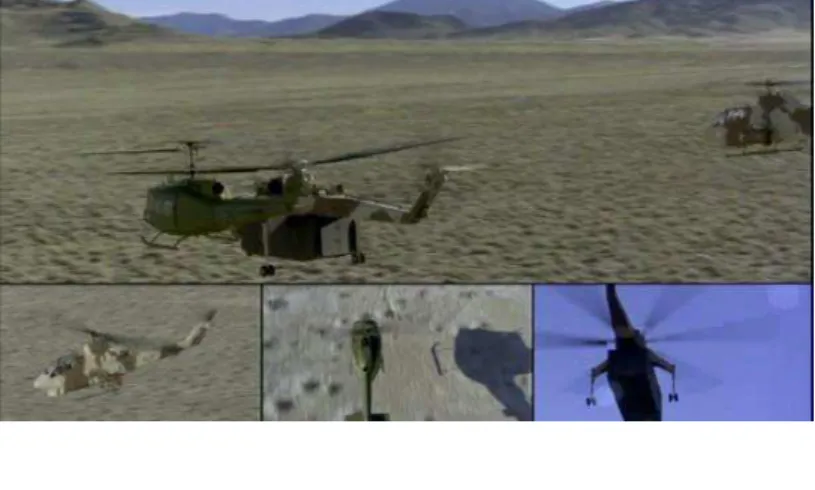
the split screen to evoke the disposition of frames in the comics page (see fig. 1). Also, in the final credits, the names of the cast and staff appear within comics balloons. The result of this effect is that the spectator is constantly reminded of the “source-text”: that what he is
Fig. 1: The split screen and the final credits in Hulk
Despite its relevance to Intermediality and intermedial phenomena, which can be attested through the frequency it is used in all kinds of media, the focus of this thesis is not on intermedial references. Instead, for our purposes, the other two categories proposed by
Rajewsky shall provide us with the necessary tools to examine two cases of graphic novel adaptations and their differences from novel-to-film adaptations.
b. Media Combination
are composite forms resulting from media combination and, depending on the way the signs are combined, they can be considered multimedia, mixmedia or intermedia texts.
Films, for instance, are considered multimedia texts, because they combine coherent separable texts, formed by different media. In fact, cinema is known to be the ultimate multimedia medium9 because it is able to put together, more than any other form, several other media (music, dance, theater, etc). Although the media within a motion picture can be separated, it is almost certain that this separation would distort or neglect the overall meaning of the film.
Comics, on the other hand, is considered a mixmedia text because it “contains complex signs in different media that would not reach coherence or self-sufficiency outside that context” (Clüver, “Estudos Interartes” 8). Indeed, one of the main characteristics of comics is its juxtaposition of the verbal and the visual texts. And it is precisely this combination of pictures and words that represents one of the causes of prejudice against comics, especially in Western culture10. For a long time in our tradition, pictures and words have been appreciated separately. Forms in which the two are juxtaposed are generally despised: novels with images are considered illustrated books for children; paintings should not have titles that explain what the image has attempted to represent.
Indeed, as René Magritte would probably agree, the relationship between word and image is one of treason11. The drawing of a pipe is not a real pipe; in the same way, the word „pipe‟ is a linguistic convention created to designate a real pipe, but is not a real pipe either.
In comics, word and image can be combined in multiple ways, causing different effects to the narrative. In old comics, for example, there was a strong parallel between both – most of the time, the text only confirms what the image shows. However, rather than simply
9. Or, as Clüver defines, a plurimediatic form (Pós: 2, 15).
10. In some Eastern cultures, image/text combination is not so problematic. One of the reasons may be because the pictorial element is present in the language; the letters are not completely dissociated from the image. Chinese and Japanese follow this pattern.
illustrating the text or explaining the image, in contemporary comics, new relationships have been established: words, for instance, can add a soundtrack or even contradict the image12.
In fact, more than the meaning produced by either verbal or visual text considered separately, the relation between the two systems produces meaning that neither of them is able to express alone. It is possible to say that the juxtaposition of verbal and visual texts in comics offers the reader a third layer of meaning. It is a narrative that can only be perceived if both graphic and textual elements are equally considered.
One of the possibilities offered by this third layer of meaning came to be known as „visual metaphor‟. Although the number of studies on visual metaphors is still not enough to
define it or to establish its differences from verbal metaphors, it is surely influenced by the shared social and cultural experiences that make it possible for readers to recognize and interpret a certain symbol or icon and relate it to the main narrative. Like verbal metaphors, pictorial metaphors “tend to represent the unknown, unresolved or problematic in terms of something more familiar and more easily imaginable” (El Refaie, “Understanding visual metaphor: the example of newspaper cartoons”, 84). Yet, unlike their verbal counterpart, visual metaphors work within two semiotic systems – words and pictures – which, together with the already naturally recognized symbols and icons, exert a mutual influence on the interpretation of a certain frame or group of frames. Therefore, in this sense, the idea that images merely show what language tells or that visual metaphors are only equivalents of verbal metaphors is undoubtedly mistaken.
In relation to their function, visual metaphors generally involve images that
metaphorically echo central themes of the story, “provid[ing] subtexts, thereby complicating verbal messages” (McCloud, Reinventing Comics, xiv). These subtexts can be references to
previous episodes in the narrative or even to real-life events. In an interview to The Comics
12. See McCloud for seven main kinds of effects produced by image/text combinations. (Understanding
Journal about Paul Auster’s City of Glass (1994), David Mazzuchelli explains that visual metaphors were used to add symbolic and psychological aspects to the identity of the characters of the work of novelist Paul Auster. Moreover, the visual metaphors were a necessary solution to represent the non-visual text, in the sense that it was not necessary to keep Auster‟s complete text.
The metaphor of the maze, for instance, is used twice in Paul Auster’s City of Glass and it represents two crucial moments in the narrative. The first happens throughout the first pages, in the description of Quinn, the main character. Auster‟s novel says that Quinn was “[l]ost, not only in the city, but within himself as well” (4). In the graphic novel, the image of the buildings in New York is transformed into a maze and, later on, into one‟s fingerprint on the window of Quinn‟s house (see fig. 2). Thus, it is possible to say that this visual metaphor provides two subtexts: the fact that Quinn feels lost in New York (the maze as a metaphor for being lost) and the fact that the character has lost his identity after his wife‟s and son‟s deaths
(the fingerprint as a metaphor for identity) and has been living through the lives of others.
Therefore, as far as Irina Rajewsky‟s second category of Intermediality, we can
conclude that, while both film and comics are hybrid media (once there is a combination of multiple media within each of them), considered multimedia and mixmedia texts respectively, traditional novels do not fit any of the three categories of media combination because there is not a combination of different media in them.
And yet, after these considerations related to the media combination involving films and comics, I side with W.J.T. Mitchell, when he claims that “[t]he real question to ask when
confronted with these kinds of image-text relations is not „what is the difference (or similarity) between the words and images?‟ but „what difference do the differences (and similarities) make?‟” (Picture Theory, 91).
Answering Mitchell‟s question, I would argue that the analysis of mediatic
specificities in comics, novels and films in this section offered a better understanding of the formal features of each media. This becomes a crucial step as I move on to the next section, in which the image-text relations within each isolated medium will profoundly influence the distinction between novel-to-film and comics-to-film adaptations.
c. Media Transposition
According to Irina Rajewsky, media transposition is “the transformation of a given media product (a text, a film, etc.) or of its substratum into another medium”. In this category, “the „original‟ text, film, etc., is the „source‟ of the newly formed media product” (51).
Considered one of the best known processes of media transposition, film adaptations have conquered an important place in academic debate through the works of George
others. However, the scope of these works has been mostly limited to novel-to-film analyses13.
Yet, while Bluestone‟s, Wagner‟s and McFarlane‟s works may be satisfactorily
applied to novel-to-film adaptations, these theoretical models have proven to be unsuitable for comics adaptations to cinema due to the specificities of each medium and especially because of the presence of images in comics.
In fact, whenever a different medium is involved in the process of transposition, new tools for the analysis of adaptations are needed14. For example, the adaptation of Hamlet‟s “to be or not to be” excerpt to the comics medium by Will Eisner cannot be analyzed by means of
the same theoretical approach used for Kenneth Branagh‟s film version of the same excerpt, because of the specificities of each target-text.
By the same token, when we change the source-text medium, new aspects must be considered. For instance, a novel-to-film adaptation cannot be analyzed by the same
parameters as a theater-to-film adaptation. In the case of theater-to-film adaptations we must take into account that the dramatic text upon which the film adaptation is based contains several stage directions (character‟s costumes, movements, and body expression, for instance) that can play a relevant role in the director‟s choices.
The demand for fidelity has been until now intrinsic to the relations governing most – if not all – media transpositions. Gaudreault and Marion alert us to the fact that the fidelity to the original is impossible to be achieved because “in moving from one medium to another, the
13. Except, perhaps, for Cartmell, who deals with types of source-texts for film adaptation other than literary texts.
14. Besides the kind of medium, the analysis of adaptations must always observe circumstantial elements – the cultural values and norms at the time of the production of the adaptation. As Thaïs Diniz explains, the translation (and here, the adaptation is included as an intersemiotic type of translation) “is not produced in perfect laboratory conditions, sterilized and neutral, but in the in-between place of various traditions, cultures,
and norms. Every translation is therefore a cultural translation” (“A New Approach to the Study of Translation”, 40). A good example of the influence of the cultural context may be seen, for instance, in some of Shakespeare‟s adaptations to cinema, e.g. in Almereyda‟s Hamlet (2000) and in Gil Junger‟s Ten Things I Hate About You
„subject‟ of a story . . . would necessarily undergo a series of informing and deforming
constraints linked to what might be called the new medium‟s intrinsic configuration” (“Transécriture and Narrative Mediatics: The Stakes of Intermediality”, 58). And, in their
opinion, in the case of comics-to-film adaptations, the impulse towards faithfulness leads to even worse consequences. Chances are that, after watching the film, the reader of a comic strip becomes more disappointed than the reader of a novel because of the false idea of
proximity of the relationship between film and comics media, based on the belief that both tell stories through images (68).
The prejudice against comics-to-film adaptations
Besides the lack of specific theoretical approaches, comic book adaptations are
doomed to carry a double burden: first, the prejudice against comics and second, the prejudice against film adaptations. According to Thierry Groensteen, comics is a medium still in search of legitimacy from authorities such as universities and museums (“Why Are Comics Still in Search”, 29). He mentions four types of frequent prejudice against comics, which he calls the “ninth art‟s four original sins”.
The first prejudice is against the hybrid nature of comics, the result of a combination of text and image on a printed page. The conflict involving word and image is an old one, dating from God‟s creation of man in His own image or even to Adam‟s act of naming
logocentric culture, this separation of text and image becomes particularly problematic in contemporary times, because of the predominance of intermedia and multimedia texts.
Because of their hybrid character –in contrast with the „pure‟ text –, new media are generally condemned to a mediocre, uncertain place within the current academic structure. Comics, for example, tend to drift in uncertain seas, somewhere between painting, drawing and literature studies15.
The second prejudice towards comics refers to their lack of narrative ambition. Because of this, comics has been seen as synonymous with easy, sub- or para-literature. Although comics certainly has a narrative quality, this position overlooks the fact that comics is an independent medium and, as such, has its own subdivision of genres, which ranges from autobiography to new wave works. Groensteen says that the “only things it has in common
with literature are: that it is printed and sold in bookshops, and that it contains linguistic statements” (39). Additionally, it cannot be considered easy or inferior literature for the reason that it is a distinct medium.
The third prejudice is based on the original connections of comics with caricature and satire, “inferior” branches of visual art. Groensteen reminds us that, since Ancient Greece, “humor has been regarded as the opposite of harmony and of the sublime” (40). As mentioned
earlier, this prejudice is proved wrong in many genres of comics, on which tragedy replaces comedy. In the groundbreaking biographical Maus, for example, animal-faced characters retell the horrors of the Holocaust.
Lastly, Groensteen comments that comics propose nothing more than a return to childhood. Rather than refuting this last prejudice, the author lays claim to it, explaining that it is during the childhood period that we discover comics and learn to love them, once pictures offer a naïve pleasure to the illiterate. Although this may be true, it does not necessarily mean
that comic books are easier to read than novels only because they have pictures. In order to fully comprehend the seductive power of comics, pictures also need to be read, as much as words. And, unfortunately, while the traditional education in our schools is able to prepare people to satisfactorily interpret words, it fails in training people to interpret images.
In “Introduction to Adaptation” (2008), Deborah Cartmell, Timothy Corrigan and
Imelda Whelehan explain that adaptations have been long neglected in literary and film studies even though they have been a common phenomenon since the beginnings of cinema. The authors point out ten reasons that help explain why adaptations are often characterized by words such as “impure”, “secondary”, “copy”, “inferior”, “betrayal”, etc:
First, adaptations have long been seen as “impure cinema”, dependant on two art forms – cinema and literature – and never reaching a mature status of art. The second reason is that, similarly to comics, film adaptations were seen as a threat to literacy, “crude
usurpations of literary masterpieces”. Third, adaptations were consigned to an undefined place within academia, with a secondary status within both literature and film departments, together with the idea that “anyone can teach it”. Next, because of the primacy of literature
over cinema, until recently, adaptations were evaluated only by their closeness to the literary source. The fifth reason is that, because of the commercial purposes of film, adaptations are accused of turning literature into a commodity. Next, there is the prejudice against the production of films in which many people are involved, in opposition to the “fetishization of individual genius” of the author of the book. Seventh, an adaptation is for some “merely a copy of a literary text”, which would characterize it as an insipid version of the “original”.
is a screen version of a canonical text. On the other hand, people generally tend to forget that those adaptations which overtook their source-texts – such as The Wizard of Oz and Mary
Poppins – are, indeed, adaptations. And finally, adaptation criticism generally ignores “shifting social and cultural concerns, other films, genre considerations or even financial and production considerations”.
These ten reasons corroborate the common use of negative expressions towards adaptations compared to the originals, such as violation, usurpation, deformation,
vulgarization, profanation and bastardization. (Cartmell, Corrigan & Whelehan, “Introduction to Adaptation”, 1-2)
Hence, in this respect, comic book adaptations are condemned twice: first, for being comics, a hybrid mass cultural product thought to be made for children; second, for being an adaptation, an inferior copy of the original, judged only by its fidelity to the primary literary text.
Literature Review on Comics and Films
Even though films and comics share narrative and visual aspects, theoretical works that approximate both arts are still scarce. And the great majority of them are attempts to find in comics equivalents to certain film narrative devices. In other words, most of the works in the field tend to concentrate on the category of media combination, analyzing the specific characteristics of each text separately. Instead, as I shall demonstrate, a better approach would be to focus on the process of media transposition.
in comics, stating that comics employed cinema‟s resources in its narrative structure and
aesthetics. Other aspects were also observed: the balloon, the onomatopoeia, the angles, and the cuts. In the year 2000, Cirne discusses the subject again in “Cinema e Quadrinhos: Uma nova leitura”. This time however, he concentrates on the differences rather than on the similarities between the two media. The differences are in the time of reading/projection, the cuts, and the agency of narrative. On the type of iconicity of the images in both media, the author says that film is not seen as a photographed image in motion or a static drawn image and that the use of live-action instead of graphic characters is a permanent reminder of this difference. As a conclusion, Cirne declares that cinema and comics are more connected by their narrative discourses than by the semiotic aspect centered on image. Yet, in some recent films, it is precisely the approximation of the images of the two media that plays the most significant role in the adaptation. In Sin City (2005), for example, the photographic
“concretion” (as Cirne calls it) of the film blends with the graphic signs of the comic book page in a way that sometimes it is hard for the spectator to define whether a certain image belongs to the film or to Frank Miller‟s book.
Also in 1972, Francis Lacassin draws a parallel between the properties of comic strip and film language. He calls our attention to the fact that, although the two media share a common past of initial unfavorable reception, cinema has been for nearly forty years an art recognized and sanctioned by cultural critics, while the comic strip was, until very recently, ignored or scorned (“The Comic Strip and Film Language”, 11). Because of that, when
analyzing the relation between the media, there is a tendency to favor cinema, taking it as basis for an investigation of what the comic strip borrows from cinematic language. The most relevant aspect of this article is the recognition of this problematic, biased inclination.
Lacassin‟s basic premise in this work is to confront this, proving that “with a few rare
the cinema, and often even before the latter was born” (14). In 1827, for example, Rodolphe
Töpffer inserted long shots into a series of medium shots recounting the loves of his M. Vieux Bois. In 1889, Georges Colomb introduced what came to be known as the American shot (head-to-knees) in “The Fenouillard Family at the Exhibition”.
Commenting on Lacassin‟s examples, comics theorist David Kunzle says that the
basic language of comic strips, especially in relation to cinematic elements, was created even before Georges Colomb, in German, Dutch, and English broadsheets in the 17th century. According to Kunzle, three major figures of the 19th century have developed cinematic techniques in comics: Rodolphe Töpffer, Gustave Doré and Wilhelm Busch. Töpffer was familiar to parallel cutting, narrow panels, broad panels, panoramic scenes, close-ups to speed up the narrative, repetition of frames, camera panning and dollying back (20-21). Doré‟s images portrayed subjective-camera effects, silhouette effects and negative image – a white line on a black background, which was introduced in his La Sainte Russie, 1854 (21-22). Busch‟s relevance lies in the devices he developed for the rendering of movement, sound, and “pain” effects (22-23).
Another work that offers some thoughts on the subject is Hans-Christian
Christiansen‟s article, “Comics and Film: A Narrative Perspective”, in which the author
cinematic devices are used differently and have a different impact in the two media in the construction of time, space and identification” (113). The author explains that this different
impact is due to distinct mediatic conventions, cross-cultural recognition of universal figures and techniques (such as face-to-face personal interaction) and aspects related to the deep structure of visual storytelling, which is based on the universal human experience, such as facial expressions and postures.
In “Du 7e au 9e art: l'inventaire des singularités”, Thierry Groensteen explains that greater importance is generally given to the similarities than to the differences between the two media. And the reason for this is that comics is still not seen as an autonomous medium. Moreover, the paternity of the arts that narrate by means of images is often erroneously credited to cinema. Therefore, Groensteen‟s article proposes an analysis of comics in terms of
its distinctiveness, focusing on how its principles have little to do with filmic enunciation. The differences between the two media are listed in three categories: a. the field of expression; b. the process of creation and; c. the mode of articulation. In the field of expression, Groensteen argues that there are at least five differences between the filmic and the graphic image which correspond, to a certain extent, to Cirne‟s considerations on the iconicity of the images. In the second category, the process of creation, Groensteen distinguishes three steps of creation for cinema (mise en scène, mise en cadre and mise en chaîne) and two for comics (mise en dessin and mise en réseau). The third category, the mode of articulation, relates to three sub-items under the mise en réseau step – the decoupage, the mise en page and the tressage. These categories will be fully explained in chapter 3.
Groensteen‟s article has proven to be a reference work among the studies produced in
medium, with its own characteristics. And secondly because, besides examining the equivalents in narration, film and comics are approximated in terms of monstration16, a concept used by Groensteen to designate all aspects related to the representation through images (18). In this sense, Groensteen‟s text is broader in scope than Cirne‟s, Lacassin‟s and Christiansen‟s. However, Groensteen‟s analysis remains limited to media combination aspects, pointing out similarities and differences between the two media, failing in exploring the consequences of his inventory to a case of media transposition. Therefore, the title “Du 7e au 9e art” conveys the misleading idea of a transposition from cinema to comics, known as the 9th art.
The most recent attempt to bring films and comics together is Film and Comic Books (2007), edited by Ian Gordon, Mark Jancovich and Matthew P. McAllister. The authors recognize that, although both media have a common narrative tradition and formal properties that constitute similar visual parallels, they also have distinct audiences, which relates to each medium in a different way. Therefore, besides the problems involving comics adaptations,
Film and Comic Books also deals with the reception of comic books-based films as well as
recurrent themes adapted, such as the coming-of-age of comics characters.
Film and Comic Books represents a valuable contribution to the field, particularly for
its first part, in which Pascal Lefèvre‟s “Incompatible Visual Ontologies? The Problematic Adaptation of Drawn Images” is inserted. The main contribution of this article is that it points
out the elements in each of the media that may present a problem in the director‟s task of transposition. Therefore, instead of examining the relations of media combination in each medium separately, trying to find film equivalents for comics formal properties (and vice-versa), this article represents considerable progress from all other works reviewed before
16. Yet, Groensteen states that the combinations “text + drawing” and “narrative + monstration” are not
because it puts the media combination analysis into practice, applying it to a media
transposition perspective. I believe this is the correct approach to analyze a comics-to-film adaptation and for this reason, Lefèvre‟s theory of adaptation should guide us in this thesis.
The contribution of Pascal Lefèvre
For Pascal Lefèvre, four main ontological differences between comics and film language devices are responsible for the fact that “comics fans may literally „see‟ film adaptations as often unfaithful and even disrespectful”. (3) And these differences influence
the process of adaptation and generally make the work of the director more complicated. The first point is the comics narrative, which must always go through changes when transposed to cinema, by means of additions and deletions. Indeed, this is a necessary procedure because every medium has its own “communicational energetics”17
. Each medium offers devices that can be used to tell the story in a particular way. Therefore, the same
narrative elements that work wonderfully in a comic book or a graphic novel may not work in a film. This can also be applied to the plot of a novel, which will always suffer additions and deletions when transposed to a film. Pascal‟s first aspect, therefore, is perfectly suited to novel adaptations too. The only difference in our case is that, in comics, both the text and the drawings represent the totality of the narrative, since images also have a narrative potential. Thus, when comics is transposed to cinema, the director has to adapt its narrative in two levels (text and image). This first point concerning the changes in the narrative will be dealt with in the next chapter.
17. Gaudreault and Marion use this term to designate the way each medium “exploits, combines and multiplies the familiar materials of expression –rhythm, movement, gesture, music, speech, image, writing”
The second problem is the difference between the page and the screen layouts. While the comics page is generally made up of several frames separated by gutters, the film screen is usually filled with one photogram, unless the director chooses to use the split-screen device, explained earlier in this chapter. Additionally, filming and editing are two separate steps of production. First, it is shot; then, it is edited. In comics, the drawing and the disposition of frames are conceived together. The artist cannot think of drawing a story without first having at least a mental draft of the way the actions will be organized on the page. Moreover, with the comic book or the graphic novel in hand, one can choose his or her own reading speed, turning the pages at will. On the other hand, a film forces the spectator to follow the speed of the projection18.
Again, I believe this incompatibility is also true in novels. One page of the novel does not correspond to one photogram; the story told in a page of a novel can take several film sequences. A similar point is the disparity between the reading of the novel and the speed of film projection. A two-hour film projection can condense several hundred pages of a novel and eight hours of reading time. Hence, it is possible to say that Lefèvre‟s distinction between
the page and the film screen layout also relate to the pages of the novel. This will be examined in chapter three.
The third aspect raised by Lefèvre to be dealt with in Chapter 4 refers to the use of sound in films in contrast with the “silence” of comics. The author explains that comics are closer to silent cinema than to contemporary cinema. And the incorporation of sound in film (narration and soundtrack) changed the way the spectator perceives and interprets the images. In comics, music, voices and noise can only be suggested by written signs. For the characters‟ voices, for example, the format of the balloon and the font type can only suggest the
characteristics of the sound and it is up to the reader to interpret it. Similarly to comics, novels
are also “silent”: the reader does not listen to noises described in the novel or to the voice of
characters. The sound can only be described, so the reader has to conceive a mental and individual impression of that sound. Once more, Lefèvre‟s aspect functions for both comics and novels.
The last ontological incompatibility between comics and films is the difference between comics drawn images and film photography. It may be argued that this aspect does not refer to animated films because they are also drawn, which is probably correct. However, I believe that animated films represent a distinct case for comic book adaptations and deserve an analysis on their own. For now, one thing can be said about animated films: if they do not undergo the exact same problems of live-action adaptations, they certainly have to deal with other problems about their own specificities.
Lefèvre mentions some distinct qualities between comics and film images. Both use flat images and similar shots (long, medium and close-up). And, while in film images move, in comics they are static. These three characteristics – the use of flat images, the distance from the camera/reader and the moving/static images – would also bring together comics and photography, from which cinema is directly derived.
Therefore, the most relevant distinction between comics and film images is perhaps the nature of the image, drawn by the hands of artists in comics and photographed in films. Lefèvre claims that this is the reason (together with movement) why a film conveys a greater impression of realism than comics. Moreover, drawings necessarily contain the signature of one artist and, by extension, the artist‟s visual interpretation of the world.And the more stylized or caricatured the drawing is, the more difficult it is to adapt to cinema because the signature of the artist is felt in a stronger manner. (9)
many different styles, there is not a stable iconic meaning to their characters. (10) This often happens with superhero comic book series, since most graphic novels are drawn by one artist19. This makes the analysis of graphic novel adaptations – the focus of this thesis – more complex because, unlike superheroes such as Batman or Superman, which have already become mythical figures with multiple incarnations, graphic novels have only one version, to which the comics readers hold on when they watch the film adaptation.
While Lefèvre gets to mention that “[i]n particular, the visual ontology of a drawing seems to be a central issue” (2), he does not acknowledge the reason why this distinction is
central to the process of adaptation. As the discussion in chapter 5 shall demonstrate, from Lefèvre‟s four incompatibilities, this is the only one which cannot be applied to novels as
well. This identification of comics graphic elements as the main aspect differentiating comics-to-film adaptations from novel-to-film ones represents my contribution to Lefèvre‟s work.
In this chapter, I have presented the theoretical background supporting the analysis of the corpus, which is developed in the following sections. First, after a discussion on the appropriateness of the term Intermediality, I have explained the three main forms of intermedial relations, as proposed by Irina Rajewsky: intermedial reference, media
combination and media transposition and pointed to the categories to which comics and its adaptation belong. Then, I have assembled a status questionis of the field, up to Pascal
Lefèvre‟s “Incompatible Visual Ontologies”, from which I have derived the main argument of
this thesis. In the following chapter, I examine the narrative aspects, according to Lefèvre‟s first category, of the graphic novel Watchmen and its film version.
19. American Splendor is an exception. Since 1976, various artists have narrated the daily life of Harvey
Hence, every time we try to speak of what we see, we speak falsely, distorting the very thing we are trying to represent. (Auster, The New York Trilogy, 77)
CHAPTER 2: NARRATIVE ASPECTS
Literature Review
The first aspect mentioned by Lefèvre refers to the narrative. Although the
phenomenon of narrative has its roots in oral and pictorial traditions, it is always seen as the natural embodiment of written language. The assumption that narrative is an exclusively literary event causes the narrative function of pictures to often be ignored in hybrid media. However, pictures can narrate as much as words. In the case of films and comics, verbal and visual texts have distinct narrative functions, and it is crucial to devote to pictures the same amount of attention of the text.
In comics and in films, narrative20 is the result of a sequence of images. In comics, the formal elements that narrate are mainly the disposition of frames and gutters on a page – which dictate the rhythm of reading and looking – as well as the pictures drawn inside the frames.
However, a single image can also be narrative. In this case, narrative is suggested by a single image, without directly representing the narrative events21. In Brueghel's “The Fall of Icarus” (1558), for example, movement is implied, but never shown. In the same way, in most
single-panel cartoons, narrative is also implied either through a representation of a cause and a suggestion of an effect (as in fig. 3) or through distinct positions or moments of one or more characters (see fig. 4). Therefore we can say that, in comics, although narrative is a natural consequence of the disposition of pictures in a sequence, one panel can also be considered a narrational unit. Moreover, it is worth mentioning that narrative is not necessarily dependent on dialogues, as the first example also demonstrates:
Fig. 3: Meehan cartoons: the representation of a cause and a suggestion of an effect.
21. Unless the several intermediary panels composing the movement are actually shown, such as in Jules
Fig. 4: Narrative through distinct positions or moments of one or more characters in Frank Miller‟s 300.
Because movement is an intrinsic feature of film, it is not possible to consider a photogram (a fixed cinematic image) a narrational unit. In films, narrative is the result of events, divided into sequences. Narrative is generally constructed by cinematic techniques such as “camera angle and movements, transitions, montage, as well as the particular repertoires of the nonvisual tracks”. (Marie-Laure Ryan, Narrative Across Media, 196)
In order to understand the narrative events of any medium, the reader/spectator needs to be able to decode and “believe” in the formal elements of that specific medium. This
constitutes a reading protocol that is applied differently for each medium. In order to
understand a comics narrative, for instance, the reader has to understand the notion of frame and the disposition of several frames on a page. S/he must believe that the world of comics does not end with the frames borders. A character appearing on several panels is the same, represented in different moments in time. And if this character exits right of a frame, s/he will not crash against the frame line, but will continue his/her movement on the reader‟s mental