J of Evolution of Med and Dent Sci/ eISSN- 2278-4802, pISSN- 2278-4748/ Vol. 4/ Issue 29/ Apr 09, 2015 Page 5059
ESSENTIAL THROMBOCYTHAEMIA: A CASE REPORT
Vaddadi Srinivas1, Vaddadi Radha Srinivas2
HOW TO CITE THIS ARTICLE:
Vaddadi Srinivas, Vaddadi Radha Srinivas. Essential Thrombocythaemia: A Case Report . Journal of Evolution of Medical and Dental Sciences 2015; Vol. 4, Issue 29, April 09; Page: 5059-5063,
DOI: 10.14260/jemds/2015/737
ABSTRACT: E. T. is a rare chronic blood disorder characterized by the over production of platelets by megakaryocytes in the Bone marrow in the absence of a known cause. Hereby presenting a rare case of E. T presented with recurrent Hematomas which has responded well with Hydroxyurea therapy.
KEYWORDS: JAK2 V617F mutation, Von Willebrand Factor, Anagrelide, megakaryocytes
INTRODUCTION: It is one among the 4 Myeloproliferative disorders others are Polycythemia vera, Chronic Myeloid leukemia, Primary myelofibrosis. Generally CML, P. V. and PMF can be diagnosed via well accepted clinical and laboratory criteria. ET is diagnosed by excluding causes of Reactive
thrombocytosis and excluding presence of other MPD’s.
Essential Thrombocythemia is an acquired myeloproliferative disorder (MPD) characterized by a sustained elevation of platelet number with a tendency for thrombosis and Hemorrhage. The prevalence is 2 to 3/1 lakh population with average age being 60 to 70 and a Female male ratio of 2:1. The clinical picture is mainly vascular occlusive events affecting cerebral, coronary and peripheral vessels and Hemorrhages. Some patients experience vasomotor symptoms like headaches, visual disturbances, light headedness, atypical chest pain, distal paresthesias, erythromelalgia. Arterial and venous thromboses, as well as platelet mediated transient occlusion of the microcirculation and bleeding represent the main risks of ET patients.
Thromboses of large arteries represent a major cause of mortality associated with E. T. Bleeding symptoms are primarily observed in patients with highest platelet count.1 The bleeding diathesis is not due to impaired platelet function but rather to an acquired Von Willebrand disease caused by proteolytic reduction of Von Willebrand Factor (VWF) multimers. This VWF multimer deficiency occurs when the platelet count range from 10 to 15 lakhs. Rarely E. T. may transform in to acute leukemia or Myelodysplasia. The molecular pathogenesis of ET is similar to other clonal MPD’s such as CML, P. V, M. F. Polycythaemia vera, M. F. and ET are Philadelphia ph negative MPD’s in which JAK2 V617F mutation2,3 is responsible for clonal proliferation of blood cells. Therapeutic intervention with Hydroxyurea4 500mg b. d, Anagrelide5 1mg bid, Alpha Interferon6 3 million daily are best options to reduce the platelet counts in E. T. Aspirin7 can be prescribed in a case of Thrombotic event predominantly.8
J of Evolution of Med and Dent Sci/ eISSN- 2278-4802, pISSN- 2278-4748/ Vol. 4/ Issue 29/ Apr 09, 2015 Page 5060 available. On 15-9-2011, blood picture showed Hb: 7.9grm%, T-49, 70/cu.mm, DC: P85%, L10%, E4%, M1%, platelet count 17.84 lakhs/ cu. mm, PVC: 25.1%, RBC: 3.39 million cu. m. m., RB. Sugar 97mg%, Serum creatinine: 1mg/dl prothrombin time: Test: 17.2 sec Cont: 12.1sec INR: 1.47; aPTT: 42.8 sec, HIV I&II – non reactive, HBSAg: nonreative Blood Grouping: A+ve, on 16-9-2011: Blood picture showed Hb: 6.1grm%, TC: 51.890cu. mm, platelet count: 16.42 lakhs. Cu. mm. On 17-9-11: PT: Test 19.7 cont: 12.6 INR: 1. 79; aPTT: Test 53.4, cont: 33.4, bleeding time 7min.
(e has been diagnosed as (ematoma Rt Thigh with possible Bleeding disorder. Patient’s
bleeding got controlled after administration of 6 fresh frozen plasma and 10 Blood transfusions, dressing of wounds were done daily. On 19-9- , Patient’s (emoglobin is gm%. Patient was discharged on 20-9-2011 as he has improved and his bleeding got controlled. At discharge patient was prescribed Tab Tranexamic acid 2 tid and Tab Rabeprazole 20mg 1/day for 1 week.
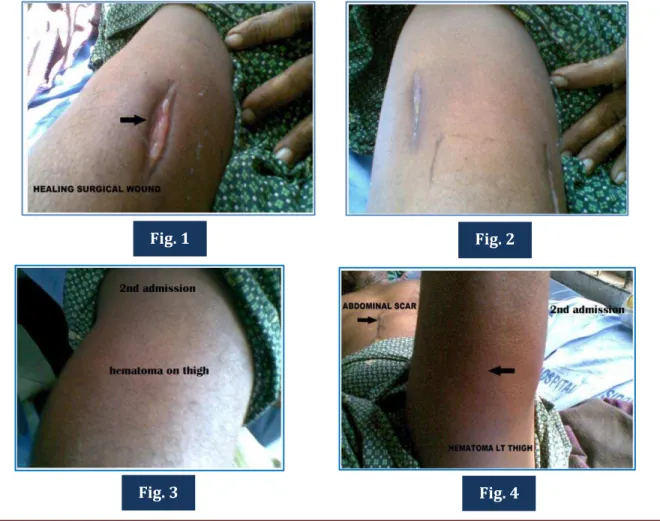
Again on 4-10-2011, patient had come with swelling of Lt Thigh and inability to walk (fig3& 4). Patient got admitted and had asked for incision and drainage of Lt Thigh as he has severe pain and Restricted movements of Lt Thigh. On examination patient has pulse 90/mt, BP 110/80 mmHg, Anemia, Heart sounds normal, Lungs –clear, no organomegaly, had abdominal scar and healing surgical scars on Rt thigh and Lt thigh swelling due to Hematoma.
Blood tests on 4-10-2011 are as follows: -Hb: 8gm%, TC: 50, 400cu. mm, DC: P89% L6%, F4%, M1%, RBC: 3.4 millions/cu. mm, platelet count: 18. 73 lakhs/cu. mm, PCV: 24%. Peripheral smear examination revealed: -RBC: Prominent anisocytosis, Poikilocytosis, Nucleated red cells & small number of fragmented red cells, WBC: Marked neutropyhil leucocytosis, No evidence of blast cells. Platelets: Marked thrombocytosis present. Opinion: Blood picture suggestive of MPD. Ultrasound abdomen was normal, spleen is intact and normal. 11/10/2011: Hb: 6. 7 gm%, TC: 51, 780 cells. Cu. mm, Platelet count 17.28 lakhs/cu.m.m. Real time PCR test: 11/10/2011: - JAK2 V617F mutation was detected (Religare). Pt is diagnosed as MPD: Essential Thrombocythaemia. Patient is prescribed Hydroxyurea 500mg bd along with ferrous sulphate and Folic acid, got discharged on 12-10-2011. Patient has not agreed for Bone marrow examination as he is bedridden and fear of bleeding.
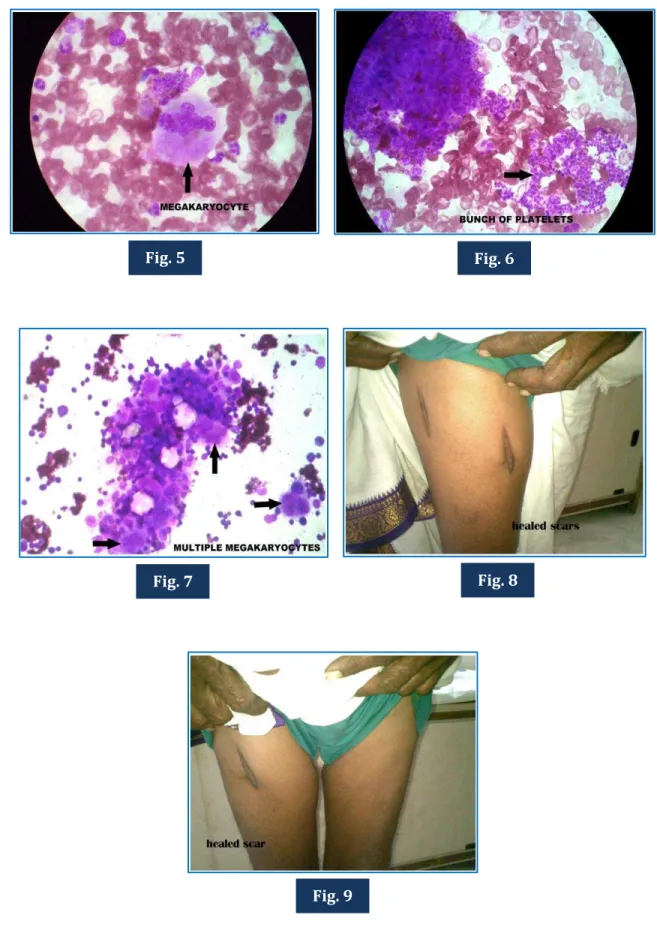
Again patient came for review on 22-11-2011, came by walking, the hematoma on Lt Thigh subsided and scar on Rt thigh healed completely (Fig. 8 & 9). His blood counts were HB: 12gm%, TC, 35,100 cells/cu. mm, platelet count 15.18 lakhs cu. mm. This time patient has given consent for Bone marrow examination. Bone marrow on 21-10-2011 showed Aparticulate marrow with Leishman stain. Smear with Giant megakaryocytes associated with marked thrombocytosis compatible with Essential thrombocythemia (Fig. 5, 6 & 7) Patient is continued on Hydroxyurea. He is doing well.
DISCUSSION: This patient has presented with recurrent hematoma, not evaluated properly initially and surgeon has attempted incision and drainage but landed up in profuse bleeding and with much difficulty bleeding was controlled. This bleeding disorder was then evaluated thoroughly and diagnosed as Essential Thrombocythaemia after excluding other causes of Myeloproliferative disorders like PV, CML, Myelofibrosis. First of all causes of thrombocytosis such as Reactive Thrombocytosis were excluded. Reactive thrombocytosis means increase in platelet count in absence of chronic myeloproliferative or myelodysplastic syndrome.
J of Evolution of Med and Dent Sci/ eISSN- 2278-4802, pISSN- 2278-4748/ Vol. 4/ Issue 29/ Apr 09, 2015 Page 5061 there is no toxic granules in leucocytes in Peripheral smear. Patient underwent surgery 2 years back for blunt injury abdomen removal of spleen at that time might have resulted in thrombocytosis. But it is excluded as the cause in view of U/S abdomen showing normal spleen in this patient.
Risk of Hemorrhage in Essential thrombocythemia is very low when the age is less than 60 years, No history of previous thrombosis and platelet count less than 15 lakhs whereas the risk is high when the age is more than 60 years, History of previous thrombosis and platelet count more than 15 lakhs.
Diagnostic Criteria for ET includes:9 1. Both A1 & A2 criteria with B3 to B6 or 2. A1 criteria with B1 to B6
The A criteria: A1: Platelets>6,00,000 cu.mmat least 2 months, A2 – Acquired V617 F JAK2 mutation.
The B criteria: B1: No cause for Reactive Thrombocytosis, B2- No evidence of Iron deficiency, B3 – No Evidence of polycythemia vera, B4-No evidence of C. M. L, B5-No evidence of Myelofibrosis, B6- No evidence of Myelodysplatic syndrome.
In our case, ET criteria have been fulfilled completely. In any case of suspected bleeding disorder, it should be thoroughly evaluated otherwise we land up in trouble which has occurred in this case pt is stable now and is doing well on hydroxyurea. Individuals with ET have good lifespan with proper treatment.
Fig. 1 Fig. 2
J of Evolution of Med and Dent Sci/ eISSN- 2278-4802, pISSN- 2278-4748/ Vol. 4/ Issue 29/ Apr 09, 2015 Page 5062
Fig. 5 Fig. 6
Fig. 8 Fig. 7
J of Evolution of Med and Dent Sci/ eISSN- 2278-4802, pISSN- 2278-4748/ Vol. 4/ Issue 29/ Apr 09, 2015 Page 5063
REFERENCES:
1. Cortelazzo S, Finazzi G, Ruggeri M, et al. Hydroxyurea for patients with essential thrombocythemia and a high risk of thrombosis. N Engl J Med. Apr 27 1995; 332(17):1132-6. [Medline]. [Full Text].
2. Teofili L, Martini M, Cenci T, et al. Epigenetic alteration of SOCS family members is a possible pathogenetic mechanism in JAK2 wild type myeloproliferative diseases. Int J Cancer. Oct 1 2008; 123(7):1586-92. [Medline].
3. Ohyashiki K, Kodama A, Ohyashiki JH. Recurrent der (9; 18) in essential thrombocythemia with JAK2 V617F is highly linked to myelofibrosis development. Cancer Genet Cytogenet. Oct 2008; 186(1):6-11. [Medline].
4. Colombi M, Radaelli F, Zocchi L, Maiolo AT. Thrombotic and hemorrhagic complications in essential thrombocythemia. A retrospective study of 103 patients. Cancer. Jun 1 1991; 67(11):2926-30. [Medline].
5. [Best Evidence] Harrison CN, Campbell PJ, Buck G, et al. Hydroxyurea compared with anagrelide in high-risk essential thrombocythemia. N Engl J Med. Jul 7 2005; 353(1):33-45. [Medline]. [Full Text
6. Elliott MA, Tefferi A. Interferon-alfa therapy in polycythemia vera and essential thrombocythemia. Semin Thromb Hemost. 1997; 23:463-472.
7. Barbui T, Finazzi G. Treatment indications and choice of a platelet-lowering agent in essential thrombocythemia. Curr Hematol Rep. May 2003; 2 (3):248-56. [Medline].
8. Cervantes F. Management of essential thrombocythemia. Hematology Am Soc Hematol Educ Program. 2011; 2011:215-21. [Medline].
9. Thiele J, Kvasnicka HM. The 2008 WHO diagnostic criteria for polycythemia vera, essential thrombocythemia, and primary myelofibrosis. Curr Hematol Malig Rep. 2009; 4: 33-40.
AUTHORS:
1. Vaddadi Srinivas 2. Vaddadi Radha Srinivas
PARTICULARS OF CONTRIBUTORS:
1. Associate Professor, Department of Medicine, Andhra Medical College, Visakhapatnam.
2. Deputy CMO (Physician), Golden Jubilee Hospital, VPT.
FINANCIAL OR OTHER
COMPETING INTERESTS: None
NAME ADDRESS EMAIL ID OF THE CORRESPONDING AUTHOR:
Dr. Vaddadi Srinivas,
5 , B Block,
Sun N Moon Heights, Ramnagar,
Visakhapatnam-530002.
E-mail: [email protected]