1158
EMPLOYEE INVOLVEMENT IN A CHANGE PROCESS - A CASE STUDY FOR ROMANIAN ORGANIZATIONS
Mariana Predişcan, Roxana Nadina Roiban
Management department, Faculty of Economics and Business Administration, West University of Timisoara, Romania
[email protected] [email protected]
Abstract: Innovation, competitive advantage, change are some concepts that should be on every organization's agenda, due to the fact the global market leads to global competition so in order to increase the market share, turnover or profit organizations have to incorporate those concepts in their strategies. The outside environment is very unstable and things are evolving very fast so managers from all levels have to acknowledge the importance of change and to identify as soon as possible several new ideas that should be the subject of different change processes. Openness to organizational change has become a mandatory feature for those organizations that want to survive and adapt to the external pressure, helping them to be efficient. Even if in many cases managers are the initiators of change, this process is very complex and needs support and involvement from all the members of the organization, so the employee's attitude and commitment to change is crucial. In many cases employees have a negative attitude towards change and manifest a strong resistance, due to the fact that they are not consulted and are not involved in the process of the identification for the need of change. Without understanding and knowing very well what it is expected from them, employees are afraid of the unknown and prefer to perform their tasks as they did before. Creating a climate and a culture for change is very important, because like this change will be something normal, continuous and people will feel comfortable with any change initiatives, without b eing surprised, confused or scared. Even if any change process should improve the current state of the organization, sometimes change efforts fail because the ones that resist change are stronger than the ones supporting change. The purpose of this paper i s to analyze how often are Romanian employees involved in the processes of change and how important is the role they play. We have also tried to see the Romanian manager's perception towards change and the way they perceive the need of involving employees when decisions are made. In order to answer those questions we have based our results on a study made on Romanian organizations from the western side of the country. The sample included managers and employees from organizations operating in industries such as: trade, manufacturing and services.
Keywords: change management; openness to change; resistance to change; employee involvement.
JEL classification: M10, M12, M19
1. Introduction
1159
and internal forces of change is very important. External forces are mainly economic, technological, political, legal, demographic, cultural and natural while potential internal forces of change are the organization's members (managers and employees) and the organization's particularities (strategy, structure, informational system and organizational culture).
Employees can have a very important role in identifying potential changes due to the fact that they are very familiar with the things that take place inside the organization, knowing the main problems and sometimes even the solutions to those problems.
Managers should encourage employee involvement in the decision-making process, especially when employees are the target of change, because if employees feel that they have an active role in the process of change they will support it, without any resistance at all. If change has to be done very quick, and there is no time to consult the employees, after the crisis has passed managers should explain the reasons why employees were not actively involved, in order to make sure that the whole organization will support that change.
In the Romanian organizations most managers are still not aware of the importance that employees can have not only when changes are implemented but mostly when the need of change is identified.
This study aims to identify how significant is the employee involvement in a change process, how do managers and employees perceive change and how often employees are a part of the process of decision-making.
2. Literature review
The global economy forces many organizations to adapt and to change the way they operate, threatening in many cases the changes of survival for those that have no response at all to the outside pressures. Openness to organizational change has become one of the ,,musts" especially for organizations that operate in a very unstable environment (Conner, 1992). In many workplaces self-managed teams, cross-training,shared information, participative decision-making and incentive rewards are no longer seen as “innovative” or “high performance” but just a normal way of doing business (Benson et al., 2013).
Identifying the domains of excellence and the business areas with a high potential on becoming visible in a large context, even global, is very important for understanding the way in which the technological entrepreneurial ecosystem has
developed over time (Roja et al., 2014). The need for rapid organizational change is something certain in today's business environment, but no matter how necessary change seems to upper management, many barriers must be broken down if a planned strategic change is to be implemented successfully (Hodges, 2007).
Responding to change can sometimes be very difficult because many organizations associate it with doubt, fear and instability and many times when employees state they cannot do anything to reply to a changing situation, they usually do not know what to do to adapt to the position and prefer to manifest a strong resistance to change (Zafar et al., 2014).
1160
Employee involvement is a process for empowering employees to participate in the process of managerial decision-making and improvement activities appropriate to their levels in the organization because at the end of the day the only thing that diferentiates one organization from another is its people (Apostolou, 2000).
The engagement can be different from one employee to another, having different behaviors as shown in the following table:
Table 1: Classification of employee engagement Engagement
types
Description of the behavior Highly
engaged
Employees feel a strong personal alignment to the mission, vision and objectives of the organization.
Moderately engaged
Employees possess positive attitudes toward work and may engage in productive behaviors, but they are not fully invested in terms of commitment and significant discretionary behavior.
Passive Employees simply come to work and go through the motions without any particular interest in work. While not as problematic as the actively disengaged, passive employees do not create a positive environment for innovation and progress.
Actively disengaged
Employees feel disconnected from their jobs and tend to be unsatisfied at work. Their poor attitudes and emotions spread through the company, which can result in their own poor performance and poor performance of others.
Source: Managing Employee Engagement During Times of Change (Hewitt, 2013)
1161 3. Research framework and results
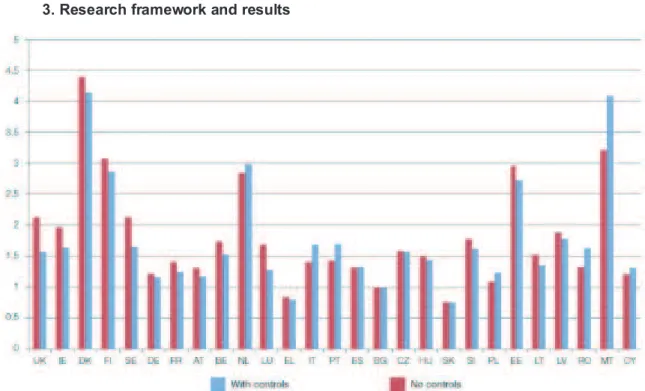
We have based our research on a recent study conducted by Eurofound in 2013 regarding the ,,Work organisation and employee involvement in Europe" where Romania was listed among the countries with a particularly low level of employee involvement. The same study revealed that our country has a very low task discretion and the lowest organizational participation among 27 UE countries, as shown in the following figure:
Figure 1: Likelihood of working in a high involvement organisation by country
Source: Work organisation and employee involvement in Europe (Eurofound 2013, p. 41)
Given the results above, the purpose of our research was to evaluate the employee involvement in a change process and to understand the reasons why figures from the Eurofound study, for our country, are so low. Therefore the following hypothesis were formulated:
H1: Employees are rarely an internal source of change;
H2: Without a motivation system employees are not an important source of change.
The methodology used in order to test the two hypothesis included an online questionnaire applied on various Romanian organizations from different industries such as services, trading and manufacturing based on a questionnaire. The information was processed using SPSS 17 and results obtained are presented below.
1162 Table 2: Internal sources of change
Never Rarely Neither often, neither rare Sometimes Always
Employees 2.8% 37.6% 22% 34.9% 2.7%
Managers 0% 4.6% 10.1% 30.3% 55%
As we can see in the table above, in 37.6% of the cases employees are rarely an internal source of change, because almost always the change ideas and initiatives come from managers.
Even if managers have the legitimate power to decide on which change initiatives will be incorporated in change processes, employees should also be involved in the decision-making process in order to understand which will be the next steps and how important is their role on achieving the desired goals after the change takes place. Like this the resistance to change will be minimum and the change will have the support from all organizational levels. This situation can be explained by the fact that in Romania , the process of delegation still arises many problems, and managers are afraid to give their employees more responsibilities and more power. Therefore our hypothesis is valid, and employees are rarely an internal source of change.
H2: Without a motivation system employees are not an important source of change Table 3: Employee motivation for change proposals
Never Rarely Neither often, neither rare
Sometimes Always Change proposals
coming from employees
11.9% 46.8% 12.8% 26.6% 1.9%
Rewards for those that come with change initiatives
36.6% 35.2% 15.6% 6.4% 6.2%
Employees are rarely motivated to come with change proposals and often the managers attitude is a very discouraging one, especially when employees have ideas that are not taken into consideration. Some managers are not aware of the fact that employees should have a very active role in finding new ideas of change because they are the ones knowing very well the processes driven by the organizations, being able to see what should be improved or changed. Another problem is that some Romanian managers are afraid to lose their power and in order to avoid that, they minimize the role of their employees. Another problem related to employee motivation is that in many organizations managers don't have a rewarding system for those that come with change proposals so even if employees want to get involved they see no winning from that. It is very important for a long term employee involvement to have a proper reward system that stimulates creativity and innovation. Giving these facts, our second hypothesis is valid, and without a motivation system employees are not an important source of change.
4. Conclusions
The results of our study have shown that Romanian employees have a low involvement in the change processes implemented by the organizations due to the fact that managers don't seem to acknowledge the advantages that can be identified by using a participative management style inside the organization.
1163
power inside the organization, and employees are rarely the promoters of change, the main reason for that being the lack of a motivation system. Without a reward system, employees are not motivated to make any change proposals and often tend to manifest resistance to change.
Openness to organizational change is very important for competitive and innovative organizations and managers should have the ability to make sure that change is supported by all organizational levels. A culture that promotes change is also a key factor for successful change, assuring also that employees are involved as much as possible in this process.
In the case of Romania, results have shown that is still a very stringent need for business leaders that have a vision for change, support it and make others enhance it.
A further research opportunity will be to identify how can managers increase employee involvement and to see which are the most powerful skills that both managers and employees should have in order to innovate and find new and creative ideas of change. A long term challenge will be to ensure that all organizations will have a high openness to change, where employees and managers work together in order to promote proactive and efficient changes with long term results.
5. Acknowledgements
This work was supported from the European Social Fund through Sectorial Operational Programme Human Resources Development 2007–2013, project number POSDRU/159/1.5/S/134197, project title “Performance and Excellence in Postdoctoral Research in Romanian Economics Science Domain”.
References
Apostolou, A. ( 2000) Employee involvement, Report produced for the EC funded project INNOREGIO: dissemination of innovation and knowledge management techniques [Online] Available:
http://www.urenio.org/tools/en/employee_involvement.pdf.
Benson, G., Kimmel, M. and Lawler III, E. (2013) Adoption of Employee Involvement Practices: Organizational Change Issues and Insights, Center for Effective Organizations Publication.
Conner, D. R. (1992) Managing at the Speed of Change: How Resilient Managers Succeed and Prosper Where Others Fail, New York, Villard books.
Dicke, C. (2007) Employee engagement & change management, CAHRS Spring Sponsor Meeting [Online] Available:
http://www.uq.edu.au/vietnampdss/docs/July2011/EmployeeEngagementFinal.pdf. Eurofound (2013) Work organisation and employee involvement in Europe, Publications Office of the European Union, Luxembourg.
Hewitt, A. (2013) Managing Employee Engagement During Times of Change, AON Empower results.
Hodges, G. (2007) The Three Greatest Barriers to Organizational Change, Ezine articles [Online] Available: http://ezinearticles.com/?The-Three-Greatest-Barriers-to-Organizational-Change&id=622461.
Khattak, M. A., Iqbal, N. and Khattak, S. R. (2013) Relationship between Employees Involvement and Organization Performance in Milieu of Pakistan, International Journal of Academic Research in Accounting, Finance and Management Sciences , Vol. 3, No.1, pp. 219–230.
Kotter, J. P. (2007) Leading change Why transformation Efforts Fail, Harvard Business Review, pp. 96-103.
1164
and Organizational Development Journal, 24, pp. 447-454.
Roja, A., Nastase, M. and Valimareanu, I. (2014) Collaborative Networks and Strategic Axes,Fundamental Pillars of the Development of Technology
Entrepreneurial Ecosystems, Review of International Comparative Management Volume 15, Issue 5, pp. 579-594.