AB ST RACT:The expensive nature of metal ions detoxification from wastewater have restricted the use of conventional treatment technologies. Cheap, alternative measures have been adopted to eliminate metal contamination, and adsorptions using agricultural adsorbents seem to be the way forward. The use of agricultural adsorbents for cadmium (II), copper (II) and lead (II) ion removal has gained more interest in literature due to the level of contamination in water bodies. This review shed lights on the removal proficiency of various low cost agricultural adsorbent for the elimination of cadmium (II), copper (II) and lead (II) ions, considering performance, surface modification, equilibrium adsorptive studies, kinetic characteristics, coefficient of correlation (R2) and reuse. Furthermore, these agricultural adsorbents have displayed better performance when rivaled with commercial/conventional adsorbent. Observations from different adsorptive capacities presented owe their performance to surface area improvement/modification, pH of the adsorbent, ionic potential of the solution, initial concentration and elemental component of the adsorbent. However, gaps have been identified to improve applicability, sorption performance, economic viability, optimization, and commercialization of suitable agricultural adsorbents.
KEYWORDS: Adsorption; Adsorption capacities; Agricultural adsorbent; Heavy metals; Wastewater DOI: 10.22034/gjesm.2016.02.04.010
*Corresponding Author Email:
[email protected] Tel.: +234 803 6051 722; Fax: +234 803 6051 722 Note: Discussion period for this manuscript open until December 1, 2016 on GJESM website at the Show Article .
Potentiality of agricultural adsorbent for the sequestering of metal ions
from wastewater
P.C. Emenike*, D.O. Omole, B.U. Ngene, I.T. Tenebe
Department of Civil Engineering, Covenant University, Canaanland, Ota, Ogun State, Nigeria
Received 3 June 2016; revised 1 July 2016; accepted 5 August 2016; available online 1 September 2016
REVIEW PAPER
INTRODUCTION
Portable water is one of the most significant resources to humanity and despite the relative abundance, there is a reduction in its availability because the percentage of salt water available is 97.5% compared to the total water present on earth (Rehman and Rehman, 2014; Tatiya, 2011; Thompson, 2009). There is increasing demand for water on a daily basis whereas all available water resources are gradually becoming contaminated and unsafe for use owing to the inadequate disposal of waste. The effort to provide adequate and proper treatment facility for homes having water related issues is challenging, and it also
involves high cost implication, hence, there is an urgent need for resourceful technologies that are attributed to low cost efficiency, cheap maintenance and energy efficiency (Rengeet al., 2012).
Global J. Environ. Sci. Manage., 2(4): 411-442, Autumn 2016
metal contamination (Manzooret al., 2013; Banerjeeet al., 2012; Ahmaruzzaman, 2011; Kang, Lee and Kima, 2007). Traces of these heavy metals flow along with the waste gotten from these industries and are later discharged directly or indirectly into the environment regularly, especially in developing countries (Radjenovic and Medunic, 2014). There is a direct link between the level of environmental contamination and rate of contamination of water. Rainwater gathers contaminants while transiting through the atmosphere, local streams and rivers bodies absorbs these unwanted elements through surface runoff and discharges from industries and sewage effluents. These contaminated sources then percolate into the reservoirs that supply our drinking water (Alissa and Ferns, 2011), making it unfit for consumption as reported byWuet al., (2014) with which heavy metals (Hg, Cd, Pb, Cr, Cu and As) were discovered in Hongfeng and Baihua Reservoirs. Compilation of this review study was carried out in Nigeria during 2016.
Metal Essentiality
The proper metabolic function requires certain nutritional elements that are essential for survival. To maintain a healthy living, some metals are required either as a micro nutrient or macro nutrient. Certain metals with high nutritional value are fundamental to human existence, and they play a vital part in the biochemical or physiological process (NAS/IOM, 2003; IPCS, 2002). The relative nature of the essentiality concept states that some organisms may not need some metals that are fundamental requirements to humans.
The non availability of sufficient amount of these elemental metals may result in adverse effects, increasing the vulnerability in human beings to toxic contributors and the risk associated with other metals. Metals such as Cr(III), Zn, Cu, Mn, Mo, Co, Fe, Se, Mg are nutritionally valuable to humans. Other metals which include Ni, V, B, Si, Pb, Hg, and As may not be needful to humans, but their adverse effect at low concentrations cannot be over emphasized (NAS; IOM, 2003).
There are three groups of essential elements; the cationic metals, the anionic metals, and the inorganic complex. The cationic group comprises of Zn, Fe, Ca, Mn, Cr., the anionic group includes Mo, Se and the bio inorganic complexes are Co complex and cobalamin (Violanteet al., 2010). The regulation of internal environment mechanism is different for each group,
and it is used to categorize the extent of health effect that may materialize and also the probable bioavailability of the metal (Soetanet al., 2010;Aggett, 2007). However, the regulation of cationic intake and transfer occurs in the gastrointestinal tract of the liver (IPCS, 2002; Berkhin and Humphreys, 2001). The anionic group has increased solubility with water and their reaction with OH groups; S, P, N and O are reduced compared to the cations. Their rapid solubility makes them to be absorbed readily through the intestine, and the burden generated controlled by renal excretion (Barakat, 2011).
Distribution of metals
Ibrahimet al. (2006) made a remark that the uniqueness of metals affects their distribution potentials into specific tissues and organs. It displays a total reflection of the transport and accumulation mechanism. Metals retention in the human system can be linked to isolation in which some metals can be active/inactive for some period (Borowska and Brzóska, 2015). Metals such as cadmium and lead can be inherent in the system for years. In a research reported byGodt et al. (2006), several factors contribute to the increasing amount of cadmium in the body e.g. deficiency in calcium, Vitamin D, and the presence of trace elements such as copper and zinc. Cadmium interaction with these trace elements could be as a result of their molecular similitude (Nazet al., 2005). Once cadmium is absorbed into the blood stream, it is transported in erythrocytes and attracts to protein fraction at an intracellular level (Godt et al., 2006). Its transport mechanism is promoted by plasma metallothionein which occurs around the liver region when subject to exposure. The transport of cadmium can also be seen, even at low concentration, at an early stage of embryo formation which is induced through the placenta (Goyer, 1995). At heightened exposure, cadmium accumulates in the renal cortex and liver and later redistributed to the kidney through active synthesis of metallothionein in the liver (Sataruget al., 2009). In line with this,Akessonet al. (2008) gave an overall remark that 50% of cadmium burden is located in kidneys, 20% around the muscles and about 15% eminent in the liver. In another report, (Wang and Du, 2013) iterates that at lower concentration, cadmium burden revolves around the brain and bone.
Copper, on the other hand, gain its control at the upper gastrointestinal tract through a variegated
homeostatic process comprising of both active and passive transport (Bostet al., 2016).Olivareset al., (2002) andArredonado et al. (2000) explained that complex protein that is metallothionein-bound propagates the transport of copper. They further highlighted that exceeding the storage capacity of metallothionein may result to cell death. Many other factors facilitate the uptake of copper e.g. the presence of precipitating anions, fibre, fulvic acid dietary proteins and ascorbic acid (IOM, 2001). The pathway at which copper is distributed from the blood into the liver cannot be clearly understood, but Uauy et al. (2008) suggested that copper transportation is attributed to ceruloplasmin and cytochrome oxidase while its excretion is through biliary canaliculi (Wijmenga and Klomp, 2004).
Lead absorption occurs through inhalation and ingestion depending on the form and means of exposure (Babalolaet al., 2010). About 90% of lead absorbed is accumulated in the bone with a half-life ranging from 600 3000days while soft tissues such as liver, brain, and kidney are the custodian of the remaining 10%, having half life of up to 40 50 days (ATSDR, 2007). The gastrointestinal tract acts as a medium by which lead enters the bloodstream. At first, attachments are made to the proteins located in the blood and later, they are transported to other parts (Gonick, 2011). In light of this, (Harmanescuet al., 2011;Babyet al., 2011) stated that the potential capacity of metals binding to proteins are limited, and the risk associated with target organs are escalated when the binding capacity is surpassed. Therefore, older adults are potential targets to metals that exhibit long half-lives.
Toxicity of metals
There are variations in the level of toxicity exhibited by different metals, and it is a representation of the collection of biochemical mechanism in which their effect and variability are made known (Krameret al., 2007). There are at least five metals that are carcinogenic while other effect includes cardiovascular disease (Alissa and Ferns, 2011), haematological, neurological, gastrointestinal, musculoskeletal, immunological effect (Tchounwouet al., 2012) and alteration of epidermal systems (Sharmaet al., 2014).
Lead is being one of the three most hazardous metal, accumulates in the body causing severe damage to the central nervous system, bone marrow, kidney and liver (Tsoiet al., 2016). Recent studies indicate that the rise
in mortality and systolic blood pressure has its root cause from elevated blood lead levels (Haraet al., 2014; McElvennyet al., 2015). Elevated blood lead level could also bring about intelligential impediments, hearing impairment and alteration of puberty in girls (Gidlow, 2015). Jarup, (2003) also reported renal, hematopoietic and endocrine disease as a result of exposure to lead. Nelsonet al., (2011) sees lead as a
potential contributor to osteoarthritis and osteoporosis.
Cadmium, on the other hand, instigates cancer, diarrhoea, damage to bones, kidney and mucus membrane. It also causes vomiting and affects hormone secretion (Godtet al., 2006). Proliferating intake of nickel results in skin dermatitis, kidney damage, lung problems, pulmonary fibrosis whereas mercury causes nervous breakdown and protoplasm poisoning.
Accumulation of copper alters the function and structure of the brain and liver (Thiele, 2003). A widely recognized ailment known as the Wilson Disease. A situation where abnormal gene duplicates in other to promote development is characterized by the accumulation of copper in the eyes, liver, and brain (Uauyet al., 2008).Pandit and Bhave, (1996) also gave a remark that Tyrolean infantile cirrhosis and Indian childhood cirrhosis are as a result of heightened exposure to copper.
It is imperative to note that the organ/tissue that is affected by metal toxicity may be different from the ones where metal absorption is identified, and this may be as a result of the metal kinetics (NORD, 2016). This difference may apply to different species owing to the absorption, distribution and excretion variation. Also, the sensitivity to metals differs with age, sex, nutritional condition and genetics (Goyeret al., 2003).
Interaction between biomass and ions
Global J. Environ. Sci. Manage., 2(4): 411-442, Autumn 2016
proper knowledge of metal activities and speciation in soils helps to determine the rate at which metals are retained in soils and understand their ability to percolate into water bodies (Ghaemi et al., 2015; Mohammadpouret al., 2016b).
Taking into account the pollution load of different soils, the geochemical accumulation index (Igeo), the pollution index (IPOLL) and their enrichment factor (EF) serves as indexing formulation used to evaluate and assess the degree of metal contamination in soils as indicated in Eq. 1:
log 2 1.5
geo n n
I C B (1)
Igeoindicates the geochemical accumulation index, the metal concentration in bulk is denoted by Cn andBn
stands for the mean metal concentration (Gonzalez Maciaset al., 2006).
The Enrichment Factor (EF) is obtained using Eq. 2:
n n
EF C CFe sample C CFe crust (2)
(Cn/CFe) Sampleserves as the ratio of specific element concentration to that of Fe in a given soil sample while
(Cn/CFe) Crust gives similar notation ration but on a sample that is not polluted (Pekey, 2006)
Modifying the Igeo formula produces the index of
pollution which is expressed as Eq. 3:
log 2 c p
IPOLL B L (3)
Bc represents the bulk concentration whileLp stands
for the lithogenous portion.
The presence of cadmium (Cd) in industrial effluents reaches humans through the food chain which tend to accumulate into toxic substances (Pandeyet al., 2008). Cadmium, being ranked the seventh most toxic heavy metal by the Agency for Toxic Substances and Disease Registry (ATSDR), is detected in steel production, cement production, battery manufacture, waste and combustion, refining, non ferrous metal production
and phosphate fertilizers (Thornton, 1992;
Samarawickrama, 1983). Recently, (Kumar, 2012; Mutluet al., 2012; Bernard, 2008) pinpointed that once cadmium is absorbed into the body, its effect stays all through life while its environmental distribution remains in soils for decades. Cadmium exposure happens primarily through inhalation and ingestion. Toxicity derived from Cd leads to lungs damage and kidney dysfunction. According to the European Union
regulations, the allowable standard for Cd in drinking water source is 5 µg/L, while its concentration in non polluted water bodies is often less than µg/L (Friberg et al., 1986).
A most recent finding outlined Lead as a highly toxic metal whose unrestricted use has given rise to high environmental contamination, causing serious health problems globally (Raghadet al., 2016). Its complexity in the mixture of compounds depending on the environmental condition makes its pollution complicated. Exposure to lead emanates from mainly industrial processes, domestic sources, food, smoking and drinking water. Initial exposures were linked to gasoline and paints, and its pollution extent has been further directed towards lead bullets, plumbing pipes, pewter pitches, toys, faucets and storage batteries (Thumer, 2002). Plants accumulate lead through their fixations to soils while the major means by which the uptake of lead is being transported into humans is either through food or by apparent flow into drinking water bodies (Goyer, 1990). (Jaishankaret al., 2014; Okoro and Ejike, 2007) buttressed that the toxicity of lead is extremely high unlike other metals because it alters the physiological process of various living organisms and it does not take part in any biological function. In order not to jeopardize the health of humans, the Environmental Protection and Health Issues arm of the WHO advised that the permissible limit of lead in drinking water should vary between 3 10 µg/L ( Pruss-Ustunet al. 2004; WHO 2000; Needleman 1999).
Copper being one of the most toxic compound known to mammals (Bowen, 1979) derive its visibility from copper compounds used for agricultural purposes, copper mining, electroplating companies and brass manufacturing industries (Nurchi and Vallaescusa, 2008). Copper sulphate used as an algicide for the elimination of blue green algae found in water supply facilities is also a contributor to the accumulation of the contaminant. Its MAL in drinking water is 1 mg/L according to EU.Table 1 displays the MAL and health implication of various trace metals (Lenntech, 2016; GSDEP, 1993; ISDW S, 1991).
Recent technologies used in water treatment
Different methods of heavy metals removal from water bodies and wastewater have been adopted which include membrane filtration, ion exchange/solvent extraction, electrochemical operations, reverse osmosis, coagulation/filtration, evaporation, electrolysis, chemical precipitation etc. (Yang and
Global J. Environ. Sci. Manage., 2(4): 411-442, Autumn 2016
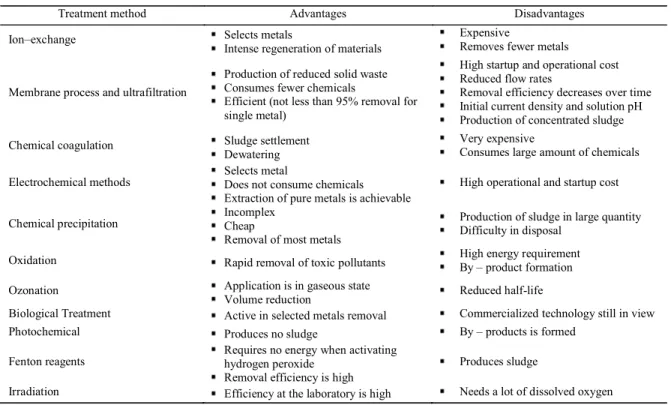
McGarrahian, 2005; Guptaet al., 2004; Nordberget al., 2007; Szpyrkowiczet al., 1995; Birchleret al., 1994; Tan and Sudak, 1992; Applegate, 1984; Judkins and Hornsby, 1978; Eliassen and Bennet, 1967). These processes generated productive results, but there are limitations with high energy requirements, incomplete removal, high operational cost, elaborate and sophisticated operations and the production of toxic sludge (Ahluwalia and Goyal, 2005a). Within the confines of different treatment methods, adsorption is seen as a user-friendly technique which is widely recognized for the abstraction of heavy metal contamination from water (Tripathi and Ranjan,2015; Gunatilake, 2015; Lakherwal, 2014; Abaset al., 2013; Geetha, 2013). Its flexibility in design and operation makes its process produce high-quality treated water (Fenglian and Qi Wang, 2011).Table 2 displays the pros and cons of several methods adopted in heavy
metal removal (Ahmaruzzaman, 2009; Farooqet al.,
2008).
Adsorption
The vast deployment of the adsorption technique in pollution mitigation has been acknowledged, and
the significance is well accredited in industries where food, chemical, petroleum and pharmaceuticals are produced (Abasiet al., 2011; Sarinet al., 2002). The definition of adsorption simply refers to a series of operations where the concentration of a particular component increase at the surface or juncture between two phases (Faust and Aly, 1987). The
adsorption phenomenon was ascertained byScheele
in 1773 for the extraction of gases using carbon (Bhatnagar and Sillanpää, 2010; Mantell, 1951). Further observation was carried out by Lowitz in 1785 in which wood charcoal was used for the erratic removal of compounds found in water that produces colour and odour (Dabrowski, 2001). A Similar
phenomenon was observed byLaroitz and Kehl in
1792 and 1793 respectively, using vegetables and animal charcoal respectively. However, Kayser in 1881 first introduced the phrase Adsorption to differentiate surface agglomeration from intermolecular intrusion, indicating that the adsorption phenomenon is all about surface accumulation of the material (Guptaet al., 2009). The adsorption technique can be grouped into two namely; physisorption and chemisorption.
Table 2: Methods adopted for heavy metal removal
Treatment method Advantages Disadvantages
Ion exchange Selects metals
Intense regeneration of materials
Expensive
Removes fewer metals
Membrane process and ultrafiltration
Production of reduced solid waste Consumes fewer chemicals
Efficient (not less than 95% removal for single metal)
High startup and operational cost Reduced flow rates
Removal efficiency decreases over time Initial current density and solution pH Production of concentrated sludge
Chemical coagulation Sludge settlement
Dewatering
Very expensive
Consumes large amount of chemicals Electrochemical methods Selects metalDoes not consume chemicals
Extraction of pure metals is achievable
High operational and startup cost
Chemical precipitation IncomplexCheap
Removal of most metals
Production of sludge in large quantity Difficulty in disposal
Oxidation Rapid removal of toxic pollutants High energy requirementBy product formation
Ozonation Application is in gaseous state
Volume reduction Reduced half-life
Biological Treatment Active in selected metals removal Commercialized technology still in view
Photochemical Produces no sludge By products is formed
Fenton reagents Requires no energy when activatinghydrogen peroxide Removal efficiency is high
Produces sludge
Physisorption
This is described as physical adsorption that involves Van der Waals forces which do not require a considerable transformation in the electronic orbital
arrangements of the species (Nabais, 2006).
Physisorption produces equal energy potential emanating from the adsorbent and the adsorbate but greater than the condensation energy released by the adsorptive; thus, no activation energy is required. In cases of physisorption, the reactions are favoured at low temperatures; therefore, physisorption process decreases with increase in temperature (Al-Anber, 2011). Also, in physisorption, equilibrium exists between the fluid phase and the adsorbate resulting in multilayer adsorption. The operation of weak Van der Waals force makes physical adsorption a relatively non specific process in which no attraction occurs between the molecules and the specific sites located at the surface of the solid, but the molecules are free to manoeuvre around the solid surface. This makes physical adsorption a reversible process (Somasundaran et al., 2008) also, the materials adsorbed may dabber, forming layers of superimposed films on the adsorbent surface (Kong, 2009).
Chemisorption
This is referred to as chemical adsorption where the adsorption process is propagated by chemical bonds forged between the adsorbent and the adsorbate. Energies are dissipated like that of chemical activity which may be endothermic or exothermic resulting in either small or large energy magnitudes. Its preliminary step requires enormous activation energy (Activated adsorption), which indicates that the pace at which equilibrium is attained may be reduced. Chemisorption
process is favoured at high temperatures and the efficiency increases with increase in temperature (Hoet al., 1993; Hoet al., 1992). Usually, chemisorbed species can be removed from the surface either by extreme temperature conditions or high exhaustion or the application of chemicals on the surface.
The adsorption sites on the surface are usually occupied with layers formed by the chemo adsorbed material (Kong, 2009). When the monomolecular layer covers the surface, the adsorbent is said to be essentially depleted. In addition, movement of molecules from one surface to the other is limited (Kong, 2009). The adsorption process is irreversible, and the chemical attributes of the adsorbent can be affected by surface dissociation whereas the original species cannot be recovered through adsorption (Guerrero Ruizet al., 1985). Holistically, adsorption isotherms showcase two categories of adsorption namely; (i) reversible
(comprising of physical adsorption and weak chemical adsorption) and(ii) irreversible (actively chemisorbed)
(Al-Anber and Al-Anber, 2008; Al Anber, 2007). Occasionally, both physical adsorption and chemical adsorption may occur simultaneously or adversely, a film of molecule may undergo physisorption above an elemental chemisorbed film (Denizliet al., 2000).
Linear forms of adsorption isotherm models
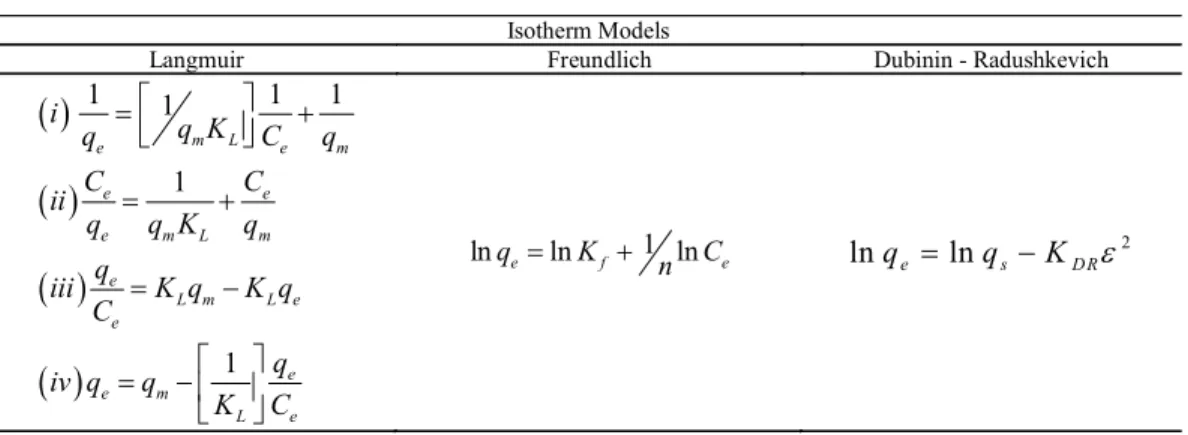
Mathematical simplicity has warranted the adoption of the linear forms of adsorption isotherm model to evaluate the isotherm parameter or the model that describes that best fit adsorptive mechanism. Langmuir model can be represented in four linearized formats (Table 3) which will culminate in different parameter estimate. The most popular Langmuir model used in literature is the type II due to little deviations from the fitted equations (Ho, 2005; Kinniburgh, 1986).
Table 3: Linearized isotherm models Isotherm Models
Langmuir Freundlich Dubinin - Radushkevich
1 1 1 1
1
1
m L
e e m
e e
e m L m
e
L m L e
e
e
e m
L e
i
q K
q C q
C C
ii
q q K q
q
iii K q K q
C
q
iv q q
K C
1
Global J. Environ. Sci. Manage., 2(4): 411-442, Autumn 2016
The equilibrium models outlined in literature that is adopted in adsorption can be grouped into mechanistic models and empirical equations. The mechanistic model explains the experiment behaviour of metal ion adsorption and also creates trends that can be used for prediction within the system. Other empirical models reported in literature that explains the single solute adsorption mechanism are displayed inTable 4.
Commercial Adsorbents
Some adsorbents have been extensively explored for water pollution control. The important ones found in literature include zeolite, Silica gel, and activated carbon.
Zeolite
There are over 140 varieties of zeolites that are being utilized as adsorbent. 40 of them occur in their natural state and over 100 are synthetic products. Zeolites are aluminosilicate materials having silicon and aluminate ratios of 1 and affinity. They are practically used in the petroleum industry as catalyst, water softeners, production of molecular sieves and production of detergents. Several types of zeolite have been used as adsorbents for pollutant removal in areas of water treatment (Ellis and Korth, 1993; Okolo et al., 2000; Meteset al., 2004; Motsiet al., 2009). Makki, (2014) applied zeolite A4 for Cd(II) and Pb(II) removal.Abdel
Model Type Model Equation Notation References
BET model (Multilayer
adsorption) 1 1
s BET e e
e
BET s e
s q C C q
C
C C C
C , ,
s e s BET
q q C and C are taken as the
theoretical isotherm saturation capacity (mg/g), equilibrium adsorption (mg/g), Saturation concentration of adsorbate monolayer (mg/L) and the BET adsorption isotherm (L/mg) respectively
Brunaueret al. (1938)
Flory Huggins (1 )FH
FH o K C
is the surface coverage potential,
FH
andKFH are the model exponent and equilibrium constant
Flory, (1942); Huggins, (1942); Kaishevaet al. (1991); Vijayaraghavanet al. (2006)
Khan
1 k
s k e
e a
k e
q b C q
b C
a and bk k
are the model exponent
and constant respectively Khanet al., (1997),
Tempkin e ln T e
T RT
q A C
b
1
( )
T T Lg
b and A are Tempkin
constants generated from the plot of
e
q againstlnCe
Tempkinet al. (1940); Aharoni and Ungarish, (1977); Vijayaraghavanet al., (2006)
Koble-Corrigan 1 n e e n e AC q BC
The linear plot using trial and error method of optimization is used to derive Isotherm constants, A, B and n
Koble and Corrigan, (1952)
Frenkel Hasley Hill
(FHH) ln r e s d s e C q
C RT q
is the isotherm constant1
( r. )
Jm mole ,d is interlayer
spacing (m) and
r
is the inverse power of distance from the surface.Hill, (1952)
Toth max
1
1 ( ) T
T T e e T e b C Q Q
b C
Two constants are itemized,
T T
b and . A Langmuir type of isotherm expression is obtained when
1
T
Toth, (1971); Vijayaraghavan et al. (2006)
Redlich Peterson 1 R e e R e k C q
a C
Redlich Peterson parameters are itemized as ,
R R
k a and . The range of the exponent spans between 0 and 1. When1, the model transforms to Langmuir isotherm model
Redlich and Peterson, (1959); Preetha and Viruthagiri, (2005)
MacMillian Teller (MET) 1 3 ln e s s e k q q C C
k
is the isotherm constant McMillan and Teller, (1951)
Salamet al., (2011) did a similar research on Cu(II) ions. Pimraksaet al., (2013) adopted synthesized zeolite for Cd(II) adsorption.Nahet al. (2002) utilized magnetically modified synthetic zeolite for Pb(II) removal. Meanwhile,Babel and Kurniawan, (2003) andBoseet al., (2002) had earlier pinpointed the cation exchangeability of zeolite on Pb, Cd, and Cu removal. Their importance as adsorbents in water and wastewater treatment was discussed extensively by Wang and Peng, (2009).
Silica gel
Silica gels are categorized into three namely; density gels, intermediate and regular gel. The low-density gels possesses surface area ranging from 100-200 m2/g. The intermediate gels are characterized with
density range of 300 350 m2/g, while the regular silica
gel has a high surface area of 750 m2/g. The various
forms of gels possess good quality as adsorbents, and its versatility has been seen in many industries (Ahmed and Ram, 1992; Backhauset al., 2001). Modification of its properties to remove pollutants have been widely explored by many industries (Moriguchiet al., 2005; Saadet al., 2007; Wanget al., 2009). Earlier research indicates that Katsumata et al. (2003) explored the usefulness of silica gel for Cd(II) removal.Bortoletoet al. (2004) obtained the concentration of Cd(II) ions using modified silica gel.Vaghettiet al. (2003) follow suit by removing Cu(II) ions using phenylenediamine propyl silica xerogel. Passoet al., (2006) worked in similar area for Cu and Pb elimination.
Activated Carbon
All around the world today, activated carbon has gained recognition for the removal of pollutants from water and wastewater. In this vein, charcoal has been identified as the longest serving adsorbent known in wastewater treatment. Its production process involves dehydration, carbonization and subsequent activation of the parent material. The by product has been characterized with porous surface structure with high surface area between 600 2000 m2/g. The continuous
use of activated carbon has developed productive results in the removal of various contaminants such as metal compounds (Perez-Candelaet al., 1995; Gabaldon et al., 1996:2000; Sanchez-Polo and Rivera-Utrilla, 2002). Liuet al., (2014)reported the progress of Cu(II) removal capacity using humic acid-impregnated activated carbon. Meanwhile, a holistic compilation of heavy
metal removal was previously reviewed byGoyal et
al., (2001). In addition,Ahnet al. (2009)reported Cd(II) removal using activated carbon treated with acid. Fan and Anderson,(2015)conducted similar research on Cu(II) and Cd(II) using granulated activated carbon. Activated carbon on Pb removal was also reported by several researchers (Karnibet al., 2014; Dwivediet al., 2008; Goelet al., 2005). Despite the relative abundance and productive use of activated carbons, there have been some restrictions on its applicability due to its high cost. Therefore, researchers are on the lookout for cheap and abundant form of adsorbent that can be applied to pollution control. As such, over some time now, attention have been diverted to the development and production of cheap alternative adsorbent using various raw materials that are abundant, possesses high carbon content and less difficult to activate ( Moreno-Castilla and Rivera-Utrilla, 2001).
The use biosorbents for the elimination of heavy metals from water and wastewater have been reported by a number of publications. Concentrated and elaborate reports from Volesky s group is seen as one of the most impactful studies in areas of biosorption. Several aspects that contribute to heavy metal adsorption using biosorbent have been discussed in their review of which a number of them are cited in this article.
Kratochvil and Volesky, (1998) discussed ion exchange as the most prominent mechanism in adsorption.Volesky, (2007) reported the challenges and mysteries behind metal adsorption. Issues such as metal interaction, modeling of equilibrium studies, the drawbacks and future of adsorption were also mentioned in this review. Volesky, despite the abundant research towards adsorption, also iterated that the application of adsorption mechanism is just at the foundational level, stating that its future cannot be envisaged.
Global J. Environ. Sci. Manage., 2(4): 411-442, Autumn 2016
different fruit peels under different modified conditions are also presented in their study. Prior to the review publication stated above, Bhatnagar et al., (2010) reported the accomplishments of coconut based adsorbent in water treatment. Their report shed lights on the elimination of various pollutants such as dyes, heavy metals, phenolic compounds, inorganic anions and other miscellaneous pollutants from water. They also reported the production process, experimental methods, modification and adsorptive potentials of the said adsorbent.
Recently,Zhouet al., (2015) did a state of the art review of organic pollutant biosorption using agricultural wastes. They mentioned the different methods of preparing adsorbent generated from agricultural wastes. The review also covers the modification properties derived from chemical and physical alteration/activation and their surface characteristics. Furthermore, the study also focuses on the removal of dyes, antibiotics, pharmaceutical and other pollutants using agricultural sorbents. Optimization conditions, regeneration and future focus were also discussed. The study proposed molecular modeling as a way to predict adsorption mechanism. Fu and Wang, (2011) also did a holistic review of different treatment methods of eliminating heavy metals from wastewater. For explanatory and cost effective means of metal removal, this publication is recommended.
In another recent report byPurkayasthaet al., (2014), an elaborate view of Cd(II) removal using several adsorbents was discussed. This paper provided insight into cheap means of removing one of the most toxic metals present in water and also espouses the use of different adsorbents which include natural minerals, municipal and industrial wastes, agricultural adsorbents, animal and microbial biomass, fungi and algae. The article also stressed that special attention should be given to coagulation and precipitation, indicating that both methods can be economically efficient in practical scenarios.
Similar content was reported bySingha and Das, (2013) but towards Cu(II) removal using agricultural wastes. A compilation of publications on Cu(II) removal using agricultural adsorbent is presented in their review. The operational conditions, promotion of adsorptive mechanism, isothermal and equilibrium studies are the main focus of the review. Another review article with similar report (Bilalet al., 2013) discussed the utilization
of waste biomass for adsorbent in sequestering of Cu(II) from industrial wastewater. The review should be recommended to interested readers.
Preparing inexpensive adsorbent from waste materials is characterized by several advantages. Their viability mainly lies in their environmentally and economically friendly nature. Many low cost adsorbent has been employed that utilized industrial, agricultural and municipal waste in the removal of metal ions in water and wastewater. Considering the increasing number of articles and the level of progress, taking into account the comprehensive conditions affecting the adsorption process and the need to provide relevant advances, this review tends to provide continuity by exploring recent publication with focus on the elimination of three prominent toxic metals namely Cu(II), Pb(II) and Cd(II) using agricultural adsorbents. Areas of adsorption which covers procedural pathways, isotherm models, kinetic and equilibrium adsorptive studies, modification, coefficient of correlation and desorption studies for different adsorbents are the primary direction of this review. Furthermore, the factors contributing to the adsorption of the aforementioned metals, drawbacks faced and prospects will be discussed as well. In order to demonstrate the potential capacity of the adsorbent in Cu, Pb, and Cd ion removal, this review tends to explore recent research articles within 10 15 years. The information contained in this review highlights the summary of methods that espouses the adsorptive potentials of several low cost adsorbents with discussion of recent findings.
General consideration of Cd, Cu and Pb removal using agricultural adsorbent
(Haskemet al., 2005; Baileyet al., 1999) itemized that any agricultural product containing cellulose exhibit potentials for heavy metals absorption. The cardinal ingredients discovered in agricultural waste that are responsible for heavy metal absorption include simple sugars, hemicellulose, proteins, lignin, lipids and starch having a multiplicity of functional groups. The availability of these waste materials makes them eco-friendly, renewable, low in cost, abundant and the most viable alternative for heavy metal remediation. Also agricultural wastes, over the past decades have been seen as an alternative for activated carbon since its conversion into low cost adsorbent is endowed with workable properties like low ash content and considerable hardness.
Elimination of Cd ions using agricultural wastes
(Cheng et al., 2016) did an assessment on the adsorptive efficiency of various pyrolysed feedstock biochars on cadmium, at room temperature. A total 22 samples were considered which were mushroom waste, wulffia, lemna, rice straw, rice stubble, rice hush, rice root, water hyacinths stem, water hyacinth leaves, water hyacinth roots, legume straws, peanut husks, oil-tea camellia seed cake, soya bean straw and lavenda oil extraction residue. The cumulative report indicated that mushroom waste (without pulverization) has the lowest adsorption efficiency of 38.7% while soya bean straw achieved the maximum efficiency of 86.6%. The biochars used in the experiment had a Significant increase in adsorption capacity with peanut thick biochars having the highest cadmium removal efficiency of 99.2%. Optimum condition identified in the adsorptive capacity were pH value of 5, Cd initial concentration of (200mg/L). The equilibrium studies of peanut husk and peanut husk biochar all confirmed to Langmuir model with correlation coefficient (R2) of peanut husk (0.9010), peanut husk
biochar (0.9722). The Freundlich model correlation coefficient (R2) observed for peanut husk and peanut husk
biochar are (0.9212) and (0.9800) respectively.
Adsorption of Cd(II) from liquefied solution was performed using Sesame as biosorbent (Cheragiet al., 2015). The experiments were carried out at temperature 25oC ± 1 using batch technique. The optimum uptake
of Cd(II) recorded was 84.74mg/g at optimum conditions of pH 6.0, bed height of 2cm and discharge of 2.5mlmin-1. The kinetics studies showed that pseudo
first order and pseudo second order model serves as the best fit to describe the adsorption mechanism with R2 values of 0.9929 and 0.9952
respectively. The experimental process revealed that the equilibrium adsorption capacity was attained in 30mins while using 201µm particle size.
Moubarik and Grimi, (2015) assessed the removal of Cd(II) from liquefied solution by vaporization of Olive stones and sugarcane bagasse. The corresponding experimental result revealed that equilibrium adsorption of Cd(II) was reached at 25mins for both samples. The removal efficiency recorded was 96% for both adsorbent. The kinetic studies could be illustrated using pseudo second order model. The optimum conditions recorded are initial pH of 7and experimental temperature of 298k.
Sedge (Onosina bracteatum) was used to remove
of Cd from aqueous solution (Raoet al., 2014). The
experiment performed showed a removal efficiency of 98.8%. The optimum sorption condition was obtained at pH 3.8. The equilibrium absorption was verified using the Langmuir model and it gave the best, considering all temperatures. The kinetics studies obeyed the pseudo second order model while the sorption of Cd(II) was seen as feasible and endothermic. The breakthrough capacity recorded was 46.2mg/g and exhaustive capacities was observed to be 99.0 mg/g. Desorption studies depicted a rapid process and within 70ml from the column 99.1% Cd(II) could be retrieved. Iqbalet al. (2009) also analyzed Cd(II) removal using mango peel waste. Optimum sorption capacity of 68.92mg/g was recorded at 60 min. The equilibrium studies were best characterized using Langmuir isotherm model while the kinetics followed pseudo second order model. Desorption process showed that the adsorbent could be recycled 5 times without considerable loss in sorption capacity.
Furthermore, in a research by (Schiewer and Patil, 2008), Cd(II) removal was investigated using Pectin rich fruit waste as biosorbents. The fruit waste materials mentioned in the study are lemon peels, orange peels, grape fruit peels, apple peels, apple cone, grape skins and apple kernel which showed rich content in pectin. The samples were modified with 0.1N HNO3 for 6hours and allowed to undergo drying for 12hours at 38 40oC.
Citrus peel performed better in the adsorption process. The equilibrium capacity was reached at 30 80mins with respect to particle size (0.18 0.9 mm). The kinetics studies were more explained using pseudo second order model while the equilibrium studies were buttressed with Langmuir model. The adsorption process was validated with R2 values of 0.88. The
maximum metal uptake of 0.67meq/g was observed at pH 5 using citrus peel.
Global J. Environ. Sci. Manage., 2(4): 411-442, Autumn 2016
respectively while fig leaves used 4h reaction time. Kinetic studies were fitted into Lagergren first-order rate model, pseudo second order model (Hoet al., 2000) and the second order rate model equation and fig leaves gave a correlation coefficient (R2) of (0.9876;
0.9988 and 0.7259) for the outlined models respectively. Medlar peels produced R2 values of 0.9866, 0.9999,
0.4473 for the model respectively. Broad bean peels had R2 values of 0.9266,0.9999, 0.4473 for the models
respectively and peas peel gave R2 values of
0.8886,0.9999, 0.9191 for the model respectively. The equilibrium studies were verified using Langmuir model with maximum sorption capacity of 147.71mg/g, 118.91mm/g, 98.14mg/g and 103.09mm/g for broad bean peel, peas peel, medlar peel and fig leaves respectively. The correlation coefficients R2 values outlined are
0.9492, 0.9142, 0.9982, 0.9546 for broad beam peel, peas peels, medlar peel and fig leaves respectively.
Pinoet al. (2006) considered the use of green coconut shell powder for the removal of cadmium. Result obtained showed that the maximum absorption capacity for a green coconut absorbent was 285.7mg/L. The best pH that favored the experiment was 7.0. Langmuir and Freundlich models both fitted when describing the equilibrium studies. Kinetics studies that best explained the experimental correlation was the pseudo second
order paradigm.
Montanheret al. (2005) examined the use of rice bran for Cd(II) removal. The sample was first acidified
using 0.1M NaNO3 and 1.0M NaNO3, 0.1M NaCl and
maintained to a pH of 3.0 using HNO3. Maximum sorption capacity for Cd(II) was attained using NaCl as modifying agent. The result indicated that optimum condition was achieved at pH values around 5 6 for Cadmium. The increase in absorbent concentration (1 20mg/L) caused a decrease in metal removal efficiency as a result of agglomeration of the sample (absorbent) in the metal solution. He highlighted that for economy to be maintained, small batches of absorbent should be used. The result displays the analysis of the equilibrium studies using Langmuir and Freundlich model having good correlation coefficients R2 of 0.9734.
The Gibb s free energy studies had negative values as a confirmation of the feasibility of the sorption process. Singhet al. (2005) examined the removal of Cd(II) using rice polish derived from agricultural waste. The result showed that the optimum prerequisite for high Cd removal were pH 8.6, initial Cd concentration of 125mg/ L and temperature 20oC, all with a yield capacity of
972mg/g. The equilibrium studies had Langmuir model applicability indicating the single layer analysis of the adsorbate on the surface of the absorbent. The thermodynamics displayed a spontaneous and endothermic process.
Elimination of Cu ions using agricultural adsorbent Yargicet al., (2015) conducted studies on the uptake of Cu(II) using chemically-treated tomato waste. Tomato waste treated with 3% v/v HCl solution. The removal efficiency was found to be 92.08%. The biosorption equilibrium was illustrated by the Langmuir and Freundlich isotherm models while the pseudo-first-order and pseudo-second-pseudo-first-order kinetic models were employed to describe the biosorption kinetics.Lunaet al., (2015) used Adlai shell from Munoz, Nueva Ecija, Philippines as absorbent in the removal of Cu(II). The sample was activated by carbonization at 350oC for
120mins and soaked in 1M Nitric acid solution for 60mins. Kinetic rate constant varied from 0.158 to 0.0027 to 0.012gmg-1 as concentration increased, which
showed that Cu(II) intake increased as concentration increased. The pseudo-second-order kinetic model confirmed the experiment with the coefficient of correlation values of the pseudo-second order kinetic equation and intraparticle diffusion of 0.999 and 0.9697 respectively. Langmuir and Freundlich isotherm equilibrium was used to evaluate the equilibrium distributions that indicated heterogeneous adsorption. Tanet al., (2015) reviewed the application of different biochar for the removal of heavy metals present in water solutions. Different biochar including corn straw, canola straw, hardwood, peanut straw, soya beans straw and Spartina alterniflora (for Cu(II) ions only) were analysed taking into thought key factors affecting the adsorption process. Langmuir model was a better fit than the Freundlich model. Results for Cu(II) ion removal are given inTable 5.
Hawariet al. (2014) analyze the characteristics of olive mill solid residue and its application in remediation of copper (Cu2+) from aqueous solution using a
mechanistic study. It was observed that as temperature increase, removal capacity increases. The models used includes the R-P, Langmuir, Freundlich and D-R models. Trakalet al., (2014) analyze the removal of copper from aqueous solution using biochar via an effect of chemical activation using 2M KOH. Two samples were critically analyzed; A synthetic solution (CuNO3.3H2O) prepared with a background electrolyte (0.01M NaNO3),
Global J. Environ. Sci. Manage., 2(4): 411-442, Autumn 2016
and a solution obtained from Cu-contaminated. The prepared biochars (BC and BCact) were able to remove Cu from synthetic and soil solutions respectively. Furthermore, chemical activation using 2M KOH significantly; i). Increased total pore volume. ii). Partly improved Cu sorption behaviour. iii). Enhanced the Cu removal from aqueous solution during the retention test over a period of time.
Application of straw ash from barley as a novel bioadsorbent for the removal of Ni(II), Cd(II), Cu(II) and Co(II) was explored byArshadiet al., (2014). The biomaterial utilized was obtained from cereal straw, barley straw and was activated thermally at 550oC. The
results revealed that the amount of adsorption increases with increasing contact time. There was an increase in the initial heavy metal concentration at 25oC
for 45mins. The adsorption of metals increases with increasing temperature in the solution. The best fit model that explained the equilibrium data was the Langmuir Freundlich model with copper being the second metal largely removed while the kinetics followed the pseudo second order equation pattern. Removal of copper by loofah fibers was experimented on by (Tanget al., 2014). The dried fibers were shredded to 2 3mm pieces and pretreated with 30% NaOH solution in anhydrous ethanol at 298.15K for 48hours. 14.49mg/g was obtained as the optimum sorption capacity at a favorable pH of 8.0. In equilibrium studies, both Langmuir and Freundlich isotherm models fitted the equilibrium data, but a better linear correlation coefficient was obtained using the Langmuir model. The pseudo second order kinetic models was the best fit when considering the kinetics studies.
(Konget al., 2014) investigated removal of Cu(II) from solutions using raw and modified litchi pericarp. Modified litchi pericarp was prepared by mixing 5g of dried litchi pericarp with 50ml NaOH (0.1M) solutions for 24 h. The maximum sorption efficiency of modified litchi pericarp was found to be more than 97.5% at pH of 6, dose of 10.0g/L and 60minutes contact time. The modified litchi pericarp showed a sorption capacity increase of 23.7 mg/g when compared with raw litchi pericarp. Langmuir and Freundlich isotherm models analyzed the equilibrium of experimental data well while the pseudo-second-order kinetic model was used in describing adsorption kinetics of Cu(II).
Feng and Guo, (2012) carried out absorption of Cu(II), Pb(II) and Zn(II) using modified orange peels. The samples were modified chemically by soaking in ethanol,
NaOH, and NaCL2 for 20h. The optimum pH value was 5.5 with absorption efficiencies of 93.7%, 99.4% and 86.6% for Cu(II), Pb(II) and Zn(II) respectively. The absorption capacities are given as 70.73mg/g, 209.8mg/ g and 56.18mg/g for Cu(II), Pb(II) and Zn(II) respectively. Selectivity order is given as Pb(II) Ã Cu(II) Ã Zn(II). The experiment fitted well using Langmuir isotherm. Absorption mechanism is due to ion exchange.
Pelleraet al., (2012) analyzed the removal of Cu(II) from aqueous solution using biochars prepared from agricultural by-products such as rice husks, olive pomace, orange waste, and compost. Pyrolysis of biochars was done under oxygen-limited conditions according toChen and Chen (2009). The chars produced were treated with HCl 1M for 12 h. with slurry separated by vacuum filtration. The optimum sorption conditions were pH in the range of 5 6 and 2 4 h. of contact time and adsorbent dose in the range of 5 12.5g/L. The adsorption kinetics was best fitted in the pseudo-second-order model while the equilibrium studies was best described by the Freundlich and linear isotherm models.
Hasfalina et al. (2012) studied the adsorption of copper (II) from aqueous solution using kenaf (Hibiscus cannabinus,L.) fibres in fixed bed column. Two models
were adopted; the Thomas model and the bed depth service time (BDST) model throughout the experimental process. The result showed 47.27mg/g was the highest bed capacity which was obtained at 100mg/L of initial copper (II) concentration, flowing at a rate of 6ml/min. The breakthrough curve was best explained using the BDST model with percentage correlation coefficient not less than 91%.
Larous and Meniai, (2012) analyzed the removal of copper (II) from aqueous solution by agricultural byproducts sawdust. After drying, activation was done using 1N H2SO4 at 150oC for 24hrs. The Cu removal
efficiency increased from 46.22% (9.245mg/g) to 97.37% (19.475mg/g) when contact time increased from 5 to 60 min. It was also checked at 60mins (97.01%) and 120mins (97.37%). The maximum adsorption took place around pH 6.0. The amount of initial concentration of Cu (II) increased from 10 to 60mg/L and the amount adsorbed increased from 9.8652 to 37.334mg/g. The equilibrium data gathered conformed to Langmuir model while the kinetic trend followed the pseudo second order equation and the intraparticle diffusion model with correlation coefficient of 0.99962 and 0.99912 respectively.
(Chenet al., 2011) analyzed adsorption of Cu(II) in aqueous solution using biochars prepared from pyrolysis of corn straw and hardwood. The corn straw biochar was prepared at a temperature of 600oC for
2hours under slow pyrolysis conditions while the preparation of other biochar was at 450oC under 5s
retention time. The maximum sorption capacity was found to be 12.52mg/g and 6.79mg/g for corn straw biochar and hardwood biochar respectively. The Langmuir and Freundlich models were used to describe the equilibrium of experimental data, but a better coefficient of correlation value was obtained with Langmuir model (R2= 0.999). The adsorption kinetics
corresponded to the pseudo-second-order kinetic models with coefficient of correlation (R2) value of 0.988
as an explanation of the entire experimental process. Moreno-Pirajan and Giraldo, (2011) used activated carbon from pyrolysed potato peel in the removal of copper from aqueous solution. The experiments followed same processes employed in adsorption of copper from aqueous solution by activated carbons obtained by pyrolysis of cassava peel ( Moreno-Pirajan and Giraldo, 2010). The optimum sorption capacity, in this case, was gotten as 74mg/g. Four three parameter isotherms models were applied to verify the equilibrium trend represented by the adsorption capacity; Sips, Toth, Radke Prausnitz and Vieth Sladek models. The correlation coefficients (R2) = 0.989511,
0.98716215, 0.986251911, 0.9767217 obtained in the experiments are in order of Radke Prausnitz, Vieth Sladek, Sips, and Toth respectively.
Moreno-Pirajan and Giraldo, (2010) investigated the removal of copper from aqueous solution using activated carbons gotten from pyrolysed cassava peel. The dried peels were impregnated with aqueous ZnCl2 at different concentrations. The peels were modified by drying in air for 8 hours at a temperature of 383K and then pyrolysis treatment at constant heating rate of 10K/min and argon flow of 30 STP.cm3/min at 823K,
and 4 hours soaking time followed. Four three parameter isotherms models were used in equilibrium studies, they include, Sips, Toth, Radke-Prausnitz and Vieth-Sladek isotherm models. The correlation coefficients (R2) arrayed in descending order are
0.997698745, 0.978315, 0.978278 and 0.978123 for Sips, Vieth-Sladek, Toth, and Radke-Praisnitz models respectively with maximum sorption capacity of 55mg/ g.Witek-Krowiaket al., (2010) researched on the use of peanut shell to remove heavy metals from water
solution. Cu (II) and Cr (III) ions were the heavy metals in this research, using Langmuir and Freundlich (two parameter models) and Redlich Peterson and Sips (three parameter models) models to examine data gotten from the tests. The analysis showed that for 1g of peanut shell, 25.39mg of Cu(II) and 27.86mg of Cr(III) were removed. The correlation coefficient R2 = 0.994,
0.994, 0.992 and 0.9326 for Sips, Redlich Peterson, Langmuir and Freundlich models respectively confirms a strong relationship between the experimental and model data. Moreso, the kinetics was best fitted using the pseudo second order model with R2 value of
0.977.
Studies were also carried out on the use of cashew nut shell to remove Cu(II) ions present in water solutions as reported bySenthilKumaret al., (2010). The results gotten from the test were analysed using Langmuir and Freundlich isotherm models. The study showed that the absorption capacity for Cu(II) ion is 20.00mg per 1g of bio sorbent at pH 5 in 30mins at 30°C, the results proved cashew nut shells to be effective. The experimental data best fitted the Freundlich model with correlation coefficient R2 of
0.998. The adsorption kinetics was better explained using the pseudo second order model.
The removal of Cu(II) from aqueous solution using pine and base modified pine cone powder as biosorbent was experimented on by (Ofomajaet al., 2009). Part of the substance was mixed with NaOH solution to attain the modified form. Optimum sorption occurred at pH of 5 and adsorbent dose of 8g/L with the modified pine cone removing more Cu(II) than the raw pine cone. The kinetic data was described by the intraparticle diffusion model and the pseudo-second-order kinetic model.
Liu et al., (2009), used raw and acid pretreated bivalve mollusk shells as an absorbent for Cu(ii) removal in aqueous solution. Some part of the sample was treated with 1M H2SO4 for 60mins at 100rpm. The optimum contact time was below 90mins while optimum pH value varied with the type of solution given as 1.5 to 9.0 for industrial by-products and 5 9 for S. cerevisiae. The absorbent operated best at temperature
between 15 40oC. The sorption was exothermic. The
Global J. Environ. Sci. Manage., 2(4): 411-442, Autumn 2016
Chestnut shell and grape seed activated carbons were also used as adsorbents for the removal of Cu(II) ions from water solutions (Özcimen and Ersoy-Mericboyu, 2009). Carbonization was achieved by impregnating the ordinary adsorbents with ZnCl2 and adding carbon under heat in an atmosphere of nitrogen. Temperature and pH factors were investigated on the adsorption process optimum time using Langmuir and Freundlich models for data deciphering. The experimental data conformed to the Freundlich model with higher R2 values. The experiment conducted proves the
absorbents to be useful with an increase in adsorption capacity due to increase in pH, temperature and surface area. Other experiments found in literature where Cu(II) ions were eliminated are further discussed in Table 6.
Elimination of Pb ions using agricultural adsorbent Yahaya and Akinlabi, (2016) made use of cocoa pod husk for the removal for the adsorption of lead. The fresh samples were collected from the Cocoa Research Institute, Nigeria. Chemical activation on the adsorbent was carried out using dilute HNO3 for 24 h. Modification of the adsorbents was conducted using 7% (v/v) aqueous H2SO4 for 90mins. Further modification was done with 0.3dm3 of pyridine and 5.67g EDTA under
reflux for 24hours. 94.6% and 98.2% removal efficiency at 50mins was recorded for unmodified and modified cocoa pod husk respectively. The kinetic studies best fits into the pseudo second order model with high R2 value ranging from 0.9776 to 1. The thermodynamic
studies produced values 5.499KJmol-1, 60.36KJ/mol and
212J/molK-1 as the free energy, enthalpy change and
entropy change respectively. (Shi et al., 2015) used arborvitae leaves to investigate heavy metal (Pb(II), Cu(II) and Co(II)) removal in aquatic environment. The conditions corresponding with single and competitive component absorption experiment was observed. The absorption ability of the leaf showed dependence on
the surface and pore diameter. Equilibrium was attained in 120mins while optimum adsorption for Pb(II) was 7.64mg/g, 3.38 mg/g for Cu(II), and 1.84 for Co(II). For the single component system, the order of adsorption was in accordance with the order of electronegativity value Pb(2.33) > Cu(1.90) > Co(1.88). The ternary component system showed a decrease in the adsorption capacity using the adsorbent from 35.84 to 9.32 mg/g, 7.94 to 3.07 mg/g, and 6.78 to 1.54 mg/g for Pb(II), Cu(II), and Co(II) ions respectively. The optimum pH value was 5.5. The experimental data was best arrayed with Langmuir model with correlation coefficient R2 value of 0.974 and 0.992 for Pb(II) ions
considering single and competitive ion adsorption respectively.Janeet al., (2014) research on heavy metals adsorption using agroforestry waste derived activated carbon on the solutions containing the metals. Macadamia nut shells, baobab shells, pigeon pea husk, rice husk, moringa oleifera husks and marula stones were all to prepare activated carbon. The metals considered were Pb(II), Hg(II), Fe(II), Cu(II), Zn(II), Ni(II), Cd(II), Mn(II), Cr(II) and As(II). As pH increased from 4 to 6 the adsorption increased and all the activated carbons gave 60% absorption for Hg (II) for pH of 6. Absorption of Pb (II) also showed 22% increase in adsorption compared to commercial carbon for baobab shells, pigeon pea husk, moringa oleifera husks and marula stones. The adsorption processes fitted the Langmuir model and Activated carbons gotten from baobab shells, pigeon pea husk had better adsorption capacity compared with all other activated carbons. Chemically Modified cellulosic biopolymer generated from okra was used in the removal of heavy metal from wastewater (Singha and Guleria, 2014). Free radical polymerization using acrylonitrile (AN) and methacrylic acid (MAA) was employed to synthesize the biopolymers based graft copolymers; then the modified
Table 6: Summary of agricultural adsorbent and their capacity (As discussed by Tanet al., (2015)
Feedstock
Pyrolytic temperature
(C)
Residence time
Adsorption temperature
(C)
Adsorption
pH (mg/g)Qmax Isotherm Kineticmodel References
Corn straw 600 2h 22 ± 2 5 12.52 Langmuir PSO Chenet al. (2011)
Canola straw 400 3.75h 25 ± 1 5 0.59 Langmuir - Tonget al.(2011)
Hard wood 450 <5s 22 ± 2 5 6.79 Langmuir PSO Chen et al.(2011)
Peanut straw 400 3.75h 25 ± 1 5 1.40 Langmuir - Tonget al. (2011).
Soya beans
straw 400 3.75h 25 ± 1 5 0.83 Langmuir - Tonget al.(2011)
Spartina alterniflora
400 2h 25 6 48 ± 0.64 Langmuir - Liet al. (2013a)
Global J. Environ. Sci. Manage., 2(4): 411-442, Autumn 2016
cellulosic biopolymer was utilized in the elimination poisonous metal namely; Cu2+, Cd2+, Zn2+ and Pb2+ from
wastewater. The impacts of pH, contact time, temperature and metal particles fixation were considered in batch mode tests. Langmuir and Dubinin Radushkevich (D R) models were utilized to demonstrate the adsorption isotherm. The arrangement of monolayer limit qm featured when utilizing Langmuir isotherm for Cu2+, Cd2+, Zn2+ and Pb2+ were 1.209, 1.2609,
0.9623 and 1.295mmol/g, individually and the correlation coefficient R2 values obtained were 0.9985,
0.9923, 0.9932 and 0.9972 respectively. The thermodynamic values Ho and Go for metal adsorption
on modified cellulosic biopolymer demonstrated that adsorption procedure was unconstrained and additionally exothermic in nature. According to (Ogunleyeet al. 2014) activated carbon produced from banana stalk was used for the removal of Pb (II). The adsorbent was modified with phosphoric acid (H3PO4) at a ratio 1:1 (w/v). This was followed by the dehydration of the mixture at 105ºC for 12 hours and then at 800ºC in the absence of air for 2 h.; carbonization took place. The carbonized sample was cooled, filtered and mixed with 0.1 M HCl for 1 h.. The maximum percentage removal was at a percentage of 97.9% at equilibrium time of 120 minutes, and the optimum sorption capacity was 200mg/g at pH 8 and 250mg/L initial concentration. The pseudo first and second order and intra particle diffusion models were employed in analyzing the kinetic data obtained while the Langmuir, Freundlich, Temkin and Dubini-Radushkevich isotherm models were used in the equilibrium studies of adsorption data. The results obtained from the research showed that the Langmuir model was the best fit model amongst the three model considered, obtaining a high correlation coefficient R2 of 0.998. Pb (II) from aqueous
streams was expunged using agricultural waste materials absorbents such as leaf base (petiole) and fiber of palm tree (Hikmatet al., 2014). The BET surface area of the powder was measured prior and afterwards activated to petiole and fiber charcoal powders at 900oC.
Variation of contact time (5 120 min), effect of pH (3.5 9), adsorbent weight effect (0.1g 1.2g), effect of initial metal concentration (5mg/l) at a maximum removal percentage of 96% of Pb(II) using fiber. The Langmuir and Freundlich adsorption isotherm model was observed, but the Langmuir model did better with correlation coefficient R2 value of 0.9974 and 0.9801 for
petiole and fiber adsorbent respectively. The
investigated kinetics parameter showed that the pseudo-first-order model best fitted the experiment, displaying a correlation coefficient R2 values of 0.9720
and 0.9773 for petiole and fiber respectively.
Ayyappanet al. (2005) made use of carbon obtained from pith, bagasse and saw dust collected from pulp, paper, and sugar industry respectively for the absorption of lead (Pb) from aqueous solution. Concentrated sulphuric acid was used to activate the materials and then placed in an oven at 150oc for 24
hours. The optimum absorption capacity was 2gd/m3
under conditions pH (5.0), 30mins contact time. Findings indicated that uptake of Pb(II) increased slowly and reached optimum level at 120 min. with piths based carbon. Saw duct carbon and bagasse carbon optimum uptake was above 90% of the same contact time. The adsorption isotherm explained in the study followed both Langmuir and Freundlich model. Kinetic modelling of data was performed using Largergren fist order rate equation. Desorption studies was also
conducted using eluted 0.1M HNO3 with 96% metal
recovery. The carbon regeneration process was achieved by washing the sample with 0.1M CaCl2
Bhattacharyya and Sharma, (2004) experimented on the adsorption of Pb (II) from water using mature Neem (Azadirachta indica) leaves. The adsorbent had an
optimum removal efficiency of 93% at 300mins of agitation time. The first-order and second-order kinetics model were used to explain the adsorption mechanism, but the adsorp tive performance corresponds to pseudo second order model. The equilibrium studies were described by the Langmuir and Freundlich isotherm models with correlation coefficient values of 0.99 respectively. Meanwhile, the dimensionless parameter RL remained within the range 0.01 and 0.43.Wonget al., (2003) analyzed the removal of lead (Pb) by means of a batch experiment using rice husk modified with tartaric acid. The sorption process relied on pH and displayed attributes of exothermic reaction. In his research, he mentioned the usability of rice husk in adsorption. Citric acid was also used at increased temperature to improve its adsorptive capacity. Citric acid was combined with cellulosic hydroxyl group forming a linkage which gives a carboxyl outcome. The cellulose content within the rice husk ranged from 28% 36% which qualifies for transmogrification with carboxylic acids. The experiment is characterized by high sorption tendencies. Pseudo-second-order