USE OF REMOTE CAMERAS IN RIPARIAN AREAS: CHALLENGES AND
SOLUTIONS
SADIE S. STEVENS, Department of Environmental Conservation, University of Massachusetts, Amherst, MA 01003, USA
ROBERT C. CORDES, Department of Biology and Natural Resources, Frostburg State University, Frostburg, MD 21532, USA
THOMAS L. SERFASS, Department of Biology and Natural Resources, Frostburg State University, Frostburg, MD 21532, USA
ABSTRACT: Remote photography has become a popular tool in wildlife research. The technique is especially valuable in monitoring elusive, free-ranging carnivores, which often are difficult to detect. We used remote cameras and video cameras manufactured by Trailmaster® to monitor river otters (Lontra canadensis) at latrines in Pennsylvania and Maryland from October 2002 to July 2004. Remote cameras previously have not been used to study river otters or other animals in riparian areas. We offer new solutions to many of the general problems encountered while using remote cameras, and to the previously undocumented difficulties that arise while using the devices in riparian areas. The techniques presented here will enable future researchers using remote cameras to increase the quality of data obtained.
KEY WORDS: camera, Lontra canadensis, Maryland, Pennsylvania, remote photography, riparian, river otter.
_______________________________________________________________________
Researchers have used remote cameras in a variety of applications, including to monitor elk (Cervus elaphus) movement across fence lines, detect forest carnivores at bait stations, study the feeding patterns of mountain lions (Puma concolor), monitor the use of highway underpasses by wildlife, and census populations (Foster and Humphrey 1995, Jacobson et al. 1997, Foresman and Pearson 1998, Pierce et al. 1998, Bauman et al. 1999, McCullough et al. 2000, Moruzzi et al. 2002). Remote photography provides the researcher with many advantages, including limited disturbance of the subject, the possibility of long-term data collection, and less disputable data (Peterson and Thomas 1998, Cutler and Swann 1999). Remote cameras may be the only way to regularly observe the behavior of elusive, wide-ranging carnivores.
One such carnivore, the river otter (Lontra canadensis), maintains large home ranges and makes extensive daily movements (Melquist and Hornocker 1983), which can make the species difficult to observe regularly. River otters do, however, visit latrines (areas where the species has been reported to defecate, loaf, and feed—Liers 1951, Greer 1955, Mowbray et al. 1976, 1977) regularly (Greer 1955). Latrines also are easily detected by a human observer and are therefore ideal locations for “camera trapping” river otters.
STUDY AREA
This study was conducted at 2 sites along the Youghiogheny River (in Fayette County, southwestern Pennsylvania, and Garrett County, Maryland) and a single section of Tionesta Creek (in the Allegheny National Forest, Forest County, northwestern Pennsylvania) Fig. 1). River otters were reintroduced to both waterways beginning in the 1990s and have become established (Serfass et al. 1993, Carpenter 2001, U.S. Department of Agriculture Forest Service 2002). Our study sites were chosen carefully to ensure that we were monitoring latrines that were regularly visited by otters. We also chose study sites that minimized danger to equipment from flooding and theft, were accessible during all seasons, and contained natural features that could be used for mounting camera equipment.
Fig. 1. Location of study areas where remote camerals were placed along the Youghiogheny River in Maryland and Pennsylvania, and Tionesta Creek in Pennsylvania during 2002-2004.
temperature in July averages 26º C (NOAA Climate Diagnostics Center 2007). Pennsylvania received above-normal precipitation in both 2003 and 2004 (Martz 2004).
Accessibility. In Fayette County, Maryland, our study area was located along a gated bike path within Ohiopyle State Park. The bike path is closed to motor vehicles and patrolled regularly by park rangers. The path is, however, heavily used by hikers, bikers, and fishermen. Whitewater rafting and kayaking are both popular along the Youghiogheny River, and vessels are often beached along the riverbanks within Park boundaries. In Garrett County, Maryland, our study area was located on posted private property. Our study site along Tionesta Creek was paralleled by a public trail, which is used mainly by hunters and fishermen, but also provides access to cross-country skiers, ATV riders, and hikers. A road follows the creek along the side opposite our study area.
Latrine characteristics. Latrines often are associated with conifers, points of land, rock formations, beaver activity, fallen logs, dense canopy cover, tributary steams, and backwaters (Greer 1955, Melquist and Hornocker 1983, Swimley 1996, Swimley et al. 1998, Carpenter 2001). Latrines also tend to occur along shoreline with vertical banks (Swimley 1996, Swimley et al. 1998, Carpenter 2001) and during winter active latrines often are associated with turbulent water (Carpenter 2001). Sites can be easily detected while walking along the shoreline and visually searching for associated characteristics (Swimley 1996, Swimley et al. 1998). Latrines generally are close to the water’s edge (Greer 1955), and therefore vulnerable to flooding.
METHODS AND MATERIALS
Equipment
We used both active (TM1500 and TM1550) and passive (TM500 and TM550) TrailMaster® infrared monitors (Goodson and Associates, 10614 Widmer, Lenexa, Kansas, USA) to control 35-mm cameras. The TM1500 and TM1550 consist of an infrared transmitter and receiver. The receiver connects to a modified Canon Sure Shot A-1 camera. The camera is triggered, and an “event” is recorded when the infrared beam that goes from the transmitter to the receiver is broken. The TM500 and TM550 consist of a single unit that emits a cone of infrared pulse windows. For an event to be recorded by the TM500 or TM550 an animal must break a certain number of these pulse windows within a specified time frame (set by the user). Whenever an “event” occurs, the receiver stores the date, time, event number, and camera frame number (if a photograph is taken) (Kucera and Barrett 1993). A simple ball and joint mount is provided by the manufacturer for attaching the 35-mm camera to a post or tree.
Trailmaster video camera systems consist of a passive infrared monitor (TM700V), Sony Handycam® video camera, light, light controller, and weatherproof video housing. The light is controlled by a 12-volt battery. We used 12-volt lawn tractor batteries purchased from department and home improvement stores. The TM700V functions like the TM500 and TM550 but has additional settings to control how long the video camera records and remains in standby, how much movement the subject must make for the camera to keep recording after activated, and if the monitor should record events after the tape is expended. An adjustable mounting bracket on the weatherproof video housing enables attachment to a post or tree.
We set active monitors to require that an animal break 5 pulse windows for an event to be recorded, and set passive monitors to require that 3-5 pulse windows (depending on site conditions) be broken within 2.5 sec for an event to be recorded. Prior to camera deployment, we tested sensitivity settings using a domestic dog similar in length and height to a river otter. We adjusted/modified camera systems in an adaptive manner based on conditions and circumstances at study sites.
Approaches: problems and solutions
stations at 2 latrines along the Youghiogheny River in Garrett County, Maryland. Video cameras were deployed at 8 stations along the Youghiogheny River in Fayette County, Pennsylvania. Six of those video camera stations at 4 latrines were functional throughout the study. Two camera systems were placed at latrines that either were too large or had too much vegetation to be accurately monitored with 1 system.
We visited camera stations regularly (typically bi-weekly), recording information about battery condition, film or videotape expenditure, and the number of scats at the site during each “camera check.” We documented all problems and the resulting number of lost camera days. To quantify the cause of lost camera days, we divided problems into the following 5 categories.
• Human error: Includes all problems that can be attributed to researcher error, such as inappropriate camera or monitor placement, incorrect settings, and unplugged camera or monitor. • Non-target animal problems: Includes malfunctions caused by ants building nests in monitors,
rodents chewing on camera cables, and rapid expenditure of film caused by detection of non-target species.
• Environmental problems: Includes flood damage, interference from snow cover, false events caused by waving vegetation or reflection from water and rocks, and fog/ice on the lens of the 35-mm camera or video camera housing.
• Equipment failure: Includes any equipment malfunction that cannot be explained by variables in any other category.
• Expended batteries:Monitor or camera batteries were occasionally expended when we visited a site. Although we tried to anticipate dates of depletion, environmental or equipment conditions often shortened battery life. (This problem was eventually alleviated by the use of rechargeable batteries, which we replaced well before the charge was close to depletion.)
• Expended film/video: We also recorded the number of camera days lost due to expended film or videotape. However, rapid expenditure of film was often a product of another problem, and in those cases lost days were recorded under another category. For example, if flooding damaged a monitor’s internal wiring, causing the monitor to record an event every few minutes and the videotape was subsequently expended before the next camera check, we included camera days lost during that period in the “environmental problems” category.
If any component of a camera system (including lights and flashes) was nonfunctional for any part of the 24-hr day (thereby preventing photos and videos from being obtained or rendering their contents indiscernible), we considered the camera day lost. Whenever a problem (and subsequently a solution) was identified, all systems were modified to eliminate or minimize the number of camera days or amount of data lost.
System modifications
We encountered several problems that required us to make system modifications. Many were attributable to the humidity associated with riparian areas, and have not been discussed in the literature previously. Others (e.g., rodent chewing of camera cables – Hernandez et al. 1997, Bauman et al. 1999, York et al. 2001, Séquin et al. 2003) have been discussed in the literature, but the previously proposed solutions did not meet our needs.
Raccoons (Procyon lotor) and deer (Odocoileus virginianus) caused the rapid expenditure of film and led us to miss visits by river otters. We could easily determine that visits by river otters had been missed when fresh scats or tracks were observed during a camera check but no photographs or videos of the animal were obtained. The problem was solved by implementing extra camera checks (especially during February and August when visitation by raccoons peaked) at sites frequented by non-target species to minimize down-time of cameras with expended film. Ants twice caused equipment problems by nesting inside monitors (see also Rice 1995). Although ants could not be prevented from entering without compromising the weatherproof nature of the equipment, monitors did become functional again after ant colonies were removed.
To deter potential vandals, we mounted cameras and video cameras above human reach (approximately 5 to 10 meters above ground level) using strap-on tree steps (Forestry Suppliers, Jackson, Mississippi, USA) to access equipment when necessary. Equipment also was fitted with signs explaining the project, was mounted on objects naturally occurring at the site for lower visibility, and was hidden/camouflaged using paint and netting. We experienced only 1 theft (of a video camera and monitor) during the project.
Flooding. We placed the 12-volt batteries and light controllers of the video camera systems in 13-liter buckets with lids to provide protection from rain, snow, and flooding. The buckets often were hung by the handle from 12.5 cm metal bicycle hooks that were screwed into trees above high water level. At latrines most prone to flooding, we discontinued the use of active monitors (TM1500s and TM1550s), which must be placed at the height of the target animal and are therefore susceptible to damage by flooding. By discontinuing the use of active monitors, we were also able to eliminate problems caused by snow covering the equipment and blocking the receiver window.
False events. Other researchers have attributed false events (events for which an animal is not present in the accompanying photograph) to rapid changes in sunlight (reflectivity), rain or snow, high winds, vegetation, and exposed soil (Mace and Manly 1991, Rice 1995). Mace and Manly (1991) reported an increase in false events during seasons with more radical sun angles and more inclement weather. Sunlight reflecting off water, sun-warmed vegetation falling (e.g., leaves) or blowing in the wind, and rainfall appear to have caused false events during this study.
We eliminated many false events by adjusting camera system set-up. To alleviate false events caused by sunlight reflecting off water, we turned monitors away from the shoreline. We trimmed vegetation to minimize false events whenever we could do so without altering the sites significantly, which we feared could cause river otters to abandon the latrine. We decreased the width of the field of detection of the monitor so that it would match that of the camera by covering the sides of the monitor’s detection window with electrical tape (see also Hernandez et al. 1997, Jacobson et al. 1997, Wolf et al. 2003).
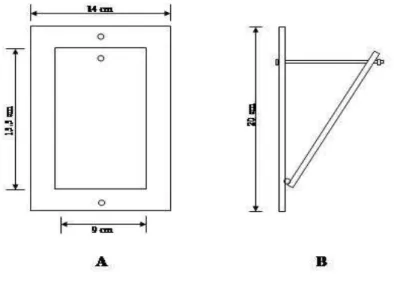
Monitor mounts. The body of the target animal must intercept an area of sensitivity that radiates outward from the receiver window of the passive monitor. The manufacturer generally recommends that monitors be mounted at such a level that the beam is chest high on the animal being monitored. For river otters, however, this area is very near ground level and subject to frequent flooding and ice jams. Also, neither the camera’s flash nor the video camera’s light can illuminate the entire length of the monitor’s detection area. Therefore, unless the passive monitor’s range is shortened, animals often trigger the camera/video camera but are not illuminated by the flash/light at night. Further, although Trailmaster equipment is designed to be water resistant, dust can compromise the waterproof nature of the rubber seals, sometimes causing equipment to malfunction during periods of precipitation (Hernandez et al. 1997).
the top with a 13 cm bolt. The edges of the mounts were covered with aluminum angling to prevent chewing by rodents (Fig. 2). The design of the mounts also allowed for the attachment of a modified plastic food container that protected the monitor’s seals from precipitation.
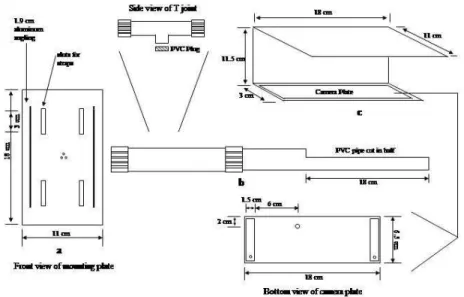
35-mm camera housings. Initially, inappropriate placement and failure of mechanical systems for mounting 35-mm cameras led to many events with no animal in the accompanying photograph. Precipitation collecting on top of the Sure Shot cameras (for which a shield isn’t provided by the manufacturer) also entered the cameras and caused them to malfunction if dust had compromised the cameras’ seals. The simple ball and joint mount provided by Trailmaster occasionally collapsed under the weight of the camera (or, more typically, from additional weight of accumulated snow), causing the camera to angle too far downward (see also Brooks 1996). We also often could not access the camera’s viewfinder when we were limited to mounting the camera on a tree trunk with the mount provided by the manufacturer, making proper setup difficult. Zielinski and Kucera (1995) suggested the use of a more substantial ball and socket head from a photographic supply store to solve the problem of the mount collapsing. However, to also eliminate problems caused by incorrect camera placement and precipitation collecting on cameras, we replaced the simple ball and joint mounts with housings that we built from PVC (Fig. 3). The camera housings we designed were strong enough to support a camera under all weather conditions, allowed us access to the camera’s viewfinder even on the largest trees, and gave us more options for camera positioning.
Fig. 3. Camera housing we created for Canon Sure Shot A-1 camera. A PVC plug is screwed into the T joint of part b. The plug and T joint can then be attached to the center of the .65 cm thick PVC mounting plate (a) by a triangular arrangement of 3 screws. Part c is attached to the PVC pipe of part b by 2 bolts underneath the camera plate, 1 cm from either edge. The camera plate is bolted to the rest of part c and the camera is affixed to the camera plate with a 6 mm inch screw. A rubber washer prevents movement of the camera when attached to the plate.
OUTCOMES
Non-target animals and theft
In total, 26 species were recorded at the latrines. Seventy-five percent of the 61 squirrel (Glaucomys volans, Sciurus niger, Sciurus carolinensis, and Tamiasciurus hudsonicus) photographs and videos we obtained were taken in October, and 15% in November. However, no camera days were lost due to chewing by squirrels in the fall of 2004, after wires had been covered.
Lost camera days
35-mm cameras. Still cameras were deployed for 3,160 camera days (1 camera day equals the deployment of a single camera for 24 hrs), and were functional for 60.4% of that time. Equipment failure was responsible for the loss of the largest percentage of camera days (32%). Other lost camera days were attributed to expended film (27.8%), human error (13.8%), expended batteries (13%), environmental factors (9.8%), and non-target animal problems (3.6%). On 39 occasions fresh scats and/or tracks of river otters were observed at a latrine, but no photographs of river otters were obtained. Fourteen of those known missed visits by river otters occurred in the fall, 11 in the spring, 8 in the summer, and 6 in the winter. Eight of the missed visits occurred during a period when the camera system appeared to be fully functional.
Video cameras.
Video cameras were deployed for 1,892 camera days and were functional for
47.1% of that time. The majority of lost camera days (67.6%) were attributed to equipment failure.
Other lost camera days were attributed to non-target animal problems (11.8%), environmental
problems (7.1%), human error (6.4%), expended video (3.6%), and expended batteries (3.5%). On 49
occasions, river otter scats or tracks were present in the monitor’s detection area but no video was
obtained. Twenty-five visits by river otters occurred during the fall, 14 during the winter, 6 during
the spring, and 3 during the summer. Ten missed visits by river otters occurred during a period when
the camera system appeared to be fully functional.
The TM700Vs recorded 52,230 events. Of those, 507 (0.97%) resulted in a video of either an animal
(target or non-target) or person (36 videos). Only 138 (0.26%) of those events resulted in video of a
river otter(s). We obtained 76 hr, 31 min, and 27 sec of video, of which 8 hr, 55 min, and 29 sec
(11.66%) were due to the camera being triggered by an animal (target or non-target) or person. We
obtained 2 hr, 47 min, and 23 sec of video due to the camera being triggered by a river otter.
Otter-triggered video made up 3.55% of the total video.
Combined results.
Combined, cameras and video cameras were deployed for 5,052 camera days,
and were functional 55.4% of that time. Of the lost camera days, 47.8% were attributable to
equipment failure, 17.1% to expended film/videotape, 10.5% to human error, 8.6% to environmental
problems, 8.8% to expended batteries, and 7.2% to non-target animal problems.
Data obtained.
We obtained 124 photographs and 94 videos of river otters using the equipment and
techniques described. Using these data we documented 173 visits to latrines. Based on the presence
of new tracks and scats when photos and videos were not obtained, we missed 88 known visits to
latrines by river otters. Of the missed visits, 44.3% were during fall, 22.7% during winter, 19.3%
during spring, and 12.5% during summer. Eighteen missed visits occurred during a period when the
camera system at the latrine appeared fully functional.
DISCUSSION
The procedures and equipment we described in this paper eliminated many problems. However,
implementation was adaptive, occurring throughout the study as problems were discovered and
therefore it was not possible to make before and after comparisons. It is however clear that after the
implementation of certain techniques, such as covering wires with tubing, the associated problem
was eliminated.
CONCLUSIONS AND RECOMMENDATIONS
Although there are potential problems with remote camera systems (such as cost and the potential for
technical difficulties), these problems are offset by many advantages, such as the ability to monitor
the natural behaviors of elusive, free-ranging animals. We believe that remote photography is a
valuable tool in monitoring the behavior of river otters and other riparian mammals. Because riparian
areas are likely used as travel corridors (Spackman and Hughes 1995), such areas could also be
valuable for monitoring many other species. However, riparian areas pose challenges to researchers
in the form of environmental problems such as flooding, increased numbers of false events, and in
many areas, increased human traffic. The set-up modifications we described will increase data
quality and decrease the number of false events, as well as the number of camera days lost to
non-target animals, environmental problems, and human error when using Trailmaster or other remote
cameras. The monitor mounts and housings described herein also could be valuable for researchers
using Trailmaster or other remote camera equipment. Although detection rates for river otters were
low in this study, they are comparable with detections of carnivores in other camera studies (Bull et
al. 1992, Foresman and Pearson 1998, Carbone et al. 2001, York et al. 2001, Moruzzi et al. 2002).
Researchers will obtain even greater detection rates than reported here when implementing the
techniques we describe at the inception of any project using remote cameras in riparian areas.
ACKNOWLEDGMENTS
This research was made possible by funds provided by the Wild Resource Conservation Fund and a State Wildlife Grant administered by the Pennsylvania Game Commission and the Pennsylvania Wild Resource Conservation Fund. We thank J. Hassinger (retired) of the Pennsylvania Game Commission for his ongoing interest in river otter research in Pennsylvania. We also thank D. Hoehn and D. Bickel of Ohiopyle State Park and B. Nelson of the Allegheny National Forest for providing access to field sites. In addition, we are grateful to J. and T. Flynn for preparing illustrations used in figures.
LITERATURE CITED
Bauman, P. J., J. A. Jenks, and D. E. Roddy. (1999). Evaluating techniques to monitor elk movement across fence lines. Wildlife Society Bulletin 27:344-352.
Brooks, R. T. (1996). Assessment of two camera-based systems for monitoring arboreal wildlife. Wildlife Society Bulletin 24:298-300.
Bull, E. L., R. S. Holthausen, and L. R. Bright. (1992). Comparison of 3 techniques to monitor marten. Wildlife Society Bulletin 20:406-410.
Carbone, C., S. Christie, K. Conforti, T. Coulson, N. Franklin, J. R. Ginsberg, M. Griffiths, J. Holden, K. Kawanishi, M. Kinnaird, R. Laidlaw, A. Lynam, D. W. Macdonald, D. Martyr, C. McDougal, L. Nath, T. O’Brian, J. Seidensticker, D. J. L. Smith, M. Sunquist, R. Tilson, and W. N. Wan Shahruddin. (2001). The use of photographic rates to estimate densities of tigers and other cryptic mammals. Animal Conservation 4:75-79. Carpenter, C. P. (2001). Scat marking and the use of latrine sites by river otters along Tionesta Creek, northwestern Pennsylvania. Thesis, Frostburg State University, Frostburg, Maryland, USA.
Cutler, T. C., and D. E. Swann. (1999). Using remote photography in wildlife ecology: a review. Wildlife Society Bulletin 27:571-581.
Foresman, K. R., and D. E. Pearson. (1998). Comparison of proposed survey procedures for detection of forest carnivores. Journal of Wildlife Management 62:1217-1226.
Foster, M. L., and S-R. Humphrey. (1995). Use of highway underpasses by Florida panthers and other wildlife.
Wildlife Society Bulletin 23:95-100.
Greer, K. E. (1955). Yearly food habits of the river otter in the Thompson Lakes Region, Northwestern Montana, as indicated by scat analyses. American Midland Naturalist 54:299-313.
Hernandez, F., D. Rollins, and R. Cantu. (1997). An evaluation of Trailmaster camera systems for identifying ground-nest predators. Wildlife Society Bulletin 25:848-853.
Kucera, T. E., and R. H. Barrett.(1993). The Trailmaster® camera system for detecting wildlife. Wildlife Society Bulletin 21:505-508.
Liers, E. E. (1951). Notes on the river otter (Lutra canadensis). Journal of Mammalogy 39(3):438-439.
Mace, R. and T. Manley. (1991). Use of systematically deployed remote cameras to monitor grizzly bears. Montana Fish Wildlife and Parks, Helena, Montana, USA.
Martz, E. (2004). Pennsylvania rainfall records broken for second consecutive year. Ag Sciences 2004. College of Agricultural Sciences, Pennsylvania State University, University Park, Pennsylvania, USA.
McCullough, D. R., K. C. J. Pei, and Y. Wang. (2000). Home range, activity patterns, and habitat relations of Reeves’ muntjacs in Taiwan. Journal of Wildlife Management 64:430-441.
Melquist, W. E., and M. G. Hornocker. (1983). Ecology of river otters in west central Idaho. Wildlife Monographs
83.
Moruzzi, T. L., T. K. Fuller, R. M. DeGraaf, R. T. Brooks, and W. Li. (2002). Assessing remotely triggered cameras for surveying carnivore distribution. Wildlife Society Bulletin 30:380-386.
Mowbray, E. E., Jr., J. A. Chapman, and J. R. Goldsberry. (1976). Preliminary observations on otter distribution and habitat preferences in Maryland with descriptions of otter field sign. 33rd Northeast Fish and Wildlife Conference, Hershey, Pennsylvania, USA.
Mowbray, E. E., Jr., J. A. Chapman, and J. R. Goldsberry. (1977). Preliminary observations on otter distribution and habitat preferences in Maryland with descriptions of otter field sign. Transactions of the Northeast Section of the Wildlife Society 33:125-131.
National Oceanic and Atmospheric Administration [NOAA]. 2007. Climate Diagnostics Center. United States Climate Page.
Peterson, L. M., and J. A. Thomas. (1998). Performance of Trailmaster infrared sensors in monitoring captive coyotes. Wildlife Society Bulletin 26:592-596.
Pierce, B. M., V. C. Bleich, C-L. B. Chetkiewicz, and J. D. Wehausen. (1998). Timing of feeding bouts of mountain lions. Journal of Mammalogy 79:222-226.
Rice, C. G. 1995. Trailmaster® camera system: the dark side. Wildlife Society Bulletin 23:110-113.
Séquin, E. S., M. M. Jaeger, P. F. Brussard, and R. H. Barrett. (2003). Wariness of coyotes to camera traps relative to social status and territorial boundaries. Canadian Journal of Zoology 81:2015-2025.
Serfass, T. L, R. L. Peper, M. T. Whary, and R. P. Brooks. (1993). River otter (Lutra canadensis) reintroduction in Pennsylvania: prerelease care and clinical evaluation. Journal of Zoo and Wildlife Medicine 24:28-40.
Spackman, S. C., and J. W. Hughes. (1995). Assessment of minimum stream corridor width for biological conservation: species richness and distribution along mid-order streams in Vermont, USA. Biological Conservation
71:325-332.
Stevens, S. S. (2005). Visitation patterns and behavior of river otters at latrines in Pennsylvania and Maryland. Thesis, Frostburg State University, Frostburg, Maryland, USA.
Swimley, T. J. (1996). Predicting river otter marking sites in Pennsylvania. Thesis, Pennsylvania State University, State College, Pennsylvania, USA.
Swimley, T. J., T. L. Serfass, R. P. Brooks, and W. M. Tzilkowski. (1998). Predicting river otter latrine sites in Pennsylvania. Wildlife Society Bulletin 26:836-845.
U.S. Department of Agriculture Forest Service. (2002). Allegheny Overview. Allegheny National Forest, Warren, Pennsylvania, USA.
Wolf, K. N., F. Elvinger, and J. L. Pilcicki. (2003). Infrared-triggered photography and tracking plates to monitor oral rabies vaccine bait contact by raccoons in culverts. Wildlife Society Bulletin 31:387-391.