Brainstorming Versus Arguments Structuring in
Online Forums
Abdulrahman
Alqahtani
Departmentof ComputerScience
NajranUniversity
Najran,Saudi Arabia
Marius
Silaghi
DepartmentofComputerScience
Florida InstituteofTechnology
Melbourne,FL, USA
Abstract—We characterize electronic discussion forums as being of one of the following two types: Brainstorming Forums and Arguments Structuring Forums. In this work we analyze and classify the types of threading models occurring as a function of the type of forum. For our analysis we study forums attached to the 25 news sources most used by the aggregator Google News, as detected by a 2007 study. Most discussion forums associated with articles on these news sources seem to be designed not with the purpose of structuring arguments but mainly with the purpose of helping readers brainstorm easily their reactions to the corresponding news item. The forums were classified as to what user-supported metadata they gather and use in comment presentation.
We compare the features observed for brainstorming forums, as learned via the aforementioned procedure, with the fea-tures of dedicated argument structuring forums. The argument structuring forums that were used as basis of the comparison are: YourView, DebateDecide, and Opinion Space. We notice significant differences in the obtained models for the two types of forums, as well as significant differences with respect to the the structuring of user submitted data in polls associated with major news channels.
We believe that this is the first kind of work that deals with the issue above.
Keywords: Knowledge Representation, Threading Models for Ar-guments in Electronic Debates, Threading Model Classification, Debate Threading Model, Comparison Online news Platforms
I. INTRODUCTION
Even before Internet users were heavily engaged in social networks like Facebook and Twitter, many of them were attracted by social applications, such as commented news, that drew significant participation and activism in the early 2000s [1].
Various other applications of electronic debates emerged in the same period of time, such as product reviews and evaluation used for collaborative filtering on online stores like Amazon or Recommendation sites like Yelp [2].
While these may be some of the most traditionally used applications of debates, a large number of other applications appeared in varied domains such as: political, religious, sci-ence, and education reviews [3].
Various foundations fund open software development for supporting comments and debates to be associated to blogs and
online news channels, as a way to promoting civil engagement and a civil society [4].
Given the effort spent by developers and foundations to build electronic debate mechanisms, the question arises on whether one platform fits it all, or platforms have to be adjusted to the actual domain [5].
Here we compare properties and expectations user have from two different and well established domains of application for electronic debates. In particular, we investigate the expec-tations and behavior of users with respect to brainstorming of comments, and argument structuring. The results of this study is used to detect relevant differences between the studied domains.
II. BACKGROUND
Open electronic debate platforms can be used with applica-tion domains, from politics to entertainment, e.g. Slashdot [6]. News articles or product descriptions can each be associated with a forum. Some studies have focused on the impact of online comments as being open news by themselves [6]. We address the issue of management for such open electronic debate platforms. Namely, of the impact of their organiza-tion (e.g., threading model) on the quality of user expe-rience (relevance, redundancy, diversity, importance, clarity, efficiency) [7], [8], [9], [10]. We are investigating the user expectation and beliefs concerning platforms for comments concerning products evaluations and news articles [10].
the presence of the refutation and enhancement claims. In a DDP2P application, all debates and arguments with news have to be related to a motion in a given organization. The user can vote on any with only one justification and he/she can post news linked to motions or justifications [11], [12], [13].
Namely, if a majority of peer members disagree with a motion that the user has earlier believed to be good, he may reconsider his position on the motion. The peers could have potentially discovered problems with that motion, problems communicated via justifications that can make the constituent withdraw his/her support. Withdrawing support for an unpop-ular motion will save the time of the other constituents who will be less tempted to spend time reading it, and this will help the organization to save the resources needed to move on the proposal and organize an official ballot [12], [13].
III. RELATEDRESEARCHAREA
A few researchers have already addressed the relationship between social network behavior and these networks’ intended purposes [14], [15]. This section highlights previous studies on the type and quality of collaboration based on social networks. In this chapter, we provide a review of the literature related to the work described in this dissertation. It also presents the gaps in the existing research literature. In this research, the related work is presented and classified according to the means and purpose of the studied collaboration.
A. Generic Tools for Collaboration
We identify the following types of generic tools for collab-oration, on an idea, between unsophisticated users:
• Arguments
• Thumb up/down
• Voting
• Threading
a) Arguments: According to the Merriam Webster
dic-tionary, argumentation is “the act or process of giving reasons for or against something: the act or process of making and presenting arguments” where an argument is “a statement or series of statements for or against something” [16]. The possi-bility to express arguments in favor of or in opposition to ideas is considered an important instrument in collaboration [17].
b) Thumb up/down: An easy way to garner feedback
on ideas and arguments is to let people show their opinion using simple tags such as a thumbs-up or a thumbs-down [18]. Often this is done in systems where participants are not authenticated. Moreover, users can often use a thumbs-up tag for opposing arguments, thereby making it difficult to use these tags for extracting reliable statistics.
c) Voting: Voting is an approach to measure the opinion
of a certain group of people. Unlike the thumbs-up/thumbs-down practice mentioned above, commonly the identity of people involved in voting is verified and each person can vote only once. Therefore, a user cannot vote simultaneously on opposing arguments [19]. Statistics about opinions can be reliably estimated [20].
d) Threading: Many writers are skeptical about the
usefulness of the comments or threads that are placed on common web forums [21], despite the large number of useful comments. However, the idea of abolishing comments is not popular. Users feel more motivated to visit forums where they can comment since they may believe in the impact of these comments [22]. Besides collaborating on ideas, people also collaborate on projects by contributing work or resources [23].
B. Discourse Architecture
Discourse architecture is the technique to provide environ-ments for users to connect with each other through networked computers. Discourse architecture is supporting the discus-sions, converdiscus-sions, debates and arguments between users in computer social media or networks [24], [25].
IV. MAJORKNOWLEDGEREPRESENTATIONTYPES
Classification:
A. Ontologies
The research in Ontologies deals with the establishment of languages that have no ambiguities. The language should be powerful enough to represent knowledge. For example, a message based on a standard ontology starts by a reference to the ontology version, and then has to follow its strict syntax [26], [27]. Ontologies define communities.
B. Logic
One of the techniques, that is used to store sentences within the computer, is mathematical logic. It is used in knowledge databases such as those used by PROLOG and GOLOG [28], [29]. They are difficult to use with general users [30]. Also, some applications such as ArgTrust that build to help the user to get information source by using logical argumentation and a computational model of trust.
C. Semantic Networks
A Semantic Network consists of a set of nodes that are linked by arcs. In general, nodes represent concepts while arcs represent the relations between concepts. There are exited researches for analysis the language by studying the nature language and its relevant with meaning, grammars, lexis and societies [31], [32].
D. Mind Maps
E. WordNet
WordNet is a huge lexical database of English [35]. It is a set of cognitive synonyms that have been collected from nouns, verbs, adjectives, and adverbs with a clear expression of concept [36].
F. Argument Maps
An Argument Map is a logic structure for arguments. It breaks up the argument into statement, reason, or fact. Also, it shows the relation between parts of the argument [37]. A lot of people have difficulty understanding complex arguments presented in textual form. An argument map is a graphical way to represent the complex relations between relevant state-ments. Therefore, it can improve human comprehension. It looks similar to a flowchart and a specialization/generalization hierarchy [38]. There exist tools that can be used to build argument maps [39]. These argument maps have been built to help people better understand the issues related to a given problem. Arguments are frequently attached to emotions. In argument maps, there is no requirement for arguments to be objective. Simple and complex arguments are captured with the help of the diagram [37].
V. EVALUATION OFKNOWLEDGEREPRESENTATION
MECHANISMS
Here I present some techniques that can be used to evaluate knowledge representation:
A. Surveys
Surveys can be used for knowledge representation eval-uation [40], [41]. In 2009, McDonald et al evaluated three formats of privacy policies for six companies. There were 749 internet users for this study and each filled out the survey to evaluate a company’s privacy with one format [42].
In 2005, Janez Brank presented a survey of the state of the art in ontology evaluation [43]. He grouped the ontology evaluation approaches depending on level of evaluation, as follows:
• Lexical, vocabulary, or data layer:
This level focused on concepts, instances, facts, etc, which are included in the ontology. Also it considers the vocabulary that is used to represent these concepts. Eval-uation in this level involves comparison with different sources of data.
• Hierarchy or taxonomy: It studies the relation between
concepts
• Other semantic relations:
This level includes other relations between concepts besides is-a. Evaluation of this level contains measures such as precision and recall.
• Context or application level:
The Context level occurs when an ontology becomes part of a huge collection of ontologies, which is mentioned by separate definitions in those other ontologies. Evaluation at this level may help to take the context into account
while evaluating different definitions. application is an-other form of context where the ontology is to be used.
• Syntactic level:
The Syntactic level matches the syntactic requirements of the particular formal languages that describe the ontology.
• Structure, architecture, design:
This is primarily manually constructed ontologies that evaluate certain pre-defined design principles or criteria for further development.
B. Case Studies
A few case studies exist that have been to improve the knowledge representation evaluation [44], [45]. In 2003, Kim and Chan proposed a way to evaluate reordered Google search results by associating each item with a score provided by clusters of human users and aggregating the total score based on the position of the valuable items [46].
C. Panels
The panel (group of people) can be used to compare different forms of knowledge representation [47], [48], [41]. Bobrow, in his research (a panel on knowledge representation), mentions that he asked panel members to briefly answer three questions in order to compare different forms of knowledge representation [48]. The three panel questions were: “What are the most important premises underlying your approach to knowledge representation, the critical ideas, and major mechanisms used in your system [48]”.
D. Simulations
Simulation is also a tool that helps to evaluate knowl-edge representation to improve quality and shorten time-to-compare [49], [50]. Zhou and his team provide simulation modeling based on knowledge representation. They presented a notation to formalize the representations to support their model development and validation and to facilitate the analysis and translation of the representations [50]. In this study, they discussed solving complex problems, such as cost, quality, pro-ductivity, and shortening time-to-market by using a knowledge engineering approach [50].
VI. THREADINGMODELS FORARGUMENTS IN
ELECTRONICDEBATES
A. Introduction to Threading Models
The relevant point to mention about threading models is that users can benefit in their decision making by exploring comments and justifications provided by others (e.g., on fora or various social networks) [55]. This exploration can be enhanced not only by search engines, but also by using hints provided by links generated by the comment authors themselves [55].
The whole World Wide Web was designed for improving information exploration based on links (here hyperlinks) [56]. The Internet fora and social networks took this a step further by hosting such links in a more compact way but typically at the expense of generality. Namely restrictions are added as to how many links are possible from each article item [57]. The most common and simple restriction is one where each article (comment) can link to a single other article, to which it is a “reply”. This structure, together with restrictions on the maximum chain of “replies”, gives rise to the so-called tree structures seen on common Internet fora. A compact representation can be enabled by such rules [58].
Conversation Threading has been standardized for the
IMAP email systems [59]. A common technical classification is:
• Client based: Microsoft Outlook, Thunderbird [60] • Web based: Gmail, Reddit, Slashdot [7]
B. Examples of Threaded Fora in Online Forums
There are many fora on the Internet. They are frequently attached to articles in online newspapers or next to items in online shops or product rating sites. Here we focus on fora that are specially designed to support debates on online news. Some of the other fora are occasionally used for debates around linked issues but they are not generally designed to help navigate or extract a conclusion for those debates.
The 24 fora that we have identified as specially designed for Online News are [61]:
• New York Times
• Washington Post
• Houston Chronicle
• Bloomberg
• Los Angeles Times
• Reuters
• Forbes
• Monsters and Critics.com
• Guardian Unlimited
• Voice of America
• International Herald Tribune
• Boston Globe
• Chicago Tribune
• BBC News
• San Francisco Chronicle
• CBS News
• Times Online
• Wall Street Journal
• USA Today
• FOX News
• CNN
• Seattle Post Intelligencer
• MSNBC
• ABC News
All above forums are online news platforms for presenting comments and helping users to explore these comments by scoring them. In most of these platforms, registered users have the ability to submit multiple comments or replies. Moreover, the participant can give a thumbs up or thumbs down for comment.
One can observe that online news platforms are significantly different from newspapers. An effort was made over the centuries to find optimal ways of organizing face-to-face debates [62]. Research is needed to decide whether current online news platforms are carried out with the optimal debate threading models and debate representation, as a means of knowledge representation.
The set of restrictions placed on the number and type of links in an article item, as well as on the global rules on
types and size of link chains, form a “debate threading model.”
For a given threading model, there are multiple ways of graphically displaying the result to users. For example, some items (i.e., at given depths in the tree) could be hidden until required by users. Otherwise, links can be shown graphically or the number or existence of connected items can just be mentioned. We used to separate the knowledge relations by their representation.
The set of rules describing how debate instances
are graphically presented to viewers is called “debate
representation model.”
Some fora specialize on debates for different topics: music, fashion, software bugs, and politics. Since some topics are more disputable than others, different threading models may be appropriate for different topics and, thus, fora.
VII. COMPARISONTHESOURCESOFGOOGLENEWS
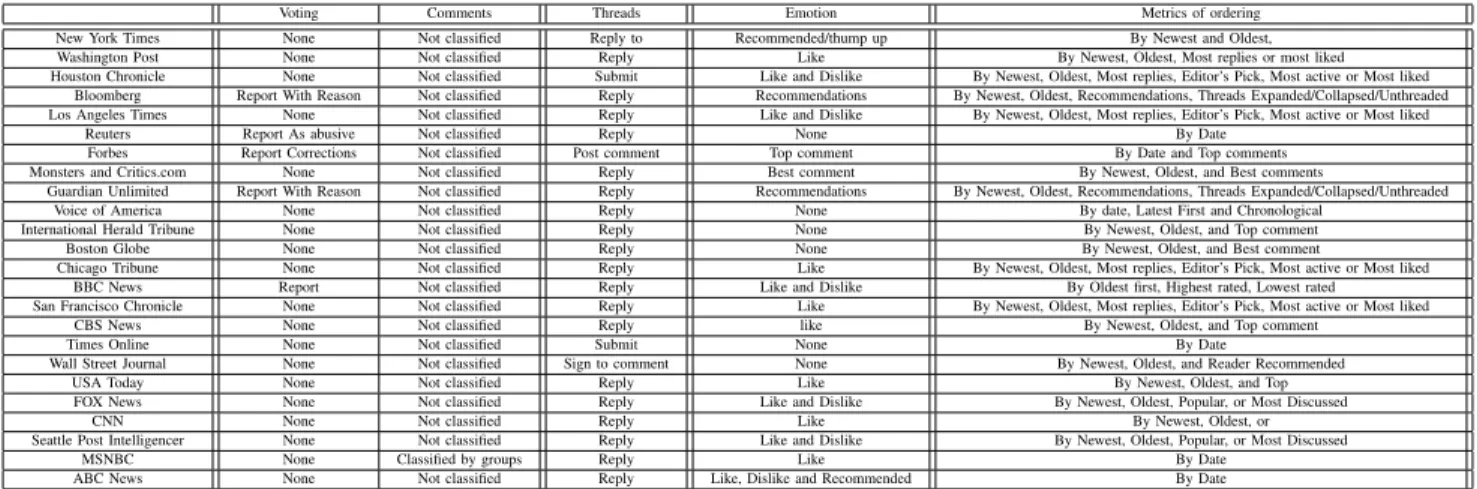
This study focuses on The Sources Of Google News struc-tured. According to Google News Report USA, the top 25 news sources year to day as of May 30, 2007 [61], we can compare these fora across six criteria to better understand differences. Table I compares The Sources Of Google News.
a) Criteria:
• Voting: It is a score that counts the number of supports.
This criterion has as domain:
– None
– Report with reasons
– Report as abusive
Voting Comments Threads Emotion Metrics of ordering New York Times None Not classified Reply to Recommended/thump up By Newest and Oldest, Washington Post None Not classified Reply Like By Newest, Oldest, Most replies or most liked Houston Chronicle None Not classified Submit Like and Dislike By Newest, Oldest, Most replies, Editor’s Pick, Most active or Most liked
Bloomberg Report With Reason Not classified Reply Recommendations By Newest, Oldest, Recommendations, Threads Expanded/Collapsed/Unthreaded Los Angeles Times None Not classified Reply Like and Dislike By Newest, Oldest, Most replies, Editor’s Pick, Most active or Most liked
Reuters Report As abusive Not classified Reply None By Date
Forbes Report Corrections Not classified Post comment Top comment By Date and Top comments Monsters and Critics.com None Not classified Reply Best comment By Newest, Oldest, and Best comments
Guardian Unlimited Report With Reason Not classified Reply Recommendations By Newest, Oldest, Recommendations, Threads Expanded/Collapsed/Unthreaded Voice of America None Not classified Reply None By date, Latest First and Chronological
International Herald Tribune None Not classified Reply None By Newest, Oldest, and Top comment Boston Globe None Not classified Reply None By Newest, Oldest, and Best comment
Chicago Tribune None Not classified Reply Like By Newest, Oldest, Most replies, Editor’s Pick, Most active or Most liked BBC News Report Not classified Reply Like and Dislike By Oldest first, Highest rated, Lowest rated San Francisco Chronicle None Not classified Reply Like By Newest, Oldest, Most replies, Editor’s Pick, Most active or Most liked
CBS News None Not classified Reply like By Newest, Oldest, and Top comment
Times Online None Not classified Submit None By Date
Wall Street Journal None Not classified Sign to comment None By Newest, Oldest, and Reader Recommended
USA Today None Not classified Reply Like By Newest, Oldest, and Top
FOX News None Not classified Reply Like and Dislike By Newest, Oldest, Popular, or Most Discussed
CNN None Not classified Reply Like By Newest, Oldest, or
Seattle Post Intelligencer None Not classified Reply Like and Dislike By Newest, Oldest, Popular, or Most Discussed
MSNBC None Classified by groups Reply Like By Date
ABC News None Not classified Reply Like, Dislike and Recommended By Date
TABLE I: Comparison The Sources Of Google News
• Comments/Justifications:
These are arguments presented by users. The domain of this criteria is:
– Not Classified
– Classified by groups
All study platforms provide a structured comment section. All comments are in the same column and the user once again has to go through each of them to assess the decision behind each comment. Only MSNBC provides a structured comment/justification section that is organized by group choice.
• Threads:
Threads are graphs/trees of arguments and relations be-tween those arguments. The domain of this criteria is:
– Reply to
– Submit
– Post
– Sign
• Emotion Thumb (Up/Down):
This is a feature that allows the users to express their emotional support of an argument by selecting “Up” when they agree and ”Down” for disagreement. Some platforms do not offer this feature while others have it available. The domain for this criteria is:
– Like
– Dislike
– Top
– Best
– Recommended
– None
Most of the study platforms have a feature to allow the users to express their emotion (Thumbs Up/Down).
• Metrics of Ordering:
This is a sorting option that allows the user to order the comments and arguments. The domain for this criteria is:
– Ordering by date
– Ordering by Oldest
– Ordering by Newest
– Ordering by most replies
– Ordering by most liked
– Ordering by most active
– Ordering by editor’s Pick
– Ordering by Recommendations
– Ordering by Threads
Ex-tended/Collapsed/Unthreaded
– Ordering by Chronological
– Ordering by Top comments
– Ordering by Best comments
– Ordering by highest rated
– Ordering by lowest rated
– Ordering by Reader Recommended
– Ordering by most Discussed
• Threading Models:
They are the general rules on types and size of link chains (Homogeneous or Heterogeneous). Homogeneous: all links have the same semantic: e.g. refutation. Hetero-geneous: links can have different semantics: e.g. refuta-tion, support. There are a several types available:
– one-homogeneous
– one-heterogeneous
– unlimited-homogeneous
– unlimited-heterogeneous
– limited-homogeneous
– limited-heterogeneous
Some of the study platforms are only one link and unlimited-homogeneous/replies but not all of them. As it can be observed from this comparison, most discussion forums associated with articles on these news sources seem to be designed not with the purpose of structuring arguments but mainly with the purpose of helping readers brainstorm easily their reactions to the corresponding news item.
VIII. CONCLUSION
significantly relates to many different activities in our lives such as communication, chatting, argumentation, and educa-tion. Here, we introduce a classification of debate threading models. We identified and classified some generic tools for collaboration used on discussion platforms on the most influent online forums. The classified tools are: Arguments, Thumbs up/down, Voting, Threading, etc. On the Internet, we can find many fora attached to some blogs and other sites that provide the users with a comment/justification opportunity. However, most of the time, they are not designed to provide or extract a conclusion on any ongoing debate, but rather to help readers brainstorm their reactions. Some web applications are nevertheless dedicated to structuring arguments with the potential intention of reaching conclusions. We here studied the relation between the features of online forums and the purpose of these forums.
While these fora utilize comments to support or negate the author’s message or other comments, no thorough analysis has been performed on analyzing the features associated with forums as a function of the purpose of the forum.
REFERENCES
[1] T. Quandt, “News on the world wide web? a comparative content analysis of online news in europe and the united states,” Journalism Studies, vol. 9, no. 5, pp. 717–738, 2008.
[2] F. Von Reischach, D. Guinard, F. Michahelles, and E. Fleisch, “A mobile product recommendation system interacting with tagged products,” in Pervasive Computing and Communications, 2009. PerCom 2009. IEEE International Conference on. IEEE, 2009, pp. 1–6.
[3] A. Kosic and A. Triandafyllidou, “Representations of the european union and the nation (-state) in italian party discourse: A critical analysis of electoral platforms and parliamentary debates,”Journal of Language and Politics, vol. 3, no. 1, pp. 53–80, 2004.
[4] L. Cotula,Land grab or development opportunity?: agricultural invest-ment and international land deals in Africa. Iied, 2009.
[5] V. Krishnan and K. T. Ulrich, “Product development decisions: A review of the literature,”Management science, vol. 47, no. 1, pp. 1–21, 2001. [6] A. Bruns, “Stuff that matters: Slashdot and the emergence of open news,”
2003.
[7] A. Alqahtani and M. Silaghi, “Classification of debate threading models for representing decentralized debates,”ICAI’15 - The 17th International Conference on Artificial Intelligence, Nevada, 2015.
[8] ——, “User interfaces for representing knowledge stemming from debates: Evaluating the impact of threading models (reviews) on online products,”ICAI’15 - The 17th International Conference on Artificial Intelligence, Nevada, 2015.
[9] ——, “Evaluation the impact of human interaction/debate on online news to improve user interfaces for debate applications,”Vol. 6 - Issue 1 (January - 2016), International Journal of Engineering Research and Applications (IJERA) , ISSN: 2248-9622 , www.ijera.com.
[10] ——, “Expectations for electronic debate platforms as a function of application domains,”Vol. 6 - Issue 1 (January - 2016), International Journal of Engineering Research and Applications (IJERA) , ISSN: 2248-9622 , www.ijera.com.
[11] “https://yourview.org.au/.”
[12] M. C. Silaghi, K. Alhamed, O. Dhannoon, S. Qin, R. Vishen, R. Knowles, I. Hussien, Y. Yang, T. Matsui, M. Yokooet al., “Direct-democracyp2pdecentralized deliberative petition drives,” inPeer-to-Peer Computing (P2P), 2013 IEEE Thirteenth International Conference on. IEEE, 2013, pp. 1–2.
[13] K. Kattamuri, M. Silaghi, C. Kaner, R. Stansifer, and M. Zanker, “Supporting debates over citizen initiatives,” in Proceedings of the 2005 national conference on Digital government research. Digital Government Society of North America, 2005, pp. 279–280.
[14] R. Cross, S. P. Borgatti, and A. Parker, “Making invisible work visi-ble: Using social network analysis to support strategic collaboration,” California management review, vol. 44, no. 2, pp. 25–46, 2002.
[15] A. Mukherjee and B. Liu, “Modeling review comments,” inProceedings of the 50th Annual Meeting of the Association for Computational Linguistics: Long Papers-Volume 1. Association for Computational Linguistics, 2012, pp. 320–329.
[16] M.-W. Inc.,Merriam-Webster’s dictionary. Merriam-Webster. [17] C. Rinner, “Argumentation maps: Gis-based discussion support for
on-line planning,” Environment and Planning B: Planning and Design, vol. 28, no. 6, pp. 847–863, 2001.
[18] A. Funk, Y. Li, H. Saggion, K. Bontcheva, and C. Leibold, “Opinion analysis for business intelligence applications,” in Proceedings of the first international workshop on Ontology-supported business intelli-gence. ACM, 2008, p. 3.
[19] D. C. Challener, R. A. Kelley, and P. E. Newman, “Method and system for secure computer moderated voting,” Jun. 27 2000, uS Patent 6,081,793.
[20] J. A. Halderman, H. Hursti, J. Kitcat, M. MacAlpine, T. Finkenauer, and D. Springall, “Security analysis of the estonian internet voting system,” ACM, Tech. Rep., 2014.
[21] J. D. Barkan, “Comment: Further reassessment of conventional wisdom: political knowledge and voting behavior in rural kenya.” American Political Science Review, vol. 70, no. 02, pp. 452–455, 1976. [22] T. Kriplean, J. Morgan, D. Freelon, A. Borning, and L. Bennett,
“Supporting reflective public thought with considerit,” inProceedings of the ACM 2012 conference on Computer Supported Cooperative Work. ACM, 2012, pp. 265–274.
[23] R. Bhathal, “Australian optical seti project,” inBioastronomy 99, vol. 213, 2000, p. 553.
[24] J. Harris and A. Henderson, “Discourse architecture,” ACM SIGCHI Bulletin, vol. 30, no. 2, pp. 147–151, 1998.
[25] P. K. Gilbert and N. Dabbagh, “How to structure online discussions for meaningful discourse: A case study,”British Journal of Educational Technology, vol. 36, no. 1, pp. 5–18, 2005.
[26] D. Fensel,Ontologies. Springer, 2001.
[27] M. Uschold and M. Gruninger, “Ontologies: Principles, methods and applications,” The knowledge engineering review, vol. 11, no. 02, pp. 93–136, 1996.
[28] W. Clocksin and C. S. Mellish,Programming in PROLOG. Springer Science & Business Media, 2003.
[29] S. McIlraith and T. C. Son, “Adapting golog for composition of semantic web services,”KR, vol. 2, pp. 482–493, 2002.
[30] H. J. Levesque, R. Reiter, Y. Lesperance, F. Lin, and R. B. Scherl, “Golog: A logic programming language for dynamic domains,” The Journal of Logic Programming, vol. 31, no. 1, pp. 59–83, 1997. [31] W. A. Woods, “Whats in a link: Foundations for semantic networks,”
Representation and understanding: Studies in cognitive science, pp. 35– 82, 1975.
[32] P. Vossen, A multilingual database with lexical semantic networks. Springer, 1998.
[33] M. J. Eppler, “A comparison between concept maps, mind maps, conceptual diagrams, and visual metaphors as complementary tools for knowledge construction and sharing,”Information visualization, vol. 5, no. 3, pp. 202–210, 2006.
[34] T. Buzan, “Mind maps at work: how to be the best at your job and still have time to play,” 2005.
[35] G. A. Miller, “Wordnet: a lexical database for english,”Communications of the ACM, vol. 38, no. 11, pp. 39–41, 1995.
[36] C. Fellbaum,WordNet. Wiley Online Library, 1998.
[37] C. Twardy, “Argument maps improve critical thinking,”Teaching Phi-losophy, vol. 27, no. 2, pp. 95–116, 2004.
[38] P. A. Kirschner, S. J. Buckingham-Shum, and C. S. Carr, Visualizing argumentation: Software tools for collaborative and educational sense-making. Springer Science & Business Media, 2012.
[39] T. van Gelder, “Mapping the arguments in an academic text,” 2011. [40] H. Wache, T. Voegele, U. Visser, H. Stuckenschmidt, G.
Schus-ter, H. Neumann, and S. H¨ubner, “Ontology-based integration of information-a survey of existing approaches,” in IJCAI-01 workshop: ontologies and information sharing, vol. 2001. Citeseer, 2001, pp. 108–117.
[41] M. B. Brown, “Survey article: Citizen panels and the concept of representation*,” Journal of Political Philosophy, vol. 14, no. 2, pp. 203–225, 2006.
[43] J. Brank, M. Grobelnik, and D. Mladeni´c, “A survey of ontology evaluation techniques,” 2005.
[44] T. R. Gruber, “Toward principles for the design of ontologies used for knowledge sharing?”International journal of human-computer studies, vol. 43, no. 5, pp. 907–928, 1995.
[45] J. Edelmann and B. Owsnicki, “Data models in knowledge represen-tation systems: A case study,” in GWAI-86 und 2. ¨Osterreichische Artificial-Intelligence-Tagung. Springer, 1986, pp. 69–74.
[46] H. R. Kim and P. K. Chan, “Learning implicit user interest hierarchy for context in personalization,” inProceedings of the 8th international conference on Intelligent user interfaces. ACM, 2003, pp. 101–108. [47] J. J. Cimino, P. D. Clayton, G. Hripcsak, and S. B. Johnson,
“Knowledge-based approaches to the maintenance of a large controlled medical terminology.” Journal of the American Medical Informatics Association, vol. 1, no. 1, p. 35, 1994.
[48] D. G. Bobrow, G. G. Hendrix, W. A. Martin, J. McCarthy, A. Newell, R. Schank, B. C. Smith, and N. Sridharan, “A panel on knowledge representation,” inProceedings of the 5th international joint conference on Artificial intelligence-Volume 2. Morgan Kaufmann Publishers Inc., 1977, pp. 983–992.
[49] T. K. Landauer and S. T. Dumais, “A solution to plato’s problem: The latent semantic analysis theory of acquisition, induction, and representa-tion of knowledge.”Psychological review, vol. 104, no. 2, p. 211, 1997. [50] M. Zhou, Y. J. Son, and Z. Chen, “Knowledge representation for conceptual simulation modeling,” inProceedings of the 36th conference on Winter simulation. Winter Simulation Conference, 2004, pp. 450– 458.
[51] J. F. Sowa, “Knowledge representation: logical, philosophical, and computational foundations,” 1999.
[52] U. Fayyad, G. Piatetsky-Shapiro, and P. Smyth, “From data mining to knowledge discovery in databases,”AI magazine, vol. 17, no. 3, p. 37, 1996.
[53] C. Reed and G. Rowe, “Araucaria: Software for argument analysis, diagramming and representation,” International Journal on Artificial Intelligence Tools, vol. 13, no. 04, pp. 961–979, 2004.
[54] G. Fischer, A. C. Lemke, R. McCall, and A. I. Morch, “Making argumentation serve design,”Human–Computer Interaction, vol. 6, no. 3-4, pp. 393–419, 1991.
[55] K. Subrahmanyam, S. M. Reich, N. Waechter, and G. Espinoza, “Online and offline social networks: Use of social networking sites by emerging adults,”Journal of Applied Developmental Psychology, vol. 29, no. 6, pp. 420–433, 2008.
[56] T. J. Berners-Lee, “The world-wide web,”Computer Networks and ISDN Systems, vol. 25, no. 4, pp. 454–459, 1992.
[57] D. Hansen, B. Shneiderman, and M. A. Smith,Analyzing social media networks with NodeXL: Insights from a connected world. Morgan Kaufmann, 2010.
[58] M. E. Newman, “Communities, modules and large-scale structure in networks,”Nature Physics, vol. 8, no. 1, pp. 25–31, 2012.
[59] M. Crispin and K. Murchison, “Internet message access protocol-sort and thread extensions,” RFC 5256, June, Tech. Rep., 2008.
[60] S. J. Delany, P. Cunningham, and B. Smyth, “Ecue: A spam filter that uses machine learning to track concept drift,” 2006.
[61] “http://searchengineland.com/revealing-the-sources-of-google-news-11353,”Revealing The Sources Of Google News, 2007.