Fundação Getulio Vargas
Escola Brasileira de Administração Pública e de Empresas (EBAPE)
Master in International Management
Catharina Jarck
Tapping Into Your People
Successfully Managing Idea Generation in Organisations
Rio de Janeiro
Catharina JARCK
Tapping Into Your People
Successfully Managing Idea Generation in Organisations
Thesis presented by the
Fundação Getulio Vargas,
Escola Brasileira de Administração Pública e de Empresas (EBAPE), as a requirement to obtain the “Master in International Management”
Table of Contents
1. Introduction ... 1
Aim of Research ... 3
Outline & Methodology ... 3
2. Frame of Reference ... 5
History of Idea Management ... 5
Idea Generation and Innovation – same thing? ... 8
Idea Generation as a Process... 9
Ideas – where from? ... 12
Motivation ... 16
Creativity... 14
The People and their Roles ... 19
Organisational Culture ... 22
Role of Leadership ... 26
Rewarding Ideas... 29
3. Frameworks... 34
Designing an Idea Management System ... 34
The 3 Stages within Idea Management ... 35
Administering an Idea Management System ... 39
Centralised Idea Management... 40
Centralised or Functional Model ... 42
The Hybrid Model... 44
Software Options ... 45
In Numbers... 47
Monitoring ... 47
Brief History of Souza Cruz ... 50
Implementation of VIA ... 54
The “Components”... 56
The System... 57
How does VIA work? ... 58
Leadership & Culture ... 60
Motivation ... 62
Rewarding Ideas... 63
Success Criteria & Monitoring ... 64
Challenges ... 65
5. Discussion & Recommendation ... 67
6. References ... 75
Abstract
Over the past few years, innovation has increasingly garnered the headlines as one of the core competencies every sustainable organisation must have. Yet, it is the idea which is the foundation of any innovation. This paper draws together knowledge about idea generation, and its management, and how the process of encouraging ideas, creativity and then managing them effectively will enhance the opportunities of successfully finding and implementing innovations which will add value to the organisation and its stakeholders. Extensive review of literature in the field of idea and innovation management, as well as a study of Souza Cruz’s recently conceptualised and implemented Idea Management programme has brought together the many facets involved in successfully harnessing and implementing ideas.
Keywords: Idea Generation & Management, innovation, motivation, creativity, organisational
culture, leadership
1.
Introduction
It seems that humans are by nature innovative. As without the willingness to experiment, to try something new, to solve a problem or to confront and overcome a challenge, we would not have evolved as a species over time and would presumably still be living in a cave. Perhaps one of the most powerful ways in which we learn is when our expectations fail, when we try something and it does not work, and so we are driven to try new ways to realise our goals. Through our search for improvements to either quality or processes, be it because we are curious or lazy – and thus seeking to make life easier – innovation occurs. The ability to innovate is in each and every person, to varying degrees. It is this underlying, yet fundamental human imperative, which provides management with the million dollar question of how to reap the pool of ideas that all employees in every organisation represent. And how to stimulate employees to become curious as to how they can impact the environment they work in, and improve products, services and the processes that deliver them. This process of innovating, driven by necessity, curiosity or laziness, could ultimately lead to not just having an idea of how to improve work but also the development of a new “killer app” that will give competitive advantage and will enhance success and sustainability for the business. Or, in the words of Johann Wolfgang von Goethe, “Daring ideas are like chessmen moved forward; they may be beaten, but they may start a winning game.”
pursuit of higher returns. Another study conducted by IBM of several hundred CEOs from all fields in the business world has also concluded that innovation ranks amongst the top three drivers of business success. To borrow Arthur M. Schlesinger’s words, “if we are to survive, we must have ideas, vision, and courage.”
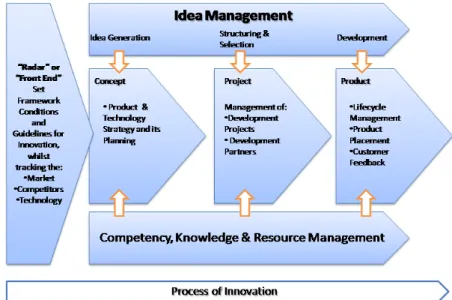
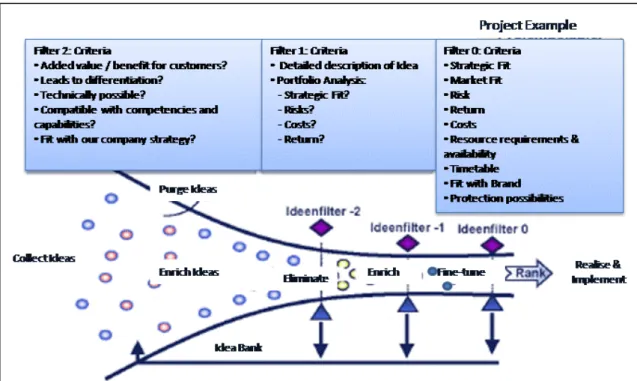
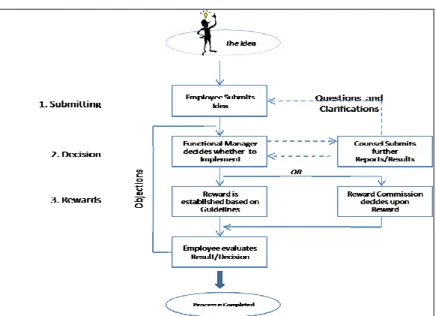
Following is one visual demonstration of how idea management could be managed.
Figure 1: Diagram of an Integrated Idea Generation Process
Source: Jeffrey Baumgartner of jpb.com, Brussels
demonstrates its commitment to the cause, and shows that employees’ idea generation is welcome and appreciated.
This all leads back to the initial question: How does management foster a culture within the organisation that not only allows, but also stimulates the idea generation from employees?
What kind of systems and processes need to be in place for employees to come forward with
their improvement ideas, their innovative approaches to work flows, products and services?
Finally, what kind of monitoring needs to be in place to oversee successful implementation
from original idea to fruition.
Aim of Research
Over the past few decades, much research has been carried out in the area of innovation, creativity and knowledge workers. Whereas the focus of this current study is on the idea generation and management aspect, the above three areas are part of, or the outcome of this
processes of tapping into the intellectual capital of the employees for suggestions.
This research is aimed at reviewing existing literature in the field of Idea Generation, innovation and creativity within employees, to put together a picture of how to make every employee feel he/she can and should contribute to improve and innovate. It will study the benefits and pitfalls, and how successfully managed Idea Generation & Management can add value not only in monetary terms for the company through savings or profit generation, but also in motivational terms for employees. It will bring together aspects such as culture including organisational culture, employee motivation and reward systems and look at different ways in which to implement a system of idea generation in organisations.
Outline & Methodology
Secondly, primary research was conducted in order to be able to examine whether theory and practice coincide. By describing and discussing the experiences of a company, which has recently implemented a comprehensive Idea Generation and Management system into one of its factories, it is possible to add value to the existing research in the subject matter. It is specifically interesting due to the fact that the research has been conducted in an organisation operating in an emerging economy (Brazil), whereas the academic and business literature reviewed in section three is mainly based on experiences in developed countries such as the United States of America, Japan, Germany and the United Kingdom. The information was obtained through structured and semi-structured interviews with employees of the company, ranging from Board Director to shop-floor level employees at the factory. All in all, nineteen employees of the company have answered questions and provided insights, and interviews lasted from 20 minutes to four hours, depending on interviewee and their scope of knowledge about the subject.
Furthermore, frameworks regarding the conceptualisation and implementation of Idea Generation, which includes the design of an Idea Generation & Management process, structural and implementation implications and a brief outline of software to manage the administration of such a process are presented.
2.
Frame of Reference
The following section of this paper is devoted to a review of the current literature on Idea Management. This literature review is aimed at creating a holistic picture of what is being studied and what the findings and trends are. It is worth noting that the majority of academic research and management papers are concerned with employees who already are working in “creative” jobs, such as research and development, marketing, product design and more. Furthermore, the studies examined in the field of employee behaviour have mostly been conducted in the United States, Great Britain and Germany. The studies are therefore based on the findings of workers who have at least a completed secondary education. This point is raised here, as the findings from the primary research span workers with incomplete primary education and literacy problems to those with university degrees. However, the literature provides a foundation, yet it leaves many questions open as to how Idea Management will/can work in other parts of the world, when the labour pool is often unskilled, with a lower degree of education and working on shop-floor level, rather than in “white collar jobs”. This aspect will be discussed briefly within the last part of the study – in section five – as it is not a focal point of this research.
In the meantime, here is a look at where Idea Management comes from, and whether it is indeed just a current fad in management circles, just as for example Total Quality Management (TQM) was a decade ago, or whether we can assume this management approach will be a lasting one.
History of Idea Management
When searching academic and professional literature, there is plenty to be found on Idea Management, and its various other names, such as
• Employee suggestion scheme/system/programme; • Idea management;
• Employee involvement program;
• Kaizen ( = 改 ('kai') means 'change' or 'the action to correct' and 善 ('zen') means 'good'
• Systems for Managing Ideas (SMI) and lately • Ideation1
Either which way you prefer to coin the practice, it comes with a long-standing history2. One of the earliest records of inviting the opinion and suggestion of others comes from Japan. In August 1721, a small box called the “meyasubako” (guide box) was placed at the Takinoguchi entrance to the Edo Castle in Kyoto, by the order of Yoshimune Tokugawa, the eighth shogun. All citizens, regardless of their social standing, were allowed to drop written suggestions, requests, and complaints into the box. The “meyasubako” was the shogun's way of finding out how people felt about his policies and what people were thinking in general. The next step towards this kind of feedback within a professional or organisation environment came from the British Navy. They realized the need for a process of listening to every individual in the organisation - without fear or reprisal. At that time, the mere mention of an idea that contradicted a captain's or admiral’s opinion was likely to be punished by hanging. Whether it was therefore taken up by the lower ranks and successful remains a mystery...
Probably one of the first successful and systematic approaches to reaping the brain power of the employees was in 1872, at the German company Krupp (now ThyssenKrupp). Its founder Alfred Krupp, as part of the company’s "General Regulativ" (translates as organisational guidelines) which described the rights and duties of all employees, outlined guidelines concerning suggestions, including submission of ideas, evaluation, non-acceptance, and revival of previously declined ideas. Recognition and monetary rewards for successful ideas were part and parcel of the process. This started the “betriebliches Vorschlagswesen” (organisational suggestion scheme), which has been deeply rooted in traditional German companies since.
Further examples from other countries include that of William Denny, of William Denny Ship Building Company of Dumbarton, Glasgow. In the 1880’s the shipbuilder asked his workers to suggest methods for building ships at low cost. He set up his pioneering system "Rules for the Awards Committee to guide them in rewarding the workmen for inventions and
improvements" in an attempt to systematically solicit suggestions from employees and to
promote creativity in a company. 1
Term taken from Olivia Toubia (2006) 2
In 1894, in the United States, John Patterson, the founder of National Cash Register (NCR) started a suggestion system which he called the “Hundred-Headed-Brain”. Also, records show that an Eastman Kodak employee named William Connors received a prize of two dollars in 1898 for suggesting that windows be washed to keep the workplace brighter. Frank Lovejoy, the supervisor who accepted Connor's suggestion, later became the president of Kodak.
The Japanese followed suit a few years later just after the turn of the century, in 1905, whereby Kanebuchi Boseki, a textile company, set up "suggestion boxes" that were reportedly an imitation of John Patterson’s suggestion system that its management team had observed on an earlier visit to United States. However, up until the 1940s Japanese suggestion systems were generally reserved for only a handful of elite workers who had the ability, the enthusiasm and the social standing, and thus credibility, to submit ideas.
In the wake of the World Wars, the employee suggestion schemes fell onto fertile ground in the industrialised nations. With a shortage of men to work the factories, and a demand for supplies, any means of improving efficiencies, process and output were suddenly most welcome; from all ranks within the organisations.
Today, more companies, often under the auspices of their the Human Resource Departments, have replaced the old fashioned “letter-box” system of collection suggestions, and have replaced them with formal processes which deliberately aim to tap into the collective wisdom of their workforces. The goal is to reduce waste and costs, increase efficiencies and to boost competitiveness. To put some numbers to the text; ABB Germany has been actively supporting Idea Management since 1950. Since the 1990’s until 2005, ABB Germany’s employees have submitted over 60’000 ideas, resulting in savings of over € 50 million for the company and payouts for its employees of roughly €10,5 mn.
Where do those figures come from? In Germany, for example, the “Deutsches Institut für Betriebswirtschaft3” (a non-governmental organisation for business management, founded in the 1950’s by local businesses and universities) is the umbrella organisation for idea management in Germany, and is actively tracking processes and progress in this area since 1975. It has been conducting studies since then as to the utilisation and implications of idea management in the German economy.
3
Its 2006 report, based on information from 315 companies representing all sectors, with approximately 2 million employees, found that in 2006 alone 1,266,758 improvement suggestions were submitted, resulting in overall savings of €1,48 billion - directly attributed to the suggestions - and €163 million in prize money being distributed amongst the responsible employees. This alone is a tremendous accreditation that the knowledge about work processes, systems and products lies with the employees, and that they are indeed a valuable asset to a company. The challenge lies in reaching out into this knowledge pool, stimulating employees to participate actively and contribute towards the improvement of their organisations. Bearing in mind the potential savings resulting from the knowledge held by employees from shop-floor level upwards, it might be worth considering one’s employees not just as cost factors, but actual cost-savers.
According to Lawson (2001), it was probably up until the mid, late 1990’s that competitive advantages had their foundations mainly on variables such as efficiency, quality, customer responsiveness and speed. In the new millennium however, these variables have almost become the minimum threshold to “play the game”. The factors remain important, for sure, but no longer provide the sustainable competitive advantage they used to; too many companies have caught up and are equally trimming costs, focusing on consumers with efficiency and effectiveness. In this day and age, companies face the additional challenge of having to churn out new innovations, be it through products or services at an ever increasing pace, and with higher success rates in order to survive and increase shareholder return. In Lawson’s words, “the sphere of organisational and managerial attention has expanded to incorporate both mainstream variables and an innovation capability”. Firms today have to use systems and process innovation to further improve their products, whilst simultaneously adding value to the consumer and stakeholders.
Idea Generation and Innovation – same thing?
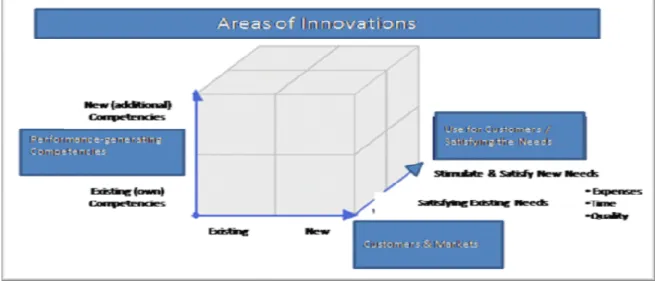
differentiate between the areas in which the innovation takes place by defining the following four types:
1. Product innovation: as changes to the things (products and services);
2. Process innovation: as changes in the ways in which the above are created and
delivered;
3. Position innovation: as changes in the context in which the products/services are
introduced (i.e. from a marketing perspective);
4. Paradigm innovation: as changes in the underlying mental models which frame what
the organisation does.
Burgelman et al (1996) identify innovation as being either one of these three types:
1. Incremental as being an adaptation, refinement or enhancement of products/services
or they production and/or delivery systems;
2. Radical as being an entirely new product or service, production and/or delivery
system;
3. Architectural as being a reconfiguration of the system of components that constitute
the product/service.
Whereas Tidd et al look at the places in which innovation takes place; Burgelman et al differentiate according to the means or degree of change/innovation. Whichever definition one feels more comfortable with depends on the purpose of study or application. The main point to bear in mind is that we are talking about actually making the changes – regardless as to where and how. By emphasising the “making” here, it clarifies the difference with regards to the concept of idea generation, which is the creative part of coming up with or thinking of something new.
Idea Generation as a Process
place, and which too benefit greatly from various forms of innovation to remain competitive. It is for precisely this reason that idea generation is being embraced the world over, and why getting it right is tantamount to being “innovative. Not all the innovations and inventions come from skunk works, R&D departments and expert creative thinkers. Some of the ideas became reality because management listened to their employees’ suggestions and had the adequate systems and procedures in place not only to further explore the ideas, but also for them to be brought forward in the first place. Put in the words of Apple’s CEO Steve Jobs, “Innovation has nothing to do with how many R&D dollars you have... it’s not about money. It’s about the people you have, how you’re lead, and how much you get it.” (Interview in
Fortune Magazine, November 1998). It is this particular area which the following sections will review in more detail.
Being innovative is no one man show, instead it is based on the capacity to interconnect many core-competencies in the interdisciplinary fields (Bolman et. al., 2003 and Ashkenas et. al., 2002). The authors furthermore claim that hardly any one organisation today has all required knowledge in-house to develop, produce and market a new product or service. More than ever, it is the capability to recognise and anticipate sooner than the competition what the future needs are going to be. It is key to maximise and combine own expertise with that of outside partners, to be able to develop solutions ahead of the competition, which will allow companies to sustain a competitive advantage. The challenge lies therefore in having permeable and flexible structures, allowing the flow of communications and ideas necessary to build a web of information, leading to ideas and ultimately innovation.
Yet, innovation per se does not guarantee success for a company. Innovating, for the sake of it, can lead to costly mistakes; products and services which consumers do not need or want. Companies need to identify the needs and generate ideas and solutions to address them. (McAdam & McClelland, 2002). So what is the driving force behind innovation? According to several authors, including Amabile (1996), creativity is the first step in the innovation
process. She, like other researchers (e.g. Mumford, 2000, McAdam & McClelland, 2002, and
This leads to the next assumption; that ideas are the foundation of innovation. Based on a four-step framework developed by Majaro (1988, 1991), innovation is considered a process whereby ideas are generated, assessed for viability and then transformed and implemented into business processes, products and services. The fifth stage of impact monitoring, depicted below, is not part of Majaro’s original innovation process, but it is an important one, and for the sake of this paper it should be included and its significance highlighted.
Source: Adapted from Majaro (1988)
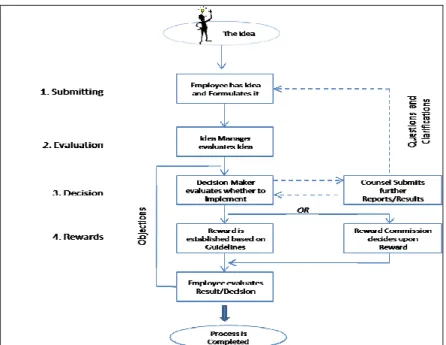
There is a need for a structured approach to managing the flow of ideas, and their implementation and monitoring, as all too often ideas float around an organisation, are discussed in canteens or corridors, but then either forgotten, not communicated or implemented properly. In accordance, the past decade or so has seen an increase in the crystallisation of a systematic focus on ideas and suggestions in the wider scheme of innovation. Companies have come to appreciate the value of suggestions made by employees of all departments, not just the formal research & development (R&D) department. In order to implement improvement suggestions effectively, and profitably, all impacted parties need to be involved in the process. For this reason companies have actively adopted the concept of
Idea Management, which is the practice of gathering and evaluating ideas in a structured
fashion, with the aim of sourcing ideas with the potential for implementation and commercial success.
Figure 2: The Innovation Process
Idea Management, according to Braun & Langermann (2005), has to be more that simply record suggestions put forward by individual employees – it lives through interaction. This is because ideas do not just pop up in a vacuum, they are formed through the interfacing of employees from production, marketing, sales, development, etc. Once ideas are born, the challenge lies in keeping the flow of communication and input at various levels going, to ensure relevance, feasibility and ultimately, success.
Boeddrich (2004), a consultant in the field of innovation management, refers to this collection of ideas and sorting through them as the “fuzzy front end”. This is due to the fact that, unlike the developing of projects and producing them, the initial stages of the innovation process are vaguer, more subjective and therefore not as clear cut. It is precisely for this reason that a transparent structure and process for the Idea Generation part is required.
Ideas – where from?
For many years now there have been authors, such as the 1992 Nobel Laureate in Economics Gary Becker4, who recognise the human capital as an asset of companies. The term, in the modern neoclassical economic sense, dates back to Jacob Mincer's article "Investment in Human Capital and Personal Income Distribution" in The Journal of Political Economy in 1958. In this view, human capital is similar to "physical means of production", e.g., factories and machines: one can invest in human capital (via education, training, medical treatment) and one's outputs depend partly on the rate of return on the human capital one owns. Thus, human capital is a means of production, into which additional investment yields additional output.
accessible to all the employees. This holds true when considering that the employees have the tacit and intrinsic knowledge which is required to operate machinery, perform tasks, provide the services on offer, etc. The tangible input can be purchased; in the open market economies demand for raw materials and operating equipment can usually met by given suppliers.
However, there are some forms of knowledge which are harder to formalise, and human capital is not always easily substitutable. As forums and discussion panels on sites such as the one of the Deutsches Institut für Betriebswirtschaft emphasise, finding and retaining the right people to transform the input into competitive output is a real challenge for most organisations. It is for this particular reason that companies the world-over are putting more emphasis on retaining its best people; those with the knowledge and the competencies to turn knowledge, experience and know-how into new ideas, and ultimately new products and services.
Authors such as Florida and Goodnight (HBR, Jul-Aug 05, pp. 125) concur with this line of thought – that it is in fact the creative capital that is crucial to companies. This creative capital is what makes the human capital so valuable; it is as the above authors state the “arsenal of creative thinkers whose ideas can be turned into valuable products and services”, and whose ideas improve the status quo to make it leaner, more efficient and/or more effective.
More specifically, ideas usually originate from a reaction to a certain situation – i.e. compelling people into action, or in a proactive form to exploit potentially new opportunities (Flynn, et al. 2003). Van den Ven et. al. (1989), as quoted in Flynn, explains further by suggesting that ideas can originate “from a recombination of old ideas, a schema that challenges the present order, or a formula or unique approach that is perceived as new by the individuals involved”. Drucker (1985) ascertains that source of ideas arise usually from one, or a combination of the following situations; unexpected occurrences, incongruities, process needs, market changes, as well as changes in demographics, perceptions and new knowledge. Either which way one looks at the “starting place” of ideas, management is confronted with a plethora of areas to direct attention to, in order to maximise the idea pool.
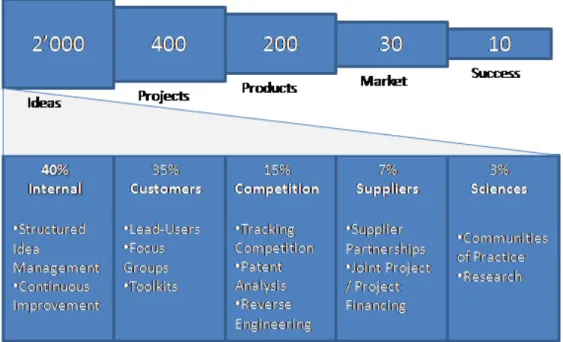
multiple sources of input – in terms of raw materials, products but also information and knowledge. In their paper on the design of an Idea Management system, the German authors Beyer & Seidel (2006) have conducted research within German companies to establish the areas in which ideas originate. The results are highlighted in the table below:
Figure 3: Sources of Ideas
Source: Translated from Bayer & Seidel (2006)
Interestingly enough, the biggest proportion of ideas are sourced internally. Noteworthy is the fact that over half of all ideas stem from outside the organisation, from suppliers, competition, customers and research institutes / academia. Therefore, in order to maximise the potential of ideas, it is important to take all the stakeholders into consideration.
Creativity
Is this creative ability something only a lucky few of us possess? According to Maslow (1954), not just the few geniuses amongst us are creative; rather creativity is the “universal heritage of every human being”. It is the environment in which we find ourselves that can either suppress or nurture our creative senses. Motta (2001) concurs with this stance, in the sense that creativity is a resource all people possess. Some may be re more creative than others, and he explains that differences are based on three attributes; firstly are the individual characteristics, then the mental and cognitive processing abilities, and finally the social contexts. Individual strengths and weaknesses in any of the three areas, will ultimately influence a person’s creativity, and thus by default also that of those around him/her.
Amabile (1996) in her studies of creativity and innovation defines that creativity has three core components, namely expertise, creative thinking skills and motivation. The first refers to technical and intellectual knowledge and know-how of an individual, as well as how an organisation manages its collective knowledge pool. Imaginative problem solving and successful task completion are often dependent on the creative thinking skills individuals possess. The final component of motivation plays a huge role in the realm of creativity in the sense that this aspect refers to what makes people strive to do their work and how. It refers to the intrinsic and extrinsic factors which influence individuals. The interplay of these three factors will determine how creative an organisation is. John Kao’s (1989) point of view regarding creativity is in line with this view; in the sense that he sees creativity is the sum of
the person, the task and the organisational environment (i.e. the organisational culture).
All of the factors influencing creativity are interrelated, and a change or development in one area will have an impact on the others, in turn impacting the overall creativity.
Furthermore, one can look at how creativity occurs. Majaro’s (1991) theory is that creativity can again be divided into three categories, depending on how it originates:
1. Normative creativity which focuses on generating ideas to solve specific needs,
problems and/or objectives;
2. Explorative creativity which refers to generating a broad spectrum of ideas, not
necessarily related to current demands, thus allowing for a far larger pool of ideas from which perhaps use is drawn at a later stage, or through
This last point however suggests that one needs to be immersed in the subject matter, or at least knowledgeable to be able to come up with an “accidental innovation”, such as for example Alexander Fleming’s discovery of the antibiotic properties of penicillin. It takes a considerable capability to see the value in an accident, and to build upon it to create even more value. After all, Fleming was not working as a car mechanic when he accidentally discovered penicillin. The point is, and this links back to Amabile’s and Kao’s point of view, creativity does not happen in a vacuum all by itself. The three main drivers of creativity within organisations are its people and their roles, the organisational culture and
motivation. Therefore, let’s look deeper into the above factors influencing creativity.
Motivation
Fundamentally, according to research conducted by Geen (1994), motivation refers to the initiation, direction, intensity and persistence of human behaviour. Essentially, it is about association positive meaning to certain behavioural patterns, whereby the time delay of rewards impacts the positive effects. The longer it takes to respond, the lesser the effect. Rewards may be extrinsic; such as praise or money, or intrinsic such as a feeling of satisfaction or accomplishment.
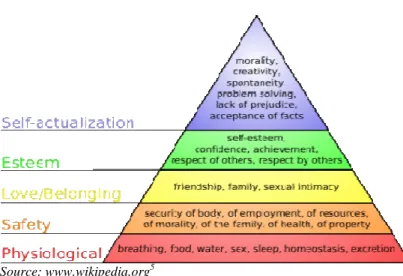
Although many theories on motivation exist, the two most applicable to this particular subject matter are deemed to be that of Maslow (1943), and his “Pyramid (Hierarchy) of Needs” and Herzberg’s “Two Factor Theory”. The next section will briefly describe both, starting with Maslow’s famous pyramid.
Figure 4: Maslow's Pyramid (Hierarchy) of Needs
Source: www.wikipedia.org5
Maslow’s theory’s main assumptions can be summarised very briefly as such; humans have needs, desires and wants which influence their behaviour, whereby only the ones not satisfied will wield influence. Given that people generally have many needs, they are categorised and arranged in order of importance, from most basic at the bottom of the pyramid, to most complex at the top. Typically, people progress up the pyramid as the levels of needs are at least minimally satisfied.
The “Two Factor Theory”, also known as Herzberg’s Motivation-Hygiene Theory, was developed by the psychologist Frederick Herzberg in 1959, and is based on Maslow’s theory to a point. Herzberg theory looks in particular at the work environment and satisfaction therein. He agrees with the notion that there are certain motivational aspects which will lead to satisfaction, yet that there is a second set of characteristics or incentives which will lead to work dissatisfaction. Hence the two factors, which are by no means a continuum or mutually inclusive, instead they are independent. He further suggests that it is imperative for managers to recognise both sets of characteristics (satisfaction and dissatisfaction) in their employees’ jobs to be able to improve job performance and productivity. Simply increasing one aspect does not lead to a decrease in the other and vice versa. Herzberg collected data through interviews with over 200 engineers and accountants in the Pittsburgh area of the United States and found that the characteristics of worker satisfaction relate to what the workers do – i.e. the nature of the work – which has the capacity to gratify needs such as achievement, competency, status, personal worth and self-realisation. Interestingly, it seems that the absence of such features no not necessarily imply dissatisfaction. Rather, dissatisfaction stemmed from job-related factors such as company policies, salaries, interpersonal relations, and working conditions. The conclusions to be drawn from Herzberg’s finding suggest that management needs to focus on aspects found in Maslow’s theory, such as opportunities for gaining status, assuming responsibility, ability to grow through continuous learning, etc. At the same time, when trying to limit dissatisfaction with employees, the onus must be on the working environment and culture, i.e. procedures, policies, supervision and the workplace itself. These two sets of factors were subsequently coined as “motivators” (those which influence satisfaction) and “hygiene” which relates to the working environment, and which are essential to ensure employees are not dissatisfied.
Business School and Robert Sternberg of Yale, have found that creative people are motivated from within (i.e. intrinsically), rather than by extrinsic rewards such as money.
Amabile et al. (1994), in their study on motivational orientation have come to interesting conclusions. The results in fact highlight that motivation comes in two forms; extrinsic and intrinsic, which have different impacts on creativity, whereby the latter is deemed to be more impactful.
Extrinsic motivation comes from outside the individual, from external sources in either the form of “the carrot” or “the stick”. In other words, extrinsic motivation can result from incentives such as monetary rewards or the prospect of promotion, or in the form of punishment in cases of failures (humiliation, demotion, firing, etc). Either which way, through rewards or threats, external factors do have an influence on a person’s motivation. Yet neither makes the employee more passionate or interested about their job or the specific task at hand. And it is precisely this passion and interest which drives and motivates people from within, i.e. intrinsically to succeed and exceed. When employees are intrinsically motivated, they engage in their work for the challenge and enjoyment of it, and the work itself becomes motivating. The Nobel prize-winning physicist Arthur Schawlow maintained that “the most successful scientists often are not the most talented, but the ones who are just impelled by curiosity”, and Albert Einstein referred to intrinsic motivation as “the enjoyment of seeing and searching”.
However, if taken to the extremes or even at face value, the above findings seem somewhat unrealistic. One cannot assume that all employees enjoy their work, and are dedicated to it. Hence, findings by authors such as Osterloh and Frey (200) have shown that when trying to stimulate all ranks of employees in all departments to think creatively about their work and its processes, and come up with ideas of how to improve them, monetary rewards tied into employee suggestion schemes can have motivational powers. The trick seems to be to find the middle ground and a combination of factors with the right mix and proportions, to be able to motivate intrinsically and extrinsically.
The People and their Roles
The annual survey conducted by the Boston Consultant Group (BCG) on the subject of innovation, whereby idea generation is a step within the innovation process as a whole, raises some interesting points which are worth mentioning.
The survey involved questioning 2,468 senior executives, in 58 countries and representing all major industries. The results demonstrate how executives view innovation within their companies; its importance, the areas in which spending is directed and the challenges they face. In addition, these 2,500 odd executives were asked to name the most innovative company in their mind. The results and some of the reasoning were:
1. Apple – its continuous reinvention, Steve Jobs (i.e. leadership), its vision
2. Google – organisational culture, high moral amongst employees with focus on innovation, accessibility to senior management
3. Toyota Motor – ability to identify customer needs, manufacturing processes, and focus on quality
4. General Electric Company – innovative management techniques, innovation-supporting organisation structure and culture
5. Microsoft Corporation – streams of new offerings, emphasis on quality, listens to consumers’ needs
basis points per year (BCG 2007 Senior Executive Innovation Survey, p. 10; BCG ValueScience Center analysis).
The study also notes that whilst the top-tier management positions (CEO, Chairman, Presidents) were overwhelmingly in the driving seat for innovative behaviour within their company, more than half of the survey’s respondents were not satisfied with the financial returns of their company’s investment in innovation. They viewed the main reasons why the investment did not seem to pay off adequately to be internal stumbling blocks such as a risk-averse corporate culture, difficulties in choosing which ideas to commercialise, lack of internal coordination and lengthy product development times. Another two factors to be considered obstacles to generating a return on investments on innovation were “insufficient support from leadership and management and [that] compensation [was] not tied to
innovation results” (BCG Innovation Survey, p. 11). Interestingly, it seemed that
highest-level executives were most satisfied with the outcome of their innovative efforts (64% of CEOs), perhaps because mostly they are the ones ultimately pushing for more innovation. Whereas financial and operations executives were least content with the outcomes of initiatives relating to innovation (37% were satisfied). This trend can be seen throughout BCG’s surveys on Innovation since 2004. This may prompt the question whether the very top level of management – which is mainly satisfied – really understands what is going on in the lower ranks; those ‘breeding, living and executing” the innovations. Or whether there is disconnect between what the top level envisions, and yet is not able to convince the rest of the organisation. Either which way, the mere fact that there seems to be a discrepancy in perceptions of satisfaction amongst different tiers of management can only suggest it could exist throughout the entire organisation, thus posing yet another challenge on how to successfully implement a culture of innovators and innovations within companies.
Yet the underlying concept of idea management is that every employee does have good ideas about their field of work, and should be listened to. An example of that can be found in Figureido’s (2003) study of a Brazilian steel company. In one particular section the author talks about a problem in the manufacture of rolled steel sheets. Management spent many months trying to find solutions to the problem, resulting in vast sums of money wasted due to discarded material, re-moulding, and delays in production lines and delivery. Seemingly by chance one of the supervisors spoke to a line employee about the issue, who immediately came up with a solution to the problem. Given his proximity to the actual work-stream, his in-depth knowledge of the process and its consequences, the matter was fixed in days by simply tweaking the temperature. This insight provided by a line-level employee – someone who by no means falls into the category of the “creative worker” in the academic literature – is the kind of input sought by management these days and rightly so. The challenges for management are what they can do to encourage employees to think about their work, stimulating them to look for improvements and to come forward with their ideas.
Ambabile et al. (2002) spent considerable time to study the effects of the actual workplace environment on creativity. She collected more than 9’000 daily diary entries of 177 employees (considered highly educated “knowledge workers”), in seven US companies. The objectives were to examine how employees experience time pressure day to day, whilst working on projects that required high levels of inventiveness, and also measuring their ability to think creatively under the given pressures. Her study’s findings support the view that “big ideas take time”. Although there are certainly scenarios in which people have come up with fabulously creative ideas under tight time pressures, and some employees firmly believe that deadlines help them be more creative, Amabile’s research has shown the contrary to be true. According to her findings she found that if “creativity is under the gun, it usually ends up getting killed”. The time pressures seemed to yield different results at different stages. Initially, the employees felt invigorated by the high level of involvement, the challenge, and thus felt very motivated. Most of the employees stated they felt overworked, fragmented and burned out.
Take a company like Google, arguably one of the most innovative there is. Laszlo Bock, the head of personnel, was quoted6 saying that “creativity comes out of people bumping into each other and not knowing where to go.” The most famous expression of this is the “20% time”.
6
In theory, all “Googlers” (employees of Google), from CEO down to receptionists, can spend one-fifth of their working time exploring new ideas. The idea behind this concept is that it gives employees the freedom and distance from their day-to-day workload to think out of the box and get the creative juices flowing. Good things have indeed come out of this, including Google News, Gmail, and many more.
Gamlin’s et al (2007) white paper begins with the quote “idea generation is everyone’s job and no one’s responsibility” and thus highlights the challenge inherent with idea generation and management. Miller’s (2008) arguments are in concurrence with this stance. She maintains that whereas most senior leaders understand the value of innovation, the culture and the skills associated with it, they are not the ones who will execute the idea generation or innovation programme. Middle managers, generally supportive and understanding of the need of such a system, can often be challenged with juggling the priorities and operational issues of day-to-day responsibilities. The line managers, those at the front-line of idea generation and innovation sources, quite often struggle to incorporate the implications of an idea generation system into their operational and tactical responsibilities; the need for training and development, the time to allow workers to grow their skills, yet alone become innovative.
Both authors argue that all too often such systems and programmes lose their potential after the initial launching and marketing phase is over, the excitement subsides and eventually dies. These findings do coincide with those from the BCG studies from the previous years. There seem to be a host of factors influencing and impacting the success or failure of idea generation and management. The following sections will look at some of the relevant ones.
Organisational Culture
look at their organisational structure and culture to ensure congruency with the goals and aims of the business.
There are many ways to approach the definition(s) of culture. The following approaches to classifying organisational culture are taken from Fincham (2000). He argues that some focus on manifestations – the heroes and villains, rites, rituals, myths and legends that populate organizations. Culture is also socially constructed and reflects meanings that are constituted in interaction and that form commonly accepted definitions of the situation.
Culture is symbolic and is described by telling stories about how we feel about the organization. A symbol stands for something more than itself and can be many things, but the point is that a symbol is invested with meaning by us and expresses forms of understanding derived from our past collective experiences. The sociological view is that organizations exist in the minds of the members. Stories about culture show how it acts as a sense-making device.
Culture is unifying and refers to the processes that bind the organization together. Culture is then consensual and not conflictual. The idea of corporate culture reinforces the unifying strengths of central goals and creates a sense of common responsibility. Culture is holistic
and refers to the essence, the reality of the organization; what it is like to work there, how people deal with each other and what behaviours are expected. All of these elements are interlocking; culture is rooted deep in unconscious sources but is represented in superficial
practices and behaviour codes. Because organizations are social organisms and not mechanisms, the whole is present in the parts and symbolic events become microcosms of the whole.
According to Martins (2003), organisational cultures are represented and brought to life by various aspects of the organisation. These components, which in their respective combinations and forms create the organisational culture, are the mission and vision, the external environment, image of the organisation, management processes, means of achieving objectives, interpersonal relationships and leadership. It is because all these aspects are unique to each organisation, that business cultures are unique too. The people, with their skills, knowledge, attitudes and relationships form the culture.
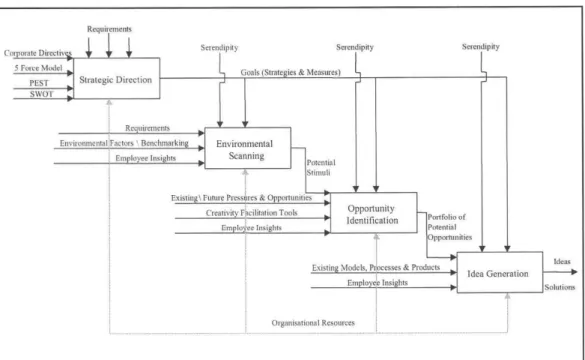
an impact on the process of sourcing and implementing ideas. Before management commences on the journey of implementing a systematic Idea Management process, it should be looking at the four distinct phases which will impact and define the “seeds of innovation” (Flynn et al, 2000), namely the ideas and the solutions resulting thereof.
Figure 5: Idea Generation Methodology
Source: Flynn et al. (2003)
As Flynn’s et. al. diagram depicts, strategic direction is the one most intertwined with the organisational culture. The organisational goals, its vision and mission provide for the overall direction of the Idea Management process. And as the exhibit above visualises, the direction the organisation has embarked on is the one common thread which permeates into all the aspects of the Idea Management process. Moreover, the model highlights the importance for an all-encompassing approach to Idea Management, whereby careful planning, the external environment and factors, resources, training and development as well as a dose of good luck have their part to play.
on a concept that defies initial cost-benefit and return-on-investment calculations. This emphasises the point of this study; that Idea Management is not a one size fits all system, nor is it possible to push a button and get useful ideas.
Although rules and regulations are necessary, when it comes to aspects such as one’s ideas, there also needs to be some freedom and intuition, ideally embodied deep within the organisation in its culture. After all, Karl Benz and Gottlieb Daimler would probably not have gotten very far if they had to “tick all the boxes”. They were in all likeliness not able to project the development related costs of getting their car into serial production, nor their market share potentials, let alone the payback periods of said investments. Thankfully, they got to build their cars anyway. It is all the more important then, to collaborate with other parties which will be able to support and provide their input and knowledge, necessary to bring an idea along towards realisation.
Therefore, the link between a company’s vision, its strategy and how this links into innovation is crucial to effective innovations management. Lawson et al (2001) argue that strategy determines the distribution of resources; manpower, machinery, money, time, and the systems adopted to administer them. Business need to make decisions about its goals, target markets, financials and thus the areas of innovation should fall within these categories or frameworks. Without innovation being guided by the strategy, resources and attention become too wide-spread. Furthermore, Beyer & Seidel (2006) maintain that in order to sustainably integrate the idea management process into the organisation, there needs to be a strong culture fostering idea generation and innovation in general. This can be achieved in two ways; one is the link between the strategy and the idea generation process, and having a clear definition of roles, responsibilities and goals of those involved. Secondly, the organisational culture, demonstrated through behaviour and actions from top management downwards, needs to support openness, willingness to try new things, flexibility and recognition to those who live by it. Flynn et. al. ( 2003) summarise the characteristics of an organisational culture in which creativity and the resulting innovation can thrive as:
• Visionary, enthusiastic leadership
• Support by top management (psychological and financial) which encourages creativity and flexibility
• A “boundaryless”7 focus, within the organisation itself and outwardly toward the consumers and suppliers; after all it does not matter where the good idea comes from.
Another aspect mentioned in a study by Miles (2007) that is specifically pertinent to leadership values, is the creation and atmosphere of trust and recognition amongst employees. Only then can employees freely collaborate amongst themselves, sharing knowledge and information vital in the process of innovation.
Given these points, it becomes clear that the role of leadership within an organisation drives the successes or failures associated with idea generation and innovation – as it does regarding every other aspect of the business.
Role of Leadership
Already back in 1964, Höckel raised the issues associated with lack of commitment, communication and power-brokering that can be related to Idea Management. Vandenbosch et al (2006) found in their research that “good ideas are assumed to underlie effective
management, and ineffective management implies poor ideas”. Especially in the scenario of a decentralised, supervisor based Idea Management system, the influence over the success of the programme is enormous. The positive aspects when the supervisor is the point of submission for ideas are clear-cut;
• The supervisor can incorporate his competencies and job-specific knowledge to the suggestion, fine-tuning them before the next step in the process, weaning out the weak ideas
• It broadens the spectrum of the supervisor’s job / role, adding responsibility and learning possibilities
• The supervisors play an active role within the process, thus showing support
• Communication between supervisors and subordinates is improved, becomes more active
• The processing time of ideas is reduced drastically when dealt with by the supervisor on a day-to-day basis, instead of going through various panels, thus making decisions and results that much more tangible.
On the other hand, there are obvious pitfalls. The “relationship” aspect features more in this decentralised model, making the decision whether to adopt the idea that much more subjective than if it were submitted to a centralised Idea Management team / person. How so?
• Employees are reliant on a cooperative and fair relationship with their superior, as their superior is the one who will decide on whether to take the idea forward, and potentially even as to the scope of the reward
• Therefore, if the manager / superior does not support the system, it is in his / her power to choke it, by not passing on suggestions and ideas or making submission too difficult, or too time consuming
Reasons for this negative attitude towards Idea Generation are plentiful, and include:
• Managers could “fear” the suggestions submitted, as it might reflect negatively upon them higher up the organisational chain, e.g. triggering the reaction of “why did you as the manager not think of this before – this is why we pay you more”... and thus block some ideas, or even pass them on as their own
• The added role / responsibility of evaluating ideas might be seen as a burden to an already heavy workload, as it requires time and effort and more communication and procedures to make the system work effectively
These issues mentioned above, albeit noted in the 1960’s, are still very much applicable to today’s organisational cultures. To be successful, implementation needs to be top-down with the leadership setting the style and supporting the Idea Management system – regardless of who came up with the idea. Leadership must be able to communicate with their managers / supervisor to reassure them of their positions and roles, and listen carefully to the input of those collecting and sorting said input, to make sure that management is compassionate about the cause.
there are certain traits and behavioural patterns which leaders should display and which stimulate creativity and idea generation within employees. Their inventory of leadership behaviours was found to be applicable both to idea generation and implementation of ideas leading towards an open and innovative working environment.
Leadership Behaviour Consisting of...
Innovative role-modelling
Being an example of innovative behaviour, exploring opportunities, generating ideas, championing and putting efforts into development.
Intellectual stimulation “Teasing” subordinates directly to come up with ideas and to evaluate current practices
Stimulating knowledge diffusion
Stimulating open and transparent communication, introducing supportive communication structures like informal work meetings
Providing vision
Communicating an explicit vision on the role and preferred types of innovation, providing directions for future activities
Consulting
Checking with people before initiating changes that may affect them, incorporating their ideas and suggestions in decisions
Delegating Giving subordinates sufficient autonomy to determine relatively independently how to do a job
Support for Innovation
Acting friendly to innovative employees, being patient and helpful, listening, looking out for someone’s interests if problems arise
Organising feedback
Ensuring feedback on concepts and first trials, providing feedback to employees, asking customers for their opinion
Recognition Showing appreciation for innovative performances Rewards Providing financial / material rewards for innovative
performances
Providing resources Providing time and money to implement ideas
Monitoring
Ensuring effectiveness and efficiency, checking-up on people, stressing tried and tested routines (negative relationship)
Task assignment
Providing employees with challenging tasks, make allowance for employees’ commitment when assigning tasks
demands and what is possible on the supply-side. It would therefore be unfair to expect the same degree of innovativeness / idea generation from all employees with a more internal focus. The individual situations of employees; in other words the scope of their work, interaction with others, job specifications and much more need to be taken into consideration when designing establishing leadership behaviours.
Rewarding Ideas
In the same respect that companies choose an overall remuneration or reward system to retain and motivate their employees, organisations need to evaluate how to best rewards their employees for their ideas, or whether to reward them at all.
Looking briefly at the philosophy of a flexible, meritocratic remuneration system based on employee participation and results, we will find parallels to the drivers that lie behind rewarding ideas. Typically, reward systems are set-up not just to promote one particular area, but to cover a number of goals. In 1983 the Deutsches Institut für Betriebswirtschaft conducted a detailed study (the sample included companies of all sizes and sectors) to identify the main goals of a remuneration system based on profit-sharing. Their findings show that motivation – with regards to increases in productivity, interest in the job, economic consideration and general effort – rank as the top drivers of such a system. Other factors include Human Resources aspects such as retention, attractiveness of job, lower turnover, as well as financial benefits.
In some countries, such as Germany, guidelines are produced by the Deutsches Institut für Betriebswirtschaft, in the form of booklets such as the one entitled “Ideenmanagement für
mittleständische Unternehmen8” published in conjunction with Bundesministerium für Wirtschaft (the German Federal Ministry of Economy) targeted specifically at SMEs. In
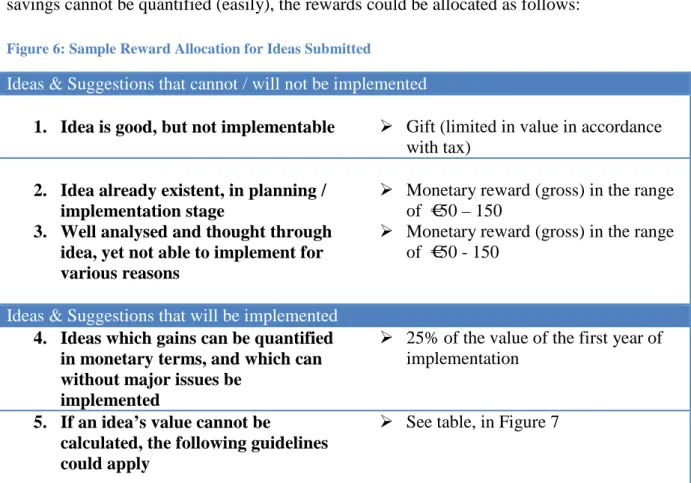
accordance with local tax laws and based on remuneration agreements between industry and the unions, these suggestions actually form a non-binding guideline for businesses which actively promote and encourage idea generation and innovation. They stipulate that if the monetary gain can indeed be calculated for a given idea, it suggests that rewards should not exceed 30% of the net savings the idea will generate. For those ideas for which the net gain / savings cannot be quantified (easily), the rewards could be allocated as follows:
Figure 6: Sample Reward Allocation for Ideas Submitted
Ideas & Suggestions that cannot / will not be implemented
1. Idea is good, but not implementable Gift (limited in value in accordance with tax)
2. Idea already existent, in planning / implementation stage
3. Well analysed and thought through idea, yet not able to implement for various reasons
Monetary reward (gross) in the range of €50 – 150
Monetary reward (gross) in the range of €50 - 150
Ideas & Suggestions that will be implemented
4. Ideas which gains can be quantified in monetary terms, and which can without major issues be
implemented
25% of the value of the first year of implementation
5. If an idea’s value cannot be
calculated, the following guidelines could apply
See table, in Figure 7
Source: Adapted and translated from “Ideenmanagement für mittleständische Unternehmen“, p.34
Figure 7: Table to calculate monetary value of reward, based on impact that idea has on the business
Scope of Application of Idea
Value of Idea
Small:
e.g. individual work place
Medium: e.g. department
Large: Entire organisation
Big €450 €750 €1200
Medium €180 €450 €750
Small €80 €180 €450
Source: Adapted and translated from “Ideenmanagement für mittleständische Unternehmen“, p.34
One large German company, which has implemented a formalised Idea Management system to promote creative input from all levels of employees, uses such a points-based reward establishing scheme. Similar to Figure 7, above, whereby ideas might not have a precise monetary value, Demag Cranes uses a point allocation chart for each and every idea. In the case of Demag, all ideas are valued through points, which measure the impact of the idea on the systems, processes, work, etc and the frequency in which this new idea will be used. The points are then allocated to specific financial rewards, which are added to the employee’s salary that month. Below the table highlights how the guideline in Figure 7 is adapted and put to use.
Figure 8: Reward Allocation Chart
Source:Demag Cranes AG (Gesamtbetriebsvereinbarung, Ideenmanagement, Januar 2002)
Each of the points allocated, as shown above, represent a monetary value, and as such employees are rewarded.
processes. However, the role of incentives is “far less clear in situations that depend heavily on flexibility, conceptual and perceptual openness, or creativity”. In other words, when trying to incentivise creative workers to become more innovative, a simple monetary reward scheme does not seem to be sufficient, or rather research cannot make a clear link between the incentives offered and an increase in creativity. It is hypothesised by the likes of McGraw (1978) that if a task is interesting enough, incentives seem to be superfluous in stimulating employees further. This of course is in line with Ambabile’s (1994) assessment of intrinsic versus extrinsic motivation. Furthermore, the role of incentives was also was deemed questionable when the “solution is open-ended enough that the steps leading to a solution are not immediately obvious”. Meaning, if the idea or suggestion is only a small part of a larger, ongoing innovation in a system or process, it is very difficult to reward one individual for their contribution, out of fairness and lack of measurability (McGraw 1978).
Which leads to the examination of individual versus group based rewards. According to research in the business setting done by Schneider and Fritz (2007), there are two noticeable trends emerging:
Firstly, achievement-based systems are being substituted by success-oriented remuneration
systems. This marks a shift in the remuneration practice, as until most recently the individual
achievements stood at the centre of flexible rewards. These were typically quantified, and the addition to the base salary calculated thereof. This new shift in focus clearly demonstrates that personal achievements alone - no matter how significant – are no longer sufficient. The emphasis now is translating those achievements into success. For who will benefit if one employee pushes up production to his / her target rate, but the market has changed and there is no longer demand? This link to targets / success at the end-user stage is also pushing a change in attitude with employees. No longer is one person’s achievement enough, it needs to be seen in the context of the entire business performance – only then will bonuses be paid out.
Schneider and Fritz’ (2007) research has shown that it is precisely this behaviour which strengthens the potentials of efficiency and success. The overall positive picture is not diminished by sporadic problems, arising for example from fear of peer pressure or from “free-riders”. Group incentives can indeed lead to more pressure on the individuals members of groups, urging all to contribute to more or less the same degree, as not to let the team down. The “free-rider” issue describes the problem of individual employees having to share their success with those who have not contributed or participated, but will gain from the benefits. One could argue that some employees will therefore not deliver to their full potential due to frustration of having to drag along others who do not contribute sufficiently. However, Schneider and Fritz (2007) assert that this scenario is not the norm. Most often, the group dynamics seem to regulate themselves, tracking performance deficiencies, applying pressure where necessary and thus pushing or pulling along weaker members.
The Audi AG, a German car manufacturer has experienced this ambiguity over the years as well. In a speech9 by one of the members of the board, Dr. Andreas Schleef commented on how although the company had an Idea Management system in place from 1967, and was rewarding with money, based on values of ideas, participation was not high, and realisation / implementation hovered around 20%. In 1994 management overhauled the system for the third time, and realised that intrinsic factors such as being valued, the process and time it took to bring forward ideas and implement them, as well as recognition played a more dominant role than just “throwing money at the problem” i.e. the idea. The company moved from searching for the big ideas to “every idea counts”, made the process more transparent and faster, put emphasis on factors such as the quality of the idea, and its formulation (the mental effort involved in brining it forward) as opposed to only the material gain thereof, as well as the degree of involvement for implementation on behalf of the idea submitter. These kinds of factors now account for roughly half of the consideration of allocation of rewards, which it should be said are still monetary. However, the realisation that money is not everything; that timing, recognition, and the process of submitting, evaluating and rewarding ideas does play a major part in the overall participation and success rates of Idea Generation and Management.
9