Submitted 14 August 2015 Accepted 1 October 2015 Published22 October 2015
Corresponding author
Seongwon Seo, [email protected]
Academic editor
Maria Rosaria Corbo
Additional Information and Declarations can be found on page 9
DOI10.7717/peerj.1343
Copyright
2015 Seo et al.
Distributed under
Creative Commons CC-BY 4.0
OPEN ACCESS
Evaluation of nutritional and economic
feed values of spent co
ff
ee grounds and
Artemisia princeps
residues as a
ruminant feed using
in vitro
ruminal
fermentation
Jakyeom Seo1,2, Jae Keun Jung1and Seongwon Seo1
1Animal Biosystem Sciences, Chungnam National University, Daejeon, Republic of Korea 2Life and Industry Convergence Research Institute, Department of Animal Science,
Pusan National University, Miryang, South Korea
ABSTRACT
Much research on animal feed has focused on finding alternative feed ingredients that can replace conventional ones (e.g., grains and beans) to reduce feed costs. The ob-jective of this study was to evaluate the economic, as well as nutritional value of spent coffee grounds (SCG) and Japanese mugwort (Artemisia princeps) residues (APR) as alternative feed ingredients for ruminants. We also investigated whether pre-fermentation usingLactobacillusspp. was a feasible way to increase the feed value of these by-products. Chemical analyses and anin vitrostudy were conducted for SCG, APR, and their pre-fermented forms. All the experimental diets forin vitroruminal fermentation were formulated to contain a similar composition of crude protein, neutral detergent fiber and total digestible nutrients at 1x maintenance feed intake based on the dairy National Research Council (NRC). The control diet was composed of ryegrass, corn, soybean meal, whereas the treatments consisted of SCG, SCG fermented withLactobacillusspp. (FSCG), APR, and its fermented form (FAPR). The treatment diets replaced 100 g/kg dry matter (DM) of the feed ingredients in the control. Costs were lower for the all treatments, except FAPR, than that of the control. After 24-h incubation, the NDF digestibility of the diets containing SCG and its fermented form were significantly lower than those of the other diets (P<0.01);
pre-fermentation tended to increase NDF digestibility (P=0.07), especially for APR.
Supplementation of SCG significantly decreased total gas production (ml/g DM) after 24-h fermentation in comparison with the control (P<0.05); however, there
were no significant differences between the control and the SCG or the APR diets in total gas production, as expressed per Korean Won (KRW). Diets supplemented with SCG or FSCG tended to have a higher total volatile fatty acid (VFA) concentra-tion, expressed as per KRW, compared with the control (P=0.06). Conversely, the
fermentation process of SCG and APR significantly decreased total gas production and VFA production as expressed per KRW (P<0.05). Because of their nutrient
Subjects Agricultural Science, Food Science and Technology
Keywords Artemisia princepsresidues,In vitrorumen fermentation,Lactobacillusfermentation,
Spent coffee grounds
INTRODUCTION
Research on animal feed has often focused on finding alternative feed ingredients to replace conventional ones (e.g., grains and beans) in order to reduce feed costs. This is most important in developing countries where the supplies of cereal grains and beans are not great enough to support even the human population. Historically, by-products from processing crops and food products have received much attention as feed alternatives because of their consistent and mass production. Food by-products would also likely be inexpensive because of their classification as a waste product. Many by-products, however, do not contain enough nutrients to support livestock requirements, and their palatability and digestibility would need to be enhanced, even for ruminants. Pre-fermentation of these by-products by bacteria (Han, 1975;Han, 1978), yeast (Wanapat et al., 2011), or fungi (Salman et al., 2008) are common methods to enhance their nutritional value (seeMahesh & Mohini (2013)for a review).
Although fermentation may improve the nutritional quality of the by-products, and it is an environmentally sustainable practice, it will increase the cost for feed production. This additional cost is often ignored by researchers. To make the fermentation process feasible, the production costs of a fermented by-product must to be competitive with conventional feed ingredients (Wanapat, Kang & Polyorach, 2013). Therefore, the economic value, as well as nutritional value, of fermented by-products must be considered simultaneously.
In this study, we evaluated the economic and nutritional values of spent coffee grounds (SCG) and Japanese mugwort (Artemisia princeps) residues (APR), as well as their fermented products as potentially cost-effective feed ingredients for ruminants. Anin
vitroruminal fermentation study where Total mixed rations (TMR) was supplemented
MATERIALS AND METHODS
Two cannulated non-lactating Holstein cows at Center for Animal Science Research, Chungnam National University, Korea were used in this study. Animal use and the protocols for this experiment were reviewed and approved by the Chungnam National University Animal Research Ethics Committee (CNU-00455).
Preparation of experimental diets
The feed ingredients used in this study were ryegrass, corn, soy bean meal (SBM), SCG, APR, and theLactobacillus-fermented forms of SCG and APR (FSCG and FAPR, respectively). SCG were purchased from an instant coffee manufacturer (Dongseo Food, Inc., Bupyeong, Korea), and APR was obtained from the Ganghwa Agricultural R&D Center (Incheon, Korea). The fermentation process for SCG and APR withLactobacillus
spp. was conducted as described byKim et al. (2012). Briefly, four strains ofLactobacillus
spp. (L. acidophilusATCC 496,L. fermentumATCC 1493 (American Type Culture Collection: Virginia, USA),L. plantarumKCTC 1048 (Korean Collection Type Culture, Daejeon, Korea), andL. caseiIFO 3533 (Korea Food Research Institute, Daejeon, Korea)) were used to ferment SCG and APR. A 1l culture medium was inoculated with a 2 ml aliquot containing 109cfu/ml of eachLactobacillusstrain (de Man, Rogosa, and Sharpe broth (Difco Laboratories, Francisco Soria Melquizo S.A., Madrid, Spain), 10 g; sucrose, 10 g) and incubated at 36◦C for 24 h (h). Next, 4 kg of dried SCG and APR were mixed with 400 ml of preparedLactobacillusinoculum in a fermentation flask and incubated for 72 h at 36◦C. The fermented by-products were obtained after freeze-drying the cultured substrate and media for 2 days following the manufacture’s recommendations (ilShinBioBase, Inc., Korea).
All of the diets that includedin vitrofermentation were formulated to meet nutrient requirements for non-lactating dairy cows (total digestible nutrient at 1x maintenance feed intake (TDN1x), 680 g/kg; crude protein (CP), 120 g/kg; neutral detergent fiber (NDF), 420 g/kg on a DM basis) according to the National Research Council (NRC, 2001). The control diet was composed of 500 g/kg of ryegrass and 500 g/kg of a corn and SBM mix. The four experimental diets (SCG, FSCG, APR, and FAPR) were formulated to contain TDN1x, CP, and NDF contents (g/kg DM) similar to the control, replacing original ingredients with 100 g/kg DM of SCG, FSCG, APR or FAPR, respectively.
In vitro incubation
Rumen fluid was collected before the morning feeding from two cannulated non-lactating Holstein cows fed a ration consisting of 600 g/kg timothy hay and 400 g/kg of a commercial concentrate mix (123±8.8 g/kg CP, 35±6.4 g/kg ether extract (EE), 265±6.9 g/kg
of rumen fluid/buffer mixture was transferred into 125 ml serum bottles containing 0.5 g of experimental diets under continuous flushing with O2-free CO2gas. The bottles were
sealed with butyl rubber stoppers and aluminum caps, and incubated for 0, 3, 6, 9, 12, 24, and 48 h at 39◦C.
Analyses
Contents of DM (#934.01), CP (#976.05), EE (#920.39), lignin (ADL; #973.18) and ash (#942.05) in the feed samples were determined as described byAOAC (2005). NDF, analyzed using a heat stable amylase and expressed inclusive of residual ash, and acid detergent fiber (ADF) were determined as described byVan Soest, Robertson & Lewis (1991). Neutral detergent insoluble crude protein (NDICP) and acid detergent insoluble crude protein (ADICP) were determined as described byLicitra, Hernandez & Van Soest (1996). Non-fiber carbohydrate (NFC) was calculated as 1000-CP-EE-Ash-(NDF-NDICP) based onNRC (2001).
For phenolic acid analysis, caffeic acid,p-coumaric acid, ferulic acid, and sinapic acid (#C0625, #C9008, #12870, and #D7927, respectively; Sigma-Aldrich, St. Louis, Missouri, USA) were used as standards. Identification of phenolic acids in the SCG and APR samples was based primarily on retention time, UV spectra obtained from high-performance liquid chromatography (HPLC-DAD), and mass spectrometric data using authentic standards. Phenolic acids were analyzed as described byRochfort et al. (2006).
After each incubation period, total gas production was measured using a pressure transducer (Sun Bee Instruments, Inc., Seoul, Korea) as described byTheodorou et al. (1994). Next, 5 ml of head space gas was collected using a gas tight syringe (Hamilton, Reno, Nevada, USA) for analysis of CH4using a gas chromatograph (Daesung Science
IGC-7200, Seoul, Korea) equipped with a thermal conductivity detector and HayeSep Q 80/100 column (Restek, Bellefonte, Pennsylvania, US). The pH of the cultured fluid was measured with a general purpose pH meter (Istek Inc., Seoul, Korea). The cultured fluid was then centrifuged at 14,000 rpm for 10 min at 4◦C, and the supernatant was used for the analyses of volatile fatty acid (VFA) and ammonia concentrations. The remaining undegraded samples and fluid were analyzed for NDF using a modified version of the micro-NDF method proposed byPell & Schofield (1993)for measuring NDF degradability. VFA concentrations were determined as described byErwin, Marco & Emery (1961). Ammonia concentration was analyzed by the method ofChaney & Marbach (1962).
Table 1 Chemical composition (g/kg, DM basis) and estimated price (KRW/kg DM) of each feed ingredient.
Feed ingredientsa
Item Ryegrass Corn SBM SCG FSCG APR FAPR
DM (g/kg as fed) 954 907 900 550 925 850 932
CP 81 103 513 138 141 107 103
EE 8 34 15 136 157 18 17
Ash 54 42 62 20 18 91 95
NDF 739 116 237 656 792 649 706
ADF 481 61 105 451 526 538 523
ADL 54 22 26 142 146 99 74
NDICP 46 33 217 105 114 59 47
ADICP 22 32 139 95 100 42 23
NFC 164 738 390 155 6 194 127
Feed priceb(KRW/kg DM) 364 317 660 91 270 235 429
Notes.
aSBM; soybean meal, SCG; spent coffee grounds, FSCG; fermented spent coffee grounds, APR;Artemisia princeps
residues, FAPR; fermentedArtemisia princepsresidues.
bThe prices for ryegrass, corn, and SBM are the average market prices in Korea in 2009. The prices of SCG and APR were
obtained from the respective manufacturers (Dongseo Food, Inc., and Ganghwa Agricultural R&D Center, respectively). For the prices of FSCG and FAPR, the cost for the fermentation process, including the expenses for microbial strains, culture medium, labor, and use of fermenter instruments was calculated and added to their raw prices.
Statistical analysis
The experiment was conducted using a completely randomized design, and the data were analyzed using the GLM procedure of SAS (SAS Institute Inc., Carey, North Carolina, USA) as:
yij=µ+τi+eij
where:yijis thejth observation in theith treatment,µis the overall mean,τiis the fixed
effect of theith treatment (i=1–5), andeij is the unexplained random effect on thejth observation in theith treatment. Four contrasts were tested: the difference between the control and SCG (controlversusSCG and FSCG), control and APR (controlversusAPR and FAPR), SCG and APR (SCG and FSCGversusAPR and FAPR), and non-fermented and fermented groups (SCG and APRversusFSCG and FAPR). Differences among treatments were also compared with the Tukey’s test when there was a significant overall treatment effect. Statistical significance was defined asP<0.05, and a trend was discussed
at 0.05≤P<0.10.
RESULTS
Both by-products had higher amounts of fiber and lower NFC compared with corn or SBM, and SCG had a markedly high level (>100 g/kg DM) of EE (Table 1). Phenolic acid
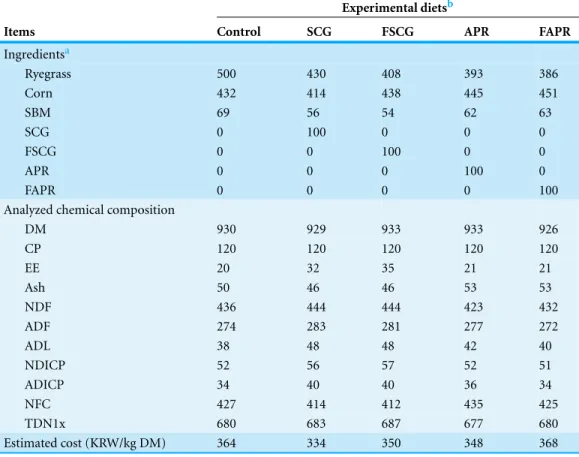
Table 2 Ingredients, analyzed chemical composition (g/kg, DM basis), and estimated cost (KRW/kg DM) of experimental diets.
Experimental dietsb
Items Control SCG FSCG APR FAPR
Ingredientsa
Ryegrass 500 430 408 393 386
Corn 432 414 438 445 451
SBM 69 56 54 62 63
SCG 0 100 0 0 0
FSCG 0 0 100 0 0
APR 0 0 0 100 0
FAPR 0 0 0 0 100
Analyzed chemical composition
DM 930 929 933 933 926
CP 120 120 120 120 120
EE 20 32 35 21 21
Ash 50 46 46 53 53
NDF 436 444 444 423 432
ADF 274 283 281 277 272
ADL 38 48 48 42 40
NDICP 52 56 57 52 51
ADICP 34 40 40 36 34
NFC 427 414 412 435 425
TDN1x 680 683 687 677 680
Estimated cost (KRW/kg DM) 364 334 350 348 368
Notes.
aSBM; soybean meal, SCG; spent coffee grounds, FSCG; fermented spent coffee grounds, APR;Artemisia princeps
residues, FAPR; fermentedArtemisia princepsresidues.
bThe SCG, FSCG, APR and FAPR treatments contained 100 g/kg of SCG, FSCG, APR, and FAPR, respectively.
respectively. The fermentation process increased feed cost and decreased NFC contents in both by-products (Table 1). The fermentation process also increased NDF content.
All the experimental diets for thein vitrofermentation contained similar TDN1x (677–683 g/kg DM), CP (120 g/kg DM), and NDF (423–444 g/kg DM) contents (Table 2), and their prices were calculated based on the prices of each feed ingredient (Table 1) and the formulated ratio of respective treatments (Table 2). The Korea Won was the unit to estimate cost of experimental diets. Compared to the control diet, inclusion of the by-products reduced the price of formulated diet (14–30 KRW/kg DM), except for FAPR which increased the price by 4 KRW/kg DM (Table 2). The use of fermented by-products increased the cost of diets by 6–20 KRW/kg DM.
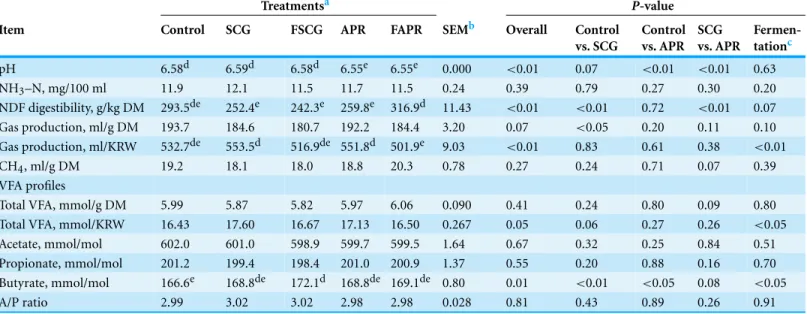
Supplementation of APR or FAPR significantly reduced pH compared to other treatments (P<0.01,Table 3). Ammonia nitrogen concentration did not differ among
treatments. NDF digestibility of the SCG group was significantly lower than that of the other diets (P<0.01) and the fermentation process tended to increase NDF digestibility
Table 3 Fermentation characteristics and CH4production after 24 hin vitroincubation of the experimental diets using strained ruminal fluid.
Treatmentsa P-value
Item Control SCG FSCG APR FAPR SEMb Overall Control vs. SCG
Control vs. APR
SCG vs. APR
Fermen-tationc
pH 6.58d 6.59d 6.58d 6.55e 6.55e 0.000 <0.01 0.07 <0.01 <0.01 0.63
NH3–N, mg/100 ml 11.9 12.1 11.5 11.7 11.5 0.24 0.39 0.79 0.27 0.30 0.20
NDF digestibility, g/kg DM 293.5de 252.4e 242.3e 259.8e 316.9d 11.43 <0.01 <0.01 0.72 <0.01 0.07
Gas production, ml/g DM 193.7 184.6 180.7 192.2 184.4 3.20 0.07 <0.05 0.20 0.11 0.10
Gas production, ml/KRW 532.7de 553.5d 516.9de 551.8d 501.9e 9.03 <0.01 0.83 0.61 0.38 <0.01
CH4, ml/g DM 19.2 18.1 18.0 18.8 20.3 0.78 0.27 0.24 0.71 0.07 0.39
VFA profiles
Total VFA, mmol/g DM 5.99 5.87 5.82 5.97 6.06 0.090 0.41 0.24 0.80 0.09 0.80
Total VFA, mmol/KRW 16.43 17.60 16.67 17.13 16.50 0.267 0.05 0.06 0.27 0.26 <0.05
Acetate, mmol/mol 602.0 601.0 598.9 599.7 599.5 1.64 0.67 0.32 0.25 0.84 0.51
Propionate, mmol/mol 201.2 199.4 198.4 201.0 200.9 1.37 0.55 0.20 0.88 0.16 0.70 Butyrate, mmol/mol 166.6e 168.8de 172.1d 168.8de 169.1de 0.80 0.01 <0.01 <0.05 0.08 <0.05
A/P ratio 2.99 3.02 3.02 2.98 2.98 0.028 0.81 0.43 0.89 0.26 0.91
Notes.
aSCG; spent coffee grounds, FSCG; fermented spent coffee grounds, APR;Artemisia princepsresidues, FAPR; fermentedArtemisia princepsresidues. The SCG, FSCG, APR
and FAPR treatments contained 100 g/kg of SCG, FSCG, APR, and FAPR, respectively.
bSEM; standard error of the mean.
cStatistical difference between fermented and non-fermented substrates (SCG, APR vs. FSCG, FAPR).
d,eMeans that do not have common superscript differ significantly (P<0.05).
supplementation of SCG significantly decreased total gas production (ml/g DM) after 24 h fermentation (P<0.05,Table 3). The fermentation process of SCG and APR tended to
decrease total gas production (P=0.10) and significantly decreased total gas production
per KRW (ml/KRW). No statistical difference in CH4production (ml/g DM) was observed
among treatments; however, there was a tendency for a decrease in CH4production with
SCG supplementation as compared to that of APR (P=0.07). Significant differences were
not detected in total VFA production (mmol/g DM), proportion of acetate (mmol/mol), proportion of propionate (mmol/mol), or acetate:propionate ratio. The diet supplemented with SCG or FSCG; however, tended to have a higher total VFA concentration per KRW (mmol/KRW) compared to the control (P=0.06). Moreover, the fermentation process
of SCG and APR significantly decreased total VFA production (mmol/KRW) (P<0.05).
There were significant differences among the experimental diets in the proportion of butyrate (P<0.01,Table 3).
DISCUSSION
Acevedo et al., 2013). It was expected that the bio-active phenolic compounds contained in these by-products would modulate rumen microbial activity, fermentation characteristics, and CH4 emission (Acevedo et al., 2013;Kim et al., 2013). Fermentation of selected
by-products usingLactobacillusspp. was applied to improve their nutritive values as feed ingredients. However, a dramatic increase of CP by microbial proliferation was not observed in either fermented by-products (Table 1), indicating that phenolic compounds, such as tannins, appear to be resistant to cell wall degradation by microbial inoculants. The decrease in NFC contents observed in fermented by-products (Table 1) indicated that the inoculated microbes might utilize non fiber sugars in both by-products during fermentation period. Both NDICP and ADICP contents were high in SCG, which might be caused by the Maillard reaction that occurs during beverage production under high temperature (Senevirathne et al., 2012).
The use of SCG and APR could decrease the price of diets with similar nutrient contents. Formulated experimental diets using SCG, FSCG, and APR had lower feed cost than the control diet without compromising CP, NDF, or TDN1x contents; however, the experimental diet using FAPR did not (Table 2). This result suggested that the residues (except those of FAPR) may be applied to feed formulation to achieve economic advantages; however, lower NFC and higher EE contents observed in diets having SCG compared to the control diet should be considered when SCG is applied to practical feed formulation. The supplementation fat source can increase energy density in diets but the excessive fat addition limits rumen fermentation, intestinal nutrients absorption (Palmquist, 1994). Because of different nutrient compositions between SCG and APR, SCG tends to replace energy and protein sources, whereas APR replaces forage. Thus, supplementation of SCG is more favorable when the price of protein sources is high, whereas APR would be a more appropriate alternative when the price of forage is high. Both SCG and APR are feed ingredient alternatives for ruminants, particularly if the goal is to reduce feed cost.
Total gas and VFA production after 24 h ofin vitrofermentation were investigated to figure out whether both SCG and APR can be alternative feed ingredients in nutritional and economical aspects. Lower gas production observed in SCG treatments than that of the control could have been caused by lower NFC contents compared to the control diet, although they had similar composition in regard to CP, NDF, and TDN1x.Seo et al. (2009)reported that total gas production at 48 h was primarily determined by the NFC content. The diets containing SCG had significantly lower NDF digestibility than the other diets. It was speculated that such phenolic compounds and resistance factors from the Maillard reaction in SCG might be associated within vitrodigestibility (Puchala et al., 2005;Senevirathne et al., 2012). More importantly, there was no significant difference between the control and the SCG supplemented diets in gas production as expressed by ml/KRW, which implied replacement of conventional feed ingredients by SCG could be economically beneficial without compromising ruminal fermentation.
production based on price (mmol/KRW) tended to be higher in samples using SCG than the control group, indicating the use of SCG as the alternative feed source might not cause any negative effects on rumen fermentation.Xu et al. (2007)indicated that the proportion of SCG in TMR should not exceed 10% of DM. Lower nutrient digestibility and VFA production were observed when 20% of SCG was added to TMR in their study. However, since nutrient composition between treatments was not controlled in their studies, the optimal concentration of SCG that could be included in ruminant diets should be tested in terms of both nutritional and economical aspects as described in this study.
Based on the results fromin vitroruminal fermentation, the pre-fermentation process in this study is unlikely a feasible practice to improve the nutritional value of SCG and APR. Although pre-fermentation increased NDF digestibility of APR, there was a significant decrease in VFA production in fermented treatments when expressed based on costs (mmol/KRW). A declining tendency in total gas production was also observed in the pre-fermentation of the by-products. This implies that fermented by-products may not be appropriate as feed alternatives in terms of cost-effectiveness, even though they have a potential to be a feed additive having probiotic functions that include modulation of ruminal fermentation, enhanced fiber digestion, and immune stimulation in the hind-gut (McAllister et al., 2011).
A previousin vitrostudy using beverage residues found that TMR using SCG had similar CH4 production to the control, whereas, both TMRs showed significantly
decreased CH4production compared to the other TMR using green tea residues
(Senevi-rathne et al., 2012). In this study, CH4production was numerically decreased in the diet
formulated with SCG compared to the control; nevertheless, further research to investigate the effect of SCG usage on rumen fermentation is required because it might have consider-able amounts of polyphenolic compounds that can modulate CH4emission (Puchala et al.,
2005), nitrogen metabolism, and the rumen protozoal population (Wallace, 2007).
CONCLUSIONS
The results of this study indicated that SCG and APR may be used as alternatives to conventional feed ingredients because of their nutrient composition and relatively low cost. Pre-fermentation of these products, however, may be inappropriate for improving their nutritional content considering the increase in production costs. Further studies onin vivoruminal fermentation, and whole body digestion and metabolism by supplementing these by-products are warranted.
ADDITIONAL INFORMATION AND DECLARATIONS
Funding
Grant Disclosures
The following grant information was disclosed by the authors:
Bio-industry Technology Development Program: 312030-04-3-HD060. Ministry of Agriculture, Food and Rural Affairs.
Competing Interests
The authors declare there are no competing interests.
Author Contributions
• Jakyeom Seo conceived and designed the experiments, performed the experiments,
analyzed the data, contributed reagents/materials/analysis tools, wrote the paper, prepared figures and/or tables, reviewed drafts of the paper.
• Jae Keun Jung performed the experiments, reviewed drafts of the paper.
• Seongwon Seo conceived and designed the experiments, contributed
reagents/materials/analysis tools, wrote the paper, reviewed drafts of the paper.
Animal Ethics
The following information was supplied relating to ethical approvals (i.e., approving body and any reference numbers):
Chungnam National University Animal Research Ethics Committee —Approval number: CNU-00455.
Supplemental Information
Supplemental information for this article can be found online athttp://dx.doi.org/ 10.7717/peerj.1343#supplemental-information.
REFERENCES
Acevedo F, Rubilar M, Scheuermann E, Cancino B, Uquiche E, Garc´es M, Inostroza K, Shene C. 2013.Spent coffee grounds as a renewable source of bioactive compounds.Journal of Biobased Materials and Bioenergy7:420–428DOI 10.1166/jbmb.2013.1369.
AOAC. 2005.Official methods of analysis of AOAC international. Gaithersburg: Association of
Official Analytical Chemists International.
Bartley EE, Ibbetson RW, Chyba LJ, Dayton AD. 1978.Coffee grounds. II. Effects of coffee grounds on performance of milking dairy cows and feedlot cattle, and on rumen fermentation
and dry matter removal rate.Journal of Animal Science47:791–799.
Campbell TW, Bartley EE, Bechtle RM, Dayton AD. 1976.Coffee grounds. I. Effects of coffee
grounds on ration digestibility and diuresis in cattle, onin vitrorumen fermentation, and on
rat growth.Journal of Dairy Science59:1452–1460DOI 10.3168/jds.S0022-0302(76)84384-6.
Chaney AL, Marbach EP. 1962.Modified reagents for determination of urea and ammonia.
Clinical Chemistry8:130–132.
Erwin ES, Marco GJ, Emery EM. 1961.Volatile fatty acid analyses of blood and rumen fluid by gas
chromatography.Journal of Dairy Science44:1768–1771
Givens DI, Barber WP. 1986.In vivoevaluation of spent coffee grounds as a ruminant feed.
Agricultural Wastes18:69–72DOI 10.1016/0141-4607(86)90108-3.
Goering HK, Van Soest PJ. 1970.Forage fiber analyses (apparatus, reagents, procedures, and some applications). US Agricultural Research Service.
Han YW. 1975.Microbial fermentation of rice straw: nutritive composition andin vitro
digestibility of the fermentation products.Applied Microbiology29:510–514.
Han YW. 1978.Microbial utilization of straw (a review).Advances in Applied Microbiology
23:119–153.
Kim CH, Kim GB, Chang MB, Bae GS, Paik IK, Kil DY. 2012.Effect of dietary supplementation ofLactobacillus-fermentedArtemisia princepson growth performance, meat lipid peroxidation,
and intestinal microflora in Hy-line Brown male chickens.Poultry Science91:2845–2851
DOI 10.3382/ps.2012-02467.
Kim ET, Moon YH, Min KS, Kim CH, Kim SC, Ahn SK, Lee SS. 2013.Changes in microbial diversity, methanogenesis and fermentation characteristics in the rumen in response to
medicinal plant extracts.Asian-Australas Journal of Animal Science26:1289–1294
DOI 10.5713/ajas.2013.13072.
Licitra G, Hernandez TM, Van Soest PJ. 1996.Standardization of procedures for nitrogen
fractionation of ruminant feeds. Animal Feed Science and Technology57:347–358
DOI 10.1016/0377-8401(95)00837-3.
Mahesh M, Mohini M. 2013.Biological treatment of crop residues for ruminant feeding: a review.
African Journal of Biotechnology12:4221–4231DOI 10.5897/AJB2012.2940.
McAllister TA, Beauchemin KA, Alazzeh AY, Baah J, Teather RM, Stanford K. 2011.Review: the
use of direct fed microbials to mitigate pathogens and enhance production in cattle.Canadian
Journal of Animal Science91:1–19DOI 10.4141/cjas10047.
NRC. 2001.Nutrient requirements of dairy cattle. Washington, D.C.: National Academy Press.
Palmquist DL. 1994.The role of dietary fats in efficiency of ruminants.Journal of Nutrition
124:1377S–1382S.
Pell AN, Schofield P. 1993.Computerized monitoring of gas production to measure forage diges-tionin vitro.Journal of Dairy Science76:1063–1073DOI 10.3168/jds.S0022-0302(93)77435-4.
Puchala R, Min BR, Goetsch AL, Sahlu T. 2005.The effect of a condensed tannin-containing
forage on methane emission by goats.Journal of Animal Science83:182–186.
Rochfort SJ, Imsic M, Jones R, Trenerry VC, Tomkins B. 2006.Characterization of flavonol
conjugates in immature leaves of pak choi [Brassica rapaL. Ssp.chinensisL. (Hanelt.)]
by HPLC-DAD and LC-MS/MS.Journal of Agricultural and Food Chemistry54:4855–4860
DOI 10.1021/jf060154j.
Salman F, El-Kadi R, Abdel-Rahman H, Ahmed S, Mohamed M, Shoukry M. 2008.Biologically
treated sugar beet pulp as a supplement in goat rations.International Journal of Agriculture and
Biology10:412–416.
Senevirathne ND, Okamoto T, Takahashi J, Umetsu K, Nishida T. 2012.Effect of mixed
microbial culture on fermentation of beverage residues and the effect of the fermented beverage
residues onin vitrorumen fermentation and methane production.International Journal of
Bioscience, Biochemistry and Bioinformatics2:349–353DOI 10.7763/IJBBB.2012.V2.130.
Seo S, Lee SC, Lee SY, Seo JG, Ha JK. 2009.Degradation kinetics of carbohydrate fractions of
ruminant feeds using automated gas production technique.Asian-Australasian Journal of
Sikka SS, Bakshi MPS, Ichhponani JS. 1985.Evaluationin vitroof spent coffee grounds as a
livestock feed.Agricultural Wastes13:315–317DOI 10.1016/0141-4607(85)90057-5.
Sikka SS, Chawla JS. 1986.Effect of feeding spent coffee grounds on the feedlot performance and
carcass quality of fattening pigs.Agricultural Wastes18:305–308
DOI 10.1016/0141-4607(86)90076-4.
Theodorou MK, Williams BA, Dhanoa MS, McAllan AB, France J. 1994.A simple gas production method using a pressure transducer to determine the fermentation kinetics of ruminant feeds.
Animal Feed Science and Technology48:185–197DOI 10.1016/0377-8401(94)90171-6.
Tokimoto T, Kawasaki N, Nakamura T, Akutagawa J, Tanada S. 2005.Removal of lead ions in
drinking water by coffee grounds as vegetable biomass.Journal of Colloid and Interface Science
281:56–61DOI 10.1016/j.jcis.2004.08.083.
Van Soest PJ, Robertson JB, Lewis BA. 1991.Methods for dietary fiber, neutral detergent fiber,
and nonstarch polysaccharides in relation to animal nutrition.Journal of Dairy Science
74:3583–3597DOI 10.3168/jds.S0022-0302(91)78551-2.
Wallace RJ. 2007.Antimicrobial properties of plant secondary metabolites.Proceedings of the Nutrition Society63:621–629DOI 10.1079/PNS2004393.
Wanapat M, Kang S, Polyorach S. 2013.Development of feeding systems and strategies of supplementation to enhance rumen fermentation and ruminant production in the tropics.
Journal of Animal Science and Biotechnology4:Article 32DOI 10.1186/2049-1891-4-32.
Wanapat M, Polyorach S, Chanthakhoun V, Sornsongnern N. 2011.Yeast-fermented cassava chip protein (YEFECAP) concentrate for lactating dairy cows fed on urea–lime treated rice
straw.Livestock Science139:258–263DOI 10.1016/j.livsci.2011.01.016.
Xu CC, Cai Y, Zhang JG, Ogawa M. 2007.Fermentation quality and nutritive value of a total
mixed ration silage containing coffee grounds at ten or twenty percent of dry matter.Journal of