Submitted 31 August 2015
Accepted 4 November 2015
Published24 November 2015
Corresponding author Phil Senter, [email protected]
Academic editor John Hutchinson
Additional Information and Declarations can be found on page 41
DOI10.7717/peerj.1439
Copyright 2015 Senter and Moch
Distributed under
Creative Commons CC-BY 4.0
OPEN ACCESS
A critical survey of vestigial structures in
the postcranial skeletons of extant
mammals
Phil Senter1and John G. Moch2
1Department of Biological Sciences, Fayetteville State University, Fayetteville, NC, United States 2Department of Chemistry and Physics, Fayetteville State University, Fayetteville, NC, United States
ABSTRACT
In the Mammalia, vestigial skeletal structures abound but have not previously been the focus of study, with a few exceptions (e.g., whale pelves). Here we use a phyloge-netic bracketing approach to identify vestigial structures in mammalian postcranial skeletons and present a descriptive survey of such structures in the Mammalia. We also correct previous misidentifications, including the previous misidentification of vestigial caviid metatarsals as sesamoids. We also examine the phylogenetic distribu-tion of vestigiality and loss. This distribudistribu-tion indicates multiple vestigializadistribu-tion and loss events in mammalian skeletal structures, especially in the hand and foot, and reveals no correlation in such events between mammalian fore and hind limbs.
Subjects Evolutionary Studies, Marine Biology, Zoology, Anatomy and Physiology
Keywords Vestigial structures, Vestigial organs, Evolution, Mammalia, Osteology, Anatomy
INTRODUCTION
A vestigial structure is a biological structure that has lost a major ancestral function and is usually drastically reduced in size. Well-known examples include the eyes of blind cave fishes and blind cave salamanders, and the diminutive wings of kiwis and emus. As early as the eighteenth century, Erasmus Darwin (1791) recognized vestigial structures as evidence for biological evolution, and such recognition continues among today’s biologists and paleontologists (e.g.,Prothero, 2007;Hall & Hallgrimsson, 2008;Senter et al., 2015). For such structuresLamarck (1809)used the French wordsrudimentsandvestiges. Charles Darwin (1859) used the term “rudimentary organs.”Wiedersheim (1895)popularized the use of the term “vestigial” for such structures, and such use continues today.
The term “vestigial” does not imply a complete lack of any function. Although some biologists maintain that it does (e.g.,Prothero, 2007;Bergstrom & Dugatkin, 2012), most reject that strict view and followDarwin (1859)in accepting that a vestigial structure has lost a salient function but may retain some other function (e.g.,Bejder & Hall, 2002;
and tarsal bones (Smythe, 1967;Jackson & Auer, 2012). Likewise, vestigial whale pelves have lost their ancestral locomotor function but still anchor muscles associated with the reproductive system (Struthers, 1881;Sim˜oes-Lopes & Gutstein, 2004).
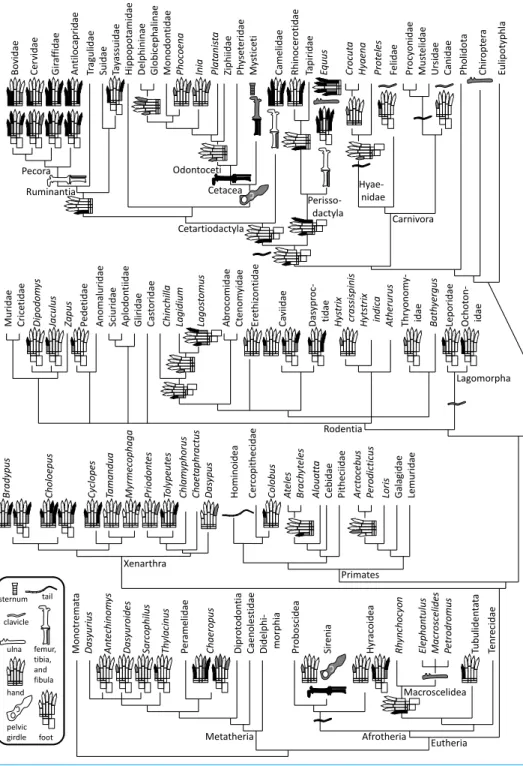
Vestigial structures are common in the postcranial skeletons of extant mammals (Fig. 1). The vestigial tails of humans, pelves of whales, and metacarpals and metatarsals of horses are frequently cited examples (e.g.,Prothero, 2007;Kardong, 2008;Hall & Hallgrimsson, 2008). Many more examples exist, but most are little-known, and some have not previously been explicitly identified as vestigial. It would be useful to publish an illustrated survey of the vestigial structures in mammal postcrania and to trace the evolutionary trends in vestigiality and loss of postcranial skeletal structures across the Mammalia. We conducted this study so as to produce such a publication by answering three questions. First, for any given postcranial skeletal element, in which mammalian taxa is it vestigial? Second, for any given postcranial skeletal element, how many times (and in what taxa) has vestigialization and/or loss independently occurred in the Mammalia? Third, have any vestigial postcranial skeletal elements in the Mammalia previously been misidentified as something else? To increase the utility of the study for the non-specialist, we have included common names in American English along with taxonomic names in the main text.
MATERIALS AND METHODS
Specimen examination
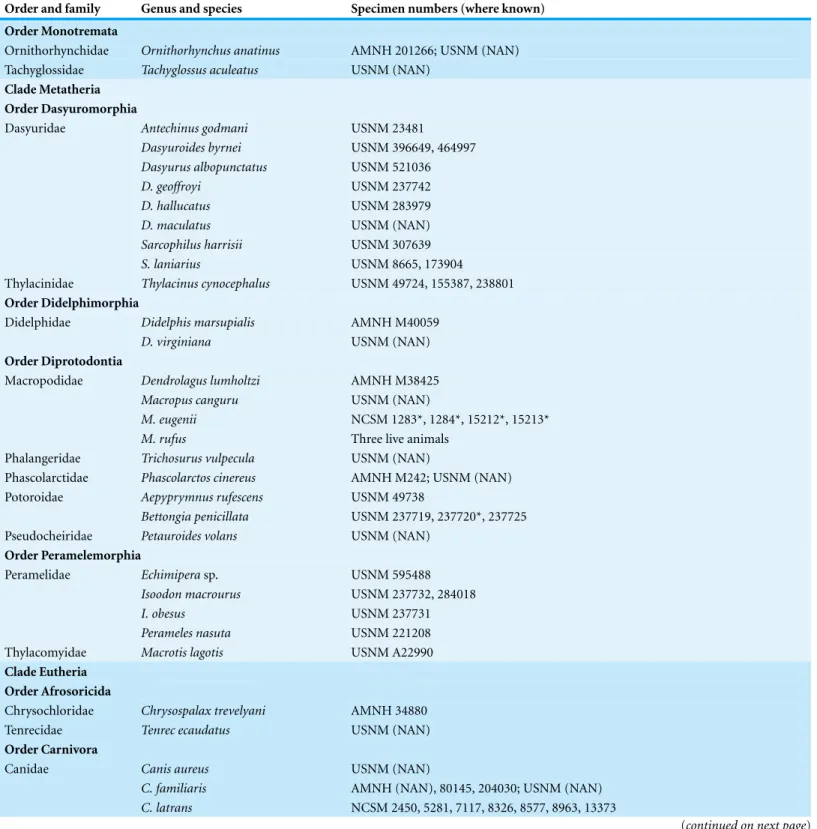
We examined 578 mammalian skeletal specimens and skins from 293 species (Table 1) representing 98 (70%) of the 139 extant mammal families listed byNowak (1999). We supplemented our observations with previously published descriptions as needed. We also examined manual and pedal morphology in 74 live members of 23 hoofed species of the Cetartiodactyla and in museum-supplied photos of seven skeletal specimens of rhinoceroses and manatees (Table 1).
Rodentia is the largest mammalian order, with over 1,700 species, of which over 70% are in the superfamily Muroidea (mice and kin) and the family Sciuridae (squirrels and kin) (Adkins, Walton & Honeycutt, 2003;Steppan, Storz & Hoffmann, 2004). Therefore, we were able to examine only a fraction of the diversity within those two taxa. Nevertheless, we achieved sufficient coverage of them to be of use here. Our overall rodent sample includes representatives of 23 (82%) of the 28 extant rodent families listed byNowak (1999).
Identification of vestigial structures
Three categories of skeletal structures were examined and considered candidates for identification as vestigial structures: (1) individual bones, (2) parts of individual bones (e.g., the shaft of the ulna), and (3) multiple-bone structures (e.g., the pelvic girdle, a limb, or a digit). Previous studies have identified vestigiality in all three anatomical categories (Tague, 1997;Kearney, 2002;Bejder & Hall, 2002;Maxwell & Larsson, 2007;Senter, 2010;
Bensimon-Brito et al., 2011;Moch & Senter, 2011).
Figure 1 Phylogeny of bone vestigialization and loss in mammals.Phylogeny of extant Mammalia, showing phylogenetic distribution of vestigial (gray) and lost (black) skeletal structures. Gray ulna symbols refer to vestigiality of the ulnar shaft, not the entire ulna. Here, the phylogeny of the major mam-malian clades is perMurphy et al. (2001). Phylogeny within Rodentia is a consensus of the studies ofDeBry & Sagel (2001),Huchon & Douzery (2001),Montgelard et al. (2002)andAdkins, Walton & Honeycutt (2003). For phylogenies within other mammalian sub-clades we used the following sources. Afrotheria:
Table 1 List of examined specimens.Specimens examined for this study. Asterisks indicate skins; all other listed specimens are skeletal except where noted. See text for literature used in addition to specimen observations.
Order and family Genus and species Specimen numbers (where known)
Order Monotremata
Ornithorhynchidae Ornithorhynchus anatinus AMNH 201266; USNM (NAN) Tachyglossidae Tachyglossus aculeatus USNM (NAN)
Clade Metatheria Order Dasyuromorphia
Dasyuridae Antechinus godmani USNM 23481
Dasyuroides byrnei USNM 396649, 464997 Dasyurus albopunctatus USNM 521036
D. geoffroyi USNM 237742
D. hallucatus USNM 283979
D. maculatus USNM (NAN)
Sarcophilus harrisii USNM 307639
S. laniarius USNM 8665, 173904
Thylacinidae Thylacinus cynocephalus USNM 49724, 155387, 238801 Order Didelphimorphia
Didelphidae Didelphis marsupialis AMNH M40059
D. virginiana USNM (NAN)
Order Diprotodontia
Macropodidae Dendrolagus lumholtzi AMNH M38425
Macropus canguru USNM (NAN)
M. eugenii NCSM 1283*, 1284*, 15212*, 15213*
M. rufus Three live animals
Phalangeridae Trichosurus vulpecula USNM (NAN)
Phascolarctidae Phascolarctos cinereus AMNH M242; USNM (NAN) Potoroidae Aepyprymnus rufescens USNM 49738
Bettongia penicillata USNM 237719, 237720*, 237725 Pseudocheiridae Petauroides volans USNM (NAN)
Order Peramelemorphia
Peramelidae Echimiperasp. USNM 595488
Isoodon macrourus USNM 237732, 284018
I. obesus USNM 237731
Perameles nasuta USNM 221208
Thylacomyidae Macrotis lagotis USNM A22990
Clade Eutheria Order Afrosoricida
Chrysochloridae Chrysospalax trevelyani AMNH 34880
Tenrecidae Tenrec ecaudatus USNM (NAN)
Order Carnivora
Canidae Canis aureus USNM (NAN)
C. familiaris AMNH (NAN), 80145, 204030; USNM (NAN) C. latrans NCSM 2450, 5281, 7117, 8326, 8577, 8963, 13373
Table 1 (continued)
Order and family Genus and species Specimen numbers (where known)
C. lupus AMNH 10417; NCSM 5284
Vulpes vulpes NCSM 15485; USNM (NAN)
Felidae Acinonyx jubatus USNM (NAN)
Caracal caracal USNM (NAN)
Felis catus FSU (NAN: six specimens); NCSM (NAN) Leopardus pardalis AMNH 4; CTR (NAN)
Lynx rufus NCSM 15020
Panthera tigris USNM (NAN); CTR (NAN)
Herpestidae Herpestes javanicus NCSM 13402*, 13405*
Hyaenidae Crocuta crocuta AMNH 5142, 147880
Hyaena brunnea USNM 267891; USNM (NAN)
H. hyaena USNM 328576
Proteles cristatus USNM (NAN)
Mephitidae Mephitis mephitis USNM (NAN)
Spilogale gracilis USNM (NAN)
Mustelidae Eira barbara CTR (NAN)
Enhydra lutra USNM (NAN)
Lutra canadensis USNM (NAN)
Mustela erminea USNM (NAN), 16458, 498822*
M. nivalis NCSM 7838*; USNM 115211
Nandiniidae Nandinia binotata NCSM 8196*
Phocidae Phoca groenlandica USNM (NAN)
Ph. vitulina NCSM 384
Procyonidae Nasua nasua NCSM 13405*; USNM (NAN)
Procyon lotor NCSM 2446, 4000*, 4010*, 15030; USNM (NAN)
Ursidae Helarctos malayanus USNM (NAN)
Ursus americanus NCSM 6655*, 8381*
U. arctos USNM (NAN)
Viverridae Arctictis binturong CTR (NAN); NCSM 15483*
Viverra tangalunga USNM (NAN)
Clade Cetartiodactyla
Antilocapridae Antilocapra americana USNM 256452, 259010; USNM (NAN)
Balaenidae Eubalaena glacialis NCSM 3286
Balaenopteridae Balaenoptera musculus NCSM 8381 Megaptera novaeangliae NCSM 8201 Bovidae Addax nasomaculatus One live animal
Ammotragus lervia NCSM 7674; Five live animals Antilope cervicapra Two live animals
Bison bison NCSM 7673; Three live animals
Bos taurus NCSM 000356; Six live animals
Bubalus bubalus Five live animals Hippotragus niger Three live animals
Nanger dama Two live animals
Table 1 (continued)
Order and family Genus and species Specimen numbers (where known)
Oryx gazelle One live animal
Ovis canadensis Two live animals
O. aries Three live animals
Tragelaphus eurycerus One live animal
Camelidae Camelus dromedarius USNM (NAN); three live animals
C. ferus Four live animals
Lama glama USNM (NAN); five live animals
Cervidae Alces alces One live animal
Axis axis NCSM 14258; seven live animals
Cervus canadensis Six live animals
C. elaphus Three live animals
Dama dama NCSM 14256*
Odocoileus hemionus USNM (NAN)
O. virginianus NCSM 298, 2678*; One live animal
Delphinidae Delphinus delphis USNM (NAN)
Tursiops truncatus NCSM 8217
Eschrichtiidae Eschrichtius robustus USNM (NAN)
Giraffidae Giraffa camelopardalis USNM 163312, 252547; Seven live animals Okapia johnstoni One live animal
Monodontidae Delphinapterus leucas AKM (NAN)
Monodon monoceros AMNH M73314/16
Phocoenidae Phocoena phocoena USNM (NAN)
Physeteridae Physeter catodon NCSM 3281
Platanistidae Platanista gangetica AMNH (NAN) Pontoporiidae Pontoporia blainvillei USNM (NAN)
Suidae Sus scrofa FSU (NAN); NCSM 16917
Tayassuidae Pecari tajacu AMNH 17352; USNM 14081, (NAN) Tayassu pecari USNM 160652, 258578, 259091
Tragulidae Tragulus napu USNM 49605, 49871
T. javanicus USNM (NAN); YPM (NAN)
Ziphiidae Mesoplodon mirus NCSM 401
Order Chiroptera
Molossidae Eumops perotis NCSM 8649*
Molossus nigricans USNM (NAN)
Tadarida brasiliensis NCSM 8283, 10392, 14971
Natalidae Natalus mexicana NCSM 8691
Phyllostomidae Artibeus jamaicensis AMNH 129101
Desmodus rotundus USNM (NAN)
Glossophaga soricina NCSM 8878, 8879 Leptonycteris sanborni NCSM 8693
Pteropodidae Pteropus edulis AMNH 245693
P. lylei AMNH 129100
P. samoensis USNM (NAN)
Table 1 (continued)
Order and family Genus and species Specimen numbers (where known)
P. vampyrus NCSM 16329
Vespertilionidae Antrozous pallidus NCSM 5314*, 7704 Mormoops blainvillei NCSM 8035, 8058
Myotis velifer NCSM 8697, 8698, 8699; USNM (NAN) Order Eulipotyphla
Erinaceidae Atelerix albiventris NCSM 4588*, 45898*, 4590*, 5192* Solenodontidae Solenodon paradoxus AMNH 269949
Soricidae Blarina brevicauda NCSM 324, 1888*, 1949, 13830, 14404, 14405, 14408
Notisorex crawfordi NCSM 9377*
Sorex cinereus NCSM 630, 17663
S. longirostris NCSM 13500*, 13501*, 13502*, 14589*, 14590* Talpidae Condylura cristata NCSM 8509, 14632, 14633, 14636, 14656
Neurotrichus gibbsi NCSM 5353*, 6299, 7636* Parascalops breweri NCSM 6152, 13303*, 14658 Scalopus aquaticus NCSM 004495, 8781, 17660 Scapanus townsendi NCSM 7635*, 7683*, 7794, 7998 Order Hyracoidea
Procaviidae Dendrohyrax arboreus AMNH 55878*, 83246
D. dorsalis AMNH 52120, 53818*, 53806; USNM (NAN), 512790, 59852, 598583 Heterohyrax brucei AMNH 82100, 82102, 82104
Procavia capensis AMNH 35326, 35673; USNM 175011, 221377, 240928, 305093; YPM MAM 6838 Order Lagomorpha
Leporidae Lepus arcticus AMNH 19169
L. callotis AMNH 1418
Oryctolagus cuniculus AMNH M144640 Sylvilagus floridanus NCSM 14102, 15652
Ochotonidae Ochotona pallasi AMNH 55981
O. princeps CM 9463, 16031, 20606; NCSM 8118, 8119 Order Macroscelidea
Macroscelididae Elephantulus brachyrhynchus USNM 365027
E. intufi USNM 29153, 295149, 295158
E. rozeti USNM (NAN)
E. rufescens USNM 399312, 535125, 574953
Macroscelides proboscideus USNM 588428
Petrodromus tetradactylus USNM 241593, 365035; YPM MAM 10314 Order Perissodactyla
Equidae Equus burchellii USNM 61743
E. caballus NCSM 433, 7675
Rhinocerotidae Dicerorhinus sumatrensis AMNH 54764
Rhinoceros sondaicus MCZ 5169 (photos), 5170 (photos); USNM 269392 R. unicornis MCZ 1730 (photos), 16893 (photos); USNM (NAN)
Tapiridae Tapirus bairdii USNM (NAN)
T. pinchaque USNM 11884
Table 1 (continued)
Order and family Genus and species Specimen numbers (where known)
T. terrestris USNM 281726
Order Pholidota
Manidae Manis longicaudata USNM (NAN)
Order Primates
Atelidae Alouatta villosa USNM (NAN)
Atelessp. USNM 47912, 49888
A. belzebuth AMNH 216*, 30637*, 98402*
A. fusciceps AMNH 32355*, 188139*
A. geoffroyi AMNH 17208*, 145158*; USNM (NAN), 102085
A. paniscus AMNH 17581*, 100076*
Callitrichidae Cebuella pygmaea USNM (NAN)
Saguinus oedipus USNM (NAN)
Cebidae Cebus capucinus USNM (NAN)
Cebussp. NCSM 8363
Cercopithecidae Nasalis larvatus USNM (NAN)
Papio sphinx USNM (NAN)
Presbytis comate NCSM 16333, 16334
Cynocephalidae Cynocephalus volans USNM (NAN) Daubentoniidae Daubentonia madagascariensis USNM (NAN)
Galagidae Galago senegalensis USNM (NAN)
Hominidae Gorilla gorilla USNM (NAN)
Homo sapiens FSU (NAN); NCSM 1214
Pan troglodytes USNM 48184, 176226, 220068, 220326, 220327, 236883, 236971, 256973, 395820
Hylobatidae Hylobates moloch USNM (NAN)
Symphilangus symphilangus USNM 49656
Lemuridae Eulemur mongoz USNM (NAN)
Lorisidae Arctocebus aureus USNM 598476*
A. calabarensis AMNH 212576, 212954; USNM 511930* Loris lydekkerianus USNM 305067, 114692*, 256737* Nycticebus bengalensis USNM 270994*, 39654
Perodicticus potto AMNH 15972; USNM 49547, 84227*, 184230*, 184229,*, 270530, 253619, 598550
Pitheciidae Cacajao calvus USNM (NAN)
Pongidae Pongo abelii USNM 49856
Tarsiidae Cephalopachus bancanus AMNH 2458 Order Proboscidea
Elephantidae Loxodonta africana USNM 49489 Order Rodentia
Abrocomidae Abrocoma cinerea USNM 583254
Anomaluridae Anomalurus beecrofti USNM 84546
A. pelii CM 69351
Idiurus zenkeri AMNH 56622
Aplodontiidae Aplodontia rufa NCSM 3770*, 4829* Castoridae Castor canadensis NCSM 8518; USNM (NAN)
Table 1 (continued)
Order and family Genus and species Specimen numbers (where known)
Caviidae Cavia porcellus USNM 35083
Dolichotis patagonum NCSM 8200*; USNM 175890, 258569
Galea spixii USNM 399272, 538313
Hydrochoerus hydrochaerus USNM 49456, 155412, 269946; USNM (NAN) Kerodon rupestris USNM 399280, 543101
Microcavia australis USNM 54417, 132278
Chinchillidae Chinchilla chinchilla USNM 219408, 279438; one live animal Lagidium peruanum USNM 194472, 194473
Lagostomus trichodactylus USNM 154146, 173042
Cricetidae Baiomys taylori NCSM 15106*, 15107*
Cleithrionomys gapperi NCSM 5165, 5836*, 5837* Lemmus trimucronatus NCSM 2524*
Mesocricetus auratus NCSM 15808*
Microtus pinetorum NCSM 8515, 8901, 13350*, 13351*, 15586, 17665
Myodes gapperi NCSM 15573
M. rutilus NCSM 3252*
Neofiber alleni NCSM 1688*, 1689*, 3020*, 3021* Neotoma floridana NCSM 2814*, 3723*
Ondatra zibethicus NCSM 374*, 4003*, 4008*, 6588*, 8265, 15104, 17664* Oryzomys palustris NCSM (NAN), 499*, 500*, 501*, 17662
Peromyscus floridanus NCSM 2191*, 12027*
P. maniculatus NCSM 5621*, 5623*, 5625*, 15530 Reithrodontomys megalotis NCSM 5878*, 5879*
Sigmodon hispidus NCSM 12021*, 12023*, 12025*, 15635 Synaptomys cooperi NCSM 15585*, 17202*
Ctenomyidae Ctenomyssp. USNM 147922
Cuniculidae Cuniculus paca USNM 13057, 155610
Dasyproctidae Dasyprocta azarae AMNH 37457*, 134215; USNM 252297
D. fuliginosa AMNH 18841*, 35438
D. leporina AMNH 37151*, 80250, 265955
D. mexicana AMNH 172283*; USNM 49736
D. punctata AMNH 215102, 215099*; USNM 261397, 503777 Myoprocta acouchy AMNH 94073*, 70198
M. pratti AMNH 33654*
Dinomyidae Dinomyssp. USNM 300797, 395160
Dinomys branickii USNM 395453
Dipodidae Allactaga elater AMNH 212116
A. pumilio AMNH 85331*, 98133
A. sibirica AMNH 57227*, 58715*
Cardiocranius paradoxus AMNH 122*
Dipus sowerbyi AMNH 176265*
Eozapus setchuanus AMNH 84264*
Jaculus jaculus AMNH 70096
Table 1 (continued)
Order and family Genus and species Specimen numbers (where known)
J. orientalis AMNH 525*
Napeozapus insignis AMNH 67768, 121830*; NCSM 15589 Salpingotus thomasi AMNH 249428*
Zapus hudsonius AMNH 206850; NCSM 2559
Z. princeps AMNH 238252*
Z. trinotatus AMNH 1244*, 38311*
Echimyidae Cercomys cuniculus USNM 543479
Hoplomys gymnurus USNM 578393
Proechimys canicolli USNM 280054
Thrichomys apereoides NCSM 12964*; USNM 293173
Erethizontidae Coendousp. USNM 267592, 297843
Erethizon dorsatum NCSM 4748*, 6213, 7825, 13040*, 16262*; USNM 88617, 568394, 568395
Geomyidae Geomys bursarius NCSM 15078*, 15080*
G. pinetus NCSM 1787*, 2143*
Thomomys bottae NCSM 5905*
Th. talpoides NCSM 5892*, 5897*
Heteromyidae Chaetodipus californicus NCSM 882*
Ch. baileyi NCSM 2993*
Dipodomys ordii NCSM 5257*, 5868*
Peromyscus pencillatus NCSM 9902*, 9905* Hystricidae Atherurus africanus USNM 539828, 538109
A. macrourus USNM 49498, 49602
Hystrix brachyura USNM 197641, 153974, 49465 H. crassispinis USNM 153974, 197640, 396591
H. cristata USNM 142163, 538408
H. indica USNM 60073, 570871
H. javanica USNM 155287
H. sumatrae USNM 49870, 49932
Trichys fasciculata USNM 347835
Muridae Acomys dimidiatus NCSM 15804* (two skins with same number)
Gerbillurus paeba USNM 295264
Gerbillussp. NCSM 15858*, 15859*
Meriones unguiculatus USNM 290460
Mus musculus NCSM 5723*, 8774, 8775, 15647, 15864*
Psammomys obesus USNM 308354
Rattus norvegicus NCSM (NAN), 201*, 202*, 203*, 1207; USNM 308359, 564244
Tatera indica USNM 329220
Myocastoridae Myocastor coypus NCSM 299*, 1109*
Octodontidae Octodon degus USNM 397332
Pedetidae Pedetes capensis USNM 49647, 221381, 384097 Sciuridae Ammospermophilus harrisi NCSM 2250*, 9834*
Cynomys gunnisoni NCSM 6406*, 6412*, 15387 Eutamias cinereicollis NCSM 5925*
Table 1 (continued)
Order and family Genus and species Specimen numbers (where known)
Glaucomys volans NCSM 91*, 730*, 9860*, 7315*, 14985, 16805, 16807 Marmota monax NCSM 7218*, 7517*, 7771*, 9680; USNM (NAN)
Sciurus carolinensis NCSM 5247, 12909, 14990*, 16873*, 16874, 16875*, 17685*
S. niger NCSM 8491, 17306*, 17307*, 17664*, NAN*
Spermophilus beecheyi NCSM 9811*, 9812*
S. lateralis NCSM 5922*, 5923*, 5924*, 9814*
S. richardsoni NCSM 6411*
Tamias striatus NCSM 8096, 15491, 16382*, 16385* Tamiasciurus hudsonicus NCSM 8383, 15492
Thryonomyidae Thryonomys swinderianus AMNH 241385, 341383*
Th. gregorianus USNM 300796, 318094
Order Scandentia
Tupaiidae Tupaiasp. AMNH 70299
T. glis NCSM 9386*, 9387*; USNM (NAN)
Order Sirenia
Dugongidae Dugong dugon AMNH (NAN); USNM (NAN)
Trichechidae Trichechus manatus NCSM 4566, 4569, 4571, 4572; USNM (NAN), 14334 (photos), 217259 (photos)
T. inunguis USNM 20916 (photos)
Order Tubulidentata
Orycertopodidae Orycteropus afer USNM (NAN) Order Xenarthra
Bradypodidae Bradypus tridactylus USNM 256676
B. variegatus USNM 49590
Cyclopedidae Cyclopes didactylus NCSM 16252*; USNM 283876, 583607 Dasypodidae Chaetophractus villosus AMNH 240; USNM 302063; USNM (NAN)
Chlamyphorus truncatus AMNH (NAN)
Dasypus novemcinctus NCSM 7353*, 7354*, 9059*, 9060*, 16454 Priodontes maximus AMNH (NAN); USNM 261024
Tolypeutes matacus USNM 291935
Megalonychidae Choloepus didactylus USNM 256769
Ch. hoffmanni USNM 012859; USNM (NAN)
Myrmecophagidae Myrmecophaga tridactyla AMNH 1873; USNM (NAN) Tamandua tetradactyla AMNH 238, M385
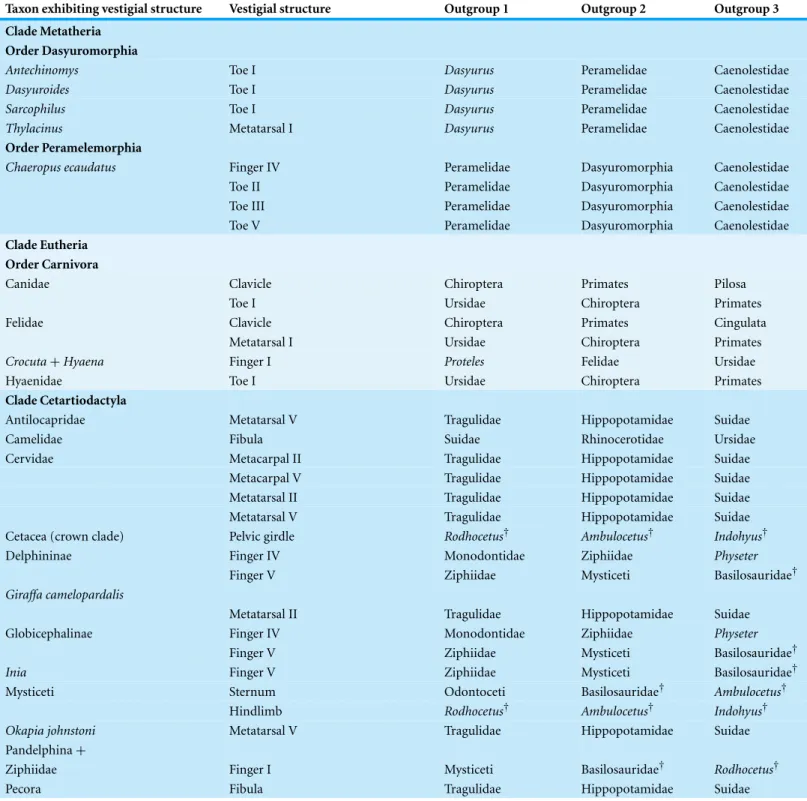
structures could be considered vestigial we used the phylogenetic bracketing approach from a previous study (Moch & Senter, 2011). According to this approach, a structure is considered vestigial if it satisfies the three criteria listed below, in comparison to its homolog in three successive sister taxa (Table 2). A phylogenetic bracketing approach only requires confirmation of a character state in two successive sister taxa (Witmer, 1995), but we included a third so as to increase the reliability of the inference.
Table 2 Outgroup lists.Vestigial skeletal structures in mammalian taxa, and successive outgroups with unreduced homologs of those structures, demonstrating that such structures are vestigial. The symbol†indicates an extinct taxon. To determine the succession of outgroups, we used the phylogenies in the references given in the caption toFig. 1, with additional information fromThewissen et al. (2007).
Taxon exhibiting vestigial structure Vestigial structure Outgroup 1 Outgroup 2 Outgroup 3
Clade Metatheria Order Dasyuromorphia
Antechinomys Toe I Dasyurus Peramelidae Caenolestidae
Dasyuroides Toe I Dasyurus Peramelidae Caenolestidae
Sarcophilus Toe I Dasyurus Peramelidae Caenolestidae
Thylacinus Metatarsal I Dasyurus Peramelidae Caenolestidae
Order Peramelemorphia
Chaeropus ecaudatus Finger IV Peramelidae Dasyuromorphia Caenolestidae
Toe II Peramelidae Dasyuromorphia Caenolestidae
Toe III Peramelidae Dasyuromorphia Caenolestidae
Toe V Peramelidae Dasyuromorphia Caenolestidae
Clade Eutheria Order Carnivora
Canidae Clavicle Chiroptera Primates Pilosa
Toe I Ursidae Chiroptera Primates
Felidae Clavicle Chiroptera Primates Cingulata
Metatarsal I Ursidae Chiroptera Primates
Crocuta+Hyaena Finger I Proteles Felidae Ursidae
Hyaenidae Toe I Ursidae Chiroptera Primates
Clade Cetartiodactyla
Antilocapridae Metatarsal V Tragulidae Hippopotamidae Suidae
Camelidae Fibula Suidae Rhinocerotidae Ursidae
Cervidae Metacarpal II Tragulidae Hippopotamidae Suidae
Metacarpal V Tragulidae Hippopotamidae Suidae
Metatarsal II Tragulidae Hippopotamidae Suidae
Metatarsal V Tragulidae Hippopotamidae Suidae
Cetacea (crown clade) Pelvic girdle Rodhocetus† Ambulocetus† Indohyus†
Delphininae Finger IV Monodontidae Ziphiidae Physeter
Finger V Ziphiidae Mysticeti Basilosauridae†
Giraffa camelopardalis
Metatarsal II Tragulidae Hippopotamidae Suidae
Globicephalinae Finger IV Monodontidae Ziphiidae Physeter
Finger V Ziphiidae Mysticeti Basilosauridae†
Inia Finger V Ziphiidae Mysticeti Basilosauridae†
Mysticeti Sternum Odontoceti Basilosauridae† Ambulocetus†
Hindlimb Rodhocetus† Ambulocetus† Indohyus†
Okapia johnstoni Metatarsal V Tragulidae Hippopotamidae Suidae
Pandelphina+
Ziphiidae Finger I Mysticeti Basilosauridae† Rodhocetus†
Pecora Fibula Tragulidae Hippopotamidae Suidae
Table 2 (continued)
Taxon exhibiting vestigial structure Vestigial structure Outgroup 1 Outgroup 2 Outgroup 3
Phocoena Finger V Ziphiidae Mysticeti Basilosauridae†
Tayassuidae Metatarsal V Suidae Hippopotamidae Ursidae
Order Chiroptera Ulnar shaft Carnivora Primates Xenarthra
Order Hyracoidea Finger I
Metatarsal V Tubulidentata Primates Didelphidae
Order Lagomorpha Clavicle Castoridae Primates Chiroptera
Leporidae Metatarsal I Castoridae Primates Chiroptera
Order Macroscelidea Elephantulus+
Macroscelides+
Petrodromus Ulnar shaft Rhynchocyon Tubulidentata Proboscidea
Order Perissodactyla
Equus Ulnar shaft Orohippus† Hyracotherium† Rhinocerotidae
Metacarpal II Merychippus† Orohippus† Hyracotherium†
Metacarpal IV Merychippus† Orohippus† Hyracotherium†
Fibula Orohippus† Hyracotherium† Rhinocerotidae
Metatarsal II Merychippus† Orohippus† Hyracotherium†
Metatarsal IV Merychippus† Orohippus† Hyracotherium†
Rhinocerotidae Metatarsal I Phenacodus† Ursidae Pholidota
+Tapiridae
Order Primates Arctocebus+
Perodicticus Finger II Loris Galagidae Lemuridae
Ateles Metacarpal I Alouatta Cebidae Pitheciidae
Brachyteles Metacarpal I Alouatta Cebidae Pitheciidae
Colobus Metacarpal I Cercopithecidae Hominoidea Tarsiidae
Hominoidea Tail Cercopithecoidea Platyrrhini Tarsiidae
Order Rodentia
Caviidae Metacarpal I Abrocoma Atherurus Bathyergus
Metatarsal I Ctenomys Hystrix Aplodontia
Metatarsal V Ctenomys Hystrix Thryonomys
Chinchillidae Metatarsal I Ctenomys Hystrix Aplodontia
Coendou+
Erethizon Finger I Abrocoma Atherurus Bathyergus
Dasyproctidae Metatarsal I Ctenomys Hystrix Aplodontia
Dipodomys Metatarsal I Rattus Castor Primates
Hystrix crassispinis Finger I Hystrix indica Atherurus Abrocoma
Jaculus Metatarsal I Zapus Rattus Castor
Lagidium+
Lagostomus Metacarpal I Abrocoma Atherurus Bathyergus
Lagostomus Metatarsal V Ctenomys Hystrix Thryonomys
Pedetidae Metatarsal I Idiurus Castor Rattus
Thryonomyidae Toe I Hystrix Aplodontia Castor
Table 2 (continued)
Taxon exhibiting vestigial structure Vestigial structure Outgroup 1 Outgroup 2 Outgroup 3
Order Sirenia Finger I Tenrecidae Primates Didelphidae
Pelvic girdle Proboscidea Hyracoidea Tubulidentata
Order Xenarthra
Bradypus Metacarpal I Primates Tenrecidae Didelphidae
Metacarpal V Chlamyphorus Primates Tenrecidae
Metatarsal I Chlamyphorus Primates Tenrecidae
Metatarsal V Chlamyphorus Primates Tenrecidae
Choloepus Metacarpal I Primates Tenrecidae Didelphidae
Metacarpal IV Bradypus Chlamyphorus Primates
Metatarsal I Chlamyphorus Primates Tenrecidae
Metatarsal V Chlamyphorus Primates Tenrecidae
Cyclopes Metacarpal I Myrmecophagidae Chlamyphorus Primates
Dasypus Finger V Chaetophractus Primates Tenrecidae
Myrmecophaga Manual phalanx V-2 Chaetophractus Primates Tenrecidae
Priodontes maximus Finger V Primates Tenrecidae Didelphidae
Tamandua Finger V Chaetophractus Primates Tenrecidae
Tolypeutes matacus Metacarpal I Primates Tenrecidae Didelphidae
Metacarpal V Primates Tenrecidae Didelphidae
necessarily applicable to other studies; we used it here simply to have a consistent standard for extreme reduction. We used fossil taxa as sister groups for comparison in the Cetacea and Perissodactyla. We used extant taxa as sister groups in all other cases (Table 2).
The second criterion is that the structure has lost the specialized morphology that it exhibits in the sister groups. For example, a finger meets this criterion if its distal phalanx is shaped like an ovoid pebble in the taxon in question but has the form of an ungual (a claw-bearing phalanx) in the sister groups.
The third criterion is that the structure has lost a salient ancestral function. Although it may not be completely functionless, biologists consider it vestigial only if it has lost a major function (e.g.,Darwin, 1859;Wilson, 1982;Prothero, 2007;Hall & Hallgrimsson, 2008;Bergstrom & Dugatkin, 2012). A limb satisfies this criterion, for example, if it is too reduced to serve as an organ of propulsion, whereas it is an organ of propulsion in the sister groups and therefore arguably in their common ancestor. Likewise, a pelvic girdle satisfies this criterion if it is too reduced to anchor a full limb and the muscles that operate it for propulsion, whereas in the sister groups it anchors a full limb and propulsive muscles. A pelvic girdle further satisfies this criterion if it is not connected to the vertebral column, because such a connection facilitates propulsion with the hindlimb by ensuring that each step propels the entire vertebral column (Kardong, 2008). A digit satisfies this criterion if it is too reduced for the functions of prehension or bodily support.
This also revealed individual variation, which is important because vestigial structures are often highly variable (Darwin, 1859;Omura, 1980;Conrad, 1982;Tague, 1997). For suprageneric taxa in which adequate previous descriptions of vestigial structures existed, we examined fewer specimens so as to spend a greater fraction of available time on previously undocumented or undescribed vestigial structures (Table 1). For the same reason, we also examined fewer specimens per species of suprageneric taxa lacking vestigial structures.
For this study we examined tail skeletons, clavicles, forelimb bones, pelvic girdles, and hindlimb bones. It is possible that vestigial skeletal structures are identifiable in other parts of the mammalian skeleton, e.g., the skull, parts of vertebrae, parts of the scapula, thyroid bones, cardiac bones, and the baculum. Such were not included in this study but may prove fruitful avenues for future research.
Tracing phylogenetic patterns
We used the cladogram inFig. 1(see caption for information sources) to trace phylogenetic patterns in vestigiality and loss of skeletal structures. Onto this cladogram we mapped the phylogenetic distribution of vestigiality and loss in postcranial skeletal elements, as shown in the figure. We then used this mapping, plus information from the fossil record as needed, to determine the phylogenetic points at which vestigiality or loss occurred for given skeletal elements. In this determination we used two assumptions. The first assumption is that if all members of a clade share a character state (e.g., vestigiality or loss of a skeletal structure), then that state arose in the clade’s common ancestor. For example, if the second toe is vestigial in all members of a clade, then it was vestigial in the clade’s common ancestor. The second assumption is that vestigialization and loss are not reversible. Therefore, if the second toe is lost in two clades but is present in a clade that is phylogenetically bracketed by the two clades, then the two clades lost the second toe independently instead of having inherited that loss from a common ancestor.
missing data, i.e., tiny clavicles that are present in the live animal are often missing or overlooked in disarticulated museum specimens (see the Clavicle section of the Results). For other bones, there were no problems with missing data. Similarly, disagreement in the literature regarding rodent phylogeny engendered ambiguity in the interpretation of the evolution of vestigialization of the hallux (the first toe) of rodents, and we used the principle of delayed transformation to interpret the results according to multiple possible phylogenies (see the Foot and toe section of the Results). For other mammalian taxa, there were no problems with phylogenetic disagreement.
Our employment of the assumption that losses are irreversible deserves further comment. There are exceptions to the general rule that vestigiality and loss are irreversible. In iguanodontian dinosaurs the ancestrally-vestigial fifth finger became elongated and useful for grasping (Senter, 2010), and atavistic limbs in aberrant cetacean and sirenian individuals show that loss is not completely irreversible (Abel, 1908;Andrews, 1929;Ogawa & Kamiya, 1957;Ohsumi, 1965). Lost body parts can be regained in the case of meristic traits in which the number of repeated parts is determined late in ontogeny (Galis, Arntzen & Lande, 2010). However, regaining of lost structures is rare (Goldberg & Igi´c, 2008;Galis, Arntzen & Lande, 2010), and there is no evidence that it has occurred within the Mammalia except in such atavistic cases.
RESULTS
Mammalian taxa without vestigial skeletal structures
There are a few major mammalian clades among whose extant representatives we did not find vestigial structures in the postcranial skeleton. These are the Monotremata (platypus and echidna); marsupial orders other than Dasyuromorphia and Peramelemorphia; and the eutherian orders Tubulidentata (aardvark), Proboscidea (elephants), Pholidota (pangolins), Eulipotyphla (shrews, moles, hedgehogs, and kin), and Scandentia (tree shrews).
Sternum
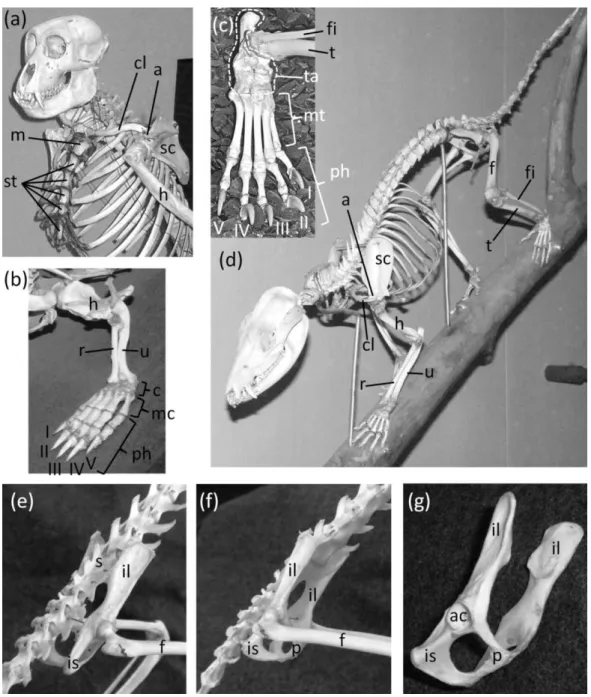
Ancestrally, the mammalian sternum consists of several segments called sternebrae, the first of which is called the manubrium (Fig. 2). The ribs articulate with the sternum via cartilaginous extensions called costal cartilages.
In most Odontoceti (toothed whales) most of the ribs maintain their connection with the sternum, and the sternum is unreduced (Fig. 3). An exception isPhyseter catodon
(sperm whale), in which the post-manubrial sternum has lost all but two sternebrae. They are reduced in relative size, but not enough to satisfy the first criterion for vestigiality (Fig. 3C).
Figure 3 Sterna of whales, with vestigial parts circled with broken line.(A) Non-vestigial sternum of Mesoplodon mirus(True’s beaked whale) (B) Non-vestigial sternum ofMonodon monoceros(narwhal), with segments fused into one, which is common in toothed whales (C) Sternum ofPhyseter catodon (sperm whale) with reduced post-manubrial section (D) Vestigial sternum ofBalaenoptera musculus (blue whale) (E) Vestigial sternum ofMegaptera novaeangliae(humpback whale) (F) Vestigial sternum of Eubalaena glacialis(North Atlantic right whale); (G) Non-vestigial sternum ofTrichechus manatus(West Indian manatee).
In the Sirenia (manatees and dugongs) the number of segments in the sternum is also reduced. Reduced rib mobility in sirenians prevents ribcage collapse (Howell, 1930), so there is less selection pressure to maintain a large sternum. The sternum retains the manubrium and a second ossification that appears to be homologous to the rest of the sternum but is reduced in size and undivided into sternebrae (Howell, 1930). However, the size of the sirenian sternum is not reduced enough to satisfy the first criterion for vestigiality (Fig. 3G), and because it maintains its cartilaginous connection to several ribs it also fails to satisfy the third criterion.
Tail
Figure 4 Pelves of primates, with coccyx (vestigial tail) circled with broken line.(A)Pan troglodytes (chimpanzee), ventral view (B)Homo sapiens(human), dorsal view.
The coccyx of apes and humans, a fused series of three to six vertebrae (Fig. 4), satisfies all three criteria for vestigiality. It does not protrude from the body’s surface and therefore cannot be used for social signaling, fly swatting, etc.
Clavicle
Ancestrally, the mammalian clavicle is a robust bone that articulates with the sternum and the acromion process of the scapula, bracing the forelimb against the axial skeleton (Fig. 2A). Most mammals retain this condition, but some have lost the clavicle altogether. This loss facilitates forward motion of the scapula, which increases stride length during running (Ewer, 1973;Hildebrand & Goslow, 2001). The clavicle is lost in the orders Perissodactyla (odd-toed hoofed mammals), Cetartiodactyla (even-toed hoofed mammals and whales), Sirenia (manatees and dugongs), Hyracoidea (hyraxes), and Proboscidea (elephants); most members of Carnivora (carnivores); and some rodents (Flower, 1870).
A vestigial clavicle is retained in two carnivoran families: Canidae (the dog family) and Felidae (the cat family). In both, only a short sliver ossifies (Figs. 5A–5C) within a ligament that connects the sternum to the acromion and represents the degenerate remainder of the ancestral clavicle, and in the Canidae the clavicle is often absent (Ewer, 1973). A similar situation is present in rabbits (Figs. 5D–5E) (Flower, 1870).
Figure 5 Vestigial clavicles, circled with broken line. (A)Caracal caracal(caracal). (B) C. caracal, close-up (C)Acinonyx jubatus(cheetah) (D)Oryctolagus cuniculus(domestic rabbit) (E)O. cuniculus, close-up.
The phylogenetic distribution of character states (Fig. 1) indicates that the clavicle was independently lost at least four times in the Mammalia: once in the common ancestor of the Hyracoidea, Sirenia, and Proboscidea; once in the Cetartiodactyla; once in the Hyaenidae; and once in the common ancestor of the Ursidae, Mustelidae, and Procyonidae. The clavicle became vestigial independently in at least three groups: Lagomorpha, Felidae, and Canidae.
Forearm
Ancestrally, the mammalian forearm contains two bones, the radius and ulna. Each articulates with the humerus proximally and the carpus distally and functions as a strut between the carpus and humerus (Figs. 2Band2D). The joint between the humerus and ulna is the hinge of the elbow; the proximal end of the ulna is therefore never lost in mammals. The shaft of the ulna, however, is reduced to a vestigial state in some mammals. In such cases the radius is the only strut between the carpus and humerus. Such is the case in the Chiroptera (bats); most Macroscelidea (elephant shrews); andEquus(horses). In bats the ulnar shaft is reduced to a threadlike sliver (Figs. 6A–6C). Among elephant shrews, the ulna is unreduced in the genusRhynchocyon, but its shaft is vestigial in other genera, tapering to a point about halfway down the length of the radius (Evans, 1942) (Fig. 6D). InEquusthe shaft of the ulna tapers to a point and does not reach the carpus (Nickel et al., 1986) (Figs. 6E–6G).
Figure 6 Vestigial ulnar shafts in bats, an elephant shrew, and a horse, and nearly-vestigial ulnae in artiodactyls, with distal tip of ulna indicated by arrow.(A)Pteropus samoensis(Samoan fruit bat) (B)Pipistrellus abramus (Japanese pipistrelle) (C) close-up of ulna of P. abramus(D) Petrodromus tetradactylus(four-toed elephant shrew) (E) right ulna ofEquus caballus(domestic horse) in medial view (F) Same specimen as ine, in posterior view (G) Close-up of distal end of ulna inf (H)Bison bison (American bison) (I)Antilocapra americana(pronghorn), left forearm in lateral view (J) Same specimen as ini, extensor (posterior) view (K)Giraffa camelopardalis(giraffe), left forearm in lateroposterior view (L) Same specimen as ink, extensor (posterior) view.
okapi), Cervidae (deer), Antilocapridae (pronghorn), and Bovidae (cattle, sheep, goats, and antelope). In these families the ulnar shaft is present for its full length but is reduced in transverse diameter to one-fourth or less the transverse diameter of the radial shaft, and the shafts of the two bones are co-ossified (Figs. 6I–6L). Because the ulnar shaft is present for its full length, it retains its ancestral function as a strut between the carpus and humerus and therefore does not satisfy the third criterion for vestigiality.
The phylogenetic distribution of character states (Fig. 1) indicates that the ulnar shaft became vestigial independently in elephant shrews, bats, and horses.
Hand and fingers
of similar diameter (Fig. 2B). The metacarpals function as struts between the phalanges and the carpus. In numerous mammalian taxa one or more fingers have become vestigial (Fig. 7). In numerous others, one or more fingers are lost and the associated metacarpals are reduced to a vestigial state. We did not find examples of identifiably vestigial carpal bones.
In the marsupialChaeropus ecaudatus(the recently-extinct pig-footed bandicoot) the first and fifth fingers and their metacarpals are lost, and the fourth finger and its metacarpal are vestigial. Together they are less than one-third the full length of the metacarpus (Flower, 1870).
In the Hyracoidea (hyraxes) the thumb is vestigial and is not externally visible. Its metacarpal is highly reduced in both length and diameter. It bears a single, miniscule phalanx (Flower, 1870) (Figs. 7Aand7B).
In the Sirenia the thumb is vestigial and usually retains only one phalanx. InDugong
(dugongs) the phalanx is reduced to a pebble-like nub (Fig. 7C). InTrichechus(manatees) the phalanx is relatively larger than in dugongs but is very reduced in length and diameter in comparison to the proximal phalanges of the other digits (Fig. 7D).
Vestigial fingers are abundant in the Xenarthra (armadillos, anteaters, and sloths). The fifth finger is vestigial inPriodontes maximus(giant armadillo). Its metacarpal is tiny, and it retains only one phalanx, which is reduced to a nub (Humphry, 1870) (Fig. 7E). InTolypeutes matacus(southern three-banded armadillo) the first and fifth fingers are lost. Their metacarpals are vestigial; each is reduced to a tiny, pebble-like, transversely flattened bone (Fig. 7F). InDasypus novemcinctus(nine-banded armadillo) the fifth finger is vestigial; it is present only as a single, miniscule, grain-shaped phalanx. InMyrmecophaga tridactyla(giant anteater) the fifth finger retains two phalanges but has lost the third, and the second is reduced to a nub and can therefore be considered vestigial (Fig. 7G). In
Tamandua(lesser anteaters) the fifth finger is vestigial. It is reduced to a single phalanx that is but a nub (Fig. 7H). InCyclopes didactylus(silky anteater), the phalanges of the thumb and fifth finger are lost, as is the fifth metacarpal, and the first metacarpal is vestigial. It is reduced to a short, subquadrangular, transversely flattened bone. InBradypus(three-toed sloths) the first and fifth fingers are lost. The corresponding metacarpals are reduced to a vestigial state, remaining only as small, hook-shaped bones (Humphry, 1870) that may be coossified with the neighboring metacarpals (Fig. 7I). InCholoepus(two-toed sloths) the first, fourth, and fifth fingers are lost, as is the fifth metacarpal. The first and fourth metacarpals are vestigial; each is approximately half the length of the neighboring metacarpal and is very reduced in diameter (Humphry, 1870) (Fig. 7J).
InAteles(spider monkeys),Brachyteles(woolly monkeys), andColobus(colobus) the thumb is vestigial. Its metacarpal is reduced in diameter and length (Fig. 7K). Some specimens retain a single phalanx that is reduced to a nub, while in others the thumb lacks phalanges (Tague, 1997;Tague, 2002).
Figure 8 Reduced structures that fail to satisfy one or more of the three criteria for vestigiality.Thumb of certain rodents (A–C), thumb of certain carnivores (dewclaw) (D–F), fibula that is fused to the tibia (G–I), second and fifth toes of deer (J), and syndactylous second and third toes of marsupials (K–L). Black arrows indicate thumbs. White arrows indicate the distal end of the fibula. (A)Mus musculus (house mouse), palmar view of right hand (B) Same individual as ina, left hand in dorsal view; note the primate-like thumbnail (C)Tamias striatus(eastern chipmunk) (D)Felis catus(domestic cat) (E) Canis aureus(golden jackal) (F)Proteles cristata(aardwolf) (G)Cephalopachus bancanus(Horsfield’s tarsier) (H)Ondatra zibethicus(muskrat) (I)Oryctolagus cuniculus(domestic rabbit) (J)Odocoileus vriginianus(white-tailed deer) (K)Macropus canguru(great gray kangaroo) (L)Aepyprymnus rufescens (rufous rat-kangaroo), plantar view.
length and diameter, its middle phalanx is reduced to a nub, and its distal phalanx is lost (Fig. 7L). In the fleshed-out animal, the second finger is reduced to a short stump in Arcto-cebus. InP. pottoit is further reduced and exists as a mere lump at the edge of the palm.
2012–2014). It is also the case inChinchilla(chinchillas). In many such cases, the claw on the thumb is not pointed at the tip but is flattened into a shape that resembles a primate’s nail (Figs. 8A–8C). Because the terminal phalanx is therefore an ungual, the digit does not satisfy the second criterion for vestigiality. Also, in such cases the tip of the thumb is used in opposition to the second finger, to grasp objects, as P Senter has personally observed (pers. obs. 2014, 2015) in the chinchilla (Chinchilla lanigera) and the degu (Octodon degus); the thumb therefore does not satisfy the third criterion for vestigiality.
In several other rodent families are a plethora of cases in which the thumb is lost or is so reduced that it does not protrude externally and satisfies all three criteria for vestigiality. In the squirrel genusSciurusis an ambiguous case: the thumb is tipped with a claw, but only the claw protrudes externally. Future studies will be necessary to determine what function, if any, this thumb claw serves.
The thumb is lost in the Caviidae (cavies, capybaras, and kin), and the metacarpal is vestigial. It remains only as a tiny, ovoid bone no larger than a distal carpal and usually much smaller (Figs. 7M–7O). In the Chinchillidae the thumb is lost inLagidium
(mountain viscachas) andLagostomus trichodactylus(plains viscacha). In the latter two the first metacarpal is vestigial; it is a tiny, transversely flattened ovoid (Fig. 7P). InErethizon dorsatum(North American porcupine) andCoendou(prehensile-tailed porcupines) the thumb is vestigial. Its metacarpal is highly reduced, and it retains only one highly reduced phalanx with a variable shape (Fig. 7Q).
The genusHystrix, a member of Hystricidae (Old World porcupines) is unusual in that different species of one genus exhibit different degrees of thumb reduction (Fig. 9). In
H. indica(the Indian porcupine) the thumb is fully expressed and robust. InH. sumatrae
(the Sumatran porcupine),H. javanica(the Sunda porcupine) andH. cristata(the crested porcupine) the thumb is reduced relative to its state inH. indica, but it is not vestigial. InH. crassispinis(the thick-skinned porcupine) the thumb is vestigial. It retains only one phalanx, which is no larger than the highly reduced metacarpal that is typical for the genus. InH. brachyura(the Malayan porcupine) the thumb is lost, leaving only its reduced metacarpal.
dromaeosaurid and troodontid dinosaurs, which was also held clear of the ground (Senter, 2009), was used to puncture (Fowler et al., 2011), and had a function that differed from those of the other digits, as shown by its difference in length and in claw curvature.
A vestigial dewclaw is present inHyaena(striped hyena and brown hyena) andCrocuta
(spotted hyena). In both, the metacarpal is reduced to a small block, the distal phalanx is lost, and the proximal phalanx is reduced. The proximal phalanx is a small, shapeless lump inHyaenaand a tiny spike inCrocuta(Figs. 7R–7T). The hyaenidProteles cristata
(aardwolf) has an unreduced dewclaw (Fig. 8F).
In the Perissodactyla the first finger and its metacarpal are lost. InEquus(horses) the second, fourth, and fifth fingers are also lost, as are the first and fifth metacarpals. The second and fourth metacarpals are vestigial. They remain as thin splints that taper to a point without reaching the distal end of the metacarpus (Fig. 7U).
In the Cetartidoactyla the first finger is lost, and in ruminant cetartiodactyls the second and fifth fingers are reduced (Tragulidae [chevrotains] and Cervidae [deer]) or lost (Antilocapridae [pronghorn], and Giraffidae [giraffes and okapi]). The reduced second and fifth fingers of deer are called dewclaws (McBride, 2001;Elbroch, 2003), and some authors consider them vestigial (e.g.,McBride, 2001). However, they bear hooves and therefore do not meet the second criterion for vestigiality. Nor do they meet the third criterion for vestigiality, because during fast locomotion they make sufficient contact with the ground (Elbroch, 2003) to exhibit a major function of digits: bodily support.
In the Cervidae (deer) the second and fifth fingers are not vestigial according to our criteria. However, the second and fifth metacarpals of Cervinae (Old World deer) are vestigial; they are reduced to proximal splints that resemble the vestigial metacarpals of horses (Geist, 1998). In the second and fifth metacarpals of Capreolinae (New World deer) the proximal end is lost, leaving only the distal end, which articulates with the proximal phalanx. The shaft of each of these metacarpals is vestigial and is reduced to a small splint (Geist, 1998) (Fig. 7V).
In the Bovidae (cattle, antelope, sheep, and goats) the second and fifth fingers have only one or two phalanges apiece, and these do not articulate with the rest of the skeleton. However, they bear hooves and therefore do not meet the second criterion for vestigiality. When present, the fifth metacarpal is vestigial. It remains only as a tiny, proximal splint (Nickel et al., 1986).
Vestigial fingers are common in the Odontoceti (toothed whales). In odontocetes other than Physeteroidea (sperm whales and kin) the thumb is vestigial (Figs. 7W–7Y). It typically either retains only a single, pebble-like phalanx, or just a metacarpal (Van Beneden & Gervais, 1879;Cooper et al., 2007). In a few species there are some individuals that have two thumb phalanges, but their conspecifics have only one phalanx or none (Cooper et al., 2007). In several odontocete clades, the fifth finger is also vestigial, retaining one or two pebble-like phalanges or just a reduced metacarpal. Such is the case in
enough to consider vestigial. It usually retains only two phalanges, and only the proximal phalanx has the typical form of an odontocete phalanx instead of being reduced to a tiny, pebble-shaped bone (Van Beneden & Gervais, 1879) (Figs. 7Xand7Y).
In addition to the first finger and its metacarpal, the fifth finger and its metacarpal are also lost in the Rhinocerotidae (rhinoceroses).Flower (1870)identified a small bone in the wrist ofDicerorhinus sumatrensis(Sumatran rhinoceros) as a vestigial fifth metacarpal, but it is more likely a sesamoid. It does not articulate with the lateral surface of the fourth metacarpal or the lateral surface of the hamate carpal, as would be expected of a fifth metacarpal. Rather, it is on the palmar surface of the hamate. We found the homologous bone in the wrist of a specimen ofRhinoceros sondaicus(Javan rhinoceros) and in photos, supplied by the Museum of Comparative Zoology, of articulated hands of two specimens ofR. unicornis(Indian rhinoceros). The bone is small and rounded, is on the palmar side of the hamate, and does not articulate with the lateral surface of the hamate or the fourth metacarpal. These are characteristics that are consistent with a sesamoid but not with a vestigial fifth metacarpal.
The phylogenetic distribution of character states (Fig. 1) indicates that the thumb independently became vestigial at least seven times in the Mammalia: in the Sirenia, Hyracoidea,Lagidium+Lagostomus, Erethizontidae,Hystrix crassipes,Crocuta+Hyaena,
and Odontoceti. In the preceding sentence and below, the phrase “at least” expresses uncertainty as to whether a skeletal structure became vestigial before its loss in the taxa that have lost it. The thumb was independently lost eight times: inChaeropus, Tubulidentata,
Ateles+Brachyteles,Colobus, Caviidae, Perissodactyla, Camelidae, and Ruminantia. The
second finger became vestigial once: inArctocebus+Perodicticus. It was lost independently
four times: in the Antilocapridae, Giraffidae, Camelidae, and Equidae. The fourth finger became vestigial inChaeropus, and is not vestigial in any other Recent mammal. It was independently lost twice: inCholoepusandEquus. The fifth finger became vestigial at least seven times: inPriodontes,Dasypus,Tamandua, Globicephalinae, Delphininae,
Phocoena, andInia. It was independently lost ten times: inChaeropus,Cyclopes,Tolypeutes,
Equus, Rhinocerotidae, Camelidae, Antilocapridae, Giraffidae,Bradypus, andCholoepus. AlthoughCholoepusis the closest living relative toBradypus, it must have lost its fifth finger independently, because the two genera are in different families, and some extinct members of the Megalonychidae (which includesCholoepus) retained a vestige of the fifth finger (P Senter, pers. obs., 2008).
Figure 10 Vestigial pelvic girdles, circled with broken line.(A)Dugong dugon(dugong) (B)Trichechus manatus(West Indian manatee) (C)Physeter catodon(sperm whale) (D)Delphinapterus leucas(beluga whale) (E)Eschrichtius robustus(gray whale) (F)Eubalaena glacialis(North Atlantic right whale).
and Bovidae+Cervidae. It was independently lost eight times: inChaeropus,Choloepus, Cyclopes,Equus, Rhinocerotidae, Camelidae, Antilocapridae, and Giraffidae.
Pelvic girdle
Ancestrally, the mammalian pelvic girdle consists of three bones: the ilium, ischium, and pubis (Figs. 2E–2G). All three bones contribute to the acetabulum (hip socket). The ilium is attached to the vertebral column, and via this attachment the hindlimb propels the entire vertebral column during locomotion. The vertebrae that contact the ilium are fused to a few more vertebrae posterior to them. Together this series of fused vertebrae is called the sacrum (Figs. 2Eand2F). The left and right pubes are ventral in location and meet in the midline at a symphysis. The left and right ischia extend posteriorly and do not meet each other. The pubis and ischium surround an opening called the obturator foramen. In most mammals, by adulthood the three bones of the pelvic girdle have fused together to form a single bone called the coxal bone or innominate.
The pelvic girdle is vestigial in Sirenia. It is extremely reduced in size and has lost contact with the vertebral column (Figs. 10Aand10B).Abel’s (1908) comparison of the pelvic girdles of extant and fossil Sirenia shows that the pelvic girdle of the dugong (Dugong dugon) retains the acetabular region, which is where the ilium, ischium, and pubis converge. Therefore, none of the three bones is lost. In the dugong the pubis is highly reduced, and the pelvic girdle consists mainly of the ilium and ischium (Abel, 1908). According toAbel (1908), inTrichechus(manatees), the pubis and ilium are both lost or reduced almost unto loss, leaving only the ischium, which retains its original shape.
Mysticeti the pelvic girdle is usually shaped like a very shallow “V,” with an anterior process meeting a posterior process at an obtuse angle, and with a third, much shorter process projecting from the point of union between the two main processes, slightly extending the point of the “V” (Howell, 1930;L¨onneberg, 1910;Arvy, 1976) (Figs. 10Eand10F). In Odontoceti the pelvic girdle is typically not V-shaped but is a straight or slightly curved rod (Howell, 1930;L¨onneberg, 1910;Arvy, 1976) (Figs. 10Cand10D).
Previous authors have disagreed as to whether the cetacean pelvic girdle retains the ischium alone (Struthers, 1881;Sim˜oes-Lopes & Gutstein, 2004), the ischium and ilium (Abel, 1908;L¨onneberg, 1910;Schulte, 1916;Howell, 1930), or the ischium, ilium, and pubis (Gol’din, 2014). Its connections with soft anatomy indicate that much of the girdle is the ischium (Struthers, 1881;Sim˜oes-Lopes & Gutstein, 2004). However, the presence of the acetabulum in mysticetes (Struthers, 1881;Fordyce et al., 2000;Gol’din, 2014) suggests that all three bones are present, at least in reduced form, in the mysticete pelvic girdle. No part of the odontocete pelvic girdle bears evidence that it represents the pubis or ilium (Sim˜oes-Lopes & Gutstein, 2004), and its simple rodlike shape suggests that one tine (containing the vestigial pubis and ilium) of the mysticete “V” has been lost, leaving only the ischium. In the reduced pelvic girdles ofBasilosaurus isisandChrysocetus healyorum, members of the extinct whale family Basilosauridae from the Eocene Epoch, the ischium and ilium are more highly reduced than the pubis, which meets its counterpart at a midline symphysis (Gingerich, Smith & Simons, 1990;Uhen & Gingerich, 2001). Apparently, then, in the evolution of the cetacean pelvis, reduction of the ilium and ischium occurred first, followed by the reduction of the pubis and ilium and subsequently their loss in odontocetes. The cetacean pelvic girdle is certainly not an abdominal bone such as marsupials have, as one author has suggested (Arvy, 1976;Arvy, 1979), because it retains a muscular or ligamentous connection to the femur in specimens that retain vestigial hindlimbs (Struthers, 1881;Hosokawa, 1951;Ogawa & Kamiya, 1957), and because the soft tissues that attach to it are those that typically attach to an ischium (Struthers, 1881;
Sim˜oes-Lopes & Gutstein, 2004).
The phylogenetic distribution of character states (Fig. 1) shows that the pelvis became vestigial twice independently: in the Sirenia and Cetacea.
Femur, tibia and fibula
Ancestrally, the mammalian hindlimb includes a single bone in the thigh (the femur) and two in the shank or crus (the tibia and fibula, with the fibula the more lateral of the two). The proximal end of the tibia articulates with the femur, and the proximal end of the fibula articulates with a lateral shelf of the tibia. Both the tibia and the fibula articulate distally with the tarsus (Figs. 2Cand2D). The fibula functions as a strut between the tarsus and the proximal tibia.
proximal portion of the fibula is free of the tibia (Figs. 8G–8I). This yields the illusion that most of the fibula has been lost, in which case the remaining portion could be considered vestigial. However, close inspection shows that even in cases with extreme amounts of fusion, the fibula is present for its full length and is a strut between the tarsus and the proximal tibia. It therefore does not satisfy the first or third criterion for vestigiality.
An unambiguously vestigial fibula is present in three extant ungulate taxa: Camelidae (camels and kin), Pecora (ruminants other than chevrotains), andEquus(horses). In Camelidae the shaft and proximal end of the fibula are lost. All that remains is a distal vestige: a block of bone called the malleolar bone or os malleolare, which fits into a cleft in the tibia and articulates with the two proximal tarsal bones (Flower, 1870). In Pecora the shaft of the fibula is replaced by a ligament, and its proximal and distal extremities remain as vestiges. The proximal vestige, all that remains of the head of the fibula, is a small spike that is fused to the lateral condyle of the tibia. The distal vestige is a malleolar bone resembling that of camelids (Nickel et al., 1986) (Fig. 11). InEquusthe distal half of the fibular shaft is lost. The proximal vestige of the tibia includes the head and a thin rod that represents the remainder of the fibular shaft. The distal vestige is similar to that of camelids and pecorans but is fused to the tibia (Nickel et al., 1986).
Hindlimb buds appear in the embryos of both mysticete and odontocete whales (Ogawa, 1953;Bejder & Hall, 2002). In odontocetes the hindlimb buds regress and limbs are not formed, except in occasional atavistic cases (Ogawa & Kamiya, 1957;Ohsumi, 1965). In mysticetes, vestigial hindlimbs are often present, with much individual variation in morphology (Struthers, 1881;Hosokawa, 1951;Gol’din, 2014). Typically, the bowhead whale (Balaena mysticetus) retains the femur and tibia; the humpback (Megaptera novaeangliae) and fin whale (Balaenoptera physalus) retain only the femur; the minke whale (Balaenoptera bonaerensis) retains the femur in about one-third of individuals; and the hindlimb is absent in the sei whale (Balaenoptera borealis) (Struthers, 1881;Hosokawa, 1951;Omura, 1980). Occasional atavistic specimens retain the more distal elements. For example,Andrews (1929)described a humpback whale with an ossified tibia and metatarsal and a cartilaginous femur and tarsus.
In the extant Sirenia there is usually no hindlimb. However, an example of an atavistic, diminutive femur has been described in an example ofTrichechus manatus(West Indian manatee) (Abel, 1908). It is tiny enough to consider vestigial.
The phylogenetic distribution of character states (Fig. 1) shows that the femur was independently lost three times: in the Sirenia, Odontoceti, andBalaenoptera borealis. The crus was independently lost three times, in the Sirenia, Odontoceti, and Balaenopteridae. The fibula became vestigial independently at least three times: in the Camelidae, Pecora, andEquus.
Foot and toes
Figure 11 Crurae (tibiae+fibulae) ofAntilocapra americana(pronghorn), with the specimen’s left crus on the viewer’s left and the specimen’s right crus on the viewer’s right.Parts of vestigial fibulae are circled with broken line. Note that the distal fibula is missing from the right crus, on which an arrow indicates the socket for the distal fibula. (A) Anterior view (B) Posterior view.
the tarsus. In numerous mammalian taxa one or more toes have become vestigial (Fig. 12). In numerous others, one or more toes are lost and the associated metatarsals are reduced to a vestigial state. We did not find examples of identifiably vestigial tarsal bones.
half or less the diameter of those of the fourth toe, and their reduction in size makes them appear vestigial (Figs. 8Kand8L). However, the two digits do not meet the second criterion for vestigiality, because they bear claws. They also fail to meet the third criterion for vestigiality, because together they functionally constitute a single toe that is used as a toe.
Chaeropus ecaudatus(pig-footed bandicoot) is an exception to the above rule. Its second, third, and fifth toes fit all three criteria for vestigiality (Flower, 1870). The foot ofC. ecaudatusis functionally monodactyl and uses only the fourth toe for support.
The first toe is reduced in some members of the marsupial family Dasyuridae. It is reduced enough to fit all three criteria for vestigiality inAntechinomys laniger(the kultarr) (Szalay, 1994),Dasyuroides byrnei(the kowari), andSarcophilus(Tasmanian devils). In all three cases it is represented only by a very short metatarsal and a single phalanx shaped like a small spike (Fig. 12A).
InThylacinus cynocephalus, the recently-extinct thylacine or Tasmanian wolf, the first toe is lost, and the first metatarsal is vestigial. It is a flattened oval, not much longer than the transverse width of one of the other metatarsals (Fig. 12B).
In the Hyracoidea the first and fifth toes are lost, as is the first metatarsal. The fifth metatarsal is vestigial. It is tiny and transversely flattened (Fig. 12C).
InBradypus(three-toed sloths) andCholoepus(two-toed sloths) the first and fifth toes are lost, and the first and fifth metatarsals are reduced to a vestigial state. InBradypus
these two metatarsals remain only as small, hook-shaped bones (Humphry, 1870) that are coossified with the neighboring metatarsals (Fig. 12D). InCholoepusthe first and fifth metatarsal are each little more than half the length of the neighboring metatarsal (Flower, 1870); these vestigial metatarsals are transversely flattened and lack a distal articulating surface (Fig. 12E).
In the Lagomorpha the first toe is lost. Its metatarsal is vestigial in Leporidae (rabbits) (Fig. 12F) and absent in Ochotonidae (pikas).