Empirical Study Regarding the Trust Relationships Established in a Community
Florina-Valentina NICOLAE1 Ioana-Maria PAVEL2
ABSTRACT
The paper that we present aims to address the issue of relationships naturally established in a community through some items that we consider relevant to the proposed topic. In this purpose, we have initiated a quantitative research, developed through a survey, based on questionnaire, self-managed and on line. The recorded answers are statistically interpreted, using IBM SPSS application. The results suggests that the perception of the subjects participating in the study on the relationships established with their communities, on the date of the study, is not clearly contoured.
KEYWORDS :communities, social economy enterprises, trust capital
JEL CLASSIFICATION : A140, C120, C140, D640, M200, M210, O350
1. INTRODUCTION
Our work completes the study on knowledge of social economy enterprises by deepening, on a direction open in one of the previous papers, in which we identified forms of latent manifestations of assumption of social responsibility, in a more or less formally framework, including social economy structures.
Our societies are feeling the absence of a social economy sector able to provide viable solutions tailored to the communities which become, for various reasons, vulnerable. Equally true is that the social economy sector is very little known, social economy enterprises often being confronted with people's distrust in objectives and activities they carry out (Popescu, et al. 2016).
Local communities development requires, equally, opening people about the possibilities of working together, using in an original and efficient way existing resources, belonging the community. Such an approach easily lead to the emergence of creative communities, involved in specialized networks of social economy enterprises, locally and regionally. Such, there are
established ties of emotional neighbourhood leading to the creation of “we”, favouring in this
way the perception of “quality of interpersonal relationships within a specific context, mutual
trust in satisfying the needs and in the access to resources” (Buschini & Moscovici, 2007).
Peculiarities of social economy enterprises are: solidarity and collective responsibility, the convergence of interests of associated members and the general interest, democratic control by members, voluntary nature and free of association, priority given to the individual and social objectives for which is allocated the financial surplus etc.
244
These characteristics favour the emergence of an collaborative economy, that brings together the person-to-person market, entrepreneurs (small businesses) and consumers (http://www.collaborativeconsumption.com/directory/).
Business models are continuously changing, facilitated by IT sector development, reducing the distances between people and markets, entailing the change of market relations and the emergence of new business models impact (Popescu & State, 2015).
On the other hand generational change leads to visible social changes that include cover new needs, unidentifiable 5 or 10 years ago. All these changes, briefly presented, require reconsideration of the needs and their associated relationships existing within communities and how these communities members perceive the connections between them.
Such an approach is necessary if we think that the management of any organization is more than a sum of functions, systems, techniques and procedures, enclosing all of these, together, without forgetting, or worse to exclude the most important factor of any economic system: the human in the permanent change and their needs.
2. LITERATURE REWIEW
Globalization produces unexpected changes at all levels of the life: economical, technological, informational, social, environmental, cultural, etc. This changes attracts changes in attitudes and behaviours that 20 or 30 years ago would be sparked, at best, smiles. In our days, this inexhaustible source of smiles is operated by researcher curiosity, desirous to find out what changes can occur in the development of the human personality and therefore human relationships leading up economic activities, and management science is not the exception to this "exercise" of imagination.
One of the works that draw our attention, in the preparatory phase of the study, is entitled
“Small is beautiful: Economics as if people mattered” written by Schumacher. The author highlights the major transformations that have occurred (at least in economic environment) starting from social organization that has gone through various stages starting from family, nation and, reaching in our days, to the "United States", continuing with sizing the prosperity of a country in order to get to the theory of "economy of scale" according to, modern technologies determine the companies become increasingly larger. Also, the author notes that almost simultaneously with increasing the size of companies, there is an increase in the number of small firms. Going forward, the author observes that simultaneously with the formation of gigantic dimensions of some firms, there is a fierce attempt to get the smallness inside the size, giving as example the experience undergone by giant General Motors. Economic changes generate divergent problems that, according to the author, forces people to rise up to an higher level (Schumacher, 2013).
245
Trying to capture the nature of social relationships that are established usually between individuals, we have identified a series of papers that addressing of social capital issues, from which we will mention two of them.
Thereby, Bogdan Voicu and collaborators, approaches the issue of social capital of the communities in the book “Romania is different? Society and sociology ... where?” (Voicu & All, 2015), starting with a brief overview of the evolution of human need for socialization which originally was going on in the archaic family, very large, because nowadays be
“outsourced”. The authors make a review of the characteristic elements of social capital arising from interconnecting individuals of a community: the ability to cooperate; ability to develop productive activities for common goods, important for the community, without the intervention of the authorities; the ability to benefit from existing relationships.
Another determining factor of involvement in collective activities is, according to the paper
“Social capital – a strategic approach to a viable governance?”, the trust (Popescu, 2011). As the author points out, development of connections and social participation at the community level is achieved when civic traditions such as behaviour rules and the trust, are brought to the forefront. The trust is the one that stimulates the interest for participation in community activities.
3. OBJECTIVE, WORKING ASSUMPTIONS AND RESEARCH METHODOLOGY
Our curiosity has started from the observation of some recent social phenomena that tend to put in a new light the relationship individual - community, where the centre of gravity starts to move little by little in favour of solidarity actions for solving specific problems.
These observations, on which we could not pass in our scientific approach regarding the
“Improving the management of social economy enterprises, essential factor for sustainable and responsible development of local communities”, helps us to better understand the nature of the relationship established between individuals (ad hoc or planned) in the perspective of which the social economy enterprises operate with both, staff and volunteers, generating a constant entropy within organizations, imposing an adaptation of management, and in particular, of human resource management.
We may observe, that the expectations of individuals arising out of everyday interactions, become more refined and, almost simultaneously, in the same manner, grows the level of expectation that the communities have from individuals. All these findings, more or less random, conduct us to the following question to which we intend to give an answer in this paper: the expectations that individuals have from their community are counterbalanced by similar actions for the benefit of community?
From this perspective, the main objective of our work is to identify the nature of the relationship established between individuals and community, as it is perceived by the subjects participating in the study, through the following three items that we consider to be useful for our research: acceptance, encouragement, trust (credibility).
To capture how the participants in the survey perceive the relationships established in their communities, we have addressed the following pairs of questions:
246
1.2. On a scale from 1 to 5, where 1 means “unsatisfactory” and 5 means “very good”, how
do you respond to the community need to be accepted?
2.1. On a scale from 1 to 5, where 1 means “unsatisfactory” and 5 means “very good”, how
do you consider that the community responds to your need to be encouraged?
2.2. On a scale from 1 to 5, where 1 means “unsatisfactory” and 5 means “very good”, how
do you respond to the community need to be encouraged?;
3.1. On a scale from 1 to 5, where 1 means “unsatisfactory” and 5 means “very good”, how
do you consider that the community responds to your need to be credible?
3.2. On a scale from 1 to 5, where 1 means “unsatisfactory” and 5 means “very good”, how do you respond to the community need to be credible?
The nature of the relationship (symmetric or asymmetric) established between the individuals and the community, for each item (acceptance, encouragement, confidence / credibility), it is revealed as a result of testing the working assumptions, formulated as follows (Clocotici & Stan, 2000):
Null Hypothesis (H0): there are not significant differences between the preference of subjects,
participating in the study, for each pairs of items.
Alternative Hypothesis (H1): one of the variants of answer is preferred by the subjects,
participating in the study, for each pair of items.
Research methodology consists in using the quantitative research, through survey conducted through a structured questionnaire. The questionnaire is self-managed and also, published on line, at this time our research being in progress. The target group for the survey are Romanians and Romanians established in Diaspora. Sampling was carried out by the snowball method.
The answers recorded are interpreted using comparing means method for recorded scores, for each pair of answer. There were analysed two demographic independent variable -
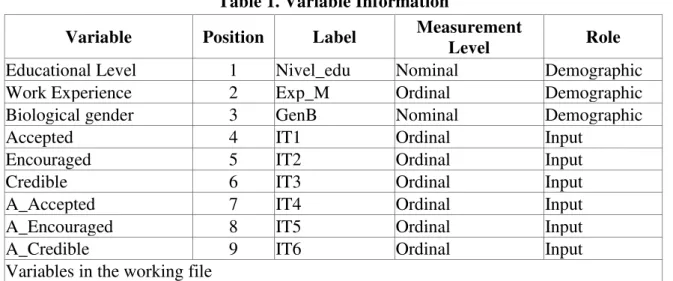
“Educational Level” and “Biological Gender” - and three pairs of dependent variable (acceptance, encouraging, trust / credibility) reflecting the perception of the subjects participating in the study, on the relationship established with the community, as follows from the table 1.
Table 1. Variable Information
Variable Position Label Measurement
Level Role
Educational Level 1 Nivel_edu Nominal Demographic
Work Experience 2 Exp_M Ordinal Demographic
Biological gender 3 GenB Nominal Demographic
Accepted 4 IT1 Ordinal Input
Encouraged 5 IT2 Ordinal Input
Credible 6 IT3 Ordinal Input
A_Accepted 7 IT4 Ordinal Input
A_Encouraged 8 IT5 Ordinal Input
A_Credible 9 IT6 Ordinal Input
Variables in the working file
247
4. RESULTS
4. 1. Basic statistical inventory analysis
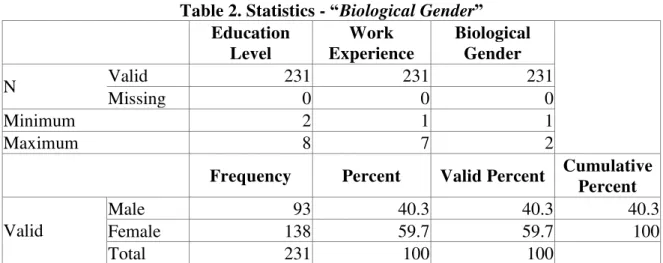
The basic statistical inventory for the variable “Biological Gender” is presented in the table 2.
Analysis of the scores distribution for this variable was conducted for 231 subjects. Scores amplitude is one point, situated between the minimum value 1 (male) and a maximum value 2 (female). The study includes 93 males and 138 females.
Table 2. Statistics - “Biological Gender”
Education Level
Work Experience
Biological Gender
N Valid 231 231 231
Missing 0 0 0
Minimum 2 1 1
Maximum 8 7 2
Frequency Percent Valid Percent Cumulative Percent
Valid
Male 93 40.3 40.3 40.3
Female 138 59.7 59.7 100
Total 231 100 100
Source: Data processing by the authors
4. 2. Testing working assumptions
The nature of relationship established between individuals and the community is evidenced by testing the working assumptions, simultaneously for each pair of questions. Thus, to find out if are significant differences between the studied variables values (acceptance, encouragement, credibility), we will use the method of comparing means ( andor, 2012). The answers are situated on a 5 point Likert scale, from 1 to 5, where 1 is unsatisfactory and 5 is very good (Likert, 1935).
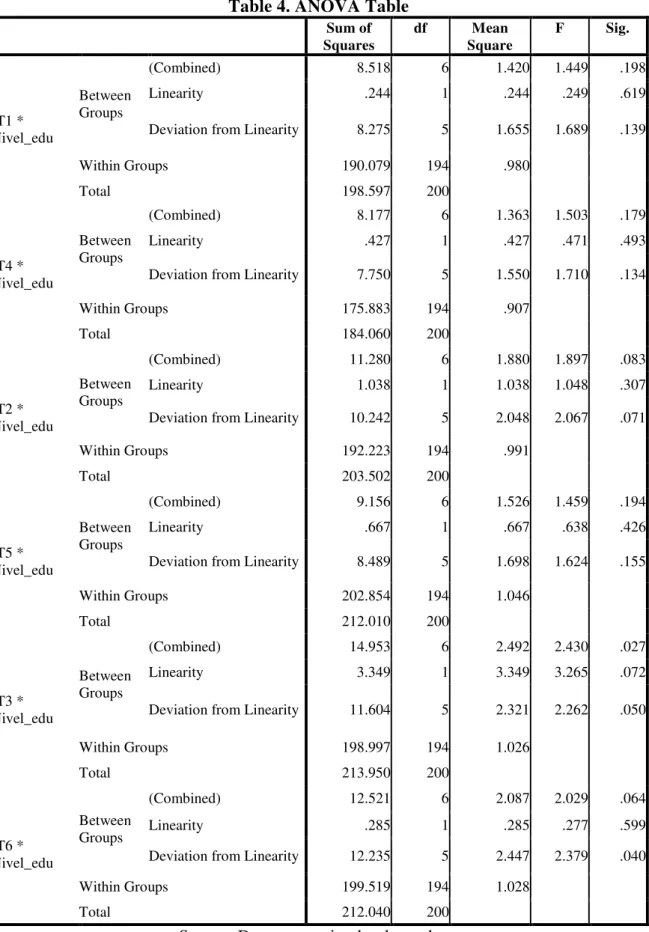
In the purpose to obtain an conclusive result, processing the dates in IBM SPSS application, we will perform the analysis of the three variables grouped by demographic variable
“Education Level”. To see to what extent the observed differences are significant, we will chose to do an analysis of variance (ANOVA) and a linearity test ( andor, 2012).
Data processing results are presented in table 3. Comparing the means values for each response category, we find that subjects participating in the study, believes that better respond to community needs to be accepted, encouraged / credible, than the community respond to their similar needs.
248
Table 3. Report
Nivel_edu IT1 IT4 IT2 IT5 IT3 IT6
High School
Mean 3.38 3.50 2.88 3.50 2.75 3.63
N 8 8 8 8 8 8
Minimum Unsatisfying Satisfying Unsatisfying Unsatisfying Unsatisfying Satisfying
Maximum Very good Very good Very good Very good Good Very good
% of Total N 4.0% 4.0% 4.0% 4.0% 4.0% 4.0%
Postliceal
Mean 2.00 2.60 1.20 2.20 1.40 2.40
N 5 5 5 5 5 5
Minimum Unsatisfying Unsatisfying Unsatisfying Unsatisfying Unsatisfying Unsatisfying
Maximum Moderate Very good Satisfying Good Satisfying Good
% of Total N 2.5% 2.5% 2.5% 2.5% 2.5% 2.5%
Licensed
Mean 2.93 3.18 2.34 3.03 2.74 3.13
N 68 68 68 68 68 68
Minimum Unsatisfying Unsatisfying Unsatisfying Unsatisfying Unsatisfying Unsatisfying
Maximum Very good Very good Very good Very good Very good Very good
% of Total N 33.8% 33.8% 33.8% 33.8% 33.8% 33.8%
Master Degree
Mean 2.86 3.07 2.36 3.14 2.71 3.00
N 14 14 14 14 14 14
Minimum Satisfying Unsatisfying Unsatisfying Unsatisfying Unsatisfying Unsatisfying
Maximum Good Good Good Very good Good Good
% of Total N 7.0% 7.0% 7.0% 7.0% 7.0% 7.0%
Postgraduate
Mean 3.00 3.39 2.37 3.13 2.67 3.32
N 76 76 76 76 76 76
Minimum Unsatisfying Unsatisfying Unsatisfying Unsatisfying Unsatisfying Unsatisfying
Maximum Very good Very good Very good Very good Very good Very good
% of Total N 37.8% 37.8% 37.8% 37.8% 37.8% 37.8%
MBA
Mean 2.00 2.00 2.00 2.00 2.00 1.50
N 2 2 2 2 2 2
Minimum Unsatisfying Unsatisfying Unsatisfying Unsatisfying Unsatisfying Unsatisfying
Maximum Moderate Moderate Moderate Moderate Moderate Satisfying
% of Total N 1.0% 1.0% 1.0% 1.0% 1.0% 1.0%
Doctorate
Mean 3.07 3.29 2.64 3.29 3.14 3.29
N 28 28 28 28 28 28
Minimum Unsatisfying Unsatisfying Unsatisfying Unsatisfying Unsatisfying Unsatisfying
Maximum Very good Very good Very good Very good Very good Very good
% of Total N 13.9% 13.9% 13.9% 13.9% 13.9% 13.9%
Total
Mean 2.96 3.25 2.38 3.10 2.73 3.20
N 201 201 201 201 201 201
Minimum Unsatisfying Unsatisfying Unsatisfying Unsatisfying Unsatisfying Unsatisfying
Maximum Very good Very good Very good Very good Very good Very good
% of Total N 100.0% 100.0% 100.0% 100.0% 100.0% 100.0%
Source: Data processing by the authors
249
Analysing the values obtained as a result of analysis of variance (ANOVA), we will find that differences of perceptions of participants in the study are insignificant, Sig value is greater than threshold value of 0.05 (Table 4).
Table 4. ANOVA Table
Sum of Squares
df Mean
Square
F Sig.
IT1 * Nivel_edu
Between Groups
(Combined) 8.518 6 1.420 1.449 .198
Linearity .244 1 .244 .249 .619
Deviation from Linearity 8.275 5 1.655 1.689 .139
Within Groups 190.079 194 .980
Total 198.597 200
IT4 * Nivel_edu
Between Groups
(Combined) 8.177 6 1.363 1.503 .179
Linearity .427 1 .427 .471 .493
Deviation from Linearity 7.750 5 1.550 1.710 .134
Within Groups 175.883 194 .907
Total 184.060 200
IT2 * Nivel_edu
Between Groups
(Combined) 11.280 6 1.880 1.897 .083
Linearity 1.038 1 1.038 1.048 .307
Deviation from Linearity 10.242 5 2.048 2.067 .071
Within Groups 192.223 194 .991
Total 203.502 200
IT5 * Nivel_edu
Between Groups
(Combined) 9.156 6 1.526 1.459 .194
Linearity .667 1 .667 .638 .426
Deviation from Linearity 8.489 5 1.698 1.624 .155
Within Groups 202.854 194 1.046
Total 212.010 200
IT3 * Nivel_edu
Between Groups
(Combined) 14.953 6 2.492 2.430 .027
Linearity 3.349 1 3.349 3.265 .072
Deviation from Linearity 11.604 5 2.321 2.262 .050
Within Groups 198.997 194 1.026
Total 213.950 200
IT6 * Nivel_edu
Between Groups
(Combined) 12.521 6 2.087 2.029 .064
Linearity .285 1 .285 .277 .599
Deviation from Linearity 12.235 5 2.447 2.379 .040
Within Groups 199.519 194 1.028
Total 212.040 200
250
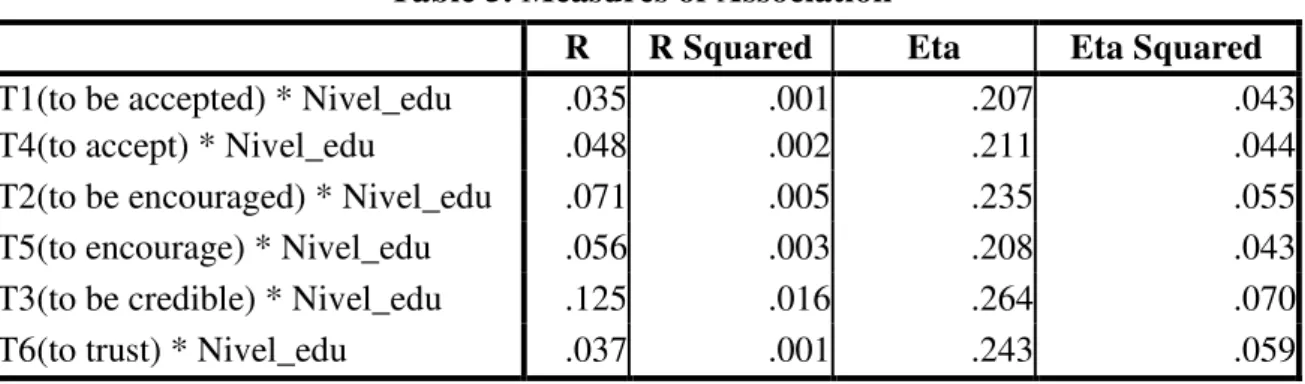
In table 5, Measures of Association, we find that the level of education leads in a very low proportion on refining the answer preferences, for each category of questions (the proportion varies between 4,3% and 7%) .
Table 5. Measures of Association
R R Squared Eta Eta Squared
IT1(to be accepted) * Nivel_edu .035 .001 .207 .043
IT4(to accept) * Nivel_edu .048 .002 .211 .044
IT2(to be encouraged) * Nivel_edu .071 .005 .235 .055
IT5(to encourage) * Nivel_edu .056 .003 .208 .043
IT3(to be credible) * Nivel_edu .125 .016 .264 .070
IT6(to trust) * Nivel_edu .037 .001 .243 .059
Source: Data processing by the authors
In this situation we must accept that perception of subjects about the mutual relationships established in relations with their community is not sufficiently clearly outlined at the time of the survey. We will accept the null hypothesis according to, there are insignificant differences between the answer preferences of the participants in the study (for each pair of response). In other words, there are no significant differences between the need to be accepted or accepting the community, the need to be encouraged or to encourage the community, the need to be credible or trusting in their community.
CONCLUSIONS
The concerns about understanding the relationships that naturally lead to interconnection of individuals of a community are subscribed to our approach of understanding the mechanism of functioning of small communities and concerns regarding the improving managerial skills of persons called upon to administer social economy enterprises. Ability to communicate facilitate the establishment of healthy relationships, acceptance and trust among individuals with different opinions and moral norms and values, thus reducing the distance between people and creating prerequisites for harmonious development of communities or organizations. It is proved that acceptance of differences between people do not lead to impoverishment, but rather enrichment (not only) of the relationships between people.
The study that we have presented, leads us to conclude that the subjects, participating in the study, do not have a very clear perception, at the time of the study, on relationships of mutual acceptance and trust in relation to the community in which they live.
The three essential needs of individuals, which were analysed - the need to be accepted and to accept, the need to be encouraged (to act) and encourage, the need to be believed (credible) and trusts in others - underlying the emergence of germs of trust capital that ensure the cohesion of a community, be it family, school or social economy enterprise. This capital is both, source and resource for sustainable and responsible development, locally and regionally.
251
relationships established by the participants in the study with their communities and motivation regarding the involvement in the life of the communities in which they live.
Thereby, we aim to identify any latent manifestations of assuming social responsibilities in local communities, possibly in economic structures of social economy, which will allow us to better understand the human relationships and to offer a viable solution to improve the management of social economy enterprises.
REFERENCES
Clocotici, V., & Stan, A. (2000). Statistică aplicatăîn psihologie. Editura Polirom, Ia i
Likert, R. (1932). A technique for the measurement of attitudes. Archives of psychology. Moscovici, S., & Buschini, F. (2007). Metodologia tiințelor socioumane. Ia i: Polirom. Popescu, D. (2015). Crowdsourcing: An Alternative for the Dynamic Development of
Entrepreneurship in the Romanian Tourism. Amfiteatru Economic, 17(38), 162.
Popescu, D., Nicolae, V., & Pavel, I. (2016). Empirical Research of the Knowledge Degree of Social Economy Enterprises in Stable Micro-communities. European Journal of Sustainable Development, 5(4), 94-106. doi: 10.14207/ejsd.2016.v5n4p94
Popescu, L. G. (2011). Capitalul social-demers strategic pentru o guvernanță locală viabilă?.
Revista Transilvană de tiințe Administrative, 13(29), 139-154
Schumacher, E. F. (2011). Small is beautiful: A study of economics as if people mattered. Random House.
Schneider, S., Gräf, B., & Peter, M. (2010). Homo economicus–or more like Homer Simpson?. Deutsche Bank Research.
Şandor, S. D. (2013). Metode şi tehnici de cercetare în ştiinţele sociale. Tritonic.
Voicu, B., Rusu, H. M., & Popa, A. E. (2015). Este Romania altfel? Societatea si sociologia... incotro?.