Identification of biomarkers for
periodontal disease using the
immunoproteomics approach
Jesinda P. Kerishnan1, Sani Mohammad2, Muhamad Shaifunizam Alias2, Alan Kang-Wai Mu3, Rathna Devi Vaithilingam4,
Nor Adinar Baharuddin4, Syarida H. Safii4, Zainal Ariff Abdul Rahman5, Yu Nieng Chen6and Yeng Chen1,7
1Department of Oral Science & Craniofacial, Faculty of Dentistry, University of Malaya, Kuala Lumpur, Malaysia
2Faculty of Dentistry, University of Malaya, Kuala Lumpur, Malaysia
3Laboratory of Biotechnology, Institute of Win Men Biotech, Sungai Bakap, Pulau Pinang, Malaysia
4Department of Restorative Dentistry, Faculty of Dentistry, University of Malaya, Kuala Lumpur, Malaysia
5Department of Oro-Maxillofacial Surgical & Medical Sciences, Faculty of Dentistry, University of Malaya, Kuala Lumpur, Malaysia
6Chen Dental Specialist Clinic, Kuching, Sarawak, Malaysia
7Oral Cancer Research and Coordinating Centre, Faculty of Dentistry, University of Malaya, Kuala Lumpur, Malaysia
ABSTRACT
Background: Periodontitis is one of the most common oral diseases associated with the host’s immune response against periodontopathogenic infection. Failure to accurately diagnose the stage of periodontitis has limited the ability to predict disease status. Therefore, we aimed to look for reliable diagnostic markers for detection or differentiation of early stage periodontitis using the immunoprotemic approach. Method: In the present study, patient serum samples from four distinct stages of periodontitis (i.e., mild chronic, moderate chronic, severe chronic, and aggressive) and healthy controls were subjected to two-dimensional gel electrophoresis (2-DE), followed by silver staining. Notably, we consistently identified 14 protein clusters in the sera of patients and normal controls.
Results: Overall, we found that protein levels were comparable between patients and controls, with the exception of the clusters corresponding to A1AT, HP, IGKC and KNG1 (p < 0.05). In addition, the immunogenicity of these proteins was analysed via immunoblotting, which revealed differential profiles for periodontal disease and controls. For this reason, IgM obtained from severe chronic periodontitis (CP) sera could be employed as a suitable autoantibody for the detection of periodontitis. Discussion:Taken together, the present study suggests that differentially expressed host immune response proteins could be used as potential biomarkers for screening periodontitis. Future studies exploring the diagnostic potential of such factors are warranted.
Subjects Molecular Biology, Dentistry
Keywords Immunoblotting, Biomarker, Proteomics, Periodontal disease, Serum immunogenic protein, Two-dimensional electrophoresis
Submitted27 April 2016 Accepted14 July 2016 Published24 August 2016 Corresponding author
Yeng Chen, [email protected]
Academic editor
Praveen Arany
Additional Information and Declarations can be found on page 15
DOI10.7717/peerj.2327
Copyright 2016 Kerishnan et al.
Distributed under
INTRODUCTION
Periodontitis, a chronic inflammatory condition in periodontal supporting structures, is the most common oral inflammatory disease and presents a dental biofilm as its primary etiology (Lo¨e, Theilade & Jensen, 1965). A harmonious balance between the microbiota present in the dental biofilm and host immunity is a sign of periodontal health. However, when this relationship is disturbed by an over stimulated or diminished immune response toward periodontopathogens, periodontitis develops and may ultimately lead to tooth loss (Bartold & Van Dyke, 2013).
There are two major forms of periodontitis, chronic periodontitis (CP) and aggressive periodontitis (AP) (Armitage, 1999). CP is a slowly progressing disease, which can be categorized as mild/early, moderate or severe based on clinical criteria, such as probing pocket depth (PPD) and clinical attachment loss (CAL) (Armitage, 1999;Eke et al., 2012;Wiebe & Putnins, 2000). CP has a high prevalence, with approximately 40% of patients suffering from moderate forms and 8% diagnosed with severe forms (Albandar, Brunelle & Kingman, 1999;Eke et al., 2012). In contrast, AP differs from CP based on the rapid rate of disease progression in an otherwise clinically healthy patient, absence of large accumulations of plaque/calculus, and familial aggregation of diseased individuals (Armitage, 1999). AP is known to occur in 1–3% of the population (Susin, Haas & Albandar, 2014).
Traditional diagnostic procedures (e.g., visual examination, tactile sensation, PPD, CAL, plaque index, bleeding on probing, and radiographic assessment of alveolar bone loss) are still currently practised and considered to be fundamental for diagnosis (Hatem, 2012). That being said, the standard protocol for measuring CAL and PPD using a manual probe was first described more than five decades ago, and very little has changed since 1959 (Kinney, Ramseier & Giannobile, 2007). Although, such procedures might measure accumulated previous disease at a specific site (Ramfjord, 1959), they lack accuracy and are unable to predict ongoing disease activity (Chapple, 1997). For this reason, there remains a fundamental need to develop accurate, precise, and reproducible biomarkers to diagnose periodontal disease, similar to those used in medical disciplines (Preshaw, 2009).
Immunoglobulin M (IgM) is a natural antibody that can bind to specific antigens to which the host has never been exposed (Avrameas, 1991;Casali & Schettino, 1996;Coutinho, Kazatchkine & Avrameas, 1995;Pereira et al., 1986). This natural immunoglobulin exhibits traits that permit it to bind to antigens as they invade, resulting in complement activation as a first line defence mechanism. Moreover, IgM displays multi-valency and naturally high avidities (Coutinho, Kazatchkine & Avrameas, 1995;
Fearon & Locksley, 1996;Tlaskalova´-Hogenova´ et al., 1991). Therefore, low-level antigenic or immunogenic proteins are known to drive IgM-induced immune responses (Lin et al., 2007). In this regard, the participation of IgM in the early recognition of bacteria in periodontal disease has been demonstrated (Vollmers & Bra¨ndlein, 2006).
included within the immunoproteome, from immunoglobulins to bone remodelling proteins. For this reason, the use of immunoproteomic approaches in combination with current clinical examination tools could lead to the development of more reliable and effective diagnostic methods to differentiate AP and CP patients. Therefore, this study aims to use two-dimensional gel electrophoresis (2-DE) and immunoblotting approaches to identify immunogenic proteins with diagnostic potential in sera from patients with periodontitis.
MATERIALS AND METHODS
Clinical samplesSerum samples were obtained from the Malaysian Periodontal Database and Biobank System (MPDBS) (Vaithilingam et al., 2015) (University of Malaya, Kuala Lumpur, Malaysia) with approval from the Ethics Committee of the Faculty of Dentistry, University of Malaya (DF PE1103/0037(L)). The study was conducted in accordance with International Conference on Harmonisation Good Clinical Practice (ICH-GCP) guidelines and the Declaration of Helsinki. Subjects were systemically healthy individuals who had at least 12 teeth present (excluding third molars). Subjects, who had received periodontal treatment or antibiotics within the past four months or were pregnant at the time of recruitment were excluded from the study. All examinations on the subjects were conducted by a qualified examiner. Written informed consent was obtained from all subjects. In this study, a total of 90 serum samples were collected, which included 42 healthy controls and 48 patient specimens (collected from 9 mild CP, 12 moderate CP, 19 severe CP (Eke et al., 2012), and 8 AP (Van Der Velden, 2005) patients).
Samples collection and preparation
Collected samples were divided, classified, and labelled based on the representative stages of periodontitis (i.e., healthy, mild CP, moderate CP, severe CP, and AP). The stages of periodontitis were classified through clinical diagnostic criteria such as PPD and CAL, which was based on the suggested CDC-AAP (Center for Disease Control & Prevention– American Academy of Periodontology) case definitions (Eke et al., 2012). The samples were pooled together by form of periodontitis (10ml each) into separate microcentrifuge tubes for later use as primary antibodies in the immunoproteomic assay. All samples were stored at a constant temperature of-20C for further analysis through 2-DE.
Two-dimensional electrophoresis (2-DE)
polyacrylamide gels. A previously described silver staining method was used to develop the 2-DE gels (Heukeshoven & Dernick, 1988), and a modified silver staining technique was used for mass spectrometry (MS) analysis (Snevechenko et al., 1996). All samples were analysed in duplicate.
Image and statistical analysis
The ImageQuantTMLAS500 (GE Healthcare Bioscience, Uppsala, Sweden) was used to visualize and store the silver-stained 2-DE gel images. Detection, matching, and quantification of the distinct protein spots were performed using the Image Master 2D Platinum Software, version 7.0 (GE Healthcare Bioscience, Uppsala, Sweden). Normalization was subsequently performed to evaluate proteins that were differentially expressed in the serum by correcting the spot quantification values and gel-to-gel variation unrelated to expression changes. This was achieved by taking into account total densities from the gel images (i.e., raw quantity of each gel spot was divided by the total quantity of all spots within the gel). The percentage of a given protein taken against total spot volume of all proteins (including the unresolved peptides) in the gel was calculated to give a percent of volume contribution (vol%) (Chen et al., 2008). All protein concentration values are presented as means of percentage volume (% volume) ± standard deviations (SD). Statistical analysis was done using the Student’st-test to analyse differences between controls and patients. A p-value of less than 0.05 (p < 0.05) was considered to be statistically significant.
Mass spectrometry analysis and database search
experimentally determined masses was calculated and assigned. These analyses were conducted using the International Protein Index (http://www.ebi.ac.uk/IPI) and NCBI Unigene human databases (version 3.38). A score of > 82 was considered to be significant in the MASCOT NCBI database.
Immunoblotting
The 2-DE analysed sera were grouped into 25 categories based on immunoblotting with primary antibodies (pooled sera) from healthy controls and the four stages of periodontitis (Table 1). The Trans-blotÒ
TurboTMTransfer Starter System (Biorad Inc., Berkeley, CA, USA) was used to transfer the separated proteins from the 2-DE gels onto nitrocellulose membranes (0.45 mm) (Biorad Inc., Berkeley, CA, USA). Blotted nitrocellulose membranes were then blocked using Superblock (Pierce, Rockford, IL, USA) for 1 h and subsequently incubated overnight (4C) with IgM (pooled sera
from patients or controls that contain the primary antibodies against various targets) as shown inTable 1. After incubation, membranes were washed three times (5 min each)
Table 1 Incubation of the 2-DE blotted nitrocellulose membranes with sera of patients or controls (as primary antibody) was conducted overnight (4) prior to monoclonal anti-human IgM-HRP.
Category Patient sera Probed primary antibody (pooled sera)
1 Normal Normal
2 Normal Mild chronic periodontitis
3 Normal Moderate chronic periodontitis
4 Normal Severe chronic periodontitis
5 Normal Aggressive periodontitis
6 Mild chronic periodontitis Normal
7 Mild chronic periodontitis Mild chronic periodontitis
8 Mild chronic periodontitis Moderate chronic periodontitis 9 Mild chronic periodontitis Severe chronic periodontitis 10 Mild chronic periodontitis Aggressive periodontitis 11 Moderate chronic periodontitis Normal
12 Moderate chronic periodontitis Mild chronic periodontitis 13 Moderate chronic periodontitis Moderate chronic periodontitis
14 Moderate chronic periodontitis Severe chronic periodontitis 15 Moderate chronic periodontitis Aggressive periodontitis 16 Severe chronic periodontitis Normal
17 Severe chronic periodontitis Mild chronic periodontitis 18 Severe chronic periodontitis Moderate chronic periodontitis 19 Severe chronic periodontitis Severe chronic periodontitis 20 Severe chronic periodontitis Aggressive periodontitis
21 Aggressive periodontitis Normal
with TBS-T (Tris-buffered saline Tween-20, pH 7.5). The membranes were then incubated with monoclonal anti-human IgM conjugated to horseradish peroxidase (HRP)
(Invitrogen, Carlsbad, CA, USA) at a dilution of 1:6,000 for 1 h at room temperature. Finally, the membranes were developed with chemmiluminescent (ECL) substrate (Pierce Rockford, IL, USA) and visualized with ImageQuant LA500 (GE Healthcare Bioscience, Uppsala, Sweden).
Functional annotation enrichment and protein interaction analysis Functional annotation enrichment and protein interactions were performed using web-based bioinformatics tools. DAVID v6.7 (Database for Annotation, Visualization and Integrated Discovery;http://david.abcc.ncifcrf.gov) was used for protein functional enrichment analysis. DAVID v6.7 is a web-based integrated biological knowledgebase and analytical tool that systematically extracts biological meaning from large lists of genes and proteins (Huang, Sherman & Lempicki, 2008). This functional annotation was considered to be significant when a p-value of less than 0.05 (p < 0.05) was obtained. Furthermore, the identified proteins were evaluated using STITCH v4.0 (Search Tool for the Retrieval of Interacting Genes;http://david.abcc.ncifcrf.gov), which is a web-based resource to explore known and predicted interactions between proteins and chemicals (Kuhn et al., 2008). Furthermore, the proteins found to be differently expressed in this study were subjected to Ingenuity Pathway Analysis (IPA), which was used to identify their relationships with other protein networks within the knowledge database through computational algorithms. The highest-scoring networks were analysed to extract relationships between pathways that might link candidate proteins to one another.
RESULTS AND DISCUSSION
Image analysis of 2-DE serum protein profiling
High-resolution serum proteome profiles from normal controls and periodontitis patients (i.e., mild CP, moderate CP, severe CP, and AP) were obtained through 2-DE separation and silver staining of unfractionated serum samples. Fourteen major protein clusters were consistently resolved in all 2-DE silver-stained profiles. Representative 2-DE serum protein profiles from all categories of periodontitis patients and controls are presented inFig. 1.
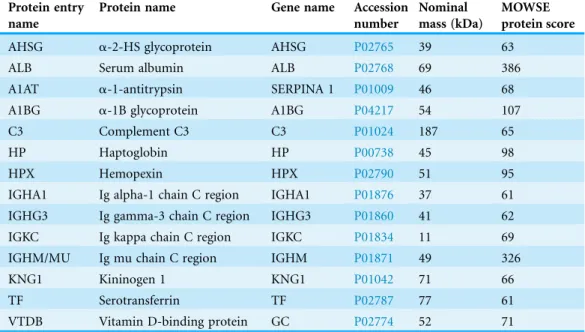
Identification of expressed biomarkers using mass spectrometry The identity of the 2-DE detected proteins was further verified by subjecting the protein spot clusters to MALDI-TOF/TOF analysis, followed by database searches. The protein clusters were identified as albumin (ALB),a2-HS glycoprotein (AHSG),
accession number, nominal mass and MOWSE protein score for each protein are presented inTable 2.
We further analysed the average percentage of volume contributions of the 14 serum proteins detected in control and periodontitis samples. Overall, we found that protein levels were comparable in periodontitis patients and controls, with the exception of A1AT, HP, IGKC, and KNG1 (Fig. 2). Notably, KNG1 expression was significantly lower in severe
A)
B)
C)
D)
E)
CP and AP patients. On the other hand, A1AT was decreased by two-fold in AP patients, and HP was decreased in moderate CP, severe CP and AP. In fact, the fold changes (down regulation) of these factors in distinct stages of periodontitis were as follows: 0.42, 0.53, 0.52, 0.79, 0.68 and 0.67, respectively (p < 0.05). Interestingly, the level of HP was increased in mild CP patients, whereas IGKC was the only protein significantly increased in severe CP patients (fold up-regulation: 1.46 and 1.28, respectively; p < 0.05). Thus, these aberrantly expressed proteins might represent effective candidate biomarkers for use in the development of future diagnostic tools for periodontitis disease.
Differently expressed proteins in periodontits patients
The comparative analysis performed in this study revealed down regulation of A1AT, HP, and KNG1 in different categories of periodontitis. The expression of these three proteins was significantly lower in AP, while only HP and KNG1 showed low expression in severe CP. On the other hand, HP was the only protein found to be significantly diminished in moderate CP.
KNG1 belongs to a group of thiol protease inhibitors known as kininogens, which act as inflammatory mediators and cause an increase in vascular permeability to release prostaglandin, another important regulator of inflammation (Iarovaia, 2000). Our data suggest that sera from patients with severe CP and AP physiologically lacked KNG1. This loss of KNG1 from patient sera might be due to the association of kinins (released from kininogens) with tissue kallikrein. In this regard, the release of kinins from kinninogens is triggered by neutrophil elastase and could result from immune recognition of periodontopathogens (Imamura, Potempa & Travis, 2004).
HP is encoded by theHPgene in humans (Dobryszycka, 1997;Wassell, 1999). It is commonly considered as an acute-phase reactant and participates in haemoglobin
Table 2 Mass spectrometric identification of host-specific protein spot clusters from serum protein profiles using the MASCOT search engine and the SWISS-PROT database accessed on 30.11.2014. Protein entry
name
Protein name Gene name Accession number
Nominal mass (kDa)
MOWSE protein score
AHSG a-2-HS glycoprotein AHSG P02765 39 63
ALB Serum albumin ALB P02768 69 386
A1AT a-1-antitrypsin SERPINA 1 P01009 46 68
A1BG a-1B glycoprotein A1BG P04217 54 107
C3 Complement C3 C3 P01024 187 65
HP Haptoglobin HP P00738 45 98
HPX Hemopexin HPX P02790 51 95
IGHA1 Ig alpha-1 chain C region IGHA1 P01876 37 61
IGHG3 Ig gamma-3 chain C region IGHG3 P01860 41 62
IGKC Ig kappa chain C region IGKC P01834 11 69
IGHM/MU Ig mu chain C region IGHM P01871 49 326
KNG1 Kininogen 1 KNG1 P01042 71 66
TF Serotransferrin TF P02787 77 61
binding in blood (Ebersole et al., 1997;Kapralov et al., 2009). In addition, HP plays a role in host defence towards pathogens (Eaton, Brandt & Lee, 1982). Our analysis of patient sera revealed that HP expression distinctly correlated with the stage of periodontitis. Indeed, HP levels were higher in mild CP patients and gradually decreased with disease progression. The high levels of HP in mild CP may result from initial bacterial
pathogenicity in periodontal tissues. In contrast, decreased HP expression in advanced stages of periodontitis could be caused by formation of haemoglobin–haptoglobin complexes that make haemoglobin iron unavailable to bacterial iron-binding proteins (Eaton, Brandt & Lee, 1982). In addition, the correlative expression of HP may reflect the acute phase response of the body (Chen, Lim & Hashim, 2009). Taken together, these findings highlight the potential prognostic value of HP for monitoring the progress of CP.
A1AT is a serine protease inhibitor (Saunders et al., 2012) that contributes to host defence against invading pathogens by inhibiting their proteolytic enzymes (Carrell, 1986;
0 1 2 3 4 5 6 7 8 9 10
N E M S A
M e a n % o f v o lum e c o n tribuo n
Stages of periodons HP
*
*
*
*
0 0.2 0.4 0.6 0.8 1 1.2 1.4 1.6 1.8 2N E M S A
Mean % of v o lume con tr ibu on
Stages of periodons KNG
*
*
0 1 2 3 4 5N E M S A
M e a n % o f v o lum e c o n tribuo n
Stages of periodons AAT
*
0 5 10 15 20 25 30 35N E M S A
M e a n % o f v o lum e c o n tribuo n
Stages of periodons IGKC
*
Figure 2 Percentage of volume contribution (vol%) of significantly detected protein clusters in controls (N), and periodontis patient (mild/ early chronic periodontitis (E), moderate chronic periodontitis (M), severe chronic periodontitis (S), and aggressive periodontitis (A)).
Starkey & Barrett, 1977). Our data reveal that A1AT levels are decreased by two fold in AP patients, which could be due to the capacity of the periodontopathogens to produce proteolytic enzymes that deplete A1AT. Interestingly, our finding is consistent with a previous report onPorphyromonas gingivalis, which is present in deep periodontal pockets of periodontitis patients (Carlsson et al., 1984).
IGKC functions as an antigen-binding agent in humans, and therefore selectively interacts with immunogens. IGKC binding can subsequently alter the biological activity of an antigen. In addition, IGKC is involved in complement activation for direct killing of microbes, immune regulation, and disposal of immune complexes (Gottlieb et al., 1970). This might provide a functional explanation for the higher amounts of IGKC seen in severe CP and AP patients.
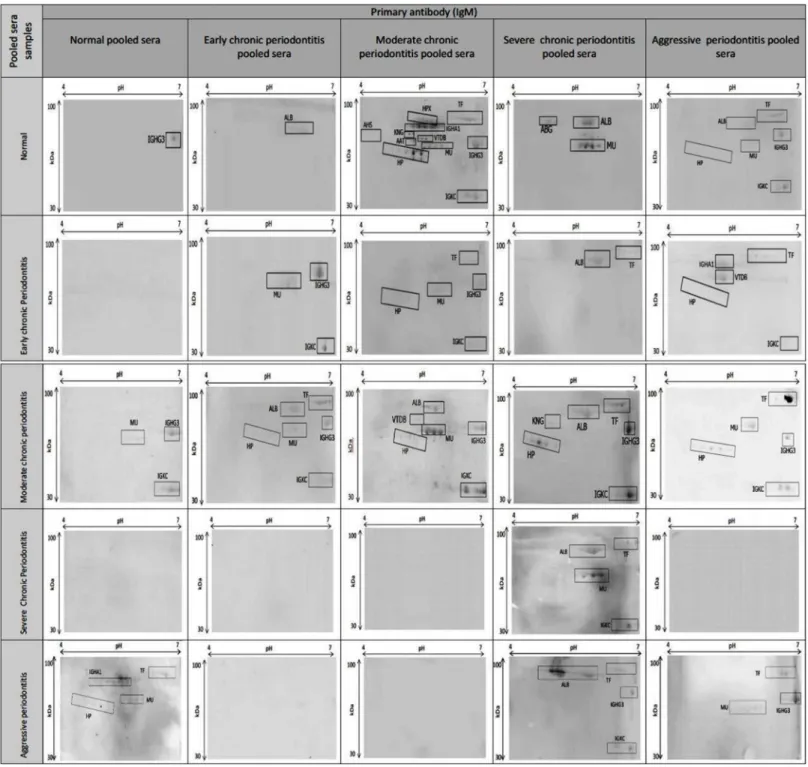
Immunogenic protein identification through 2-DE immunoblotting In order to further investigate the immunoproteomics analyses, 2-DE immunobloting using periodontitis and normal control sera was performed according to the 25 conditions listed in Table 1. The use of normal sera against normal and periodontitis sera was to verify that reactions were restricted to periodontitis. Notably, only IGHG3 was detected in the normal control.
IgM antibodies are secreted by B cells upon stimulation with primary antigen and are important for initial defence mechanisms (Boes et al., 1998). In this regard, IgM is capable of recognizing several pathogens, including lymphocytic choriomeningitis virus (LCMV),Listeria monocytogenes, vaccinia virus (vacc-WR), and vesicular stomatitis virus (VSV) (Boes, 2000). Therefore, the identification of immunogenic proteins recognized by IgM in patient sera could allow for the early detection of periodontitis with high specificity and sensitivity.
The use of 2-DE immunoblots and MS identification confirmed that all of the observed proteins were host-specific. In addition, it revealed that the immunoblot profiles were distinctive for periodontitis patients and controls, with the exception of categories 6, 16, 17, 18, 20, 22, and 23 (Table 1). The proteins in these categories were not reactive to IgM in the natural condition.Figure 3illustrates the presence of immunogenic proteins within each category. Based on this immunobloting technique, we found that HP, IGKC, and IGHM of moderate CP were immunoreactive towards the primary antibody (IgM). On the other hand, ALB, HPX, IGHM, and IGKC could be detected in category 19, which corresponded to severe CP serum probed with sever CP IgM.
controls. This indicates that these proteins could be used as potential biomarkers to diagnose and differentiate the stages of periodontitis, improving the accuracy of current methods.
proteins presented high immunoreactivity to the IgM, suggesting that they are common proteins recognized by the autoantibody.
Functional annotation and protein interaction analysis
Functional annotation analysis was performed for our 14 candidate host-specific proteins using DAVID v6.7 and IPA. The associated gene ontology (GO) terms (i.e., biological process, cellular component and molecular function) were annoted based on the database. Additionally, in order to further investigate the signalling pathways of the identified proteins, the Kyoto Encyclopedia of Genes and Genomes (KEGG) database was used to perform pathway annotation and enrichment analysis. Indeed, significant categories could be identified through the expression analysis systemic explorer (EASE) score, which is a modified Fisher Exact p-value (threshold of significance set at p < 0.05). IPA analysis identified three significant networks with scores of 18, 3 and 3, respectively (Table 4). The highest-scoring network, which comprises 14 of the identified proteins in our study, included the following functional processes: inflammatory response, cellular growth, proliferation, and cellular function/maintenance. The remaining two networks showing significant scores involved processes such as cell death and survival, cellular assembly/organization and disease (i.e., cancer, gastrointestinal disease, and hepatic disease).
Analysis of GO biological processes revealed that A1AT, AHSG, C3, KNG1, and TF are involved in host defence, inflammatory response, acute inflammation, and wound responses. Based on the KEGG pathway analysis, we found that A1AT, KNG1 and C3 were also associated with the complement and coagulation cascades. The complement system is a known mediator of innate immunity and constitutes a non-specific defence mechanism against pathogens (Markiewski et al., 2007). Furthermore, IPA analysis revealed that nine proteins identified in our study are associated with the inflammatory response, cellular growth/proliferation, and cellular function/ maintenance (Table 4). All of these annotations are consistent with the immediate response of the host to infection or injury in periodontal disease. Therefore, since it is known that periodontal disease is mediated by host defence and the inflammation (Cekici et al., 2014), these findings emphasize the role of these identified proteins in periodontitis.
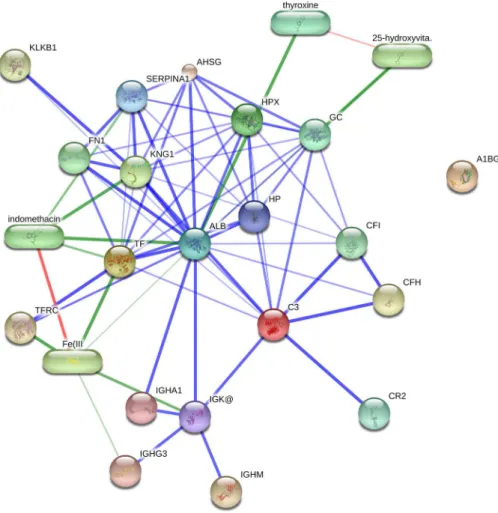
In addition, STITCH v4.0 was employed to identify binding partners for the proteins identified in this study and to generate a protein interaction network (Fig. 4). STITCH v4.0 is a web-based resource to explore known and predicted
Table 3 Incubation of the 2-DE blotted nitrocellulose membranes with pool sera of SCP patients as primary antibody was conducted overnight at 4prior to monoclonal anti-human IgM-HRP.
Patients sera Primary antibody Immunogenic proteins detected
Normal SCP pooled sera ABG, ALB, IGHM
ECP SCP pooled sera ALB, TRF
MCP SCP pooled sera HP, KNG, ALB, TRF, IGHG3, IGKC
SCP SCP pooled sera ALB, TRF, IGHM, IGKC
Table 4 Functional annotation analysis of 14 identified proteins using the DAVID bioinformatics resource (DAVID v6.7).(A) Gene Ontology term. Top highest relevant enriched gene ontology terms with EASE score of p < 0.05 (a modified Fisher Exact p-Value) are listed for “Biological Process,” “Cellular Component,” and “Molecular Function,” respectively. (B) KEGG Pathway analysis by DAVID bioinformatics resource. (C) Functional enrichment analysis of 14 identified proteins using Ingenuity Pathway Analysis (IPA) a computational algorithms to identify networks consisting of proteins of interest and their interactions with other proteins in the knowledge database.
(A)
GO term Protein
count % EASE score Fold enrichment Benjamini score Protein ID Biological process
Defence response 6 46 7.02E-05 10.99 0.010341 AHSG, HP, KNG1, A1AT, C3, TF Inflammatory response 5 39 9.44E-05 17.34 0.009274 AHSG, KNG1, A1AT, C3, TF
Response to wounding 5 39 6.17E-04 10.63 0.025758 AHSG, KNG1, A1AT, C3, TF Acute inflammatory response 4 31 5.83E-05 46.01 0.017115 AHSG, A1AT, C3, TF
Cellular component
Extracellular region 12 92 1.42E-09 6.36 5.54E-08 ALB, A1BG, AHSG, VTDB, HP, HPX, IGHG3, IGHM, KNG1, A1AT, C3, I
Extracellular space 9 69 9.34E-09 13.99 1.82E-07 ALB, AHSG, VTDB, HP, HPX, KNG1, A1AT, C3, TF Extracellular region part 9 69 1.32E-07 9.99 1.72E-06 ALB, AHSG, VTDB, HP, HPX, KNG1, A1AT, C3, TF
Molecular function
Inhibitor activity 4 31 2.11E-04 29.85 0.012572 AHSG, KNG1, A1AT, C3 Peptidase inhibitor activity 4 31 2.47E-04 28.27 0.007385 AHSG, KNG1, A1AT, C3 Enzyme inhibitor activity 4 31 0.001297 16.03 0.019277 AHSG, KNG1, A1AT, C3 Antigen binding 3 23 9.80E-04 57.96 0.019424 IGHA1, IGHG3, IGHM, IGKC
(B)
Signalling pathway Protein count % EASE score Fold enrichment Benjamini score Protein ID
Complement and coagulation cascades
3 23 1.81E-04 73.69565 3.63E-04 KNG1, A1AT, C3
(C)
Top network Score Focus protein Protein ID
Inflammatory response, cellular growth and proliferation, cellular function and maintenance
18 9 ABCA1, ABCB1, AGER, AGT,AHSG,ALB, ANGPTL3, APOA1, APOA2, APOH, ARF6, BMX,C3, CANX, CCL4, CEBPB, CFTR, Cg, CLDN2, CPB2, CSH1/CSH2, DEFB103A/DEFB103B, EGFR, ELF3, FGFR2, Fibrinogen, FUT8, G6PC, GFER, HABP2, hemoglobin, HFE, HNF1A, HNF1B,HP,HPX, Iga,IGHM, IL1, ITCH, ITGAM, JAG1,KNG1, KRT17, LCN2, MBL2, miR-21-5p (and other miRNAs w/seed AGCUUAU), NFkB (complex), NR1H3, NR1H4, NR5A2, PIAS3, PLC gamma, PLD2, PPAP2B, PTPRS, RHOB, RNF31, SAA, SDC4,SERPINA1, TAB2, TAP1,TF, TFRC, TLR5, TLR, TLR9, TNFSF13B, WWP2
Cell death and survival, cellular assembly and organization, connective tissue disorders
3 1 FCGR2C,IGHG3
Cancer, gastrointestinal disease, hepatic system disease
interactions of proteins and chemicals. It integrates widely dispersed information found across numerous databases and the literature (e.g., interaction with metabolic pathways, results from binding experiments and drug-target relationships) to detect known and predicted interactions between proteins and chemicals through genomic context-based inferences and text-mining protocols (Kuhn et al., 2008). Based on this analysis, we identified interactions between the indentified proteins and factors associated with the complement and coagulation pathways (i.e., CF1, CFH, CR2, KLKB1 and FN1). These results further support data obtained from the DAVID and IPA analyses.
CONCLUSION
In the present study, we found that HP, KNG1, A1AT and IGKC were differentially expressed in sera collected from periodontal patients. Notably, the identification of these immunogenic proteins in patient sera could contribute to early detection of periodontitis with high specificity and sensitivity. Our findings also revealed that the
antibody extracted from patients with severe CP has the most immunogenic properties to classify the distinct stages of periodontitis. Therefore, our results suggest that these differentially expressed host immune response proteins might represent valuable biomarkers for periodontal screening, thereby improving the accuracy of current diagnostic methods to promote early delivery of therapeutic measures against periodontitis. Furthermore, the role of these proteins in host inflammatory and defence responses also highlights their importance as potential biomarkers for periodontal disease. Further study within clinically representative populations will be needed to validate these promising findings.
ACKNOWLEDGEMENTS
The authors would like to acknowledge the Malaysian Periodontal Database and Biobank System (MPDBS), University of Malaya, Kuala Lumpur, Malaysia for providing the serum samples of the periodontal diseases.
ADDITIONAL INFORMATION AND DECLARATIONS
Funding
This study was supported by the University of Malaya (UM)-High Impact Research (HIR)-the Ministry of Education (MoE) Grant UM/C/625/1/HIR/MOE/DENT/9, UM.C/ 625/1/HIR/MOHE/MED/16/5 and UM/C/625/1/HIR/MOE/DENT/4. The funders had no role in study design, data collection and analysis, decision to publish, or preparation of the manuscript.
Grant Disclosures
The following grant information was disclosed by the authors:
University of Malaya (UM)-High Impact Research (HIR)-the Ministry of Education (MoE): UM/C/625/1/HIR/MOE/DENT/9, UM.C/625/1/HIR/MOHE/MED/16/5 and UM/C/625/1/HIR/MOE/DENT/4.
Competing Interests
The authors declared that they have no competing interests. Yu Nieng Chen is an employee of Chen Dental Specialist Clinic, Kuching, Sarawak, Malaysia.
Author Contributions
Jesinda P. Kerishnan performed the experiments, analyzed the data, wrote the paper,
prepared figures and/or tables.
Sani Mohammad performed the experiments, wrote the paper.
Muhamad Shaifunizam Alias performed the experiments, wrote the paper.
Alan Kang-Wai Mu conceived and designed the experiments, performed the
experiments, analyzed the data, wrote the paper, prepared figures and/or tables.
Rathna Devi Vaithilingam contributed reagents/materials/analysis tools, reviewed drafts
Nor Adinar Baharuddin contributed reagents/materials/analysis tools, reviewed drafts
of the paper.
Syarida H. Safii contributed reagents/materials/analysis tools, reviewed drafts of the
paper.
Zainal Ariff Abdul Rahman contributed reagents/materials/analysis tools, reviewed
drafts of the paper.
Yu Nieng Chen analyzed the data, reviewed drafts of the paper.
Yeng Chen conceived and designed the experiments, analyzed the data, contributed
reagents/materials/analysis tools, wrote the paper, prepared figures and/or tables, reviewed drafts of the paper.
Human Ethics
The following information was supplied relating to ethical approvals (i.e., approving body and any reference numbers):
Serum samples were obtained from the Malaysian Periodontal Database and Biobank System (MPDBS), University of Malaya, Kuala Lumpur, Malaysia with approval from the Ethics Committee of the Faculty of Dentistry, University of Malaya (DF PE1103/0037(L)).
Data Deposition
The following information was supplied regarding data availability: MASCOT search engine and SWISS-PROT database.
Accession numbersP02765,P02768,P01009,P04217,P01024,P00738,P02790, P01876,P01860,P01834,P01871,P01042,P02787,P02774.
REFERENCES
Albandar JM, Brunelle JM, Kingman A. 1999.Destructive periodontal disease in adults 30 years of age and older in the United States, 1988–1994.Journal of Periodontology70(1):13–29
DOI 10.1902/jop.1999.70.1.13.
Armitage GC. 1999.Development of a classification system for periodontal diseases and conditions.Annals of Periodontology4(1):1–6DOI 10.1902/annals.1999.4.1.1.
Avrameas S. 1991.Natural autoantibodies: from ‘horror autotoxicus’ to ‘gnothi seauton’.
Immunology Today12(5):154–159DOI 10.1016/S0167-5699(05)80045-3.
Bartold PM, Van Dyke TE. 2013.Periodontitis: a host-mediated disruption of microbial homeostasis. Unlearning learned concepts.Periodontology 200062(1):203–217
DOI 10.1111/j.1600-0757.2012.00450.x.
Boes M. 2000.Role of natural and immune IgM antibodies in immune responses.Molecular Immunology37(18):1141–1149DOI 10.1016/S0161-5890(01)00025-6.
Boes M, Prodeus AP, Schmidt T, Carroll MC, Chen J. 1998.A critical role of natural immunoglobulin M in immediate defense against systemic bacterial infection.Journal of Experimental Medicine188(12):2381–2386DOI 10.1084/jem.188.12.2381.
Carrell RW. 1986.Alpha 1-Antitrypsin: molecular pathology, leukocytes, and tissue damage.
Journal of Clinical Investigation78(6):1427–1431DOI 10.1172/JCI112731.
Casali P, Schettino EW. 1996.Structure and function of natural antibodies.Immunology of Silicones. Berlin, Heidelberg: Springer, 167–179.
Cekici A, Kantarci A, Hasturk H, Van Dyke TE. 2014.Inflammatory and immune pathways in the pathogenesis of periodontal disease.Periodontology 200064(1):57–80
DOI 10.1111/prd.12002.
Chapple ILC. 1997.Periodontal disease diagnosis: current status and future developments.
Journal of Dentistry25(1):3–15DOI 10.1016/S0300-5712(95)00118-2.
Chen Y, Azman SN, Kerishnan JP, Zain RB, Chen YN, Wong YL, Gopinath SCB. 2014.
Identification of host-immune response protein candidates in the sera of human oral squamous cell carcinoma patients.PLoS ONE9(10):e109012DOI 10.1371/journal.pone.0109012.
Chen Y, Lim B-K, Hashim OH. 2009.Different altered stage correlative expression of high abundance acute-phase proteins in sera of patients with epithelial ovarian carcinoma.Journal of Hematology & Oncology2(1):37DOI 10.1186/1756-8722-2-37.
Chen Y, Lim B-K, Peh S-C, Abdul-Rahman PS, Hashim OH. 2008.Profiling of serum and tissue high abundance acute-phase proteins of patients with epithelial and germ line ovarian carcinoma.Proteome Science6(1):20DOI 10.1186/1477-5956-6-20.
Coutinho A, Kazatchkine MD, Avrameas S. 1995.Natural autoantibodies.Current Opinion in Immunology7(6):812–818DOI 10.1016/0952-7915(95)80053-0.
Dobryszycka W. 1997.Biological functions of haptoglobin-new pieces to an old puzzle.European Journal of Clinical Chemistry and Clinical Biochemistry35(9):647–654.
Eaton JW, Brandt P, Lee J. 1982.Haptoglobin: a natural bacteriostat.Science215(4533):691–693
DOI 10.1126/science.7036344.
Ebersole JL, Machen RL, Steffen MJ, Willmann DE. 1997.Systemic acute-phase reactants, C-reactive protein and haptoglobin, in adult periodontitis.Clinical & Experimental Immunology 107(2):347–352DOI 10.1111/j.1365-2249.1997.270-ce1162.x.
Eke PI, Dye BA, Wei L, Thornton-Evans GO, Genco RJ. 2012.Prevalence of periodontitis in adults in the United States: 2009 and 2010.Journal of Dental Research91(10):914–920
DOI 10.1177/0022034512457373.
Fearon DT, Locksley RM. 1996.The instructive role of innate immunity in the acquired immune response.Science272(5258):50–54DOI 10.1126/science.272.5258.50.
Gottlieb PD, Cunningham BA, Rutishauser US, Edelman GM. 1970.Covalent structure of a humanG-immunoglobulin. VI. Amino acid sequence of the light chain.Biochemistry 9(16):3155–3161DOI 10.1021/bi00818a007.
Guevara M, Terra C, Nazar A, Sola` E, Ferna´ndez J, Pavesi M, Arroyo V, Gine`s P. 2012.Albumin for bacterial infections other than spontaneous bacterial peritonitis in cirrhosis. A randomized, controlled study.Journal of Hepatology57(4):759–765DOI 10.1016/j.jhep.2012.06.013.
Hatem AE. 2012.Epidemiology and Risk Factors of Periodontal Disease. Rijeka: INTECH Open Access Publisher.
Heukeshoven J, Dernick R. 1988.Improved silver staining procedure for fast staining in PhastSystem development unit. I. Staining of sodium dodecyl sulfate gels.Electrophoresis 9(1):28–32DOI 10.1002/elps.1150090106.
Huang DW, Sherman BT, Lempicki RA. 2008.Systematic and integrative analysis of large gene lists using DAVID bioinformatics resources.Nature Protocols4(1):44–57
Iarovaia G. 2000.Kallikrein-kinin system: novel facts and concepts (literature review).
Voprosy Meditsinskoi Khimii47(1):20–42.
Imamura T, Potempa J, Travis J. 2004.Activation of the kallikrein-kinin system and release of new kinins through alternative cleavage of kininogens by microbial and human cell proteinases.
Biological Chemistry385(11):989–996DOI 10.1515/BC.2004.129.
Jefferis R, Lefranc M-P. 2009.Human immunoglobulin allotypes: possible implications for immunogenicity.MAbs1(4):332–338.
Kapralov A, Vlasova II, Feng W, Maeda A, Walson K, Tyurin VA, Huang Z, Aneja RK, Carcillo J, Bayır H, Kagan VE. 2009.Peroxidase activity of hemoglobin haptoglobin complexes: covalent aggregation and oxidative stress in plasma and macrophages.Journal of Biological Chemistry 284(44):30395–30407DOI 10.1074/jbc.M109.045567.
Kinney JS, Ramseier CA, Giannobile WV. 2007.Oral fluid–based biomarkers of alveolar bone loss in periodontitis.Annals of the New York Academy of Sciences1098(1):230–251
DOI 10.1196/annals.1384.028.
Kuhn M, von Mering C, Campillos M, Jensen LJ, Bork P. 2008.STITCH: interaction networks of chemicals and proteins.Nucleic Acids Research36(Supp 1):D684–D688
DOI 10.1093/nar/gkm795.
Lin H-S, Talwar HS, Tarca AL, Ionan A, Chatterjee M, Ye B, Wojciechowski J, Mohapatra S, Basson MD, Yoo GH, Peshek B, Lonardo F, Pan C-JG, Folbe AJ, Draghici S, Abrams J, Tainsky MA. 2007.Autoantibody approach for serum-based detection of head and neck cancer.
Cancer Epidemiology Biomarkers & Prevention16(11):2396–2405
DOI 10.1158/1055-9965.EPI-07-0318.
Lo¨e H, Theilade E, Jensen SB. 1965.Experimental gingivitis in man.Journal of Periodontology 36(3):177–187DOI 10.1902/jop.1965.36.3.177.
Markiewski MM, Nilsson B, Ekdahl KN, Mollnes TE, Lambris JD. 2007.Complement and coagulation: strangers or partners in crime?Trends in Immunology28(4):184–192
DOI 10.1016/j.it.2007.02.006.
Matsuzaki G, Vordermeier HM, Hashimoto A, Nomoto K, Ivanyi J. 1999.The role of B cells in the establishment of T cell response in mice infected with an intracellular bacteria,Listeria monocytogenes.Cellular Immunology194(2):178–185
DOI 10.1006/cimm.1999.1503.
Pereira P, Forni L, Larsson EL, Cooper M, Heusser C, Coutinho A. 1986.Autonomous activation of B and T cells in antigen-free mice.European Journal of Immunology16(6):685–688
DOI 10.1002/eji.1830160616.
Preshaw PM. 2009.Definitions of periodontal disease in research.Journal of Clinical Periodontology36(1):1–2DOI 10.1111/j.1600-051X.2008.01320.x.
Ramfjord SP. 1959.Indices for prevalence and incidence of periodontal disease.Journal of Periodontology30(1):51–59DOI 10.1902/jop.1959.30.1.51.
Saunders DN, Tindall EA, Shearer RF, Roberson J, Decker A, Wilson JA, Hayes VM. 2012.
A novel SERPINA1 mutation causing serum alpha1-antitrypsin deficiency.PLoS ONE 7(12):e51762DOI 10.1371/journal.pone.0051762.
Skaar EP. 2010.The battle for iron between bacterial pathogens and their vertebrate hosts.
PLoS Pathogens6(8):e1000949DOI 10.1371/journal.ppat.1000949.
Starkey PM, Barrett A. 1977.a2-Macroglobulin, a physiological regulator of proteinase activity. In: Barrett AJ, ed.Proteinases in Mammalian Cells and Tissues. Amsterdam: Elsevier/North Holland Biomedical Press, 663–696.
Susin C, Haas AN, Albandar JM. 2014.Epidemiology and demographics of aggressive periodontitis.Periodontology 200065(1):27–45DOI 10.1111/prd.12019.
Tlaskalova´-Hogenova´ H, Mandel L, Ste˘pa´nkova´ R, Ba´rtova´ J, Barot R, Leclerc M, Kova´ru˚ F, Trebichavsky´ I. 1991.Autoimmunity: from physiology to pathology. Natural antibodies, mucosal immunity and development of B cell repertoire.Folia Biologica38(3–4):202–215.
Vaithilingam R, Safii S, Baharuddin N, Karen-Ng LP, Saub R, Ariffin F, Ramli H, Sharifuddin A, Hidayat MFH, Raman R, Chan YK, Rani NA, Rahim RA, Shahruddin N, Cheong SC, Bartold PM, Zain RB. 2015.Establishing and managing a periodontal biobank for research: the sharing of experience.Oral Diseases21(1):e62–e69DOI 10.1111/odi.12267.
Van Der Velden U. 2005.Purpose and problems of periodontal disease classification.
Periodontology 200039(1):13–21DOI 10.1111/j.1600-0757.2005.00127.x.
Vollmers HP, Bra¨ndlein S. 2006.Natural IgM antibodies: the orphaned molecules in immune surveillance.Advanced Drug Delivery Reviews58(5–6):755–765
DOI 10.1016/j.addr.2005.08.007.
Wassell J. 1999.Haptoglobin: function and polymorphism.Clinical Laboratory 46(11–12):547–552.
Wiebe CB, Putnins EE. 2000.The periodontal disease classification system of the