Original Research
Microleakage under Orthodontic Metal Brackets Bonded with Three
Different Bonding Techniques with/without Thermocycling
Berahman Sabzevari
1, Barat Ali Ramazanzadeh
2, Saied Mostafa Moazzami
3,
Armin Sharifi
41
Department of Orthodontics, Faculty of Dentistry, Rafsanjan University of Medical Sciences,
Rafsanjan, Iran
2
Department of Orthodontics, Faculty of Dentistry, Mashhad University of Medical Sciences,
Mashhad, Iran
3
Department of Operative and Aesthetic Dentistry, Faculty of Dentistry, Mashhad University of
Medical Sciences, Mashhad, Iran
4
Dentist, Private Practice, Mashhad, Iran
Received 5 September 2012 and Accepted 26 November 2012
Abstract
Introduction: The aim of this study was to compare the microleakage of beneath the orthodontic brackets bonded with 3 different bonding techniques and evaluate the effect of thermocycling. Methods: One hundred and twenty premolars were randomly divided into 6 groups, received the following treatment: group 1: 37% phosphoric acid gel+Unite primer+Unite adhesive, group 2: 37% phosphoric acid gel+ Transbond XT primer+Transbond XT adhesive, group 3: Transbond plus Self Etching Primer (TSEP)+Transbond XT adhesive. Groups 4, 5, and 6 were similar to groups 1, 2, and 3, respectively. Evaluation of microleakage was done following to thermocycling test. After bonding, the specimens were sealed with nail varnish except for 1 mm around the brackets and then stained with 0.5% basic fuchsine. The specimens were sectioned at buccolingual direction in 2 parallel planes and evaluated under a stereomicroscope to determine the amount of microleakage at bracket-adhesive and adhesive-enamel interfaces from gingival and occlusal margins. Results: Microleakage was observed in all groups, and increased significantly after thermocycling at some interfaces of Unite adhesive group and conventional etching+Transbond XT adhesive group, but the increase was not significant in any interface of TSEP group. With or without thermocycling, TSEP displayed more microleakage than other groups. In most groups, microleakage at gingival margin was significantly higher than occlusal margin. Conclusion:
Thermocycling and type of bonding technique significantly affect the amount of microleakage.
Key Words: Adhesive, microleakage, orthodontic bracket, thermocycling.
---
Sabzevari B, Ramazanzadeh BA, Moazzami SM. Microleakage under Orthodontic Metal Brackets Bonded with Three Different Bonding Techniques with/without Thermocycling. J Dent Mater Tech 2013; 2(1): 21-8.Introduction
The most popular adhesive for bracket bonding among orthodontists is light cure adhesive. Compared with other chemical adhesives, light cure adhesives have several advantages: high primary bond strength, better physical characteristics because of air inhibition phenomenon, user friendly application, long working time and better removal of adhesive excess but they have three major disadvantages: time-consuming, hindering light transmission, and polymerization shrinkage (1-4).
factor for the infiltration of bacteria, liquids, molecules and ions through the cavity walls. Microleakage leads to some clinical effects such as marginal discoloration, secondary caries, and dental sensitivity and finally potential failure of restoration (8). In orthodontics, microleakage at enamel-adhesive interface could produce enamel decalcification defects that its primary sign is white spot lesion (1,9,10). It was reported that the most common pattern of enamel opacity after orthodontic treatment is diffuse pattern (11). The area around the brackets is critical from the point view of caries, but region beneath the brackets must be considered as so (12).Self-Etching Primer (SEP) is one of the newest materials for dental bonding methods, that facilitate bracket positioning and decrease chair time through eliminating some stages of bonding procedures (13). One of these materials that have been produced for orthodontic bonding is Transbond plus Self Etching Primer (TSEP). In vitro studies of TSEP have pointed out some acceptable results (13-15).
In oral cavity, bonding materials are frequently exposed to thermal fluctuation. Thermocycling test is routinely used for simulation of oral thermal cycles for bonding materials at in vitro studies (16). Linear thermal expansion of tooth structure and adhesives are different, so thermal changes in oral cavity can lead to unequal volume changes and subsequently debonding at bonding area (17). Several studies have shown that thermocycling significantly decreases bond strength and increases microleakage at interfaces (17-22).
The aim of this study was to evaluate the microleakage of beneath orthodontic metal brackets bonded with three different bonding techniques with and without thermocycling.
Materials and Methods
One hundred and twenty newly extracted human maxillary first premolar teeth without enamel defects such as caries, cracks, attrition or erosion, and hypoplastic areas at labial surface were collected. These teeth were extracted at recent two months. Labial surface of teeth were evaluated by magnifier (×5) to confirm that selected teeth were sound. After extraction, teeth were disinfected by placing in 0.1% thymol solution for one week and then stored at room temperature in ionized distilled water that was changed daily. Immediately before bracket bonding, teeth were cleaned by a scaler and polished by rubber cap with non-fluoride pumice paste for 10 seconds to remove soft-tissue remnants, callus, and plaques. Teeth were washed with tap water and dried, then randomly divided into six equal groups (n=20/group).
A new light curing unit (LCU) was used for bracket bonding in groups 2, 3, 5 and 6 (Coltulux 75,
Coltene-whaledent, Ohio, USA). Metal standard edgewise bracket (Equilibrium 2, Dentaurum, Inspringen, Germany) for maxillary first premolar was used in this study.
The teeth received the following treatments according to manufacturer’s recommendations:
In groups 1 and 4, 37% phosphoric acid gel (Ultra-Etch, Ultradent Product Inc, Utah, USA) was applied for 30 seconds, then washed for 30 seconds and dried for 20 seconds. Unite liquid primer (3M Unitek, Monrovia, California, USA) was applied on the tooth surface and bracket base in a thin layer. Unite adhesive (3M Unitek, Monrovia, California, USA) was used immediately for bonding.
In groups 2 and 5, 37% phosphoric acid gel (Ultra-Etch, Ultradent Product Inc, Utah, USA) was applied for 30 seconds, then washed for 30 seconds and dried for 20 seconds. Transbond XT liquid primer (3M Unitek, Monrovia, California, USA) was applied onto tooth surface in a thin layer. Transbond XT adhesive (3M Unitek, Monrovia, California, USA) was used immediately for bonding. Curing was performed by LCU for 10 seconds from mesial and distal directions individually.
In groups 3 and 6, SEP (3M Unitek, Monrovia, California, USA) was applied onto tooth surface for a minimum 3-5 seconds. Then it was thinned by gentle air burst for 1-2 seconds. Transbond XT adhesive (3M Unitek, Monrovia, California, USA) was used immediately for bonding. Curing was performed by LCU for 10 seconds from mesial and distal directions individually.
For the last three groups, microleakage was evaluated after thermocycling test following the ISO 11405 recommendations (23).This test consists of 500 cycles in which the specimens were transferred between two baths of distilled water with 5 and 55oC temperatures. Transfer and submergence time in each baths was 30 seconds.
After bonding procedure, specimens were stored in distilled water at 37oC for 24 hours before fuchsine staining in groups 1, 2 and 3 or thermocycling test in groups 4, 5 and 6 (23).
Specimens were dried with oil free air, and then tooth apices were covered with a thick layer of modeling wax to seal apical foramen. Entire surface of teeth except 1mm around the margins of brackets were covered with 2 subsequent layer of nail varnish (Resist
and Shine, L’Oreal, Paris, France). These procedures
longitudinally in a buccolingual direction with a low-speed diamond saw (Isomet, Buehler, Illinois, USA) in two parallel sections.
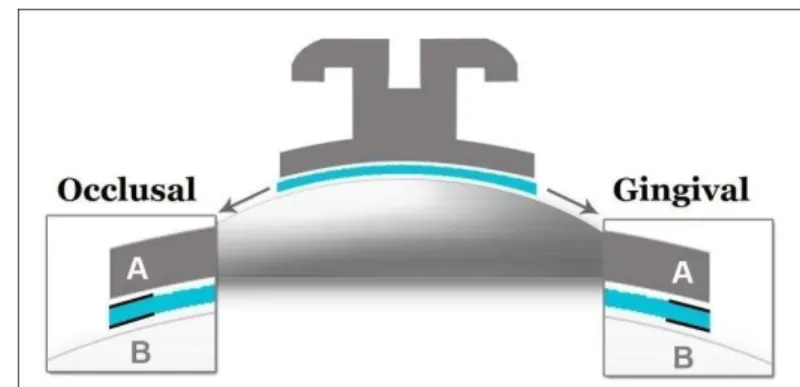
The microleakage was evaluated by a digital stereomicroscope (Dino-Lite Pro, Anmo Electronics Corp, Taiwan) (×20 magnifications). In each section, microleakage was directly measured in mm at enamel-adhesive and enamel-adhesive- bracket interfaces in occlusal and gingival margins (Fig. 1).
Ten percent of specimens (12 specimens) were selected randomly and microleakage examination was done a month after the first evaluation by the same operator. Gained differences for microleakage were not significant between two times of evaluations by Student T-test (P=0.106).
Statistical analysiswas performed by Software SPSS 16 (SPSS Inc, Chicago, USA). One-sample-Kolmogorov-Smirnov test showed that data was not normal, so non- parametric tests were used. Statistical analyses were performed by Kruskal-Wallis and Mann-Whitney U-tests.
Results
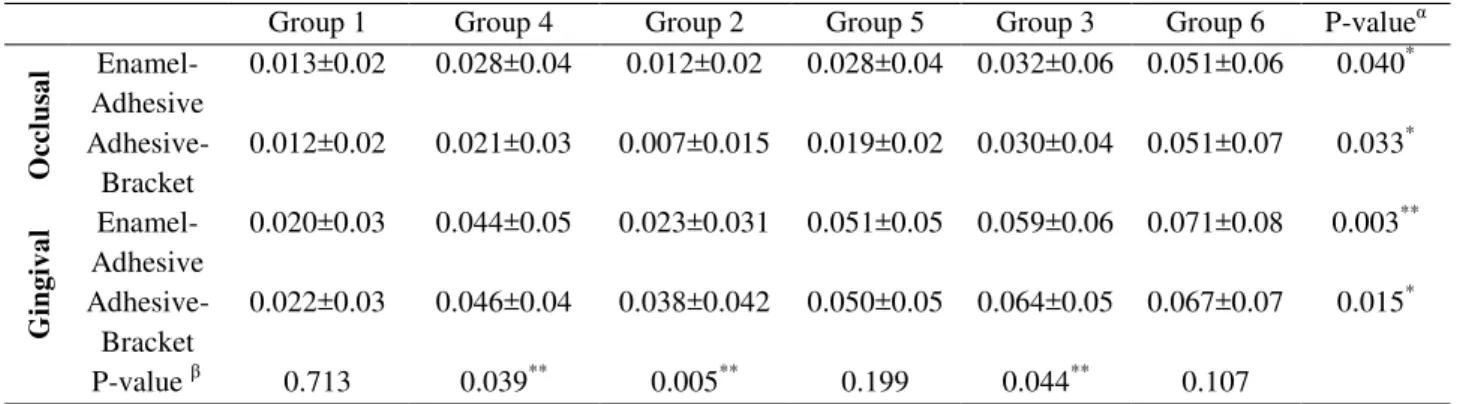
Figures 2-4 presents three samples of this study. Comparisons of the microleakage among study groups are shown in tables 1 and 2. Microleakage in groups with thermocycling test at each interface was more compared to the same bonding technique groups without thermocycling test, Mann-Whitney U test results showed that differences were statistically significant only in three interfaces (P<0.05): groups 1 and 4 at gingival adhesive-bracket interface, groups 2 and 5 at occlusal adhesive-bracket and gingival enamel-adhesive interface. Thermocycling test did not lead to microleakage increase significantly at any interfaces of the brackets bonded with TSEP.
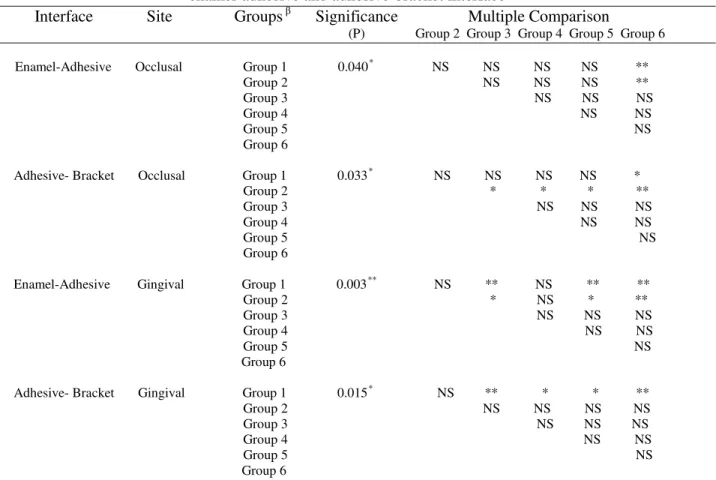
Bonding technique effect on microleakage was assessed by Kruskal–Wallis test and it was significant among groups at different interfaces. Mann-Whitney U test was applied to compare these each two groups. A significant difference was found between group 2 and 3 at occlusal bracket-adhesive interface and gingival adhesive-enamel interface. Also a significant difference was found between group 1 and 3 at gingival adhesive-enamel interface and gingival bracket-adhesive interfaces.
Comparison of microleakage of four Interfaces for each group was assessed by Kruskal–Wallis test, and Mann-Whitney U test. In group 2, significant difference was found between occlusal bracket-adhesive and gingival bracket-adhesive interfaces. In group 3, significant differences were found between these couples: occlusal adhesive-enamel and gingival bracket-adhesive interface, occlusal bracket-bracket-adhesive and gingival adhesive-enamel interface and occlusal bracket-adhesive and gingival bracket-adhesive. In group 4, significant differences were found between these couples: occlusal adhesive-enamel and gingival adhesive-enamel interface, occlusal adhesive-enamel and gingival bracket-adhesive interface, occlusal bracket-adhesive and gingival adhesive-enamel interface and occlusal bracket-adhesive and gingival bracket-adhesive interface. Difference between four interfaces in each group, was not significant for groups 1, 5, and 6 (P>0.05).
The comparison between groups 1 and 2 revealed no significant difference at any interfaces, therefore without thermal cycling test, the microleakage under brackets bonded with Unite adhesive and Transbond XT adhesive (phosphoric acid etching) was similar. Microleakage under brackets bonded with TSEP (group 3) was significantly more than groups 1 and 2. Without thermal cycling test, bonding technique would lead to different microleakage underneath the brackets: more microleakage was shown with TSEP.
The comparison of the last three groups revealed no significant difference at gingival and occlusal sides and enamel-adhesive and adhesive-bracket interfaces. Whereas, after thermal cycling test, microleakage was similar for different bonding techniques (Groups with thermocycling test).
Figure 2.
No microleakage under a bracket (×20)
Figure 3.
Microleakage at the enamel-adhesive
interface (×20)
Figure 4.
Microleakage at the adhesive-bracket
interface (×20)
Table 1.
Comparisons of microleakage among study groups in Bracket-Adhesive and Adhesive-Enamel
interfaces at the gingival and occlusal margins
Group 1 Group 4 Group 2 Group 5 Group 3 Group 6 P-valueα
O
cc
lus
a
l Enamel-Adhesive
0.013±0.02 0.028±0.04 0.012±0.02 0.028±0.04 0.032±0.06 0.051±0.06 0.040*
Adhesive- Bracket
0.012±0.02 0.021±0.03 0.007±0.015 0.019±0.02 0.030±0.04 0.051±0.07 0.033*
G
ing
iv
a
l Enamel-Adhesive
0.020±0.03 0.044±0.05 0.023±0.031 0.051±0.05 0.059±0.06 0.071±0.08 0.003**
Adhesive- Bracket
0.022±0.03 0.046±0.04 0.038±0.042 0.050±0.05 0.064±0.05 0.067±0.07 0.015*
P-value β 0.713 0.039** 0.005** 0.199 0.044** 0.107
Data are mean ± 1SD.
Group 1: Unite adhesive without thermocycling, Group2: Transbond XT adhesive without thermocycling, Group 3: (TSEP) SEP + Transbond XT adhesive without thermocycling, Group 4: Unite adhesive after thermocycling, Group 5: Transbond XT adhesive after thermocycling, Group 6: SEP + Transbond XT adhesive after thermocycling. αBonding technique effect on microleakage was assessed by Kruskal–Wallis test and Mann-Whitney U test. βInterface effect on microleakage was evaluated by Kruskal–Wallis test and Mann-Whitney U test.
*
Table 2.
Multiple comparisons of the microleakage scores between groups for occlusal and gingival Sides in
enamel-adhesive and adhesive-bracket interface
α
Interface Site Groups
βSignificance Multiple Comparison
(P) Group 2 Group 3 Group 4 Group 5 Group 6 Enamel-Adhesive Occlusal Group 1 0.040* NS NS NS NS **
Group 2 NS NS NS ** Group 3 NS NS NS Group 4 NS NS Group 5 NS Group 6
Adhesive- Bracket Occlusal Group 1 0.033* NS NS NS NS * Group 2 * * * ** Group 3 NS NS NS Group 4 NS NS Group 5 NS Group 6
Enamel-Adhesive Gingival Group 1 0.003** NS ** NS ** ** Group 2 * NS * ** Group 3 NS NS NS Group 4 NS NS Group 5 NS Group 6
Adhesive- Bracket Gingival Group 1 0.015* NS ** * * ** Group 2 NS NS NS NS Group 3 NS NS NS Group 4 NS NS Group 5 NS Group 6
α
NS: not significant. Data was analyzed by Kruskal–Wallis test and Mann-Whitney U test.
β
Group 1: Unite adhesive without thermocycling, Group 2: Transbond XT adhesive without thermocycling, Group 3: (TSEP) SEP + Transbond XT adhesive without thermocycling, Group 4: Unite adhesive after thermocycling, Group 5: Transbond XT adhesive after thermocycling, Group 6: SEP + Transbond XT adhesive after thermocycling.
*
P-value <0.05 ** P-value < 0.01
Discussion
Patients under orthodontic treatment have more white spots on their teeth in comparison with untreated persons. This phenomenon develops rapidly and may appear around the brackets after one mouth (24). It has been reported that on average two out of three teeth bonded with any bonding techniques show the degrees of enamel opacity after orthodontic treatment and its most frequent pattern is diffuse opacity (11). In 2006, Arikan et al. (25) stated that caries around and under brackets in fixed orthodontic treatment is a major threat for permanent teeth and area beneath the brackets is as critical as area around brackets.
In oral cavity, teeth undergo thermal shocks and subsequently expand or shrink. Because of different coefficient of thermal expansion of teeth and restorations, liquids penetrate into restorative cavity walls. This phenomenon is called “Percolation”. Several factors can lead to microleakage under orthodontic brackets such as different coefficient of expansion of
metal brackets, enamel and bonding adhesive (12). Another factor is polymerization shrinkage of adhesive. It depends on curing technique and adhesive composition consists filler content, diluents percentage and the degree of conversion (26).
There are major differences in microleakage studies between operative dentistry and orthodontics: (a) resin restoration is a bulk but resin adhesive layer beneath the bracket is so thin (b), excessive resin usually remains around the brackets that reduce polymerization shrinkage (c) polymerization shrinkage get the bracket closer to the tooth because of its free floating posture (d) “no mix” adhesive is not used in operative dentistry. Regarding to items b and c, it is believed that polymerization shrinkage in orthodontics is not as critical as operative dentistry (27).
cure resins like Transbond XT are most popular adhesives at orthodontists’ point of view and it is known that the most used light curing units are Quartz-Tungsten-Halogen units. No mix adhesives simplify clinical bonding process. More clinicians use metal brackets as usual especially for children, so these elements were included in this study (5,28).
According to Arhun et al. (12) and Vincente et al. (29) Studies, we evaluated microleakage at enamel-adhesive and enamel-adhesive-bracket interfaces individually, because their final clinical result is different.
Microleakage at enamel-adhesive interface leads to enamel decalcification but microleakage at adhesive-bracket interface may lead to bond degeneration and subsequently bracket debonding, but it is controversial (30). Abdelnaby and Al-Wakeel (31) in 2010 showed that there is a significant negative relation between microleakage and bracket bond strength, but James et al. (1) denied it.
Microleakage evaluation in dental study is done commonly by dye penetration technique. It is a rapid, easy and cost-saving technique. This process consists of exposing the specimens to dye solution and then assessment of sections under light microscope (5, 32). 0.5% basic fuchsine is a common solution for this technique (1,5,12,25,29,31,33,34).
In this study, thermaocycling test was used to simulate percolation similar to Ulker et al. study (5). Effects of different variables on microleakage under the orthodontic brackets are as below:
1. Thermocycling Test
A review of literature pointed out that no study have been performed to evaluate the microleakage under the brackets bonded with Unite adhesive, and Transbond XT + SEP. In restorative dentistry, Kubo et al. (30) found that thermocycling did not have any effect on microleakage at restoration using SEP, we found the same results for brackets bonded with Transbond XT.
In our study microleakage under the brackets bonded with Unite adhesive and Transbond XT increased after thermocycling. Vincente et al. (29) showed the results for Transbond XT.
Different results after thermocycling test might cause different etching patterns. Etching by phosphoric acid leads to deep and equal demineralization area with honey comb structure that presents resin tags, but SEP leads to a more conservative etching pattern with less aggressive demineralization area, so compared with phosphoric acid etching, its main bond strength is due to chemical bond with enamel calcium (28,35).
2. Interfaces
In most groups, microleakage at gingival interfaces was more than occlusal but comparison between enamel-adhesive and adhesive-bracket interfaces was various. Most studies showed that microleakage at
gingival margins is more than occlusal ones (12,32,34,36). Arhun et al. (12) stated that there would be more microleakage at gingival margins related to thicker adhesive and subsequently more polymerization shrinkage. This fact and difficulty of getting access to gingival margin of brackets for plaque removal might make these areas critical zone for caries.
Ulker et al. (5) reported the same microleakage amount at occlusal and gingival margins by Quartz-Tungsten-Halogen light cure unit, but plasma arc and Argon Laser led to more microleakage at gingival margin.
3. Bonding Technique
Without thermocycling, microleakage at most interfaces was significantly different among the three bonding systems, so that results of Unite and Transbond XT adhesives are almost identical, but microleakage of TSEP was significantly more than other systems. Yagci et al. (36) showed no microleakage under orthodontic brackets bonded with Transbond XT at the enamel-composite or enamel-composite-bracket interfaces at occlusal margins. Hamamci et al. (32,37) reported that microleakage by using TSEP was more than Transbond XT adhesive and its difference at gingival margins of adhesive-bracket interface was significant. Uysal et al. (33) showed relatively the same results, but a significant difference was found only at gingival margins of enamel-adhesive and adhesive-bracket interfaces.
Conclusion
Three bonding techniques were evaluated in this study led to some degree of microleakage under the brackets. Thermocycling test increased microleakage in all groups, but it was not significant when TSEP was used. Microleakage at gingival margins was significantly more than occlusal ones in most groups, but there was no significant difference between bracket-adhesive and bracket-adhesive-enamel interfaces. Microleakage depends on bonding technique and it was the most for TSEP group, but Unite and Transbond XT groups were relatively similar.
Acknowledgement
This article is based on Berahman Sabzevari's postgraduate thesis (Thesis no: 397). The authors wish to appreciate the Vice Chancellor for Research of Mashhad University of Medical Sciences for their financial support of this project.
References
1. James J, Miller B, English J, Tadlock L, Buschang
P. Effects of high-speed curing devices on shear
brackets. Am J Orthod Dentofac Orthop 2003;
123: 555-61.
2. Keim RG, Gottlieb EL, Nelson AH, Vogels DS.
2002 JCO study of orthodontic diagnosis and
treatment procedures. 1. Results and trends. J Clin
Orthod 2002; 36: 553-68.
3. Eliades T, Viazis AD, Eliades G. Bonding of
ceramic brackets to enamel: morphologic and
structural considerations. Am J Orthod Dentofac
Orthop 1991; 99: 369-75.
4. Eliades T, Eliades G, Brantley WA, Johnston WM.
Polymerization efficiency of chemically cured and
visible light cured orthodontic adhesives: degree of
cure. Am J Orthod Dentofac Orthop 1995; 108:
294-301.
5. Ulker M, Uysal T, Ramoglu SI, Ertas H.
Microleakage under orthodontic brackets using
high-intensity curing lights. Angle Orthod 2009;
79: 144-9.
6. Miyazaki M, Hinoura K, Onose H, Moore BK.
Effect of filler content of light-cured composites
on bond strength to bovine dentine. J Dent 1991;
19: 301-3.
7. Kidd E. Microleakage: a review. J Dent 1976; 4:
199-206.
8. Youssef M, Youssef F, Souza – Zaroni W, Turbino
M, Vieira M. Effect of enamel preparation method
on in vitro marginal microleakage of a flowable
composite used as a pit and fissure sealant. Int J
Paediatr Dent 2006; 16: 342-7.
9. Gillgrass T, Millett DT, Creanor SL, Mackenzie D,
Bagg J, Gilmour WH, et al. Fluoride release,
microbial inhibition and microleakage pattern of
two orthodontic band cements. J Dent 1999; 27:
455-61.
10. Oesterle LJ, Newman SM, Shellhart WC.
Comparative bond strength of brackets cured using
a pulsed xenon curing light with 2 different
light-guide sizes. Am J Orthod Dentofac Orthop 2002;
122: 242-50.
11. Nunn JH, Rugg-Gunn AJ, Ekanayake L,
Saparamadu KDG. Prevalence of developmental
defects of enamel in areas with differing water
fluoride levels and socioeconomic groups in Sri
Lanka and England. Int Dent J 1994; 44: 165-73.
12. Arhun N, Arman A, Cehreli S, Arikan S,
Karabulut E, Gulsahi K. Microleakage beneath
ceramic and metal brackets bonded with a
conventional and an antibacterial adhesive system.
Angle Orthod 2006; 76: 1028-34.
13. Romano FL, Tavares SW, Nouer DF, Consani S,
Borges de Araujo Magnani MB. Shear bond
strength of metallic orthodontic brackets bonded to
enamel prepared with self-etching primer. Angle
Orthod 2005; 75: 849-53.
14. Ireland AL, Knight H, Sherriff M. An in vivo
investigation into bond failure rates with a new
self-etching system. Am J Orthod Dentofac Orthop
2003; 124: 323-6.
15. Dorminey JC, Dunn WJ, Taloumis LJ. Shear bond
strength of orthodontic brackets bonded with a
modified 1-step etchant-and-primer technique. Am
J Orthod Dentofac Orthop 2003; 124: 410-3.
16. Gale MS, Darvell BW. Thermal cycling
procedures for laboratory testing of dental
restorations. J Dent 1999; 27: 89-99.
17. Wahab F, Shaini F, Morgano S. The effect of
thermocycling on microleakage of several
commercially available composite class V
restorations in vitro. J Prosthet Dent 2003; 90:
168-74.
18. Bishara S, Ajlouni R, Laffoon JF. Effect of
thermocycling on the shear bond strength of a
cyanocrylate orthodontic adhesive. Am J Orthod
Dentofac Orthop 2003; 123: 21-4.
19. Arici S, Arici N. Effects of thermocycling on the
bond strength of a resin-modified glass ionomer
cement: an in vitro study. Angle Orthod 2003; 73:
692-6.
20. Daub J, Berzins D, Linn B, Bradley T. Bond
strength of direct and indirect bonded brackets
after thermocycling. Angle Orthod 2006; 76:
21. Hakimeh S, Vaidyanathan J, Houpt M,
Vaidyanathan T, Von Hagen S. Microleakage of
compomer class V restorations: effect of load
cycling, thermal cycling, and cavity shape
differences. J Prosthet Dent 2000; 83: 194-203.
22. Helvatjoglu-Antoniades M, Kalinderis K, Pedulu
L, Papadogiannis Y. The effect of pulse activation
on microleakage of a 'packable' composite resin
and two 'Ormocers'. J Oral Rehabil 2004; 31:
1068-74.
23. International Organization for Standardization
1994 Dental materials-guidance on testing of
adhesion to tooth structure ISO TR 11405.
Geneva, Switzerland.
24. O'Reilly MM, Featherstone JD. Demineralization
and remineralization around orthodontic
appliances: an in vivo study. Am J Orthod
Dentofac Orthop 1987; 92: 33-40
25.Arikan S, Arhun N, Arman A, Cehreli S.
Microleakage beneath ceramic and metal brackets
photopolymerized with LED or conventional light
curing units. Angle Orthod 2006; 76: 1035-40.
26. Senser Y, Uysal T, Bascifti FA, Demir A, Botsali
MS. Conventional and high-intensity halogen light
effects on polymerization shrinkage of orthodontic
adhesive. Angle Orthod 2006; 76: 677-81.
27. Oesterle LJ, Newman SM, Shellhart WC. Rapid
curing of bonding composite with a xenon plasma
arc light. Am J Orthod Dentofac Orthop 2001;
119: 610-6.
28. Zachrisson BU, Buyukyilmaz T. Bonding in
Orthodontics. In: Graber TM, Vanarsdall RL, Vig
KWL. Orthodontics: current principles &
techniques. St. Louis: Mosby, 2005.
29. Vicente A, Ortiz AJ, Bravo LA. Microleakage
beneath brackets bonded with flowable materials:
effect of thermocycling. Eur J Orthod 2009; 31:
390-6.
30. Kubo S, Yokota H, Sata Y, Hayashi Y.
Microleakage of self etching primers after thermal
and load cycling. Am J Dent 2001; 14: 163-9.
31. Abdelnaby YL, Al-Wakeel EE. Influence of
modifying the resin coat application protocol on
bond strength and microleakage of metal
orthodontic brackets. Angle Orthod 2010; 80:
378-84.
32. Hamamci N, Akkurt A, Basaran G. In vitro
evaluation of microleakage under orthodontic
brackets using two different laser etching, self
etching and acid etching methods. Lasers Med Sci
2009; 27: 1-6.
33. Uysal T, Ulker M, Ramoglu SI, Ertas H.
Microleakage under metallic and ceramic brackets
bonded with orthodontic self-etching primer
systems. Angle Orthod 2008; 78: 1089-94.
34. Ramoglu SI, Uysal T, Ulker M, Ertas H.
Microleakage under ceramic and metallic brackets
bonded with resin-modified glass ionomer. Angle
Orthod 2009; 79: 138-43.
35. Cal-Neto JP, Miguel JA. Scanning electron
microscopy evaluation of the bonding mechanism
of a self-etching primer on enamel. Angle Orthod
2006; 76: 132-6.
36. Yagci A, Uysal T, Ulker M, Ramoglu SI.
Microleakage under orthodontic brackets bonded
with the custom base indirect bonding technique.
Eur J Orthod 2010; 32: 259-63
37. Hamamci N, Akkurt A, Basaran G. In vitro
evaluation of microleakage under orthodontic
brackets using two different laser etching and acid
etching methods. Lasers Med Sci 2010; 25: 811-6.
Corresponding Author: Barat Ali Ramazanzadeh Faculty of Dentistry
Vakilabad Blvd, Mashhad, Iran Tel: +98-511-8829501
Fax: +98-511-8829500