Etiolated Development in
Arabidopsis thaliana
Javier Gallego-Bartolome´, David Alabadı´*, Miguel A. Bla´zquez
Instituto de Biologı´a Molecular y Celular de Plantas (CSIC-Universidad Polite´cnica de Valencia), Valencia, Spain
Abstract
The hormones gibberellins (GAs) control a wide variety of processes in plants, including stress and developmental responses. This task largely relies on the activity of the DELLA proteins, nuclear-localized transcriptional regulators that do not seem to have DNA binding capacity. The identification of early target genes of DELLA action is key not only to understand how GAs regulate physiological responses, but also to get clues about the molecular mechanisms by which DELLAs regulate gene expression. Here, we have investigated the global, early transcriptional response triggered by the
ArabidopsisDELLA protein GAI during skotomorphogenesis, a developmental program tightly regulated by GAs. Our results show that the induction of GAI activity has an almost immediate effect on gene expression. Although this transcriptional regulation is largely mediated by the PIFs and HY5 transcription factors based on target meta-analysis, additional evidence points to other transcription factors that would be directly involved in DELLA regulation of gene expression. First, we have identifiedciselements recognized by Dofs and type-B ARRs among the sequences enriched in the promoters of GAI targets; and second, an enrichment in additionalcis elements appeared when this analysis was extended to a dataset of early targets of the DELLA protein RGA: CArG boxes, bound by MADS-box proteins, and the E-box CACATG that links the activity of DELLAs to circadian transcriptional regulation. Finally, Gene Ontology analysis highlights the impact of DELLA regulation upon the homeostasis of the GA, auxin, and ethylene pathways, as well as upon pre-existing transcriptional networks.
Citation:Gallego-Bartolome´ J, Alabadı´ D, Bla´zquez MA (2011) DELLA-Induced Early Transcriptional Changes during Etiolated Development inArabidopsis thaliana. PLoS ONE 6(8): e23918. doi:10.1371/journal.pone.0023918
Editor:Mohammed Bendahmane, Ecole Normale Superieure, France
ReceivedJune 16, 2011;AcceptedAugust 1, 2011;PublishedAugust 31, 2011
Copyright:ß2011 Gallego-Bartolome´ et al. This is an open-access article distributed under the terms of the Creative Commons Attribution License, which permits unrestricted use, distribution, and reproduction in any medium, provided the original author and source are credited.
Funding:Work in the laboratory of Dr. Bla´zquez and Dr. Alabadı´ is supported by grants from the Spanish Ministry of Science and Innovation (BIO2007-60293 and Consolider-TRANSPLANTA). The funders had no role in study design, data collection and analysis, decision to publish, or preparation of the manuscript.
Competing Interests:The authors have declared that no competing interests exist. * E-mail: [email protected]
Introduction
Plants are sessile organisms that cannot change their location as a strategy to optimize their access to energy sources or in response to the environment. Thus, adjusting their growth and choosing the correct developmental program has to be precise and robust otherwise chances of survival could be reduced. This need has forced the development of very sophisticated sensing mechanisms and signal transduction pathways to respond properly to fluctuating environmental conditions. Plant hormones play an instructive role on this as they control many, if not all, developmental responses in plants [1,2].
Gibberellins (GAs) are one of the classical plant hormones. They regulate several processes during the plant life cycle such as germination, vegetative growth or flowering [3] through gene transcriptional regulation [4,5,6,7]. This transcriptional regulation relies on the activity of the nuclear, GA-regulated DELLA proteins [8]. In brief, DELLAs accumulate in the absence of GAs blocking the transcriptional response to the hormone. When GA levels increase, the binding of the hormone to its receptor, GID1, promotes the formation of a GA-GID1-DELLA complex [9,10] that favors the recognition of the DELLA protein by the SCFSLY ubiquitin ligase [11] and the subsequent ubiquitination. This modification leads to DELLA degradation by the 26S proteosome [12,13] and transcriptional changes to the hormone take place.
Two observations support the idea that DELLAs are transcrip-tional regulators: first, chromatin immunoprecipitation (ChIP)
experiments reveal that DELLAs sit at the vicinity of promoters of certain GA-regulated genes [6,14]. Second, DELLAs interact physically with transcription factors and other transcriptional regulators. For example, they interact with bHLH transcription factors of the PIF clade and inhibit their ability to bind DNA [15,16], as well as with other members of the bHLH family [17,18]. Also, they interact with JAZ proteins, which are transcriptional regulators that negatively regulate jasmonate signaling [19], and with SCL3, a transcriptional regulator that belongs to the GRAS family [14,20]. In addition, genetic evidence indicates that the bZIP transcription factor HY5 mediates the promotion of photomorphogenesis by DELLA [21].
Despite these recent advances, we still lack a broader view of the mechanisms by which DELLA proteins regulate the large variety of GA responses. A bottom-up strategy to dissect further this fundamental aspect of GA signaling is to identify and classify GA target genes according to their expression domain or the process in which they participate. In this regard, global analyses of DELLA-regulated transcription in two different developmental contexts – vegetative growth and floral development– have shown that only 3.6% of the target genes are shared between the two sets [4,6]. This observation underscores the importance of the developmental context in which GA signaling is investigated.
examined global, rapid changes in gene expression after compromising the GA signaling pathway in dark-grown seedlings. This approach allowed us 1) to identify which cellular pathways are directly regulated by GAs to promote skotomorphogenesis; and 2) to identify gene targets that will serve as markers to further dissect the mechanisms by which DELLAs regulate gene expression.
Results and Discussion
Identification of genes rapidly regulated by GAI in etiolated seedlings
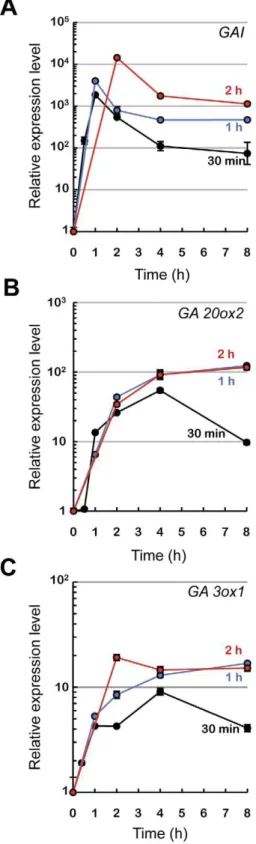
We sought to identify in a global and unbiased way genes whose expression was modulated rapidly in response to a change in GA activity in etiolated seedlings by using a transgenic line that expresses a gain-of-function version of the DELLA protein GAI under the control of a temperature-inducible promoter,HS::gai-1 [21]. To determine the optimal duration of the heat treatment needed to strongly inducegai-1transcript accumulation, we placed 2-day-old etiolated HS::gai-1 seedlings at 37uC for 30, 60, and 120 minutes, and then analyzed expression of the transgene by qRT-PCR over a time-course (Figure 1A). The 30-min treatment was sufficient to strongly and transiently induce gai-1 transcript accumulation. To confirm that the inductive treatment resulted in an increase of GAI activity, we checked the expression of the GA20ox2andGA3ox1genes, that encode key enzymes in the GA biosynthetic pathway subject to feedback regulation by DELLA proteins [6,24,25,26]. As expected, transcripts of both genes accumulated strongly in seedlings following the heat shock, but only in the 30-min treatment was this accumulation transitory (Figures 1B and C); moreover, expression of these genes did not change significantly in response to the temperature treatment in wild-type seedlings (data not shown).
Given that the induction protocol was appropriate to modulate the expression of GAI target genes, we interrogated the transcriptome of two-day-old etiolatedHS::gai-1seedlings at 0, 1, 2, and 4 hours after starting a 30-min heat shock at 37uC. Expression was compared at each time point using triplicate RNA samples from whole transgenic seedlings and the corresponding wild-type seedlings by hybridization of 70-mer oligonucleotide, two-colors arrays representing the majority of theArabidopsisgenes (http://www.ag.arizona.edu/microarray). The microarray raw data have been deposited in the NCBI’s GEO database under accession GSE24253. The application of a Significance Analysis of Microarrays criterion [27] with a false discovery rate of 8.74% and a 1.5-fold cutoff value allowed us to identify 148 genes differentially expressed during the first four hours after the induction of gai-1 activity. This list represented the genes putatively regulated by GAI in etiolated seedlings (Table S1); among them, 58 were downregulated and 90 induced (Figure 2A). Recently, a microarray analysis identified hundreds of genes whose expression is altered in the dark in the GA-deficientga1-3 mutant compared to the wild type [23]. Notably, only 18% of the GAI-regulated genes appeared equally misregulated in thega1-3 mutant (Figure S1). This little overlap is a likely consequence of the different experimental designs, aimed to investigate global gene expression in response to a short (this study) vs. a continuous blockage of the GA signaling pathway [23]. In addition, this clearly reflects the complexity of the dynamics of gene expression in response to DELLA proteins. For instance, the non-overlap-ping, GAI-regulated genes seem to respond only transiently since they were not misregulated in response to continuous accumula-tion of DELLAs. Conversely, the great majority of genes from the ga1-3 experiment either was late responders or responded
indirectly to DELLA accumulation. Importantly, this comparison highlights the suitability of our approach to identify early events downstream of the DELLA protein GAI in etiolated seedlings.
Comparison of DELLA-regulated genes in different developmental situations
Recent studies have identified by a similar approach early target genes of the Arabidopsis DELLA protein RGA in aerial tissue of light-grown seedlings [6] and in flowers of Arabidopsis [4], as well as genes responding rapidly to GA application [6]. Despite the functional similarities between these two DELLA proteins [17], comparison of the sets of genes regulated by GAI and RGA showed little overlap. Out of the 148 GAI targets in etiolated seedlings, 19 genes overlapped with RGA targets in seedlings [6] and 11 in flowers [4], which corresponds to 13% and 7% of the GAI-regulated genes respectively (Figures 2B and C). Only five genes overlapped in all conditions (Figure 2B) and, remarkably, four of them encode members of the GA pathway (GA20ox1, GA20ox2, GA3ox1, and GID1b) supporting the notion that the
strong regulation of GA activity by DELLA proteins extends to several tissues and growth conditions. However, beyond this regulatory process, a limited overlap in targets displayed by DELLA proteins is evident. It is unlikely that this effect is the consequence of the different expression patterns of the DELLA genes used in these studies, given that ubiquitous promoters were used to drive their expression [6,21]. Rather, the low degree of overlap probably reflects the presence of very different sets of transcription factors available for DELLA interaction in etiolated seedlings (our current study) compared with light-grown seedlings and flowers.
GAI regulates target genes in part through PIFs and HY5 transcription factors
The proper control of the developmental switch between skotomorphogenesis and photomorphogenesis after germination is triggered by light through the activation of transcription factors that promote photomorphogenesis, like ELONGATED HYPO-COTYL5 (HY5), and the inactivation of other transcription Figure 2. Transcriptomic analysis of early targets of DELLA proteins.(A) Heatmap representation of the 148 best-scored genes (q-value#8). (B) Illustration of the overlap with the datasets of DELLA target genes in two other developmental situations [6,73] (C) Heatmap representation of the differential expression of genes overlapping in the three datasets. Red and blue colors in the heatmaps represent induced and repressed genes, respectively.
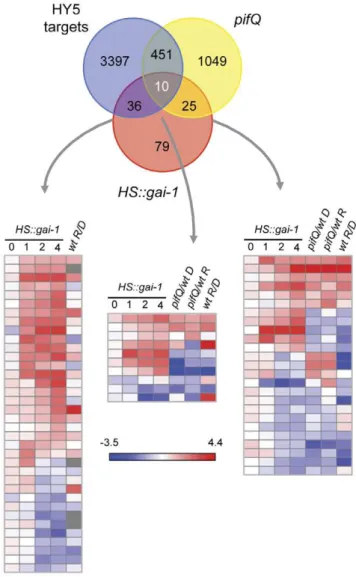
factors that promote etiolated growth, such as the PHYTO-CHROME-INTERACTING FACTORs, (PIFs) [28]. Remark-ably, GAs counterbalance the effect of light by regulating negatively HY5 protein levels [21], and also alleviating the negative effect that DELLAs exert on the PIFs and that prevents the binding of these transcription factors to their target promoters [15,16]. To investigate at the molecular level the extent of these functional interactions, we compared the list of GAI targets with the available lists of genes regulated by HY5 and the PIFs. We reasoned that this comparison would allow us to identify which GAI-regulated genes depend on the activity of these transcription factors, and delineate the transcriptional network that mediates the GA-control on this developmental switch. While a faithful dataset ofin vivotarget genes for HY5 in light-grown seedlings has been generated by ChIP-to-chip experiments [29], the only available list of putative PIF targets can be extracted from transcriptomic analyses of dark- and light-grown wild-type and pifQ mutants [30]. As shown in Figure 3, almost half of the GAI regulated targets are either regulated by HY5, the PIFs, or both, supporting the relevance of these transcription factors in transcriptional regulation by DELLAs.
The comparisons are consistent with current models of light and GA regulation. For instance, many of the genes whose promoters are bound by HY5 are coherently regulated by light treatments, and also by DELLA accumulation (Figure 3). Only a few of them displayed conflictive regulation by light and by DELLAs (induced by light, bound by HY5, repressed by DELLAs), probably indicating that these targets common to HY5 and DELLAs are not regulated jointly, but in parallel. In the case of PIFs, it is well established that DELLAs have a negative effect on PIFs activity [15,16]. In agreement with this, many genes that are targets for both PIFs and DELLAs show the same behavior for DELLA accumulation and for PIF deficiency (Figure 3). An indication that this regulation is biologically relevant is that endodermis-specific expression ofPIF1inpifQmutants restores the formation of the apical hook [31], and this tissue specificity is also observed for the regulation of the apical hook by GAs [32]. But there are also some cases where the opposite behavior is observed, suggesting either that DELLA regulation of those targets does not proceed through PIFs, or that not all individual PIFs have equivalent activities and abilities to interact with DELLAsin vivo.
Promoter analysis of GAI regulated targets suggests new transcription factors mediating DELLA activity
Although half of the GAI targets are likely regulated by HY5 and PIFs, there is no obvious connection between these two transcription factors and the rest of the genes regulated by GAI. To get hints regarding the identity of the additional transcription factors mediating DELLA regulation, we investigated the enrichment of particular cis elements among the promoters of genes up- and downregulated inHS::gai-1using ELEMENT (http://element.cgrb. oregonstate.edu/) [33]. This tool returns those 3–8 bp sequences that are over-represented in the 1000 bp upstream region that precedes the transcription start site of target genes, compared to those same regions through the whole Arabidopsis genome. According to this analysis, apart from a small number of putative ciselements with unknown identity (Figure 4A), the promoters of genes induced by GAI are enriched in the Dof (AAAG) [34] and ARR1 (NGATT) [35] binding sites. Interestingly, both types of transcription factors have been related to GAs. For example, Dof proteins have been implicated in the regulation of GA signaling and biosynthesis in Arabidopsis and barley, possibly in the DELLA-mediated feedback regulation of the GA pathway [36,37,38]. And ARR1 has been shown to mediate the control of root meristem size in response to GAs through the up-regulation ofARR1expression by DELLA proteins [39].
To investigate if this analysis allows the identification of DELLA-related regulatory sequences common to different developmental contexts, we examined the enrichment ofciselements in the dataset containing all DELLA target promoters found in all available experiments [4,6]. Surprisingly, the analysis showed an enrichment in two known regulatory sequences: the G-box (CACGTG) [40] and a sequence similar to the CArG box (CC(A/T)6GG) [41], which also
includes a Dof binding site (AAAG) (Figure 4B). The presence of G-boxes is reasonable, taking into account that they are bound both by bHLH and bZIP transcription factors [29,42], like the PIFs and HY5, for which strong molecular interactions exist with respect to GA signaling [15,16,21]. However, no link between MADS-box transcription factors and GAs has been established yet.
Figure 3. Meta-analysis comparing microarray data from
HS::gai-1, HY5 and PIF targets.Venn diagram of microarray data fromHS::gai-1, HY5 targets [30] and quadruplepif mutant (pifQ) [31] show common genes regulated by GAI, HY5 and PIF proteins. Heatmaps show the behavior of common GAI-HY5, GAI-HY5-PIF and GAI-PIF targets in different light conditions. Wt R/D, data are differentially expressed genes under red light compared to dark in a WT.pifQ/wt D, data are differentially expressed genes among pifQ
mutant compared to wt in darkness.pifQ/wt R, data are differentially expressed genes amongpifQmutant compared to wt under red light. The heatmaps represent the differential expressions of genes overlap-ping in the different datasets. Red and blue colors in the heatmaps represent induced and repressed genes, respectively.
On the other hand, the E-box CATGTG also appeared as an over-represented sequence both in the etiolated and in the joint dataset of DELLA targets (Figure 4). E-boxes (CAnnTG) are usually bound by bHLH proteins. Unlike the G-box, which is a particular case of an E-box bound by PIFs [15,16,40,43], the CATGTG (or CACATG, in the opposite orientation) is the E-box preferred for instance by the brassinosteroid signaling elements BZR1 and BES1 [39,44,45]. Moreover, this element is enriched in promoters of dawn-phased genes that oscillate under short-day photocycles, and it is important for gating their expression by the circadian clock [46]. Thus, the enrichment of this E-box element could subtend the connection between DELLA proteins and circadian regulation of transcription [26] or point to new interactions between the GA and brassinosteroid pathways.
Identity of GAI-regulated genes
To identify the basic biological processes that are regulated by GAs in etiolated seedlings at the molecular level, we followed two complementary approaches. In the first one, we searched for any significantly over-represented Gene Ontology term (GO) [47] in our gene list by using the FatiGO algorithm [48]. In the second approach, we paid attention to the appearance of annotations that could reveal suggestive connections between GA signaling and other signaling pathways. As expected, we found that GAI is closely involved in the control of GA homeostasis and growth, but we also found that GAI regulates the expression of genes directly implicated in light signaling, stress responses, transcriptional networks, and the synthesis and signaling of other hormones (Table 1).
Direct regulation of the GA pathway by DELLA proteins The control of the homeostasis of GA levels and perception in the plant is finely achieved through feedback and feedforward mechanisms that require the activity of the different elements of the GA signaling pathways [3,49,50]. Recently, Zentella et al. (2007) [6] demonstrated the involvement of the DELLA protein RGA in this process, as they showed that RGA directly up-regulates the expression of GA20ox2, GA3ox1,GA INSENSITIVE DWARF1a(GID1a), andGID1bgenes. In addition to these genes, we have foundGA20ox1andGA20ox4among the GAI up-regulated genes, andGA2ox8,RGA, andRGL1among the GAI down-regulated genes (Figure 2B, Table 1, and Table S1). The regulation of some of these genes by GAI was confirmed by analyzing their transcript levels in several GA-related mutants and transgenic lines (Figure S2). Control on the expression of the majority of genes seems to be shared by GAI, RGA, and also other DELLA proteins –for example, the repression ofGA2ox8gene expression by PAC still occurs in the double null mutantgai-t6 rga-24.
The rapid change in the expression of these genes in response to gai-1 accumulation suggested to us that they might be direct targets. We tested this possibility by using transgenic lines that express a translational fusion between gai-1 and the glucocorticoid receptor domain from rats, under the control of theGAIpromoter [51]. As expected, dexamethasone (DEX) treatment mimicked the effect on target gene expression that a heat-shock treatment provokes in the HS::gai-1 line (Figure 5). Addition of cycloheximide (CHX) alone caused induction or repression of some target genes, suggesting that they are also regulated by short-lived repressors or activators, respectively. But most importantly, a clear induction of GA20ox1, GA20ox4,GA3ox1,GID1a, andGID1b, and a clear repression ofRGL1
andGAIwas still observed in the simultaneous presence of DEX and CHX, indicating that these genes are directly regulated by GAI activity, i.e. independently of protein synthesis. It is difficult, however, to draw conclusions in the case of GA2ox8, given the strong upregulation of this gene in response to CHX. At first glance, results suggest thatGA2ox8might not be directly regulated by GAI. However, the strong CHX effect could mask the repression exerted by GAI on this gene, as reported forACS8that is a bona fide direct target [32].
Interestingly, the observation that GAI represses the expression of otherDELLAgenes is in agreement with a more general role for DELLAs controlling each other expression, and it provides a mechanism for the observation thatGAIandRGAgene expression was higher in the presence of GAs [52].
DELLA proteins mediate direct cross-regulation with auxin and ethylene pathways
Our analysis indicates that the crosstalk between GAs and other hormones could be exerted at the transcriptional level. Among the relevant targets for GAI, we identified several genes related to auxin synthesis and signaling, such as the negative auxin signaling intermediates AUXIN/INDOLE-3-ACETIC ACID19 (Aux/IAA19) [53] and Aux/IAA29, two auxin-inducible SMALL AUXIN UPREGULATED genes, and also INDOLE-3-ACETIC ACID METHYLTRANSFERASE1 (IAMT1) [54] and YUCCA3 (YUC3) involved in IAA inactivation [55] and biosynthesis [56], respectively (Table 1 and Table S1). The ethylene biosynthesis genes ACC SYNTHASE8 (ACS8) and ACS5/ETO2 [57,58] were also among the genes downregulated by GAI, extending the control by GAs to hormones other than auxin.
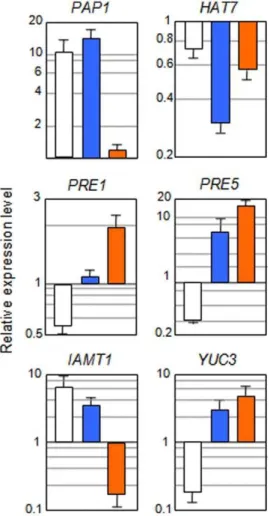
We analyzed if the expression of a representative set of these genes was directly regulated by GAI using the DEX system. Transcriptional control ofAux/IAA19,IAMT1, YUC3, andACS8 by GAI was direct, since CHX did not abolish the effect that DEX treatment had on their expression (Figures 6) [32,51]. Other DELLA proteins, on the other hand, shared the control on the expression of these genes (Figure S3) [32,51].
These results indicate the GA pathway may directly influence the metabolism and/or signaling cascades of other hormone pathways as a way to control different features of the skotomor-phogenic developmental program. Some of these interactions have been proven biologically relevant. For instance, the control ofAux/ IAA19 expression by DELLAs modulates the intensity and the variance of the response to auxin, thereby conferring flexibility to tropic responses [51]. Similarly, downregulation of ACS5/ETO2 andACS8expression by GAI represents the mechanism for cross-regulation between GAs and ethylene during the development of the apical hook [32]. Further, the effect that the GA pathway might have on auxin metabolism through regulation of theIAMT1 gene, adds a new layer of complexity to the web of interactions involving the cross-regulation of hormone metabolism [59].
DELLAs impinge on transcriptional networks
The enrichment of the GO term that defines transcription factors among the GAI targets indicates that the strategy by which GAs orchestrate the regulation of multiple cellular processes could be through the control of high rank regulators that in turn modulate subsets of the responses (Table 1). Several families of transcription factors were up- or downregulated by GAI, indicating no particular Figure 4. Over-representedciselements among DELLA-regulated promoters.(A) Logos of over-representedciselements in the promoters of induced and repressed targets in theHS::gai-1microarray experiment. (B) Logos of over-representedciselements in the promoters of induced and repressed genes coming from the joint dataset ofHS::gai-1,rga-D17[6] and GA/floral [4] microarray targets. The logo representation was obtained at http://weblogo.berkeley.edu/ [73].
Table 1.Gene Ontology (GO) categories statistically over-represented among DELLA targets.
BIOLOGICAL PROCCESS MOLECULAR FUNCTION
GO category p-value genes GO category p-value genes
Response to gibberellin stimulus 2.38E-09 AT2G01570 RGA1 oxidoreductase activity 5.95E-05 AT4G25420 GA20OX1
Gibberellic acid mediated signaling pathway 5.12E-08 AT3G05120 GID1A AT1G60980 ATGA20OX4
Gibberellin biosynthetic process 1.23E-06 AT2G37640 EXP3 AT4G21200 GA2OX8
AT1G67100 LBD40 AT1G15550 GA3OX1
AT1G66350 RGL1 AT5G51810 GA20OX2
AT4G25420 GA20OX1 transcription factor activity 1.66E-05 AT5G56860 GNC
AT5G25900 GA3 AT3G60390 HAT3
AT3G63010 GID1B AT1G49560 MYB TF
AT2G04240 XERICO AT4G00050 UNE10
AT1G15550 GA3OX1 AT5G28300 trihelix
DNA-binding
AT5G51810 GA20OX2 AT1G56650 PAP1
AT5G67480 BT4 AT3G50890 AtHB28
Regulation of transcription 0.00485 AT3G28857 PRE5 AT3G18010 WOX1
AT4G39070 STH7 AT4G32280 IAA29
AT1G66380 MYB114 AT1G53910 RAP2.12
AT3G60390 HAT3 AT2G02450 ANAC035
AT4G30180 bHLH146 AT2G42380 AtBZIP34
AT1G49560 MYB TF AT1G66380 MYB114
AT4G00050 UNE10 AT4G39070 STH7
AT5G28300 trihelix DNA-bind
AT1G69690 TCP TF
AT1G53910 RAP2.12 AT3G06590 AIF2
AT5G14750 ATMYB66 AT5G39860 PRE1
AT1G14600 Myb-like TF AT1G21910 AtERF012
AT1G69690 TCP TF AT2G01570 RGA1
AT1G56650 PAP1 AT4G30180 bHLH146
AT3G06590 AIF2 AT1G66350 RGL1
AT5G15150 ATHB-3 AT3G15540 IAA19
AT2G01570 RGA1 AT3G28730 ATHMG
AT5G41920 SCL25 AT5G14750 ATMYB66
AT4G32890 GATA9 AT1G14600 Myb-like TF
AT1G21910 AtERF012 AT5G41920 SCL25
response to red or far red light 0.000851 AT2G01570 RGA1 AT5G15150 ATHB-3
AT5G04190 PKS4 AT4G32890 GATA9
AT2G37640 EXP3 monooxigenase activity 0.00246 AT5G25900 GA3
AT4G32280 IAA29 AT4G28720 YUCCA8
AT4G25260 invertase inhibitor
AT2G26710 BAS1
AT1G15550 GA3OX1 AT1G58440 XF1
AT5G51810 GA20OX2 AT5G38970 BR6OX1
response to jasmonic acid stimilus 0.0193 AT1G66350 RGL1 lyase activity 0.0244 AT3G51430 YLS2
AT2G01570 RGA1 AT3G07010 pectate lyase
AT1G66380 MYB114 AT1G27980 DPL1
AT5G13220 JAZ10 AT1G67750 pectate lyase
AT1G56650 PAP1 AT5G28020 CYSD2
response to salt stress 0.0366 AT1G13930 AT4G37770 ACS8
preference for structural features. By using the DEX system, we showed that the regulation ofPRODUCTION OF ANTHOCYANIN PIGMENT1(PAP1),HOMEOBOX-LEUCINE ZIPPER PROTEIN7 (HAT7),PACLOBUTRAZOL RESISTANT1(PRE1), andPRE5genes by GAI was direct (Figure 6). Moreover, this regulation was shared by other DELLA proteins (Figure S3).
Interestingly, some of the transcription factors are key regulators of processes in which GAs have been shown to be relevant. This is the case ofPAP1, which encodes amybtranscription factor that simultaneously controls the expression of several steps in anthocyanin production [60]. Although the results involving GAs in the control of flavonoid production are contradictory and they largely depend on the tissue analyzed [61,62], DELLAs are implicated in the promotion of anthocyanin accumulation [63,64], and it is reasonable to think that this regulation occurs, at least in part, through PAP1.
In a similar way, the downregulation by GAI of PRE1 and PRE5, that encode bHLH transcription factors that impair cell expansion [65], could link GAs with growth in certain circum-stances, for example during skotomorphogenic development. PRE1 and PRE5 are HLH proteins that cannot bind DNA, and it has been shown that this type of transcriptional regulators exert their regulatory activity through physical interaction with other bHLH transcription factors for which the interaction is deleterious [66]. Therefore, the negative effect of DELLAs on PRE1 and PRE5expression would indirectly affect the activity of additional transcriptional networks not identified in this analysis.
Concluding remarks
The enormous plasticity in plant development depends on highly wired, interconnected signaling networks that properly integrate endogenous and environmental cues [67]. In many cases, the
cross-Figure 5. GAI directly regulates the expression of genes of the GA pathway.Three-day-old, etiolatedpGAI::gai-1-GRseedlings grown at 22uC were incubated for 5 h in water or in water (control treatment) supplemented with either 10aM DEX (white bars), 10aM cycloheximide (orange bars) or both (blue bars). Expression was monitored by RT-qPCR and normalized to the control treatment. Values are log ratios between the treatment and the control. Data represent mean and the standard error of the mean from three independent biological replicates. Data from each biological replicate consisted in three technical replicates that were averaged and normalized.
doi:10.1371/journal.pone.0023918.g005
BIOLOGICAL PROCCESS MOLECULAR FUNCTION
GO category p-value genes GO category p-value genes
AT1G66350 RGL1
AT1G56650 PAP1
AT2G33380 RD20
AT2G04240 XERICO
unidimensional cell growth 0.0115 AT5G51810 GA20OX2
AT4G25420 GA20OX1
AT2G37640 EXP3
AT2G20750 ATEXPB1
AT2G40610 ATEXPA8
doi:10.1371/journal.pone.0023918.t001
regulation between pathways occurs at the level of transcriptional regulation [68]. The output of the GA pathway largely relies on the activity of the transcriptional regulators DELLA proteins. Our transcriptomic analysis of DELLA responsive genes in etiolated seedlings reveals that the activity of the GA pathway directly influences other hormone pathways –ethylene and auxin– and pre-existing transcriptional networks. Furthermore, our results highlight that the comparison of DELLA target lists in different tissues and conditions, as well as the survey of enrichedciselements among the targets, is a promising strategy to understand at the molecular level the multiplicity in DELLA functions along plant development.
Methods
Plant material and growth conditions
Arabidopsis thalianaGA signaling dominant mutantrga-D17[25], the double loss-of-functionrga-24 gai-t6 [69] and pGAI::gai-1-GR [51] are in the Lerbackground, whileHS::gai-1and the35S::gai-1 [21] are derived from Col-0 accession. Seeds were sterilized and stratified for 6 days in water at 4uC. Germination took place under
white fluorescent light (90–100mmol m22s21) at 22uC for 6 h in a Percival growth chamber E-30B (http://www.percival-scientific. com). Seeds were plated in plates of half-strength MS medium with 0.8% (w/v) agar and 1% (w/v) sucrose supplemented with either 1mM PAC or mock treatment and grown in darkness at 22uC for 3 days. For short-term treatments, seedlings were incubated in the dark in water supplemented with 10mM CHX and/or 10mM DEX. MS and PAC were from Duchefa (http:// www.duchefa.com). DEX and CHX were from Sigma (http:// www.sigmaaldrich.com).
Real-time quantitative RT-PCR
RNA extraction, cDNA synthesis, quantitative RT-PCR (RT-qPCR), analysis, and primer sequences for amplification of GA20ox2andEF1-agenes, used to normalize all expression data, have been previously described [70]. RT-qPCR oligonucleotides sequences for the other target genes are listed in Table S2.
To analyze expression of transgenic gai-1 in the HS::gai-1 seedlings, we used an oligonucleotide annealing to the 59UTR of the HSP18.2 gene, which is included in the construct, as the forward primer (59-CCCGAAAAGCAACGAACAAT-39), and an oligonucleotide annealing to thegai-1coding region as the reverse primer (59 -TCATTCATCATCATAGTCTTCTTATCTTGA-39).
Gene expression analysis by long oligonucleotide microarrays
Seeds of Arabidopsis Col-0 and HS::gai-1 transgenic line were sterilized, sown, stratified, and germinated as described above. Seedling were grown for 3 days in darkness at 22uC. Then both wild type and transgenic seedlings were moved to 37uC for 30 minutes. After the heat-shock treatment plates were moved back to 22uC. Samples were collected at time points 0, 1, 2, and 4 hours after the beginning of the heat treatment. Three independent biological replicates were used for the analysis. Total RNA from whole seedlings was extracted as described above. RNA amplification, labeling, and hybridization of microarray slides were carried out as described [71]. Scanning of the slides, quantification of spots, and normalization were performed as previously described [72].
Promoter analysis
Promoter analysis (http://element.cgrb.oregonstate.edu/) was done using the ELEMENT webtool (http://element.cgrb. oregonstate.edu/). Logos were built using the Weblogo webtool (http://weblogo.berkeley.edu/). The cluster lists are formulated by using the highest-count promoter core elements. All longer elements containing the core element are clustered together. PLACE database (http://www.dna.affrc.go.jp/PLACE/) was used to identify any knowncis-acting element.
Supporting Information
Figure S1 Meta-analysis comparing microarray data
fromHS::gai-1andga1-3seedlings.Heatmap representation of the differential expression of genes overlapping between the HS::gai-1 and the ga1-3 datasets. Red and blue colors in the heatmaps represent induced and repressed genes, respectively. (TIF)
Figure S2 DELLA regulation of GA homeostasis. The
expression of genes of the GA pathway was monitored by RT-qPCR and normalized to the corresponding controls. Values are log ratios between the treatment and the control. PAC, fold Figure 6. GAI directly modulates the auxin pathway and
transcriptional networks.Three-day-old, etiolatedpGAI::gai-1-GR seed-lings grown at 22uC were incubated for 5 h in water or in water (control treatment) supplemented with either 10 aM DEX (white bars), 10 aM cycloheximide (orange bars) or both (blue bars). Expression was monitored by RT-qPCR and normalized to the control treatment. Values are log ratios between the treatment and the control. Data represent mean and standard error of the mean from three independent biological replicates. Data from each biological replicate consisted in three technical replicates that were averaged and normalized.
change between 0.2 aM PAC- and mock-treated wild type Ler seedlings; gai1-ox, fold change between transgenic and wild type Col-0 seedlings; rga-a17, fold change between ProRGA:GFP-(rga-a17) and wild type Ler seedlings; gai/rga null M, fold change
betweengai-t6 rga-24and wild type Lerseedlings; gai/rganull P, fold change between PAC-treated and mock-treatedgai-t6 rga-24 seedlings. Three-day-old, dark-grown seedlings of the different genotypes were used. Data represent mean and standard error of the mean from three independent biological replicates. Data from each biological replicate consisted in three technical replicates that were averaged and normalized.
(TIF)
Figure S3 DELLAs regulate the expression of genes of
the auxin metabolism and transcription factors. The expression ofIAMT1,YUC3,PRE1,PRE5,PAP1, andHAT7was monitored by RT-qPCR and normalized to the corresponding controls. Values are log ratios between the treatment and the control. PAC, fold change between 0.2 aM PAC- and mock-treated wild type Ler seedlings; gai1-ox, fold change between transgenic and wild type Col-0 seedlings; rga-a17, fold change betweenProRGA:GFP-(rga-a17)and wild type Lerseedlings;gai/rga null M, fold change between gai-t6 rga-24 and wild type Ler
seedlings;gai/rganull PAC, fold change between PAC-treated and mock-treated gai-t6 rga-24 seedlings. Three-day-old, dark-grown seedlings of the different genotypes were used. Data represent mean and standard error of the mean from three independent biological replicates. Data from each biological replicate consisted in three technical replicates that were averaged and normalized. (TIF)
Table S1 GAI regulated genes in etiolated seedlings.
(XLS)
Table S2 List of oligonucleotides used for RT-qPCR.
(XLS)
Acknowledgments
We thank Dr Pablo Carbonell for helping with microarray analysis.
Author Contributions
Conceived and designed the experiments: JG-B DA MAB. Performed the experiments: JG-B DA MAB. Analyzed the data: JG-B DA MAB. Contributed reagents/materials/analysis tools: JG-B DA MAB. Wrote the paper: JG-B DA MAB.
References
1. Jaillais Y, Chory J (2010) Unraveling the paradoxes of plant hormone signaling integration. Nat Struct Mol Biol 17: 642–645.
2. Alabadı´ D, Bla´zquez MA, Carbonell J, Ferra´ndiz C, Pe´rez-Amador MA (2009) Instructive roles for hormones in plant development. Int J Dev Biol 53: 1597–1608.
3. Yamaguchi S (2008) Gibberellin metabolism and its regulation. Annu Rev Plant Biol 59: 225–251.
4. Hou X, Hu WW, Shen L, Lee LY, Tao Z, et al. (2008) Global identification of DELLA target genes during Arabidopsis flower development. Plant Physiol 147: 1126–1142.
5. Cao D, Cheng H, Wu W, Soo HM, Peng J (2006) Gibberellin mobilizes distinct DELLA-dependent transcriptomes to regulate seed germination and floral development in Arabidopsis. Plant Physiol 142: 509–525.
6. Zentella R, Zhang ZL, Park M, Thomas SG, Endo A, et al. (2007) Global analysis of della direct targets in early gibberellin signaling in Arabidopsis. Plant Cell 19: 3037–3057.
7. Ogawa M, Hanada A, Yamauchi Y, Kuwahara A, Kamiya Y, et al. (2003) Gibberellin biosynthesis and response during Arabidopsis seed germination. Plant Cell 15: 1591–1604.
8. Harberd NP, Belfield E, Yasumura Y (2009) The angiosperm gibberellin-GID1-DELLA growth regulatory mechanism: how an ‘‘inhibitor of an inhibitor’’ enables flexible response to fluctuating environments. Plant Cell 21: 1328–1339. 9. Ueguchi-Tanaka M, Ashikari M, Nakajima M, Itoh H, Katoh E, et al. (2005) GIBBERELLIN INSENSITIVE DWARF1 encodes a soluble receptor for gibberellin. Nature 437: 693–698.
10. Shimada A, Ueguchi-Tanaka M, Nakatsu T, Nakajima M, Naoe Y, et al. (2008) Structural basis for gibberellin recognition by its receptor GID1. Nature 456: 520–523.
11. Hirano K, Asano K, Tsuji H, Kawamura M, Mori H, et al. (2010) Characterization of the Molecular Mechanism Underlying Gibberellin Percep-tion Complex FormaPercep-tion in Rice. Plant Cell 22: 2680–2696.
12. Fu X, Richards DE, Ait-Ali T, Hynes LW, Ougham H, et al. (2002) Gibberellin-mediated proteasome-dependent degradation of the barley DELLA protein SLN1 repressor. Plant Cell 14: 3191–3200.
13. Itoh H, Matsuoka M, Steber CM (2003) A role for the ubiquitin-26S-proteasome pathway in gibberellin signaling. Trends Plant Sci 8: 492–497.
14. Zhang ZL, Ogawa M, Fleet CM, Zentella R, Hu J, et al. (2011) Scarecrow-like 3 promotes gibberellin signaling by antagonizing master growth repressor DELLA in Arabidopsis. Proc Natl Acad Sci U S A 108: 2160–2165.
15. de Lucas M, Daviere JM, Rodrı´guez-Falco´n M, Pontı´n M, Iglesias-Pedraz JM, et al. (2008) A molecular framework for light and gibberellin control of cell elongation. Nature 451: 480–484.
16. Feng S, Martı´nez C, Gusmaroli G, Wang Y, Zhou J, et al. (2008) Coordinated regulation of Arabidopsis thaliana development by light and gibberellins. Nature 451: 475–479.
17. Gallego-Bartolome´ J, Minguet EG, Marı´n JA, Prat S, Bla´zquez MA, et al. (2010) Transcriptional diversification and functional conservation between DELLA proteins in Arabidopsis. Mol Biol Evol 27: 1247–1256.
18. Arnaud N, Girin T, Sorefan K, Fuentes S, Wood TA, et al. (2010) Gibberellins control fruit patterning in Arabidopsis thaliana. Genes Dev 24: 2127–2132.
19. Hou X, Lee LY, Xia K, Yan Y, Yu H (2010) DELLAs modulate jasmonate signaling via competitive binding to JAZs. Dev Cell 19: 884–894.
20. Heo JO, Chang KS, Kim IA, Lee MH, Lee SA, et al. (2011) Funneling of gibberellin signaling by the GRAS transcription regulator scarecrow-like 3 in the Arabidopsis root. Proc Natl Acad Sci U S A 108: 2166–2171.
21. Alabadı´ D, Gallego-Bartolome´ J, Orlando L, Garcı´a-Ca´rcel L, Rubio V, et al. (2008) Gibberellins modulate light signaling pathways to prevent Arabidopsis seedling de-etiolation in darkness. Plant J 53: 324–335.
22. Alabadı´ D, Gil J, Bla´zquez MA, Garcı´a-Martı´nez JL (2004) Gibberellins repress photomorphogenesis in darkness. Plant Physiol 134: 1050–1057.
23. Cheminant S, Wild M, Bouvier F, Pelletier S, Renou JP, et al. (2011) DELLAs Regulate Chlorophyll and Carotenoid Biosynthesis to Prevent Photooxidative Damage during Seedling Deetiolation in Arabidopsis. Plant Cell 23: 1849–1860. 24. Peng J, Carol P, Richards DE, King KE, Cowling RJ, et al. (1997) The Arabidopsis GAI gene defines a signaling pathway that negatively regulates gibberellin responses. Genes Dev 11: 3194–3205.
25. Dill A, Jung HS, Sun TP (2001) The DELLA motif is essential for gibberellin-induced degradation of RGA. Proc Natl Acad Sci U S A 98: 14162–14167. 26. Arana MV, Marı´n-de la Rosa N, Maloof JN, Bla´zquez MA, Alabadı´ D (2011)
Circadian oscillation of gibberellin signaling in Arabidopsis. Proc Natl Acad Sci U S A 108: 9292–9297.
27. Tusher VG, Tibshirani R, Chu G (2001) Significance analysis of microarrays applied to the ionizing radiation response. Proc Natl Acad Sci U S A 98: 5116–5121.
28. Alabadı´ D, Bla´zquez MA (2009) Molecular interactions between light and hormone signaling to control plant growth. Plant Mol Biol 69: 409–417. 29. Lee J, He K, Stolc V, Lee H, Figueroa P, et al. (2007) Analysis of transcription
factor HY5 genomic binding sites revealed its hierarchical role in light regulation of development. Plant Cell 19: 731–749.
30. Leivar P, Tepperman JM, Monte E, Caldero´n RH, Liu TL, et al. (2009) Definition of early transcriptional circuitry involved in light-induced reversal of PIF-imposed repression of photomorphogenesis in young Arabidopsis seedlings. Plant Cell 21: 3535–3553.
31. Kim K, Shin J, Lee SH, Kweon HS, Maloof JN, et al. (2011) Phytochromes inhibit hypocotyl negative gravitropism by regulating the development of endodermal amyloplasts through phytochrome-interacting factors. Proc Natl Acad Sci U S A 108: 1729–1734.
32. Gallego-Bartolome´ J, Arana MV, Vandenbussche F, Zadnikova P, Minguet EG, et al. (2011) Hierarchy of hormone action controlling apical hook development in Arabidopsis. Plant J; doi: 10.1111/j.1365-313X.2011.04621.x.
33. Nemhauser JL, Mockler TC, Chory J (2004) Interdependency of brassinosteroid and auxin signaling in Arabidopsis. PLoS Biol 2: e258.
34. Yanagisawa S (2004) Dof domain proteins: plant-specific transcription factors associated with diverse phenomena unique to plants. Plant Cell Physiol 45: 386–391.
35. Sakai H, Aoyama T, Oka A (2000) Arabidopsis ARR1 and ARR2 response regulators operate as transcriptional activators. Plant J 24: 703–711. 36. Mena M, Cejudo FJ, Isabel-Lamoneda I, Carbonero P (2002) A role for the
37. Zou X, Neuman D, Shen QJ (2008) Interactions of two transcriptional repressors and two transcriptional activators in modulating gibberellin signaling in aleurone cells. Plant Physiol 148: 176–186.
38. Gabriele S, Rizza A, Martone J, Circelli P, Costantino P, et al. (2010) The Dof protein DAG1 mediates PIL5 activity on seed germination by negatively regulating GA biosynthetic gene AtGA3ox1. Plant J 61: 312–323.
39. Moubayidin L, Perilli S, Dello Ioio R, Di Mambro R, Costantino P, et al. (2010) The rate of cell differentiation controls the Arabidopsis root meristem growth phase. Curr Biol 20: 1138–1143.
40. Giuliano G, Pichersky E, Malik VS, Timko MP, Scolnik PA, et al. (1988) An evolutionarily conserved protein binding sequence upstream of a plant light-regulated gene. Proc Natl Acad Sci U S A 85: 7089–7093.
41. Riechmann JL, Krizek BA, Meyerowitz EM (1996) Dimerization specificity of Arabidopsis MADS domain homeotic proteins APETALA1, APETALA3, PISTILLATA, and AGAMOUS. Proc Natl Acad Sci U S A 93: 4793–4798. 42. Foster R, Izawa T, Chua NH (1994) Plant bZIP proteins gather at ACGT
elements. FASEB J 8: 192–200.
43. Huq E, Quail PH (2002) PIF4, a phytochrome-interacting bHLH factor, functions as a negative regulator of phytochrome B signaling in Arabidopsis. EMBO J 21: 2441–2450.
44. Sun Y, Fan XY, Cao DM, Tang W, He K, et al. (2010) Integration of brassinosteroid signal transduction with the transcription network for plant growth regulation in Arabidopsis. Dev Cell 19: 765–777.
45. Yu X, Li L, Zola J, Aluru M, Ye H, et al. (2011) A brassinosteroid transcriptional network revealed by genome-wide identification of BESI target genes in Arabidopsis thaliana. Plant J 65: 634–646.
46. Michael TP, Breton G, Hazen SP, Priest H, Mockler TC, et al. (2008) A morning-specific phytohormone gene expression program underlying rhythmic plant growth. PLoS Biol 6: e225.
47. Ashburner M, Ball CA, Blake JA, Botstein D, Butler H, et al. (2000) Gene ontology: tool for the unification of biology. The Gene Ontology Consortium. Nat Genet 25: 25–29.
48. Al-Shahrour F, Dı´az-Uriarte R, Dopazo J (2005) Discovering molecular functions significantly related to phenotypes by combining gene expression data and biological information. Bioinformatics 21: 2988–2993.
49. Hedden P, Phillips AL (2000) Gibberellin metabolism: new insights revealed by the genes. Trends Plant Sci 5: 523–530.
50. Griffiths J, Murase K, Rieu I, Zentella R, Zhang ZL, et al. (2006) Genetic characterization and functional analysis of the GID1 gibberellin receptors in Arabidopsis. Plant Cell 18: 3399–3414.
51. Gallego-Bartolome´ J, Kami C, Fankhauser C, Alabadı´ D, Bla´zquez MA (2011) A hormonal regulatory module that provides flexibility to tropic responses. Plant Physiol 156: 1819–1825.
52. Silverstone AL, Ciampaglio CN, Sun T (1998) The Arabidopsis RGA gene encodes a transcriptional regulator repressing the gibberellin signal transduction pathway. Plant Cell 10: 155–169.
53. Tatematsu K, Kumagai S, Muto H, Sato A, Watahiki MK, et al. (2004) MASSUGU2 encodes Aux/IAA19, an auxin-regulated protein that functions together with the transcriptional activator NPH4/ARF7 to regulate differential growth responses of hypocotyl and formation of lateral roots in Arabidopsis thaliana. Plant Cell 16: 379–393.
54. Qin G, Gu H, Zhao Y, Ma Z, Shi G, et al. (2005) An indole-3-acetic acid carboxyl methyltransferase regulates Arabidopsis leaf development. Plant Cell 17: 2693–2704.
55. Li L, Hou X, Tsuge T, Ding M, Aoyama T, et al. (2007) The possible action mechanisms of indole-3-acetic acid methyl ester in Arabidopsis. Plant Cell Rep 27: 575–584.
56. Zhao Y, Christensen SK, Fankhauser C, Cashman JR, Cohen JD, et al. (2001) A role for flavin monooxygenase-like enzymes in auxin biosynthesis. Science 291: 306–309.
57. Vogel JP, Woeste KE, Theologis A, Kieber JJ (1998) Recessive and dominant mutations in the ethylene biosynthetic gene ACS5 of Arabidopsis confer cytokinin insensitivity and ethylene overproduction, respectively. Proc Natl Acad Sci U S A 95: 4766–4771.
58. Yamagami T, Tsuchisaka A, Yamada K, Haddon WF, Harden LA, et al. (2003) Biochemical diversity among the 1-amino-cyclopropane-1-carboxylate synthase isozymes encoded by the Arabidopsis gene family. J Biol Chem 278: 49102–49112.
59. Nemhauser JL, Hong F, Chory J (2006) Different plant hormones regulate similar processes through largely nonoverlapping transcriptional responses. Cell 126: 467–475.
60. Borevitz JO, Xia Y, Blount J, Dixon RA, Lamb C (2000) Activation tagging identifies a conserved MYB regulator of phenylpropanoid biosynthesis. Plant Cell 12: 2383–2394.
61. Weiss D, Van Der Luit A, Knegt E, Vermeer E, Mol J, et al. (1995) Identification of Endogenous Gibberellins in Petunia Flowers (Induction of Anthocyanin Biosynthetic Gene Expression and the Antagonistic Effect of Abscisic Acid). Plant Physiol 107: 695–702.
62. Martı´nez GA, Cha´ves AR, An˜o´n MC (1996) Effect of exogenous application of gibberellic acid on color change and phenylalanine ammonia-lyase, chlorophyl-lase, and perxydase activities during ripening of strawberry fruit (fragaria6 ana-nassaDuch.). J Plant Growth Regul 15: 139–146.
63. Loreti E, Povero G, Novi G, Solfanelli C, Alpi A, et al. (2008) Gibberellins, jasmonate and abscisic acid modulate the sucrose-induced expression of anthocyanin biosynthetic genes in Arabidopsis. New Phytol 179: 1004–1016. 64. Jiang C, Gao X, Liao L, Harberd NP, Fu X (2007) Phosphate starvation root
architecture and anthocyanin accumulation responses are modulated by the gibberellin-DELLA signaling pathway in Arabidopsis. Plant Physiol 145: 1460–1470.
65. Lee S, Yang KY, Kim YM, Park SY, Kim SY, et al. (2006) Overexpression of PRE1 and its homologous genes activates Gibberellin-dependent responses in Arabidopsis thaliana. Plant Cell Physiol 47: 591–600.
66. Hornitschek P, Lorrain S, Zoete V, Michielin O, Fankhauser C (2009) Inhibition of the shade avoidance response by formation of non-DNA binding bHLH heterodimers. EMBO J 28: 3893–3902.
67. Casal JJ, Fankhauser C, Coupland G, Bla´zquez MA (2004) Signalling for developmental plasticity. Trends Plant Sci 9: 309–314.
68. Kuppusamy KT, Walcher CL, Nemhauser JL (2008) Cross-regulatory mechanisms in hormone signaling. Plant Mol Biol 69: 375–381.
69. King KE, Moritz T, Harberd NP (2001) Gibberellins are not required for normal stem growth in Arabidopsis thaliana in the absence of GAI and RGA. Genetics 159: 767–776.
70. Frigerio M, Alabadı´ D, Pe´rez-Go´mez J, Garcı´a-Ca´rcel L, Phillips AL, et al. (2006) Transcriptional regulation of gibberellin metabolism genes by auxin signaling in Arabidopsis. Plant Physiol 142: 553–563.
71. Bueso E, Alejandro S, Carbonell P, Perez-Amador MA, Fayos J, et al. (2007) The lithium tolerance of the Arabidopsis cat2 mutant reveals a cross-talk between oxidative stress and ethylene. Plant J 52: 1052–1065.
72. Stavang JA, Gallego-Bartolome´ J, Go´mez MD, Yoshida S, Asami T, et al. (2009) Hormonal regulation of temperature-induced growth in Arabidopsis. Plant J 60: 589–601.