Brazilian
Journal
of
OTORHINOLARYNGOLOGY
www.bjorl.org
ORIGINAL
ARTICLE
Evaluation
of
postural
control
in
unilateral
vestibular
hypofunction
夽
,
夽夽
Rafaela
Maia
Quitschal
a,∗,
Jackeline
Yumi
Fukunaga
a,
Maurício
Malavasi
Gananc
¸a
b,
Heloísa
Helena
Caovilla
baPost-GraduationProgram,EscolaPaulistadeMedicina,UniversidadeFederaldeSãoPaulo,SãoPaulo,SP,Brazil
bOtologyandOtoneurologyDiscipline,EscolaPaulistadeMedicina,UniversidadeFederaldeSãoPaulo,SãoPauloSP,Brazil
Received24September2013;accepted15February2014 Availableonline11June2014
KEYWORDS Posturalbalance; Vestibularfunction tests;
Physiological nystagmus; Vestibulardiseases
Abstract
Introduction:Patientswithvestibularhypofunction,atypicalfindinginperipheralvestibular disorders,showbodybalancealterations.
Objective: Toevaluatetheposturalcontrolofpatientswithvertigoandunilateralvestibular hypofunction.
Method: Thisisaclinicalcross-sectionalstudy.Twenty-fivepatientswithvertigoandunilateral vestibularhypofunctionandahomogeneouscontrolgroupconsistingof32healthyindividuals weresubmittedtoaneurotologicalevaluationincludingtheTetraxInteractiveBalanceSystem posturographyineightdifferentsensoryconditions.
Results:For differentpositions, vertiginouspatientswith unilateralvestibular hypofunction showedsignificantlyhighervaluesofgeneralstabilityindex,weightdistributionindex,right/left andtool/heelsynchronizations,Fouriertransformationindexandfallindexthancontrols.
Conclusion: Increasedvaluesintheindicesofweightdistribution,right/leftandtool/heel syn-chronizations, Fouriertransformation andfall risk characterize the impairment ofpostural controlinpatientswithvertigoandunilateralvestibularhypofunction.
© 2014Associac¸ãoBrasileira de Otorrinolaringologiae CirurgiaCérvico-Facial. Publishedby ElsevierEditoraLtda.Allrightsreserved.
夽 Pleasecitethisarticleas:QuitschalRM,FukunagaJY,Gananc¸aMM,CaovillaHH.Evaluationofposturalcontrolinunilateralvestibular
hypofunction.BrazJOtorhinolaryngol.2014;80:339---45.
夽夽
Institution:EscolaPaulistadeMedicina,UniversidadeFederaldeSãoPaulo(UNIFESP-EPM),SãoPaulo,SP,Brazil.
∗Correspondingauthor.
E-mail:[email protected](R.M.Quitschal). http://dx.doi.org/10.1016/j.bjorl.2014.05.015
PALAVRAS-CHAVE Equilíbriopostural; Testesdefunc¸ão vestibular;
Nistagmofisiológico; Doenc¸asvestibulares
Avaliac¸ãodocontroleposturalnahipofunc¸ãovestibularunilateral
Resumo
Introduc¸ão:Pacientescomhipofunc¸ãovestibular,achadotípicoemvestibulopatiasperiféricas, apresentamalterac¸õesdeequilíbriocorporal.
Objetivo:Avaliarocontroleposturaldepacientesvertiginososcomhipofunc¸ãovestibular uni-lateral.
Método: Trata-sedeum estudo clínicotransversal. Nototal, 25pacientesvertiginososcom hipofunc¸ãovestibularunilateraleumgrupocontrolehomogêneode32indivíduoshígidosforam submetidosàavaliac¸ãootoneurológica,incluindoaposturografiadoTetraxInteractiveBalance Systememoitodiferentescondic¸õessensoriais.
Resultados: Ogrupoexperimentalapresentouvaloressignificantementemaioresdoqueogrupo controlequanto ao índice de estabilidadegeral, índice de distribuic¸ão de peso, índice de sincronizac¸ão daoscilac¸ão postural direita/esquerda e dedos/calcanhar,faixas de frequên-ciadeoscilac¸ãopostural(F1,F2---F4,F5---F6,F7---F8)eíndicederiscodequeda,emdiferentes condic¸õessensoriais.
Conclusão:Alterac¸ões de distribuic¸ão de peso, sincronizac¸ão da oscilac¸ão postural dire-ita/esquerdaededos/calcanhares,faixasdefrequênciadeoscilac¸ãoposturaledoíndicede riscodequedacaracterizamocomprometimentodocontroleposturalempacientesvertiginosos comhipofunc¸ãovestibularunilateral.
©2014Associac¸ãoBrasileira deOtorrinolaringologiaeCirurgiaCérvico-Facial.Publicadopor ElsevierEditoraLtda.Todososdireitosreservados.
Introduction
Oneofthemostimportanttasksofthehumanpostural con-trolsystem isthe bodybalanceonthesmallsupportbase providedby the feet. The vestibularsystem, asa gravity sensor,isoneofthemaintoolsofthenervoussystemforthe controlofpostureandbalancewhenapersonisstandingand during locomotion. The difficulty to perceive movement, orientoneselfvertically,controlthepositionofthecenter of massand stabilize thehead result in gait andbalance impairment.1
Problemsofvestibularoriginaccountforapproximately 50%ofthecasesofbodybalancedisorders,withdizziness beingone of the most frequent complaintsin specialized clinicaloffices.Thus,thereisastrongimpetustoevaluate labyrinthinefunctionandidentifypossiblevestibularlesions responsibleforbodybalanceimpairment.2
Thediseasesthatcompromisethevestibularsystemare calledvestibulopathies;peripheralonescomprisedisorders oftheinnerear(labyrinth)and/orthevestibularbranchof theeighth cranialnerve; thecentral ones involvecentral nervoussystem vestibularnuclei, pathways and intercon-nections.Thevestibulopathiesareconsideredprimarywhen theyaretheresultofvestibularsystemstructure dysfunc-tion;andsecondarywhentheyareassociatedwithclinical manifestationsoriginating fromother partsof the human body.3
The instability and postural imbalances of individuals with vestibular dysfunction usually manifest as increased body sway in situations of visual and somatosensory con-flict,reducedstabilitythresholdandfunctionalcapacity,a shiftedgaitandfalls.4
Afall,themainresultofposturalimbalance,isaresult of multiple factors.It can be definedasan unintentional
displacementofthebodytoalevelbelowtheinitialposition duetoanincapacitytopromptlycorrectposture.5
Many neurotological evaluation methods have been developed to study body balance; the most commonly usedproceduresaretheelectronystagmography(ENG)and vecto-electronystagmography(VNG).Vestibularassessment performedwithENGorVNGisusefultosubstantiateor elim-inate the diagnosis of vestibular involvement, locate the lesionatperipheral,centraloramixedlevel,establishthe lesionprognosis,guidetherapyandmonitorevolution.6
Thevestibularfunctiontestscan assesspostural stabil-ity(vestibulospinalreflexorVSR)andvestibulo-ocularreflex (VOR);VORistheprimarycontrolsystemforvisual stabiliza-tionduringlocomotionanddisturbancesinthisreflexresult indizzinessandothersymptomsofthelossofbodybalance.7
TheevaluationoftheVORisinsufficienttoassess vesti-bularfunctionasawhole.Althoughthisreflexisessentialfor thebody’sangulardisplacement,thevestibulospinalreflex (VSR), visual and somatosensory information and sensory integrationinthebrainstem,activelyparticipatein main-tainingbodybalance,thusdemonstratingtheimportanceof adiagnosticmethodtoassessthisinformation.2
In clinical practice, postural stability is commonly assessedqualitativelybyobservingthestaticanddynamic balance.Aquantitativeevaluationcanbeperformedusinga posturographydeviceconsistingofasensitiveforceplatform thatprovidesinformationaboutthepatient’sbodysway.
Posturographymeasuresthebodyswayandthevariables associatedwiththissway.Posturographycanbestatic,when it evaluates the subject’s standingposture; and dynamic, whenitmeasurestheresponsetoadisturbanceappliedto thesubject.8
Kohen-Raz,inIsrael,thatanalyzestheindividual’spostural balanceandthemechanismsusedtomaintainit.9Thisstatic
posturography measures balance and postural sway on a platform consisting of four individual plates that capture variations inweight distribution.10 On each plate thereis
astrain gauge thatconverts thevariations ofthe vertical forcesintoelectricalsignalsofanalogwave.9
TheTetraxTMallowstheinvestigationofposturalcontrol
through the difference in pressure on each platform and compares the valuesprovided by the anterior and poste-riorportionsofeachfoot(toesandheel)andofeachheel withtheanteriorportionofthecontralateralfoot.9Thenew
parameters provided by the equipment may be useful in theclinicalinvestigationofpatientswithbalancedisorders, undiagnosedthroughconventionaltests.
In ourcountry,the bodybalanceof healthyindividuals was assessed at the TetraxTM in relation to the overall
stabilityindex,weightdistributionindex,left/right synchro-nization,toe/heelsynchronization andriskof falls,in the followingsensoryconditions:eyesopenandeyesclosedand theheadturned45◦totherightandtotheleftortilted30◦
forwardandbackwards,onafirmandunstablesurface.11
The literature showed only one study that evalu-atedpatients withvestibulardysfunctionaccordingtothe TetraxTMparameters,synchronizationofswaybetweenthe
toesandheels,weightdistributionindexonthefour plat-forms(harmonyinweightdistribution)andintensityoflow frequencysways,differentiatingpatientswithnormalENG frompatientswithperipheralandcentralENG;patientswith normalcalorictestsfromthosewithcalorictestalterations; andpatientswithrightperipheraldisorderfromthosewith leftperipheraldisorder.12
Theinterestinquantifyingandcharacterizingbody bal-anceinpatientswithvestibulardysfunction,atypicalfinding inperipheral vestibulardisorders,andthescarcity of ref-erences on the TetraxTM justified this study. The findings
of TetraxTM, especiallyregarding theparameters that
dif-ferfromthoseofotherposturographies,maycontributeto amorecomprehensiveknowledgeofvestibulardysfunction inthesepatients,withpotentialdiagnosticandtherapeutic implications.
The aim of this research is to evaluate the postural control of patients with vertigo and unilateral vestibular hypofunction,throughposturographyusingtheTetrax Inter-activeBalanceSystem.
Method
Thisclinicalandcross-sectionalstudyofaconsecutive sam-ple wasinitiated after approval by the Ethics Committee onResearchwithhumansubjects,number1360-11.All vol-unteers wereevaluatedbetween 2011and2012 andwere informed about the procedures that would be performed and signed the free and informed consent formto allow participationinthestudyandsubsequentpublicationofthe results.
Atotalof25patientswithvertigoandunilateral periph-eralvestibulardysfunction,whowereofeithergenderand between 25 and 75 years of age, were enrolled. A con-trol group, matched for age and gender with respect to theexperimentalgroup,consistedof32healthyvolunteers
fromthecommunity.Inclusioncriteriaforthisgroupwere absenceofneurologicaldiseasesandbodyimbalance,with no history of vestibular and/or auditory symptoms, and a vestibular assessment by vecto-electronystagmography withinthereferenceparameters.
Patientswhohadexternaland/ormiddleearalterations, psychiatric disorders, history of otological surgery, were unabletounderstandandanswersimpleverbalcommands, wereunabletoremainindependentlyinthestanding posi-tion,hadseverevisualimpairmentorwerenotcompensated bythe useof corrective lenses,orthopedic disordersthat resultedinlimitedmovement,neededlower-limb prosthe-sisandhadundergonebodybalancerehabilitationinthelast sixmonthswereexcluded.
The patients were submitted to an evaluation consist-ingof clinicalhistory, otorhinolaryngological examination, vestibularfunctionandstaticposturographyassessment.
The vestibular function assessment13,14 included
posi-tional and positioning nystagmus, spontaneous, semi-spontaneous,optokineticnystagmus,fixedandrandomized saccadiceyemovements,pendulartracking,rotationalchair testingandaircalorictestat50◦Cand24◦CattheVNG
(dig-italvecto-nystagmographVECWINdevice,lightbarandair caloricstimulator, NeurograffEletromedicina Ind. e Com. Ltda---EPT).
Static posturography was performed using a TetraxTM
of Sunlight Medical Ltd., which includes a specific pro-graminstalledonacomputer,aplatformconsistingoffour independent and integrated platforms (ABCD), placed on uncarpetedlevelgroundwithhandrailandfoammat.
Thepatientsplacedthetoesandheelsonthefour plat-forms(A,leftheel;B,lefttoes;C,rightheel;D,righttoes) withthearmsextendedalongthebodyandwereinstructed toremaininthestandingposition,stableandstillfor32s ineachoftheeightsensoryconditions:faceforward,eyes open,lookingat atargetonthewalloppositetothe plat-form,onafirmsurface(NO);faceforward,eyesclosed,on afirmsurface(NC);eyesclosed,headrotatedat45◦ tothe
right,onafirmsurface(HR);eyesclosed,headrotatedat 45◦ tothe left,ona firm surface(HL); eyesclosed, head
tiltedat30◦backwards,onafirmsurface(HB);eyesclosed,
headtiltedat30◦forward,onafirmsurface(HF);face
for-ward,eyesopen,lookingatatargetonthewalloppositeto theplatform,onanunstablesurface,onacushion(PO);face forward,eyesclosed,onanunstablesurface,onacushion (PC).
The TetraxTM posturography evaluated the following
parameters: stability index, weight distribution index, right/left and toe/heel synchronization index, frequency bandsofposturalsway(F1,F2---F4,F5---F6tracksF7---F8)and fallrisk.9
The stability index, regardless of weight and height, indicatestheoverallstabilityandthecapacitytomake pos-turalchanges.Itassessesthe amountof swayonthefour platforms.9
Theweightdistributionindex,expressedaspercentage, ismeasured by comparingthedeviations fromthe weight distributiononeachplatforminrelationtoameanexpected valueof25%.9
the contralateral foot toes (AD, BC), measures the coor-dinationbetweenthelowerlimbsandsymmetryinweight distributionineachcondition.9
The frequencies ofpostural sway, measuredby Fourier Transformation, determine the intensity of postural sway withina variablespectrum between0.01 and 3.0Hz. The TetraxTM subdivides the spectrum of postural sway into
fourfrequencybands:Low(F1)below0.1Hz;Medium---Low (F2---F4), between 0.1 and 0.5Hz; Medium---High (F5---F6), between0.5and1.0Hz;High(F7---F8)higherthan1.0Hz.9
The fall risk, expressed as a percentage and variable between zero and one hundred analyzes the results of the TetraxTM parameters in the eight conditions. A value
between 0% and 36% is considered as mild risk; a value between37%and58%,moderaterisk;andbetween59%and 100%,ashighrisk;thehigherthescore,thegreatertherisk offalls.9
Alldataweresubmittedtodescriptivestatisticsfor sam-plecharacterization.Levene’stestwasusedtoanalyzethe equalityofvariancesregardingageandtheChi-squaretest toanalyzethe homogeneity of genders betweenthe con-trolandexperimentalgroups. In thecomparativeanalysis ofthe experimental andcontrol groups, the nonparamet-ric Mann---Whitney test was used when data distribution wasasymmetrical; and the Student’s t-test was used for independentsamples,accordingtoage,levelofoverall sta-bility, weight distribution index, right/left and toes/heel synchronizationindex,posturalsway frequencybandsand fallrisk inthe eightsensoryconditions.Data wereshown asmean±standarddeviation,median,minimumand maxi-mumvalues.Thelevelofsignificancewassetatp<0.05.The PredictiveAnalytics Software(PASW,release18.0)andMS OfficeExcel2007programswereusedforthecalculations.
Results
A total of 57 individuals were evaluated, 25 from the experimentalgroupconsistingofpatientswithvertigoand unilateral vestibular hypofunction, of which 76% (n=19) were females and 24% (n=6) males and 32 in the con-trolgroup, consisting of 62.5% (n=20)females and 37.5% (n=12) males. The mean age of the experimental group was54.3±12.4andthemeanageofthecontrolgroupwas 55.9±13.4.Thegroupswerehomogeneousregarding gen-der(p=0.423)andage(p=0.752).
Theexperimentalgrouphad12subjectswithright vesti-bulardysfunction(48%)and13subjectswithleftvestibular dysfunction(52%).
The risk of falls was moderate on average (mean±SD=50.4±38.8) in the experimental group and mild (mean±standard deviation=21.3±13.8) in the control group. The group with unilateral vestibular hypofunctionshowedahigherriskoffallsthanthecontrol group,withstatisticallysignificantdifference(p=0.001).
Table1showsacomparativeanalysisoftheweight distri-butionindexandstabilityindexbetweenthecontrolgroup and the experimental group at the TetraxTM. The
experi-mentalgroupshowedhigherweightdistributionindexthan thecontrolgroupinallassessedconditions,witha statisti-callysignificant differenceinthecondition ofeyesclosed on an unstable surface. The experimental group showed
higherstabilityindexthanthecontrolgroupinallassessed conditions,withastatisticallysignificant differenceinthe conditionsofeyesclosedonafirmsurface(NC),headtothe left(HL), head tilted backwards (HB) head tilted forward (HF)andeyesclosedonanunstablesurface(PC).
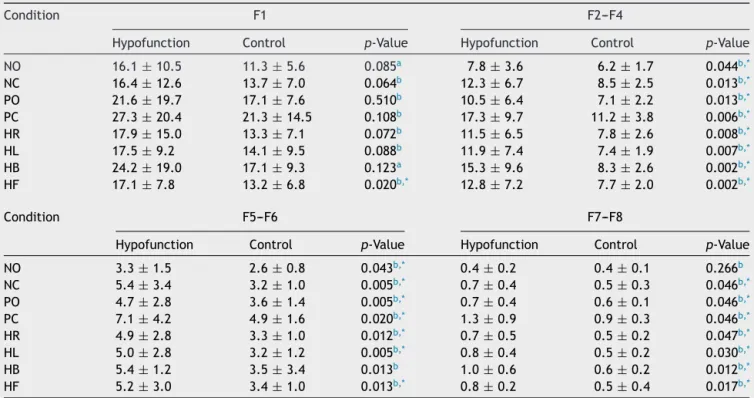
Table2shows thecomparative analysisofthe postural swayfrequencybands(F1,F2---F4,F5---F6,F7---F8)inthe con-trolgroupandtheexperimentalgroupintheeightsensory conditionsoftheTetraxTM.Thegroupwithunilateral
vesti-bularhypofunctionhadhighervaluesthanthecontrolgroup inallfrequencybands.Therewasastatisticallysignificant differencebetween groups in all postural swayfrequency bandsin theconditionof eyesclosedandhead tilted for-ward(HF),inthebandsF2---F4andF5---F6in thecondition eyesopenonafirmsurface(NO)andinbandsF2---F4,F5---F6 andF7---F8intheotherconditions.
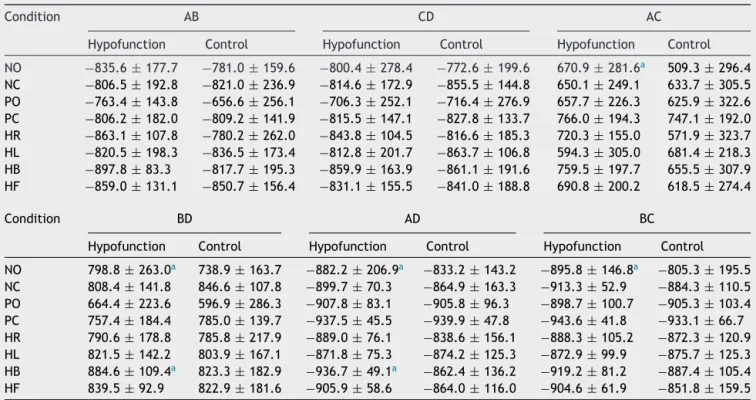
Table3showsthecomparativeanalysisoftheright/left and toes/heel synchronization indexof the control group andtheexperimentalgroupintheeightsensoryconditions oftheTetraxTM.Therewasnosignificantdifferencebetween
the groups in the AB, CD, AC, BD, AD and BC (p>0.05) synchronizationsintheconditionsofeyesclosedonafirm surface(NC),eyesclosedandheadturnedtotheright(HR), eyesclosedandheadturnedtotheleft(HL),eyesclosedand headtiltedforward(HF),eyesopenonanunstablesurface (PO)andeyesclosedonanunstablesurface(PC).
Therewasastatisticallysignificantdifferencebetween groups,withhighervaluesinthegroupofpatientswith ver-tigoandunilateralvestibularhypofunction,intheAC---right andleftheels(p=0.020),BD---betweenrightfoottoesand leftfoottoes (p=0.018),AD --- betweenthe leftheeland rightfoottoes(p=0.016)andBC---betweenleftfoottoes andrightheel(p=0.011)synchronizationsinthecondition ofeyesopenonafirmsurface(NO);inBD---betweenright foottoesandleftfoottoes(p=0.050)andAD---betweenthe leftheeland righttoes (p=0.012)synchronizationsin the conditionofeyesclosedandheadtiltedbackwards(HB).
Discussion
Thisstudysoughttoevaluatebodybalanceinan experimen-talgroupofpatientswithvertigoandunilateralvestibular hypofunction at the staticposturography of the TetraxTM.
This posturography uses different parameters and proce-duresfromothertypesofposturographies,whichmakesthe quantitativecomparisonofresultsdifficult.
The fall risk in theexperimental group showed signifi-cantincrease,classifiedasmoderate.Wefoundnoliterature references on the fall risk at the static posturography of TetraxTM in patients withvertigo andunilateral vestibular
hypofunction.
The experimental group showed increased values of weightdistributionindexintheeightassessedconditions, butonlysignificantlyintheconditionofeyesclosed,onthe cushion. These findings concur with reports that in situa-tions of vestibularstress,asin the conditionsofunstable surfaceandeyesclosed,patientswithperipheralvestibular disordersshowsignificantworseninginweightdistribution.12
Table1 Analysis ofthestability indexandthe weightdistribution indexintheeight conditions oftheTetraxInteractive BalanceSystem(TetraxTM)in32controlsubjectsand25patientswithvertigoandunilateralvestibularhypofunctionfromthe experimentalgroup.
Condition Stabilityindex Weightdistributionindex
Hypofunction Control p-Value Hypofunction Control p-Value
NO 16.7±7.1 13.1±3.5 0.082a 5.2±2.3 4.8±2.5 0.479a
NC 28.0±13.7 18.0±6.0 0.007a,* 5.4±2.0 4.7±2.3 0.177a
PO 25.2±14.6 18.4±6.6 0.267a 6.0±2.6 4.8±2.5 0.640a
PC 39.6±21.4 26.0±10.4 0.031a 6.0±3.2 4.0±2.2 0.008b,*
HR 25.6±14.8 17.7±5.2 0.074a 6.5±3.1 5.3±2.7 0.152a
HL 26.7±14.9 17.5±6.4 0.009a,* 6.6±3.4 5.4±2.5 0.162a
HB 30.1±17.6 19.2±6.3 0.016a,* 6.3
±2.5 4.9±2.9 0.640b
HF 27.8±14.3 17.7±4.5 0.010a,* 5.8±2.3 5.4±2.4 0.464b
Valuesareshownasmean±standarddeviation.
NO,eyesopenonafirmsurface;NC,eyesclosedonafirmsurface;PO,eyesopenonanunstablesurface;PC,eyesclosedonanunstable surface;HR,eyesclosedwithheadrotationtotherightonafirmsurface;HL,eyesclosedwithheadrotationtotheleftonafirm surface;HB,eyesclosed;headtiltedat30◦backwardsonafirmsurface;HF,eyesclosed,headtiltedforwardat30◦onfirmsurface.
a Mann-Whitneytest. b Student’st-test.
* Statisticallysignificantdifferencebetweenthegroups(p<0.05).
Table2 ComparativeanalysisofFourierfrequencybandsintheeightconditions oftheTetraxInteractive BalanceSystem (TetraxTM)in32controlsubjectsand25patientswithvertigoandunilateralvestibularhypofunctionintheexperimentalgroup.
Condition F1 F2---F4
Hypofunction Control p-Value Hypofunction Control p-Value
NO 16.1±10.5 11.3±5.6 0.085a 7.8±3.6 6.2±1.7 0.044b,*
NC 16.4±12.6 13.7±7.0 0.064b 12.3±6.7 8.5±2.5 0.013b,*
PO 21.6±19.7 17.1±7.6 0.510b 10.5±6.4 7.1±2.2 0.013b,*
PC 27.3±20.4 21.3±14.5 0.108b 17.3±9.7 11.2±3.8 0.006b,*
HR 17.9±15.0 13.3±7.1 0.072b 11.5
±6.5 7.8±2.6 0.008b,*
HL 17.5±9.2 14.1±9.5 0.088b 11.9±7.4 7.4±1.9 0.007b,*
HB 24.2±19.0 17.1±9.3 0.123a 15.3±9.6 8.3±2.6 0.002b,*
HF 17.1±7.8 13.2±6.8 0.020b,* 12.8±7.2 7.7±2.0 0.002b,*
Condition F5---F6 F7---F8
Hypofunction Control p-Value Hypofunction Control p-Value
NO 3.3±1.5 2.6±0.8 0.043b,* 0.4±0.2 0.4±0.1 0.266b
NC 5.4±3.4 3.2±1.0 0.005b,* 0.7±0.4 0.5±0.3 0.046b,*
PO 4.7±2.8 3.6±1.4 0.005b,* 0.7±0.4 0.6±0.1 0.046b,*
PC 7.1±4.2 4.9±1.6 0.020b,* 1.3±0.9 0.9±0.3 0.046b,*
HR 4.9±2.8 3.3±1.0 0.012b,* 0.7±0.5 0.5±0.2 0.047b,*
HL 5.0±2.8 3.2±1.2 0.005b,* 0.8±0.4 0.5±0.2 0.030b,*
HB 5.4±1.2 3.5±3.4 0.013b 1.0
±0.6 0.6±0.2 0.012b,*
HF 5.2±3.0 3.4±1.0 0.013b,* 0.8±0.2 0.5±0.4 0.017b,*
Valuesareshownasmean±standarddeviation.
NO,eyesopenonafirmsurface;NC,eyesclosedonafirmsurface;PO,eyesopenonanunstablesurface;PC,eyesclosedonanunstable surface;HR,eyesclosedwithheadrotationtotherightonafirmsurface;HL,eyesclosedwithheadrotationtotheleftonafirm surface;HB,eyesclosed;headtiltedat30◦backwardsonafirmsurface;HF,eyesclosed,headtiltedforwardat30◦onfirmsurface.
F1,F2---F4,F5---F6;F7---F8,frequencybandsofposturalsway. a Mann---Whitneytest.
b Student’st-test.
Table3 ComparativeanalysisofindicesofsynchronizationintheeightconditionsoftheTetraxInteractiveBalanceSystem (TetraxTM)in32 controlsubjects and25patients withvertigoandunilateral vestibularhypofunction fromtheexperimental group.
Condition AB CD AC
Hypofunction Control Hypofunction Control Hypofunction Control
NO −835.6±177.7 −781.0±159.6 −800.4±278.4 −772.6±199.6 670.9±281.6a 509.3±296.4
NC −806.5±192.8 −821.0±236.9 −814.6±172.9 −855.5±144.8 650.1±249.1 633.7±305.5
PO −763.4±143.8 −656.6±256.1 −706.3±252.1 −716.4±276.9 657.7±226.3 625.9±322.6
PC −806.2±182.0 −809.2±141.9 −815.5±147.1 −827.8±133.7 766.0±194.3 747.1±192.0
HR −863.1±107.8 −780.2±262.0 −843.8±104.5 −816.6±185.3 720.3±155.0 571.9±323.7
HL −820.5±198.3 −836.5±173.4 −812.8±201.7 −863.7±106.8 594.3±305.0 681.4±218.3
HB −897.8±83.3 −817.7±195.3 −859.9±163.9 −861.1±191.6 759.5±197.7 655.5±307.9 HF −859.0±131.1 −850.7±156.4 −831.1±155.5 −841.0±188.8 690.8±200.2 618.5±274.4
Condition BD AD BC
Hypofunction Control Hypofunction Control Hypofunction Control
NO 798.8±263.0a 738.9±163.7 −882.2±206.9a −833.2±143.2 −895.8±146.8a −805.3±195.5
NC 808.4±141.8 846.6±107.8 −899.7±70.3 −864.9±163.3 −913.3±52.9 −884.3±110.5 PO 664.4±223.6 596.9±286.3 −907.8±83.1 −905.8±96.3 −898.7±100.7 −905.3±103.4 PC 757.4±184.4 785.0±139.7 −937.5±45.5 −939.9±47.8 −943.6±41.8 −933.1±66.7 HR 790.6±178.8 785.8±217.9 −889.0±76.1 −838.6±156.1 −888.3±105.2 −872.3±120.9 HL 821.5±142.2 803.9±167.1 −871.8±75.3 −874.2±125.3 −872.9±99.9 −875.7±125.3 HB 884.6±109.4a 823.3±182.9 −936.7±49.1a −862.4±136.2 −919.2±81.2 −887.4±105.4
HF 839.5±92.9 822.9±181.6 −905.9±58.6 −864.0±116.0 −904.6±61.9 −851.8±159.5
Valuesareshownasmean±standarddeviation.
AB,synchronizationindexbetweenplatformsregardingtheleftfoottoesandheel;CD,synchronizationindexbetweentherightfoot toesandheel;AC,synchronizationindexbetweenthetwoheels;BD,synchronizationindexbetweenthetwoanteriorpartsofthefoot; AD,synchronizationindexbetweentheleftheelandrighttoes;BC,synchronizationindexbetweenthelefttoesandrightheel;NO,eyes openonafirmsurface;NC,eyesclosedonafirmsurface;PO,eyesopenonanunstablesurface;PC,eyesclosedonanunstablesurface; HR,eyesclosedwithheadrotationtotherightonafirmsurface;HL,eyesclosedwithheadrotationtotheleftonafirmsurface;HB, eyesclosed;headtiltedat30◦backwardsonafirmsurface;HF,eyesclosed,headtiltedforwardat30◦onfirmsurface.
Mann---Whitneytest.
aStatisticallysignificantdifferencebetweenthegroups(p<0.05).
turned the left, head tilted backwards, head tilted for-wardandeyesclosedonanunstablesurface.Thevaluesin thecontrolgroupwerewithinthereferenceparameters10
in all conditions, indicating little oscillation on the four plates and showing good overall stability. These results suggest that unilateral vestibular hypofunction compro-misesposturalstability,mainlyinsituationsinvolvingvisual informationdeprivationandproprioceptiveinformation dis-turbance,similartowhatwasfoundwhencomparingagroup ofpatientswithdizzinessandacontrolgroup.12
Theexperimentalgroupshowedasignificantincreasein valuesin all postural sway frequency bands in the condi-tion of head tilted forward, in the bands F2---F4, F5---F6, andF7---F8intheconditionseyesclosedonafirmsurface, headturnedtotheright,totheleft,tiltedbackwards,eyes openonanunstablesurfaceandeyesclosedonanunstable surface and in the bands F2---F4 and F5---F6 in the condi-tion of eyes open on a firm surface. Higher sway values wereobservedintheLow(F1)bandandlowervaluesinthe Medium---High(F5---F6)andHigh(F7---F8)bands.Theincrease intheswayintheMedium---Low(F2---F4)bandfoundinthe experimentalgroupisexpectedinperipheralvestibular dys-function;thedominanceoftheswaysintheLow(F1)band couldindicatetheinfluenceofvisualpreferenceinpostural
control;dominantswaysintheMedium---High(F5---F6)band wouldindicatesomatosensory dysfunctionand intheHigh (F7---F8)band,centralvestibulardysfunction.9Wefoundno
referencesintheliteratureonthefrequencybandsatthe TetraxTM staticposturographyin patientswithvertigo and
unilateralvestibularhypofunction.
Theexperimentalgroupshowedasignificantincreasein thesynchronization indexbetweentheright heelandleft heel(AC),righttoesandlefttoes(BD),leftheelandright toes(AD)andlefttoesandrightheel(BC)inthecondition eyesopenonfirmsurfaceandinthesynchronizationsBDand ADintheconditionheadtiltedbackwards.The synchroniza-tionindexvaluesintheeightconditionsweresymmetricand positive or negativeaccording tothe expectedin healthy individuals9inthecontrolandexperimentalgroups,
indicat-ingcoordinationandsynchronization.Wefoundnoliterature references on the synchronizations indexes at the static posturographyoftheTetraxTMinpatientswithvertigoand
unilateralvestibularhypofunction.
The parameters evaluated by TetraxTM were sensitive
todemonstrate alterations in postural controlmechanism in our patients with vertigo and vestibular hypofunction. In this research, the TetraxTM provided relevant data on
index,right/leftandtoes/heel synchronization index pos-turalswayfrequencybands(F1,F2---F4,F5---F6,F7---F8)and fallriskintheassessmentofposturalcontrolinpatientswith vertigoandunilateralvestibularhypofunction.
The identification of the characteristics of body bal-ancedisordersinpatientswithvertigomayhavediagnostic, preventive andtherapeutic implications. Furtherresearch should be undertaken to better clarify the consequences ofalterationsin theseparametersonposturalcontroland vestibularhypofunction, found in different neurotological clinicalpictures.
Conclusion
Alterationsinweightdistribution,right/leftandtoes/heels synchronization index, postural sway frequency bands and fall risk characterize postural control impairment in patientswithvertigoandunilateralvestibularhypofunction, assessedbyposturographyoftheTetraxInteractiveBalance System.
Funding
This study was supported by Coordenac¸ão de Aperfeic¸oamentodePessoaldeNívelSuperior---CAPES.
Conflicts
of
interest
Theauthorsdeclarenoconflictsofinterest.
References
1.HorakBF,ShupertCL.Func¸ãodosistemavestibularnocontrole postural.In:HerdmanSJ,editor.Reabilitac¸ãovestibular.São Paulo:Manole;2002.p.25---51.
2.BittarRSM.Como a posturografia dinâmica computadorizada podenosajudarnoscasosdetontura.ArqIntOtorrinolaringol. 2007;11:330---3.
3.Gananc¸aMM,CaovillaHH,Gananc¸aFF,DonaF,BrancoF,Paulino CA,etal.Vertigem.RevBrasMed.2008;65:6---14.
4.GazzolaJM,Perracini MR,Gananc¸a MM,Gananc¸aFF.Fatores associadosaoequilíbriofuncionalemidososcomdisfunc¸ão ves-tibularcrônica.BrazJOtorhinolaryngol.2006;72:683---90. 5.PereiraSRM.Oidosoquecai.In:SociedadeBrasileirade
Geri-atriaeGerontologia.Caminhosdoenvelhecer.RiodeJaneiro: Revinter;1994.p.217---21.
6.Gananc¸a MM, Caovilla HH, Gananc¸a FF. Electronystagmog-raphy versus videonystagmography. Braz J Otorhinolaryngol. 2010;76:399---403.
7.Gananc¸aMM,CaovillaHH,MunhozMSL,SilvaMLG,Gananc¸aFF, Gananc¸aCF.Oqueesperardaequilibriometria.In:CaovillaHH, Gananc¸aMM,MunhozMSL,SilvaMLG,editors.Equilibriometria Clínica.SãoPaulo:Atheneu;1999.p.23---9.
8.Duarte M, Freitas SMF. Revisão sobre posturografia baseada emplataformadeforc¸aparaavaliac¸ãodoequilíbrio.RevBras Fisioter.2010;14:183---9.
9.Tetrax.Guidaperoperatoreclinico.Italy:SunlightMedicalLtd; 2004,34pp.
10.Kohen-RazR,VolkmarFR,CohenDJ.Posturalcontrolinchildren withautism.JAutismDevDisord.1992;22:419---32.
11.FukunagaJY,QuitschalRM,Gananc¸aMM,Caovilla HH.Ofthe posturography of the Tetrax interactive balance system in healthyindividuals:preliminarystudy.IntArch Otorhinolaryn-gol.2012;16:17.
12.Kohen-RazR, Sokolov A,Kohen-Raz A,DemmerM, HarellM. Posturographiccorrelatesofperipheralandcentralvestibular disordersasassessedbyelectronystagmography(ENG)andthe TetraxInteractiveBalanceSystem.In: ReidA, MarchbanksR, Ernst A, editors. Intercranial and inner ear physiology and pathophysiology.London:Whurr;1998.p.231---6.
13.Albertino S,BittarRSM,Bottino MA,Gananc¸a MM,Gonc¸alves DU,GretersME,etal.Aircalorictestreferencevalues.BrazJ Otorhinolaryngol.2012;78:2.