An analysis of the risk of cocoa moniliasis occurrence in Brazil as the result of
climate change
Wanderson Bucker Moraes
1*; Waldir Cintra de Jesus Júnior
1; Leonardo de Azevedo Peixoto
1; Willian Bucker
Moraes
2; Edson Luiz Furtado
2, Lilianne Gomes da Silva
1; Roberto Avelino Cecílio
1, Fábio Ramos Alves
11Department of Plant Production, Agricultural Science Center, Federal University of Espirito Santo (UFES), 29500-000, Alegre, ES, Brazil. 2Department of Plant Protection, University Estadual Paulista “Julio de Mesquita Filho” (UNESP), Botucatu, SP, Brazil. *Bolsista CNPq. Autor para correspondência: Wanderson Bucker Moraes ([email protected]).
Data de chegada: 02/08/2011. Aceito para publicação em: 13/02/2012.
1771
RESUMO
T he a im of this stu dy wa s to eva lu a te the potentia l r isk of monilia sis occu r r ence a nd the impa cts of clima te cha nge on this disease in the coming decades, should this pathogen be introduced in Brazil. To this end, climate favora bility ma ps wer e devised for the oc cu r r enc e o f m oni lia s is, bo th f or the pr esen t a nd fu t u r e tim e. The future scenarios (A2 and B2) focused on the deca des of 2 020, 2 0 5 0 a nd 2 0 8 0 . T hese scena r ios we r e obt a ined fr om s ix glo ba l clima t e models ( G C Ms) ma de a va ila ble by th e thir d a sse ssment r e po r t o f I n te r go ve r n me nt a l Pa ne l on C li ma te C h a n ge ( I P C C ) . C ur rently, there a r e la rge a reas with favor able climate conditions
Moraes, W. B.; Jesus Júnior W.C.; Peixoto, L.A.; Moraes W.B.; Silva, L.G.; Cecílio, R.A.; Alves, F.R. An analysis of the risk of cocoa moniliasis occurrence in Brazil as the result of climate change. Summa Phytopathologica, v.38, n.1, p.30-35, 2012.
Palavras-chave adicionais: Moniliophthora roreri, Theobroma cacao, aquecimento global, sistema de informação geográfico.
f or m on i li a s is in B r a z il , e s p ec i a l l y i n r e g io n s a t h i gh r i s k o f in tr o du c tio n o f t ha t pa tho gen . C ons ide r in g t he glo ba l wa r mi ng scena rios pr ovided by the IPC C , the potentia l r isk of monilia sis occurrence in Brazil will be reduced. This decrease is predicted for both futu re scenar ios, bu t will occur mor e sharply in scenario A2. However, there will still be areas with favor able climate conditions for the development of the disease, pa r ticu la r ly in B r a zil’s ma in producing regions. Moreover, pathogen and host alike may undergo a ltera tions du e to climate cha nge, which will a ffect the extent of their impa cts on this pa thosystem.
Este tr aba lho teve como objetivo ava lia r o potencia l r isco de ocor r ên cia da monil ía se e os im pa ctos da s m u da nça s clim á tica s so br e esta doe nça na s déca d as futura s, caso este patógeno seja m introduzida no Brasil. Para tal, elaboraram-se mapas de favorabilidade climática à ocorrência da monilíase no período atu al e fu tu ro. Os cenários futuros empregados (A2 e B2) foram centrados nas décadas de 2020, 2050 e 2080. Estes cenários foram obtidos a partir de seis modelos climáticos globais (MCG’s) disponibiliza dos pelo ter ceiro r ela tór io do Pa inel I nter governa menta l de Mu da nça s C limá tica s ( IPC C ). No per íodo a tu al existem extensa s ár eas que apr esenta m co n di ç õ e s d e f a v o r a bi l i d a d e c li m á t i ca a mo n i l ía s e n o B r a si l ,
Moraes, W. B.; Jesus Júnior W.C.; Peixoto, L.A.; Moraes W.B.; Silva, L.G.; Cecílio, R.A.; Alves, F.R. Análise do risco de ocorrência da monilíase em cacaueiro no Brasil face às mudanças climáticas globais. Summa Phytopathologica, v.38, n.1, p.30-35, 2012.
principa lmente em regiões qu e apr esentam a lto r isco de introdu ção do p a t óg en o. C on si de r a nd o os c en á r io s de a qu ec im en to g lo ba l pr evisto pelo IPCC, haverá a r edu çã o do potencial risco climático de ocor r ência da monilí a se no B r a sil. Ta l r edu çã o é pr edita em a mb os c ená r i os futur os, por ém ocor rerá de for ma mais a centua da a dmitindo-se o cená r io A2 . N o enta nto, a inda ha ver á á r ea s qu e a pr esenta r a m condições de fa vor a bilida de climá tica a o desenvolvimento da doença , pr incipa lmente na s ma ior es r egiões produtoras do Brasil. Além disso, tanto o patógeno como o hospedeiro poderão sofrer alterações com mudanças climáticas, o que influenciará magnitu de dos seu s impa ctos sobr e este pa tossistema .
Keywords: Moniliophthora roreri, Theobroma cacao, global warming, geographic information system.
ABSTRACT
Moniliasis (Moniliophthora roreri (Cif & Par.) Evans et al) is one of the most destructive diseases affecting cocoa trees worldwide, affected cocoa beans in the countries of Central and South America, and is responsible for the plummet in tropical American cocoa production (2). Currently, this disease is of considerable importance in Ecuador, Colombia and Peru, where it limits the expansion of cocoa plantations (12). Although moniliasis has not yet been reported in Brazil, it could be a significant threat to Brazilian cocoa crops. Recent surveys have reported the disease at the Brazil-Peru border, near the
Amazon (15, 27). In addition, Brazil borders other countries in which this pathogen has already been reported, such as Venezuela and Colombia (15, 24). Therefore, the transit of people and illegal transportation plant material (seedlings and cocoa fruit) on the border of Brazil with these countries means risks to Brazilian cocoa crops.
presence of a virulent pathogen and susceptible host (18). Once the adequate conditions for the onset and development of the pathogen are defined, the disease’s risk can be deduced and such areas can be delineated. This management practice can be improved by inputting epidemiological information onto a Geographic Information System (GIS). GIS has been applied in agriculture to analyze spatial and temporal distribution of plant diseases by mapping risk areas (20). Additionally, the identification of areas at high risk for pathogens is crucial with regard to the introduction of quarantine diseases (4).
Nevertheless, in addition to analyzing the risk of moniliasis occurrence in Brazil, it is necessary to consider the potential impacts of climate change on this disease, should this pathogen be introduced in Brazil. Climate changes may have direct and indirect effects on pathogens and host plants alike, as well as in their interaction (7, 13). Changes in geographical distribution will potentially alter the relative importance and spectrum of diseases, and new disease complexes may arise (6). Therefore, depending on the climate conditions, there may be an increased potential for the establishment of quarantine pathogens. Thus, new diseases may occur in certain regions and others can lose or in crease their econ omic importance, especially if displacement of crop fields takes place (8). However, despite the threats of climate change for crop protection in the near future, there are few reports on this subject.
Accordingly, learning the effects of climate change on the risk for moniliasis in Brazil can support government agricultural policies and adequate disease management, in case this pathogen is introduced and established in the country. Therefore, this study aimed to evaluate the potential risk of occurrence of moniliasis in Brazil and the impacts of climate change on this disease in coming decades based on the climate scenarios A2 and B2 (17).
MATERIAL AND METHODS
Definition of climate favorability classes for moniliasis
Classes of climate favorability were used to draw monthly maps of the spatial distribution of moniliasis. These classes were defined based on epidemiological data about the effect of air temperature (Tm, °C) and relative humidity (RH, %) in the development of cocoa moniliasis. The thresholds of temperature and relative humidity of the climate favorability classes of the disease were defined based on bibliographic reports, namely: highly favorable – Tm between 22 °C and 26 °C, RH above 85%; favorable – Tm between 18 °C and 22 °C or 26 °C and 30 °C, RH above 80%, or Tm between 22 °C and 26 °C, RH between 80% and 85%; relatively favorable – Tm between 18 °C and 30 °C, RH between 70% and 80%; unfavorable – Tm below 18 °C or above 30 °C, or RH below 70% (5, 25, 26, 27).
Climate Data
Current climate data, average air temperature and relative humidity are related to historical averages of these variables from 1961 to 1990 (21). These data are available in matrix format (grid), with cells of 10’ latitude by 10’ longitude.
Data on future predictions of temperature and relative humidity deviation s for each month were obtain ed from the IPC C (Intergovernmental Panel on Climate Change) website (17). Future average air temperatures were calculated using the deviations of this variable provided by six different global climate models (GCMs): HadCM3 (Hadley Centre Coupled Model version 3), CSIROMk2 (Commonwealth Scientific and Industrial Research Organisation Mark
2 GCM), CCSR/NIES (Centre for Climate Research Studies Model), ECHAM4 (European Centre Hamburg Model version 4), CGCM2 (Canadian Global Coupled Model version 2) and GFDL-R30 (Geophysical Fluid Dynamics Laboratory, R-30 resolution model) (17). Among the models, only HadCM3 considers future deviations of relative humidity. The other models assume that this variable will remain constant or undergo little change in the future. Therefore, future data of relative humidity were derived only from the HadCM3 model. The future scenarios selected were A2 and B2, with a focus on the 2020s (2010- 2039), 2050s (2040-2069) and 2080s (2070-2099). Scenario A2 describes a future when heterogeneous regionalization is dominant, whereas scenario B2 emphasizes local solutions to economic, social and environmental sustainability (16). Therefore, scenario A2 can be considered more “pessimistic” concerning emission of greenhouse gases. Conversely, scenario B2 is “optimistic” about climate change, because it takes mitigation measures into account.
Preparing climate favorability maps for moniliasis
GIS (Geographic Information System) Idrisi 32 was used to devise the maps. As each model has different spatial resolutions (HadCM3: 3.75° by 2.5°; CSIROMk2b: 5.625° by 3.214°; CCSR/NIES: 5.625° by 5.625°; ECHAM4: 2.8125° by 2.8125º; CGCM2: 3.75° by 3.75°; and GFDL-R30: 3.7° by 2.2°), the deviations of future climate data were resampled using GIS Idrisi 32 to produce maps with spatial resolution of 10’ latitude by 10’ longitude. For each month, these maps were added using Idrisi 32® (arithmetic operation) to the maps of current temperature and relative humidity, to obtain future projections of these climate variables.
In order to reduce the variability of the simulation, all six models were used to calculate the average values to create monthly maps of future deviations from the average air temperature. For this purpose, we used the spatial analysis tool (arithmetic) of Idrisi 32 GIS. This technique is called “multimodel ensemble”, because it uses the average values provided by each of the GCMs. Recent studies have found that the use of the “multimodel ensemble” technique reduced the variation in the estimates of the impacts of climate change on plant diseases (19).
World maps of average temperature and relative humidity for the present and future (2020, 2050 and 2080) for both scenarios (A2 and B2) were classified according to the classes of climate favorability for moniliasis. Based on the overlapping of selected maps of temperature and relative humidity, new monthly maps of moniliasis distribution in Brazil were devised. The area corresponding to Brazil was selected from georeferenced data, and a mask delineating the individual states was applied to these maps.
RESULTS AND DISCUSSION
between April and June. Therefore, the most susceptible growth stage of the crop corresponds to the period of highest favorability for moniliasis in Brazil. Thus, determining the possible critical points of this disease during that period would be instrumental in formulating future management strategies, should the disease be introduced in the country.
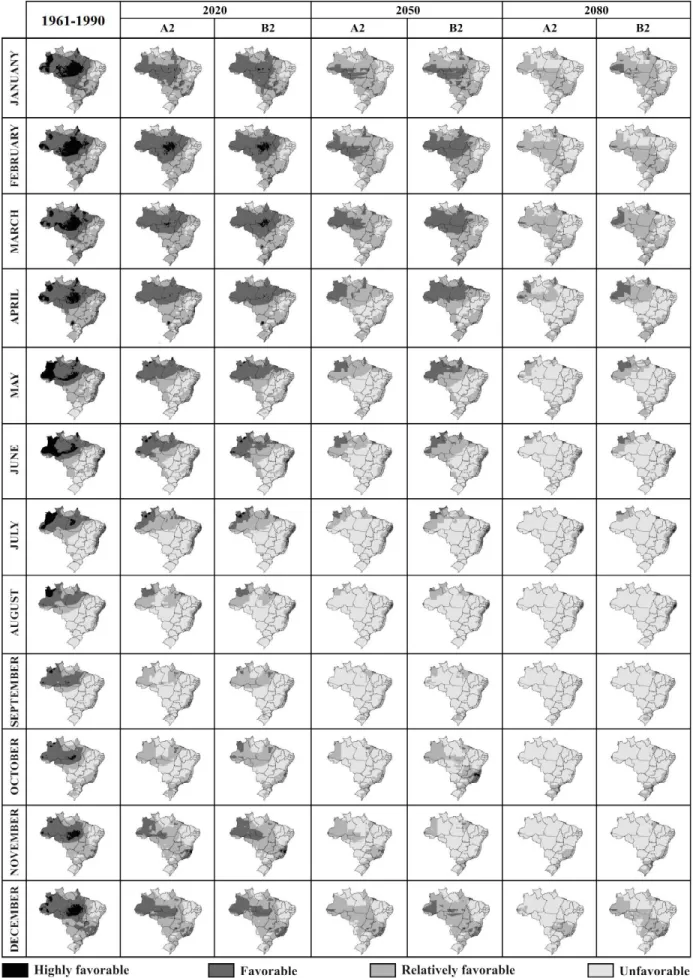
Regarding spatial distribution, there is predominance of areas with climate potential for the occurrence of moniliasis (highly favorable, favorable and relatively favorable) in the North, Midwest, Southeast and the Northeast regions (especially southern Bahia) of Brazil (Figure 1). In southern Brazil, there is a high concentration of areas classified as “unfavorable” for the disease during certain periods of the year (May-September) (Figure 1). This is due to low temperatures in the region during that time of the year. In the North, due to high relative humidity and the presence of favorable temperatures for moniliasis, there is predominance of areas classified as “favorable” for the disease every year (Figure 1).
Although the disease has not officially been detected so far in Brazil, it will likely find favorable conditions for its onset if introduced. The occurrence of moniliasis has been recently reported on the border between Brazil and Peru, near Amazon (15, 27). There are land and river routes in various locations of the wide range of Brazil’s border with Peru, Colombia and Venezuela. Evidence indicates transport of cocoa materials at these sites. Therefore, there is the risk of diseased fruits, apparently healthy, be transported. Thus, it is estimated that if quarantine measures are not adopted to restrict the spread of moniliasis, the introduction of this disease in Brazil will occur in a matter of time (27).
The Ministry of Agriculture, Livestock and Food Supply (MAPA) developed a contingency plan of moniliasis. The aim of this program is to prevent the entry and spread of moniliasis in Brazil, and hold fast action to eradicate foci after detection (9). In the states with high risk of introduction this disease (Acre, Amazonas, Roraima and Rondônia), the contingency plan of moniliasis determines at least one prospecting per year in areas of species of Theobroma and Herrania wild and cultivated (9). Additionally, the MAPA and Agency of Agricultural Defense of Bahia (Adab) founded in 2011 the Technical Committee of Prevention Moniliasis of Cocoa (CTPMC). The CTPMC aims to develop actions to prevent the entry and establishment of moniliasis of cacao in the state Bahia, through integrated activities of research, technical assistance, education and plant health protection. Currently, moniliasis has widespread distribution in Peru, which in dicates good adaptation of th e path ogen and host to those environmental conditions. These conditions favored the wide spread of the disease, which affected the entire country in a short period of time (27). A similar situation occurred in Costa Rica, where moniliasis spread rapidly between 1978 and 1981 (11). Therefore, given the lack of efficient management methods to control moniliasis and the existence of risk areas in Brazil, this disease presents a serious threat to the national cocoa crop. In addition to these factors, the absence of pathogens antagonists to moniliasis in Brazil may compound losses from the onset of this disease in the country.
Nevertheless, results indicate a reduction in areas with climate potential for the occurrence of moniliasis in coming decades (2020, 2050 and 2080) for both scenarios (A2 and B2) (Figure 1 and 2). This reduction is forecast both for the most favorable period of the disease (November-May) and for the period of least favorability (June-October). The main factor responsible for these results is the sharp decrease in relative humidity expected in the future scenarios. In Colombia, the intensity of moniliasis and its control was less efficient
in drier areas than in areas of tropical rainforest (3).
The increase in unfavorable areas for the disease is more pronounced in scenario A2 compared to B2 (Figure 2). In scenario A2, the estimated percentage of Brazilian territory likely to be unfavorable to moniliasis will be 31.9%, 52.4% and 75.1% in the decades of 2020, 2050 and 2080, respectively. In scenario B2, the percentage of Brazilian territory occupied by this class of favorable weather will be 31.0%, 44.2% and 62.5% respectively in the decades of 2020, 2050 and 2080. Scenario A2 predicts greater reductions in relative humidity than scenario B2, resulting in less favorable conditions to moniliasis.
Regarding the future temporal distribution of risk areas, the most favorable climate period for moniliasis in 2080 will be between December and March (Figures 1 and 2). During that period in 2080 the average percentage of the Brazilian territory occupied by areas favorable for moniliasis development will be 1.6% for scenario A2 and 3.9% for scenario B2. In contrast, in the same period of 2080, the percentage of Brazilian territory occupied by relatively favorable disease areas will be 73.2% and 60.9% for scenarios A2 and B2, respectively. Therefore, there should be an increase in areas with lower risk of moniliasis during that most favorable period.
Currently, the main cocoa growing regions of Brazil are located in the states of Bahia, Rondônia, Espírito Santo, Pará and Amazonas. Future scenarios in these regions will still feature areas at risk for moniliasis (Figure 1). While there is a trend of decreasing favorability for moniliasis in Brazil, there are still areas with climate potential for the occurrence of this disease in the main producing regions. Thus, studies on moniliasis control should be done to minimize the impacts and potential losses from its possible introduction in Brazil.
Only the favorable conditions for disease’s development were taken into account in this study. Nevertheless, the impacts of climate change on ecosystem services are complex in the sense that effective prediction requires considering a wide range of factors (14). The impact of climate change may have positive effects on one part of the disease triangle and negative effects on another (7). Moreover, the effects can also be opposite at various stages of the pathogen’s life cycle (8). Additionally, both the pathogen and host may undergo alterations from climate change, thereby influencing the plant-pathogen interaction (7, 10).
With respect to the host, it will likely undergo changes as the environmental conditions expected in future scenarios may become adverse to the development of this crop in certain regions of the country. Thus, new cultivars adapted to future environmental conditions should be developed. Moreover, climate change may also alter the effectiveness of genetic resistance of current cultivars, which show moderate disease resistance. Cocoa features a quantitative-type resistance to moniliasis, showing variation in disease intensity between different genotypes and environmental conditions (23, 27). This type of resistance is affected by environmental variations (29). Thus, global climate change may alter the effectiveness of genetic resistance to cacao moniliasis.
Another important factor is the possibility of cultivating cocoa intercropped with forest species, in order to mitigate the effects of climate change on the crop. As a native plant to Amazon, cacao has better characteristics of adaptation and development in areas of shade, thus often associated with other cultivated species (22, 28). However, microclimate conditions inside the canopy are different under this crop system, affecting the disease development and modifying the potential for moniliasis occurrence.
Figure 1. Spatial-temporal distribution of moniliasis climate favorability classes in Brazil in the current period (average 1961 to 1990) and in the future
Figure 2. Effect of climate change on a percentage of the Brazilian territory occupied by classes of favorability of cacao moniliasis occurrence. (A)
over the years. The selective pressure on physiological races more adapted to new conditions can select pathogens adapted to the future new environmental conditions. Furthermore, genetic mutations can occur, and new physiological races of M. roreri selected for the future climate conditions are likely to emerge.
CONCLUSIONS
Currently, there are extensive areas with climate potential for the onset of moniliasis in Brazil, especially in areas at high risk for introduction of the pathogen.
Assuming future scenarios predicted by the IPCC, the areas at potential risk for moniliasis in Brazil should be reduced, according to both future scenarios (A2 and B2). However, this declining trend will occur more sharply for scenario A2, compared to that predicted for scenario B2.
ACKNOWLEDGEMENTS
The authors thank CNPq for the scholarship for Scientific Initiation to the first author (project 508748/2010-0) and research productivity to the second author (project 308596/2006-4).
REFERENCES
01. Agrios, G. N. Plant pathology. Burlington: Elsevier Academic, 200 5. 922 p.
02. Aime, M. C.; Phillips-Mor a, W. The cau sa l a gents of witches’ br oom a nd fr osty pod r ot of ca ca o ( chocolate, Th eo bro ma c
a-cao) form a new lineage of Marasmiaceae. Mycologia,
Lawren-ce, v. 97, p. 1 012-1022, 2005.
03. Aranzazu, H. F. La moniliasis del cacao. In: Tercera Reunion del Comité Consultivo de Sanidad Vegetal, 3., 1982, Caracas. Anais. Caracas, 1982. p. 22-26.
04. Booth, T. H.; Jovanovic, T.; Old, K. M.; Dudzinski, M. J. Clima-tic mapping to identify high-risk areas for Cylindrocladium
quin-queseptatum leaf blight on eucalypts in mainland South East Asia
a nd a r ou nd the wor ld. E nv iro nment al Po llution , B a rk ing, v. 108 , p. 365-37 2, 20 00.
05. Campuzano, H. Influencia de la temperatura y la humedad en la germinación de esporas de Monilia roreri. In: International Co-coa Research Conference, 8., 1981, Cartagena. Anais. Cartage-na: Actas Cocoa Producers´ Alliance, 1981. p. 493-497.
06. Chakraborty, S.; Tiedemann, A. V.; Teng, P. S. Climate change: potentia l impa ct on pla nt disea ses. Enviro nmental Po llut io n, Barking, v. 108, p. 317-326, 2000.
07 . C ha k ra bor ty, S. Potentia l impa ct of clima te cha nge on pla nt-pathogen interactions. Aust ralasian Plant Pathology, C layton, v. 34, p. 443-448, 2005.
08. Coakley, S. M. Biospheric change: will it matter in plant patho-logy? C anadian J ournal of Plant Pat ho lo gy , G uelph, v. 17 , p. 147-153, 199 5.
09 . DSV/MAPA. Plano de c ont ing ê nc ia para mo nilías e do c
a-c aue iro . Ava ila ble fr om:< http://www.a gr icu ltu r a .gov.br / a r q _ e d i t o r / f i l e / c a m a r a s _ s e t o r i a i s / C a c a u / 1 7 _ r e u n i a o / Plano_de_Contingencia _de_Valor es_da_Ca cauicultura.pdf> . Ac-cessed: Dez. 15, 2010.
10. Eastburna, D. M.; Mcelroneb, A. J.; Bilginc, D. D. Influence of a tmospher ic a nd clima tic cha nge on pla nt– pathogen intera cti-ons. I nflu ence of a tmospher ic a nd clima tic cha nge on pla nt– pa thogen interactions. Plant Patho log y, Oxfor d, v. 60, p. 5 4– 69 , 2 01 1.
11. Enríquez, G. A.; Brenes, O.; Delgado, J. C. Desarrollo e impacto de la moniliasis del cacao en Costa Rica. In: Eighth International
Cocoa Research Conference, 8., 1981. Cartagena. Proceedings. Cartagena: Actas Cocoa Producers´Alliance, 1981. p. 375-380. 12. Freitas, V. M.; Mendes, M. A. S. Espéc ies de fungos exó ticas
para a cultura do cacau. Brasília, DF: EMBRAPA, 2005. 10 p.
(Comunicado Técnico, 12 4).
13. Garrett, K. A.; Dendy, S. P.; Frank, E. E.; Rouse, M. N.; Travers, S. E. Climate change effects on plant disease: genomes to ecosys-tems. Annual Revie w of Phytopat holo gy, Palo Alto, v. 44, p. 489 -509, 2006 .
14. Garrett, K. A.; Forbes, G. A.; Savary, S.; Skelsey, P.; Sparks, A. H.; Valdivia, C.; Van Bruggen, A. H. C.; Willocquet, L.; Djurle, A.; Duveiller, E.; Eckersten, H.; Pa nde, S.; Vera Cruz, C.; Yuen, J. Complexity in climate-change impacts: an analytical framework for effects mediated by plant disease. Plant Pathology, Oxford, v. 60, p. 15–30, 2011.
15. Griffith, G. W.; Nicholson, J.; Nenninger, A.; Birch, R. N.; Hed-ger, J. N. Witches’ brooms and frosty pods: two major pathogens of cacao. New Zealand Journal o f Botany, Wellington, v. 41, p. 423-435, 200 3.
16 . Inter governmental Panel on C lima te Cha nge. Climate C hange
2001: synthesis report. Cambridge, United Kingdom: Cambridge
University Press, 2001. 398p. Available from: <http://www.ipcc-data.org/sres/gcm_data.html>. Accessed: 20 Dez. 2010.
17. Intergovernmental Panel on Climate Change. IPCC SRES climate
scenarios: the IPCC data distribution centre. 2001. Available from:
<http://www.ipcc-data.org/sres/gcm_data.html>. Accessed: 20 Fev. 2011.
18. Jesus Junior, W. C.; Bergamin Filho, A.; Amorim, L.; Vale, F. X. R. Sistemas de auxílio à tomada de decisão no manejo de doenças de plantas. Revisão Anual de Patologia de Plantas, Passo Fundo, v. 11, p. 133-193, 2003.
19. Jesus Junior, W. C.; Valadares Júnior, R.; Cecílio, R. A.; Moraes, W. B.; Vale, F. X. R.; Alves, F. R.; Paul, P. A. Worldwide geographical distribution of Black Sigatoka for banana: predictions based on cli-mate change models. Scientia Agricola, Piracicaba, v. 65, p. 40-53, 2008.
20. Nelson, M. R.; Orum, T. V.; Jaime-Garcia, R.; Nadeem, A. Applicati-ons of geographic information systems and geostatistics in plant disease epidemiology and management. Plant Disease, St. Paul, v. 83, p. 308-319, 1999.
21. New, M.; Lister, D.; Hulme, M.; Makin, I. A high-resolution data set of surface climate over global land areas. Climate Research, Ol-dendorf, v. 21, p. 1-25, 2002.
22. Perfecto, I.; Rice, R. A.; Greenberg, R.; Vander-Voort, A. Shade coffee: a disappearing refuge for biodiversity. Bioscience, Reston, v. 46, p. 598–608, 1996.
23. Phillips-Mora, W.; Castillo, J.; Krauss, U.; Rodríguez, E.; Wilkinson, M. J. Evaluation of cacao (Theobroma cacao) clones against seven Colombian isolates of Moniliophthora roreri from four pathogen genetic groups. Plant Pathology, Oxford, v. 54, p. 483-490, 2005. 24. Phillips-Mora, W.; Aime, M. C.; Wilkinson, M. J. Biodiversity and biogeography of the cacao (Theobroma cacao) pathogen
Monilio-phthora roreri in tropical America. Plant Pathology, Oxford, v.
56, p. 911–922, 2007.
25. Phillips-Mora, W.; Wilkinson, M. J. Frosty pod of cacao: A cisease with a limited geographic range but unlimited potential for damage.
Phytopathology, St. Paul, v. 97, p. 1644-1647, 2007.
26. Porras, V. H.; Gonzales, L. C. Epifitiología de la moniliasis del cacao (Monilia roreri) y su relación con el ciclo de producción en la zona de Matina, Costa Rica. Fitopatología, v. 19, p. 78-84, 1984. 27. Rios-Ruiz, R. A. Epidemiologia e manejo da monilíase do
ca-caueiro no Peru. 2004. 80 f. Tese (Doutorado em Fitopatologia),
Universidade Federal de Viçosa, Viçosa.
28. Silva Neto, P. J.; Melo, A. C. G.; Santos, M. M. Sistema Agroflo-restal cacaueiro (Theobroma cacao) e Mogno (Swietenia
macro-phylla) em Medicilândia, PA. In: Congresso Brasileiro em
Siste-mas Agroflorestais, 2., 1999, Belém. Anais. Belém: EMBRAPA, CPAT U, 19 99 . p. 10 7-10 8.