VEDUTE OF CLUJ NAPOCA: AN ICONGRAPHIC PERSPECTIVE
OVER THE URBAN SPACE
IULIA-FLORIANA CIANG
1ABSTRACT – The town views were a constant preoccupation of the European scientists, artists,
geographers and military stuff, sometimes without a distinct separation between them. Starting with the 17th century, the correct representations of space became a predominant military matter, controlled by
theăengineersăofătheămainămonarchiesăofăEurope.ăEvenăso,ăităremainedămoreă“space”ătoăconquerăandătheă artistsăprovedătoăbeărealăagentsăofăchange,ăespeciallyă“vedutisti”,ăconcernedătoăcatchăthatăcomplexăgenius lociwhichăcombinesăspectacularălandmarkăpanoramasăwithăeverydayălife,ăchoosingăEurope’sămainăcitiesă
as scenery. Transylvania region has also experienced a similar process due the influence of the Age of Enlightenment, but with a delay specific to its peripheral geographic position and political status. The city of Cluj-Napoca was one of the favourite subjects of the foreign and local artists, which proved to be very sensitive to the trends of the urban change capturing the local colour as a statement of the historic past, but also as a change in perceiving the urban space. Compared with almost one-sided urban views of the past centuries, the 19th century brings a 360-degree perspective over the urban space, significant
for the future development of the city.
Keywords: urban space, vedute, Cluj-Napoca, cityscape, Transylvania
INTRODUCTION
The image of the urban space had a sinuous evolution in time, oscillating between representations of religious type, in the Middle Ages, and scientific ones specific to the geographers and other men of science like artists, cartographers, or explorers from Renaissance.
Starting with the 17th century, the town views reached their full artistic potential trough the
vedutist representations of the Italian artists from Venice like Giovanni Antonio Canal, called Canaletto (1697-1768) and Bernardo Belotto (1720-1780).
Vedute are artistic representations (drawings, engravings or paintings) of the very popular cities of the 17th century, that capture both real architectural objectives, with an almost a photographic
fidelity (veduta esatta), and imaginary elements (veduta ideata) (Mari Pictori..., 2001, 71, 74).
The term vedutism comes from Italian vedutismo, which means the art of the vedute, developed from veduta, meaning view, perspective.
The vedute representations along with cartographic materials and European urban atlases of the 14th -17th centuries are used in numerous studies of history and urban iconography (Soragni, U.,
Colleta, T., 2010; Elliot, J., 1988; Niedermaier, P., 1979, etc.) to highlight the evolution of the space and image of the European cities. Due to their documentary value, they could be considered real links to the past but also source of inspiration for the future urban development.
PREMISES OF VEDUTISM
An essential contribution in the evolution of the urban image was brought by the perception of sailors over the mainland. The transpositions of territories seen from the sea were very different in representation. This led to two distinct navigation tools - the Italian portolan, or the book of harbours (a description that helps creating the maps of the safe trade routes and harbours), and the second one,
the nautical map. This way, for the first time, a space became acknowledged through the reading of guides. One of the main components of these navigation guides, the one describing the coastline, has a figurative character, representing the origin of the profile veduta. This way, cities are recognized due to the contour of the buildings, the so-called skyline, which defines their personality. This model would be borrowed from Italians also by the North-European Flemish sailors (leeskart), English (rutter) or French (routier). Especially the Flemish would develop these publications, adding in-depth explanations addressed to a more and more pretentious audience (Nuti, L., 1996, pp. 69-75).
These kind of representations would lead in time to more customized maps, from the regional andă cadastrală toă theă topographică ones,ă mostlyă becauseă ofă theă cartographers’ă worksă like Sebastian Munster’să“Chosmographia”ă(1544),ăAbrahamăOertel’să(Ortelius)ă“TheatrumăOrbisăTerrarum”(1564)ă orăGerardusăMercator’săAtlasăofăEuropeă(1572).ă
Inspiredăbyătheăworkă“TheatrumăOrbisăTerrarum”,ăGeorgăBraună(1541-1622), together with the engraver Franz Hogenberg (1535-1590),ă publishedă aă newă atlasă ofă theă world’să citiesă ină collaborationăwithăOrteliusăentitledă“Civitas”.ăThisăatlasăwouldăenjoyăaăgreatăpublicăsuccess,ărequiringă repeated prints, completed and enriched through time with new information, after the first edition was published in 1570. In the sixth volume, also the last edited in 1617, representations of two cities of the historical Transylvania appear, Claudiopolis (Cluj-Napoca) and Varadinum (Oradea). This atlas made its mark through the ages, being frequently imitated and improved by other authors, creating a strong phenomenon of concurrency between printing workshops.
The field of cartography was one of the most prolific between 16th-17th centuries. The editorial
house of Blaeu from Amsterdam, under the lead of Joan Blaeu (1596 -1673), retrieved the tradition of the urban atlases edited by Georg Braun, bringing innovation in representation, but most of all raising their aesthetic value to the highest level. The end of his career coincided with the last edition of urban atlases (Nuti, L., 1996, p. 190).
The representations of urban space would become more diversified and more distant from the original atlas format in some parts of Europe, combining the urban profiles with fortification plans (France) or showing partial vedute, having in common with the original publication only the urban character (Nuti, L., 1996, p. 198).
Gradually, the dualism of the profiles of cities and urban maps made its presence, justified by the similar dualist collaboration between artist and cartographer. This fact would lead to the individualization of two different sciences: Cartography and Topography starting with the 17th century.
This fact allowed the vedutist artists to explore the poetic scenery more, especially the urban space, in a remarkable destination, central point of a real aesthetic pilgrimage - Italy.
VEDUTISM AND THE GRAND TOUR PHENOMENON
Italy would signify the main destination for a voyage of discovery of the antique European culture, path opened by the publications of William Hamilton (about the collection of antique Etruscan,ăRoman,ăandăGreekăvestiges)ăandăofăJohannesăJoachimăWinckelmannă(“GeschichteăderăKunstă desăAltertums”- History of Antique Arts, 1764), also considered the father of archaeology. This way, theă Antiqueă Artă gainedă theă public’să attentionă (Technicală Universityă ofă Cluj-Napoca, Faculty of Architecture and Urbanism, 2002, pp. 82-83).
The Grand Tour phenomenon symbolizes the official European recognition of the cultural function of travelling, releasing practically the tourism phenomenon of the travelling per se. This cathartic experience had also an educational purpose, especially for the young English aristocrats. The result of this phenomenon was a high number of followers from different countries of the world, but also a provision of the diffusion of the cultural influences of the Age of Enlightenment all over Europe.
The next generations of Grand Tour pushed this exploratory odyssey farther, reaching the Near and the Far East (De Seta C., 1999, p. 24). The Romanian Principalities were partially included in the exotic tour of exploration of the Near East (Oprescu G., 1926, pp. 5-6), especially in the 19th
What all these travellers in Italy have inăcommonăisă“ătheărespectătheyăcherishăforăeachăother’să work, (...) all feeling as part of an itinerary and ideal academy, where everybody is welcomed to join in,ăanăacademyăwhereăthereăareănoănationsăandăreligionsătoăstandăfor,ăonlyăeverybody’săownăsavant and artistăidentity”ă(De Seta C., 1999, p. 11).
Venice is known and frequently associated as the city that generated the Italian School of vedutism. The change that vedutism brought, compared to the global vision of the precedent topographic and cartographic vedute, was initiated by Gaspar van Wittel (Vanvitelli) (1653-1736) throughă theă “fragmentationă ofă theă urbană spaceă andă theă choiceă ofă peculiară pointsă ofă observation,ă searchingăviewsăwithoutăpreviousărepresentations”ă(De Seta C., 1999, p. 85).
These artists, lately named with the general term of vedutisti, had an essential role through their artworks, with a distinctive documentary value, even if their methods were different, if not antagonist. Giovanni Antonio Canal, called Canaletto (1697-1768), and Bernardo Belotto (1720-1780) followed the path of the very accurate, almost photographical representations. On the contrary, Gian Paolo Pannini (1692-1780) and the French artist Hubert Robert (1733-1808), more influenced by the work of Gianbattista Piranesi (1720-1778), would depict the space populated with ruins, combining real and imaginary features in a capriccio manner (Technical University of Cluj-Napoca, Faculty of Architecture and Urbanism, 2002, pp. 89-90).
Canaletto, considered the most known painter of vedute of his time, took this genre to the highest level through his realist representations, depicting the city of Venice in an unprecedented way. Canaletto, known for his accurate depiction of the urban theme, used mechanical devices like camera obscura (dark room), along with printing methods of image multiplication. His numerous replicas and engraved copies of his paintings that facilitated his work became widely known in Europe, and collected with avidity, mostly by the English aristocrats. Relevant forătheăartist’ăstyleăareătheăremarksă ofătheăItalianăartăhistorianăCesarădeăSeta:ă“Canalettoăisădeformingătheăurbanăspaceăafterăhisăownătasteă (…)ădilatingăandăcontractingăsquaresăandăcanals,ălongingăbellătowersăandăshrinkingăpalaces,ăwideningă the fields withăaădisinhibitedăfreedomăandădexterity”ă(De Seta C., 1999, pp. 85-86).
VEDUTA, A RESEARCH INSTRUMENT
According to some historians, vedute are not considered exact reflections of reality, useful for the reconstruction of the missing urban structures of the past. On the other hand, the value of these figurative sources within the research process cannot be ignored because they carry information not always mentioned in the written sources, their subjective and inaccurate character demanding a careful process of interpretation (Tosco C., 2009, pp. 58-65).
Sometimes, those implicated in the edification of the built space, clerks, aristocrats, kings, or those responsible for the printing process, sometimes architects of these monuments, influenced the unreal emphasis of the monumentality of some buildings neglecting the others (Guidoni E., 2002, pp. 24-27). For example, civil buildings, most frequently conventionally represented, were repeating a standardized model, void of specificity, in contrast with those owned by clerks or aristocrats.
In this paper, I would like to emphasise the fact that these vedute, even if not always accurate, have a great documentary value because of their subjective reality and because of the motivation behind the artistic approach, which tends to treat some elements as more important than others.
This way, the urban space becomes an individual reality in the eyes of every artist. Fixed landmarks must be also taken into consideration, required by the geography of space and the temporal colour, which are more or less common places for these artworks.
It is interesting to notice in Transylvania the maintenance of some medieval iconographic patterns also in the 17th and the 18th centuries. The 19th century reflects in the Transylvanian space the same European artistic trend in discovering new approaches and viewpoints over the cities, unexplored so far.
CASE STUDY OF CLUJ-NAPOCA
political centre of the Principality of Transylvania starting with the 16th century, but also the second princelyăresidenceăafterăAlbaăIuliaă(PascuăŞt.,ă1974,ăpp.ă137-138). After a period of oscillations, when this status passed to Sibiu, starting with 1918 until now, Cluj-Napoca is considered the heart of Transylvania.
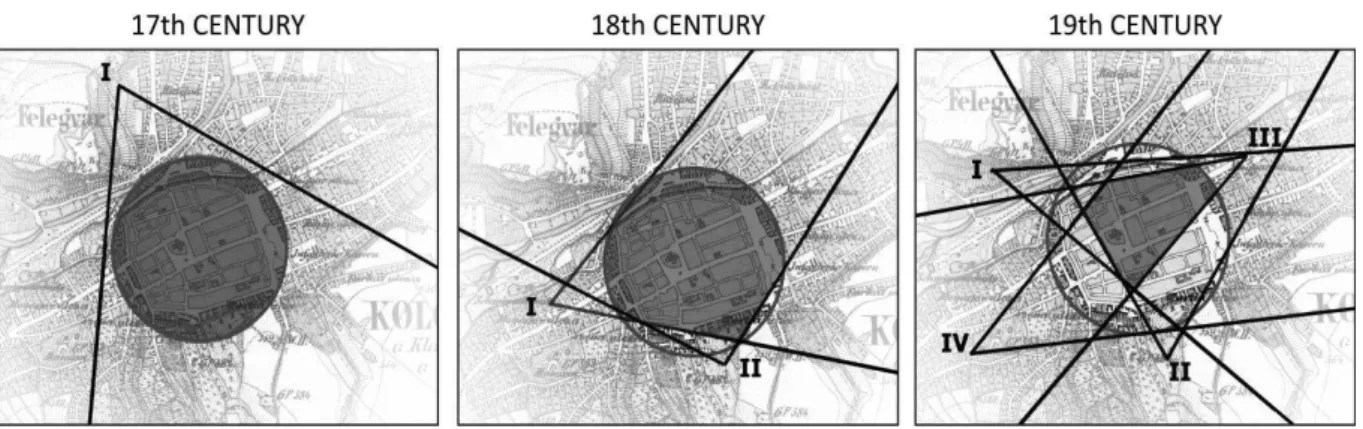
For this study, the general urban views of Cluj-Napoca were analyzed. They were selected and grouped on centuries according to the period with the highest number of representations (17th-19th
centuries). Then, the approximate points of view and directions used by artists to depict the city were identified for each vedute. One of the first accurate Austrian map of the city, Neue Aufnahme (1869), was used as cartographic background. The city core, also the main subject of the vedute representations, is indicated within a circle.
In the 17th century, the city of Cluj-Napoca had a considerable number of vedute, but most of
them were more fantasist than real, the city being seen from one predominant observation point, located in the northern part of the city.
Figure 1. The main point of view over Cluj-Napoca from the north, in the 17th century Source: Österreichischen Nationalbibliothek, Bildarchiv und Grafiksammlung, PORT_00060037_01;
“LucianăBlaga”ăCentralăUniversityăLibraryăofăCluj-Napoca, Special Collections
The 17th century town views (Figure 1) represent the urban space as a whole, encapsulated in
that clear forma urbis, usually circular or polygonal, emphasizing the elements with defensive role (fortified walls, towers, gates), but also the main ecclesiastical buildings. This was a common approach of the medieval towns of Europe, more political than artistic, carrying out a specific task, that of anti-Ottoman propaganda. Possible, for the same reason - the Ottoman threat, the inexactness of the images is explicable, also knowing the precautionary measures taken by the European leaders to protect maps of the possessedăterritoriesăfromătheăenemy’săeyes.ă
Comparing the three vedute of the 17th century in the up-down direction, it can be noticed an
Georg Kreckwitz, 1688), even if it presents unreal elements like the square form of the city, the aerial point of view, the form of the towers, gates and buildings, it also shows similarities with reality throughătheănumberăofătowers,ăchurchesăandătheăcity’săpositionăinărelationătoătheăSomeşăRiver.ăTheă third vedute, of Aegidius van der Rhye (around 1600, published in Teatrum Orbis Terrarum in 1617) is the most precise of all. In this representation, the profile of Cluj is emphasized through a ground-level view combined with a slight aerial view. Some of the medieval architectural elements of Cluj can be identify in this vedute, also due the documentary drawings realized in the 19th century by the chief
architect of the city Pákei Lajos, the English doctor John Paget and the photographer Veress Ferencz (Melinda, Mihály, 2008, p. 19).
Amongăthem,ăonătheănorthernăsideăofătheăcity,ăthereăareătheăGoldsmiths’săTower,ătheăBridgeă Streetă GateăTower,ătheă Locksmiths’ăToweră (todayă knownă asătheă Firemen’să Tower),ătheă toweră withă Italian battlements. On the easternăside,ăthereăareătheăMiddleăStreetăGateăTower,ătheăHungarian’săStreetă GateăTowerăandătheăTaylors’săTower.ăOnătheăwesternăside:ăM n şturăStreetăGateăTowerăandăaăsmalleră tower,ăpossibleătheăHay’săTower.
Using idealized representations in the 17th century is valid also for the rest of the
Transylvania’să cities,ă suchă asă Braşov,ă Sibiu,ă Sighişoara,ă Mediaş,ă Bisti a,ă andă Albaă Iulia;ă however,ă these approaches could be significant for understanding better the preferences for certain points of view that materialized later.
The 18th century brings an objective approach through more accurate vedute, some of them
being the result of the military motivation and created at the request of the Austrian authorities (e.g. the vedute of the Transylvanian fortresses, ordered by military engineer Johann Conrad Von Weiss in 1736) (Borbély, 1943).
In the 18th century, the city is seen from above, using two new points of view, from the west
and south, from a central position (Figure 2).
The vedute representing the western side of the city was frequent used as a decorative caption ofătheăgildsădiplomasă(theăcarpenters’ăguild),ăengravedăbyăSzákallăJohann,ăină1759ă(BálintăI.ăJ.,ă1989,ă p.ă6).ăTheătowersăonătheăwesternăsideăofătheăfortifiedăwallăareăwellăvisible:ătheăGoldsmiths’ăTower, the Ironsmiths’ăTower,ătheăHay’săTower,ătheăBootmakers’ăTower.ăInăaddition,ătheăM n şturăStreetăGateă withăitsătowerăcanăbeănoticedăand,ăinătheăbackground,ăonătheăeasternăsideăofătheăcity,ătheăHungarian’să Street Gate Tower and the Middle Street Gate Tower. The other civil buildings and towers do not reveal any particular details, being represented in a simple manner (excepting the tower with Italian battlements from the east side). From this angle, for the first time, all the churches of the city are clearly visible. The three oldest churches of Cluj – Saint Michael Church, the church in the Farkas Street, the Franciscan Curch and a new one, part of the pragmatic urban program of the Habsburg dominance, the first Roman Catholic church built in Transylvania after the Protestant Reformation, the Jesuit Church (from 1776, belonging to the PiaristăOrder)ă( ocaăM.,ă1974,ăpp.ă247-248). For the last three churches, the influence of the new Baroque style is notable, more evident at the facades of Franciscan and Jesuit churches. Saint Michael church had only a Baroque tower with an onion-shaped roof, possibly destroyed by the fire of 1798 (Pataki Katalin, 2009, p. 38). A later (19th century)
representation of the same vedute displays also the Greek-Catholic Church, Bob Church, in the western part of the city.
The second vedute reveals the southern side of the fortified wall with its towers: from left to right,ă theă Carpenters’ă Tower,ă Turziiă Streetă Gateă Tower,ă Ropeă makers’ă Tower,ă Bricklayersă Tower,ă Tanners’ăTowerăandăTaylors’ăToweră(Borbély,ă1943,ăp.ă201).ăThisăurbanăviewăisăalsoăimportantăforă bringing to our attention two other significant elements for the urban landscape of Cluj, namely, the new Unitarian Church in the eastern side of the city and the uphill Citadel. This vedute could be considered a later remake (1798) of the vedute of Haas J. I. (1734).
Figure 2. The main points of view over Cluj-Napoca from the west and south, in the 18th century Source: western view: Cluj County Directorate of the National Archives, Kelemen Lajos Collection 593,
folder114,ăfileă509;ăsouthernăview:ă“LucianăBlaga”ăCentralăUniversityăLibraryăofăCluj-Napoca, “GheorgheăSion”Collection, inv.XVII/30
The 19th century signified the diversification of the points of view, the city being depicted
from northwest (Figure 3), partially from the south (Figure 4), northeast (Figure 5) and southwest (Figure 6), from dynamic perspectives which allow a transversal observation, resulting real radiographies of the urban tissue.
There is a decrease in interest for the city seen as a whole (Figure 3 and Figure 4), peripheral spaces occupying an increasingly important part of the vedute, the city's iconic monuments serving almost only as geographic references.
Figure 4. View from south towards north-east, in the 19th century
Source: Österreichischen Nationalbibliothek, Bildarchiv und Grafiksammlung, 00000001
The space between the city core and its periphery became important for the first time, on the one hand because of the official interest of the imperial authorities for the development and modernization of this area, but, on the other hand, it could signify also a symbolic act of isolation from what the process of urbanization could bring in the future, the so called le mâle du siècle. Today, this
“isolation”,ăorăbetter-saidădistance,ăisăalmostămandatoryăforăaăvedutist’săexerciseăofăcapturingătheăurbană space, aerial photography representing the only possibility to cover the entire extension of the urban space.
Figure 5. View from north-east, in the 19th century
A new artistic approach of the vedute representations is also notable for the 19th century. They became less general and more focused to capture the peculiarity of a building or groups of buildings with a certain educational, administrative or religious importance (Figure 5 and Figure 6).
Ludwig Rohboch (1828-1883) is one of the main artists who depicted the vedute of the city of Cluj and its buildings in the 19th century. His drawings of the Transylvanian sights appeared in the book edited in 1864, together with János Hunfalvy, Ungarn und Siebenbürgen in malerischen Original – Ansichten in Darmstadt. In the image above (Figure 5), the Reformat Church with two towers, the Hungarian Street Gate Tower, and the towers of the Saint Michael Church, of the Unitarian Church and, possible, of the Evangelical Church are depicted.
Figure 6. View from south-west, in the 19th century
Source:ă“LucianăBlaga”ăCentralăUniversityăLibraryăofăCluj-Napoca,“GheorgheăSion”Collection,ăinv.ăXVII/20ăa
In the image above (Figure 6), the famous park and villa of Count Miko Imre are represented. This place went through several transformations at the end of the 19th century and the beginning of the
20th century. Here the first Botanical Garden in Cluj was initiated, which was later transferred into its
present place, near Republicii Street. Today, the park is a multi-functional area, with various buildings hosting the Faculty of Geography, the Faculty of Biology and Geology of Babeş-Bolyai University andă“Haşdeu”ăStudentăCampusă(Ciang ăIulia,ă2012,ăp.ă681).
CONCLUSIONS
Analyzing the evolution of the urban space of Cluj City by comparing the vedute belonging to the 17th, 18th and 19th centuries some conclusions can be drawn.
If the 17th and 18th centuries had almost a unidirectional view over the city, from one, at most,
two points of observation, the 19th century increased the visibility, the city being captured almost at
360 degree (Figure 7).
The area most frequently represented in all vedute includes the main square of the city and the buildings located in its proximity (on the north, south and mostly on the east side). This way, a possible core of the urban development of Cluj in the 19th century could be individualized.
Figure 7. The temporal dynamics of the points of view over the city and a possible “hot” core of the
modern city
ACKNOWLEDGMENTS
This work was possible with the financial support of the Sectoral Operational Programme for Human Resources Development 2007-2013, co-financed by the European Social Fund, under the projectă numberă POSDRU/107/1.5/S/76841ă withă theă titleă “Modernă Doctorală Studies:ă InternationalizationăandăInterdisciplinarity”.
REFERENCES
BALINT, I. J. (ed.) (1989), Koloysvar [Cluj], in: Transylvania Képeskönyvek [Illustrated Book of Transylvania], Polygon Könzvkiadó, Budapest.
BORBÉLY, A. (1943), Erdélyi városok képeskönyve 1736-ból [Illustrated Book of the Transylvanian Cities in 1736], Erdélyi Múzeum-Egyesület, Kolozsvár.
CERNOVODEANU, P. (coord.) (2004), Călători străini despre ările Române în secolul al XIX-lea [Foreign Travellers about the Romanian Provinces in the 19th Century], vol. 1,Editura Academiei
Române,ăBucureşti.
CIANG ,ăIULIAă(2012),ăUrbanăLandscapesăinăTransylvanianăVedutism,ăProceedings of International Scientific Conference People, Buildings and Environment, 2, Brno University of Technology Faculty of Civil Engineering.
DE SETA, C. (1999), Vedutisti e viaggiatori in Italia tra Settecento e Ottocento [Vedutist Artists and Travellers in Italy between the 18 and the 19th Centuries], Electa, Napoli.
GUIDONI, E. (2002), Leonardo da Vinci e le prospettive di citta. Le vedute quattrocentesche di Firenze, Roma, Napoli, Genova, Milano e Venezia [Leonardo da Vinci and the Prospect of the City. The 15th Century Vedute of Firenze, Roma, Napoli, Genova, Milano and Venezia],
Edizioni Kappa, Roma.
JAMES, E. (1988), The city in maps: urban mapping to 1900, The British Library, London.
MIHÁLY,ă MELINDAă (2008),ă Fortifica iileă Clujului [The Fortifications of Cluj], in: Clujul renascentist [The Renaissance City of Cluj], Koloszvár Társaság, Ideea Print and Gloria, Cluj-Napoca.
NIEDERMAIER, P. (1979), Siebenbuergische Staedte. Forschung zur städtebaulichen und architektonischen Entwicklung von Handwerksorten zwischen dem 12 und 16 Jaarhundert [Transylvanian Cities. Research on Urban and Architectural Development of Handicrafts between the 12th and the 16th Centuries], Editura Kriterion, Bucureşti.
NUTI, LUCIA (1996), Ritratti di città. Visione e memoria tra Medioevo e Settecento [Portraits of the
OPRESCU, G., (1926), ările Române văzute de artişti francezi (sec. XVIII şi XIX) [The Romanian Provinces Seen by French Artists (18th and 19th Centuries)], Edituraă Culturaă Na ional ,ă
Bucureşti.
PASCU,ăŞt.ă(1974),ăClujul–„oraşăprimar”ăînăaădouaăjum tateăaăsec.ăalăXVI-lea; stagnarea lui în sec. al XVII-lea [Cluj – “PrimateăCity”ăinătheăSecondăHalfăofătheă16th Century; Its Stagnation in the
17th Century], in:
Istoria Clujului [History of Cluj], Consiliul Popular al Municipiului Cluj, Cluj-Napoca.
PATAKI, KATALIN (2009), Kolozsvár látképe 1734-böl [Vedute of Cluj in 1734], in: Kolozsvár XVII-XVIII. századi látképeinek forrásértéke [The Value of 17th-18th Century Vedute Sources for Cluj], MSc Dissertation, Szegedi Tudományegyetem Bölcsészettudományi Kar, Szeged. SORAGNI, U. COLLETA, TERESA (2010), I punti di vista e le vedute di città. Secoli XIII-XV
[Viewpoints and Vedute of Cities. 13th -15th Centuries]
, Edizioni Kappa, Roma.
TECHNICAL UNIVERSITY OF CLUJ-NAPOCA, FACULTY OF ARCHITECTURE AND URBANISM (2002), Istoria conservării [History of Conservation], Editura U.T. Pres, Cluj-Napoca.
TOSCO, C. (2009), Il paesaggio storico. Le fonti e i metodi di ricerca [The Historic Landscape. Research Sources and Methods], Editori Laterza, Bari
OCA,ăM.ă(1974),ăBaroculăşiăneoclasicismulăclujeană[BaroqueăandăNeoclassicismăinăCluj],in: Istoria Clujului [History of Cluj], Consiliul Popular al Municipiului Cluj, Cluj-Napoca.
***ă(2001),ăPeisagiştiăolandeziădinăsec.ăalăXVII-lea [Dutch Landscape Painters in the 17th Century], in:
Mari Pictori, via a, sursele de inspira ie şi opera [Great Painters, Life, Inspiration Sources andăWork],ă74,ăPublishingăServices,ăBucureşti.