Summary
Medna bijela is an autochthonous cultivar of the third Adriatic vine-growing subregion. Its synonyms in use are: Buboj, Bumba, Medna, Rizavac, Zložder etc. No detailed ampelographic study has been made to date; based on our research this cultivar is classii ed in the ecological-geographical group of Convarietas Pontica, Negr. Subconvarietas Balcanica, Provarietas Mesocarpa, Nem., Subprovarietas Dalmatica Nem. It is a medium lush wine cultivar with some 16-17 % of sugar and 6.0-7.0 g/l of total acidity, with a yield of 2.5-3.5 kg of grapes per grapevine and a load of 16 buds per grapevine. h e wines are light, acidulous, with a specii c i ne aroma of honey, which is implied in the very name of the cultivar. It is recommended that the research should be continued, particularly on clonal selection.
Key words
ampelographic research; Medna bijela cultivar; autochthonous cultivar
Medna bijela (
Vitis vinifera
L.) –
Ampelographic properties
Ivan PEZO
1( )Irena BUDIĆ LETO
1Sonja KAČIĆ
1Goran ZDUNIĆ
1Nikola MIROŠEVIĆ
21 Institute for Adriatic Crops and Karst Reclamation, Put Duilova 11, 21000 Split, Croatia
e-mail: [email protected]
2 Faculty of Agriculture, University of Zagreb, Svetošimunska 25, 10000 Zagreb, Croatia
Introduction
In the vine-growing regions of Pannonian and Adriatic Croatia, an assortment mostly autochtho-nous, rather old, vine cultivars have been grown to date. Many have never been ampelographically described in detail, and some have even never been bibliographically recorded. It can be assumed that many were abandoned because of low resistance to the oidium (Uncinula neca-tor) and mildew (Plasmopara viticola) when such diseases struck, whereas only those with higher resistance have been retained. One of the cultivars which have not been ampelographically researched is Medna bijela, grown in the Vrgorac area in the third Adriatic subregion.
Several authors have made detailed ampelograph-ic research of autochthonous vine cultivars in Croatia. h us Maleš (1981, 1993) described Plavac mali crni; Mirošević did the same with Moslavac bijeli (1981), Škrlet bijeli (1986), Plavac sivi (1988), Zelenika bijela, etc. Maletić (1993) researched and ampelographically described Maraština bijela, Bogdanuša bijela, Pošip bijeli and Vugava bijela; Pezo et al. (1998, 2002) did it with Okatica bijela and Okatac crni.
Recently many autochthonous cultivars have been de-termined by means of DNA, along with ampelographic description. h us Mirošević and Meredith (2000) made a comparative research of Plavac mali, Zinfandel and Primitivo, at er which followed the studies by Pejić et al. (2000 and 2001), covering the same topic, as well as by Piljac et al. (2002), who worked on determination and origin of Pošip bijeli.
However, no extensive ampelographic research of Medna bijela has been performed. h e only bibliographi-cal record was made by Bulić (1949). h erefore, during the period of 1996-1998 we carried out ampelographic research of the cultivar with the aim to determine its bio-logical, agroecobio-logical, and economic and technological properties in order to valorize its specii cs.
Material and methods
Ampelographic research was made according to the method of the International Ampelographic Registry (Registre ampélographique international, 1957) and the descriptor list of ampelographic characteristics (Codes des carakteres des descriptifs des varietes et especes de vitis – O.I.V. 2001.). Each year there were 25 vines under research. Philometric elements were determined by use of the SUMMASKETCH Professional tablet.
Uvometric research was carried out on 10 bunches, according to methods of Prostoserdov (1946), and Galet (1958 and 1976), while the dimensions of berries and seeds were measured by a micrometer.
h e annual biological cycle was monitored according to methods of Lazarevski, (1946) from the beginning of weeping. h e start of each phase was marked when 5% of vines were within a given phase, while the full phase was at 50%, and the end of phase was at 95%.
h e amount of sugar in must was determined acc. to Babo (1909), and the total acidity by the n/4 NaOH titration. h e quality of wine was determined by stan-dard analyses and evaluated organoleptically.
h e study was conducted on a plantation that had been established in 1989, in region of Vrgorac with the 1.40 x 1.10 m spacing and on the P 1103 rootstock during the period of three years (1996-1998). h e vine trees were 70 cm high, with bifurcated growth. h e av-erage mean annual temperature during the research was 13.9oC, while during vegetation it was 18.4oC. December was the coldest (5.8oC), and July the warmest (24.8oC). h e sun shone for the average of 2652 hours per annum while during the vegetation period the insolation was 1736 hours. h e sum of active temperatures was 3814oC. h ere was 1800 mm of precipitation per annum while during the vegetation period there was 656 mm.
h e soils were terra rossa (Škorić, 1977), evolved on Mesozoic limestones, skeletal to poorly skeletal, of medium water- and high air-capacity. As such, they are very favorable for vine-growing.
All data were processed by standard statistical meth-ods.
Results and discussion
Description of the cultivar
Synonyms: Buboj, Bumba, Medena, Medva, Rizavac, Zložder.
Origin and distribution: Comparing a number of sources, we can assume that Medna bijela (white) is an autochthonous cultivar of the region, spreading in a coni ned area of the subregion (Vrgorac, Pelješac, Dubrovnik).
Botanical properties
Young shoot: well-developed; with closed tip (OIV 001-3); medium intensity of anthocyanin colouration (OIV 003-5); medium thickness of hairs on the tip (OIV 005-5).
Young leaves: greenish, with bronzed margins (OIV 051-2), and very weak anthocyanin colouring (OIV 052-1). h e thickness of woolly hairs between veins is medium (OIV 053-5), as is the case at the main vein (OIV 055-5).
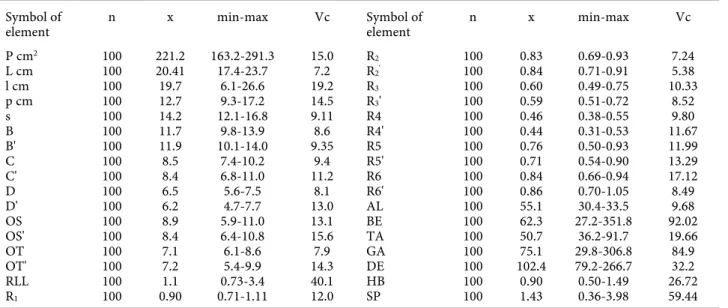
Grown leaf: l eshy, leathery, medium large, with the average surface area of 221.2 cm2 (OIV 065-5), the main nerve average length of 14,22 cm (OIV 066-5), heart-shaped (OIV 067-2), tripartite (OIV 068-2), of medium green front (OIV 069-5), while the main nerves are either very weakly coloured or not at all (OIV 070-1). h e leaf blade is bubblingly creased (OIV 075-7). h e teeth are concave at both sides (OIV 076-1), of medium length (OIV 077-5). h e stem sinus is deep, not quite open (OIV 079-3), while the lateral sinuses are shallow and open (OIV 082-1). h e upper side of the leaf is bare (OIV 084-1), while the lower side is sparsely covered with woolly hairs (OIV 086-3).
Leaf stem: bare (OIV 090-1) and of medium length (OIV 092-5).
Vine shoot: medium thick, elliptical in cross-sec-tion (OIV 101-2), grooved (OIV 102-3), of light-brown colour, with insui cient lenticels (OIV 104-1) and thick-ened dark-tinted nodes.
h e results of the philometric research are shown in Table 1.
Blossom: hermaphrodite (OIV 151-3).
Inl orescence: large, pyramidal, developed at the 1st or 2nd joint (152-1), with one or two winglets.
Bunch: medium large (OIV 202-5); average length 15.6 cm; short (OIV 203-3); average breadth 11.87 cm;
compact (OIV 204-7); cylindrically winged with one or two winglets (OIV 209-2). h e stem is 2.2 cm long in average to the i rst winglet, so it is rather short length-wise (OIV 206-1) and medium stif (OIV 207-5). Table 2 contains values pertaining to the length and breadth of the Medna bijela bunch.
Berry: medium large (OIV 220-5); average length 17.67 mm (OIV 221-5); balanced (OIV 222-2); round in shape (OIV 223-3), and circular in cross-section (OIV 224-2). h e skin colour is green-yellow (OIV 225-1), with a marked amber colouring on the sunny side (OIV 226-1). It is profusely pollinated (OIV 227-7), with a marked umbilical point (OIV 229-2). h e skin is thick and tough; the juice is colourless (OIV 230-1); the l esh is juicy (OIV 232-2) and i rm (OIV 234-2), with a par-ticular odour, specii c for this variety (OIV 236-4), in slight degrees (OIV 237-2). h e pedicel is short, 4.5 mm in average (OIV 238-3), and is hard to detach from the berry (OIV 239-1).
Category n x min-max Vc
length in cm 30 15.60 12.7-18.8 10.57 breadth in cm 30 11.87 9.7-14.5 11.06 Symbol of
element
n x min-max Vc Symbol of element
n x min-max Vc
P cm2 100 221.2 163.2-291.3 15.0 R
2 100 0.83 0.69-0.93 7.24
L cm 100 20.41 17.4-23.7 7.2 R2' 100 0.84 0.71-0.91 5.38
l cm 100 19.7 6.1-26.6 19.2 R3 100 0.60 0.49-0.75 10.33
p cm 100 12.7 9.3-17.2 14.5 R3' 100 0.59 0.51-0.72 8.52
s 100 14.2 12.1-16.8 9.11 R4 100 0.46 0.38-0.55 9.80
B 100 11.7 9.8-13.9 8.6 R4' 100 0.44 0.31-0.53 11.67 B' 100 11.9 10.1-14.0 9.35 R5 100 0.76 0.50-0.93 11.99 C 100 8.5 7.4-10.2 9.4 R5' 100 0.71 0.54-0.90 13.29 C' 100 8.4 6.8-11.0 11.2 R6 100 0.84 0.66-0.94 17.12 D 100 6.5 5.6-7.5 8.1 R6' 100 0.86 0.70-1.05 8.49 D' 100 6.2 4.7-7.7 13.0 AL 100 55.1 30.4-33.5 9.68 OS 100 8.9 5.9-11.0 13.1 BE 100 62.3 27.2-351.8 92.02 OS' 100 8.4 6.4-10.8 15.6 TA 100 50.7 36.2-91.7 19.66 OT 100 7.1 6.1-8.6 7.9 GA 100 75.1 29.8-306.8 84.9 OT' 100 7.2 5.4-9.9 14.3 DE 100 102.4 79.2-266.7 32.2 RLL 100 1.1 0.73-3.4 40.1 HB 100 0.90 0.50-1.49 26.72 R1 100 0.90 0.71-1.11 12.0 SP 100 1.43 0.36-3.98 59.44
Table 1.
Average statistical indicators of philometric values for the Medna bijela cultivar (1996-1998)
Table 2. Average statistical indicators of philometric values for the Medna bijela cultivar (1996-1998)
Category n x min-max Vc
length in mm 300 17.67 9.5-23.0 8.90 breadth in mm 300 16.93 9.2-23.5 10.15
Table 3. Average length and breadth of the Medna bijela
Table 3 contains values pertaining to the length and breadth of the Medna bijela cultivar berry.
Seed: h e berry contains (OIV 241-3) medium large, dark-brown seeds with short nebs, 5.59 mm long (OIV 242-3) and 3.7 mm wide. h e average seeds weigh 3.04 g, and are thus classii ed as light (OIV 242-3).
Table 4 contains values pertaining to the length and breadth of the Medna bijela cultivar seed.
Based on the research of botanical properties, it can be asserted that the Medna bijela cultivar belongs to the ecological-geographical group of the Convarietas Pontica, Negr. Subconvarietas Balcanica, Provarietas Mesocarpa, Nem., Subprovarietas Dalmatica Nem.
Agrobiological properties of the Medna bijela cultivar
Technological observations, the beginning, dura-tion and end of respective phases of annual growth cycles of the Medna bijela cultivar during the research depended on the year. Since there were no major vari-ances, we shall indicate average dates of the beginning, the climax and the end of respective vegetational suc-cession phases. h us weeping commenced on Mar 22, and the opening of buds on Apr 21. Inl orescence start-ed on Jun 7; its height was on Jun 11; the phase endstart-ed Jun 16. Berries started ripening on Aug 8; physiological ripening commenced Sep 29; the end of vegetation was on Nov 11 – leaf-fall.
It should be pointed out that the full bloom occurred somewhat late (OIV 302-5), while the berries started
ripening in early September, which can be regarded as late (OIV 303-7).
Table 5 indicates duration of respective annual cycle phases for the Medna bijela cultivar in days.
According to data in 5, a full annual cycle takes 237 days in average (I through VII), i.e. 207 days from germination to leaf-fall. h e interval from germination to physiological ripeness lasts for 164 days, so, acc. to Pulliat (1897), the Medna bijela cultivar belongs to the 3rd ripening period. h e period of rest under the research conditions was 130 days.
Economic and technological properties of the Medna bijela cultivar
Lushness of vegetation
In order to determine the vegetation growth, we used the method of weighing the topped sprouts, as well as the vine shoot. h e average results of the research are shown in Table 6.
h e data indicate there were no signii cant dif erenc-es during the years of rerenc-esearch in the average weight of topped sprouts, nor in the vine shoot weight. h e aver-age triennial weight of the green mass is 0.45 kg, and of the vine shoots 0.71 kg.
h e mean total length of the vine shoot per vine varied in the course of the years from 4.63 m to 6.27 m, whereas the average length was 5.47 m.
Growth stage No. of days of each growth stage per years
Average no. of days
from to 1996 1997 1998 1996-1998
I. Beginning of weeping Bud burst 29 31 30 30 II. Bud burst Beginning of inflorescence 47 47 49 48 III. Beginning of inflorescence End of inflorescence 10 11 9 10 IV. End of inflorescence Beginning of ripening 53 54 54 54 V. Beginning of ripening Technological ripening 52 51 54 52 VI. Technological ripening Leaf-fall 40 49 42 44 VII. Leaf-fall Beginning of weeping 127 132 130 130 Duration of vegetation Phases I through VI 231 243 236 237 Duration of vegetation Phases II through VI 202 212 208 207
Table 5. Duration of the Medna bijela cultivar growth phases in days
Table 4. Average length and breadth of the Medna bijela
cultivar seed (1996-1998)
Category n x min-max Vc
length in mm 300 5.59 5.00-6.63 5.08 breadth in mm 300 3.70 3.02-4.7 8.40
Year
Weight of topped shoots
in kg
Weight of vine shoot
in kg
Total length of vine shoot per vine in kg
1996 0.48 0.66 4.63 1997 0.40 0.71 5.50 1998 0.47 0.75 6.27
Average 0.45 0.71 5.47
Based on the presented indicators of lushness, it can be deduced that the Medna bijela cultivar is medium lush.
Elements of fertility
h e basic fertility indicators are shown in Table 7. h e research results reveal that the basic fertility elements exhibited low variability. h e data obtained are signii cant for calculations of fertility coei cients. h us the Medna bijela cultivar is characterized by the following:
1. AFC – absolute fertility coei cient (total number of bunches/total number of fertile shoots) is 11.30/9.77 = 1.16
2. RFC – relative fertility coei cient (total number of bunches/total number of shoots) is 11.30/13.08 = 0.86
3. BFC – bud fertility coei cient (total number of bunch-es/total number of buds) is 11.30/16.45 = 0.69 Mechanical composition of the bunch and berries
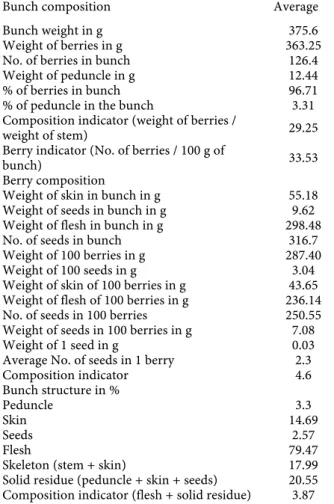
Table 8 shows average values of composition of the bunch and berries and structural indicators in percent-ages.
h e data concerning the bunch composition in Table 8 indicate that its average weight was 375.6 g, of which the berry weighed 363.25 g or 96.71%, while that of the peduncle was 12.44 g or 3.31%. h e data regarding the berry composition and the bunch structure reveal that the l esh weight in berries and the bunch was 298.48 g, i.e. 79.47%, and that the weight of the solid residue (pe-duncle, skin, seeds) was 20.55 g, i.e. 5.47%. Based on all relevant indicators, and the structural indicators (l esh/solid residue) Medna bijela can be classii ed in the group of typical wine cultivars, with a pretty high utilisation.
Quantity of sugar and total acid in must
h e average values of sugar concentration and total acidity in the must are shown in Table 9.
Year No. of buds /
vine
No. of fertile shoots /
vine
No. of shoots /
vine
No. of bunches /
vine
No. of bunches /
bud
No. of bunches /
shoot
No. of bunches /
fertile shoot
Bunch weight in
g
Grape weight / vine in kg
1996 16.40 9.33 13.08 10.76 0.65 0.82 1.15 341.4 3.67 1997 16.35 9.87 13.86 11.34 0.69 0.82 1.15 329.2 3.73 1998 16.60 10.11 14.18 11.82 0.71 0.83 1.17 337.4 3.99 Average 16.45 9.77 13.71 11.30 0.68 0.82 1.16 336.0 3.80
Table 9. Average values of sugar concentration and total
acidity in the Medna bijela cultivar must (1996-1998)
Table 7: Average values of the Medna bijela cultivar basic elements of fertility (n = 20 bunches)
Table 8. Average research results of the Medna White
cultivar bunch and berry composition and the berry structure (1996/1998)
Bunch composition Average
Bunch weight in g 375.6 Weight of berries in g 363.25 No. of berries in bunch 126.4 Weight of peduncle in g 12.44 % of berries in bunch 96.71 % of peduncle in the bunch 3.31 Composition indicator (weight of berries /
weight of stem) 29.25 Berry indicator (No. of berries / 100 g of
bunch) 33.53
Berry composition
Weight of skin in bunch in g 55.18 Weight of seeds in bunch in g 9.62 Weight of flesh in bunch in g 298.48 No. of seeds in bunch 316.7 Weight of 100 berries in g 287.40 Weight of 100 seeds in g 3.04 Weight of skin of 100 berries in g 43.65 Weight of flesh of 100 berries in g 236.14 No. of seeds in 100 berries 250.55 Weight of seeds in 100 berries in g 7.08 Weight of 1 seed in g 0.03 Average No. of seeds in 1 berry 2.3 Composition indicator 4.6 Bunch structure in %
Peduncle 3.3 Skin 14.69 Seeds 2.57 Flesh 79.47 Skeleton (stem + skin) 17.99
Solid residue (peduncle + skin + seeds) 20.55 Composition indicator (flesh + solid residue) 3.87
Category n x min-max Vc
h e data shown in Table 9 reveal that the average values of sugar concentration ranged from 14.31% to 17.81%, with the variance coei cient of 5.81. h e total acidity was within the range from 4.63 g/l to 7.94 g/l, with the average value of 6.29 g/l, and the variance co-ei cient of 13.09.
Minivinii cation was performed in every year of re-search; the wines had an average alcohol content of 10.43 vol%, the total acidity of 6.06 g/l, with the total extract of 16.9 g/l and 2.29 g/l of ash.
Conclusions
Based on the ampelographic research of the Medna bijela cultivar (Vitis vinifera L.) we can conclude the following:
- the Medna bijela cultivar probably originates from the area of the third Adriatic vine-growing subregion; its synonyms are Buboj, Bumba, Medena, Rizavac, Zložder etc.
- all botanical properties revealed exceptional stability, so, according to the classii cation of ecological-geo-graphical groups, Medna bijela can be classed within Convarietas Pontica, Negr. Subconvarietas Balcanica, Provarietas Mesocarpa, Nem., Subprovarietas Dalmatica Nem.
- with respect to the quantity of the cut-of green (0.45 kg) and ripe (0.71 kg) masses per grapevine, it be-longs to medium lush cultivars
- the basic fertility indicators are within the range specii c for this group of cultivars, viz. AFC = 1.17, RFC = 0.86, BFC = 0.69; the yield per one grapevine is 3.73 kg
- the sugar concentration of 16.0% and the total acid-ity of 6.29 g/l in the must reveal that it is a cultivar that renders light table wines, with a pleasant varietal aroma, the alcohol content of 10.43 vol% and 6.06 g/l of total acidity
Finally, we can conclude that this cultivar deserves more attention, due to its specii c features, and that re-search should be continued, primarily in the selection process.
References
Babo U., Mach E. (). Handbuch des Weinbaues und der Kellerwirtschat . . Band Weinbau. . Aul age, Verlag Paul Parey, Berlin.
Bulić S. (). Dalmatinska ampelograi ja. Poljoprivredni nakladni zavod, Zagreb.
Galet P. (). Precis d’Ampelographie pratique, Montpellier.
Galet P. (). Precis d’Ampelographie pratique, Montpellier.
Goethe, H. (). Handbuch der Ampelographie. . Aul age. Verlag Paul Parey, Berlin,
Lazarevski A. M. : Matodi botaničesko opisanie i agrobiologičesko izučenie sortov vinograda. Ampelograi a SSSR, Tom I, Moskva.
Maleš P. (). Ampelografska i tehnološka istraživanja sorte vinove loze Plavac. Slobodna Dalmacija, Split Maleš P. (). Populacija Plavac (Plavac
mali-Zinfandel-Primitivo), Vitigraf, Rijeka
Maletić E. (). Ampelografska istraživanja kultivara Maraština, Bogdanuša, Vugava i Pošip (Vitis vinifera
L.) u uvjetima Ravnih Kotara. Master of Science h esis, Ljubljana
Mirošević N. (). Istraživanje klijavosti polena sorte Moslavac bijeli. Poljoprivredna znanstvena smotra :-
Mirošević N. (). Ampelografska istraživanja vinove loze Škrlet bijeli. Poljoprivredna znanstvena smotra :- Mirošević N. (). Ampelografske i tehnološke
karakteristike jednog mutanta Plavca malog. Jugoslavensko vinogradarstvo i vinarstvo :- Mirošević N. and C. P. Meredith (). A review of
research and literature related to the origin and identity of the cultivars Plavac mali, Zinfandel and Primitivo (Vitis vinifera L.). Agriculturae Conspectus Scientii cus :-
Oi ce International de la Vigne et du Vin (). Code of Descriptive Characteristics of the Varieties and Species of Vitis. OIV, Paris
Pejić I., Maletić, E., Karoglan Kontić J., Kozina B., Mirošević N. (). Diversity of autochthonous grapevine genotypes in Croatia. Acta. Hortic. :-
Pejić I., Maletić E., Karoglan Kontić J., (). Unutarsortna varijabilnost Plavca malog crnog (Vitis vinifera L.). Radovi Sabatina, Orebić.
Pezo I., Puljiz N., Bubić J. (). Okatica white. Agronomski glasnik -:-
Pezo I., Puljiz N., Bubić J. (). Agrobiological and technological characteristics of the cultivar Okatac black
(Vitis vinifera L.). Agronomski glasnik -:-
Piljac J., Maletić E., Karoglan Kontić J., Dangl G. S., Pejić I., Mirošević N., Meredith C. P. (). h e Parentage of Pošip bijeli, a major white cultivar of Croatia. Vitis :-
Prostoserdov I.I. (). Tehnologičeskae harakteristika vinograda i produktiv ego peredabotki. Ampelograi a SSSR, Tom I, Moskva
Pulliat V. (). Les raisins précoces. Montpellier Vidal P. J. (). Registre ampélographique international.
Bulletin de l´ O.I.V. , Pariz
Škorić A. (). Tipovi naših tala. SN Liber, Zagreb