Medication Prescribing Pattern at a Pediatric Ward of an
Ethiopian Hospital
*Fitsum Sebsibe Teni1, Abdrrahman Shemsu Surur2, Addisu Getie1, Abel Alemseged1, Mulugeta Meselu1
1
Department of Pharmaceutics and Social Pharmacy, School of Pharmacy, College of Medicine and Health Sciences, University of Gondar, Gondar, Ethiopia.
2
Department of Pharmaceutical Chemistry, School of Pharmacy, College of Medicine and Health Sciences, University of Gondar, Gondar, Ethiopia.
Abstract
Introduction
Drug use in pediatric patients is a unique dilemma in the management and monitoring of disease. This study aimed at assessing medication prescribing in a pediatric ward of an Ethiopian hospital.
Materials and Methods
A retrospective cross-sectional study was done by reviewing the medical records of 249 patients among those admitted in the period between 11th of September 2007 and 10th of September 2008 to the pediatric ward of Gondar University Referral Hospital, Northwest Ethiopia. Data on characteristics like age, sex and weight; the diagnoses for which patients were admitted and medications prescribed to them during their stay in the ward was collected from the medical records of the patients.
Results
An average of 3 diagnoses per patient with the most frequently diagnosed being malnutrition (29.23%), severe community acquired pneumonia (12.96%) and underweight (8.86%) were reported. A mean of 4.5 medications per patient with the most commonly prescribed being antibacterials namely penicillins which constituted 25.42%, other antibacterials making up 19.61% and medications used for correcting water, electrolyte and acid-base disturbances accounting for 17.19% of the total number of medications prescribed in the ward. The most common individual medications prescribed to the patients included crystalline penicillin, gentamicin and maintenance fluid constituting 9.22, 7.52 and 6.45 percentages respectively most of them in solution forms which were administered dominantly intravenously.
Conclusion
In this study the common prescription of antibacterials and those used for correcting water, electrolyte and acid-base disturbances was observed which went with the common diagnoses of malnutrition and pneumonia.
Keywords: Ethiopia, Gondar, Medication, Pediatric, Prescribing .
*
Corresponding Author:
Fitsum Sebsibe Teni, Department of Pharmaceutics and Social Pharmacy, School of Pharmacy, College of Medicine and Health Sciences, University of Gondar, Gondar, Ethiopia.
E-mail: [email protected]
Introduction
Rational use of medicines refers to the correct, proper and appropriate use of medicines. It requires conditions like appropriate medicine, in the proper dose, for an adequate period of time, and at the lowest cost to them and their community. As estimated by World Health Organization (WHO) more than half of all medicines are prescribed, dispensed or sold inappropriately, and that half of all patients fail to take them correctly. This incorrect use may take the form of overuse, underuse and misuse of prescription or non-prescription medicines, polypharmacy; overuse of antibiotics and injections; failure to prescribe in accordance with clinical guidelines; inappropriate self-medication (1).
Pediatric population is a spectrum of different physiologies and comprises subgroups differing by age as preterm neonates, full term neonates, infants and toddlers, and older children and adolescents. Significant changes in the pharmacokinetics and pharmacodynamics occur as preterm infants mature toward term, as infants mature during the first few years of life, and as children reach puberty and adolescence (2). The bioavailability, pharmacodynamics, pharmacokinetics, efficacy and adverse effect information can differ markedly between pediatrics and adult patients as well as among pediatric patients because of difference in age, organ function and disease state (3).
their use. Safe and effective pharmacotherapy in pediatric patients requires the timely development of information on the proper use of medicinal products in pediatric patients of various ages and, often, the development of pediatric formulations of those products (4).
Drug use in pediatric patients is a unique dilemma in the management and monitoring of disease as establishing safe and effective therapeutic regimen is challenging. This is related to the scarcity of data on pharmacokinetics, pharmacodynamics, efficacy and safety of drugs in infants and children. This challenge results in different problems, for example, Gray baby syndrome from chloramphenicol (3).
Different problems occur in using medicines in treating children and adolescents which include off-label and unlicensed use of medicines, availability of over-the-counter, traditional and herbal medicines with generally no evidence based use; presence of counterfeit and substandard medicines. In particular for resource poor countries the unavailability of treatment especially during war and civil strife and the availability of medicines through illegal street vendors are some of the problems (5).
the practice pattern and how it is changing with time. So, the aim of the present study was to assess the pattern of medications prescribing in the pediatric ward of Gondar University Referral Hospital located in northwest Ethiopian town of Gondar.
Materials and methods
In this study, a retrospective cross-sectional study was conducted to assess the pattern of medication prescribing in the pediatric ward. The sources of data on medications prescribed were the medical records of pediatric patients who were admitted to the ward in the period from 11th of September 2007 to 10th of September 2008. The review on the medical records to collect the data was done from 24th of April to 9th of May 2009.
The inclusion criteria applied in the selection of the medical records required that records be of pediatric patients (age younger than 18 years) and records with in which medications were prescribed. On the other hand the exclusion criteria were medical records with no medications prescribed in them, medical records of patients aged 18 years or older, and those records which were not legible. Based on the inclusion and exclusion criteria, 249 medical records which accounted for more than a third of the medical records of the total 712 patients admitted to the ward during the period from 11th of September to 10th of September 2008, were included in the study. The 249 medical records were sampled using a simple random sampling technique.
Data on the patient characteristics like age, gender and weight; the diagnoses for which
they were admitted and the medications prescribed to them during their stay in the ward were collected from the medical records of the patients in the ward. A data collection format was employed in collecting the data on the patients during their stay in the ward. The data collection was conducted by the principal investigators using the data collection format. Before the actual data collection pretest on the data collection format was done using 13 medical records which were not part of the sample size and excluded from the final analysis. The study was conducted after securing approval from school of pharmacy and the hospital. Furthermore the data obtained from the medical records were recorded using codes avoiding patient identifiers, were kept confidential and used strictly for the study only. The data collected in this study was analyzed descriptively using Microsoft Excel 2003 and presented in frequency tables and graphs describing the various features of medication prescribing in the ward (11).
Results
Fig.1: Age and sex distribution of patients in the pediatric ward
Among the total 249 patients 75 different diagnoses were identified during their stay in the ward with a total frequency of 756 diseases. So, an average of 3 diagnoses per patient occurred among the patients. Among the most frequently encountered diagnoses malnutrition (29.23%), severe community acquired pneumonia (SCAP) (12.96%) and underweight (8.86%) were the top ranking in that order (Figure. 2).
221
98 67
25 22 21 14 14 14
0 50 100 150 200 250
Frequency
Diagnosis
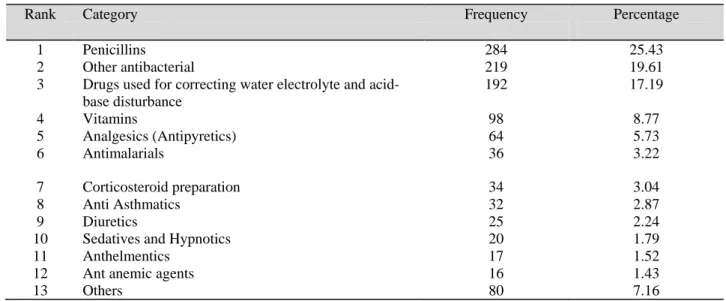
In the pediatric ward, the total frequency of medications prescribed was 1117 constituted by 76 different kinds of medications. This made up a mean of 4.5 medications per patient prescribed during their stay. The categories of medications most commonly prescribed were penicillins which constituted 284 (25.42%) of the total followed by other antibacterials making up 219 (19.61%) of the total number of medications. These were followed by medications used for correcting water, electrolyte and acid-base disturbances account for 192 (17.19%) of the total number of medications prescribed in the ward (Table. 1).
more than 5% of the total number of medications (Table. 2).
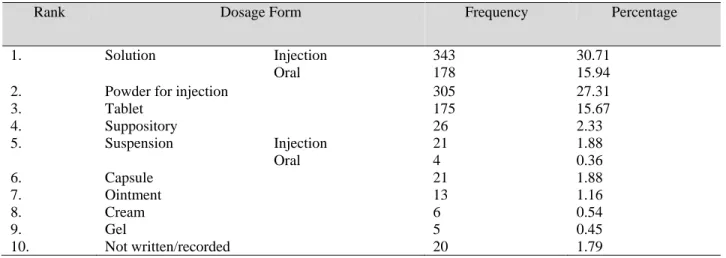
Most of the medications prescribed to the patients were in solution forms, of which those in the form of injectable solution constituted 343 (30.71%) and oral solution accounted for 178 (15.94%) of the total number of medications (Table. 3).
The findings in this study showed that, most of the medications prescribed in the pediatric ward were to be administered intravenously constituting 631 (56.49%) of the total medications followed by the oral route with a frequency of 378 (33.84%) (Figure. 3).
Intravas cular 40%
Oral 24% Intramu
scular 9% Rectal
9% Topical
9%
SC 8%
Not written
1%
Fig. 3: Routes of administration of the medications prescribed in the pediatric ward
Table 1: The most frequently prescribed categories of mediations in the pediatric ward
Rank Category Frequency Percentage
1 Penicillins 284 25.43
2 Other antibacterial 219 19.61
3 Drugs used for correcting water electrolyte and acid-base disturbance
192 17.19
4 Vitamins 98 8.77
5 Analgesics (Antipyretics) 64 5.73
6 Antimalarials 36 3.22
7 Corticosteroid preparation 34 3.04
8 Anti Asthmatics 32 2.87
9 Diuretics 25 2.24
10 Sedatives and Hypnotics 20 1.79
11 Anthelmentics 17 1.52
12 Ant anemic agents 16 1.43
Table 2: Frequency and percentage of Individual drugs prescribed the pediatric ward
Rank Name of drug(s) Frequency Percentage
1 Crystalline penicillin 103 9.22
2 Gentamicin 84 7.52
3 Maintenance Fluid 72 6.45
4 Amoxicillin 66 5.91
5 Ampicillin 66 5.91
6 10% Dextrose 60 5.37
7 Chloramphenicol 56 5.01
8 Paracetamol 54 4.83
9 Cloxacillin 49 4.39
10 Folic acid 40 3.58
11 Vitamin A 40 3.58
12 Ceftriaxone 31 2.78
13 Furosemide 24 2.15
14 Oral Rehydration Salts 22 1.97
15 Co-trimoxazole 21 1.88
16 Ringer lactate 19 1.70
17 Mebendazole 15 1.34
18 Chloroquine 14 1.26
19 Coartem 13 1.16
20 Others 268 23.99
Table 3: Dosage forms of medications prescribed in the pediatric ward
Rank Dosage Form Frequency Percentage
1. Solution Injection 343 30.71
Oral 178 15.94
2. Powder for injection 305 27.31
3. Tablet 175 15.67
4. Suppository 26 2.33
5. Suspension Injection 21 1.88
Oral 4 0.36
6. Capsule 21 1.88
7. Ointment 13 1.16
8. Cream 6 0.54
9. Gel 5 0.45
10. Not written/recorded 20 1.79
Discussion
In this study malnutrition and infectious diseases were the two most prevalent problems; malnutrition (29.23%) was the
frequently recorded diagnoses in Gondar, Bahir Dar and Debre Tabor Hospitals respectively (7). Another study done in a university hospital in south western Ethiopia also found that the leading diagnosis was severe pneumonia (25%) which was the second leading diagnosis in the present study (12). Yet another study done a governmental hospital in Palestine revealed that gastrointestinal infection (24.7%) as a top diagnosis which was different compared to the present study (13).
The average number of medications prescribed per patient was 4.5 in the average duration of stay 9.3 days in the ward. The study in three pediatric wards of hospitals in Northwest Ethiopia reported that the average number of medications per patient was 4 in Gondar, 3.2 in Bahir Dar, 3.3 in Debre Tabor during the average stay of 24.9 days in Gondar, 4.8 days in Bahir Dar and 10.1 days in Debre Tabor. This showed that in our study larger number of medications was prescribed within shorter period of stay in the ward compared to the past finding in the same ward (7).
Crystalline penicillin (9.22%) was the most frequently prescribed medication in our study which was similar compared this with the findings in the three Northwest Ethiopian hospitals in which crystalline penicillin (13.4%) was found to be the most frequently prescribed medication in the same hospital about ten years ago. However, it was different from that of Bahir Dar and Debre Tabor hospitals in which chloramphenicol was the most frequently prescribed drug with 76 (12.7%) and 68 (11.8%) in the respective hospitals (7).
Chloramphenicol was the most frequently prescribed drug in Bahir Dar and Debre Tabor as mentioned above; it is also the second most highly prescribed drug in
Gondar in the same study. But in our study prescribing of chloramphenicol (5.01%) was seventh in its rank of frequency which showed that the use of chloramphenicol was decreasing. This decreased tendency is a practice to be encouraged because chloramphenicol has potentially serious adverse effects (14). The high prescribing rate of mebendazole (1.34%) as anthelmintic agent was encouraging practice as it is cheap, broad spectrum which is useful for mixed worm infections as was reported in the study in Jimma University Specialized Hospital (12).
If the drug does not reach to the site of action, all the time and effort involved in diagnosis, treatment and dosages determination becomes a loss. Oral therapy is the most acceptable route for child but in the present study 59.44% of the medications used were injections (14). This could be associated to the fact that most of the patients admitted to the ward were unable to take oral medications.
Conclusion
In this study it was shown that the most frequent diagnoses were malnutrition and pneumonia which were matched by the frequent prescribing of antibacterials and medications used for correcting water, electrolyte and acid-base disturbance. The medications prescribed consisted mainly of injection dosage forms which were accordingly administered dominantly through intravascular route.
Conflict of interest: None
Acknowledgments
References
1. WHO. Medicines: rational use of medicines Fact sheet N338. 2010. [Cited 2014 Feb 26].
Available from:
http://www.who.int/mediacentre/factsheets/fs33 8/en/Medicines
2. Kearns GL, Reed MD. “Clinical
pharmacokinetics in infants and children: a reappraisal,” Clinical Pharmacokinetics 1989; 17(1): 29–67.
3. Nahata MC, Taketomo C. Pediatrics. In: DiPiro JT, Talbert RL, Yee GC, Matzke GR, Wells BG, Posey, LM,(eds) Pharmacotherapy: A Pathophysiologic Approach. USA the Mc Graw Hill Companies Inc. 2002; 5th edn p: 69-77.
4. European Medicines Agency. Note for Guidance on Clinical Investigation of Medicinal Products in the Pediatric Population. Clinical Investigation of Medicinal Products in the Pediatric Population. (2001) p 3. [Cited 2014
Feb 25]. Available from:
http://www.ema.europa.eu/docs/en_GB/docume nt_library/Scientific_guideline/2009/09/WC500 002926.
5. WHO. Problems with medicine treatment in children and adolescents around the world. Promoting Safety of Medicines for Children. World Health Organization 2007. [Cited 2014 Feb 25]. Available from:
http://www.who.int/medicines/publications/ess entialmedicines/Promotion_safe_med_childrens 6. Central Statistical Agency [Ethiopia] and ICF International. Ethiopia Demographic and Health Survey 2011. Addis Ababa, Ethiopia and Calverton, Maryland, USA: Central Statistical Agency and ICF International. 2012. [cited
2014 Feb 26]. Available from:
http://www.unicef.org/ethiopia/ET_2011_EDH S.
7. Abula T, Desta Z. Prescribing patterns of drug in pediatric ward of three Ethiopian Hospitals. Ethiopian Journal of Health Development 1999; 13(2): 135–40.
8. Agalu A, Mekonnen H. Drug prescribing practice in a pediatrics ward in Ethiopian Int. Res. J. Pharm. Pharmacol 2012 Jun; 2(6): 132-8.
9. Bergicho M, Mohammed MA, Wabe NT. Assessment of the pattern of drug prescribing in pediatrics ward in tertiary setting hospital in Addis Ababa, Ethiopia. Gaziantep Med J 2012; 18(2): 61-5.
10. Feleke M, Yenet W, Lenjisa JL. Prescribing pattern of antibiotics in pediatric wards of Bishoftu Hospital, East Ethiopia. Int J Basic Clin Pharmacol 2013; 2(6):718-22.
11. Microsoft. Microsoft Excel. Redmond, Washington: Microsoft, 2003. Computer Software.
12. Mengistu A. Patterns of drug prescription in inpatient departments, Jimma University Specialized Hospital, South west Ethiopia. Ethiopian Journal of Health Sciences 2005; 15(2): 139–45.
13. Sawalha A, Al-Bishtawi G, Al-Khayyat L, Sweileh W, Al-Ramahi R, Jaradat N. Pattern of Parenteral Antimicrobial Prescription among Pediatric Patients in Al-Watani Governmental Hospital in Palestine. An - Najah Univ. J. Res. (N. Sc.) 2006: 20 (1): 191-206.