175
Pakistan Veterinary Journal
ISSN: 0253-8318 (PRINT), 2074-7764 (ONLINE)Accessible at: www.pvj.com.pk
Performance and Health of Group-Housed Calves Kept in Igloo Calf Hutches and Calf Barn
Jerzy Wójcik*, Renata Pilarczyk, Anna Bilska, Ottfried Weiher1 and Peter Sanftleben1
Department of Ruminant Science, West Pomeranian University of Technology in Szczecin, Poland; 1Institute of Animal Production, State Research Institute for Agriculture and Fishery, Mecklenburg-Vorpommern, Germany
*Corresponding author: [email protected]
A R T I C L E H I S T O R Y A B S T R A C T Received:
Revised: Accepted:
November 15, 2011 April 23, 2012 April 24, 2012
Group-reared calves are usually housed in common buildings, such as calf barns of all sorts; however, there are concerns about this practice due to problems such as an increased incidence of diseases and poor performance of the calves. Group calf rearing using igloo hutches may be a solution combining the benefits of individual and group housing systems. The aim of this study was to evaluate group-reared calves housed in Igloo-type hutches compared with those housed in common calf barns. The experiment was carried out on a large private dairy farm located in Vorpommern, Germany. A total of 90 Deutsche-Holstein bull calves were assigned to 2 treatment groups: the calf-barn group, with calves grouped in pens in a building, and the Igloo-hutch group, with calves housed in outdoor enclosures with an access to group igloo-style hutches. Calves entering the 84-day experiment were at an average age of about three weeks, with the mean initial body weight of about 50 kg. The calves housed in the group Igloo hutches attained higher daily weight gains compared to those housed in the calf barn (973 vs 721 g/day), consumed more solid feeds (concentrate, corn grain and maize silage): (1.79 vs 1.59 kg/day), and less milk replacer (5.51 vs 6.19 kg/day), had also a lower incidence of respiratory diseases (1.24 vs 3.57%) with a shorter persistence of the illness.
©2012 PVJ. All rights reserved Key words:
Body weight gains Calves
Feed intake Group rearing Health
To Cite This Article: Wójcik J, R Pilarczyk, A Bilska, O Weiher and P Sanftleben, 2013. Performance and health of group-housed calves kept in Igloo calf hutches and calf barn. Pak Vet J, 33(2): 175-178.
INTRODUCTION
The effects of calf rearing depend on many factors, including management system, feeding methods, and group size, to name a few (Chua et al., 2002). Calf housing can be a major source of weakness in animal welfare. Animals can be housed in groups or in individual pens, under conditions ranging from complete environmental control to minimal shelter, and provided with a wide range of space per animal. Conventional calf rearing methods that generally involve housing large groups of calves in buildings generate a number of problems, of which poor health condition of the calves is the most serious one (Svensson and Liberg, 2006). Calves reared in individual outdoor pens with hutches are usually healthier; however, this system itself is very labour-consuming (Kung et al., 1997; Hepola et al., 2006).
At present, calves are increasingly housed in individual hutches; however, animal welfare issues have raised an interest towards group housing of calves (Hänninen et al., 2005). From the animal welfare perspective, group housing is in many ways preferable to
individual pens. It allows the calves to experience all kinds of social interactions. The area available for a calf is usually larger in groups systems and the animals have more space to move and play (Babu et al., 2004; Svensson and Liberg, 2006). Group housing may also stimulate appetite (Hepola et al., 2006).
The risk of infection is higher in groups, irrespective of milk feeding method, and the morbidity observed in large groups may pose a serious problem to the farm. Infections in groups of calves spread quickly among frequently contacting animals (Svensson and Jensen, 2007; Gorden and Plummer, 2010; Bach et al., 2011). In the case of group housing with an automatic feeder, the teats of the feeder can also be a source of cross-infection; however, this does not add much to the infection contracting risk already present in groups. Diseases in large groups may be detected late and the treatment must in consequence be more extensive (Hepola, 2003).
Intensive research has been aimed at finding the calf housing system that will provide optimum environment with maximum welfare, will require minimum veterinary assistance, will reduce morbidity and mortality of the
Pak Vet J, 2013, 33(2): 175-178. 176
calves, and will minimize labour consumption and costs in general (Huuskonen et al., 2009; Bach et al., 2010). There is also evidence that improperly managed group housing leads to increased morbidity and mortality, and reduces the overall efficiency of calf raising. Group rearing using igloo hutches may represent a solution that combines the benefits of individual and group housing of calves.
Group housing with igloo-type hutches has not been applied so far in combination with automatic feeding, although it may reduce morbidity and mortality of calves, may require less labor, and may improve the success of raising. All these possible benefits inspired us to experiment on group calf housing systems involving outdoor pens with igloo-type hutches, on the one hand, and a conventional calf barn, on the other.
MATERIALS AND METHODS
Housing, animals and treatment routines: The experiment was carried out on a large private dairy cattle farm in Vorpommern (Germany) in period from 20 June to 23 October. We used 90 Deutsche Holstein bull calves. They were approximately 3 weeks old on entering the experiment, with the mean body weight of about 50 kg. Using the analogues method, the calves were divided into the following groups, 45 calves each:
1. Calf barn group - managed in group pens in a calf barn under conventional conditions;
2. Igloo hutch group - housed outdoors with an access to group igloo-type calf hutches.
The calves originated from the same dairy farm and, after birth, were housed in individual pens. They were fed on the same diet of milk and colostrum until 2-3 weeks of age. The experiment lasted 84 days. Calves were housed in groups of 15 individuals.
The barn-group calves were housed in a wooden barn built on a concrete floor and concrete foundation of 1 m height. There were eight box stalls in the barn, separated by metal hurdles. Each stall was designed for 20 calves kept on deep straw bedding, which was replenished manually every day if needed and removed every second month. Each stall was equipped with mangers for provision of concentrate, silage, maize grain, and hay. Six stalls were equipped with automatic milk replacer feeders with two feeding points, one per stall. The calves were successively placed in each of three neighbouring stalls.
In the igloo hutch group, calves were housed outdoors on three large common yards, approx. 150 m2 each, attached to the northern wall of the calf barn. In each yard, animals had access to group igloo-type hutches made of three plastic steel-reinforced segments. Each hutch provided about 15 m2 of surface and was designed for a group of 20 calves. Its upper part contained four vent openings of 25 cm diameter each, with 12-cm high, steel internal air flow adjustment device. A part of the yard by the barn wall was under roof, and the floor of the roofed area, as well as inside the hutches, was densely bedded with straw. Mangers for concentrate, silage, maize grain, and hay were also placed under the roof, along with two milk replacer automatic feeders, each for two neighbouring pens with two separate feeding points.
In both groups, a computer-controlled automatic feeder dispensed individually programmed amounts of milk replacer. The calves were fitted with neck-strap transponders, which sent the data on the consumed amount of milk replacer to the computer each time the calf was present at the feeder. The data for the entire day remained in the memory for over 24 hours and were stored daily.
Feed consumption control: The feed, i.e. concentrate (pellets), silage, and maize corn, was fed fresh every morning to both groups of calves. Feed leftovers from the previous day were removed from the mangers and weighed. Solid feeds were weighed to an accuracy of 0.05 kg, except for hay, which was provided ad libitum. The amount consumed for each feed was determined for the entire group and the mean intake was calculated per calf for each day of the experiment.
The calves of both groups received the same solid and liquid feeds in terms of both quality and quantity. From the first day of the experiment, the animals of both groups had unrestricted access to concentrate mash, maize silage, maize grain, and meadow hay; water and salt licks were also available ad libitum. The components of the pellets were as follows: maize, barley, solvent-extracted rapeseed meal, rye, solvent-extracted soybean meal, dried grass, molasses, and mineral-vitamin supplements. However, milk replacer was limited to a maximum of 8.0 kg per calf per day. The liquid feed was fed from the first day of the experiment until 84 days of age. During the first eight days of the experiment, the amount of the liquid feed (38°C) increased gradually from 5.6 to 8.0 kg, i.e. by 0.7 kg per day. The calves were again gradually weaned from milk replacer starting from 70 days of age during the following 14 days, with the daily ration reduced by 0.6 kg each day. One kilogram of liquid feed contained 0.1 kg of powdered milk replacer composed of dried whey, powdered casein, partly de-sugared dried whey, animal and plant fat, soybean protein, dried yeast, and mineral-vitamin supplements.
Body weight gain: In order to track the body weight and daily gains over the subsequent weeks of rearing, the calves were weighed fortnightly, between 9 a.m. and 11 a.m., to an accuracy of 0.1 kg, starting on the first day of the experiment.
Health state: Veterinary inspection was carried out every morning over the entire period of the experiment in order to evaluate the health state of calves. An experienced veterinarian classified the diagnosed diseases primarily by clinical symptoms, such as cough, cold, and diarrhoea, and graded the conditions as mild, medium, or severe. Body temperature was measured in severe cases. All deaths, morbid conditions, recommended treatments, as well as applied therapies were duly recorded. Diseases that affected the calves were divided into four groups: 1. Respiratory system diseases: pneumonias and
common colds,
2. Alimentary tract diseases: diarrhoea of various origin, rumen perforation,
3. Lameness,
Pak Vet J, 2013, 33(2): 175-178. 177
Throughout the process of raising, the calves were also subjected to veterinary prophylactic measures.
Statistical analysis: The obtained data was analysed statistically by means of the STATISTICA 9.0. PL computer software using the t-test for the comparison of body weight gains and feed intake of calves between the calf barn and igloo hutch groups. Chi-square statistics was used to compare number of sick days and dead animals.
RESULTS
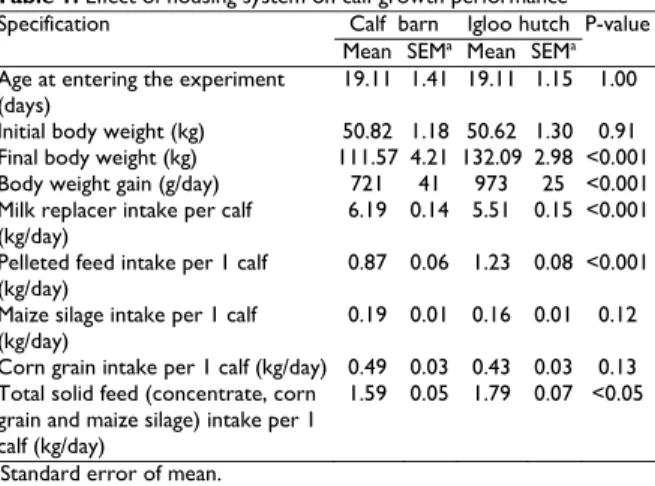
Growth and feed intake: The calves housed in group hutches were characterised by significantly (P<0.001) higher final weight and daily gains, by 20.5 kg and 252 g, respectively, as compared with those housed in the barn (Table 1). The average daily milk replacer intake was significantly higher (P<0.001) in the calf barn group, whereas the mean intake of concentrate per calf was significantly (P<0.001) higher in the igloo group.
Health state: Respiratory system diseases were most frequent, persisting for 135 days in the calf-barn group, or 3.57% in relation to the number of days of the experiment (Table 2). This period was shorter in the igloo-hutch group, 47 days and 1.24%, respectively (P<0.001). The total number of sick days, 163 days (4.31%), was considerably higher in the calf-barn group (P<0.001), whereas in the igloo-hutch group it was 77 days (2.04%). Whenever a calf of the igloo-hutch group was sick, it took it shorter to recover and the disease itself was much less severe, especially in the case of respiratory infections. This resulted in a considerably lower mortality rate in this group of calves; only 2 deaths (4.4%) were noted in the igloo-hutch group, whereas as many as 8 calves (17.8%) died in the barn group (P<0.05).
Table 1: Effect of housing system on calf growth performance
Specification Calf barn Igloo hutch P-value
Mean SEMa Mean SEMa
Age at entering the experiment (days)
19.11 1.41 19.11 1.15 1.00
Initial body weight (kg) 50.82 1.18 50.62 1.30 0.91
Final body weight (kg) 111.57 4.21 132.09 2.98 <0.001
Body weight gain (g/day) 721 41 973 25 <0.001
Milk replacer intake per calf (kg/day)
6.19 0.14 5.51 0.15 <0.001
Pelleted feed intake per 1 calf (kg/day)
0.87 0.06 1.23 0.08 <0.001
Maize silage intake per 1 calf (kg/day)
0.19 0.01 0.16 0.01 0.12
Corn grain intake per 1 calf (kg/day) 0.49 0.03 0.43 0.03 0.13
Total solid feed (concentrate, corn grain and maize silage) intake per 1 calf (kg/day)
1.59 0.05 1.79 0.07 <0.05
aStandard error of mean.
Table 2: Calf morbidity during the rearing period
Specification
Calf barn group Igloo hutch group P-value number of
sick days %
number of
sick days %
Respiratory system diseases 135 3.57 47 1.24 <0.001
Digestive system diseases 19 0.50 7 0.18 <0.05
Lameness 7 0.18 1 0.03 <0.05
Other diseases 2 0.06 22 0.58 <0.001
Total number of sick days 163 4.31 77 2.04 <0.001
Dead animals (n) 8 17.8 2 4.4 <0.05
DISCUSSION
Diseases, more frequent and more persistent within the barn group, should probably be blamed for lower gains attained by the calves managed this way; however, lower consumption of concentrates (pellets in particular) may have also led to poorer growth of the calves housed in the building compared to those in the hutches. The calves in igloo-hutch group began feeding on solid feeds earlier and consumed larger amounts of these feeds. This also reduced the individual consumption of milk replacer, which can be considered as a positive effect, since it contributes to faster development of the alimentary tract of the ruminant.
Hill et al. (2007) noted that naturally ventilated calf housing in all weather conditions had a positive impact on feed intake and growth rate of young calves. The main advantages of hutch housing include: isolation, less pathogen loads, open ventilation and physical comfort of young calves. Moreover, the polyvinyl hutches are durable and easy to clean and maintain (Razzaque et al., 2009).
In the study by Scott et al. (1993), calves housed in cold hutches consumed as much feed as those housed in buildings. On the other hand, Hepola et al. (2006) found no differences in feed intake between calves housed in groups in building and those housed outdoors with heated or unheated shelters. No differences were found in weight gains either. The group-housed calves started to take solid feeds sooner than those housed individually, with a higher consumption of milk, hay, and solid feed during the first 7 weeks. Terré et al. (2006) report that no differences were in final body weight and starter total dry matter intake between calves reared in individual pens and calves grouped in pens.
Although intensive milk feeding results in faster growth of the calf in the initial stage of rearing, it is inappropriate from both breeding and economic point of view. Hepola (2003) states that feeding calves too long with large amounts of milk may later bring a setback in growth due to a low solid feed intake. Also Franklin et al. (2003) have demonstrated that if feeding solid feeds, such as grain, starts sooner, provision of milk and milk replacers can be discontinued sooner as well, which reduces costs and labour without a compromise to the growth rate.
In our study, respiratory tract diseases were most frequent, especially among the calves housed in the barn. We have also recorded higher mortality in this management system. Earlier studies have shown that the hutch calf management system is accompanied by lower calf morbidity and lower calf death rate as compared with calf-barn rearing (Esslemont and Kossaibati, 1996; Razzaque et al., 2009).
Pak Vet J, 2013, 33(2): 175-178. 178
(2003) assessed that growth rate in calves with apparent symptoms of respiratory system diseases was approximately 25 g/day lower than that in healthy ones. Svensson and Liberg (2006) have found that smaller size of the group reduces the incidence of respiratory diseases and improves the growth rate of the calves. They also suggested that a group of calves sharing an automatic feeder should not exceed 10 animals. The authors observed that calves housed in a calf barn in groups of 12-18 suffered from respiratory system diseases more often than those housed in groups of 6-9, whereas no differences were found in the incidence of diarrhoea. Hänninen et al. (2005) did not find significant differences in health between individually reared calves and those reared in groups of four. Space per calf affects health of calves in large groups. A trend has been found that a small space per calf increased the incidence of pneumonia in particular. Hepola (2003) observed that if the allowed space was larger than 1.4 m² per calf, no health problems were encountered.
Conclusion: The calves housed in groups with igloo-type hutches attained significantly higher body weight gains as compared with those housed in groups in the calf barn. They consumed significantly more solid feeds, mainly pellets, and significantly less milk replacer. The igloo-housed calves had also a lower incidence and lower persistence of respiratory diseases.
REFERENCES
Babu LK, HN Pandey and A Sahoo, 2004. Effect of individual versus group rearing on ethological and physiological responses of crossbred calves. Appl Anim Behav Sci, 87: 177-191.
Bach A, C Tejeroand J Ahedo, 2011. Effects of group composition on
the incidence of respiratory afflictions in group-housed calves after weaning. J Dairy Sci, 94: 2001-2006.
Bach A, J Ahedo and A Ferrer, 2010. Optimizing weaning strategies of dairy replacement calves. J Dairy Sci, 93: 413-419.
Chua B, E Coenen, J van Delen and DM Weary, 2002. Effects of pair versus individual housing on the behavior and performance of dairy calves. J Dairy Sci, 85: 360–364.
Esslemont RJ and MA Kossaibati, 1996. Incidence of production diseases and other health problems in a group of dairy herds in England. Vet Rec, 139: 486-490.
Franklin ST, DM Amaral-Phillips, JA Jackson and AA Campbell, 2003. Health and performance of holstein calves that suckled or were hand-fed colostrum and were fed one of three physical forms of starter. J Dairy Sci, 86: 2145-2153.
Gorden PJ and P Plummer, 2010. Control, management, and prevention of bovine respiratory disease in dairy calves and cows. Vet Clin North Am Food Anim Pract, 26: 243-259.
Gulliksen SM, KI Lie and O Osteras, 2009. Calf health monitoring in Norwegian dairy herds. J Dairy Sci, 92: 1660-1669.
Hänninen L, AM de Passille and J Rushen, 2005. The effect of flooring type and social grouping on the rest and growth of dairy calves. Appl Anim Behav Sci, 91: 193-204.
Hepola H, 2003. Milk feeding systems for dairy calves in groups: Effects of feed intake, growth and health. Appl Anim Behav Sci, 80: 233–243. Hepola H, L Hänninen, P. Pursiainen, VM Tuure, L Syrjälä-Qvist, M
Pyykkönen and H Saloniemi, 2006. Feed intake and oral behaviour of dairy calves housed individually or in groups in warm or cold buildings. Livest Sci, 105: 94-104.
Hill TM, G. Bateman II, JM Aldrich and L Schlootterbeck, 2007. Effects of feeding rate of milk replacers and bedding material for calves in
a cold, naturally ventilated nursery. Prof Anim Sci,23: 656-664.
Huuskonen A, L Tuomisto, E Joki-Tokola and R Kauppinen, 2009. Animal performance and carcass characteristics of growing Hereford bulls under insulated, uninsulated and outdoor housing
conditions in Northern Finland. Agric Food Sci,18: 16-26.
Kung L Jr, S Demarco, LN Siebenson, E Joyner, GFW Haenlein and RM Morris, 1997. An evaluation of two management systems for rearing calves fed milk replacer. J Dairy Sci, 80: 2529-2533. Lorenz I, J Fagan, SJ More, 2011a. Calf health from birth to weaning. II.
Management of diarrhoea in pre-weaned calves. Ir Vet J, 64: 9. Lorenz I., B. Earley, J. Gilmore, I. Hogan, E. Kennedy and SJ More,
2011b. Calf health from birth to weaning. III. Housing and management of calf pneumonia. Ir Vet J, 64: 14.
Lundborg K., PO Oltenacu, DO Maizon, EC Svensson and PGA Liberg, 2003. Dam-related effects on heart girth at birth, morbidity and growth rate from birth to 90 days of age in Swedish dairy calves.
Prev Vet Med,60: 175-190.
Marcé C, R Guatteo, N Bareille and C Fourichon, 2010. Dairy calf housing systems across Europe and risk for calf infectious diseases. Animal, 4: 1588-1596.
Pourjafar M, K Badiei, MG Nadalian and RJ Jozani, 2011. Effect of long term administration of frozen and fermented colostrums of vaccinated cows on performance and prevention of neonatal calf diarrhea. Pak Vet J, 31: 199-202.
Razzaque MA, S Abbas, T Al-Mutawa and M Bedair, 2009. Performance of pre-weaned female calves confined in housing and open environment hutches in Kuwait. Pak Vet J, 29: 1-4.
Scott SL, RJ Christopherson, JR Thompson and VE Baracos, 1993. The effect of a cold environment on protein and energy metabolism in
calves. Brit JNutr, 69: 127-139.
Svensson C and MB Jensen, 2007. Identification of diseased calves by
use of data from automatic milk feeders. J Dairy Sci,90: 994-997.
Svensson C and P Liberg, 2006. The effect of group size on health and growth rate of Swedish dairy calves housed in pens with automatic milk-feeders. Prev Vet Med, 73: 43-53.
Svensson C, J Hultgren and PA Oltenacu, 2006. Morbidity in 3-7-month-old dairy calves in south-western Sweden, and risk factors for diarrhoea and respiratory disease. Prev Vet Med, 74: 162-179. Terré M, A Bach and M Devant, 2006. Performance and behavior of