Vol-7, Special Issue3-April, 2016, pp725-730 http://www.bipublication.com
Research Article
Relationship between Parenting Styles and Learning Strategies in High
School Students
1
Parisa Kolahi, 2Farshid Ebrahimi, 3Ghazale Tarnas,
4
Zahra Roshandel and 5Majid Shafiei Amiri 1
Master of Psychology, Faculty of Psychology, Islamic Azad University, Urmia,
2
Young Researchers Club,
Islamic Azad University Roudehen branch. Roudehen, Iran. [email protected]
3,4
Islamic Azad University, Karaj Branch, Department of Psychology, Karaj, Iran.
5
Young Researchers Club, Islamic Azad University . [email protected]
ABSTRACT
The purpose of this study is to examine the relationship, between perceived parenting styles and learning strategies. Research method is correlation .Statistical population composes of all high school students in Urmia city. The sampling process conducted with random method of stage cluster sampling selected 127 high school students. The sample was 56% female students and 44% male students. The research tools were the Perceptions of Parent's Actions Questionnaire and The LASSI-HS measures. The results revealed that those students who perceived their parents as being authoritative tended to engage in more effective learning and study strategies. Implications are discussed for counselors and teachers using this information as a fostering tool in their work with Iranian students.
Keywords: Parenting styles, Learning strategies, Hhigh school students
INTRODUCTİON
The family is generally considered an important system that has a heavy impact on the development of children and adolescents. Some studies have identified child-rearing behaviors as variables that contribute to self-concept development in children and adolescents (Mboya, 2009). A critical component of parenting style is the way in which parents attempt to control the adolescent. Much research has been conducted with White Americans on this issue. Even though a clear picture has not emerged, researchers have identified critical factors that seem to be significant to all adolescents (Becker, 2009). In studies addressing how parenting practices affect the development of children, findings have shown
faulty learning styles and the lack of opportunity to acquire effective studying strategies. In 1996, Laurence Steinberg conducted a study (Salmon, 1996) with 20,000 teenagers and hundreds of parents and educators nationwide and found that children raised by parents who were authoritative did better in school than adolescents from authoritarian or permissive homes. Therefore, counselors, teachers, and parents must consider the impact parenting styles may have on urban adolescents' ability to learn and study, if interventions are to be developed to increase students' academic abilities.
However, there has been little research on the possible effects of parenting styles on the academic performance and achievement among racial and ethnic minority urban adolescents and how it relates to learning and studying strategies. In a study done by Reich (2012) with American adolescents, it was hypothesized and concluded that perceptions of parental love and control may be a significant factor in the teen's general school achievement.
There has also been little research on how counselors can enable adolescents to become more aware of their learning styles. Weinstein and Palmer (1990), who have done research with minority and majority adolescents, suggested that students can become more aware of their thinking and can comprehend and retain more information if they are motivated, have good time management, and can concentrate.
What is missing, however, are interventions that allow adolescents to acknowledge and identify their thought processes that affect their learning. The school and the family provide a network of communication experiences through which the individual learns the arts of speech, interaction, listening, and negotiation, all of which are important in an adolescent's study habits. Adolescents, who perceive too much or too little support and control from their parents regarding the basic family functions, are likely to be at risk in their intellectual development, thus reducing their school achievement abilities (Olson, 1981). One recommendation for attending to this problem has been the development of a working alliance between parents and the school. This recommendation is based on the premise that
parents play a critical role in the school behavior of their children. Research studies show that adolescents who have parents high in demandingness and responsiveness are more social and have high educational aspirations (Reich, 2012). Similar research results go back more than 20 years. In their research with White Americans, Balswick and Macrides (1975) discovered that a very restrictive (authoritarian) home leads to a cyclical pattern of frustration and aggression.
On the other hand, a very permissive home can lead a youth to not know what the parental expectations are, which then leads to aggression in search of norms. If there are no checks on the aggression, an increased Amount of aggression is expressed. Thus, an "authoritative" type of parenting may be beneficial for increasing student achievement. The purpose of this study was to determine if parenting styles affect Iranian adolescents' learning and studying strategies and if counselors and teachers can set up interventions to work with (a) Parents, to have them incorporate more effective parenting styles, and (b) students, to improve or strengthen their learning and studying strategies. It was hypothesized that perceived authoritative parenting would result in iranian adolescents' using more effective learning and studying strategies than would those adolescents with perceived authoritarian or permissive parenting. Finally, the literature review and the findings of the current study should contribute to counselors' knowledge in identifying iranian adolescents' unproductive thoughts and behaviors, thus enabling adolescents to become more aware of themselves.
Counselors and teachers can also use this information as a tool to help iranian adolescents focus on major issues that are important in high school, such as listening and reading comprehension.
METHOD
The sample was drawn from a population of currently enrolled high school students (10th grades) in a large, Urmia city. The total student population of this school was 800, 60% (n = 480) were female students and 40% (n = 320) were male students. We randomly selected 127 high school students. The sample was 56% female students and 44% male students. Data was collected in 12 high school classrooms. Before doing this, We obtained informed consent from school administrators to conduct this study in the school to assist the school system in determining how best to attend to and improve the learning and studying strategies among students. Students served as voluntary participants, and the confidentiality of the students, parents, and school identification was assured. I used a causal-comparative design in this study. Research packets were distributed to all students in each class. Each packet included directions and a three-part booklet to be completed within 1 hour. Part I was a demographic profile sheet. Part 2 was a questionnaire that the researcher modeled after the Perceptions of Parents Actions Questionnaire (PPAQ; Schaefer, 1965; Streit, 1987). Part 3 was the Learning and Studying Strategies Inventory-High School Version (LASSI-HS; Weinstein & Palmer, 1990). Participants completed the following questionnaire measures, all scales were adapted for Iranian population:First, the demographic profile sheet was completed by all participants. This measure requested participants to indicate sex, age and level in school. The second measure was a modified version of the Perceptions of Parent's Actions Questionnaire (PPAQ; Schaefer, 1965), a 104-item questionnaire that was designed for adolescents to assess which parent (mother or father) displayed a certain behavior (permissive, authoritative, or authoritarian) in specific situations. The 48-item modified version was designed for adolescents to assess if their parent(s) did or did not display a certain behavior (permissive, authoritative, or authoritarian) in specific situations. These revisions were made for two reasons: (a) I was not concerned about which parent displayed the
strategies; and (f) depending on the number of scores within a strategy level, a numerical value of I (low), 2 (average), or 3 (high) was assigned. Construct validity has been established by comparing LASSI-HS scale scores with other tests measuring similar learner behaviors, and several of the scales have been validated against performance measures (Eldredge, 1990).
RESULTS
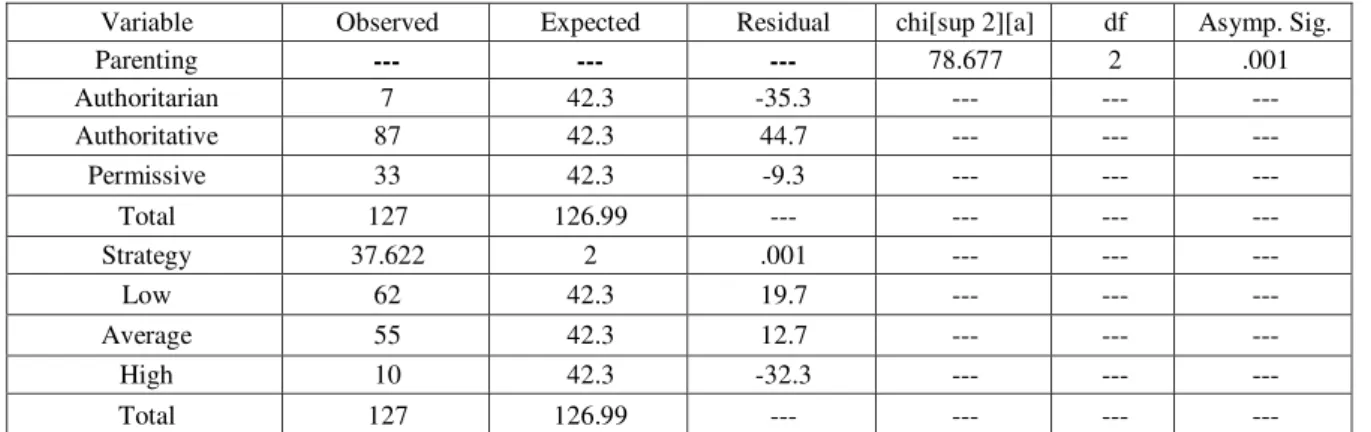
The analysis of nominal data in this causal-comparative study involved descriptive and inferential statistics. The descriptive statistics used were means and standard deviations. Of all the participants, 69% (n = 87) perceived their parents as being authoritative, 26% (n = 33) of the students perceived their parents as being permissive, and 5% (n = 7) reported a perception
of authoritarian parenting. The findings also revealed that 49% (n = 62) of the students reported very limited use of effective learning and study strategies, 43% (n = 55) reported average use of strategies, and 8% (n = 10) reported extensive use of such strategies. The mean score for parenting styles was 2.20 (SD = .52; i.e., authoritarian = 1, authoritative = 2, and permissive = 3). The mean score for the strategies was 1.59 (SD = .63; i.e., low = 1, average = 2, and high = 3).
The inferential statistic, chi-square, was used to compare perceived parenting styles (Table 1) to examine the relationship between group frequencies (permissive, authoritative, authoritarian) in parenting and learning and study strategies.
TABLE 1:Two-Way Chi-Square Analysis of Parenting and Strategy Variables
Asymp. Sig. df
chi[sup 2][a] Residual
Expected Observed
Variable
.001 2
78.677
--- ---
---
Parenting
----35.3
42.3 7
Authoritarian
---44.7
42.3 87
Authoritative
----9.3
42.3 33
Permissive
---126.99 127
Total
---.001
2 37.622
Strategy
---19.7
42.3 62
Low
---12.7
42.3 55
Average
----32.3
42.3 10
High
---126.99 127
Total
A significant (p < .01) association between perceived parenting styles and learning and study strategies (n = 127, df = 2) was found. Those participants who perceived their parents as being authoritative also engaged most often in effective learning and study strategies. Participants who perceived their parents as permissive were found to engage least often in such strategies.
DİSCUSSİON
The results of this study support the initial hypothesis that perceived authoritative parenting style would be significantly associated with urban adolescents' use of effective learning and study strategies. This association has also been documented in other research studies addressing the link between parenting styles and adolescents' academic achievement (Dubin et al., 1993; Hein & Lewko, 2011; Shucksmith et al., 2009). In addition, I believe that it is most important to note the underrepresentation of students who indicated the use of effective learning and study strategies. Data from this study indicated that approximately 50% of the
and encouraging their children to do well in school, teachers and counselors might need to be aware of and responsive to these standards. One way of doing this is for educators to accommodate students' learning styles in the classroom by becoming more flexible regarding instruction style (i.e., visual, auditory, hands on, etc.). This would represent educators as not only setting educational standards (like parents) but also encouraging the practice of recognizing student differences. Adolescents can work toward increasing their study habit only if they are made aware of their learning styles. This parent and school alliance, as mentioned before, is important if the community, itself, is going to be authoritative. Another possible reason for the significant number of low learning strategies among urban adolescents could be due to adolescents having learning disabilities. Adolescents with learning disabilities may have different abilities, strengths and weaknesses, and interests. Parents, authoritative or not, need to communicate their needs with school personnel and be decision makers when they participate in the Individual Education Plan (IEP) process. Counselors and teachers need to have positive attitudes and instructional priorities; they should also find out what skills an adolescent will need to function adequately and implement a program for preparing the child to develop these skills. The other problem is that many adolescents with learning disabilities are undiagnosed. Many educators and parents do not recognize the specific learning needs of urban adolescents and therefore cannot design strategies to meet them. Thus, effective academic programs need to mandate a higher awareness of adolescents' learning aptitude variations and to supply educators and parents with comprehensive knowledge of the structure of learning. With such information, low learning and studying strategies of urban adolescents can be changed, so that there is an increase of effective study habitsA third reason for the limited number of adolescents engaging in effective learning and studying strategies is the fact that many urban adolescents may have additional life responsibilities and personal and emotional challenges that compete with academic
competence as a priority. For many students, school-related activities are secondary or tertiary to work and family responsibilities. 1 Recommendations and Limitations On the basis of the findings and conclusions of this study, I have made several recommendations for counselors, teachers, and parents of adolescents. First, counselors, teachers, and parents should take advantage of the information they have or can get regarding students' home and school life and should use this information as a fostering tool in working with urban adolescents. An example is for educators to vary their teaching styles to accommodate different learning styles. Second, by having a well-rounded body of knowledge about the urban adolescent population, parents can incorporate or maintain more effective parenting styles. This knowledge would include parents being informed of their child's learning disability and would also include how they can be involved in the IEP process. Third, it is recommended that urban adolescents must first recognize their strengths and weaknesses to improve their learning and study strategies. Perceived parenting styles, alone, may not predict a students' academic success, but an alliance between schools and parents can help these adolescents determine what they need help with and what they can build on. In reference to additional research, I made several recommendations. First, more research needs to be done in the area of how parenting styles affect urban adolescents' learning and studying strategies. As evidenced here, the parenting style variable is not the only variable involved. Collaborative partnership between the school system and parents as well as an awareness of learning disabilities may also contribute. Second, there needs to be more research that looks at the urban adolescent population and how these students compare with other groups of students. Such data could then be compared for possible relationships or lack thereof. This could help determine the cultural influences on study habits of all adolescents. Third, any research with an ESOL population that extends from this study needs to take into account the data gathering
instruments to be used. It is recommended that to collect representative responses, the researcher needs to use a "testing language" that is familiar to the sample population. This would include simple translatable questions and items or different versions of the instruments basted on the primary language of the participants. There were two major limitations to this study. First, the sample did not adequately represent all high school students because the sample was drawn from only one high school population. This method of sampling was used because I had difficulty getting permission from other high schools to enter classrooms. Second, the nature of the data collection using self-report measures limits interpretations to what was perceived by participants. Adolescents may report perceptions that do not always accurately reflect actual parenting styles. Thus, future researchers should be cautioned to attend to these limitations in designing studies addressing this topic.
REFERENCES
1. Balswick, J. O., & Macrides, C. (1975). Parental stimulus for adolescent rebellion, Adolescence, 10(38). 53-56.
2. Becker, W. C. (2009). Consequences of different kinds of parental discipline. In M. L. Hoffman & L. Hoffman (Eds.), Review of child development (pp. 51-84). Chicago: University of Chicago Press.
3. Dubin, D. A., Darling, N., Steinberg, L., & Brown, B. B. (1993). Parenting style and peer group membership among European-American adolescents. Journal of Research on Adolescence, 3(1), 87-100.
4. Eldredge, J. L. (1990). Learning and Study Strategies Inventory--High School Version (Lassi-HS). Journal of Reading, 34(2), 146-149.
5. Hein, C., & Lewko, J. H. (2011). Gender differences in factors related to parenting style: A study of high performing science students, Journal of Adolescent Research, 9(2), 262-281.
6. Mboya, M. M. (2009). A comparative analysis of the relationship between parenting styles and self-concepts of Black and White
high school students. School Psychology International, 16, 19-27.
7. Olson, D. H. (1981). Marital and family therapy: A decade review. Journal of Marriage and the Family, 42, 973-994. 8. Reich, C. A. (2012). Perceived parental
closeness and control in relation to adolescent general expectancy for success in life and school achievement. Unpublished master's thesis, University of Maryland, College Park, Maryland.
9. Salmon, J. L. (1996, November 24). Firm support for stricter upbringing. The Washington Post, pp. B1, B5.S
10.Schaefer, E. S. (1965). Children's reports of parental behavior: An inventory. Child Development, 36, 413-424.
11.Shucksmith, J., Hendry, L. B., & Glendinning, A. (2009). Models of parenting: Implications for adolescent well-being within different types of family contexts. Journal of Adolescence, 18, 253-270.
12.Streit, F. (1981). Differences among youthful criminal offenders based on their perceptions of parental behavior. Adolescence, 16 (62), 409-413.
13.Streit, F. (1987). The Epac System manual for professionals (Vol. 1). New Jersey: People Science.