Full reference:
Allegra M., Tulumello S., Colombo A., Ferrão J. (2020), “The (hidden) role of the EU on housing policy: the case of Portugal in multi-scalar perspective”, European Planning Studies, online first. Doi: 10.1080/09654313.2020.1719474.
For Peer Review Only
The (hidden) role of the EU in housing policy: the Portuguese case in
multi-scalar perspective
Word count: 8,300 words (including abstract, footnotes) + 2,200 (references)
Marco Allegra
Instituto de Ciências Sociais, Universidade de Lisboa, Lisbon, Portugal
Centro de Investigação e Estudos de Sociologia, Iscte - Instituto Universitário de Lisboa, Lisbon, Portugal
Simone Tulumello
Instituto de Ciências Sociais, Universidade de Lisboa, Lisbon, Portugal
Alessandro Colombo
Dinâmia’CET, ISCTE-IUL, Lisbon, Portugal
João Ferrão
Instituto de Ciências Sociais, Universidade de Lisboa, Lisbon, Portugal
Corresponding author: Marco Allegra, ICS-ULisboa, Avenida Bettencourt 9, 1600-189 Lisboa, Portugal [email protected] 3 4 5 6 7 8 9 10 11 12 13 14 15 16 17 18 19 20 21 22 23 24 25 26 27 28 29 30 31 32 33 34 35 36 37 38 39 40 41 42 43 44 45 46 47 48 49 50 51 52 53 54 55 56
For Peer Review Only
Marco Allegra is principal investigator at ICS-ULisboa, where he integrates the research group Environment, Territory and Society and the Urban Transition Hub. He is the coordinator of FCT-funded project exPERts, FCT-funded by the Fundação para a Ciência e a Tecnologia (FCT, ref:
PTDC/ATP-EUR/4309/2014). His area of expertise includes Middle East politics, planning theory and urban studies; his current research activity focuses on housing policy and the role of knowledge in the policy process.
Simone Tulumello is research fellow at ICS-ULisboa and member of the coordination of the PhD in Development Studies of ULisboa. His visiting and appointments include: Fulbright Research Scholar at the University of Memphis; Policy Fellow at the B. Hook Institute for Social Change; Visiting Scholar at DIST, Polytechnic of Turin and and Senior Expert Evaluator at Regiostars Awards 2019 (DG-REGIO). His research interests include: housing policy; austerity and neoliberal urban policy; urban security, fear and urban violence; Southern European and Southern US cities.
Alessandro Colombo PhD candidate in Public Policies (CIES-IUL, ISCTE-IUL) at DINAMIA-CET (ISCTE-IUL). His main research focus is on policy evaluation within multilevel governance
framework in distressed urban areas, with particular attention to housing-related issues, and to the European Urban Agenda in its relationship with EU Member States. He is currently policy consultant at the Sociedade Portuguesa de Inovação (SPI), working on housing policies, local development, and smart cities.
João Ferrão is research professor at ICS-ULisboa, where he coordinates the Environment, Territory and Society research group. His area of expertise includes social geography and regional and urban planning. He acted as an expert of public policies evaluation for EU and Portuguese authorities. He was Secretary of State for Spatial Planning and Cities and Pro-Rector of the University of Lisbon.
Acknowledgements
The research for this paper has been conducted in the context of the project ‘exPERts - Making sense of planning expertise: housing policy and the role of experts in the Programa Especial de Realojamento (PER)’, hosted at the Instituto de Ciências Sociais, ULisboa and funded by Fundação
3 4 5 6 7 8 9 10 11 12 13 14 15 16 17 18 19 20 21 22 23 24 25 26 27 28 29 30 31 32 33 34 35 36 37 38 39 40 41 42 43 44 45 46 47 48 49 50 51 52 53 54 55 56
For Peer Review Only
para a Ciência e Tecnologia (FCT: PTDC/ATP-EUR/4309/2014). The authors would like to
acknowledge the members of the exPERts research team, as well as the many respondents that have shared with us their knowledge on Portuguese housing policy. A preliminary version of this article has been presented at the AESOP Congress 2018 in Lisbon.
The authors declare that they do not have any conflicts of interest.
3 4 5 6 7 8 9 10 11 12 13 14 15 16 17 18 19 20 21 22 23 24 25 26 27 28 29 30 31 32 33 34 35 36 37 38 39 40 41 42 43 44 45 46 47 48 49 50 51 52 53 54 55 56
For Peer Review Only
The (hidden) role of the EU in housing policy: the Portuguese case in
multi-scalar perspective
Doling (2006) characterised the intervention of the EU in the field of housing as a ‘stealth policy’, arguing that while the EU has no formal competence in this policy area, it has de facto conditioned national housing policies. This suggests that housing policy is a particularly interesting case for the study of formal and informal modes of multilevel governance. However, European comparative studies about housing policy have almost exclusively focused either on the national or local characteristics of housing systems.
In this paper we explore the connections between the development of Portuguese housing policies in the last four decades, on the one side, and EU programmes and documents on the other. We will show how the dynamics of Portuguese housing policy reflected the fluctuations of EU agenda.
In doing so, we aim at (i) exploring the history of EU ‘stealth housing policy’ in a moment of re-emergence of housing as a defining theme of EU agenda; and (ii) providing a more accurate characterisation of domestic recent general trends and processes through a multi-scalar gaze, and in particular by Portugal as Member State of the EU.
Keywords: housing policy; European Union; Portugal; multilevel governance; Europeanization 3 4 5 6 7 8 9 10 11 12 13 14 15 16 17 18 19 20 21 22 23 24 25 26 27 28 29 30 31 32 33 34 35 36 37 38 39 40 41 42 43 44 45 46 47 48 49 50 51 52 53 54 55 56
For Peer Review Only
1. Introduction
The EU has no formal competence over housing policy, and, contrary to what happens in cognate fields, such as spatial planning, has not engaged in explicit and direct efforts for the ‘Europeanization’ of this field.1 Yet, it has been suggested that the EU has developed a set
of tactics to steer the European housing market (see e.g. Doling, 2006), and that we are currently seeing the emergence of housing as a defining topic in the EU social agenda (Ferrão, 2018). Surprisingly, the influence of the EU on housing policies in the member states has not received much scholarly attention. On the one hand, the studies on European multilevel governance (e.g. Hooghe, Marks, 2001; Piattoni, 2010; Faludi, 2012) have overlooked the subject of housing and housing policy. On the other hand, housing studies have mostly focused on either the national or local characteristics of housing systems.2
Against this background, this paper explores the historical trajectory of housing policy in Portugal (with a specific focus on the metropolitan area of Lisbon) with the goal of providing a better understanding of the relation between national housing policies and
1 There is no equivalent, in the field of housing policy, of the process of Europeanization in the
spatial and urban planning field, as represented by key strategic documents (e.g. ESDP – European Spatial Development Perspective, 1999; Leipzig Charter on Sustainable European Cities, 2007; Green Paper on Territorial Cohesion, 2008), institutions for soft governance (e.g. ESPON), and other EU initiatives (e.g. URBAN and URBACT). For an overview, see
Zonneveld et al., 2012; Cotella, Janin Rivolin, 2018.
2 Among the few exceptions are: De Weerdt and Garcia’s (2016) discussion of the role of the
Spanish Platform of Mortgage Victims (Plataforma de Afectados por la Hipoteca, PAH) in fostering innovation in multilevel governance; Lang and Novy’s (2014) reflection on the room that dominant models of governance leave for participatory cooperative housing; and Card and Mudd’s (2006) analysis of the relationship between housing, regeneration and ‘new localism’.
3 4 5 6 7 8 9 10 11 12 13 14 15 16 17 18 19 20 21 22 23 24 25 26 27 28 29 30 31 32 33 34 35 36 37 38 39 40 41 42 43 44 45 46 47 48 49 50 51 52 53 54 55 56
For Peer Review Only
EU multilevel governance. We will do so by starting from Doling’s (2006) idea of a European housing policy ‘by stealth’ (i.e. the idea that EU’s de facto influence on national housing policies has significantly grown despite the lack of formal competences in the field), and therefore from Doling’s key question: does the EU have a housing policy? Or better: to what extent EU policies in other areas can be said to constitute an implicit housing policy?
Portugal is an adequate case of study for two reasons. First, the long-term evolution of the Portuguese housing system and policy can hardly be explained through reference to the traditional taxonomies provided by housing and welfare studies (see, e.g., Allen et al., 2004; Allen, 2006) and planning theory (Campos, Ferrão, 2015; Tulumello et al., 2018).3
The difficulty in placing Portugal in existing taxonomies suggests that taxonomies, after all, may not be the best way to describe the dynamics of continuity and change in housing and planning policy (an argument that some of us made elsewhere; see Tulumello et al., 2018); and that the exploration of cases that have remained at the margins of urban and planning theory can be fruitful to enrich our theoretical understanding of the phenomena under exam (Baptista, 2013). Second, Portugal is currently affected by a housing crisis of significant proportions, especially acute in the metropolitan regions of Lisbon and Oporto. This crisis has resulted from the combined effect of the cycle of post-2008 economic recession and austerity measures, epitomised by the Memorandum of Agreement signed by the country with the European Central Bank, the European Commission and the International Monetary
3 Campos and Ferrão (2018) show how different taxonomic exercises have given contradictory
outputs with regard to the placement of the Portuguese planning system within different systems of categories. Allen et al. (2004) have criticised the conventional placement of Portugal within welfare taxonomies inspired by theories on varieties of capitalism.
3 4 5 6 7 8 9 10 11 12 13 14 15 16 17 18 19 20 21 22 23 24 25 26 27 28 29 30 31 32 33 34 35 36 37 38 39 40 41 42 43 44 45 46 47 48 49 50 51 52 53 54 55 56
For Peer Review Only
Fund in 2011 (Pedroso, 2014); and of the recent economic recovery, largely based on a real estate and touristic boom (Mendes, 2017). This crisis has spurred the recent growth of grassroots mobilizations (see, e.g., Falanga et al., 2019), and brought housing issues in the limelight again (Allegra and Tulumello, 2019). In other words, from a Portuguese
perspective, studying the drivers and the historical dynamic of local housing policy is now especially urgent.
Our epistemological strategy for pursuing these goals is to set out a historical study of Portuguese housing policy inspired by Foucault’s concept of ‘genealogy’ (Foucault, 1994[1976]; Gutting, 1990; Crowley, 2009; for a study on Portuguese housing and planning policy, see Tulumello et al., 2018), by investigating social processes in the long term in search of what Foucault called ‘specificities’, ‘discontinuities’ and ‘exteriorities’ of historical development (as opposed to the quest for universal explanatory systems). This approach seems to us to be particularly apt to understand the relations among the plurality of actors and forces intervening in a complex policy field such as housing policy. The long-term analysis of a single case shows the interaction between endogenous and exogenous forces in the context of study. In turn, the in-depth investigation of single cases can help to overcome the tendency of taxonomic comparison to assign simplistic labels (such as ‘advanced’ vs. ‘lagging behind’ countries), which tend to privilege culturalistic explanations (cf. Tulumello, 2016).
Our account of the long-term trajectory of Portuguese housing policy builds mainly on the analysis of Portuguese legislation and policy documents; on grey literature produced or commissioned by European institutions; on in depth interviews with academics,
3 4 5 6 7 8 9 10 11 12 13 14 15 16 17 18 19 20 21 22 23 24 25 26 27 28 29 30 31 32 33 34 35 36 37 38 39 40 41 42 43 44 45 46 47 48 49 50 51 52 53 54 55 56
For Peer Review Only
policymakers, and professionals who have worked on housing policy in the last decades;4
and on our own direct involvement with the field of housing and planning policy as researchers, activists and policymakers.5
The paper is organised as follows. Section 2 briefly presents the general trends emphasised by comparative housing studies, and interrogates the existence of an EU housing policy ‘by stealth’ in the long run. Section 3 thus presents a timeline of housing policy in Portugal, and of multilevel governance arrangements therein. In the concluding section we suggest that EU’s influence on national housing policy is visible in four areas: in the implicit and symbolic conditionality inherent to Portugal’s of the participation in the EU; in the effects of EU-induced financial stability, and in the possibility to enjoy access EU funds; in the impact of cycles of EU policies on the national economy and fiscal policies; and in the travel of ideas and policy paradigms between the European and the
4 Our respondents include: a former secretary of state for Housing; a former civil officer that held
several positions in the national Department of Housing, and collaborated closely with the abovementioned Secretary of State; a researcher and former IHRU board member; a professor of sociology at UNL; a politician, president of the Municipal Assembly of Lisbon and MP; a professor of sociology and urban studies at ISCTE-IUL; an architect working for the
municipality of Lisbon; a professor of urban sociology at ISCTE-IUL; a former president of IHRU and former civil servant at municipality of Oeiras; a former ministry for Public Works, Transport and Communication.
5 The research for this paper has been mainly conducted in the context of the projects ‘exPERts –
Making sense of planning expertise’ (https://expertsproject.org/) and ‘HOPES – HOusing Perspectives and Struggles (www.ics.ulisboa.pt/en/projeto/housing-perspectives-and-struggles-futures-housing-movements-policies-and-dynamics-lisbon). One of the authors is actively involved in recent mobilisations about the right to housing as member of the association Habita and participant/organiser of the Caravana pelo Direito à Habitação (Caravan for the Right to Housing; see Falanga et al., 2019). Finally, one of the authors has been Secretary of State for Spatial Planning and Cities (2005-2009).
3 4 5 6 7 8 9 10 11 12 13 14 15 16 17 18 19 20 21 22 23 24 25 26 27 28 29 30 31 32 33 34 35 36 37 38 39 40 41 42 43 44 45 46 47 48 49 50 51 52 53 54 55 56
For Peer Review Only
national level.
2. In search of a European housing policy
European comparative housing studies have pursued so far two main goals: first, they have produced taxonomies of the national housing systems and policy paradigms; secondly, they have discussed common processes of change. From a variety of perspectives (e.g., Harloe, 1995; Kemeny, 2001; Whitehead, Scanlon, 2007; Alves, 2017), taxonomic efforts have mostly considered two key dimensions (the characteristics of national housing systems, and of national policy and political approaches), and showed a normative focus on bridging the gap between more ‘advanced’ systems and those ‘lagging behind’ – a duality that typically alluded to Central and Northern European versus Southern and Eastern European countries (see Allen et al., 2004).
With regards to common processes of change, virtually all available studies have shown a long-term process of convergence of national housing policies since 1980s. Such convergence has taken the form of a generalised shift from a paradigm dominated by direct public provision of social-rented housing, towards a plurality of approaches based on deregulation and liberalisation, stimulus of homeownership, support to private/charity social housing, privatization of public housing stocks, coupled with an emphasis on the regeneration of the built environment (see e.g. Lundqwist, 1992; Harloe, 1995; Kleinman et al., 1998; Urban Studies 39[2], 2002; Whitehead, Scanlon, 2007; Difeliciantonio, Aalbers, 2018). 3 4 5 6 7 8 9 10 11 12 13 14 15 16 17 18 19 20 21 22 23 24 25 26 27 28 29 30 31 32 33 34 35 36 37 38 39 40 41 42 43 44 45 46 47 48 49 50 51 52 53 54 55 56
For Peer Review Only
However, despite the common emphasis placed by this body of work on the idea of convergence, the question as to whether the EU may have had a role in influencing this process has yet to receive significant scholarly attention. This void is even more surprising if we consider the rich literature about ‘Europeanisation’ of the spatial planning, a field cognate to, and interwoven with, that of housing. To our knowledge, no studies have addressed so far the impact of ‘soft’ forms of Europeanisation in the field of housing, for example in relation to the role of the periodic informal meeting of EU Housing ministers, the Committee of Regions (CoR) or the conditionality attached to the loans offered by the European Investment Bank (EIB). Indeed, only very recently Purkarthofer (2019) has discussed the EU Urban Agenda (and specifically, the partnership on affordable housing) as an example of ‘soft Europeanisation’ that has significant implications for the housing sector.
In the mid-1990s, Chapman and Murie (1996; see also Priemus, 1994) have offered a description, from a UK perspective, of the first steps beyond the simple and relatively unimportant ‘leakage’ of EU influence onto national housing systems from other policy areas – i.e. through the impact of EU regulations on competition, public procurement, technical standards, etc. on the daily operations of all actors involved in housing policies (see e.g. Drake, 1991; 1992; see also Oxley, Smith, 2012: 5-7). ). The exclusion of housing policy from the areas eligible for the attribution of EU Structural Funds has been defined as a ‘noticeable omission’ of the Cohesion Policy (Barlow, 2005[1998]), an omission that has contributed to the ‘evasion’ of the housing issue in some contexts (Governa, Saccomani, 2009; see also the section about Portugal in DG/RES, 1996).During the 1990s, this
decision was the object of a debate between, on the one side, the European Council and the 3 4 5 6 7 8 9 10 11 12 13 14 15 16 17 18 19 20 21 22 23 24 25 26 27 28 29 30 31 32 33 34 35 36 37 38 39 40 41 42 43 44 45 46 47 48 49 50 51 52 53 54 55 56
For Peer Review Only
European Commission, and, on the other, the European Parliament, which passed several motions asking a more direct engagement of the EU with housing (Stephens, 1999: 725). In the same period, the realignment of EU financial instruments toward the goal of social and economic cohesion brought the focus of EU policy ‘closer to the agenda and activities of housing policy and housing organizations’ (Chapman, Murie, 1996: 310). Indeed, this allowed the use of EU Structural Funds to complement and support, albeit indirectly, national housing policies and programmes (see DG/RES, 1996) – for example for building public facilities (IORU, ERDF), training human resources (EQUAL, ESF), and financing area-based-projects (e.g. URBAN Community Initiative, ERDF/ESF).
Later contributions (Kleinman et al., 2005[1998]; Kleinman, 2001, 2002; Doling, 2006) therefore started to ask whether or not the growing (if indirect) influence of the EU on the housing policy sector amounted to the exercise of an undeclared but effective regulatory action. Kleinman, for example, argued that there was ‘some EU dimension to housing policy’ (2001: 341), as the EU had always been involved with housing ‘through its competences in regard to economic and monetary policies, competition policy and
promotion of the single market’ (idem: 350). Doling (2006), in his analysis of the 2004 ‘Kok report’ (commissioned by the EU to review the progresses toward the Lisbon strategy), has individuated two policy areas especially relevant to housing, namely the increasing integration of mortgage markets (for its effects in stimulating homeownership); and the reduction of transaction costs (for its effects in stimulating private renting and therefore housing mobility). Recent works have shown how EU financial regulations have had a significant impact over housing policy, especially in those countries where state intervention is more robust (see Oxley et al., 2008; Elsinga et al., 2008; Gruis, Priemus, 3 4 5 6 7 8 9 10 11 12 13 14 15 16 17 18 19 20 21 22 23 24 25 26 27 28 29 30 31 32 33 34 35 36 37 38 39 40 41 42 43 44 45 46 47 48 49 50 51 52 53 54 55 56
For Peer Review Only
2008; Elsinga et al., 2013; Altes, 2015).
So, is there a pre-crisis EU housing policy ‘by stealth’? Although it is probably more correct considering housing in the pre-crisis period an area of implicit and indirect policymaking, there are at least two conclusions that can be drawn. On the one hand, it seems that the increase of levels of homeownership and private renting – and therefore a relative decrease of publicly provided social housing – has long been a desirable outcome for the EU (Doling, 2006; Kleinman et al., 2005). On the other, if one agrees that
mortgaged homeownership serves to ‘keep financial markets going, rather than being facilitated by those markets’ (Aalbers, 2017: 542), than the fact that the main thrust for developing such a policy has been the financial domain suggests that the EU has – more or less intentionally – played a role in the progressive financialisation of housing in Europe.6
In the aftermaths of the global financial crisis, a more explicit engagement of the EU in housing can be observed, though in a rather contradictory fashion. On the one hand, throughout the crisis the EU has pushed Southern member countries to implement a number of reforms of spatial planning, territorial governance and housing systems, with the general aim of liberalising and simplifying planning procedures as a way to provide a stimulus to the real estate sector and to construction industry (Chardas, 2014; Teles, 2016; Tulumello et al., forthcoming). On the other hand, for the first time, the EU has explicitly addressed housing as a policy field and a crucial social problem. The first steps in this process can be
6 In the literature about the financialisation of housing, some – albeit quite generic – references to
the role of the EU in the process exist – see, e.g., Rolnik (2013: 1062) on the liberalisation of mortgages, and Aalbers and colleagues (2017: 577) on the impact of regulation on Services of General Economic Services (SGEI) and on social housing providers. See also the work by Santos (2019) on Portugal referred below.
3 4 5 6 7 8 9 10 11 12 13 14 15 16 17 18 19 20 21 22 23 24 25 26 27 28 29 30 31 32 33 34 35 36 37 38 39 40 41 42 43 44 45 46 47 48 49 50 51 52 53 54 55 56
For Peer Review Only
traced back to the successful pressures by Eastern European countries, during the
negotiations for the 2007-2013 cycle of Cohesion Policy, for including the refurbishment and energetic renovation of housing and social housing among eligible areas for Structural Funds (see Tosics, 2008). In the last few years, documents such as the Urban Agenda of the EU,7 the European Committee of Regions’ ‘Towards a European Agenda for Housing’
(ECR, 2017) and the EC’s recommendation about the ‘European Pillar of Social Rights’ (EC, 2017) have signalled the possible shift toward a new set of ideas (see e.g. Ferrão, 2018) – including an effort to guarantee a better equilibrium between macroeconomics and social policy; the recognition of the right to housing at EU level; the need to guarantee affordable, quality housing for all; the development of a European agenda for housing; the full-fledged integration of housing policies in the future rounds of EU Cohesion Policy; and the need for a better integration between European policies and national housing policies. Although a recent report (Hacker, 2019) has shown that the European Pillar of Social Rights has had little impact so far, more concrete results have been achieved so far by the inclusion of housing among the eligible areas of the European Fund for Strategic
Investment (also known as ‘Juncker Plan’) – some 500 thousand housing units have been refurbished or built using these funds (EIB, 2018: 63).
Whether or not housing will eventually become a policy area in which the EU has formal, direct competences certainly remains an open question. But we can start to address it through a genealogical discussion of the trajectory of Portugal-EU relation as reflected in the country’s housing policy.
7 See https://ec.europa.eu/futurium/en/urban-agenda. 3 4 5 6 7 8 9 10 11 12 13 14 15 16 17 18 19 20 21 22 23 24 25 26 27 28 29 30 31 32 33 34 35 36 37 38 39 40 41 42 43 44 45 46 47 48 49 50 51 52 53 54 55 56
For Peer Review Only
3. A timeline of housing policy in Portugal
3.1. Before the adhesion to the European Economic Community
Portugal joined the European Economic Community (EEC) in 1986, at a time in which the process of integration was intensifying: between the late 1980s and the early 1990s were laid the foundation of the Economic and Monetary Union, which culminated in the Maastricht Treaty (1992), the subsequent introduction of the single currency (1999), and the consolidation of EU’s Cohesion Policy (Pires, 2017).
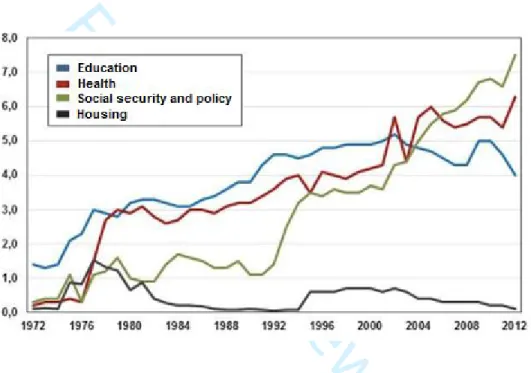
Portugal entered the EEC as a newly established democracy. The Carnation Revolution (1974) had ended both the authoritarian regime of António Salazar (the so-called ‘Estado Novo’, 1926-1974), and a period of bloody colonial wars (1961-1974). At the moment of the adhesion, Portugal had experienced a decade of revolutionary turmoil and political instability (with two attempted coups in 1975 and fifteen different executives between 1974 and 1984), and of severe economic crises (which had resulted in two rounds of IMF-sponsored adjustment programs, in 1977-1978 and 1983-1985). Along the same time span, a housing crisis of large proportions was building up in Portugal in the metropolitan areas of Lisbon and Oporto. Traditionally, housing policies had not been a primary concern for the Portuguese state (fig. 1): despite some relatively successful efforts under Salazar’s regime,8 the primacy of private intervention coupled by scarce and
paternalistic public interventions (Serra, 1997) had made the housing system unable of accommodating population growth and rural-urban migrations – with the consequent
8 E.g. through the programme Affordable Rent Housing (Habitações de Renda Económica; see
Nunes, 2013). 3 4 5 6 7 8 9 10 11 12 13 14 15 16 17 18 19 20 21 22 23 24 25 26 27 28 29 30 31 32 33 34 35 36 37 38 39 40 41 42 43 44 45 46 47 48 49 50 51 52 53 54 55 56
For Peer Review Only
growth of a large population living in informal neighbourhoods and substandard housing, especially in the metropolitan areas.
The Carnation Revolution brought housing issues into the limelight, also because of the pressure exerted by grassroots movements (Santos, 2014), and specific provisions enshrined the right to housing in the 1976 Portuguese Constitution (article 65). Indeed, in the immediate aftermath of the Revolution public spending in housing grew on par with the building of the Portuguese welfare state in other sectors (fig. 1). In terms of policy
approaches, the short-lived experience of the post-revolutionary Local Support Ambulatory Service (Serviço de Apoio Ambulatório Local, SAAL; 1974-1976) constitutes an example of a pioneering approach to the issue of informal settlements, which wad based on the regeneration of the built structure, and on participatory process in which professionals (i.e. engineers and architects) interacted with the resident population (Portas, 1986, Bandeirinha, 2002).
However, the new constitutional provisions and the SAAL ultimately failed to meet the challenge. On the one hand, housing policy was the first victim of spending cuts in the framework of the IMF-sponsored bailouts; from that moment on, while spending on education, health and social policies continued to grow, housing policy became the “weak pillar” of Portuguese welfare state (fig. 1; Ferreira, 1998: 60). On the other hand, the housing shortage became even more severe as Portugal (which counted at the time some 8.6 million) experienced the influx of about six hundred thousand immigrants from the former colonies – including families of Portuguese (the so-called retornados) and African origins. Later interventions (e.g. through Decree-Law 226/87, which established the
framework for financing local housing programs) did not significantly change the situation. 3 4 5 6 7 8 9 10 11 12 13 14 15 16 17 18 19 20 21 22 23 24 25 26 27 28 29 30 31 32 33 34 35 36 37 38 39 40 41 42 43 44 45 46 47 48 49 50 51 52 53 54 55 56
For Peer Review Only
Toward the end of 1980s, the shortage was still a major problem (Ferreira, 1988: 55-56); in 1993, a comprehensive survey conducted in the metropolitan areas of Oporto and Lisbon counted 42,034 shacks, hosting a population of 155,417 residents in 48,767 households (Guerra et al., 1999: 40-41).
Figure 1. Evolution of main components of welfare public expenditure as a
percentage of GDP, 1972-2012. Source: Observatório sobre Crises e Alternativas, 2013. Data: DGO/MF and INE/BP.
3.2. How Portugal’s adhesion to the EEC impacted housing policy
Portugal’s decision to join the EEC primarily ‘rested on the country’s ambition to
consolidate the process of democratic transition, and to anchor its economy to the club of the more prosperous European democracies’ (Ferreira-Pereira, 2008: 133). Indeed, 3 4 5 6 7 8 9 10 11 12 13 14 15 16 17 18 19 20 21 22 23 24 25 26 27 28 29 30 31 32 33 34 35 36 37 38 39 40 41 42 43 44 45 46 47 48 49 50 51 52 53 54 55 56
For Peer Review Only
Portugal’s membership paid back in the first fifteen years following the adhesion in 1986, as the country experienced economic growth and stability. In this respect, two elements are especially relevant for the contemporary trajectory of housing policies.
First, the low interest rates guaranteed by Portugal’s membership in the EEC strengthened the governmental policy of encouraging homeownership through tax deductions for mortgage interests (the so-called juros bonificados, 1986-2002). In the 1990s, average interest rates fell by two thirds, and the government was subsidizing approximately half of all mortgage contracts signed in that period (fig. 2; ALP, 2011). The combination of low interest rates, Portugal’s return to a stable economic growth,9 and
subsidized mortgages resulted into a rapid growth of homeownership rates – and of private debt (Observatório sobre Crises e Alternativas, 2013; Carmo et al., 2014; Santos et al., 2014). Some observers have considered subsidised mortgages the only stable housing policy implemented, in a coherent fashion and on a large scale, by the Portuguese state.10
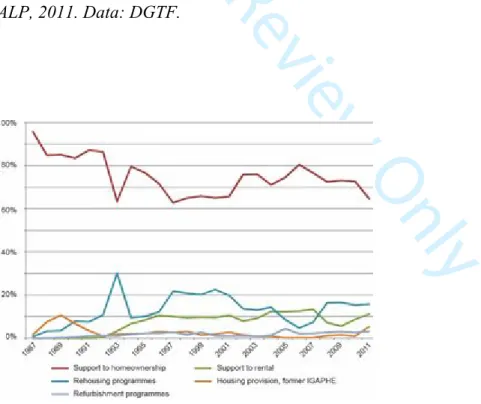
Indeed, the financing of homeownership represented by far the largest public investment in housing policies. All in all, between 1987 and 2011, 73,3% of the national budget allocated to housing policy was to subsidize mortgages, while only 17.9% was spent on direct
housing provision (and mostly on rehousing operations), and just 8.7% on subsidies to rent
9 The economy returned to grow (+5.6% a year in the period 1986-1992) and salaries to rise (GDP
per person at PP in 1998 was 72% of EU average, against a 55% in 1986); inflation was greatly reduced (from 13% to 2% in the period 1990-1997) and the balance of payments returned to equilibrium (Vasconcelos, Seabra, 2000: 131-152).
10 As suggested by our informants, including a former IHRU board member and a president of the
Municipal Assembly of Lisbon and MP. See also Serra (2019).
3 4 5 6 7 8 9 10 11 12 13 14 15 16 17 18 19 20 21 22 23 24 25 26 27 28 29 30 31 32 33 34 35 36 37 38 39 40 41 42 43 44 45 46 47 48 49 50 51 52 53 54 55 56
For Peer Review Only
(IHRU, 2015: 4; see fig. 3).11 As we discuss below, there has been an implicit and indirect
role of the EU in pushing toward this outcome (cf. Doling, 2006; Kleinman et al., 2005).
The second key consequence of Portugal’s membership in the EEC/EU had to do with the influx of European financial support (Mata, Valério, 1993; Mateus, 2013: 140-146). EU Cohesion Policy, in particular, provided poorer European regions with significant funds for improving their competitiveness, aiming at contributing to the reduction of regional imbalances, both at the national and European level (Leonardi, 2006; Bouayad-Agha et al., 2013). These funds could not be used to finance housing policy directly, which had, on the one hand, the paradoxical effect of subtracting resources from national housing policy: a report released in 1996 argued that the decision to not include housing among the eligible areas of Cohesion Policy represented ‘an obstacle to the resolution of the
Portuguese problem of shanty towns’ (DG/RES, 1996), as the co-financing of Structural Funds absorbed local resources that could have been otherwise dedicated to rehousing operations. On the other hand, many of the extensive infrastructural and urban projects paid for by the EU Cohesion Policy were implemented in geographical areas that were among the epicentres of the Portuguese housing crisis of the 1990s. In the area of Lisbon, this was the case of the of the Modernisation Plan for Railways (Plano de Modernização dos
Caminhos de Ferro; 1988-1994), of Lisbon’s ring road (Circular Regional Interior de Lisboa, CRIL, whose construction started in 1995), and of the projects linked to the 1998 Lisbon EXPO (the construction of the new neighbourhood of Parque das Nações and the Vasco da Gama bridge). Furthermore, European funds allocated to combat poverty were
11 These figures only include national-level expenditure, as aggregate data including expenditure by
local authorities are not available. Were the latter to be included, the proportion of spending would likely be slightly rebalanced toward direct provision.
3 4 5 6 7 8 9 10 11 12 13 14 15 16 17 18 19 20 21 22 23 24 25 26 27 28 29 30 31 32 33 34 35 36 37 38 39 40 41 42 43 44 45 46 47 48 49 50 51 52 53 54 55 56
For Peer Review Only
often used to address local housing issues, sometimes in informal settlements – this is the case, for example, of the National Program of Fight Against Poverty (Programa Nacional de Luta Contra a Pobreza, launched in 1990; see ILO, 2004: 81-157, 201-2017).
Figure 2. Number of mortgage contracts signed between 1990 and 2007. Source: ALP, 2011. Data: DGTF.
Figure 3. Distribution of public spending for housing, 1987-2011 (adapted from IHRU, 2015). 3 4 5 6 7 8 9 10 11 12 13 14 15 16 17 18 19 20 21 22 23 24 25 26 27 28 29 30 31 32 33 34 35 36 37 38 39 40 41 42 43 44 45 46 47 48 49 50 51 52 53 54 55 56
For Peer Review Only
Eventually, the proliferation of informal settlements in the metropolitan areas of Lisbon and Oporto came to be addressed through the Special Program for Rehousing (Programa
Especial de Realojamento, PER; 1993), launched in 1993 as the cornerstone of the ‘housing package’ (Decree-Law 163/93) put forward by the centre-right government of Aníbal Cavaco Silva (see Cachado, 2012, Tulumello et al., 2018).
While direct housing provision under the PER was entirely financed by national funds, Portugal’s adhesion to the EEC/EU contributed in creating the political momentum for the PER. In this respect, the history of the PER shows yet another facet of EU’s indirect influence on Portuguese housing policy, i.e. the implicit and symbolic conditionality attached to the adhesion itself. In the early 1990s, Portugal’s aspiration to full membership in the circle of economically advanced European democracies starkly contrasted with the images of the large informal settlements that surrounded the country’s capital. It is fair to note that virtually all our respondents mentioned this contrast as a crucial factor behind the launch of the PER. In the words of a Portuguese MP, ‘people that came to Portugal, landed in Portela [Lisbon airport], and saw the shacks. This was an anti-travel poster image. […] People thought that they were landing in third world city.’ The realization that this situation was hardly compatible with the image that Portugal wanted to project abroad added to the local political momentum towards launching a decisive action for the solution of the so-called ‘chaga das barracas’ (the ‘wound of the shacks’). In the early 1990s the situation in the peripheries of Lisbon began to attract the attention of activists and politicians, planning professionals and social workers, and of the media.In 1993 the President of the Republic, the socialist Mário Soares, organised a well-publicised series of visits in the informal 3 4 5 6 7 8 9 10 11 12 13 14 15 16 17 18 19 20 21 22 23 24 25 26 27 28 29 30 31 32 33 34 35 36 37 38 39 40 41 42 43 44 45 46 47 48 49 50 51 52 53 54 55 56
For Peer Review Only
settlements surrounding Lisbon (the so-called ‘presidência aberta’, ‘open presidency’), with the goal of putting pressure on Cavaco Silva’s centre-right government.
3.3. The Portuguese paradox: the development an urban policy perspective, and the ‘housing drought’
In the late 1990s, EU funds started to be used in coordination with housing policy, to expand the scope of the PER beyond the construction and acquisition of housing units for the rehousing of the dwellers of informal settlements – the Socialist party (which returned to government in 1995) used Cohesion Policy funds to build infrastructures and public facilities in PER neighbourhoods.12 Despite the efforts to expand its scope and increase its
flexibility, however, the PER remained by and large an ‘outdated’ program (Tulumello et al., 2018), based on quick-and-dirty interventions, rather than a component of full-fledged housing policy based on a clear strategic vision implemented through multilevel
governance arrangements – which brought about both ex-ante warnings (Guerra, 1994) and ex post critiques (e.g. Guerra 1999; Cachado, 2012) about the repetition of mistakes typical of post-WWII rationalist planning. All in all, Portuguese housing policy in the 1990s did not venture beyond subsidies for homeownership and direct housing provision for the most
12 Interviews with a former Secretary of State for Housing and a former civil officer (see also
Tribunal das Contas 2001, 15, 32-33). In particular, the Operational Intervention for Urban Renewal (Intervenção Operacional Renovação Urbana, IORU), funded within the second Community Support Framework (Quadro Comunitário de Apoio, QCA II; 1995-1999), was used to co-fund up to 80% of the cost of public facilities in the neighbourhoods built under the PER – with the municipalities adding the remaining 20% (usually corresponding to the value of the land). 3 4 5 6 7 8 9 10 11 12 13 14 15 16 17 18 19 20 21 22 23 24 25 26 27 28 29 30 31 32 33 34 35 36 37 38 39 40 41 42 43 44 45 46 47 48 49 50 51 52 53 54 55 56
For Peer Review Only
marginal sector of the population living in sub-standard housing.
The following years (between 2002 and the financial crisis) present us with a paradox. On the one side, investments in housing policy plummeted again, inaugurating a sort of ‘housing drought’ that lasted for over a decade (fig. 4). Already during the centre-right government of the early 2000s, in line with the broad governmental goal to ‘reduce the role of the State in the development and management of housing provision’ (Decree-Law 199/2002), the two key housing policies that had marked the previous decade were suspended without transitioning toward new programs. The regime of subsidised mortgages was suspended in 2002; the PER, after reaching its peak (measured in terms of housing units built per year) between 1996 and 1999, started its downward trajectory, because of substantial limitations imposed on the ability of the municipalities to borrow funds and cuts in government’s spending (fig. 2). With few exceptions, investments remained almost completely dependent on local governments, on the attraction of private capital (Alves, Branco, 2018), and on the availability of EU funds for urban regeneration (civil servant at Lisbon Municipality, interview).
On the other side, in the same period became visible a significant policy shift, namely an attempt at the consolidation of the spatial planning system and at the integration of housing policy with urban policy (including a shift from policies of direct provision and support to home ownership, toward public support to urban regeneration and the
revitalization of rental market). This policy shift started to be apparent with the return to government of the centre-right, with the executives of José Durão Barroso (2002-2004) and 3 4 5 6 7 8 9 10 11 12 13 14 15 16 17 18 19 20 21 22 23 24 25 26 27 28 29 30 31 32 33 34 35 36 37 38 39 40 41 42 43 44 45 46 47 48 49 50 51 52 53 54 55 56
For Peer Review Only
Pedro Santana Lopes (2004-2005), which established a ‘Ministry of Cities’ 13 and
introduced further provisions that made the PER more flexible.14 The socialist governments
lead by José Socrates (2005-2009, 2009-2011) further developed the so-called ‘Urban Policy’ (Política de Cidades Polis XXI, PdC; 2007) implemented under the National
Strategic Reference Framework (Quadro Estratégico de Referência Nacional, QREN; 2007-2013) and its Regional Operational Programme, largely funded by EU Cohesion Policy. Within this perspective, several policy instruments were designed and implemented with the goal of experimenting new approaches – this was the case of the pilot Portuguese programme Critical Neighbourhoods Initiative (Iniciativa Bairros Críticos, IBC, 2005; cf. Sousa, 2008). These developments largely reflected the trajectory of the debate at EU level, which progressively came to indicate the urban environment as the crucial site in which pressing social problems manifested themselves, as well as the privileged site for fostering competitiveness and creating economic opportunities (EU Commission 1997a; 1998; Parkinson, 2005; Atkinson, 2007).15 In parallel, the EU debate came to emphasise the
13 First under the denomination of ‘Ministry of Cities, Spatial Planning and Environment’
(2002-2004); then as ‘Ministry of Cities, Local Government, Housing and Regional Development’ (2004-2005).
14 With the Decree Law 271/2003, it became possible, under the provision of the PER, to finance
projects of urban regeneration; to build public facilities and services; and to sell municipal housing units built with the PER or other municipal programmes. In 2004, the PROHABITA programme (Decree-Law 135/2004) was launched extending the framework for rehousing interventions outside of the metros of Lisbon and Oporto (previously endowed with limited funding under the provision of Decree-Law 226/1987), and extending the provision of the law to all situations of severe housing stress (whereas the PER only concerned informal
settlements).
15 See also the Lille Action Programme (2000), the Gothenburg Agenda (2001), the Rotterdam
Aquis on Urban Policy (2004), the Bristol Agreement (2005), the Leipzig Charter and the
3 4 5 6 7 8 9 10 11 12 13 14 15 16 17 18 19 20 21 22 23 24 25 26 27 28 29 30 31 32 33 34 35 36 37 38 39 40 41 42 43 44 45 46 47 48 49 50 51 52 53 54 55 56
For Peer Review Only
potential of integrated interventions (EU Commission 1997b; 2011a) and, later on, of place-based approaches (Barca, 2009) for sustainable urban development.
In Portugal, this shift implied (i) the consolidation of the ‘area-based approach’ (essentially from the experience of the URBANCommunity Initiative), and (ii) the development, in a multilevel governance perspective, of a logic of formal ‘partnerships’ that were designed to change the relationship between the central state and the local levels. These two trends run parallel with the first attempts to revitalise the rental market by way of simplification and liberalisation (New Urban Lease Regime, Novo Regime de
Arrendamento Urbano, NRAU; 2004); and the creation of the Partnerships for Urban Regeneration (Parcerias para a Regeneração Urbana, PRU; 2007) and of the Urban
Refurbishment Areas (Áreas de Reabilitação Urbana, ARU; 2009). The socialist executive also promoted the most ambitious (although never implemented) attempt at making housing a pillar of urban policy, namely the preliminary study for the national Strategic Housing Plan (Plano Estratégico de Habitação, PEH; 2008-2013) – which, in many ways, built on the debate generated by the experience of the PER (researcher and former IHRU board member, interview), and constituted an inspiration for the more recent reforms, such as the so-called New Generation of Housing Policies (Nova Geração de Políticas de Habitação; see SEH, 2017; 2018a; 2018b). These tendencies were also mirrored in experiences under the Community programming period 2014-2020, such as in the case of Strategic Urban Development Plans (Planos Estratégicos de Desenvolvimento Urbano, PEDU), which compelled local authorities to elaborate ‘action plans’ with a spatial component in order to
Territorial Agenda (2007), the Toledo Declaration (2010), the Riga Declaration (2015), and the Pact of Amsterdam (2016).
3 4 5 6 7 8 9 10 11 12 13 14 15 16 17 18 19 20 21 22 23 24 25 26 27 28 29 30 31 32 33 34 35 36 37 38 39 40 41 42 43 44 45 46 47 48 49 50 51 52 53 54 55 56
For Peer Review Only
access financial resources in fields such as sustainable urban mobility (Planos de Ação para a Mobilidade Urbana Sustentável, PAMUS), urban regeneration (Plano de Ação de
Regeneração Urbana, PARU), and interventions for disadvantaged urban communities (Plano de Ação Integrada para as Comunidades Desfavorecidas, PAICD).
It is interesting to note that this paradox (i.e. the fact that an attempt at developing a more integrated approach to housing policy took place while governmental investment in the sector continued to decline) cut across party lines, and did not relate to ideological perspectives. While the centre-right had started to cut funds for housing, the trend was not reversed by the return of the socialists to the government. Indeed, while José Socrates’s first executive (2005-2009) was most active in its attempts at building a place-based and integrated approach to housing policy, it also significantly contributed to the dynamic of financialisation of housing in Portugal: under Socrates, for example, a set of fiscal benefits for real-estate investment funds (Law 64-A/2008, art. 71) were introduced as the key incentive for ‘urban refurbishment’ – a measure that came under was among the key targets of criticised by housing activists concerned with the recent boom of real estate prices in the areas of Lisbon and Oporto. Once again, it is instead reasonable to locate the Portuguese ‘housing drought’ in the context of the ‘climate of fiscal austerity’ (Stephens, 1999) that long predated the burst of the global financial crisis and was, above all, caused by the hegemony of monetarist macro-economics, including in the dominant approach of EU institutions (ibidem; Lapavitsas et al., 2010).
3 4 5 6 7 8 9 10 11 12 13 14 15 16 17 18 19 20 21 22 23 24 25 26 27 28 29 30 31 32 33 34 35 36 37 38 39 40 41 42 43 44 45 46 47 48 49 50 51 52 53 54 55 56
For Peer Review Only
Figure 4. Public expenditure (M€) in housing and public facilities, 1995-2018. Our elaboration on data DGO/MF - Relatório/publicação ‘Conta Geral do Estado’ (compiled on PORDATA; www.pordata.pt/).
3.4. The crisis – the other face of fiscal stability (2009 onward)
The global economic crisis (2007-?) that hit Portugal in 2009 contributed to bury the perspective of significant public investments in housing policy for several years. After a period of stimulus in 2009 (once again, in line with a short-lived revival of Keynesian approaches in the EU, epitomised by the launch of the European Economic Recovery Plan, see EU Commission, 2008) the Socialist government launched a first round of austerity measures in 2010. In 2011, after the failure to approve a new adjustment package and in the context of skyrocketing interest rates over the national debt, the government requested external financial aid to the troika – the label identifying the group formed by the European Commission (EC), the European Central Bank (ECB) and the International Monetary Fund (IMF). Unable to secure a parliamentary majority on the bailout plan, the government fell. 3 4 5 6 7 8 9 10 11 12 13 14 15 16 17 18 19 20 21 22 23 24 25 26 27 28 29 30 31 32 33 34 35 36 37 38 39 40 41 42 43 44 45 46 47 48 49 50 51 52 53 54 55 56
For Peer Review Only
Shortly thereafter, the centre-right government elected in 2011 negotiated the package of financial adjustment and reforms (the Economic Adjustment Program; EU Commission, 2011b). The combined impact of the demise of the PER, of the economic crisis, and of the austerity measures resulted into a sharp decline of public spending for housing policies after the peak of the late 1990s (fig. 4). Indeed, the largest share of the remaining housing budget was destined to servicing the debt created by past operations, and primarily to subsidised mortgages.
Beside financial adjustment, the conditionality attached to the external financial aid emphasised the need for a more market-based approach to housing issues. The Economic Adjustment Program explicitly invoked reforms to improve ‘malfunctioning housing and rental markets’, with the aim of lowering transaction costs on the housing market so to ease labour mobility (EU Commission, 2011a: 5, 26-27, 87-88, 103, 106, 110). The centre-right government embraced this agenda. The reform of the urban rental market (Novo Regime de Arrendamento Urbano, New Urban Lease Regime; 2012) aimed at bringing to an end the controlled rent contracts in place, as well as simplifying the eviction of tenants, the refurbishment of dwellings and their transformation into touristic facilities. At the same time, right before or after the crisis, a number of measures were launched with the goal of attracting foreign investments, that had significant impact on the real estate market, such as the Golden Visa regime, allowing non-EU citizens to get a permanent Portuguese visa in exchange of a real estate investment of at least €500,000; the ‘non habitual resident’ status, that concedes fiscal bonuses to whom moves their residency to Portugal (see AT, 2016); and the bilateral agreements (for instance with Germany, France and Italy) that granted a 10-years tax break to pensioners relocating to Portugal.
3 4 5 6 7 8 9 10 11 12 13 14 15 16 17 18 19 20 21 22 23 24 25 26 27 28 29 30 31 32 33 34 35 36 37 38 39 40 41 42 43 44 45 46 47 48 49 50 51 52 53 54 55 56
For Peer Review Only
3.5. After the crisis? (2016 onward)
The ‘housing drought’ inaugurated in the early 2000s continues to this day – but in a vastly changed landscape. In 2014 the country returned to economic growth, with a fall of
unemployment and a recovery of public finances. Paradoxically, however, economic recovery has considerably increased the pressure on the Portuguese housing system.
Since economic growth has been driven by a significant touristic boom, real estate prices have skyrocketed in the areas most affected by the influx of tourists. This was the case of the seaside tourism destination of Algarve, and, most importantly, of the
metropolitan areas of Lisbon and Oporto. In Lisbon, in particular, the urban pressure has become extremely intense due to the combined effect of a number of factors: the inflow of tourism and the development of a large industry of short-term rentals (Gant, Gago, 2019); the regimes of Golden Visas and the ‘non habitual resident’ status (see also Gant, 2018); and, more broadly, Lisbon’s rising international visibility and reputation in the network of major European cities. These developments brought new challenges to the housing system. While more ‘traditional’ situations of severe housing stress still exist, both in terms of persistence of informal settlements and other severely degraded forms of housing,16 the
recent real estate boom has determined a lack of affordable housing opportunities that cut across all sectors of the urban population. To make a single significant example: in Lisbon, the average square meter was sold, in late 2017, for more 15.5% than in the previous years;
16 Despite the significant impact of rehousing programs implemented in the 1990s, a recent survey
by the IHRU found a countrywide total of more than 25,000 households that need rehousing (IHRU, 2018). 3 4 5 6 7 8 9 10 11 12 13 14 15 16 17 18 19 20 21 22 23 24 25 26 27 28 29 30 31 32 33 34 35 36 37 38 39 40 41 42 43 44 45 46 47 48 49 50 51 52 53 54 55 56
For Peer Review Only
and the growth reached 30, 40 and even 45 per cent in the most central, touristic parishes (INE, 2018).
This pressure, coupled with the absence of any structured initiative in the field of housing for years, solicited a reaction that brought once again housing issues in the limelight. In recent years Portugal has seen the renaissance of housing activism (Seixas, Guterres, 2018; Falanga et al., 2019). And when in 2017 Lailani Farha, UN Special
Rapporteur on Adequate Housing Lisbon, published a very critical report on the precarious conditions of housing in Portugal (Farha, 2017), the socialist government led by António Costa admitted the need for an ‘extraordinary response’ to pressing housing needs (Allegra, Tulumello, 2019). In 2017, a group of MPs started to work on a project for a Framework Law for Housing (Lei de Bases da Habitação), approved two years later, with the stated goal of giving legal substance to the constitutional provision on the universal right to housing. In 2017, the government also re-established the State Department for Housing (Secretaria de Estado da Habitação, SEH) which shortly thereafter launched the so-called New Generation of Housing Policies (Nova Geração de Políticas de Habitação, NGPH; SEH, 2017; 2018a; 2018b); in the same year, the Housing and Urban Rehabilitation Institute (Instituto da Habitação e da Reabilitação Urbana, IHRU; IHRU is the main
governmental arm for housing policy) realised a comprehensive survey of housing needs at national level (IHRU, 2018).
The debate spurred by Farah’s visit is just one example of how local dynamics in the field of housing policy have been influenced by developments on broader continental and global stages. In a general perspective, the European dimension of these trends can be discerned observing experiences of bottom-up activism, in the widespread sense of urgency 3 4 5 6 7 8 9 10 11 12 13 14 15 16 17 18 19 20 21 22 23 24 25 26 27 28 29 30 31 32 33 34 35 36 37 38 39 40 41 42 43 44 45 46 47 48 49 50 51 52 53 54 55 56
For Peer Review Only
that housing issues have acquired in the years of the economic crisis all over Europe,17 as
well as in the participation of local activists to European networks.18 More specifically,
national policy trends have continued to follow the contradictory inputs coming from the EU. The renewed activism on the part of the Portuguese government parallels the
emergence of the EU ‘housing agenda’, and the NGPH itself – with its emphasis on affordable rent, urban regeneration, and rehabilitation/energy efficiency (SEH, 2017; 2018a; 2018b) – is largely consistent with prevailing orientations at EU level.19 At the same
time, however, the Portuguese government introduced measures that furthered the trend of financialisation of the housing sector (see Santos, 2019), for example with the introduction of the regime of Real Estate Investment Trusts (Sociedades de Investimento e Gestão Imobiliária, SIGI; 2019) – once again, these developments are in line with the liberalisation agenda pushed by the EU during the years of the crisis. Finally, another dimension of the centrality of EU regulations in this field is exemplified by the regulation of the short-term rental market. Recently, the Portuguese government has created a provision that allows local governments to put caps on short-term rental (Law 62/2018); however, a recent decision by the Court of Justice of the European Union (CJEU, 2019) has determined that Airbnb is to be considered, according to present legislation, an information society service – a move that could make null and void legislative efforts by national or local governments
17 See, for instance, the recently launched European Citizens’ Initiative ‘Housing for All’,
www.housingforall.eu/lu/wunnen-muss-bezuelbar-sin-fier-alleguerten/.
18 For example, the association Habita hosted in Lisbon, in September 2018, a European meeting of
the European action coalition for the right to housing, and is among the proponent of the European Citizen’s Initiative ‘Housing for All’ (see www.housingforall.eu).
19 João Ferrão, ‘Revitalizar bairros sociais: algumas propostas para debate’; talk at the conference
“(Re)pensar a intervenção em bairros sociais – realidades e desafios”, Lourinhã, 13 December 2017. 3 4 5 6 7 8 9 10 11 12 13 14 15 16 17 18 19 20 21 22 23 24 25 26 27 28 29 30 31 32 33 34 35 36 37 38 39 40 41 42 43 44 45 46 47 48 49 50 51 52 53 54 55 56
For Peer Review Only
to impose any sort of caps to short-term rentals.
4. Conclusions
Our reconstruction of the last few decades of housing policy in Portugal has tried to show two things: (i) how paradigms and ideas have been emerging, fading and persisting in the trajectory of Portuguese housing policy; and (ii), how developments at the national level have been consistently (if mostly in an indirect way) influenced by trends and processes developing at other scales – and, in particular, by Portugal’s membership in the EU.
With regard to the first point, and to the dynamic of policy change in Portugal, our account of the long-term trajectory of Portuguese housing policy shows how the
construction of a policy field proceeds in a non-linear and fuzzy fashion, through
subsequent rounds of experimentation, progress and reflux. Emerging discursive formations have been regularly contradicted by the persistence, and even dominance, of different approaches in practice – this is the case of the (largely unsuccessful so far) efforts at consolidation of a fully-fledged housing policy through its integration with urban policy. Furthermore, our reconstruction shows how policy paradigms and policy actions are not necessarily conceptually consistent with one another: the case of PER (an out-dated, modernist programme of direct public housing provision launched by a centre-right government bent on introducing a set of neoliberal reforms) shows for example how ‘old-fashioned’ policy paradigms may be mobilised for their capacity to efficiently address pressing problems. Today, the persistence of austerity measures and a dynamic of further financialisation of housing seem to coexist with a new round of ‘post-austerity’ reforms and 3 4 5 6 7 8 9 10 11 12 13 14 15 16 17 18 19 20 21 22 23 24 25 26 27 28 29 30 31 32 33 34 35 36 37 38 39 40 41 42 43 44 45 46 47 48 49 50 51 52 53 54 55 56
For Peer Review Only
policy initiatives inspired by the re-emergence of housing in the EU agenda – a tension that will probably constitute a defining feature of the Portuguese welfare in the forthcoming years.
With regard to the power relations at stake, we have seen how electoral cycles and the alternation of executives of different colours represent an important factor in the
dynamic of policymaking. But our reconstruction also shows continuities across party lines – for instance, in the crucial role played by the centre-left government before and after the crisis in paving the way for housing financialisation under austerity rules. This is where a focus on multilevel governance relationships can be particularly fruitful, as it allows us to understand how the changing geography and relative weight of a pluralistic set of actors influence policy change. This is the case of the EU’s influence over Portugal, but also of the role of Portuguese civil society, which has been crucial in specific moments: in the post-revolutionary years; in the early 1990s, putting considerable pressure on the centre-right government to address the issue of informal settlements; and, more recently, for bringing again to the limelight in the context of post-austerity politics.
Last but not least, from an epistemological standpoint, such a genealogical account shows the inherent difficulty of placing national housing systems on the sort of taxonomic hierarchies such as those defining ‘advanced’ and ‘less-advanced’ housing systems. More importantly, this paper challenges the very idea that this kind of categorisation can
somehow add to our knowledge and to our capacity to steer policymaking. Indeed, it seems to us that genealogical analyses can provide some fruitful lessons to the field of
comparative housing studies by acknowledging the complex functioning and fuzzy evolutionary trajectories of local/national housing systems. Taxonomic studies have 3 4 5 6 7 8 9 10 11 12 13 14 15 16 17 18 19 20 21 22 23 24 25 26 27 28 29 30 31 32 33 34 35 36 37 38 39 40 41 42 43 44 45 46 47 48 49 50 51 52 53 54 55 56
For Peer Review Only
generally concluded that the Portuguese housing system is ‘less advanced’ when compared to other European systems characterised by stronger public action; however, our
genealogical perspective has shown how the present state is crucially shaped by a historical trajectory in which the relation with the EU has been crucial – hence the inherent difficulty in comparing national systems as if they were existing and functioning in isolation.
With regard to the second point, and the specific role of Portugal-EU relations in steering Portuguese housing policy, our account shows four channels, or modes, through which this relation has been played out in the period under exam. First, the implicit and symbolic conditionality inherent to Portugal’s adhesion to the EC/EU, which introduced a very effective and normative model of ‘modernisation/Europeanisation’ of the country in general – and of the housing system in particular. Second, the effects that the EU-induced financial stability and the availability of European funds have had on the local housing policies, and on integrated place-based approaches with an important housing dimension. Third, the harsh impact of austerity measures (the ‘flip side’ of the financial and
macroeconomic stability enjoyed by Portugal during the 1990s), and their impact on government spending and on the progressive financialisation of the housing sector. Fourth, the travels of ideas, paradigms and debates between EU and national arenas.
With this in mind, the first question Doling posed in 2006 (‘does the EU now have a housing policy?’) remains open – the answer also being largely dependent on one’s
understanding of the extent to which the number of indirect and direct actions carried out by the EU in time in this field constitute a ‘policy agenda’. What the case of Portugal shows, however, is that local housing policies have been heavily influenced, both directly and indirectly, by EU-Portugal relations – from the country‘s adhesion to the EEC in 1986, 3 4 5 6 7 8 9 10 11 12 13 14 15 16 17 18 19 20 21 22 23 24 25 26 27 28 29 30 31 32 33 34 35 36 37 38 39 40 41 42 43 44 45 46 47 48 49 50 51 52 53 54 55 56
For Peer Review Only
to the Economic Adjustment Program of 2011, and beyond. In other words, the historical record clearly shows that role of the EU in the field of housing has grown significantly, well beyond the ‘leakages’ observed in the early 1990s (Drake 1991), or Kleinman’s later acknowledgement of the existence of ‘some EU dimension to housing policy’ (2001, 341). Our account also demonstrates, we believe, that the EU has exerted a significant influence in shaping the trajectory of Portuguese housing policies. Although the somehow incoherent nature of this influence over time (including in the post-crisis years) makes it difficult to define it as a full-fledged, consistent policy intervention, we can conclude that the EU is an important player in the field, one that no other national actor can ignore.
This evidence is the starting point to reflect, in a more normative fashion, on a second question posed by Doling in his 2006 paper: does the EU need a housing policy? Once again, the answer inevitably depends on one’s understandings of what constitutes the most desirable future for the development of EU integration, and especially in a time of rapid change and mounting controversies around the Union’s status – see, for instance, Priemus’ argument (2006) on why Member States should retain full autonomy in the field of housing policy. At any rate, observing the impact of EU conditionality and policymaking on the housing sector shows how such influence is often deployed through institutions that are largely uninterested in the social and territorial dimensions inherent to housing policy (e.g. through regulations by the EU’s DG-ECFIN, which promote economic growth and monitor financial stability); through the leakage of funds from other policy areas (such as energy, environment, and social cohesion, for which the EU has shared competences with member states), and via financial instruments that are not designed to support housing policy (e.g. through the European Social Fund); or in single instances and on an ad hoc 3 4 5 6 7 8 9 10 11 12 13 14 15 16 17 18 19 20 21 22 23 24 25 26 27 28 29 30 31 32 33 34 35 36 37 38 39 40 41 42 43 44 45 46 47 48 49 50 51 52 53 54 55 56
For Peer Review Only
basis (e.g. in the case of the Economic Adjustment Program). In a moment when there seems to be a growing momentum for the emergence of housing policy as a primary concern for EU policymaking, the case of Portugal can offer precious food for thought in this respect. 3 4 5 6 7 8 9 10 11 12 13 14 15 16 17 18 19 20 21 22 23 24 25 26 27 28 29 30 31 32 33 34 35 36 37 38 39 40 41 42 43 44 45 46 47 48 49 50 51 52 53 54 55 56
For Peer Review Only
References
Aalbers, M. B., Loon, J. V., Fernandez, R. (2017), The Financialization of A Social Housing Provider. International Journal of Urban and Regional Research, 41(4), 572-587
Aalbers, M.B. (2017) The Variegated Financialization of Housing. International Journal of Urban and Regional Research. 41(4), 542-554.
Allegra M., Tulumello S. (eds) (2019) O Estado da Habitação. special issue of the journal CIDADES, Comunidades e Territórios (38)
Allen, J. (2006) Welfare Regimes, Welfare Systems and Housing in Southern Europe. International Journal of Housing Policy, 6 (3), 251-277.
Allen, J., Barlow, J., Leal, J., Maloutas, T., Padovani, L. (2004) Housing and Welfare in Southern Europe. Oxford: Blackwell.
ALP (Associação Lisbonense de Proprietários) (2011) Retrato da Habitação em Portugal: Característcas e Recomendações.
https://observatorio-lisboa.eapn.pt/ficheiro/habitacaoportugal.pdf
Alves, S. (2017) Poles Apart? A Comparative Study of Housing Policies and Outcomes in Portugal and Denmark. Housing, Theory and Society, 34(2), 221-248.
Alves, S., Branco, R. (2018) With or without you: models of urban requalification under neoliberalismo in Portugal”. In S. Aboim, P. Granjo, A. Ramos (eds) Changing Societies: Legacies and Challenges. Vol. i. Ambiguous Inclusions: Inside Out, Inside In. Lisbon: Imprensa de Ciências Sociais, 457-479.
3 4 5 6 7 8 9 10 11 12 13 14 15 16 17 18 19 20 21 22 23 24 25 26 27 28 29 30 31 32 33 34 35 36 37 38 39 40 41 42 43 44 45 46 47 48 49 50 51 52 53 54 55 56
For Peer Review Only
AT (Autoridade Tributária e Aduaneira) (2016) IRS. Regime Fiscal para o Residente Não Habitual.
https://www.portaldascomunidades.mne.pt/images/GADG/IRS__Regime_Fiscal_Residente _N%C3%A3o_Habitual.pdf
Atkinson R., (2007), “EU Urban Policy, European Urban Policies and the Neighbourhood: An overview of concepts, programmes and strategies”, Paper presented at a EURA
Conference – The Vital City, Glasgow, September 12th-14th, 2007.
Bandeirinha, J. A. (2002). O Processo SAAL e a Arquitectura no 25 de Abril de 1974. Coimbra: Coimbra University Press.
Baptista, I. (2013) The Travels of Critiques of Neoliberalism: Urban Experiences from the ‘Borderlands’. Urban Geography, 34(5), 590-611.
Barca, F. (2009) An Agenda for a Reformed Cohesion Policy. A place-based approach to meeting European Union challenges and expectations. Independent Report prepared at the request of the Commissioner for Regional Policy.
http://www.europarl.europa.eu/meetdocs/2009_2014/documents/regi/dv/barca_report_/barc a_report_en.pdf
Barlow, J., 2005[1998], Planning, housing and the European Union. In: European
Integration and Housing Policy, edited by M. Kleinman, W. Matznetter and M. Stephens (London: Routledge), pp. 110-121
Bouayad-Agha, S., Turpin, N., Védrine, L. (2013). Fostering the development of European regions: A spatial dynamic panel data analysis of the impact of Cohesion Policy. Regional 3 4 5 6 7 8 9 10 11 12 13 14 15 16 17 18 19 20 21 22 23 24 25 26 27 28 29 30 31 32 33 34 35 36 37 38 39 40 41 42 43 44 45 46 47 48 49 50 51 52 53 54 55 56
For Peer Review Only
Studies, 47(9), 1573-1593.Campos, V., Ferrão, J. (2015) O Ordenamento do Território em Portugal: Uma Perspetiva Genealógica. ICS Working Papers, 2015-1. http://repositorio.ul.pt/handle/10451/20716.
Card P., Mudd J. (2006) The role of housing stock transfer organisations in neighbourhood regeneration: Exploring the relationship between regeneration, 'new localism' and social networks. Housing Studies 21(2), 253-267.
Chardas, A. (2014) The interplay between austerity, domestic territorial reform and European Union Cohesion Policy: Multi-level Governance and the application of the partnership principle in Greece. European Urban and Regional Studies, 21(4), 432-444.
CJEU (Court of Justice of the European Union) (2019), ‘According to Advocate General Szpunar a service such as that provided by the AIRBNB portal constitutes an information society service. Court of Justice of the European Union Press Release No 51/19.
https://curia.europa.eu/jcms/upload/docs/application/pdf/2019-04/cp190051en.pdf.
Cocola-Gant, A., Gago, A. (2019). Airbnb, Buy-To-Let Investment and Tourism-Driven Displacement: A case Study in Lisbon, Environment and Planning A: Economy and Space, online first. https://doi.org/10.1177/0308518X19869012.
Cotella, G., Janinr Rivolin U. (2019) The Europeanisation of territorial governance and spatial planning: a tool for analysis. In ESPON (ed) Scientific Report. Building the next generation of research on territorial development. Luxembourg: ESPON, pp. 50-56.
Council of the European Union (2016) Urban Agenda for the EU - Pact of Amsterdam. Informal Meeting of EU Ministers Responsible for Urban Matters, May 2016.
3 4 5 6 7 8 9 10 11 12 13 14 15 16 17 18 19 20 21 22 23 24 25 26 27 28 29 30 31 32 33 34 35 36 37 38 39 40 41 42 43 44 45 46 47 48 49 50 51 52 53 54 55 56