SUBMITTED TO CHEMICAL RIPENERS APPLICATION AND SAMPLING PERIODS BRUNO RAFAEL DE ALMEIDA MOREIRA1, MATHEUS LUIS OLIVEIRA CUNHA2,
GUSTAVO PAVAN MATEUS3 and RONALDO DA SILVA VIANA4
1São Paulo States University (UNESP), College of Agricultural and Technological Sciences, Dracena, São Paulo, Brazil, [email protected]
2São Paulo States University (UNESP), College of Agricultural and Technological Sciences, Dracena, São Paulo, Brazil, [email protected]
3Agrobusiness Technology Agency, Andradina, São Paulo, Brazil, [email protected]
4São Paulo States University (UNESP), College of Agricultural and Technological Sciences, Dracena, São Paulo, Brazil, [email protected]
Revista Brasileira de Milho e Sorgo, v.17, n.3, p. 420-430, 2018
ABSTRACT - There is a little information about sweet sorghum crop behavior under chemical ripeners spraying management. Therefore, the aim of this study was to assess the technological profile of sweet sorghum (cv. CMSXS-646) juice under spraying of plant growth regulators and sampling periods. A randomized complete block experimental factorial design was used, with an additional control treatment (arrangement 2x2+1), corresponding to two chemical ripeners with three-doses for each product, glyphosate (0.2, 0.4, and 0.8 l c.p. ha-1) and methyl-sulfumeturon (10, 20, and 30 g c.p. ha-1), two sampling periods (15 and 30-days after spraying - DAS) and one control treatment (water spraying). After crop harvest, stalks were milled using a hydraulic press and the derived juice was assessed for total soluble solids (°Brix), apparent sucrose (POL), purity (PRT), reducing sugars (RS), total reducing sugars (TRS), fibers (FIB) and recoverable theoretical sugars (RTS). The dataset was subjected to the Shapiro-Wilk, Fisher, Tukey, Pearson and multiple linear regression statistical tests (p<0.05). There was an interaction between causes of variation for almost all assessed characteristics except to RTS, only affected by the sampling period. As conclusion, it is possible to grow sweet sorghum (cv. CMSXS-646) till thirty-days after spraying of chemical ripeners, treated by glyphosate 0.4 l c.p. ha-1 or sulfumeturon-methyl 10 g c.p. ha-1, because these doses caused feedstock with high °Brix, POL, total reducing sugars, purity levels.
Keywords: Sorghum spp., phytorregulators, plant growth regulators, glyphosate, sulfumeturon-methyl.
PERFIL TECNOLÓGICO DE CALDO DE SORGO SACARINO (cv. CMSXS-646)
SUBMETIDO À APLICAÇÃO DE MATURADORES QUÍMICOS E ÉPOCAS DE AMOSTRAGEM RESUMO – Há poucas informações sobre o comportamento da cultura do sorgo sacarino sob manejo de aplicação de maturadores químicos. Portanto, o objetivo desta pesquisa foi avaliar o perfil tecnológico de caldo de sorgo sacarino cv. CMSXS-646 submetido à aplicação de maturadores químicos e períodos de amostragem. Aplicou-se o delineamento de blocos inteiramente casualizados, em esquema de fatorial (2x2+1), correspondente a dois maturadores químicos com três dosagens - glifosato (0,2; 0,4 e 0,8 l p.c. ha-1) e sulfumeturon-metil (10, 20 e 30 g p.c. ha-1); dois períodos de amostragem (15 e 30 dias após aplicação - DAA); e um tratamento controle (aplicação de água). Após a colheita, destinaram-se colmos à moagem, realizada em prensa hidráulica, para extração de caldo; avaliaram-se sólidos solúveis totais (°Brix), sacarose aparente (POL), pureza (PRT), açúcares redutores (AR), açúcares redutores totais (ART), fibras (FIB) e açúcares teóricos recuperáveis (ATR). Ao conjunto de dados, aplicaram-se testes estatísticos, Shapiro-Wilk, Fisher, Tukey, Pearson e regressão múltipla, ao nível de 5% de probabilidade. Houve interação entre as causas de variação para quase todas as características, exceto ATR, influenciado, somente, pelo período de amostragem. Concluiu-se que a aplicação dos maturadores químicos glifosato 0,4 l c.p. ha-1 e sulfumeturon-metil 10 g p.c. ha-1 apresentou um incremento na qualidade da matéria-prima com alto teor de °Brix, POL, açúcares redutores totais e níveis de pureza trinta dias após a pulverização dos maturadores.
Palavras-chave: Sorghum spp., fitorreguladores, reguladores de crescimento vegetal, glifosato, sulfumeturon-metil.
SUBMITTED TO CHEMICAL RIPENERS APPLICATION AND SAMPLING PERIODS
BRUNO RAFAEL DE ALMEIDA MOREIRA1, MATHEUS LUIS OLIVEIRA CUNHA2,
GUSTAVO PAVAN MATEUS3 and RONALDO DA SILVA VIANA4
1São Paulo State University (UNESP), College of Agricultural and Technological Sciences, Dracena, São Paulo, Brazil,
2São Paulo State University (UNESP), College of Agricultural and Technological Sciences, Dracena, São Paulo, Brazil,
3Agrobusiness Technology Agency, Andradina, São Paulo, Brazil, [email protected]
4São Paulo State University (UNESP), College of Agricultural and Technological Sciences, Dracena, São Paulo, Brazil,
Revista Brasileira de Milho e Sorgo, v.17, n.3, p. 420-430, 2018
ABSTRACT - There is a little information about sweet sorghum crop behavior under chemical ripeners spraying
management. Therefore, the aim of this study was to assess the technological profile of sweet sorghum (cv. CMSXS-646) juice under spraying of plant growth regulators and sampling periods. A randomized complete block experimental factorial design was used, with an additional control treatment (arrangement 7x2), corresponding to chemical ripeners, glyphosate (0.2, 0.4, and 0.8 l c.p. ha-1), methyl-sulfumeturon (10, 20, and 30 g c.p. ha-1), and control
treatment (water spraying) with two sampling periods (15 and 30-days after spraying - DAS).. After crop harvest, stalks were milled using a hydraulic press and the derived juice was assessed for total soluble solids (°Brix), apparent sucrose (POL), purity (PRT), reducing sugars (RS), total reducing sugars (TRS), fibers (FIB) and recoverable theoretical sugars (RTS). The dataset was subjected to the Shapiro-Wilk, Fisher, Tukey, Pearson and multiple linear regression statistical tests (p<0.05). There was an interaction between causes of variation for almost all assessed characteristics except to RTS, only affected by the sampling period. As conclusion, it is possible to grow sweet sorghum (cv. CMSXS-646) till thirty-days after spraying of chemical ripeners, treated by glyphosate 0.4 l c.p. ha-1 or
sulfumeturon-methyl 10 g c.p. ha-1, because these doses caused feedstock with high °Brix, POL, total reducing
sugars, purity levels.
Keywords: Sorghum spp., phytorregulators, glyphosate, sulfumeturon-methyl.
PERFIL TECNOLÓGICO DE CALDO DE SORGO SACARINO (cv. CMSXS-646)
SUBMETIDO À APLICAÇÃO DE MATURADORES QUÍMICOS E ÉPOCAS DE AMOSTRAGEM RESUMO – Há poucas informações sobre o comportamento da cultura do sorgo sacarino sob manejo de aplicação de
maturadores químicos. Portanto, o objetivo desta pesquisa foi avaliar o perfil tecnológico de caldo de sorgo sacarino cv. CMSXS-646 submetido à aplicação de maturadores químicos e períodos de amostragem. Aplicou-se o delineamento de blocos inteiramente casualizados, em esquema de fatorial (7x2), correspondente a maturadores químicos - glifosato (0,2; 0,4 e 0,8 l p.c. ha-1), sulfumeturon-metil (10, 20 e 30 g p.c. ha-1) e tratamento controle (aplicação de
água), com dois períodos de amostragem (15 e 30 dias após aplicação - DAA).. Após a colheita, destinaram-se colmos à moagem, realizada em prensa hidráulica, para extração de caldo; avaliaram-se sólidos solúveis totais (°Brix), sacarose aparente (POL), pureza (PRT), açúcares redutores (AR), açúcares redutores totais (ART), fibras (FIB) e açúcares teóricos recuperáveis (ATR). Ao conjunto de dados, aplicaram-se testes estatísticos, Shapiro- Wilk, Fisher, Tukey, Pearson e regressão múltipla, ao nível de 5% de probabilidade. Houve interação entre as causas de variação para quase todas as características, exceto ATR, influenciado, somente, pelo período de amostragem. Concluiu-se que a aplicação dos maturadores químicos glifosato 0,4 l c.p. ha-1 e sulfumeturon-metil 10 g p.c. ha-1 apresentou um
incremento na qualidade da matéria-prima com alto teor de °Brix, POL, açúcares redutores totais e níveis de pureza trinta dias após a pulverização dos maturadores.
Palavras-chave: Sorghum spp., fitorreguladores, glifosato, sulfumeturon-metil.
Technological profile of sweet sorghum juice cv. CMSXS-646 juice submitted to... 421 Sugar-energy industry is very important to
world sustainability since it offers job opportunities to population, both direct and indirectly, and produces food and feed resources for human and animal consumption, such as industrial sugars (crystal, VHP, brown, etc.), alcoholic beverages, silage and forage. In addition, provides services to the international carbon market, helps to reduce greenhouse-derived negative effects, and generates alternative biofuels to petroleum, natural gas, and coal, diversifying Global
Energetic Matrix (Goldemberg et al., 2014; Milanez
et al., 2015; Carvalho et al., 2017).
In Brazil, sugarcane (Saccharum spp.) crop is the most important lignocellulosic feedstock employed to industrialization of sugar and first-generation bioethanol. However, due to its morphological and physiological characteristics, regionalization and tillage seasonal planning, there is an ethanol shortage in the off-season period. Hence, government entities-financed centers of research and development are concentrating efforts in studies about sugar extraction from of beets, cassava, maize, sweet sorghum, among others amylaceous crops (Tsao et al., 2011; Carvalho et al., 2013; Carbonari et al., 2014).
Originating from the African continent, sweet sorghum (Sorghum bicolor L. Moench) is a rustic crop, resistant to both tropical regions and water stress, with a high photosynthetic capacity; moreover, this crop is well responsive to mechanized agriculture. Owing to its short commercial cycle (90 to 120-days) and high fermentable sugars concentration in stalks, sweet sorghum is widely desirable to sugar and ethanol complementary production, mainly along to sugarcane crop replacement in the off-season period, avoiding sugar-energy industry idleness (Bermann, 2008; Durães, 2011; Han et al., 2011).
Sweet sorghum energetic quality is almost always lowest than sugarcane crop, due to higher fibers content of its lignocellulosic share. However, it is possible overcome this technical problem adjusting the harvest time and/or using chemical ripeners. Theoretically, chemical ripeners (popularly called plant growth regulators) are synthetic products that act as plant hormones, applied to crops for improve its quality and, consequently, supply add-value feedstocks to the industrial processing. Nationally, glyphosate, methyl-sulfumeturon-methyl, ethephon, and ethyl-trinexapac, are the commonly tested main products at sugarcane tillages and, for this reason, there are little scientific information about the its benefits to sweet sorghum crop (Han et al., 2011; Meschede et al., 2011; Heerden et al., 2012; Viana et al., 2015; Muhwiridzwa et al., 2016; Viana et al., 2016).
Therefore, the aim of this study was to assess the technological profile of sweet sorghum (cv. CMSXS-646) juice under spraying of plant growth regulators and sampling periods.
Material and Methods
The research was carried out at São Paulo Agribusiness Technology Agency, located at Andradina, Brazil, geographical coordinates 50°55’23”S and 51°23’37”W. Climate is Aw according to Köppen-Geiger classification system, with rainy summer and dry winter. Moreover, the experimental field soil is a dystrophic yellow-red Latosol.
A randomized complete block factorial experimental design was used with an additional control treatment (arrangement 2x2+1), comprised of two chemical ripeners with three-doses, (glyphosate 0.2, 0.4, and 0.8 l c.p. ha-1 and methyl-sulfumeturon 10, 20, and 30 g c.p. ha-1),two sampling periods (15
Technological profile of sweet sorghum cv. CMSXS-646 juice submitted to... 421
Sugar-energy industry is very important to world sustainability since it offers job opportunities to population, both direct and indirectly, and produces food and feed resources for human and animal consumption, such as industrial sugars (crystal, VHP, brown, etc.), alcoholic beverages, silage and forage. In addition, provides services to the international carbon market, helps to reduce greenhouse-derived negative effects, and generates alternative biofuels to petroleum, natural gas, and coal, diversifying Global
Energetic Matrix (Goldemberg et al., 2014; Milanez
et al., 2015; Carvalho et al., 2017).
In Brazil, sugarcane (Saccharum spp.) crop is the most important lignocellulosic feedstock employed to industrialization of sugar and first- generation bioethanol. However, due to its morphological and physiological characteristics, regionalization and tillage seasonal planning, there is an ethanol shortage in the off-season period. Hence, government entities-financed centers of research and development are concentrating efforts in studies about sugar extraction from of beets, cassava, maize, sweet sorghum, among others amylaceous crops (Tsao et al., 2011; Carvalho et al., 2013; Carbonari et al., 2014).
Originating from the African continent, sweet sorghum (Sorghum bicolor L. Moench) is a rustic crop, resistant to both tropical regions and water stress, with a high photosynthetic capacity; moreover, this crop is well responsive to mechanized agriculture. Owing to its short commercial cycle (90 to 120-days) and high fermentable sugars concentration in stalks, sweet sorghum is widely desirable to sugar and ethanol complementary production, mainly along to sugarcane crop replacement in the off-season period, avoiding sugar-energy industry idleness (Bermann, 2008; Durães, 2011; Han et al., 2011).
Sweet sorghum energetic quality is almost always lowest than sugarcane crop, due to higher fibers content of its lignocellulosic share. However, it is possible overcome this technical problem adjusting the harvest time and/or using chemical ripeners. Theoretically, chemical ripeners (popularly called plant growth regulators) are synthetic products that act as plant hormones, applied to crops for improve its quality and, consequently, supply add-value feedstocks to the industrial processing. Nationally, glyphosate, methyl-sulfumeturon-methyl, ethephon, and ethyl-trinexapac, are the commonly tested main products at sugarcane tillages and, for this reason, there are little scientific information about the its benefits to sweet sorghum crop (Han et al., 2011; Meschede et al., 2011; Heerden et al., 2012; Viana et al., 2015; Muhwiridzwa et al., 2016; Vianaetal., 2016).
Therefore, the aim of this study was to assess the technological profile of sweet sorghum (cv. CMSXS-646) juice under spraying of plant growth regulators and sampling periods.
Material and Methods
The research was carried out at São Paulo Agribusiness Technology Agency, located at Andradina, Brazil, geographical coordinates 50°55’23”Sand 51°23’37”W. ClimateisAw according to Köppen-Geiger classification system, with rainy summer and dry winter. Moreover, the experimental field soil is a dystrophic yellow-red Latosol. A randomized complete block factorial
experimental design was used with an additional control treatment (arrangement 7x2), comprised of chemical ripeners with three-doses, (glyphosate 0.2, 0.4, and 0.8 l c.p. ha-1 and methyl-sulfumeturon
and 30-days after spraying - DAS) and one control treatment (water spraying), with four replications.
Regarding soil preparation, basis saturation was adjusted to 60 % using dolomitic limestone (90 % TNRP). After two-months, i.e., in December 2016, sweet sorghum (cv. CMSXS 646) seeds were sowed at plots with five rows (10 m length) spaced 0.5 m. Finally, after twenty five-days tillage density was adjusted for 100.000 plants per hectare (Durães, 2011).
Sixty-days after sowing, glyphosate and methyl-sulfumeturon doses were sprayed using a CO2-pressurized sprayer with six flat nozzles (AXI-11002) spaced at 0.5 m along to spraying boom body (Viana et al., 2016). The applications were performed in the morning, from 8:00 to 11:00 a.m., at 25 ± 2.5°C and 70 ± 5.0 % air relative humidity. There was no subsequent rainfall.
Before the flowering stage (± 70-days-age), sweet sorghum plants were randomly harvested considering three-intermediate rows of each plot, leaves were removed, and stalks were milled using a hydraulic press. The derived juice was assessed for soluble solids (°Brix), apparent sucrose (POL), purity (PRT), reducing sugars (RS), total reducing sugars (TRS), fibers (FIB) and recoverable theoretical sugars (RTS) (Durães, 2011; Viana et al., 2016). Although chemical ripeners represented the plots, it was decided to sample the subplots, due to the lower amount of material need to assure acceptable variation and consistence to the results and discussion, since on experimental designs involving chemical products management as plots are more susceptible to randomization effects.
The dataset was subjected to the statistical tests Shapiro-Wilk, Fisher, Tukey, Pearson and multiple linear regression (p<0.05). Despite to controversies, MLR techniques can be successful
applied to both regular and non-equidistant numeric intervals, since the current computation machines easily solve orthogonal polynomials matrixes, pre-requisite basically preconized to make more easy data processing (Yaghoubi et al., 2017). The statistical analysis was carried out using the R Core Team (Version 3.3.1.) software.
Results and Discussion
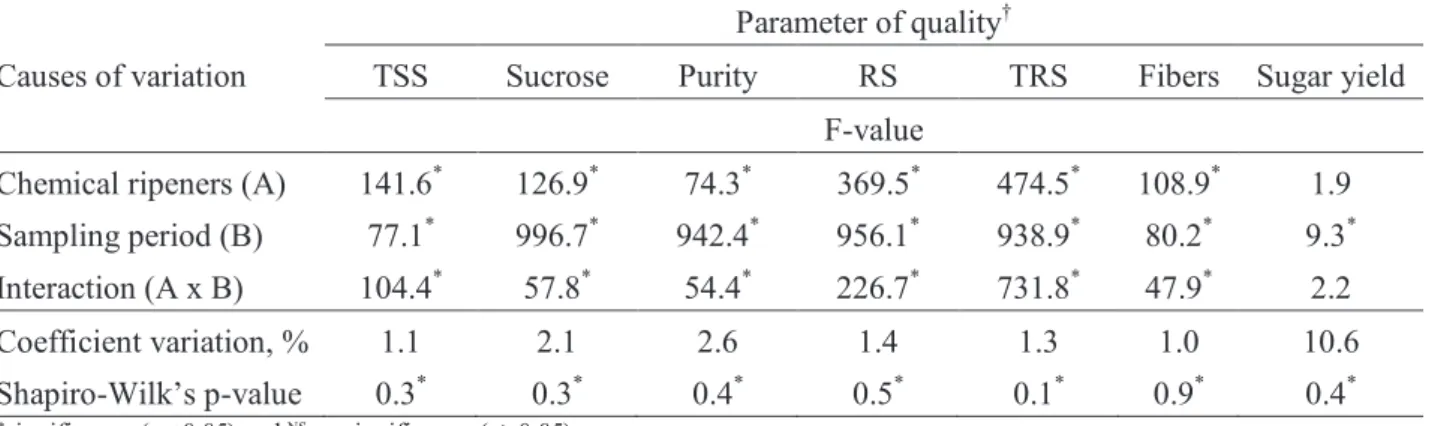
The null hypothesis for the interaction level between the causes of variation (chemical ripener and sampling period) was rejected for almost all assessed traits, except RTS, which was only significantly affected by the last factor. Furthermore, low coefficient of variation values displayed compatibility between sweet sorghum crop management and the applied experimental design (Table 1).
Regarding the singular effects of the chemical ripener, glyphosate 0.8 l c.p. ha-1 and methyl-sulfumeturon 30 g c.p. ha-1 presented the best means for °Brix and no significant difference between doses. In addition, similar mean of °Brix was observed in the non-treated juice, indicating that the effects of plant growth regulators were not enough to significantly enhance soluble solids concentration (Table 2).
Glyphosate 0.4 l c.p. ha-1, glyphosate 0.2 l c.p. ha-1 and methyl-sulfumeturon 20 g c.p. ha-1, presented a negative effect on °Brix content, with 2% reduction, suggesting that higher ripener doses stimulated sugar fixation by the sweet sorghum plants owing to apical dominance removal associated with inhibition of invertase enzyme and blockage of the metabolic shikimic acid pathway, particularly the glyphosate herbicide (Meschede et al., 2011; Carbonari et al., 2014).
Assessing sweet sorghum (cv. Biomatrix 535), Viana et al. (2015) reported that some
methyl-and 30-days after spraying - DAS) methyl-and one control treatment (water spraying), with four replications.
Regarding soil preparation, basis saturation was adjusted to 60 % using dolomitic limestone (90 % TNRP). After two-months, i.e., in December 2016,
sweet sorghum (cv. CMSXS 646) seeds were sowed at plots with five rows (10 m length) spaced 0.5 m. Finally, after twenty five-days tillage density was adjusted for 100.000 plants per hectare (Durães, 2011).
Sixty-days after sowing, glyphosate and methyl-sulfumeturon doses were sprayed using a CO2-pressurized sprayer with six flat nozzles (AXI-
11002) spaced at 0.5 m along to spraying boom body (Viana et al., 2016). The applications were performed in the morning, from 8:00 to 11:00 a.m., at 25 ± 2.5°C and 70 ± 5.0 % air relative humidity. There was no subsequent rainfall.
Before the flowering stage (± 70-days-age), sweet sorghum plants were randomly harvested considering three-intermediate rows of each plot, leaves were removed, and stalks were milled using a hydraulic press. The derived juice was assessed for soluble solids (°Brix), apparent sucrose (POL), purity (PRT), reducing sugars (RS), total reducing sugars (TRS), fibers (FIB) and recoverable theoretical sugars (RTS) (Durães, 2011; Viana et al., 2016). Although chemical ripeners represented the plots, it was decided to sample the subplots, due to the lower amount of material need to assure acceptable variation and consistence to the results and discussion, since on experimental designs involving chemical products management as plots are more susceptible to randomization effects.
The dataset was subjected to the statistical tests Shapiro-Wilk, Fisher, Tukey, Pearson and multiple linear regression (p<0.05). Despite to controversies, MLR techniques can be successful
applied to both regular and non-equidistant numeric intervals, since the current computation machines easily solve orthogonal polynomials matrixes, pre- requisite basically preconized to make more easy data processing (Yaghoubi et al., 2017). The statistical analysis was carried out using the R Core Team (Version 3.3.1.) software.
Results and Discussion
The null hypothesis for the interaction level between the causes of variation (chemical ripener and sampling period) was rejected for almost all assessed traits, except RTS, which was only significantly affected by the last factor. Furthermore, low coefficient of variation values displayed compatibility between sweet sorghum crop management and the applied experimental design (Table 1).
Regarding the singular effects of the chemical ripener, glyphosate 0.8 l c.p. ha-1 and methyl-
sulfumeturon 30 g c.p. ha-1 presented the best means
for °Brix and no significant difference between doses. In addition, similar mean of °Brix was observed in the non-treated juice, indicating that the effects of plant growth regulators were not enough to significantly enhance soluble solids concentration (Table 2).
Glyphosate 0.4 l c.p. ha-1, glyphosate 0.2 l c.p.
ha-1 and methyl-sulfumeturon 20 g c.p. ha-1, presented
a negative effect on °Brix content, with 2% reduction, suggesting that higher ripener doses stimulated sugar fixation by the sweet sorghum plants owing to apical dominance removal associated with inhibition of invertase enzyme and blockage of the metabolic shikimic acid pathway, particularly the glyphosate herbicide(Meschedeetal.,2011;Carbonarietal.,2014). Assessing sweet sorghum (cv. Biomatrix
methyl-Technological profile of sweet sorghum juice cv. CMSXS-646 juice submitted to... 423 sulfumeturon and glyphosate doses increased the
total soluble solids content of juice, corroborating the results of this study. Otherwise, studying methyl-sulfumeturon effects on qualitative aspects of sweet sorghum (cv. 80007) juice, Viana et al. (2016) observed an inverse relation between °Brix and dose of chemical ripener. According to Kumar et al. (2008), nutritional status, crop sanity, genotype, weather
conditions, edaphic elements, and plant growth regulators-types can positively or negatively affect °Brix. Under the industrial viewpoint, sugarcane or sweet sorghum juices with about to 18 °Brix are desirable to sustainable production of sugar and first-generation bioethanol. So, based only on °Brix values, all treatments presented feasibility to sugar-energy industry.
Causes of variation °Brix POL Purity RS(1) TRS(1) Fibers RTS(1)
Chemical ripener (A) 141.6* 126.9* 74.3* 369.5* 474.5* 108.9* 1.9NS Sampling periods (B) 77.0* 996.7* 942.4* 956.1* 938.9* 80.2* 9.3* Interaction (A x B) 104.4* 57.8* 54.4* 226.7* 731.8* 47.9* 2.2NS CV(2)
(chemical ripener) (%) 1.0 2.1 2.6 1.4 1.3 1.0 10.6
CV (sampling period) (%) 6.4 9.9 10.9 14.4 24.7 4.9 16.6
P-value (chemical ripener) 0.3* 0.3* 0.4* 0.5* 0.1 0.9 0.4
P-value (sampling period) 0.4* 0.5* 0.2* 0.3* 0.2 0.4 0.6
Chemical ripeners °Brix Pol Purity RS(1) TRS(1) Fibers RTS(1)
Glyphosate 0.2 l c.p. ha-1 19.0c 10.3e 54.7d 1.9a 9.1d 20.0a 82.8a Glyphosate 0.4 l c.p. ha-1 18.7c 12.3c 66.12ab 1.4e 11.0b 17.4d 99.3a Glyphosate 0.8 l c.p. ha-1 21.2a 11.2d 52.9d 1.8b 10.4c 18.7b 94.1a Methyl-sulf. 10 g c.p. ha-1 20.3b 13.9a 68.6a 1.2f 11.7a 19.9a 94.3a Methyl-sulf. 20 g c.p. ha-1 19.0c 11.2d 59.5c 1.5c 10.4c 18.2c 94.3a Methyl-sulf. 30 g c.p. ha-1 21.1a 13.1b 62.1c 1.5c 11.6a 18.9b 104.3a Control (water spraying) 21.0a 13.2b 62.6bc 1.5d 11.9a 20.2a 102.0a Table 1. Summary of analysis of variance for effects of chemical ripeners and sampling period on technological profile of sweet sorghum (cv. CMSXS 646) juice.
(1)Reducing sugars (RS), total reducing sugars (TRS) and recoverable theoretical sugars (RTS); (2)Coefficient of variance (CV); *significance (p<0.05) and NS no significance (p≥0.05).
Table 2. Simple effect of chemical ripeners on technological profile of sweet sorghum (cv. CMSXS 646) juice.
Averages followed by same letters on columns had no difference by Tukey’s test (p<0.05); (1)Reducing sugars (RS), total reducing sugars (TRS) and recoverable theoretical sugars (RTS).
Technological profile of sweet sorghum cv. CMSXS-646 juice submitted to... 423
sulfumeturon and glyphosate doses increased the total soluble solids content of juice, corroborating the results of this study. Otherwise, studying methyl- sulfumeturon effects on qualitative aspects of sweet sorghum (cv. 80007) juice, Viana et al. (2016) observed an inverse relation between °Brix and dose of chemical ripener. According to Kumar et al. (2008), nutritional status, crop sanity, genotype, weather
conditions, edaphic elements, and plant growth regulators-types can positively or negatively affect °Brix. Under the industrial viewpoint, sugarcane or sweet sorghum juices with about to 18 °Brix are desirable to sustainable production of sugar and first-generation bioethanol. So, based only on °Brix values, all treatments presented feasibility to sugar- energy industry.
Table 1. Summary of analysis of variance for effects of chemical ripeners and sampling period on technological
profile of juice from sweet sorghum cv. CMSXS 646.
Causes of variation
Parameter of quality†
TSS Sucrose Purity RS TRS Fibers Sugar yield
F-value
Chemical ripeners (A) 141.6* 126.9* 74.3* 369.5* 474.5* 108.9* 1.9 Sampling period (B) 77.1* 996.7* 942.4* 956.1* 938.9* 80.2* 9.3* Interaction (A x B) 104.4* 57.8* 54.4* 226.7* 731.8* 47.9* 2.2
Coefficient variation, % 1.1 2.1 2.6 1.4 1.3 1.0 10.6
Shapiro-Wilk’s p-value 0.3* 0.3* 0.4* 0.5* 0.1* 0.9* 0.4*
*significance (p<0.05) and NS no significance (p≥0.05).
†Total soluble solids (TSS), reducing sugars (RS) and total reducing sugars (TRS).
Table 2. Simple effect of chemical ripeners on technological profile of sweet sorghum (cv. CMSXS 646) juice.
Chemical ripeners °Brix Pol Purity RS(1) TRS(1) Fibers RTS(1)
Glyphosate 0.2 l c.p. ha-1 19.0c 10.3e 54.7d 1.9a 9.1d 20.0a 82.8a Glyphosate 0.4 l c.p. ha-1 18.7c 12.3c 66.12ab 1.4e 11.0b 17.4d 99.3a Glyphosate 0.8 l c.p. ha-1 21.2a 11.2d 52.9d 1.8b 10.4c 18.7b 94.1a Methyl-sulf. 10 g c.p. ha-1 20.3b 13.9a 68.6a 1.2f 11.7a 19.9a 94.3a Methyl-sulf. 20 g c.p. ha-1 19.0c 11.2d 59.5c 1.5c 10.4c 18.2c 94.3a Methyl-sulf. 30 g c.p. ha-1 21.1a 13.1b 62.1c 1.5c 11.6a 18.9b 104.3a
Control (water spraying) 21.0a 13.2b 62.6bc 1.5d 11.9a 20.2a 102.0a
Averages followed by same letters on columns had no difference by Tukey’s test (p<0.05); (1)Reducing sugars (RS), total reducing
Concerning sucrose apparent, methyl-sulfumeturon 10 g c.p. ha-1 reached the highest POL content. Compared with control treatment, all doses of chemical ripeners reduced POL by 1.5%, approximately, in contrast to the results obtained by Leite et al. (2009) and Silva et al. (2010). However, results of this work agree to Viana et al. (2016).
In general, purity percentages were higher than the values reported by Viana et al. (2016), who also verified positive effects on juice purity of sweet sorghum cv. 80007 by applying the chemical ripeners ethephon, methyl-sulfumeturon and thiadiazuron (TDZ). The best RS percentages were displayed by juices extracted from plants that received glyphosate 0.2 l c.p. ha-1 and glyphosate 0.8 l c.p. ha-1. There was no statistical diference between doses. Audilakshmi et al. (2010) and Viana et al. (2015, 2016) evaluating sweet sorghum hybrids obtained RS values similar to the observed in this study. Theoretically, feedstocks with high monosaccharide concentration are desirable for bioethanol industrialization, since they enhance alcoholic fermentation and partially reduce production costs associated with transport and electrical energy spent (Audilakshmi et al., 2010).
Non-treated juice of sweet sorghum reached highest TRS value. However, this treatment was not significant for methyl-sulfumeturon 30 g c.p. ha -1. In general, chemical ripeners reduced juice TRS, especially glyphosate 0.2 l c.p. ha-1.
Compared with control treatment, glyphosate 0.4 l c.p. ha-1 decreased 3% fiber percentage, approximately. Similar patterns were observed to the other doses. Data of this study corroborate the results reported by Silva et al. (2010) but disagree from Viana et al. (2016), suggesting that there is specificity between sweet sorghum cultivars and chemical ripener-types.
RTS was not significantly affected by the chemical ripeners. However, plants subjected to methyl-sulfumeturon 30 g c.p. ha-1 showed yield greater than control. Moreover, remaining doses had negative effects on RTS. Viana et al. (2016) obtained 87.2 kg t-1 RTS applying methyl-sulfumeturon 5 g c.p. ha-1. Other authors found similar patterns (Meschede et al., 2009; Souza & Foloni, 2012). According to Viana et al. (2015), RTS is very important to sugarcane chain, as this technological trait is directly associated to price paid by feedstock to farmers. Sweet sorghum plants sampled at 15 DAS produced juice with higher °Brix than those sampled at 30 DAS, indicating an antagonistic effect, but no significance, from harvest time on feedstock total soluble solids concentration (Table 3).
Oliveira Filho et al. (2016) and Viana et al. (2016), studying sugarcane varieties and sweet sorghum, respectively, observed a positive association between °Brix and sampling periods: 18.4% and 19.3% at 15 and 30 DAS, and 12.7 and 14.3 % at 15 and 32 DAS, respectively, contrasting to the results of this research. According to Viana et al. (2015), there is an inverse relation between plant age and °Brix concentration, owing to intensive deposition of lignin on stalks, which considerably reduces carbohydrate accumulation into plant parenchymatic tissues.
In summary, juices from plants harvested at 30 DAS displayed best POL, purity, TRS, and RTS yields, corroborating results reported by Viana et al. (2016) and Oliveira Filho et al. (2016). Similarly, evaluating the response of sugarcane genotypes to plant growth regulators, Caputo et al. (2008) verified significant increases of °Brix, POL, purity, and RTS over to sampling periods.
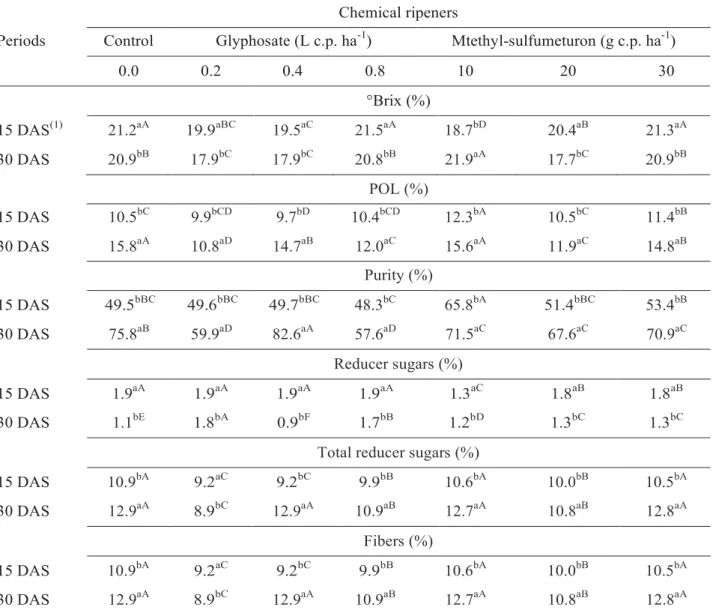
Analysis of variance and multiple comparisons results for the interaction effect between chemical ripeners and sampling period are shown in Table 4.
Concerning sucrose apparent, methyl- sulfumeturon 10 g c.p. ha-1 reached the highest
POL content. Compared with control treatment, all doses of chemical ripeners reduced POL by 1.5%, approximately, in contrast to the results obtained by Leite et al. (2009) and Silva et al. (2010). However, results of this work agree to Viana et al. (2016).
In general, purity percentages were higher than the values reported by Viana et al. (2016), who also verifiedpositiveeffectsonjuicepurityofsweetsorghum cv. 80007 by applying the chemical ripeners ethephon, methyl-sulfumeturon and thiadiazuron (TDZ).
The best RS percentages were displayed by juices extracted from plants that received glyphosate 0.2 l c.p. ha-1 and glyphosate 0.8 l c.p. ha-1. There was
no statistical diference between doses. Audilakshmi et al. (2010) and Viana et al. (2015, 2016) evaluating sweet sorghum hybrids obtained RS values similar to the observed in this study. Theoretically, feedstocks with high monosaccharide concentration are desirable for bioethanol industrialization, since they enhance alcoholic fermentation and partially reduce production costs associated with transport and electrical energy spent (Audilakshmi et al., 2010).
Non-treated juice of sweet sorghum reached highest TRS value. However, this treatment was not significant for methyl-sulfumeturon 30 g c.p. ha -1. In general, chemical ripeners reduced juice TRS,
especially glyphosate 0.2 l c.p. ha-1.
Compared with control treatment, glyphosate 0.4 l c.p. ha-1 decreased 3% fiber percentage,
approximately. Similar patterns were observed to the other doses. Data of this study corroborate the results reported by Silva et al. (2010) but disagree from Viana et al. (2016), suggesting that there is specificity between sweet sorghum cultivars and chemical ripener-types.
RTS was not significantly affected by the chemical ripeners. However, plants subjected to methyl- sulfumeturon 30 g c.p. ha-1 showed yield greater than
control. Moreover, remaining doses had negative effects on RTS. Viana et al. (2016) obtained 87.2 kg t-1 RTS
applying methyl-sulfumeturon 5 g c.p. ha-1. Other authors
found similar patterns (Meschede et al., 2009; Souza & Foloni, 2012).According toViana et al. (2015), RTS is very important to sugarcane chain, as this technological trait is directly associated to price paid by feedstock to farmers. Sweet sorghum plants sampled at 15 DAS produced juice with higher °Brix than those sampled at 30 DAS, indicating an antagonistic effect, but no significance, from harvest time on feedstock total soluble solids concentration (Table 3).
Oliveira Filho et al. (2016) and Viana et al. (2016), studying sugarcane varieties and sweet sorghum, respectively, observed a positive association between °Brix and sampling periods: 18.4% and 19.3% at 15 and 30 DAS, and 12.7 and 14.3 % at 15 and 32 DAS, respectively, contrasting to the results of this research. According to Viana et al. (2015), there is an inverse relation between plant age and °Brix concentration, owing to intensive deposition of lignin on stalks, which considerably reduces carbohydrate accumulation into plant parenchymatic tissues.
In summary, juices from plants harvested at 30 DAS displayed best POL, purity, TRS, and RTS yields, corroborating results reported by Viana et al. (2016) and Oliveira Filho et al. (2016). Similarly, evaluating the response of sugarcane genotypes to plant growth regulators, Caputo et al. (2008) verified significant increases of °Brix, POL, purity, and RTS over to sampling periods.
Analysis of variance and multiple comparisons results for the interaction effect between chemical ripeners and sampling period are shown in Table 4.
Technological profile of sweet sorghum juice cv. CMSXS-646 juice submitted to... 425
Table 4. Interaction effect of chemical ripeners and sampling periods on technological profile of sweet sorghum (cv. CMSXS 646) juice.
Means followed by the same upper-case letters in the lines and lower-case letters in the columns, not differ at Tukey’s test (p<0.05); (1) Days after spraying (DAS).
Table 3. Simple effects of sampling period on technological profile of sweet sorghum (cv. CMSXS 646) juice.
Means followed by same letters on columns do not differ by Tukey’s test (p<0.05); (1)Reducing sugars (RS), total reducing sugars (TRS) and recoverable theoretical sugars (RTS); (2)Days after spraying (DAS).
Sampling periods °Brix Pol Purity RS(1) TRS(1) Fibers RTS(1)
15 DAS(2) 20.3a 10.6b 52.5b 1.8a 10.7b 19.4a 101.7a
30 DAS 19.7b 13.7a 69.4a 1.3b 11.7a 18.7b 90.0b
Chemical ripeners
Periods Control Glyphosate (L c.p. ha-1) Mtethyl-sulfumeturon (g c.p. ha-1)
0.0 0.2 0.4 0.8 10 20 30 °Brix (%) 15 DAS(1) 21.2aA 19.9aBC 19.5aC 21.5aA 18.7bD 20.4aB 21.3aA 30 DAS 20.9bB 17.9bC 17.9bC 20.8bB 21.9aA 17.7bC 20.9bB POL (%) 15 DAS 10.5bC 9.9bCD 9.7bD 10.4bCD 12.3bA 10.5bC 11.4bB 30 DAS 15.8aA 10.8aD 14.7aB 12.0aC 15.6aA 11.9aC 14.8aB Purity (%) 15 DAS 49.5bBC 49.6bBC 49.7bBC 48.3bC 65.8bA 51.4bBC 53.4bB 30 DAS 75.8aB 59.9aD 82.6aA 57.6aD 71.5aC 67.6aC 70.9aC Reducer sugars (%) 15 DAS 1.9aA 1.9aA 1.9aA 1.9aA 1.3aC 1.8aB 1.8aB 30 DAS 1.1bE 1.8bA 0.9bF 1.7bB 1.2bD 1.3bC 1.3bC
Total reducer sugars (%)
15 DAS 10.9bA 9.2aC 9.2bC 9.9bB 10.6bA 10.0bB 10.5bA
30 DAS 12.9aA 8.9bC 12.9aA 10.9aB 12.7aA 10.8aB 12.8aA
Fibers (%)
15 DAS 10.9bA 9.2aC 9.2bC 9.9bB 10.6bA 10.0bB 10.5bA
30 DAS 12.9aA 8.9bC 12.9aA 10.9aB 12.7aA 10.8aB 12.8aA
Technological profile of sweet sorghum cv. CMSXS-646 juice submitted to... 425
Table 3. Simple effects of sampling period on technological profile of sweet sorghum (cv. CMSXS 646) juice.
Sampling periods °Brix Pol Purity RS(1) TRS(1) Fibers RTS(1)
15 DAS(2) 20.3a 10.6b 52.5b 1.8a 10.7b 19.4a 101.7a
30 DAS 19.7b 13.7a 69.4a 1.3b 11.7a 18.7b 90.0b
Means followed by same letters on columns do not differ by Tukey’s test (p<0.05); (1)Reducing sugars (RS), total reducing sugars
(TRS) and recoverable theoretical sugars (RTS); (2)Days after spraying (DAS).
Table 4. Interaction effect of chemical ripeners and sampling periods on technological profile of sweet sorghum
(cv. CMSXS 646) juice.
Chemical ripeners
Periods Control Glyphosate (L c.p. ha-1) Mtethyl-sulfumeturon (g c.p. ha-1)
0.0 0.2 0.4 0.8 10 20 30 °Brix (%) 15 DAS(1) 21.2aA 19.9aBC 19.5aC 21.5aA 18.7bD 20.4aB 21.3aA 30 DAS 20.9bB 17.9bC 17.9bC 20.8bB 21.9aA 17.7bC 20.9bB POL (%) 15 DAS 10.5bC 9.9bCD 9.7bD 10.4bCD 12.3bA 10.5bC 11.4bB 30 DAS 15.8aA 10.8aD 14.7aB 12.0aC 15.6aA 11.9aC 14.8aB Purity (%) 15 DAS 30 DAS 49.5bBC 75.8aB 49.6bBC 59.9aD 49.7bBC 82.6aA 48.3bC 57.6aD 65.8bA 71.5aC 51.4bBC 67.6aC 53.4bB 70.9aC Reducer sugars (%) 15 DAS 1.9aA 1.9aA 1.9aA 1.9aA 1.3aC 1.8aB 1.8aB 30 DAS 1.1bE 1.8bA 0.9bF 1.7bB 1.2bD 1.3bC 1.3bC
Total reducer sugars (%)
15 DAS 10.9bA 9.2aC 9.2bC 9.9bB 10.6bA 10.0bB 10.5bA
30 DAS 12.9aA 8.9bC 12.9aA 10.9aB 12.7aA 10.8aB 12.8aA
Fibers (%)
15 DAS 10.9bA 9.2aC 9.2bC 9.9bB 10.6bA 10.0bB 10.5bA
30 DAS 12.9aA 8.9bC 12.9aA 10.9aB 12.7aA 10.8aB 12.8aA
Means followed by the same upper-case letters in the lines and lower-case letters in the columns, not differ at Tukey’s test (p<0.05); (1)
Higher °Brix contents were observed in the juices from plants sprayed with methyl-sulfumeturon 10 g c.p. ha-1 and glyphosate 0.8 l c.p. ha-1, sampled at 15 DAS. However, both treatments do not significantly differed from non-treated, indicating that chemical ripeners and sampling periods were not enough to considerably increase soluble solids level. °Brix yield is proportional to dry mass production, which increases significantly during physiological maturation of the crop (Leite et al., 2011).
Sugarcane and sweet sorghum are fit to mechanized harvest only when reach 15.5 to 16.5 °Brix, providing juice with high fermentation quality and increased ethanol yield (Prasad et al., 2007). In this sense, chemical ripeners-treated sweet sorghum (cv. CMSXS 646) could be harvested seventy five-days after sowing, preventing pests and diseases attacks and another adverse weather effects, factors which could cause sucrose inversion and reduction of energetic power quality on feedstock.
Regarding POL, non-treated samples from 30 DAS presented apparent sucrose percentage higher than samples from 15 DAS. Similar situations were observed for methyl-sulfumeturon 10 g c.p. ha-1, methyl-sulfumeturon 30 g c.p. ha-1, and glyphosate 0.4 l c.p. ha-1 treatments. Therefore, the largest sweet sorghum crop time on field increased sucrose concentration on stalks owing to higher exposure of plants to photosynthesis advantages, as well as advanced maturation degree.
The best purity value was displayed by the feedstock treated with glyphosate 0.4 g c.p. ha-1, sampled at 30 DAS. Pure juices are more desirable to bioethanol production because of the ease industrial extraction of sugar (Viana et al., 2015).
Plants harvested at 15 DAS showed highest RS percentage compared to 30 DAS. In this last sampling
period, there was great fiber deposition on feedstock; there is an inverse relation between reducing sugars and fibers (Caputo et al., 2008).
For the TRS, samples from 30 DAS treated with methyl-sulfumeturon 10 g c.p. ha-1, methyl-sulfumeturon 30 g c.p. ha-1, and glyphosate 0.4 l c.p. ha-1 produced 2% more juices, approximately, than samples from 15 DAS. However, these dosages were not statistically different from the control. Total soluble solids, purity, and TRS are the most important parameters associated with determining feedstock energetic quality (Caputo et al., 2008; Silva et al., 2010). For Viana et al. (2015), TRS is more important than Pol for technological analysis of sweet sorghum, since this parameter reveal the true feedstock quality status.
Compared to the control treatment, samples from 30 DAA sprayed with glyphosate 0.2 l c.p. ha-1 presented 4% less fiber percentage. Fibers are relevant to mechanical resistance of plants against pest attacks and prevent crop tumbling. However, this characteristic is undesirable under both industrial and economic viewpoints. In sugarcane chain, for example, milling operational capacity and RTS yield are reduced 15% and 1.85 kg t-1, respectively, due to increases of 0.5 and 1% of fiber percentage, respectively (Carvalho et al., 2017). For these researchers, feedstocks with about 12.5% FIB are fit to industrialization of sugar and bioethanol. Pearson’s correlation test results are shown in Table 5.
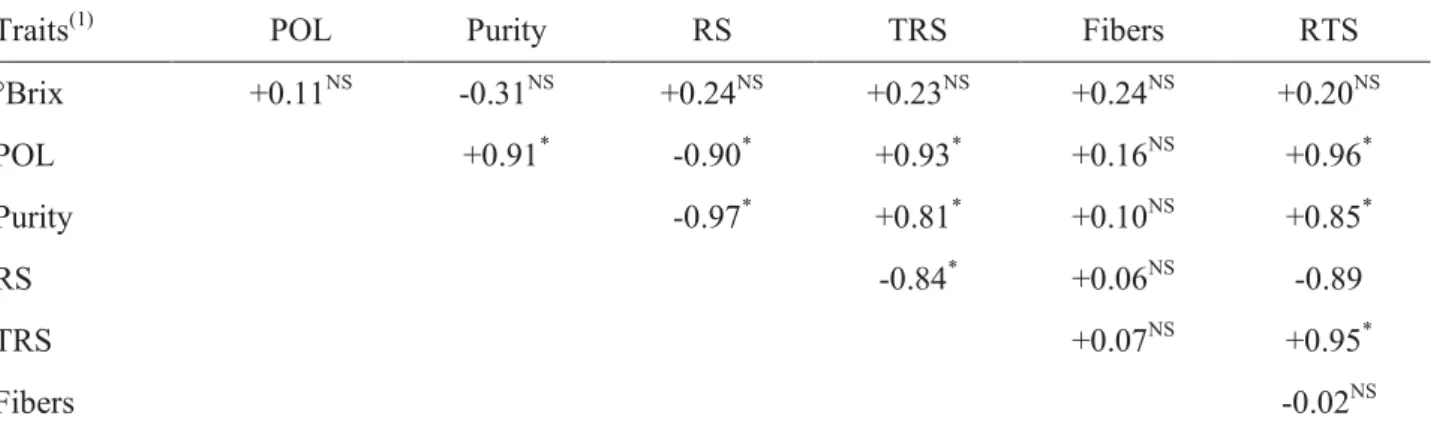
°Brix and POL presented inverse and direct correlations with purity, respectively. Sales et al. (2016) evaluated sugarcane genotypes and obtained positive correlation between °Brix and purity, unlike to the results of this study. According to Carvalho et al. (2017), pure feedstocks usually presented low °Brix percentage, supporting findings from this study.
Higher °Brix contents were observed in the juices from plants sprayed with methyl-sulfumeturon 10 g c.p. ha-1 and glyphosate 0.8 l c.p. ha-1, sampled
at 15 DAS. However, both treatments do not significantly differed from non-treated, indicating that chemical ripeners and sampling periods were not enough to considerably increase soluble solids level. °Brix yield is proportional to dry mass production, which increases significantly during physiological maturation of the crop (Leite et al., 2011).
Sugarcane and sweet sorghum are fit to mechanized harvest only when reach 15.5 to 16.5 °Brix, providing juice with high fermentation quality and increased ethanol yield (Prasad et al., 2007). In this sense, chemical ripeners-treated sweet sorghum (cv. CMSXS 646) could be harvested seventy five- days after sowing, preventing pests and diseases attacks and another adverse weather effects, factors which could cause sucrose inversion and reduction of energetic power quality on feedstock.
Regarding POL, non-treated samples from 30 DAS presented apparent sucrose percentage higher than samples from 15 DAS. Similar situations were observed for methyl-sulfumeturon 10 g c.p. ha-1,
methyl-sulfumeturon 30 g c.p. ha-1, and glyphosate
0.4 l c.p. ha-1 treatments. Therefore, the largest
sweet sorghum crop time on field increased sucrose concentration on stalks owing to higher exposure of plants to photosynthesis advantages, as well as advanced maturation degree.
The best purity value was displayed by the feedstock treated with glyphosate 0.4 g c.p. ha-1,
sampled at 30 DAS. Pure juices are more desirable to bioethanol production because of the ease industrial extraction of sugar (Viana et al., 2015).
Plants harvested at 15 DAS showed highest RS percentage compared to 30 DAS. In this last sampling
period, there was great fiber deposition on feedstock; there is an inverse relation between reducing sugars and fibers (Caputo et al., 2008).
For the TRS, samples from 30 DAS treated with methyl-sulfumeturon 10 g c.p. ha-1, methyl-
sulfumeturon 30 g c.p. ha-1, and glyphosate 0.4 l
c.p. ha-1 produced 2% more juices, approximately,
than samples from 15 DAS. However, these dosages were not statistically different from the control. Total soluble solids, purity, and TRS are the most important parameters associated with determining feedstock energetic quality (Caputo et al., 2008; Silva et al., 2010). For Viana et al. (2015), TRS is more important than Pol for technological analysis of sweet sorghum, since this parameter reveal the true feedstock quality status.
Compared to the control treatment, samples from 30 DAA sprayed with glyphosate 0.2 l c.p. ha -1 presented 4% less fiber percentage. Fibers are
relevant to mechanical resistance of plants against pest attacks and prevent crop tumbling. However, this characteristic is undesirable under both industrial and economic viewpoints. In sugarcane chain, for example, milling operational capacity and RTS yield are reduced 15% and 1.85 kg t-1, respectively,
due to increases of 0.5 and 1% of fiber percentage, respectively (Carvalho et al., 2017). For these researchers, feedstocks with about 12.5% FIB are fit to industrialization of sugar and bioethanol. Pearson’s correlation test results are shown in Table 5.
°Brix and POL presented inverse and direct correlations with purity, respectively. Sales et al. (2016) evaluated sugarcane genotypes and obtained positive correlation between °Brix and purity, unlike to the results of this study. According to Carvalho et al. (2017), pure feedstocks usually presented low °Brix percentage, supporting findings from this study.
Technological profile of sweet sorghum juice cv. CMSXS-646 juice submitted to... 427 POL it directly correlated with TRS and RTS
and inversely with RS. A similar pattern was observed for purity, supporting results recorded by Carvalho et al. (2013), Dalchiavon et al. (2014) and Sales et al. (2016). According to these researchers, there are positive correlations between purity, TRS, and RTS. Adjusted multiple linear regressions to parameters that established significant correlations are shown in Table 6.
The mathematical interpretation of equations shows that apparent sucrose content would increase 0.15, 3.70 and 0.12% with unit increases of purity, RS, TRS, and RTS percentages, respectively.
Increases in RS and RTS content would decrease purity in 32.32% and 0.08%, respectively. On the other hand, this characteristic would be improved 0.23% with TRS increase.
Traits(1) POL Purity RS TRS Fibers RTS
°Brix +0.11NS -0.31NS +0.24NS +0.23NS +0.24NS +0.20NS POL +0.91* -0.90* +0.93* +0.16NS +0.96* Purity -0.97* +0.81* +0.10NS +0.85* RS -0.84* +0.06NS -0.89 TRS +0.07NS +0.95* Fibers -0.02NS Traits(1) Y i = B0 + B1X1 + B2X2 +...+ BkXk R2adj Sucrose POL (%) = -16.97* + 0.15PRT* + 3.70RS* + 0.18TRSNS + 0.12RTS* 0.97* Purity PRT (%) = 117.07* - 32.32RS* + 0.23TRSNS - 0.08RTSNS 0.93* RS RS(%) = 4.11* - 0.02TRSNS - 0.02RTS* + 0.12POL* - 0.03PRT* 0.97* TRS TRS(%) = 12.87* + 0.69 POL* - 0.10 PRT* - 2.68 RS* 0.90* RTS RTS(kg t-1) = 109.16* + 5.18POL*- 0.83PRT*- 24.25RS* + 1.29 RTS* 0.97* Table 5. Linear associations between technological traits of sweet sorghum (cv. CMSXS 646) juice under spraying of chemical ripeners and sampling periods.
(1)Reducing sugars (RS), total reducing sugars (TRS) and recoverable theoretical sugars (RTS); *Significance (P < 0.05) and NSno significance (P ≥ 0.05).
Table 6. Adjusted multiple regressions to technological traits of sweet sorghum (cv. CMSXS 646) juice under spraying of chemical ripeners and sampling periods
(1)Reducing sugars (RS),total reducer sugars (TRS) and recoverable theoretical sugars (RTS); *Significance (p<0.05) and NS no significance (p≥0.05).
Technological profile of sweet sorghum cv. CMSXS-646 juice submitted to... 427
POL it directly correlated with TRS and RTS and inversely with RS. A similar pattern was observed for purity, supporting results recorded by Carvalho et al. (2013), Dalchiavon et al. (2014) and Sales et al. (2016). According to these researchers, there are positive correlations between purity, TRS, and RTS. Adjusted multiple linear regressions to parameters that establishedsignificantcorrelationsareshowninTable6.
The mathematical interpretation of equations shows that apparent sucrose content would increase 0.15, 3.70 and 0.12% with unit increases of purity, RS, TRS, and RTS percentages, respectively.
Increases in RS and RTS content would decrease purity in 32.32% and 0.08%, respectively. On the other hand, this characteristic would be improved 0.23% with TRS increase.
Table 5. Linear associations between technological traits of sweet sorghum (cv. CMSXS 646) juice under
spraying of chemical ripeners and sampling periods.
Traits(1) POL Purity RS TRS Fibers RTS
°Brix +0.11NS -0.31NS +0.24NS +0.23NS +0.24NS +0.20NS POL +0.91* -0.90* +0.93* +0.16NS +0.96* Purity -0.97* +0.81* +0.10NS +0.85* RS -0.84* +0.06NS -0.89 TRS +0.07NS +0.95* Fibers -0.02NS
(1)Reducing sugars (RS), total reducing sugars (TRS) and recoverable theoretical sugars (RTS); *Significance (P < 0.05) and NSno
significance (P ≥ 0.05).
Table 6. Adjusted multiple regressions to technological traits of sweet sorghum (cv. CMSXS 646) juice under
spraying of chemical ripeners and sampling periods
Traits(1) Y i = B0 + B1X1 + B2X2 +...+ BkXk R2adj Sucrose POL (%) = -16.97* + 0.15PRT* + 3.70RS* + 0.18TRSNS + 0.12RTS* 0.97* Purity PRT (%) = 117.07* - 32.32RS* + 0.23TRSNS - 0.08RTSNS 0.93* RS RS (%) = 4.11* - 0.02TRSNS - 0.02RTS* + 0.12POL* - 0.03PRT* 0.97* TRS TRS (%) = 12.87* + 0.69 POL* - 0.10 PRT* - 2.68 RS* 0.90* RTS RTS (kg t-1) = 109.16* + 5.18POL*- 0.83PRT*- 24.25RS* + 1.29 RTS* 0.97*
(1)Reducing sugars (RS), total reducer sugars (TRS) and recoverable theoretical sugars (RTS); *Significance (p<0.05) and NS no
TRS share on physical-chemical composition of sweet sorghum juice would be decreased 2.68 and 0.10%, respectively, for each RS percentage point increase, indicating antagonistic effects of reducing sugars in the apparent sucrose yield.
Regarding RTS, significant increases of 5.18 and 1.29 kg t-1 were observed for each POL and TRS point. However, 24.15 kg t-1 depreciation occurred with increase in RS percentage.
Statistical analyses involving multiple regressions in studies about sugarcane and sweet sorghum are essential to the sugar-energy industry evolution, as the use of this information is helpful to define associated strategies to plant physiology, fertilization management, plant genetic breeding, and industrial operations, aiming to enhances feedstock quality to sustainable production of sugar and bioethanol (Dalchiavon et al., 2014).
Conclusions
The tested plant growth regulators (glyphosate and sulfumeturon-methyl) are recommendable to sugar-energy industry, due to the increase in °Brix, POL, PRT, TRS, and TRS averages, and reduction of FIB content, improving energetic power quality of sweet sorghum (cv. CMSXS-646) juice.
Sulfumeturon-methyl 10 g c.p. ha-1 was effective in adding value to sweet sorghum (cv. CMSXS-646) juice, since ripener product induces decreases in fibers content, while the plant growth regulator enhances POL and purity, and reduces RS percentage.
On another hand, it is possible grow sweet sorghum (cv. CMSXS-646) till thirty-days after spraying of chemical ripeners, glyphosate 0.4 l c.p. ha-1 or sulfumeturon-methyl 10 g c.p. ha-1, because
these doses induced high °Brix, POL, total reducing sugars and purity level.
References
AUDILAKSHMI, S.; MALL, A. K.; SWARNALATHA, M.; SEETHARAMA, N. Inheritance of sugar concentration in stalk (Brix), sucrose content, stalk and juice yield in sorghum. Biomass and Bioenergy, v. 34, n. 6, p. 813-820, 2010. DOI: 10.1016/j.biombioe.2010.01.025.
BERMANN, C. Crise ambiental e as energias renováveis.
Ciência e Cultura, v. 60, n. 3, p. 20-29, 2008.
CAPUTO, M. M.; BEAUCLAIR, E. G. F.; SILVA, M. A.; PIEDADE, S. M. S. Resposta de genótipos de cana-de-açúcar à aplicação de indutores de maturação. Bragantia, v. 67, n. 1, p. 15-23, 2008.
DOI: 10.1590/S0006-87052008000100002.
CARBONARI, C. A.; GOMES, G. L. G. C.; VELINI, E. D.; MACHADO, R. F.; SIMÕES, P. S.; CASTRO MACEDO, G. Glyphosate effects on sugarcane metabolism and growth. American Journal of Plant Sciences, v. 5, n. 24, p. 3585-3593, 2014. DOI: 10.4236/ajps.2014.524374.
CARVALHO, J. L. N.; NOGUEIROL, R. C.; MENANDRO L. M. S.; BORDONAL, R. O.; BORGES, C. D.; CANTARELLA H.; FRANCO H. J. Agronomic and environmental implications of sugarcane straw removal: a major review. Global Change Biology Bioenergy, v. 9, n. 7, p. 1181-1195, 2017. DOI: 10.1111/gcbb.12410. CARVALHO, M. E. A.; CASTRO, P. R. C.; DIAS, C. T. S. Plant growth reducers: an alternative to increase the juice production potential and decrease the lodging of sweet sorghum. American-Eurasian Journal of Agricultural
and Environmental Sciences, v. 13, n. 6, p. 774-777, 2013.
DALCHIAVON, F. C.; CARVALHO, M. P.; MONTANARI, R.; ANDREOTTI, M.; PANOSSO, A. R. Produtividade da cana-de-açúcar: variabilidade linear e espacial entre componentes tecnológicos e da produção. Bioscience
Journal, v. 30, n. 3, p. 390-400, 2014.
TRS share on physical-chemical composition of sweet sorghum juice would be decreased 2.68 and 0.10%, respectively, for each RS percentage point increase, indicating antagonistic effects of reducing sugars in the apparent sucrose yield.
Regarding RTS, significant increases of 5.18 and 1.29 kg t-1 were observed for each POL and TRS
point. However, 24.15 kg t-1 depreciation occurred
with increase in RS percentage.
Statistical analyses involving multiple regressions in studies about sugarcane and sweet sorghum are essential to the sugar-energy industry evolution, as the use of this information is helpful to define associated strategies to plant physiology, fertilization management, plant genetic breeding, and industrial operations, aiming to enhances feedstock quality to sustainable production of sugar and bioethanol (Dalchiavon et al., 2014).
Conclusions
The tested plant growth regulators (glyphosate and sulfumeturon-methyl) are recommendable to sugar-energy industry, due to the increase in °Brix, POL, PRT, TRS, and TRS averages, and reduction of FIB content, improving energetic power quality of sweet sorghum (cv. CMSXS-646) juice.
Sulfumeturon-methyl 10 g c.p. ha-1 was
effective in adding value to sweet sorghum (cv. CMSXS-646) juice, since ripener product induces decreases in fibers content, while the plant growth regulator enhances POL and purity, and reduces RS percentage.
On another hand, it is possible grow sweet sorghum (cv. CMSXS-646) till thirty-days after spraying of chemical ripeners, glyphosate 0.4 l c.p. ha-1 or sulfumeturon-methyl 10 g c.p. ha-1, because
these doses induced high °Brix, POL, total reducing sugars and purity level.
References
AUDILAKSHMI, S.; MALL, A. K.; SWARNALATHA, M.; SEETHARAMA, N. Inheritance of sugar concentration in stalk (Brix), sucrose content, stalk and juice yield in sorghum. Biomass and Bioenergy, v. 34, n. 6, p. 813-820, 2010. DOI: 10.1016/j.biombioe.2010.01.025.
BERMANN, C. Crise ambiental e as energias renováveis. Ciência e Cultura, v. 60, n. 3, p. 20-29, 2008.
CAPUTO, M. M.; BEAUCLAIR, E. G. F.; SILVA, M. A.; PIEDADE, S. M. S. Resposta de genótipos de cana-de- açúcar à aplicação de indutores de maturação. Bragantia, v. 67, n. 1, p. 15-23, 2008.
DOI: 10.1590/S0006-87052008000100002.
CARBONARI, C. A.; GOMES, G. L. G. C.; VELINI, E. D.; MACHADO, R. F.; SIMÕES, P. S.; CASTRO MACEDO, G. Glyphosate effects on sugarcane metabolism and growth. American Journal of Plant Sciences, v. 5, n. 24, p. 3585-3593, 2014. DOI: 10.4236/ajps.2014.524374. CARVALHO, J. L. N.; NOGUEIROL, R. C.; MENANDRO L. M. S.; BORDONAL, R. O.; BORGES, C. D.; CANTARELLA H.; FRANCO H. J. Agronomic and environmental implications of sugarcane straw removal: a major review. Global Change Biology Bioenergy, v. 9, n. 7, p. 1181-1195, 2017. DOI: 10.1111/gcbb.12410.
CARVALHO, M. E. A.; CASTRO, P. R. C.; DIAS, C. T. S. Plant growth reducers: an alternative to increase the juice production potential and decrease the lodging of sweet sorghum. American-Eurasian Journal of Agricultural and Environmental Sciences, v. 13, n. 6, p. 774-777, 2013. DALCHIAVON, F. C.; CARVALHO, M. P.; MONTANARI, R.; ANDREOTTI, M.; PANOSSO, A. R. Produtividade da cana-de-açúcar: variabilidade linear e espacial entre componentes tecnológicos e da produção. Bioscience Journal, v. 30, n. 3, p. 390-400, 2014.
TRS share on physical-chemical composition of sweet sorghum juice would be decreased 2.68 and 0.10%, respectively, for each RS percentage point increase, indicating antagonistic effects of reducing sugars in the apparent sucrose yield.
Regarding RTS, significant increases of 5.18 and 1.29 kg t-1 were observed for each POL and TRS
point. However, 24.15 kg t-1 depreciation occurred
with increase in RS percentage.
Statistical analyses involving multiple regressions in studies about sugarcane and sweet sorghum are essential to the sugar-energy industry evolution, as the use of this information is helpful to define associated strategies to plant physiology, fertilization management, plant genetic breeding, and industrial operations, aiming to enhances feedstock quality to sustainable production of sugar and bioethanol (Dalchiavon et al., 2014).
Conclusions
The tested plant growth regulators (glyphosate and sulfumeturon-methyl) are recommendable to sugar-energy industry, due to the increase in °Brix, POL, PRT, TRS, and TRS averages, and reduction of FIB content, improving energetic power quality of sweet sorghum (cv. CMSXS-646) juice.
Sulfumeturon-methyl 10 g c.p. ha-1 was
effective in adding value to sweet sorghum (cv. CMSXS-646) juice, since ripener product induces decreases in fibers content, while the plant growth regulator enhances POL and purity, and reduces RS percentage.
On another hand, it is possible grow sweet sorghum (cv. CMSXS-646) till thirty-days after spraying of chemical ripeners, glyphosate 0.4 l c.p. ha-1 or sulfumeturon-methyl 10 g c.p. ha-1, because
these doses induced high °Brix, POL, total reducing sugars and purity level.
References
AUDILAKSHMI, S.; MALL, A. K.; SWARNALATHA, M.; SEETHARAMA, N. Inheritance of sugar concentration in stalk (Brix), sucrose content, stalk and juice yield in sorghum. Biomass and Bioenergy, v. 34, n. 6, p. 813-820, 2010. DOI: 10.1016/j.biombioe.2010.01.025.
BERMANN, C. Crise ambiental e as energias renováveis. Ciência e Cultura, v. 60, n. 3, p. 20-29, 2008.
CAPUTO, M. M.; BEAUCLAIR, E. G. F.; SILVA, M. A.; PIEDADE, S. M. S. Resposta de genótipos de cana-de- açúcar à aplicação de indutores de maturação. Bragantia, v. 67, n. 1, p. 15-23, 2008.
DOI: 10.1590/S0006-87052008000100002.
CARBONARI, C. A.; GOMES, G. L. G. C.; VELINI, E. D.; MACHADO, R. F.; SIMÕES, P. S.; CASTRO MACEDO, G. Glyphosate effects on sugarcane metabolism and growth. American Journal of Plant Sciences, v. 5, n. 24, p. 3585-3593, 2014. DOI: 10.4236/ajps.2014.524374. CARVALHO, J. L. N.; NOGUEIROL, R. C.; MENANDRO L. M. S.; BORDONAL, R. O.; BORGES, C. D.; CANTARELLA H.; FRANCO H. J. Agronomic and environmental implications of sugarcane straw removal: a major review. Global Change Biology Bioenergy, v. 9, n. 7, p. 1181-1195, 2017. DOI: 10.1111/gcbb.12410.
CARVALHO, M. E. A.; CASTRO, P. R. C.; DIAS, C. T. S. Plant growth reducers: an alternative to increase the juice production potential and decrease the lodging of sweet sorghum. American-Eurasian Journal of Agricultural and Environmental Sciences, v. 13, n. 6, p. 774-777, 2013. DALCHIAVON, F. C.; CARVALHO, M. P.; MONTANARI, R.; ANDREOTTI, M.; PANOSSO, A. R. Produtividade da cana-de-açúcar: variabilidade linear e espacial entre componentes tecnológicos e da produção. Bioscience Journal, v. 30, n. 3, p. 390-400, 2014.
Technological profile of sweet sorghum juice cv. CMSXS-646 juice submitted to... 429 DURÃES, F. O. M. Sorgo sacarino: desenvolvimento de
tecnologia agronômica. Agroenergia em Revista, v. 3, p. 7-8, 2011.
GOLDEMBERG, J.; MELLO, F. F. C.; CERRI, C. E. P.; DAVIES, C. A.; CERRI, C. C. Meeting the global demand for biofuels in 2021 through sustainable land use change policy. Energy Policy, v. 69, p. 14-18, 2014.
DOI: 10.1016/j.enpol.2014.02.008.
HAN, L. P.; WANG, X.; GUO, X.; RAO, M. S.; STEINBERGER, Y.; CHENG, X.; XIE, G. H. Effects of plant growth regulators on growth, yield and lodging of sweet sorghum. Research on Crops, v. 12, n. 2, p. 372-382, 2011.
HEERDEN, P. D. R. van. Evaluation of Moddus® as a new chemical ripener for the South African sugar industry: preliminary finding. South African Sugarcane Research
Institute, v. 85, n. 1375, p. 193-195, 2012.
KUMAR, S. R.; SHROTRIA, P. K.; DESHMUKH, J. P. Characterizing nutrient management effect on yield of sweet sorghum genotypes. World Journal of Agricultural
Sciences, v. 4, n. 6, p. 787-789, 2008.
LEITE, G. H. P.; CRUSCIOL, C. A. C.; SILVA, M. A. Desenvolvimento e produtividade da cana-de-açúcar após aplicação de reguladores vegetais em meio de safra.
Ciências Agrárias, v. 32, n. 1, p. 129-138, 2011.
LEITE, G. H. P.; CRUSCIOL, C. A. C.; SILVA, M. A.; VENTURINI FILHO, W. G. Qualidade tecnológica da cana-de-açúcar em função da aplicação de maturadores em meio de safra. Bragantia, v. 68, n. 2, p. 527-534, 2009.
DOI: 10.1590/S0006-87052009000200028.
MESCHEDE, D. K.; CARBONARI, C. A.; VELINI, E. D. Ação de diferentes maturadores na produtividade e qualidade tecnológica da cana-de-açúcar. Revista
Brasileira de Herbicidas, v. 8, n. 2, p. 62-67, 2009.
DOI: 10.7824/rbh.v8i2.69.
MESCHEDE, D. K.; VELINI, E. D.; CARBONARI, C. A.; SILVA, J. R. M. Alteração fisiológica da
cana-de-açúcar pela aplicação de glyphosate e sulfumeturon-methyl. Planta Daninha, v. 29, n. 2, p. 413-419, 2011.
DOI: 10.1590/S0100-83582011000200019.
MILANEZ, A. Y.; NYKO, D.; VALENTE, M. S.; SOUSA, L. C.; BONOMI, A. M. F. L. J.; JESUS, C. D. F. D.; JUNQUEIRA, T. L. De promessa à realidade: como o etanol celulósico pode revolucionar a indústria da cana-de-açúcar-uma avaliação do potencial competitivo e sugestões de política pública. BNDES Setorial, v. 41, p. 237-294, 2015.
MUHWIRIDZWA, M.; MANENJI, B. T.; MADANZI, T.; MAHONOMA, W. Evaluating the effects of chemical ripening with fluazifop-p-butyl on sugarcane (Saccharum officinarum) yield and sugar content. International
Journal of Plant & Soil Science, v. 9, n. 6, p. 1-8, 2016.
DOI: 10.9734/IJPSS/2016/20596.
OLIVEIRA FILHO, P. B.; DUARTE JÚNIOR, J. B.; COSTA, A. C. T.; OLIVEIRA, P. S. R.; MACEDO JÚNIOR, E. K.; GUIMARÃES, V. F.; BOSQUETTE, W. Chemical ripeners and different harvest periods in sugarcane in State of Paraná, Southern Brazil. African
Journal of Agricultural Research, v. 11, n. 39, p.
3904-3913, 2016.
DOI: 10.5897/AJAR2014.9142.
PRASAD, S.; ANOOP S.; JAIN, N.; JOSHI, H. C. Ethanol production from sweet sorghum syrup for utilization as automotive fuel in India. Energy and Fuels, v. 21, n. 4, p. 2415-2420, 2007. DOI: 10.1021/ef060328z.
SALES, L. R.; CESAR, L. E. V.; BRUZI, A. T.; NUNES, J. A. R.; ANDRADE, L. A. de B.; LOPES, M. F. Seleção de cultivares de cana-de-açúcar potenciais para o município de Lavras-sul de Minas Gerais. Revista Agrogeoambiental, v. 8, n. 1, p. 97-109, 2016.
SILVA, M. A.; GAVA, G. J. C.; CAPUTO, M. M.; SORRILLA, P. F.; BASSETTO, S. C. Produtividade de colmos e de sacarose em cana-de-açúcar em função da interação entre cultivares e maturadores. Scientia Agraria, v. 11, n. 4, p. 323-329, 2010.
SOUZA, R. A.; FOLONI, L. L. Uso de biostimulantes como maturadores de cana-de-açúcar. In: CONGRESSO BRASILEIRO DA CIÊNCIA DAS PLANTAS DANINHAS, 28., 2012, Campo Grande. A ciência das
plantas daninhas na era da biotecnologia: anais. Campo
Grande: SBCPD, 2012. p. 338-342.
TSAO, C. C.; CAMPBELL, J. E.; MENA-CARRASCO, M.; SPAK, S. N.; CARMICHAEL, G. R. Increased estimates of air-pollution emissions from Brazilian sugar-cane ethanol. Nature Climate Change, v. 2, n. 1, p. 53-57, 2011. DOI: 10.1038/nclimate1325.
VIANA, R. S.; FIGUEIREDO, P. A. M.; LISBOA, L. A. M.; ASSUMPÇÃO, A. C. N. D.; SÁ, M. E.; MAY, A. Aplicação de fitorreguladores químicos na qualidade
tecnológica do sorgo sacarino cv. Biomatrix 535. Revista
Brasileira de Milho e Sorgo, v. 14, n. 3, p. 326-334, 2015.
DOI: 10.18512/1980-6477/rbms.v14n3p326-334.
VIANA, R. S.; FIGUEIREDO, P. A. M.; LISBOA, L. A. M.; MAGALHÃES, A. C. Morpho-anatomical aspects and technological quality of saccharine sorghum submitted to planta regulators. Revista Brasileira de Herbicidas, v. 15, n. 2, p. 175-183, 2016. DOI: 10.7824/rbh.v15i2.459. YAGHOUBI, V.; MARELLI, S.; SUDRET, B.; ABRAHAMSSON, T. Sparse polynomial chaos expansions of frequency response functions using stochastic frequency transformation. Probabilistic Engineering Mechanics, v. 48, p. 39-58, 2017.