Hedonic Methodologies in the Real Estate
Valuation
Cristina Canavarro
1, José Maria Caridad
2, and Nuria Ceular
2 1Escola Superior Agrária,
Instituto Politécnico de Castelo Branco, Castelo Branco, Portugal [email protected]
2
Facultad de Ciencias del Trabajo, Universidad de Cordoba, Cordoba, Spain
Abstract — Several models have been used to estimate the market value of real
es-tate properties, with the aim of obtaining better measures of the price of transaction than the official figures calculated for fiscal purposes. Hedonic models are well known techniques for estimating values of complex goods, as a house. Here they are focused on flats and apartments sold between 2005 and 2009 in a medium size por-tuguese city; sample data have been collected in collaboration with real estate agents, both for new and non-new houses, using transaction prices. Several internal and external characteristics of each property are included in the models, and the methodology can be extended to other cities alike in the country.
Keywords — market value, real estate, hedonic models
1 Introduction
The precise estimation of a dwelling's price is of most importance for all the different agents that form the real estate market: buyers and sellers, owners and investors, builders and resellers, and banks and fiscal authorities. Nowadays, it is frequent to find different values, depending of the institution or persons involved: fiscal authorities use predefined formulas, based on some fixed coefficients, that do not take into account the reality of the house and its real characteristics; a bank studying a mortgage related to a buying or credit operation, uses higher values, with a great degree of subjectivity, associated to the expert experience evaluating the property; the owner proposing his asking price, produces a still greater value. This variability is thus associated to the final objective of the valuation.
The situation in Portugal is conditioned by the generalized ownership of the house or apartment; most of the population own their house, or is paying a mortgage to a financial institution. Even, the investment in a second property is widespread. There are public
subsidies for young’s, and these are used by parents whose children are going to study in another town, to invest in a second house.
In the last decade, there are several studies of the Portuguese real estate market. Several mathematical models have been proposed, to estimate the value of a property depending of its attributes and its localization. Regression techniques, used in the so called hedonic models, provide a scientific approach based on empirical data, and introducing objectivity in the estimated values [1]. An alternative for using non linear models is provided by arti-ficial neural networks.
Hedonic models used in the Portuguese market, are associated to the particular data sources available. Here we propose several of these models for new and second hand apartments and flats. A sample of 222 apartments sold in Castelo Branco, during the pe-riod from 2005 to 2009, is employed. The data were supplied by real estate agents located in the area.
2 Characteristics of the real estate market
Dwellings behave different as other economics goods. This is due to some of their charac-teristics: their high value related to family income, their heterogeneity, their durability and so on. On the other hand, real estate markets are dynamic, with different agents, which do not act in coordinated manner. These factors can explain part of the variability in their prices.
Their heterogeneity derives from each particular combination of their intrinsic factors. They are non separable: each property has to be purchased as a non separable basket of goods, and thus the difficulty in an objective valuation. These combination of attributes has to be transferred together, for each dwelling [2] [3].
The hedonic prices are the theoretical unitary value of each of its attributes, and this could also by applied to several compound goods (as for example, a car) [4], and are different from individual goods, as the supermarket sales [5].
3 Some literature on the real estate market
There are many papers on the evaluation of house's prices in the economic literature. Re-gression techniques, and follow up of sales of the same property are common [6], most of them based on the sale's price.
Hedonic theory applied to consumption studies originates in Lancaster [7]. This author considers that the value of a compound good derives from its characteristics. Rosen, in 1974 generalizes this theory to houses, and applies it to the real estate market, using lin-ear regression techniques [8]. Bailey in 1963 studies the time evolution of the price of a particular property, through its repeated sales. This approach requires long periods of observation, and thus, is of limited applicability [9].
In Portugal, the first publications began in the nineties, with Pinho [10] and Carvalho [11].
Pinho estimates hedonic models for Porto and Aveiro, using internal attributes of each dwelling and localization data, maintain common explanatory variables in both cities, like their surface, the number of bathrooms, stage, and other usual attributes. The localization factor is considered important in this market, but conditioned to the other attributes. Three years later, Carvalho publish his cross section study along 305 counties in Portugal.
Marta Moreira uses hedonic prices in the metropolitan area of Porto [12]. For the first time there are explanatory variables taking into account the environment and urbanistic attributes, and they are specific of each geographical area. In their models the determina-tion coefficient is over 75%.
Several additional studies related to continental Portugal have been published during last decade [1] [13] [14] [15] [16] [17] [18] [19] [20] [21]. Their degree of fit, were around 60%. This value increases for more homogenous samples, as for flats newly builds, or in a particular city. The data source is also variable: property agents, Internet specialized portals, and advertisements. Generally, authors point at the data availability limitations.
The national statistics institute (INE) has also been recording sale and price data of houses through some surveys carried out with companies involved in real estate transac-tions, but this gathering of information was suspended in 2006 due to the poor quality of the data, and to practical difficulties with the surveys. From them on, it just records aver-age prices of apartments and houses.
In America, new studies have taken into account, some externalities associated to the localization of the dwelling, as sights and parks [22] [23]. Or the proximity of under-ground transport [24] [25], or to green fields in Sweden [26]. The quality of the surround-ings where the property is located has been introduced [27], as this matter is of interest to environment economists. The proximity of a park can be found in Baltimore studies [28], and in some cases [29], this has been considered as a negative factor due to a higher crime rate. Noise in the proximity of an airport has been recorded as a negative factor [30], or nearby industrial zones [25]. Very old house valuation can be found in several papers [31] [32].
A geographical information system has been employed recently including environment variables [33], and with spatial variables and characteristics of the properties [34] [35] [36].
In a Canadian paper, sociological variables are included, with data of the families living in the houses [37].
Looking for a 'best model' and comparing several estimation methods, in 2002 Olympia Bover and Pilar Velilla propose, in Spain, an alternative to the hedonic methodology, aimed at estimating price inflation, in new built apartments in large Spanish cities, and taking into account building quality [38]. Also in Spain, several studies have been developed in the city of Cordova [39], and [40] estimating the hedonic prices of each attribute, and comparing the results with non linear models, as in Artificial Neural Networks. Bourassa and others researchers treat spatial models, using geostatistics techniques, but better results are obtained with hedonic models; they use a large sample of sales in New Zeland [41]. In 2006, James Hansen presents a comparative study using hedonic models and repeated sales models reaching to similar conclusions [42].
4 Experimental
design
A medium size town, at the centre of Portugal, with over 31000 inhabitants, Castelo Branco is in the region of Beira, with an agricultural sector traditionally in crisis. The town shows a dynamic industrial economy, with a good infrastructures and regional ser-vices sector. In 2001 there were 16607 flats or houses and 93 residences of different
kinds. More than 67% were occupied by families, and 24% were second residences, and 2% were on sale.
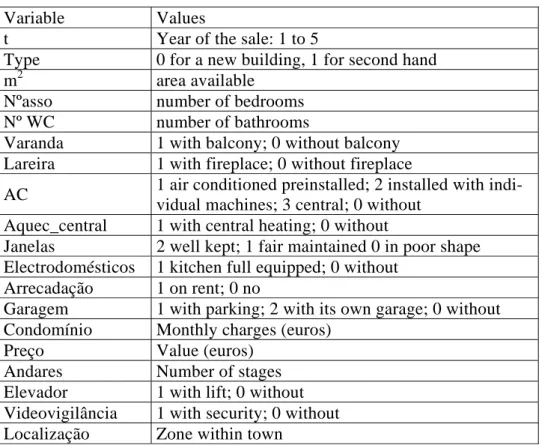
The real price of each transaction was recorded, with a large set of variables associated to each property, as show below in Table 1. About half of apartments are new.
Variable Values t Year of the sale: 1 to 5
Type 0 for a new building, 1 for second hand
m2 area available
Nºasso number of bedrooms Nº WC number of bathrooms
Varanda 1 with balcony; 0 without balcony Lareira 1 with fireplace; 0 without fireplace
AC 1 air conditioned preinstalled; 2 installed with indi-vidual machines; 3 central; 0 without
Aquec_central 1 with central heating; 0 without
Janelas 2 well kept; 1 fair maintained 0 in poor shape Electrodomésticos 1 kitchen full equipped; 0 without
Arrecadação 1 on rent; 0 no
Garagem 1 with parking; 2 with its own garage; 0 without Condomínio Monthly charges (euros)
Preço Value (euros)
Andares Number of stages Elevador 1 with lift; 0 without Videovigilância 1 with security; 0 without Localização Zone within town
Table 1: Some Variables recorded for each apartment
In addition to these features, was later recorded the location of each zone, and associated to it a coefficient. We assume that this coefficient, defined by the fiscal authorities, is distinctive of the area where the property is located because it meets the following as-pects: accessibility, proximity to social amenities, public transport services and localiza-tion in areas of high value real estate market. This coefficient can vary between 0.35 and 3 respectively in situations of dispersed housing in rural areas, and in areas with high market value. In the case of Castelo Branco, particularly in the locations studied, this co-efficient varies only between 0.9 and 1.2. Values of localization coco-efficient are defined by the municipality in its Código do Imposto Municipal sobre Imóveis (CIMI) and it can be observed at http://www.e-financas.gov.pt/SIGIMI/.
Thus, it was also defined an 'index location' for each part of the town, with a larger range of values between 0 and 1, validated by real estate agents and it reflects other approaches, such as whether the area is new, with wide streets lined with and with easy parking or whether it is an area with a large cluster of buildings, enclosed, poorly lit and with parking difficulties. In relation to the sale price, given that we have a period of five years, a price index was applied to deflate the prices.
5 Estimation of a hedonic model
5.1 New apartmentsTo obtain a hedonic model that best explains the price of new buildings according to their characteristics, several tests were conducted.Estimation was done using SPSS v.18. The model obtained, is presented in (1). The explanatory variables being the usable area, the interaction between the number of rooms and number of bathrooms, garage, heating, and the coefficient of geographic location as we can see in (1).
2 Pr 31381, 631 525,885 1085, 712 º º 6044,199 52474, 046 _ 3934,831 i i i i i i eço m N asso N WC AC
Coef loc Garagem
= − + × + × × + × +
+ × + × (1)
The coefficient of determination obtained was 81.0%. The standard error of estimation obtained was 11.929,83€, and the percentage of the mean absolute error is relatively low, with a value of 11.5% over the actual selling price.
The analysis of residuals shows homokedasticity and normality. The p-value in the Normality test was 0.567. The Durbin-Watson statistic had a non conclusive value of 1.583. The index of multicollinearity obtained was 58.175, but the highest value of VIF obtained was 2.317, and its tolerance value equal to 0.432, thus, we concluded that there were no serious problems with the estimation of regression coefficients due to the pres-ence of collinearity in the exogenous variables.
Two outliers were also detected, of some importance, and it was decided to remove these properties from the sample. Although the accuracy of the new model is substantially the same (79.9%) because they were real data, but different type of apartments, one due to its large area of 225m2, with availability of parking and central air conditioning; it was sold for 230.000,00 euros. And the other, was smaller (110 m2), but with three rooms and two bathrooms, and with a garage, but with a very affordable price of 70 thousand euros. 5.2 Non-new apartments
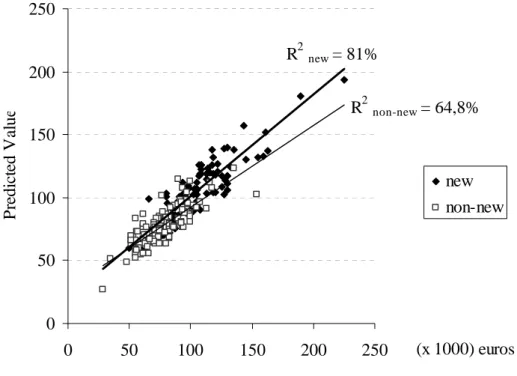
In this case, the best model is described in (2) and includes, as in the previous one, the following variables: garage availability and area, as well as the number of bathrooms, the conservation index of the windows, the index location, and the time variable, t, ranging between 1 and 5, which refers to each of the years under study. The determination coeffi-cient is 64.8% (Figure 1). The standard error of the model is 11.745,24 euros and the rela-tive mean absolute error, 15.14% of the sale price.
Pr 5362,950 265,320 2 3459, 437 8669, 647 5745,189 º 6693, 625 55647,864 i i i i i i eço m t Janelas N WC Garagem IndiceLoc = − + × − × + × + × + × + × (2)
A graphic analysis of residuals shows Normality and homokedasticity. The p-value of the goodness of fit is p = 0.561. The Durbin-Watson statistics has a value of 2.12 and therefore we can say no first order autocorrelation is detected. The index of multicollin-earity obtained was 35.184, and the highest VIF value was 1.683, and its tolerance was equal to 0.594, thus indicating no problems with the estimation of regression coefficients due to the presence of collinearity among the exogenous variables.
R2non-new = 64,8% R2new= 81% 0 50 100 150 200 250 0 50 100 150 200 250 (x 1000) euros P re d ic te d V alu e new non-new
Figure 1: Real price vs estimated price
6 Results
As the real estate market is depending of the characteristics of each property, the implicit or hedonic prices of each of then, are taken from the corresponding regression coeffi-cients in the models [43].
Thus, hedonic methodology allows the forecasting of sale prices of properties, and can set up guidelines for the potential buyers, both overall and for each of the characteristics that contribute to the global asking price.
6.1 Implicit prices for new apartments
For apartments with the same number of rooms and bathrooms, no garage, an area with the same coefficient of location and installation of central air conditioning, the buyer will pay more than 525,885 euros per m2. If a parking space is available, the other variables remaining constant, the price increases in 3.935 euros, and if a garage is associated to the property, this difference doubles itself.
The value that the buyer will pay for an apartment located in an area where the location is of 1, increases in 52.474 euros, but if it is an area whose coefficient is 1.1, you have to pay an extra 5.247,4 euros. With pre-installation of air conditioning, the selling price in-creases by 6.044 euros, but if there is already central air conditioning, that figure triples.
For the interaction between the numbers of bathrooms and rooms, the analysis is not so immediate, but suppose, the following simpler situation: in a house with a single room and one bathroom, the selling price has increased by 1.086 euros, but adding another room, while keeping a bathroom, this increase will have doubled.
6.2 Implicit prices for non-new apartments
In this case an additional square meter will increase the price by 265,32 euros. If the apartment has been sold in 2005, the estimated price decreases approximately by 3.459 euros, but if it was sold in 2009, this reduction is fivefold, to around 17.295 euros. If parking is available the increase is 6.693,625 euros, witch double for a garage associated to the property.
Rates used in the conservation status and the quality of windows are important, while the buyer is willing to pay more than 8.669 euros, where these are in fair state, and twice if they are in good condition. In relation to the index location, the apartment situated in a very good place, will fetch approximately another 55.648 euros.
Regarding the number of bathrooms for each apartment, the sale price is increased by 5.745 euros for an additional one. In relation to the year in which the house was sold, there is a decrease of 3.459 euros per year, keeping other variables constant.
7 Conclusions
Actual situation of the real estate markets and the non usual evolution of the price of dwellings explain the importance of a clear analysis of the behaviour of the economics agents involved, with the implications in other sectors of the economy of a region.
In Castelo Branco, in the period from 2005 to 2009, the price of non-new apartments has been falling, reaching an average of 17.300 euros. In the case of new buildings, with just five explanatory variables (localization, size of the property, an interaction between the number of bathrooms and rooms, the presence of a garage and of air conditioning equipment) originate a determination coefficient of 81%. For non-new apartments, an-other model has to be applied, and the determination coefficient falls under 65%; the cor-responding exogenous variables also differ: beside de surface, garage included or not and localization, the number of bathrooms is significant, as well as a conservation or mainte-nance index and the age of the building.
The markets of new and second hand houses, are, different as we saw earlier in Figure 1, but the three stated variables (localization, area and garage), and the number of bath-rooms are of importance in both. This could lead to a classification of properties, cluster-ing them in homogenous groups, and estimate the correspondcluster-ing models in each of them. As Castelo Branco is a medium sized town, in central Portugal, the methodology can be extended to other areas, including a new variable related to add on of the property: the so-called comfort index. The objective to extend the methodology to most parts of the coun-try can be achieved with minor adaptations.
Acknowledgments
We would like to thank those in charge of real estate agencies GRADUZ, LING, SGH and IMOFACTOR of Castelo Branco. Our sincere thanks for providing data that made this study possible.
References
[1] R. J. A. Reis. Avaliação de empreendimentos residenciais em Lisbon: estimativa de valor de
[2] P. N. Balchin and J. L. Kieve. Urban land economics. McMillan, London, 3rd edition, Sep-tember 1986.
[3] R. Robinson. Housing economics and public policy. Studies in planning, McMillan, London, April 1979.
[4] H. Reis and J. S. Silva. Índices de preços hedónicos de automóveis ligeiros de passageiros novos em Portugal (1997-2001). Banco de Portugal, Boletim económico, 8(4): 21-26, Dezembro de 2002.
[5] P. A. B. R. Pires. Comparação de variantes de redes neuronais artificiais e dos Modelos Mixed Logit e Logit Multinomial na aquisição de produtos em supermercados. Conocimiento,
Innovación y Emprendedores: Camino al Futuro, 2099-2113, 2007.
[6] C. Y. Yiu and C. S. Tam. A review of recent empirical studies on property price gradients.
Journal Real State Literature, 12(3): 307-322, December 2004.
[7] K. J. Lancaster, A New Approach to Consumer Theory. Journal Political Economy, 74(2): 132-157, April 1966.
[8] S. Rosen. Hedonic prices and implicit markets: product differentiation in pure competition.
Journal of Political Economy, 82(1): 34-55, January-February 1974.
[9] M. J. Bailey, R. F. Muth and H.O. Nourse. A regression method for real estate price index construction. Journal of the American Statistical Association, 58(304):933-942, December 1963. [10] M. F. M. T. L. Pinho. Funções hedónicas de Preços para o mercado de habitação:
aplica-ção às cidades do Porto e Aveiro. Master Thesis, Faculty of Economics, University of Porto,
Portugal, 1992.
[11] P. F. G. Carvalho. O mercado de habitação em Portugal. Master Thesis, Faculty of Econom-ics, University of Coimbra, Portugal, September 1995.
[12] M. S. Moreira. A dinâmica pública local e o valor da habitação: Uma aplicação à Área
Metropolitana do Porto, Master Thesis, Faculty of Engineering, University of Porto, Portugal,
December 2000.
[13] J. R. G. M. Guimarães. Índice de Preços Hedónicos no Mercado Habitacional: Análise
Exploratória no Quadro do Sistema Estatístico Nacional. Master Thesis, Faculty of Economics,
University of Porto, Portugal, April 2004.
[14] E. M. N. Jesus and J. M. C. Rodrigues. Um sistema de apoio à decisão multicritério para avaliação do património edificado (habitação), Instituto de Engenharia de Sistemas e
Computa-dores de Coimbra, Research Report Nº 03, 2004.
[15] J. L. Marques and E. A. Castro. Avaliação Hedónica da ocupação urbana residencial: uma análise empírica aplicada a um centro urbano. In Proceedings of the 13th Conference of APDR, University of Açores, Portugal, July 2007.
[16] P. M. Couto. Avaliação Patrimonial de Imóveis para Habitação. Doctoral Thesis, Portugue-se National Civil Engineering, Lisbon, Portugal, July 2007.
[17] M. J. Valente and R. N. Baleiras. Spatial effects on Housing Price Predictions for Guarda city. In Proceedings of the 13th Conference of APDR, Universidade dos Açores, Portugal, July 2007.
[18] F. S. Neto. Aplicação de um modelo hedónico de avaliação a edifícios habitacionais no
[19] A. F. Tarré. Análise de valores de avaliação de apartamentos no âmbito do crédito à
habita-ção, para duas zonas distintas do concelho de Lisboa: recurso a Modelos Hedónicos. Master
Thesis, ISEG, Lisbon, Portugal, March 2009.
[20] J. L. Marques, E. A. Castro and A. A. Bhattachacharjee. localização urbana na valorização residencial: Modelos de autocorrelação espacial. In Proceedings of the 15th Conference of APDR,
Cabo Verde, July 2009.
[21] E. M. Rebelo. Land economic rent computation for urban planning and fiscal purposes. Land
Use Policy, 26(3): 521-534, July 2009.
[22] K. A. Kiel and J. E. Zabel. Location, Location, location: The 3L Approach to house price determination. Journal of Housing Economics, 17(2):175-190, June 2008.
[23] H. A. Sander and S. Polasky. The value of views and open space: Estimates from a hedonic pricing model for Ramsey Country, Minnesota, USA. Land Use Policy, 26(3): 837-845, July 2009.
[24] D. C. Estrella. Analysis of the impact of London underground on the supply value of
residen-tial real estate. Master Thesis, ISEG, Lisbon, Portugal, November 2008.
[25] M. Bazyl. Hedonic price model for Warsaw housing market. Department of Applied
Econo-metrics, Warsaw School of Economics, 42:1-17, December 2009.
[26] P. Juusola. Estimating Economic Values of Meadows and Grazings using Hedonic Housing Modeling and GIS. CISEG, 5:1-22, March 2009.
[27] K. A. Kiel. Environmental Contamination and House Values. College of the Holy Cross,
Department of Economics, 0601: 121-142, January 2006.
[28] A. Troy and J. M. Grove. Property values, parks, and crime: A hedonic analysis in Balti-more, MD. Landscape and Urban Planning, 87: 233-245, June 2008.
[29] C.Y. Jim and W. Y. Chen. External effects of neighbourhood parks and landscape elements on high-rise residential value. Land Use Policy, 27(2): 662-670, April 2009.
[30] J. P. Cohen and C. C. Coughlin. Spatial Hedonic Models of Airport Noise, Proximity, and Housing Prices. Federal Reserve Bank of St. Louis, 2006-026C:1-34, September 2007.
[31] S. Stevenson. New empirical evidence on heteroscedasticity in hedonic housing models.
Journal of Housing Economics, 13:136-153, January 2004.
[32] G. S. Sirmans, L. MacDonald, D. A. Macpherson and E. N. Zietz. The Value of Housing Characteristics: A Meta Analysis. Journal Real Estate Finantial Economy, 33(3): 215-240, No-vember 2006.
[33] J. S. Lee and M-H. Li. The impact of detention basin on residential property value: Case studies using GIS in the hedonic price modelling. Landscape and Urban Planning, 89(1-2): 7–16, January 2009.
[34] R. A. Dantas, A. M. Magalhães and J. R. Vergolino. Avaliação de imóveis: a importância dos vizinhos no caso de Recife. Revista de Economia Aplicada, 11(2): 231-251, June 2007. [35] A. F. G. Pozo. Housing Market in Malaga: An Application of the Hedonic Methodology.
Proccedings of the European Regional Science Association conference, ersa06p101, August
2006.
[36] A. F. G. Pozo. A Nested Housing Market Structure: Additional Evidence. Housing Studies, 24(3): 373 – 395, May 2009.
[37] Y. Kestens, M. Thériault and F. Rosiers. Heterogeneity in hedonic modelling of house prices: looking at buyers´ household profiles. Journal Geographical Systems, 8(1):61-96, March 2006.
[38] O. Bover, O. and P. Velilla. Hedonic House Prices Without Characteristics: The case of new multiunit housing. European Central Bank, Working Paper nº 117, January 2002.
[39] J. M. Caridad and P. Brañas. Demanda de características de la vivienda en Córdoba: un mo-delo de precios hedónico. Revista de Estudios Regionales, 46(1996): 139-153, Sep-Dec 1996. [40] J. M. Caridad and N. Ceular. Determinación de los precios implícitos en bienes inmuebles: Una alternativa a la modelización hedónica, Revista de Estudios Regionales, 71(2004): 85-105, Sep-Dec 2004.
[41] S. C. Bourassa, E. Cantoni and M. Hoesli. Spatial Dependence, Housing Submarkets, and House Price Prediction. The Journal of Real Estate Finance and Economics, 35(2): 143-160 2007.
[42] J. Hansen. Australian House Prices: A comparison of Hedonic and Repeat-Sales Measures.
Economic Record, 85(269): 132-145, June 2009.
[43] R. A. Dubin. Predicting house prices using multiple listings data. Journal of Real Estate