
25-27 September 2019, Guimarães, Portugal
IT’S WHAT’S INSIDE THAT COUNTS: AN ASSESSMENT METHOD TO
MEASURE THE RESIDUAL STRENGTH OF ANOBIIDS INFESTED
TIMBER USING MICRO-COMPUTED TOMOGRAPHY
João L. Parracha1, Manuel F. C. Pereira2, António Maurício2, José S. Machado3, Paulina Faria4 and Lina Nunes5
1 FCT-NOVA and Structures Department, National Laboratory for Civil Engineering 2 CERENA and Instituto Superior Técnico, University of Lisbon
3Structures Department, National Laboratory for Civil Engineering 4CERIS and Faculty of Science and Technology, NOVA University of Lisbon 5CE3C and Structures Department, National Laboratory for Civil Engineering
pp. 485-494
Keywords: Timber, Anobiid infestation, Micro-computed tomography, Screw withdrawal, Dam-age assessment.
Abstract
The safety assessment of old timber structures is an important issue due to the long-term behav-ior of wood and the structural complexity found in some older constructions. If the structure is degraded due to the action of wood-boring insects, the complexity of the analysis increases. The objective of the work reported in this paper is to provide an assessment method to measure the residual strength of pine structural elements degraded by anobiids. Samples of degraded tim-ber were submitted to micro-computed tomography (μ-XCT) to quantify density loss being this parameter of fundamental importance for the assessment of timber structures as it is highly cor-related with timber mechanical properties. During the μ-XCT study an empirical correlation be-tween lost material percentage (consumed by beetles) and timber apparent densities (original – before degradation and residual – after degradation) was established.
The results showed an experimental high correlation (r2=0.66) between original apparent density and lost material percentage and an even higher correlation (r2=0.87) between residual apparent density and lost material percentage which confirms that μ-XCT can be validly used contributing to the 3D visualization and quantification of timber degraded elements.
After the μ-XCT study, screw withdrawal and shear parallel to grain tests have been made in maritime pine degraded timber. Screw withdrawal force and shear strength values were related with density loss (r2=0.64 for screw withdrawal; r2=0.65 for shear strength parallel to grain). A novel assessment method for evaluating the impact of anobiid damage on timber degraded struc-tural elements based in four major steps is proposed enabling a more quantitative assessment of the timber elements residual strength and, therefore, contributing to reduce unnecessary re-placement and to provide foundations required to perform experimental modelling tests.
1 INTRODUCTION
Timber is known as one of the oldest and more widespread construction materials. Howev-er, this natural material is susceptible to biodeterioration, which is frequently caused by agents like fungi and insects [1]. In Portugal, the insects that cause most problems to timber struc-tures are termites (Blattodea, Termitoidae) or wood boring beetles (Coleoptera) of which sev-eral representatives of the anobiid family play a major role in the deterioration problems of older structures. These beetles’ attack is normally limited to sapwood [2] and the damage caused is easily recognizable on the outside of timber elements by the size and the shape of emergency holes and the type of frass [3].
A structural assessment is certainly required in cases of insect damage on timber elements and actions must be taken to ensure an adequate safety level. The correct identification of the responsible insects is essential to better set up valid diagnosis and remediation strategies. Nevertheless, due to a diffuse damage create by these insects, the assessment of the structural soundness of the remaining timber becomes more difficult [4]. The damage caused by anobi-ids is a frequent justification for partial or complete replacement of structures since it is diffi-cult to assess the structural soundness of the “remaining” timber [5]. Furthermore, degraded structural elements are often wrongly assessed as not having any residual strength and thus replaced. It happens that, most of the times, there is no need to remove those elements since the structural safety is still guarantee or can be achieved with appropriate strengthening [6].
When the structure is not replaced, most of times, the effect of anobiids’ attack is consid-ered by assuming a significantly reduced cross section or reduced mechanical properties for that cross sections [7]. This approach may although be too conservative, as even the insect damaged-layer can often be able to resist load.
Several studies have been made [6,7,8] with the objective to evaluate the impact of anobiid damage on timber structures. However, the degradation intensity on the structure was mostly inferred from an examination of the surface appearance. This visual approach is not complete-ly representative of the real degradation state as the intensity of the internal holes tends to be much greater than that on the surface [8]. Then, it is important to know the lost material per-centage (wood consumed by beetles) as well as the loss of density, in order to conclude on structural safety. Knowledge of timber original and residual apparent density is of fundamen-tal importance to assess timber soundness as these parameters are highly correlated with tim-bers mechanical properties.
The main objective of the work reported in this paper was to evaluate the impact of anobiid damage on pine timber structures by establishing a valid correlation between lost material percentage (obtained using micro-computed tomography) and original/residual density and by developing an initial approach for a method for an on-site assessment of infested timber struc-tural elements based on a screw withdrawal test.
2 EXPERIMENTAL PROGRAMME 2.1 Sampling
Timber samples used in this study came from a beam of maritime pine (Pinus pinaster Ai-ton) retrieved from a mid-20th century roof structure of a residential building located in Lis-bon, Portugal. The beam presented varying degrees of infestation restricted to the sapwood and mainly caused by insects identified as anobiids (Coleoptera, Anobiidae). Furthermore, frass characteristics as well as the size of tunnels and the presence of cocoons inside the wood allowed the identification of Nicobium castaneum Olivier has the main species responsible for the degradation, although the presence of other anobiid species cannot be excluded.
The beam was then divided in 4 segments (3 presenting degradation and the heartwood (Fig. 1a) and 17 samples of approximately 40 20 40 mm3 were cut (Fig 1b). After that, and because these initial samples cannot be submitted to a procedure like micro-computed tomography due to their relatively large size, samples were cut again in order to obtain 17 “new” paired samples with approximately 40 20 10 mm3 (Fig 1c) [4].
Figure 1: Sampling [4]: (a) timber beam initially divided in 4 segments; (b) some of the 17 samples resulting from the first cut of the beam and (c) some of the 17 “new” paired samples resulting from the second cutting
process.
All the samples were conditioned in a climatic room at a temperature of 20±2ºC and a rela-tive humidity (RH) of 65±5% and maintained in this condition until required for mechanical testing of micro-computed tomography scanning procedure [9].
2.2 Micro-computed tomography study
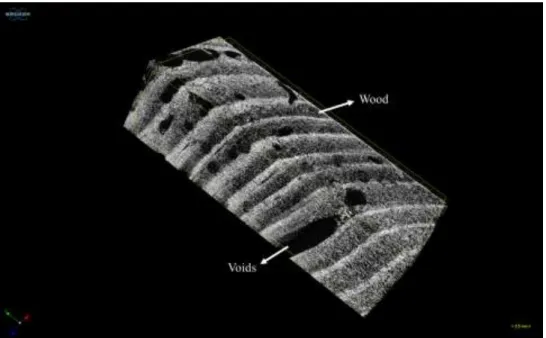
Micro-computed tomography (μ-XCT) was used as a 3D microscope to assess the anobi-ids’ tunnelling process result (visualizing its spatial distribution and morphology) and calcu-late void’s volume (lost material) [16] (Fig.2). By knowing this percentage of lost material, the loss of density can be estimated. After that, the loss of density can be correlated with tim-ber mechanical properties via screw withdrawal and shear parallel to the grain tests enabling a valid quantitative assessment of the timber elements residual strength.
The samples were scanned using a compact desktop with micrometric range resolution, μ-XCT Skyscan 1172 microtomograph (Bruker Instruments, Inc., Billerica, Massachustets), us-ing computer-controlled tomography acquisition, processus-ing, reconstruction and analysis software packages (http://bruker-microct.com/products/1172.htm).
The parameters used in the scanning procedure (acquisition) were optimised considering the studied material, the maximum possible resolution (18.09 μm) for the selected samples
and the required output parameters (wood – skeleton and voids – empty spaces). Concerning the acquisition process, the best choice of the scanner settings is of fundamental importance since this choice affect substantially image quality. Therefore, these settings must be selected considering the aim of the problem to be studied and the physical, geometrical and operating constraints of the scanner. In this study, the voltage selected for the X-ray source was 60 kV and an aluminium filter with a tick of 0.5 mm was used. The X-ray source was operated at 165 μA and the samples were image through 180 degrees of rotation at 0.7-degree increment’ steps. The total acquisition time for each sample was approximately 1.5 h with a total of 288 acquired images. These acquisition parameters were applied to the study of all 17 samples.
Figure 2: Reconstructed 3D object showing the parameters of interest: wood and voids.
2.3 Data analysis
The output parameters are exported from CTAn software in a form of a txt file. In this file, among the various output parameters values that can be estimated, two of them can be high-lighted: total volume, referring to the volume of the sample (wood and voids) and wood
vol-ume, relating to the wood itself (skeleton). These parameters correspond to those of interest
previously defined, as voids volume will correspond to the difference between total volume and wood volume. Wood apparent density was assessed at 12% moisture content according to [10]. Original apparent density is obtained by the ratio between the sample weight and wood
volume whilst residual apparent density is obtained by the ratio between the sample weight
and total volume.
2.4 Methods
2.4.1. Screw withdrawal perpendicular to grain
Screw withdrawal tests were carried out considering the method specified in [11] and con-ducted in a universal testing machine (Schimazu AG-250KNIS-MO), capable of measuring the load applied with an accuracy of 1% in the range 1kN to 250 kN. A metal screw with an outer diameter of 6 mm and a length of 60 mm was used. The screw was inserted in the direc-tion perpendicular to the grain and no distincdirec-tion was made between the radial and tangential directions since the results do not differ significantly [8].
In this study, four screw withdrawal tests were performed at four different places of the beam before the first cutting process. Before measurements, a pre-drilled hole of 4 mm in
di-ameter was made and the penetration length of the screws was 20 mm to enable a comparative profile of strengths at a range of depths. The samples that were submitted to μ-XCT and those that were tested to shear parallel to the grain, due to their relatively small size, cannot be sub-mitted to a semi-destructive test such as is the case of the screw withdrawal test. Therefore, the timber places along the beam where the screw withdrawal test was performed were not used in samples that would be submitted to μ-XCT scanning procedure or shear tests.
2.4.2. Shear parallel to grain
Shear parallel to the grain tests were performed according to [9] and were conducted under deformation-control at a rate of 1 mm min-1 in a universal testing machine (Schimadzu), with a load cell of 250 kN. The machine can measure the applied load with an accuracy of 1% in the range of 1 kN to 250 kN. Shear strength parallel to the grain corresponded to the maxi-mum load attained on samples. The load was applied at a constant rate so that the maximum load was attained in the interval 300 ± 120 seconds.
The test was performed in nine samples (three samples for each three proposed degradation level). The glue used in these tests was an epoxy glue Araldite® with a maximum tension
strength of 320 kg/cm2 in 48 hours.
3 RESULTS AND DISCUSSION 3.1 Micro-computed tomography study
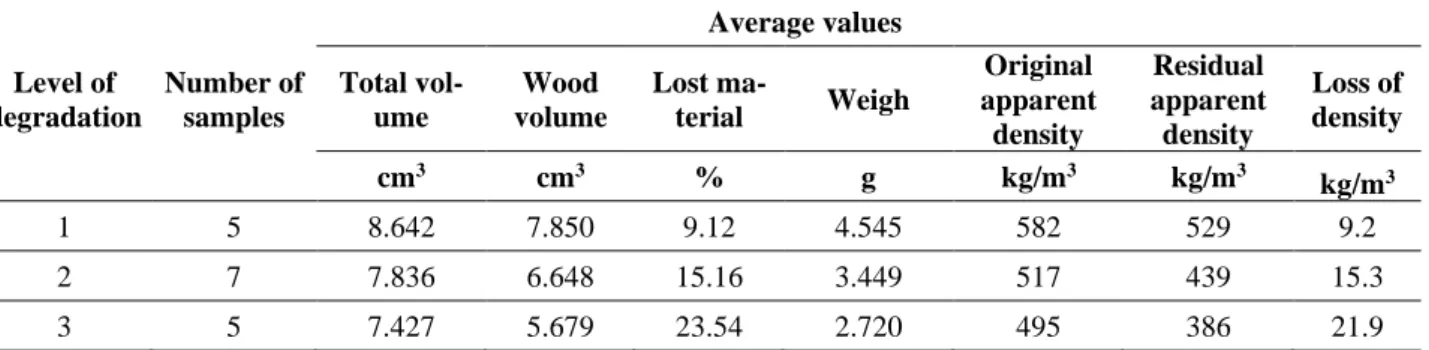
Table 1 presents the results obtained.
Table 1: Output parameters’ values, sample weigh and apparent densities per level of degradation.
Average values Level of degradation Number of samples Total vol-ume Wood volume Lost ma-terial Weigh Original apparent density Residual apparent density Loss of density cm3 cm3 % g kg/m3 kg/m3 kg/m3 1 5 8.642 7.850 9.12 4.545 582 529 9.2 2 7 7.836 6.648 15.16 3.449 517 439 15.3 3 5 7.427 5.679 23.54 2.720 495 386 21.9
According to the results obtained using micro-computed tomography (parameters of inter-est), the samples were distributed over three levels of degradation: level 1 (< 10% lost materi-al); level 2 (10 to 20% of lost materimateri-al); level 3 (>20% lost material). A Shapiro-Wilk test has confirmed the normality of the results (p-value = 0.276).
The obtained results for apparent densities (original and residual) decrease with increasing percentage of lost material, as expected. With regards to the proposed level definition, the highest density loss occurred for level 3, with a loss of 21.9 ± 1.4%. For levels 1 and 2, the loss of density was 9.2 ± 0.64 % and 15.3 ± 3.5 %, respectively. Considering all samples, it was obtained an average loss of density of 80 ± 24 kg/m3 (15.4 ± 5.5%), an average original theoretical density of 529 ± 53 kg/m3 and an average residual density of 449 ± 70 kg/m3.
The obtained results indicate a medium correlation (r2 = 0.60) between lost material per-centage and original timber density, which becomes higher (r2 = 0.83) when comparing lost material percentage and residual density (Fig.3). The results show that the higher the density, the lower the percentage of lost material, as expected. The obtained results suggest it is very
likely that timber density is a determinant of the quality of timber but also supports the claim that μ-XCT methodology was well applied in this research study.
Figure 3: Correlations between original density and lost material percentage (left) and residual density and lost material percentage (right).
3.2 Screw withdrawal perpendicular to grain
The average results obtained for screw withdrawal perpendicular to the grain are lower than those observed in previous studies [6,8]. However, the level of deterioration caused on timber by the beetles seem visually to be much higher. The values of C.V are relatively large which can be explained by the differences found in the level of degradation along the beam. The results are presented in Table 2, where CV is the coefficient of variation.
Table 2: Screw withdrawal test results.
Parameter
Values
Average (μ) Minimum Maximum Standard deviation (σ) C.V (%)
Fmáx [kN] 0.46 0.28 0.69 0.19
41.7
f [N/mm2] 6.62 3.99 9.86 2.76
The Fig. 4 shows the obtained correlations between densities (original and residual) and the screw withdrawal forces. It should be noted that the four places along the beam where the screw withdrawal tests were performed, were not submitted to μ-XCT or shear tests, as previ-ously stated. So, the real density values for that particular test places are still unknown. This, however, is not a substantial problem, since the values used in the correlations of Fig. 4 are those that have been estimated for the samples near the screw withdrawal test site.
Figure 4: Correlations between screw withdrawal force and original density (left) and screw withdrawal force and residual density (left) [4].
The results show a high correlation (r2 = 0.80) for original density and an even higher cor-relation (r2 = 0.84) for residual density (Fig. 4). As is to be expected, higher values of density lead to greater values of screw withdrawal forces.
3.3 Shear parallel to grain
The following Table 3 presents the results obtained for shear parallel to the grain tests. Fig. 5 presents the obtained correlations between densities (original and residual) and the shear strength. This figure indicates a medium correlation (r2 = 0.75) for original density and a high correlation (r2 = 0.82) for residual density. These coefficients of determination suggest that the shear parallel to the grain test applied on timber degraded by anobiids can be likely to be quite explanatory of the behaviour of the material at breaking. This is because the tunnels formed by beetles are preferentially formed in the early wood and tend to progress tangent to adjacent late wood [6]. It is in this direction and in zones with greater concentration of tunnels that the material has a greater tendency to break (Fig. 6). The samples crushed easily realising a large amount of bore dust, which indicates the high level of degradation of timber.
Figure 5: Correlations between shear strength and original density (left) and shear strength and residual density (right) [4].
3.4 Description of the semi-destructive assessment method proposed
The proposed procedure applies the concept introduced by [8], however with some chang-es. The method is based on the maximum force required to withdraw a screw which is insert-ed on the timber’ surface in a direction perpendicular to the grain. No distinction was made between the radial and the tangential directions since the results are not expected to differ sig-nificantly [8].
In this article, two relationships estimated for deteriorated timber elements are shown. These correlations can be used to estimate density loss of degraded maritime pine elements (Fig. 4) and its associated shear strength parallel to the grain (Fig. 5) via the maximum screw withdrawal force, determined in situ.
The procedure, based on laboratory tests, can be briefly summarized in the following steps: • A preliminary visual inspection of each timber member for identification of the
most degraded zones and to identify the presence of defects (knots, fissures, slope of the grain) must be conducted. The in situ visual inspections is recognized by several authors as the first step for the assessment of a timber structure [5, 12]. Ital-ian standard UNI 11119 [13] refers to the principles that must be applied during the inspection procedure as well as the necessary conditions for such diagnosis inspec-tion. The screw withdrawal test should not be performed in places where the pres-ence of defects was detected. The results will be affected by the prespres-ence of such defects (i.e. when the screw is in or around knots, the provided results will be high-er) [14].
• Identification of the screw withdrawal test positions. Screw withdrawal test provide a local parameter, so tests must be applied to multiple locations, and the average re-sult should be used to estimate member properties [15]. However, if the structure has historic interest, this approach can be difficult to perform because the damage to the structure must be kept to a minimum. This fact reinforces the importance of the visual inspection (point 1).
• During the performance of the screw withdrawal test, the type of screw, the outer diameter of that screw, the penetration length, the penetration direction and the pre-drilling must be checked. The results of the present research are only applied if the setup conditions described in section 2.4.1 are followed. Any change in the applica-tion of the technique will lead to the producapplica-tion of anomalous results. Using the correlations of Fig. 4 to estimate density loss (due to the degradation caused by anobiids) as a function of the screw withdrawal force.
• Once the loss of density is obtained can be correlated with shear strength parallel to the grain using correlations of Fig. 5. At the end it can be concluded on the residual resistance and thus contribute to a better quantitative assessment of the structural elements.
4 CONCLUSIONS
A method for evaluating the impact of anobiid damage on timber structures is presented. It is based in four major steps: visual inspection of each deteriorated timber member; semi-destructive prediction of the density loss based on a screw withdrawal test performed in situ; using correlations of Fig. 4 to estimate the loss of density; using correlations of Fig. 5 to pre-dict shear strength parallel to the grain and thus to conclude on the residual resistance.
Although good results were obtained for degraded timber elements, the method was devel-oped in laboratory though it is important that the technique can be used in situ. For this pur-pose, the experimental work now needs to be extended using portable devices available to
measure screw withdrawal resistance and performing a larger number of measurements. When in situ, the screws should be pulled slowly and steadily, according to the methods used on laboratory. This extension is also important to the validation of the proposed method, as well as to estimate and verify valid correlations for other species.
ACKNOWLEDGEMENTS
The authors acknowledge the support given by Portuguese Foundation for Science and Technology (FCT) within research projects: PTDC/EPH-PAT/4684/2014 (DB-HERITAGE – Database of building materials with historical and heritage interest), PTDC/ECM-EST/1072/2014 (Pro-Timber – Probabilistic assessment of timber structures) and Pest-OE/CTE/UI4028/2011 (CERENA).
REFERENCES
[1] Eaton, R. A. and Hale, M. D. C. 1993. Wood: Decay, Pests and Protection. Chapmman & Hall, London, UK.
[2] EN 350:2016. Durability of wood and wood-based products – Testing and classification of the durability to biological agents of wood and wood-based materials. European Committee for Standardization, Brussels, Belgium.
[3] Bravery, A. F., Berry, R. W., Carey, J. K. and Cooper, D. E. 1992 Recognizing wood rot and insects damage in buildings. Building Research Establishment (BRE), Garston, UK. [4] Parracha, J. L., Pereira, M. F. C., Maurício, A., Machado, J. S., Faria, P. and Nunes, L. 2019. “A semi-destructive assessment method to estimate the residual strength of maritime pine structural elements degraded by anobiids”. Materials and Structures. Springer, 52:54. [5] Cruz, H., Yeomans, D., Tsakanika, E., Macchioni, N., Jorissen, A., Touza, M., Mannucci, M. and Lourenço, P. B. 2015. “Guidelines for on-site assessment of historic timber structures”.
International Journal of Architectural Heritage. Taylor & Francis, 9(3), 277-289.
[6] Nunes, L., Parracha, J. L., Faria, P., Palma, P., Pereira, M. F. and Maurício, A. 2019. “Towards an assessment tool of anobiid damage of pine timber structures. In IABSE
Symposi-um – Towards a Resilient Built Environment – Risk and Asset Management. Guimarães,
Por-tugal, 1734-1741.
[7] Cruz, H. and Machado J. S. 2013. “Effects of beetle attack on the bending and compres-sion strength properties of pine wood”. Advanced Materials Research. Scientific.Net, 778, 145-151.
[8] Gilfillan, J. R. and Gilbert, S. G. 2001 “Development of a technique to measure the resid-ual strength of woodworm infested timber”. Construction and Building Materials. Elsevier, 15, 381-388.
[9] EN 408:2010. Timber structures – Structural timber and glued laminate timber – Determi-nation of some physical and mechanical properties. European Committee for Standardization, Brussels.
[10] ISO 16061-1:2014. Physical and mechanical properties of wood – Test methods for small clear wood specimens – Part 1: Determination of moisture content for physical and mechani-cal tests, International Organization for Standardization, Genève.
[11] EN 1382:2000. Timber structures – Test methods: Withdrawal capacity of timber fasten-ers. European Committee for Standardization, Brussels.
[12] Feio, A. and Machado, J. S. 2015 “In-situ assessment of timber structural elements: Combining information from visual strength grading and NDT/SDT methods – A review”.
Construction and Building Materials. Elsevier, 101, 1157-1165.
[13] UNI 11119:2004. Cultural heritage – Wooden artefacts. Load-bearing structures. On site inspections for the diagnosis of timber members. Ente Nazionale Italiano di Unificazione, Rome.
[14] Kloiber, M., Drdácký, M., Machado, J. S., Piazza, M. and Yamagushi, N. 2015. “Predic-tion of mechanical properties by means of semi-destructive methods: A review”. Construc“Predic-tion
and Building Materials. Elsevier, 101, 1215-1234.
[15] Tannert, T., Anthony, R., Kasal, K., Kloiber, M., Piazza, M., Riggio, M., Rinn, F., Wid-mann, R. and Yamagushi, Y. 2014. “In situ assessment of structural timber using semi-destructive techniques”. Materials and Structures. Springer, 47, 767-785.
[16] Parracha, J. L., Pereira, M. F. C., Maurício, A., Faria, P. and Nunes, L. 2019. Using X-ray micro-CT to evaluate density loss in anobiid infested wood. Proceedings IRG Annual
Meeting, IRG/WP 19-10956, 7 pp.
![Figure 1: Sampling [4]: (a) timber beam initially divided in 4 segments; (b) some of the 17 samples resulting from the first cut of the beam and (c) some of the 17 “new” paired samples resulting from the second cutting](https://thumb-eu.123doks.com/thumbv2/123dok_br/15210208.1019296/3.892.161.736.243.689/figure-sampling-initially-divided-segments-samples-resulting-resulting.webp)
![Figure 4: Correlations between screw withdrawal force and original density (left) and screw withdrawal force and residual density (left) [4]](https://thumb-eu.123doks.com/thumbv2/123dok_br/15210208.1019296/6.892.136.761.884.1087/figure-correlations-withdrawal-original-density-withdrawal-residual-density.webp)
![Figure 6: Rupture of the sample by shear parallel to grain test [4].](https://thumb-eu.123doks.com/thumbv2/123dok_br/15210208.1019296/7.892.310.585.721.1093/figure-rupture-sample-shear-parallel-grain-test.webp)