Dissertation for Obtaining the Degree of
Master in Business Administration
Field of Study: Entrepreneurship / Global Markets & Strategy
Tittle: Learning from startup ecosystems’ examples worldwide: how Lisbon can use its own uniqueness to benefit its young entrepreneurial hub
Author: Abrão Abud Kulaif Neto
Thesis Supervisor: João Borges de Assunção Date: January 2019
Contents
I. Introduction ... 5
II. Theoretical Background ... 7
Ecosystem ... 7
Role of Government ... 8
Road Map ... 9
III. Methodology ... 11
The descriptive analysis ... 11
The quantitative analysis ... 13
IV. Descriptive Analysis ... 14
Lisbon, Portugal... 14
Sao Paulo, Brazil ... 16
Lagos, Nigeria ... 17
Tel Aviv, Israel ... 18
Boston, USA ... 19
V. Qualitative Results... 20
VI. Quantitative Results ... 22
Regressions ... 22
The factor analysis ... 23
VII. Conclusion ... 27
VIII. Appendix A: Full dataset from Startup Genome ... 29
IX. Appendix B: Summary results from the Regressions run ... 29
X. Appendix C: Global Innovation INDEX for the selected countries ... 30
XI. Appendix D: Results from the factor analysis ... 30
Summary Statistics ... 30
Eigenvalues ... 30
Scree Plot ... 31
Correlations between variables and factors ... 31
XII. Appendix E: Results from the factor analysis after the Varimax Rotation... 31
Rotation Matrix ... 31
Percentage of variance after Varimax rotation ... 32
Factor pattern after Varimax rotation ... 32
Correlations between variables and factors after Varimax rotation ... 32
Summary of Figures:
Figure I: Ecosystem, Performance and Outcomes ... 10
Figure 2 - Framework conditions, System Conditions, Outputs and Outcomes ... 11
Figure 3 - Key elements found by the factor analysis for the chosen ecosystems ... 25
Figure 4 - Observations (axes D1 and D2: 58.31%) after Varimax rotation ... 27
Summary of Tables: Table 1 - Holistic diversity of the entrepreneurial ecosystems chosen ... 12
Table 2 - Key Elements with their respective chosen proxies ... 14
Table 3 - summary of the takeaways from the described ecosystems ... 22
Summary
:What are the common characteristics of successful entrepreneurial ecosystems worldwide that Lisbon can use on its benefit in the process of building its own? Aiming to help answering that question, this Master Thesis analyses qualified examples globally of cities that have built a healthy startup ecosystem, together with incipient not so mature cases, while drawing parallels with the newly created one in Lisbon. The methodology used was to compare examples from different continents – South America (São Paulo, Brazil), Africa (Lagos, Nigeria), Middle East (Tel Aviv, Israel) and North America (Boston, United States) -, to identify uniqueness among them that can either be used in Lisbon’s favour, or ultimately be marketed as one of the city’s competitive advantages for the goal of attracting (and retaining) awareness, funding and talents.
The approach combined a specific description of the ecosystems selected and a general quantitative model. Jointly with the descriptive analysis of the entrepreneurial ecosystems mentioned and a final section highlighting the takeaways from each one of them, an own model was created to identify those common elements that helped these ecosystems to succeed. Based on an organogram from Stam (2015) the key elements were divided into "System Conditions": Networks, Leadership, Finance, Talent, Knowledge and Support services/Intermediaries, and "Framework Conditions": Formal Institutions, Culture, Physical Infrastructure and Demand. Those ten elements were quantified using a proxy from a similar category chosen from a list of 101 of published indexes by Global Innovation Index 2018. A factor analysis was then conducted.
What is evidenced is that every ecosystem is unique and has been built under a singular set of conditions and own characteristics. Hence, Lisbon has its own strengthens, such as good weather, great infrastructure and a prosperous business environment to boost its entrepreneurial movement. That specific picture is also enriched by the factor analysis’ outcome, which is that “Framework Conditions” are the key ones from the ten considered, notably Formal Institutions, Culture and Physical Infrastructure, as well as Knowledge as a “System Condition”. That takeaway plays certainly in Lisbon’s favour as the country is highly rated in all those factors. An entrepreneurial ecosystem’s success can be therefore interpreted as being positively correlated with a country’s development, past productivity, quality of life and a possible consequence of great implemented public policies.
Moreover, a well-established entrepreneurial movement ultimately brings a real-life benefit for the population, as well as a pull force in organizational behaviour. It comes with a positive impact across the whole economy, making it also beneficial for the continuance of a good quality of life, development and improvement of future productivity. Thus, the needed basis for the creation is as well improved by its further development. It becomes, as vastly said, a positive snowball effect.
I.
Introduction
A well-known and over-studied subject is the reason behind as well as the consequential benefits for economic activity to cluster. Business natural’s tendency is to cluster in specific geographical locations, according to the old theory. In 1890, the economist Alfred Marshall recognised that cities’ high concentration of people led to two big benefits. The first is lower costs - thanks to shorter distances to transport goods, for example. The second is the smoother flow of information, skills and ideas1. A
century later, that theory was formally introduced as “Clustering”, by Michael Porter. Clustering is a phenomenon linked to geographic concentrations of national industries which origin from vertical or horizontal relationships between companies. Firms in a cluster are often located in a single town or region within a nation (Porter 1990, p. 154). Clusters offer a constructive way to change the nature of the dialogue between the public and private sectors2. Overall, the benefits of companies being
geographically close to each other are, among others, knowledge creation, knowledge transfer, innovation fostering, lower operational costs as a way of spreading the use of better technologies, higher wages and a trigger to foster culture switch within its niche market by leading customers to be more open-minded to new products and services. What was also evidenced is that those benefits were ultimately seen across the whole economy rather than purely near the clusters themselves – a clear example was the spread of new and better technologies causing a decrease in overall costs for the average user of different markets. According to Porter (1990), the power of a cluster lies in fierce competition within it, which obliges the firms to elevate their standards of performance. Aggressive rivalry is induced by the bargaining power of customers who may be in contact with several firms within the cluster. These connections also encourage the flow of information and diffusion of innovations. (Porter 1990, p. 151)3. That exchange of knowledge within a certain cluster is commonly called
‘knowledge spillover’. “The knowledge spillover theory of entrepreneurship suggests that, ceteris paribus, entrepreneurial activity will tend to be greater in contexts where investments in new knowledges are relatively high, since the new firm will be started from knowledge that has spilled over from the source actually producing that new knowledge4”. This concept implies that clusters are networks where
investments in new knowledges are an instrumental element for their ultimate success, therefore the reason for its spread benefit for the creation of new enterprises that may use on their own favour the previous experiences of the stable ones, as well as the ones that failed within a certain industry and/or geography.
1 HANNA, Kat (2017). Why do Business cluster together? British Council.
2 PORTER, Michael E. (1998). Clusters and the New Economics of Competition. Harvard Business Review. 3 PELTONIEMI, Mirva (2004). Cluster, Value Network and Business Ecosystem: Knowledge and Innovation
Approach. Institute of Business Information Management, Tampere University of Technology, Finland
4 ACS, Zoltan J.; AUDRETSCH, David B.; BRAUNERHIELM, Pontus; CARLSSON, Bo (2005). The Knowledge Spillover
Although clusters are still vastly seen today, the field of study evolved to what is called ‘Business Ecosystems’. Business Ecosystem progress from Clustering brings a technological innovation in itself, as the geographical presence for certain industries became less important due to technology. Thus, a Business Ecosystem rejects both regionality and the concept of industry. Moore (1996) claims that modern communication technology and global competition reduces the importance of geography as a way of attracting demand. Similar to clusters, business ecosystems aim to attract and retain talents, also brings also the concept of knowledge spillover, as well as the benefit from the experiences of previous/existing players by tying the networks in a certain location.
On the other hand, business ecosystems, differently from clusters, do not necessarily focus on attracting local demand as they are quite often looking to solve global problems with scalable solutions. This global mindset from the inception increases the probabilities of these lean enterprises to have an overall chance of becoming big corporations in shorter periods. Moreover, it is vastly seen an exchange of contacts between different ecosystems, where people from Boston visit Silicon Valley, for example, to bring fresh ideas to their day to day activities. In Europe, it is also common to see those kinds of interactions. Therefore, Business Ecosystems base their success on both competition and cooperation5.
On a more philosophical, although practical, line of thought, the concept of business ecosystem has a belief of inclusiveness. An attitude of ‘give-before-you-get’ is embedded in the start-up community, culture of widely sharing knowledge experience and expertise6.
Developed Ecosystems are in general built under the concept of self-organization, a spontaneous and ongoing process whose outcome will never be completed in full. According to Mitleton-Kelly (2004), self-organization is defined as a process in which novel structures or features arise in a system without the intervention of an outside actor or an inside controller7. That’s a key topic especially due to government’s
intervention with the idea of creating something from nothing, which generally fails. It is questionable and overall a good discussion of how actors and players can help in boost the business ecosystem, whether it is by creating a buzz, by formal partnerships with universities, or any others, although it is undesirable to have a sort of government control over the ecosystem if the expected mid to long-term outcome is meant to be continuous.
Thus, the purpose of this Master Thesis is to identify the key elements that initially supported successful entrepreneurial ecosystems to succeed while drawing a parallel with Lisbon’s young startup ecosystem, ultimately getting a vision if the city has the needed foundations to become a significant global hub. Part
5 PELTONIEMI, Mirva (2004). Cluster, Value Network and Business Ecosystem: Knowledge and Innovation
Approach. Institute of Business Information Management, Tampere University of Technology, Finland
6 MASON, Colin; BROWN, Ross (2014). Entrepreneurial Ecosystems and Growth Oriented Entrepreneurship.
OECD LEED Programme.
7 PELTONIEMI, Mirva; VUORI, Elisa. Business Ecosystem as the new approach to complex adaptive business
of the theory about the subject considers funding and talents availability as necessary elements to create a scene that would attract more money, retain and attract more skilled people, and so on and so forth. Thus, a first government’s boost would be enough to kick off that snowball effect. Hence, the key questions this Master Thesis wants to address is whether it is true that money and skilled people alone are in fact what triggers a startup ecosystem to be successful and, in case they are not, what are those essential characteristics that can vouch in leveraging a new one, such as Lisbon.
II.
Theoretical Background
EcosystemDespite being a commonly used expression these days, “startup ecosystem” is still an understudied subject, yet to be explored. Also known as “entrepreneurial ecosystem” or “business ecosystem”, the initial challenge is to define what characterizes such expression and what differentiates them from other entrepreneurial environments.
According to Mason & Brown (OECD, 2014), startup ecosystem is “a set of interconnected entrepreneurial actors (both potential and existing), entrepreneurial organisations (e.g. firms, venture capitalists, business angels, banks), institutions (universities, public sector agencies, financial bodies) and entrepreneurial processes (e.g. the business birth rate, numbers of high growth firms, levels of ‘blockbuster entrepreneurship’, number of serial entrepreneurs, degree of sellout mentality within firms and levels of entrepreneurial ambition) which formally and informally coalesce to connect, mediate and govern the performance within the local entrepreneurial environment”.
Following a similar line of thought, although considering a more direct definition is the following by Spigel & Stam (2016): entrepreneurial ecosystems as a set of interdependent actors and factors coordinated in such a way that they enable productive entrepreneurship within a particular territory.
As per 2017 Global Entrepreneurship Index report, “(…) Entrepreneurship ecosystems are complex, multifaceted structures in which many elements interact to produce systems performance”, with its modus operandi being “…dynamic institutionally embedded interaction between entrepreneurial attitudes, abilities and aspirations, by individuals, which drives the allocation of resources through the creation and operation of new ventures.”.
So, the general concept of a startup ecosystem considers internal and external factors to be supportive for existing entrepreneurial actors, as well as a trigger for the emergence of new ones. According to Isenberg (2011), those are factors that startup ecosystems are composed of: policy, finance, culture, supports, human capital and markets. And later, the same author also added: leadership, capital markets, and open-minded customers - that combine in complex ways. Despite being only one among many decisive factors, it is questionable to include “open-minded customers” in the list as it may be,
alternatively, a consequence of the emergence of new companies instead of a cause or a decisive factor for the creation of an entrepreneurial ecosystem (e.g., lag rather than lead). Cultural behavior can as well be changed over time. As the World Economic Forum 2017 reported, culture can be a key driver for change. The report mentions examples from Chile and Ireland where the entrepreneurs became a role to be achieved for the young generation, rather than the bad character as they used to be. As Rachel Schurman reports in her researches at the University of Minnesota about the Chilean example: “today the youth, everybody, wants to be an entrepreneur. If a successful empresario is interviewed in the newspaper, everybody reads it. Why was he successful? How did he do it? It’s a model that never existed before…”8
Once conceptualizing the definition for a startup ecosystem, a key question is whether they are replicable or not. The available literature is almost unanimous in saying there are not. As Isenberg (2010) postulates: “there’s no exact formula for creating an entrepreneurial economy; there are only practical, if imperfect, roadmaps”. And he adds that ecosystems shall be shaped considered (and around) local conditions.
“There are limits to the value of identifying generic features of entrepreneurial ecosystems. (…) Each ecosystem has emerged under a unique set of conditions and circumstances.” Mason & Brown (OECD, 2014)
Every ecosystem is unique. Many of the components will differ from one ecosystem to another. Local cultural attitudes, the structure of local banking systems and educational policies will all affect the nature of these local ecosystems. An approach which merely seeks to duplicate other ecosystems is therefore inappropriate and likely to fail. Every ecosystem needs a different approach that is customised to local circumstances. This is underlined by the proliferation of ‘Silicon Somewhere’ (Hospers et al., 2008) Role of Government
Another crucial element cited in a vast number of sources is the role of government in boosting an entrepreneurial ecosystem and its effectiveness. That analysis, although specific-driven for the entrepreneurial topic, goes far back in the macroeconomic literature about the role of the government in the economy – where the most influential schools of economics about this subject is the Classical (with Adam Smith as the icon), followed by the Austrians, opposed by the Keynesians. Despite being far beyond the scope of this Master thesis, those are the ones who started that research, therefore being instrumental for the end entrepreneurial ecosystem analysis to follow.
In general, the literature specifies two main approaches for the public sector to help developing a startup ecosystem: number 1 is through the creation of accelerators, whereas number 2 is by offering benefits through general incentives.
Moreover, as Isenberg (2011) emphasizes: “policy-makers need to recognise that ‘you cannot create something from nothing’. (…) entrepreneurial ecosystems are based on pre-existing assets and not just a tool for high-tech industries”. And he cautiously adds that government fails in trying to boost one or two elements of the full ecosystem. "In isolation, each is conducive to entrepreneurship but insufficient to sustain it. That’s where many governmental efforts go wrong – they address only one or two elements. Together, however, these elements turbocharge venture creation and growth."
Brad Feld is more direct in postulating the following: “when a start-up community starts relying on government to be a leader, bad things happen.”
In a mixed note of supporting government intervention with several caveats, there follows a statement from the 2017 report of the World Economic Forum, where it cites Endeavor’s key lessons for growing an ecosystem: “governments should design policies that facilitate the growth of entrepreneurial ecosystems by empowering private actors rather than public ones. Government-run incubators and venture funds have a mixed track record, and typically do no better than private ones in picking winners and losers. Governments can support opportunities for international studies, rational investment and bankruptcy regulations, and fundamental scientific research (along with the pathways to commercialization). These policies, more than direct intervention, make it more likely that the most important nodes will realize their entrepreneurial visions, find business success and stay engaged in the ecosystem as mentors, advisers and investors.”
Michael Jackson, an experienced Venture Capitalist at Silicon Valley smartly pointed out regarding the usual ecosystems comparison with Silicon Valley and a crucial point that is often overlooked by decision makers in nascent startup ecosystems: “Access to a deep pool of experienced executives that know how to build, and scale companies is where most startup ecosystems get blocked as it requires the local tech scene to have achieved a certain critical mass over a span of decades. Those ecosystems that have achieved that critical mass (like San Francisco) can pull talent away from lesser developed ecosystems which can stunt the development of those less mature ecosystems irregardless of how much money gets pumped into them. For an ecosystem to develop and thrive there need to be policies in place that build sustained brain gain over the long term. That seems to be a harder sell to governments than them simply pumping in subsidized money though”.
Road Map
Organograms are usually a good summary of the key aspects of a theoretical study. No differently, they can be used as a good representation of the instrumental elements of an entrepreneurial environment.
Elements such as determinant conditions, outputs and outcomes are often shown in ecosystem’s roadmaps. Although acknowledging the limitations of those instruments, which are, among others, standardizing the analysis leaving, therefore, uniqueness out, it can be useful in selecting the crucial facets for the development of a productive startup ecosystem. For that reason, we considered two organograms to summarize the needed elements of the main subject of scope of this Master Thesis, the entrepreneurial ecosystem.
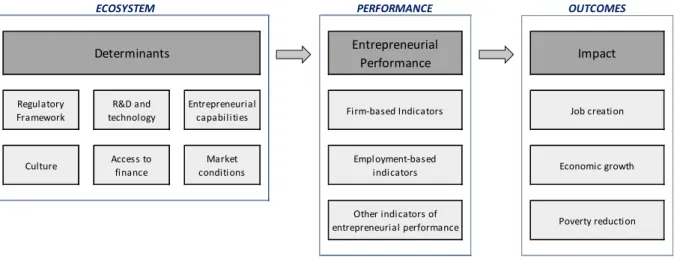
The following organogram (Figure I) shows the whole chain of an entrepreneurial environment with its potential outcomes linked to performance, as well as all the parameters that affect them. In general terms, this scheme shall be considered as an excellent summary of what is needed to initially have a set of conditions/determinants for an entrepreneurial environment to be called an “ecosystem”. Additionally, the outcomes dependent on the performance also evidence the positive consequences of having that implemented, therefore highlighting the reason for governments’ interests in helping to build/boost them.
Figure I: Ecosystem, Performance and Outcomes
Source: Author’s creation based on "Topic categories for entrepreneurship indicators" (OCDE 2009)
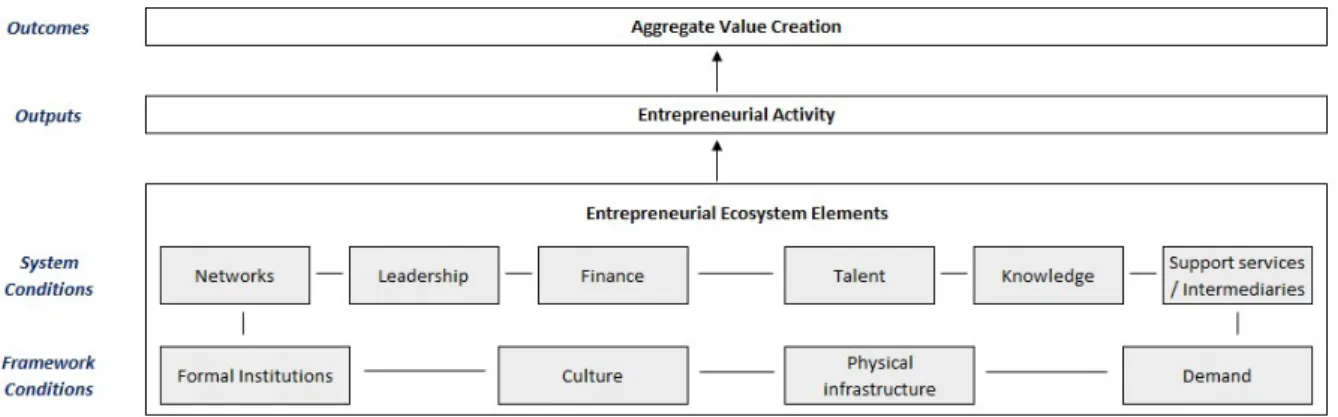
Another useful roadmap is shown in the following figure (Figure 2) with the key elements needed for the creation of a fruitful startup ecosystem, split between “system conditions” and “framework conditions”, as well as the outputs and outcomes. This roadmap will be further used as a basis for the quantitative sector of this Master Thesis, notably the factor analysis conducted.
ECOSYSTEM PERFORMANCE OUTCOMES
Entrepreneurial Performance Impact Regulatory Framework R&D and technology Entrepreneurial
capabilities Firm-based Indicators Job creation
Culture Access to finance conditionsMarket Employment-based indicators Economic growth
Other indicators of
entrepreneurial performance Poverty reduction
Figure 2 - Framework conditions, System Conditions, Outputs and Outcomes
Source: Author’s creation based on Stam, 2015
III.
Methodology
This Master Thesis adopts a mixed-method approach, combining a descriptive, qualitative and quantitative analysis with the goal of identifying the key elements of some successful entrepreneurial ecosystems. That approach was chosen given the lack of comparable studies on the field of business ecosystems, where it is vastly seen the use of guessing and ‘common sense’ as the general answer for new initiatives to build a new “Silicon something”. That study, therefore, aims to address the uniqueness of different ecosystems in creating their own business hubs, considering their cultural background, geographic location and the maturity of the entrepreneurial movement. To support the qualitative descriptive analysis, a quantitative approach was also included aiming to generalize and identify the key common elements for business ecosystems to succeed. Hence, both are meant to be complementary to each other, forming together the mixed-method approach.
The descriptive analysis
The methodology used in this section was to initially collect data from various sources, such as OECD, World Bank, and Independent consultants, among others, combined with news from the local press from each one of the entrepreneurial ecosystems from the geographic units analysed. The primary objective of this action was to gather as much possible information from the comparable regions, thus conducting a descriptive analysis of the specifics of each one of them, including also a timeline of the creation and development of the ecosystems, with their own uniqueness and current situation.
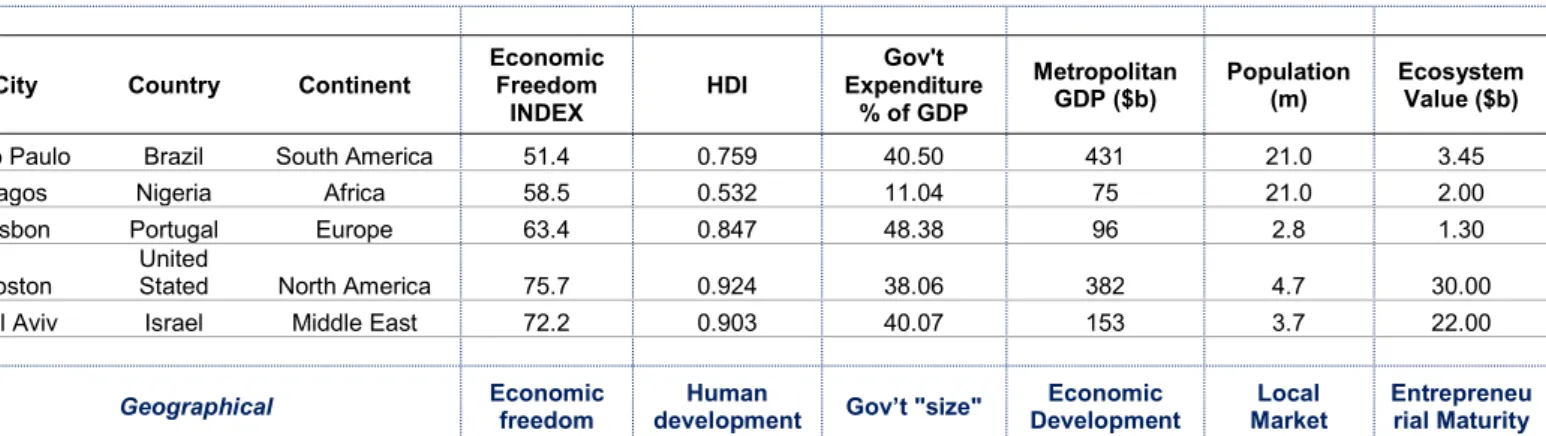
In order to consider a heterogeneous holistic approach, the five ecosystems were chosen based on diversity of geographic location, formal background culture, government’s presence in the economy, the maturity of entrepreneurial culture, the level of economic freedom, among others. As per
Table 1 -
Holistic diversity of the entrepreneurial ecosystems
- below it is evidenced the overall diversity of theecosystems chosen. First of all, the geographical heterogeneity – they are all located in different continents, implying therefore a variety of beliefs and cultures. Secondly, the economic freedom, valued by the Economic freedom Index, published by the Herritage Foundation9, where it shows completely
different scenarios for the cities chosen. As per the definition of the Foundation itself: “The Index of Economic Freedom focuses on four key aspects of the economic environment over which governments typically exercise policy control: rule of law, government size, regulatory efficiency, and market openness”. The third element used to differentiate them is the Human Development Index, published by the World Bank. Its definition, by the World Bank10 is: “the Human Development Index (HDI) is a
summary measure of average achievement in key dimensions of human development: a long and healthy life, being knowledgeable and have a decent standard of living. The HDI is the geometric mean of normalized indices for each of the three dimensions”. Following, is the proxy of government’s size which was also captured by the Economic Freedom, but purely evidenced by the ratio of government’s expenditure per nominal GDP. It is then followed by two direct metrics, such as Nominal Metropolitan GDP as a proxy for Economic Development, and Metropolitan Population, as a proxy for Local Market size. Ultimately, to identify the entrepreneurial maturity of the ecosystems, are their values – Startup Genome calculates it as a combination of the startup's valuations and exits11. The Global Median, as
per the latest report from 2018, is U$ 4.1 billion, meaning that the range of the cities chosen goes from below 68% of global median (e.g. Lisbon) to a 632% higher (e.g. Boston). Given the lack of information available in the city level, some of the data used was at the country level, notably the “Freedom Economic Index”, “Human Development Index”, and “Government Expenditure as a percentage of GDP”.
Table 1 - Holistic diversity of the entrepreneurial ecosystems chosen
Source: Author’s creation based on Herritage Foundation, World Bank, Doing Business and Startup Genome
9 2018 Index of Economic Freedom. The Herritage Foundation.
10 Human Development Index (HDI). United Nations Development Programme.
11 In the jargon of the startup industry, especially within Mergers and Acquisitions, Exit is the value of which the
company is sold, primarily in the vision of the founders as they would be “making an exit”.
City Country Continent
Economic Freedom INDEX HDI Gov't Expenditure % of GDP Metropolitan
GDP ($b) Population (m) Ecosystem Value ($b)
São Paulo Brazil South America 51.4 0.759 40.50 431 21.0 3.45
Lagos Nigeria Africa 58.5 0.532 11.04 75 21.0 2.00
Lisbon Portugal Europe 63.4 0.847 48.38 96 2.8 1.30
Boston
United
Stated North America 75.7 0.924 38.06 382 4.7 30.00
Tel Aviv Israel Middle East 72.2 0.903 40.07 153 3.7 22.00
It is important to mention that there are vastly available studies aiming to value entrepreneurial ecosystems, with different methodologies and approaches. This Master Thesis considered a reputable source, such as Startup Genome, that has already worked on gathering all data needed for that purpose, with its results, as a basis for all analysis conducted here. Therefore, showing a high degree of objectivity to the analysis further structured.
After selecting the entrepreneurial ecosystems, it was conducted an empirical description of each one of them, considering their basis for growth, how successful they are thus far, what are their competitive advantages, while also raising potential opportunities and challenges for the near future. On that basis, the end goal was to identify elements that can be replicable to Lisbon in its benefit but also what can be taught as previous experiences that can be avoided as a formal government practice, or even by the players aiming to build its own unfair advantage.
The quantitative analysis
The descriptive analysis is then followed by a quantitative one. The initial approach for quantifying as well identifying common elements for the successful entrepreneurial ecosystems was to run some regressions, where the dependent variable was the ecosystem value, while the independent ones were Metropolitan GDP, Metropolitan Population, Metropolitan GDP per capita, Number of Startups, Percentage of female founders, Percentage of immigrant founders. The data gathered for running those regressions were mainly from Startup Genome, from the latest 2018 report where they published data, on a city level, for 45 different startup ecosystems.
Together with the regressions, another chosen approach for the quantitative section of this Ms Thesis was to conduct a factor analysis. It was initially considered the key elements for a startup ecosystem to succeed based on a roadmap from Stam (2015)12. They were divided into "System Conditions":
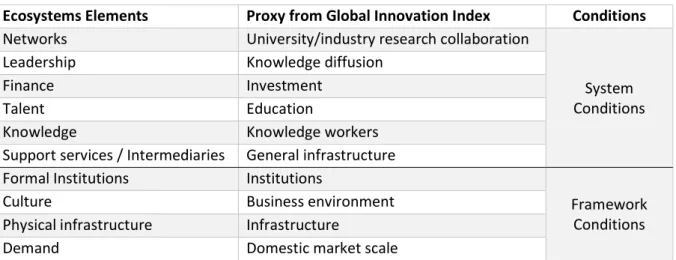
Networks, Leadership, Finance, Talent, Knowledge and Support services/Intermediaries, and "Framework Conditions": Formal Institutions, Culture, Physical Infrastructure and Demand. Those ten elements were quantified using a proxy from a similar category chosen from a list of 101 of published indexes by Global Innovation Index 2018 measured from 0 to 100, where 100 is the highest (
Appendix C: Global Innovation INDEX for the
selected countries
). They were, respectively: University/Industry Research Collaboration, Knowledge Diffusion, Investment, Education, Knowledge12 STAM, Erik. Entrepreneurial Ecosystems and a Regional Policy: A Sympathetic Critique. European Planning
Workers and General Infrastructure as the “System Conditions”, and Institutions, Business Environment, Infrastructure and Domestic Market Scale as the “Framework Conditions” (as summarized in the
Table
2 - Key Elements with their respective chosen proxies
). Considering the lack of information available on a city level, those figures were all at the country level – however, as the biggest cities are, in general, the ones from each country to host the formal entrepreneurial ecosystems, being therefore accountable for a significant portion of the key indicators of a country’s successful entrepreneurial movement, it was considered no prejudice to the outcome. The full dataset used to conduct the factor analysis was 126 countries. Two factors were chosen based on their Eigenvalues (together accounting for more than 58% of the variance).Table 2 - Key Elements with their respective chosen proxies
Ecosystems Elements
Proxy from Global Innovation Index
Conditions
Networks
University/industry research collaboration
System
Conditions
Leadership
Knowledge diffusion
Finance
Investment
Talent
Education
Knowledge
Knowledge workers
Support services / Intermediaries General infrastructure
Formal Institutions
Institutions
Framework
Conditions
Culture
Business environment
Physical infrastructure
Infrastructure
Demand
Domestic market scale
Source: Author’s creation
IV.
Descriptive Analysis
The chosen ecosystems to be deeper analysed, while used ultimately as a basis for comparison with Lisbon’s entrepreneurial hub are: São Paulo (Brazil), Lagos (Nigeria), Tel Aviv (Israel) and Boston (United States). They were chosen primarily due to their geographically and developmental state diversity. Cities from different continents, belonging to countries with entirely different histories of economic development, historical government’s intervention approaches and distinct entrepreneurial cultures shall help understanding various perspectives of the foundation and potential future evolution of their startup ecosystems. This section aims to describe past and current situation of those ecosystems identifying their singularities.
Lisbon, Portugal
“Lisbon has ample access to talent, affordable housing, and adequate public transportation, and the coastal location adds to its attractiveness as a spot for founders to establish their firms” (Startup Genome).
Portugal was in the epicentre of the European fiscal crisis of 2011, where the country was unable to repay/refinance its government debt13. In order to regain access to capital, the country left having to
meet all the austerity measures required by Troika14, which ultimately lead to a boost in the country’s
unemployment rate. Fasting forward a few years, the country has managed to overcome all these and is becoming the host for a fruitful entrepreneurial ecosystem in its capital, Lisbon.
Fed by sources such as the New York Times, Boston Globe and Financial Times, Lisbon is being called the San Francisco of Europe and not only because of the hills and trams – but also because Lisbon may well be one of the most dynamic and exciting ecosystems for new business creation. The city strategy on this regard is to make Lisbon move beyond its known identity and its objective is to be one of the most creative and innovative cities in Europe, and city officers are very focused on partnerships and alliances to make things happen. Those are the key elements of “why Lisbon” has a fruitful entrepreneurial ecosystem: “Lots of talent”, “Affordable talent”, “Ease to set up the company”, “The city is small enough to use as a test site”. (Startup Europe Club)
Moreover, an important investment, already disbursed, has been made to build an entrepreneurial spot, called Beato Creative Hub: "A 35,000-square-meter former army food factory is going to be transformed into a huge startup campus, (…) while the Portuguese government has also set up a €200m venture capital fund aimed at bolstering foreign investment in start-ups" (Forbes). Some more initiatives are being responsible for adding value to the Lisbon ecosystem. For instance, the city is being the host of the Web Summit for the triennium 2016-2018 with a high probability of it being renewed for another 3 to 5 years. Additionally, its ecosystem is growing together with the boom of the city which may evidence a well-developed sustainable growth. Important to note the diversity of the hub, shown by the number of female founders: "Lisbon has the highest rate of Women Founders in Europe, pointing towards inclusive growth, which could become a competitive advantage over time." (Startup Genome).
Besides its positive current environment, Lisbon ecosystem is still embryonic and therefore have had only a few examples of successful exits, which in general terms explains its low ecosystem value15. In
addition, Portugal is still showing a high net debt16 that can pose a hassle for funding going further. The
primary challenge for the city’s ecosystem is to achieve a critical mass point to become a more robust environment for newcomers. A potential yellow flag is whether the ecosystem would directly depend on the government. As of 2017, the federal government announced a € 200M investment. Despite being great news, the challenge is that it shall pose a short-term benefit, however it may become a long-term
13 https://en.wikipedia.org/wiki/2010%E2%80%9314_Portuguese_financial_crisis
14 “(…) refers to a decision group formed by the European Commission (EC), the European Central Bank (ECB)
and the International Monetary Fund (IMF)”.
15 According to “Startup Genome”
development block. The key question is: how to avoid those incipient companies not to be dependent on the government?
Sao Paulo, Brazil
"São Paulo is home to the largest and most mature startup ecosystem in South America. The Brazilian tech epicentre is also one of the 15 largest ecosystems in the world." (Startup Genome)
Brazilian political scene has been under complete turbulence in the past years. A huge corruption scandal involving the most important politics of the country, from all over the political spectrum, was discovered which ultimately culminated in the impeachment of the former president Dilma Rousseff on 201617. The political turmoil aggravated the economic situation with the country’s GDP falling by near
7% on the triennium 2014-201618. Despite all that situation, the entrepreneurial movement has been
warming in the country, more specifically in São Paulo, the financial capital of Brazil. Hence, differently from many other examples, the ecosystem in São Paulo is growing despite the economic turmoil and government’s interference. Private initiatives, thus, are playing an extremely significant role of getting the ecosystem structured, while backing the funding equation. “Visa and IBM are major sponsors of Startup Farm, a leading accelerator with more than $100 million invested in upwards of 200 startups. Brands as varied as Embraco, a refrigeration technology and production company, and Natura, a cosmetics label, have created similar programs to invest in startups operating in their respective spaces” (Tech Crunch19)
“Multinational and regional tech powerhouses have graced Brazilian cities with their approval. For instance, Google, Airbnb, and Uber have built offices in São Paulo; in Google’s case, its São Paulo campus is a cross between a coworking space, accelerator, and networking center – a sort of comprehensive, all-inclusive startup factory” (Venture Beat20).
Sao Paulo is a growing hub of startups and an extensive market filled opportunities (Startup Blink21).
So, in spite of the government’s interference, there are the technological sector’s initiatives to push back against bureaucracy, remarkably “its human capital, specifically the well-organized, welcoming entrepreneurial ecosystems”. (…) And in an otherwise dismal economic landscape, few sectors are more successful than startups. From 2011-2016, Brazil’s startup sector was estimated to have grown by 30 percent per year, even as the rest of the country deals with political crises and an unemployment rate of 13.6 percent (or 14 million people)” (Venture Beat).
17 Brazil Impeachment: Key Questions. BBC.
18 Brazil GDP Annual Growth Rate. Trading Economics.
19 EGUSA, Conrad; CARTER, David. Brazil: a look into Latin America’s largest startup ecosystem. Tech Crunch. 20 JIANG, Ping. Brazil’s Startup Ecosystem is thriving despite bureaucracy. Venture Beat.
In addition to the economic and political turbulence, a big challenge for the São Paulo’s ecosystem is the bureaucracy, notably the average time spent to pay taxes22. Another major challenge for the
ecosystem is the difficulty of its startups to reach to global markets. According to Startup Genome, only 7% of customers of startups in São Paulo come from outside of the country and 9% of São Paulo startups immediately target the US or UK market, well below the global average of 36%.
Lagos, Nigeria
"Lagos, the most populated and fastest growing city on the African continent, is a rising star in the global startup ecosystem" (Startup Genome)
Lagos has recently surged as a prominent place for startups in the African continent. It has been showing a lot of improvements over the last few years that made its ecosystem to be ranked on top of the major entrepreneurial hubs, especially when compared to its African peers, notably Johannesburg and Cape Town. Through its uniqueness, such as significant internal market potential of 170 million people, young and vibrant population with median age of 19 years old, and the largest mobile market in Africa with over 125 million mobile subscribers and a penetration rate of 75%23, to name a few of its strengthens,
Lagos is making good progress through a further medium-term development.
Lagos, being Africa’s largest city and the commercial center of Africa’s largest economy, has seen its ecosystem grow rapidly time largely thanks to work that’s been done to build the “Yabacon Valley24”.
That work is paying off: in 2017, Nigeria attracted more investment than any other startup ecosystem in Africa25.
On the other hand, the challenges faced by Lagos is ultimately common to its African peers: huge infrastructural deficiency, high cost of Internet, lack of funds and investment-friendly environment, vast knowledge and skill gap, a big gap between the government and the Startup industry. The biggest of them is that the industry has not really seen the needed support from the government and has been kept going only by private initiatives (Startup Lagos26), which is similar to the development of the hub in
São Paulo, held in proportion.
22 A 2015 study by the World Bank estimated that Brazilian businesses spent a staggering 2,600 hours on filing
taxes (…) 15 times above the average of European countries. (Venture Beat)
23 Startup Nigeria: Opportunities, Challenges and the Future. Startup Lagos.
24 “Yabacon Valley (YV) is a nickname for an area within Yaba. Yaba is a suburb of Lagos, Nigeria and located at
the mainland of the Lagos. This area is already growing as Nigeria’s technology hub (…).” (https://en.wikipedia.org/wiki/Yabacon_Valley)
25 KAZEEM, Yomi. Lagos is set to overtake Nairobi as Africa’s startup capital. Quartz Africa. 26 Startup Nigeria: Opportunities, Challenges and the Future. Startup Lagos.
After all, there has been a positive and robust entrepreneurial culture in Lagos, driven mainly by the young population. This shows that many young Nigerians are eager to become entrepreneurs, which has been enough to create an interesting buzz in the local startup scene.
Tel Aviv, Israel
"Tiny Tel Aviv has all the characteristics of a global tech ecosystem giant: education, entrepreneurial
spirit, technology, a global mindset, government support, and a staggering 300 multinational R&D
centers operating in Israel" (Startup Genome)
Tel Aviv has been building its startup ecosystem fur such a long time now, leveraged by a country that in general rewards the entrepreneurial spirit while has been developing for years the grounds for its success. It goes back to the 70's, with its former President and Prime Minister Shimon Peres27. As he
once provoked: “The greatest contribution of the Jewish people in history is dissatisfaction. That’s poor for politics, but good for science28.” "(…) in the late 1970s, Israel and the United States established the
BIRD Foundation (Binational Industrial Research and Development), an endowment that gave, and still gives, about twenty grants each year of $500,000 to $1 million for Research and Development aspects of joint ventures between Israeli and U.S. companies. (…) That joint venture angle helped Israel’s fledgling tech companies learn about the vast U.S. market, and BIRD’s $250 million worth of investments over the past decades has generated more than $8 billion in sales for recipient companies29".
Israelis show some unique characteristics that may help explain the successful trend of their entrepreneurial ecosystems, here evidenced by the biggest and most prominent, Tel Aviv. As one Canadian student noted after his visit to Tel Aviv: "They (Israelis) have a sense of urgency. They don’t know what will happen tomorrow30”. And that is certainly more about the culture that is what made (and
make) Tel Aviv a top entrepreneurial hub. As per a BBC report: "the lack of hierarchy, a constant drive for individualism, regular risk-taking". And the key, in my opinion: "military service is compulsory, but besides regular military units, the army also has designated hi-tech units, where computer-savvy conscripts are constantly prompted to come up with innovative ideas in disciplines such as computer security, cryptography, communications, and electronic warfare. The military enables young people in certain units to get technological skills, to run large technological projects at a very young age, where
27 Shimon Peres was also awarded the Nobel Peace Price of 1994, together with Yasser Arafat and Yitzhak
Rabin. [Shimon Peres: Biographical. The Nobel Prize].
28 SPENCE, Rick. Why Israel is the ideal place to teach entrepreneurs how to succeed. Financial Post. 29 KOLTAI, Steven R. Shimon Peres: Godfather of Israeli entrepreneurship. Brookings.
30 Said Charu Jaiswal, a York graduate now working on a social-entrepreneurship startup at the MaRS Discovery
they need to improvise to get fast solutions. Once back in the real world, many military alumni use the newly acquired experience to launch their own technology start-ups31."
However, the yellow flag of Tel Aviv's startup ecosystem is ultimately related to its competitive advantage, which is the low diversity - as per Startup Genome, only 8% of founders are women and 16% are immigrants32. The inherent risk of living in the country, combined with its cultural conservatism
might explain those figures, as well as the reason Israelis move outside their home country to open their businesses abroad, notably the US and UK.
Boston, USA
"Boston is home to an estimated 2,900-3,900 tech startups and continues to hold its own as a globally leading startup ecosystem. As the third highest performing startup ecosystem in the U.S., Boston draws on the ideas and people of over 50 colleges and universities, most notably Harvard University and MIT". (Startup Genome)
With its strong and mature entrepreneurial ecosystem, Boston is constantly placed on top of the most prominent startup hubs' rankings. It was awarded by the American Chamber of Commerce for two consecutive years (2016-2017) as the best city for startups in the United States. "In addition to nabbing the top spot overall in the innovation rankings, the Chamber of Commerce also recognized the city for connecting its broader economic engines to the startup community33”. Interesting to note that the
ecosystem was not built initially centred in innovation. As per Spigel (2017): "Boston first developed a thriving biotechnology ecosystem in the absence of a strong local market or histories of successful biotech entrepreneurs. Rather, these attributes should be understood as the major factors that help create supportive environments for entrepreneurial activity and provide external resources that increase the competitiveness of new ventures34."
It was then further developed as a robust place for the birth of companies across different industries. Its future may also pose an even better picture on the medium and long terms considering some details that should make the difference as Boston’s competitive advantages. For instance, Boston has the highest concentration of millennials in the United States, with more than one-third of the city’s population being between 20 and 34 years old35. Moreover, 39.2 percent of adults ages 18 to 34 in
31 MOSKVITCH, Katia. How Israel turned itself into a high-tech hub. BBC.
32 As a matter of comparison, those figures for Boston are 16% and 30%. And for Lisbon, 17% and 15%,
respectively. Silicon Valley, as a benchmark, show 16% and 46%.
33 GLATTER, Hayley. Boston was ranked America’s Best City for Startups. Boston Magazine.
34 SPIGEL, Ben. The Relational Organization of Entrepreneurial Ecosystems. Entrepreneurship Theory and
Practice. January 2017.
Boston have a bachelor’s degree36. And more, Boston indicates the 6th highest percentage of startups
that offer all their employees stock options, at 48% in comparison to Silicon Valley at 50% and the global average at only 26%37". That all indicates the city's entrepreneurial activity shall continue strong over
the next years, while continuing to attract and maintain talents especially through its two-key based-universities, Harvard and MIT. A yellow flag might only be raised concerning formal global connections. As per Startup Genome: Boston entrepreneurs aren't focused on building relationships with other ecosystems. Among U.S. ecosystems, Boston shows the lowest percentage of international founders coming in. Boston lies at 12% while the U.S. average amounts to 17%. These factors suggest that Boston could further improve its inflow of human and financial capital compared to U.S. counterparts.
V.
Qualitative Results
Firstly, it is outlined the findings of the descriptive analysis, comparing on a high level the similarities and differences of the ecosystems previously described, which ultimately brings the strengthens and weaknesses of the Lisbon entrepreneurial hub, using as basis the relevant takeaways from the descriptive section. Lastly, it is stated the results from the factor analysis with its implications for the overall conclusion and the potential benefits for Lisbon.
Although there are some evidence from the describing section that there are several ways of building an entrepreneurial scene, it is also relevant that it can differ from place to place. In Tel Aviv’s case, for example, the entrepreneurial culture is strong based on the inconvenient historical situation of the Jewish population, who overcame a lot of terrible disasters and still are involved in an ongoing war with their neighbors. For that reason, they are a lot more risk-takers than most of the cultures, as well as they inherit the sense of urgency in what they do, combined with some more practical influences, such as the military obligation for all citizens that is vastly responsible for their technological development. That is the uniqueness that is primarily the cause for their successful startup movement. It has also been the case for such a long time now, as it was described it was strongly supported by Israel’s former president and prime minister, Shimon Peres, back on the 70’s that culminated in a mature and widespread entrepreneurial culture within the country. Another primary element of how they built a robust entrepreneurial hub under their uniqueness, also taking advantage of some of what could be considered a weakness, was the fact that the majority of the companies in Tel Aviv focused on scaling globally, given the lack of strong local demand38. Most of the companies were created targeting the US and the
European markets from their inception, using Israel’s market as a proof of concept for their solution, product or service. That is undoubtedly something Lisbon can use as an excellent example to imitate,
36 THOMAS, G. Scott. Boston leads the U.S. in education levels for young adults. The Business Journals. 37 From Startup Genome
as Portugal’s population is near the size of Israel, while potentially leveraging it with its easiness to access the European market, as well as the UK.
Another mature and successful startup ecosystem described was Boston. With its singularities, such as the presence of two of the top universities of world, Harvard and MIT, and the highest concentration of millennials in the United States, Boston managed to build its ecosystem initially under a set of conditions centered in innovation that was later spread across different industries. There is also a uniqueness about the American Federalism, where each state has its own legal system. Therefore, states that are pro-business can leverage its potential by approving some laws that can be beneficial for the entrepreneurial scene. According to a ranking from 2018, with data powered by McKinsey&Company and published in the website U.S. news39, Massachusetts was ranked second for Best States for Business Environment,
right after California. That evidenced that the combination of talents and a free business environment is instrumental for the startup movement, later help in attracting and retaining more talents, investments, and connections. Thus, Portugal can use Boston’s example to keep on liberalizing40 its economy, while
attracting investments in the academic sector as it has been a significant movement of improving the ranking of the Portuguese universities in Europe, though influencing in exchanging knowledge and tying the networks.
Differently, from Tel Aviv and Boston, São Paulo and Lagos are examples where the whole environment is generally against the proliferation of prominent entrepreneurial activities. Economic uncertainty, political scandals and institutions often under suspicious are some of the reasons why the local environments are not adequately pro-business. However, as previously described, there have been many initiatives both in São Paulo and Lagos that can turn players to become more optimistic with the future of their startup ecosystems, also helpful to evidence positive and negative examples for Lisbon to look up to. For instance, São Paulo and Lagos attracted the tech giants Google and Facebook to have a physical presence there, becoming the hub respectively for their micro-regions. Also, private initiatives are helping to boost the entrepreneurial movement through the creation of accelerators, incubators, private funds. Theoretically, that private movement can help the medium-term sustainability of both ecosystems to not create an interdependence with the state. Moreover, in different scales São Paulo and Lagos’ startups focus highly to market their local demands, which can be explained by the size of those markets but mainly because of the maturity of their economies – São Paulo far ahead Lagos but still with many general solutions’ deficits.
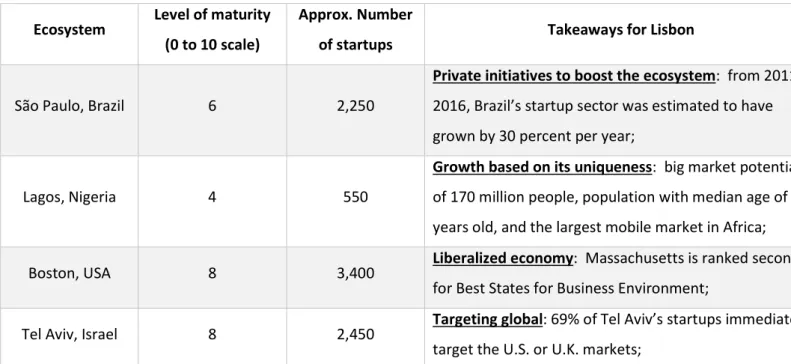
The overall comparable picture is that more mature ecosystems of cities such as Tel Aviv and Boston show a way higher number of startups (e.g. respectively, 2,450 and 3,400) compared to younger
39 Business Environment Rankings. US News.
40 The term liberal, in this context, is used as per the classic British meaning, notably the economic liberalism,
ecosystems like Lisbon and Lagos (250 and 550). The more startups become successful, the more it attracts investors while helping younger companies to learn/adapt. However, São Paulo seems to diverge from the other cited examples as it shows a relatively high number of existing startups (2,250) with a low overall ecosystem value, therefore resulting in a comparable low ecosystem per startup value. Some possible explanations would be the low internationalization of the founders, together with its focus on the local market - companies being therefore faced with a cap to their exit value, as they are purely adapted to the Brazilian market resulting in a discount for internationalization.
The following table (
Table 3 - summary of the takeaways from the described ecosystems
) is a summary of the all the takeaways that Lisbon can mirror its movement, from each one of the ecosystems described.Table 3 - summary of the takeaways from the described ecosystems
Source: Author’s creation based on Startup Genome 2018 report and the descriptive analysis of this Ms. Thesis
VI.
Quantitative Results
RegressionsThe initial goal of the statistical analysis was to find a variable that could explain the Startup Ecosystem Value. This construct is interesting because it is an indicator of both the potential economic value of each city or country. Measuring the economic value of an ecosystem is a task that depends greatly on modelling assumptions. Therefore, using the published figures from a reputable source gives some degrees of objectivity to this measurement.
Ecosystem
Level of maturity
(0 to 10 scale)
Approx. Number
of startups
Takeaways for Lisbon
São Paulo, Brazil
6
2,250
Private initiatives to boost the ecosystem: from
2011-2016, Brazil’s startup sector was estimated to have
grown by 30 percent per year;
Lagos, Nigeria
4
550
Growth based on its uniqueness: big market potential
of 170 million people, population with median age of 19
years old, and the largest mobile market in Africa;
Boston, USA
8
3,400
Liberalized economy: Massachusetts is ranked second
for Best States for Business Environment;
Tel Aviv, Israel
8
2,450
Targeting global: 69% of Tel Aviv’s startups immediately
target the U.S. or U.K. markets;
If one could find other measured variables that could explain cross-sectionally the ecosystem value, we would have a mechanism that could guide us both in terms of economic and city policy as well as location decisions by entrepreneurs.
A reasonably large set of regressions were tried using the Startup Ecosystem value as a dependent variable and using the remaining database variables as potential explanatory variables. Some regressions were performed linearly others used various transformations of both the dependent and independent variables.
In Appendix B: Summary results from the Regressions run a sample of those univariate linear regressions are shown. Even though some of them are statistically significant at 5% level, the results do not suggest a strong explanatory power. Suggesting that these variables, individually, and collectively, explain too little of the Variable of Interest, the economic value of the ecosystem. Not surprisingly, the most significant variable is the number of startups. This makes sense since an ecosystem will tend to have a larger economic value if there are many startups. However, when similar regressions were conducted using Ecosystem value per startup, there was minimal remaining variance explained.
In summary, the linear regressions suggest, almost trivially, that ecosystem economic value depends primarily on three very general other variables: the number of startups, population size, and nominal GDP.
Additionally, the regression estimators were poor when multivariate regressions were performed, suggesting a high degree of multicollinearity among the independent variables. To cope with this problem, it was decided to conduct a factor analysis on the data set.
The factor analysis
Aiming to understand the most impactful indicators of a successful entrepreneurial ecosystem, a factor analysis was conducted using 126 countries as the full dataset (the results are shown in the Appendix D: Results from the factor analysis and Appendix E: Results from the factor analysis after the Varimax Rotation). The end goal was to identify, among the ten key elements chosen, what was more important when building a startup ecosystem. In general, given the fact that some mature ecosystems have currently all of the key elements, a derived analysis would be to identify what were the causes that benefited the ecosystem to start and grow and what came in later after its prominence – splitting, therefore, those 10 key elements in “cause/consequence” for the purpose of this factor analysis. It is always valuable to reinforce that each one of the entrepreneurial ecosystems have their characteristics and are based on a set of singularities, as more in-depth discussed in the previous section. However, that factor analysis implied some generalization, or a picture of the average case, independently of their uniqueness or momentum. By doing this, the focus was on extracting what has been done worldwide,
considering a timeless vision, foreseeing potential policies and initiatives that may lead to increase or not the probability of success of any startup ecosystem, with takeaways for Lisbon, specifically. Following the definition done by Stam (2015), the factor analysis' output shows that the frameworks conditions have a more significant impact on the overall entrepreneurial ecosystem score than the system conditions - the higher correlation between the factor one, which per sé explains for more than 50% of the independent variable, and the elements are, in order: Formal Institutions, Physical Infrastructure, Knowledge and Culture. Three out of these four are part of the framework conditions, Knowledge being the exception. Therefore, it can be implied that framework conditions are instrumental for a startup ecosystem to succeed. An interesting result is the fact that finance shows one of the lowest correlations with the factor. A side analysis would be that finance itself (e.g. investment) is not a key element according to this factor analysis, which in practice can be explained by investments (or funding availability) being more of a consequence of a successful/prominent ecosystem than a cause for its success. The same goes for talent - a well-stablished ecosystem, such as Silicon Valley and Boston, attracts talents rather than being built because of those available talents at the first place.
The top key factors for a successful entrepreneurial ecosystem: Formal Institutions, Culture, Knowledge and Physical Infrastructure. Those are the most important ones from the list of 10 chosen, initially picked based on the organogram from Stam (2015) as a proxy of the full set of elements needed for creating a startup hub. Those elements can be generalized by the status of a country's development, through its institutions and infrastructure. Ultimately, it can also be seen as the consequence of well implemented long-term public policies, evidenced by the quality of life and, in some cases, a direct result of past productivity.
The following chart (Figure 3 - Key elements found by the factor analysis for the chosen ecosystems) compares the chosen ecosystems, primarily for the elements identified as being key according to the factor analysis. As expected, United States and Israel are ranked higher, vis-à-vis the Global Average, in all the factors, evidencing they have passed the initial phase of building a successful hub and are now in a more robust environment to attract and retain all the other elements from the ten initially selected, notably Finance, Talent and Leadership, all leading to better and strong Networks. On the other hand, Nigeria and Brazil are, in most of the cases, below the global average, highlighting the stage and the prominence of their ecosystems. Hence, not so surprising that there is a lack of funding availability on those hubs, just to mention one of the factors. The picture for Portugal is a bit unique, however. The auspicious scenario for the European country shows a high rate for all of the aspects, even compared with some mature environments, such as the United States and Israel, as well as the global average. What is implied, nevertheless, is the fact that the ecosystem is, similarly to examples such as Brazil and Nigeria, not yet abundant in investments, as well as not fully prepared to attract loads of talents and to
create all the needed networks although this not necessarily mean that the required elements are not already in place, as the chart shows otherwise.
Figure 3 - Key elements found by the factor analysis for the chosen ecosystems
Source: Author’s creation
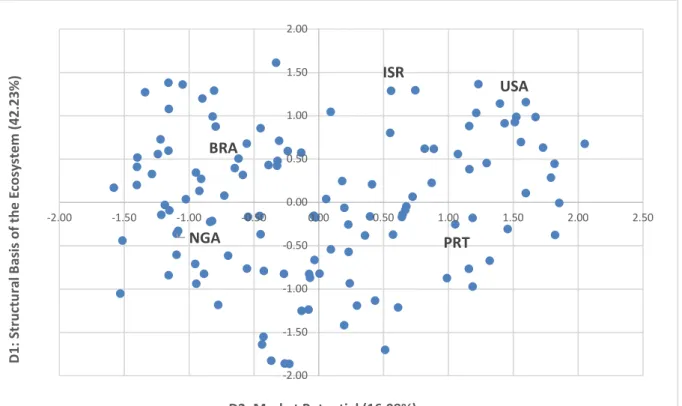
Also, another interesting result from the factor analysis is shown in the following chart – Figure 4. Initially, the two factors with the highest eigenvalue were named according to their correlation with the formal elements, after Varimax rotation (as shown in
Appendix E: Results from the factor analysis after the
Varimax Rotation
). As factor 1 has a high correlation mostly with the framework conditions, it was named as “Structural Basis of the Ecosystem”. That also guide to a factor linked to the supply side of the economy, of the ability of the ecosystem to provide for the startups. Factor 2, on the other hand, has a high correlation with demand, therefore being named as “Market Potential” - leading to the demand side of the equation, of how the existing market can help startups to grow targeting local. By doing this, we aim to map the strengthens of the ecosystems splitting into those two categories. What also made the analysis robust is that fact it ended up with an almost equally split of observations within the quadrants of the chart – down left-hand side (quadrant 1) with 35 observations or 28%; up left-hand side (quadrant 2) with 29 observations or 23%; up right-hand side with 28 observations or 22%; and down right-hand side with 34 observations or 27%.0.00 10.00 20.00 30.00 40.00 50.00 60.00 70.00 80.00 90.00 100.00
Knowledge Physical infrastructure Culture Formal Institutions Brazil Israel Nigeria Portugal USA Global Average
What was evidenced by that analysis, primarily focusing on the chosen ecosystems, is that it corroborates with the descriptive analysis of this Master Thesis. For instance, Israel and the United States have positive numbers for both factors 1 and 2, showing that they have the needed structural foundations for the development of their entrepreneurial ecosystems, which explains their long-lived mature hubs, combined with the local demand (e.g. factor 2). Despite having completely different scales, a possible explanation for Israel to be ranked favorable for “Market Potential” is the maturity of its consumers, generally receptive to new business ideas. Portugal is ranked positive for “Structural Basis of the Ecosystem”, evidencing once more it has the most important elements for the development of its still young ecosystem. However, differently from Israel, it is ranked negative for “Market Potential” even having a numerical similar local demand. That is possibly explained by its incipiency, about the openness of local customer to the launch of new products and services. Brazil, on the other hand, shows a negative number for factor 1 while is ranked positive for factor 2 – with all previously described, it was expected to have that picture for Brazil as the country does not have robust institutions to support the creation of new enterprises, whereas does not have a pro-business environment, it all happens in spite of those problems ultimately. However, with a population of approximately 207 million people and its relatively openness to the launch of new solutions, especially on the big cities, the country has a positive figure for “Market Potential”. Lastly, no surprisingly, Nigeria ranks negative for both factors. An interesting caveat on that analysis is that the country shows a higher (lower negative) number for “Market Potential” vis-à-vis “Structural Basis of the Ecosystem”, primarily for a similar reason of Brazil – big and young population, with a relative receptiveness for technology, evidenced mainly by the largest mobile phones’ market in Africa.
Figure 4 - Observations (axes D1 and D2: 58.31%) after Varimax rotation
Source: Author’s creation
VII.
Conclusion
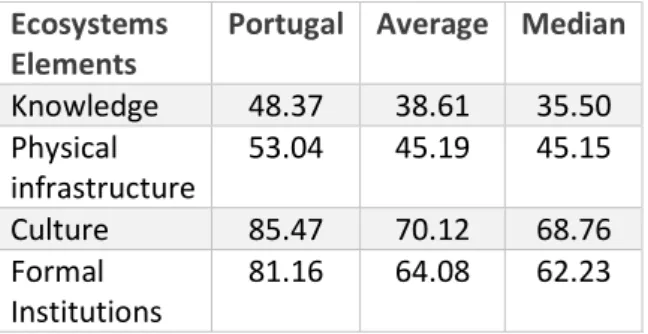
The main outcome we get from the above-conducted analysis is that Lisbon has a prominent entrepreneurial ecosystem or, in general, it aggregates the key elements to build a successful startup hub. It shows how Portugal has all the important elements, according to the comparable and factor analysis, to be a top entrepreneurial hub. Business Environment and Institutions, as proxies for Culture and Formal Institutions, show a high value even compared with the full dataset of countries analysed (e.g. 126), with their values higher by near 20% - independently if compared to average or median of the full pool of countries.
Moreover, within the chosen ecosystems, Portugal shows similar to higher values even if we take Israel or the USA as a comparable basis. In other words, Lisbon might have all the needed foundations for its ecosystem to grow sustainably - it is also more valid if we take for granted that investments, attraction and retainment of talents may come as a consequence of a more mature successful ecosystem. On the other hand, it is vastly identified that ecosystems are built under a set of unique conditions, meaning that there is no one right formula to boost entrepreneurial hubs by leveraging one or two key elements, it is usually a combination of factors that overall help creating the foundations for it to grow and attract new companies.