EUROPEAN ORGANIZATION FOR NUCLEAR RESEARCH (CERN)
CERN-EP-2018-005 2018/04/24
CMS-HIN-16-005
Comparing transverse momentum balance of b jet pairs in
pp and PbPb collisions at
√
s
NN=
5.02 TeV
The CMS Collaboration
∗Abstract
The transverse momentum balance of pairs of back-to-back b quark jets in PbPb and pp collisions recorded with the CMS detector at the LHC is reported. The center-of-mass energy in both collision systems is 5.02 TeV per nucleon pair. Compared to the pp collision baseline, b quark jets have a larger imbalance in the most central PbPb collisions, as expected from the jet quenching effect. The data are also compared to the corresponding measurement with inclusive dijets. In the most central collisions, the imbalance of b quark dijets is comparable to that of inclusive dijets.
Published in the Journal of High Energy Physics as doi:10.1007/JHEP03(2018)181.
c
2018 CERN for the benefit of the CMS Collaboration. CC-BY-4.0 license ∗See Appendix B for the list of collaboration members
1
1
Introduction
Jets are sensitive probes of final-state effects in heavy ion collisions. The jet quenching phe-nomenon is understood to arise from the interaction of hard-scattered partons with the quark-gluon plasma produced in such collisions [1]. The first observable used to probe this phe-nomenon at the LHC was the transverse momentum (pT) balance of back-to-back jets [2–5].
Quenching imparts a net imbalance to dijets that exceeds the imbalance from QCD radiation in vacuum, as measured in pp collisions. This additional imbalance is expected based on the dif-ference of the in-medium path-length traversed by the two jets. However, jet-by-jet fluctuation of the quenching may also play a role, and could even be dominant [6].
The dependence of quenching on the type of parton that initiates the jet may provide insight into the underlying dynamics. Such a dependence could arise directly from the interaction of the initiating parton with the medium. For example, radiative loss via gluon bremsstrahlung is expected to be larger for jets initiated by gluons than for those from quarks. Furthermore, for heavy quarks, radiation is expected to be suppressed in the direction of propagation [7]. A dependence could also arise less directly, via the medium interactions of subleading partons in the shower. For models in which quenching depends on the shower multiplicity, e.g.,JEWEL[6,
8], the relatively larger average parton multiplicity of gluon-initiated jets would lead to a larger quenching effect.
In general, the type of parton that initiates the jet is difficult to determine experimentally. A notable exception are jets produced by the fragmentation of bottom quarks. The corresponding b hadron may be identified, for example, by the presence of a soft lepton or a displaced vertex inside the jet. The latter strategy was pursued in the CMS measurement of the b quark jet (“b jet”) spectra and the corresponding nuclear modification factor in PbPb collisions at a nucleon-nucleon center of mass energy of√sNN = 2.76 TeV [9]. However, there is a potential ambiguity in that measurement. Bottom quarks may be produced not only directly in the hard scattering, but also in the subsequent splitting of gluons into b quark pairs. Jets associated with b hadrons may contain a significant contribution from gluon splitting, both from gluons that participate directly in the hard scattering, as well as those that arise from final-state radiation in the parton shower process.
One way to suppress the contribution of gluon splitting, which tends to produce pairs of b quarks with a relatively small opening angle, is to look at pairs of b jets that are back-to-back in azimuth. As shown in the Appendix, this configuration enhances the contribution from primary b quarks, typically produced via the reaction gg →bb. The pT balance of such b jets
may then be compared with those of inclusive (i.e., nontagged) dijets. This paper presents the first measurement of the pTbalance of b jet pairs (“b dijets”) in PbPb, using collisions recorded
at√sNN = 5.02 TeV. The b dijet data are compared with that of inclusive dijets to search for a possible dependence of the pT balance on the species of the initiating partons.
2
The CMS detector
The central feature of the CMS apparatus is a superconducting solenoid of 6 m internal diam-eter, providing a magnetic field of 3.8 T. Within the solenoid volume are a silicon pixel and strip tracker, a lead tungstate crystal electromagnetic calorimeter, and a brass and scintillator hadron calorimeter, each composed of a barrel and two endcap sections. Forward calorime-ters extend the pseudorapidity coverage provided by the barrel and endcap detectors over the range of about 3 < η < 5. Muons are detected in gas-ionization chambers embedded in the
together with a definition of the coordinate system used and the relevant kinematic variables, can be found in Ref. [10].
Events of interest are selected using a two-tiered trigger system [11]. The first level, composed of custom hardware processors, uses information from the calorimeters and muon detectors. The second level, known as the high-level trigger, consists of a farm of processors running a version of the full event reconstruction software optimized for fast processing.
3
Event and object selection
This analysis is performed using PbPb and pp data recorded in 2015 at a center-of-mass energy per nucleon pair of√sNN =5.02 TeV. The PbPb and pp samples correspond to integrated lumi-nosities of 404 µb−1and 25.8 pb−1, respectively. Events were selected using single-jet triggers in both pp and PbPb collisions. The jet triggers used in this analysis are fully efficient with respect to the offline leading jet selection of pT > 100 GeV. For PbPb collisions, b tagging algorithms
are applied at the high-level trigger to reduce the data volume. This is achieved by performing a simplified version of the charged-particle tracking and vertex reconstruction in regions of the detector delineated by high-pT jets. The efficiency of the online b tagging with respect to the
corresponding offline algorithm is evaluated using single-jet triggers, and lies in the range of 70–90%, depending on collision centrality.
To reject noncollision processes such as beam-gas interactions, events are required to have at least one reconstructed primary vertex and to deposit an energy of at least 3 GeV in at least 3 towers in each of the two forward calorimeters. The forward calorimeters are also used to estimate the collision centrality, evaluated as a percentile of the total inelastic hadronic cross section, with the most central event corresponding to a centrality of 0%.
The anti-kTalgorithm [12] is used to cluster jets from objects produced by the CMS particle-flow
algorithm [13], which combines information from the various subdetector systems. A radius parameter of R = 0.4 is used. In PbPb collisions, the heavy ion background is subtracted event-by-event with an algorithm that is a variant of an iterative “noise/pedestal subtraction” technique [14]. The jet energy is calibrated as a function of the η and pTfollowing the procedure
described in Ref. [15].
The identification of b jets is achieved using the “combined secondary vertex” (CSV) discrim-inator. This algorithm takes as input a number of properties of the reconstructed secondary vertex (SV), such as its displacement, the number of associated tracks, and their invariant mass (with the assumption that the tracks are originated by charged pions). For events in which no SV is properly reconstructed, the displacement of selected tracks is used. Details of the b tagging algorithms, and tracking and vertexing in general, can be found in Refs. [16] and [17], respectively. Simulated data samples produced with GEANT4 [18] are used to evaluate the b tagging performance and derive various corrections. These samples are generated withPYTHIA
version 6.423 [19], tune Z2 [20]. To compare with PbPb data, PYTHIAevents are embedded in an underlying event produced with theHYDJETgenerator, version 1.9 [21].
The performance of the CSV algorithm to identify b jet pairs offline is shown in Fig. 1. The efficiency and purity are evaluated in simulation as a function of the b-tagging selection vari-able for pp and PbPb collisions for different centrality intervals. A tight selection on the CSV discriminator is applied in this analysis, as indicated in Fig 1, leading to a purity in the range of 85–95% for b dijets, with an efficiency in the range of about 10–35%, depending on collision sys-tem and centrality. The degradation of the performance with increasing centrality corresponds
3
to a larger mistagging rate for fixed b tagging efficiency, as also observed in Ref. [9]. These jets are mistagged primarily due to vertices from false track combinations.
b tagging purity 0 0.2 0.4 0.6 0.8 1 b tagging efficiency 0 0.1 0.2 0.3 0.4 0.5 0.6 0.7 0.8 0.9 1
Pythia6 (+Hydjet)
pp PbPb, 30-100% PbPb, 10-30% PbPb, 0-10% CMS SimulationFigure 1: The b dijet purity vs. efficiency as a function of the value of the selection on the CSV discriminator in simulation. The same CSV selection is applied to both jets. Several different centrality intervals of PbPb, as well as pp collisions, are shown, as indicated in the legend. The closed symbols indicate the working point used in this analysis.
4
Data analysis
The pT balance of dijets is measured using the leading and subleading jets. This balance is
quantified by the ratio of the subleading to leading jet pT, denoted xJ. Dijets are selected from
the two highest pT jets within a window of|η| <1.5. The pTof the leading and the subleading
jets are required to be above 100 and 40 GeV, respectively. This asymmetric pT selection is
chosen to ensure sensitivity to quenching effects. The subleading jet threshold of 40 GeV is chosen to keep the subleading jet-finding efficiency reasonably high, as will be described below. The leading jet threshold of 100 GeV is a compromise between statistical precision, on one hand, and maintaining a large lever-arm with the subleading jet, on the other. For the case of b dijets, the leading and subleading jets are chosen prior to b-tagging selection. By restricting the analysis to the two highest pTjets in the event, the contribution from gluon splitting processes
is significantly suppressed.
Pairs of jets from a single hard scattering are referred to as “signal” pairs. To enhance the con-tribution of such pairs, the jets are required to be back-to-back in azimuthal opening angle with the selection of |∆φ| > 2π/3. The ∆φ distributions in pp collisions for inclusive dijets and dijets for which both the leading and subleading jets are b tagged are shown in the left panel of Fig. 2. The b-tagged dijets show a more pronounced tail at small∆φ, which comes from a larger contribution of 3-jet topologies, as further discussed in the Appendix. The∆φ distribu-tions in central (0–10%) PbPb collisions are shown in the right panel of Fig. 2. For inclusive dijets, an increased contribution (compared to pp collisions) at small ∆φ arises from pairs of
jets that are not from the same nucleon-nucleon interaction. These combinatorial jet pairs tend to bias the xJ distribution towards low values, i.e., towards large imbalance. To subtract this
contribution from the selected dijet pairs, we exploit the fact that such combinatorial pairs are uniform in∆φ, and subtract the contribution of pairs from a control region where combinato-rial background dominates over the signal pairs. The region is chosen to be|∆φ| <π/3, which
is symmetric to the back-to-back region with respect to the reaction plane, and thus receives the same contribution from elliptic flow. Higher order anisotropies are assumed to be negligible for this range in pT. Since combinatorial jets are unlikely to pass the b tagging selection, the
near-angle contribution is smaller for b dijets than inclusive dijets.
0 0.5 1 1.5 2 2.5 3 φ ∆ 3 − 10 2 − 10 1 − 10 1 φ ∆ ) dN/d π 1/(N (5.02 TeV pp) -1 25.8 pb CMS pp 0.5 1 1.5 2 2.5 3 φ ∆ 3 − 10 2 − 10 1 − 10 1 φ ∆ ) dN/d π 1/(N (5.02 TeV PbPb) -1 b µ 404 CMS inclusive dijets b dijets PbPb, 0-10%
Figure 2: Distributions of the azimuthal opening angle (∆φ) between the leading and sublead-ing jets for pp (left) and central (0–10%) PbPb collisions (right) for inclusive dijets and b dijets. The small-angle region (|∆φ| < π/3), the boundary of which is indicated by a dashed line, is
used to evaluate the combinatorial contribution in PbPb collisions. The vertical bars represent statistical uncertainties, while the horizontal bars represent the bin widths.
In addition to subtracting the combinatorial component, one also needs to correct for the con-tribution of signal pairs that are lost when there is a combinatorial jet of higher pT than the
signal partner jet. To achieve this, an efficiency correction is derived, which is the inverse of the probability that a partner jet of a given pT was found, i.e., not obscured by a
combinato-rial jet of larger pT. This efficiency is again estimated from data using the small-angle control
region, |∆φ| < π/3. For a given centrality class, we obtain the spectrum of the highest
trans-verse momentum (pmax
T ) partner jet in this region in each event. Assuming that all partner jets
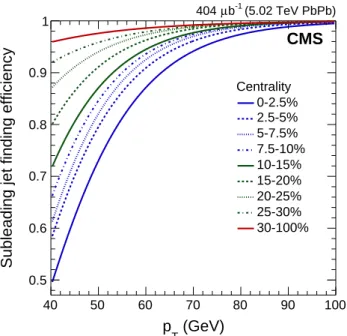
in this region are combinatorial, one can derive the probability that a signal partner jet is ob-scured, as a function of pT. This efficiency for detecting the signal partner jet is the cumulative
distribution function of this pmaxT spectrum:
e(pT) ≡1− 1 N Z ∞ pT dN dpmaxT dp max T . (1)
The efficiency is obtained from a fit to the data in fine bins of centrality, using the Gompertz function, f(pT) = exp[b exp(cpT)], where b and c are free parameters. The fits obtained are
5
linear interpolation. The function with these interpolated parameters is then evaluated at the pT of the subleading jet.
(GeV)
T
p
40 50 60 70 80 90 100
Subleading jet finding efficiency
0.5 0.6 0.7 0.8 0.9 1 Centrality 0-2.5% 2.5-5% 5-7.5% 7.5-10% 10-15% 15-20% 20-25% 25-30% 30-100% (5.02 TeV PbPb) -1 b µ 404 CMS
Figure 3: The efficiency of finding a signal partner jet as function of its pT in PbPb collisions,
as evaluated from the small-angle jet pair control region. The corrections are shown in the fine centrality bins used in the analysis.
Although the self-normalized quantities presented in this analysis do not depend on the ab-solute b tagging efficiency, the relative efficiency as a function of the pT and η must be taken
into account. Corrections are derived from simulation for both the leading and subleading jet. We also correct for the variation of the b tagging efficiency within the centrality selections presented in this analysis.
In order to probe for quenching or other nuclear effects on the balance distributions, a base-line is constructed using pp data as a reference. Since the deterioration of the jet pTresolution
with increasing collision centrality introduces an additional imbalance in the xJdistributions, a
direct comparison of PbPb and pp measurements does not solely reflect the nuclear modifica-tions. This issue is addressed by smearing the transverse momentum of the jets in pp data by the amount that corresponds to the additional underlying event fluctuations estimated from
HYDJETsimulations that have been tuned to match the underlying event density in PbPb data. As in Ref. [22], the jet pT resolution is parametrized according the following form, typical for
calorimeter energy resolutions.
σ(pT)/pT =
q
C2+S2/p
T+N2/p2T (2)
In pp collisions, the constant (C) and stochastic (S) terms are 0.06 and 0.8√GeV, respectively. In PbPb collisions the S term has a slightly larger value of 1.0√GeV, due to the underlying event subtraction. The noise parameter (N) depends on collision centrality, according to N = 14.82−centrality (%)/5.40(GeV). This term is neglected in pp collisions.
5
Systematic uncertainties
The sources of systematic uncertainties inhxJifor the inclusive dijet and b dijet measurements
are summarized in Table 1 and discussed directly below.
Table 1: Absolute systematic uncertainties onhxJifor inclusive (upper sub-table) and b (lower sub-table) dijets.
Source pp 30–100% 10–30% 0–10%
Combinatorial subtraction — 0.001 0.006 0.014
Subleading jet finding — 0.002 0.004 0.004
Energy scale 0.001 0.006 0.010 0.013
Jet resolution 0.007 0.008 0.010 0.012
Total 0.007 0.010 0.016 0.023
Combinatorial subtraction — 0.008 0.008 0.008
Subleading jet finding — 0.002 0.004 0.004
Tagging efficiency 0.002 0.003 0.003 0.009
Signal mistagging 0.002 0.004 0.006 0.006
Jet energy scale 0.001 0.006 0.010 0.013
Jet resolution 0.007 0.008 0.010 0.012
Total 0.008 0.014 0.018 0.023
Combinatorial jet pair subtraction
The systematic uncertainty in the combinatorial background subtraction in PbPb collisions is evaluated by varying the contribution of the near-angle control region. For inclusive dijets, where the near-angle region is dominated by combinatorial jets, the size of the contribution is varied by 30%, which is sufficient to cover the nonclosure of the subtraction procedure in simulation (the difference between the output of the analysis procedure and the generated input for the simulation). For b dijets, the number of jet pairs in the near-angle control region is reduced by the b tagging requirement, and is much less centrality-dependent than for inclusive dijets. Simulations based onHYDJET embedding show that the dominant contribution in this region corresponds to signal jets from gluon splitting. We therefore use the entire yield in the near-angle region in pp data to estimate the systematic uncertainty in the subtraction procedure in PbPb data.
Subleading jet finding efficiency
The uncertainty on the efficiency correction for finding the subleading jet is attributed to several effects: a contribution of signal jets in the near-angle control region (|∆φ| < π/3), the finite
centrality binning used and the imperfect description of the Gompertz fit function employed. The systematic uncertainty associated with these corrections is evaluated from the nonclosure inHYDJET-embedded simulated samples.
Jet energy scale
The uncertainty on the (inclusive) jet energy scale in pp collisions is evaluated from in-situ studies to be 1% for the η range used in this analysis [15, 22]. The same jet energy scale and uncertainty are found to apply to b jets, based on studies of Z → bb. In-situ studies were also carried out in peripheral PbPb collisions in Ref. [4], albeit with limited statistics. A 4% uncertainty is assigned to cover the observed difference between data and simulation. The modification of jet fragmentation pattern due to quenching is also a source of systematic uncer-tainty on the jet energy scale that can be as large as 5% for the most central collisions [23, 24].
7
Finally, underlying event subtraction leads to an uncertainty in the jet energy scale of up to 2% for central collisions [4, 25].
To propagate the uncertainties to the xJ distributions, the correlation between the leading and
subleading jet energy scales must be taken into account. For a given jet pair, the ratio xJ is
insensitive to an overall shift of the jet energy scale by a multiplicative factor. Such a shift does, however, effectively change the leading and subleading jet thresholds. The total correlated shift from the above mentioned sources was estimated to be as large as 6.5% in central events. For b dijets, there is an additional systematic uncertainty due to the bias of the b tagging on the jet energy scale, which was evaluated in simulation and found to be 1% in pp collisions and 2% in PbPb collisions.
There is also a component of the systematic uncertainty that is uncorrelated between the lead-ing and subleadlead-ing jet. The subleadlead-ing jet is also more sensitive to the underlylead-ing event sub-traction systematics than the leading jet is. To be conservative, we applied the entire uncer-tainty of 2% to the subleading jet, independently of the leading jet. In addition, to cover the pT
dependence of the modification of the fragmentation pattern due to quenching, the jet energy scale is shifted by a fixed amount, up to 2 GeV in central events.
Jet energy resolution
The uncertainly from the jet resolution is propagated by varying the resolution parametrization in Eq. 2. The effect on the xJ distribution is evaluated by applying these alternate smearing
parametrizations to particle-level jets. In pp collisions, the C and S parameters are varied by 0.02 and 0.2√GeV, respectively. For PbPb collisions, in addition, the N term is varied by 2 GeV, which covers the difference in underlying event between data and simulation, and the variation of the resolution within the wide centrality bins. Although the results are not unfolded for the resolution effects, the uncertainty is fully included in the data points in order to correctly evaluate any theoretical models that fold in the resolution effects for comparison.
Tagging efficiency (b jets only)
The tagging efficiency has a fairly flat pT dependence, such that it has only a mild effect on
the observed mean xJvalues (hxJi). The values of the corrections are varied by 50% as a
con-servative estimate of the systematic uncertainty in these corrections. This is sufficient to cover possible differences in data and simulation observed with studies of the b jet tagging efficiency in control samples in data [9, 16].
Mistagging (b jets only)
The effect of mistagging signal (i.e., not combinatorial) dijets where one or both jets is not as-sociated with a b quark is evaluated by inverting the b tagging selection for both the leading and subleading jets, both independently and simultaneously. The systematic uncertainty asso-ciated with mistagging is based on the imbalance of the inverted selections, taking into account the purity of the b dijet selection in simulation, which is around 85–90%, depending slightly on centrality.
6
Results
The pT balance, as quantified by the distribution of xJ, is presented for both inclusive and b
dijets. Both sets of dijets use leading and subleading jet pT thresholds of 100 and 40 GeV,
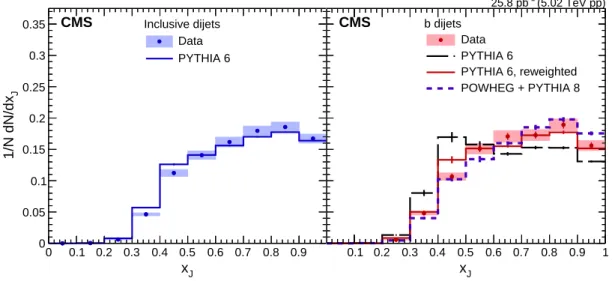
data are compared with simulations performed withPYTHIA6, which was found to give an ad-equate description of the dijet balance for inclusive jets. The agreement ofPYTHIA6 with data is notably worse for b dijets, where the simulated distribution is broadened towards imbalanced jet pairs. This broad feature is not observed in the b dijet data, which instead shows an xJ
distri-bution that resembles that of inclusive dijets. It was found that improved agreement could be obtained by reweighting the contributions of heavy-flavor production processes in PYTHIA6, a procedure which is discussed in the Appendix. The reweighted distribution is also shown in Fig 4. Finally, the data are also compared to simulations based on next-to-leading order matrix elements, as encoded in the hvq package [26] of thePOWHEG BOX[27] (v2) generator. Hadroni-zation in thePOWHEGmethod [28, 29] is performed by matching the matrix elements to parton showers, which in this case are generated with PYTHIA8.212 [30], tune CUETP8M1 [31]. The POWHEG+PYTHIA8 simulations are found to give a good description of the b dijet data.
0 0.1 0.2 0.3 0.4 0.5 0.6 0.7 0.8 0.9 J x 0 0.05 0.1 0.15 0.2 0.25 0.3 0.35 J 1/N dN/dx CMS Inclusive dijets Data PYTHIA 6 0.1 0.2 0.3 0.4 0.5 0.6 0.7 0.8 0.9 1 J x 0 0.05 0.1 0.15 0.2 0.25 0.3 0.35 J 1/N dN/dx (5.02 TeV pp) -1 25.8 pb CMS b dijets Data PYTHIA 6 PYTHIA 6, reweighted POWHEG + PYTHIA 8
Figure 4: Distributions of xJin pp collisions for inclusive dijets (left) and b dijets (right).
Sys-tematic uncertainties are shown as shaded boxes, while statistical uncertainties are shown as vertical lines. The data are compared to simulations performed usingPOWHEGandPYTHIA, as described in the text.
Figure 5 shows the xJdistributions for inclusive dijets and b dijets for three different centrality
selections of PbPb collisions. Here the data are compared to the reference obtained from pp data by smearing the pT of each jet according to a parametrization of the resolution for the
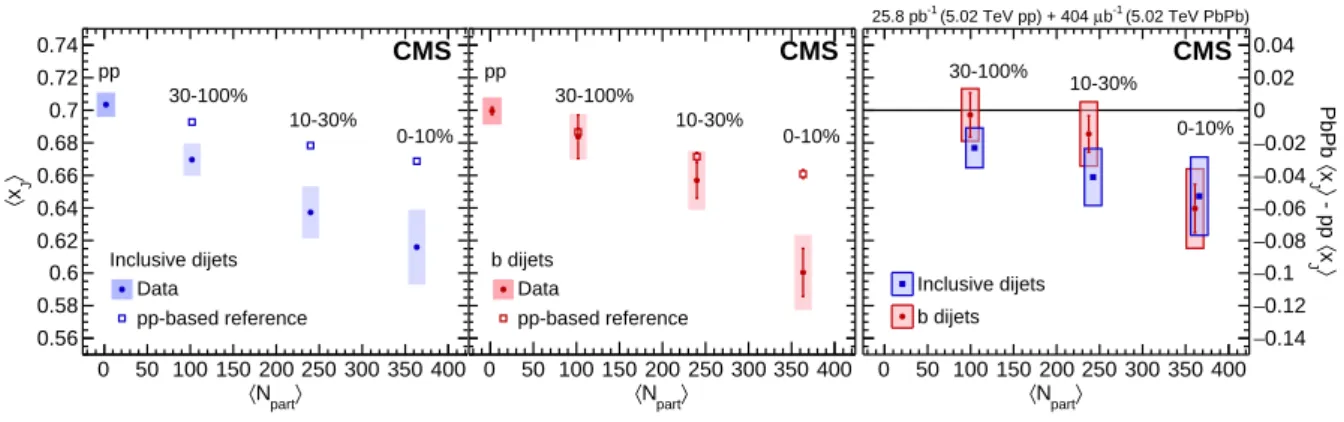
given centrality class. Figure 6 shows the hxJi values from these distributions, as well as the difference between the hxJi in PbPb and the smeared pp reference. The data are plotted as a function of the number of participants estimated from a Monte Carlo Glauber model [32, 33]. The number of participants is weighted by the number of collisions to account for the hard scattering bias within each bin. Both the inclusive dijet and b dijet data show a tendency towards increasing imbalance with increasing centrality. While the reference data also become more imbalanced because of resolution effects, the magnitude of the effect is clearly smaller. The effect is understood to result from jet quenching, as observed in previous inclusive dijet results [3, 34]. For inclusive dijets, a clear quenching signal is observed already for the 30–100% centrality bin. For b dijets, on the other hand, the imbalance is compatible with the pp reference in the 30–100% bin. In the 10–30% bin, the b dijet data point lies between the inclusive dijet one and the pp reference, within two standard deviations of both. Only in the most central bin (0–10%) is the b dijet quenching significant at the level of about three standard deviations, with a value close to that observed for inclusive dijets.
9 0 0.1 0.2 0.3 0.4 0.5 0.6 0.7 0.8 0.9 J x 0.05 0.1 0.15 0.2 0.25 0.3 0.35 J 1/N dN/dx Inclusive dijets Data pp-based reference CMS 0-10% 0 0.1 0.2 0.3 0.4 0.5 0.6 0.7 0.8 0.9 J x 0.05 0.1 0.15 0.2 0.25 0.3 0.35 J 1/N dN/dx CMS 10-30% 0 0.1 0.2 0.3 0.4 0.5 0.6 0.7 0.8 0.9 J x 0.05 0.1 0.15 0.2 0.25 0.3 0.35 J 1/N dN/dx CMS 30-100% 0.1 0.2 0.3 0.4 0.5 0.6 0.7 0.8 0.9 1 J x 0.05 0.1 0.15 0.2 0.25 0.3 0.35 J 1/N dN/dx (5.02 TeV PbPb) -1 b µ 404 CMS b dijets Data pp-based reference 0-10% 0.1 0.2 0.3 0.4 0.5 0.6 0.7 0.8 0.9 1 J x 0.05 0.1 0.15 0.2 0.25 0.3 0.35 J 1/N dN/dx CMS 10-30% 0.1 0.2 0.3 0.4 0.5 0.6 0.7 0.8 0.9 1 J x 0.05 0.1 0.15 0.2 0.25 0.3 0.35 J 1/N dN/dx CMS 30-100%
Figure 5: Distributions of xJ in PbPb collisions for inclusive dijets (left) and b dijets (right).
Systematic uncertainties are shown as shaded boxes, while statistical uncertainties are shown as vertical lines. The top, middle and bottom rows show the 0–10, 10–30 and 30–100% cen-trality selections, respectively. The data are compared to a reference obtained by smearing pp according to the jet resolution for the given centrality class, as described in the text.
7
Conclusions
In this paper, transverse momentum (pT) correlations of b quark jet pairs (b dijets) have been
measured in PbPb collisions for the first time, and compared to results from pp collisions. In pp collisions, a similar pT balance distribution was observed for inclusive dijets and b dijets. For
the latter case,POWHEG was found to give a better description thanPYTHIA6 alone (without reweighting), suggesting that next-to-leading order effects are important for the modeling of this observable. This should be taken into consideration for models of parton energy loss in nucleus-nucleus collisions, which often use leading order calculations or generators as input. In PbPb collisions the net pTimbalance was observed to be larger in the most central collisions
for b dijets, as had already been observed for inclusive dijets. This effect can be understood to originate from the energy loss of partons in the quark-gluon plasma. In the most central bin, the observed quenching effect is of comparable magnitude for b dijets and for inclusive dijets, the latter of which contains a mixture of quark and gluon jets. Insofar as parton energy loss is
0 50 100 150 200 250 300 350 400 〉 part N 〈 0.56 0.58 0.6 0.62 0.64 0.66 0.68 0.7 0.72 0.74 〉J x 〈 pp 30-100% 10-30% 0-10% Inclusive dijets Data pp-based reference CMS 0 50 100 150 200 250 300 350 400 〉 part N 〈 〉 J x 〈 pp 30-100% 10-30% 0-10% b dijets Data pp-based reference CMS 0 50 100 150 200 250 300 350 400 〉 part N 〈 0.14 − 0.12 − 0.1 − 0.08 − 0.06 − 0.04 − 0.02 − 0 0.02 0.04 〉 J x〈 - pp 〉 J x〈 PbPb 30-100% 10-30% 0-10% Inclusive dijets b dijets (5.02 TeV PbPb) -1 b µ (5.02 TeV pp) + 404 -1 25.8 pb CMS
Figure 6: hxJifor inclusive (left) dijets and b dijets (center) in pp collisions and for different centrality selections of PbPb collisions. The right panel shows the difference in thehxJivalues between PbPb and the smeared pp reference. Systematic uncertainties are shown as shaded boxes, while statistical uncertainties are shown as vertical lines.
thought to depend on the type of parton that initiates the parton shower, this measurement can place constraints on the underlying dynamics of the interaction of the parton with the quark-gluon plasma.
Acknowledgments
We congratulate our colleagues in the CERN accelerator departments for the excellent perfor-mance of the LHC and thank the technical and administrative staffs at CERN and at other CMS institutes for their contributions to the success of the CMS effort. In addition, we grate-fully acknowledge the computing centers and personnel of the Worldwide LHC Computing Grid for delivering so effectively the computing infrastructure essential to our analyses. Fi-nally, we acknowledge the enduring support for the construction and operation of the LHC and the CMS detector provided by the following funding agencies: BMWFW and FWF (Aus-tria); FNRS and FWO (Belgium); CNPq, CAPES, FAPERJ, and FAPESP (Brazil); MES (Bulgaria); CERN; CAS, MoST, and NSFC (China); COLCIENCIAS (Colombia); MSES and CSF (Croatia); RPF (Cyprus); SENESCYT (Ecuador); MoER, ERC IUT, and ERDF (Estonia); Academy of Fin-land, MEC, and HIP (Finland); CEA and CNRS/IN2P3 (France); BMBF, DFG, and HGF (Ger-many); GSRT (Greece); OTKA and NIH (Hungary); DAE and DST (India); IPM (Iran); SFI (Ireland); INFN (Italy); MSIP and NRF (Republic of Korea); LAS (Lithuania); MOE and UM (Malaysia); BUAP, CINVESTAV, CONACYT, LNS, SEP, and UASLP-FAI (Mexico); MBIE (New Zealand); PAEC (Pakistan); MSHE and NSC (Poland); FCT (Portugal); JINR (Dubna); MON, RosAtom, RAS, RFBR and RAEP (Russia); MESTD (Serbia); SEIDI, CPAN, PCTI and FEDER (Spain); Swiss Funding Agencies (Switzerland); MST (Taipei); ThEPCenter, IPST, STAR, and NSTDA (Thailand); TUBITAK and TAEK (Turkey); NASU and SFFR (Ukraine); STFC (United Kingdom); DOE and NSF (USA).
Individuals have received support from the Marie-Curie program and the European Research Council and Horizon 2020 Grant, contract No. 675440 (European Union); the Leventis Foun-dation; the A. P. Sloan FounFoun-dation; the Alexander von Humboldt FounFoun-dation; the Belgian Federal Science Policy Office; the Fonds pour la Formation `a la Recherche dans l’Industrie et dans l’Agriculture (FRIA-Belgium); the Agentschap voor Innovatie door Wetenschap en Technologie (IWT-Belgium); the F.R.S.-FNRS and FWO (Belgium) under the ”Excellence of Sci-ence - EOS” - be.h project n. 30820817; the Ministry of Education, Youth and Sports (MEYS) of the Czech Republic; the Council of Science and Industrial Research, India; the HOMING
References 11
PLUS program of the Foundation for Polish Science, cofinanced from European Union, Re-gional Development Fund, the Mobility Plus program of the Ministry of Science and Higher Education, the National Science Center (Poland), contracts Harmonia 2014/14/M/ST2/00428, Opus 2014/13/B/ST2/02543, 2014/15/B/ST2/03998, and 2015/19/B/ST2/02861, Sonata-bis 2012/07/E/ST2/01406; the National Priorities Research Program by Qatar National Research Fund; the Programa Severo Ochoa del Principado de Asturias; the Thalis and Aristeia programs cofinanced by EU-ESF and the Greek NSRF; the Rachadapisek Sompot Fund for Postdoctoral Fellowship, Chulalongkorn University and the Chulalongkorn Academic into Its 2nd Century Project Advancement Project (Thailand); the Welch Foundation, contract C-1845; and the We-ston Havens Foundation (USA).
References
[1] G.-Y. Qin and X.-N. Wang, “Jet quenching in high-energy heavy-ion collisions”, Int. J. Mod. Phys. E 24 (2015) 1530014, doi:10.1142/9789814663717_0007,
arXiv:1511.00790.
[2] ATLAS Collaboration, “Observation of a centrality-dependent dijet asymmetry in lead-lead collisions at√snn =2.76 TeV with the ATLAS detector at the LHC”, Phys. Rev. Lett. 105 (2010) 252303, doi:10.1103/PhysRevLett.105.252303,
arXiv:1011.6182.
[3] CMS Collaboration, “Observation and studies of jet quenching in PbPb collisions at nucleon-nucleon center-of-mass energy = 2.76 TeV”, Phys. Rev. C 84 (2011) 024906,
doi:10.1103/PhysRevC.84.024906, arXiv:1102.1957.
[4] CMS Collaboration, “Measurement of transverse momentum relative to dijet systems in PbPb and pp collisions at√snn =2.76 TeV”, JHEP 01 (2016) 006,
doi:10.1007/JHEP01(2016)006, arXiv:1509.09029.
[5] ATLAS Collaboration, “Measurement of jet p√ tcorrelations in Pb+Pb and pp collisions at
snn =2.76 TeV with the ATLAS detector”, Phys. Lett. B 774 (2017) 379, doi:10.1016/j.physletb.2017.09.078, arXiv:1706.09363.
[6] J. G. Milhano and K. C. Zapp, “Origins of the di-jet asymmetry in heavy ion collisions”, Eur. Phys. J. C 76 (2016) 288, doi:10.1140/epjc/s10052-016-4130-9,
arXiv:1512.08107.
[7] Y. L. Dokshitzer and D. E. Kharzeev, “Heavy quark colorimetry of QCD matter”, Phys. Lett. B 519 (2001) 199, doi:10.1016/S0370-2693(01)01130-3,
arXiv:hep-ph/0106202.
[8] K. Zapp et al., “A Monte Carlo model for ’jet quenching”’, Eur. Phys. J. C 60 (2009) 617,
doi:10.1140/epjc/s10052-009-0941-2, arXiv:0804.3568.
[9] CMS Collaboration, “Evidence of b-jet quenching in PbPb collisions at√snn =2.76 TeV”, Phys. Rev. Lett. 113 (2014) 132301, doi:10.1103/PhysRevLett.113.132301,
arXiv:1312.4198. [Erratum: doi:10.1103/PhysRevLett.115.029903].
[10] CMS Collaboration, “The CMS experiment at the CERN LHC”, JINST 3 (2008) S08004, doi:10.1088/1748-0221/3/08/S08004.
[11] CMS Collaboration, “The CMS trigger system”, JINST 12 (2017) P01020, doi:10.1088/1748-0221/12/01/P01020, arXiv:1609.02366.
[12] M. Cacciari, G. P. Salam, and G. Soyez, “The anti-ktjet clustering algorithm”, JHEP 04
(2008) 063, doi:10.1088/1126-6708/2008/04/063, arXiv:0802.1189.
[13] CMS Collaboration, “Particle-flow reconstruction and global event description with the CMS detector”, JINST 12 (2017) P10003, doi:10.1088/1748-0221/12/10/P10003,
arXiv:1706.04965.
[14] O. Kodolova, I. Vardanian, A. Nikitenko, and A. Oulianov, “The performance of the jet identification and reconstruction in heavy ions collisions with CMS detector”, Eur. Phys. J. C 50 (2007) 117, doi:10.1140/epjc/s10052-007-0223-9.
[15] CMS Collaboration, “Determination of jet energy calibration and transverse momentum resolution in CMS”, JINST 6 (2011) P11002,
doi:10.1088/1748-0221/6/11/P11002, arXiv:1107.4277.
[16] CMS Collaboration, “Identification of b-quark jets with the CMS experiment”, JINST 8 (2013) P04013, doi:10.1088/1748-0221/8/04/P04013, arXiv:1211.4462. [17] CMS Collaboration, “Description and performance of track and primary-vertex
reconstruction with the CMS tracker”, JINST (2014), no. 10, P10009,
doi:10.1088/1748-0221/9/10/P10009, arXiv:1405.6569.
[18] GEANT4 Collaboration, “GEANT4—a simulation toolkit”, Nucl. Instrum. Meth. A 506 (2003) 250, doi:10.1016/S0168-9002(03)01368-8.
[19] T. Sj ¨ostrand, S. Mrenna, and P. Skands, “PYTHIA 6.4 physics and manual”, JHEP 05 (2006) 026, doi:10.1088/1126-6708/2006/05/026, arXiv:hep-ph/0603175. [20] R. Field, “Min-bias and the underlying event at the LHC”, Acta Phys. Polon. B 42 (2011)
2631, doi:10.5506/APhysPolB.42.2631, arXiv:1110.5530.
[21] I. P. Lokhtin and A. M. Snigirev, “A model of jet quenching in ultrarelativistic heavy ion collisions and high-pthadron spectra at RHIC”, Eur. Phys. J. C 45 (2006) 211,
doi:10.1140/epjc/s2005-02426-3, arXiv:hep-ph/0506189.
[22] CMS Collaboration, “Jet energy scale and resolution in the CMS experiment in pp collisions at 8 TeV”, JINST 12 (2017) P02014,
doi:10.1088/1748-0221/12/02/P02014, arXiv:1607.03663.
[23] CMS Collaboration, “Measurement of jet fragmentation into charged particles in pp and PbPb collisions at√snn =2.76 TeV”, JHEP 10 (2012) 087,
doi:10.1007/JHEP10(2012)087, arXiv:1205.5872.
[24] CMS Collaboration, “Measurement of jet fragmentation in PbPb and pp collisions at√ snn =2.76 TeV”, Phys. Rev. C 90 (2014) 024908,
doi:10.1103/PhysRevC.90.024908, arXiv:1406.0932.
[25] CMS Collaboration, “Correlations between jets and charged particles in PbPb and pp collisions at√snn =2.76 TeV”, JHEP 02 (2016) 156, doi:10.1007/JHEP02(2016)156,
References 13
[26] S. Frixione, P. Nason, and G. Ridolfi, “A positive-weight next-to-leading-order Monte Carlo for heavy flavour hadroproduction”, JHEP 09 (2007) 126,
doi:10.1088/1126-6708/2007/09/126, arXiv:0707.3088.
[27] S. Alioli, P. Nason, C. Oleari, and E. Re, “A general framework for implementing NLO calculations in shower Monte Carlo programs: the POWHEG BOX”, JHEP 06 (2010) 043, doi:10.1007/JHEP06(2010)043, arXiv:1002.2581.
[28] S. Frixione, P. Nason, and C. Oleari, “Matching NLO QCD computations with parton shower simulations: the POWHEG method”, JHEP 11 (2007) 070,
doi:10.1088/1126-6708/2007/11/070, arXiv:0709.2092.
[29] P. Nason, “A new method for combining NLO QCD with shower Monte Carlo algorithms”, JHEP 11 (2004) 040, doi:10.1088/1126-6708/2004/11/040,
arXiv:hep-ph/0409146.
[30] T. Sj ¨ostrand, S. Mrenna, and P. Z. Skands, “A brief introduction to PYTHIA 8.1”, Comput. Phys. Commun. 178 (2008) 852, doi:10.1016/j.cpc.2008.01.036,
arXiv:0710.3820.
[31] CMS Collaboration, “Event generator tunes obtained from underlying event and multiparton scattering measurements”, Eur. Phys. J. C 76 (2016) 155,
doi:10.1140/epjc/s10052-016-3988-x, arXiv:1512.00815.
[32] M. L. Miller, K. Reygers, S. J. Sanders, and P. Steinberg, “Glauber modeling in high energy nuclear collisions”, Ann. Rev. Nucl. Part. Sci. 57 (2007) 205,
doi:10.1146/annurev.nucl.57.090506.123020, arXiv:nucl-ex/0701025. [33] B. Alver et al., “Importance of correlations and fluctuations on the initial source
eccentricity in high-energy nucleus-nucleus collisions”, Phys. Rev. C 77 (2008) 014906,
doi:10.1103/PhysRevC.77.014906, arXiv:0711.3724.
[34] CMS Collaboration, “Jet momentum dependence of jet quenching in PbPb collisions at√ snn =2.76 TeV”, Phys. Lett. B 712 (2012) 176,
doi:10.1016/j.physletb.2012.04.058, arXiv:1202.5022.
[35] CDF Collaboration, “Measurements of b ¯b azimuthal production correlations in p ¯p collisions at√s=1.8 TeV”, Phys. Rev. D 71 (2005) 092001,
A
Appendix
Whereas tunes ofPYTHIA6 used to compare to LHC data give a reasonable description of the dijet balance for inclusive jets (e.g., in Ref. [34]), they fail to adequately describe the angular and pT correlations between b jet pairs for the kinematic range probed by this measurement,
as shown in the xJand∆φ distributions in Fig. 7. To understand the nature of this discrepancy
simulated bb events are separated into three categories, depending on the number of outgoing b (or b) quarks in the 2→2 hard scattering. In the flavor creation process (denoted FCR), both of the outgoing particles are b quarks. The gluon fusion reaction (gg → bb) dominates, with a small contribution from quark-antiquark annihilation (qq → bb). In the flavor excitation process (FEX) only one of the outgoing particles is b quark. In this case, a virtual gluon in one of the protons has split into a bb pair and one of the b quarks enters the hard scattering. In the process referred to here as gluon splitting (GSP), neither of the outgoing particles is a b quark. The parent may be a gluon that participates in the hard scattering or a gluon that appears elsewhere in the event, for example in a parton shower.
0 0.05 0.1 0.15 0.2 0.25 0.3 J 1/N dN/dx pp data GSP FEX FCR (5.02 TeV pp) -1 25.8 pb CMS 0 0.1 0.2 0.3 0.4 0.5 0.6 0.7 0.8 0.9 1 J x 0.06 −0.04 −0.02 − 0 0.02 0.04 0.06 Data - MC 0.002 ± = 0.704 pp data 〉 J x 〈 0.003 ± = 0.661 MC 〉 J x 〈 3 − 10 2 − 10 1 − 10 1 10 φ∆ dN/d π N 1/ pp data GSP FEX FCR (5.02 TeV pp) -1 25.8 pb CMS 0 0.5 1 1.5 2 2.5 3 φ ∆ 0.06 −0.04 −0.02 − 0 0.02 0.04 0.06 Data - MC 0.005 ± = 0.244 pp data ) φ ∆ ( σ 0.008 ± = 0.314 MC ) φ ∆ ( σ
Figure 7: The distributions of xJ (left) and ∆φ (right) in pp collisions before flavor process
reweighting. Data are shown in solid points, while the stacked histograms show the contribu-tions of different processes inPYTHIA6 (see text for details). The bottom set of panels show the difference between data and simulation (MC).
The discrepancy of PYTHIA6 with the data is driven by the poor modeling of the FEX contri-bution, which tends to give b dijet pairs that are too asymmetric in pT. This discrepancy was
already noted by the CDF Collaboration [35], and may be understood as follows. The partner b quark in the FEX process is treated as initial-state radiation. ThePYTHIA6 tunes require large initial-state radiation to describe TeV scale collider data. However, such tunes over-predict the probability that the partner b quark at mid-rapidity and enters the kinematic selections used in this analysis. While an improved modeling of this process can be achieved by softening the initial-state radiation, this would have an impact on other observables, in particular the overall dijet pTbalance. Instead, the contribution of the three heavy-flavor production modes
are reweighted according to the following procedure. Three exclusive categories of events are defined, using jets within|η| <1.5:
15
• The two highest pT jets are b-tagged and back-to-back (|∆φ1,2| >2π/3);
• The first and third highest pTjet are b-tagged and back-to-back (|∆φ1,3| >2π/3);
• The first and third highest pTjet are b-tagged and nearby (|∆φ1,3| <π/3).
In simulation, these categories are found to be dominated by FCR, FEX, and GSP events, re-spectively. The contribution of each process in simulation is reweighted such that the relative abundance of these three categories of events are the same as in data. The relative contri-butions of the three heavy-flavor production sub-processes to these categories are shown in Table. 2. Also shown in Table. 2 are the relative occurrences of the three categories in data and simulation. Finally, Table 3 shows the relative contribution of the three production processes to selected b dijets before and after the reweighting. The contribution of the FCR process to the selected b dijet events is found to be at the level of 70% inPYTHIA6 after the reweighting procedure is applied. Figure 8 shows the improved agreement of the xJ and∆φ distributions
between data and simulation after reweighting.
Table 2: Relative contributions of the three heavy-flavor production sub-processes inPYTHIA6
to the jet pair categories, as well as the relative abundance of the three categories in data and simulation.
Category FCR GSP FEX Data Simulation
|∆φ1,2| >2π/3 57% 17% 26% 56% 46%
|∆φ1,3| >2π/3 11% 27% 62% 37% 49%
|∆φ1,3| <π/3 0% 83% 17% 7% 5%
Table 3: Contributions of the three production processes to selected dijets inPYTHIA 6 before
and after reweighting.
Process Default Reweighted
FCR 53% 70%
FEX 33% 9%
0 0.05 0.1 0.15 0.2 0.25 0.3 J 1/N dN/dx pp data GSP FEX FCR (5.02 TeV pp) -1 25.8 pb CMS 0 0.1 0.2 0.3 0.4 0.5 0.6 0.7 0.8 0.9 1 J x 0.06 −0.04 −0.02 − 0 0.02 0.04 0.06 Data - MC 0.002 ± = 0.704 pp data 〉 J x 〈 0.002 ± = 0.692 MC 〉 J x 〈 4 − 10 3 − 10 2 − 10 1 − 10 1 10 φ∆ dN/d π N 1/ pp data GSP FEX FCR (5.02 TeV pp) -1 25.8 pb CMS 0 0.5 1 1.5 2 2.5 3 φ ∆ 0.06 −0.04 −0.02 − 0 0.02 0.04 0.06 Data - MC 0.005 ± = 0.244 pp data ) φ ∆ ( σ 0.005 ± = 0.269 MC ) φ ∆ ( σ
Figure 8: The distributions of xJ (left) and ∆φ (right) in pp collisions after flavor process
reweighting. Data are shown in solid points, while the stacked histograms show the contri-butions of different processes inPYTHIA6 (see text for details). The bottom set of panels show the difference between data and simulation (MC).
17
B
The CMS Collaboration
Yerevan Physics Institute, Yerevan, Armenia
A.M. Sirunyan, A. Tumasyan
Institut f ¨ur Hochenergiephysik, Wien, Austria
W. Adam, F. Ambrogi, E. Asilar, T. Bergauer, J. Brandstetter, E. Brondolin, M. Dragicevic, J. Er ¨o, A. Escalante Del Valle, M. Flechl, M. Friedl, R. Fr ¨uhwirth1, V.M. Ghete, J. Grossmann, J. Hrubec, M. Jeitler1, A. K ¨onig, N. Krammer, I. Kr¨atschmer, D. Liko, T. Madlener, I. Mikulec,
E. Pree, N. Rad, H. Rohringer, J. Schieck1, R. Sch ¨ofbeck, M. Spanring, D. Spitzbart, A. Taurok, W. Waltenberger, J. Wittmann, C.-E. Wulz1, M. Zarucki
Institute for Nuclear Problems, Minsk, Belarus
V. Chekhovsky, V. Mossolov, J. Suarez Gonzalez
Universiteit Antwerpen, Antwerpen, Belgium
E.A. De Wolf, D. Di Croce, X. Janssen, J. Lauwers, M. Pieters, M. Van De Klundert, H. Van Haevermaet, P. Van Mechelen, N. Van Remortel
Vrije Universiteit Brussel, Brussel, Belgium
S. Abu Zeid, F. Blekman, J. D’Hondt, I. De Bruyn, J. De Clercq, K. Deroover, G. Flouris, D. Lontkovskyi, S. Lowette, I. Marchesini, S. Moortgat, L. Moreels, Q. Python, K. Skovpen, S. Tavernier, W. Van Doninck, P. Van Mulders, I. Van Parijs
Universit´e Libre de Bruxelles, Bruxelles, Belgium
D. Beghin, B. Bilin, H. Brun, B. Clerbaux, G. De Lentdecker, H. Delannoy, B. Dorney, G. Fasanella, L. Favart, R. Goldouzian, A. Grebenyuk, A.K. Kalsi, T. Lenzi, J. Luetic, T. Seva, E. Starling, C. Vander Velde, P. Vanlaer, D. Vannerom, R. Yonamine
Ghent University, Ghent, Belgium
T. Cornelis, D. Dobur, A. Fagot, M. Gul, I. Khvastunov2, D. Poyraz, C. Roskas, D. Trocino, M. Tytgat, W. Verbeke, B. Vermassen, M. Vit, N. Zaganidis
Universit´e Catholique de Louvain, Louvain-la-Neuve, Belgium
H. Bakhshiansohi, O. Bondu, S. Brochet, G. Bruno, C. Caputo, A. Caudron, P. David, S. De Visscher, C. Delaere, M. Delcourt, B. Francois, A. Giammanco, G. Krintiras, V. Lemaitre, A. Magitteri, A. Mertens, M. Musich, K. Piotrzkowski, L. Quertenmont, A. Saggio, M. Vidal Marono, S. Wertz, J. Zobec
Centro Brasileiro de Pesquisas Fisicas, Rio de Janeiro, Brazil
W.L. Ald´a J ´unior, F.L. Alves, G.A. Alves, L. Brito, G. Correia Silva, C. Hensel, A. Moraes, M.E. Pol, P. Rebello Teles
Universidade do Estado do Rio de Janeiro, Rio de Janeiro, Brazil
E. Belchior Batista Das Chagas, W. Carvalho, J. Chinellato3, E. Coelho, E.M. Da Costa, G.G. Da Silveira4, D. De Jesus Damiao, S. Fonseca De Souza, H. Malbouisson, M. Medina Jaime5, M. Melo De Almeida, C. Mora Herrera, L. Mundim, H. Nogima, L.J. Sanchez Rosas, A. Santoro, A. Sznajder, M. Thiel, E.J. Tonelli Manganote3, F. Torres Da Silva De Araujo, A. Vilela Pereira Universidade Estadual Paulistaa, Universidade Federal do ABCb, S˜ao Paulo, Brazil
S. Ahujaa, C.A. Bernardesa, L. Calligarisa, T.R. Fernandez Perez Tomeia, E.M. Gregoresb, P.G. Mercadanteb, S.F. Novaesa, Sandra S. Padulaa, D. Romero Abadb, J.C. Ruiz Vargasa
Institute for Nuclear Research and Nuclear Energy, Bulgarian Academy of Sciences, Sofia, Bulgaria
A. Aleksandrov, R. Hadjiiska, P. Iaydjiev, A. Marinov, M. Misheva, M. Rodozov, M. Shopova, G. Sultanov
University of Sofia, Sofia, Bulgaria
A. Dimitrov, L. Litov, B. Pavlov, P. Petkov
Beihang University, Beijing, China
W. Fang6, X. Gao6, L. Yuan
Institute of High Energy Physics, Beijing, China
M. Ahmad, J.G. Bian, G.M. Chen, H.S. Chen, M. Chen, Y. Chen, C.H. Jiang, D. Leggat, H. Liao, Z. Liu, F. Romeo, S.M. Shaheen, A. Spiezia, J. Tao, C. Wang, Z. Wang, E. Yazgan, H. Zhang, J. Zhao
State Key Laboratory of Nuclear Physics and Technology, Peking University, Beijing, China
Y. Ban, G. Chen, J. Li, Q. Li, S. Liu, Y. Mao, S.J. Qian, D. Wang, Z. Xu
Tsinghua University, Beijing, China
Y. Wang
Universidad de Los Andes, Bogota, Colombia
C. Avila, A. Cabrera, C.A. Carrillo Montoya, L.F. Chaparro Sierra, C. Florez, C.F. Gonz´alez Hern´andez, M.A. Segura Delgado
University of Split, Faculty of Electrical Engineering, Mechanical Engineering and Naval Architecture, Split, Croatia
B. Courbon, N. Godinovic, D. Lelas, I. Puljak, P.M. Ribeiro Cipriano, T. Sculac
University of Split, Faculty of Science, Split, Croatia
Z. Antunovic, M. Kovac
Institute Rudjer Boskovic, Zagreb, Croatia
V. Brigljevic, D. Ferencek, K. Kadija, B. Mesic, A. Starodumov7, T. Susa
University of Cyprus, Nicosia, Cyprus
M.W. Ather, A. Attikis, G. Mavromanolakis, J. Mousa, C. Nicolaou, F. Ptochos, P.A. Razis, H. Rykaczewski
Charles University, Prague, Czech Republic
M. Finger8, M. Finger Jr.8
Universidad San Francisco de Quito, Quito, Ecuador
E. Carrera Jarrin
Academy of Scientific Research and Technology of the Arab Republic of Egypt, Egyptian Network of High Energy Physics, Cairo, Egypt
H. Abdalla9, M.A. Mahmoud10,11, Y. Mohammed10
National Institute of Chemical Physics and Biophysics, Tallinn, Estonia
S. Bhowmik, R.K. Dewanjee, M. Kadastik, L. Perrini, M. Raidal, C. Veelken
Department of Physics, University of Helsinki, Helsinki, Finland
19
Helsinki Institute of Physics, Helsinki, Finland
J. Havukainen, J.K. Heikkil¨a, T. J¨arvinen, V. Karim¨aki, R. Kinnunen, T. Lamp´en, K. Lassila-Perini, S. Laurila, S. Lehti, T. Lind´en, P. Luukka, T. M¨aenp¨a¨a, H. Siikonen, E. Tuominen, J. Tuominiemi
Lappeenranta University of Technology, Lappeenranta, Finland
T. Tuuva
IRFU, CEA, Universit´e Paris-Saclay, Gif-sur-Yvette, France
M. Besancon, F. Couderc, M. Dejardin, D. Denegri, J.L. Faure, F. Ferri, S. Ganjour, S. Ghosh, A. Givernaud, P. Gras, G. Hamel de Monchenault, P. Jarry, C. Leloup, E. Locci, M. Machet, J. Malcles, G. Negro, J. Rander, A. Rosowsky, M. ¨O. Sahin, M. Titov
Laboratoire Leprince-Ringuet, Ecole polytechnique, CNRS/IN2P3, Universit´e Paris-Saclay, Palaiseau, France
A. Abdulsalam12, C. Amendola, I. Antropov, S. Baffioni, F. Beaudette, P. Busson, L. Cadamuro, C. Charlot, R. Granier de Cassagnac, M. Jo, I. Kucher, S. Lisniak, A. Lobanov, J. Martin Blanco, M. Nguyen, C. Ochando, G. Ortona, P. Paganini, P. Pigard, R. Salerno, J.B. Sauvan, Y. Sirois, A.G. Stahl Leiton, Y. Yilmaz, A. Zabi, A. Zghiche
Universit´e de Strasbourg, CNRS, IPHC UMR 7178, F-67000 Strasbourg, France
J.-L. Agram13, J. Andrea, D. Bloch, J.-M. Brom, E.C. Chabert, C. Collard, E. Conte13, X. Coubez, F. Drouhin13, J.-C. Fontaine13, D. Gel´e, U. Goerlach, M. Jansov´a, P. Juillot, A.-C. Le Bihan, N. Tonon, P. Van Hove
Centre de Calcul de l’Institut National de Physique Nucleaire et de Physique des Particules, CNRS/IN2P3, Villeurbanne, France
S. Gadrat
Universit´e de Lyon, Universit´e Claude Bernard Lyon 1, CNRS-IN2P3, Institut de Physique Nucl´eaire de Lyon, Villeurbanne, France
S. Beauceron, C. Bernet, G. Boudoul, N. Chanon, R. Chierici, D. Contardo, P. Depasse, H. El Mamouni, J. Fay, L. Finco, S. Gascon, M. Gouzevitch, G. Grenier, B. Ille, F. Lagarde, I.B. Laktineh, H. Lattaud, M. Lethuillier, L. Mirabito, A.L. Pequegnot, S. Perries, A. Popov14, V. Sordini, M. Vander Donckt, S. Viret, S. Zhang
Georgian Technical University, Tbilisi, Georgia
T. Toriashvili15
Tbilisi State University, Tbilisi, Georgia
Z. Tsamalaidze8
RWTH Aachen University, I. Physikalisches Institut, Aachen, Germany
C. Autermann, L. Feld, M.K. Kiesel, K. Klein, M. Lipinski, M. Preuten, M.P. Rauch, C. Schomakers, J. Schulz, M. Teroerde, B. Wittmer, V. Zhukov14
RWTH Aachen University, III. Physikalisches Institut A, Aachen, Germany
A. Albert, D. Duchardt, M. Endres, M. Erdmann, S. Erdweg, T. Esch, R. Fischer, A. G ¨uth, T. Hebbeker, C. Heidemann, K. Hoepfner, S. Knutzen, M. Merschmeyer, A. Meyer, P. Millet, S. Mukherjee, T. Pook, M. Radziej, H. Reithler, M. Rieger, F. Scheuch, D. Teyssier, S. Th ¨uer
RWTH Aachen University, III. Physikalisches Institut B, Aachen, Germany
G. Fl ¨ugge, B. Kargoll, T. Kress, A. K ¨unsken, T. M ¨uller, A. Nehrkorn, A. Nowack, C. Pistone, O. Pooth, A. Stahl16
Deutsches Elektronen-Synchrotron, Hamburg, Germany
M. Aldaya Martin, T. Arndt, C. Asawatangtrakuldee, K. Beernaert, O. Behnke, U. Behrens, A. Berm ´udez Mart´ınez, A.A. Bin Anuar, K. Borras17, V. Botta, A. Campbell, P. Connor, C. Contreras-Campana, F. Costanza, V. Danilov, A. De Wit, C. Diez Pardos, D. Dom´ınguez Damiani, G. Eckerlin, D. Eckstein, T. Eichhorn, E. Eren, E. Gallo18, J. Garay Garcia, A. Geiser, J.M. Grados Luyando, A. Grohsjean, P. Gunnellini, M. Guthoff, A. Harb, J. Hauk, M. Hempel19, H. Jung, M. Kasemann, J. Keaveney, C. Kleinwort, J. Knolle, I. Korol, D. Kr ¨ucker, W. Lange, A. Lelek, T. Lenz, K. Lipka, W. Lohmann19, R. Mankel, I.-A. Melzer-Pellmann, A.B. Meyer, M. Meyer, M. Missiroli, G. Mittag, J. Mnich, A. Mussgiller, D. Pitzl, A. Raspereza, M. Savitskyi, P. Saxena, R. Shevchenko, N. Stefaniuk, H. Tholen, G.P. Van Onsem, R. Walsh, Y. Wen, K. Wichmann, C. Wissing, O. Zenaiev
University of Hamburg, Hamburg, Germany
R. Aggleton, S. Bein, V. Blobel, M. Centis Vignali, T. Dreyer, E. Garutti, D. Gonzalez, J. Haller, A. Hinzmann, M. Hoffmann, A. Karavdina, G. Kasieczka, R. Klanner, R. Kogler, N. Kovalchuk, S. Kurz, D. Marconi, J. Multhaup, M. Niedziela, D. Nowatschin, T. Peiffer, A. Perieanu, A. Reimers, C. Scharf, P. Schleper, A. Schmidt, S. Schumann, J. Schwandt, J. Sonneveld, H. Stadie, G. Steinbr ¨uck, F.M. Stober, M. St ¨over, D. Troendle, E. Usai, A. Vanhoefer, B. Vormwald
Institut f ¨ur Experimentelle Teilchenphysik, Karlsruhe, Germany
M. Akbiyik, C. Barth, M. Baselga, S. Baur, E. Butz, R. Caspart, T. Chwalek, F. Colombo, W. De Boer, A. Dierlamm, N. Faltermann, B. Freund, R. Friese, M. Giffels, M.A. Harrendorf, F. Hartmann16, S.M. Heindl, U. Husemann, F. Kassel16, S. Kudella, H. Mildner, M.U. Mozer, Th. M ¨uller, M. Plagge, G. Quast, K. Rabbertz, M. Schr ¨oder, I. Shvetsov, G. Sieber, H.J. Simonis, R. Ulrich, S. Wayand, M. Weber, T. Weiler, S. Williamson, C. W ¨ohrmann, R. Wolf
Institute of Nuclear and Particle Physics (INPP), NCSR Demokritos, Aghia Paraskevi, Greece
G. Anagnostou, G. Daskalakis, T. Geralis, A. Kyriakis, D. Loukas, I. Topsis-Giotis
National and Kapodistrian University of Athens, Athens, Greece
G. Karathanasis, S. Kesisoglou, A. Panagiotou, N. Saoulidou, E. Tziaferi
National Technical University of Athens, Athens, Greece
K. Kousouris, I. Papakrivopoulos
University of Io´annina, Io´annina, Greece
I. Evangelou, C. Foudas, P. Gianneios, P. Katsoulis, P. Kokkas, S. Mallios, N. Manthos, I. Papadopoulos, E. Paradas, J. Strologas, F.A. Triantis, D. Tsitsonis
MTA-ELTE Lend ¨ulet CMS Particle and Nuclear Physics Group, E ¨otv ¨os Lor´and University, Budapest, Hungary
M. Csanad, N. Filipovic, G. Pasztor, O. Sur´anyi, G.I. Veres20
Wigner Research Centre for Physics, Budapest, Hungary
G. Bencze, C. Hajdu, D. Horvath21, ´A. Hunyadi, F. Sikler, V. Veszpremi, G. Vesztergombi20, T. ´A. V´ami
Institute of Nuclear Research ATOMKI, Debrecen, Hungary
N. Beni, S. Czellar, J. Karancsi22, A. Makovec, J. Molnar, Z. Szillasi Institute of Physics, University of Debrecen, Debrecen, Hungary
21
Indian Institute of Science (IISc), Bangalore, India
S. Choudhury, J.R. Komaragiri
National Institute of Science Education and Research, Bhubaneswar, India
S. Bahinipati23, P. Mal, K. Mandal, A. Nayak24, D.K. Sahoo23, S.K. Swain
Panjab University, Chandigarh, India
S. Bansal, S.B. Beri, V. Bhatnagar, S. Chauhan, R. Chawla, N. Dhingra, R. Gupta, A. Kaur, M. Kaur, S. Kaur, R. Kumar, P. Kumari, M. Lohan, A. Mehta, S. Sharma, J.B. Singh, G. Walia
University of Delhi, Delhi, India
Ashok Kumar, Aashaq Shah, A. Bhardwaj, B.C. Choudhary, R.B. Garg, S. Keshri, A. Kumar, S. Malhotra, M. Naimuddin, K. Ranjan, R. Sharma
Saha Institute of Nuclear Physics, HBNI, Kolkata, India
R. Bhardwaj25, R. Bhattacharya, S. Bhattacharya, U. Bhawandeep25, D. Bhowmik, S. Dey, S. Dutt25, S. Dutta, S. Ghosh, N. Majumdar, K. Mondal, S. Mukhopadhyay, S. Nandan, A. Purohit, P.K. Rout, A. Roy, S. Roy Chowdhury, S. Sarkar, M. Sharan, B. Singh, S. Thakur25
Indian Institute of Technology Madras, Madras, India
P.K. Behera
Bhabha Atomic Research Centre, Mumbai, India
R. Chudasama, D. Dutta, V. Jha, V. Kumar, A.K. Mohanty16, P.K. Netrakanti, L.M. Pant, P. Shukla, A. Topkar
Tata Institute of Fundamental Research-A, Mumbai, India
T. Aziz, S. Dugad, B. Mahakud, S. Mitra, G.B. Mohanty, N. Sur, B. Sutar
Tata Institute of Fundamental Research-B, Mumbai, India
S. Banerjee, S. Bhattacharya, S. Chatterjee, P. Das, M. Guchait, Sa. Jain, S. Kumar, M. Maity26, G. Majumder, K. Mazumdar, N. Sahoo, T. Sarkar26, N. Wickramage27
Indian Institute of Science Education and Research (IISER), Pune, India
S. Chauhan, S. Dube, V. Hegde, A. Kapoor, K. Kothekar, S. Pandey, A. Rane, S. Sharma
Institute for Research in Fundamental Sciences (IPM), Tehran, Iran
S. Chenarani28, E. Eskandari Tadavani, S.M. Etesami28, M. Khakzad, M. Mohammadi Najafabadi, M. Naseri, S. Paktinat Mehdiabadi29, F. Rezaei Hosseinabadi, B. Safarzadeh30, M. Zeinali
University College Dublin, Dublin, Ireland
M. Felcini, M. Grunewald
INFN Sezione di Baria, Universit`a di Barib, Politecnico di Baric, Bari, Italy
M. Abbresciaa,b, C. Calabriaa,b, A. Colaleoa, D. Creanzaa,c, L. Cristellaa,b, N. De Filippisa,c, M. De Palmaa,b, A. Di Florioa,b, F. Erricoa,b, L. Fiorea, A. Gelmia,b, G. Iasellia,c, S. Lezkia,b, G. Maggia,c, M. Maggia, B. Marangellia,b, G. Minielloa,b, S. Mya,b, S. Nuzzoa,b, A. Pompilia,b, G. Pugliesea,c, R. Radognaa, A. Ranieria, G. Selvaggia,b, A. Sharmaa, L. Silvestrisa,16, R. Vendittia, P. Verwilligena, G. Zitoa
INFN Sezione di Bolognaa, Universit`a di Bolognab, Bologna, Italy
G. Abbiendia, C. Battilanaa,b, D. Bonacorsia,b, L. Borgonovia,b, S. Braibant-Giacomellia,b, R. Campaninia,b, P. Capiluppia,b, A. Castroa,b, F.R. Cavalloa, S.S. Chhibraa,b, G. Codispotia,b, M. Cuffiania,b, G.M. Dallavallea, F. Fabbria, A. Fanfania,b, D. Fasanellaa,b, P. Giacomellia,
C. Grandia, L. Guiduccia,b, F. Iemmi, S. Marcellinia, G. Masettia, A. Montanaria, F.L. Navarriaa,b, A. Perrottaa, A.M. Rossia,b, T. Rovellia,b, G.P. Sirolia,b, N. Tosia
INFN Sezione di Cataniaa, Universit`a di Cataniab, Catania, Italy
S. Albergoa,b, S. Costaa,b, A. Di Mattiaa, F. Giordanoa,b, R. Potenzaa,b, A. Tricomia,b, C. Tuvea,b
INFN Sezione di Firenzea, Universit`a di Firenzeb, Firenze, Italy
G. Barbaglia, K. Chatterjeea,b, V. Ciullia,b, C. Civininia, R. D’Alessandroa,b, E. Focardia,b, G. Latino, P. Lenzia,b, M. Meschinia, S. Paolettia, L. Russoa,31, G. Sguazzonia, D. Stroma, L. Viliania
INFN Laboratori Nazionali di Frascati, Frascati, Italy
L. Benussi, S. Bianco, F. Fabbri, D. Piccolo, F. Primavera16
INFN Sezione di Genovaa, Universit`a di Genovab, Genova, Italy
V. Calvellia,b, F. Ferroa, F. Raveraa,b, E. Robuttia, S. Tosia,b
INFN Sezione di Milano-Bicoccaa, Universit`a di Milano-Bicoccab, Milano, Italy
A. Benagliaa, A. Beschib, L. Brianzaa,b, F. Brivioa,b, V. Cirioloa,b,16, M.E. Dinardoa,b,
S. Fiorendia,b, S. Gennaia, A. Ghezzia,b, P. Govonia,b, M. Malbertia,b, S. Malvezzia, R.A. Manzonia,b, D. Menascea, L. Moronia, M. Paganonia,b, K. Pauwelsa,b, D. Pedrinia, S. Pigazzinia,b,32, S. Ragazzia,b, T. Tabarelli de Fatisa,b
INFN Sezione di Napolia, Universit`a di Napoli ’Federico II’b, Napoli, Italy, Universit`a della Basilicatac, Potenza, Italy, Universit`a G. Marconid, Roma, Italy
S. Buontempoa, N. Cavalloa,c, S. Di Guidaa,d,16, F. Fabozzia,c, F. Fiengaa,b, G. Galatia,b, A.O.M. Iorioa,b, W.A. Khana, L. Listaa, S. Meolaa,d,16, P. Paoluccia,16, C. Sciaccaa,b, F. Thyssena,
E. Voevodinaa,b
INFN Sezione di Padova a, Universit`a di Padova b, Padova, Italy, Universit`a di Trento c, Trento, Italy
P. Azzia, N. Bacchettaa, L. Benatoa,b, D. Biselloa,b, A. Bolettia,b, R. Carlina,b, A. Carvalho Antunes De Oliveiraa,b, P. Checchiaa, M. Dall’Ossoa,b, P. De Castro Manzanoa, T. Dorigoa, U. Dossellia, F. Gasparinia,b, U. Gasparinia,b, A. Gozzelinoa, S. Lacapraraa, P. Lujan, M. Margonia,b, N. Pozzobona,b, P. Ronchesea,b, R. Rossina,b, F. Simonettoa,b, A. Tiko, E. Torassaa, M. Zanettia,b,
P. Zottoa,b, G. Zumerlea,b
INFN Sezione di Paviaa, Universit`a di Paviab, Pavia, Italy
A. Braghieria, A. Magnania, P. Montagnaa,b, S.P. Rattia,b, V. Rea, M. Ressegottia,b, C. Riccardia,b, P. Salvinia, I. Vaia,b, P. Vituloa,b
INFN Sezione di Perugiaa, Universit`a di Perugiab, Perugia, Italy
L. Alunni Solestizia,b, M. Biasinia,b, G.M. Bileia, C. Cecchia,b, D. Ciangottinia,b, L. Fan `oa,b,
P. Laricciaa,b, R. Leonardia,b, E. Manonia, G. Mantovania,b, V. Mariania,b, M. Menichellia, A. Rossia,b, A. Santocchiaa,b, D. Spigaa
INFN Sezione di Pisaa, Universit`a di Pisab, Scuola Normale Superiore di Pisac, Pisa, Italy
K. Androsova, P. Azzurria,16, G. Bagliesia, L. Bianchinia, T. Boccalia, L. Borrello, R. Castaldia, M.A. Cioccia,b, R. Dell’Orsoa, G. Fedia, L. Gianninia,c, A. Giassia, M.T. Grippoa,31, F. Ligabuea,c, T. Lomtadzea, E. Mancaa,c, G. Mandorlia,c, A. Messineoa,b, F. Pallaa, A. Rizzia,b, P. Spagnoloa, R. Tenchinia, G. Tonellia,b, A. Venturia, P.G. Verdinia
INFN Sezione di Romaa, Sapienza Universit`a di Romab, Rome, Italy
23
S. Gellia,b, E. Longoa,b, B. Marzocchia,b, P. Meridiania, G. Organtinia,b, F. Pandolfia, R. Paramattia,b, F. Preiatoa,b, S. Rahatloua,b, C. Rovellia, F. Santanastasioa,b
INFN Sezione di Torino a, Universit`a di Torino b, Torino, Italy, Universit`a del Piemonte Orientalec, Novara, Italy
N. Amapanea,b, R. Arcidiaconoa,c, S. Argiroa,b, M. Arneodoa,c, N. Bartosika, R. Bellana,b, C. Biinoa, N. Cartigliaa, R. Castelloa,b, F. Cennaa,b, M. Costaa,b, R. Covarellia,b, A. Deganoa,b, N. Demariaa, B. Kiania,b, C. Mariottia, S. Masellia, E. Migliorea,b, V. Monacoa,b, E. Monteila,b, M. Montenoa, M.M. Obertinoa,b, L. Pachera,b, N. Pastronea, M. Pelliccionia, G.L. Pinna Angionia,b, A. Romeroa,b, M. Ruspaa,c, R. Sacchia,b, K. Shchelinaa,b, V. Solaa, A. Solanoa,b, A. Staianoa
INFN Sezione di Triestea, Universit`a di Triesteb, Trieste, Italy
S. Belfortea, M. Casarsaa, F. Cossuttia, G. Della Riccaa,b, A. Zanettia
Kyungpook National University
D.H. Kim, G.N. Kim, M.S. Kim, J. Lee, S. Lee, S.W. Lee, C.S. Moon, Y.D. Oh, S. Sekmen, D.C. Son, Y.C. Yang
Chonnam National University, Institute for Universe and Elementary Particles, Kwangju, Korea
H. Kim, D.H. Moon, G. Oh
Hanyang University, Seoul, Korea
J.A. Brochero Cifuentes, J. Goh, T.J. Kim
Korea University, Seoul, Korea
S. Cho, S. Choi, Y. Go, D. Gyun, S. Ha, B. Hong, Y. Jo, Y. Kim, K. Lee, K.S. Lee, S. Lee, J. Lim, S.K. Park, Y. Roh
Seoul National University, Seoul, Korea
J. Almond, J. Kim, J.S. Kim, H. Lee, K. Lee, K. Nam, S.B. Oh, B.C. Radburn-Smith, S.h. Seo, U.K. Yang, H.D. Yoo, G.B. Yu
University of Seoul, Seoul, Korea
H. Kim, J.H. Kim, J.S.H. Lee, I.C. Park
Sungkyunkwan University, Suwon, Korea
Y. Choi, C. Hwang, J. Lee, I. Yu
Vilnius University, Vilnius, Lithuania
V. Dudenas, A. Juodagalvis, J. Vaitkus
National Centre for Particle Physics, Universiti Malaya, Kuala Lumpur, Malaysia
I. Ahmed, Z.A. Ibrahim, M.A.B. Md Ali33, F. Mohamad Idris34, W.A.T. Wan Abdullah, M.N. Yusli, Z. Zolkapli
Centro de Investigacion y de Estudios Avanzados del IPN, Mexico City, Mexico
Reyes-Almanza, R, Ramirez-Sanchez, G., Duran-Osuna, M. C., H. Castilla-Valdez, E. De La Cruz-Burelo, I. Heredia-De La Cruz35, Rabadan-Trejo, R. I., R. Lopez-Fernandez, J. Mejia
Guisao, A. Sanchez-Hernandez
Universidad Iberoamericana, Mexico City, Mexico
Benemerita Universidad Autonoma de Puebla, Puebla, Mexico
J. Eysermans, I. Pedraza, H.A. Salazar Ibarguen, C. Uribe Estrada
Universidad Aut ´onoma de San Luis Potos´ı, San Luis Potos´ı, Mexico
A. Morelos Pineda
University of Auckland, Auckland, New Zealand
D. Krofcheck
University of Canterbury, Christchurch, New Zealand
P.H. Butler
National Centre for Physics, Quaid-I-Azam University, Islamabad, Pakistan
A. Ahmad, M. Ahmad, Q. Hassan, H.R. Hoorani, A. Saddique, M.A. Shah, M. Shoaib, M. Waqas
National Centre for Nuclear Research, Swierk, Poland
H. Bialkowska, M. Bluj, B. Boimska, T. Frueboes, M. G ´orski, M. Kazana, K. Nawrocki, M. Szleper, P. Traczyk, P. Zalewski
Institute of Experimental Physics, Faculty of Physics, University of Warsaw, Warsaw, Poland
K. Bunkowski, A. Byszuk36, K. Doroba, A. Kalinowski, M. Konecki, J. Krolikowski, M. Misiura, M. Olszewski, A. Pyskir, M. Walczak
Laborat ´orio de Instrumenta¸c˜ao e F´ısica Experimental de Part´ıculas, Lisboa, Portugal
P. Bargassa, C. Beir˜ao Da Cruz E Silva, A. Di Francesco, P. Faccioli, B. Galinhas, M. Gallinaro, J. Hollar, N. Leonardo, L. Lloret Iglesias, M.V. Nemallapudi, J. Seixas, G. Strong, O. Toldaiev, D. Vadruccio, J. Varela
Joint Institute for Nuclear Research, Dubna, Russia
S. Afanasiev, P. Bunin, M. Gavrilenko, I. Golutvin, I. Gorbunov, A. Kamenev, V. Karjavin, A. Lanev, A. Malakhov, V. Matveev37,38, P. Moisenz, V. Palichik, V. Perelygin, S. Shmatov, S. Shulha, N. Skatchkov, V. Smirnov, N. Voytishin, A. Zarubin
Petersburg Nuclear Physics Institute, Gatchina (St. Petersburg), Russia
Y. Ivanov, V. Kim39, E. Kuznetsova40, P. Levchenko, V. Murzin, V. Oreshkin, I. Smirnov, D. Sosnov, V. Sulimov, L. Uvarov, S. Vavilov, A. Vorobyev
Institute for Nuclear Research, Moscow, Russia
Yu. Andreev, A. Dermenev, S. Gninenko, N. Golubev, A. Karneyeu, M. Kirsanov, N. Krasnikov, A. Pashenkov, D. Tlisov, A. Toropin
Institute for Theoretical and Experimental Physics, Moscow, Russia
V. Epshteyn, V. Gavrilov, N. Lychkovskaya, V. Popov, I. Pozdnyakov, G. Safronov, A. Spiridonov, A. Stepennov, V. Stolin, M. Toms, E. Vlasov, A. Zhokin
Moscow Institute of Physics and Technology, Moscow, Russia
T. Aushev, A. Bylinkin38
National Research Nuclear University ’Moscow Engineering Physics Institute’ (MEPhI), Moscow, Russia
R. Chistov41, M. Danilov41, P. Parygin, D. Philippov, S. Polikarpov, E. Tarkovskii
P.N. Lebedev Physical Institute, Moscow, Russia
25
Skobeltsyn Institute of Nuclear Physics, Lomonosov Moscow State University, Moscow, Russia
A. Baskakov, A. Belyaev, E. Boos, A. Demiyanov, A. Ershov, A. Gribushin, O. Kodolova, V. Korotkikh, I. Lokhtin, I. Miagkov, S. Obraztsov, S. Petrushanko, V. Savrin, A. Snigirev, I. Vardanyan
Novosibirsk State University (NSU), Novosibirsk, Russia
V. Blinov42, D. Shtol42, Y. Skovpen42
State Research Center of Russian Federation, Institute for High Energy Physics of NRC "Kurchatov Institute", Protvino, Russia
I. Azhgirey, I. Bayshev, S. Bitioukov, D. Elumakhov, A. Godizov, V. Kachanov, A. Kalinin, D. Konstantinov, P. Mandrik, V. Petrov, R. Ryutin, A. Sobol, S. Troshin, N. Tyurin, A. Uzunian, A. Volkov
National Research Tomsk Polytechnic University, Tomsk, Russia
A. Babaev
University of Belgrade, Faculty of Physics and Vinca Institute of Nuclear Sciences, Belgrade, Serbia
P. Adzic43, P. Cirkovic, D. Devetak, M. Dordevic, J. Milosevic
Centro de Investigaciones Energ´eticas Medioambientales y Tecnol ´ogicas (CIEMAT), Madrid, Spain
J. Alcaraz Maestre, I. Bachiller, M. Barrio Luna, M. Cerrada, N. Colino, B. De La Cruz, A. Delgado Peris, C. Fernandez Bedoya, J.P. Fern´andez Ramos, J. Flix, M.C. Fouz, O. Gonzalez Lopez, S. Goy Lopez, J.M. Hernandez, M.I. Josa, D. Moran, A. P´erez-Calero Yzquierdo, J. Puerta Pelayo, I. Redondo, L. Romero, M.S. Soares, A. Triossi, A. ´Alvarez Fern´andez
Universidad Aut ´onoma de Madrid, Madrid, Spain
C. Albajar, J.F. de Troc ´oniz
Universidad de Oviedo, Oviedo, Spain
J. Cuevas, C. Erice, J. Fernandez Menendez, S. Folgueras, I. Gonzalez Caballero, J.R. Gonz´alez Fern´andez, E. Palencia Cortezon, S. Sanchez Cruz, P. Vischia, J.M. Vizan Garcia
Instituto de F´ısica de Cantabria (IFCA), CSIC-Universidad de Cantabria, Santander, Spain
I.J. Cabrillo, A. Calderon, B. Chazin Quero, J. Duarte Campderros, M. Fernandez, P.J. Fern´andez Manteca, J. Garcia-Ferrero, A. Garc´ıa Alonso, G. Gomez, A. Lopez Virto, J. Marco, C. Martinez Rivero, P. Martinez Ruiz del Arbol, F. Matorras, J. Piedra Gomez, C. Prieels, T. Rodrigo, A. Ruiz-Jimeno, L. Scodellaro, N. Trevisani, I. Vila, R. Vilar Cortabitarte
CERN, European Organization for Nuclear Research, Geneva, Switzerland
D. Abbaneo, B. Akgun, E. Auffray, P. Baillon, A.H. Ball, D. Barney, J. Bendavid, M. Bianco, A. Bocci, C. Botta, T. Camporesi, M. Cepeda, G. Cerminara, E. Chapon, Y. Chen, D. d’Enterria, A. Dabrowski, V. Daponte, A. David, M. De Gruttola, A. De Roeck, N. Deelen, M. Dobson, T. du Pree, M. D ¨unser, N. Dupont, A. Elliott-Peisert, P. Everaerts, F. Fallavollita44, G. Franzoni, J. Fulcher, W. Funk, D. Gigi, A. Gilbert, K. Gill, F. Glege, D. Gulhan, J. Hegeman, V. Innocente, A. Jafari, P. Janot, O. Karacheban19, J. Kieseler, V. Kn ¨unz, A. Kornmayer, M. Krammer1, C. Lange, P. Lecoq, C. Lourenc¸o, M.T. Lucchini, L. Malgeri, M. Mannelli, A. Martelli, F. Meijers, J.A. Merlin, S. Mersi, E. Meschi, P. Milenovic45, F. Moortgat, M. Mulders, H. Neugebauer,
J. Ngadiuba, S. Orfanelli, L. Orsini, F. Pantaleo16, L. Pape, E. Perez, M. Peruzzi, A. Petrilli, G. Petrucciani, A. Pfeiffer, M. Pierini, F.M. Pitters, D. Rabady, A. Racz, T. Reis, G. Rolandi46, M. Rovere, H. Sakulin, C. Sch¨afer, C. Schwick, M. Seidel, M. Selvaggi, A. Sharma, P. Silva,