Journal of Experimental Psychology: General
The Control-Freak Mind: Stereotypical Biases Are
Eliminated Following Conflict-Activated Cognitive Control
Tali Kleiman, Ran R. Hassin, and Yaacov Trope
Online First Publication, May 13, 2013. doi: 10.1037/a0033047
CITATION
Kleiman, T., Hassin, R. R., & Trope, Y. (2013, May 13). The Control-Freak Mind: Stereotypical
Biases Are Eliminated Following Conflict-Activated Cognitive Control. Journal of Experimental
Psychology: General. Advance online publication. doi: 10.1037/a0033047
BRIEF REPORT
The Control-Freak Mind: Stereotypical Biases Are Eliminated Following
Conflict-Activated Cognitive Control
Tali Kleiman
New York University
Ran R. Hassin
The Hebrew University
Yaacov Trope
New York University
Numerous daily situations require control for successful goal attainment. An important question is whether control can adjust across situations, to create control readiness from one situation to the next. Using trial to trial control adjustment paradigms, previous research generally suggested that control adjustments are domain specific. However, this research typically used neutral stimuli (e.g., single letters) devoid of personally and socially relevant goals. We propose that personal relevance may be an important modulator of control adjustment and, hence, that personally relevant control tasks can benefit from control readiness, even if it is produced by a different task. In 2 experiments we test whether control over the expression of stereotypes, a highly meaningful and desirable goal for many, can benefit from control readiness evoked by a neutral unrelated Flanker task. Results suggest that stereotype-driven behavior is modulated by independently activated control and that personal relevance may facilitate control adjust-ments across domains.
Keywords: self-control, control readiness, conflict monitoring
Trying to avoid a biased judgment, even though the stereotype is very salient, and ignoring flanking distractors in order to cor-rectly identify the target in a classic Flanker task are obviously very different experiences; the former is personally and socially significant, whereas the latter is more neutral. Nonetheless, both are examples of numerous situations in which cognitive control is required for successful goal attainment. Given the major role cognitive control plays in modulating goal-directed behavior, an important question is whether it can adjust across situations, to create control readiness from one situation to the next. With some notable exceptions, previous research has generally suggested that control readiness is domain specific and that control adjustments between different domains are rather limited (see Egner, 2008; Hazeltine, Lightman, Schwarb, & Schumacher, 2011, for recent reviews). In the current article we bring social-cognitive insights to
bear on what is usually thought of as a purely cognitive process: We propose that personal relevance may be an important modu-lator of control adjustment and, hence, that personally relevant control tasks can benefit from control readiness, even if it is produced by another, seemingly different task. We test whether control over the expression of stereotypes, a highly meaningful and desirable goal for many, can benefit from control readiness evoked by a neutral,1unrelated Flanker task.
Maintaining goal-directed behavior is one of the prominent functions of cognitive control, and it has been extensively studied using various stimulus–response compatibility (SRC) tasks. The Flanker task (Eriksen & Eriksen, 1974), in which participants are instructed to respond to the middle letter in an array, is a classic example. On congruent trials of this task (e.g., SSS) the target and distractors are mapped to the same response, and no cognitive control is required to maintain goal directed behavior. On incon-gruent trials (e.g., SHS) the target and distractors are mapped to conflicting responses, and cognitive control is activated to ensure goal attainment.
To account for how the need for control is signaled and how control is subsequently adjusted, conflict monitoring theory (CMT; Botvinick, Braver, Barch, Carter, & Cohen, 2001) proposed that detecting conflict and exerting control at time N-1, creates control readiness for time N. This readiness is manifested in biasing
1We use the term neutral to refer to tasks in which the stimuli do not
bear social, personal or emotional significance (e.g., letters, arrows).
Editor’s Note. Bruce Milliken served as the action editor for this article.—IG
Tali Kleiman, Department of Psychology, New York University; Ran R. Hassin, Department of Psychology and the Center for the Study of Ratio-nality, The Hebrew University, Jerusalem, Israel; Yaacov Trope, Depart-ment of Psychology, New York University.
Correspondence concerning this article should be addressed to Tali Kleiman, Department of Psychology, New York University, 6 Washington Place, Room 768, New York, NY 10003. E-mail: [email protected]
This document is copyrighted by the American Psychological Association or one of its allied publishers. This article is intended solely for the personal use of the individual user and is not to be disseminated broadly. 1
information processing toward goal-relevant features (and away from goal-irrelevant distractors). This influential theory accounted for findings such as the Gratton effect (Gratton, Coles, & Donchin, 1992). Specifically, using the Flanker task Gratton et al. (1992) found that the magnitude of the congruency effect—longer re-sponse times on incongruent compared to congruent trials— de-pends on the nature of the preceding trial. On trials that follow congruent trials, the typically large congruency effect emerges. However, on trials that follow incongruent trials the congruency effect is substantially smaller. This finding has since been repli-cated using various SRC tasks (e.g., Kerns et al., 2004; Stürmer, Leuthold, Soetens, Schroter, & Sommer, 2002), demonstrating control readiness from one trial to the next.
CMT originally conceptualized the control readiness mecha-nism as domain general: Once conflict was detected and control activated, control could be applied to resolve any other conflict. The lion’s share of research addressing the generality of control readiness, however, suggests that control adjustments are domain specific (e.g., Funes, Lupiáñez, & Humphreys, 2010a, 2010b; Hazeltin et al., 2011; Kiesel, Kunde, & Hoffmann, 2006; Notebaert & Verguts, 2008).2 This research has typically used relatively
neutral stimuli (e.g., letters), and thus the tasks did not directly relate to participants’ needs and motivations outside the lab. One possible limitation of such tasks is that they may yield an under-estimation of the potential for control adjustment (the cognitive system, if you wish, simply does not care enough). Real life goals that participants bring with them to the lab may facilitate the use of previously evoked control in the service of attaining these personally relevant goals (see Hassin, in press, for a similar argu-ment regarding motivation as a facilitative force for implicit pro-cesses). In the current article, then, we aim to test whether the control over the expression of stereotypes, a core social phenom-enon that evokes a highly important, real life goal may benefit from control activated by a neutral, unrelated task.
Research on the activation and expression of common stereo-types portrays a highly important role for cognitive control in modulating the expression of automatic stereotypical associations (e.g., Payne, 2001, 2005; Sherman et al., 2008). This research uses tasks that are similar in structure to classic SRC tasks, replacing the neutral stimuli with social ones (e.g., Bartholow & Dickter, 2008; Payne, 2001). Findings from various laboratories suggest that performance on these tasks correlates with independent cog-nitive control measures (Govorun & Payne, 2006; Payne, 2005) and that control is adjusted on a trial to trial basis to modulate responses within a specific task (a social Gratton type effect; Amodio et al., 2004; Bartholow & Dickter, 2008). To date, how-ever, the question central to our concerns here, whether control readiness stemming from an unrelated task can be utilized to overcome the expression of stereotypes, has not been examined.
The modulating role cognitive control plays in the expression of implicit bias, coupled with the high social and personal signifi-cance of the goal not to be (or appear) biased, makes the assess-ment of implicit bias especially suitable for examining whether personal significance can facilitate adjustment of control across domains. In the current article we examine whether cognitive control recruited in a classic neutral cognitive control task (a Flanker task; Eriksen & Eriksen, 1974) can facilitate subsequent control over the expression of stereotypes, which are loaded with such significance. We report two experiments in which
partici-pants performed alternating single trials of the classic Flanker task and a task aimed at assessing Gender bias (Experiment 1) or Race bias (Experiment 2). In both experiments we predicted that the expression of common stereotypes would emerge following Flanker congruent trials but would be significantly reduced fol-lowing Flanker incongruent trials.
Experiment 1
This experiment uses gender stereotypes that tie together females and weakness and males and strength (Banaji & Har-din, 1996; Gawronski, Deutsch, Mbirkou, Seibt, & Strack, 2008). As a first test of our hypothesis we intermixed trials of a classic Flanker task with trials of a Gender Flanker task, composed of stereotype congruent and stereotype incongruent stimuli. We predict that following congruent Flanker trials, responses to Gender Flankers will reflect the common stereo-types; namely, response times will be shorter for stereotype congruent versus stereotype incongruent stimuli. However, fol-lowing incongruent Flanker trials, responses to Gender Flankers will not reflect these stereotypes.
Method
Participants. Twenty-five participants (68% female) took
part in the experiment in exchange for course credit.
Experimental tasks and procedure. Each trial in the
exper-iment consisted of two consecutive trials of two tasks (see Figure 1, for a schematic of an experimental trial). The first was a classic Flanker task (Eriksen & Eriksen, 1974), in which participants were instructed to identify the middle letter in a three-letters vertical letter string. Half of the trials in this task were congruent (SSS, HHH), and half were incongruent (SHS, HSH). The second task was a Gender/Trait Stereotype Flanker task (henceforth, Gender Flanker task). In this task participants saw a male name (Kevin, George, Andrew, Jason) or a female name (Karen, Dianne, Rachel, Janet) at the center of the screen. Crucially, flanker words appeared above and below each name. These flanker words (taken from Gawronski et al., 2008) were associated with either weakness (delicate, weak, fragile, tender) or strength (mighty, forceful, tough, strong). Hence, by com-bining names and traits we created 32 gender-stereotype con-gruent stimuli (e.g., the name Rachel surrounded by the trait Weak) and 32 gender-stereotype incongruent ones (e.g., the name Kevin surrounded by the trait Delicate). Participants had to indicate whether the name was a female or a male name by pressing the H or S keys (counterbalanced across participants). Each of the 64 Gender Flanker stimuli appeared after each of the four Flanker stimuli, resulting in 256 experimental trials that were fully randomized. Intertrial interval was 1,500 ms.
Results
Incorrect responses were excluded from further analysis (4.3% for the Flanker task and 6.4% for the Gender Flanker task) as well
2Some studies showed control adjustments across different types of
conflict suggesting that control adjustments are domain general (e.g., Freitas, Bahar, Yang, & Banai, 2007; Kunde & Wuhr, 2006). But see also Egner (2008) and Funes et al. (2010a) for the argument that the conflicts in the tasks used in those studies may not have been sufficiently different.
This document is copyrighted by the American Psychological Association or one of its allied publishers. This article is intended solely for the personal use of the individual user and is not to be disseminated broadly.
as response latencies that deviated more than 3 standard deviations from the response time mean of each participant (1.8%). To ensure our results were not driven solely by response repetition effects (Mayr, Awh, & Laurey, 2003) we excluded response repetition trials (i.e., Flanker congruent trials that were followed by Stereo-type congruent trials, both sharing the same correct response key, 12.3% of the trials) from the analysis; results remain the same if these trials are included. Before heading to our main analysis of interest we conducted a paired sample t test between response times to Flanker congruent (M⫽ 553.38 ms, SD ⫽ 121.80) and Flanker incongruent trials (M⫽ 580.55 ms, SD ⫽ 127.63), veri-fying that the classic Flanker effect is replicated in our data, which indeed was the case, t(24)⫽ 4.42, p ⬍ .0001.
Response times to the male and female names in the Gender Flanker task were subjected to a 2 (preceding Flanker trial: Con-gruent vs. InconCon-gruent)⫻ 2 (Gender of target: Male vs. Female) ⫻ 2 (Trait flankers: Weak vs. Strong) repeated-measures analysis of variance (ANOVA). This analysis showed the predicted three-way interaction, F(1, 24) ⫽ 6.08, p ⫽ .02, 2 ⫽ .20. The two-way
interaction of Gender by Trait for trials preceded by congruent Flanker trials was significant, F(1, 24)⫽ 8.45, p ⬍ .01, p2⫽ .26.
Response times to female names were facilitated by weakness-related compared to strength-weakness-related flankers, t(24)⫽ ⫺1.78, p ⫽ .04, one-tailed, and response times to male names were facilitated by strength-related compared to weakness-related flankers, t(24)⫽ 1.69, p ⫽ .05, one-tailed; see Figure 2A. However, following incongruent Flanker trials the two-way interaction of Gender ⫻ Trait was not significant (F⬍ 1), as responses to male and female names were not affected by the weakness- and strength-related flanked traits (see Figure 2B).
Discussion
Following congruent Flanker trials, participants’ response pattern reflected common gender stereotypes. However, follow-ing incongruent Flanker trials participants’ response pattern was not at all stereotypical; recognition of male and female names did not differ as a function of the trait flankers surround-ing them.
Note that while both types of Flankers (the Letter Flankers and the Gender Flankers) had similar spatial distribution, they differed in a very important respect. While in the traditional Letter Flankers the target letters and flankers were mapped to competing task responses, this was not the case in the Gender Flanker task. The trait flankers (the weakness and strength related words) were not mapped to any task response; they were simply either congruent or incongruent stereotypical associations of the target (Bartholow &
Dickter, 2008). Nevertheless, despite this difference, the conflict-activated cognitive control in the Flanker task affected control on the Gender stereotype task. This is a first step in demonstrating that control over stereotype-driven biases significantly benefits from independently activated previous control, as well as that the scope of control readiness may be extended within a personally signifi-cant task context.
Experiment 2
It may be argued that a general control readiness mechanism is not necessary to account for the results of Experiment 1, because
Figure 1. Schematic of a trial in Experiment 1, depicting a trial in which an incongruent Flanker trial preceded an incongruent Gender Flanker trial.
A. Following Congruent Flanker trials.
630 640 650 660 670 680 690 Weak Strong RT (ms ) Trait Male Female
B. Following Incongruent Flanker trials.
630 640 650 660 670 680 690 Weak Strong RT ( m s) Trait Male Female
Figure 2. Response times (RTs) to Male and Female names as a function of the Trait flanker (Weak vs. Strong) for trials following Flanker congru-ent trials (A) and Flanker incongrucongru-ent trials (B) in Experimcongru-ent 1. Error bars represent standard errors.
This document is copyrighted by the American Psychological Association or one of its allied publishers. This article is intended solely for the personal use of the individual user and is not to be disseminated broadly.
the Letter and Gender Flanker trials had the same spatial distribu-tion. Namely, keeping with the task set after an incongruent Flanker trial resulted in allocating attention to the central stimulus in the Gender Flanker task and thus eliminated stereotype driven responses. Hence, in Experiment 2 we used a sequential priming task in which both the distractors and the targets are presented in the same central location. In addition we used a different set of stereotypes—racial stereotypes as measured by the Weapon Iden-tification Task (WIT; Payne, 2001). The WIT is a sequential priming task that measures implicit racial bias; by and large, participants is this task are quicker to identify guns and slower to identify hand-tools when they follow Black face primes compared to White face primes, reflecting a stereotype that associates Black individuals with violence and crime. We again predict racially biased responses following congruent Flanker trials but not fol-lowing incongruent ones.
Method
Participants. Forty-five (61% females) non-Black (75%
Cau-casian, 18% Asian, 5% Hispanic, 2% Native Hawaiian) partici-pants took part in the experiment for course credit.
Experimental tasks and procedure. Each trial in the
exper-iment consisted of two consecutive trials of two tasks (see Figure 3 for a schematic of an experimental trial). The first was the Flanker Task (Eriksen & Eriksen, 1974). This task was similar to the one described in Experiment 1, except for a horizontal rather than a vertical layout of the letters. The second was the Weapon Identification Task (WIT; Payne, 2001). In each trial of the WIT, a face prime (either a Black or a White face) was presented for 150 ms. The face was immediately replaced by the target (either a Gun or a Tool), which was replaced by a pattern mask after 150 ms. The pattern mask remained on the screen until the participant re-sponded. Participants had to indicate whether the target was a gun or a tool using the H and S keys (counterbalanced across partici-pants). Each of the WIT stimuli appeared after each of the four Flanker stimuli, for a total of 256 experimental trials that were fully randomized. Intertrial interval was 2 s.
Results
The data of one participant who erred on 50% of the trials in the Flanker task were excluded from analyses. For the remaining 44 participants only trials with correct responses in both the Flanker and the WIT trials were included in the analysis (error rate was 4.3% in the Flanker task and 6.4% in the WIT). Response latencies that deviated more than 3 standard deviations from each partici-pant’s response time mean were excluded from further analysis (1.8% of the trials). As in Experiment 1 we removed repetition
trials from the analysis (12.3% of the trials; results hold when these are included) and verified that the classic Flanker effect (M ⫽ 580.47 ms, SD⫽ 108.36 and M ⫽ 631.84 ms, SD ⫽ 109.11 for congruent and incongruent Flanker trials, respectively) is repli-cated, t(44)⫽ 8.26, p ⬍ .0001.
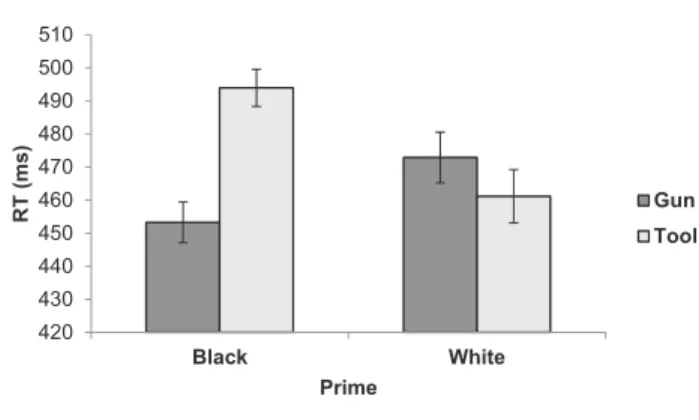
A 2 (preceding Flanker trial: Congruent vs. Incongruent) ⫻ 2 (Prime: Black vs. White face)⫻ 2 (target: Gun vs. Tool) repeated-measures ANOVA on response times in the WIT task yielded the predicted three-way interaction, F(1, 43)⫽ 17.71, p ⬍ .001, p2⫽
.29.3 For WIT trials that followed congruent Flanker trials the
standard finding of an interaction between prime and target was replicated, F(1, 43)⫽ 12.71, p ⫽ .001, p2⫽ .23 (see Figure 4A).
Participants were faster to identify guns, t(43)⫽ ⫺2.35, p ⫽ .02, and slower to identify tools, t(43) ⫽ 3.97, p ⬍ .001, following Black face primes compared to White face primes. However, following incongruent Flanker trials, this interaction vanished (F⬍ 1). Participants’ response times to either Gun or Tool targets did not differ as a function of the prime’s race (see Figure 4B).
Discussion
Implicit Race biased responding as detected by the WIT (Payne, 2001) persisted following Flanker congruent trials. However, this bias disappeared altogether when WIT trials followed incongruent Flanker trials. Specifically, Black faces ceased to facilitate the identification of guns following flanker incongruent trials. Presum-ably, incongruent Flanker trials activated cognitive control, thus biasing judgments on subsequent trials toward target-relevant fea-tures (gun or tool) and away from the distracting, target-irrelevant ones (the color of the face prime). Importantly, distractors and targets in the WIT were both presented in the same central spatial location. Hence, control activated in a spatial selection task (the Flanker task) modulated control in a temporal selection task (the WIT). This finding lends further support to our suggestion that personal significance may modulate the application of control readiness, presumably by changing the context in which control activation and adjustment operate.
General Discussion
We tested whether cognitive control activated in a classic Flanker task can generalize to modulate biased responding on a trial to trial basis in implicit bias tasks. In two experiments
ste-3The Preceding Flanker type and Prime main effects as well as the
Prime ⫻ Target two-way interaction were significant (all ps ⬍ .04). Importantly, these effects were qualified by the predicted three-way inter-action.
Figure 3. Schematic of a trial in Experiment 2, depicting a trial in which an incongruent Flanker trial preceded a congruent Weapon Identification Task trial.
This document is copyrighted by the American Psychological Association or one of its allied publishers. This article is intended solely for the personal use of the individual user and is not to be disseminated broadly.
reotypical biases (gender and race stereotypes in Experiments 1 and 2, respectively) emerged following congruent Flanker trials. However, following Flanker incongruent trials, responses were bias free; stereotypical associations ceased to affect overt behavior. Crucially, in both experiments, whereas in the Flanker task the need for control was created by specific ad hoc task response mapping, in the stereotype tasks it was “all in participants’ heads”—stereotypical associations created by our culture.
Our findings complement recent research on implicit biases, emphasizing the crucial role cognitive control plays in modulating biased responses (e.g., Amodio, Devine, & Harmon-Jones, 2008; Amodio et al., 2004; Govorun & Payne, 2006; Payne, 2001, 2005; Sherman et al., 2008). We manipulated cognitive control on a trial by trial basis in a task exogenous to the one measuring stereotyp-ical biases. This allowed us to demonstrate that incidental activa-tion of control may be sufficient to eliminate biased behavior and that control need not necessarily stem from a specific motivation to control bias.
Our findings are also informative with respect to the question of the generality of control adjustment effects (e.g., Egner, 2008; Funes et al., 2010b). An intriguing possibility stemming from our results is that the personal and social significance of the task may modulate the scope of control readiness and adjustment. When facing an implicit bias task, the goal not to be (or appear) biased may be just as important as the assigned task goal (to correctly
identify the target), arguably even more important (see Amodio et al., 2004, 2008, for an argument regarding egalitarian goals in a participants’ sample similar to the one used in the current studies). Hence, an implicit bias task may significantly change the context in which conflict monitoring and control adjustment processes operate. This may lead to either quantitative changes in the thresh-old of control readiness and adjustment across situations, or even to qualitative changes that render control readiness across domains possible.
References
Amodio, D. M., Devine, P. G., & Harmon-Jones, E. (2008). Individual differences in the regulation of intergroup bias: The role of conflict monitoring and neural signals for control. Journal of Personality and
Social Psychology, 94, 60 –74. doi:10.1037/0022-3514.94.1.60
Amodio, D. M., Harmon-Jones, E., Devine, P. G., Curtin, J. J., Hartley, S. L., & Covert, A. E. (2004). Neural signals for the detection of unintentional race bias. Psychological Science, 15, 88 –93. doi:10.1111/ j.0963-7214.2004.01502003.x
Banaji, M. R., & Hardin, C. D. (1996). Automatic stereotyping.
Psycho-logical Science, 7, 136 –141. doi:10.1111/j.1467-9280.1996.tb00346.x
Bartholow, B. D., & Dickter, C. L. (2008). A response conflict account of the effects of stereotypes on racial categorization. Social Cognition, 26, 314 –332. doi:10.1521/soco.2008.26.3.314
Botvinick, M., Braver, T., Barch, D., Carter, C., & Cohen, J. (2001). Conflict monitoring and cognitive control. Psychological Review, 108, 624 – 652. doi:10.1037/0033-295X.108.3.624
Egner, T. (2008). Multiple conflict-driven control mechanisms in the human brain. Trends in Cognitive Sciences, 12, 374 –380. doi:10.1016/ j.tics.2008.07.001
Eriksen, B. A., & Eriksen, C. W. (1974). Effects of noise letters upon the identification of a target letter in a nonsearch task. Perception &
Psy-chophysics, 16, 143–149. doi:10.3758/BF03203267
Freitas, A. L., Bahar, M., Yang, S., & Banai, R. (2007). Contextual adjustments in cognitive control across tasks. Psychological Science, 18, 1040 –1043. doi:10.1111/j.1467-9280.2007.02022.x
Funes, M. J., Lupiáñez, J., & Humphreys, G. (2010a). Analyzing the generality of conflict adaptation effects. Journal of Experimental
Psy-chology: Human Perception and Performance, 36, 147–161. doi:
10.1037/a0017598
Funes, M. J., Lupiáñez, J., & Humphreys, G. (2010b). Sustained vs. transient cognitive control: Evidence of a behavioral dissociation.
Cog-nition, 114, 338 –347. doi:10.1016/j.cognition.2009.10.007
Gawronski, B., Deutsch, R., Mbirkou, S., Seibt, B., & Strack, F. (2008). When “just say no” is not enough: Affirmation versus negation training and the reduction of automatic stereotype activation. Journal of
Exper-imental Social Psychology, 44, 370 –377. doi:10.1016/j.jesp.2006.12
.004
Govorun, O., & Payne, B. K. (2006). Ego depletion and prejudice: Sepa-rating automatic and controlled components. Social Cognition, 24, 111– 136. doi:10.1521/soco.2006.24.2.111
Gratton, G., Coles, M. G. H., & Donchin, E. (1992). Optimizing the use of information: Strategic control of activation of responses. Journal of
Experimental Psychology: General, 121, 480 –506.
doi:10.1037/0096-3445.121.4.480
Hassin, R. R. (in press). Yes it can: On the functional abilities of the human unconscious. Perspectives on Psychological Science.
Hazeltine, E., Lightman, E., Schwarb, H., & Schumacher, E. H. (2011). The boundaries of sequential modulations: Evidence for set-level con-trol. Journal of Experimental Psychology: Human Perception and
Per-formance, 37, 1898 –1914. doi:10.1037/a0024662
Kerns, J. G., Cohen, J. D., MacDonald, A. W., III, Cho, R. Y., Stenger, V. A., & Carter, C. S. (2004). Anterior cingulate conflict monitoring and
A. Following Congruent Flanker trials.
420 430 440 450 460 470 480 490 500 510 Black White RT (ms ) Prime Gun Tool
B. Following Incongruent Flanker trials.
420 430 440 450 460 470 480 490 500 510 Black White RT ( m s) Prime Gun Tool
Figure 4. Response times (RTs) to Guns and Tools as a function of the face prime (Black vs. White) following Flanker congruent trials (A) and Flanker incongruent trials (B) in Experiment 2. Error bars represent stan-dard errors. This document is copyrighted by the American Psychological Association or one of its allied publishers. This article is intended solely for the personal use of the individual user and is not to be disseminated broadly.
adjustments in control. Science, 303, 1023–1026. doi:10.1126/science .1089910
Kiesel, A., Kunde, W., & Hoffmann, J. (2006). Evidence for task-specific resolution of response conflict. Psychonomic Bulletin & Review, 13, 800 – 806. doi:10.3758/BF03194000
Kunde, W., & Wühr, P. (2006). Sequential modulations of correspondence effects across spatial dimensions and tasks. Memory & Cognition, 34, 356 –367. doi:10.3758/BF03193413
Mayr, U., Awh, E., & Laurey, P. (2003). Conflict adaptation effects in the absence of executive control. Nature Neuroscience, 6, 450 – 452. Notebaert, W., & Verguts, T. (2008). Cognitive control acts locally.
Cog-nition, 106, 1071–1080. doi:10.1016/j.cognition.2007.04.011
Payne, B. K. (2001). Prejudice and perception: The role of automatic and controlled processes in misperceiving a weapon. Journal of Personality
and Social Psychology, 81, 181–192. doi:10.1037/0022-3514.81.2.181
Payne, B. K. (2005). Conceptualizing control in social cognition: How executive control modulates the expression of automatic stereotyping.
Journal of Personality and Social Psychology, 89, 488 –503. doi:
10.1037/0022-3514.89.4.488
Sherman, J. W., Gawronski, B., Gonsalkorale, K., Hugenberg, K., Allen, T. J., & Groom, C. J. (2008). The self-regulation of automatic associa-tions and behavioral impulses. Psychological Review, 115, 314 –335. doi:10.1037/0033-295X.115.2.314
Stürmer, B., Leuthold, H., Soetens, E., Schröter, H., & Sommer, W. (2002). Control over location-based response activation in the Simon task: Behavioral and electrophysiological evidence. Journal of Experimental
Psychology: Human Perception and Performance, 28, 1345–1363. doi:
10.1037/0096-1523.28.6.1345
Received May 9, 2012 Revision received April 15, 2013
Accepted April 16, 2013 䡲 This document is copyrighted by the American Psychological Association or one of its allied publishers. This article is intended solely for the personal use of the individual user and is not to be disseminated broadly.