CONTRACTS
ARIJIT MUKHERJEEy AND LUIS VASCONCELOSz
Abstract. We characterize the optimal job design in a multitasking environment when the …rms rely on implicit incentive contracts (i.e., bonus payments). Two natural forms of job design are compared: (i) individual accountability, where each agent is assigned to a particular job and assumes full responsibility for its outcome; and (ii) team accountability, where a group of agents share responsibility for a job and are jointly accountable for its outcome. The key trade-o¤ is that team accountability mitigates the multitasking problem but may weaken the implicit contracts. The optimal job design follows a cut-o¤ rule: …rms with high reputation concerns opt for team accountability, whereas …rms with low reputation concerns opt for individual accountability. Team accountability is more likely the more acute the multitasking problem is. However, the cut-o¤ rule need not hold if the …rm combines implicit incentives with explicit pay-per-performance contracts.
1. Introduction
Firms frequently give work assignments to a group of employees (or “teams”) and hold them jointly accountable for the outcome of the assignment. In fact, …rms often adopt such a strategy even when it is technologically feasible to assign each worker to a particular job, and hold him solely accountable for his own performance (Bartol and Hagmann, 1992; Shaw and Schneier, 1995). Such a practice may seem counterintuitive because team performance can obscure individual contributions and blunt incentives. There is a vast literature on agency theory that studies the optimal incentive provisions in teams, but Corts (2007) is perhaps the …rst to explore how, in a multitasking environment, team accountability may arise endogenously when individual accountability is still a technologically feasible option. Corts argues that team accountability may optimally balance the trade-o¤ between mitigating the multitasking problem and exposing the workers to a higher performance volatility.
This article contributes to the recent literature on endogenous job design by drawing out the implications for team accountability in the presence of implicit contracts, i.e., an informal promise by the …rm to reward its worker(s) that is sustained through the threat of future retaliation of the worker(s) should the …rm renege on its promise.1 Indeed, it is not hard
to …nd real life examples where the …rms o¤er implicit incentives in an environment where both multitasking and job design play a crucial role. Consider the mutual fund industry.
Date: December 31, 2010.
We would like to thank Simon Anderson, Heski Bar-Isaac, Carl Davidson, Thomas Jeitschko, Pedro Pita Barros, Jon Levin, Helder Vasconcelos, Michael Waldman, Ján Zábojník and the seminar participants at Autoridade da Concorrência (Lisbon), Bates White LLC, McGill University, Michigan State University, the EARIE 2008 conference, 2009 SOLE Annual Meetings, and 2009 Labor Day Conference (University of Michigan) for their helpful comments. All errors that remain are ours.
yDepartment of Economics, Michigan State University, 110 Marshall Adams Hall, East Lansing, MI 48824,
USA. E-mail: [email protected]. URL: http://www.amukherjee.net
zDepartment of Economics, Universidade Nova de Lisboa, Campus de Campolide, 1099-032 Lisboa, Portugal.
Email: [email protected]. URL: http://docentes.fe.unl.pt/~lipv064/.
1Such contracts are also referred to as “relational” contracts (Levin, 2003; Rayo, 2007) or “self-enforcing
implicit” contracts (Bull, 1987).
Managing a mutual fund may require a fund manager to exert e¤ort to …nd new investment opportunities as well as to gather information about the risks associated with such invest-ments. Even though both risks and returns signi…cantly a¤ect the overall pro…tability of the …rm, a fund manager may be tempted to undertake high return investments without paying su¢ cient attention to the underlying risks.2 Traditionally each fund was individually
man-aged by an assigned manager. However, there is a recent trend to move towards “comanman-aged” and/or “team managed” funds, where a group of employees are jointly responsible for the performance of a set of funds (see, e.g., Prather and Middleton, 2000; Chen, et al., 2004; and Massa, 2008).3 Implicit contracts, in the form of bonus payments, are ubiquitous in this
industry.
As is the case with the mutual fund industry, there are two natural job designs: (i) indi-vidual accountability, where each agent is assigned to a particular job. An agent performs all of the tasks associated with the job, and the agent is solely responsible for the outcome of job he has been assigned to. (ii) Team accountability, where a group of agents share the responsibility for a job, each agent performs a subset of tasks associated with the job, and all agents are jointly accountable for the job outcome.4
In this article, we argue that while team accountability might mitigate the multitasking problem, it may make implicit contracts harder to sustain. Consider the following example that illustrates this trade-o¤: Suppose that the …rm hires a worker (or a team of workers) to perform a job that involves two tasks— task 1 and 2. Let ei be the e¤ort in task i, and the
worker’s cost of e¤ort is e2i=2. The workers’e¤ort produces a value for the …rm that is equal to e1+ e2: That is, the …rm cares about both tasks equally. Hence, the …rst-best e¤ort levels
(i.e., those that maximize the joint surplus e1+ e2 e21=2 + e22=2 ) are one unit of e¤ort in
each task (e1 = e2= 1) and the resulting surplus level is 1. The …rm cannot observe the e¤ort
levels but can observe an imperfect measure of job performance, say, “success” or “failure,” where Pr(“success”) = 0:2e1+ 0:3e2. The …rm promises a bonus if the job is a “success.”
Note that even if the …rm cares equally about both tasks, the worker has an incentive to exert more e¤ort on task 2. E¤ort in task 2 has a higher marginal impact on the performance measure (or, probability of success) that determines the worker’s bonus amount. Such an imperfection of the performance measure is the source of the multitasking problem.
2This might be particularly the case when the manager is primarily interested in increasing the fund’s
returns in the short run. The most visible signal of the manager’s performance is perhaps the fund’s returns over the last few quarters rather than the details of where the fund has been invested and what type of underlying risks it bears.
3In some cases, however, the di¤erence between the two may not be one of job design but merely an issue
of whether the …rm is willing to share the credit (and blame) of the fund’s performance with its employees (Massa, et al., 2008). The …rm may also exploit potential economies of scope in production by assigning the same manager for both the tasks: …nding investment and assessing risk. In this article we will abstract away from this issue of the production economies in order to stay focused on the multitasking problem. In fact, as we will discuss shortly, the bene…t of individual accountability in our model stems from the economies of scope in incentive provision rather than the economies of scope in production.
4We use the terms “individual accountability” and “team accountability” in conformity with the existing
literature on endogenous team formation (Corts, 2007). Note that this terminology indicates a classi…cation of job design based on the associated incentive schemes. Alternatively, one can also think about this classi…cation as one based on the type of specialization asked from the worker. Under “individual accountability,”the worker specializes in a “job,” whereas under “team accountability,” the worker may specialize in a “task” (without any loss of generality, the model we use in Section 2 can be reformulated in this way). It is also important to note that the term “team” is used here in a slightly unconventional fashion. The term “team” often refers to a production process where no production is feasible unless a group of workers collaborate (mainly due to complementarities). In such settings, the …rm assigns the job to a group of workers, and it is up to the workers to decide how they want to divide up the di¤erent tasks associated with the job. In contrast, we use the term “team” as a form of task assignment, where the …rm instructs multiple workers to perform di¤erent parts of a job, even when it is technologically feasible for one worker to work on all parts.
The …rm decides whether to hire one worker to do both task 1 and 2 (i.e., adopt “individual accountability”) or to hire two workers and assign each worker to one of the two tasks (i.e., adopt “team accountability”). Observe that if the …rm resorts to individual accountability, to elicit the total e¤ort (between the two tasks) under …rst-best— i.e., two units— the …rm needs to o¤er $4 in bonus: the worker chooses e1 = 0:8 and e2 = 1:2. Note that, while the
aggregate e¤ort level is two units, the worker overemphasizes task 2, creating an allocational ine¢ ciency. The joint surplus produced is 0:96, less than the …rst-best level. Indeed, it is not possible to ensure equal e¤ort in the two tasks because the …rm must provide a single bonus payment to provide incentives for both tasks. Such a misalignment of e¤ort across tasks re‡ects the underlying multitasking problem and leads to a loss of joint surplus.
Now suppose that the …rm splits the job between the two workers: A is in charge of task 1 and B is in charge of task 2. The …rm can now resolve the multitasking problem by o¤ering $5 bonus to A and $3:33 bonus to B. Under these incentives, both A and B exert exactly one unit of e¤ort, and, consequently, the …rst-best surplus is attained. The key issue to note is that, under team accountability, the …rm can vary the power of incentives for the two workers, even if their pays are based on the same performance measure. Such ‡exibility in the incentive provisions alleviates the multitasking problem. However, observe that the total bonus requirement is now $8:33; this is much higher than the bonus required to elicit two units of aggregate e¤ort under individual accountability. Consequently, the …rm’s gains from reneging on its promise is also higher and it is harder for the …rm to credibly commit to such a bonus pool.5 This is the basic trade-o¤ with team accountability that we will explore in this article.
The bene…t of team accountability in solving the multitasking problem has been discussed by several authors (Dewatriport, et al., 2000; Corts, 2007). The novel part of our analysis is to highlight the cost of team accountability in terms of weaker implicit incentives (or, equivalently, the need for larger bonus pool), and to draw out the implications of the trade-o¤ between mitigating the multitasking problem and weaker implicit incentives on the …rm’s job design decisions.
It is important to note that the necessity for a larger bonus pool under team account-ability can be interpreted in terms of economies of scope in incentive provision. To see this point, consider the example discussed above. Under individual accountability, a single bonus payment (based on the job performance) o¤ers incentives for e¤orts in both tasks associated with the job. The resulting economies of scope in incentive provision reduces the size of the bonus pool the …rm needs to commit to. In contrast, under team accountability the job performance measure must be used twice to provide incentives for each of the two e¤orts separately (therefore two bonuses are required). Therefore the …rm must commit to a larger bonus pool vis-a-vis the individual accountability case to provide the same incentive. One can also interpret the larger bonus requirement under teams as a cost of solving the underlying free-riding problem. The …rm needs to o¤er separate bonus payments for each of the two tasks solely because a worker does not internalize the impact of his e¤ort on the other agent’s payo¤ (we will further elaborate on this issue in Section 3).
We formalize this trade-o¤ between the mitigating multitasking problem and weakening of the implicit incentives in a stylized model similar to the example discussed above. We consider an environment where an in…nitely lived principal (…rm) hires two in…nitely lived agents (workers). In each period, the two agents exert e¤ort to perform two jobs. Both jobs involve two tasks each (i.e., there are four tasks in total). The e¤ort exerted in each of the four tasks cannot be observed by the …rm; this gives rise to a moral hazard problem.
5This e¤ect is in sharp contrast with the credibility of promise discussed in the models of multilateral implicit contracts (e.g., Levin, 2002). In these models implicit contracts are easier to sustain when promises are multilateral rather than bilateral. We will further elaborate on this issue in section 3.
However, each of the two jobs yields an observable performance measure. The …rm can o¤er incentives by tying an agent’s compensation to the observed performance in the job(s) he has been assigned to. We further assume that the outcomes of both jobs are nonveri…able. Thus, the …rm can only o¤er an implicit contract (i.e., bonus payment) to provide incentives for the two jobs.
The e¤ort exerted in all four tasks has the same marginal bene…t to the …rm. But the e¤ort spent on each of the two tasks related to any particular job a¤ects the observed job performance di¤erently. This gives rise to a multitasking problem. At the beginning of the game, the …rm chooses between two alternative job designs: individual accountability and team accountability. In such a setting, we characterize the optimal job design as a function of the …rm’s discount factor ( ) that parameterizes its reputation concerns.
We show that the optimal job design follows a cut-o¤ rule: team accountability is strictly optimal only if the …rm’s discount factor is su¢ ciently high. The intuition behind this result is simple but subtle. Recall that while team accountability allows the …rm to overcome the multitasking problem, certeris paribus, it requires the …rm to credibly commit to a larger bonus pool vis-a-vis individual accountability. If the …rm’s discount factor ( ) is su¢ ciently high, the threat of future punishment is signi…cantly large for the …rm, which, in turn, allows the …rm to credibly promise to a larger bonus pool. Consequently, team accountability becomes optimal for …rms with high . However, for low , the …rm lacks credibility to o¤er a large bonus payments, and the …rm is better o¤ by resorting to individual accountability. Under individual accountability, even a small bonus payment gives sharper incentives because it elicits e¤ort in all tasks associated with a particular job. In other words, individual accountability allows the …rm to exploit the economies of scope in incentive provision. A single bonus payment provides some work incentives in all tasks, and the stronger incentives can outweigh the ine¢ ciencies originating from the multitasking problem.
Given this basic intuition on how job design may interact with the implicit incentive provisions, we consider a more general setting where the workers’performances in a subset of jobs are indeed veri…able. In such an environment the …rm may opt to provide incentives to its workers though a combination of explicit and implicit incentives. It may o¤er explicit pay-per-performance contracts to the agents assigned to the jobs where contractible performance measures are available and promise implicit contracts to the others.6
The scenario described above can be readily accommodated in our basic model. However, a new e¤ect originates in the presence of the explicit contract: team accountability makes implicit incentives more fragile by enhancing the …rm’s punishment payo¤. Following a break-down of the implicit contract, the …rm may only rely on the explicit contract for motivating the agents on the punishment path. Indeed, the …rm’s punishment payo¤ is simply the pro…t it earns from the jobs that are compensated by the explicit contracts. Because team account-ability allows the …rm to mitigate the multitasking problem, the explicit contracts are more e¢ cient under team, and therefore, the …rm’s punishment payo¤ is higher under team ac-countability than under individual acac-countability. This makes implicit incentives even more fragile under team accountability. In other words, in the presence of explicit contracts, the punishment threats are weaker under team accountability, and this, in turn, increases the …rm’s temptation to cheat on its bonus promises.
This new e¤ect invalidates the cut-o¤ rule discussed above. Instead, we …nd that the optimal job design must be one of the following: (i) Only the …rms with very high or very low opt for team accountability, while the …rms with intermediate opt for individual accountability. (ii) Team accountability is optimal for all . The former is the case when
6As we will discuss in section 4, the commercial insurance industry is a typical example of such a multi-tasking environment.
the extent of the multitasking problem is low; the latter is the case when the multitasking problem is severe.
The intuition behind this result is similar to the case of the cut-o¤ result discussed above, except in the case of su¢ ciently low . What drives the optimality of teams for low ? For su¢ ciently small, the …rm has low reputation concerns, and hence, the implicit incentives are infeasible under both types of job designs. The …rm’s pro…t under team accountability is higher because the explicit incentive can elicit e¤ort more e¢ ciently (for the explicitly contracted job) under team setting by mitigating the multitasking problem. However, if the multitasking problem is su¢ ciently large, then even for a moderate , the stronger implicit incentives under individual accountability need not be enough to compensate the associated multitasking problem. In this case, team accountability remains optimal for all values of .
The main results of the article yield interesting comparative statics predictions by inter-linking the key parameters to the …rm’s job design decision. For example, the cut-o¤ result discussed above indicates that when only implicit incentives are available, team accountability becomes more likely as the …rm’s reputation concerns increase. Our results also imply that team accountability is more likely to be the optimal job design when the extent of the mul-titasking problem is severe. This …nding, however, is quite intuitive, because the key bene…t of team accountability that we highlight in this model is that of overcoming the multitasking problem. Thus, when the multitasking problem is severe, it favors team accountability over individual accountability.
Related literature: This article relates to two broad strands of literature on agency theory— incentives in team and implicit contracts— and highlights how team accountability may arise endogenously as the optimal job design in the presence of implicit contracts.
Both explicit and implicit contracts in teams are well studied in the literature (Holmström, 1982; Che and Yoo, 2003; Kvaloy and Olsen, 2006, Bar-Issac, 2007; Rayo, 2007). However, this literature generally assumes that team accountability arises exogenously and focuses solely on the incentive issues that may arise in teams. Two important exceptions are Itoh (1991) and Bar-Issac (2007), who argue that teamwork may indeed originate endogenously. But none of these authors considers the role of multitasking in team formation.7 Our article is perhaps more closely related to Corts (2007) who studies how team accountability may endogenously emerge as the optimal job design in a multitasking environment with explicit pay-per-performance contracts. Similar to our article, Corts highlights the bene…t of team in overcoming the multitasking problem. However, he considers a di¤erent cost of team: teams make the agents’income more noisy, for which the risk-averse agents must be o¤ered a higher risk premium. Corts shows that team accountability might be the optimal job design when the extent of the multitasking problem is high and/or the extent of risk aversion among the agents is low. Our article complements Corts’ article by highlighting a di¤erent trade-o¤ associated with the team accountability in the presence of implicit incentives. We abstract away from the risk aversion issue by assuming that the agents are risk neutral, but introduce a new friction in terms of implicit contracts. Drawing parallel to Corts, we …nd that team accountability emerges as an optimal job design when the extent of multitasking problem is large and/or the …rm’s concerns for future reputation (as represented by its discount factor) is high.
Another article that is closely related to ours is Levin (2002). Levin discusses the costs and bene…ts of multilateral contracting over bilateral contracting in employment relationships. In a multilateral contracting, similar to team accountability, the …rm makes commitments to a
7Itoh’s argument relies on the need to foster collaborations among employees (also see Ramakrishnan and Thakor, 1991). Bar-Issac shows how a team formed with the old and the young workers can restore the reputation concerns of the old workers, who otherwise have nothing more to prove to the outside labor market.
large group of employees, whereas under bilateral contracting, similar to individual account-ability, the …rm makes commitments to individuals or small groups. There is no multitasking issue in Levin’s model, and he highlights the trade-o¤ that while multilateral contracting are di¢ cult to adjust in response to exogenous shocks to the business environment, it facil-itates implicit contracts. The latter e¤ect is in sharp contrast with our article where team accountability hinders implicit incentive provisions. We will revisit this issue in Section 3.
Finally, our article is also related to two “sub-branches” of the agency theory literature: (i) multitasking (Holmström and Milgrom, 1991; Dewatripont, et al., 2000; Besanko, et al., 2005) and (ii) interaction between explicit and implicit incentives (Gibbons and Murphy, 1992; Baker, et al., 1994). In contrast with our article, the existing literature on multitasking primarily focuses on the explicit incentives. And the literature on the interaction between incentives primarily discusses the characteristics of the optimal contract (that emerges from such interplay between incentives) and is silent about its potential implications on job design in a multitasking environment. An important exception is Schöttner (2008). Schöttner investigates when to split three tasks between two agents, where both explicit and implicit contracts may be feasible. In her model, task-spliting can elicit the …rst-best e¤ort level in one of the three tasks, but implicit contracts are sharper under “no-task-splitting.”However, these bene…ts and costs of task-spliting originate from very di¤erent reasons (compared to our model), namely, speci…c restrictions on the agents’cost function and larger punishment threats when tasks are not split. Also, in contrast to our results, Schöttner …nds that task-splitting can be optimal only when implicit contracts are infeasible.
The article is organized as follows. Section 2 discusses the basic model and section 3 characterizes the optimal job design. The role of explicit contracts is discussed in section 4. Section 5 discusses the empirical implications of our main results and their robustness to alternative modeling assumptions. Finally, section 6 concludes. Unless mentioned otherwise, all proofs are in the appendix.
2. The Basic Model
Players. A long-run …rm, F , hires two long-run agents, A and B, to manage two funds.8 Stage game
In what follows we will describe the stage game that is played between the …rm and the agents in each period 2 f1; 2; :::g. The stage game is de…ned in terms of its four key ingredients: technology, job design, contracts, and the players’ payo¤ s. We elaborate below on each of these four ingredients.9
Technology. The technology is modelled after the canonical task allocation model of Dewatripont et. al (2000). There are three central features to this class of models: (i) The …rm only cares about the impact of the agents’e¤ort to its bottom line (de…ned below as V ); however, V is not observed by the agents, (ii) the agents’compensations are based on a set of performance measures (de…ned below as x) that are observable but that are distinct from the …rm’s bottom line, and (iii) the marginal impact of the agents’ e¤orts on V and x are di¤erent; this gives rise to a multitasking problem.10 The detailed description of the model is as follows.
8The reference to the mutual fund industry is only to maintain a parallel with the example discussed in the introduction. The model presented here does not purport to be a model of mutual funds but a general model of multitasking with implicit incentives.
9For the sake of clarity, while describing the stage game we will suppress the time su¢ x associated with each variable.
Suppose F owns two funds, say 1 and 2, where in each period a fund performance can either be good or bad. Let xi2 f0; 1g be the index for the fund’s performance, where xi = 1
if the fund’s performance is good and xi = 0 if it is bad (i = 1; 2). We de…ne managing
a fund as a “job” (thus there are two jobs in total). Each job consists of two tasks: (i) …nding investment opportunities that yield higher returns and (ii) assessing the underlying risks associated with such an investment opportunity. We denote tasks 1 and 2 as the tasks required for job 1, and tasks 3 and 4 as those required for job 2. Task j 2 f1; 2; 3; 4g requires an e¤ort level of ej 2 [0; 1]. Let the cost of e¤ort in task j be c (ej) = e2j=2. The tasks a¤ect
the value, V , that F receives from the two funds, where V (e) = (e1+ e2+ e3+ e4) ;
and > 0. The value V is not observable to the agents. One may interpret V as the impact of the agent’s e¤ort in various tasks to the bottom line of the …rm’s pro…tability. This value accrues directly to the …rm and may not be clearly observed by the rank-and-…le of a hierarchical organization. Furthermore, e¤orts are also unobservable, but each of the two jobs has performance measures, x1 and x2, that are observable. The e¤orts in each of the
two jobs determine their performance as follows:
(1) Pr (x1= 1 j e) = e1+ e2;
Pr (x2= 1 j e) = e3+ e4;
where > 1. While x1and x2 are observable, neither of them are veri…able.11 The parameter
measures the extent of multitasking problem. An agent who is compensated on the basis of x1 (or x2) has incentives to substitute away from e1 (or e3) and concentrate more on e2
(or e4), even though all tasks have the same marginal impact on the …rm’s value (V ). We
assume the following parametric restriction to ensure that the probabilities in equation (1) are well de…ned (i.e., probabilities lie between 0 and 1) in any equilibrium of this game: Assumption 1. < 1= (1 + ) :
Assumption 1 requires to be small when is large and vice versa. An important issue to note about this technology speci…cation is that it rules out all interactions across e¤orts in di¤erent tasks. The costs (c) and value (V ) are additively separable in e¤orts ruling out any substitutability or complementarity across tasks. The assumption of additive separability streamlines the model and improves the exposition of the key trade-o¤ between multitasking and implicit incentives. This trade-o¤ itself is not driven by this assumption, and we will discuss the impact of relaxing this assumption in section 5.
Job design. Each agent is responsible for exactly two tasks. The type of allocation of tasks between the two agents is referred to as the job design. The …rm chooses between two alternative job designs: individual accountability and team accountability. The agents have individual accountability when one is assigned to tasks 1 and 2 and the other is assigned to tasks 3 and 4: Thus, under individual accountability, one agent is responsible for job 1 (i.e., sole responsibility of managing fund 1), while the other one is responsible for job 2 (i.e., fund 2). Without loss of generality, we assume that under individual accountability, A is responsible for job 1 (i.e., tasks 1 and 2), while B is responsible for job 2 (i.e., tasks 3 and 4). In contrast, we assume that under team accountability, agent A is assigned to the tasks 1
and 4, while agent B is assigned to tasks 2 and 3. This is to say that, in a team, both agents have responsibility for both jobs.
It is important to note that in order to form teams one can also consider grouping tasks (1 and 3) and (2 and 4). This con…guration has a natural interpretation that, under team accountability, each agent specializes in a task (say, “ -task” or “non- -task”) and performs this task for all jobs. However, we specify the grouping (task 1 and 4) and (task 2 and 3) to maintain a parallel with the case of individual accountability where each agent is responsible for exactly one “ -task” (i.e., task 2 or 4). Such a speci…cation is without loss of generality, because both con…gurations yield the same surplus to the …rm (the total bonus requirement to implement a given e¤ort pro…le e remains the same under the two con…gurations).12 Assumption 2. F decides on the job design at the beginning of the game, and its decision is irreversible.
Once a particular design is chosen, it is prohibitively costly to change it at a future date. This assumption simpli…es the analysis of the …rm’s punishment payo¤ and allows us to draw out the implications of the key trade-o¤ between the multitasking problem and sustenance of implicit contract more succinctly.13 With a slight abuse of notation, we add an auxiliary period, say = 0, at the beginning of the game to denote the stage when the …rm makes its job design decision (this formulation will be useful below in de…ning the history and the strategies in the game).
Contracts. Because the performance in both jobs is nonveri…able, the …rm can only o¤er an implicit contract promising (in each period) a bonus payment if the fund performance turns out to be good. So, under individual accountability (where agent A is assigned to job 1, and B is assigned to job 2), a contract o¤ered to agent A (in each period) is a tuple (WA; A),
where WAis a lump sum wage and Aan implicitly contracted bonus payment that is o¤ered
only if x1 = 1. The contract o¤ered to agent B is of similar form. In contrast, in a team
setting, a contract o¤ered to agent k 2 fA; Bg (in each period) is a tuple (Wk; k1; k2),
where Wk is a lump sum wage and ki is an implicitly contracted bonus payment that is
o¤ered only if xi = 1.14
12Also note that a related feature of such team formation is that every agent is a member in multiple teams. This feature is, however, a modeling artifact and it is not essential for capturing the main trade-o¤ we are interested in. One can use an alternative model similar to the numerical example discussed in the introduction where there is only one job involving two tasks. In this case, the question of job design boils down to the question of whether to hire one agent for both tasks or to hire two agents for each of the two tasks. We did not use such a model, because it has a potential drawback: the number of agents in the environment changes across the two forms of job design. Hence the …rm’s payo¤s under team and individual accountability may not be readily comparable (especially when the reservation wages of the agents are strictly positive) leading to an additional complexity in our analysis.
13Note that this assumption does not a¤ect the key trade-o¤ between multitasking and sustenance of implicit contracts, and therefore, it does not a¤ect the qualitative nature of our results. However, if this assumption is relaxed, on the punishment path, the …rm will always choose the job design that leads to the highest punishment payo¤. This e¤ect will (weakly) increase the …rm’s punishment payo¤ under both individual and team accountability and enhance its temptation to cheat.
14An important implication of such contract speci…cation is that bonuses are assumed to be additively separable across jobs. While such a speci…cation rules out certain interesting types of compensation schemes, e.g., relative performance evaluation, in some situations implementation of a “nonseparable” compensation scheme may not be feasible or it may involve additional costs to the …rm (e.g., the job performance signals may not be public, it may create incentives for sabotage, it may encourage the workers to collude and shirk, etc.) However, as we will discuss in section 5, this assumption is not crucial for the qualitative nature of our …ndings but we maintain this assumption because it considerably improves the analytical tractability of our model.
Payoffs. We assume that both the …rm and the two agents are risk neutral. The payo¤ of the …rm is simply the overall value that the …rm receives from the two funds net of its expected wage payments. The payo¤ of an agent is the expected wages he receives net of the cost of e¤ort. The exact expressions for the payo¤s will depend on the job design. Under individual accountability, the …rm’s payo¤ in each period is
I = V (e) W
A APr (x1 = 1 j e) WB BPr (x2 = 1 j e) ;
and the payo¤s of agent A and B are de…ned as
uIA= WA+ APr (x1 = 1 j e) c (e1) c (e2) ;
uIB= WB+ BPr (x2 = 1 j e) c (e3) c (e4) ;
respectively. In contrast, under team accountability, the …rm’s payo¤ is
T = V (e) X
k2fA;Bg
[Wk+ k1Pr (x1 = 1 j e) + k2Pr (x2 = 1 j e)] ;
the payo¤ of the agent A (who is assigned to the tasks 1 and 4) and B (who is assigned to the tasks 2 and 3) are
uTA= WA+ A1Pr (x1 = 1 j e) + A2Pr (x2 = 1 j e) c (e1) c (e4) ;
uTB= WB+ B1Pr (x1= 1 j e) + B2Pr (x2 = 1 j e) c (e2) c (e3) ;
respectively. The outside option of both agents is assumed to be 0.
Time line. The sequence of events in a stage game (in an arbitrary period 1) is summarized as follows:
At date :1 (beginning of the period): F o¤ers contracts to the two agents (W; ). Agents decide whether to accept or reject their contract. Game goes to period :2 if at least one agent accepts his contract. Else the game ends.
At date :2: Agents exert e¤ort e in the tasks they have been assigned to. At date :3: Performance signals x1 and x2 in the two jobs are realized.
At date :4 (end of the period): F pays the contracted lump sum wages (W ) and a bonus ~ (which may be di¤erent from the implicitly promised bonus ).
Repeated game
The repeated game is simply the aforementioned stage game repeated in each period. Both the …rm and the agents discount the future payo¤ at a common per period rate of 2 [0; 1). History of the game. We denote the public history of play within period (or in the th stage game) by h . For = 0, this history consists of F ’s choice of job design
d 2 fteam accountability, individual accountabilityg. Thus, h0 = d. For 1, h is a tuple
that reports: (i) the contract o¤ered by F to the two agents (WA ; WB ); (ii) A and B’s
decisions on whether to accept the contract, zi 2 faccept; rejectg, i 2 fA; Bg; (iii) the
outcomes in jobs 1 and 2, x1 and x2 ; and (iv) F ’s actual bonus payments at the end of
period , ~ . That is, h = ((WA ; WB ); (zA ; zB ); (x1 ; x2 ); ~ ). We denote the public
history of the game at the beginning of period by h and the set of all possible public histories of the game at the beginning of period by H . For 1, h = (h1; h2; ::; h 1).
Strategies, Implicit contracts and equilibrium. We focus on pure strategy equi-libria due to their analytical tractability. A strategy of F , F, consists of the following
decisions: (i) the decision made in period one on the job design d; (ii) the decisions made at the beginning of each period 1 on the contracts (WA ; WB ), given the history h 2 H ;
and (iii) the decisions made at the end of each period 1 on the actual bonus payments ~ , given the history h 2 H , contracts (WA ; WB ) and outcomes (x1 ; x2 ). A strategy of
agent i 2 fA; Bg, i, consists of the following decisions: (i) whether to accept the contract
o¤ered by F at the beginning of each period 1, given the history h 2 H ; and (ii) the e¤ort decisions in each period in which he accepts F ’s contract o¤er, given the history h 2 H and contract (WA ; WB ).
For each period 1 and every history h 2 H , an implicit contract between the …rm and the two agents describes: (i) the compensation the …rm should o¤er (and that should be paid) to both agents; (ii) whether the agents should accept or reject the …rm’s o¤er; and in the event of acceptance (iii) the agents’ e¤ort levels in the tasks they are assigned to. Because a part of the compensation (the bonuses) in this contract is only promised, the …rm may have the incentive to renege on them once production occurs.
An implicit contract is self-enforcing if it constitutes a Perfect Public Equilibrium (PPE) in trigger strategies of the repeated game.15 A strategy pro…le h F; A; Bi constitutes a PPE
in trigger strategies if: (i) given any public history, the strategy pro…le h F; A; Bi induces
a Nash Equilibrium in the continuation game, and (ii) both agents revert back to playing their static best responses forever if F reneges on its promise to any of the two agents.16
3. Optimal Job design
The optimal job design is derived by comparing the …rm’s payo¤ under individual and team accountability when the associated incentive contracts are optimally chosen. Therefore, a characterization of the optimal job design requires a characterization of the optimal contracts. But before we do so, we brie‡y discuss the …rst-best solution to the …rm’s contracting problem. The …rst-best solution serves as a benchmark for comparing the e¢ cacy of each of the two job designs. The …rst-best solution is the one that maximizes the joint surplus between the …rm and the two agents. That is, the …rst-best e¤ort levels, eF B, solve max
eV (e) Pc (ej),
or, equivalently, must satisfy the …rst-order conditions
(2) = eF Bj 8j:
Equation (2) suggests that the …rst-best e¤ort in all four tasks should be the same and equal to , the marginal bene…t of e¤ort to the …rm.
We now focus on the optimal contracting under individual and team accountability and compare the e¢ ciency of such contracts with the …rst-best outcome. The following lemma (à la Levin, 2003) simpli…es the analysis by ensuring that without loss of generality, one can restrict attention to the class of stationary contracts; i.e., we can characterize the optimal contract in the repeated game as a tuple (WA; WB; A; B) under individual accountability
and as a tuple (WA; WB; A1; B1; A2; B2) under team setting, where the optimal contract
does not vary over time. (We omit the proof as it directly follows from the proof of Theorem 2 in Levin’s article)
15See Fudenberg et. al (1994) for a detailed discussion of the PPE solution concept.
16Note that we have assumed that irrespective of the job design both agents trigger punishment if the …rm cheats on at least one of the two agents. This speci…cation, however, is not essential for our main results. For example, one can consider alternative speci…cations where under individual accountability agents do not observe each other’s performance, and hence, the …rm can cheat on one agent without drawing any punishment for the other.
Lemma 1. (Levin, 2003) If an optimal contract exists, there exists a stationary contract that is also optimal.
Based on this observation we characterize below the optimal contracts under di¤erent job designs.
3.1. Individual Accountability. The optimal contract must satisfy three constraints: (i) Individual rationality (IR), i.e., the contract must o¤er both agents rents at least as large as their outside options. (ii) Incentive compatibility (IC), i.e., given the incentives, both agents choose their e¤ort levels to maximize their expected payo¤s. And …nally, (iii) dynamic restriction (DR), i.e., the …rm’s promise of bonus payments must be credible. We elaborate on each of these constraints below.
As the outside options of both agents are equal to 0, given the contracts (WA; A) for
agent A and (WB; B) for agent B and the prescribed e¤ort levels e, the (IR) constraints for
agent A and B are:
(IRIA) WA+ APr (x1 = 1 j e) c (e1) c (e2) 0;
(IRIB) WB+ BPr (x2= 1 j e) c (e3) c (e4) 0:
Next, consider the (IC) constraints. As we have discussed above, under individual ac-countability, agent A is responsible for tasks 1 and 2 (i.e., job 1), and agent B is responsible for tasks 3 and 4 (i.e., job 2). Given the implicitly contracted bonus payments A(o¤ered if x1 = 1) and B (o¤ered if x2 = 1), the optimization problems for the two agents are:
max e1;e2 WA+ APr (x1 = 1 j e) c (e1) c (e2) ; max e3;e4 WB+ BPr (x2 = 1 j e) c (e3) c (e4) :
Thus, for any credible promise of bonus amounts, the agents’ choice of e¤ort levels must satisfy the following incentive compatibility conditions:
(ICAI) A= e1 = e2= ;
(ICBI) B= e3 = e4= :
The (IC) constraints above highlight the multitasking problem. Consider the case of job 1 that is assigned to agent A (the case of job 2 is analogous). Given that both task 1 and task 2 are compensated based on the performance outcome in job 1, the e¤ort levels exerted in these two tasks are linked by the relation e1 = e2= . Because > 1, for any value of A, agent A
will exert more e¤ort in task 2 than in task 1 (similarly for B). And there cannot exist any values of A and B that can ensure the …rst-best allocation e1 = e2= = eF B1 = eF B2 .
Finally, consider the dynamic restriction (DR) constraint. If the bonus promises are to be credible, the discounted value of the …rm’s payo¤ stream from o¤ering such bonus payments (i.e., equilibrium payo¤) must be greater than the bonus amount that the …rm forfeits by reneging on its promise, plus the discounted value of the payo¤ stream the …rm may earn if it reneges on its promise to one or both agents (i.e., punishment payo¤). Now, by modeling speci…cations, if the …rm reneges on its promise to at least one of the two agents, both agents revert back to their static best response, and do not exert any e¤ort. Consequently, if the …rm decides to renege on its promise, it is optimal to renege on both agents and its continuation
payo¤ on the punishment path is zero. Hence, we must have the following constraint on A and B to ensure that reneging on bonus payments is not a pro…table deviation for the …rm: (DRI)
1
I
A+ B:
The optimal contracting problem for the …rm can now be written as follows: max
e;WA:WB; A; B
V (e) WA WB APr (x1 = 1 j e) BPr (x2 = 1 j e)
s:t: IRIA ; IRIB ; ICAI ; ICBI ; and DRI :
This problem can be written as follows by eliminating WA, WB, and e by using the (IR) and
(IC) constraints: max A; B I( A; B) = (1 + ) ( A+ B) 12 1 + 2 2 A+ 2B s:t: 1 I( A; B) A+ B DRI
We can further simplify this problem by observing the fact that for any Aand B, I( A; B) =
I(
A; 0) + I(0; B) and I( A; B) is concave in both A and B. This observation
im-plies that at the optimum, A= B (say), and the …rm’s optimal contracting problem boils down to:
PI : 8 > < > : I max 2 (1 + ) 1 2 1 + 2 2 s:t: 1 (1 + ) 12 1 + 2 2 : DRI
Let r = (1 ) = . Lemma 2 below characterizes the optimal pro…t of the …rm associated with the above contracting problem.
Lemma 2. The optimal pro…t under individual accountability is a continuous and monoton-ically decreasing function in r, given as follows:
(3) I(r) = 8 < : 2(1 + )2= 1 + 2 if r 1 2 (1 + ) 4 (1 + )r r2 =(1 + 2) if 1 2 (1 + ) < r < (1 + ) 0 if r (1 + ) :
For r su¢ ciently large (i.e., su¢ ciently low), the optimal pro…t is simply equal to the pun-ishment payo¤ of the …rm, because no implicit incentives are feasible, even on the equilibrium path. As r decreases (i.e., for larger values of ) the …rm gains more credibility in promising implicit contracts. The resulting stronger implicit incentive induces greater e¤ort and leads to an increase in the …rm’s pro…t until the maximal pro…t under individual accountability is achieved.17
17Observe that the maximal pro…t under individual accountability is less than the pro…t associated with the …rst-best, because the multitasking problem continues to prevail irrespective of how strong an implicit incentive the …rm can credibly o¤er.
While we present the formal proof of Lemma 2 in the Appendix, it is instructive to discuss the basic argument behind this lemma as it highlights the nature of the optimal incentive contract. Note that the solution to PI is simply the highest feasible under DRI until the
unconstrained maxima is reached. We can rewrite the DRI constraint as
(4) RI( ) := (1 + ) 1
2(1 +
2) 2 r :
The function RI( ) re‡ects the credibility of the …rm when it promises a bonus of the amount , and this function can be interpreted as the “reputation capital”(or per-period reputational capital) of the …rm, given the bonus . Thus, for any given r, the optimal is simply the largest that the …rm can credibly promise until the value of that solves the unconstrained version of PIbecomes credible. The optimal bonus payment thus obtained, say I(r), is given
as: (5) I(r) = 8 < : (1 + ) = 1 + 2 if r 12 (1 + ) (2 (1 + ) 2r) = 1 + 2 if 12 (1 + ) < r < (1 + ) 0 if r (1 + ) ;
The optimal pro…t under individual accountability can now be obtained by plugging the value of I(r) in I.
Having characterized the optimal contract and the associated pro…t of the …rm under individual accountability, we next analyze the case of team accountability.
3.2. Team Accountability. Recall that without any loss of generality, we assumed that un-der team accountability, agent A is responsible for tasks 1 and 4, while agent B is responsible for tasks 2 and 3. As in the case with individual accountability, we …rst discuss the (IR), (IC), and (DR) constraints associated with the optimal contracting problem. The (IR) constraints are analogous to the case of individual accountability and are given as follows: (IRTA) WA+ A1Pr (x1= 1 j e) + A2Pr (x2= 1 j e) c (e1) c (e4) 0;
(IRT
B) WB+ B1Pr (x1 = 1 j e) + B2Pr (x2 = 1 j e) c (e2) c (e3) 0:
However, the nature of the (IC) and the (DR) constraints is signi…cantly di¤erent com-pared to the previous case. Consider the (IC) constraints …rst. Given the bonus payments
A1and B1(o¤ered if x1= 1) and the bonus payments A2and B2(o¤ered if x2= 1), the
optimization problem for the two agents are: max e1;e4 WA+ A1Pr (x1 = 1 j e) + A2Pr (x2 = 1 j e) c (e1) c (e4) ; max e2;e3 WB+ B1Pr (x1= 1 j e) + B2Pr (x2 = 1 j e) c (e2) c (e3) :
Thus, the (IC) constraints that the optimal contract must satisfy are:
(ICAT) A1 = e1; A2 = e4= ;
The (IC) constraints above highlight both the bene…t and the cost of team accountability. First, on the bene…t side, it shows how team can mitigate the multitasking problem. Consider the case of job 1, where task 1 is performed by agent A and task 2 is performed by agent B (the case of job 2 is analogous). Under team accountability, the …rm can vary the power of the incentives o¤ered to agents A and B for each of the two tasks associated with job 1. Because two di¤erent agents are performing the two tasks, they can be paid di¤erently for the same performance outcome in job 1 (i.e., A1 need not be equal to B1). Thus, the e¤ort levels exerted in tasks 1 and 2 are no longer interlinked (as is the case with individual accountability), and for A1 = and B1= = , the …rst best allocation (e1= e2 = ) can
be attained. Second, on the cost side, it shows why team accountability requires a higher bonus pool (compared to individual accountability) to extract the same amount of e¤ort. Under individual accountability, the …rm enjoys economies of scope in incentive provision. By promising a bonus payment of $1 in a job, say job 1, the …rm can elicit e¤ort in both tasks: one unit of e¤ort in task 1 and units of e¤ort in task 2. But under team accountability, such economies of scope disappear. In order to elicit the same level of e¤ort, the …rm must pay $1 to each of the two agents, i.e., the total amount of bonus that the …rm must commit to is $2. The need for a larger bonus pool can also be interpreted as a free-riding problem in teams— an agent chooses his e¤ort levels to maximize his own payo¤ and ignores its impact on the other agent.18
Next, consider the dynamic restriction (DR) constraint. Similar to the case of individ-ual accountability, even under team accountability, both agents become aware of the …rm’s deviation (and hence, trigger punishment), even if the …rm reneges its promise only with one of the two agents. Thus, if the …rm decides to deviate, it is optimal to renege on both agents, and the punishment payo¤ of the …rm would be 0. Consequently, the relevant (DR) constraint is
(DRT)
1
T
A1+ B1+ A2+ B2:
The optimal contracting problem can now be formulated as follows:
max
e;WA:WB; A1; A2; B1; B2
V (e) WA WB ( A1+ B1) Pr (x1 = 1 j e)
( A2+ B2) Pr (x2 = 1 j e)
s:t: IRAT ; IRTB ; ICAT ; ICBT ; and DRT .
Using the (IR) and (IC) constraints to eliminate WA, WB and e, we can rewrite the
problem as:
18As re‡ected by the agents’(IC) constraints, we implicitly assume that the agents cannot collude between themselves. This is a natural assumption in our model, because we are primarily interested in exploring how the optimal job design is in‡uenced by the reputation concerns of the …rm (rather than the agents). Indeed, one can interpret the in…nitely lived agents as a sequence of short-lived agents with perfect observability of the game’s history (i.e., at the beginning of each period, two new agents are hired who leave the environment at the end of the period). This interpretation makes our model perhaps more realistic as most …rms face a nontrivial rate of turnover in their workforce.
max A1; B1; A2; B2 T ( A1+ B1+ B2+ A2) 12 2 A1 12 2 2 B1 12 2 B2 12 2 2 A2 s:t: 1 T A1+ B1+ A2+ B2: DRT
This problem can further be simpli…ed by virtue of the following observation: because, the agents are ex ante symmetric, and T is concave and additively separable in s, at the
optimum, we must have A1= B2and B1= A2. Using this fact, we can rewrite the …rm’s problem as: PT : 8 > < > : T max A1; B1 2 ( A1+ B1) 12 2A1+ 2 2B1 s:t: 1 ( A1+ B1) 12 A12 + 2 2B1 A1+ B1: DRT
The above optimization program PT is similar in spirit to its individual accountability
counterpart PI: However three issues are important to note.
First, the DRT constraint o¤ers a neat representation of the key trade-o¤ associated with the team accountability. The DRT constraint indicates that, compared to individual accountability, under team accountability, the …rm must commit to a larger bonus pool to elicit the same e¤ort levels (because a separate bonus payment must be o¤ered for each task). Consequently, team accountability makes implicit contracts di¢ cult to sustain. However, given an aggregate bonus pool (i.e., A1+ B1) the …rm can vary the power of incentives o¤ered for the two tasks (i.e., A1 and B1 do not have to be equal) and overcome the multitasking problem.19
Second, the DRT constraint is in sharp contrast with the dynamic restrictions discussed in the models of multilateral implicit contracts (Levin, 2002). In Levin’s model, the dynamic restriction under multilateral contracts simply requires that the dynamic restriction under bilateral contracts must hold at the aggregate level (i.e., summed over all agents). Thus, the multilateral implicit contracts are easier to sustain. A similar e¤ect is also discussed by Bernheim and Whinston (1990) in the context of multimarket contacts. In contrast, in the current setting, DRT is not an aggregate version of DRI (i.e., the (DR) constraint under individual accountability as given in the program PI).
Third, the solution technique is slightly more complex than the method used in the case of individual accountability. This is due to the fact that now the …rm needs to maximize with respect to two bonus amounts, A1 and B1, instead of one (as is the case in PI). We solve
this problem in two steps. First, for a given value of total bonus payments = A1+ B1we characterize the optimal individual bonus payments A1and B1. Second, given the optimal
A1 and B1as a function of ; we …nd the optimal that the …rm can sustain.
The following lemma characterizes the optimal pro…t of the …rm under team accountability.
19Note that in our model, the free-riding problem in teams does not restrain the …rm from achieving the …rst-best. As shown by Holmsrtom (1982), the free riding problem necessarily leads to a loss of e¢ ciency in the absence of any “budget breaker” (i.e., under the constraint that the total wage bill for the team must be equal to the total output produced). Indeed, in our model, the …rm is the residual claimant and works as the “budget breaker.” Therefore, if the …rm can o¤er su¢ ciently strong incentives, there is no loss of surplus due to free-riding and the …rst-best can be achieved (as we will show below).
Lemma 3. The optimal pro…t under team accountability is a continuous and monotonically decreasing function in r given as follows:
(6) T(r) = 8 > > > < > > > : 2 2 if r +1 2rK (r) = 2 if +1 < r 12 ( + 1) 4r ( r) = 2 if 12 ( + 1) < r < 0 if r ; where K (r) = (1 + ) r(1 + 2) +h (1 + ) r(1 + 2) 2+ 2(1 )2 2i1=2.
For r su¢ ciently large (i.e., su¢ ciently small), the …rm has little reputation concern, and hence, cannot credibly commit to any bonus payments. Consequently, it cannot induce any e¤ort and makes zero pro…t. When r decreases (i.e., increases), the …rm can credibly commit to a positive but small amount of bonus payment. As discussed below in the context of equation (7), when the …rm can only commit to a small amount of bonus payments, it o¤ers bonuses only for the -tasks (e2 and e4). As r decreases even further, the …rm …nds it
optimal to o¤er bonus for both tasks, and …nally, for r su¢ ciently small, the …rst-best e¤ort level becomes feasible.
A discussion of the basic argument behind Lemma 3 is useful in understanding the nature of optimal contract under team accountability. We solve this problem in two steps. The …rst step is to solve an auxiliary problem of maximizing the …rm’s pro…t by choosing A1and B1 when it can commit to a …xed amount of total bonus (= A1+ B1). The following are the solutions to A1 and B1 in terms of the total bonus (for ( + 1) = ):
(7) T A1= 0; TB1= if < 21 T A1= 2 ( 1) 1+ 2 ; TB1= + ( 1) 1+ 2 if 1 2 < +1 T A1= ; TB1= if = +1 :
(Note that if > ( + 1) = , the solution is trivial, because the maximal pro…t is always attained by setting TA1= and TB1= = :)
This solution has two important implications: First, it suggests that when the size of the available bonus pool ( ) is small, the …rm should optimally give incentives only for the “ -task” (i.e., task 2). However, as the amount of total available bonus increases, the …rm starts o¤ering bonuses for both tasks and eventually reaches the …rst best e¤ort levels. The intuition behind this …nding is as follows: for a dollar of bonus payment (o¤ered if x1 = 1),
the marginal bene…t of e¤ort is higher if the e¤ort is spent on the -task, i.e., task 2 (recall that > 1). Thus, as long as the marginal cost of e¤ort is moderate, a dollar promised for task 2 elicits more e¤ort from the agent than a dollar promised for task 1. When the …rm cannot o¤er large bonus payments, the associated e¤ort level is low, and so is the marginal cost of e¤ort. Thus, in such a scenario, the …rm is better o¤ by o¤ering the entire sum on task 2: But when a larger sum of bonus is o¤ered, more e¤ort is spent on task 2, and the marginal cost of e¤ort associate with this task increases. Consequently, the marginal return of a dollar of bonus payment (in terms of the increment in e¤ort induced) on task 2 decreases. In such a scenario, the …rm …nds it optimal to split the available bonus pool between the two tasks such that the marginal returns from bonus dollars o¤ered for each task are equal. When the available bonus pool is signi…cantly large, both A1 and B1 can be chosen appropriately so that the …rst-best e¤ort levels become available.
Second, equation (7) suggests that under the optimal contract, di¤erent members of the team receive di¤erent bonuses based on the same measure of performance (i.e., TA1 6= TB1). Moreover, the relative size of an agent’s bonus is inversely related to his marginal contri-bution to the team’s measured performance (x). For example, as increases, e¤ort in task 2 has larger impact on the outcome of job 1. But agent B’s (agent assigned to task 2) bonus payment, TB1, decreases in .20 This observation simply highlights the fact that team accountability allows the …rm to align incentives with tasks within a job to mitigate the multitasking problem.
In the second step, we write the …rm’s pro…t function, and hence, the DRT constraint in terms of the total bonus pool using the solution as in equation (7). Now, similar to the case of individual accountability, the DRT constraint can be written as RT( ) r
where RT( ) is the “reputation capital”of the …rm when it promises a total bonus pool of . Therefore, the …rm’s optimization problem boils down to the problem of …nding the largest value of subject to the (DR) constraint: RT( ) r .21 The optimal thus obtained is given as follows: (8) T(r) = 8 > > > < > > > : 1 ( + 1) if r +1 1 2K (r) if +1 < r 1 2 ( + 1) 2 2( r) if 12 ( + 1) < r < 0 if r ;
where the function K (r) is as de…ned in Lemma 3. When is very low (i.e., r is very high) the …rm does not have enough credibility to promise any bonus payment. As increases (i.e., r decreases) the …rm gradually gains credibility in committing to an increasing amount of bonus payment. When is su¢ ciently large (i.e., r is su¢ ciently low) the …rm has enough credibility to promise a large bonus pool that can implement the …rst-best e¤ort levels. The optimal pro…t under team accountability can now be obtained by plugging the value of Tkis in T.
Equipped with the complete characterization of the …rm’s pro…t under team accountability and individual accountability, we can now address the issue of optimal job design.
3.3. Optimal job design. The optimal job design for a given value of r (and hence, for a given ) is the one that yields the highest pro…t to the …rm. A comparison between the optimal pro…ts under individual and team accountability leads to the following characterization of the optimal job design.
Proposition 1. There exists a value of r, say r , such that team accountability is strictly optimal if and only if r < r .
20This …nding is similar in spirit with a well-established result in incentive theory that the power of incentive may inversely vary with the sensitivity of the observed performance measure with respect to e¤ort (see Banker and Datar, 1989). Indeed, the workers’ incentive contracts often intentionally ignore certain observed performance measures so as to avoid the potential multitasking problem. For example, employment contracts for school teachers usually do not specify that teachers’pay be conditioned on the standardized test scores of their students, even though such scores are easily observed by both the employer and the employees.
This proposition suggests that the optimal job design follows a cut-o¤ rule: team account-ability is optimal only for the …rms with su¢ ciently high reputation concerns, i.e., su¢ ciently high (or, equivalently, su¢ ciently low r). And individual accountability is optimal other-wise. The key idea behind Proposition 1 is shown in …gure 1 below. Figure 1 depicts an illustrative example of the optimal payo¤ from team T and individual accountability I as a function of the …rm’s discount rate represented by r. The optimal payo¤ functions inter-sect each other at only one point, r , where the payo¤ from team lies above the payo¤ from individual accountability for all r < r .
The intuition behind this result is simple. Recall that while team accountability allows the …rm to overcome the multitasking problem, it also requires the …rm to credibly commit to a larger bonus pool in order to elicit e¤ort in all tasks. If the …rm’s discount factor ( ) is su¢ ciently high, the threat of future punishment is signi…cantly large for the …rm, which, in turn, allows the …rm to credibly promise a high level of bonus payments. Thus, team accountability becomes optimal. However, for low , the …rm may not have the credibility to o¤er high bonus payments. In such a setting, the …rm might be better o¤ by resorting to individual accountability. Individual accountability o¤ers economies of scope in incentive provisions where a single performance bonus payment based on the job outcome can simulta-neously provide incentives for all tasks associated with the job. The sharper incentives under individual accountability may outweigh the ine¢ ciencies that originate from the multitasking problem. 6 -r 1+ r (1+ ) 2 (1 + ) 2(1+ )2 1+ 2 2 2 T(r) I(r) s c c
Figure 1. The maximal pro…ts under team and individual accountability (team is optimal for r < r )
Proposition 2. The threshold r is increasing in :
The proposition above suggests that as the multitasking problem becomes more severe (i.e., as increases), team accountability is more likely to be the optimal job design . This …nding is quite intuitive, because the key bene…t of team accountability is that it mitigates the multitasking problem. Thus, the more acute is the multitasking problem, the more likely it is that the …rm will opt for teams.
4. Interaction between explicit and implicit incentives
The previous section is instructive in drawing out the key trade-o¤ associated with team accountability. But it does so under a simple framework where implicit contracts are the only form of incentives available. However, in many real life scenarios, …rms augment implicitly contracted bonus incentives with explicit pay-per-performance contracts. A typical example of such an environment is the commercial insurance industry. The insurers rely on the agents (brokers) to perform two key jobs: (i) search for (commercial) clients who are willing to buy insurance coverage (i.e., search job) and (ii) elicit information about the clients’risk and cov-erage requirement to ensure that the insurer’s o¤ered covcov-erage matches the clients’needs (i.e., match job).22 The performance of an agent on the search job has a contractible measure— the amount of business he brings to the insurer— and the agent is compensated through an ex-plicitly contracted commission rate. The performance in the match job is, however, relatively hard to verify. Often, the agents are compensated for the match job through an implicitly promised bonus payment, or “contingency fee.”23 Both search and match jobs may involve multitasking problems. E¤ective search may require active solicitation of new business from existing clients as well as advertising the insurer’s products to a broader clientele. Similarly, e¤ective matching may require the agent to not only advise the client on the appropriate coverage but also to elicit accurate information about the risks borne by the clients.24 How would the presence of explicit contracts a¤ect the optimal job design? This section discusses this issue.
In order to accommodate explicit incentives in our model, we can simply “relabel” job 1 as the veri…able job and job 2 as the nonver…able job. In other words, we assume that x1 is
a veri…able signal while x2 continues to be nonveri…able. Let the piece-rates associated with
job 1 under individual accountability be bA and under team accountability be bA1 and bB1.
Thus, the …rm now chooses the tuple (WA; WB; bA; B) under individual accountability and
the tuple (WA; WB; bA1; bB1; A2; B2) under team accountability.
Observe that for given values of bs and s, the presence of explicit contracts does not change the agents’incentives in any substantive way (compared to the case where all incentives are implicit). It is merely a matter of relabelling s as bs. Thus, it does not a¤ect the (IR) and (IC) constraints. However, the (DR) constraint changes substantially for two reasons. First, instead of both jobs, only the incentives associated with job 2 are now implicitly contracted upon. Second, and more importantly, the presence of explicit contracts changes the …rm’s punishment payo¤. This is due to the fact that the …rm can continue to rely on the explicit incentives to elicit some e¤ort from the agents, even on the punishment path (this issue is similar to the one discussed in Baker et al., 1994). Therefore, while discussing below the optimal contracts under individual and team accountability, we will primarily focus on the (DR) constraint.
22Commercial insurance coverage can often be a complex product, and it may be di¢ cult for the client to assess his exact needs and the best suitable coverage. An important role of the agents is to o¤er “risk analysis,” i.e., to infer the type and degree of risk borne by the client and to advice her on the appropriate coverage.
23The success in the match job can be measured by observing how a particular client’s account has per-formed in a given time period. One may expect that if the agents were successful in eliciting the information on the level of risk borne by the client, the insurer would tailor its o¤ered coverage appropriately (and would set the premium rate accordingly) to ensure that the account would be a pro…table one. Even though this measure is observable, it is often not veri…able. Insurance claims may take several years to settle. The insurer can manipulate reported performance of the account in a given …nancial year by using discretion as to when and how to enter the claim record in its books (Wilder, 2002).
24“Misselling” of products is indeed a major concern in the insurance industry and, in general, in the …nancial sector (see Indrest and Ottavianni, 2008).
Consider …rst the case of individual accountability. On the punishment path, agent B reverts back to the static best response and does not exert any e¤ort, i.e., e3 = e4 = 0.
Con-sequently, the optimal explicit contract on the punishment path simply solves the following program (after eliminating WA, WB and e using (IR) and (IC)):
max bA ^I bA (1 + ) 1 2b 2 A(1 + 2):
The optimal bAthus obtained is bIA= (1 + ) = 1 + 2 , and the optimal punishment payo¤
is:
(9) ^I = 1
2
2(1 + )2
1 + 2 :
Now, analogous to the program PI (i.e., the optimization problem of the …rm when both
jobs are implicitly contracted, as discussed in the previous section) the …rm’s optimization problem can be written as (again, after eliminating WA, WB and e using (IC) and (IR)):
^ PI : 8 > > < > > : ^I max bA; B ^I(bA; B) = (1 + ) (bA+ B) 12 1 + 2 b2 A+ 2 B s:t: 1 ^I(bA; B) ^I B: (dDR I ) It is important to note the following about ^PI: As before, ^I(bA; B) is additively separable
in bA and B. Thus, …xing B, the optimal bA; say bA, is independent of B and is exactly
equal to bIA. In other words, the …rm continues to o¤er the same explicit contract on both the equilibrium and the punishment paths. An implication of this observation is that ^PI can
be rewritten as: ^I max B ^I(bA; B) = (1 + ) (bA+ B) 12 1 + 2 bA2+ 2B = ^I+ (1 + ) B 12 1 + 2 2B s:t: 1 (1 + ) B 12 1 + 2 2B B: (dDRI)
This program is identical to the program PI, except for the fact that the objective function
in ^PI, ^I(bA; B) is a linear transformation of the objective function in PI. Thus, one readily
obtains the following relationship between the pro…ts associated with the optimal contracts in the two scenarios:
(10) ^I = 1
2
I+ ^I:
The above equation is quite intuitive given the additive separability of the …rm’s optimiza-tion problem with respect to the incentives o¤ered to each of the two agents. There are two key di¤erences between the case where only implicit contracts are o¤ered to the two agents and the case where explicit and implicit incentives are combined: (i) In the latter case, only
one of the two agents faces an implicit contract and the strength of this implicit contract is the same across the two cases. Hence, he generates a pro…t of I=2. (ii) The other agent, the one who is responsible for job 1, faces an explicit contract that is the same on the punishment path and on the equilibrium path. Hence, he always generates a pro…t of ^I.
The same logic holds in the case of team accountability. But of course, the punishment payo¤ under team accountability is di¤erent from its individual accountability counterpart. On the punishment path under team accountability, both agents exert e¤ort only in response to the explicit incentives. Thus, e3 = e4 = 0 as job 2 is compensated only through implicit
contracts. For e¤orts associated with job 1, the (IC) constraints for the agents imply that e1 = bA1, and e2 = bB1. Therefore, analogous to the case of individual accountability, the
optimal explicit contract on the punishment path simply solves the following program (after eliminating WA, WB, and e using (IR) and (IC)):
max bA1;bB1 ^T (bA1+ bB1) 1 2(b 2 A1+ 2b2B1):
The optimal bAand bB thus obtained are bTA1= , and bTB1= = , and the optimal
punish-ment payo¤ is:
(11) ^T = 2:
Now, analogous to the case of individual accountability (i.e., as given in equation (10)), the equilibrium payo¤ under team accountability, say, ^T, is given as follows:
(12) ^T = 1
2
T + ^T:
Equations (10) and (12) o¤er a simple characterization of the …rm’s equilibrium payo¤ under team and individual accountability when explicit contracts are combined with implicit incentives. Using these relationships, the following proposition shows that the optimal job design no longer follows a cut-o¤ rule in the presence of explicit incentives.
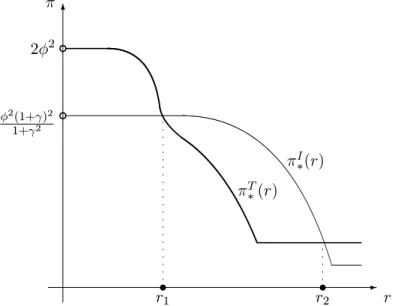
Proposition 3. If is su¢ ciently large, team accountability is optimal for all values of r. Else, there exist two values of r, say r1 and r2, such that individual accountability is optimal
for all r 2 [r1; r2], and team accountability is strictly optimal otherwise.
The intuition behind this result is similar to the cut-o¤ result discussed in Proposition 1, particularly when r is not too large. For r su¢ ciently small (i.e., su¢ ciently large), the …rm’s reputational capital is su¢ ciently large. Thus, the …rm can o¤er strong implicit incentives even under team accountability. Consequently, team accountability becomes optimal because it overcomes the multitasking problem. In contrast, for moderate values of r, individual accountability dominates. This is due to the fact that for a moderate r, the …rm has some reputational capital that allows it to o¤er implicit incentives. In such a scenario, the implicit incentives are sharper under individual accountability. This is because the …rm only needs to promise a bonus payment to one of the two agents, and hence, can credibly promise a larger bonus amount than it could if it were to promise a bonus payment to each of the two agents (as is the case with team accountability). When the multitasking problem is not too large (i.e., moderate ), this incentive e¤ect outweighs the multitasking problem associated with