Ana Cristina Correia Simões
Contributions to the development of a performance
measurement framework for Hospital Centres
Dissertation submitted to the Faculdade de Engenharia da Universidade do Porto to obtainthe Doctoral Degree in Industrial Engineering and Management
Advisors:
Professor Américo Lopes Azevedo Professor Maria Suzete dos Santos Gonçalves
Faculdade de Engenharia da Universidade do Porto 2016
ABSTRACT
The recent healthcare reforms of the health system, and in particular in the hospital sector, seek to increase cost effectiveness, accountability, sustainability and the quality of care. These reforms concern different stakeholders, including healthcare professionals, patients and the communities. Some of these reforms led to organizational changes in hospitals generating different organizational models. Following this trend, the Portuguese organizational model called Hospital Centre (HC) matches the horizontal integration model and involves the integration of two or more hospital units. The benefits of this integration have been presented in the literature. Nonetheless, performance measurement frameworks for HCs considering the internal stakeholders’ value-based objectives and performance domains have, to the best of our knowledge, not yet been proposed. Although there has been a scarcity of literature relating to the performance of integrated health systems, the measurement of HC performance is a fundamental task for management decision-making, improving effectiveness and strategy formulation. Additionally, there is growing awareness to improve the scope of performance measurement in order to embrace the recent hospital reforms, namely horizontal and vertical integration. The leaders of the healthcare organizations need to develop performance measurement frameworks that align the organizational strategy with performance measurement (PM). In this research we intended to cope with several aspects related to hospital organizations, in particular HCs. Our aim is to deepen the knowledge regarding the horizontal integration processes in Portugal and thus to develop a PM framework design more adapted to this reality.
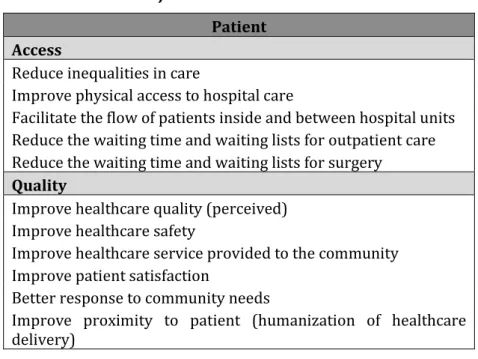
Therefore, in this research work a qualitative case study design was applied to address these challenges. A qualitative study was conducted to gain in-depth understanding of the Portuguese horizontal integration context. The aim of this study was also to identify intended or planned objectives and also the non-stated objectives, which are not defined in any official document. Instead they were expected benefits or those perceived by the different stakeholders. A detailed list of the most important objectives for key informants and internal stakeholders was developed and distributed according to three main dimensions: organizational, patient and professional. Additionally, a list containing the important external pre-conditions that can contribute to a successful HC organizational model is also presented. The results of this study revealed that a large portion of the mentioned objectives were in the organizational dimension. In this dimension, objectives related to resources rationalization and optimisation, with consequent cost reductions, were frequently mentioned. The objectives most frequently mentioned in the patient
dimension concerned reducing inequalities in care provision. In the professional dimension, the objectives related to professional conditions and the improvement of the work environment were referred. Regarding the second aim of this study, a very important external pre-condition that can contribute to successful integration is the support of the local and regional authorities.
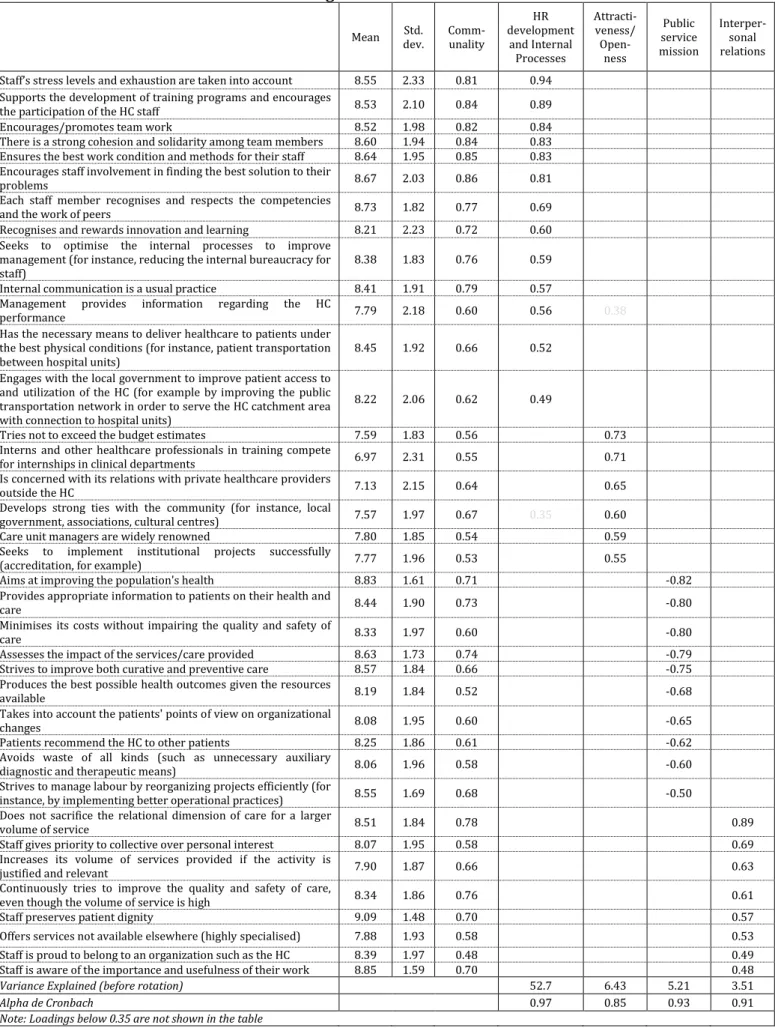
In the second study, following the definition of the objectives, the most valued performance domains were identified and their relative importance to internal stakeholders. We conducted a survey study using a questionnaire based on Parsons' social system action theory, which embraces the four major models of organizational performance. An exploratory factor analysis was conducted for a final sample of 365 participants, through principal component analysis, with oblique rotation and the Kaiser criterion. Four factors were retained: “Human resources development and Internal Processes”, “Attractiveness/Openness”, “Public service mission” and “Interpersonal relationships”. The means of the factor score only show statistical differences between the “Attractiveness/Openness” factor and the remaining three factors. A shared view was found in this study among the three groups of internal stakeholders: physicians, caregivers and administrative staff, since there were no statistical differences when factor score means were compared between groups. The results of this study suggest that the HC performance concept should be expanded and performance measurement frameworks with a broader scope should be used. The domains of interpersonal relationships, human resources development and public service are deemed important for consideration in the performance measurement of the HC. Moreover, a consensual view regarding the most valued performance domains and shared organizational values could contribute to a beneficial and healthy working environment and improvements to HC performance. The third phase of this research, based on previous studies, consisted of designing a performance framework using structured design methodologies focused mainly on the design phase, and the conceptualization stage in particular. The proposed PM framework design for a HC includes objectives considered important by key informants and internal stakeholders and performance domains valued by internal HC stakeholders. Additionally, it reflects the needs and specificities of the different stakeholders involved in the development process. The alignment of the objectives of HC departments/services with the HC objectives, and these latter with national and regional hospital care objectives were also considered in the design. The proposed domains and sub-domains of the PM framework reflect the different operational strategy perspectives. It is possible to achieve
the organizational goals by developing the necessary resources and configuring the processes to acquire the required capabilities.
RESUMO
As recentes reformas no sistema dos cuidados de saúde, e em particular no sector hospitalar, visam melhorar a relação custo-benefício, responsabilidade, sustentabilidade e qualidade dos cuidados. Estas reformas envolvem as diferentes partes interessadas (stakeholders), incluindo profissionais de saúde, doentes e comunidades. Algumas destas reformas levaram a alterações nos hospitais dando origem a diferentes modelos organizacionais. Seguindo esta tendência, o modelo organizacional português, designado por Centro Hospitalar (CH), é um modelo de integração horizontal que envolve a integração de duas ou mais unidades hospitalares. Os benefícios deste tipo de integração têm sido apresentados na literatura. No entanto, e que tenhamos conhecimento, não foram ainda propostas ferramentas para a medição do desempenho dos centros hospitalares que considerem os objectivos e domínios de desempenho mais valorizados pelos parceiros internos (internal stakeholders). Apesar de ser escassa a literatura relacionada com o desempenho de sistemas de saúde integrados, a medição do desempenho dos CHs é uma tarefa fundamental para a tomada de decisões, para melhorar a eficácia e para a formulação de estratégias. Adicionalmente, existe uma crescente consciência no sentido de melhorar o âmbito da medição de desempenho para lidar com as recentes reformas hospitalares, nomeadamente a integração horizontal e vertical. Os líderes das organizações prestadoras de cuidados de saúde necessitam de desenvolver ferramentas que alinhem a estratégia organizacional com a medição de desempenho. Com esta investigação pretende-se fazer face aos vários aspectos relacionados com as organizações hospitalares, em particular os CHs. O nosso objectivo é aprofundar o conhecimento no que respeita ao processo de integração horizontal em Portugal e assim contribuir para a conceção de uma ferramenta de medição do desempenho mais adaptada a esta realidade. Deste modo, foi aplicada nesta investigação um caso de estudo qualitativo para responder a estes desafios. Foi realizado um estudo qualitativo de modo a aprofundar o conhecimento do contexto de integração horizontal em Portugal. Um outro objectivo deste estudo foi identificar os objectivos estabelecidos ou planeados, e também os não estabelecidos, aqueles que não foram definidos em nenhum documento oficial. Estes últimos foram objectivos esperados ou benefícios percebidos pelas diferentes partes interessadas (stakeholders). Foi desenvolvida uma lista detalhada dos principais objectivos considerados pelos informadores-chave e pelos parceiros internos (internal
stakeholders). Estes objectivos foram posteriormente distribuídos por três dimensões:
organizacional, doente e profissional. Além disso foi também apresentada uma lista contendo pré-condições externas importantes as quais contribuem para um modelo
organizacional de CH bem sucedido. Os resultados deste estudo revelaram que uma grande parte dos objectivos mencionados se encontravam na dimensão organizacional. Nesta dimensão, foram mencionados frequentemente objectivos relacionados com a racionalização e optimização de recursos, com a consequente redução de custos. Objectivos relacionados com a redução de desigualdade na prestação de cuidados foram os mais frequentemente mencionados na dimensão do doente. Na dimensão profissional foram referidos objectivos relacionados com as condições profissionais e melhoria das condições de trabalho. Relativamente ao segundo objectivo deste estudo, uma pré-condição muito importante que pode contribuir para uma integração bem sucedida é o apoio das autoridades locais e regionais.
No segundo estudo, posterior à definição de objectivos, foi feita a identificação dos domínios de desempenho e avaliada a sua relativa importância entre os parceiros internos (internal stakeholders). Foi aplicado um estudo por questionário usando um questionário baseado na teoria de ação do sistema social de Parson, a qual combina os quatro modelos de desempenho organizacional dominantes. Foi conduzida uma análise factorial exploratória numa amostra final de 365 participantes, através da análise de componentes principais, com rotação oblíqua e critério de Kaiser. Forma retidos quatro factores: “Desenvolvimento dos recursos humanos e processos internos”, “Atratividade/Abertura”, “Missão de serviço público” e “Relações interpessoais”. A média da pontuação obtida em cada factor apenas revelou diferenças estatisticamente significativas entre o factor “Atratividade/Abertura” e os restantes três factores. Neste estudo contatou-se uma visão partilhada entre os três grupos profissionais: médicos, cuidadores e pessoal administrativo. Os resultados deste estudo sugerem que o conceito de desempenho do CH deve ser expandido e deverão ser usadas ferramentas de medição de desempenho com um maior âmbito. As relações interpessoais, o desenvolvimento dos recursos humanos e o serviço público são domínios importantes a considerar na medição de desempenho do CH. Mais ainda, uma visão partilhada relativamente aos domínios de desempenho mais valorizados pode contribuir para um ambiente de trabalho mais benéfico e saudável e para melhorias no desempenho do CH.
A terceira fase desta investigação, a qual foi baseada nos estudos anteriores, consistiu no desenvolvimento do projeto para uma ferramenta de desempenho utilizando metodologias de projeto estruturadas focadas fundamentalmente na fase de projeto, e em particular na fase de conceptualização. O desenho proposto para a ferramenta de medição do desempenho para CH inclui objectivos considerados importantes pelos informadores-chave e parceiros internos (internal stakeholders). Adicionalmente, este reflete as
necessidades e particularidades dos diferentes partes interessadas, (stakeholders) envolvidos no processo de desenvolvimento. O alinhamento dos objectivos dos departamentos/serviços do CH com os do CH, e destes com os objectivos regionais e nacionais ao nível dos cuidados hospitalares foram também considerados no desenho. Os domínios e subdomínios propostos da ferramenta de medição de desempenho refletem as diferentes visões da estratégia operacional. Desenvolvendo os recursos necessários e configurando os processos para adquirir as capacidades necessárias é possível alcançar os objectivos organizacionais.
AKNOWLEDGEMENTS
A number of people have generously contributed to the writing of this dissertation, and I’m greatly indebted to them.
I would like to express my gratitude to my advisor, Professor Américo Azevedo, and my co-advisor Professor Suzete Gonçalves, for their full support, understanding, encouragement and guidance throughout my study and research.
Special thanks to Centro Hospitalar do Tâmega e Sousa (CHTS), in the person of its chairman of the board, Dr. Carlos Vaz, who provided data and background material for the research work. I am indebted to the people who participated in the research at the CHTS. Thank you for being exceptionally easy-going, open, and friendly to work with, and for taking the time for interviews, surveys and visits. Also in CHTS, I also thank Dr. Emanuel Barros for his help and cooperation at different points in time.
I’m grateful for the technical expertise and willing assistance of all key informants who agreed to participate in the research work.
Thanks also to Prof. Alexandra Lopes, Prof. Carla Martins and Prof. Ana Barros for their helpful comments on specific parts of this document.
I would especially like to thank José Couto, Nazaré Gonçalves and José Pedro Rodrigues who were first colleagues then friends, with whom I shared the best and worst of this journey and from whom I learned so much.
This dissertation is dedicated to my brother António José, to my parents, and to my brothers and sisters who have shown me the value of hard work and perseverance, and to my supportive husband, Francisco, and my lovely children, Francisco and Maria, who continue to show me that there is more to life than a dissertation.
TABLE OF CONTENTS
Chapter 1: Introduction ... 1
1.1. Context ... 2
1.2. Problem Statement and Objectives ... 4
1.3. Research Questions and Research Development ... 6
1.4. Document Structure ... 8
Chapter 2: Research Design ... 11
2.1. Introduction ... 12
2.2. Theoretical perspectives ... 12
2.3. Research strategy ... 13
2.4. Research Methodology ... 14
2.5. Qualitative Research Methods ... 14
2.5.1 Case Study ... 15
2.5.2 Case Selection ... 17
2.5.3 Collecting case evidence and data analysis ... 19
2.6. Research Evaluation ... 20
2.7. Ethical issues ... 22
Chapter 3: Stated and non-stated objectives and performance domains ... 25
3.1. Paper #1 ... 26
Abstract ... 27
1. Introduction... 28
2. Material and Methods ... 43
3. Results... 47
4. Discussion and Conclusions ... 54
5. References ... 57 3.2. Paper #2 ... 61 Abstract ... 62 1. Introduction... 63 2. Literature Review ... 64 3. Methodology ... 72
4. Analysis and Results ... 78
5. Discussion and Conclusions ... 82
6. References ... 88
Chapter 4: Proposal of a performance measurement framework for the HC ... 91
4.1. Background ... 92
4.2.1. Purpose and uses of performance measurement ...95
4.2.2. Measuring performance in the public healthcare sector ... 98
4.2.3. Criteria for performance measurement system design ... 99
4.2.4. Structured and procedural design methodologies ... 101
4.2.5. Approaches used to measure organizational/system performance ... 102
4.2.6. Frameworks for performance measurement /quality improvement in health104 4.3. Development Methodology ... 105
4.3.1. Structured design methodologies ... 105
4.3.2. Guidelines for the design and development of a performance measurement framework ... 113
4.4. Proposal design of performance measurement framework ... 117
4.4.1. Conceptualization stage ... 119
4.4.2. Measures selection ... 131
4.5. Operational Implementation Methodology ... 145
4.6 Final remarks... 149
Chapter 5: Findings and contributions ... 153
5.1. Overall findings ... 154
5.2. Contributions ... 155
5.3. Managerial implications ... 159
5.4. Limitations ... 160
Chapter 6: Conclusions and Future work ... 163
6.1. Main conclusions ... 164
6.2. Future work ... 166
References ... 169
Appendix 1: HC Characterization ... 180
Appendix 2: Interview Guide – Key informants ... 183
Appendix 3: Interview Guide – HC internal stakeholders ... 184
Appendix 4: Survey ... 187
Appendix 5: Papers used to formulate the PM framework principles ... 189
LIST OF FIGURES
Figure 1: Process used in the research ...9
Figure 2: Research methodology ... 14
Figure 3: Characterization of the HCs in the North of Portugal ... 18
Figure 4: Stages preceding the design of the PM framework ... 95
Figure 5: Development phases of the PM framework ... 107
Figure 6: Research Focus ... 117
Figure 7: Dimensions for PM ... 118
Figure 8: Design phases ... 119
Figure 9: Main domains presented in the Organizational dimension ... 120
Figure 10: List of domains and sub-domains used in the PM framework design ... 121
Figure 11: Quality sub-domain ... 122
Figure 12: Satisfaction/perception of care sub-domain... 122
Figure 13: Financial performance sub-domain ... 122
Figure 14: Attractiveness sub-domain... 123
Figure 15: Accessibility/responsiveness/timeliness sub-domain ... 123
Figure 16: System management/integration sub-domain ... 124
Figure 17: Staff satisfaction/work conditions sub-domain ... 125
Figure 18: Efficiency sub-domain ... 125
Figure 19: Work environment sub-domain ... 126
Figure 20: Two hierarchical levels in the HC ... 128
Figure 21: PM framework domains representing the different views of the HC operational strategy ... 129
Figure 22: Overview of the objectives in each domain and sub-domain ... 131
Figure 23: Proposed framework to obtain performance measures ... 144
Chapter 1: Introduction
The research topic is introduced in this chapter. This chapter starts with an overview about the international and the Portuguese healthcare sectors. Then, the integration context in the Portuguese healthcare sector is presented. After that the research problem and purpose are defined. This is followed by the identification of the research objectives and the research questions are presented. Finally, there is a brief description of the dissertation chapters.
1.1. Context
Hospitals are a crucial part of the health system and their reform has a relevant impact on healthcare. Hospitals symbolize the healthcare system for most people. The role of hospitals in the healthcare system evolved from religious establishments (a place where patients could be supported and comforted until nature took its course) to establishments largely steered by technology and consumerism (Edwards, Wyatt, and McKee - 2004). Hospitals are rarely seen as an integrated part of the broader healthcare delivery system (Edwards, Wyatt, and McKee - 2004).
Hospitals can be seen as complex organizations1. Indeed, they are complex in their structure and management since they have their own dynamics, especially in the market where they operate. They also have certain specific characteristics in their economic and management models such as an activity with multi-products due to the diversity of diagnostics and disease which can be treated in the hospital. This diversity in diseases and diagnostics can be improved by the degree of evolution of the disease (Costa and Lopes - 2007).
The healthcare sector is characterised by enormous differentiation. That differentiation has to be reduced or integration improved as a means of improving efficiency and effectiveness in care (van Wijngaarden, de Bont, and Huijsman - 2006). Minkman (- 2012) referred that over the past decade integrating care and services has become an important development to better serve patient needs and reduce fragmentation within several healthcare systems.
In some European countries there have been some experiences to stimulate and encourage providers to establish integrated care arrangements and to support their efforts. In some countries like Finland, Sweden, the Netherlands, and England there is legislation, financial incentives, and other kinds of initiatives that enable providers to implement integrated care initiatives and support their efforts (Mur-Veeman, Raak, and Paulus - 2008). In the United States, organizations called Health Maintenance Organisations have been founded to be able to deliver integrated care (van Wijngaarden, de Bont, and Huijsman - 2006).
In Portugal, there have been some initiatives to delivery more integrated care. One of the first initiatives leading to vertical integration of healthcare units was the creation of the
1Complexity science is useful for studying the evolution of complex organizations, which are entities with multiple, diverse and interconnected elements. Due to the diversity of organizational forms and interactions among organizations that are evolving, healthcare organizations are an ideal setting for the application of
Local Health Units (LHU). A LHU is the integration of primary care units with hospital care units and continuity healthcare. This is a means of vertical integration. One of the most important objectives of LHU creation is to improve healthcare delivery, creating conditions to improve articulation and management between National Health Service (NHS) organizations in the same geographical area. The first pilot experience, occurred in 1999, with the creation of the Matosinhos LHU (Assembleia da Republica - 1999a). Nevertheless, the vast majority of these vertical integrations took place in 2008.
At the same time that the first experience of vertical healthcare integration occurred in Portugal, in 1999, the creation of a new organizational model to deliver hospital care also occurred, named Hospital Centre (HC). The HC, as an organizational model to deliver hospital care, was created in 19992 by decree-law (Assembleia da Republica - 1999b). This legal document defines the main aims of an HC and establishes the general guidelines to create HCs. The main aims of an HC are, therefore, resources rationalization and value creation for NHS users. This model for the delivery of hospital care consists of the integration of two or more individual hospital units, creating a HC with one management board, which is responsible for managing the entire activities of the integrated units. Each HC created, according to this legal instrument, should be preceded by a proposal from the Regional Health Authority (Administração Regional de Saúde). This proposal must give the reasons for hospital unit integration, based on the public interest, namely optimisation of the delivery of healthcare services by the hospital units when integrated and the reinforcement of articulation and complementarity of hospital services.
22 HCs were created in Portugal following this decree-law approval, and up to 2012. All the HCs were created by decree-law, one per each HC. Some of the first HCs created were readjusted after a number of years to include more hospital units. HCs were created throughout the Portuguese territory, but with higher prevalence in the north of Portugal. As previously referred, each HC created needed to give the reasons for that integration. In practice, for each HC to be created, i.e. for the integration of two or more hospital units, the definition of an integration plan was required. This plan discriminates the specific objectives to be achieved with the integration. Therefore, few HCs had a preliminary plan that supported their creation (Portuguese Health Regulation Authority - 2012). In the few cases where this integration plan is available, it had been made at high level inside the hospital units (the board) with the collaboration of the Regional Health Authority. Thus,
2Although the legal status of the Portuguese HCs had been created in 1999, there were very few specific previous experiences with integration of hospital units (Portuguese Health Regulation Authority - 2012).
very few people inside the hospital units, mainly the board and some services directors, participated in the establishment of objectives.
At the same time these hospital care integration initiatives emerged in Portugal, other sorts of reforms had been made regarding the management rules and the payment of services. The main element of these reforms was to provide hospitals with business-like statutes. The main objective of this reform was to provide autonomy and management accountability to hospital boards (Barros and Simões - 2007).
Hospitals are nowadays facing important challenges besides greater control by the State. The introduction of business models in hospital management are changing the hospital environments, where the barriers between hospital professionals are being knocked down to build more contingent relationships between the management and clinical areas (Doolin - 2002; Minvielle et al. - 2008). Management and clinical areas must collaborate more closely to better answer these new challenges with new management and performance review tasks (Llewellyn - 2001).
In conclusion, over the years the Portuguese Health Ministry has tried to improve hospital efficiency and management accountability with these abovementioned initiatives, in particular the creation of hospital centres.
1.2. Problem Statement and Objectives
The integration of hospital units is an important initiative regarding the main benefits expected. There are some examples of benefits reported in the literature: scale economies, efficiency, organization and coordination of care, improvement and development of human resources (Markham and Lomas - 1995; Snail and Robinson - 1998; Brousselle, Denis, and Langley - 1999; Lee and Alexander - 1999). However, there are also some expected disadvantages mentioned in the literature such as: increased financial costs to create the new entity, lack of easy access to certain services, insecurity of human resources, loss of managerial and organizational identity, and disruption of routines at the clinical and organizational level (Markham and Lomas - 1995; Lee and Alexander - 1999). Moreover, in the public system, horizontal integrations only produce benefits when it’s possible to eliminate duplication and reduce capacity, when there are clinical reasons for greater scope and scale, there are pressures from medical and surgical associations to provide minimum levels of consultant staffing that are difficult to achieve in small hospitals, and capital and work flexibility are raised across multiple services (Garside - 1999; Posnett - 2002).
In a well-performed HC, the objectives should be established in a way to enhance the benefits and to minimise the disadvantages of horizontal integration. However, as previously mentioned, in the few cases in Portugal where the integration plans were available they focused mainly on an organizational perspective with the majority of objectives established in domains related to finances, access and quality.
The lack of a complete perspective of the integration objectives makes it difficult to evaluate if the proposed objectives were achieved and thus, to improve HC performance. Furthermore, the variety of healthcare performance models reflects different and fragmented aspects of performance (Neely et al. - 2000; Adair et al. - 2003). Consensus regarding the best model to assess performance is impossible to obtain. The traditional performance measurement (PM) systems in business and in healthcare focus mainly on accounting and financial measures (Tangen - 2004; Mauro et al. - 2014). However, each stakeholder group has different preferences, purposes and values (Sicotte et al. - 1998). According to the multiple constituent model of organizational performance, the stakeholders' perspectives must be considered in an integrated way for the purposes of evaluation (Zammuto - 1984; Mauro et al. - 2014). Sicotte et al. (- 1998) developed a comprehensive theoretical grounded framework that overcomes the fragmented approach to assess the healthcare organization’s performance. This framework is based on Pearson’s social system action theory (Parsons - 2005) which combines the four dominant models for the evaluation of organizational performance. Therefore, a multidimensional framework of performance measurement is appropriate for HCs.
Although there are 24 HCs in Portugal, no PM framework is specifically designed for them, as horizontally-integrated organizations, and which not only considers the traditional measures and stated objectives but also the non-stated objectives. This fact makes HC performance difficult to measure from a holistic perspective (Was there a performance improvement? Were the integration objectives achieved?) and makes it difficult to make decisions regarding performance improvements. Although HCs are organizations that deliver hospital care, they have their own specificities because they are larger in dimension and thus have to deal with more resources (human and physical) when compared with non-integrated hospitals. Additionally, other challenges they face are multi-site infrastructures that have a strong impact on HC performance.
We want to take advantage, from a holistic overview of the context of the Portuguese HC, capturing the understanding, expectations, experiences and inner opinions of the key informants and HC internal stakeholders that have a deep understanding and awareness.
In this research project we aim to contribute to the development of a PM framework for HCs.
This research was guided by two main objectives. The first was the definition of the most important objectives and also the performance domains that should be included in the design of the PM framework. In relation to the objectives we would like to identify the most important, related to the reality of the HC. The second objective is to develop the design of a PM framework for the HC.
Some of the intended or planned objectives were defined when the hospitals centres were created by decree-law and were also indicated in the findings of the literature review. Other planned or intended objectives were not defined in any plan or in any official document. Instead they were expected benefits and objectives or experienced by the different stakeholders. Thus, with the first objective we intend to involve the most important stakeholders in the development of the framework, giving them the opportunity to express their feelings and expectations about the benefits of horizontal integration, which resulted in the creation of the HC.
In the development of this PM framework design it is essential to define the HC performance domains. The HC internal stakeholders’ opinion regarding the most important performance domains will be an important contribution to their definition. Finally, the conceptual design of the PM framework for the HC will be developed and its operational implementation will be described. This framework will help the HC managers to align the operational and strategic objectives throughout the integrated units.
1.3. Research Questions and Research Development
To achieve the final proposed objective we established the following research question:
Research question: How to develop a PM framework for a HC?
With this research question we intend to address several aspects related to hospital organizations, in particular HCs. Our intention is to expand on the knowledge regarding horizontal integration processes and thus to develop a PM framework more adapted to this reality.
Since the HCs are integrated organizations, its development is a dynamic process with a lot of room for improvement. The number of elements to be implemented, the number of healthcare professionals and number of hospital services involved are extensive. The most important dynamics involved during the integration process are processes integration,
structures integration and resources integration. This dynamic process also involves aspects related to organizational and professional cultures, decision-making power, social relations and many others interests. These dynamics have evolved over time, making them a challenge for the process. Thus, the integration process never ends; it never seems to be complete. Although the benefits and the rationale for integrated care are mostly evident, the development process to enable organizations to reach higher levels of integration, and consequently performance, over time is less clear (Minkman - 2012).
Some of the intended or planned objectives were defined when the hospitals centres were created by decree-law and also indicated in the findings of the literature review. Other non-stated objectives were not defined in any official document. Instead they were expected benefits or those perceived by the different stakeholders.
Therefore, this main research question is unfolded into four sub-questions:
Sub-RQ1: What are the HC objectives most valued by the main stakeholders?
Sub-RQ2: What are the external pre-conditions that influence a successful HC
implementation (that achieves the proposed objectives) according to key informants and internal HC stakeholders?
Sub-RQ3: What are the most important performance domains in the Portuguese HC context? Sub-RQ4: Are these performance domain preferences different among internal stakeholder
groups?
To answer the first research sub-question we intend to involve all the most important stakeholders, giving them the opportunity to express their expectations and knowledge about the benefits of horizontal integration, which resulted in the creation of the HC. The knowledge of what goes well, and not so well, in the HC Portuguese experience, led to the definition of second research sub-question.
The answers to these two research sub-questions (Sub-RQ1 and Sub-RQ2) correspond to the first part of this research, presented in Paper #1 (here included in section 3.1. of chapter 3). In this paper we presented the results of research focused on the identification of objectives and pre-conditions that are most valued by key informants and internal stakeholders regarding the HC. Qualitative case study research design was applied. Semi-structured interviews were conducted with two groups of interviewees: external key informants and HC internal stakeholders. Documentary information was also used as a source of evidence.
The third and fourth research sub-questions (Sub-RQ3 and Sub-RQ4) arise following the definition of performance domains to consider in the performance measurement (PM) framework.
In Portugal, there is little official information that enables a complete definition of PM domains for a HC. In this study we suggest finding these domains considering the understanding and experience of the different stakeholders.
In the few studies published regarding HC performance measurement they only consider a limited number of domains. In this research we intended to better understand the HC reality, exploring the expectations, experiences and knowledge of the different stakeholders. This background allowed us to define the most important performance domains and objectives to consider in the PM framework design.
It was also important to know if the performance domain preferences varied among stakeholders. Thus the fourth sub-question arose naturally.
The answers to these two questions constitute the second part of this research (paper #2). In this paper, internal stakeholders defined the most valued HC performance domains, and we indicate how these preferences varied among them. We conducted a survey to achieve this goal using a questionnaire based on Parsons' social system action theory, which embraces the four major models of organizational performance.
The results of this research showed some fields that will enable HCs to improve their performance (as an integrated structure) by developing a PM framework that aligns the strategic and operational strategies. It allowed us to conclude that there is a multiplicity of aspects and concerns to consider in the design of the PM framework. The core idea was to generate guidelines for a PM framework that considers the performance domains and objectives that are most valued by the different stakeholders.
1.4. Document Structure
The rationale for this document structure was to firstly present the answers to the first two unfolded research sub-questions, Sub-RQ1 and Sub-RQ2, and then to the other two, Sub-RQ3 and Sub-RQ4. The PM framework design resulted from the answers to these four research sub-questions, and is thus presented at the end.
This document is therefore organized into six chapters and six appendices. Chapter one introduces the research, presenting the problem context, the research purpose, the
research objectives and research questions. Finally, it presents an overview of the research study.
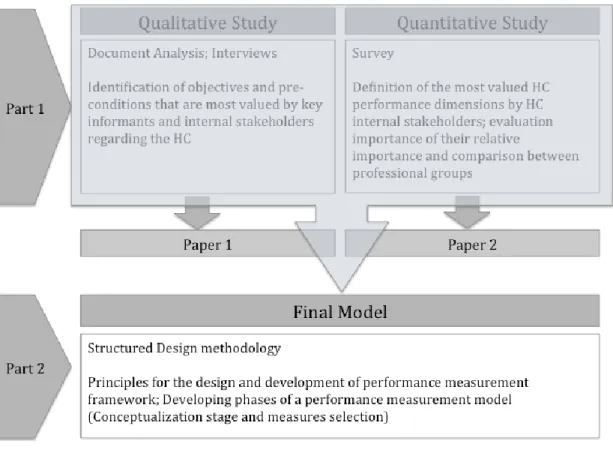
In chapter two, the general research design was presented. In this chapter the research phases are explained as presented in figure 1.
Figure 1: Process used in the research
Chapter 3 corresponds to the first part of the research and is divided in two sections. Section 1 is related to the qualitative study (paper #1). The objective of this paper was to identify the objectives and pre-conditions most valued by key informants and internal stakeholders. Section 2 refers to the quantitative study (paper #2). The objective of this paper was the definition of the most important HC performance domains and their relative importance among the internal stakeholders.
The second part of the research is presented in chapter 4, where the final PM framework design is presented.
Chapter 5 discusses the research results and its contributions, with a link to the research questions. In this chapter the managerial implications of the results and the research limitations are also discussed.
Finally, in chapter 6 the main research conclusions and future research opportunities are presented.
Chapter 2: Research Design
Since the research methodology is central to the collection and analysis of the evidence in an empirical study, this chapter describes an overview of the research strategy. Case study methodology was selected as the research design. The criteria to select the case study used in this research are presented. Finally, since the case study was based on data collected from qualitative and quantitative methods, a brief overview of each data collection and analysis method is made.
2.1. Introduction
This chapter aims is to explain how to answer the research questions. These questions are in nature exploratory and thus explore issues in a contextually rich environment. The procedures for data collection and data analysis will be explained, in order to guide the research process.
The theoretical perspectives, or epistemological positions, condition the choice of the research methodology (Gray - 2009). According to this author, the most influential theoretical perspectives are positivism and the various strands of interpretivism. These theoretical perspectives will influence the choice of research methodology. The choice of an epistemological perspective is important to clarify issues in the research design and to acknowledge which methods will work (Easterby-Smith, Thorpe, and Jackson - 2012). The choice of the best method to apply will depend on the nature of the research questions. All methods have their strengths and weaknesses.
2.2. Theoretical perspectives
Epistemology is a general set of assumptions about ways of inquiring into the nature of the world (Easterby-Smith, Thorpe, and Jackson - 2012). It provides a philosophical background for deciding what kinds of knowledge are legitimate and adequate. As referred to above, there are two main epistemological perspectives: positivism and the interpretivism.
The key idea of positivism “is that the social world exists externally, and that its properties should be measured through objective methods rather than being inferred subjectively through sensation, reflection or intuition.” (Easterby-Smith, Thorpe, and Jackson - 2012, 22). According to this perspective, reality is external and objective and knowledge is only of significance if it is based on observations of this external reality (Easterby-Smith, Thorpe, and Jackson - 2012). This perspective also states that knowledge of the world is obtained through applying the scientific method to experiences. Positivist research involves following methodological rules that are independent of the content and context of the inquiry. The observer is independent, which reduces researcher bias. Collecting quantifiable data that lends itself to statistical analysis such as hypothesis testing or causal explanations is typical of a positivist study. The objective of the positivist approach is to formulate and test hypothesis to present objective facts and established truths (Patton - 2002; Gray - 2009; Easterby-Smith, Thorpe, and Jackson - 2012). Researchers with different points of view criticize this perspective. They see it as inflexible and artificial, as
it simplifies the real world and ignore some of the more interesting and complex factors in a human or social situation. It is not very effective in understanding processes or the significance that people attach to actions (Easterby-Smith, Thorpe, and Jackson - 2012). The constructivism or social constructionism epistemology holds that the truth and meaning do not exist in some external world, and so meaning is constructed not discovered. “Subjects construct their own meaning in different ways, even in relation to the same phenomenon.” (Gray - 2009, 18). It focuses on the ways that people make sense of the world especially through sharing their experiences with others. The role of the researcher is “to appreciate the different constructions and meanings that people place upon their experience.” (Easterby-Smith, Thorpe, and Jackson - 2012, 23).
The major strengths of this perspective is its “ability to look at changes to processes over time, to understand people’s meanings, to adjust to new issues and ideas as they emerge, and to contribute to the evolution of new theories. It also provides a way of gathering data, which is seen as natural rather than artificial ” (Easterby-Smith, Thorpe, and Jackson - 2012, 28).
In this research work we want to gain a deep, intense and “holistic” overview of the context under study, which involves interacting with people and organizations. In this research work we want to understand the phenomena within their own specific context and settings through detailed descriptions, which shall be sought by answering questions such as “what?”, and “how?” We intend to collect data on the opinions, experiences and expectations of actors in the field of the study. Therefore, constructivism was the predominant philosophical position in this research study.
2.3. Research strategy
In this research, as referred to above, we will adopt an interpretivism perspective where the dominant approach is inductive. The methods for collecting evidence will be presented, based on these aspects.
This is cross-sectional research, although there are some parts where a longitudinal approach was applied. According to the research purpose, this research work can be classified as exploratory. A qualitative design was applied for this research and the selected method was case study. The research methodology is presented in the next section.
2.4. Research Methodology
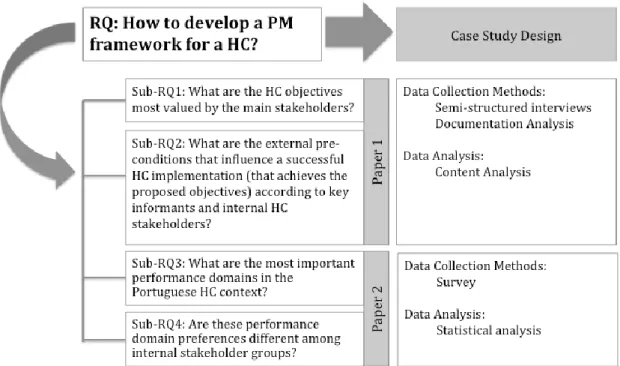
The research methodology is presented in Figure 2. The case study was based on data collected from three sources: HC internal documentation, decree-laws and newspaper clippings, structured interviews and survey. The evidence collected by semi-structured interviews involved developing two interview guides; identifying informants; conducting interviews and transcribing the interview material. These were the methods used to answer Sub-RQ1 and Sub-RQ2. This is described in paper #1.
Evidence collected in the surveys involved the adaptation, validation and fine-tuning of the survey, the pilot survey and actually conducting the survey. This was the method used to answer Sub-RQ3 and Sub-RQ4.
Evidence collected from these sources was later analysed. More detailed information regarding the stages involved is discussed in chapter 3.
Figure 2: Research methodology
2.5. Qualitative Research Methods
In this research we are interested in contributing to the development of a PM framework for HCs. To do that, we needed to know the process of planning and implementing a HC. A valuable input was also work experience in a HC. We want to understand the expectations and experiences of HC internal stakeholders and external key informants. In this process
we want to drill down further, we want to collect good evidence (Thomas - 2011) We want to gain new perspectives on issues related to the research purpose. Therefore, a qualitative approach was used in this research.
There are some characteristics of the qualitative research that fit in with the research objectives and purpose, such as that conducted through intense contact within the field (Miles and Huberman - 1994); that giving precise and substantial descriptions (Gray - 2009); that which must take account of the views of those involved (Flick, von Kardoff, and Steinke - 2004).
According to Mason (- 2002), conducting qualitative research requires considerable reflection on the researcher’s role, and the ability to make a critical assessment of informants’ comments. This author provided some guidelines for the qualitative researcher:
The research should be conducted systematically and rigorously; It should be strategic, flexible and contextual;
The researcher is accountable for the quality and claims; He/She should engage in critical scrutiny or active reflexivity; He/She should produce convincing arguments
Qualitative data collection approaches include, for example, participant observation, observation, documentary analysis, discourse analysis, conversation analysis, biographical methods, case studies, interviews and focus group discussions (Gray - 2009). The choice of method is influenced by the nature of the research problem, the researcher’s theoretical lens or philosophical assumptions (Easterby-Smith, Thorpe, and Jackson - 2012).
2.5.1 Case Study
An exploratory case study was conducted in this research. The case study was used as design method because it was important to have a meaningful and holistic view of the entire context, trying to capture the important characteristics of real-life events (Meredith - 1998; Yin - 2009). It was essential to understand the integration process, ranging from the planning phase up to its implementation and operational implementation in its natural setting (Meredith - 1998). It was important to know what were the expectations of the people inside the HC and outside the HC regarding the integration, to assess the multiple impacts of the integration (Keen and Packwood - 1995). We were interested in the case in itself, its uniqueness as a whole (Thomas - 2011).
Moreover, conducting the research in the field and being exposed to real problems of research of the case enriches the researchers themselves. The researchers benefit from this process by listening to creative insights from people at all levels of the HC in a variety of contexts (Voss, Tsikriktsis, and Frohlich - 2002).
Moreover, the form of the research question (“how”) and the fact that HC creation is a recent event makes case study the best option as a research strategy.
In this study we want to contribute to the development of a PM framework design for HCs based on the stated and non-stated objectives of the HC and on the most valued performance domains. It would probably be possible to do that with a research survey, but doing so wouldn’t allow us to understand the problem context, such as the integration process and the integration context.
According to Kitchenham (- 2010, 562), mixed methods research fits well in the case of study research “as it allows the researcher to take the rich empirical data yielded from case studies and apply either quantitative or qualitative methods or quantitative and qualitative methods to the data. In this manner, qualitative data can be quantized or quantitative data can be qualitized to extract meaning from the data sets that might otherwise be hidden.”
The combination of quantitative and qualitative approaches used by researchers has become increasingly common (Bryman - 2006). The rationale for this combination lies in the different strengths and weaknesses of both approaches (Adamson - 2005; Kitchenham - 2010). Qualitative and quantitative methods should be viewed as complementing each other rather than being in rival camps, so combining them allows the researcher to offset their weaknesses and draw on the strengths of both in order to collaborate findings and thus to increase confidence to reach the final conclusions (Adamson - 2005; Punch - 2005; Johnson and Onwuegbuzie - 2004). Another benefit is the ability to generate greater understanding about complex phenomena (Johnson and Onwuegbuzie - 2004).
Qualitative methods and quantitative methods were combined in this case study to answer the research sub-questions. The main reason/purpose to combine these two approaches in this case study was to obtain complementarity. The aim was to have a general picture, since all the aspects of the PM framework couldn’t solely be open to a qualitative approach. Therefore, a quantitative approach was employed to fill the gaps of the qualitative approach. The results from one method are used to elaborate, enhance and illustrate the results of the other method (Greene, Caracelli, and Graham - 1989; Punch - 2005). Another reason was that the quantitative approach established the relationships
between variables, but the qualitative approach allowed the reasons for those relationships to be better explained/explored (i.e. the factors underlying the broad relationships that were established). The qualitative approach facilitated the interpretation of the relationships between some variables in the quantitative approach. (Punch - 2005).
In conclusion, using a case study, which combined quantitative and qualitative methods, allowed the positive aspects to be strengthened and the weaknesses of each method to be minimised, thus generating greater understanding about this research problem.
2.5.2 Case Selection
To answer the research question the design for the case study had to be defined.
According to Yin (- 2009, 40), there are four main types of design for case studies. In a two-by-two matrix approach presented by this author, it’s possible to identify: a) single-case (holistic) designs; b) single-single-case (embedded) designs; c) multiple-single-case (holistic) designs and d) multiple-case (embedded) designs.
A single case study was considered appropriate for three main reasons. Firstly, the opportunity that was given by the HC board to study that HC, with the provision of privileged conditions to conduct the study (Yin - 2009). This helps to overcome one of the vulnerabilities of single-case study research: “…single-case designs […] require careful
investigation of the potential case to minimize the chances of misrepresentation and to maximize the access needed to collect the case study evidence” (Yin - 2009, 42). Other HC
had already refused the invitation to participate in this research work.
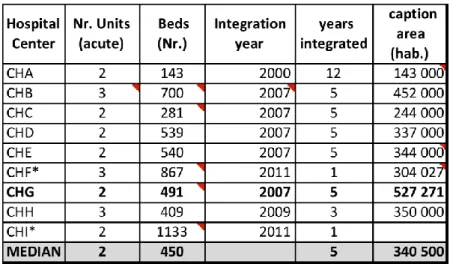
The second reason was related to the typical HC (Miles and Huberman - 1994; Yin - 2009). The average HC creation consisted of the integration of one big hospital unit with a smaller one, and none of these units were specialised. Considering the number of hospital units integrated, number of beds, number of years after integration, and number of inhabitants in the attraction area, we found the selected HC to be a typical case. In the following figure (Figure 3) we present these data for HCs in the North Portugal region.
Figure 3: Characterization of the HCs in the North of Portugal
The third reason was related to resource constraints and the time available. The resources and time necessary for conducting multiple-case studies would compromise the depth of the observations. One of the great advantages of a single case was the opportunity for greater depth observation and the opportunity to study several contexts within the case. However, a single case has some limitations. The first is the generalizability of the conclusions, models or theory developed from one case study. Another risk is biases, such as misjudging the representativeness of a single event and exaggerating easily available data (Voss, Tsikriktsis, and Frohlich - 2002).
Another relevant aspect for the selection of this HC for the case study is that the HC board and its staff were very motivated to participate in the research. Thus the selection of HCTS for the case study was opportunistic.
HCTS is a multisite hospital that resulted from the integration of two hospital units, Penafiel and Amarante, in 2007. They were both acute hospitals. The distance between these two hospital units is about 30 Km, 20 minutes by motorway and 40 minutes on national roads.
HCTS is part of the Portuguese public hospitals network and serves a population from Vale do Sousa and Baixo Tâmega of over 500,000 inhabitants (Centro Hospitalar Tâmega e Sousa - 2013). It is a typical acute hospital, not a mainstream hospital, with 480 inpatient beds (416 at the Penafiel hospital unit and 64 at the Amarante hospital unit), seven central operating rooms (one for emergencies and 6 for selective surgery), four operating rooms for out-patient surgery and 25 specialisations for the day-hospital. 1597 professionals
work in the HC, 327 of them are physicians. For more complicated situations the HC refers those situations to the Porto HC.
These aspects make this HC an interesting case to study because many HC in Portugal face similar challenges.
Appendix 1 provides more detailed information about the HC.
2.5.3 Collecting case evidence and data analysis
As referred to above, this single case study is based on qualitative and quantitative methods to collect evidence on the case. The case study was based on data collected from semi-structured interviews, documentation analysis and surveys. A brief description of the methods used to collect and analyse data is detailed in the following sections.
2.5.3.1.The qualitative study (paper #1)
To answer the first and second research sub-questions a qualitative study was conducted. Evidence was collected in semi-structured interviews and documentation analysis. The interviews involved the development of two interview guides - one for Key informants and the other for HC internal stakeholders, the identification of Key informants, carrying out the interviews and the interviews’ transcriptions.
The interview process is described and the techniques for analysing and interpreting the qualitative evidence are presented in the first part of this research, corresponding to Paper #1, “What lies beyond the stated objectives of hospital horizontal integration? - The
results of a qualitative study” This study is presented in section 3.1. (Chapter 3).
2.5.3.2. The quantitative study (paper #2)
A quantitative study was conducted to answer the third and fourth research sub-questions. The evidence collected in surveys involved survey development (adaptation to Portuguese context), the content validity of the survey, the pilot test and consequent survey fine-tuning, and finally conducting the survey.
The aspects involved in the quantitative study, describing the survey used to gather information related to the performance domains valued by internal stakeholders in an integration context, are stated in the first part of this research work and correspond to Paper #2, “Hospital Centre performance dimensions: what are those most valued by internal
for a final sample of 365 participants, through principal component analysis, with oblique rotation and the Kaiser criterion. This study is presented in section 3.2. (Chapter 3).
2.6. Research Evaluation
The concepts of validity and reliability have their roots in a quantitative tradition and were originally developed in a positivist paradigm (Bryman and Burgess - 2002; Gray - 2009). Moreover, some authors resist the temptation to address such matters in qualitative research (Gray - 2009).
Therefore, in this section we will discuss the techniques and approaches to ensure the trustworthiness of the data gathering procedures, data analysis and research findings. As mentioned by Westbrook (- 1994, 250) “As with the positivist paradigm, there are no
absolute guarantees of results that are both meaningful and unbiased.”
There is no universal agreement on the terminology used when assessing the quality of a qualitative study (Zhang and Wildemuth - 2009). Qualitative researchers have struggled for decades to search for ways to decide whether their research is complete and credible in developing some criteria and strategies (Marshall and Rossman - 2010). In the conventional positivistic research paradigm, the criteria for evaluating the quality of the research are: validity, reliability and objectivity. However, qualitative content analysis is an interpretative method and these criteria are unsuitable for judging the quality of the research (Zhang and Wildemuth - 2009). In this research we shall use the four criteria proposed by Guba and Lincoln (- 1982) to evaluate interpretive research work: credibility (in preference to internal validity), transferability (in preference to external validity/generalizability), dependability (in preference to reliability), and confirmability (in preference to objectivity).
The researchers must try to address credibility, according to Shenton (- 2004), by presenting a true picture of the phenomenon being studied. In relation to transferability, the context of the fieldwork must be described in detail so that it may be compared with future situations. The reader must know if the environment is similar to another situation, so they may know if the findings can be applied. The most difficult criterion to achieve is dependability. The researcher must endorse efforts to ensure that a future investigator can repeat the study. The fourth criterion is confirmability. Here, the researcher must take steps to demonstrate that the findings come from the data and not from their own perspective.
Credibility
We carried out, based on the recommended activities of Shenton (- 2004) to improve the credibility of our research results, the triangulation of data sources using interviews and documentation analysis and we used another form of triangulation that involves the use of a wide range of informants. The different perspectives, expectations and experiences were verified against each other and, as a result, a broad and rich picture was obtained based on a variety of people. We obtained similar results using key informants with different perspectives of planning and implementation of HCs and internal stakeholders within different clinical and support areas. Thus, the credibility of our results improved. The credibility of the research findings was verified since most objectives were mentioned by more than one interviewee and in different contexts.
Another activity carried out to improve the credibility of our results was to invite people to participate in the interviews (Shenton - 2004). No one was forced to participate. This approach helped to ensure that the data collected was as truthful as possible.
Transferability
According to Shenton (- 2004), the findings of qualitative research are specifically related with a particular context and individuals. Hence, it is impossible to demonstrate that the results of a specific qualitative element are applicable to other contexts and populations As referred to previously, the qualitative results achieve the transferability criteria if the researcher’s working hypothesis can be applied to another context (Zhang and Wildemuth - 2009). To improve the transferability of the research findings, the researcher must provide enough contextual information about the fieldwork sites “so that other researchers
are able to make judgments about the findings’ transferability to different settings or contexts.” (Zhang and Wildemuth - 2009, 6).
In this research work we tried to improve transferability by making a rich description of the context (HC and interviewees) and a detailed description of the research process. In the coding scheme we present the codes created, their description and we include some examples. We tried to make it easy with this documentation for future researchers to make transferability judgements.
Dependability
Shenton (- 2004, 71) mentioned that the processes within the study should be described in detail in order to address the dependability criteria, “thereby enabling a future
cited by Shenton (- 2004, 71), argued that credibility and dependability are closely related, since “a demonstration of the former goes some distance in ensuring the latter.” A transparent coding process in this study established the dependability of the research findings.
Confirmability
The concept of confirmability is related to the efforts taken to ensure that the study findings are, as far as possible, the result of experiences and ideas of the interviewees, rather than the opinions and preferences of the researcher (Shenton - 2004). These criteria are related with the researcher’s biases included in the research findings.
Shenton (- 2004) stated that triangulation plays an important role in reducing the effect of researcher bias. This author also recommended other approaches to improve confirmability: recognition of shortcomings in the study’s methods and their potential effects; and an in-depth methodological description to allow the integrity of the research results. Miles and Huberman (- 1994) presented a key criterion for conformability that is the extent to which the researcher admits his/her own predispositions.
The significant overlap of the objectives identified in this research with those identified in the literature indicates that other researchers have confirmed the research findings. The same significant overlap of the identified objectives also occurred between interviewees. In addition, the detailed documentation of data handling and analysis also provides means for confirmability checking (Zhang and Wildemuth - 2009).
In this section we focused on aspects of the research assessment mainly relating to qualitative research, because the case study was classified as having a qualitative research design. However, more specific and detailed aspects related to quality in research analysis are mentioned in each individual study, which are presented in the two sections of chapter 3, paper #1 and paper #2.
2.7. Ethical issues
Research that involves contact with humans in the data gathering processes involves ethical considerations. In general terms, the ethical issues concern: how will the research abide by ethical principles; are respondents giving their views voluntarily; will respondents privacy be safeguarded; will the information respondents provide be treated confidentially; and also aspects related to how the data are going to be stored securely so that anonymity can be protected.
Gray (- 2009) identified ethical principles in four main areas: Avoid harming participants
Ensure the informed consent of participants Respect the privacy of participants
Avoid the use of deception
The word “harm” can be applied to physical, mental and emotional harm. For example, if research causes a participant to be embarrassed, ridiculed, produces anxiety, or stress or produces negative emotional reaction, it will be considered harmful (Gray - 2009). Confidentiality, and sometimes anonymity of the participant should be requested by the researcher to avoid these effects. Confidentiality refers to avoiding the attribution of comments to research participants in written reports and other published elements. This is associated with anonymity, which requires that the participants’ identity is not known outside of the research team.
This author argues that researchers need “to go beyond avoiding harm to participants and should aim, instead, for positive benefits. One potential benefit from the research is adding to the stock of human knowledge” (-, 74). This can be accomplished by providing the participant with a summary of the results of the study.
The principle of informed consent means that the participants are provided with sufficient and accessible information about the project so that they can make an informed decision regarding their participation. Informed consent involves outlining to potential informants the research purpose, the risks and benefits of participation, the use and possible publication of results, and obtaining their agreement to participate.
By respect the privacy of participants we mean that the researchers do not have the right to intrude into a respondent’s personal affairs (Gray - 2009). The respondents have the right to withdraw from an interview at any time, or refuse to answer any particular question they find intrusive. Researchers must inform the participants that their participation is voluntary and they have the right to withdraw at any time during the interview. Another aspect to consider in this principle is related to the databases used to store the data from the interviews and the surveys. Thus, it is advisable to weaken the link between the raw data and the information stored in the database, assigning an identifying code number instead of the complete identification of the participant.
The last principle is to avoid the use of deception, where deception means “researchers presenting their research as something which it is not” (Gray - 2009, 80). This author gave a typical and common example as being the fact the researcher did not tell participants
that an interview they have agreed to participate in will take more than one hour to complete. Acting against deception avoids building a negative reputation that might reduce levels of participant cooperation in the long term.
In this research work the abovementioned principles were followed to ensure the researcher’s ethical integrity. Access to the HC was approved by the HC board and informed consent was obtained from all participants. The purpose of evidence collection and data management procedures was clearly outlined. The anonymity and confidentiality of information collected during the interviews was also respected.
Chapter 3: Stated and non-stated objectives and performance domains
This chapter is structured in two parts. The first part presents the qualitative study, corresponding to Paper #1. The quantitative study is presented in the second part, which corresponds to Paper #2. Each part follows the paper structure, with an introductory section, followed by a methodological section, then a results and analysis section is presented. Finally, a discussion and conclusions section is provided.